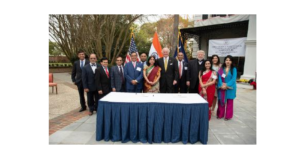
India Business Conference at Columbia University discuses ‘India: Unlocking the Growth Engine’

Hundreds of business enthusiasts, including several Indian titans and entrepreneurs attended the 14th annual India Business Conference on Saturday, April 7th, at Columbia University, a day-long conference presented by the South Asian Business Association (SABA), discussing, ‘India: Unlocking the Growth Engine.’  Prominent among those attended the event at the heart of the world were, the Consul General of India in New York, Sandeep Chakravorty, Hikmet Ersek, the President, CEO and Director of Western Union; Salman Khurshid, the former Minister of External Affairs and Subramanian Swamy, the former Minister of Law, Justice and Commerce.

The India Business Conference is the premier India-focused forum that inspires thought-leadership and generates discussions around the business, social, political, and creative undercurrents that permeate Indian life. The conference brought together the nation’s most influential and insightful voices in analyzing India’s growth trajectory, discuss its economic and socio-political  components and debate strategies for businesses to grow over the next decade.

Both Khurshid and Swamy spoke about the economic growth rate of India since the election of Prime Minister Narendra Modi in 2014. “India is a remarkable destination for investment; India is on the move; India is an emerging economy and India has a bright future lying ahead,” Khurshid said in his opening remarks, talking about how the economy of India has grown in the areas of food, health, housing and education after the election of Modi as prime minister.

“The critical problem in our country was how we can integrate the rural economy with the urban economy. How do we change the terms of trade, how do we shift the industry to agriculture,” Khurshid asked the roomful of business enthusiasts, adding “we must not forget that India still has a huge number of people who live below the poverty line, who live without hope and aspiration to become a part of this ‘New India,’ the India of Narendra Modi.”

He also touched upon the fact that people in India have a mobile phone but don’t have the capacity to pay a doctor, send their children to school or even travel five to 10 kilometers. Khurshid concluded his remarks by stating that India is in a crisis due to the many social norms that the population of the country disagrees on and so now “we have to have faith in democracy. In democracy, you have to understand that the dialogue and conversations in a democracy are very critical. You cannot have a democracy based only on numbers; a democracy has to be based on communication. The trouble in India today is that we have forgotten that communication is an integral part of democracy and we have restricted ourselves to numbers only.”

 Swamy focused his remarks on the development of India’s economy since May 26, 2014, the day Prime Minister Narendra Modi took office, but touched upon issues like demonetization and GST. “First of all I would like to say that the BJP came to power after 33 years in full majority and it is not based only on the economic performance that we promised but we also made an appeal for the unity of nationalistic forces, which our critics define as ‘Hindutva,’ so that we can fight corruption,” Swamy said.

“It is our view, mine in particular, that past history shows that pure economic performance does not guarantee the ladder to success. In a brief period of two-and-a-half years, Morarji Desai produced one of the best economic situations particularly for the people because it controlled prices to such an extent that human ration cards became unfashionable. But he lost the election. Narsimha Rao produced a miracle of sorts; he abolished the soviet economic system and brought in a market economy. But he too lost,” Swamy added.

Swamy informed all the attendees that “during the last four-and-a-half years there has been an acceleration of growth of GDP” in India and that prior to 2014, those growth rates were decelerating.

It was within the first two years after the 2014 election that the growth rates started to increase again. However, they have been decreasing since the 2016-2017 financial year and have come down to six percent a year which is not enough because India needs to have at least a 10 percent growth rate each year for the next 10 years in order to solve the problems of unemployment and inequality, he said.

Along with mentioning the fact that the rate of domestic sales has declined in the past four years because of high interest rates and the labor laws need to be changed, Swamy announced that the idea of demonetization was his when he was the chairman of strategic action under Prime Minister Modi. Swamy concluded his remarks on a hopeful note about how the youngsters of India are the future of the country and will take India to a higher level.

In a fireside chat with Ersek and Columbia University professor Stephen P. Zeldes, Ersek said that Western Union has licenses to operate in over 200 countries and with 50 million customers, they are able to transfer a total of $150 billion worldwide each year with 31 transactions taking place every second. Ersek also talked about trust and how that has been the company’s strength for all these years when transferring money to India and other countries.

“More than 50 percent of the people who receive money through Western Union are female, mainly mothers who are worried about their children’s future and thus tend to spend their money more wisely than males,” Ersek said.

Now in the growing age of digitization, many are relying on sending and receiving money on their mobile devices through the Western Union app and Ersek reassured an audience member that there is no need to worry about crypto currencies because for Western Union it depends on the environment as “it occurs in closed environments” and Western Union customers are in a more open one, especially in India.

Others who spoke at the conference included: Francisco D’Souza, the CEO of Cognizant; Anjali Bansal, the former MD of TPG Private Equity; Gaurav Dalmia, the Chairman of Dalmia Group Holdings; Sheena Iyengar, a S.T. Lee Professor of Business; Ananth Narayanan, the CEO Myntra & Jabong; Shankar Narayanan, the former MD of Carlyle Group; Ashwini Tewari, the Country Head of the U.S. Operations at State Bank of India; Meera Vasudevan, Co-founder of Tasty Bite Eatables; Arvind Panagariya, the Ex Vice Chairman of NITI Aayog; Sanjay Nath, the Co-founder & Managing Partner of Blume Ventures; Deepak Ohri, the CEO of Lebua Hotels and Resorts; Kshitij Bhati, the former Warburg Pincus; and, Musthafa PC, the CEO & Co-founder of iD Fresh Food (India) Pvt. Ltd.

Texas Governor Greg Abbott meets Narendra Modi during India visit

Texas Governor Greg Abbott met with the Prime Minister of India, Narendra Modi, in New Delhi, March 28. During the meeting, Governor Abbott thanked the Prime Minister for his hospitality and spoke on the importance of continuing to grow Texas-India relations both economically and culturally. This marks the first time the Prime Minister has met with a United States Governor, according to a press release from the governor’s office.

“Texas is continuing to grow relations with India both economically & culturally. A productive meeting today in New Delhi with Prime Minister @narendramodi,” Gov. Abbott tweeted a few hours after the meeting. According to the Governor’s office, Texas is 2nd among all U.S. states for exports to India with exports valued at nearly $3.4 billion in 2017.

“I am extremely grateful to Prime Minister Modi for welcoming me to his country and for the opportunity to discuss the meaningful relationship between Texas and India,” Abbott is quoted saying in the release. “While Texas and India have long maintained an important economic relationship, this trip has also highlighted our commonly shared values of family, faith, community and hard work. These are the bonds that we will continue to build on, and I look forward to growing this partnership even more after this successful trip,” the Governor added.

The meeting which took place at the Prime Minister’s residence, lasted more than an hour. Among the topics the two leaders discussed were Hurricane Harvey relief efforts, the Indian-American community in Texas, healthcare, defense, their respective economies, and energy. The The Governor talked about how productive his trip has been and the potential it will have in creating more jobs and investment for the people of Texas.

The Governor and Prime Minister spoke on how they can continue to strengthen the strong bond between Texas and India and reaffirmed  their commitment to continuing the successful partnership, the press release said.

The Governor also met with India’s Minister of Commerce and Industry and Civil Aviation, Suresh Prabhu the same day.  “Texas is working to establish a direct flight from Texas to India,” and the meeting was held to further that goal, the Governor’s Facebook page said. The two also discussed mutually beneficial trade.

On March 26, while in Mumbai, Gov. Abbott  closed a deal with JSW Steel to expand its operations in Baytown, Texas, that the governor’s office said, will create 500 new jobs and expand economic growth in Texas.

“The Memorandum signed by Greg Abbott and JSW USA is part of our long term strategy to enhance our U.S. footprint,” Parth Jindal of JSW Group is quoted saying in a press release. “It reiterates our commitment to stay invested and grow in the U.S. market. It also provides JSW USA an opportunity to participate in USA’s infrastructure development and job creation priorities,” Jindal added. “Access to natural gas at extremely economical prices and the abundant availability of scrap steel in Texas make conditions very conducive for manufacturing through the Electric Arc Furnace route,” Jindal said.

Earlier, on March 25, Gov. Abbott addressed the Rotary Club of Bombay, touting the Texas economy and the importance of strengthening the bond between India and Texas.

Governor Abbott also emphasized the importance of trade with India, noting that Texas is the 2nd largest exporter to India in the U.S., and the 4th largest importer of Indian goods in the U.S., a press release from his office said.

“It’s not just the exchange of goods that connects the people of India and Texas,” Abbott is quoted saying at the Rotary meeting. “The values that we share are founded on family, faith, commitment to our communities, and hard work.”

Following his address, the Governor participated in a question and answer session with members of the Rotary Club of Bombay which is one of the oldest rotaries in India founded in 1929.

Dallas News, which accompanied the Governor and his delegation to India, reported Abbott has 15 Texans in his delegation, including “some Indian American businessmen who have flown to India at their own expense to accompany him for part of his nine-day jaunt.”

The governor also visited the headquarters of the multinational Mahindra & Mahindra in south Mumbai, where he praised the company and its operations in Texas. Mahindra North America. donated  $1.5 million in cash and kind after the disastrous  Hurricane Harvey last September, according to Dallas News. “That shows us that you’re more than just a business operating in Texas. You are a genuine part of our community,” the Governor is quoted saying in the Dallas News report. He also praised Indian immigrants in Texas, describing them as “very productive, very hard-working, very committed to the ideals that … underlie both America and the American dream,” the news report  stated.

Fifth largest diamond in history sells for $40 million

The 910-carat Lesotho Legend was sold for $40 million in a tender in Antwerp, Gem Diamonds Ltd. said Tuesday. The company found the stone, which is about the size of two golf balls, at its Letseng mine in the African country this year.

While it’s the most Gem has yet received for a diamond, other companies have sold for more. Lucara Diamond Corp. got a record $63 million for an 813-carat stone last year and $53 million for the 1,109-carat diamond it found at the same time, which was the second-biggest in history.

And another 2 precious world biggest diamonds Niravmodi and Mehul choksi escaped out of India. The Letseng mine is famous for the size and quality of the diamonds it produces and has the highest average selling price in the world. Gem sold a 357-carat stone for $19.3 million in 2015 and in 2006 found the 603-carat Lesotho Promise.

So far this year, the company has found six diamonds bigger than 100 carats, putting it on track for its best year yet. Twitter Appoints ‘Distinguished Software Engineer’ Parag Agrawal as New Chief Technology Officer

Parag Agrawal appointed COO of Twitter

Twitter has appointed distinguished software engineer Parag Agrawal, an alumnus of the Indian Institute of Technology at Mumbai, as its chief technology officer, according to an update at the micro-blogging site. The Indian American computer scientist takes the position most recently held by Adam Messinger, who left in late 2016, CNBC reported March 8.

The appointment of Agrawal, who completed his doctorate in computer science from Stanford University in 2011, was announced internally in October 2017. Agrawal joined Twitter in October 2011 as an ads engineer, and he most recently held the title of distinguished software engineer.

Before joining Twitter, he did research internships at AT&T, Microsoft and Yahoo. His contributions at Twitter include leading efforts to increase the relevance of tweets in Twitter users’ timelines using artificial intelligence. AI also helps Twitter in preventing abuse on the social network.

“In his capacity as CTO, he’s focused on scaling a cohesive machine learning and AI approach across our consumer and revenue product and infrastructure teams,” a Twitter spokesman told CNBC.

Twitter also announced this week that it intends to hire a director of social science in an attempt to “increase the collective health, openness and civility of public conversation” on its platform.

HAB BANK hosts customer appreciation gala dinner in New Jersey

HAB BANK, nation’s oldest and largest South Asian American bank, hosted a dinner on Friday, February 16, for its Iselin Branch valued customers at The Marigold, Somerset, New Jersey. The event was organized by the Bank’s Iselin Branch to thank and pay tribute to the community that the Bank serve. Over 300 guests included successful entrepreneurs and professionals who attended the gala dinner. Mr. Girish Vazirani, Vice President & Branch Manager, Iselin Branch welcomed the guests and expressed HAB’s gratitude for their presence at the dinner.

In his welcome speech, HAB’s President & CEO Saleem Iqbal thanked the invited guests for taking time out from their busy schedule to be at the HAB’s Customer Appreciation Gala Dinner. The dinner coincided with HAB’s yearlong celebration of its 35 Years of service to the community. Mr. Iqbal devoted much of his speech highlighting the history of South Asian Community and presence in the United States, which dates back to 1820.

The origin was not without struggles and challenges. He pointed out that early migrants from South Asia paved the way to whole new generation of successful South Asians playing pivotal roles in a number of disciplines and industries. From software pioneers in Silicone Valley, mainstream politics, academia and to successful artists in TV and Films, South Asian community has made its mark. Mr. Iqbal highlighted some of the business leaders of South Asian origin that have become an integral part of American landscape and are contributing to our adopted home USA.

Since its charter in 1983, HAB has made great strides and is now the largest South Asian American bank in the United States. Mr. Iqbal highlighted that HAB’s success and progress is primarily because of its dedicated employees and customers at each and every branch.

Besides a large number of clients, HAB’s Imran Habib, Rizwan Qureshi, Zilay Wahidy, Girish Vazirani and several staff members and senior executives attended the event. Multiple media outlets such as ARY Digital, TV Asia, TV 9 and India Life & Times, and Desi Talk extensively covered HAB’s Gala Dinner.

HAB BANK was founded in 1983 and since its inception, it has played a key role in nurturing and strengthening the South Asian community with branch network located in New York, New Jersey and California. Through the years, the Bank has evolved in response to needs of its customers and maintains a close relationship with the community it serves.

The Bank’s core products are Commercial Real Estate Mortgages, International Trade Services, US Small Business Loans and a well-designed commercial banking products and services for small to medium sized businesses. The Bank also has a wide range of consumer products and services including personal checking, savings, CDs, and full-service online banking. The Bank is fully committed to remain engaged and pro-active in meeting the banking requirements of its customer and, above all, continues to work towards “Building Relationships”.

Modi ‘fantastic’ but duty cuts on Harley-Davidson not enough, says Trump

US President Donald Trump called Prime Minister Narendra Modi a “fantastic” and “beautiful” man but ratcheted up the rhetoric on bilateral trade, saying he wasn’t impressed by the recent cuts in tariff on Harley-Davidson motorbikes sold in India.

“Now, the prime minister, who I think is a fantastic man, called me the other day. He said, ‘We are lowering it (the tariff on Harley-Davidson) to 50%.’ I said, ‘Okay, but so far we’re getting nothing.’ So we get nothing, he gets 50 (percent), and they think we’re doing — like they’re doing us a favour,” Trump said at a meeting with state governors at the White House.“

“He (Modi) said it so beautifully. He’s a beautiful man. And he said, ‘I just want to inform you that we have reduced it to 75, but we have further reduced it to 50.’ And I said, ‘Huh.’ What do I say? Am I supposed to be thrilled?”

Trump was referring to a phone conversation he had had with Modi on February 8, in which they had discussed Maldives, Afghanistan and a whole range of bilateral issues, including trade. India earlier used to levy a 100% tariff on motorcycles larger than 800cc, but as of this month, the rates have dropped down to a flat 50%. But the duty on Indian motorbikes sold in the US is 0%.

According to reports, Harley-Davidson India has an annual sale of 3,700, but Trump’s claims that Indian motorcycles sell by the “thousands and thousands” in the United States has been called an exaggeration — the US is not among major importers of Indian bikes.

Trump has publicly litigated his case against tariff rates on Harley-Davidsons and his despite his glowing references to Modi, his tone has grown sharper, even as his administration presses India to lower tariff on other goods and remove non-tariff trade barriers.

“So they have a motorcycle or a motorbike that comes into our country — the number is zero. We get zero. They get 100%, brought down to 75; brought down, now, to 50. Okay,” Trump told his governors.

Trump and Modi share a good working relationship, according to officials on both sides, but the US leader is not known to pass up an opportunity to speak his mind. He also likes to quote Modi’s remarks about Afghanistan — the Indian leader, visiting the White House last June, told him that “never has a country given so much away for so little in return” as the United States had in Afghanistan.

Apple orders M. Night Shyamalan psychological thriller TV Series

Apple has landed a series package from M. Night Shyamalan and British TV writer Tony Basgallop, which recently hit the premium/digital marketplace. The untitled half-hour psychological thriller has received a 10-episode straight-to-series order from the tech giant.

The streaming service has given a straight-to-series order to a psychological thriller series from writer Tony Basgallop (“24: Legacy”) that Shyamalan will executive produce, reports Variety. Plot details for the series are being kept under wraps. The half-hour series has received a 10-episode order, with Shyamalan also set to direct the first episode, adds the report.

Shyamalan’s Blinding Edge Pictures will help produce the untitled Apple thriller series, with Indian American Ashwin Rajan (“Split,” “Wayward Pines”) serving as executive producer. Jason Blumenthal, Todd Black and Steve Tisch of Escape Artists will also executive produce, with Taylor Latham co-executive producing.

Shyamalan, known for blockbusters like “The Sixth Sense,” and the more recent “Split,” is currently working on the post-production of “Glass,” a sequel which brings together the narratives of the 2000 film, “Unbreakable,” and the 2016 thriller, “Split.”

Actors Bruce Willis and Samuel L. Jackson, who played the characters of David Dunn and Elijah Price, respectively, in “Unbreakable,” will reprise their parts in “Glass,” which is expected to release in 2019.

This is the latest straight-to-series order for Apple which has been quickly building up its slate of originals. Over the last couple of months, Apple has ordered a Damien Chazelle drama series, Steven Spielberg’s Amazing Stories reboot, a morning show drama starring Reese Witherspoon and Jennifer Aniston, a comedy series toplined by Kristin Wiig, a space drama from Ron Moore, and world-building drama series See from Steven Knight and Francis Lawrence. On the unscripted side, Apple has greenlighted  docuseries Home from Matt Tyrnauer and Matthew Weaver.

Nirav Modi, India’s jeweler to Hollywood stars, accused of massive bank fraud

Nirav Modi’s name is a stamp of corporate India’s growing global prestige. On Hollywood red carpets, his diamonds have sparkled on the necklines and dangled from the earlobes of actors and models like Kate Winslet, Dakota Johnson and Rosie Huntington-Whiteley.

Back in India, billboards above the traffic jams of New Delhi bear the image of Priyanka Chopra, a Bollywood star and former Miss World who is fast becoming a household name in the United States, also draped in Modi’s jewels.

Actress Priyanka Chopra, the global brand ambassador for Nirav Modi, is seeking legal opinion to terminate her contract now that the jeweler has been accused of committing a major banking fraud, her spokesperson said on Feb. 15.

Officials at the nation’s federal investigative agency announced it was looking for Modi as law enforcement officials fanned out to raid his jewelry stores and other businesses in Mumbai and New Delhi.

Central Bureau of Investigation (CBI) officials told reporters the agency had on Feb. 4 issued a lookout circular in the country for Modi, who they say had left four weeks earlier.

Modi has not yet responded to the allegations and could not be reached for comment. His flagship company, Firestar Diamond, has said it had no involvement in the case. The setback in Modi’s climb to fame and fortune was abrupt, even by the rough-and-tumble standards of one of the world’s fastest growing major economies.

Amid revelations that Nirav Modi was the prime accused in a Rs 11,515 crore fraud involving the Punjab National Bank, there was speculation that Chopra would sue the brand for non-payment of dues.

“There are speculative reports that Priyanka Chopra has sued Nirav Modi. This is not true. However, she is currently seeking legal opinion with respect to terminating her contract with the brand in light of allegations of financial fraud against Nirav Modi,” the spokesperson said in a statement. Nirav Modi’s name is a stamp of corporate India’s growing global prestige. On Hollywood red carpets, his diamonds have sparkled on the necklines and dangled from the earlobes of actors and models like Kate Winslet, Dakota Johnson and Rosie Huntington-Whiteley.

The news was a shock for the circles in which Modi moved. As recently as last month, he was at the World Economic Forum in Davos. Indian media carried a group photograph with Prime Minister Narendra Modi in the foreground and Nirav Modi, who is no relation, grinning between rows of Indian business leaders behind him.

“Top industrialists invited him home to display his collections,” said a Mumbai investment banker at a U.S.-based firm who has worked directly with Modi’s company. “There was a personal touch in everything he sold. Nirav Modi is a brand.”

Firestar Group, the parent company Modi controls as a majority shareholder, saw its revenue grow over three years from 103 billion rupees (about $1.6 billion at current rates) to some 147 billion rupees ($2.3 billion) by the 2016-17 fiscal year, according to figures previously provided by the company.

In 2010, Modi launched an eponymous jewellery business branded NIRAV MODI, in capitals, with the tagline “Haut Diamantaire”. New boutiques in Las Vegas and Hawaii have since been added to a stable that stretches from New York to London to Beijing.

He became a man whose diamond necklaces were sold, with his name attached, by Sotheby’s: “pure feminine elegance,” says a Hong Kong auction catalogue note of one 85.33 carat diamond necklace.

The auction house posted an online slideshow of jewellery-on-stars at the 2017 Oscars and highlighted supermodel Karlie Kloss having “a major Nirav Modi moment with her diamond ‘Mughal’ choker.”

Top colleges like Yale are teaching students to prioritize happiness—not money and power

It takes a lot of hard work to get into places like Yale and Stanford. But once students make it to the Ivy League, many find that while they’re ready to tackle Shakespeare and comparative political systems, they’re lost when it comes to building emotionally rich, and balanced lives.
To that end, a growing number of top universities are offering courses that aim to put students on the happiness track. A week after Yale opened registration for its debut course “Psychology and the Good Life” this January, a quarter of the undergraduate population—more than 1,180 students—had signed up, making it the most popular course ever at the university. Meanwhile, one in six undergraduates at Stanford take a course that teaches students to apply design thinking to the “wicked problem” of creating fulfilling lives and careers. And at McGill University, in Montreal, Quebec, students have flocked to “Lessons of Community and Compassion,” a course on social connectedness and belonging—precisely the things they may have sacrificed to get into one of Canada’s top institutions.
“I think students are looking for meaning,” Peter Salovey, president of Yale, told Quartz at the World Economic Forum in Davos. Salovey, an early pioneer in research on emotional intelligence, says that while students today are more sophisticated and worldly than previous generations, they seem to be much less resilient. Their sense of vulnerability is driving them to search for purpose, in academic courses and beyond.
Laurie Santos, the psychology professor teaching the Yale class, says the message behind her course—helping students figure out what it means to live happier, more satisfying lives, and teaching them scientifically-tested strategies to achieve that goal—resonates with kids who are only now realizing the toll that academic rigor has taken on their sleep, mental health, and sense of social connectedness.
“Our intuitions about what to do to be happy are wrong.” “Our intuitions about what to do to be happy are wrong,” she says. We think we want to achieve high-powered positions or make a lot of money, even if that means sacrificing the things that make us balanced and sane—human connection, exercise, rest, and activities that allow us to recharge. “This is a great moment when we have rigorous research on positive psychology—what makes us happy, but also on behavioral change,” says Santos. Her course covers practical topicsranging from the psychological benefits of charitable giving to how to pick a meaningful career. And because science shows that grade-seeking can undermine happiness, she encourages the students to take the course pass-fail.
Mental health issues among young adults are on the rise at universities around the world. “I was really surprised at the levels of anxiety and depression students face,” Santos says. A 2013 report by the Yale College Council found that more than half of undergraduates sought mental health services during their time on campus. A 2009 survey of 80,121 students, conducted by the American College Health Association-National College Health Assessment, showed that 39% of college students felt hopeless during the school year, and 25% felt so depressed they found it hard to function. Nearly half (47%) reported feeling overwhelming anxiety, and 84% said they felt generally overwhelmed by all they have to do.
Teaching students how to be happier isn’t just about helping them as individuals—it can also be about helping them be better citizens. In the course “Lessons of Community and Compassion: Overcoming Social Isolation and Building Social Connectedness through Policy and Program Development,” McGill University professor of practice Kim Samuel introduces students to some of the most socially isolated people on the planet—refugees and migrants, indigenous communities, families struggling with food insecurity; the displaced, disabled, and disconnected. One of the goals of her course, she says, is to teach students what it feels like to have a sense of safety and community in their own lives, so that they can help build connectedness in more disadvantaged populations. “All students have experienced some degree of social isolation in their lives,” she says, “and that recognition is the royal road to reciprocity.”
“We’re adding the ‘life’ component explicitly back to the college experience.” Many of her students say it’s a life-altering experience. Jeremy Monk, who took Samuel’s course and is now a graduate student at Columbia University, says, “I think a lot of us down the road, when we look back on where we started … this is going to be the place that we started, and where our ideas started to blossom, and where we really were given the chance to feel like we can make a difference and we are the leaders of change.”
Stanford’s “Designing Your Life” course, meanwhile, is taught by Bill Burnett, head of Stanford’s design program, and Dave Evans, who led the design of Apple’s first mouse and co-founded the gaming company Electronic Arts before becoming a lecturer in the design program.
Evans says everyone is trying to answer the question posed by poet Mary Oliver: “What is it you plan to do / with your one wild and precious life?” “None of us got the manual explaining how to figure out the answer,” he adds. Soon-to-be graduates are facing that question with immediacy, and under pressure. “They’ve been wonderfully trained to get into and attend schools for 22 years—but not how to live in the world and to determine what “a life” means to them,” Evans says. He notes that being good at school is not the same thing as being good at life.
The Stanford courses have been such a success that the university’s Life Design Lab, co-founded by Evans and Burnett, now helps other colleges and universities to develop their own versions of the program. Evans says similar courses are now being taught at Northwestern, University of Vermont, Dartmouth, University of Michigan and MIT. “We’re adding the ‘life’ component explicitly back to the college experience,” Evans says. “It’s attractive because the need is great, the priority is high, and there’s little offered to help.”
The pursuit of happiness is, of course, hardly a new development. “Plato was talking about this,” Santo says. Scores of people have bought best-selling books on achieving happiness, from Gretchen Rubin’s The Happiness Project to Dan Gilbert’s Stumbling on Happiness. And as the New York Times notes, courses on positive psychology are a popular draw for college students; 900 students enrolled in a Harvard lecture titled Positive Psychology in 2006.
What’s new is the growing body of scientific research on what actually makes people happy—and a sense from universities that today’s undergraduates are particularly in need of guidance.
Parents hold some responsibility for students’ lack of resilience, says Salovey. Parents’ laser-sharp, lifelong focus on getting their kids into top universities means that students are terrified of messing up. “It’s a kind of parenting that’s focused on college admissions and mitigating risks. We have to help students develop their own voice, to pick themselves up after failure.”
 “We have to help students develop their own voice, to pick themselves up after failure.” There’s another advantage to offering classes on happiness: They underscore that mental health and emotional balance aren’t things that young people can afford to keep putting off. According to Sonja Lyuboirsky, a psychology professor at the University of California, Riverside and author of the The How of Happiness: A Scientific Approach to Getting the Life You Want, 40% of our happiness is conscious, intentional, and under our control. “It takes the work you have to put in to be a great violinist, it takes work every day,” Santos says. Happiness is never a lost cause, but the science does suggests that becoming a happy person is not a quick fix. Taking a college course on the subject may be the best short cut there is.
Santos will only teach one semester of the Yale course. But a five-part seminar-style series, “The Science of Well-Being,” will be available in March, for free, on the online education site Coursera.
So far, Santos has taught five sessions of “Psychology and the Good Life.” She says the feedback has been overwhelmingly positive. “They are taking these ideas to heart in a way I did not expect,” she says. Alumni are already writing her to request a copy of the syllabus, as are kindergarten teachers and PTA heads. It’s not just young people who need help with happiness, she notes: “This is a human problem.”

More than 11,000 Americans targeted in India call center tax scheme

Three men in India were arrested Monday night after police uncovered a huge scheme that targeted more than 11,000 people in the United States. Con men posing as officials from the Internal Revenue Service left thousands of voice messages claiming to have found irregularities in tax records of the targets. The messages instructed them to call back or face legal action. But the phone number they gave connected unsuspecting people in the United States to Indian con men sitting in a second-floor office in an upscale locality called Koregaon Park in the western Indian city of Pune.
India’s in-demand call center industry has contributed to the rapid development of sleepy cities such as Pune in the past three decades, drawing hundreds of thousands of ambitious job seekers to call centers for multinational firms. But in recent years, Indian con artists are using English accents and Americanized names, often utilized in call centers, for a different reason: to cheat unsuspecting foreigners.
Indian police officers have sent thousands of emails to victims in the United States asking for details about how they were cheated. Only three people have replied, said Assistant Police Inspector Sagar Panmand from Pune’s cybercrime branch, who raided the trio’s call center.
Indian investigators said they still don’t know how many people in the United States were affected by the scheme or how much money the scammers took. They also said it is unclear how the computer-savvy con men got the victims to transfer money to India but said it probably involved the use of gift cards from Target, iTunes and Walmart.
Panmand said early investigations suggest there are at least two similar call centers in Delhi and the state of Rajasthan that police are trying to trace.
Authorities learned about the Koregaon Park call center after they discovered another ring of scammers in January, who had targeted users of Apple products in the United States. At least 1,500 people in the United States received pop-up notifications on their iPhones, iPads or Macs saying their systems had crashed. The pop-up message also gave a phone number of an Apple service center – which was the phone number for a fake call center in India. The scammers then asked their targets to pay for the service of “fixing” their systems by buying iTunes credit that could be transferred to the con men and cashed in.
During the raid Monday night, police seized hard drives and laptops with the personal details of 11,000 people in the United States. “They had bank details, bank account numbers, phone numbers, addresses, everything,” Panmand said. “American authorities will need to do their own investigations to find out how all this data got out.”
He said Pune police are in contact with the Federal Trade Commission and will support U.S. authorities in their investigations. The FTC did not immediately respond to The Washington Post’s request for comment.

Chhaya CDC launches Free Tax Prep Services for citizens of Richmond Hill, Queens, NY

Richmond Hill, New York. On Wednesday, July 7th, Chhaya CDC launched the expansion of its Free Tax Prep Services in the historically underserved area of Richmond Hill, Queens. Chhaya began to offer these services last year with the support of NYC’s Department of Consumer Affairs and helped nearly 100 families claim the powerful asset building tool of the Earned Income Tax Credit (EITC). This year Chhaya continues to offer the tax preparation services in almost seven additional languages. By working with Queens Public Library at the Lefferts Branch, Chhaya’s program will be one of two NYC Free Tax Prep tax sites serving the communities of Richmond Hill, South Richmond Hill, Ozone Park, and South Ozone Park. One out of every five households in these neighborhoods live in poverty and could benefit from access to free, professional-quality tax preparation services.
Chhaya CDC is the only South Asian and Indo-Caribbean community development organization, whose mission is advocate for and build economically stable, sustainable and thriving communities. Tax preparation is often a daunting and expensive endeavor for low to moderate income individuals, and often not seen as an opportunity.  NYC Free Tax Prep increases awareness about tax credits that put money back in the pockets of working New Yorkers. Far too many qualified individuals do not take advantage of the EITC, leaving thousands of dollars on the table that can be put to good use – whether it’s education, paying off a loan, upgrading a household appliance, moving, etc.
“Chhaya’s Free Tax Prep program will be the first of its kind in this community, “said Chhaya CDC’s Executive Director Annetta Seecharran, “Building on our other immigration and housing counseling services in this neighborhood, this is an important next step in expanding Chhaya’s programs to the Richmond Hill community, which is a desert when it comes to social services. Each tax prep client will be provided a list of wrap around services connected to Chhaya’s work in housing, financial capability, and immigration.”
“The reason why Queens Library is able to provide free, high-quality services such as free tax preparation is because of our partnerships with outstanding organizations such as Chhaya CDC and government agencies such as the Department of Consumer Affairs,” said Queens Library President and CEO Dennis M. Walcott. “They make it possible for us to meet our mission to build strong communities and give our customers the information and resources to help them grow personally and intellectually.”
“Since 2015 we have helped New Yorkers file more than 425,000 returns for free and claim refund-boosting tax credits that can be pivotal in helping them pay bills, get out of debt and save for their future,” said DCA Commissioner Lorelei Salas. “We are proud to be working with Chhaya CDC again this year to expand our trusted and professional free tax prep services to previously underserved communities. I encourage all New Yorkers to take advantage of this free program to ensure that their returns are completed accurately and that they are receiving every credit and deduction available to them, including the EITC.”
NYC Free Tax Prep is offered at Lefferts Library on Wednesdays: February 7, 21; March 7, 21; and April 4 at 11 AM. This free service is available for families or individuals who earned below $66,000 in 2017.

Indian Americans who rule the tech world in USA

In the early 20th century just a few hundred people emigrated from India to America each year and there were only about 5,000 folk of Indian heritage living in the United States. Today Indian-born Americans number 2m and they are probably the most successful minority group in the country. Compared with all other big foreign-born groups, they are younger, richer and more likely to be married and supremely well educated. On the west coast they are a mighty force in Silicon Valley; well-off Indians cluster around New York, too.

Like all immigrant groups, Indians have found niches in America’s vast economy. Half of all motels are owned by Indians, mainly Gujaratis. Punjabis dominate the franchises for 7-Eleven stores and Subway sandwiches in Los Angeles. The surge in Indians moving to America is also intimately linked to the rise of the technology industry. In the 1980s India loosened its rules on private colleges, leading to a large expansion in the pool of engineering and science graduates. Fear of the “Y2K” bug in the late 1990s served as a catalyst for them to engage with the global economy, with armies of Indian engineers working remotely from the subcontinent, or travelling to America on workers’ visas, to make sure computers did not fail at the stroke of midnight on December 31st 1999.

Today a quarter or more of the Indian-born workforce is employed in the tech industry. In Silicon Valley neighbourhoods such as Fremont and Cupertino, people of Indian origin make up a fifth of the population. Some 10-20% of all tech start-ups have Indian founders; Indians have ascended to the heights of the biggest firms, too.

Indians for decades have been playing an important role in global technology landscape. Indian IT pros have been an important cog in the machinery running technologly behemoths across the world. In fact, two of the world’s biggest technology companies — Google and Microsoft — are led by Indian-origin CEOs. Other than these two, there are many others who have made an indelible mark on the world of technology.

Satya Nadella. After a 22-year stint with Microsoft, Nadella was appointed as the chief executive officer of the company in February 2014. He previously held the position of executive vice president of Microsoft’s Cloud and Enterprise group.

India-born Sundar Pichai was named as Google CEO on August 10, 2015. The 44-year-old head of Google was born in Chennai, Tamil Nadu and pursued education at IIT Kharagpur (B Tech), Stanford (MS) and Wharton (MBA); at Wharton, he was named a Siebel Scholar and Palmer Scholar.

Rajeev Suri joined Nokia in 1995 and held various positions before being appointed as president and CEO in April 2014. Suri’s ascedancy to Nokia CEO’s position came after Microsoft acquired Nokia’s mobile phone business. Previously, he was the head of the services, Nokia Siemens Networks 2007-2009.

Born in Hyderabad, Shantanu Narayen joined Adobe in 1998 as the senior vice president of worldwide product research and became the COO in 2005 and CEO in 2007. He holds a Bachelor in Science from Osmania University, an MBA from University of California, Berkley, and an MS from Bowling Green State University.

Sanjay Jha, CEO, Global Foundries, took over as CEO of Global Foundries, a semiconductor foundry that produces chips for giants like AMD, Broadcom, Qualcomm, and STMicroelectronics, in January 2014; before that he has served as the CEO of Motorola Mobility and COO of Qualcomm. He joined Motorola as co-CEO in 2008, while serving simultaneously as CEO of Motorola’s Mobile Devices Business.

George Kurian became the CEO and president of storage and data management company NetApp in June 2015, after serving as its executive vice president of product operations for nearly two years. Prior to joining NetApp, George was vice president and general manager of the Application Networking and Switching Technology Group at Cisco Systems. His diverse background also includes the role of vice president at Akamai Technologies,

Among the youngest CEOs in the software services sector, Francisco D’Souza, CEO, Cognizant, is a member of the company’s board of directors. D’Souza joined Cognizant as a co-founder in 1994 and went on to become its CEO in the year 2007. During his tenure as CEO, Cognizant’s employee base has grown from 55,000 to over 230,000.

Dinesh Paliwal is the president and CEO of Harman International, a premium audio gear brand that owns the likes of JBL, Becker, dbx, among others. Born in Agra, Uttar Pradesh, Paliwal holds a BE from IIT Roorkee, and MS and MBA from Miami University.

Ashok Vemuri is the CEO, Conduent Inc, the Xerox’s sibling business services unit that spun off into a separate company recently. In June 2016, the 110-year-old document technology company Xerox named former iGate CEO Ashok Vemuri as the new CEO of its back-office outsourcing company. A former Infosys veteran, Vemuri became CEO of Xerox’s business process outsourcing.

Indians, especially in Silicon Valley, are growing in prominence, influence, and sheer population. The promotion of Satya Nadella, Sundar Pichai, and Nikesh Arora are just a few more recent examples. The fact is that Silicon Valley is the epicenter of the technology companies and people that run the world, and it just so happens that Indians have flocked to it with great success. And they’ve done this with much smaller numbers than most other ethnic groups in the United States have.

Indians have always been rising in America. As James Crabtree of Financial Times suggests, “More than any other group of outsiders, it was the Indians who figured out that, to make it in startup land, it helps to have a social network of your own.”

Silicon Valley’s Forgotten Minority

By Matt Schiavenza From The New Republic

In spite of exceptions like Google CEO Sundar Pichai, Asians and Asian Americans are underrepresented in executive suites at Silicon Valley companies. In recent years, the American tech industry has struggled to overcome a perception that, for all its talk of diversity, it remains inhospitable to women and minorities. Asians and Asian Americans, well-represented in junior levels throughout Silicon Valley, have mostly been missing from this conversation. But new research shows that Asians and Asian Americans remain conspicuously absent in the executive suite: Equal Employment Opportunity data taken from 2007 to 2015 found that white men and women were two times as likely as Asians to become executives and held three times the number of executive jobs.

The record for the industry’s marquee companies was even more dismal. The same data reveal that inn 2013, Asians and Asian Americans were found to comprise 27 percent of the workforce at Google, Intel, Yahoo, Hewlett Packard, and LinkedIn but hold just 13 percent of executive jobs.

This discrepancy is not limited to Silicon Valley: An Asia Society corporate survey conducted earlier this year found that more than one in four U.S. corporations had no Asian or Asian American representation at all. But in Silicon Valley, an industry that prides itself on its progressive nature, the struggle of Asians and Asian Americans to ascend the corporate ladder is one that receives comparatively little attention.
MSNBC anchor Richard Lui delivers the keynote address at the 2017 West Coast Diversity Leadership Forum (23 min., 50 sec.)

These workers are getting their foot in the door. So why aren’t they moving up the ranks? The answer appears to be a combination of two factors. Asians and Asian Americans, like other minority groups, are subject to racial discrimination in an industry where white Americans — particularly white men — retain an entrenched advantage. But Asians are also victimized by their perceived success, a factor that has made their pursuit of equality and justice appear less urgent than that of other groups.

Conversations with Asians and Asian Americans who work in Silicon Valley, all of whom spoke with Asia Blogunder an alias, reveal a frustration with this paradox. “Asians tend to be left out of diversity conversations,” Jennifer, a Taiwanese-American veteran of several startups, said. “Companies will ask themselves if they have enough women, black, or Latino workers and they forget that Asians should be represented.”

“We’re in this weird position of being privileged,” Neil, a Chinese-American engineer, added. “So, obviously, we should be allies and supportive of other groups. But often I find that we’re stuck in between.”

In 1966, the sociologist William Petersen first coined the term “model minority” to describe Asian Americans, a group whose population was rapidly growing following immigration reforms enacted the previous year. The theory was tantalizingly simple: Because of characteristics like diligence, obedience, and deference to authority, Asians and their children in the United States were able to earn more money and obtain college degrees at rates higher even than that of whites. Soon, the term “model minority” became a tool for criticizing African American and Latino groups whose relative poverty and lack of success could be blamed on an absence of stereotypically “Asian” values.

More than 50 years after its origin, the concept of the model minority is still being used as a wedge in discussions of race. In a widely-discussed piece published this April in New York, Andrew Sullivan wrote thatAsian Americans are among the “most prosperous, well-educated, and successful ethnic groups” in the United States because they maintained “solid two-parent family structures, had social networks that looked after each other, and placed enormous emphasis on education and hard work.” Their success, he said, posed a problem for the “social justice brigade” who could not explain why Asian Americans were seemingly undiminished by racism.

But the “model minority” theory does not account for the enormous differences among the nations, ethnicities, and religious groups classified as “Asian,” a description so broad that it is virtually meaningless. A disaggregation of education data among Asians in the United States found a huge discrepancy between Taiwanese-Americans, of whom 75 percent have a bachelor’s degree or higher, and Laotians, for whom the figure is merely 11 percent. And that Asians have acquired a reputation for skill in math and science derives less from innate characteristics than from the fact that the first group of Asians to move to the United States after immigration reform in 1965 were overwhelmingly scientists, engineers, and doctors.

Even still, the perception of the “model minority” has had a pernicious effect on Asians working in Silicon Valley by inculcating a belief that they lack leadership qualities. Denise Peck, a co-author of a new report on diversity from Ascend, a research organization that has published reports about racial discrimination in Silicon Valley, argues that the stereotypical qualities behind Asian success have hindered Asian Americans in seeking leadership roles. Diligence and deference to authority are useful skills for getting hired. But “as you move up the ladder,” she said, “soft skills like communication, networking, and influencing become more important.”

Cultivating these soft skills is an important aspect of any job, but Asian Americans remain burdened by a widespread perception that they’re unfit for executive positions. “If you mention, say, ‘Asian male’ as one sort of group, there are immediate assumptions of the personality and characteristics of that person before you’ve really gotten to know them,” said John, a Chinese-American engineer. “You always feel like you’re working from that stereotype.”

Jennifer added that “there are a lot of leadership positions, whether for executives, management, or lead technical roles, that are based on someone within the organization thinking, ‘Oh, we need someone to run this team, who do I think would be a good candidate?'” she said. “And then they mentally conjure up an image of someone who tends to be white, male, and confident.”

In an age in which Americans have reckoned with racial and gender equality to a degree unseen in decades, Silicon Valley has positioned itself as a meritocratic oasis, a place where the world’s most talented coders and designers and engineers propel the American technology industry forward. Many of these men and women are Asians and Asian American who, in spite of exceptions like Google’s Sundar Pichai, have found their upward trajectory dimmed by stereotypes so insidious that they occasionally fail to register in conversations about diversity and equality.

“There’s a sort of ‘oppression Olympics’ going on,” said Jennifer. “Black and Latino populations are much worse off than Asians, so there’s a desire to focus on them. It’s harder for people to be sympathetic to Asians.”

World needs more computing power:’ Satya Nadella

The world is rapidly “running out of computing capacity”, the head of tech giant Microsoft has warned. Satya Nadella said at the World Economic Forum in Davos that superfast quantum computers were needed to solve some of the most difficult problems.

Nadella cited the quest to create a catalyst that can absorb carbon, in order to help tackle climate change. This, he cautioned, would likely not be achieved without an increase in computer processing power.

“Moore’s Law is kinda running out of steam,” Mr Nadella told assembled delegates, referring to the maxim that the power of computer chips doubles every two years. The Microsoft chief executive also took aim at so-called “re-skilling programs”, calling them “one of the greatest wastes of money”.

Such schemes, which are designed to retrain those whose professions have been lost to globalisation or automation, are often “done without a true understanding of where the labour market is going,” Nadella argued.

Instead, the India-born chief executive, who took over at the helm of Microsoft in 2014, said that reforming school curriculums was of paramount importance. “We can with some certainty say that we will need more people graduating from our schools who will need to be comfortable with these augmented realities,” he predicted.

“The fact that most curricula in schools still don’t recognise computer science like they do maths or physics is just crazy.” Nadella added: “We need middle school teachers of computer science of the highest quality.”

He also emphasized that artificial intelligence, on which Microsoft is increasingly focused, could be a part of the solution to joblessness, rather than merely its cause. Earlier, Klaus Schwab, the man behind the World Economic Forum, called for leading tech executives to consider the disruption that their products may cause to economic, political and social life.

“If we act now,” Schwab said, “we have the opportunity to ensure that technologies – such as artificial intelligence – sustainably and meaningfully improve the lives and prospects of as many people as possible.”

Foreign citizens make up 71% of Silicon Valley tech workforce

While the Trump administration and the right wing Republicans continue to mount their attack against foreign workers in this country, a new report has found that Silicon Valley would be lost without foreign-born technology workers.

About 71 percent of tech employees in the Valley are foreign born, compared to around 50 percent in the San Francisco-Oakland-Hayward region, according to a new report based on 2016 census data.

Many foreign tech workers are employed under the controversial H-1B visa — intended for specialty occupations — which has become a flashpoint in the U.S. cage fight over immigration, with opponents claiming it lets foreigners steal American jobs. Several companies and UC San Francisco have been accused of abusing the visa program by using it as a tool to outsource Americans’ jobs to workers from far-away lands.

Although 2016 data released by the federal government last year showed that outsourcing companies — mostly from India — raked in the bulk of H-1B visas, Google took more than 2,500 and Apple took nearly 2,000 to hire foreign workers, about 60 percent of them holding master’s degrees.

“The H1-B process is not just complicated — it’s also quite expensive to sponsor an H1-B visa worker, a cost larger companies may be more willing to absorb,” the report pointed out. Legal blog UpCounsel puts the cost of the H-1B process at $10,000 to $11,000 per employee.

The report did not include a breakdown for Silicon Valley of how many foreign-born tech workers are U.S. citizens, versus visa holders. But the paper’s research indicated that 63 percent of Seattle’s foreign-born tech workers were not American citizens. Applications for foreign visas for work at other large American technology companies, according to a recent analysis of Department of Labor records covering eight major tech businesses between October 2015 and October 2016.

Applications submitted by contractors accounted for half of the H-1B visa applications for jobs at PayPal Holdings Inc.’s headquarters, 43 percent of those on Microsoft Corp.’s campus, 29 percent at EBay Inc.’s headquarters, and about a quarter of those at the Googleplex. At Facebook Inc., contracting companies submitted 12 percent of the applications for jobs at its headquarters. According to the analysis, Apple Inc. barely relies on contractors who employ workers through H-1B program to staff its headquarters, and Amazon.com Inc. doesn’t appear to use them at all. The contractors included Infosys and Wipro.

The H-1B visas are not only used in Silicon Valley. They are used across the nation. Several other large and small companies continue to use this program that allows 65,000 highly-skilled workers to be hired each year to fill the position that are not normally able to be filled by American workers.

Indian Govt. eases norms to allow foreign investment up to 49% in Air India

The civil aviation ministry of the Indian Government has said it would invite expressions of interest in buying Air India Ltd after the budget. The government has relaxed FDI norms in various sectors such as single brand retail and allowed foreign airlines to invest up to 49% in Air India through approval route ahead of its proposed privatization.

In a Cabinet meeting chaired by Prime Minister Narendra Modi, the government, however, clarified that substantial ownership and effective control of Air India shall continue to be vested in Indian nationals. “Foreign investments in Air India including that of foreign airlines shall not exceed 49% either directly or indirectly,” the government said in a statement. Existing rules allow foreign airlines to own as much as 49% in an Indian airline, with the exception of Air India.

According to media reports, the Cabinet also approved 100% foreign direct investment (FDI) in single-brand retail through automatic route. It also tweaked the local sourcing norm by allowing such entities to meet the mandatory 30% local sourcing norm incrementally within a period of five years of opening their first store in India.

The civil aviation ministry reported last wek that it would invite expressions of interest in buying Air India Ltd after the budget — indicating the government’s resolve to push the process even as a large section of the political class and stakeholders are opposed to it.

A parliamentary panel has asked the government not sell to Air India and recommended that the airline’s accumulated debt be written off and that it “function like a public sector undertaking with less government control.”

The transport panel of Parliament cited a report by the government auditor, the comptroller and auditor general (C&AG) that noted that Air India has been able to cut 10% of its variable cost between 2012 and 2016. It also argued that the airline pays Rs 4,000 crore as interest on an accumulated loss of Rs 40,000 crore.

The House panel, which asked the government to give five more years to the ailing airline for a turnaround, argued that it earns 60% of its revenue in foreign currency and that this money could end up going to foreign airlines of Air India is privatised. It also expressed concern about the possible job loss for 3.34 lakh people including 50,000 directly.

The panel also pointed out that three of the airline’s five subsidiaries (AI Express, the ground handling wing and the engineering branch) are making profits, and questioned the rationale for their divestment.

Immigration agents raid 98 7-Eleven Stores, arrest 21

U.S. immigration agents, known as ICE agents went at 6 a.m. to 98 franchises of 7-Eleven around the country and arrested 21 people who were allegedly without immigration authorization. A significant proportion of franchises of this and other well known brands are owned by people of Indian origin. Several of those detained were of Indian descent, according to Srujal Parikh, president of the Federation of Indian Associations (FIA) for the tri-state area of New York, New Jersey and Connecticut.

ICE Homeland Security Investigations special agents served notices of inspection, also known as I-9 audit notices, to 7-Eleven stores in California, Colorado, Delaware, Florida, Illinois, Indiana, Maryland, Michigan, Missouri, Nevada, New Jersey, New York, North Carolina, Oregon, Pennsylvania, Texas, Washington, and Washington, DC. Indian Americans own many of the franchises across the country. Approximately two-thirds of America’s convenience stores are owned by Indian Americans and other South Asians, according to data from the American Petroleum and Convenient Store Association. APCA declined to comment on the Jan. 10 raids.

“Today’s actions send a strong message to U.S. businesses that hire and employ an illegal workforce,” ICE’s Acting Director Thomas D. Homan said in a statement. “ICE will enforce the law, and if you are found to be breaking the law, you will be held accountable.”

Homan did not say why ICE went after the Irving, Texas-based convenience store chain, which has 60,000 franchises worldwide and is famous for its Slurpee drinks. ICE hit stores in 17 states and Washington, D.C., and gave managers and franchise owners three days to provide the agency with the immigration status of their workers.

“Businesses that hire illegal workers are a pull factor for illegal immigration, and we are working hard to remove this magnet,” Homan said. “ICE will continue its efforts to protect jobs for American workers by eliminating unfair competitive advantages for companies that exploit illegal immigration.”

The National Asian Pacific American Women’s Forum and South Asian Americans Leading Together, released a joint statement condemning the ICE raids, adding, “It’s clear from the numbers that any large scale immigration raids, detentions and deportations deeply impact the South Asian community in the U.S. With 450,000 undocumented Indians …”

The 17 states where the 7-Elevens that were raided, are located included California, Colorado, Delaware, Florida, Illinois, Indiana, Maryland, Michigan, Missouri, Nevada, New Jersey, New York, North Carolina, Oregon, Pennsylvania, Texas and Washington. According to ICE this was the largest such operation targeting a specific employer since President Trump took office, The Washington Post reported, adding that ICE agents went into the stores “to deliver audit notifications and conduct interviews.”

In its own statement, 7-Eleven said it was aware of the ICE raids and stressed that each franchise is run by “independent business owners” who are “solely responsible for their employees, including deciding who to hire and verifying their eligibility to work in the United States.”

“7-Eleven takes compliance with immigration laws seriously and has terminated the franchise agreements of franchisees convicted of violating these laws,” the statement read.

Accountancy firm Price Waterhouse banned from India

The New Jersey-based auditing giant, Price Waterhouse, which was auditor for Satyam computers, has been banned from serving Indian clients. The ban by Indian market regulator the Securities and Exchange Board (Sebi) will come into effect on March 31st. Price Waterhouse has said that it will appeal the decision in court.

Satyam was being audited by the US- company for several years, when company owner Ramalinga Raju admitted to inflating earnings.

Price Waterhouse’s Indian arm, PW Bangalore, was Satyam’s auditor during this period. The collapse of Satyam Computers in 2009 cost shareholders more than $2bn and rocked India’s IT industry. Analysts said it was the biggest fraud at a listed company in India.

The group’s audit functions are under the brand Price Waterhouse in India. The broader PwC entity handles consulting, tax advisory and other businesses. Auditing services constitute around 40% of its overall business in India.

It added that “there has been no intentional wrongdoing by [PwC] firms in the unprecedented management perpetrated fraud at Satyam”. In January 2009, Raju stunned the corporate world by admitting to accounting malpractices to inflate earnings and assets for years.

Analysts say the Sebi order is a big setback for the firm which never quite recovered from the fallout of the case. It could very well lead some of the firm’s 70-plus listed clients, which include corporate giants like Tata Steel, to shift their business.

That would mean not only a loss of revenues but it would also impact the jobs of some 2,500 workers. Price Waterhouse lost its leadership position in the Indian market soon after Raju’s confession and it has struggled to compete with other global companies like Deloitte.

KKR-backed EMERALD MEDIA acquires stakes in COSMOS-MAYA

Emerald Media, the Pan-Asia company backed by leading global investment firm KKR, today announced that it has acquired a controlling stake in Cosmos-Maya through a combination of primary and secondary stake acquisition. Based in India, Cosmos-Maya is the market leader in IP-led Indian kid’s animation content. The capital from this investment will help the company with strategic growth initiatives and creating global IPs to further increase its footprint across the world.

Promoted by internationally acclaimed Indian filmmakers Ketan Mehta & Deepa Sahi, Cosmos-Maya pioneered the art and technology of animation and visual effects in India.  Over the last 5 years, the company has produced a record 1000+ half-hour segments of animated content. Today, it has multiple ongoing productions with major television and digital platforms, including Viacom18, Disney Networks, Turner International, Sony Pictures Network, Discovery Networks, Netflix, Amazon Prime Video and ALT Balaji.

The creators of the Motu Patlu animation series, a popular Indian kids’ show, Cosmos-Maya has an impressive lineup of 9 TV shows on air including Shiva, Eena Meena Deeka, Kisna, ViR – The Robot Boy, Guru Aur Bhole, Chacha Bhatija, Tik Tak Tail and Selfie with Bajrangi. The company is also working on 3 international co-productions — Captain Cactus, Atchoo! and Help me Ganesha — in different stages of production and development. Cosmos-Maya targets audiences globally through its own YouTube channel, WowKidz, which has already become one of the fastest-growing channels for kids’ content with over 2 million active subscribers and over 2 billion cumulative views since its launch in 2016.

Ketan Mehta, Founder and Managing Director, Cosmos-Maya said, “The vision for Cosmos-Maya has always been to become a cutting-edge media technology company creating quality Indian content for the global market. The company will benefit greatly with a partner like Emerald Media which has a strong understanding of the entertainment, broadcast and OTT space. Through the capital infused, the company intends to develop international projects while leveraging the media relationships of Emerald to expand its global footprint.”

Rajesh Kamat, Managing Director of Emerald Media, said, “Cosmos-Maya has created and owns the content for some of the most popular kids’ shows and hence has its finger on the pulse of a very captive and influential audience. With the company now focused on the development of content, that crosses geographies, it is poised for growth on a global stage — not to mention the added opportunity of brand expansion and merchandising for its properties. This investment is a great addition to Emerald Media’s growing portfolio as it aligns with our vision of creating an ecosystem that caters to audiences of all age groups.”

Paul Aiello, Managing Director of Emerald Media, added, “Cosmos-Maya has made great strides in the animation space in the past few years. Their original shows have been huge successes and have paved the way for original Indian content to compete on a global platform. This investment will help Cosmos-Maya achieve its exciting growth potential.”

Anish Mehta, the CEO of Cosmos-Maya said, “With its successful and sizeable IP bank, strong business associations, a passionate team and the constant quest for quality — combined with the capital, domain knowledge and management bandwidth that Emerald Media brings on board — Cosmos-Maya is now poised for a global 360-degree approach to grow and monetize its brands through content, media, marketing, distribution, licensing and retail to markets, for kids across the world.”

Emerald Media is a Pan-Asian company backed by KKR to invest in the fast-growing media, entertainment, consumer tech and B2B industries across Asia for which KKR has committed up to $300mm from its KKR Asian Fund II. Emerald Media is led by industry veterans Rajesh Kamat and Paul Aiello, supported by an experienced team of investment and operating executives. Paul and Rajesh together have a combined experience of more than 40 years in the industry and bring a unique blend of operational and investment acumen to their business approach. Since inception, Emerald Media has made key investments in YuppTV, one of the world’s leading OTT video platforms for South Asian content, Amagi Media Labs, India’s leading targeted-TV advertisement solutions firm, aCommerce, Southeast Asia’s leading ecommerce enabler and e-distributor and Cosmos-Maya, one of the most successful animation content producers in Asia.

Emerald Media primarily focuses on providing growth capital to media, entertainment, consumer tech and B2B companies. The company looks to support growing public and private companies, by providing growth capital and strategic value add. For more information, please visit www.emeraldmedia.asia

Cosmos-Maya is Asia’s leading animation production studio that produces high-quality 3D as well as 2D animation content. Headquartered in Singapore, the company’s studio facility in Mumbai has 750 artists. The market leader in original Indian animation content production the company has worked on several IPR and commissioned projects for Television and Digital platforms including Viacom18, Disney Networks, Turner International, Sony Pictures Network, Discovery Networks, YouTube, Netflix, ALT Balaji & Amazon Prime Video.

The studio produces around 600 minutes (30 half hours) of animation on a monthly basis. Cosmos-Maya has produced over 20000 minutes of original animated content created in the last 5 years, (comprising of over 1000 half hour episodes) ready/currently on air. Launched in 2016, Cosmos-Maya’s YouTube channel WowKidz is one of the fastest growing kids’ platforms with an active subscriber base of over 2 Million and total view count of more than 2 Billion.

TCS faces discriminatory lawsuit as CA Judge dismisses appeal

India’s Tata Consultancy Services Ltd. will have to defend itself at a U.S. trial over claims that it’s biased against American workers. A federal judge in Oakland, California, has rejected a request from the information technology outsourcing giant to dismiss a 2015 lawsuit accusing it of violating anti-discrimination laws by favoring South Asians.

In a further setback for the company, the judge also expanded the case into a class action on behalf of American workers who lost their jobs at TCS offices in the U.S. because they hadn’t been assigned to any of its clients.

“TCS will vigorously defend its position and expects positive outcome. There are no discriminatory practices in any part of the company and TCSBSE 0.30 % is confident that it will be able to defend its position at the Trial,” TCS said in a statement.

TCS was sued back in 2015 by a white, American IT worker named Brian Buchanan, who accused them of overwhelming favoritism toward Indian American workers, adding that he experienced “substantial anti-American sentiment” in his 20 months at TCS, and was ultimately terminated.

TCS has argued that Buchanan’s experience does not prove he was a victim of bias as “he has ‘no idea’ whether the application process was discriminatory because he did not attend any of the town hall meetings he was invited to during the Edison transition to learn about open positions with TCS and how to apply for them—and he did not apply for a specific job, the company said in a court filing.”

Another IT firm, Infosys also faced a similar lawsuit in Milwaukee four years ago and both the IT firms have come under pressure from President Donald Trump’s desire to hire more American locals and he is also wanting to decrease the amount of H-1B visa applications in a year.

American Dance Company to Perform in Five Indian Cities

New York, NY: Sandeep Chakravorty, Consul General of India in New York, will host a reception at the Consulate on Sunday, January 7th 2018, providing an elegant send-off for Battery Dance on the day before the lower Manhattan-based company begins a national tour of India, with performances and workshops in Mumbai, Pune, Bangalore, Kolkata and New Delhi. The event will be an opportunity to obtain a sneak preview of the India tour.

Battery Dance, founded and directed by Jonathan Hollander in 1976, has been a cultural bridge-builder between the U.S. and India for the past quarter-century. Cross-cultural collaborations have included SONGS OF TAGORE that traversed 17 cities in the Indian subcontinent in 1997 during the 50th Anniversary of Indian Independence; and LAYAPRIYA, which toured six major metro cities in 2001. Hollander and Battery Dance have presented many of the foremost dancers and musicians of India in New York and on national US tours and annually at its Battery Dance Festival in conjunction with the Indo-American Arts Council, an institution that Hollander co-founded and on whose Board he serves.

The current India tour features SHAKTI: A Return to the Source, previously named The Durga Project, which was premiered as the centerpiece of the Company’s 40thAnniversary Season in New York in 2016 and which subsequently toured the U.S. and Sri Lanka. SHAKTI is a collaboration between Indian classical dancer Unnath Hassan Rathnaraju and the 5 principal dancers of Battery Dance – Robin Cantrell, Mira Cook, Bethany Mitchell, Sean Scantlebury and Clement Mensah. The work was inspired by the rendition of Raag Durga as recorded by the Hindustani master vocalists Rajan & Sajan Mishra who have given special permission to use their recording and who will attend the final performance of the tour in New Delhi.

The Consulate General of India, New York will be a co-sponsor in the company’s 37th Annual Dance Festival which is scheduled for August 2018 to be held in New York City where they will continue their tradition of presenting Indian dance with a special performance on India’s Independence Day, August 15th, 2018.

TiE-Boston Bestows Lifetime Achievement Award to Venkat Srinivasan, Honors 13 Other Entrepreneurs

TiE-Boston, which celebrated its 20th anniversary at a black-tie gala attended by its founding charter members, past presidents and over 300 guests, bestowed its highest honor, the Lifetime Achievement Award, to entrepreneur and philanthropist Venkat Srinivasan, who has founded eight companies and is credited with creating 1,800 jobs and over $2 billion in value for shareholders.

TiE-Boston, which was founded in 1997 as TiE-Atlantic and is TiE Global’s second oldest and second largest chapter, also honored 13 other entrepreneurs in various categories. Eight entrepreneurs were awarded with the Entrepreneurial Achievement Award: Anil Agarwal, Veera Anantha, Nilanjana Bhowmik, Neil Chedda, Bhaskar Panigrahi, Ramji Raghavan, Jagat Sisodia and Satish Tadikonda.

The other awards were bestowed in the following categories: Distinguished Service to Philanthropy: Sekhar Naik; Health Innovator of the Year: Derek Haas; Rising Entrepreneur of the Year: Allis Tweed-Kent; Charter Member of the Year: Rishi Bhalerao; and Volunteer of the Year: Arjun Venkatachalam.

The gala also held a “Fireside Chat” between Harvard Business School Dean Nitin Nohria and Lifetime Achievement Award recipient Venkat Srinivasan. The TiE-Boston Board awards the Lifetime Achievement Award when an individual has made a lasting impact in the business community, and a significant contribution to the success of TiE-Boston.

“Venkat embodies the true spirit of TiE by building good companies, empowering employees and entrepreneurs, and giving back to solve big problems and help society at large,” said TiE-Boston President Praveen Tailam. “He has been associated with TiE for a long time and has always inspired budding entrepreneurs by investing his time and capital, and is well-respected by fellow charter members for his philanthropic work.”

Santhana Krishnan, a fellow TiE-Boston Charter Member and Managing Partner of Om Ventures, introduced Dr. Srinivasan at the gala, saying that he admired him greatly for many things, including his passion to build companies with big disruptive ideas, commitment to giving back through mentoring entrepreneurs and philanthropy.

“Venkat has charted his own unique course all his life. He broke from traditional entrepreneurial paths and has had a very interesting and remarkable professional journey,” said Mr. Krishnan. “He came to the United States from India 35 years ago, to pursue his American dream.”

Mark Nunnelly, former Managing Director of Bain Capital and a close friend paid rich tribute to Srinivasan highlighting his many qualities as a remarkable entrepreneur who at the end has a deep desire to leave the world a better place than he found it. Ravi Ramamurti, a Northeastern University Professor and former colleague, observed how Venkat’s ability to work without functional boundaries was a key factor in his success.

Mr. Krishnan noted that Dr. Srinivasan received 3 professional degrees, spent 7 years in academics, becoming a tenured professor before he left Northeastern University. He wrote over 35 research papers, published three books, received seven patents, founded and sold four companies, and currently serves on the boards of six companies and three non-profit organizations. In addition, Venkat’s ventures have employed over 1800 people, and in the process, he has created a total value of over $2 billion for shareholders. Dr. Srinivasan has also recently founded EnglishHelper, KnowYourMeds and AIinGov, all of which are double bottom-line enterprises focused on education, health and the public sector respectively. He is a uniquely experienced individual with expertise in multiple functional areas. He is an expert in knowledge-based systems architectures, artificial intelligence, computational linguistics, natural language processing, corporate finance and accounting.

Venkat and his wife, Pratima, are active in the community. He is a Vice-Chair of the American India Foundation (AIF), which is dedicated to catalyzing social and economic change in India. Srinivasan is also a Trustee of BUILD, a non-profit organization focusing on entrepreneurship to excite and propel disengaged, low-income students through high school to college success in the U.S. He is a member of the Boston Harbor Now’s Advisory Board.

“I am honored and humbled that TiE-Boston selected me for this award,” said Dr. Srinivasan. “I salute TiE and the many Charter members for fostering entrepreneurship so passionately. Entrepreneurship is a key solution to society’s many challenges.”

Since 1997, TiE-Boston has been supporting entrepreneurs by offering education, mentorship, networking, and funding opportunities. What makes TiE unique is that the organization connects entrepreneurs with each other and other stakeholders in the ecosystem, including seasoned serial entrepreneurs, angel investors, venture capitalists, service providers, and early customers. TiE-Boston is a chapter of TiE-Global, the largest global not-for-profit organization fostering entrepreneurship. TiE-Boston members leverage the global network of members from 61 chapters in 18 countries. TiE has 12,000 members throughout the world, and has contributed over $250B in wealth creation. For more information, and to become a member of TiE-Boston, visit boston.tie.org.

Association of South Asian Real-estate Professional gala to discusses proposed tax reforms from Trump administration

Chicago IL: Association of South Asian Real Estate Professionals (ASARP) held its second annual gathering at this festive time of the year, on December 15th at The Meadows Club, 2950 Golf Rd, Rolling Meadows, IL from 5.30 to 9.30 p.m.

ASARP is a registered non-for profit reputable association to provide the leadership to South Asian community required in order to achieve the cherished objectives of property ownership in United States and India. Main purpose of the program was to provide a forum for interaction among South Asian Real Estate Professionals and the communities that they represent, with some degree of entertainment and education.

The event was attended by capacity crowd consisting of active members, MS. Neeta Bhushan (Consul General of India in Chicago), Erica Harold (running for State Attorney General in Illinois), Tim Schneider (Chairman of State’s Republican Party). Dr Sapan Shah (Nominated on republican ticker for US Congress for 10th District),

Mr. Nimesh Jani-Nimesh Jani (member of Schaumburg Township Board), Pam Krieter (Pam Krieter CEOs of the Real Estate profession), Nancy Suvarnamani (Past President of Chicago Association of Realtors and FIABCI International, founder member of AREAA), Thomas Krettler (Director of National Association), Donna Wilson (Director of Global and Commercial Business) and Brian Bernardino (Political coordinator for Chicago Association of Realtors and member of Federal Taxation Committee of NAR).

The principal purpose of gathering was to discuss new proposed tax reforms and its ramifications by reputed Legal and industrial professionals for their guideline, input, panel discussion, QA sessions and provide networking.

After lamp lighting ceremony, Mr. Pradeep B. Shukla gave starting speech “As we all acknowledge the US tax systems were revised in 1986. After sporadic modifying legislations and lapsed time, it needed massive overhaul and re-organization. Some of these regulations are regressive US corporate taxes which are one of the highest in the world, tempting US corporate giants to park the funds outside the country amounting to be in trillions of dollars along with revision of high Death tax of 45% at federal level with additional incidence of about 15 to 18% at the state level”.

“With this revision in mind, Trump administration introduced “Tax Cuts and Jobs Act of 2017”. Principal goals are simplicity and tax reduction while keeping mind the principle of neutrality. The bill passed in both houses with minor variations. Now in a proposed reconciled bill, there are some significant provisions that will affect real estate industry like capping property tax deduction to $10,000, restricting mortgage interest deduction to new loans of $500,000 as against current limit of $1 million, reducing marginal tax rates at all the levels of income, 100% write off of some business assets and significant reduction of corporate tax, etc. While there is overall tax deduction, what concerns our community as realtors, is dilution of Home Ownership Deductions. The stand taken by the National Association of Realtors is that homeowners must be treated fairly, must reverse decline in first-time home buyers as the home ownership level is 50 years low in 2016”.

Thereafter, Mr Shukla invited expert Panelists on stage to discuss their views in all these matter. The Panel Moderator was Al Haroon Hussain, Attorney. The other distinguished Panelists included Paul Chawala, Attorney, Director Brian Bernandoni, Realtor and member of Federal Taxation Committee at NAR and Tom Krettler- Realtor and also Director at NAR.

These panelists addressed the tax reforms congenial to the interest of the real estate community and how would these reforms affect the growth of GDP in USA in coming years.

QA session followed. Subsequently in his concluding remark Mr. Pradeep B. Shukla advised that Taxpayers should consider paying their 2017 state and local income taxes in 2017. This will allow the deductions to be preserved and applied against 2017 income. Since the application of the Alternative Minimum Tax might mitigate these benefits, please discuss your specific situation and any other questions you might have with your accountant.

President of ASARP Mr. Pradeep B. Shukla, in  highlight of his remarks, pointed out that some of the important tasks undertaken at ASARP are educating our South Asian local real estate professionals on how to serve best interests in our community, all while keeping in mind the highest degree of professional standards. He also requested members providing effective outreach to these communities including guidance on EB 5 and other programs available to foreign investors. In addition he also requested to provide effective liaison to our communities and professionals He urged educating American real estate professionals dealing with specific needs of our community, and finally acting as an effective political arm for ASARP members.

Almost half of Fortune 500 companies were founded by American immigrants or their children

By Ian Hathaway, Nonresident Senior Fellow – Metropolitan Policy Program

As two critical immigration policy issues face Congress—the fate of 800,000 immigrants brought to the United States illegally as children (“DREAMers”), and the re-introduction of the bipartisan Startup Act, which among other things, provides 75,000 visas to entrepreneurs that come to this country to start high-potential companies—new evidence demonstrates yet again just how critical foreign-born entrepreneurs are to lasting economic prosperity in the United States.

The Center for American Entrepreneurship, a non-partisan policy and advocacy organization, published a study today on the founders of America’s most valuable companies—those in the Fortune 500. The results are striking—43 percent of companies in the 2017 Fortune 500 were founded or co-founded by an immigrant or the child of an immigrant, and among the Top 35, that share is 57 percent.

These 216 companies produced $5.3 trillion in global revenue and employed 12.1 million workers worldwide last year, spanning a wide range of industrial activities—though half are in the high-technology, wholesale and retail trade, and financial and insurance sectors.

These iconic immigrant-founded American companies come from a broad range of geographies, too. Sixty-eight metropolitan areas and five non-metropolitan areas spread across 33 states are headquarters to Fortune 500 firms founded by an immigrant or the child of an immigrant.

The New York, Chicago, San Jose, Houston, and Dallas metropolitan areas are headquarters to the most, with at least eight such companies in each. On a population adjusted-basis, metro areas with the highest density include the Northern Chicago suburbs (Lake County-Kenosha County), San Jose, Cambridge, Bridgeport-Stamford, and Richmond.

Among states, New York, California, Illinois, Texas, and Virginia have the most, as each are home to at least 13 immigrant or child-of-immigrant founded Fortune 500 firms. Delaware, Connecticut, New York, Virginia, and Illinois have the most on a population-adjusted basis.

Digging deeper into the numbers, 18.4 percent of Fortune 500 companies were founded by immigrants, and another 24.8 percent were founded by the children of immigrants—figures that are consistent with broader research literature. Though accounting for less than 14 percent of the population, immigrants found almost a quarter of all new businesses, nearly one-third of venture-backed companies, and half of Silicon Valley high-tech startups.

“America was indebted to immigration for her settlement and prosperity. That part of America which had encouraged them most had advanced most rapidly in population, agriculture and the arts.” –James Madison, Constitutional Convention (1787)

And, research has shown that the economic benefits of immigrants are lasting. U.S. cities and regions that welcomed more immigrants in the past have been linked with higher incomes, less poverty and unemployment, and greater educational attainment today. Immigrants also make outsized contributions to science and technology, whether measured as patent productivity or breakthrough discoveries—in recent years, U.S.-based researchers have been awarded with 65 percent of Nobel Prizes, though more than half of this group was born abroad.

43 percent of companies in the 2017 Fortune 500 were founded or co-founded by an immigrant or the child of an immigrant, and among the Top 35, that share is 57 percent.

But, the issue is much bigger than targeting only well-educated immigrants or those backed by venture capitalists. Many foreign-born founders of iconic American companies—those in the Fortune 500—wouldn’t have met such thresholds. They were poor, young, and fleeing harsh economic and political conditions. A recent Harvard Business School study found that among foreign-born entrepreneurs, those who come here as children have among the best business outcomes (growth and survival rates).

The evidence on immigrants, entrepreneurship, and economic growth is clear. Now it is up to Congress to take action—first by joining the rest of the advanced economies in creating a visa for high-potential entrepreneurs, and second by ensuring the safety and legality of DREAMers to stay and thrive in the only country they call home. During a period of slow growth, declining startup rates, and anemic productivity gains, the United States cannot afford not to.

India-based startup 1st in world to finish all 20 Facebook QA bAbi tasks with 100% accuracy

Bangalore based startup first in the world to finish all 20 Facebook QA bAbi tasks with 100% accuracy DataVal Analytics Inc, a Bangalore and Chicago-based Artificial Intelligence – (AI) startup is the first in the world to successfully complete a difficult 20-part challenge in AI created by Facebook in 2015. The test, known as the (20) QA bAbi Tasks hosted by Facebook AI Research (FAIR), assesses the ability of AI based programs to perform text understanding and reasoning. To date, NO organization has been able to solve all the 20 tasks with 100% accuracy. However, using a unique approach, DataVal has successfully completed all 20 tasks with 100% accuracy. The DataVal approach focuses on the human way of understanding Language. It also has integrated multiple processes related to language pre-processing, word sense disambiguation, conjunction processing, preposition association, co-reference resolution and time and space analysis. DataVal focuses on a holistic view of the environment and the ecosystem to reason and understand the situation, an approach similar to the human approach to problem solving.
AI is the new frontier technology of the future with far reaching implications on social, economic and political activities across the world. It will have a significant impact at home, business, factories, banking, government, education, health and lot more. All major global companies and universities have been working on AI for decades. With advances in high speed computing, low cost storage, open source software, cloud computing and smart phones, AI is now in prominence. All leading companies like Google, Microsoft, Amazon, Facebook, Apple, IBM and a handful of startups have substantial research and development underway on AI.
The success of DataVal in solving QA bAbI tasks offers hope to address a variety of AI applications related to intelligent personal assistance, search engine, voice command & control applications, social media content analysis, and expert systems in fields such as Education, Health, Energy, Environment, Transport, Finance, Manufacturing, Services and Government. DataVal Analytics Inc has offices in Bangalore, India and Chicago, USA with a small team of highly experienced data scientists and programmers focused on Natural Language Understanding technology & Big Data Analytics. The company has been founded by veterans from the Indian Army – Lt Col Shashi Kiran (Veteran) and Lt Col Naveen Xavier (Veteran). The team is mentored by the leading entrepreneur, innovator, policy maker and development thinker, Dr. Sam Pitroda as Chairman.

Jet Airways, Air France-KLM announce tie-up to boost traffic

Indian international air traffic is booming, but much of the growth has been captured by the three big Gulf carriers including Etihad, which owns 24 percent of Jet. India’s Jet Airways and Air France-KLM announced a partnership to route more traffic through Europe and on to North America, in a potential challenge to Gulf carrier Etihad Airways that is a shareholder in Jet.
Indian international air traffic is booming, but much of the growth has been captured by the three big Gulf carriers including Etihad, which owns 24 percent of Jet. The “enhanced cooperation agreement” with Air France-KLM, signed on Wednesday in India’s financial capital Mumbai, is designed to route more traffic and expand the number of flights to Europe and then onwards to the United States.
The agreement also includes Delta Air Lines, with which Air France KLM has an existing partnership. International carriers are increasingly tying up on routes in the face of rising competition.
The Gulf will continue to be an important market and Jet will not reduce its operations there, Naresh Goyal, chairman of Jet, told reporters. He added that Jet had a “great relationship with Etihad” and that would continue.

Indian Council for Cultural Relations (ICCR) Chair of Indian Studies at University of Pittsburgh established

 A Memorandum of Understanding (MoU) was signed between the Indian Council for Cultural Relations (ICCR) and the University of Pittsburgh for the establishment of a Chair of Indian Studies at University of Pittsburgh. ICCR’s Director General, Riva Ganguly Das, and University of Pittsburgh’s Chancellor Emeritus, Mark Nordenberg and Vice Provost for Global Affairs, Ariel C. Armony, signed the MoU at New Delhi on 13 November 2017.
The ICCR Chair at the University of Pittsburgh is the second such Chair of Indian Studies in the USA, the first being the current Chair at Rutgers University. The academic partnership with the University of Pittsburgh has been signed for a period of five years.
 
Under the MoU, a distinguished visiting professor from India is to be hosted by the University of Pittsburgh for one semester each year to teach courses, conduct lectures, seminars and workshops on various subjects related to different aspects of India like sociology, economy, polity, art and culture. The MoU is another firm step towards deepening cooperation and further strengthening of relations between India and the United States.

Nishant Pandey becomes CEO of AIF

Nishant Pandey, who has been the India Country Director for three years, has become the American Indian Foundation’s (AIF) CEO in New York, the high profile non-profit organization announced Nov. 1. He is expected to build on the important programmatic, institutional development and fund raising successes that he has achieved in India, a press release from AIF said, thus providing strategic leadership to AIF’s operations spanning the U.S. and India.
Pandey began his career as a banker but soon realized that the development sector was his calling. He joined the global charity, Oxfam, as the program officer for South India where he designed and developed value-chain programs on the theme of ‘power in markets’.
Subsequently, he moved to Oxfam’s global headquarters in Oxford to lead on program development and management in 12 countries including Russia, Tajikistan, Georgia, Azerbaijan, Armenia, Albania, Yemen, Egypt, Lebanon, Morocco and Jordon, according to the AIF website. His ability to link high-level policy with projects on the ground during his work on the Euro-Mediterranean Free Trade Area and its impact on small farmers in the European neighborhood, earned him the opportunity to lead the entire policy and campaigns portfolio for Oxfam in the region.
Before moving back to India with AIF, Pandey was based in Jerusalem where he led one of Oxfam’s most complex and challenging country programs in Occupied Palestinian Territory and Israel as the Country Director.
“I am thrilled about the prospect and promise of taking AIF to greater heights and the opportunity for me to contribute to this journey. I am confident that working together, we will achieve our ambition of touching the lives of 5 million women, men and children over the next 5 years,” Pandey said in the press release.
“Nishant firmly believes in the power of win-win partnerships. In his career spanning 20 years, he has forged several multi-stakeholder initiatives involving civil society, governments and corporate partners, big and small, global and local,” AIF said. “He believes that in the history of humanity, we have never had so much resources, connectivity and promise to make a positive difference to the underprivileged and marginalized women, men and children,” it added.
Pandey has a Master’s degree in International Development & Finance from the University of Leicester in the U.K. after he won the British Chevening Scholarship. He also has a Master’s degree in Economics as well as a Bachelor’s degree in Anthropology and Economics.

Mukesh Ambani tops Forbes’ 2017 list of India’s 100 richest tycoons

With a net worth of $38 billion, Reliance Industries Ltd. (RIL) chairman Mukesh Ambani has topped Forbes’ annual list of India’s 100 richest tycoons of 2017, a statement said here on Thursday.
“Reliance Industries Ltd. chairman Mukesh Ambani has topped Forbes’s annual list of India’s 100 richest tycoons, with a net worth of $38 billion. To put it in context, this is equal to the entire GDP of the former Soviet republic of Azerbaijan, as per World Bank Data 2016 estimates,” the statement said.
Forbes India will release the 2017 India Rich List by way of a special issue that hits the stands on November 6, 2017. The richest newcomer in the list is Wadia Group of companies Chairman Nusli Wadia (No. 25, $5.6 billion).
At $19 billion, the net worth of Wipro’s Azim Premji — who jumped two places up over last year to become the second richest Indian on the list — is almost equal to Afghanistan’s GDP of $19.4 billion, the statement said.
The Hinduja family maintained the third position ($18.4 billion) in the list. Last year’s second richest Indian, Dilip Shanghvi of Sun Pharmaceuticals (No. 9, $12.1 billion) is the biggest dollar loser on the list as his net worth fell by $4.8 billion.
“The Indian economy is still grappling with the impact of demonetization and GST. This makes The Forbes India Rich List 2017 edition special since it features those who have faced the challenges head on and continued to deliver phenomenal results. The list has come to stand as a testament to brand India and also puts many emerging successful entrepreneurs on the global map,” said Forbes India CEO Joy Chakraborthy.
According to the list, the total wealth of India’s top 100 billionaires, which stands at a whopping $479 billion, is more than the country’s foreign exchange reserves estimated at $402.5 billion in September 2017. The entry point to the list is at its highest ever, at $1.46 billion. Last year, the minimum amount required to make the list was $1.25 billion, 17 percent lower than this year. The aggregate wealth of the top 100 has risen 26 percent over last year.

Dr. Kiran Patel sells Health Insurance Company Freedom Health to Anthem

Dr. Kiran Patel, an Indian American cardiologist, entrepreneur and philanthropist, has announced the sale of his Tampa, Fla.-based healthcare services company Freedom Health Inc. to Anthem Inc., the second largest health insurer in the United States.

Anthem did not disclose financial terms for the purchase of the company, which had combined revenues of $1.4 billion and net income of $10.1 million in 2016. The deal will close in the first quarter of 2018. This is Anthem’s second acquisition of a Medical Advantage company in Florida. Last month Anthem, which has a market cap of $54 billion, acquired HealthSun, which has 40,000 Medicare Advantage members in Miami-Dade and Broward counties. In acquiring America’s 1st Choice, Anthem said it had also scooped up the company’s Florida Medicare Advantage brands which include Patel’s Freedom Health as well as Optimum.

Patel told the Tampa Bay Business Journal: “In life, there comes a time where one has to decide personal capacity and capabilities. I’m an entrepreneurial type and the company has grown to a level where now, to grow to next level, you need a disciplined approach, a corporate type-approach and I don’t survive in that type of environment…. I like to grow things and then it’s time to pass it on to someone who has a more corporate structure.”

Patel, who said the sale process started about four months ago with several suitors, ended with Anthem winning out because it aligns properly with how he foresees his company heading. In a letter he wrote to more than 1,000 employees, Patel said, “Many corporations can provide the governance and capital but I wanted a partner that was philosophically aligned with my thoughts. After discussion with multiple players, I found Anthem to be uniquely aligned with my thoughts and visions.”

The Indian American entrepreneur said he is confident Anthem will take care of every employee who works hard and can adapt to Anthem’s culture. With this company sold, Patel told the Tampa Bay Times he hopes to shift his focus to philanthropic efforts.

In a company press release, Anthem CEO Joseph Swedish said: “The acquisition of America’s 1st Choice, which has strong technology tools and expertise designing and implementing engagement programs, fits well with our growth objective and will also enhance our ability to deliver a broad variety of cost-effective, high quality plans to meet the diverse needs of the Medicare population.”.

“I want to focus on the other things that I have started, from hospitality to different funds and technology companies,” Patel told the publication. “But more of my time will go to the philanthropic side.”

Patel and his wife Dr. Pallavi Patel have donated millions to philanthropic efforts across the Tampa Bay area and built hospitals in India and Zambia, according to a Tampa Bay Times report. Among their donations include $26 million to the University of South Florida, $5 million for a conservatory at the David A. Straz Jr. Center for the Performing Arts, and $3 million for a research institute at Florida Hospital Tampa, the report said. The couple recently announced they had made a $200 million commitment to Nova Southeastern University for a regional campus in Clearwater that would focus on medical education, the report added.

He is also starting a university in India, which is called the Drs. Kiran and Pallavi Patel University, with a medical school, and he hopes to exchange students between India and the U.S. He’s working on health care initiatives in Zambia and Jamaica, while “passing the torch” on other business involvement to his children.

KLM resumes Mumbai operations after 16 years

World’s oldest scheduled airline, KLM Dutch Royal Airlines has reconnected with Mumbai with Mumbai –Amsterdam service from October 30, 2017. This move will further enhance the seamless air connectivity offered to flyers. GVK’s Mumbai International Airport Private Limited (MIAL), the company that operates Chhatrapati Shivaji International Airport (CSIA), welcomed the Dutch Carrier – KLM which touched down in Mumbai on Monday.

The airline will operate thrice weekly service with a 294-seater Boeing 787-9 aircraft with 30 World Business class, 45 Economy Comfort Class and 219 Economy Class. Earlier, Mumbai and Amsterdam route was served with daily services offered by Jet Airways. Now along with KLM, Mumbai-Amsterdam route will be served with a total of 10 services per week.

The start of operations by KLM is a manifestation of CSIA’s commitment to continuously strengthen the connectivity enhancing Mumbai’s rapidly developing trade and commerce relationship with Netherland and rest of the globe.

Last week, CSIA welcomed Thai Smile’s maiden flight on the Mumbai-Bangkok route, the second airline after Thai Lion to start services in the sector within a month. Mumbai International Airport serves as a key gateway to India and has 52 airlines operating to 100 destinations from the city to various parts of India and the World. In FY 2017, CSIA, Mumbai welcomed 45.2 million air travellers (12.4 million international passengers) registering an annual growth of 8 percent.

India jumps to 100th spot on World Bank’s Ease of Doing Business list

India jumped into 100th place on the World Bank’s ranking of countries by Ease of Doing Business for the first time in its report for 2018, up about 30 places, driven by reforms in access to credit, power supplies and protection of minority investors.

The report, based on data from the capital New Delhi and the financial hub of Mumbai, ranked India among the top 10 “improvers” globally, having done better in eight out of 10 business indicators.

“Today’s result is a very clear signal from India to the rest of the world that not only has the country been ready and open for business, as it has been for many decades, it is now competing as the preferred place to do business globally,” Annette Dixon, World Bank’s vice president for South Asia, told reporters in New Delhi.

“Starting a business is now faster,” Dixon said, adding that India had strengthened access to credit system and made it easier to secure to procure construction permits.

However, the agency noted that India lags in areas such as “starting a business”, “enforcing contracts” and “dealing with construction permits.”

The report excluded the impact of Prime Minister Narendra Modi’s shock withdrawal of high-value banknotes last year and the implementation of a nationwide multi-rate goods and services tax (GST), steps that affected businesses and dragged the economy to a three-year-low in the April-June quarter.

“In the case of GST, we know that this is a very complicated reform,” Dixon said, adding that the agency would observe the GST for the next two or three years to see its full implementation.

This month Modi eased tax rules for small and medium-sized companies in a bid to address growing criticism of his stewardship of Asia’s third-largest economy.

The World Bank report, covering the period from June 2 last year to June 1 this year, ranked India top among the South Asian nations.

“This year’s remarkable results are the culmination of efforts that have taken place over the past three years, so you can extrapolate forward and see that steps that are taken this year may take 2-3 years to show up in the results,” Dixon said.

Rohit Chopra nominated as Commissioner of Federal Trade Commission

Rohit Chopra, a senior fellow at the Consumer Federation of America, is expected to be nominated by President Trump as the commissioner of the US Federal Trade Commission, according to an announcement by the White House on October 19th.

Interestingly, the Indian American resident of Brooklyn, N.Y., was part of Hillary Clinton’s transition team. A financial services expert, currently, Chopra is currently a Senior Fellow at the Consumer Federation of America, where he focuses on consumer protection issues facing young people and military families, the White House said in a press release. If confirmed, he would serve the remainder of a seven-year term that expires Sept. 25, 2019, according to the White House.

According to a report in Politico, Chopra was hired at the Consumer Financial Protection Bureau early in Elizabeth Warren’s tenure when she headed that agency during the Obama administration. In an Aug. 30, 2016 report, the news outlet said, “Politico has learned that Hillary Clinton has named a progressive with close ties to Elizabeth Warren to her transition team in a move that seems aimed at mollifying liberals unhappy with earlier choices.”

The Secretary of the Treasury also appointed him as the agency’s student loan ombudsman. In 2016, Chopra served as special adviser to the Secretary of Education. Chopra it said, “battled for-profit colleges and loan servicers as the student loan ombudsman at the Consumer Financial Protection Bureau…”

The FTC works with the Justice Department to enforce antitrust law and pursues companies accused of deceptive advertising. It is an independent agency that is headed by a chairman and four commissioners. No more than three commissioners can come from any one party.

The agency is currently headed by Acting Chairman Maureen Ohlhausen, a Republican, with Democrat Terrell McSweeny the only other commissioner. The president has long been expected to name a permanent chair and fill the three empty commission seats, two Republican and one Democrat or independent, according to a zeebiz.com report.

Before he joined government service, Chopra was an associate at McKinsey & Company, where he served clients in the financial services and consumer technology sectors. Chopra holds a bachelor’s degree from Harvard University and a master’s in business administration from the Wharton School at the University of Pennsylvania.  He was also the recipient of a Fulbright Fellowship.

Nisha Desai Biswal heads the U.S.-India Business Council

India is “one of the most significant and fastest growing markets” says the newly appointed head of the U.S. – India Business Council Nisha Desai Biswal, who took over as President of the organization on October 23rd. The U.S. Chamber of Commerce had appointed Nisha Desai Biswal as the President of the U.S.-India Business Council.

“We are thrilled to welcome Nisha Biswal to the U.S.-India Business Council and to the U.S. Chamber team,” said Myron Brilliant, U.S. Chamber executive vice president and head of International Affairs. “She is a driven, visionary leader who has a strong record of advancing United States business across the growth markets of Asia and throughout India. Under her strong leadership, we’re confident the U.S.-India Business Council will play a critical role growing commercial partnership, investment, and innovation across the world’s oldest and largest democracies.”

Biswal served as Assistant Secretary for South and Central Asian Affairs in the U.S. Department of State from 2013 to 2017, where she oversaw the U.S.-India strategic partnership during a period of unprecedented cooperation, including launching the U.S.-India Strategic and Commercial Dialogue. In recognition of her efforts, Biswal was awarded the prestigious Bharatiya Samman Award by the President of India in January 2017. She previously served as Assistant Administrator for Asia at the U.S. Agency for International Development (USAID). Biswal also spent over ten years on Capitol Hill, serving as staff director on the State, Foreign Operations Appropriations Subcommittee and the Foreign Affairs Committee in the House of Representatives. ‎ Most recently, she was a senior advisor with the Albright Stonebridge Group, where she helped expand the firm’s India and South Asia practice.

“I am honored and excited by the opportunity to lead the U.S.-India Business Council and to join the leadership of the U.S. Chamber of Commerce during a period of historic opportunity for both countries,” said Biswal. “As one of the most significant and fastest growing markets, India is an important economic partner for the United States. Likewise, Indian companies are investing in ever greater numbers here in the United States. I am proud to be part of an organization which will play such a critical role shaping U.S.-India relations, and I am thrilled at the chance to help our companies deliver a brighter, more prosperous future for the citizens of the United States and India.” Biswal has served on the board of the U.S. Global Leadership Coalition, and is a current member of the U.S. Institute of Peace International Advisory Council and the Institute for Sustainable Communities Board of Directors.

“UPS applauds Nisha being named as the new president of the U.S.-India Business Council,” said Jim Barber, president of UPS International. “At this critical time, she will bring dynamic leadership and well-established economic expertise to the mission of improving the U.S.-India relationship.” Biswal will join the U.S. Chamber beginning October 23, 2017.

Formed in 1975 at the request of the U.S. and Indian governments, the U.S.-India Business Council is the premier business advocacy organization, comprised of 350 top-tier U.S. and Indian companies advancing U.S.-India commercial ties. USIBC is the largest bilateral trade association in the United States, with liaison presence in New York, Silicon Valley, and New Delhi. The U.S. Chamber of Commerce is the world’s largest business federation representing the interests of more than 3 million businesses of all sizes, sectors, and regions, as well as state and local chambers and industry associations. Its International Affairs division includes more than 70 regional and policy experts and 25 country- and region-specific business councils and initiatives. The U.S. Chamber also works closely with 117 American Chambers of Commerce abroad.

The USIBC went through an internal spat that culminated in June-July with a virtual walkout by top Indian-American and other CEOs from the organization, including former head of USIBC Mukesh Aghi, PepsiCo chief Indra Nooyi, Mastercard Worldwide chief Ajay Banga,  and Cisco’s John Chambers, in a bid to form a separate organization. According to news reports those who quit the Council had differences with the US Chambers of Commerce and other members of USIBC who pushed for a stronger stance against India on trade and other matters. How Biswal tackles these differences will be a test for the new leader. Biswal has served on the board of the U.S. Global Leadership Coalition, and is a current member of the U.S. Institute of Peace International Advisory Council and the Institute for Sustainable Communities Board of Directors.

Lakshmi Mittal donates $25 million to Harvard University

India’s Steel tycoon Lakshmi Mittal has donated $25 million to the prestigious Harvard University with an aim to increase engagement with South Asian countries, including India.
The donation will establish an endowed fund for the South Asia Institute at the university.

The institute spearheads Harvard’s engagement with South Asian countries, including India, Afghanistan, Bangladesh, Bhutan, Maldives, Myanmar, Nepal, Pakistan and Sri Lanka as well as diaspora populations from these countries, the university said in a statement.

As a result of the endowment from the Mittal Foundation, Harvard’s South Asia Institute would be called as Lakshmi Mittal South Asia Institute at Harvard University, it said. Founded in 2003, the South Asia Initiative became a University-wide interdisciplinary institute in 2010 under the leadership of its current faculty director, Indian-American Tarun Khanna, the Jorge Paulo Lemann Professor at Harvard Business School.

“We are so grateful for the Mittal family’s support and what it will enable us to learn and share — across the sciences, social sciences, and the humanities — and the many people and institutions it will allow us to engage,” said Khanna.

“International centers like the South Asia Institute at Harvard University serve as a vital conduit between the University and the world we study,” said Harvard President Drew Faust.

“The generous support from the Mittal family is a testament to both the important work being done by this community of scholars and students and the continuing impact it will have in the region,” Faust added.

South Asia has played a dynamic and influential role in the development of our world since the very first civilisations, said 67-year-old Mittal, chairman and CEO of ArcelorMittal, the world’s largest steel company.

“Ensuring that we fully understand its history and unique dynamics is a critical enabler in helping to shape a successful future,” he added. As someone who was born in India, the long-term prosperity of India and its neighbouring countries “matters a great deal to me and my family,” Mittal told Harvard Gazette in an interview.

“Harvard is one of the world’s greatest learning institutions, with a unique ability to facilitate dialogue and drive thinking and progress,” he said. The Mittal family has long supported educational endeavours and public policy development in India as a means of positioning the country — and the region — for future success, the university said.

India leading emerging nations in race for universal energy access

India is on course to achieving universal access to electricity and clean cooking facilities by the early 2020s, a decade ahead of other developing countries, the International Energy Agency has said, indicating global recognition for the Narendra Modi government’s energy programme.

“Developing countries in Asia are making significant progress. Many countries in the region are well on track to reach universal energy access by 2030, while India is on course to reach that goal by the early 2020s,” the International Energy Agency has said in its latest report, ‘Energy Access Outlook: from Poverty to Prosperity’.

“Just look at India, which has provided electricity access to half a billion people since 2000. The government’s tremendous efforts over the last several years have put it on track to achieving one of the biggest success stories ever in electrification,” an IEA statement on Wednesday quoted its executive director Fatih Birol as saying.

According to Birol, the process of providing access to clean and affordable energy is being accelerated by the “convergence of political will and cost reductions”. Globally, this has brought universal energy access by 2030 within reach.

“The cost-effective strategy for providing universal access to electricity and clean-cooking facilities in developing countries is compatible with meeting global climate goals and prevents millions of premature deaths each year. It would also benefit women the most, as it would free up billions of hours currently lost to gathering fuelwood,” says the report.

In the Indian context, the report’s positive results towards universal energy access are a reflection of the bristling pace set by the Modi government to electrify all villages and rural households through the Deen Dayal Upadhyaya Gram Jyoti Yojana and providing free connections to poor households through the Subhagya scheme announced recently, besides bringing clean cooking fuel to poor homes through the Ujjwala scheme.

These schemes, clearly targeted at improving the lives of India’s poor, are at the core of the Modi government’s development plank. Together, they also form a key element of the Bharatiya Janata Party’s political outreach plan by lighting up homes and rid poor women from the scourge of smoky ‘chulhas’

So far 14,670 villages, or 80% of the unelectrified villages, have been electrified in the two years since the electrification drive was launched. Only 2,791 inhabited villages, marking 15% of the target, remain to be electrified. With the rapid progress in village electrification, the government earlier this month announced the Saubhagya scheme envisaging free connections to poor households. The Ujjwala scheme too has reached over 3 crore poor homes since it was launched in May 2016 against a target of 5 crore homes set for 2019.

‘Roshni Rides’ wins $1 million Hult Prize for project to help South Asian refugees

Rutgers Business School students won the $1 million Hult Prize for social entrepreneurship last month, capping off 11 months of entrepreneurial effort with a polished, convincing pitch about the ability of its rickshaw transportation business to improve the lives of refugees overseas. The team made history with its win at the Hult regionals, becoming the first team from Rutgers to become a finalist in the competition – widely regarded as the Nobel Prize for student. The five finalists beat out 50,000 participants from more than 100 countries.

Senior Gia Farooqi, new graduates Hasan Usmani and Moneeb Mian, and alumna Hanaa Lakhani created the Roshni Rides startup as a way of answering the 2017 Hult Prize Challenge of developing a business capable of restoring the dignity of one million refugees by 2022. The company uses a pre-loaded transaction card, encourages ride-sharing and existing rickshaw drivers.

On a stage at the United Nations headquarters in New York City, the young executives of six start-up companies made their final, feverish bids to win the coveted Hult Prize. Each had formed and launched business ideas over the last year that would try to solve this year’s Hult Prize challenge – improving the well-being of at least one million refugees over the next five years.

The six finalists rose to the stage from a pool of 50,000 applicants. The judges are an illustrious bunch, including Mercy Corps CEO Neal Keny-Guyer, Earth Day Network president Kathleen Rogers and KIVA president Premal Shah. They decided who wins a big blue megaphone-shaped trophy — and a million dollars in startup capital. The money comes from the Hult family, whose patriarch, Bertil Hult, founded EF Education First. The Hult Prize was formerly associated with the Clinton Global Initiative. The Initiative has ended its annual conference, so the U.N. hosted the Hult Prize for the first time this year and plans to host again next year.

Their ability to persuasively pitch the idea to the Hult judges enabled them to beat out finalist teams from five other schools: Harvard University’s Kennedy School, the Instituto Tecnológico Autónomo de México, the University of Waterloo, the University of Calgary and York University.

Former President Bill Clinton, who announced the winning team, said that along with optimizing rickshaws to provide reliable transportation for refugees, Roshni Rides modeled their card transaction system after the New York City subway’s MetroCard. The team’s business idea, he said, advocates ride-sharing, keeping prices down – and fixed. “It will have a big impact,” he said.

The Rutgers team will use the prize money to continue to build Roshni Rides and explore the possibility of using rickshaws powered by electricity rather than natural gas. Listen to the team’s winning pitch at the Hult Prize Final.

Alok Baveja, a supply chain professor who advised the team, said “the Hult Prize honor is an unequivocal recognition of this team’s undying conviction that great ideas have an elegance in their simplicity, achieve scalable societal good and make good business sense, all at once.”

“True to their name, these young Rutgers entrepreneurs are bringing the light (Roshni) of new hope and optimism to millions of displaced refugees globally through an accessible, affordable and reliable rickshaw transportation system,” Baveja said.

From the start, the theme of the Hult Prize Challenge inspired and motivated the team, all of whom are Americans of Pakistani ancestry. “We are the sons and daughters of immigrants and refugees,” Farooqi said after the team won the regional competition in March. “This is very personal for us.”


GOPIO Chicago Hosts 3rd Annual Business Convention & Gala

Chicago IL: Chicago Chapter of Global Organization for People of India Origin (GOPIO) hosted 3rd Annual Business Convention & Gala on September 17th 2017 at Rosemont Hyatt Hotel. The event was attended by many corporate executives, State and local Government officials, Asian-American and small & minority business leaders and non-profit organization leaders. The objective of the event was to promote common cultural heritage and create binding relationship among business community.

Chairman and Founder of GOPIO Chicago Gladson Varghese welcomed all the Business Leaders, Political leaders and other esteemed guests. He also stated GOPIO is one of the largest Indian organizations outside India with Chapters in over 20 countries.

President and Founder Hina Trivedi in her Presidential address stated GOPIO Chicago is in the path of rapid Growth and invited all the business leaders to be part of the organization. Hon. D.B. Bhati,  Consul of India, Chicago, in his inaugural address said Business Conference like this is a first step to bring Indian Business owners under one umbrella, Indian Americans should expand their businesses to India as well, since India is one of the fastest growing economies in the world’,

Raja Krishnamoorthi, US Congressman, who was the of the keynote speakers, congratulated GOPIO Chicago Leadership for hosting a Business Conference like this and he will support the Indian Community and GOPIO Chicago to create a business environment that will help to grow Indian businesses especially the startup companies.

State Representative Hon. Linda Chapa LaVia, said that businesses are failing mainly on account of lack of proper direction to grow and paucity of required funding to launch new technology products. She also Presented the Award to Lovely Varughese.

Mayor Mickey Straub said GOPIO Chicago created a platform for all the small and large Indian business owners to do business networking and grow their businesses. There are several awards were presented during the event, Business man of the year given to H.R Pundit Corporation CEO K.K. Reddy, Community leader of the year award was given to Dr. Bharat Barai, Student of the year award was given to Payal Patel.

U.S. Congressman Raja Krishnamoorthi Presented the Leadership award to Gladson Varghese, State Representative Hon. Linda Chapa Lavia presented Mother’s Rights Award to Lovely Varughese, Community service Awards were given for the Excellent community service to Consul of India D.B. Bhati, Mayor Mickey Straub, Congressman Raja Krishnamoorthi, Consul of India O.P. Meena, Humanitarian Award is given to Zahid Hameed, Sponsorship recognition is given to Lisa Victoria Waller, Syed Hussaini, Avani Trivedi, Abdul Gafoor, Manoj Kumar Singamsetti, Nick Gakhal and Nambirajan Vaithilingam.

The event was attended by the following Board members: SaviSingh, Vikrant Singh, Syed Hussaini, Hement Trivedi, Sharan Walia, Nambi Vaithilingam, Vinoz Chanamolu, Chandrasekar Reddy, Manoj Kumar Singamsetti, Hitesh Gandhi and Laddi Singh. The MC for the evening was Dr. Ajit Pant, President Hina Trivedi thanked all the dignitaries, GOPIO Board members, CEOs of various companies, Media, Sponsors and all the audience for their support for GOPIO Chicago.

The Business Conference ended with Bollywood style entertainment programs including Dances, Music and DJ. At the end of the program, Indian style Dinner and cocktails served to the guest.

Amazon launches largest Fulfillment Center in India

Amazon has announced the expansion of its infrastructure footprint opening its largest fulfillment center in India. The 400,000 square feett center, located in Shamshabad, has roughly 2.1 million cubic feet of storage space. It is the fifth fulfillment center in Telangana and the largest in the country, Amazon said in a news release. In total, Amazon has upped its storage capacity to 3.2 million cubic feet in Telangana to enable faster deliveries to customers in the region, the company said.

“Amazon India’s latest investment … evidently signifies the growing interest of large global enterprises in the state,” K.T. Rama Rao of the government of Telangana said in a statement. “The (center) will enable thousands of small and medium businesses selling locally created products such as apparels, handlooms and handicraft to service customers seamlessly across the country and the globe,” he said.

“It will also fuel the growth of ancillary businesses such as packaging, transportation, logistics and hospitality across the state,” Rao added. “We are committed to enabling the ease of doing business and enabling companies like Amazon.in to expand their presence in Telangana.”

Added Amazon India vice president of India customer fulfillment Akhil Saxena, “Our vision is to transform the way India buys and sells. At Amazon, we have been consistently investing in our infrastructure and delivery network, so we can increase our speed of delivery and provide a superior experience to both – customers and sellers.

“With the launch of our largest fulfillment center here in Telangana, we strongly believe that we will be able to better serve our customers with one-day and two-day delivery,” Saxena added. “The (fulfillment center) will enable sellers to use local infrastructure, save capital and help them grow their businesses.”

Saxena noted that the center will work with the local communities to create many employment opportunities for the youth. Amazon continues to work with sellers in Telangana providing them with a marketplace to sell their products to millions of customers and scale their business to greater heights, he said. There are more than 10,000 sellers in Telangana, according to Saxena.

Leveraging its fulfillment centers with state-of-the-art infrastructure, Amazon provides a positive customer experience through its Fulfilment By Amazon program, the company said.

When using FBA, sellers across India send their products to Amazon’s fulfillment centers and once an order is placed, Amazon picks, packs and ships the order to the customer, provides customer service and manages returns on behalf of the sellers, it said. Orders fulfilled by Amazon are eligible for cash on delivery, guaranteed next-day, same day, release day, morning delivery and Sunday delivery, the company noted.

Sellers always have the flexibility to choose the number of products they want to have fulfilled by Amazon and scale according to their business requirements, it added.

HAB Bank

HAB BANK IS NOT AFFILIATED WITH HABIB BANK LIMITED (HBL)

“In light of recent news regarding HBL, HAB Bank, strongly affirms it has no direct, indirect or any affiliation whatsoever or shared ownership with Habib Bank Limited, a Pakistan-based financial institution with an office in Manhattan”, as stated in a press release issued by HAB Bank, New York.

The release further stated that HAB Bank is a U.S.-based community bank headquartered in Manhattan with FDIC membership. HAB Bank has no operations outside the US.  The institution has operated continuously and successfully since its original incorporation in 1983 and has branches in NY, NJ and CA.

“HAB Bank proudly serves our consumer and commercial banking customers in the New York Tri-state area and California for over three decades,” said Saleem Iqbal, President and CEO of HAB Bank.

We reached out to HAB Bank’s President & CEO Mr. Saleem Iqbal to seek clarification on the penalties assessed by the New York State against Habib Bank Limited. In an exclusive interview with this newspaper, Mr. Iqbal answered a series of questions clarifying HAB Bank’s position. on the whole matter and reiterated the fact that HAB Bank has no affiliation, direct or indirect, with Habib Bank Limited or HBL.

Reporter: What is the difference between HAB Bank and Habib Bank Limited or HBL?

Saleem Iqbal: HAB Bank is a US chartered, FDIC Insured bank with branches in three states. Our charter dates back to 1983. Habib Bank Limited on the other hand is Pakistan based foreign bank with a branch in New York City. As we have categorically stated over the last so many years, HAB Bank is not affiliated in any manner whatsoever with Pakistan based Habib Bank Limited or HBL.

Reporter: How does this action by the NY regulator impact you?

Saleem Iqbal: This has no impact on HAB Bank, we are two different banks.

Reporter: How do you safeguard and protect your bank from such matters?

Saleem Iqbal: HAB Bank, from day one of its inception, has built a strong culture of compliance. We recognize that banking industry in our country is highly regulated and there are number of federal as well as state laws that applies to us as a community bank. We have a top-down approach in complying with various regulations including Anti Money Laundering laws currently in place. Our frontline personnel are fully aware of such laws and trained by the Bank on an ongoing basis. Then there is active oversight by the senior management and the board of directors in addition to an extensive risk management framework.

Reporter:  What does future hold for HAB Bank?

Saleem Iqbal:

The Bank has shown steady and consistent growth; we are one of the largest South Asian-American banks in the US with assets over $1.3 billion with branches in three states. We were one of the few community banks in the US which remained unscathed and actually grew during the Great Recession, which started in 2007. We will continue to grow and to serve the banking needs of the South Asian community in the US.

HAB BANK was incorporated in 1983 as a New York State Chartered Bank. HAB is a member of the Federal Deposit Insurance Corporation (FDIC), and holds $1.3 billion in assets as of June 30, 2017. Headquartered in New York, the Bank and besides Manhattan maintains branches in, Jackson Heights, Richmond Hill, Hicksville in NY, Iselin in NJ, Artesia and Downtown Los Angeles in CA.

For further information, please visit HAB Bank’s website at www.habbank.com and Click on “Important Announcement”.

“All started with a dream. Wanted to find something that would bring me pleasure daily:” Olga Noskova Tells Ancy James in an Exclusive Interview

By Ancy James

Cake Artist and Columnist

Olga Noskova, Russian Pastry Chef extraordinaire broke Instagram on May 2016 by gaining 300k followers overnight, a jump from her previous 34,000 followers, after sharing a few pictures of her eclectic cake which would go on to become her trademark “mirror glaze” technique. The internet drooled over every glamorous and blindingly shining masterpiece that she shared. Even as thousands of cake enthusiasts shared her cake designs praising it with words like “flawless”,”trippy and groovy”, “mesmerizing” and it was Britney Spears tweet: “This cake is too perfect to eat” that made the Russian Pastry Chef realize her own multimedia celebrity status.

A year into her phenomenal rise as the most sought after Cake designer and being in the spotlight has in no way dampened her ongoing passion to deliver the most perfect, glamorous and awe inspiring confection and her thriving Instagram account is proof of that

Currently she is gearing up for a Mega event where she will get to rub shoulders with the likes of Oprah Winfrey, Samuel L Jackson, Lady Gaga, Britney Spears and many others at “The 9th Shorty Awards” to be held in October this year in New York City. She has bagged a prestigious nomination as a finalist in the “Food” category. The Shorty Awards annually honor the best of social media by recognizing the influencer, brand and organization on Facebook, YouTube and Instagram, snapchat and others.

Ancy James got in touch with her to share with our viewers her inspirations and share some light on the creative process of making her gorgeous cakes. We asked her about her journey to the top and how much life has changed since 2016, between then and now and her plans for the coming years.

Ancy James:

You have to give yourself credit for making history in instagram by adding 300k followers in less than 24 hrs last year with your glamorous mirror cakes  and being the inspiration for cake afficianados around the world. Even the DIY(Do it yourself) kitchen table entrepreneurs  are trying their hand at replicating your mirror glaze technique. In less than a year you have been recognized as a social media influencer with your prestigious nomination in the food category this year at ‘the shorty awards thanks to your every increasing followers. How do you feel about your phenomenal path to the top?

Olga Noskova:

In cooking, as in the fashion industry has its own legislature, trendsetters. Most often, they are world-famous masters of their craft, working with well-known restaurants or influential persons. Perhaps ordinary people have never heard of them, but they are well known in their circles. However, sometimes previously unknown confectioner can surprise the world with any of his incredible technique and conquer it, becoming the progenitor of a new trend. This is what happened to me. Many manufactures made mousse cakes, but my style of mirror glaze helped me stand apart from the general mass, and now, many associate mousse cake with my name. It’s a big responsibility because, now the world, professionals and amateurs alike are watching me and my work, and I always must be at a decent level in representing this trend in the confectionery art.

Ancy James

Pl share a little bit of the journey to becoming a multimedia celebrity. How has life changed after becoming the most popular and followed cake artist on the net? 

Olga Noskova:

All started with a dream. I was an economist but I wanted to find something that would bring me pleasure daily. Do you know the English say: “Water dripping day by day wears the hardest rock away”? So, every day I tried to create something so beautiful and lovely. And thanks to my unbelievable mirror and delicious cakes my popularity started to grow. The stars smiled at me.  In my case, the first star who rated my talent is Britney Spears 🙂

The British “Independent” wrote my cake is “absolutely impeccably”. The BuzzFeed called my work is “absolutely flawless” and wrote that they are “too good to be eaten”.

One day I woke up famous in the world. My Instagram increased to 613K followers. I could not believe what had happened to me! Their comments, admiration, love – that’s what makes me understand that this is not a hobby and not a job. This is my life!

Ancy James

You have seen phenomenal success in an industry where it is very important to offer something unique and different. How have you kept yourself grounded and what is your strategy to keep the internet drooling over you flawless and incredible creations in the coming years?

Olga Noskova:

I do not follow trends; I try to develop myself in the direction I have chosen. I love to experiment and explore new design options, combinations of textures, fillings and colors. Minimalism in details, incredible play of colors and combinations, memorable taste – all part of my style. Therefore, throughout 2017. I plan to continue to develop in this direction. But that’s not all) To remain trendsetter, it is needed to look ahead of the curve. Therefore, I now firmly engaged in studying extremely difficult, but at the same time, incredibly beautiful and unique technology that will not leave anyone indifferent.

Ancy James:

What inspires you to work so hard to create new designs. How do you draw inspiration from your life?

Olga Noskova:

My cake for me is pure “art”.  I’m a pastry chef and an artist. I’m inspired by paintings by Van Gogh, Monet, Gauguin, Korovin. Their style and the transmission, infinite movement, fluidity of moment, a riot of colors – everything is so dynamic and passes you up a glimpse of the artist. The cake is my canvas. I paint my works in the soul and reproduce it.  I strive to make every of my cake better than the previous. I guess what my followers want; I feel them and create for them. I draw inspiration from everywhere: from nature and its constant mutability, from the universe and its forces, from the world’s largest events. For example, when I think of infinity and majesty of the universe, I feel her strength and energy. I know that the universe helps, if you really want, and so always speak to her. I have a whole lot of cakes, dedicated to space, each of which is unique, as the universe itself. Every time it’s a new cosmic history, combining the incredible aureole, shine, color versatility, depth and power of outer space. As they say it is better to see once, so check my Instagram @olganoskovaa.

Ancy James:

Every month we see new and innovative tools and technology being introduced to the Cake decorating and Pastry world on some social platform or another. Which ones are your favorite? 

Olga Noskova

To be honest, I like to do everything myself, using my hands. I do not have a large, mass production, which requires special equipment to accelerate the process.

I can afford to create. Sometimes ideas for cake decoration come during the actual creation process, and sometimes I ponder them in advance each detail, color. In each cake I put my love, happiness, and a piece of my soul. I think this is one of the secrets of the popularity of my cakes.

Ancy James:

How do you de-stress/let-off steam after a hard day at work?

Olga Noskova:

Orders are enough. Even if I’m not making cakes, I’m always looking for ideas. Now a lot of problems for the development of the brand, especially abroad. The Arab countries are showing great interest in my cakes and spent a lot of time to negotiate and discuss details.

But I always find time for family! It is very important for me to be there, do not miss any important moment. We like to spend weekends out of town, a break from the city bustle, enjoying nature and family gatherings.

And I love hockey! I try not to miss the games of Salavat Yulaev and root for them with all my heart. Now, I began to actively participate in the life of the club, most recently, my cake was put up for charity auction as a lot, and we helped to make this world a better place for special children.

Ancy James:

What advice would you give cake decorators who are flooded with new ideas but haven’t yet managed to develop their own style? 

Olga Noskova:

Of course, in the beginning it is important to get the basic knowledge of the confectionery business in any kind of courses or workshops. This will be your foundation. I got my first experience from well-known foreign and Russian chiefs, absorbing like a sponge, their knowledge and advice. But if you want to become a true professional, stand out from the masses, you should not be afraid to take a chance. Begin to experiment, to try, to mix and find your perfect recipe. The true recipe can only be achieved by trial and error. Do not look at others, choose what you like, what you do best and take that route, developing and improving. Always keep learning, do not stop there.

Ancy James, after pursuing a career (16 years) as a television producer, at age 37,  changed her life course by getting a Culinary and cake diploma and a few international cakes decorating certifications from international cake artists. Her stint of two years (2014-2016) running a small business in New Delhi, boosted her network with top notch cake aficionados and it got her thinking of writing a column with their views on global cake decorating trends. In 2016, she wrote columns for Indian top two bakery industry magazines, bakery biz and bakery review.

https://www.instagram.com/olganoskovaa

http://www.youtube.com/c/OlgaNoskova

https://www.facebook.com/olga.noskova.311

UAE topples Saudi as top draw for Indian job seekers in Gulf

The United Arab Emirates (UAE) has emerged as the leading destination for Indians migrating to the Gulf in search of work, as per emigration clearance data for the first six months of 2017. The UAE has toppled, by a wide margin, Saudi Arabia which used to traditionally lead the pack.

Of the total emigration clearance of nearly 1.84 lakh, as many as 74,778 Indians (or 40.6%) obtained emigration clearances for the UAE during January-June this calendar year, while only 32,995 (or 18% ) migrated to Saudi Arabia.

Oman came a close third with 30,413 migrants, which is 16.5% of the total Gulf migration. In 2016, Kuwait was the third most popular destination. The Gulf Cooperation Council (GCC) is an alliance of six countries: Saudi Arabia, Kuwait, UAE, Qatar, Bahrain and Oman.

The other surprise in store is that Bihar edged Uttar Pradesh to occupy the top slot as the leading source state during the first half of 2017. Bihar contributed 35,807 (or 19.5%) of the total migrants to the Gulf. UP sent 33,043 migrants (or 18%).

Contrast this with 2015, when of the total 7.58 lakh Indian migrants to the Gulf, 31% hailed from UP and only 14% from Bihar. The main reason for this shift in ranking is a drastic fall in migration from UP to Saudi Arabia during the first half of 2017. Of the total migrant figure of 3.06 lakh to Saudi Arabia in 2015, 1.28 lakh migrants (or 42%) hailed from UP. The pan-India figure of migrants to Saudi Arabia dipped to 1.65 lakh in 2016 of which 36% were from UP.

Between January to June, only 1,179 workers from UP obtained emigration clearance for Saudi Arabia. This works out to a mere 3.57% of the total migration to this country. On the whole, emigration clearance statistics reflect a steady decline in migration to the Gulf, as per the statistics of the ministry of external affairs (MoEA). The pan-India emigration clearance during 2016, of 5.07 lakh, was a decline of 33% as compared to the previous calendar year.

While comparative six monthly figures of 2016 are not available, with only 1.84 emigration clearances during the first half of 2017, it shows that the falling trend will continue. Contrary to popular notions, Kerala doesn’t occupy the top slot of source states for Gulf bound migration. S Irudaya Rajan, professor at the Centre for Development Studies (CDS), who spearheads the annual Kerala Migration Survey, says: “Historically, Kerala was the leading source state for migrants going to the Gulf countries. One out of every five migrants who left India in 2008 was a Keralite. After the global crisis that followed, this is down to one out of twenty in 2016.”

Kerala occupied eight slot in 2015, with 42,731 migrants (or 5.6%) of the pan- India total. Its eighth position continued in 2016 with 24,962 Keralities migrating to Gulf and its ratio to all-India migration was 4.9%. Kerala’s ranking was up to seventh in the first half of 2017, with 8,995 emigration clearances or nearly 5% of the pan-India emigration clearances (See graphic). Rajan explains: “The wage differential for unskilled labourers between Kerala and Gulf has narrowed, plus savings for Gulf workers are hit by the high cost of living.

Keralites are slowly vacating from Gulf and are replaced by people from UP, Bihar, and neighbouring countries such as Nepal and Sri Lanka. Unlike the rest of India, Kerala is experiencing an ageing population-—this too impacts migration.”

A study done by the International Labour Organisation (ILO) in 2016 illustrates that India has fixed the referral wage for carpenters and masons at Saudi Riyal 1,700 per month, which is 40% and 10% higher than that set by Nepal and Philippines “The higher referral wages may periodically reduce employers’ preference for Indian workers. But if this tendency continues for long, it may adversely impact migration outflows from India, which in turn will restrict livelihood options and dampen remittance inflows,” the report said.

After ambassadorship, Swati Dandekar forms new consulting firm

Swati Dandekar – who served in the Iowa state legislature for nine years and then served as the U.S. ambassador to the Asian Development Bank in Manila – has formed a new consulting group, Thirty-Ninth Street Strategies.

Dandekar is one of the first Indian American women to be elected to a statewide office. She was an Obama appointee to the Asian Development Bank and served in that role for 10 months until President Donald Trump took office and recalled all ambassadors appointed by the previous administration.

Swati Dandekar of Marion, Iowa, as United States Executive Director, Asian Development Bank, with the Rank of Ambassador.  President Obama nominated Dandekar for the position.  Sen. Chuck Grassley made the following comment on the confirmation. “Swati Dandekar has served Iowa in many ways over a long period of time.  She’s shown her talent for building relationships that lead to productive dialogue and initiatives.  Her enthusiasm for public service and willingness to take on new challenges and responsibilities are what the public deserves.  The President and the Senate made a good decision in choosing Swati Dandekar to represent the United States in this capacity.”

At the ADB, Dandekar worked with 60 countries in Asia and the Pacific Rim on energy, telecom, water and transportation issues, as well as developing infrastructure projects.

Swati A. Dandekar is a former Iowa state legislator and member of the Iowa Utilities Board.  Ms. Dandekar served on the Iowa Utilities Board from 2011 to 2013.  Prior to joining the Utilities Board, Ms. Dandekar served in the Iowa State Senate from 2009 to 2011 and in the Iowa State House of Representatives from 2002 to 2008.  From 2000 to 2003, she was a member of the Vision Iowa Board of Directors.  Ms. Dandekar also served on the Linn-Mar Community School District Board of Education from 1996 to 2002 and was a member of the Iowa Association of School Boards from 2000 to 2002.  Ms. Dandekar received a B.S. from Nagpur University and a Post-Graduate Diploma from Bombay University.

Dandekar formed Thirty-Ninth Street Strategies in July with veteran pollster Marc Silverman, who formerly served on the White House National Economic Council during the Clinton Administration. Silverman played a key role in helping to shape the administration’s policy process for energy, telecommunications, and environmental issues. Mark Pritchard, a member of Parliament in the United Kingdom, will serve as the group’s international advisor. Thirty-Ninth Street Strategies is working with U.S. companies aiming to do business in Asia.

“We’re hoping to get people focused on the Democratic message,” she said. The consultancy is already working with several Democratic congressional candidates, including Reps. Matt Cartwright of Pennsylvania and John Conyers of Michigan; and Danner Kline, who is running for a House seat in Alabama’s sixth congressional district.

 Nikesh Arora in race for CEO Post at Uber

Indian American Nikesh Arora, the former chief operating officer of SoftBank Group Corp., is in race among the individuals in the running to take over as Uber chief executive officer. The top job at the company was vacated by Travis Kalanick. Arora has been quietly advancing himself for the position, said a New York Times report.

Uber is making a pitch to potential CEO candidates after Kalanick, the firm’s co-founder was ousted last month. The company has received a flood of interest and Uber’s board has interviewed multiple candidates, says the newspaper, citing an anonymous source.

The company is pitching top bosses such as Susan Wojcicki of YouTube, Adam Bain, Twitter’s former CEO, David Cush, ex-CEO, Virgin America, and Marissa Mayer, ex-CEO Yahoo. The race also includes Disney’s ex-COO Thomas Staggs, added the report.

Kalanick’s resignation came after U.S. Attorney General Eric Holder conducted an investigation into the company’s culture and practices, after a former female employee publicly accused it of promoting sexual harassment by often looking the other way.

Uber has also been in a legal tangle with Waymo, Google’s self-driving car unit, over intellectual property theft, according to reports. Waymo has accused Uber of stealing trade secrets and infringing on patents of its self-driving program, it said. Since February, Uber has lost or removed numerous senior executives including Indian American president of engineering Amit Singhal and finance chief Gautam Gupta.

Arora was on course to become the next CEO of Japan’s SoftBank, before stepping down in June 2016. The Times, citing unnamed sources, said that Kalanick, who remains on the company’s board, is actively involved in the search for his replacement. Arora was believed to be set to take over as SoftBank chair and CEO when Masayoshi Son retired, but eventually resigned amid allegations of his business acumen. During Arora’s SoftBank tenure, the company invested in a set of ground-breaking growth-stage companies in India like Snapdeal, Ola, Oyo, Grofers, Housing and extended its footprint in Asia successfully with the mobile e-commerce company Coupang in Korea and the ride-share player Grab in Southeast Asia.

Prior to joining SoftBank, Arora was a longtime executive at Google Inc., serving as the chief business officer. In addition to his role in revenue and customer operations, and marketing and partnerships, he served in several other positions, including development and management of Google’s operations in Europe, the Middle East and Africa. Before that, he was chief marketing officer at T-Mobile Europe. Arora earned a bachelor’s degree in electrical and electronics engineering at IIT Varanasi, a master’s from Boston College, and an M.B.A. and doctorate from Northeastern University.

TCS sees opportunities in Manufacturing, Life Sciences

India’s top IT services company Tata Consultancy Services Ltd (TCS) is moving to capitalize on growth opportunities in areas such as life sciences and manufacturing, Chief Executive Rajesh Gopinathan said last week.

According to a report by Reuters, with IT spending in the core banking, financial services and insurance (BFSI) segment subdued in the United States – the largest market for India’s more than $150 billion software services sector – companies are looking at different sectors and a wider range of service offerings to drive revenue growth.

Gopinathan said in an interview with Reuters that technology was playing a growing role in not just the manufacturing process, but also in products, allowing companies such as TCS to target non-traditional sectors more than they did in the past.

“When we look at manufacturing, the extent of smart features that go into not just the manufacturing process, but the product itself are steadily increasing,” he said.

From smart refrigerators to connected cars, technology now plays a far bigger role in products, with the proliferation of the Internet of Things and embedded tracking devices helping companies manage logistics and inventory.

TCS posted slightly weaker-than-expected quarterly results late on Thursday, but it reported over 10 percent year-over-year revenue growth from clients in the manufacturing, life sciences and energy sectors.

The three combined currently account for less than 20 percent of TCS’s revenue and the BFSI segment accounts for a third.

Gopinathan also said that while TCS would have traditionally focused on servicing the sales and administration functions of such clients, it was now working with those companies even on the final products they market.

“We have a situation where we are under-penetrated in such sectors. On top of that the addressable space in these sectors is rapidly expanding,” said Gopinathan. “That’s a growth driver and an unfolding opportunity.”

Gopinathan said the mood among BFSI clients had turned optimistic with the prospect of a further interest rate hike by the U.S. Federal Reserve and the potential easing of regulatory requirements. “Sentiment is definitely positive,” he said, adding that movement on interest rates and regulations could help trigger increased IT spending by BFSI clients.

Interest rate hikes can improve banks’ margins, while U.S. President Donald Trump’s administration is looking to ease regulations that were imposed on banks after the global financial crises.

The Mumbai-based company sees scope to expand in the BFSI market by adding smaller clients, such as regional banks. The Indian market also offers a big opportunity for TCS as Prime Minister Narendra Modi’s flagship Digital India initiative could boost tech spending in Asia’s third-largest economy, Gopinathan said.

Sales in India, which accounts for 7 percent of TCS revenues, rose by around 13 percent year-on year in the quarter to June, coming in a close second to mainland Europe. “I think as growth rates pick up back in India, we should see a pickup (in spending).”

Ria Money Transfer adds tens of thousands of locations to Indian network to serve world’s largest diaspora group

Ria Money Transfer (“Ria”) the third largest money transfer company in the world and subsidiary of Euronet Worldwide, Inc. (NASDAQ: EEFT) has signed direct partnership agreements with three of India’s leading cash remittance payout agents, Paul Merchants Limited, Weizmann Forex Limited and Transcorp International Limited.

Ria’s new principal agents are well-recognized in India and each have more than 15 years’ experience in the money transfer sector. With the addition of these agents, Ria will upgrade its cash payout network during the next 12 months by adding tens of thousands of high-quality retail and non-banking financial company (NBFC) locations across India. The robust and ubiquitous payout network will provide Ria with increased brand recognition, while providing tremendous convenience and accessibility for beneficiaries to easily receive cash remittances.

Speaking at a press event in New York, Juan Bianchi, CEO & President of Ria Money Transfer, said: “Indians make up the largest diaspora group globally and India is still the top receiving market for family remittances, receiving $62.7 billion(1) in 2016.

“Today, Ria has one of the best services in the United States to send money to India. Millions of households are largely dependent on these transfers for family maintenance, savings and investment. We are proud to be the link that connects our customers in the US to their loved ones in rural and urban centers across India. We welcome our new partners to the Ria family.”

Ria already has a strong network worldwide, including in top remittance sending countries such as the United States, where many Indians reside. In 2015, the United States was named the second top remittance sending country to India, responsible for facilitating $11.7 billion in transfers(2).

In addition to cash pick-up, Ria also offers bank deposit services which offers customers the option to transfer money to any bank account in India online at www.riamoneytransfer.com or via an agent location. In a recent report from the World Bank’s Remittance Prices Worldwide(3), Ria ranked first for sending $200 and $500 to India using the online service and in the top 10 for cash to account transfers through an agent location. These results reflect the company’s commitment to offering the most competitive rates and best service possible to the customers its serves.

(1) World Bank Remittance Inflows, updated April 2016
(2) World Bank Bilateral Remittance Matrix 2015
(3) Remittance Prices Worldwide, data collected April 24, 2017 https://remittanceprices.worldbank.org/en/corridor/United-States/India

Ria, a subsidiary of Euronet Worldwide, Inc. (NASDAQ: EEFT), is a global leader in money remittances.  Ria offers fast, secure, affordable money transfers through a network of approximately 321,000 global agents spanning 146 countries and online at www.riamoneytransfer.com.  Weizmann Forex Limited – part of the INR 45 billion Weizmann Group, is a public limited company listed with Bombay Stock Exchange and National Stock Exchange since 2011. Paul Merchants Limited (PML), an ISO 9001:2008 certified Company for its quality procedures & processes, is the flagship company of the “PAUL GROUP OF COMPANIES.” Transcorp International Limited is a public limited company listed with the Bombay Stock Exchange; paying yearly dividends to its shareholders for the last 17 years.

FICCI-IIFA Global Business Forum 2017 fcusses On “India And United States: Partners In Progress”

FICCI-IIFA Global Business Forum was held on July 14th, 2017 at the Asia Society, 725 Park Avenue as part of the IIFA Weekend and Awards in New York. Supported by Consulate General of India- New York, Asia Society and US-India Business Council (USIBC), the Business Forum was an initiative which began in 2005 and has grown into a global platform which has in threw past hosted international leaders such as Nelson Mandela, Prince Charles, Prime Minister Tony Blair of UK, President Mahindra Rajapaksa of Sri Lanka and a number of CEOs of Fortune 500 companies.

A stronger partnership in dealing with counter-terrorism will give an impetus to India-US relations, US Congresswoman Tulsi Gabbard has said. “The number of military-to-military engagement and exercises between US and India exceeds any other partner in the region and it is only continuing to grow,” the Hawaiian Democrat said at a Ficci-IIFA Global Business Forum here on Friday.

Gabbard, the first Hindu elected to the Congress, was in conversation with the Indian envoy to the US, Navtej Sarna, at the event.

They discussed Prime Minister Narendra Modi’s visit to the US last month to meet President Donald Trump and how opportunities must be explored to further strengthen ties between the two countries. Stressing the need to boost counter-terrorism, Gabbard said: “There is a recognition of the benefit to continuing to strengthen the partnership and engagement, to ensure the countries are stable and that we deal with unconventional counter-terror threats together… Because then we will be stronger.”

Sarna pointed out at the ongoing Malabar joint naval exercise, which is aimed at enhancing interoperability between the navies of India, US and Japan. “Aircraft carriers from India and US are exercising together with submarines. This year, India has been designated as a major defence partner by the US… We need to fight this together, and we appreciate the personal reactions we got on the recent attack on pilgrims in India,” he added.

Gabbard also said there’s still a lot of excitement in Washington around Modi’s visit. “For those of us on the India-US Caucus and those who have been working on India-US partnership for years, everyone is saying it that these are the most exciting times for friendship between both the countries.

She mentioned that economic partnerships were flourishing and so too were relationships in technology, education, culture and the Arts. “Having the IIFA (International Indian Film Academy) celebrations here is appropriate given how much interest not just the Indian-American audience has, but the Americans as a whole have in films coming from India. This is increasing the understanding and affinity between the people of the two countries,” she said.

Sarna appreciated how the support for India-US engagement is “bipartisan and across the political spectrum”. He even said that during Modi’s visit to meet Trump, they “hit it off in terms of understanding, engaging each other and listening to each other’s concerns”.

Bollywood actor Anil Kapoor talked about the Globalization of Indian Cinema and Media, as part of the FICCI-IIFA Business Forum, at the Asia Society. After praising the diversity of New York, Kapoor said that with digitization, the world is becoming a smaller place. “Just sitting at home, in Mumbai, you can reach out to the world,” he said, also emphasizing how important digitization has become for Indian cinema and its media as everything can be uploaded and sent immediately.

In a fireside chat with Viacom 18 CEO Sudhanshu Vats, Kapoor explained his journey of working on the sets of the show 24 when he was here. “I was here for six months and I shot for 24 over here so I had a very day-to-day experience over here where I met from the writers, to the directors, to the actors, to the prop managers; from the top to the bottom, how they worked,” he said.

FICCI- IIFA Global Business Forum, the annual one-day event has been a major highlight of the IIFA Weekend And Awards, solidifying the business ties between India and its significant trade and investment partners. This year, the Global Business Forum 2017 will focus on the theme “India and United States: Partners in Progress”, with discussions on India- US commercial relations, with panel sessions focusing on key aspects of the relationship:  The future of India-US Economic Partnership, Defense and Security, Manufacturing, Innovation and Entrepreneurship, Media & Entertainment.

US-India Business Council members vote to split from U.S. Chamber of Commerce

A top American business advocacy group representing US companies having footprint in India has decided to part ways with the all-powerful US Chambers of Commerce, accusing it of undue interference in its work, a media report has said.

In an unprecedented move, the high-profile Board of the US India Business Council(USIBC) unanimously voted 29-0 to separate from the US Chambers of Commerce, which is the world’s largest chambers of commerce, The Washington Post reported.

The board of the U.S. India Business Council- whose membership includes the chief executives of Pepsi and MasterCard – has voted unanimously to break off from the U.S. Chamber of Commerce, saying that “recent actions taken by the Chamber have left us with no alternative but to take this vote to formally separate.”

The vote by 29 USIBC board members was the culmination of a running battle with U.S. Chamber of Commerce president Thomas J. Donohue that dates back to 2010 and which came to a boil during the recent visit to Washington by Indian Prime Minister Narendra Modi. The dispute provides a rare look at tensions among business leaders at high levels.

The board members who voted to split off from the Chamber include heavyweights such as Pepsi chief executive Indra Nooyi, Cisco executive chairman and former CEO John Chambers, former defense secretary William Cohen, MasterCard chief executive Ajay Banga and Warburg Pincus co-chief executive Charles “Chip” Kaye.

Donohue wrote a letter to USIBC board members on July 1 before the vote saying that the U.S.-India group “cannot ‘separate’ from the U.S. Chamber of Commerce without our concurrence.” The Chamber founded the group, and in his letter Donohue described the USIBC as a “program” with “no autonomous existence outside of the U.S. Chamber.”

Donohue said the same in a public letter to USIBC members July 11, saying that “the USIBC has no separate existence and its board has no legal authority.” He said the Chamber would continue to operate the program and “will not consent to the demands of a group of disaffected individuals.”

The fight between the USIBC, which has about 350 members, and the Chamber was largely about turf and independence. A member of the USIBC board said that Donohue was unhappy that the USIBC invited Vice President Pence to a meeting because Donohue wanted to invite Pence to a different event.

A person close to the USIBC board said that Donohue also wanted to oust certain members of the U.S.-India Business Council board and install others, moves that would be unprecedented in the history of the council.

In the run-up to Modi’s June trip to Washington, the Chamber also pressured top USIBC officials, including USIBC president Mukesh Aghi, according to a July 3 email to board members from the group’s executive committee. Since the Modi visit and board vote, the Chamber has dismissed Aghi and another USIBC senior official, USIBC officials said. Aghi said in a letter that the Chamber dismissed him because he would not agree to report to the Chamber instead of to the U.S.-India group.

Chamber spokesman Blair Holmes said that “our view is he walked away from the Chamber, and therefore he resigned.” The Chamber also abruptly fired another veteran senior official at the USIBC after he declined to report directly to the Chamber, a USIBC board member said.

The U.S. Chamber of Commerce established the USIBC in 1976, at the request of then-Secretary of State Henry Kissinger, who wanted to promote better business ties between India and the United States. Today it is one of the biggest of 15 bilateral business groups under the Chamber umbrella whose staff members work out of the Chamber’s office. Each of the groups has its own board.

Tensions first surfaced when Terry McGraw of the McGraw-Hill Companies was chairman of the USIBC. “Donohue chafed at the council’s independence. McGraw chafed at being told what to do on policy,” said a member of the board who asked for anonymity to protect his business relationships.

In February 2011, the two sides signed a memorandum of understanding that gave the USIBC autonomy on policy matters and strategic planning, with a governing committee that included three members of the USIBC’s executive committee and the chief operating officer of the Chamber. The two sides pledged to avoid conflicts.

The memorandum also spelled out financial details, saying that the Chamber would open an account in its name but for the benefit of the USIBC with restricted funds. The USIBC was to receive all the funds except those given to the Chamber to cover administrative costs. The account currently has millions of dollars that each side claims as its own, the board member said.

Donohue said in his July 1 letter said “all of the assets of the USIBC program are in fact the legal assets of the U.S. Chamber.” He called a meeting of the USIBC board for July 14. It is not clear who, if anyone, would attend. Instead, the USIBC executive committee wrote to Donohue on July 7 after its vote, urging him to pick a date during the week of July 17 “so that we can work out an amicable way to resolve this.”

Sant Singh Chatwal, Sachiin Joshi sign deal for Dream New Delhi

Dream Hotel Group, founded by Indian American entrepreneur Sant Singh Chatwal, has signed a hotel management agreement with chairman of Viiking Ventures, Sachiin J. Joshi, to open Dream New Delhi, in 2019.

Renowned hotel brand and management company Dream Hotel Group today signed a hotel management agreement with chairman of Viiking Ventures, Sachiin J. Joshi to open Dream New Delhi in 2019.

Set to open in the Central Business District of West Delhi, Dream New Delhi features 187 guest rooms and suites and five highly activated dining and nightlife venues, including a Food Hall concept by renowned chef Todd English.

Joining to celebrate the signing today were Dream Hotel Group chairman Sant Singh Chatwal, Dream Hotel Group CEO Jay Stein, Sachiin J. Joshi, Chairman of Viiking Ventures; Rabinder Pal Singh, CFO of Dream Hotel Group; and Todd English, celebrity chef and restaurateur. The event also featured actress Rashmi Nigam as master of ceremonies.

?I am thrilled to expand our global footprint to India and bring the Dream Hotel brand back to my home country,? remarked Dream Hotel Group chairman Sant Singh Chatwal. ?With Dream Hotel Group?s unprecedented growth and high-velocity expansion, we are well positioned to triple our existing portfolio in less than five-years.?

The signings come on the heels of the company?s largest international expansion news to date with nine new hotel signings across all four brands ? Dream Hotels, Time Hotels, The Chatwal and Unscripted Hotels. Dream Hotel Group now boasts its strongest portfolio and its largest/most active pipeline ever. With 16 hotels open today and an additional 26 properties in the pipeline, Dream Hotel Group is on track to increase its global footprint by 230 percent over the next four years; tripling its existing portfolio by 2022.

?We are delighted to be partnering with Dream Hotel Group and its dynamic team,? said Sachiin J. Joshi, Chairman of Viiking Ventures. ?India is among the fastest growing economies and we are excited to take the hospitality industry in this country to new heights with Mr. Chatwal himself, who is an inspiration to us all in India.?

?We recently reached an exciting milestone by signing most new hotel deals in the company?s history,? said Dream Hotel Group CEO Jay Stein. ?I?m incredibly proud to continue our unprecedented growth momentum with the signing of Dream New Delhi.?

Todd English, celebrity chef and restaurateur, joined in the festivities to celebrate the signing of Dream New Delhi and the extension of his food and beverage partnership with Dream Hotel Group.

“I couldn?t be more pleased to extend my partnership with the Dream Hotel Group, this time, on a new venture to create an unforgettable dining experience at Dream New Delhi,” said Chef Todd English. “I?ve always dreamt of bringing my restaurant to India and I can’t think of a more exciting place to establish it.”

Infosys plans 2000 new jobs by 2021 in North Carolina

While Trump has been trying to restrict immigrants from entering this great nation of immigrants, India-based Infosys, an information technology outsourcing firm, announced July 6 it will hire 2,000 workers over the next four years for a technology hub in North Carolina, the second of four planned hubs in the U.S.

Infosys executives were joined by North Carolina Governor Roy Cooper at a news conference in which they said the hub will be developed in the state’s Research Triangle region. The company expects to hire the first 500 North Carolina workers within two years as part of an overall strategy leading to eventual creation of 10,000 job overall across the four sites. The first was announced for Indiana in May and the other two locations haven’t yet been announced.

Infosys already has more than 1,100 jobs in North Carolina and will begin hiring later this year, company President Ravi Kumar said in the appearance before reporters at North Carolina’s old Capitol Building with Cooper.

Kumar stressed that the jobs created as part of its U.S. expansion would go to American workers. While workers could come to North Carolina from all over the country, Kumar emphasized the company aimed to fill positions in part through recruiting local university graduates and training workers via a customized community college program. “This was an easy one for us,” Kumar said. “That’s one of the key reasons why we chose North Carolina – there’s such an excellent ecosystem of colleges and schools.”

The jobs will be created in Wake County, which contains Raleigh and parts of the Research Triangle Park, with average salaries of $71,000. A state incentives panel earlier finalized an agreement whereby Infosys could receive more than $22 million in taxpayer-funded grants if they meet job creation, investment and wage thresholds. The state community college system is also chipping in $3 million for Infosys worker training.

Gov. Roy Cooper defended using the incentives to attract a company that is coming to a region of North Carolina that already has less than 4 percent unemployment. He says it’s all part of competing with other states that offer similar benefits to attract jobs.

Infosys said it will use the technology hubs to work with its clients on products such as artificial intelligence, big data analysis and shared computing. Previously, Infosys announced its first hub as part of plans to hire 2,000 new workers by the end of 2021 in the Indianapolis area, home turf of Vice President Mike Pence, a former Indiana governor.

Air India launches direct flight from DC Dulles to Delhi

Washington Dulles International Airport and Air India celebrated the first-ever nonstop flight connecting the National Capital Region and Delhi, India, last week with delegations from the Embassy of India, the Commonwealth of Virginia and the District of Columbia.

The inaugural events, which included a ceremonial water cannon salute, traditional gate-side Indian prayer ceremony, press conference, ribbon cutting and gala luncheon, commemorate Air India’s new three weekly nonstop, roundtrip flights between Indira Gandhi International Airport and Washington Dulles International Airport.

The new Air India service represents another milestone in the growing relationship between the National Capital Region and India. “Today, we celebrate an important partnership and welcome Air India’s direct air service to Dulles,” said Governor McAuliffe. “Virginia is committed to expanding and growing our relationships with the international community, especially our friends in India. We look forward to the opportunities this new route will provide for people in Virginia and India alike. This will be an important avenue for business, tourism and educational opportunities between our two great countries.”

“This inaugural launch highlights our work with the international community to drive business and tourism to the D.C. region,” said District of Columbia Mayor Muriel Bowser. “Here in the nation’s capital, we are delighted to invite many more visitors from India to explore the sights and sounds that make Washington, D.C., the greatest city in the world.”

Sabre Global Demand Data shows that for the year ending March 2016, the Washington, D.C., area welcomed more than 281,000 Indian visitors—making India the fourth largest overseas travel market for the region.

“With international visitation between India and the Washington, D.C., area expected to double by 2025, the Airports Authority’s partnership with Air India, the Commonwealth of Virginia and the District of Columbia is just one way we’re working to enhance the level of service offered at Dulles International,” said Jerome L. Davis, executive vice president and chief revenue officer of the Metropolitan Washington Airports Authority.

“India currently represents a 6 percent market share of all international travelers to the Commonwealth and is Virginia’s fourth largest market,” said Todd Haymore, Secretary of Commerce and Trade. “With projected growth, this new direct route to Dulles International will not only help to boost visitation from this high growth market, but also introduce the Commonwealth to new Indian audiences, including businesses, tourists and students.”

Flight service between Dulles International and Delhi is also estimated to bring in an additional 30,000 leisure and business travelers and $30 million in total economic impact annually to the National Capital Region.

“According to Travel Market Insights, visitation from India to D.C. has grown 40 percent since 2013, and 70 percent to the region,” said Elliott Ferguson, president and chief executive officer of Destination DC, the official destination marketing organization for the nation’s capital. “We’re excited about the potential for even more Indian business and leisure travelers to experience Washington D.C.’s dynamic neighborhoods and free attractions as well as the diverse experiences throughout the capital region.”

“Serving 7.5 million international travelers annually with nonstop service to more than 50 international destinations in more than 40 countries, Dulles International Airport is the region’s gateway to the world,” said Margaret McKeough, executive vice president and chief operating officer of the Airports Authority. “Air India’s service launch adds our 33rd capital-to-capital connection—linking the world’s oldest democracy with the world’s largest democracy.”

“The Washington, D.C., metro is Air India’s fifth U.S. destination after New York, Newark, Chicago and San Francisco, and it reinforces our commitment to providing the most convenient service between the United States and India,” commented Ashwani Lohani, chairman and managing director of Air India Limited.

As part of an effort to stimulate travel to Virginia through Dulles International Airport, the Commonwealth of Virginia approved an incentive package over a three-year period beginning in fiscal year 2018 to support Air India. In addition, the District of Columbia plans to provide incentive funding this year to support the partnership. Tourism marketing support will be provided by the Virginia Tourism Corporation, Capital Region USA and Destination DC.

Air India is the flag carrier of India and a member of the Star Alliance group. Air India transports passengers, baggage and cargo across a network of 66 domestic Indian destinations and 34 international destinations in the United States, Europe, Australia, Far-East and South-East Asia and the Gulf. Air India flies one of the youngest aircraft fleets—including the wide-body Boeing B777, B747 and B787 Dreamliner, as well as the narrow body Airbus A321, A320 and A319. Air India plans to operate a Boeing 777-200LR, with eight first class, 35 business class and 195 economy seats, on service to Washington Dulles International Airport. For more information, visit airindia.in.

Naveen Chopra named interim CEO of Pandora

Indian American executive Naveen Chopra has been named interim chief executive officer of the company, Pandora, as co-founder and CEO Tim Westergren, under intensifying competitive pressure from Spotify and Apple Music, is relinquishing his position and stepping down from the company board. Chopra, the chief financial officer, will remain in the interim CEO role as the company seeks a permanent replacement.

“Tim stepped in to be CEO at a critical time for the company and was quickly able to reset relations with the major labels, launch our on-demand service, reconstitute the management team and refortify our balance sheet by securing an investment from Sirius. We support Tim’s desire to identify a new CEO for Pandora’s next stage,” said Tim Leiweke, Pandora board member.

Westergren, who helped found the company 17 years ago, returned as CEO about 15 months ago with Pandora struggling to match the subscribers heading to rival services. He had also been CEO between 2002 and 2004.

After Westergren’s return as CEO in March, the company launched a new $10 a month on-demand music service which lets users select the songs they want to hear, copying what Spotify and Apple Music already offer.

Pandora had 4.7 million paying subscribers at the end of March, while Spotify said it had more than 50 million. Pandora and other streaming music services use algorithms to determine what listeners want to hear, based on the songs they like and do not like. Ads are played in the free version, but users can pay $5 per month to listen ad-free. Pandora makes most of its money from the free version, bringing in nearly $1.1 billion in ad revenue last year.

The company, based in Oakland, Calif., also said June 27 that Michael Herring has stepped down as president and that former MySpace and MTV Networks executive Jason Hirschhorn is joining Pandora’s board. Shares of Pandora Media Inc., which are already down 35 percent since the beginning of the year, slipped about 1 percent to $8.38 in midday trading.

Prior to joining Pandora, Chopra served as interim CEO of TiVo Inc. A graduate of Stanford in computer science and economics, he also earned an MBA from the Stanford Graduate School of Business.

President Trump lauds SpiceJet’s deal and says it will create thousands of American jobs

U.S. President Donald Trump said June 27 a recent order for 100 new Boeing aircraft placed by Indian airline SpiceJet will create thousands of American jobs. SpiceJet announced the $22 billion order with the U.S. aircraft maker in January. The order is expected to create 132,000 high-skilled jobs in America.

“I was pleased to learn about an Indian airlines’ recent order of 100 new American planes, one of the largest orders of its kind, which will support thousands and thousands of American jobs,” Trump said alongside Prime Minister Narendra Modi at the White House Rose Garden.

During their maiden meeting, Modi and Trump discussed a range of issues. Trump’s remarks come at a time when there are concerns in certain quarters that jobs are moving out of the U.S.

SpiceJet Chairman and Managing Director Ajay Singh said the planes will be manufactured in the U.S “As per the U.S. Department of Commerce, it creates 132,000 high-skilled, high-paid American jobs within the U.S.,” Singh said in a statement.

“We have placed a large order for the Boeing 737 MAX, in fact, the biggest ever placed by an Indian airline with Boeing. The new planes start to join the fleet in the middle of 2018 and with that our operating cost will further go down,” he noted.

The no-frills airline, which was on the verge of going belly up more than two years ago, has remained profitable for nine straight quarters. “We have paid back most of the liabilities. Today, there are no government dues, there is zero bank debt. We have cleaned the slate as far as the past is concerned,” Singh said.

Along with the January order, the airline last week inked an initial pact for 40 Boeing 737 MAX planes. This includes conversion of 20 737 MAX 8 airplanes from the carrier’s existing order of 737 MAX 10s.

Noting that funding arrangements for the plane orders are “coming very quickly,” the SpiceJet chief said the airline has already funded a significant number of those aircraft through a sale and leaseback mechanism.

“And we have several offers. We really see no great challenge to funding these planes. Going further, we will take a call, depending on what is cheaper for us at that point in time,” he said.

“Our objective is that whatever we go in for should reduce the cost of financing. Fortunately, we are in a pretty conducive financial environment, where interest rates are low across the world,” he added.

India’s domestic aviation sector has been growing by double-digits for more than two years and many airlines, including SpiceJet, have ambitious expansion plans. “There is enough for more; even if the market grows around 12-15 percent, there is a requirement of 60 aircraft every year. There is space for all,” Singh said.

3 NRIs on Modern Healthcare’s List of 50 Most Influential Healthcare Leaders

Prem Reddy, Sachin Jain, and Tejal Gandhi have been featured in Modern Healthcare magazine’s annual list of the 50 Most Influential Physician Executives and Leaders, announced June 19. “The 50 Most Influential Physician Executives and Leaders recognition program honors physicians working in all sectors of the healthcare industry who are steering their organizations and the healthcare delivery system through dynamic, challenging times,” said the magazine in a statement announcing this year’s awards. “These physicians stand out for the scope of their executive responsibilities, personal achievements, innovation and commitment to their communities,” noted the publication.

The awards are based on nominations from members of the health care community. Health and Human Services Secretary Tom Price was ranked number one on the list, followed by John Noseworthy, president and CEO of the Mayo Clinic.

Prem Reddy, chairman and CEO of Prime Healthcare Services, ranked number 19 on this year’s list. Reddy is a cardiologist, entrepreneur and philanthropist, according to his bio on Modern Healthcare’s web site. “He was born into a family of leaders in rural India, where he learned the values and guiding principles that led to his medical and business accomplishments,” noted the publication.

Sachin Jain, CEO of CareMore Health System, ranked number 23 on this year’s awards list. CareMore Health System is an innovative health plan and care delivery system based in Cerritos, Calif., with more than 100,000 members in eight states, and $1.2 billion in revenue. Jain is also a consulting professor of medicine at the Stanford University School of Medicine.

Tejal Gandhi, chief clinical and safety officer at the Institute for Healthcare Improvement, ranked number 30 on the list. Gandhi leads programs focusing on improving patient and workforce safety. She has long advocated for patient safety at the regional, national and international levels, driving educational and professional certification efforts, and helping to promote innovation in health care quality, noted Modern Healthcare.

Infosys Corporation settles for $1 million with New York state on alleged visa violations

NEW YORK – According to the New York Attorney General, Infosys, the Indian multinational IT outsourcing and consulting company, placed foreign workers in New York jobs without paying prevailing wages and the taxes owed on them.
Attorney General Eric T. Schneiderman announced a $1 million settlement with Infosys Corporation, for “systematically abusing the United States visa rules in placing foreign workers at client sites in New York State.” This can hardly bode well for the Indian company that has been trying to reposition itself in the U,S, after President Donald Trump took office, and the potential changes in store for H-1B visas of which Infosys is one of the major users. It has attempted lately, also portray itself as a company employing local American workers.
Infosys Corporation has a significant presence in New York State, said the press release from Schneiderman’s office. The settlement resolves whistleblower claims that Infosys Corporation, in the course of providing outsourcing services, routinely brought foreign IT personnel into New York to perform work in violation of the terms of their visas, it says.
The H-1B visa allows a business to employ a foreign national temporarily in a “specialty occupation” in the United States, and H-1B visa holders in New York are accordingly paid according to prevailing wage requirements, and state taxes are withheld on salary earned while working in the State.
The Attorney General’s office contends that Infosys knowingly and unlawfully obtained temporary visitor visas (B-1 visas) instead of H-1B.  The B-1 visas are much easier to obtain but do not allow visa holders to work here.
Infosys workers using B-1 visas were doing work that would otherwise have been performed by U.S. citizens or H1-B visa holders, and were paid significantly less than what comparable U.S. workers or H1-B visa holders would have been paid in the same positions, Schneiderman’s office says.
According to the AG’s investigation, Infosys provided instructions to employees on B-1 visas regarding how to deceive U.S. Consular Officials and/or Customs and Border Protection Officers.  This conduct included creation of a “Do’s and Don’ts” memorandum that was provided to Infosys employees entering the United States that explicitly instructed such employees to avoid talking about the work they were doing; The Indian company sent “invitation letters” to U.S. consular officials that contained materially false representations about the true purpose of the Infosys employees’ visits to the United States
Schneiderman thanked the whistleblower and its attorneys, and to the New York State Department of Taxation and Finance, for their assistance in bringing this case to resolution. The New York AG’s office was helped by the investigative work of the U.S. Attorney’s Office in the Eastern District of Texas and other federal law enforcement, on which this investigation significantly relied, the press release said.

‘The whole world is looking at India,’ Modi tells leading world business leaders

“The whole world is looking at India. 7,000 reforms alone (have been carried out) by the Government of India for ease of business and minimum government, (with) maximum governance,” PM Modi said at the round-table to the chief executives of world’s top business leaders in Washington, DC.

PM Modi presented India as a “win-win” opportunity to the business tycoons. “The growth of India presents a win-win partnership for India and the US both. US companies have a great opportunity to contribute to that,” the PM explained.

Prime Minister Narendra Modi was meeting with the who’s who of American business – including Google’s Sundar Pichai, Apple’s Tim Cook and Amazon’s Jeff Bezos – at a round-table gathering in Washington DC on Sunday, June 25th.

As the Indian Embassy in Washington DC tweeted, it was “A Stellar Starcast” that had gathered to meet the workaholic PM, despite it being a Sunday morning in the US. As many as 21 high-profile chief executives of US corporations were in attendance at the round-table with Modi at the Hotel Willard Intercontinental in Washington.

The PM, in his inimitable style, also had a suggestion for US business schools. “The implementation of the landmark initiative of GST (Goods and Services Tax Bill) could be a subject of studies in US business schools,” he said, talking about the historic bill that will do away with the system of cascading taxes that has for long been seen as a drag on business and for consumers. In reference to this, he emphasised the importance attached by his government to “efficiency, transparency, growth and benefit for all”.

SEC Charges Former CEO of Penny Stock Company Systems America, Inc. with Fraud

The Securities and Exchange Commission has filed fraud charges against Adesh Kumar Tyagi, the former CEO, sole director, and majority shareholder of Systems America, Inc., subsequently renamed Cloudeeva, Inc.
The SEC’s complaint, filed in the U.S. District Court for the Northern District of California on May 31, 2017, alleges that Tyagi falsely claimed in press releases he issued between July 2010 and September 2011 that the company had hundreds of customers and supported customer operations in nearly 20 countries when, in fact, the company had only two main clients in 2010 and did not support operations in any foreign countries in 2010 and 2011. Tyagi also allegedly falsely claimed in an Initial Disclosure he published on behalf of Systems American on July 2, 2010 that he was not a party to any material litigation. In Annual Reports he published on behalf of Systems America on February 24, 2011 and July 24, 2012, Tyagi claimed that no officer or director of the company had been named as a defendant in a criminal proceeding, when he had been named as a defendant in two pending criminal proceedings at the time of each publication. The complaint also alleges that Tyagi placed buy limit orders in small increments during individual trading days and marked the close on at least 16 trade dates in order to artificially inflate the share price and trading volume of the company’s securities. Finally, the complaint alleges that Tyagi failed to file with the SEC required disclosures of his holdings and transactions in company securities.
The SEC’s complaint charges Tyagi with violating Section 17(a) of the Securities Act of 1933 and Sections 10(b), 13(d), and 16(a) of the Securities Exchange Act of 1934 and Exchange Act Rules 10b-5, 13d-1, and 16a-3, and seeks to hold Tyagi secondarily liable as a control person under Section 20(a) of the Exchange Act and as an aider and abettor under Exchange Act Section 20(e) for the company’s violations of Exchange Act Section 10(b) and Rule 10b-5(b). The complaint seeks permanent injunctions, an injunction prohibiting Tyagi from participating in transactions of any security of an entity of which he is an officer, director, owner, significant shareholder, or control person, disgorgement of ill-gotten gains plus prejudgment interest, penalties, and officer-and-director and penny stock bars.
On November 9, 2016, Tyagi pleaded guilty to certain of the misconduct at issue in the SEC’s complaint in a parallel criminal matter in the U.S. District Court for the Central District of California to one co

Bancorp, Inc. to acquire New Jersey-based Indus-American Bank

BCB Bancorp, Inc., based in Bayonne, the holding company for BCB Community Bank, has announced it has entered into a definitive merger agreement, with IA Bancorp, Inc., pursuant to which the company will acquire IAB and its wholly owned subsidiary, I n d u s – A m e r i c a n Bank. Upon consummation of the merger, Indus- American Bank will merge with BCB Community Bank and will operate as a division of BCB Community Bank. Following the closing of the merger, BCB will form an advisory board which will consist of current members of the IAB board of directors and other prominent community members.

Indus-American Bank, which has its headquarters in Edison, operates full-service branches in Edison, Jersey City, Parsippany and Plainsboro, and Hicksville, New York. Indus-American Bank was founded primarily to meet the banking needs of the South Asian- American community. Indus-American Bank specializes in core business banking products for small- to medium-sized companies, with an emphasis on real estate-based lending. Mark D. Hogan, Chairman of the Board of Directors of the company, stated, “We are extremely excited and pleased to welcome Indus-American customers and employees to BCB. Our partnership with Indus-American is consistent with BCB’s strategic plan of executing smart growth via expansions and organic branching. This transaction will allow the combined entities to further develop our existing markets in Jersey City and Edison, and will provide further opportunities in Parsippany, Plainsboro and Hicksville, New York, three new, attractive markets for BCB.”

The total transaction value is approximately $20 million, including the assumption by BCB of approximately $7.5 million of IAB preferred stock, outstanding shares of IAB common stock of approximately 4.18 million and based on a 10- day volume weighted average price of BCB common stock. Under the terms of the Merger Agreement, which both boards of directors have approved, IAB shareholders shall be entitled to elect to receive either 0.189 shares of BCB common stock or $3.05 in cash for each share of IAB common stock, subject to an overall allocation of exchanged IAB shares into 80% BCB common stock and 20% cash.

The closing and the systems’ conversion is anticipated to occur in the fourth quarter of 2017, subject to approval by IAB shareholders, regulatory approvals and other customary closing conditions. On a pro forma basis, the transaction is expected to be accretive to the Company’s 2018 earnings by approximately 10% per share, with tangible book value per share dilution of approximately 1.3% and an earn-back period of approximately 1.2 years.

Anil Bansal, Chairman of the Board of Directors of IAB, said, “We believe our loyal Indus-American Bank customers and shareholders will greatly benefit from this merger. BCB is a true community bank, with a history of a very strong commitment to its customers and the communities it serves.

This merger will bring expanded lending capacity, supplementary retail and business products and added capital, which should enable our combined organizations to better serve our customers, to continue growing in our marketplaces, and to further enhance shareholder value.”

Thomas Coughlin, President and Chief Executive Officer of the company and the Bank, added, “BCB is excited to be partnering with IAB and Indus-American Bank. Indus- American Bank’s branch locations complement BCB’s current locations. BCB will continue Indus-American Bank’s commitment of service to its customers and its communities. The existing Indus- American branches will operate and be known as “BCB-Indus-American Bank, a division of BCB Community Bank,” in recognition of the strong identity forged over the years by Indus-American Bank.”

The merger will add approximately $235 million to the Company’s asset base, based on IAB’s assets as of March 31, 2017. Following completion of the merger, the Company will have total assets of over $2 billion, based on IAB’s and BCB’s respective assets as of March 31, 2017. The merger is subject to customary closing conditions, including the receipt of regulatory approvals and IAB shareholder approval. The merger is expected to close in the fourth quarter of 2017.

Amazon unveils 1st Indian original series ‘Inside Edge’


Amazon has unveiled a teaser for its first Indian original drama series, Inside Edge, which seeks to capitalize on the country’s national sporting obsession, cricket. The series will launch on July 10 and will stream on Prime Video worldwide in over 200 countries. Inside Edge follows the ups and downs of the fictional Mumbai Mavericks professional cricket team through a season of the Powerplay League, a fictional version of the lucrative Indian Premier League. According to Amazon, the series is set “in a landscape of conflicting interests, where selfishness is almost a virtue, where sex, money and power are mere means to an end.”

The series is executive produced by Ritesh Sidhwani and Farhan Akhtar who head leading Bollywood banner Excel Entertainment. Its credits include Dil Chahta Hai, Lakshya and last year’s Raees starring Shah Rukh Khan, among other titles.

Inside Edge is created by Karan Anshuman and stars Vivek Oberoi, Richa Chadha, Sanjay Suri, Angad Bedi, Tanuj Virwani, Siddhanth Chaturvedi, Sarah Jane Dias and Amit Sial.

Prime Video has 18 Indian originals at various stages of development via deals signed with a range of producers. In addition to Inside Edge, Excel has also been signed on to produce two other shows, Mirzapur and Made in Heaven.

Since the video giant launched in India last December, Amazon has been building on its local content offerings via a slew of licensing deals with leading banners to offer blockbuster movies covering Bollywood to regional cinema. In addition, Prime Video also offers a wide range of homegrown comedy content via stand-up specials featuring some of India’s leading comics.

Meanwhile, rival Netflix has also commissioned its first Indian series, Sacred Games, produced by Phantom Films, whose founders include well-known film-maker Anurag Kashyap. Phantom has also been signed by Amazon to produce two shows, Stardust and The Family Man.

Joyalukkas announces Shop & Win 60 Kg Gold promotion

The world’s favourite jeweller is gearing up for a sizzling promotion with a 60KG gold giveaway. Joyalukkas has consistently launched massive promotions during summer since it opened its doors 30 years ago and 2017 is no exception. This year’s promotion will see lucky shoppers go home with up to 1.5KG gold in USA through raffle draws.
“Opening showrooms in the USA is a dream come true for all of us at Joyalukkas Group,” said Mr. Joy Alukkas, Chairman and Managing Director of Joyalukkas Group. “USA is an exciting location and we are looking forward to providing the quality of jewellery and service Joyalukkas is known for to the cosmopolitan mix of customers here.
The response to the opening our showrooms in USA was heartwarming and we strive to return this great reception with the sizzling promotion, great value and quality service for all customers.”
Shoppers get 1 raffle coupon to enter the raffle draw for 60KG gold upon purchase of gold jewellery worth USD 200 and above. They also get 2 raffle coupons on purchase of diamond and polki jewellery. Adding to this exciting opportunity are generous offers.

Joyalukkas’s Shop & Win Upto 60KG gold giveaway is till July 31, 2017.

The Joyalukkas USA showrooms show cases a mix of traditional, ethno contemporary and international designs that have won of hearts and following of customers around the world in exclusive Joyalukkas brands, such as Veda Temple Jewellery, Pride Diamonds, Eleganza Polki Diamonds, Masaaki Pearls, Zenina Turkish Jewellery, Li’l Joy Kids Jewellery, the Apurva Antique collection & Ratna Precious Stone Jewellery, along with exquisite pieces in gold, diamond, precious stones, platinum and pearl.
Joyalukkas Group is a multi-billion dollar global conglomerate, with varied business interests. The group operates its various business operations across UAE, Saudi Arabia, Bahrain, Oman, Kuwait, Qatar, Singapore, Malaysia, London, USA and India. The group businesses include jewellery, money exchange, fashion & textiles, luxury air charters, malls and realty. Joyalukkas employs over 8,000 professionals across the world, and is one of the most awarded and recognized jewellery retail chains in the world.

Trump Hotels collaborates with Chawla Brothers to launch New ‘American Idea’ Brand

Trump Hotels announced on June 6th that it has teamed up with Chawla Pointe, LLC, to launch “American Idea,” a midscale brand of lodging in the Mississippi Delta area. Indian American hoteliers Suresh Chawla and Dinesh Chawla, whose late father V.K. Chawla founded Chawla Pointe in the 1980s, currently run the business. They will partner with Trump Hotels to initially build three hotels in the region.

American Idea hotels will build upon President Donald Trump’s pledge on the campaign trail to put America first. The three-star chain will feature artifacts of American culture in the hotels, such as an old Coca ­Cola machine in the lobby or American-­made sundries in the rooms, reported the New York Times.

When Suresh Chawla began construction on a luxury hotel in rural Mississippi last fall, he had no idea it would be the first in a series of new licensing agreements with The Trump Organization.

Chawla, who manages a small chain of hotels with his brother, Dinesh, envisioned an upscale offering to complement the 17 mid-scale hotels the family already operates. The new hotel, which is expected to be completed in first half of 2018, would be called the Lyric Hotel and Spa, and allow “guests from all over the world to immerse themselves in Mississippi culture.”

Now, some nine months after breaking ground on the hotel, Chawla Hotels is teaming up with President Donald Trump’s sons to make that aim a reality. It’s the same idea, the Chawla brothers say, but with the day-to-day operations turned over to the Trump Organization in a licensing deal the Trumps aim to replicate across the country. The new four-star chain, dubbed “Scion,” will be built by local partners such as Chawla Hotels that have agreed to pay royalties and other fees to the Trump Organization.

“The Trump Organization will be branding the hotel as a Scion hotel,” Suresh Chawla explained. “They will be managing and marketing the hotel. My brother and I are a board of directors that will consult them.”

In addition to the Scion-branded hotel, the Chawla brothers have agreed to move three of their existing hotels under a new brand called “American IDEA,” a more affordable, three-star option that Trump’s sons, Eric and Donald Jr., announced Monday in New York. Unlike the higher-priced Scion option, which the Trump Organization will run, American Idea hotels will be managed by partners such as the Chawlas.

The Chawla brothers are the first publicly announced partners in both chains, which are expected to grow rapidly in the coming months. “We were developing our own hotel. We were going to go full-service boutique. We had no idea we’d be associated with the Trump Organization,” Suresh Chawla told Forbes Monday evening on his way to the announcement in New York. “Now, we are doing a whole new interior package. It’s going to be much higher quality.”

So how did a pair of Indian-American immigrants become business partners with the Trump family?

It began with a phone call in March. Suresh Chawla was on spring break, watching a tennis match with his family. He received a call was from an employee at the Trump Organization who had read about the Chawla’s new hotel and wanted in on it. “They read about our hotel and asked if we’d be interested [in partnering]. I had to Google ‘Scion’ to find out what it was,” Dinesh Chawla said, adding that he quickly realized he and his brother “shared about 80 percent of our goals” for the hotel with the Trump Organization. “We want it to be a great social enterprise, as well as a profitable enterprise. … I really felt they listened to us.”

The Chawla brothers declined to disclose the details of their financial arrangement with the Trump Organization. Mitch Garrett, a vice president of Acquisition & Development at Trump Hotels who helped broker the deal, did not respond to a request for comment.

“The only thing I can say for sure,” Dinesh Chawla said, “is on the Scion deal the Trump Organization will manage the day-to-day. And we hope they look out for our financial interests; I can’t imagine they wouldn’t. We have some leverage, too. We are their first hotel [under the Scion brand]. If we suck, there’s going to be a deflating effect.”

The hotel industry has seen several years of consecutive growth. But while Asian markets are demanding construction of luxury and upscale hotels, U.S. markets have skewed toward mid-scale and upper-mid-scale chains. Think: La Quinta Inn & Suites, Quality Inn, Holiday Inn and now–American IDEA. Overall in the US, the number of hotel rooms currently in construction is up 18% from last year. Mid-scale and upper mid-scale hotels are up 35% and 21% respectively, according to the research firm STR, Inc.

Prominent hotel operators have recently expanded their mid-scale offerings. Last month, Hilton opened doors on a new hotel brand dubbed “Tru.” The chain is expected to be Hilton’s largest brand by number of units, with more than 400 Tru hotels in development. Marriott, meanwhile, recently introduced “Moxy,” a budget friendly hotel chain with millennial travelers in mind, after a successful brand launch in Europe.

In the case of Chawla Hotels and the new American IDEA properties, the Chawla brothers said they will complete renovations prior to transferring the name in the spring of 2018. The hotels must adhere to standards set by the Trump Organization in the licensing agreement. While Donald Trump turned over management of his company to his sons upon taking office earlier this year, the president has been criticized for not doing enough to separate himself from the family business.

In March, Eric Trump told Forbes that he would provide copies of the company’s financial reports to his father on a regular basis.

That the Trump Organization is launching its new, cheaper hotel lines with a pair of socially liberal immigrant entrepreneurs isn’t lost on the Chawla brothers. The arrangement was kept under wraps until Monday afternoon, when The New York Times first reported details of the deal. But the relationship had been a long time in the making for the Chawla brothers, whose father cold-called Donald Trump some 30 years ago to ask for a loan. Trump declined, Suresh Chawla said, but offered his father advice that would stick with the family as it grew a modest hotel chain in the Mississippi Delta.

“This all started because of my father and his hard work 30 years ago,” Suresh Chawla said, adding that his parents came to the United States after falling in love at a refugee camp in 1947.

Suresh Chawla has come to support Trump as president–he donated to his campaign–but he initially favored Marco Rubio. While the Chawla brothers were raised in a staunchly Democratic household, they said politics did not get in the way of their current business partnership with the Trump Organization. “My father was a Bill Clinton fanatic. When he first moved here in 1977, he was a Jimmy Carter guy,” Suresh Chawla said. “Despite all that, he would still have loved to do this deal. … Associating with the Trump brand will be good for the Delta.”

What about President Trump’s stance on immigration, including his failed bid at temporarily blocking travel to the U.S. from citizens of a half-dozen mostly Muslim countries? Are the Chawla brothers concerned about possible political ramifications from doing business with the Trumps?

“I don’t even understand the travel ban,” Suresh Chawla said. “The whole concept of what’s going on there… I kind of stay away from all that. I do know this country was built by immigrants–including us. But I don’t know what to think as far as the politics of the travel ban.”

“The most important thing,” Suresh continued, “is we’re hoping that tourism will boom in the Delta as a result of [the deal with the Trump Organization]. That is the overriding issue here.”

Dinesh Chawla said he voted for Barack Obama in 2008. He supported Hillary Clinton last year, and said he encouraged his female hotel managers to study her preparation for public speaking engagements when dealing with challenging situations at work. “I liked Hillary a lot. If I had a daughter, she would be a role model.”

Still, the deal with the Trump Organization, he said, “is not a political thing. It’s purely business.”

4 Indians, 1 Pakistani Plead Guilty in U.S. Call Center Scam

Four Indians and a Pakistani national pleaded guilty to charges for their role in a massive telephone impersonation fraud and money laundering scheme in the U.S. perpetrated by India-based call centers, the U.S. Department of Justice said, a scheme affecting hundreds of Indian Americans.

Indian nationals Rajubhai Patel, 32; Viraj Patel, 33; Dilipkumar Ambal Patel, 53; and Pakistani Fahad Ali, 25, each pleaded guilty to money laundering conspiracy before U.S. District Court Judge David Hittner of the Southern District of Texas. Indian national Hardik Patel, 31, pleaded guilty to wire fraud conspiracy before the same court June 2.

Sentencing dates were pending for all five defendants, the Department of Justice said in a June 5 statement. Based on the statements in his June 2 guilty plea, beginning in August 2012, Hardik Patel owned and managed the day-to-day operations of an India-based scam call center before leaving for the U.S.

While in India, he communicated extensively via email, text and other means with various India-based co-defendants to operate the scheme and exchange scripts used in the scheme. He also used to coordinate the processing of payments from scammed victims, obtain and exchange lead lists used by callers to target U.S. victims and exchange spreadsheets containing the personal identifying information of U.S. persons misappropriated by the scammers to register reloadable cards used in the scheme.

Hardik Patel also managed worker payroll and kept detailed records of profits and expenses for various associated scam call centers. He continued to communicate with India-based co-defendants about the scheme and assist with the conspiracy after he moved to the U.S.

According to his June 6 guilty plea, Rajubhai Patel operated as a runner and assisted a co-defendant in managing the activities of a crew of other runners, based primarily out of Illinois, who liquidated victims’ funds in various locales in the U.S. for conspirators from India-based call centers.

Viraj Patel first became involved in the conspiracy between April and September 2013, prior to entering the U.S, when he worked at and assisted with overseeing the operations of a call center in India engaging in scam activity at the behest of a co-defendant.

Dilipkumar A. Patel operated as a runner in and around Southern California, along with other co-defendants based in the region. To date, 56 other individuals and five India-based call centers have been charged for their roles in the fraud and money laundering scheme in an indictment returned by a federal grand jury in Texas on Oct. 19, 2016.

AAHOA Promotes Rachel Humphrey to COO

Humphrey will build upon AAHOA’s record-setting year as chief operating officer

ATLANTA – The Asian American Hotel Owners Association announced today the promotion of Rachel Humphrey to chief operating officer. Humphrey’s promotion comes as AAHOA is reaching historic heights for the organization. After hitting a record 16,655 members in 2016, AAHOA’s 2017 convention featured a record 6,689 attendees, the largest trade show in the hotel industry and a mainstage roundtable discussion with 11 hotel brand executives—a first for any industry event.

“We’re extremely happy to announce Rachel Humphrey’s promotion to COO and are thrilled to have her leadership and vision on our executive team,” said AAHOA President and CEO Chip Rogers. “Since joining AAHOA in 2015, Rachel has been dedicated to growing our organization’s footprint in the industry. Her exemplary work has not only been reflected in a record-breaking year for AAHOA but also in terms of building meaningful, productive relationships with every brand in the industry. As the representative of owners, Rachel has always fiercely and respectfully advocated for their best interest and the best interest of the industry at large. I know she’ll bring that drive and determination to her new role.”

Humphrey previously served as vice president and managing attorney for franchise relations with AAHOA, responsible for strategically developing relationships with brands. In addition, she fielded hundreds of AAHOA member inquiries annually on a wide variety of hotel ownership issues and managed AAHOA’s education department, which saw a record 7,125 members attend education in 2016.

“Rachel has been integral to AAHOA’s success and growth, and her leadership specifically in relating to our partners and brands has been tremendous,” said AAHOA Chairman Bhavesh Patel. “On behalf of the AAHOA Board of Directors, I welcome her to her new position as COO. Her unique vision and ability to bring people together make her supremely qualified to oversee the operations of our ever-growing association. Together with President and CEO Chip Rogers, AAHOA has never had stronger leadership.”

As COO, Humphrey is charged with executing the day-to-day activities of the organization, which includes achieving its strategic and long-term goals, serving on the executive leadership team, spearheading growth strategies and improving all operational systems. She will report to the president and CEO.

“I’m honored to take on this new duty and responsibility,” said Humphrey. “Working with our staff, members, partners and brands over the last two years has been a great opportunity, and I’m excited to take on the new role of overseeing the organization’s operations. In the last few years, AAHOA has grown not only in terms of raw numbers, like our record 16,655 members, but also in our stature in the industry. As the voice of America’s hotel owners, AAHOA has a big role to play in the future of hospitality, and I’m excited to contribute to that. I thank our CEO Chip Rogers, Chairman Bhavesh Patel and the entire AAHOA Board of Directors for this opportunity.”

Before joining AAHOA, Humphrey spent 20 years in private practice as an attorney. She received a bachelor’s degree from Connecticut College and a Juris Doctor from the Syracuse University College of Law.

AAHOA is headquartered in Atlanta with a government affairs office in Washington, D.C. AAHOA is the largest hotel owners association in the world. The more than 16,000 AAHOA members own almost one in every two hotels in the United States. With billions of dollars in property assets and hundreds of thousands of employees, AAHOA members are core economic contributors in virtually every community in the United States. As an association, AAHOA is a proud defender of free enterprise and the foremost current-day example of realizing the American Dream.

Vinay Dube Appointed new CEO of Jet Airways

Jet Airways has appointed Indian American Vinay Dube, a senior executive with Delta Airlines, as its chief executive officer. Currently Dube is the senior vice president of Asia Pacific with Delta and has been associated with the U.S.-based carrier since 2007. There has been no full-time CEO at Jet Airways since Cramer Ball quit in February 2016.

“As the CEO of Jet Airways, Dube will be responsible for strengthening the airline’s overall business performance and its position in the domestic and international markets,” the airline said in a May 31 news release.

He would also head the executive management team that has been tasked by the board to drive the airline’s growth and future strategy “by leveraging its enduring partnership with our equity partner Etihad Airways,” the release said.
Dube’s appointment was approved by the Jet Airways’ board of directors during their May 30 meeting.

The appointment is subject to receipt of all requisite government, regulatory approvals, including security clearance. According to the release, Dube helped Delta grow one of the largest premium carriers across the Pacific, profitably expanding its Asia-Pacific business, entering new markets and restructuring its network, partner and customer base.

Dube began his career with American Airlines as an operations research analyst and later became manager of Network Forecasting Systems. Later, he moved to Sabre Inc., a global leader in technology solutions and marketing services for the travel industry. He has a master’s degree in operations research.

“An Indian American, Vinay brings an enviable combination of smart and sharp mindset with global exposure to industry best practices,” Jet Airways chairman Naresh Goyal said. “I am sure Jet Airways will gain substantially from his wealth of experience and industry insight. I personally look forward to Vinay providing leadership to the entire Jet Airways team.”

On his appointment, Dube said he is looking forward to meeting the organization’s business objectives and deepening the relationship with its strategic partner Etihad Airways.

Since the exit of Ball last year, there have been two acting CEOs — Gaurang Shetty and Amit Agarwal. Dube’s appointment also comes at a time when the airline is facing challenging business conditions and its consolidated net profit fell nearly 95 percent to Rs 23 crore in the three months ending March 2017 as higher fuel prices and lower fares took a toll on its bottom line. Jet Airways flies to 65 destinations and the group currently has a fleet of 113 aircraft.

Health Records Vendor Settles False-claims Lawsuit for $155M

Westborough-based eClinicalWorks, one of the country’s largest vendors of electronic health records will pay a $155 million settlement to resolve allegations it caused health care providers to submit false claims to the federal government, the U.S. Department of Justice and federal prosecutors in Vermont announced May 31.

The acting U.S. attorney for Vermont said eClinicalWorks, of Westborough, Massachusetts, and three executives will pay the settlement to resolve allegations the company misrepresented the abilities of its software and paid kickbacks to some customers in exchange for promoting its products. The company’s CEO is an Indian American executive, Girish Navani.

“Every day, millions of Americans rely on the accuracy of their electronic health records to record and transmit their vital health information,” Acting Assistant Attorney General Chad Readler, of the Department of Justice’s Civil Division, said in statement. “This resolution is a testament to our deep commitment to public health and our determination to hold accountable those whose conduct results in improper payments by the federal government.”
Most of the money will go into federal Medicare and Medicaid funds in Washington, said Eugenia Cowles, acting U.S. attorney for Vermont, who said it was the largest False Claims Act recovery in the district of Vermont.

The case began as a whistleblower lawsuit filed in Vermont by a former employee of the New York City Division of Health Care Access and Improvement. The employee, Brendan Delaney, was implementing the eClinicalWorks electronic health records system at the Rikers Island jail complex when he noticed numerous software problems he alleged put patients at risk, said the Phillips & Cohen law firm, which represented him.

Vermont is among many states that had providers that used the software, prosecutors said. An attorney representing Delaney said they chose to file the lawsuit in Vermont because of the talented team of lawyers in the federal prosecutor’s office. Delaney will receive $30 million from the settlement. Colette G. Matzzie, who represented Delaney, called the case “ground-breaking.”

Cricket fans to compete for cash during 2017 MoneyGram Cricket Bee

Cricket fans will soon test their expertise of the game for a chance to win $10,000 during the second annual MoneyGram Cricket Bee competition. The game includes trivia questions about the history of cricket, key moments, teams, players and other general knowledge.

“We are thrilled to sponsor the 2017 Cricket Bee and as always we enjoy being a part of an initiative that our customers are passionate about,” says Ivy Wisco, MoneyGram’s global marketing strategy leader. “Our South Asian consumers are some of the top senders in the world and we know how much cricket means to them. Sponsoring the Cricket Bee allows us to say thank you to our customers, and build relationships with new customers as well.”

The Cricket Bee was created by leading multicultural firm, Touchdown Media which strives to bring cricket enthusiasts together from across North America.

“Cricket is a passion point for many immigrants and whether one plays the game or not, one always knows a lot of trivia. We hope to bring all cricket lovers together on this platform and encourage the spirit of the game,” said Rahul Walia, CEO, Touchdown Media Inc.

Open to those 18 and older, the contest will begin in July with regional rounds in San Francisco, Dallas, Chicago, New Jersey and Toronto. The top two finalists in each regional round will move on to the finals which will be held in New Jersey on August 12.

The regional contests will have two components, a written test and an oral test. In the written qualifier, contestants will be asked 25 questions. They must get at least 15 correct in order to advance to the oral round. In the oral round, the contest will be held on a miss and out basis; simply if a contestant misses the right answer, they are eliminated.

This year, the initiative has also tied up with several local Cricket leagues across the country including the Bay Area Cricket Association, the Northern California Cricket Association, the Edison Cricket Club, the North Texas Cricket Association and the Bolingbrook Premiere League.

Registration deadline for the regional rounds begin on July 7, 2017. Contestants can register and watch a video detailing and explaining the contest at Cricketbee.com. A sample set of questions and sources will be provided for the participants. Please see the official rules for details.

According to the World Bank, South Asia is the fastest growing developing area in the world. An estimated $112 billion in remittances flowed into the region in 2016. India received more than $62 billion, making it the top receiver country in the region.

MoneyGram is a global provider of innovative money transfer and payment services and is recognized worldwide as a financial connection to friends and family. Whether online, or through a mobile device, at a kiosk or in a local store, we connect consumers any way that is convenient for them. We also provide bill payment services, issue money orders and process official checks in select markets. More information about MoneyGram International, Inc. is available at moneygram.com.

Jayshree Ullal, Neerja Sethi on Forbes’ List of ‘America’s Richest Self-Made Women’

Jayshree Ullal and Neerja Sethi are tow Indian Americans on Forbes third annual edition of “America’s Richest Self-Made Women” list, released on May 17.  Both Jayshree Ullal and Neerja Sethi had made the list a year ago.

According to reports, Ullal, who has made her $840 million fortune in the technology industry, came in at No. 21 on the list. At No. 24 on the list, Sethi has a net worth of $750 million. The minimum net worth needed to make this year’s list is $260 million, up from $250 million in 2016.

Ullal, the 56-year-old chief executive officer of computer networking firm Arista Networks, where she has been since 2008, was born in London and raised in India before settling in California.

The former Cisco employee helped Arista go public in June 2014. The company reported $1.1 billion in revenues in 2016, according to Forbes. Ullal owns 7 percent of Arista’s stock. Ullal’s former employer, meanwhile, is suing Arista for alleged patent infringement, which the company steadfastly denies. Ullal won the Ernst and Young U.S. Entrepreneur of the Year award in 2015.

The Florida-based Sethi, 62, is the vice president of IT consulting and outsourcing company Syntel, a company she founded with her husband Bharat Desai in 1980 in their Troy, Mich., apartment.

Syntel started with an initial investment of $2,000 and made just $30,000 in first-year sales. Today, Syntel has $966 million in sales and about 23,000 employees across the globe — 80 percent of whom are in India.

Topping the 60-person list was Marian Ilitch of Michigan. The 84 year old earned her $5.1 billion net worth from Little Caesers. Rounding out the top five were Diane Hendricks of the roofing industry, Judy Love of retail and gas stations, TV mogul Oprah Winfrey and Doris Fisher of Gap, who earned $4.9 billion, $2.9 billion, $2.9 billion and $2.7 billion, respectively.

The 60 women, who have a record combined net worth of $61.5 billion, have created their own fortunes, deploying invention and innovation and achieving unparalleled success, Forbes said.

“These 60 entrepreneurs, innovators and entertainers made their fortunes in everything from makeup and music to fashion, food and finance,” said Luisa Kroll, Forbes’ assistant managing editor of wealth, in a statement. “A number of them saw their fortunes increase as investors and corporate buyers rushed in.”


U.S. Dept. of Energy’s Better Buildings Summit to Feature AAHOA Chairman

ATLANTA, May 12, 2017 – Bhavesh Patel, chairman of the Asian American Hotel Owners Association (AAHOA), will address attendees at the U.S. Dept. of Energy’s 2017 Better Buildings Summit on Monday, May 15.

The summit, which is expected to draw nearly 1,000 leaders across key industries from around the United States, is aimed at showcasing energy-efficiency measures and sharing best practices for their adoption and implementation.

Mr. Patel, whose platform as chairman strongly emphasizes professional development among hoteliers, will speak to a hospitality breakout session on Monday morning.

“Energy efficiency hasn’t always been a major issue within hospitality, but it is our duty and to our business advantage, both as hoteliers and business owners, to do whatever we can to lessen our collective impact,” he said. “It’s an honor to speak at the Better Buildings Summit and I’m excited to learn more about what AAHOA members can do to reduce their energy consumption.”

Breakout session participants are expected to include representatives from MGM Resorts International, Hilton Worldwide, AH&LA, Disney Corp., Las Vegas Sands Corp., and others.

For more information on the summit and on the Dept. of Energy’s energy-saving initiatives, please visit betterbuildingssolutioncenter.energy.gov.

Founded in 1989, AAHOA (www.aahoa.com) is the largest hotel owners association in the
world, with more than 16,500 small business own

GOPIO to hold Global Indian Business Summit

May 11, 2017 – GOPIO, the Global Organization of People of Indian Origin (www.gopio.net and gopio.com), together with GOPIO SOUTH AFRICA will be conducting GOPIO Africa Business Summit, at The Coastlands Hotel, Umhlanga, Durban, Kwazulu Natal from May 19 through May 21, 2017.

The theme will be INDIASPORA BUILDING AFRICA THROUGH OPPORTUNITIES BEYOND FRONTIERS, The three-day convention of Global Organization of People of Indian Origin (GOPIO) in Durban, South Africa will strike the right note in articulating Indiaspora Building Africa through opportunities beyond frontiers.

“GOPIO International is committed to the enhancement of the lives of the South Africa Indians to connect, share and engage with global Indian communities in social, health, cultural, academic issues as well as to promote and advance business and entrepreneurship alliances with global PIOs/NRIs and India,” said Dr. Thomas Abraham, Chairman of GOPIO International.

“The Global Indian Diaspora community has reached to a stage where it can contribute to the developing countries and the Indian Diaspora Business Summit in South Africa is the first GOPIO initiative to explore such opportunities and motivate PIOs and NRIs to get involved,” Dr. Abraham added.

Our International Coordinator for Africa Ishwar Ramlutchman has put together a great program for the Global Indian Diaspora Business Summit.  The Summit will begin on Friday, May 19 at 17:00 Hours with a WELCOME & REGISTRATION OF

DELEGATES at The COASTLANDS UMHLANGA. The Durban Chamber Meetings will be followed by Cocktail and Dinner. The next day, Saturday, May 20, 2017 will begin with a business breakfast meeting from 7 AM to 9 AM. This would be followed by WELCOME AND INAUGUARATION OF CONVENTION. The meeting will

have the presence of Consulate General of India, Dr Shashank Vikram, Deputy Mayor of Durban, Mrs Fawzia Peer and MEC for Rural Development and Public works, Mr Ravi Pillay. From 10 AM to 11:30 will be PANEL DISCUSSION 1, The Topic will be: BUILDING AFRICA THROUGH TECHNOLOGY. The Speakers/Panelists would consist of Dr. Thomas Abraham, President, Innovative Research and Products, Inc., Stamford, CT, USA; Mr. Noel Lall, Managing Director, South Pacific Engineering Pty Ltd, Sydney, Australia; Dr. Varma Mudunuru, Practicing Physician, Trinidad and Tobago; Mr. Mahen Poinswamy, IT Engineer, CapGemini, France and Mr Krishna Shivalingaiah, Sales Manager, Accenture IT, France. The Moderator will be Ms. Michelle Micheal, Durban, South Africa.

Neil Chatterjee tapped for key energy dept. job

President Donald Trump has nominated Indian American attorney Neil Chatterjee to fill one of the vacancies on the Federal Energy Regulatory Commission, which oversees electricity, natural gas and oil at the national level.

Chatterjee will play a key role in Trump’s program to reshape energy policy, most of which is opposed by environmentalists and Democrats, if his appointment is confirmed by the Senate, reports IANS.  He is the second Indian American to be tapped by Trump for a major regulatory position with a controversial mission.

The other is Ajit Pai, current chairman of the Federal Communications Commission, who is spearheading the administration’s drive to end net neutrality, a policy that prevents internet service providers from giving special treatment to preferred web companies.

Chatterjee holds the influential position of energy policy advisor to Senate Majority Leader Mitch McConnell and helped shape energy legislation.  His work backed the senator’s campaign against regulations to restrict use of coal for electricity generation.

A lawyer by training, Chatterjee started as an intern with the House Works and Means Committee. Between his stints on Congressional staff, he has been a lobbyist for the National Rural Electric Cooperative Association.

Chatterjee, 40, grew up in Lexington, Kentucky, where his parents worked in cancer research. He is married with two sons and a daughter. Among the issues he will likely deal with are Trump’s plans to allow the construction of the Keystone pipeline to carry crude oil from Canada to Texas, which was stopped by former President Barack Obama, and several gas pipeline projects.

Politico reports that Chatterjee was named along with Rob Powelson, a Pennsylvania regulator, to fill two of the three vacancies in the FERC leadership, according to an official White House statement. If confirmed by the Senate, the new Republican members will take positions that expire in 2021 and 2020, respectively, and restore the agency’s quorum

As energy policy advisor to McConnell, Chatterjee serves as his liaison to the Senate Committee on Energy and Natural Resources, the Committee on Environment and Public Works and the Committee on Agriculture, Forestry and Nutrition. Over the years, according to his bio, he has played an integral role in the passage of major highway and farm policy and he has been a leader in the energy policy space shepherding efforts to combat cumbersome regulation and most recently working to lift the decades old ban on U.S. crude oil exports.

Prior to serving with McConnell, Chatterjee worked as a Principal in Government Relations for the National Rural Electric Cooperative Association and as an aide to House Republican Conference chairwoman Deborah Pryce of Ohio. He began his career in Washington with the House Committee on Ways and Means.

Chatterjee was recently named one of the 25 Most Influential People on Capitol Hill by Congressional Quarterly and has also been named a top energy staffer to watch by National Journal and Energy and Environment Daily. He is a graduate of St. Lawrence University and the University of Cincinnati College of Law.

US welcomes Infosys decision to hire 10,000 workers in US

The US administration has welcomed the decision of Indian IT giant Infosys to hire 10,000 Americans in the next two years, as part of their drive to hire more locally, saying it was a result of the US government’s “pro-growth economic agenda.”

Infosys announced it plans to hire 10,000 U.S. workers in the next two years and open four technology centers in the United States, starting with a center this August in Indiana, the home state of U.S. Vice President Mike Pence, reported Reuters.

Other Indian IT companies have recently announced plans to hire locally in the US, including TCS, to face the challenge of likely reforms in the H-1B visa and other work visas. In a statement to The Washington Post, the White House termed the announcement by the Bangalore-based Infosys a political victory for the Trump administration, which has on several occasions accused outsourcing firms of “unfairly” taking jobs away from the US. “We’re glad to see companies like Infosys see opportunity in the American economy again,” said Ninio Fetalvo, a White House spokesman, in a statement to The Post.

The decision to hire locally by Indian IT companies comes as Infosys and some of its peers such as Tata Consultancy Services and Wipro Ltd have become political targets in the United States and have been accused of displacing U.S. workers’ jobs by flying in foreigners on temporary visas to service U.S. clients.

The IT service firms – which advise large companies on tech issues and carry out a range of tasks for them, from managing back-end computing systems to high-level programming – rely heavily on the H1-B visa program, which U.S. President Donald Trump told federal agencies to review.

Other Indian outsourcing firms have recruited in the United States, but Infosys is the first to give concrete hiring numbers and a timeline for its plans, following Trump’s visa review. The move marks a huge increase in U.S. hiring by Infosys. In 2014, when Vishal Sikka became chief executive, the firm had said it would hire 2,000 people in the United States.

In a telephone interview with Reuters from Indiana, Sikka said Infosys had achieved that goal and now wanted to hire U.S. workers in fields such as artificial intelligence, cloud and big data. “The reality is bringing in local talent and mixing that with the best of global talent in the times we are living in and the times we’re entering is the right thing to do,” said Sikka.

He said the timing of the decision was not related to the visa review. The company started active talks with Indiana in late February, Deputy Chief Operating Officer Ravi Kumar told reporters in Indiana.

“More and more as we look at the future, we have to decrease the dependency on visas,” Sikka told CNBC earlier on Tuesday. “That is something we have been working on for the last two and a half years.”

The 10,000 new U.S. jobs will form a small part of Infosys’ overall workforce of over 200,000. Infosys did not give details on specific jobs it would bring to the United States, but said it would seek experienced tech professionals and recent graduates from universities and community colleges.

NRI-led Networking Start-up Viptela tobe bought by $610 Million by Cisco

Technology giant Cisco has reported that will pay $610 million in cash to acquire a networking start-up led by an Indian American software industry veteran. Cisco will buy San Jose, Calif.-based Viptela, a privately held software-defined wide area network company, a move that will expand its portfolio.

Viptela chief executive officer Praveen Akkiraju, a University of Madras and Harvard Business School graduate, said the company’s fabric, as it relates to SD-WAN and cloud networking, “fits in as an important piece of Cisco’s Enterprise Networking strategy which is driving an industry-wide transition to a software-centric architecture and business model.”

Viptela was founded by 2012 by former Cisco engineers Amir Khan and Khalid Raza. Cisco will buy Viptela for $610 million in cash and assumed equity awards; the acquisition is expected to close in the second half of 2017 after the completion of the customary closing conditions and regulatory review.

Cisco said managing the network is becoming more complex as applications move to the cloud, employees become more mobile and billions of Internet of Things devices are added to the network.

“Customers are turning to SD-WAN solutions to help manage and orchestrate their WAN deployments to cost effectively improve access to both the cloud and their corporate network,” Cisco said in a statement.

“Viptela provides a compelling SD-WAN solution that simplifies management, increases agility and reduces costs of interconnecting dispersed enterprise networks,” it said. The company said Viptela’s network management, orchestration and overlay technologies make it easy to deploy and manage SD-WAN.

“Viptela’s technology is cloud-first, with a focus on simplicity and ease of deployment while simultaneously providing a rich set of capabilities and scale. These principles are what today’s customers demand,” said Scott Harrell, senior vice president of product management for the Cisco Enterprise Networking Group.

“With Viptela and Cisco, we will be able to deliver a comprehensive portfolio of comprehensive on-premises, hybrid and cloud-based SD-WAN solutions,” Harrell said. The Viptela team will join Cisco’s Enterprise Routing team within the Networking and Security Business led by senior vice president David Goeckeler.

GOPIO launches Chamber of Commerce at Indian Consulate in New York

New York City, N.Y.  – May 1, 2017 – GOPIO, the Global Organization of People of Indian Origin (www.gopio.net), together with the New York Consul General of India, announced the USA launch of GOPIO’s International Chamber of Commerce (GICC) at the Indian Consulate in New York on April 28, 2017. GICC was inaugurated earlier at India’s business capital in Mumbai on Jan. 10, 2017 by the Governor of Maharashtra and Tamil Nadu Shri Vidyasagar Rao.
Honored chief guest Riva Ganguly Das, Consul General of India and GOPIO’s elected GOPIO officials hosted this event for the Indian Diaspora of the New York Tri-State region. The inauguration event was attended by approximately 150 members of the NRI (Non-Indian Resident) and PIO (Person of Indian Origin) community. The Networking Cocktail started at 6:30 pm, followed by the Launch Ceremony at 7:00pm and Dinner at 8:15pm.
Master of Ceremony Prakash Shah, Co-Chair of GICC kicked off the event, with introductory remarks, “GOPIO has tapped into a long-felt need for an international networking organization for the business People of Indian Origin. GICC has gotten off to a flying start after the January 10, 2017 global launch in Mumbai (India) by the Maharashtra Governor, with requests from around the world pouring in to open GICC chapters in all the major cities”. Shah stated GICC objectives as, “GICC aims to bring together the business people of the Indian Diaspora, providing them the networking opportunity on a common worldwide platform.”
Indian Consul General Riva Ganguly Das welcomed the attendees to the Consulate for the US launch of GICC, commenting “GOPIO is the only organization that truly represents the interests of the worldwide 30 million Indian Diaspora.”  She praised this latest GOPIO venture launch remarking, “GOPIO ‘s GICC initiative is most timely and very much needed at this time.”
Other speakers included H. R. Shah, Chair of the GICC launch; GOPIO Life Member and Parikh Media Chairman Dr. Sudhir Parikh and New Jersey Assemblyman Raj Mukherji. H R Shah, this year’s recipient of Padma Shri award from Indian President, who Chairs the GOPIO’s Board of Advisors and is Chairman of TV Asia, quoting a number of key statistics on Diaspora businesses explained why an effort such as GICC was very much needed. Mr. Shah also served as the GICC Launch Chair.
Event sponsor State Bank of India (SBI) was represented by senior officers at the launch. SBI’s new USA Country Head Ashwini Tewari sad that SBI fully supports GOPIO efforts and SBI see great opportunity ahead to work with Indian owned businesses.
Dr. Thomas Abraham Chairman of GOPIO International presented the details of GICC including the genesis of GICC, “The Biennial Convention in 2016 held in New York became a corner stone for GOPIO to be more involved in business, technology, investment and philanthropic activities to mobilize Diaspora resources for the common good. At this meeting, GOPIO General Body decided to initiate GOPIO International Chamber of Commerce (GICC) as a business platform for the Indian Diaspora.”
“GOPIO International is the most networked Indian Diaspora organization which is a brand, and unlike other chambers, GOPIO International Chamber of Commerce (GICC) will cater to the Indian Diaspora businesses and entrepreneurs and will be the only globally networked Indian Chamber of Commerce,” Dr. Abraham added
GICC would serve as a non-geographical chapter of GOPIO International and will create worldwide networking opportunity for people of Indian origin in business and professional services. As there are over 3 million businesses owned by People of Indian Origin around the world within the Indian Diaspora of 30 million, GICC provides a great opportunity for one to become a Sponsor Member or Life Member. GICC will encourage and promote increasing levels of business investments by and among NRI/PIOs in various parts of the world.
GICC will reach out and set up chapters in neighborhoods with large number of Indian owned businesses and services. It will also launch chapters in small towns, cities, counties, states/provinces and countries. Hopefully GICC will emerge as the most networked Indian Diaspora business group. Unlike other chambers, GICC’s biggest advantage and benefit to its members and chapters will be that it will be the most globally networked Indian Diaspora business group.
The launch program was put together by GOPIO’s Tri-State New York Area Coordinator Lal Motwani and GOPIO New York President Beena Kothari and was supported by other GOPIO Chapters in the New York area; GOPIO-Upper New York, GOPIO-Connecticut, GOPIO-Central Jersey and GOPIO-North Jersey. The event was sponsored by the State Bank of India in New York.
GOPIO is a non-partisan, not-for-profit, secular organization. GOPIO’s volunteers are committed to enhancing cooperation and communication between NRIs/PIOs, building bonds, friendships, alliances, and the camaraderie of citizens and colleagues alike.  GOPIO volunteers believe that when they help network the global Indian community, they facilitate making tomorrow a better world for the Indian Diaspora.
GOPIO publishes a very informative monthly newsletter. Interested persons can receive free of charge at www.gopio.net  or by request email to:  gopio-intl@sbcglobal.net or by calling +1-818-708-3885 (USA).

NRI techie accused of planting a ticking ‘time-bomb’ on company’s servers

Nimesh Patel, a former IT worker at Worcester, Mass.-based Allegro MicroSystems, has been accused of putting a malicious computer programming code in the company network. The Indian American tech specialist, of Shrewsbury, Mass., worked at Allegro from Aug. 26, 2002 through Jan. 8, 2016 in the company’s IT department.
Patel is alleged to have broken the Computer Fraud and Abuse Act, trespassed, and committed conversion – that’s legal jargon for using other people’s property for a crime, reported The Register.
For 14 years, Patel worked at high-performance computing chip biz Allegro MicroSystems as a sysadmin, with particular responsibility for programming the shop’s Oracle financial database system. He resigned on January 8, 2016 but is accused of then trying to sabotage the company.
Over the course of his employment Patel was issued two laptops, which his bosses requested he return. Patel gave back one of the original laptops, and another unissued laptop, after completely wiping the hard drive.
The chip designer alleges the second work laptop was kept so that Patel could still access the company network and because it still contained a file with all the employees’ login data and passwords. Allegro claims the meddling cost it over $100,000, and it is seeking to recover these costs from Patel plus its legal bills and any damages the court levies. The lawsuit was filed in August 2016, but is still rumbling on, according to the Register.
Court documents filed in a Massachusetts district court by Allegro claim that on January 31 that year, Patel trespassed on company property to get within wireless range of the network, and then used the laptop to log into the network using the account of his subordinate staffer. He then uploaded malware into the Oracle financial gear, the report.
The code was designed to activate on the first day of Allegro’s financial year, April 1. The software was designed to delete key financial figures and records from the system. The software worked as designed, and two weeks into April the accounting department noticed something was wrong. Allegro called in investigators, who found the malicious code on April 25, along with evidence that Patel had used the second laptop to access the network after he had left the job.
The biz claims that the only other employee with the skills to write code for the Oracle database had left before Patel’s departure. It also alleges he logged into the network using the subordinate’s ID before he quit the job.

Google CEO Sundar Pichai paid $200 million from Alphabet in 2016

Google CEO Sundar Pichai received nearly $199.7 million in compensation last year, double the amount he made in 2015, according to a filing from Google’s parent company, Alphabet (GOOGL, Tech30).  Pichai’s base pay was a mere $650,000. On top of that, he received a stock award for $198.7 million. The company’s compensation committee attributed the lavish pay to Pichai’s promotion to CEO and “numerous successful product launches.”
Pichai, a longtime Google executive, took over as CEO as part of a corporate restructuring in 2015. Larry Page, Google’s cofounder and previous CEO, shifted his focus to growing new businesses under the Alphabet umbrella. Alphabet gave the award to Pichai in January 2016, a few months after he succeeded Larry Page as Google’s CEO. Pichai still reports to Page, a Google co-founder who is now Alphabet’s CEO.
Page limits his annual pay to $1 because he already has an estimated fortune of $41 billion. The stock that Pichai received will vest in quarterly increments through January 2020. Under Pichai, Google has boosted sales from its core advertising and YouTube business, while also investing in machine learning, hardware and cloud computing.
In 2016, Google unveiled new smartphones, a virtual reality headset, a router, and a voice controlled smart speaker similar to the Amazon Echo. These efforts have started to pay off for the company.
Google’s “other revenues,” a category that includes hardware and cloud services, hit nearly $3.1 billion in the most recent quarter, a gain of about 50% from the same quarter a year earlier. Alphabet’s stock has soared this year, pushing it above a $600 billion market cap this week for the first time.

India’s economy to become 3rd largest, surpass Japan, Germany by 2030

The estimate by the United States Department for Agriculture Economic Research Service (USDA) assumes the Indian economy will expand annually at an average 7.4% to $6.84 trillion by 2030. This will make it bigger than that of the economies of Japan ($6.37 trillion) and Germany ($4.38 trillion)

India is well poised to become the third-largest economy by 2030, surpassing four developed nations Japan, Germany, Britain and France, according to projections by a US government agency.

The estimate by the United States Department for Agriculture Economic Research Service (USDA), based on data collated by World Bank and IMF, assumes the Indian economy will expand annually at an average 7.4% to $6.84 trillion by 2030. This will make it bigger than that of the economies of Japan ($6.37 trillion) and Germany ($4.38 trillion).

What’s more, India’s annual economic output will be almost double that of Britain ($3.6 trillion) and France ($3.44 trillion) in the next 15 years. International Monetary Fund’s managing director Christine Lagarde, who has repeatedly coined India as a “bright spot”, has forecast that the Asia’s third largest will surpass Germany by 2030.

India’s fast growing young population is perceived to boost economic activity and help the nation outpace ageing developed nations. Rising aspirations in the world’s second most populous country is driving demand for mobile phones, electronic goods, cars and houses.

The government’s apex think-tank Niti Aayog on Sunday projected the Indian economy to grow by an annual average rate of 8% in the next 15 years.  “The future looks extremely bright…There is a very good case that we should over the next 15-16 years grow at 8%,” Niti Aayog’s vice chairman Arvind Panagariya has said.

After 15-16 years, India’s gross domestic product or the size of the economy will touch Rs 469 lakh crore from Rs 137 lakh crore in 2015-16, he said while reeling out the numbers in terms of the local currency.

The US will continue to be the global leader with an annual economic output, measured in terms of gross domestic product, of $24.8 trillion in 2030. But it is estimated to grow by an average annual 2.1% from $16.97 trillion in 2016, as per the USDA data.

China will close in the gap with the US by growing its GDP by 5.3% to $19.2 trillion by 2030, from $9.4 trillion in 2016. Last month, management consultant PricewaterhouseCoopers (PwC) portrayed India to emerge as a super-power ranked only after the United States and China.

By 2040, India’s GDP in terms of purchasing power parity (PPP) will grow to $30 trillion from $8.7 trillion in 2016, while US will grow from $18.6 trillion to $28.3 trillion, PwC said in a report titled “The World in 2050”. China will continue to lead the chart with its GDP rising from $21.3 trillion to $47.4 trillion by 2040. However, India’s GDP measured in terms of dollar will grow to $28 trillion to emerge as third biggest by 2050, only after China ($49.9 trillion) and the US ($34.1 trillion), PwC said.

New Jersey Hotelier Becomes Chairman of World’s Largest Hotel Owners Association

New Jersey hotelier Bhavesh Patel was named the new chairman of the world’s largest hotel owners association last week. Patel took the reins as the new leader of the Asian American Hotel Owners Association at the group’s annual convention in San Antonio, Texas, last week. U.S. Rep.
“It’s one of the greatest accomplishments of my life to have the opportunity to lead AAHOA,” said Patel. “We have over 16,000 members who own half of the hotels in the country. They’ve placed their trust in me to be their representative on the national stage. I’m excited to take on the responsibility and work to make AAHOA even greater.” Patel said, he wants his tenure to be marked by even greater member engagement in AAHOA’s educational programs, one of the central pillars of the organization’s mission.
 “You have to know the ins and outs of running a hotel to be the best you can be,” said Patel. “AAHOA offers so many opportunities to become a better business owner and better hotel owner, including advocacy and knowing what the state and federal governments are doing that affect our industry. I want to continue to expand on and emphasize the importance of these programs with all the different educational platforms we offer and are going to be offering.”
Patel is a Certified Hotel Owner, or CHO, which is AAHOA’s exclusive, nationally recognized certification program for hotel owners and the only program of its kind in the country. In 2016, AAHOA graduated a record 312 new CHOs. Patel is a principal of ADM Hotels, a family-owned, full-service real estate company specializing in hospitality management, development and investments. His portfolio features several multi-brand and independent hotel properties in the Northeast.
Patel has served on the group’s board of directors since 2009 and was elected by the membership to the position of secretary in 2014. The group’s officers are elected to the position of secretary and automatically ascend to treasurer, vice chair and chair annually.
New Jersey Hotelier Becomes Chairman of World’s Largest Hotel Owners AssociationTom MacArthur, who represents Patel’s hometown of Cinnaminson in Congress, congratulated him on his new role. “A big congratulations to Bhavesh Patel on becoming chairman of the Asian American Hotel Owners Association,” said MacArthur (R, Burlington). “I’ve spoken with Bhavesh many times over the years about how to help our hotel industry thrive and I’m proud to represent him in Congress. I know he’ll be an excellent leader for AAHOA and I look forward to working with him to help support hotel owners across the country and in New Jersey.”
The group’s officers are elected to the position of secretary and automatically ascend to treasurer, vice chair and chair annually. Patel said he wants his tenure as chairman to be marked by even greater member engagement in AAHOA’s educational programs, one of the central pillars of the organization’s mission. “You have to know the ins and outs of running a hotel to be the best you can be,” Patel said.
AAHOA elected a new executive board during the San Antonio convention. Texas hotelier and current North Texas Regional Director Biran Patel was elected as the group’s new secretary. A second-generation hotelier, Patel began his career in the hotel industry as a teenager while his family lived at the hotel they owned. A member for more than 15 years, Patel has served on five AAHOA committees, was previously an AAHOA regional ambassador and has led North Texas as regional director since 2014, according to a AAHOA press release.
Other successful candidates at this year’s AAHOA elections include Piyush Patel (Director at Large); Lina Patel (Female Director at Large – Eastern Division); Purvi Panwala (Young Professional Director at Large – Eastern Division); Nitin (Nick) Patel (Alabama Panhandle Regional Director); Bharat Patel (Florida Regional Director); Girish (Gary) Patel (Gulf Regional Director); Naresh (Nick) Patel (North Central Regional Director); Sunil (Sunny) Patel (Northeast Regional Director); and Mayur (Mike) Patel (North Texas Regional Director). Georgia Regional Director Kapil (Ken) Patel, South Carolina Regional Director Mahesh (Mike) Patel, and Washington District Regional Director Vinaykumar (Vinay) Patel were re-elected.
AAHOA is headquartered in Atlanta, Georgia, and has a government affairs office in Washington, D.C. The group has more than 16,500 members throughout the country, including more than 470 in New Jersey and 340 in Pennsylvania.
Founded in 1989, AAHOA (www.aahoa.com) is the largest hotel owners association in the world, with more than 16,500 small business owner-members. AAHOA members own almost one in every two hotels in the United States.

Dr. Thomas Abraham confronts RBI Governor Dr. Urjit Patel at Columbia University

Dr. Thomas Abraham, Global Organization of People of Indian Origin (GOPIO) Chairman, confronted Reserve Bank of India (RBI) Governor Dr. Urjit Patel at a talk delivered by him at Columbia University on April 24th for not allowing Diaspora Indians with foreign citizenship to deposit or exchange their demonetized Indian currencies. GOPIO estimates that over Rs. 5,000 crores of demonetized currencies are in the possession of OCI card holders and those non-OCI card holders with foreign citizenship. Many travelling to India to deposit their currencies were turned away by RBI at five of its branches which still accept the demonetized currencies from NRIs who are Indian citizens.
“This is gross injustice to more than 50% of the overseas Indians who have been deprived of their hard-earned income,” said Dr. Abraham. In January 2017, GOPIO launched a PeitionOnline campaign appealing to Prime Minister of India to allow OCI/PIO card holders as well as Diaspora Indians with Foreign Citizenship to deposit or exchange their demonetized Indian currencies at the Reserve Bank of India. Currently, NRIs holding Indian Passport are only allowed to deposit or exchange the demonetized currencies at five Reserve Bank India branches in Delhi, Mumbai, Kolkata, Chennai and Nagpur.
Dr. Abraham presented a copy of the issues and comments raised by Diaspora Indians through PetitionOnline. Several thousands of Diaspora Indians signed the petition which is still going on at www.gopio.net. “This is a major issue for the Diaspora Indians and it is a created issue and it needs to be resolved,” said GOPIO International President Niraj Baxi.
In a letter to RBI Governor Patel, GOPIO noted that It would be unfair of India to treat OCI card holders differently from NRIs for depositing their hard-earned demonetized currencies. Diaspora Indians with Foreign Citizenship, and PIO and OCI card holders be given the same opportunity for depositing old and obsolete currency notes as given to NRIs (Indian Passport holders), allowing them to deposit up to Rs. 250,000 of Indian currency in the Reserve Bank of India instead of notified amount of Rs. 25,000. RBI argument that OCI card holders may be used by those in India to convert their demonetized currencies fails apart since more NRIs have closer contacts with people in India than OCI hard holders, so why discriminate OCI card holders.
The letter further stated that some of the NRIs and PIO/OCI card holders have old currency notes safely kept in their residences in India for reasons such as education of their children in India, supporting old age parents, helping family members, etc., so allow RBI and Banks having NRO accounts to accept the old currency notes up to Rs. 2,50,000;
Finally, since all Diaspora Indians with Foreign Citizenship (PIO and OCI card holders) may not be able to visit India prior to June 30, 2017, they should be allowed to deposit old currency notes at either the Reserve Bank of India or in their NRO Accounts up to December 31, 2017.
“Indians who left India to earn their living should not be deprived of their hard-earned money because they were not in India to deposit the demonetized notes when Indian banks were accepting the notes,” Dr. Abraham added. GOPIO has appealed to Dr. Patel to resolve this issue quickly.

GOPIO International Chamber of Commerce (GICC) USA launch in New York

New York City, N.Y.  – Apr. 21, 2017 – GOPIO, the Global Organization of People of Indian Origin (www.gopio.net), together with the New York Consul General of India, is pleased to announce the USA launch of GOPIO’s International Chamber of Commerce (GICC) at the Indian Consulate (3 East 64th Street, New York, NY 10065) on April 28, 2017. GICC was inaugurated earlier at India’s business capital in Mumbai on Jan. 10, 2017 by the Governor of Maharashtra and Tamil Nadu Shri Vidyasagar Rao.
Honored chief guest Mrs. Riva Ganguly Das, Consul General of India and GOPIO’s elected officials encourage members of the Indian Diaspora to engage and participate in this inaugural event at the Consulate Ballroom. The Networking Cocktail starting at 6:30 pm will be followed by the Launch Ceremony at 7:15pm and Dinner at 8:30pm.
GOPIO’s host committee for this event consists of: Dr. Thomas Abraham, Chairman, GOPIO International; H. R. Shah, Chair of the GICC Launch; Prakash Shah, Co-Chair, GICC; Ram Gadhavi, Vice President, GOPIO International; Dr. Rajeev Mehta, North America International Coordinator, GOPIO; Lal Motwani, New York Tri-State Area Coordinator, GOPIO; and, Beena Kothari, New York Chapter President, GOPIO.
Supporting the launch of this event are the local Tri-State GOPIO chapters: – GOPIO-New York, GOPIO-Upper New York, GOPIO-CT, GOPIO-Central Jersey, GOPIO-North Jersey and GOPIO-Long Island.

Trump’s rise, fall in oil prices hit foreign job prospects for Indians

Blue-collar employment in Gulf nations such as Saudi Arabia fell 33% in 2016, skilled jobs in countries like US too are expected to dry up. Job opportunities abroad plummeted in 2016, recruitment and remittances data show, projecting an employment crisis brought on by upheaval in the oil economies of Gulf countries and rising protectionism in the West.

The year saw a 33% fall in Indians getting jobs in the six Gulf countries — the destination for 90% of Indians emigrating for blue-collar jobs. It also saw the rise of political and economic conservatism, with nations such as the United States and Australia deciding to put up protectionist curbs in skilled sectors such as software.

“The crisis in Gulf is something that affects us in more ways than one. The workers here send most of their earnings back home,” said a diplomat from a Gulf country, pointing to an effect reflected in private remittances to India. The World Bank has reported that India saw an 8.9% drop in money sent back by its citizens from other countries in 2016, a sharp decline compared to the 1% dip in the previous year.

India saw $69.6 billion in remittance from 2014, which dipped to $68.9bn in 2015 before falling to $62.7bn last year. The back-to-back decline is a first in three decades, the World Bank report said. “I lost two jobs in past two years in Saudi and then I headed home and waiting for dues to be settled,” said Satheesh Kurup from Kerala.

In 2016, 165,356 people found jobs in Saudi Arabia, almost half of the 306,642 people who got employment in 2015.  “With oil prices hitting below $40 per barrel this was bound to happen. But we doing our best to ensure anyone who lost his or her job is assisted”, the diplomat posted in a Gulf country said. He requested to not be identified for this story since he was not authorised to speak on the matter.

In addition to the problems in the Gulf, the rising anti-globalisation sentiment in the West is seen dealing a one-two punch to foreign job prospects. Companies in United States have been seen paring back plans to hire Indians through the H1-B visa scheme after the election of Donald Trump who rode on, among others, a promise to protect the employment opportunities for Americans.

Last week, Trump signed an executive order to overhaul the H-1B program. One of the bills calls for a minimum wage of $130,000 against the current $60,000 for those being brought in on the visa category.

The higher ceiling will close the wage benefit the H1-B programme gave to US firms when they hired Indian workers, who typically draw significantly lower salaries than American workers at comparable levels.  According to industry body ASSOCHAM, nearly 86% of H-1B visas issued for workers in the technology sector goes to Indians and this figure could be scaled down to about 60% or less.

“Currently there are four Bills in the US Congress about curbs on H-1B visas. We are engaged (in a dialogue) with the US at very high level regarding this… We are making all efforts (through diplomatic channels) to ensure these Bills are not passed,” external affairs minister Sushma Swaraj said in the Rajya Sabha in March.

Australia too tightened its visa rules for foreign workers, abolishing a scheme primarily used by Indians. While the Indian government is engaging their counterparts in most countries that have tightened work visa rules, prospect seems bleak.

“The government should always look at ways to promote legal immigration. If one destination is hit, there will be others, and they need to be explored and found out and proper legal mechanism for immigration should be arrived at with the host country”, said S Irudayarajan of Central for Development Studies in Thiruvananthapuram and a former consultant for the government on immigration.  In addition to the policies of the destination countries, some Indian rules too have contributed to jobs abroad becoming difficult.

AAHOA Annual Convention in San Antonio One for the Record Books

SAN ANTONIO – The largest gathering of hotel owners in the country set a new record this week as the four-day annual convention and trade show of the Asian American Hotel Owners Association wrapped up, reaching 6,689 attendees and vendors.

“The 2017 AAHOA National Convention and Trade Show surpassed even our highest expectations,” said Chip Rogers, the group’s president and CEO. “Over the past few years, AAHOA has grown tremendously. And that’s because we’ve focused on what matters to members—advocacy, industry leadership, professional development, member benefits and community engagement.”

“This year’s convention theme, Evolving Through Collaboration, points to how we’ll continue to grow,” continued Rogers. “As an industry, every time we’ve made a leap forward it’s through working together—owners, brands and vendor-partners.”

The annual confab at the Henry B. Gonzalez Convention Center featured three days of keynote speakers that included Marcus Lemonis, entrepreneur and star of CNBC’s hit show “The Profit,” David Robinson, former San Antonio Spur and 10-time NBA All-Star, and Scott Kelly, former astronaut and U.S. Navy fighter pilot.

“A big thank you to our keynote speakers for inspiring us with their words of wisdom on leadership and business,” said Rogers. “A special thank you to David Robinson, who is one my personal heroes. He’s an NBA legend, but his legacy is much greater than his accomplishments on the court. As San Antonians know well, he has tirelessly given back to his community—both financially and through his time and efforts.”

Texas Gov. Greg Abbott (R) also addressed attendees on Friday, welcoming them to Texas and applauding the economic impact that hospitality and tourism has on the Lone Star State. More than 650,000 jobs are supported by more than $68.7 billion in direct travel spending and $6.7 billion in state and local tax revenue, according to 2015 numbers released by the governor’s office.

The presidents and CEOs of 10 major hotel brands were on hand to speak about the future of the industry. Brands represented include Best Western Hotels & Resorts, Choice Hotels

International, G6 Hospitality, Hyatt Hotels Corporation, InterContinental Hotels Group (IHG), La Quinta Inns & Suites, Magnuson Worldwide, Red Lion Hotels Corporation (RLHC), Red Roof Inn, Trump Hotels and Wyndham Hotel Group.

The event also featured one of the largest trade shows in the industry. On Wednesday and Thursday afternoon last week, attendees roamed over 62,000 square feet of exhibit space and networked with more than 400 exhibiting companies. Convention-goers could also attend any of the 11 educational sessions held, with topics ranging from “Make Lodging Great Again” to how hotels can fight human trafficking.

Chip Rogers congratulated Biran Patel of Irving, Texas, for being elected by the AAHOA membership to be an officer of the association Friday. The group’s officers are elected to the position of secretary and automatically ascend to treasurer, vice chair and chair annually, meaning Patel will become chair in 2020.

“We’re very proud our organization is so member-driven, and that starts with our officer elections,” said Rogers. “Congratulations to Biran for his successful election. We know he’ll serve AAHOA with all his heart over the next four years.”

Bhavesh Patel of Cinnaminson, New Jersey, took over the reins as chair on Friday, with Hitesh (HP) Patel of Austin, Texas, becoming vice chair. Jagruti Panwala of Ivyland, Pennsylvania, who last year became the organization’s first-ever woman to be elected an officer, became treasurer.

Bruce Patel of Irving, Texas, stepped down from his four-year term as an officer of AAHOA. He’ll continue to serve on the board as immediate past chair. Rogers thanked the San Antonio community for their amazing hospitality this week.

“San Antonio’s riverwalk and the downtown area is stunning,” commented Rogers. “And the restaurants, shops and other businesses in the area welcomed us with open arms, which we greatly appreciate. We can’t wait to come back.”

The group announced the location and dates of its 2018 convention: March 27-30 at the Gaylord National Resort and Convention Center in National Harbor, Maryland, minutes away from the nation’s capital.

AAHOA was founded in Atlanta, Georgia, in 1989 and is now the largest group of hotel owners in the world with over 16,500 members. Its mission is to advance and protect hotel owners through advocacy, industry leadership, education, member benefits and community engagement.

Founded in 1989, AAHOA (www.aahoa.com) is the largest hotel owners association in the world, with more than 16,500 small business owner-members. AAHOA members own almost one in every two hotels in the United States.

Pratham, Google collaborate to democratize learning

New York, NY, April 7, 2017 – Pratham USA has been awarded a $3.1 million grant from Google.org to strengthen the organization’s technology initiative aimed at making quality education more accessible by creating cooperative learning environments that foster children’s curiosity and improve their learning outcomes.
Studies show that in India, even after several years of attending school, roughly half of all fifth graders can’t read a second-grade text or perform a two-digit subtraction problem. For the last 18 months, Pratham has been exploring the use of technology to sustain the impact of its highly successful literacy programs and to enable students to become self-directed learners outside of school.
The initiative, called Hybrid Learning or H-Learning, leverages tablet-based curricula to empower students in grades five through eight to decide collaboratively what content they will learn and how they will go about learning it. Pratham’s objective is to better understand how a student-focused model can accompany more traditional models, with the goal of scaling these methodologies across India’s rural school ecosystem.
The Google.org funds will support the operational costs, including content development in science, language and math. They will also be used to measure impact and make refinements to scale the program. As part of the grant, Google employees will contribute data analysis.
“This grant from Google is a shot in the arm as we experiment with open learning to achieve education equality,” said Pratham co-founder and President Dr. Madhav Chavan. “We are excited that Google is supporting our work so soon after the Sarva Mangal Family Trust gave us critical capital to develop the digital initiative.”
Pratham is one of nine nonprofits selected for the multi-year grant, which is part of a larger education portfolio to support organizations that are using technology to solve the global education problem.
“Access to learning and information is a part of our core values at Google,” said Brigitte Hoyer Gosselink, Education Lead at Google. “We’re excited to announce our $50M commitment to help scale groundbreaking education nonprofits working to make a quality education a reality for everyone.”
Pratham USA Chairman Deepak Raj also commented on the Google.org grant. “We are very pleased and grateful for this funding, and we celebrate it as recognition of the long-term collaboration between Google and Pratham to bridge the digital divide and provide quality education for all.”
Google.org has been a significant supporter of Pratham for over a decade, having invested $4 million in 2007 to help Pratham establish the autonomous ASER Centre, and again in 2016, awarding $3 million for technology infrastructure to further enhance learning experiences in Pratham’s core programs, including Balwadis (preschools) and Read India learning camps.
Established in the slums of Mumbai in 1995, Pratham is now one of India’s largest non-governmental education organizations, having affected the lives of more than 45 million underprivileged children in the past two decades. To achieve its mission of “every child in school and learning well,” Pratham develops practical solutions to address gaps in the education system and works in collaboration with India’s governments, communities, educators and industry to increase learning outcomes and influence education policy.
Pratham USA is a 501(c)(3) nonprofit organization with a consistent four-star rating from Charity Navigator that seeks to raise awareness and mobilize financial resources for its work in India. For more information, visit prathamusa.org.

Dr. Sanjiv K. Patel appointed President and CEO of Relay Therapeutics

Relay Therapeutics, a biotech company dedicated to developing breakthrough medicines by focusing on insights in protein motion, has appointed Dr. Sanjiv K. Patel, as the President and CEO. Headquartered in Cambridge, Massachusetts, Relay Therapeutics is a private company launched in 2016 with $57 million in Series A financing from Third Rock Ventures and an affiliate of D. E. Shaw Research.

Dr. Patel brings to Relay over 20 years of life sciences industry experience. He succeeds interim CEO Alexis Borisy, a Partner at Third Rock Ventures, who is assuming the position of Chairman of the company’s Board of Directors.

“We are thrilled to welcome Sanjiv as the CEO of Relay Therapeutics. Sanjiv’s strategic acumen and business experience coupled with his deep commitment to patients will help fulfill the transformational potential of Relay,” said Mr. Borisy. “Along with this key leadership appointment, our new board members, Laura Shawver and Markus Warmuth bring to Relay an incredible depth of research, development and entrepreneurial experience in building great biotech drugs and companies. We are enthusiastic to partner with them as Board members as we build a great company that will make a transformative difference for patients.”

Prior to Relay, Dr. Patel was at Allergan for over 10 years, and played a key part in Allergan’s sustained growth and value creation over that period. He was most recently part of Allergan’s Executive Team, as Chief Strategy Officer and at the center of some of the industry’s largest transactions. Prior to this, he held roles of increased responsibility, including leading Global Strategic Marketing for all franchises and general management of Allergan’s fastest growth geographic region, the Emerging Markets. Prior to Allergan, Dr. Patel was a Management Consultant at Boston Consulting Group in London and he started his career as a surgeon in the U.K.’s National Health Service. Dr. Patel received his MBA from INSEAD, MBBS from the University of London and has a M.A. in Neurosciences from Cambridge University.

“This is a rare opportunity to join a team that is fully dedicated to treating diseases where today, no truly effective therapy exists,” said Dr. Patel. “Relay is uniquely positioned to design innovative drugs by visualizing protein motion through integrating emerging computational and experimental methods. I look forward to working with the team to build a pipeline of groundbreaking therapies with an initial focus in oncology.”

Relay Therapeutics is building the first dedicated drug discovery pipeline centered on protein motion. Bringing together the latest scientific advances in structural biology, biophysics, computation, chemistry and biology, Relay’s drug discovery engine illuminates the full mobility of a protein and the ways in which protein motion regulates function, according to a press release.

US to India: No major change in H-1B visa rules

The United States has conveyed to India that there is no significant change in the H-1B visa regime, Commerce Minister Nirmala Sitharaman is reported to have said. Sitharaman said in Lok Sabha that India is articulating its concerns regarding the visa policy vigorously with the new administration in the US.

However, the Minister said, there is no significant change in the H-1B visa regime.  US President Donald Trump is said to be preparing to issue executive orders on H-1B visas as part of larger immigration reform efforts, which could impact technology companies such as Infosys, Wipro and TCS that use these visas to send Indian professionals to the US. H-1B visa is a non-immigrant visa that enables the visa holder to work in a “specialty occupation, in the US for three years, with extensions possible in most cases.

“The fear, at least for 2017, is not proved to be correct. They (US authorities) are saying their current priority is to deal with the illegal immigrants,” she said during Question Hour.  Sitharaman said the issue was also taken up by the Commerce Minister recently with visiting Congressional delegation led by Bob Goodlatte and during the visit of Commerce Secretary and Foreign Secretary to the US during first week of March 2017.

The Minister said India’s concerns on visa issues were articulated during the Strategic and Commerce Dialogue 2016 and Trade Policy Forum 2016 held in October, 2016. She said India had decided to continue their engagement on visa issues and reiterated their shared resolve to facilitate the movement of professionals.

Sitharaman said a number of industry bodies have raised concerns on visa policies of the US and these concerns were conveyed to the US authorities by the government. The Minister said the US monitors policies of 73 countries and India may be one of them. “But we don’t recognise any monitoring by any countries. No unilateral policing is acceptable for India,” she said.

Started under President George H Bush, who signed The Immigration Act, 1990, increasing legal immigration by 40%, the total number of years of visa stay allowed was six years including a three year extension. The H-1B cap was 65,000 and the base filing fees was $365. The American Competitiveness and Workforce Improvement Act was enacted during the presidency of Bill Clinton. Under the Act, the number of H-1B visas allotted nearly doubled from 65,000 to 115,000 for the fiscal years 1999 and 2000 respectively.

An amount of $500 was added to the base filing fees of $365 to fund the scholarship and training program. In 2000, the AC21 Act made it easy for H-1B visa holders to change company

American Competitiveness in the 21st Century Act was enacted to change rules related to H-1B portability and increase the annual cap quota, allowing them to change employers in certain situations. This Act, under Clinton, raised the cap to 195,000 for fiscal years 2001, 2002 and 2003 respectively.

The Consolidated Appropriations Act came into effect under George W Bush. It reduced the annual H-1B cap to 65,000 and introduced a separate pool of 20,000 H-1B visas under the H-1B Advanced Degree Exemption for people having a US Master’s degree. It introduced anti-fraud fees of $500.

The H-1B Visa Reforms Act came under President Barack Obama in the year 2013, and it aimed to cut down the inconsistencies in the H-1B visa program with a focus to prevent misuse and fraud, as well as it doubled H-1B visa fee to $4,000 for companies having more than 50 employees and with more than 50% of them being H-1B or L-1 visa employees.

H-1B visas: Nasscom has a suggestion for Indian IT companies

IT sector needs to work more to educate US policymakers on the mutual benefits of strong India-US trade relations in the software services market, industry body Nasscom said today. This is important as in some cases those “benefits and the actual workings of the visa programs are not well understood”, Nasscom President R Chandrasekhar said.

The comments come after Nasscom took a delegation to Washington DC (February 27-March 2) to discuss issues like clampdown on work visas and flow of skilled manpower between the two nations.

“From recent meetings, it is clear that IT sector has more work to do in educating US policymakers on the mutual benefits of strong India-US trade in IT services… In some cases, those benefits and the actual workings of the visa programs are not well understood,” Chandrasekhar said.

Over the past few months, there have been concerns over the protectionist stance taken by the US administration under President Donald Trump. The US accounts for about 60 per cent of the revenues of Indian IT services firms. While India has been pressing for a fair approach, a number of steps have been proposed by the new administration that is likely to impact the USD 110 Indian IT exports market.

Last week, US temporarily suspended the expedited premium processing of H-1B visas that will lead to process delays for Indian IT firms seeking to send employees on urgent projects. Chandrasekhar said he remains hopeful that further dialogue between government and business leaders in both nations will lead to a better understanding of the high-skill visa issues, which will in turn inform “constructive reforms”.

“We appreciated the openness of the policymakers and their advisors to engage in substantive, candid discussions,” he said. Specific topics of discussion included the H-1B visa program, which faces calls for new restrictions by some members of Congress and allies of President Trump. The delegation met officials like Darrell Issa and Zoe Lofgren, influential members of Congress who have sponsored legislation on the issue.

Nasscom also pushed for a level-playing field, saying any new requirements aimed at protecting US workers should be applied to all visa sponsors. Most of the existing legislative and administrative proposals would not actually protect American workers, since the proposed restrictions would be applicable only to a small group of companies that account for a minority of new visas issued, it added. Any changes in visa regime may result in higher operational costs and shortage of skilled workers for the Indian outsourcing industry.

As per reports, US President Donald Trump is said to be preparing to issue executive orders on H1-B visas, the visas primarily used by Indian IT companies to send Indian professionals to the US. Also, a legislation has been introduced in the US House of Representatives which among other things calls for more than doubling the minimum salary of H-1B visa holders to $130,000.

AAHOA Launches Two-Day Hotel-Development Workshop in Dallas

ATLANTA, March 2, 2017 – The Asian American Hotel Owners Association (AAHOA) launched its “How to Develop a Hotel Workshop” today in Grapevine, Texas, just outside Dallas.

The workshop will span two days and is the second of its kind. The first two-day AAHOA workshop, “How to Form a Management Company,” was held last November. Both workshops sold out in just a few weeks, indicating a demand for intensive high-level instruction that AAHOA will meet with additional workshop dates throughout 2017 and beyond.

This week’s event will be facilitated by Tarun Kapoor, managing director of Kapoor & Kapoor Hospitality. The workshop will cover site and franchisor selection, pre-opening and ramp-up, financing, and design and development.

A panel titled “Lessons from Successful AAHOA Developers” will be moderated by Mr. Kapoor and feature CEOs from some of Texas’ most prolific hoteliers and AAHOA members. Other speakers include Kirsten Mathews, a senior loan officer at Live Oak Bank, and Patrick Campbell, managing member and founding principal at Construction 1.

“We’ve assembled an all-star slate of panelists and speakers for this workshop and have received an incredibly enthusiastic response,” said AAHOA President and CEO Chip Rogers. “Providing first-class opportunities for professional development is a top priority for AAHOA and this workshop is the best available of its kind.”

The workshop will be held at the Courtyard & TownePlace Suites DFW Airport North. Registration and the waiting list are now closed. For information on future AAHOA workshops, please visit AAHOA.com.

Founded in 1989, AAHOA (www.aahoa.com) is the largest hotel owners association in the world, with more than 16,000 small business owner-members. AAHOA members own almost one in every two hotels in the United States.

Indian Business Association hosts ‘Know Your Rights’ seminar

With the new Trump administration’s policies of targeting immigrants in various ways, the Indian Business Association (IBA) Legal Policy Group organized a non-political and educational seminar on Know Your Rights at the TV Asia Studios in Edison, New Jersey on February 8th.

Attended by over 200 people, the event was organized in coordination with the Middlesex County Prosecutor Andrew Carey and the Middlesex County Chief of Detectives, Gerard McAleer, who discussed community policing efforts. The county prosecutor also reiterated the important relationship between immigrant/minority communities and local law enforcement. Chief McAleer discussed the efforts of local law enforcement in Middlesex County to recruit South Asian American and other minority candidates.

Following the county prosecutor’s presentation, a distinguished panel of lawyers, including Ehsan Chowdhry, Kunal Shah, Asma Warsi, and Punita Amin discussed the law and the rights of individuals. The IBA Legal Panel was moderated by attorney Bhaveen Jani. The event was supported by the New Jersey South Asian Bar Association and the New Jersey Muslim Lawyers Association.

Issues covered by the IBA Legal Panel included the processing of visa applications, rights of individuals interviewed by ICE, and the deportation process. The panelists also discussed the ramifications of recent Executive Orders. The IBA Legal Panel also fielded dozens of questions from the audience.

This is the latest in a series of seminars hosted by the Indian Business Association. Past topics have included teenage drug use, the Affordable Care Act, neighborhood security, and economic opportunities for businesses in Newark.

The Sectors ‘Ripe for Investment’ in India


While China was once the hot emerging market for foreign investment — with its consistent double-digit GDP growth and massive population — it’s begun to lose luster in recent years amid slowing growth and what many businesses say is a deteriorating atmosphere for foreign companies. But India, with economic growth that’s been picking up steam, promising trends in demographics, urbanization, and infrastructure development, and a government that’s courting foreign investment, is starting to look more appealing.

“The rates of return for international investors [in India] have been average,” said Mini Roy, managing director at Standard Chartered Bank for emerging markets, Africa, Asia, and the Middle East. “But there’s an expectation that if India opens up, you could make so much more. That’s why people are going.”

Speaking at Asia Society in New York on February 7 at an event on investment opportunities in India, Roy noted that, in spite of the shock demonetization announcement in November that voided certain currency notes, the government has made considerable strides in liberalizing the economy and making it more transparent and accessible for foreign investment. Two particularly promising sectors are infrastructure and consumer goods. “It’s a huge economy with a lot of people and they all need stuff,” she said.

Naveen Aggarwal, India-U.S. corridor leader at KPMG India, said that the country’s young population presents enormous potential, and a drive to connect far-flung regions by developing digital and transportation infrastructure means more and more of them will become active players in the economy. Half of India’s 1.25 billion population is under 25-years-old, and they’re rapidly urbanizing. “The modern Indian consumer is wanting to look better, travel better, eat better, and is aspirational, “Aggarwal said. “[There are] very different categories of products getting consumed today, ranging from automobiles to personal care products and restaurants.”

He also noted that of the 350,000 babies born around the world each day, 70,000 are in India. But currently, only 3 percent of them use diapers, which is one indicator of the untapped potential. “The opportunity there is $70 billion,” he said. “That’s the kind of consumerism we’re looking at in India — with the kind of urbanization and shift in demographics that we’re going to see.”

In the above video of the program, panelists discuss other sectors “ripe for investment” in India and the implications of government economic policies.

Indian IT Industry faces challenges of Trump, Automation: Media reports say

Automation and the new U.S. administration were the big unknowns at the Indian tech sector’s annual shindig this week, with machines threatening to take away thousands of jobs and concerns over possible visa rule changes in the key American market, a report by REUTERS stated.

In a New York Times story last week, it was reported that senior executives from the $150 billion industry, which rose to prominence at the turn of the century by helping Western firms solve the “Y2K” bug, said companies with skilled English-speaking staff and low costs could not be written off yet.

The sector, led by Tata Consultancy Services, Infosys Ltd and Wipro Ltd, is lobbying hard as the new U.S. administration under President Donald Trump considers putting in place visa restrictions.

The administration may also raise salaries paid to H1-B visa holders, a move that could significantly increase costs for IT companies that are already facing pressure on margins, the REUTERS report stated.

The longer-term challenge and opportunity for the sector was automation, executives said, as global corporations from plane-makers to consumer firms bet on the use of machines to further cut costs and boost efficiency. That threatens lower-end software services and outsourcing jobs in a sector which employs more than 3.5 million people.

Summing up the mood at the three-day NASSCOM leadership event in Mumbai ending on Friday, Malcolm Frank, Chief Strategy Officer at Cognizant which has most of its operations in India, spoke of “fear and optimism.” Even top IT executives were “fearing the machines”, he said.

According to REUTERS, some Indian executives, including Infosys’ Chief Operating Officer Pravin Rao, said that greater automation was expected to help engineers and developers shed repetitive jobs for more creative roles.

“Some part of the work we’ll be automating 100 percent, you don’t require people to do that kind of work,” Rao was quoted to have told Reuters. “But there are always newer things, where we will be able to re-purpose employees who are released from those areas.”

Meanwhile, with rapidly changing technology, Indian IT firms are emphasizing the need for retraining their workforce, in many cases setting up experience centers and learning zones on their sprawling campuses.

Some companies are partnering with universities to design and fund education programs, while staff members spoke of employers laying on training and webinars to help develop skills in automation and cloud computing.

“The threat from automation killing jobs is more than Trump’s anticipated visa rule changes,” a general manager-level employee at a top Indian IT firm said.

NASSCOM chairman and Tech Mahindra CEO C.P. Gurnani said technology would create new roles where “man will manage machines,” even if a fourth of Indian IT jobs were to be replaced by machines over the next four years.

Hiring patterns may also change, with unconventional, high-value graduates likely to be more attractive, to the possible detriment of hiring from India’s engineering colleges.

Infosys, which traditionally recruited only engineering graduates, is considering hiring people educated in liberal arts to add creative skills to its workforce, COO Rao said.

In a first, NASSCOM (National Association of Software and Services Companies), the leading Indian IT lobby group, delayed its initial growth forecast for fiscal 2017/18, citing market uncertainty.

NASSCOM officials said it had deferred its predictions by three months to give it time to gauge policy announcements in the United States which could make immigration rules tougher.

“A certain level of … uncertainty will continue over the medium-term,” said NASSCOM President R. Chandrashekhar. “And businesses therefore have to take essential decisions on new technology in the face of a certain degree of uncertainty.”

Charu Jain named Chief Information Officer, VP of Alaska Airlines

Indian American Charu Jain has been named vice president and chief information officer of Alaska Airlines by the airline’s board of directors. Jain comes to the airline from IBM Global Business Services, where she led the team helping American Airlines integrate its IT systems. Prior to that she worked 20 years at United Airlines in progressive roles from programmer to senior managing director of airline operations technology and technology integration before leaving the company in 2012.

As Alaska’s CIO, Jain will lead a department of more than 400 information technology professionals. “Charu’s experience as both an airline executive and consultant is perfectly suited to help Air Group successfully integrate Virgin America from a technology standpoint,” said Brandon Pedersen, Alaska Airlines executive vice president of finance and CFO. “Throughout her 24-year career, Charu has been able to blend thoughtful leadership with a focus on results and we’re excited to have her onboard.”

Alaska Airlines and Virgin America along with their regional partners, fly 40 million customers a year to 118 destinations with an average of 1,200 daily flights across the United States and to Mexico, Canada, Costa Rica and Cuba. With Alaska and Alaska’s global partners, customers can earn and redeem miles on flights to nearly 1,000 destinations in the U.S. and worldwide. Learn more about Alaska’s award-winning service and unmatched reliability atnewsroom.alaskaair.com and blog.alaskaair.com. Alaska Airlines, Virgin America and Horizon Air are subsidiaries of Alaska Air Group (NYSE: ALK).

Jain was previously with IBM Global Business Services, where she led the team helping American Airlines integrate its IT systems. Prior to that she worked for 20 years at United Airlines in progressive roles from programmer to senior managing director of airline operations technology and technology integration before leaving the company in 2012.

H-4 Visa holders likely to lose work permit under Trump Executive Order

Indian Americans overwhelmingly use H1-B or the work visa. Most recently, under Obama administration their spouses, who are on H-4 visa were allowed to work. However, things are changing with the new Trump administration at the healm and Republicans and some Democratic lawmakers consider that high-tech Indian workers are stealing away American jobs.

The Trump administration, media reports suggest, has launched a sweeping overhaul of the nation’s immigration policies, especially on the H-4 visa holders — spouses of H-1B visa-holders. According to a report, the Trump administration is reviewing a 2014 Obama ruling that allowed those in the country on H4 visas to work beginning mid-2015.
President Donald Trump said to be considering an executive order that would rescind employment authorization for H-4 visa holders, leaving 180,000 women, mostly from India, frantic about their ability to continue to work in the U.S.
H-4 visas are given to the spouses of H-1B visa holders, highly-skilled foreign workers, the majority of whom are from India. Until 2015, H-4 visa holders – who often had skill levels comparable to their spouses – were not allowed to work. In 2015, U.S. Citizenship and Immigration Services announced that some H-4 visa holders, whose spouses were on track for permanent residency in the U.S., would be able to work.
“Allowing the spouses of these visa holders to legally work in the United States makes perfect sense,” USCIS Director León Rodríguez said in February 2015. “It helps U.S. businesses keep their highly skilled workers by increasing the chances these workers will choose to stay in this country during the transition from temporary workers to permanent residents. It also provides more economic stability and better quality of life for the affected families.”
At a press briefing on February 8th organized by New America Media, Sally Kinoshita, deputy director of the Immigrant Legal Resource Center, told reporters that a leaked memo from the Trump administration proposes to end work authorization for H-4 visa holders. “H-4s are vulnerable because the Department of Homeland Security extended work permits to them under the regulations in 2015 and this draft memo seeks to rescind those regulations,” she said.
A leaked draft of an executive order titled “Protecting American jobs and workers by strengthening the integrity of foreign worker visa programs” appeared on the New York Times Web site Jan. 27. In the draft, Trump proposes sweeping changes to several highly-skilled foreign worker visa programs, including H-1B workers.

 TIMES NOW marks its presence in 100 countries

~Hrithik Roshan celebrates TIMES NOW’s century~

Mumbai, February 07, 2016: TIMES NETWORK – of India’s largest media conglomerate, The Times Group is set to launch its No.1 English News Channel in Europe, marking its presence in 100 countries. This momentous occasion was celebrated in Mumbai today.  Bollywood superstar Hrithik Roshan was present at the function. The expansion, closely followed on the heels of Times Now’s launch in UK, will enable TIMES NETWORK to add a potential audience of 1.4mn Indians in mainland Europe in countries like Belgium, Germany, France, Italy, Netherlands, Spain, Sweden, and Switzerland, taking the international footprint to 10 million on 5 continents.  The network will launch TIMES NOW with the support of Bobbles Media GmbH DTH and OTT platforms in Europe.

Recently, the TIMES NETWORK’s International Business received the ‘Porter Prize for Strategy 2016’ from the Institute of Competitiveness, affiliated to the Harvard Business School for ‘Creating Distinctive Value’. Bollywood star Hrithik Roshan joined in the celebrations by cutting a cake on the occasion.

M K Anand, MD & CEO, TIMES NETWORK said, “Today, with India’s growing participation in international affairs, engaging the Indian diaspora is equally important towards our economic development. I feel, as India’s leading English broadcast network, it’s the right time for us to create a global presence for ourselves and for our country. Through our approach towards television news journalism, which revolutionised the way news was presented in the country, we plan to represent a modern, vibrant, successful and vocal India to the world.”

Bollywood Actor Hrithik Roshan said, “TIMES NOW, thank you for having me here to celebrate TIMES NOW reaching 100 countries. This is an exceptional achievement. Supplying objective and unbiased news to the world to make them aware of their environment is one of the noblest services that we can provide and I wish the entire team of TIMES NOW for this milestone hope that the entire team of TIMES NOW reaches more than 183 countries in the coming year. Finally, I personally believe and admit that no success is achieved solely but by the efforts of an entire team and that’s what TIMES NOW has managed to do.”

Naveen Chandra, Head International Business, TIMES NETWORK added, “This is truly a landmark achievement considering we were the last Indian TV network to begin international operations and have reached 100 countries in just a little over 5 years. From Times Now’s commercial launch in Australia in early 2011 to its launch in Western Europe in December last year, it has been an incredible journey. We have been a part of some of the largest global Indian events and built some of very effective enabling platforms for the Diaspora’s engagement with India and for Indian brands to expand internationally. We are all set to launch our first local content initiatives in Europe and look forward to growing aggressively in the future.”

The flagship channel of TIMES NETWORK, the broadcast arm of Bennett Coleman & Co—TIMES NOW has consistently been the most watched English News Channel over the last nine years and continues to dominate the market. It commands 43% market share in the English News category, and 58% overall market share during prime time English News, according to Broadcast Audience Research Council (BARC) India.

TIMES NOW has been India’s No. 1 English News channel for over 8 years now. It is a channel that stands for credibility and unbiased approach in bringing news and reportage to the viewers. Sharp, incisive and direct, Times NOW is the nation’s voice in news. Its distinctive style and fearless approach makes it different from the others. TIMES NOW engages with viewers in 100 countries across the globe.

Trump’s ban on 7 Muslim nations affects businesses across US

Using his newly-acquired executive fiat, President Donald Trump declared a ban on immigrants from seven Muslim majority nations, including Iraq, Syria, Iran, Sudan, Libya, Somalia and Yemen blocking all refugees from entering the US for 120 days. In Syria’s case, the suspension is indefinite.

The Executive Order on “Protecting the Nation from Terrorist Attacks by Foreign Nationals,” by President Donald J. Trump has been described by many as a war on Muslim refugees around the world. While civil libertarians reacted with fury to what was seen as a strike against American ideals of welcoming refugees and immigrants, concern in Silicon Valley centered on the fallout of the executive order on its globalized work-force, particularly if the orders are enforced randomly.

In television interviews explaining the ban, Trump said travelers from Muslim-majority countries left out of the ban — Afghanistan, Pakistan, Saudi Arabia — will face what he called “extreme vetting,” while dismissing concerns that his actions will inflame tensions in the Muslim world.
“The world is as angry as it gets,” the President countered. “What, you think this is going to cause a little more anger?”

The US tech industry, substantially staffed with immigrants, was thrown into a tizzy last week. Immigrants make up much of the workforce in Silicon Valley, including many executive roles, and the tech industry has long advocated for more open immigration laws in the U.S., saying they need more skilled foreigners to fill technical jobs.

The new restrictions will have a major impact on American technology companies that hire skilled staff from all over the world on special H1B visas, mostly used by Indian IT firms.

“There have already been reports of green card holders, who are allowed to work in the U.S., being prevented from getting on flights. However, green cards are not specifically mentioned in the executive order,” the Wall Street Journal said. After pressure from across the nation, the White House has stated that Green Card holders will be allowed entry into the country.

Although the move appeared to affect the tech industry only marginally, it was criticized among others by the chief executives of Facebook and Google — Mark Zuckerberg and Sundar Pichai — besides many lawmakers and civil liberties activists because of possible wider fall-out.

As per reports, Google recalled scores of its immigrant staffers from foreign travels who are from countries cited by the Trump administration, amid reports of US-bound passengers being off-loaded from planes in some of the affected countries.

“We’re upset about the impact of this order and any proposals that could impose restrictions on Googlers and their families, or that could create barriers to bringing great talent to the US,” Google CEO Sundar Pichai, an immigrant from India himself, wrote in a “Get Back to US Now” memo to employees. “It’s painful to see the personal cost of this executive order on our colleagues… We’ve always made our view on immigration issues known publicly and will continue to do so.”

According to The Wall Street Journal, at least 187 Google employees who normally live and work in the US have been affected by the ban. “Our first order of business is to help Googlers who are affected,” Pichai wrote while recalling employees who are currently abroad and might be at risk. “If you’re abroad and need help please reach out to our global security team.”

Facebook’s Zuckerberg also wrote in a post that that he’s “concerned about the impact of the recent executive orders,” while recounting that his great grandparents came from Germany, Austria and Poland, and his wife Priscilla’s parents were refugees from China and Vietnam.

“We wouldn’t wish this fear and uncertainty on anyone—and especially not our fellow Googlers,” he wrote. “In times of uncertainty, our values remain the best guide.” Microsoft has also warned its shareholders that curbs on immigration could have a material impact on its business.

Chicagoans robustly represented at Global Indian Diaspora conference in India

Chicago’s Indian American Business Council’s [IABC] domineering presence at Pravasi Haryana Divas [PHD] was manifestly conspicuous with four prominent Chicagoans Poonam Gupta-Krishnan, Harish Kolasani, Keerthi Kumar Ravoori and Chacko Kurian actively participated and interacted as official representatives at this glittering global diaspora conference hosted on a grand epic scale with all the fanfare at the Kingdom of Dreams venue in Gurgaon in Haryana near Delhi.

The enthused Chicagoans of the Indian American Business Council actively interacted with ministers and several high ranking government officials to complement their efforts and discussed laying out of a preliminary road map on ways to inspire investors to make India the investment destination.   Poonam Gupta-Krishnan, CEO of Iyka International and IABC Chairperson said the Pravasi Haryana Divas served as a momentous opportunity for Chicago’s IABC to serve as an effective catalyst to garner investors in Haryana and other states in India from the United States — that which seeks to benefit both the countries. Poonam Gupta-Krishnan led the team to interact with the officials, corporate heads and other entrepreneurs in forging this alliance of collaboration.

Harish Kolasani, IABC President IABC said Pravasi Haryana Divas has opened sluice gates of investment opportunities in wide range of sectors and added that IABC would play a substantive role in leveraging its organizational business-acumen capital to build bridges of partnerships to encourage a mutually-beneficial business opportunities especially in the area of information technology.

Keerthi Kumar Ravoori, IABC Vice President outlined several initiatives to be undertaken by IABC with a goal of serving as ambassadors promoting business and investments opportunities between India and the United States and enable a robust exchange of business prospects between the two countries.

Connected by roots and united by vision, the state of Haryana in partnership with Confederation of Indian Industry [CII] hosted this grand scale 2-day diaspora summit that was replete with sectoral sessions and business seminars on information technology enabled service, education, sports, tourism, media and entertainment to usher a paradigm shift in the development of the state of Haryana. The 2-day conference also encompassed colorful cultural programs in the evening culminating with a grand awards presentation attracting the diaspora elite showcasing the best of Haryana and its global class city making the city as a ‘Preferred Investment Destination’

Earlier, the executive team of IABC also actively participated in Pravasi Bharitya Divas [PBD] in Bengaluru, India. Chairperson Poonam Gupta -Krishnan and President, Harish Kolasani held high level trade discussions at Pravasi Bhartiya Divas in Bengaluru. Discussions with Chief Minister, Siddaramaiah and his high-level team was productive especially the meeting with B. K. Shivkumar, MD Department of Industry and Commerce; Gaurav Gupta, Commissioner for Industrial Development ; Dr. K. Muralidhara, Secretary, NRI Forum, Government of Karnataka.

Other well-known Chicagoans who joined at this global Indian diaspora conference include Dr. Sanhita Agnihotri, Dr. Hyder Mohammed and Hina Trivedi.

Flying 40, Sky Bird Travel Celebrates its 40th Anniversary in New York

“We have a great future ahead of us,” declared Arvin Shah, Chairman & President of SKY BIRD TRAVEL & TOURS, one of the largest national Airline Consolidators in the United States during his address to hundreds of airline industry executives at Sky Bird’s gala 40th anniversary and Holiday party celebration at the prestigious St. Regis Hotel in New York City on Wednesday, December 6th.

With total dedication, hard work, solid customer base, and visionary ideals, Sky Bird Travel & Tours is recognized as a world renowned award winning Airfare Consolidator working with more than 90 airlines around the globe. “We have been in business for over 40 years. We can truly say that we are your global partner. We value your needs. Our customer service team makes sure you come first,” Arvin confidently stated to the party’s attendees.

Headquartered in Detroit, Michigan, served by nearly 300 employees, with 12 satellite offices in the US and many abroad, Sky Bird Travel & Tours has come a long way since Arvin and his wife, Jaya, first started their travel agency, Jaya Travel Inc., in 1974 in Windsor, Canada, working from home. “We literally worked from the kitchen table,” he recalls.

In 1976, the Shah family established Sky Bird Travel & Tours, Inc., alongside with Jaya Travel, in Southfield, Michigan, to cater to the growing South Asian ethnic community throughout the US and Canada by developing a full service leisure travel agency which offers airline tickets, hotels, car rentals and customized tour packages to valued customers.

In 1982, Raj Patel joined the family business as its Vice President. From there, the company was able to grow with its wisdom and experience coupled with innovative and creative ideas which became the hallmark of the success story of Sky Bird Travel & Tours. According to Raj, “We believe there are two elements vital to every company’s success: a great product and great service. Since our founding in 1976, Sky Bird has amassed active contracts with over 90 airlines which has given us the ability to offer you a wide range of options for our clients.”

Arvin’s son Akshay joined the business after his college graduation. Together father and son are working to build and grow more business, challenging all the negatives in the industry. “With Sky Bird Travel, it’s not just about maximizing profits—it’s about becoming a part of our team where we value your needs,” Akshay, while giving an overview of the company’s 40 years of journey through a beautifully made visual presentation, told the airline executives who had come in to celebrate the success story of Sky Bird.  “Our customer service is the reason for our success,” he said.

Within the first decade, Sky Bird Travel & Tours gained a reputation for quality and dependability and continues to provide its clientele with professional quality services along a diversified array of travel destinations, with the highest standards of excellence.

“We did not want to limit ourselves in business and wanted to handle the complete international airline ticketing to India and China, as well as Europe, the Middle East and Far East, Africa, Asia, South Pacific and Latin America from all major cities of origin in the USA”, said Akshay. From there, the Shah’s made the idea feasible and started to manage the task of expanding Sky Bird into the major global travel management business.

Not satisfied with handling just issuing tickets and making reservations, the company created its own tour company Sky Vacations.  Sky Vacations has formed preferred alliances with partners in destination management companies all over the world. It provides a “local presence” and infrastructure within various regions. “Our clients get the advantage of established land package rates combined with our competitive airfares which makes for a very well-priced experience for our customers. This has made us a one-stop-shop for virtually any type of travel program we wish to provide,” Akshay says.

Sky Bird Travel has grown with the changing times and the needs of the tech savvy customers and industry. Its fares database is updated daily to make it easy for travel agencies to provide their clients with instant quotes and to give them the flexibility of adding one’s own markup.

In order to constantly grow in the business, the company concentrated on new challenges in the new technology during a period of major upheaval in the travel business in the late 1990s. Sky Bird became a SolarNet LiveLinx client, which hosts a travel vendor’s database and information search capabilities and accessibility on the Internet as well as four Global Distribution System (GDS) networks: Sabre, Apollo/Galileo, Worldspan and Amadeus and online through its business-to-business web portals.  By embracing technology at an early stage, Sky Bird was well positioned to handle a greater amount and variety of business as well as serve customers worldwide.

With a view to better serve his large clientele and offer a competitive advantage through its customer-driven advanced technology solutions to optimize travel agents’ needs, Arvin and his management staff continue to make technology accessible and affordable to the greatest number of users, by delivering innovative, popular fare distribution systems that are easy to use and access for travel agents. Sky Bird offers fares less than 40-70 percent than most of the competitors, and its tickets are less restrictive than published and/ or web fares. .

With Sky Bird, travel agents also get access to ‘Wings’, their in-house booking system which searches the major GDS systems to give instant net fares on over 90 airlines. With the latest in technology along with a pure passion for helping travel agents, Sky Bird Travel Tours remains one of the top Airfare consolidators in the US.

As a first generation immigrant from the sub-continent of India, Arvin Shah and his company Sky Bird are a true story of the American Dream achieved through determination, hard work and persistence.  “It was no easy task and demanded grit, self-confidence and vision. It also meant working under a heavy load of management skills and taking financial risks to gamble in the unpredictable travel business”, he said. “We had our share of ups and downs, until we started thinking more seriously about taking a different approach in the competitive travel industry, while exploring other alternatives like the travel consolidator market. It was an expensive move and involved a lot of risk-taking challenges.”

“Whether it’s dealing with global events, changing economies, or even weather-related difficulties, Sky Bird has managed to consistently provide top-tier customer service, low net fares, and commission checks to travel agents on time. Our commitment to excellence, unparalleled customer support, and travel industry wisdom has undoubtedly helped take their

Arvin feels that Sky Bird success is more like the success of a travel management organization than a travel agency, with all of its various departments IT, customer services, analytics, finance, sales, marketing etc. working in sync. Arvin says, with a sense of joy and pride, “Thank God I came to America – this is the right place. The land of opportunities. I had nothing when I came here. If you work hard, you can achieve anything you desire.”

Arvin’s vision for Sky Bird is to make it into a Billion Dollar Company. “I am confident with the kind of dedicated staff we have and the continued support from our customers, airlines, and tours, Sky Bird will soon be a Billion Dollar Company.” business to new heights in recent years,” Arvin says with a sense of pride and optimism.

Arvin and his company have won the praises and laurels from across the travel industry.  “Congratulation to Mr. Arvin Shah on the success of Skybird Travel excellent customer service and its 40th year celebration,” stated Daryl Yu, Manager of Eva Air. “Standing strong against the competition and by the sides of its cherished partner – EVA Air, Skybird under the leadership of Arvin Shah has set a benchmark on travel experience with customized packages and tours.  A true consolidator that combines fares and savings in one.  We are very pleased to have Skybird Travel as our partner.”

Throughout its 40 years, Sky Bird Travel has been bestowed with hundreds of national and international awards by numerous airlines and leading travel industry platforms. This high standard was recognized early and rewarded by various segments of the travel industry, involving major awards and citations from numerous international airlines. Air India, Lufthansa, British Airways,  Delta Airlines, Air France, Singapore Airlines are just a handful of the many carriers who have recognized Sky Bird as one of the world’s best serviced for reaching their annual sales target consistently.

In addition to managing Sky Bird Travel and its entities, Arvin and his family are extremely active in the community.  The family has been in the forefront supporting numerous community events in Detroit. Whether it be natural calamities or man-made, they have spent substantial amount of resources to ease the needs of the South Asian as wells the larger society through its non-profit charitable organization, Jaya Foundation.

Jaya Foundation has been a major donor for the Jaya Rehabilitation Institute and Research Center at Bidada Sarvodaya Trust in Bidada, Gujarat in India has been doing amazing work in helping with the rehab process of thousands of people in the region. Jaya Rehabilitation Institute was awarded the Best Rebab Center Award by the President of India for its innovative and dedicated services to its customers.

Since 2005, Jaya Foundation has supported a Maternity Clinic in one of the most remote rural areas, providing much needed healthcare services to the local community. There are numerous other causes across the United States, the Shah family has promoted, including education, training and leadership.

For further information on Sky Bird Travel, please visit www.skybirdtravel.com.  You can learn more about Jaya Foundation atwww.jayafoundation.com.

South Asians hold a fundraiser for New Jersey gubernatorial candidate Phil Murphy

Leaders of the South Asian business community in New Jersey joined together to hold a fundraiser for New Jersey gubernatorial candidate Phil Murphy. Murphy, who was recently the United States Ambassador to Germany under the Obama Administration and an executive at Goldman Sachs, declared his candidacy in 2016.

Murphy is viewed as the likely Democratic nominee for the position, and has been endorsed by a number of business, labor and community groups, as well as each of the 21 democratic county chairs throughout the State.

The event was held at the home of Jagdish Patel, an entrepreneur and business owner based in Colonia, who is a current trustee and past President of the Federation of Indian Associations (FIA). Other co-chairs of the event were Prakash Shah, former chair of the New Jersey Development Authority and an appointee of President Clinton on the Southern Africa Enterprise Development Fund Board of Directors, and prominent South Asian American attorney Rajiv D. Parikh, Esq., a partner at Genova Burns LLC and General Counsel to the New Democratic State Committee.

Murphy spoke at length about his commitment to renewing economic growth within New Jersey and ensuring that all residents are treated fairly in every way.  He also discussed his many visits to India during his life in business and public service.  Most importantly, Murphy recognized that South Asians are one of the fastest growing ethnic groups in New Jersey, and a group that contributes to the economy, education and culture of the State at every level and in virtually all professions.

Patel noted that he was “honored to host Ambassador Murphy in my home and proud to support a candidate that was committed to growing economic opportunities in our State.”  In introducing Murphy to the group, Shah stated that “Phil is the most qualified candidate to lead New Jersey after eight years of a lack of growth under Chris Christie’s Republican administration.”

Following the event, Attorney Rajiv Parikh discussed Murphy and his team’s vision for improving life and creating equality for all residents, concluding that “Ambassador Murphy’s energy, enthusiasm and progressive values are exactly what we need to improve things for our families, friends and communities.”

Also in attendance was Assemblyman Raj Mukerjhi from Jersey City, and Essex County Freeholder Brendan Gill, who also serves as the Chief Executive of Murphy’s gubernatorial campaign.  Assemblyman Mukerjhi noted Murphy’s support of the South Asian community around New Jersey and the country, and discussed Murphy’s own personal commitment to many of the same cultural values that are prevalent in the South Asian community, including family, education and hard work.

Prominent community members, Dr. Sudhir Parikh, H.R. Shah and Ramesh Patel were also part of the organizing committee. Dr. Parikh noted that he “has a lot of faith in what Ambassador Murphy can do for New Jersey and the community after failures of the Christie administration.”  Mr. H.R. Shah urged Mr. Murphy to ensure that his administration looks at all issues, including disproportionate revenue sharing for lottery vendors, many of whom are from the community.  Mr. Ramesh Patel, in his role as Chairman of FIA extended an invitation to Mr. Murphy to march in FIA’s annual India Day Parade in New York City, and Mr. Murphy expressed his gratitude and interest.

Over forty community leaders attended the event including members of law enforcement, the medical field, law, business and finance.  The hosts will be holding additional events with Mr. Murphy in the future.

Rahul Anand is Rutgers “Student Entrepreneur Of The Year 2016”

After eight tries and 17 rounds of interviews, Anand was hired as one of the first members of the pilot team that created Google Knowledge Graph. Over time, the team grew to 17,000 globally, but as Anand was poised to move on, he realized his gastronomy degree would not help him advance in his career.
So he applied to undergraduate business programs near his sister in New Jersey and chose Rutgers. Anand, 27, arrived at Rutgers Business School-Newark and New Brunswick in the fall of 2013 to study marketing. After one quiet semester to adjust to language and cultural differences, he widened his world. He joined the Dean’s Advisory Council to help engage students and restarted a defunct, in-debt Indian Students Association. Classes were going well, he was getting to know more people, but something was lacking.
“I missed having problems to solve,” Anand says.
In need of a challenge, he decided to start a digital marketing services business in the competitive New Jersey-New York market while a full-time student. “I figured if I’m pursuing a degree in marketing, I should be able to market it, because if I can’t do this, I might be in the wrong field,” he says.
The first $450 he earned – for helping a car repair shop owner establish a web and social presence and gain market traction through banner ads — helped him buy the fledgling company’s first server. “It was the beginning,” he says. By spring 2015, a few more students joined, bringing sales and graphics skills.

By the end of that summer, there were six. A year and a half later, the staff of The Ideas Maker has been as many as 16 in the summer of 2016 to 11 now. They have worked with 18 clients and reached a goal of $50,000 in revenues by the end of the summer. The new goal: $75,000 by the end of the year.
“Rahul has the ability to rally a team and find ways to help everybody who is on his team,” says Alfred Blake, assistant director of undergraduate entrepreneurship programs in the business school’s Center for Urban Entrepreneurship & Economic Development. “He is a true entrepreneur who can draw people in by helping them see the value in it for them.”
Growing a successful student-run business is only one of the reasons why Anand was chosen Student Entrepreneur of the Year 2016. While building The Ideas Maker and pursuing his courses, Anand helped organize a Google I/O Extended event in May 2016, bringing Google’s well-known annual developer conference to Rutgers in Newark.
The next month, 90 people – entrepreneurs in and around Newark as well as students – turned out for an Entrepreneurship Summit planned by Anand and the student entrepreneurship organization he helped start. Serial entrepreneur and millennial branding expert Gerard Adams spoke at the event.
In October, Anand helped organize a two-day hackathon based on the recently released Google Cloud Machine Learning API. “We had over 60 people – 12 teams started and 8 teams made products over the two days,” Anand says. The winning team combined a vision API with an audio API to create an app that would allow a visually challenged person to scan another person’s emotions via a phone’s camera.
“Rahul has great analytical skills to begin with but he also couples these skills with outstanding intellectual curiosity, interpersonal rapport, and grit – that is a very powerful combination in any setting, and sets him apart,” says Can Uslay, associate professor of marketing and co-director of the RBS Center for Market Advantage.
Anand also was named to a Newark 30 Under 30 list recognizing young people who are collaborating with other organizations and individuals in Newark.
“I think he is unstoppable and has already made us proud at RBS with his current accomplishments,” Uslay adds, “but I think he is just getting started on a very bright career and his future accomplishments will amaze us all.”

Bhairavi Desai-led union helps Uber Driver win Employee Status & Unemployment Benefits in NY

New York – “Uber’s refusal to own up to its responsibilities as an employer is hurting drivers across the board as the company seeks to replace full-time jobs with unstable gig work and part time pay,” said Bhairavi Desai, Executive Director of the New York Taxi Workers Alliance. “We are heartened that Jeffrey Shepherd has received his unemployment benefits and that the Unemployment
Jeffrey Shepherd, an Uber driver in New York found to be an employee by the New York State Department of Labor is possibly the first Uber driver in the country to receive unemployment benefits after he was forced to quit driving for Uber due to poverty wages. Jeffrey Shepherd sometimes brought home as little as a penny in a workweek, after Uber deducted its fees and leasing expenses from his paycheck.
“Uber promised that I could make a good living driving for them. But they took car payments straight out of my paycheck so that sometimes after working seven days a week, I was left with pennies in income,” said former Uber driver Jeffrey Shepherd. “My car was repossessed because eventually I didn’t even make enough money working for Uber to make my leasing payments. At 54 years old, it’s humiliating to have to depend on my 76-year-old father for support, but for a long time I didn’t have the money to buy food, pay my bills, or even to pay for gas to drive to a job interview. I’m still struggling to dig myself out of the hole of poverty I fell into working for Uber, but I am thankful to finally receive unemployment benefits. I’m speaking out now so that no one else has to go through what I did.”
Shepherd is the third Uber driver to be declared an employee by the New York Department of Labor for the purposes of unemployment – which has the narrowest threshold for employee status. In June, the Brooklyn Legal Services filed a federal lawsuit on behalf of the two other drivers, Jakir Hossain and Levon Aleksanian, and the New York Taxi Workers Alliance against Governor Andrew Cuomo and the state’s Department of Labor for not processing Unemployment claims by Uber drivers. In October, NYTWA announced that the two driver plaintiffs in the suit were determined to be employees of Uber.
In one email cited in the federal complaint a Department of Labor employee wrote, “The information we are being given is these claims (not just yours) are under executive review, which means the Dept of Labor is not making the decision whether or not this employment is covered.” The email was, according to The New York Times, “hinting at possible intervention by the governor’s office.”
“Appeals Board has consolidated the three unemployment cases,” Desai said. “We will keep fighting against Uber as long as it continues to treat workers as disposable. We know that Uber wants to replicate this model of exploitation and poverty pay across New York State and indeed the entire world. The company has a pattern of skirting labor laws and, when that fails, trying to change the laws themselves. We will continue to fight at every step of the way Uber and its lackeys continue their assault on workers’ rights by attempting to deregulate taxi services and destroy labor protections in our state.”
Founded in 1998, NYTWA is the 19,000-member strong union of NYC taxicab drivers, representing yellow cab drivers, green car, and black car drivers, including drivers for Uber and Lyft.  We fight for justice, rights, respect and dignity for the over 50,000 licensed men and women who often labor 12 hour shifts with little pay and few protections in the city’s mobile sweatshop.  Our members come from every community, garage, and neighborhood. To find out more visit NYTWA.org or like us on facebook.com/nytwa.

Sikh Realtor given FBI’s Community Leadership Award

Swaranjit Singh Khalsa, president of Sikh Sewak Society International and a resident of the state of Connecticut, has been awarded the FBI Director’s Community Leadership Award last week.

In April, 2017, he will travel to Washington, D.C., where he’ll receive a tour of FBI headquarters and will be celebrated along with the other award recipients during a ceremony, according to a report in Sikh 24.com.

FBI Community Outreach Specialist Charles Grady said, according to the Dec. 10 report, that Khalsa was chosen for his work with the U.S. Attorney’s Office and the FBI to help educate law enforcement officers about cultural differences in Connecticut.

“It’s all about the willingness of an individual to go over and above what’s asked and bring people together from all walks of life,” Grady was quoted as saying. “He was the clear choice.”

The vetting process for the award is extensive A community or law enforcement agency nominates the person after which a special agent narrows down the nominees. Members of the FBI conduct interviews to learn how much of an impact the person has made.

Khalsa came to the city of Norwich in 2010 after graduating in New Jersey. He also serves as a member in commission of city planning, while running his own real estate business and gas station.

He held Connecticut’s first ever Sikh Awareness Day at his gas station where dozens of people including historians, police officers and local residents, turned up. This became the ice-breaker for a number of community-based meetings.

“That was the start of my interaction with the community,” he said. “After that, people were coming in, helping out, asking me to tell them more about my religion and where I came from,” he was quoted as saying.

An award he received at the 10th annual Interfaith Spiritual Wellness Fair symbolizes how far-reaching his efforts have been in the years since. The recognition is granted yearly to 56 people – one for each of the FBI’s field offices. In Connecticut, the Sikh population has been growing for years, Khalsa said. The rise of hate crime against Sikhs and the Wisconsin shootings prompted Khalsa to become proactive. “Sometimes it’s just the fear of the unknown,” Khalsa said.

That’s part of why he got involved educating officers about not only Sikhs, but also Muslims and Arabs. “When people learn, they realize they’re no different than us,” said Khalsa.

“They might look different, but their values are the same. Once we have that feeling among everyone, I think it will be a good thing,” he said. Khalsa said he largely stays away from talking politics but said education is more important than ever, and that the leader of the country sets the tone, so if they are sending a message of hate, that’s what will be spread around.

Khalsa is serving as a Member in Commission of City Planning and has his own real estate and Gas station business. He also held first Sikh awareness day in Connecticut, right at his station. Dozens of people — local residents, police officers, historians — showed up. That, he said, was the “icebreaker. That was the start of my interaction with the community,” he said. “After that, people were coming in, helping out, asking me to tell them more about my religion and where I came from.”

Trishla Jain Debuts “Thank Joy” Capsule Collection  at Arianna Huffington’s Thrive Global Pop-Up Store in New York City (NYC)


NEW YORK, NY: Artist Trishla Jain is debuting a capsule collection of mementos for home and beyond at Thrive Global’s premiere retail experience as a pop-up store in New York. The Thank Joy capsule collection is inspired by the fine art, poetry, and spiritual reflections of international artist and poet, Trishla Jain.  Trishla Jain is an artist, a mother, and a spiritual devotee in service of life’s ultimate purpose: to elevate human consciousness.

Thank Joy will offer a selection of embroidered tapestries, decorative pillows, statement scarves and jackets. Each hints at the signature use of color, texture, play and spirit identified with artist Trishla Jain. The capsule collection will be available for sale from December 1, 2016 through January 15, 2017 at 491 Broome Street.

Every Thank Joy tapestry is derived from Trishla Jain’s original paintings and subsequently hand-embellished with centuries-old techniques of beading, stitching, and jewelling by artisans in India. Two to four artisans work simultaneously to complete the craftsmanship on the tapestries, using up to 108 unique materials. The artisans finish the edges of the tapestries with gold hand-block printing before stretching them on wooden frames. The tapestries vary in size from larger wall hangings to ‘minis’ – a perfect gift offering versatile room adornment for a cozy corner, the boudoir, mantle, personal desk, and the like.

Thrive Global was founded by Arianna Huffington with a mission to lead a cultural shift from surviving to thriving. “We are a company deeply rooted in science and dedicated to helping people go from knowing what to do to bring more well -being into their lives, to actually doing it. I am so excited about the amazing collection of products, services and technologies we’re featuring at Thrive Global that will help people improve their well-being and productivity and lead healthier and more joyful lives.”

Trishla Jain, founder of Thank Joy, stated, “I’m honored to be part of my dear friend Arianna’s bold vision: consciously moving away from default-survival-mode to a full-blossom-thrive way of life. Fueled by daily meditation, my art aims to thank joy and remind us to walk towards the Self with every step.”

Thank Joy’s capsule collection of mementos for home and beyond is a sneak peek of the company’s formal launch in the Bay Area in early 2017 and eventual flagship stores in India.  Thank Joy by Trishla Jain At Thrive Global’s Pop-Up Store from December 1, 2016 – January 15, 2017 491 Broome Street New York, New York 10013 www.ThankJoy.com

-+=