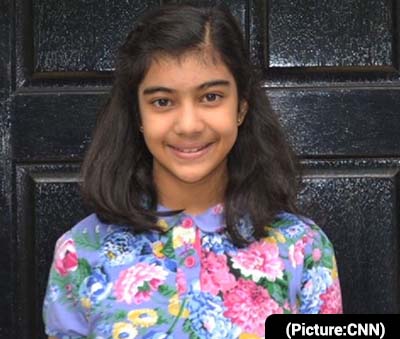
Priya Aiyar Appointed Senior Vice President and General Counsel at American Airlines

Priya Aiyar, an Indian-American has been chosen as the Senior Vice President and General Counsel at American Airlines. Priya Aiyar, a former Obama administration official, was named senior vp and general counsel at American Airlines, the company announced Aug. 5, 2019.  Priya Aiyar, a former Obama administration official, succeeds Paul Jones, who retired from American earlier this year.

“We are thrilled to welcome Priya to American Airlines,” American’s Executive Vice President of Corporate Affairs Steve Johnson is quoted saying in a press release Aug. 5. “Priya is an outstanding lawyer and an extraordinary intellect, and her strategic perspective, integrity, energy, unique experience, passion for the law, and demonstrated ability to build and inspire teams make her the perfect person to lead our legal strategy and team over the coming years,” Johnson added.

Aiyar, a graduate of Yale Law School, with degrees from Oxford University and Harvard, worked in senior positions at several U.S. government agencies. She was Legal Advisor to the Chairman at the Federal Communications, Deputy Chief Counsel at the National Commission on the BP Deepwater Horizon OIl Spill and Offshore Drilling; Deputy General Counsel for Environment and Nuclear Programs at the Department of Energy, and worked from 2013 to 2017 at the U.S. Treasury, first as Deputy General Counsel and then as Acting General Counsel.

In her role at American, Aiyar will lead the Legal Affairs team and its legal strategies, a press release from the airline said. This includes the company’s corporate governance, securities and corporate finance, business and commercial, litigation, competition and antitrust, compliance, privacy, environmental, employment, and intellectual property legal issues and work.

Aiyar joins American from Willkie Farr & Gallagher LLP, where she has been a partner, and brings more than 18 years of government and private sector experience, American noted in the press release.

She began her legal career as a clerk to Judge Merrick Garland of the U.S. Court of Appeals for the D.C. Circuit and to Justice Stephen Breyer of the U.S. Supreme Court.

American Airlines is among the top carriers in the country with 6,800 daily flights to more than 365 destinations in 61 countries, employs 130,000 staff globally and serves some 200 million customers the company said. The airline was recently named a Five Star Global Airline by the Airline Passenger Experience Association and Airline of the Year by Air Transport World.

Anuradha Mazumdar and Sanjib Biswas Launch C0deEX for Teaching Coding to Kids

The husband-wife team of Sanjib Biswas and Anuradha Mazumdar last month opened C0deEX, an Acton, MA-based school to teach coding to kids of age group 6-14; and almost a month-and-a-half later the C0deEX Panther team won the first prize in a major robotics competition.

“On August 9th, 2019 middle school students from the Acton C0deEx Panther robotics team watched their computer program control a satellite on the International Space Station (ISS) during the finals of the Zero Robotics competition,” C0deEX said in a statement. “C0deEx Panther, after winning the State Championship competing against fifteen other teams from around the state on July-27th, 2019 was representing Massachusetts at the ISS (International Space Station) final.”

For the ISS finals, teams from all over the northeast gathered at MIT Stata Center to join a video conference with other teams from around the world. NASA astronauts Andrew (Drew) R. Morgan, Christina Koch and Aleksandar (Sasha) Aleksandrovich Skvortsov Jr. facilitated the competition and provided live commentary which was telecasted live to MIT Stata Center and  16 others physical locations across USA, Russia and Puerte Rico.

Three hundred teams and more than 2,000 students across USA, Russia and PuertoRico participated in this competition. The ground teams watched the Synchronized Position Hold, Engage, Reorient, Experimental Satellites (SPHERES) on the ISS competition.

C0deEx Panther’s code went head on with code written by 16 finalist teams. After being the winner in the Team A bracket, C0deEx Panther also beat the Teams from Team B securing the first position in 2019 International Zero Robotics Competition. The C0deEx Panther team consists of 5 students from Acton/Boxborough and Westford.

Zero Robotics is a summer STEM program for middle school students that “seek to inspire our next generation of great minds by allowing them unprecedented access to space at the middle school level.” The students spend five weeks learning about programming, engineering, and space exploration, while developing code to control satellites known as SPHERES. During this five-week program, the students rely on a simulation environment from MIT to develop their code. After the state finals, the international finalists’ code is tested on physical SPHERES at MIT before being uploaded to the ISS.

The program culminates in a tournament where winning teams’ SPHERES compete aboard the International Space Station (ISS). Middle school participants will get to see the SPHERES operate in space via a live feed from the ISS while NASA astronauts provide real-time commentary. Each year’s game is motivated by a problem of interest to NASA and MIT.

AAPI Partnering with TATA Trusts to Fight Against Cancer in India

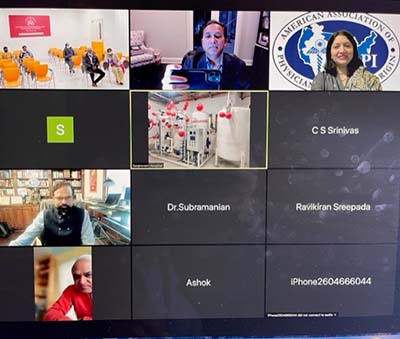
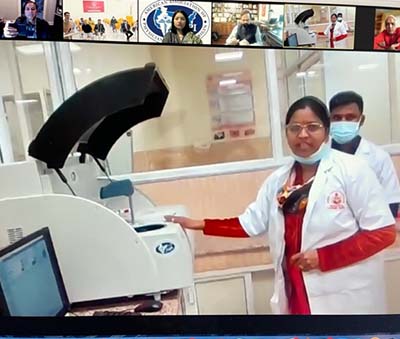
API is partnering with Tata Trust to improve health care for people in rural India. Nearly 75% of the poor population of the country resides in villages.. They lack access to even basic medical care. India is facing an enormous burden of 1.9 million new cases per year. Most of these present at an advanced stage thus necessitating complex and expensive treatments. A majority of these patients are visiting a doctor for the first time in their life. There is a significant gap between the needs and the availability of physician and health care resources for rural cancer patients. The need to travel to metropolitan areas, the cost and the delay in receiving care for these villagers further compromises the care they can obtain leading poor outcomes.

Tata trust is developing a distributive model for cancer care with digitally connected centers across the country to address this discrepancy in the delivery of cancer care to the poor in the villages. The network will integrate primary health centers, district hospitals to medical colleges. As  India lacks adequate number of qualified Oncology specialists they would like to partner with AAPI  to provide Medical ,Surgical and Radiation oncologists to deliver quality cancer care. These specialists will spend from one to three  months in Tata cancer centers in India. They will also provide Tele-medicine consultations.

The model envisions an integrated well connected network of existing and additional centers staffed by local and AAPI volunteer specialists from USA working partly in India and partly via tele-medicine from US to deliver high quality cancer care across the country i n the villages. This collaboration can also help with prevention, early detection as well as other health related areas like sanitation and safe drinking water.

The trust has already embarked on forming a national cancer grid comprising major cancer centers in the country, research institutes, patient groups and charitable institutions. They will develop uniform standards of treatment, early diagnosis and prevention protocols. The specialized centers will also provide training and education besides conducting basic, transnational and clinical research.

Tata trusts will pioneer these programs with from their flagship cancer centers of Mumbai, Kolkata and the most recent center in Tirupati in A.P. This collaborative effort can not only provide much needed high quality care in an affordable manner to the impoverished in rural India but also open new vistas for joint research for local and US cancer specialists.

Gold hits life-time high of Rs 38,070 per 10 gram

Gold prices last week surpassed the Rs 38,000 per 10 gram mark for the first time ever, amid heightened trade tension between US and China and marked slowdown in global economic activity.

Gold has seen a sharp surge in demand as a safe haven asset, ever since the US Federal Reserve’s statement that the first rate cut since 2008 was not the beginning of a rate cut cycle.

At the Multi-Commodity Exchange (MCX), the October contract of gold was trading at Rs 37,956 per 10 gram before it hit a life time high of Rs 38,070.

Prices of the precious metal surged after the US last week announced fresh tariffs on Chinese products. Later, China decided not to buy US agricultural products as a response to this escalation.

On Wednesday, the Reserve Bank of India’s Monetary Policy Committee (MPC) lowered the economy’s projection of real GDP growth to 6.9 per cent for 2019-20 from 7 per cent earlier.

The downward adjustment in the GDP growth projection, RBI Governor Shaktikanta Das, said was warranted by various high frequency indicators pointing to weakening of both domestic and external demand conditions .(IANS)

Just one-third of U.S. Catholics agree with their church that Eucharist is body, blood of Christ

Transubstantiation – the idea that during Mass, the bread and wine used for Communion become the body and blood of Jesus Christ – is central to the Catholic faith. Indeed, the Catholic Church teaches that “the Eucharist is ‘the source and summit of the Christian life.’”

But a new Pew Research Center survey finds that most self-described Catholics don’t believe this core teaching. In fact, nearly seven-in-ten Catholics (69%) say they personally believe that during Catholic Mass, the bread and wine used in Communion “are symbols of the body and blood of Jesus Christ.” Just one-third of U.S. Catholics (31%) say they believe that “during Catholic Mass, the bread and wine actually become the body and blood of Jesus.”

In addition to asking Catholics what they believe about the Eucharist, the new survey also included a question that tested whether Catholics know what the church teaches on the subject. Most Catholics who believe that the bread and wine are symbolic do not know that the church holds that transubstantiation occurs. Overall, 43% of Catholics believe that the bread and wine are symbolic and also that this reflects the position of the church. Still, one-in-five Catholics (22%) reject the idea of transubstantiation, even though they know about the church’s teaching.

The vast majority of those who believe that the bread and wine actually become the body and blood of Christ – 28% of all Catholics – do know that this is what the church teaches. A small share of Catholics (3%) profess to believe in the real presence of Christ in the Eucharist despite not knowing the church’s teaching on transubstantiation.

About six-in-ten (63%) of the most observant Catholics — those who attend Mass at least once a week — accept the church’s teaching about transubstantiation. Still, even among this most observant group of Catholics, roughly one-third (37%) don’t believe that the Communion bread and wine actually become the body and blood of Christ (including 23% who don’t know the church’s teaching and 14% who know the church’s teaching but don’t believe it). And among Catholics who do not attend Mass weekly, large majorities say they believe the bread and wine are symbolic and do not actually become the body and blood of Jesus.

The survey also finds that belief in the real presence of Christ in the Eucharist is most common among older Catholics, though majorities in every age group (including 61% of those age 60 and over) believe that the bread and wine are symbols, not the actual body and blood of Christ.

Keerthy Suresh Wins National Film Award

Suresh Kumar, Maneka and Keerthy Suresh, often referred to as Kerala’s complete film family, were in celebration mood after Keerthy Suresh bagged the best actress national award for her role in the bilingual film ‘Mahanati’.

Speaking to IANS, Keerthy’s father Suresh Kumar, one of Malayalam film industry’s top notch producers, said, “It’s something that we will cherish for a long time”.

“To be honest, we would have been disappointed, had she not won this award, as it was such a beautiful performance by her. We were sure that she had done a great job as an actress and hence we did expect this would come,” he said.

Incidentally, Kumar’s wife Maneka was a hugely popular actress in the 1980s and acted in over 100 films before ending her career after marrying Kumar.

“She (Maneka) missed the national award by a whisker for her performance in the Malayalam film ‘Oppol’, when actor Balan K. Nair won the best actor award for his role in the same film. So our wait has finally ended with Keerthy winning it and hence it’s double joy for all of us,” said Kumar.

Starting off as a child artiste, Keerthy made it big with her debut lead role in director Priyadarshana’s film ‘Geethanjali’ in 2013. She has not looked back since then, acting not just in Malayali cinemas, but also in other South Indian films as well.

The Surgical Strike bagged two major categories as the 66th National Film awards were announced on Friday. The military movie won its director, Aditya Dhar, and lead actor, Vicky Kaushal, the awards in their respective category, though Kaushal shared the honours with Ayushmann Khuranna (Andhadhun). Keerthy Suresh won the best actress for Mahanati, the Telugu movie on actress Savitri.

A selected list of winners:
Best Feature Film: Hellaro (Gujarati), directed by Abhishek Shah
Best Action Direction: KGF Chapter I
Best Choreography: Padmaavat for Goomar
Best Popular Film: Badhaai Ho
Best film on Social Issues: Padman
Best Child artist: P V Rohith (Kannada), Sameep Singh (Punjabi), Talha Arshad Reshi (Urdu) and Shrinivas Pokale (Marathi)
Best Children’s Film: Sarkari Area Prathamika Shaale Kasaragod

Best Tamil Film: Baaram
Best Marathi Film: Bhonga
Best Hindi Film: Andhadhun
Best Telugu Film: Mahanati

Besides the medal, award winners also get cash prize of varying amounts — Rs 50,000 for best actor/actress to Rs. 2,50,000 for best feature film.

FYI: Last year’s National Award was controversial after more than 50 award winners did not turn up for the presentation ceremony as President Ram Nath Kovind gave away just 11 of the 137 awards.

Mardaani 2 to hit theatres on 13th December!

Rani Mukerji’s edge of the seat entertainer Mardaani 2 is set to release this year with YRF announcing that the much-awaited cop thriller will release on 13th December. Rani is reprising the role of the fearless and committed Superintendent of Police, Shivani Shivaji Roy in Mardaani 2. She had delivered an outstanding performance in the superhit and hugely acclaimed prequel, Mardaani, in which she took on the kingpin of a child trafficking racket.

In Mardaani 2, Rani will be seen pitted against a 21-year-old menacing villain who can be called pure evil. There is a lot of anticipation on who her villain will be and the crime that Rani will try to solve in the sequel. One thing is for certain, Aditya Chopra is set to launch a new face as the antagonist. The film marks the directorial debut of Gopi Puthran, the writer of the first Mardaani film. Produced by Aditya Chopra, Mardaani 2 was shot extensively in Jaipur and parts of Rajasthan. This will be Rani’s next release after the global blockbuster Hichki that delivered 250 crores worldwide.

Bhasha Mukherjee Crowned Miss England 2019, to Compete in Miss World

Bhasha Mukherjee, a British Indian medic, who starts her new job as a junior doctor on Friday, has been crowned Miss England 2019. Mukherjee, who moved to the UK from India with her parents aged 9, will compete in the 69th Miss World contest to be held in December in London.
The 23-year-old beauty from Derby in East Midlands region of England starts her new medical job at Pilgrim Hospital in Boston, Lincolnshire, just hours after winning the contest in Newcastle Upon Tyne in North East England on Thursday night.
 
Mukherjee speaks five languages and has a Bachelor’s degree in medicine and surgery from the University of Nottingham. “Bhasha is an incredibly hard-working young woman, an ideal candidate to represent the multicultural country of England,” said Angie Beasley, director of the Miss England contest.
 
“Bhasha was sponsored by celebrity make-up artist Joggy Kang and wore a rose gold-beaded gown by designer Puneet Brandao,” she added.
 
The pageant winners bagged over GBP 30,000 worth of prizes, which include a luxury holiday to Mauritius. Mukherjee, who speaks English, Bengali, Hindi, German and French, describes herself as studious with an IQ of 146.
 
She admits it was “quite difficult” to balance the Miss England contest with completing her medical finals this year. “I’m very proud to be representing the south Asian community, minority populations and Derby,” she said.
 
“It’s been really nerve-wracking, I couldn’t tell if I was more nervous about the competition or about starting my job as a junior doctor,” she said.
 
Mukherjee, who performed an Indian dance sequence for her talent round, has been running her own charity called the Generation Bridge Project since 2013, which supports Derby’s elderly community with events like fun days and talent shows.
 
After modelling for seven years, she became one of just 55 contestants to reach the finals of the Miss England pageant from more than 22,000 entries. Last month, the Miss England 2019 pageant hit the headlines as one of the first to launch a new make-up free round, with the winner of the ‘bare face top model’ contest being fast-tracked to the final round of 20 women vying for the overall title.
 
As part of their entries, the women had to wear no make-up and also had to post the photo on social media with the message to celebrate natural beauty.

Boris Johnson’s ‘desi’ cabinet shows Indian diaspora impact

British Prime Minister Boris Johnson’s ‘desi’ cabinet, with three Indian-origin leaders in his top ministerial team, is a profound testament of the impact of the Indian diaspora in the UK, British High Commissioner to India Dominic Asquith said.
Johnson has appointed Priti Patel as Home Secretary, Alok Sharma as International Development Secretary and Rishi Sunak as Chief Secretary to the Treasury. The Cabinet also includes Pakistani-origin Sajid Javid in the top job of Chancellor.
“The ‘desi’ cabinet is a testament to just how diverse the UK is, and also what an impact the Indian diaspora makes in the UK. It is fantastic profile of the current state of UK,” Asquith said at a media briefing.
To a question on Britain’s new immigration policy under the new government, which is to leave the European Union by October 31, he said that Johnson has made it clear that the UK should “attract the best of brains”.
Asquith said that Johnson “has made clear that he is a profound supporter of making sure Britain attracts the best of brains”, and his government will “overlook the whole immigration process”.
He added that Priti Patel “has made clear that once we leave the EU, we will not favour geographical barriers and it will be open to all, on the basis of merit”.
Johnson has announced to explore an “Australian style points-based system” as part of “a radical rewriting” of the immigration system.
Both Johnson and Patel support “economic” migration and don’t support giving priority to EU migrants – which could be beneficial for skilled Indians, including students who go to the UK to study.
The Prime Minister has instructed the Migration Advisory Committee, a panel of academics and economists who advise the government on migration policy, to re-design the UK’s post-Brexit immigration system.
Patel has also announced that priority would be given to “those with the highest skills and the greatest talents – to attract those who add the most to our economy”. (IANS)

15 Hours of Continuing Medical Education (CME) at GHS 2019

The 13th edition of the annual Global Healthcare Summit (GHS) 2019, organized by the Association of American Physicians of Indian Origin (AAPI) at the Taj Krishna, from July 21st to 23rd, 2019 offered a unique forum for the Physicians of Indian Origin to come together, sharing their knowledge and expertise in their respective medical fields with their fellow physicians from around the world, and to learn from one another.

Through a series of world class Continuing Medical Education (CME) and non-CME seminars by experts in their fields, AAPI provided comprehensive and current reviews and guidelines for the diagnosis and treatment of various diseases and to reduce morbidity and mortality and achieve cost effective quality care outcomes. At the end of the activity, attendees were able to gain an understanding of the causation, diagnosis and the best clinical practices for the management of the diverse group of diseases discussed during this program.

Dr. Suresh Reddy, president of AAPI, says, “AAPI has been engaged in harnessing the power of Indian Diaspora to bring the most innovative, efficient, cost effective healthcare solutions to India. This conference has been successful in bringing the highest caliber of internationally acclaimed faculty and developed a very robust agenda in collaboration with leading experts from India with  enhanced focus on conducting skills enhancement workshops, hands on experience with advanced techniques. It was encouraging to note that overcoming/ignoring minor glitches with audio visual system, the audience were enthusiastic, and were up until 11 pm with no sign of tiredness.”

Dr. Reddy thanked the organizers and the lead clinicians at the CMEs. The scientific program and workshops of GHS was developed by leading experts with contributions by the Scientific Advisory Board and the International Scientific Committee.

The days were filled with back to back CMEs on cutting edge technologies, modern trends in diagnosing treating patients. This CME program has been jointly sponsored by the American Association of Physicians of Indian Origin and has been designed to meet the educational needs of Primary Care physicians – Internists, Family Practitioners, Pediatricians, and Specialists – Cardiology, Oncology, Endocrinology, Surgery and other specialties involved in the care of patients with Atrial Fibrillation, HIV disease, Diabetes, Dyslipidemia, Depression, Prostate and Hematologic malignancies and Back pain.

Dr. Krishan Kumar, who was the Chair of the CME Committee, said, AAPI organized CMEs during the Pre-Tour to Israel and Jordan, and during the Post Tour and at the GHS in India from July 13 to 24, 2019. The cutting edge 15 hours of CMEs attracted more than 150 AAPI delegates from the US.  The topics broadly covered the recent advances in Medicine. The participants were enthusiastic in learning the common topics like management of anaphylaxis, head injuries, stroke, sleep apnea, infections and facial attractiveness etc.

Dr. Suresh Reddy, President of AAPI, educated the participants on the management of stroke and minimally invasive spinal surgery.  Dr. Krishan Kumar, Chair of CME Committee, spoke on the management of Anaphylaxis, Snake Bites, Scorpion Bites, and Head Injuries.

Dr. Vani Vijayakumar and Dr. Sreenivasan Vijaykumar, Dr, Saraswathi Muppana, Dr. Raj Bhayani, Dr. Sarvam Terakonda, Dr. Nikhil Bhayani, and, Dr. Srinagesh Paluvoi were the other speakers at the CMEs. Dr. Sarvam Terakonda educated the speakers on Perception of Beauty and Facial Attractiveness.

Dr. Krishan Kumar, and Dr. Udaya Shivangi, the Co-Chair of the CME Organizing Committee and thanked AAPI, especially Dr. Suresh Reddy, Dr. Seema Arora, Dr. Dwarakanath Reddy, and Dr. Sreeni Ganagsani,  for giving the opportunity to lead and organize the CME sessions for the entire year.

178 Trained at AAPI GHS Resuscitation Workshop in Hyderabad

Dr. Vemuri S. Murthy, a well-known resuscitation educator and trainer, a veteran US and international volunteer of the American Heart Association (AHA) for more than three decades, in coordination with Dr. Anupama Gotimukula, Vice President of AAPI, led the workshop on Resuscitation, on July 22nd at the Nizams Institute of Medicine in Hyderabad during the 13th edition of the annual Global Healthcare Summit organized by the American Association of Physicians of Indian Origin (AAPI), USA.

Attended by 178, including 123 Medical Students, 27 Consultants, 22 Nurses and 6 Laerdal Representatives, the seven hours long workshop provided Training on ways enhance the outcomes after sudden cardiac arrests ongoing community hands-only CPR training and AED awareness. Dr. Murthy said, “The AAPI Resuscitation Workshop 2019 was designed, incorporating the basic and advanced Resuscitation Science (Post-Cardiac Arrest) information including global 2018 updates. The workshop focused on Indian resuscitation projects to enhance outcomes after sudden cardiac arrests.”

According to Dr. Anupama Gotimukula, the workshop was an effective way “to share information about recent global advances in Adult and Pediatric Resuscitation; and, to share information about the role of simulation technology in resuscitation training, including a simulation session.”

Describing the 7 hour program with Indo-US Faculty as a great success,

Dr. Murthy, Chair, AAPI GHS Resuscitation Workshop 2019, thanked “AAPI President Dr.Suresh Reddy, the Executive Committee and Board for their support and help. My special thanks to the Director of NIMS, Dr. K. Manohar and the Indian coordinator, Dr. Ashima Sharma and the staff @ NIMS for their hard work and support contributing to the success of the workshop!”

With more than 1.2 billion people, India is estimated to account for 60 per cent of patients with heart diseases. According to the World Health Organization, heart related disorders kills almost 20 million people annually, and they are exceptionally prevalent in the sub-Indian continent.  Half of all heart attacks in this population occur under the age of 50 years and 25 percent under the age of 40. It is estimated that India is estimated to have over 1.6 million strokes per year, resulting in disabilities on one third of them. Although there is some level of awareness regarding smoking, dietary habits and diabetes, somehow there is no massive intervention on a national level either by the government or by the physicians.

While coronary artery disease (CAD) tends to occur earlier in life and in a higher percentage of the population in Asian Indians than in other ethnic groups, it has been found that American Southeast Asian Indians typically develop a heart attack 10 years earlier than other populations. Studies also have found that heart disease among Indians is more severe, diffuse, and more likely to be multi-vessel compared to whites despite their younger age, smoking less, and lower rates of hypertension.

India has one of the highest accident rates leading to trauma and head injury. AAPI, in collaboration with leading healthcare institutions in India and the Indian Ministry of Health has embarked on a long-term project to create awareness on the need to prevent, treat, and provide special care and rehab services to those involved in accidents.

“In this context, AAPI’s initiative to educate and prevent deaths by accidents and chronic heart problems is very significant,” says Dr. Sanku Rao Chief Advisor of the GHS 2019. To be presented by leading global healthcare leaders and professionals, the day-long Advanced Resuscitation (Post-Cardiac Arrest) Workshop in collaboration with The Chicago Medical Society will be held at the Nizam’s Institute of Medical Sciences, Hyderabad, Telangana, India on July 22, 2019, Dr. Rao adds.

Dr. Dwarkanatha Reddy, Convener of says, “AAPI has been in the forefront in addressing the accidental deaths, by collaborating with the American University of Antigua (AUA) College of Medicine, and the American Heart Association, with  workshop/training (EMTC) trainings to hundreds of first responders, including police, para-medical professional at every  GHS in recent years.”

The trainings are aimed at decreasing the number of deaths, especially from road accidents by enabling the first responders to provide life support to victims of accidents. The training, which includes CPI and other medical services are being provided by professional trainers from the US and is being offered to personnel from Police, Traffic Police, and other healthcare professionals from the state.

Dr. Vemuri S. Murthy, MD, MS, FAHA, FICS, Department of Emergency Medicine at the University of Illinois, Chicago, Illinois, USA, and a team including, Dr. Radhika Chimata, Dr. Srinivas Ramaka, Dr. Anupama Gotimukula, and Dr. K. Manohar will be the lead speakers.

Dr. Anupama Gotimukula, MD, is a Faculty Co-Chair, Pediatric Anesthesiologist, is based in San Antonio, Texas. She currently serves as the Secretary, AAPI & Member, AAPI Global CPR Ad-Hoc Committee. Dr. Ashima Sharma, MD, DA, is the Coordinator at Nizam’s Institute of Medical Sciences, and serves as the Head, Department of Emergency Medicine, Nizam’sInstitute of Medical Sciences, Hyderabad, Telangana, India.

Dr. Murthy says, “The AAPI Resuscitation Workshop 2019 is designed, incorporating the basic and advanced Resuscitation Science (Post-Cardiac Arrest) information including global 2018 updates. The workshop focuses on Indian resuscitation projects to enhance outcomes after sudden cardiac arrests.”

According to Dr. Anupama Gotimukula, the workshop will be an effective way “To share information about recent global advances in Adult and Pediatric Resuscitation; and, to share information about the role of simulation technology in resuscitation training (includes a simulation session).”

AAPI Lauds Indian Pharma Companies for Providing Medications at Affordable Cost to Patients Globally

Healthcare industry in the United States and around the world is rapidly changing, leading to many describing the healthcare environment as dynamic, complex, and highly uncertain. The manner in which the health care environment is perceived and characterized is important for several reasons.

The American Association of Physicians of Indian Origin (AAPI), continuing with the past traditions on the successful experiences has stated that AAPI supports the FDA Commissioner Scott Gottlieb’s Initiatives as pronounced in his statement on February 22nd, urging globally uniform standards utilized for quality control monitoring, including for overseas generic drug manufacturers.

“Advances in technology and material science are enabling new opportunities to transform health and mobility through innovations in medical products. The FDA is committed to adopting pathways that allow patients efficient access to these safe and effective products,” Dr. Gottlieb said.

The Indian pharma companies have established their strong presence in the global pharma landscape that was dominated by the multinational pharma companies predominantly based out of Europe and USA.

According to Dr. Suresh Reddy, President of AAPI, “With the changing trends and statistics in healthcare, both in India and US, we are refocusing our mission and vision, AAPI would like to make a positive meaningful impact on the healthcare delivery system both in the US and in India.”

“AAPI thus supports large research-based Indian companies that manufacture generic drugs and applauds their major role in providing medications at more affordable cost to patients globally, including in the United States,” said Dr. Ravi Jahagirdar, Past President of AAPI.  The national and international presence and impact of the Indian Pharmaceutical industry with its  progressive vision has included its role in cost containment resulting in affordability, involvement in biosimilars, specialty drugs and gene therapy, which is an ambitious plan to expand the impact of Indian pharmaceutical companies across the globe,  while seeking to make quality medicine affordable and available to billions of people all over the world.

Indian Pharmaceutical companies and their subsidiaries have established strong presence in US during the past few years with higher ANDA approvals. The loss of patent exclusivity and cost cutting measures adopted by several nations pushed the demand for generic segment. Indian pharma companies enhanced their investments in research and development (R&D) and successfully received higher approvals from US FDA during last decade. Out of total 5,350 ANDA approvals between 2009 to 2018, Indian companies have secured 34.4% of these approvals and received total 1,842 ANDA final approvals.  Further, out of total 1,310 tentative approvals, Indian companies grab 500 tentative approvals from US FDA which worked out to over 38.2%.

India is home to the second highest number of US FDA approved facilities. The Pharma industry in India has posted a robust, double-digit growth over the last few years. The industry was worth USD 36.7 billion in 2017 and is projected to grow to USD 55 billion by 2020. India is now among the top five pharmaceutical emerging markets of the world.

Indian sand artist wins People’s Choice Award at Boston festival

Sudarshan Pattnaik’s sculpture highlighted the dangers of plastic pollution in oceans

Renowned Indian sand artist Sudarsan Pattnaik has won the People’s Choice Award at the recently-concluded Revere Beach International Sand Sculpting Festival in Boston, Massachusetts.

Pattnaik was among the 15 top sand artists selected from across the world to participate in the annual festival. His sand sculpture titled “Stop Plastic Pollution, Save Our Ocean,” highlighted dangers of plastic pollution in oceans and the importance and urgency to combat it. The Odisha native is known to convey social messages and themes through his art.

Pattnaik’s sculpture showed a turtle caught in a plastic bag and a fish with plastic trash such as slippers, bottles and glass inside its body. The tail of the fish is in the mouth of a human, signifying how plastic pollution in the oceans is adversely impacting human beings also when they consume sea food.

“This is a very big award and honor for me in the U.S.,” Pattnaik told the Press Trust of India. “This award is for India,” he added. “Thousands of people voting for my sculpture that highlights the problem of plastic pollution underscores that the public too is concerned about our oceans getting polluted and supports the urgent need to take action to save our oceans and planet,” he said. Through his sculpture he said he wants to highlight that human activity is destroying the oceans and humans are also getting impacted by polluted waterways as they consume food from the sea and rivers.

Hosted by non-profit organization Revere Beach Partnership, the festival, now in its 16th year, ran from July 26-28 and was attended by close to a million people. One of the largest sand sculpting festivals in the world, it sees participation from leading sand sculptors from around the world. Pattnaik was the sole representative from India and Asia.

India’s Parliament OKs ending instant divorce for Muslims

Indian lawmakers on Tuesday approved a bill to end the Muslim practice of instant divorce two years after the Supreme Court ruled that it violated the constitutional rights of Muslim women.

Law Minister Ravi Shankar Prasad said the bill’s approval by the upper house of Parliament reflects the empowerment of women and India’s changing profile.

The more powerful lower house approved the bill last week. It will become law after India’s president approves it, which is a formality.

Most of the 170 million Muslims in India are Sunnis governed by the Muslim Personal Law for family matters. The law has included allowing Muslim men to divorce their wives by saying “Talaq,” the Arabic word for divorce, three times — and not necessarily consecutively, but at any time, and by any medium, including telephone, text message or social media post.

More than 20 countries, including neighboring Pakistan and Bangladesh, have banned the practice.

The 99-84 approval last week was a victory for Prime Minister Narendra Modi’s government. The opposition had blocked the bill for more than a year, as the ruling party lacked majority support in the upper house. A split in the opposition ranks helped the government cross the line.

Ghulam Nabi Azad, a Congress party leader, said the opposition parties were opposed to a clause providing a three-year jail term for a husband who divorced his wife in such a way, arguing that no other religion has such a punishment. The opposition also said the bill had no clarity on spousal support if men were jailed for an instant divorce.

Both houses of Parliament rejected the opposition stand and also refused to refer the bill to a parliamentary committee to consider those provisions.

Byju Raveendran is India’s newest billionaire

India has crowned its latest billionaire, a 37-year-old former teacher from a small village in Kerala. Byju Raveendran received the coveted title this month after his seven-year-old education app Byju’s raked in $150 million in its latest funding round.

The deal gives Raveendran’s eponymous business a valuation of $5.7 billion, sending his own personal wealth over the billion-dollar threshold. Raveendran holds a 21% stake in the education technology company, which is backed by investors including the Qatar Investment Authority, Tencent and Mark Zuckerberg.

The entrepreneur’s feat sees him become one of India’s youngest billionaires, joining the country’s recent wave of newly-minted millennial unicorn founders such as Flipkart’s Binny Bansal and Sachin Bansal.

It’s some achievement, especially given Raveendran’s humble beginnings.

The son of math and physics teachers, Raveendran grew up in the village of Azhikode in South India before going on to university. But, once working as an engineer, he discovered his own knack for teaching and helping friends with their entrance exams to engineering and management schools in his spare time.

Word quickly spread of Raveendran’s top-rated teaching abilities, and he began filling out stadiums and receiving nationwide requests from students eager to learn his techniques.

So, in 2011, alongside fellow twenty-something co-founder Divya Gokulnath, he founded Byju’s — The Learning App, an online education platform for children aged five to 16. Built around interactive videos, games and quizzes, the platform helps students with everyday classes as well as exam preparation.

In the seven years since, Raveendran’s young start-up — which has 35 million users in India, 2.5 million of whom pay an annual fee of $145 to $290 — has become the world’s most valuable ed-tech company, according to the company’s website. The Bengaluru-based company became profitable in March.

The new billionaire now has his sights set on global expansion, targeting the U.S. and the U.K. following a recent partnership with Walt Disney Co.

Raveendran, who has said he wants to do for education what Disney did for entertainment, said the collaboration will help children learn with the help of their favorite characters by featuring them in their interactive content.

“Kids everywhere relate to Disney’s Simba or Moana, who grip kids’ attention before we take them through the loop of learning,” CEO Raveendran told Bloomberg recently.

“We are customizing Disney Byju’s to the American and British school curriculum,” Raveendran said. “The characters have universal appeal.”

India receives $64.37 billion foreign investment in FY19, $286 billion in 5 years

Riding the foreign direct investment policy liberalisation and reforms in the last financial year, the country received $64.37 billion FDI in 2018-19.

According to a report by Department for Promotion of Industry and Internal Trade (DPIIT), it was up from $60.97 billion received in FY18.

“The country registered the highest FDI inflow of $64.37 billion during 2018-19. FDI worth $286 billion has been received in last five years,” DPIIT said in its annual report 2018-19.

“FDI brings in resources, the latest technology and best practices to push economic growth on to a higher trajectory,” it said. The central government has been carrying out FDI “liberalisation and simplification”.

The DPIIT, set up in 1995, was reconstituted in 2000 with the merger of the Department of Industrial Development. Earlier, DPIIT was earlier called Department of Industrial Policy & Promotion and was renamed DPIIT in January 2019. (IANS)

SCHOLARSHIP PROGRAM FOR DIASPORA CHILDREN FOR ACADEMIC SESSION 2019-’20

Government of India launched a scheme called “Scholarship Programme for Diaspora Children” (SPDC), in the academic year 2006-2007, for the wards of Persons of Indian Origin (PIOs) and Non-Resident Indians (NRIs) to assist them in pursuing Under Graduate courses in Indian Universities/Institutes.

Under SPDC scheme financial assistance for specific undergraduate courses in Professional and Non-Professional courses (except Medical and related courses)is provided towards tuition fee, admission fee and post admission services. The scheme is applicable to NRIs and PIOs from 66 countries.

Under the scheme, PIO/NRI students are awarded a scholarship of up to US$4,000 per annum for payment of tuition fee, admission fee and post admission services for Undergraduate courses in Engineering, Technology, Humanities, Liberal Arts, Commerce, Management, Journalism, Hotel Management, Agriculture, Animal Husbandry and other courses. The scholarship is applicable to students who have already secured admission in an Indian institution. Admission is   permitted only in Central Universities, NAAC “A” Grade Institutions, National Institute of Technologies (NITs), School of Planning & Architecture (SPAs), and Indian Institute of Information Technology (IIITs) as covered under Direct Admission of Students Abroad (DASA) scheme.

In case of any technical assistance, please contact following: SPDC Portal Support Team, EG & IT Division, MEA, 1025, A Wing, Jawaharlal Nehru Bhavan
23-D Janpath, New Delhi 110011, Email: technicalcellegit@mea.gov.in, Tel. +91 11 4901 8371

In case of any assistance/clarification regarding Scholarship Programme for Diaspora Children, please contact following: Section Officer, OIA II Division, MEA, 925, Akbar Bhawan, Chankyapuri, New Delhi 110021, Email: so1oia2@mea.gov.in, Tel.: +91 11 2419 7927; Or Visitwww.spdcindia.gov.in

Last date for application is Nov. 30, 2019.

Ketamine Isn’t an Opioid and Treats Depression in a Unique Way

Newswise — Ketamine has gotten a bad rap as an opioid when there’s plenty of evidence suggesting it isn’t one, Johns Hopkins experts say. They believe this reputation may hamper patients from getting necessary treatment for the kinds of depression that don’t respond to typical antidepressants. In a new paper, the researchers clarify the mechanism behind ketamine’s mechanism of action in hopes of restoring the therapy’s standing among health care professionals and the public.

In March of this year, the U.S. Food and Drug Administration approved ketamine as a nasal spray to treat depression.

“A study done late last year delivered a black eye to ketamine, and as a result of the coverage, there was a wholesale acceptance by both potential patients and physicians that ketamine is an opioid,” says Adam Kaplin, M.D., Ph.D., assistant professor of psychiatry and behavioral sciences at the Johns Hopkins University School of Medicine. “This is most worrisome if people continue to think this way, particularly in the wake of the opioid epidemic; clinicians won’t refer patients for a treatment, despite that it has been shown to be incredibly effective for many patients with treatment-resistant depression.”

The researchers published their viewpoint and explanation of the alternative mechanism as a Letter to the Editor in the May 1 issue of The American Journal of Psychiatry.

Naltrexone — the drug used to reverse accidental opioid overdoses — binds to opioid receptors on the surface of brain cells and prevents opioids like morphine or heroin from sticking to them and acting on the brain, preventing the high.

In late 2018, researchers at Stanford University and Palo Alto University showed that naltrexone also blocks the antidepressant effects of ketamine, which led them to propose that ketamine must also bind to the same opioid receptors and thus concluded that ketamine must be an opioid. Kaplin says that there’s plenty of contrary evidence demonstrating that ketamine sticks to an entirely different receptor on brain cells: the NMDA receptors — involved in learning and memory — instead of the opioid receptors.

He, proposes how this works: Normally, NMDA receptors get turned on when the chemical messenger glutamate binds to them. Turning on the NMDA receptors turns off a master control switch in the cell called mTOR, which ultimately results in learning a behavior or forming a new memory. Ketamine can also bind to the NMDA receptors, but it has the opposite effect of glutamate, in that it turns these receptors off. Turning off the NMDA receptors turns on the master control switch mTOR, which is required for ketamine’s antidepressant properties.

Separately, says Kaplin, opioid receptors are normally turned on at low-levels all the time, even without opioids to turn them on all the way. This low activity of the opioid receptors normally suppresses the level of another chemical messenger called cyclic AMP (cAMP). When the overdose drug naltrexone is administered, it sticks to the opioid receptors, turning them completely off, which releases the brakes on cAMP. This increase in cAMP is what then interferes with the master switch mTOR, shutting it down. When ketamine is taken, it turns on the master switch mTOR to enable antidepressant effects, but if naltrexone is given on top of that, naltrexone obstructs and shuts off the mTOR again. It is through cAMP that naltrexone overrides and extinguishes the antidepressant effects of ketamine.

These NMDA receptors are found together with the opioid receptors on brain cells, and Kaplin says it’s no surprise that their components can meddle with one another, like interference picked up on a phone call or on the radio. “This interference and cross-talk does not mean that ketamine is an opioid, and to wrongly label it as such could eventually keep patients from essential antidepressant medications that could make a huge difference in their quality of life,” says Kaplin.

The FDA specified that ketamine is to be administered under the watch of physicians in small doses and in a health care setting to minimize any chance of abuse. The drug works much faster than other traditional antidepressants on the market, sometimes even after one or two uses.

Kaplin and his team are in the process of setting up their own ketamine clinic at Johns Hopkins, which they anticipate will be opening within the next year.

Mike Wang was also an author on the paper. Wang and Kaplin received grant funding from Janssen. Kaplin is the co-founder of Reward Pathways and a consultant for Biogen, EMD Serono and Pear Therapeutics.

Americares India Responds to Flooding in Assam and Bihar

Americares India is organizing medical teams to treat survivors of the monsoon rains that have inundated South Asia.
More than 25 million people in India, Bangladesh and Nepal are affected by flooding, as monsoon rains have washed out roads, submerged homes and triggered landslides. To date, more than 500,000 people are displaced and over 600 people have died, according to the United Nations Office for the Coordination of Humanitarian Affairs.
Beginning Monday, Americares India will organize medical teams in three districts in Assam and two districts in Bihar, where continuous rains and contaminated water have heightened health concerns. The teams, operated in partnership with local health care organizations, will provide medical care and dispense medications as needed. Americares also plans to deliver hygiene kits.
“With homes and roads submerged in several feet of standing water, we expect to see an increase in infections,” said Americares India Managing Director Shripad Desai. “Our medical teams will focus on providing primary care and basic first aid for the most vulnerable survivors, including pregnant women, children and the elderly.”
Americares India, based in Mumbai, provides emergency medical and humanitarian aid in response to floods, cyclones, earthquakes and other disasters. Most recently, the Americares India team responded to Cyclone Fani in Odisha, deploying medical teams to care for more than 5,200 patients. Americares India also provides health education, supports health worker safety programs and operates seven mobile health centers that provide free primary care services in 13 municipal wards across the slums of Mumbai.
In Nepal, where more than 100 people have died as result of the flooding, the Americares team in Kathmandu is working closely with the Ministry of Health and Population and local partners to restock health facilities with essential medicines and relief supplies.
Donations to Americares Worldwide Disaster Relief Fund will support its response to the flooding in India and Nepal. To make a donation, please go towww.americares.org/worldwide\
Americares is a health-focused relief and development organization that saves lives and improves health for people affected by poverty or disaster. Each year, Americares reaches more than 90 countries, including the United States, with life-changing health programs, medicine and medical supplies. Americares is the world’s leading nonprofit provider of donated medicine and medical supplies. For more information, visit americares.org

Changes in Patient Care That You Need to Look Out For In 2019

The physical therapy field is a dynamic one. In fact, job growth projections for the industry over the next few years are significantly higher than average projections in other fields.

Now is one of the most exciting times to get involved. As the following examples illustrate, new developments in the industry will soon offer major benefits to physical therapists, their clients, and everyone else involved in the recovery process. These benefits will enable patients to have direct access to physical therapy in New Jersey and other states across the nation, among other numerous advantages.

These are just a few changes to look out for in the coming months:

Merit-based Incentive Payment System

As of January 1, 2019, some physical therapists are now required to adopt MIPS physical therapy billing, while others may choose to do so.

What is MIPS? It’s simply a payment adjustment system designed to both improve the quality of care while reducing average costs.

With this change, a physical therapist will receive a MIPS payment adjustment score based on four criteria: Quality, Improvement Activities, Advancing Care Information, and Cost. The score will determine a Medicare B payment adjustment two years later.

Mergers & Acquisitions

In the first half of 2018 alone, approximately $2.5 trillion in total deals were made as a result of hospital mergers and acquisitions. It’s highly likely this uptrend will continue. Large healthcare corporations will continue to buy smaller practices and operations in the coming years. Although the impact this will have on the quality of care remains to be seen, it’s still an important trend to pay attention to.

New Referral Methods

The degree of ownership hospitals and physicians have over physical therapy billing has increased recently. The result? Doctors and healthcare providers can no longer be relied on as the primary referral sources for physical therapists who operate private practices. Physicians and healthcare facilities are simply less likely to refer patients to anyone out of network.

Thus, private practice physical therapists will have to seek other ways to attract clients, such as leveraging social media.

Technology Boosting Patient Engagement

Patient engagement is crucial in physical therapy. In order to ensure patients successfully complete treatment programs, physical therapists need to maintain relationships with them. That means making sure they have ways to coordinate even when a patient can’t actually visit their physical therapist in person.

Luckily, technology is making that easier than ever. Thanks to new patient engagement tools, physical therapists can cultivate productive relationships, resulting in better results for everyone.

Again, these are merely a few new developments worth paying attention to. The main point to remember is that physical therapy is a constantly-changing field. Staying abreast of those changes is key to success for both patients and practitioners.

Europe experienced a surge in government restrictions on religious activity over the last decade

From national laws regulating religious dress to local laws banning public worship by Muslims, religious restrictions have in recent years become more common in Europe. Indeed, while the Middle East-North Africa region had the highest levels of religious restrictions in the world, Europe saw some of the biggest increases over the last decade in certain types of restrictions.

These findings come from a recent Pew Research Center report that analyzes restrictions on religion (by both governments and private individuals or social groups) from 2007 to 2017. The report measures various types of government restrictions and social hostilities across eight different categories on a scale from zero to 10.

In one of these categories – government limits on religious activity – Europe’s score doubled over a 10-year period. This was one of the largest increases in any of the five global regions analyzed. (An explanation of the methodology is available here.)

A number of factors contributed to Europe’s higher score in this category. To begin with, numerous European countries and cities have banned people from wearing religious symbols or religious clothing, either completely or in certain circumstances (such as at public service jobs or photographs for official documents). For example, France in 2011 outlawed full-face coverings, preventing Muslim women from being able to wear the burqa or niqab in public. And in Spain in 2010, several cities in Catalonia banned the burqa and niqab, as well as face-covering veils, in public buildings.

Other government actions also raised Europe’s score in this area. In 2012, several local councils in Moldova banned public Muslim worship. And in Germany, a court in Cologne classified circumcision as assault when not done for medical purposes. After protests from Jewish and Muslim groups, the federal government passed legislation allowing the practice for religious reasons.

Europe’s score also rose sharply in the category of government harassment of religious groups. In one year of our analysis, 2015, religious groups in 38 out of 45 European countries reported at least limited levels of harassment. Some of these incidents related to the increase in immigrants to Europe. For instance, Dutch parliamentarian Geert Wilders campaigned against the growth of Muslim populations in the West, lamenting what he called “a tsunami of refugees from Islamic countries who threaten our women and our civilization.”

In addition to government actions, there also was a dramatic increase in Europe in some measures of social hostility to religion. Europe’s score in the category of social hostilities related to religious norms increased by a factor of four over a decade, exceeding the global average. The number of European countries reporting individual or group violence or threats of violence aimed at forcing people to adopt religious beliefs or practices different than their own rose from four to 15 (out of 45 European countries) over the decade studied.

Examples of this kind of harassment include a case in 2015 in Ukraine, where four Jehovah’s Witnesses were held at gunpoint, beaten and forced to confess Orthodox Christianity as the only true religion. In 2016 in the United Kingdom, a Sunni Muslim killed an Ahmadi Muslim for allegedly disrespecting the Prophet Muhammad. And in Germany, religious groups reportedly used the fear of deportation to encourage thousands of refugees to convert to Christianity.

There also was an increase in Europe over the decade in the category of religious hostilities by organized groups. The number of European countries where organized groups used force or coercion to promote their perspective on religion rose during this period from 21 to 33. These incidents included not only multiple attacks by those pledging allegiance to the Islamic State, but also cases such as one in Finland, where a neo-Nazi group called the Nordic Resistance Movement published anti-Jewish and anti-Muslim materials and organized rallies. The group also coordinated antireligious activities in Sweden in 2017.

Of eight categories we measured, the only one where Europe saw a decline in restrictive activity was in the measure of interreligious tension and violence. This also was the only category for which the global average declined.

Hichki wins big at Giffoni Film Fest in Italy

Rani Mukerji’s internationally acclaimed blockbuster Hichki has been winning hearts worldwide. Hichki has grossed over 250 crore worldwide and has also been winning top awards at several international film festivals. Now, Hichki has won big at the 49th Edition of Giffoni Film Festival in Italy and bagged the Gryphon Award for the Best Film!

Giffoni has a special segment called Elements +10 where jurors range between the ages of 10 to 12. The jurors who voted for the films in the Elements + 10 category were over 1500 children. With seven feature films competing here from diverse nations like China, Germany, Sweden, Australia and the Netherlands, Hichki won the top honour in this section! This recognition is a testament to the universal connect and emotional bond that Rani’s Hichki has built with audiences from all over the world.

The heart-warming and inspiring film had a progressive message of beating stereotypes and featured Rani as a determined school teacher who changes the lives of innocent students from economically backward strata, while dealing with her own nervous system disorder – Tourette Syndrome.

Producer Maneesh Sharma says, “Hichki is truly a universal film that has resonated with audiences across the world. The fact that children have voted Hichki as the Best Film of the festival just goes to show that the film’s story of overcoming odds and finding your own success is relevant to cinema lovers even in this age group. We at YRF are absolutely thrilled that kids have celebrated the message of Hichki in Italy.”

First Ever Medical Jeopardy Organized At Global Healthcare Summit 2019 In Hyderabad

(Chicago, IL: July 23, 2019) “For the 1st time ever, AAPI successfully organized a popular Jeopardy-type Med-Quiz for the medical students from all the medical colleges from the state of Telengana and Andhra Pradesh during the 13th edition of the annual Global Healthcare Summit in Hyderabad, India,” Dr. Suresh Reddy, President of American Association of Physicians of Indian Origin (AAPI), said today on the concluding day of the 13th edition of the Global Healthcare Summit by the American Association of Physicians of Indian Origin (AAPI) at the famous Taj Krishna Hotel in Hyderabad, India on July 23rd, 2019.

The semi-final and the final stages of the Med-Quiz were held during the GHS 2019 in Hyderabad before a live audience attending the GHS 2019. Drs. Uma Jonnalagadda; Soumya Neravelta; Stella Gandhi coordinated the Jeopardy, while Dr. Saumya Neravelta and Dr. Dharmesh Gandhi conducted the live Jeopardy on stage.

A group of five students from Rangaraya Medical School won the coveted first prize that won them cash prizes, citations and stethoscopes. The 2nd prize went to students from Pinnamaneni Medical School and the 3rd prize went to medical students from Gandhi Medical School. The top six teams from across the state were awarded with citations and cash prizes by AAPI and local organizers.

First Ever Medical Jeopardy Organized At Global Healthcare Summit 2019 In Hyderabad“The essence of AAPI is educational,” Dr. Reddy, while describing the purpose of the Med-Quiz, said. “That translates into numerous programs that AAPI has planned to motivate med students, physicians, academicians and researchers to excel and master their areas of work.”

Dr. Suresh Reddy envisaged and planned this firs ever event, encouraging the medical students to be part of the Global Healthcare Summit, and providing them with valuable opportunities for interacting with world renowned medical professionals from across the world.

“The purpose of the Med-Quiz is to foster curiosity, enhance knowledge and understanding of the medical students,” Dr. Sudhakar Jonnalagadda, President-Elect of AAPI, said. “Competing at a global level and being recognized by an international organization such as AAPI, will instill confidence in aspiring young physicians and will help exposing them to Western ways of learning and mastering their areas of study,”

Describing the process for the Med-Quiz, Dr. Dwarkananda Reddy, Co-Chair, Global Health Summit 2019, said, “Each Medical School chose and sent 5 medical students, representing each year of Medical school study. These students competed with students from other med schools from the state of Telengana. The winners at the Preliminary Rounds competed at the Global Healthcare Summit.”

Dr. Sreeni Gangasani, Chair of GHS 2019, said, GHS 2019 was attended by over 100 opinion leaders and expert speakers from many countries across the globe to present cutting edge scientific findings as these relate to clinical practice, representing major Centers of Excellence, Institutions, and Professional Associations are represented by the invited chairs and speakers.

First Ever Medical Jeopardy Organized At Global Healthcare Summit 2019 In HyderabadDr. Anupama Gotimukula, Vice President of AAPI, said, “It’s a well known fact that physicians of Indian origin excel in their respective areas of work and continue to play key roles in patient care, administration, academics and medical research in their adopted land, the United State. In order to cater to its diversity of medical specialties, AAPI continues to use a multi-disciplinary conference format,” while referring to the many efforts and initiatives by AAPI during the GHS 2019.

The Medical Jeopardy was sponsored by Dr. Nikhil Bhayani. The First Prize was sponsored Sahayata through Nusrat Dean, an Aauxillary Member, while the 2nd prize was sponsored by the Deccan Medical Alumni of North America, and the 3rd prize was sponsored by RVM Medical College, Sponsors of the remaining 4th through 6th prizes are: Poonam and Ravi Gupta; Ram Reddy and Geeta Reddy; and, Uma and Sudhakar Jonnalagadda.

The much appreciated and long awaited with much planning and execution, Medical Jeopardy turned out to be a trend setter with prompt answers to tough questions by medical students from the three Medical Colleges who qualified to be part of the Final Rounds on the final day of the GHS 2019. It was heartening to watch a houseful of Medical Students cheering their fellow students for their knowledge and extempore answers.

Representing the interests of the over 100,000 physicians of Indian origin, leaders of American Association of Physicians of Indian Origin (AAPI), the largest ethnic organization of physicians, for 37 years. For more details, please visit:  https://ghs2019.aapisummit.org/www.aapiusa.org

FIA of NY NJ CT holds its 26th Curtain Raiser at the Indian Consulate

The Federation of Indian Association of NY NJ CT held its 26th Curtain Raiser at the Indian Consulate unveiling the 2019 theme of ‘ Support our troops – Salute our troops’.  The event was opened with national anthems of USA & India followed by a themed performance done on Bollywood medley.  The spectacular performers were from Nritya Dance Academy and the performance choreographed by Meena Basu Naag.

The emcee for the evening was up and coming model and actress Nisha Kalamdani.   Addressing the gathering, Alok Kumar, President-FIA, elaborated on the theme and placed emphasis on the need to appeal to the community to do more in saluting and supporting the men and women in uniform.  Kumar applauded the contribution of his team and pointed out the hard work that goes in on a day in day out basis by the 100% voluntary team that place a prolonged hard work and effort to bring the parade festivities to fruition.  Kumar complimented and expressed gratitude on behalf of the FIA fraternity to the CGI-NY Hon. Sandeep Chakravorty, DCG Shatrughna Sinha and the CGINY team for their warm welcome and reception extended to FIA for nearly 3 decades.

Guest of Honor and keynote speaker, CGI-NY Hon. Sandeep Chakravorty cited the need of including youth and the 2nd generation in the festivities and extended his help and support with elevating youth participation in the parade by including more schools and inviting them to participate as well as engaging the youth.  He pointed the need to introspect on how the changing and growing community needs should reflect into a large event such as the India day parade which should become adaptive and inclusive of the changing times in its event format.

FIA Chairman Ramesh Patel reflected in brief on how the parade as an event has evolved and how support from the community needs to grow to further the outreach and grandeur of the parade festivities.  The curtain raiser showcased distinguished dignitaries including FIA Trustee & Padma Shri Dr. Sudhir Parikh,  FIA Trustee & Padma Shri Dr. H R Shah, Albert Jasani, Anand Patel-Dunkin Donuts, Anil Bansal, Andy Bhatia, Srujal Parikh, Shobhna & Dr. Dinesh Patel among other speakers. Concluding Alok Kumar acknowledged the women team of FIA along with the 2019 Executive Committee comprising of Himanshu Bhatia-EVP-who also delivered the vote of thanks, Imm. Past President Srujal Parikh, VP-Saurin Parikh, Gen. Secretary Amit Yadav, Jt. Secretary Mardavi Patel & Treasurer Amit Ringasia.  The curtain raiser also showcased live music as well as authentic appetizers and a full dinner sponsored by the Royal Alberts Palace.

20th JAINA Convention Attracts Thousands Of Devotees

Thousands of Jain devotees from around the United States and the world met in the massive Ontario Convention Center, Ontario, California, a suburb of Los Angeles, July 4-7, to celebrate their religion, observe its tenets, enjoy entertainment, listen to experts and professionals, and explore  modern Jainism.

The very successful Convention was not phased by the July 4 earthquake that shook the building where it was being held. Sadhvi Sanghamitraji began reciting prayers leading the crowd of attendees, and organizers assured the crowd, “The show will go on,” Dr. Navin Shah, co-convenor of the Convention, told Desi Talk.

Every two years JAINA, which was founded in 1981, works along with a local Sangh, hosts a biennial convention, this year with 3,450 attendees and 600 volunteers, 90 speakers, including 22 sadhu/sadhvis, organizers told Desi Talk.

The theme for this convention was “Celebrating Jain Religion in 21st Century” where people shared how values of this ancient religion work in today’s volatile society to promote values of ahimsa, anekantavada, and aparigraha, and have a positive impact in their communities.

The organizers strove to deliver a “well-rounded” experience to attendees, according to the website jainaconvention.org.

In addition to sessions on ‘Jain Philosophy’ and ‘Jain Virtues’, there were panels on ‘Devotion’, Compassion’, ‘Transformation of Our Lives’, as well as on current events in Jain communities and current world challenges.

These themes were incorporated in youth programming as well. Pre-recorded speeches were played from renowned Jain gurus like Acharyas Shri Yashovijayji Maharaj, Shri Ratna Sundar Maharaj among others.

Numerous dignitaries of multiple faiths delivered keynote speeches that highlighted the  themes of the convention.  Among them were Yogi Sadhguru Jaggi Vasudev who is involved in social and environmental initiatives; U.S. Representative Tulsi Gabbard, D-Hawaii, the first Hindu to be elected to Congress, sent a three-minute video blessing the event and expressing her sadness at not being able to attend despite giving a commitment; Ingrid Newkirk, president of People for the Ethical Treatment of Animals (PETA); animal rights activist Philip Wollen; ISKCON Monk Motivational speaker, life coach and engineer, Monk Gaur Gopal Das of the International Society for Krishna Consciousness (ISKCON);  and Nipun Mehta, founder of Servicespace.org, a volunteer-based non-profit.

Newkirk urged those present to spread their values to others. “There’s nothing more wonderful than Jain values, so please press them on everyone you meet without any excuse, unfailingly and always,” Newkirk said.

The convention featured five distinct tracks of learning about Jain principles and practices during the afternoon sessions — Seva, Satsang, Samarpan, Sadhana, and Self-Realization — representing the steps in a path of the spiritual journey towards achieving moksha, the final liberation.

For the first time in its history, the JAINA Convention held a seva health camp morning on the first day, treating many for dental and eye conditions. Fifty eye-glasses were handed out and 52 dental treatments given free of charge, sponsored by Dr. Atul Karia who gave his clinic space for free, Dr. Nitin Shah, co-convenor of the Convention told Desi Talk.

Seva activities also included preparing 1,008 backpacks put together by Jain youth, with basic essentials, for distribution at three homeless shelters in Annaheim, Santa Ana, and San Diego through the organization You Turn Lives. This was sponsored by the Sarva Mangal Family Trust.

On the first night Parth Doshi, Kalpesh Kharwa and Shilpi Paul sang and led the traditional Raas-Garba. Multiple speakers and dignitaries shared examples to demonstrate how a ‘Jain Way of Life’ could make a profound impact on an individual and allows them to influence those around them.

Several awards were handed out during the Convention. Among them was the JAINA President’s Award from current president Gunvant Shah, which was presented to Padma Shri Dr. Sudhir Parikh, chairman of Parikh Worldwide Media and ITV Gold; and Purvin Vakharwala. The two institutions that received this award included Jaya Rehab Institute of Bidada Sarvodaya Trust, and Ratnanidhi Charitable Trust.

Gunvant Shah described Dr. Parikh’s achievements and awards and recognitions when announcing the JAINA President’s Award. “I would like to give one of the JAINA President’s Award to Dr. Sudhir Parikh and Dr. Sudhaben Parikh,” Shah said. Dr. Parikh said he was very touched by the affection and love. “But more important, you have recognized the work of Life Global which is really helping the poorest of poor women to make them self-sufficient,” Dr. Parikh, who is president of Life Global USA, said in his speech, thanking all those who support activities of Life Global, a non-profit based in India and reaching out to North America.

The JAINA Executive Committee also gave out four awards to Acharya Chandanaji, late Gurudev Chitrabhanuji, Acharya Lokesh Muniji, and Gurudev Rakeshbhai. The JAINA Ratna Award went to Minnesota-based mechanical engineer who founded the Jain Center of Minnesota, Rama Gada.

Speakers included not only Jain sadhu-sadhvis, but also professors, doctors, scientists, authors, swadhyaykars, Jain scholars, and spiritual guides.  They included Acharya Shri Chandanaji, founder of Veerayatan and first Jain Sadhvi to receive the title of Acharya; Acharya Dr. Lokesh Muni, social reformer, thinker, writer, poet; Acharya Namra Muniji (via live video conference) – considered by Jains as a ‘revolutionary saint with extraordinary dynamism’; Gurudev Shri Rakeshbhai Jhaveri, spiritual leader and founder of Shrimad Rajchandra Mission in Dharampur, India.

The BAPS Swaminarayan Mandir of Los Angeles helped at the event with all of the food services, covering 10 freshly prepared meals for thousands of attendees during the Convention. A ‘Grand Procession’ featuring colorful artifacts and represented by all Jain Sangh’s of North America, was held on July 4. The procession was followed by an unveiling ceremony of a model of a Jain Temple that covered more than 5,000 square feet of prime floor space of the convention center.

The competitions held included the Jain Academic Bowl (JAB), launched a decade ago, a jeopardy style vocabulary game in which young Jains compete with other teams. The Jain Center of Metropolitan Chicago and the Houston Jain Society were the winners.

Evening entertainment included a Jain’s Got Talent (JGT) competition, a Jain Cultural show, and a Bollywood concert. The JGT competition participants showcased their special performances on July 6 night, followed by a “Bollywood Night” show conducted by Rex D’Souza, Mauli Dave, and Sunny Jadhav. “That Bollywood entertainment literally brought the house down,” Dr. Nitin Shah said, adding, “I don’t even like dancing, and I joined it.” The Cultural Program “One World, One Rhythm” included non-stop music, dance, and drama performances by artists of all ages on July 5. It featured 19 dances from countries across the world. The special Jain Connect program also featured, allowing youth aged 21 to 42, to build networks and form genuine connections, organizers said.

For the first time in its history the JAINA Convention featured Shatavdhan. Jaynesh Jain demonstrated his ability to memorize scores of questions (cut to 45 due to sheer interest of time, organizers said), from a live audience.  Kartik Trivedi, whose impressionist paintings are hanging in well-known galleries offered a hands-on 3-hour art workshop. Shanti Parakh and Arun Yogi, morning Yoga sessions on July 5 and 6.

Sachchidananda Swamiji, L. Subramaniam play together at meditation and healing concert at Kennedy Center. Amidst a huge gathering, His Holiness Sri Dr. Ganapathy Sachchidananda Swamiji of Mysore, India performed ‘Raga Maya Raga Sagara,’ a meditation and healing concert at the John F Kennedy Center for Performing Arts in Washington DC, on July 6, 2019 .

At the concert, Swami Chidatmananda of Chinmaya Mission offered a garland to Sri Swamiji.  Special invitees, Ambassador P K Kapur, former Indian Ambassador to Chile, and Cambodia, honored Sri Swamiji with a Vastram, and Rajan Natarajan, Transportation Commissioner, and former Deputy Secretary of State for the State of Maryland, presented a memento to Sri Swamiji from the State of Maryland.

Another special invitee Shambhu Hakki, First Secretary and Spokesperson for the Indian Embassy in Washington DC, who represented the Indian Ambassador to the US, Harsh Vardhan Shringla, honored internationally acclaimed violinist Dr. L. Subramaniam, who played alongside Sri Swamiji at the concert.

At the press conference, prior to the concert, in the Kennedy Center, Sri Swamiji said that he was happy to be performing at the Kennedy Center, and talked about the importance and benefits of attending the Music for Meditation and Healing concerts.

Soon after the concert Sri Swamiji conveyed that the Kennedy Center concert had been planned for a long time but finally the star, date and time aligned and the concert happened.  He played two new ragas, Chandika and Kamavardhini and their combination turned out very well.  He appreciated special guest, violinist Dr. L. Subramaniam for an excellent performance, and the overall troupe for their musical support.

The main raga, Kamavardhini, a very powerful healing raga, played during the concert, worked on the entire body, all chakras, all zodiac signs, and all five elements. Sri Swamiji also played Rushyaketupriya, Kapi, Mohana, Chandika, Kamavardhini, Madhuvarshini, and Sama ragas. The ragas played during the concert are helpful in Cervical Spondylosis, Computer Related Stress, Thyroid diseases, Laryngeal Disorders, Hyperacidity, Irritable Bowel Syndrome, Arthritis, High Blood Pressure, and Insomnia to name a few. Regularly listening to these ragas help relax persons with such ailments, according to a press release.

During the concert, Sri Swamiji walked amidst the audience with a crystal rod and identified people with chronic diseases and channeled healing energy and vibrations.

At the concert, artists Jaitra Varanasi (Violin), Shankar Ramesh (Mridangam), Mahesh Bhatt (Tabla), and Mani (Keyboard), and Jaya Datta (Cymbals) from Sri Swamiji’s Celestial Message Troupe accompanied Sri Swamiji.  The event was jointly organized by Datta Yoga Center, DC Chapter and Yoga Sangeeta, Sri Swamiji’s non-profit organization based in New Jersey.

This concert was part of the US and Switzerland concert tour 2019.  Thus far, Sri Swamiji has performed in Houston, and Washington DC.  Other concerts are planned in Atlanta, Chicago, Seattle, and Davos, Switzerland.

India Association of Long Island hosts annual fundraiser

The Indian-American organization, India Association of Long Island held its annual fundraising gala dinner on June 30, at the Marriott, Long Island. An estimated 270 guests attended according to a press release from the organization.  The funds raised at the event will go toward the India Fest, the organization’s flagship event with free admission and parking, scheduled to be held Sept. 22, at the Hyatt in Long Island

At the June 30, 2019, fundraising gala of the India Association of Long Island, gala honorees pose with the president of the IALI, Lalit Aery. (Photo: courtesy IAL)

Bollywood celebrity Jinal Pandya was a special guest at the fundraising gala, and she performed two dances urging the audience to join on the dance floor.

Other special guests were New York State Senators Kevin Thomas, the only Indian-American elected to Albany, and Anna Kaplan, Chairman of Human Rights Commission Bobby Kalotee and Nassau County Human Rights Commissioner Zahid Syed, the IALI press release said.
Treasurer Rajeev Chaudhary and Event Advisor Jyoti Gupta welcomed guests. Emcee Indu Gajwani, cultural chair of IALI, invited two talented artists Khushi and Jigna Oza to perform the Ganesh Vandana, and introduced President of IALI Lalit Aery.

Aery, in his speech, dwelt on the work of the various forums and thanked members who helped organize the fundraiser

Sens. Thomas and Kaplan presented citations to all five Honorees —  Indu Chhabra, Dr Vijay Rasquinha, Dr Gopal Kishore , Jasbir Jay Singh and Anupam Goenka. All the special guests and honorees were honored with plaque and a scarf by IALI officers and Executive Committee members.

India Association of Long Island held its annual fundraising gala dinner on June 30, 2019, at the Marriott, Long Island. An estimated 270 guests attended. Seen in photo are honorees with the committee members of IALI. (Photo: courtesy IALI)

For the first time, IALI launched a ‘Membership Card’ for IALI members sponsored by Gary Sikka of Mint Restaurant, Dilip Bansal of the India Visa Center, Batra (Batra Travels) and Sumit Verma of Hicksville Optical, the press release said. Naveen Shah and Madhu Pareek from Navika Group and all the past presidents of IALI cut the ribbon of the box containing the new cards, which were presented to all the officers. Gajwani announced that all the IALI members will get the cards at a later time.

The India Association of Long Island has more than 2,300 members and still growing, organizers said in the press release. “Our aim is to keep our culture alive and we do cultural program to promote the culture,” it added. To engage its members in various activities, the IALI includes a Women’s Forum, Senior Forum, Kids Forum, and Youth Forum, Meditation Forum, and a Sangeet Forum.

After uncertainties in US over work visas, Indian techies look at Canada for Permanent Residency

Trump administration’s increased scrutiny of the H-1B visa program has forced Indian citizens to prefer Canada over the United States for permanent residency. There is growing uncertainty in the United States over the future of Indian techies because of the Trump administration’s focus on giving preference to locals for jobs. In fact, the current administration wants to replace the existing Green Cards system with the proposed Build America visa.

In 2018, more than 39,500 Indians opted for permanent residency in Canada. The country’s express entry program has been quite a success in attracting highly skilled foreign workers, especially India’s IT professionals.

Newly released statistics highlight that Canada granted permanent residency to over 92,000 new residents in 2018. In the previous year, Canada had only 65,500 permanent residents, out of which 26,300 were from India. The number of Indian citizens to be awarded permanent residency has increased by 51% from 2017. China secured the second rank in 2017 but slipped to the third in 2018. Meanwhile, Nigeria holds the second rank in acquiring permanent residency in 2018.

The Immigration, Refugees, and Citizenship Canada report states, “The top countries of citizenship based on the people admitted to Canada generally mirrors those of invited candidates. Nearly half of all people admitted in 2018 had Indian citizenship.” The Justin Trudeau-led government has created ample amount of opportunities for permanent entry residents.

Canada’s express entry program is similar to the US’s green card system. With the increasing scrutiny in obtaining the H-1B visa, skilled workers are moving towards Canada. The US visa system is suffering through delays, denials of visa extensions, green card backlogs and the proposed plan to revoke the work authorisation of H-1B spouses.

The Global Talent Stream (GTS) has helped Canada become a preferred destination for Indian techies. GTS is a merit-based work visa process. Canadian companies are increasingly using GTS to bring expats with STEM background within two weeks. The program has helped in increasing the flow of Indian employees to Canada.

The express entry program draws are held periodically. The most recent one was conducted on June 21. Canada’s multi-year immigration plan has a target to welcome 3.30 lakh immigrants in 2019, and 3.40 lakh in 2020.

630,000 Undocumented Indians in the United States, Reports SAALT

There are 630,000 undocumented Indians in the United States, according to a study by the South Asian Americans Leading Together, known as SAALT. The report also said that South Asian population in the United States has grown by 40 percent since 2010.

“By 2065, Asian Americans are on track to be the largest immigrant population in the U.S. The South Asian population in the U.S. grew a staggering 40% in seven years, from 3.5 million in 2010 to 5.4 million in 2017,” SAALT said in a statement.

Here are some other findings: The Nepali community grew by 206.6% since 2010, followed by Indian (38%), Bhutanese (38%), Pakistani (33%), Bangladeshi (26%), and Sri Lankan populations (15%).

There are at least 630,000 Indians who are undocumented, a 72% increase since 2010. There are currently at least 4,300 active South Asian DACA recipients.

Income inequality has been reported to be the greatest among Asian Americans. Nearly 10% of the approximately five million South Asians in the U.S. live in poverty.

There has been a rise in the number of South Asians seeking asylum in the U.S. over the last 10 years. ICE has detained 3,013 South Asians since 2017. U.S. Customs and Border Patrol arrested 17,119 South Asians between October 2014 and April 2018 through border and interior enforcement.

The South Asian community in the United States includes individuals who trace their ancestry to Bangladesh, Bhutan, India, the Maldives, Nepal, Pakistan and Sri Lanka. The community also includes members of the South Asian diaspora – past generations of South Asians who originally settled in other parts of the world, including the Caribbean, Africa, Europe, Canada and the Middle East, and other parts of Asia and the Pacific Islands. South Asian Americans include citizens, legal permanent residents, students, H-1B and H-4 visa holders, DACA recipients, and undocumented immigrants.

“As we witness this unprecedented growth in our communities, it is more important than ever that the needs of the most vulnerable South Asian populations are met. South Asians are impacted by the full spectrum of federal immigration policies – from detention and deportation to H-4 visa work authorization and denaturalization to the assault on public benefits,” said SAALT’s Interim Co-Executive Director Lakshmi Sridaran. “An accurate Census 2020 population count is essential to distributing critical federal funding to our communities. A citizenship question on the census would chill thousands of community members, resulting in a severe undercount, with at least 600,000 South Asians in the country not being counted and thousands more deterred. And, this means even fewer resources to the communities who need it the most.”

SAALT’s demographic snapshot is based primarily on Census 2010 and the 2017 American Community Survey.

Biden leads 2020 Democrats by 5 points, followed by Warren, Harris

Joe Biden leads the 2020 Democratic presidential primary race, according to the first NBC News/Wall Street Journal poll of the contest.

The former vice president draws the support of 26% of voters nationally who plan to vote in 2020 Democratic nominating contests, the survey released Thursday found. Sen. Elizabeth Warren, D-Mass., trails him at 19%.

Sens. Kamala Harris, D-Calif., and Bernie Sanders, I-Vt., each get 13% of support, according to the poll. South Bend Mayor Pete Buttigieg rounds out the top five contenders at 7%. Former Rep. Beto O’Rourke and entrepreneur Andrew Yang both garner 2% of support, and no other candidate in the field of about two dozen draws more than 1%.

The survey largely squares with what recent polls have found about the contenders in the race to challenge President Donald Trump next year. While Biden jumped out to a more substantial lead in early polls, surveys suggest a tighter contest after the first Democratic debate last month introduced more voters to the field.

Much can change before Democratic voters start choosing their nominee. The first-in-the-nation Iowa caucus sits about seven months away.

Only 12% of respondents to the NBC/WSJ poll say they definitely made up their minds about who they will support next year. Asked about their second choices for president, 14% of respondents chose Harris. She was followed by Warren at 13% and Sanders at 12%. Meanwhile, 10% of respondents picked Biden as their second choice, and 8% chose Buttigieg.

The former vice president comfortably leads the field among African-American Democratic primary voters, according to the NBC/WSJ poll. He garners 46% of support, trailed distantly by Harris at 17%. Among non-white primary voters, Biden draws 33% of support, followed by Harris at 16%, Sanders at 15% and Warren at 14%.

Biden leads among primary voters who consider themselves moderate or conservative. Warren has an edge over Sanders among liberal respondents.

Do voters want big or small changes?

One core issue that will define the Democratic primary is whether voters want sweeping overhauls or incremental change. For example, Sanders and Warren have backed a single-payer “Medicare for All” system and massive student debt forgiveness. Biden and others have cautioned against Medicare for All or widespread debt cancellation, calling the plans too expensive.

More than half, or 54%, of Democratic primary voters said they want a candidate who “proposes larger scale policies that cost more and might be harder to pass into law, but could bring major change” on issues such as health care, climate change, college affordability and economic opportunity. Meanwhile, 41% responded that they prefer a candidate who “proposes smaller scale policies that cost less a Among all registered voters, 44% support a single-payer health care system, versus 49% who oppose it.

Harris, one of three black candidates in the field, created the debate’s most discussed moment when she targeted Biden’s record on race and his stance on school busing policy. She told a story about getting bused to school in a newly integrated California school as a child.

The poll also questioned voters about whether they back a candidate based more on ideology or their ability to deny Trump a second term in the White House. Among Democrats primary voters, 51% said they want a candidate who comes close to their views on issues. Meanwhile, 45% responded that they want a candidate with the best chance to defeat the president.

Out of those who consider beating Trump most important, 34% choose Biden, followed by Warren at 21% and Harris at 16%. Among respondents who say they prefer to agree on issues, Biden and Warren are tied at 18%, while Harris garners 17% of support.

The survey was taken after the first Democratic debate in Miami, which appeared to reflect well on Harris and Warren. Nearly half — 47% — of Democratic primary voters who watched at least some of the debates or paid close attention to news coverage of them said Harris most impressed them. About a third responded that Warren impressed them most.

GOPIO-CT To Honor Six Indian American Achievers At Its 13th Annual Awards Banquet In Stamford

The Global Organization of People of Indian Origin (GOPIO)-Connecticut Chapter will honor outstanding achievers of the Indian American community in Connecticut and those provide service to the community or the society at large at its Annual Awards Banquet on Saturday, July 27th at the Stamford Marriott Hotel, Stamford, CT starting at 6 p.m. Six Indian Americans are honored for their achievements in profession and service to the nation.

Chief Guest at the banquet is Indian Consul General Sandeep Chakravorty. Other honored guests include US Senator Richard Blumenthal, Norwalk Mayor Harry Rillings; New Canaan First Selectman Kevin Moynihan; CT State Senators Carlo Leone and Tony Hwang and CT State Representatives Dr. Prasad Srinivasan and Raghib Allie-Brennan.

The Global Organization of People of Indian Origin (GOPIO)-Connecticut Chapter will honor outstanding achievers of the Indian American community in Connecticut and those provide service to the community or the society at large at its Annual Awards Banquet on Saturday, July 27th at the Stamford Marriott Hotel, Stamford, CT starting at 6 p.m. Six Indian Americans are honored for their achievements in profession and service to the nation.   Chief Guest at the banquet is Indian Consul General Sandeep Chakravorty. Other honored guests include US Senator Richard Blumenthal, Norwalk Mayor Harry Rillings; New Canaan First Selectman Kevin Moynihan; CT State Senators Carlo Leone and Tony Hwang and CT State Representatives Dr. Prasad Srinivasan and Raghib Allie-Brennan.  The 2019 awardees are: Connecticut State Representative Raghib Allie-Brennan for achievement in Political involvement; Dr. Ravi Dhar is George Rogers Clark Professor of Management and Marketing, Yale School of Management and Professor of Psychology at Yale University for Business Management; Dr. Sathya Motupally, Chief Operating Officer (COO), Doosan Fuel Cell America for Engineering; Dr. D.R. Nagaraj, Principal Research Fellow at Cytec Solvay for Applied Sciences and Dinyar Wadia, Principal of Wadia Associates for Architecture. In addition, GOPIO-CT President’s Award for a young professional will be presented to Dr. Asha Kapoor Shah, Associate Hospital Epidemiologist and Associate Director of Infectious Diseases at Stamford Hospital. Rep. Raghib Allie-Brennan – Achievement in Political Involvement Community advocate and former Congressional advisor Raghib Allie-Brennan is the State Representative of Connecticut’s 2nd Assembly District which includes the towns of Bethel, Danbury, Redding, and Newtown. His father immigrated to Queens, NY from Guyana and Raghib was raised in Bethel. As a former Congressional adviser in the U.S. House of Representatives, Mr. Allie-Brennan developed policy knowledge on energy and environmental issues, emergency response, foreign policy and civil rights. He had drafted environmental protection legislation that received bipartisan support, served as a lead staffer in efforts to secure Low Income Home Energy Assistance Program (LIHEAP) funding, and has testified before the U.S. Commission on Civil Rights regarding environmental justice issue. Raghib graduated from Marymount Manhattan College with a Bachelor’s in International Studies.    Dr. Ravi Dhar – Achievement in Business Management   Dr. Dhar is George Rogers Clark Professor of Management and Marketing, Yale School of Management; Professor of Psychology in the Department of Psychology, Yale University; Director, Center for Customer Insights. Professor Dhar has been involved in pioneering work in understanding the different factors that influence how consumers think and decide. Ravi has published more than 70 articles and serves on the editorial boards of several of the leading marketing journals. A consultant to dozens of Fortune 100 companies, the American Marketing Association has ranked Professor Dhar as the second most productive scholar publishing in premier journals from 2009 to 2016. His research and teaching has been honored with various awards including the Distinguished Scientific Contribution Award of the Society for Consumer Psychology, the Distinguished Alumnus Award from the Indian Institute of Management, and the Yale School of Management Alumni Association Teaching Award.   Dr. Sathya Motupally – Achievement in Engineering     Dr. Motupally is Chief Operating Officer (COO), Doosan Fuel Cell America reporting to the Chief Executive Officer and handles Research and Engineering, Manufacturing, Operations, Service and Installation, striving for seamless integration across the organization to deliver world-class clean energy solutions to customers. Dr. Motupally has over 17 years of experience in multiple Fortune 50 companies. Prior to Doosan, Dr. Motupally was Head of R&D at UTC Power, a division of United Technologies Corporation and at the Gillette Company. Dr. Motupally has a Ph.D. in Chemical Engineering from the University of South Carolina and DuPont Central R&D and an MBA from Carnegie Mellon University. Dr. Motupally has authored over 50 papers and patents in the areas of materials, electrochemical engineering and mathematical modeling. He and his team have won numerous international awards for their ground-breaking work in commercializing fuel cells and has been recognized with many awards.   Dr. D.R. Nagaraj – Achievement in Applied Sciences   Dr. Nagaraj is Principal Research Fellow at Cytec Solvay. He started his career at American Cyanamid in 1979 after his doctorate from Columbia University, and held various positions in Cyanamid/Cytec over the years, but never far from science, research, and education which are his passions. Nag has degrees in both chemistry and metallurgy. He has over 100 journal publications and over 30 patents. Nag has been a part-time educator throughout his career. He is an Adjunct professor at Columbia University, and was a visiting professor for 5 years at JKMRC of University of Queensland, Brisbane. Nag was elected into the National Academy of Engineering in 2006 and inducted into the International Mining Technology Hall of Fame in 2016. Nag is a Distinguished Member of SME.   Dr. Asha Kapoor Shah – President’s Award for Young Professional for Achievement in Medicine     Dr. Shah is a Board Certified Infectious Diseases specialist and has been with Stamford Hospital and the Medical Group for 7 years. She did her Internal Medicine training at the University of Pennsylvania followed by an Infectious Diseases fellowship at Columbia University Medical Center. She received her Masters of Epidemiology at Columbia University Mailman School of Health. She is currently the Associate Hospital Epidemiologist and Associate Director of Infectious Diseases at Stamford Hospital. She has been a member of the Alpha Omega Alpha Medical Honor Society since 2007 and received the Rookie of the Year Award from the Stamford Hospital Department of Internal Medicine during her first year as an attending.  She has been a co-author for a few invited poster presentations at national medical conferences on topics ranging from HIV prevention, C. dificile reduction, and Aspergillosis. She is an active member on numerous committees in the hospital and is also involved in teaching the medical house staff.   Dinyar Wadia – Achievement in Architecture     Dinyar is Principal of Wadia Associates, an architectural firm in New Canaan, CT. Dinyar developed his love of architecture and unerring eye for distinction as a child growing up in Bombay (Mumbai) with the infrastructure of magnificent public buildings erected by the British during their colonization of India. After a bachelor’s degree at the MS University of Baroda, Dinyar and his wife Gool came to the US in 1968 and Dinyar enrolled for a graduate degree at the School of Architecture, Columbia University. After graduating as a William Kinney Fellow, he then went to work for one of his professors, Victor Christ-Janer, at his architectural firm in New Canaan, CT, beginning his career in the modern vernacular. However, Dinyar found himself drawn to the beauty and charm of the traditional buildings in New Canaan and the surrounding towns of Fairfield County. Determined to heed his passion, he decided to strike out on his own in 1975 to design traditionally inspired homes. Over the past 30 years, he has demonstrated a remarkable versatility and adaptability that has solidified his position as the areas’ leading classical architect. With holistic approach to design. Dinyar has been recognized with numerous architectural and landscape.  Commenting on the award selection, GOPIO-CT President Anita Bhat said, “We select the awardees, who have made an impact in our society and/or those who provide outstanding service.” GOPIO International Founder President Dr. Thomas Abraham and Chairman of GOPIO-CT Awards Committee said, “These awardees are role models for our new generations and GOPIO-CT has a done great job in building up a good image of India and Indian Americans in Connecticut.”  Over the last 13 years, GOPIO-CT, a chapter of GOPIO International has become an active and dynamic organization hosting interactive sessions with policy makers and academicians, community events, youth mentoring and networking workshops, and working with other area organizations to help create a better future. GOPIO-CT serves as a non-partisan, secular, civic and community service organization – promoting awareness of Indian culture, customs and contributions of PIOs through community programs, forums, events and youth activities. It seeks to strengthen partnerships and create an ongoing dialogue with local communities. The awardees will be honored at GOPIO-CT’s 13th Annual Awards Banquet on Saturday, July 27th at the Stamford Marriott Hotel in Stamford. CT. The program includes dignitaries, entertainment and Bollywood DJ. For reservation or to buy tickets, call Anita Bhat 203-524-2935 or send an e-mail to abnewyork71@gmail.com.The 2019 awardees are: Connecticut State Representative Raghib Allie-Brennan for achievement in Political involvement; Dr. Ravi Dhar is George Rogers Clark Professor of Management and Marketing, Yale School of Management and Professor of Psychology at Yale University for Business Management; Dr. Sathya Motupally, Chief Operating Officer (COO), Doosan Fuel Cell America for Engineering; Dr. D.R. Nagaraj, Principal Research Fellow at Cytec Solvay for Applied Sciences and Dinyar Wadia, Principal of Wadia Associates for Architecture. In addition, GOPIO-CT President’s Award for a young professional will be presented to Dr. Asha Kapoor Shah, Associate Hospital Epidemiologist and Associate Director of Infectious Diseases at Stamford Hospital.

Rep. Raghib Allie-Brennan – Achievement in Political Involvement

Community advocate and former Congressional advisor Raghib Allie-Brennan is the State Representative of Connecticut’s 2nd Assembly District which includes the towns of Bethel, Danbury, Redding, and Newtown. His father immigrated to Queens, NY from Guyana and Raghib was raised in Bethel. As a former Congressional adviser in the U.S. House of Representatives, Mr. Allie-Brennan developed policy knowledge on energy and environmental issues, emergency response, foreign policy and civil rights. He had drafted environmental protection legislation that received bipartisan support, served as a lead staffer in efforts to secure Low Income Home Energy Assistance Program (LIHEAP) funding, and has testified before the U.S. Commission on Civil Rights regarding environmental justice issue. Raghib graduated from Marymount Manhattan College with a Bachelor’s in International Studies.

Dr. Ravi Dhar – Achievement in Business Management

Dr. Dhar is George Rogers Clark Professor of Management and Marketing, Yale School of Management; Professor of Psychology in the Department of Psychology, Yale University; Director, Center for Customer Insights. Professor Dhar has been involved in pioneering work in understanding the different factors that influence how consumers think and decide. Ravi has published more than 70 articles and serves on the editorial boards of several of the leading marketing journals. A consultant to dozens of Fortune 100 companies, the American Marketing Association has ranked Professor Dhar as the second most productive scholar publishing in premier journals from 2009 to 2016. His research and teaching has been honored with various awards including the Distinguished Scientific Contribution Award of the Society for Consumer Psychology, the Distinguished Alumnus Award from the Indian Institute of Management, and the Yale School of Management Alumni Association Teaching Award.

Dr. Sathya Motupally – Achievement in Engineering

Dr. Motupally is Chief Operating Officer (COO), Doosan Fuel Cell America reporting to the Chief Executive Officer and handles Research and Engineering, Manufacturing, Operations, Service and Installation, striving for seamless integration across the organization to deliver world-class clean energy solutions to customers. Dr. Motupally has over 17 years of experience in multiple Fortune 50 companies. Prior to Doosan, Dr. Motupally was Head of R&D at UTC Power, a division of United Technologies Corporation and at the Gillette Company. Dr. Motupally has a Ph.D. in Chemical Engineering from the University of South Carolina and DuPont Central R&D and an MBA from Carnegie Mellon University. Dr. Motupally has authored over 50 papers and patents in the areas of materials, electrochemical engineering and mathematical modeling. He and his team have won numerous international awards for their ground-breaking work in commercializing fuel cells and has been recognized with many awards.

Dr. D.R. Nagaraj – Achievement in Applied Sciences

Dr. Nagaraj is Principal Research Fellow at Cytec Solvay. He started his career at American Cyanamid in 1979 after his doctorate from Columbia University, and held various positions in Cyanamid/Cytec over the years, but never far from science, research, and education which are his passions. Nag has degrees in both chemistry and metallurgy. He has over 100 journal publications and over 30 patents. Nag has been a part-time educator throughout his career. He is an Adjunct professor at Columbia University, and was a visiting professor for 5 years at JKMRC of University of Queensland, Brisbane. Nag was elected into the National Academy of Engineering in 2006 and inducted into the International Mining Technology Hall of Fame in 2016. Nag is a Distinguished Member of SME.

Dr. Asha Kapoor Shah – President’s Award for Young Professional for Achievement in Medicine

Dr. Shah is a Board Certified Infectious Diseases specialist and has been with Stamford Hospital and the Medical Group for 7 years. She did her Internal Medicine training at the University of Pennsylvania followed by an Infectious Diseases fellowship at Columbia University Medical Center. She received her Masters of Epidemiology at Columbia University Mailman School of Health. She is currently the Associate Hospital Epidemiologist and Associate Director of Infectious Diseases at Stamford Hospital. She has been a member of the Alpha Omega Alpha Medical Honor Society since 2007 and received the Rookie of the Year Award from the Stamford Hospital Department of Internal Medicine during her first year as an attending.  She has been a co-author for a few invited poster presentations at national medical conferences on topics ranging from HIV prevention, C. dificile reduction, and Aspergillosis. She is an active member on numerous committees in the hospital and is also involved in teaching the medical house staff.

Dinyar Wadia – Achievement in Architecture

Dinyar is Principal of Wadia Associates, an architectural firm in New Canaan, CT. Dinyar developed his love of architecture and unerring eye for distinction as a child growing up in Bombay (Mumbai) with the infrastructure of magnificent public buildings erected by the British during their colonization of India. After a bachelor’s degree at the MS University of Baroda, Dinyar and his wife Gool came to the US in 1968 and Dinyar enrolled for a graduate degree at the School of Architecture, Columbia University. After graduating as a William Kinney Fellow, he then went to work for one of his professors, Victor Christ-Janer, at his architectural firm in New Canaan, CT, beginning his career in the modern vernacular. However, Dinyar found himself drawn to the beauty and charm of the traditional buildings in New Canaan and the surrounding towns of Fairfield County. Determined to heed his passion, he decided to strike out on his own in 1975 to design traditionally inspired homes. Over the past 30 years, he has demonstrated a remarkable versatility and adaptability that has solidified his position as the areas’ leading classical architect. With holistic approach to design. Dinyar has been recognized with numerous architectural and landscape.

 Commenting on the award selection, GOPIO-CT President Anita Bhat said, “We select the awardees, who have made an impact in our society and/or those who provide outstanding service.” GOPIO International Founder President Dr. Thomas Abraham and Chairman of GOPIO-CT Awards Committee said, “These awardees are role models for our new generations and GOPIO-CT has a done great job in building up a good image of India and Indian Americans in Connecticut.”

Over the last 13 years, GOPIO-CT, a chapter of GOPIO International has become an active and dynamic organization hosting interactive sessions with policy makers and academicians, community events, youth mentoring and networking workshops, and working with other area organizations to help create a better future. GOPIO-CT serves as a non-partisan, secular, civic and community service organization – promoting awareness of Indian culture, customs and contributions of PIOs through community programs, forums, events and youth activities. It seeks to strengthen partnerships and create an ongoing dialogue with local communities.

The awardees will be honored at GOPIO-CT’s 13th Annual Awards Banquet on Saturday, July 27th at the Stamford Marriott Hotel in Stamford. CT. The program includes dignitaries, entertainment and Bollywood DJ. For reservation or to buy tickets, call Anita Bhat 203-524-2935 or send an e-mail to abnewyork71@gmail.com.

The 2019 South Asian Spelling Bee finishes strong with 5 Regionals

Continuing its quest for the best speller in the community, the 2019 South Asian Spelling Bee (www.SouthAsianSpellingBee.com) traveled to California, Maryland, North Carolina, Washington DC and New Jersey these past two weekends.

With a huge turnout this year, the Bee attracted some top talent as well as young and new spellers that competed for the coveted prizes and titles. In Bay Area, Nidhi Vadlamudi of Santa Clara was the regional champ and Vayun Krishna of Sunnyvale, California was the first runner up.

In DC, Aryan Nindra of Leesburg Virginia along with Nilla Rajan of Chillicothe, Ohio were named co-champions.

In Charlotte, Maya Jadhav from Fitchburg, Wisconsin was the regional champ and Ekansh Rastogi of Heathrow, Florida was the first runner up.

In Dallas Pranav Nandakumar of Austin, Texas was the regional champ and Hepzibah Sujoe of Fort Worth, Texas was the first runner up.

In New Jersey, Navneeth Murali from Edison, New Jersey was the regional champ and Advitiya Jadhav of Princeton Junction, New Jersey was the first runner up.

The event is open to children of South Asian descendants up to 14 years of age. It will give South Asian children a chance to test their spelling skills in their core peer group. Interested spellers need their parent or guardian to register them online at: www.southasianspellingbee.com

Organized by Touchdown Media Inc., the South Asian Spelling Bee is celebrating its 12thanniversary this year.

“For the past twelve years, the Bee has consistently provided a firm platform for the community to come together and hone their craft. It’s become a family activity that contributes towards the overall development of the child. We are proud to have concluded our twelfth consecutive year with wonderful spellers,” said Rahul Walia, founder of the South Asian Spelling Bee and CEO of Touchdown Media Inc.

Within the past year the South Asian Spelling Bee has been exhaustively featured in the documentary, “Breaking the Bee”, an exclusive story on VICE News that followed the journey of South Asian Spelling Bee spellers and the importance of the South Asian Spelling Bee platform being a vital step in their spelling journey and various mainstream media platforms across the country.

The top two spellers of each regional competition advance to the finals to be held in New Jersey on August 8th and the championship prize is $3,000.

This year, the Bee is proudly powered by Kawan- the world’s most popular Roti paratha brand and as always, Sony Entertainment Television ASIA, is the exclusive broadcast partner for the South Asian Spelling Bee and will be airing the series across 120 countries.

“Kawan is proud to return as a sponsor and we have tremendous faith in contributing towards crucial family time for the community. We look forward to getting to know the spellers and their families through this wonderful journey,” said Tim Tan, Managing Director Kawan Food.

“Year over year, the South Asian Spelling Bee has made for great programming that gels with our ethos of compete family entertainment. We are all about family values and encourage platforms such as these that highlight the talent of our community,” said Jaideep Janakiram, Head of Americas, Sony Pictures Networks.

For a complete schedule, registration and any other information, please visit: www.SouthAsianSpellingBee.com

“Bollywood Reloaded” Concert Tour By Indian-American singer Anuradha Palakurthi

Guitar Rockstar Prasanna, Indian American Singer Anuradha Palakurthi-Juju, and a 10-Piece International Band to Kick Off a Six-City “Bollywood Reloaded” Concert Tour Indian-American singer Anuradha Palakurthi-Juju, guitar genius Prasanna and a 10-piece international band with members from four continents will launch a “Bollywood Reloaded” concert tour across the United States, Juju Productions, LLC, a Boston-based music and video production company, announced today.

The concert will kick-off with a performance in Saratoga High School Auditorium in Saratoga, CA, on Aug. 25, followed by a performance on Oct. 5 in Boston, MA, and on Dec. 14 in Atlanta, GA – and is expected to be in other cities.

 “I have specially re-arranged golden songs by Illayaraja, R.D. Burman, Madan Mohan, A.R. Rahman, Shankar Jaikishan, Vishal Shekar and other Indian composers with the amazing and versatile Anuradha Palakurthi-Juju on vocals and a new world fusion sound and together with my world class band, together we can’t wait to lift your spirits with music that we will all take back home with joy and pride,” said Prasanna.

Prasanna and Anuradha will present the endearing legacy of Bollywood by taking songs that have been the soundtrack of our lives and injecting them with a new world urgency of live music sound that define our global times.

Charged by the soaring and soulful voice of Anuradha, Prasanna’s band of musicians hailing from India, Bulgaria, Suriname, Israel, USA, Colombia, Switzerland and other countries will take viewers and listeners on a wild but compassionate journey that will paint contemporary India’s imagery with a sound that blends everything from Brazilian Samba and Classic Rock stylings, Carnatic music and Gypsy Folk Styles, Raw Funk and African dance styles, Heavy Metal and Ghazal-like sensibilities – creating a one world experience that will bring us all together through the unifying spirit of Bollywood.

Known as a fearless innovator with a unique guitar sound that sweeps across genres like Carnatic music, rock, metal, jazz, reggae, funk and many more, Prasanna has garnered a legion of followers across the globe enchanted by his musical ability to capture the 21st century’s pan-cultural landscape. The guitar is his ‘All Terrain Vehicle’ on which he takes listeners on a journey across various aural landscapes like a poet or a painter.

Anuradha has been recognized as the top-rated singer of Indian origin by Indian music industry legends. She has performed live with Bollywood singers like Kumar Sanu, Suresh Wadkar, Deepak Pandit and Bappi Lahiri across the United States and in India. She has recorded a duet with Hariharan for Ekal Vidyalaya – composed by Prasanna. She sings in six Indian languages and has recorded playback for South Indian films.

“Music knows no boundaries,” said Anuradha, “In this event, audiences will be transported musically across the globe ensconced in popular Hindi, Tamil and Telugu tunes. I am excited to present the show with Prasanna – one of the most creative geniuses of our times.”

About Juju Productions

JuJu Productions is a Boston-based music and video production company. It creates music that attracts global audiences, transcends national and cultural boundaries while rooted in evolving Indian traditions.

Yogesh Surendranath awarded Presidential Early Career Award for Scientists and Engineers

Yogesh (Yogi) Surendranath, an Associate Professor of Chemistry at Paul M. Cook Career Development at the Massachusetts Institute of Technology, has been nominated for the Presidential Early Career Award for Scientists and Engineers (PECASE) by the Department of Defense for the year 2019.

President Trump announced the recipients of the Presidential Early Career Award for Scientists and Engineers (PECASE) earlier this month. Indian-Americans dominated the list from all across the country.

The Surendranath Lab is focused on addressing global challenges in the areas of chemical catalysis, energy storage and utilization, and environmental stewardship.

PECASE is the highest honor bestowed by the United States Government to outstanding scientists and engineers who are beginning their independent research careers and who show exceptional promise for leadership in science and technology.

Established in 1996, the PECASE acknowledges the contributions scientists and engineers have made to the advancement of science, technology, education, and mathematics (STEM) education and to community service as demonstrated through scientific leadership, public education, and community outreach. The White House Office of Science and Technology Policy coordinates the PECASE with participating departments and agencies.

Yogesh (Yogi) Surendranath holds dual bachelor’s degrees in chemistry and physics from the University of Virginia and a PhD in inorganic chemistry from MIT.His research group aims to use renewable electricity to rearrange chemical bonds by controlling interfacial reactivity at the molecular level. Professor Surendranath has authored over 50 publications and is the recipient of young investigator awards from the NSF, DOE, Air Force, and Toyota. He is also a Sloan Foundation Fellow and Cottrell Scholar.

One in nine people on the planet lack access to safe drinking water and three in nine lack access to adequate sanitation leading to more than 3.5 million deaths each year. Water quality and sanitation can be significantly improved in resource-constrained locations such as rural India by developing distributed technologies for generating hydrogen peroxide, a potent clean oxidant that is ideal for water purification, waste water treatment, and broad-spectrum sanitation. The Surendranath Group is developing a new portable technology that uses solar or wind electricity to generating hydrogen peroxide from water and air. The Group is actively collaborating with Prof. Alan Hatton (MIT Chemical Engineering) to advance the technology to the prototype stage on an aggressive timeline.

Sahib Khan appointed senior vice president of operations by APPLE

Sahib Khan, a 24-year, an Apple veteran, has been named to the company’s executive team as senior vice president of Operations. According to a company press release, the India-born Khan who joined Apple in 1995 has played an important role in delivering each of Apple’s innovative products to market, leading key product operations and supply chain functions. He continues to report to Jeff Williams, Apple’s chief operating officer.

In his new role, Khan will be in charge of Apple’s global supply chain, “ensuring product quality and overseeing planning, procurement, manufacturing, logistics and product fulfillment functions, as well as Apple’s supplier responsibility programs that protect and educate workers at production facilities around the world.”

“Sabih leads our Ops team with heart,” the press release quoted CEO Tim Cook, as saying. “He and his entire worldwide team are committed to delivering unmatched experiences to our customers, treating workers everywhere with dignity and respect, and protecting the environment for future generations.”

The Operations team is responsible for driving scale across the global supply chain and accelerating manufacturing innovation, including developing and scaling a new aluminum alloy that enables the use of 100 percent recycled aluminum in MacBook Air and Mac mini enclosures without compromising quality. The team also supports Apple’s environmental initiatives by partnering with suppliers to propel green manufacturing, helping conserve resources and protect the planet.

Before joining Apple’s procurement group in 1995, Khan worked as an applications development engineer and key account technical leader at GE Plastics. He earned bachelor’s degrees in Economics and Mechanical Engineering from Tufts University and a master’s degree in Mechanical Engineering from Rensselaer Polytechnic Institute (RPI).

India Today reported that Khan hails from Moradabad in Uttar Pradesh, and was born in 1966.Quoting Hindi news channel Aaj Tak, the India Today report said that Khan studied up to the fifth grade in India before his family shifted to Singapore from where he completed his schooling. The report also noted Khan’s love for Hindi songs and Parle-G biscuits.

Bloomberg, in an August 2018 report on people who help Cook run Apple, called Khan Chief Operating Officer Jeff Williams’ “wingman,” and said that Khan, who “Khan runs day-to-day manufacturing of the iPhone, as well as other devices,” has inherited “more responsibility for global supply chain operations that churn out hundreds of millions of devices per year—tasks once handled by Williams.”

Over 1k Android apps gain your data even if denied permission

Researchers from the International Computer Science Institute (ICSI) in the US identified 1,325 Android apps that were gathering data from devices even after people explicitly denied them permission, news portal CNET reported on Tuesday.

Serge Egelman, Director of Usable Security And Privacy research at the ICSI, presented the study at the Federal Trade Commission’s privacy conference.

He said the researchers had notified Google about these issues in September 2018, as well as the FTC.

One of the apps mentioned by name was Shutterfly, which is used for editing photos. It had been gathering GPS coordinates from photos and sending that data to its own servers.

In a statement, Shutterfly said: “Like many photo services, Shutterfly uses this data to enhance the user experience with features such as categorization and personalized product suggestions, all in accordance with Shutterfly’s privacy policy as well as the Android developer agreement.”

The study published on the FTC website cited 153 apps, including Samsung’s Health and Browser apps, which are installed in more than 500 million devices.

According to the report, Egelman would be presenting more detailed information about the research findings at the Usenix Security conference in August.

AAHOA Chairwoman Panwala, Interim President & CEO Humphrey Help Launch 2019 ALIS Summer Update

At the 2019 ALIS Summer Update held this week in Los Angeles, Calif. and Chicago, Ill., AAHOA Chairwoman Jagruti Panwala and Interim President and CEO Rachel Humphrey touted the partnership between ALIS and AAHOA and the benefits the ALIS conferences provide to the hotel industry.

On Tuesday, July 9, at the Embassy Suites LAX North in Los Angeles, AAHOA Chairwoman Jagruti Panwala participated on a panel, “A View from the Top.” In her closing remarks to the conference, she lauded AAHOA’s and ALIS’s collaborative efforts in connecting industry leaders to discuss ideas for the future of hospitality.

“ALIS offers an important opportunity for our industry to discuss the issues affecting hospitality and the road ahead. AAHOA is grateful to work with Jeff Higley and his team to co-host the ALIS Summer Update for the third year in a row,” said Panwala.

On Thursday, July 11, at the Hiltons at McCormick Place in Chicago, AAHOA Interim President and CEO Rachel Humphrey moderated the panel “View from the Boardroom” and delivered closing remarks.

“We are grateful for the chance to bring AAHOA and ALIS together to create these informative sessions and the networking opportunities that strengthen our industry. I always enjoy attending the ALIS and the ALIS Law conferences because of all the forward-looking and constructive conversations they foster about hospitality and its future. We have a chance to hear from some of the industry’s sharpest minds, and I hope attendees found the topics discussed here to be insightful and informative,” said Humphrey.

The 2019 ALIS Summer Update concludes this month with two more events held in Washington, D.C. on July 23, and in Boston, Mass. on July 25.

AAHOA is the largest hotel owners association in the world. The over 18,500 AAHOA members own almost one in every two hotels in the United States. With billions of dollars in property assets and hundreds of thousands of employees, AAHOA members are core economic contributors in virtually every community. AAHOA is a proud defender of free enterprise and the foremost current-day example of realizing the American dream.

For more information, visit https://www.burba.com/alissummerupdate

Dr. Suresh Reddy Assumes Office as President of AAPI During Convention in Atlanta

CMEs, Women’s Forum, CEO Forum, Obesity Awareness Walk,  Entertainment, Mehfil, Research Contest, Spiritual & Political Discourses, Fashion Parade, Speech Contests, AAPI Has Got Talent, Networking, Fellowship, Honoring of Past Presidents & BOTs  Were Highlights of the Convention

(Atlanta, GA. July 7, 2019):  Dr. Suresh Reddy, a young and dynamic Neuro-Interventional Radiologist by profession, assumed charge as the 36th President of the President of American Association of Physicians of Indian Origin (AAPI) for the year 2019-20, at the 37th annual convention in Atlanta, GA on July 6th, 2019.
“I promise to align all the energies to make AAPI an enormous force,” Dr. Suresh Reddy declared immediately after assuming charge of the largest ethnic medical association in the country. As the curtains drew at the fabulous and world famous Omni Atlanta at CNN Center and Georgia World Congress Center, Atlanta, the over 2,000 delegates from across the nation cheered and wished him well in his new role, leading the dynamic and vibrant organization.
Dr. Vinod Shah, former President of AAPI, administered the transfer of office at the solemn celebration, while the audience gave a rousing applause to the new leader of AAPI.

Dr. Reddy received the Gavel from Dr. Naresh Parikh, the outgoing President of AAPI at the final day of the Convention at the Famous Georgia World Congress Center. Dr. Suresh Reddy has a Team with Dr. Seema Arora, who will serve as the Chair of BOT; Dr. Sudhakar Jonnalagadda, President-Elect of AAPI; Dr. Anupama Gotimukula, Vice President;  Dr. Vijay Kolli, Secretary; Dr. Raj Bhayani, Treasurer of AAPI;  Dr. Stella Gandhi, President of Young Physician section;  and, Dr. Anubhav Jain, President of Medical student and Resident section.

In his farewell address, Dr. Parikh enumerated his several achievements, especially his “efforts and success in enabling AAPI financially sound, cleaning up of AAPI’s Voters List, obtaining and using $9 Million from USAID to eradicate TB from several cities of India; Bringing local Chapters of AAPI and national AAPI closer and bonding through the 10 City Jai HO Musical Tour by Sukhvinder Singh have been some among the many successful initiatives under Dr. Parikh.”
“I am honored to be serving with such an enthusiastic and cohesive group of physicians,” Dr. Suresh Reddy, the soft spoken and unassuming young leader of AAPI, said. In his capacity as the President of the largest ethnic organization of physicians in the United States, Dr. Reddy is committed to take the more than three decades old organization to the new heights and “bring all the AAPI Chapters, Regions, Members of the Executive Committee and Board of Trustees to work cohesively and unitedly for the success of AAPI and the realization of its noble mission.”
“At the outset I would like to immensely thank you for electing me with landslide majority in my last three elections. I feel honored to take charge as the President of AAPI. “As I have promised you that, we will bring increased dignity, decency, professionalism and eliteness into the organization, and thus elevate the already existing stand.” Among the goals Dr. Reddy has set before him as he takes on the leadership of AAPI is to: “Make AAPI financially robust and increase our endowments enormously so we can focus on our mission of  E, M, R (education, mentoring, research) and service.”
The four-days long annual event was packed with activities, celebrating the success story of Indian American Physicians and the fast growing Indian American community at large, offering an intimate setting that facilitated sharing of knowledge about cutting-edge research through CMEs, promotimg personal, professional and business relationships, and displaying ethnic items, and an array of ethnic cuisine that was appreciated and enjoyed by one and all.
The convention is filled with CMEs, Women’s Forum, CEO Forum, Obesity Awareness Walk,  Entertainment, Mehfil, Research Contest, Spiritual & Political Discourses, Fashion Parade, Speech Contests, AAPI Has Got Talent, Networking, Fellowship, Honoring of Past Presidents & BOTs  and thus was a treat for all, satisfying to the needs and tastes of everyone.
Shri Sadhguru, recognized around the world for his pioneering efforts to nurture global harmony, inaugurated the convention with his wisdom filled spiritual discourse on July 4th. In his keynote address, Sadhguru said, “The moment we learn to see things as they are, we will be peaceful. No one can make me happy or angry. I do it to myself by choice. You need to treat the lifestyle illness. What happens within you is your choice 100 percent.”
Patricia Harris, MD, President American Medical Association, referred to some the key initiatives AMA is pursuing in recent years. She spoke about AMA’s three strategic areas: attacking the dysfunction in health care by removing obstacles and burdens that interfere with patient care; driving the future of medicine by reimagining medical education, training and lifelong learning for future generation of Physicians, and by promoting innovation to tackle the biggest challenges in health care; and leading the charge to confront the chronic disease crisis and improve the health of the nation. Pointing to the immense contributions of Indian American Doctors, she said, “We value your contributions in healthcare. AMA is your partner and ally in patient care. We all need to work together to address the healthcare needs of the nation.”
On July 3rd, Georgia Chapter of AAPI hosted the inaugural dinner event with gala, recognition of various individuals who had worked hard to put together the convention and mesmerizing cultural events by local artists. In his address, Dr. Sreeni Gangasani acknowledged the efforts of the local committees that made the events spectacularly successful. “The convention team has been working incredibly hard to provide a delightful 4 days of events packed with educational CME credits, world-class entertainment, leadership seminars, networking opportunities, exhibits, and more,” Dr. Gangasani added. “Without their hard work, dedication, talents, skills and generosity, this mega event would not have been a success, I want to thank each one of them personally and on behalf of national AAPI for their dedication.”
In her address, Consul General of India in Atlanta, Dr. Swati Vijay Kulkarni, praised the many contributions of AAPI members in the United States and back home in India. “You have excelled in your fields of medicine, and thus make significant contributions through hard work, commitment and dedication to your profession and the people you are committed to serve,” she said.
Rep. Raja Krishnamurthy praised the achievments of the Indian American community and the Doctors, who are the role models for the rest of America. He urged AAPI leaders to take active role in local and national politics, in order to be able to shape the destiny of the nation.
The crowd cheered loudly as Shankar Mahadevan performed before a packed audience, not disappointing the audience even a single moment of their more than three hours long non-stop songs and music.
An Obesity Awareness Walk led by Dr. Uma Koduri and other AAPI leaders at the famous Centennial Park in Atlanta drew .hundreds of Doctors and their family members as they walked around the Park wearing Yellow T Shirts proclaiming to the world the need to create awareness on healthy lifestyle.
At the Executive Committee Luncheon members of the powerful and dynamic body were honored. Senior Advisors to the Team led by Dr. Parikh, including S. Purohit, Past BOT Chair, Vinod Shah, Dr. Narendra Kumar, and Dr. Ravi Jahagirdar, all Senior AAPI Leaders and AAPI Presidents, were honored.
At the Luncheon Gala hosted by AAPI’s Board of Trustees, Dr. Ajith Kothari provided an updater on the efforts of BOT under his leadership in strengthening AAPI. Dr. Seema Arora, the incoming BOT Chair assumed charge at the event and stated of her commitment to continue to strengthen AAPI and work with the Team to make AAPI financially sound and responsive to the needs of larger AAPI Body.
Also, for the first time, all past AAPI Presidents and past BOT Chairs were recognized and honored with a decorative shawl for their able leadership and continued guidance of AAPI. AAPI honored its members for their achievements.Most Distinguished Physicians Awards were given to Drs. Sanjeev Gupta; Ramesh Vandal; and Enas Enas. Distinguished Service Award was bestowed on Dr. Sanat Gandhi. The Young Physician Award went to Dr. Rupesh Raina & Dr. Sandeep Bagla, while the Most Distinguished Medical Student/Fellow Award was giventn to Dr. Radhika Chimera.
AAPI has got Talent and Mehfil, led by Dr. Amit Chakraborthy and Dr. Hemant Dhingra kept the audience enchanted every night often until early hours of every morning, where AAPI members showcased their talents and skills and art and music spontaneously before their peers. Yoga sessions in the mornings, Speech contests and the Fashion Show Archana Kochchar wer some of the other events that were much appreciated by the delegates.
Golf with Cricketer Kapil Dev and his keynote address at the final gala and special address by Bollywood actor Gulshan Grover and signing of the books by the tow legends and donating their sale of books to AAPI and its Charitable Foundation were other highlights of the convention.
The Women’s Forum, chaired by Dr. Asha Parikh & Dr. Udaya Shivangi, had Bollywwood actor Preity Zinta,  Archana kochar. International designer, who promotes India and Indian-ness through fashion. Consul General of India in Atlanta, Ambassador Swati Kulkarni; Aparna Bhattacharya. Executive Director of Raksha, who has won awards for her relentless community service; Malini Moorthy, Vice President of Medtroics, and Dr. Ila Shah, a Physician and AAPI Leader.
In her welcome remarks, Dr. Asha Parikh said, “The Women’s Forum is where successful and powerful women come and share their life’s dreams, challenges and this empower and inspire other women. Today’s Forum is about how career changes by women affect t them and the larger society.” In her keynote address, Preity Zinta said, “Women have come to be successful and they have to be working really hard.” She stressed on the need for equal wages. Respecting women and have them walk shoulder to shoulder with men is the biggest challenge, she said.
The 37th annual AAPI Convention, while providing physicians of Indian origin an opportunity to come together in an atmosphere of collegiality, has enabled them to retrace and appreciate their common roots, culture and the bond that unites them as members of this large professional community.  Giving them a platform to celebrate their accomplishments, the annual convention to be attended by nearly 2,000 physicians of Indian origin, it also provided a forum to renew their professional commitment through continuing medical educations activities.
AAPI organization is a dynamic body, spearheading legislative agendas and influencing the advancement of medical care not only in the US, but internationally. AAPI’s impact is seen in areas such as advocating for the increasing physician work force, participating in national health initiatives such as obesity prevention, and investing in global health education. Whether practicing in medically underserved areas such as inner cities and rural communities or participating in cutting edge research & academics, Indian physicians form an impressive group.
Almost 10%-12% of medical students entering US schools are of Indian origin. Headquartered in Oak Brook, Illinois, AAPI represents the interests of over nearly 100,000 physicians, medical students and residents of Indian heritage in the United States. It is the largest ethnic medical organization in the nation.
Among his several priorities, Dr. Reddy assured that collaboration and cooperation is essential among AAPI leadership that all members of the lead team speak and act in one voice. “I promise you that I will work closely with the next two confirmed presidents so we can start strategic planning on multiple projects,” Dr. Reddy says. This will ensure continuity and smooth transition of programs and initiatives from current President to next.
For more details and registration for the convention, please visit:  www.aapiconvention.org and www.aapiusa.org

Shankar Mahadevan enthralls audience at AAPI Convention in Atlanta – Obesity Awareness Walk, CMEs, Women’s Forum Honoring Past Presidents on Day 2

(Atlanta, GA. July 6, 2019):  Shankar Mahadevan performed before a packed audience at the 37th annual convention of The American Association of Physicians of Indian Origin (AAPI) on July 5th night, 2019 at the fabulous and world famous Omni Atlanta at CNN Center and Georgia World Congress Center, mesmerizing And electrifying the nearly 2,000 audience from across the nation with his powerful and enchanting voice.
The crowd cheered loudly as Shankar and his talented team entered the eloquent stage, not disappointing the audience even a single moment of their more than three hours long non-stop songs and music. Stating that it’s the team’s 24th year of contributions to Music, the lalented artist opened the concert with an invocation to Lord Ganesha praying for all.
As the crowd reached out to him to the stage, the popular playback singer and musician, drawing more inspiration from the crowd, sang his way to stealing their hearts at the over 3 hours long musical concert that went beyond mid night.
Shankar Mahadevan, who shot to fame with the albums, Dil Chahta Hai and Kal Ho Na Ho, which in addition to winning millions of hearts, winning him several national awards and international recognition, flew in from India to be part of the 37th annual convention organized by the Atlanta Chapter of the national AAPI.
Performing before a packed audience Shankar Mahadevan, the lead playback singer was at his best. The team then thundered in, and held the crowd spellbound for next three pulsating hours. The orchestra was magnificent, complimenting the artists. The crowd was in raptures, and very soon, people were crowding the aisles to dance, in abandon to the rhythms of the night.
Earlier, The day began with an Obesity Awareness Walk led by Dr. Uma Koduri and other AAPI leaders at the famous Centennial Park in Atlanta. Hundreds of Doctors and their family members walked around the Park wearing Yellow T Shirts proclaiming to the world the need to create awareness on healthy lifestyle.

At the Executive Committee Luncheon members of the powerful and dynamic body were honored. Drs. Naresh Parikh, President; Suresh Reddy, President Elect; Sudhakar Jonnalagadda, Vice-President; Anupama Gotimukula, Secretary; Anjana Samadder, Treasurer; Raj Bhayani, Treasurer-Elect; Ajeet Kothari, Chair, Board of Trustees; Prachi Dua, President, MSRF; Praveen Arla, President, YPS; S. Purohit, Past BOT Chair and Senior AAPI Leader; and Vinod Shah, Senior AAPI Leader and Advisor to AAPI President.

At the gala dinner, for the first time nearly two dozen past presidents of AA{I were called on stage and were recognized for their leadership and making AAPI strong in its journey of 37 years. In his address, Dr. Naresh Parikh, President of AAPI, thanked the leadership of each AAPI president. He said, “The 37th annual AAPI Convention, while providing physicians of Indian origin an opportunity to come together in an atmosphere of collegiality, it will enable them to retrace and appreciate their common roots, culture and the bond that unites them as members of this large professional community.  Giving them a platform to celebrate their accomplishments, the annual convention to be attended by nearly 2,000 physicians of Indian origin, it will also provide a forum to renew their professional commitment through continuing medical educations activities.” Dr. Raj Bhayani, AAPI’s IT Chair and Dr. Sathis Kathula emceed the event.
The annual convention this year is being organized by AAPI’s Atlanta Chapter, headed by Dr. Sreeni Gangasani. In his address, Dr. Sreeni Gangasani acknowledged the efforts of the local committees that made the events spectacularly successful. “The convention team has been working incredibly hard to provide a delightful 4 days of events packed with educational CME credits, world-class entertainment, leadership seminars, networking opportunities, exhibits, and more,” Dr. Gangasani added. “Without their hard work, dedication, talents, skills and generosity, this mega event would not have been a success, I want to thank each one of them personally and on behalf of national AAPI for their dedication.”
At the Luncheon Gala hosted by AAPI’s Board of Trustees, Dr. Ajith Kothari provided an updater on the efforts of BOT under his leadership in strengthening AAPI. Dr. Seema Arora, the incoming BOT Chair assumed charge at the event and stated of her commitment to continue to strengthen AAPI and work with the Team to make AAPI financially sound and responsive to the needs of larger AAPI Body. Past BOT Chairs were recognized on stage with Shawl for their leadership and commitment to AAPI.
AAPI honored its members for their achievements. Most Distinguished Physicians Awards were given to Drs. Sanjeev Gupta; Ramesh Vandal; and Enas Enas. Distinguished Service Award
Was bestowed on Dr. Sanat Gandhi. The Young Physician Award went to Dr. Rupesh Raina & Dr. Sandeep Bagla, while the Most Distinguished Medical Student/Fellow Award was giventn to Dr. Radhika Chimera.
AAPI organization is a dynamic body, spearheading legislative agendas and influencing the Tadvancement of medical care not only in the US, but internationally. AAPI’s impact is seen in areas such as advocating for the increasing physician work force, participating in national health initiatives such as obesity prevention, and investing in global health education. Whether practicing in medically underserved areas such as inner cities and rural communities or participating in cutting edge research & academics, Indian physicians form an impressive group.
Almost 10%-12% of medical students entering US schools are of Indian origin. Headquartered in Oak Brook, Illinois, AAPI represents the interests of over nearly 100,000 physicians, medical students and residents of Indian heritage in the United States. It is the largest ethnic medical organization in the nation. For more details and registration for the convention, please visit:  www.aapiconvention.org and www.aapiusa.org

AAPI’s Women’s Forum Discusses Changes In Women’s Career & It’s Impact

(Atlanta, Georgia: July 6th, 2019) “I have to work double hard in Bollywood. Men had lots of freedom and can have their way. Women had to be confined to line always,” recalled Bollywood actor Preity Zinta, in her keynote address at the Women’s Forum to a packed audience during the 37th annual Convention of American Association of Physicians of Indian Origin (AAPI) at the world famous World Congress Center in Atlanta, GA on July 5th, 2019.
Organized by the American Association of Physicians of Indian Origin (AAPI) the Women’s Forum had a galaxy of successful women, who shared with the AAPI delegates their own stories of growing up and facing challenges with conviction and courage, and have today become role models for other women around the world. Dr. Naresh Parikh welcomed the panelists to the Forum with a warm note. Dr. Naresh Parikh, in his opening remarks, highlighted the importance of Women’s Forum, which has come to be a much sought after event at ever Convention and GHS.
In her welcome remarks, Dr. Asha Parikh, Chairwoman of the Women’s Forum, said, “There is a need for empowerment of women, which means women should be respected at home, at work and in the larger society.” Dr. Parikh underscored the importance of the Women’s Forum in AAPI convention and Global Healthcare Summit, and how it has evolved and today it’s one of the much sought after event, with distinguished panelists on the Forum. “The Women’s Forum is where successful and powerful women come and share their life’s dreams, challenges and this empower and inspire other women. Today’s Forum is about how career changes by women affect t them and the larger society.”
Dr. Parikh, who is a renowned physician and the First Lady of AAPI, is described to be the power behind Dr. Naresh Parikh, the president of AAPI. Dr. Asha Parikh introduced the Panelists to the audience.
AAPI’s Women’s Forum Discusses Changes In Women’s Career & It’s Impact
Panelists on the podium: Preity Zinta, Archana kochar, Ambassador Swati Kulkarni; Aparna Bhattacharya. Malini Moorthy, Dr. Ila Shah, Dr. Asha Parikh, and Dr. Udaya Shivangi

The Women’s Forum had Bollywwood actor Preity Zinta,  Archana kochar. International designer, who promotes India and Indian-ness through fashion. Consul General of India in Atlanta, Ambassador Swati Kulkarni; Aparna Bhattacharya. Founder and President of Raksha, who has won awards for her relentless community service; Malini Moorthy, Vice President of Medtroics, and Dr. Ila Shah, a Physician and AAPI Leader.

Dr. Udaya Shivangi, Vice Chair, AAPI Women’s Forum, led the panelists to a lively discussion on ways how career changes affect women and the inspiration for leading successful career lives.  She introduced Dr. Asha Parikh to the audience and welcomed the panelists. Through insightful short questions, DR. Shivangi, a veteran at the Forum since its inception, was able to bring out the best from member of the panel through pointed questions.
Priety Zinta, an Indian film actress and entrepreneur, has earned a name for herself as a popular actress in Hindi, Telugu, Punjabi, and English language films. In her free flowing spontaneous speech, now an actor turned entrepreneur, owning several Cricket Teams, said, in a developing country like hours, “Women have come to be successful and they have to be working really hard.” She stressed on the need for equal wages. Respect women and have them walk shoulder to shoulder with men is the biggest challenge, she said.
Zinta said, education of women is critical and the need of the hour. “In fact, education helps to highlight a woman’s strength and how much she can do to better the life of her children.” According to her, great emphasis should be given to every woman to empower her financially and socially, educationally, so that she can be independent. “I believe that woman empowerment means financial independence and self-reliance for women.”
Preity Zinta said, today, I feel proud that women have achieved so much. But we still have a long way to go. Woman has to realize her own potential and strength as an equal member of society. Empowerment is also about women realizing that they should embrace change. Creating awareness is so important, drawing public attention to instances of injustices towards women. “My biggest change in life is being married and I love it and that’s the best change that has ever happened in my life,” the young and talented actor told the AAPI delegates.
Aparna Bhattacharya shared with the audience about her own advocacy role she and RAKSHA, her noble organization working with women are doing in the state of Georgia and other southern states. Describing violence against women as “most shameful,” Bhattacharya stated, the prevalence of violence against women is a global phenomenon. She called for the need for education towards gender sensitization.
Preity Zinta felicitated by Dr. Ila Shah, Dr. Asha Parikh, and Dr. Udaya Shivangi

“I started as a volunteer and was working with survivors and wanted to help victims of crime in my community,” she recalled. “Breaking the silence of talking about violence and able to talk about it and empower those silently suffering has been the biggest challenge,” she said. “Getting to communicate become aware of working with the Administration to get the resources and help someone get services and break the barriers, some of the initiatives she and RAKSHA are committed to work on. According to her, “The biggest challenge is to keep fighting. Women need to support each other and applaud each other’s victory. If you are not doing it no one is going to do it for yourself,” she told the audience.

Malini Moorthy, another panelist, while acknowledging that there is discrimination in the business world, said, in choosing lead positions and when it comes to payments, men are always preferred over women. “We have come a long way. Changes are taking place,” she said. “There are questions raised when such practices are seen happening.” She called upon “more people to speak out against any type of discrimination.” Stressing the need for equality, she said, “I strongly believe in promoting equality. You are the role models for all of us here. Keep fighting and support one another.” In terms of women’s empowerment, “Medtronic has a policy and program for empowering and ensuring recruitment of women from each community, ensuring equal representation to all. We look at leadership as coming from all forms women bring in their unique talents and leadership,” she said. Regarding her personal life, Moorthy said, while she wants to use her talents and skills for serving larger society, but not sure if she wants to fight for any political office.
Archana Kochhar, an Indian fashion designer, who designs have been featured by celebrities like Prabhu Deva, Shriya Saran, Amrita Rao, Nargis Fakhri, Jacqueline Fernandez, Bipasha Basu and Vijender Singh among others, spoke about guiding our children to make career choices in the highly competitive fashion world. If one wants to make fashion his or her  career, one needs to be prepared to have hard work, right attitude, creativity, how you deal with people, especially being humble and open attitude, she said. “We should work hard on building our brand, Be able to recognize one’s uniqueness inonselfu and build on it and pursue your career.
Sharing her personal experiences with SMILE and ther inspiration to start SMILE, Kochar said, “My journey with SMILE happened accidentally after seeing an acid victim.” In her efforts to help acid victims and help with their treatment, she had an acid victim walk on a New York Fashion Show, which made headlines across the world media. She was able to raise money to help victims of acid victim. Ever since, it has been a passion for this talented fashion designer to be associated with and support acid victims, she said. “When we share our platform for a noble cause, we can create magic for all,” she said.
Dr. Kulkarni, who has changed career from being a Physician to a Career Diplomat shared with the audience her won story of how she happened to change her career. She have credit to her uncle from Mumbai, who “dragged” her into career diplomacy, which she has come to enjoy in life.
Stating that she misses being with patients and caring for their health, Dr. Kulkarni, who has risen to heights through hard work and dedication said, “My Medical career gave me the rigorous discipline which has made me successful in my present career. I miss my OPD, but I love my new career and work,” she said.
In her message to women, Dr. Kulkarni stressed the need for women’s education. “Education is the keyword, which will empower women socially, emotionally, and economically. Financial independence will give one self respect and she can become a key rolemodel for others.”
The three-day historic event, the 37th Annual AAPI Convention & Scientific Assembly being held from July 3rd to July 7th, 2019 at the fabulous and world famous Omni Atlanta at CNN Center and Georgia World Congress Center, and inaugurated by Sadhguru, offers an intimate setting that facilitates the exchange of cutting-edge research through CMEs, promotes business relationships, and displays and promotes ethnic culture and traditions.
The 37th annual AAPI Convention, while providing physicians of Indian origin an opportunity to come together in an atmosphere of collegiality, it enables them to retrace and appreciate their common roots, culture and the bond that unites them as members of this large professional community.  Giving them a platform to celebrate their accomplishments, the annual convention to be attended by nearly 2,000 physicians of Indian origin, it provides a forum to renew their professional commitment through continuing medical educations activities.
Representing the interests of the over 100,000 physicians of Indian origin, leaders of American Association of Physicians of Indian Origin (AAPI), the largest ethnic organization of physicians, for 37 years. For more details, please visit:  https://aapisummit.org/www.aapiusa.org

Shri Sadhguru Inaugurates AAPI’s 37th Annual Convention In Atlanta With Keynote Address

(Atlanta, Georgia:  July 4, 2019) Shri Sadhguru, recognized around the world for his pioneering efforts to nurture global harmony, inaugurated the 37th annual convention, organized by The American Association of Physicians of Indian Origin (AAPI) on July 4th at the fabulous and world famous Omni Atlanta at CNN Center and Georgia World Congress Center, Atlanta, Georgia.
Attended by over 2,000 delegates from across the nation, the event began with the welcome address by Dr. Naresh Parikh, President of AAPI. He said,  “The 37th Annual AAPI Convention & Scientific Assembly offers an intimate setting that will facilitate our ability to convoy cutting-edge research and CMEs, promote personal, professional and business relationships, and display ethnic items. The convention is filled with cutting-edge CMEs, product theaters, women’s forum, great entertainment from Bollywood and local talent and lot more.”
A section of the audience at the inaugural gala

Dr. Parikh highlighted some of the major accomplishments during his Presidency, particularly pointing to the campaign to rid India of TB with the $ 9 Million funds from the USAID. Stating that AAPI’s collaborative efforts with the Government of India and local organizations, several cities have become TB Free and there are several others who are on the way to be free of TB Free in India. Dr. Parikh also highlighted the 10 City musical tour by Sukhvinder Singh which has generated closer bonds between national and local AAPI Chapters, energizing the entire AAPI.

In his address, Dr. Sreeni Gangasani, Convention Chair, said, “The convention team has been working incredibly hard for the past several months to provide a delightful 4 days of events packed with educational CME credits, world-class entertainment, leadership seminars, networking opportunities, exhibits, and more. Our team is working relentlessly with a great enthusiasm to make this event a most successful one and I assure that you will have great time and would go home with wonderful memories. ”
The 37th Annual AAPI Convention is being held at the Omni Atlanta at CNN Center & Georgia World Congress Center from July 3-7, 2019, offering an exciting venue to interact with leading physicians, health professionals, academicians, and scientists of Indian origin. Physicians and healthcare professionals from across the country will convene and participate in the scholarly exchange of medical advances, to develop health policy agendas, and to encourage legislative priorities in the coming year.
Sadhguru addressing a packed audience at the 34th annual convention of American Association of Physicians of Indian Origin (AAPI) in nAtlanta on July 4th

In his keynote address, Sadhguru said, “The moment we learn to see things as they are, we will be peaceful. No one can make me happy or angry. I do it to myself by choice. You need to treat the lifestyle illness. What happens within you is your choice 100 percent.”

The mind is there to perceive, not to cook up nonsense. It has to be like a mirror, showing you everything the way it is. Inner Engineering provides tools and solutions to empower yourself to create your life the way you want it. It gives you the opportunity to intellectually explore the basics of life using methods from the distilled essence of yogic sciences, Sadhguru said.
Sadhguru lamented that being in an affluent land with an immense choice of abundance, millions of people are without healthcare, which is a crime against humanity. Stating that healthcare should become popular not the Doctors, Sadhguru focused on how in recent times, several Doctors and Medical students are committing suicide.
“Today Doctors themselves are having serious illnesses. Those address health need to be healthy. Stress, tension, paperwork rather than patient care are contributing the your health issues,” he told AAPI delegates. Referring to ancient Indian wisdom that stresses that education, spirituality, and medicine should not be commercialized, Sadhguru said, “Market and medicine are two different dynamics. Every Doctor needs to look at one’s system inside self. And you need to put you through cobra test. Unless you are a sage, one cannot be a Doctor,”
Pointing to the larger picture about life, Sadhguru said, “Life is a phenomenon happening all in it. We are all a small part of the large universe. No one knows where it begins and where it ends. Solar system with all it contains, earth is a small part of it. We are here only for a short period of time. Life is short.”
Describing that the brain is the cause of many problems, Sadhguru said, “If you remove half the brain you will be peaceful. you have the most organized brain system which has created lots of problems.” Stating that one’s intelligence has turned against self, Sadhguru said, “More people are ill today because of their own choice. You have not exercised your choice to be happy.”
Being on the spiritual path means understanding that the source of your trouble and the source of your wellbeing are within you. Every cell in your body is working for your wellbeing. If you are in tune with your system, you will naturally be healthy, he said.
Shri Sadhguru Inaugurates AAPI’s 37th Annual Convention In Atlanta With Keynote Address
Dr. Naresh Parih and Dr. Sreeni Ganagsani with their spouses felicitating Sadhguru

Stating that Human beings are not too different from other creatures, he said, animals do cycles of life blissfully but we do it with lots of fuss. “No one is trying to destroy the planet just as humans are doing today,” Sadhguru said.

Recalling that over 200 years ago, how infection was the main problem, Sadhguru pointed out how modern medicine has developed over the past few centuries from the symptomatic approach to cure the diseases and invent vaccination, which has saved millions of lives. “Many of us are alive due to vaccination,” he said.
Sadhguru pointed out that in today’s world, most illnesses are self created, due to one’s lifestyle, which he called “self help diseases” with dimensional shift that is often self inflicted. “We become affluent to get sick is not fair,” he said. “We need a culture of health.”
Patrice Harris, MD, President American Medical Association, referred to some the key initiatives AMA is pursuing in recent years. A psychiatrist from Atlanta, serving as the 174th president of AMA, the nation’s premier physician organization, Dr. Harris is the first African-American woman to hold the office.
She said, AMA’s three strategic arcs: attacking the dysfunction in health care by removing obstacles and burdens that interfere with patient care; driving the future of medicine by reimagining medical education, training and lifelong learning for future generation of Physicians, and by promoting innovation to tackle the biggest challenges in health care; and leading the charge to confront the chronic disease crisis and improve the health of the nation.
Referring to the AMA Opioid Task Force, which she has chaired since its inception in 2014, Dr. Harris said, “AMA will work to elevate the importance of mental health as a part of overall health, health equity and improving the diversity of the physician workforce, and the impact of childhood trauma on health. And, the programs created to address the opioid crisis.”
AAPI leadership at the inaugural event of the 37th annual convention in Atlanta

“We face big challenges in health care today, and the decisions we make now will move us forward in a future we help create,” Dr. Harris said.  AMA is “committed to nondiscrimination through policy and advocacy” and pointed to AMA’s advocacy for fair immigration policies. Pointing to the immense contributions of Indian American Doctors, she said, “We value your contributions in healthcare. AMA is your partner and ally in patient care. We all need to work together to address the healthcare needs of the nation.”

On July 3rd, Georgia Chapter of AAPI hosted the inaugural dinner event with gala, recognition of various individuals who had worked hard to put together the convention and mesmerizing cultural events by local artists.  In her address, Consul General of India in Atlanta, Dr. Swati Vijay Kulkarni, shared passionately about her own experiences of working as a Physician, prior to becoming an Ambassador. She drew to the emergence of India as the center of Medical Revolution. She praised the many contributions of AAPI members in the United States and back home in India. “You have excelled in your fields of medicine, and thus make significant contributions through hard work, commitment and dedication to your profession and the people you are committed to serve,” she said.
It’s a well-known fact that physicians of Indian origin excel in their respective areas of work and continue to play key roles in patient care, administration, academics and medical research. In order to cater to its diversity of medical specialties, AAPI continues to use a multi-disciplinary conference format.  Some of the major themes as part of the CME sessions include: Pursuit of Happiness In MedicineBurnout Prevention and Wellness in PhysiciansEasy Life of a Hospitalist: An Illusion; and, Meditation and Mindfulness.
Shankar Mahadevan, the popular award winning Bollywood playback singer will perform on July 7th nite. Golf With Cricket Star Kapil Dev is another major attraction. Kapil Dev, the popular cricket star who won India the World Cup will be the keynote speaker at the convention. In addition, he will play Gold with AAPI members and will sign a coffee table book on Sikhism – ‘WE THE SIKHS’, by the legendary cricket star.  Preity Zinta, the famous Bollywood actor will be the keynote speaker at the much anticipated Women’s Forum, which has come to be a popular agenda item at every convention.
Dr. Naresh Parikh delivering inaugural address

In addition, there will be, for the first time a Youth Public Speaking Competition and the much anticipated and appreciated “AAPI Has Got Talent” where the AAPI members showcase their talents before their colleagues.

The evening g gala on July 4th was dedicated to AAPI Charitable Foundation with Dr. Kapasi leading the campaign for raising funds for AAPI’s numerous noble causes. Dr. Suresh Reddy, President Elect announced a raffle program where in AAPI gives back money to winning members, with discounted rates for AAPI[s cruise tour in January next year.
The finale of the nite, was the much anticipated, “AAPI Has Got Talent” led by DR. Hemant Dhingra and team, where AAPI members showcased their talents in art, cultural events and music,

Continuing Medical Education and non-CME seminars by experts in their fields provide ongoing comprehensive and current reviews and guidelines for the diagnosis and treatment of various disease states to reduce morbidity and mortality and achieve cost effective quality care outcomes at the 4 day convention. At the end of the activity, it is expected that attendees will gain an understanding of the causation, diagnosis and the best clinical practices for the management of the diverse group of diseases discussed during this program.
As though responding to the growing need: “Physician, heal thyself,” especially when there are growing signs of burn out among physicians, AAPI is focusing on themes such as how to take care of self and find satisfaction and happiness in the challenging situations they are in, while serving hundreds of patients everyday of their dedicated and noble profession.
Fashion show by Archana Kochar, and being joined by Dr. Naresh Parik and Dr. Asha Parikh

CMEs, CEO/Leadership/Women’s Forums, Spiritual Discourses, Educational Seminars, Fashion Show, Mega Entertainment, Awards, Contests, Speeches, & Networking mark AAPI’s 37th annual convention in AAPI organization is a dynamic body, spearheading legislative agendas and influencing the advancement of medical care not only in the US, but internationally. AAPI’s impact is seen in areas such as advocating for the increasing physician work force, participating in national health initiatives such as obesity prevention, and investing in global health education. Whether practicing in medically underserved areas such as inner cities and rural communities or participating in cutting edge research & academics, Indian physicians form an impressive group.

Almost 10%-12% of medical students entering US schools are of Indian origin. Headquartered in Oak Brook, Illinois, AAPI represents the interests of over nearly 100,000 physicians, medical students and residents of Indian heritage in the United States. It is the largest ethnic medical organization in the nation.
“The 2019 AAPI Annual Convention & Scientific Assembly offers an exciting venue to interact with leading physicians, health professionals, academicians, and scientists of Indian origin. Physicians and healthcare professionals from across the country will convene and participate in the scholarly exchange of medical advances, to develop health policy agendas, and to encourage legislative priorities in the coming year,” says Dr. Naresh Parekh. For more details and registration for the convention, please visit:  www.aapiconvention.org and www.aapiusa.org

Kamala Harris makes an impressive show at Democratic debate

In preparation for the US general elections 2020, to choose a successor to President Donald Trump, the first round of the Democratic debates featured twenty candidates and six moderators, spread across two nights of primetime TV last week. One of the remarkable visual aspects of the debate was the diversity of candidates on the stages: six women, five people of color, a member of the LGBTQ community, and an age range from 37 to 77. And the most historic part of the debates was the success of women in different roles and on different nights. The story, however, was not that women excelled. The story was that the three individuals excelled, and they happened to be women.

California Senator Kamala Harris was the third-highest-polling candidate in the second night of the debate and emerged the most potent. She spoke thoughtfully and passionately about topics ranging from health care to immigration to race to climate change, which she called a “climate crisis”. And Senator Harris was effectively able to bridge a gap in the party that few have been able to do—she showed herself to be a progressive without labeling herself a socialist. She showed that while she agrees with Bernie Sanders on some ideas, she is not beholden to his ideology. She used her background as a prosecutor effectively. What we saw was someone in tune with the average Democratic voter: an independent individual with a diverse set of views.

Ultimately, three individuals showed their colleagues—candidates and journalists alike—what a stellar performance looks like. Those individuals performed well because they were prepared, thoughtful, and connected well with the constituencies with whom they needed to connect. They showed why they deserved to be on that stage—on either side of the dais. They provided key voices in the most important decision over the next 17 months—the choice over our next president. And as a tribute to how far we have progressed as a society and a culture, it is almost a footnote that those individuals are women. And all those men on stage better have been taking notes.

Rival Democratic presidential contenders pummeled former vice president Joe Biden with searing, emotional critiques Thursday at their first debate — denouncing his record on racial issues and calling on him to pass the torch to a new generation of leaders.

In one of the most dramatic moments of the campaign season, Biden found that his long-held stature as a beloved party leader offered him no respite at the center of a crowded debate stage, given his early domination of national polling in the race.

While candidates debated whether “socialism” was a term to eschew or embrace, Sen. Harris spoke about policies and ideas while leaving her colleagues—most of them male—in the dust. As a woman of color she experiences a high level of scrutiny. Yet, she effectively balanced what was necessary to show herself to be a serious player and a top-tier candidate in the Democratic primary: strength, resolve, compassion, and detail.

And finally, Kamala Harris took the hardest and most effective hit at the Democratic frontrunner, Joe Biden. In an exchange over the issue of race, Kamala Harris got the better of the former Vice President when she asked about his position against school busing in the 1970s.  Decades later, the party has a different perspective on race.  Harris gave voice to that better than anyone else and instead of making a clumsy reference to Biden’s age (as Congressman Eric Swalwell did early on), she reminded voters that Biden sometimes seems to be from a different era.

Sen. Kamala D. Harris of California, who commanded the event at several points in the night, led the charge. “I do not believe you are a racist. I agree with you when you commit yourself to the importance of finding common ground,” Harris said. “But I also believe, and it’s personal . . . it was hurtful to hear you talk about the reputations of two United States senators who built their reputations and career on segregation of race in this country.”

She accused him of opposing policies that allowed black girls like her to attend integrated schools. “There was a little girl in California who was part of the second class to integrate her public schools, and she was bused to school every day,” she said. “That little girl was me.”

Harris was not the only one to set her sights on Biden. Sen. Michael F. Bennet (Colo.) attacked him for striking a deal with Republican leaders to keep some of George W. Bush’s tax cuts. And Rep. Eric Swalwell (Calif.), 38, opened a generational front, calling Biden, 76, to “pass the torch” to a new generation of leaders.

Trump, who was attending the Group of 20 summit in Japan, was paying attention to the debate and weighed in after all 10 Democrats raised their hands to declare that they would support providing health care for undocumented immigrants.

“All Democrats just raised their hands for giving millions of illegal aliens unlimited health care,” Trump said on Twitter during the debate. “How about taking care of American Citizens first!? That’s the end of that race!”

Asked if they believed crossing the border into the United States without proper documentation should be downgraded from a criminal offense to a civil offense, almost every candidate again raised their hand.

The display, which Republicans seized on as evidence of Democratic support for “open borders,” came a day after the issue of decriminalizing undocumented migrants emerged as a flash point during the first round of the debate. Former housing and urban development secretary Julián Castro sharply criticized former congressman Beto O’Rourke of Texas for opposing legislation to repeal part of U.S. immigration law that allows for criminal prosecution of migrants who come to the United States without proper documentation

Health care dominated the early portion of the debate, with the candidates discussing ideas for moving toward universal coverage. Sanders and Harris were the only two candidates to raise their hands when asked if they would eliminate private health insurance in favor of a government-run plan, echoing similar pledges Wednesday by Sen. Elizabeth Warren (Mass.) and New York Mayor Bill de Blasio. Harris, one of only two people of color on the stage, asked to speak, positioning herself as the candidate best qualified to handle racial tension — and therefore, best able to stage what amounted to a personal attack on the former vice president.

It was one of many authoritative moments for Harris, who channeled the forceful prosecutor approach that earned her national attention in Senate hearings with Supreme Court Justice Brett M. Kavanaugh, Attorney General William P. Barr and others. Since drawing 22,000 people to her January campaign launch in Oakland, Calif., Harris has failed to seize a place in the top three in early polls, hovering just outside the tier consistently occupied by Biden, Sanders and, more recently, Warren.

Harris began making a case against Biden by offering delicate criticism of former president Barack Obama’s record of deporting millions of undocumented immigrants — saying that while she respected Obama, she disagreed with his deportation policy.

She went in for the more direct hit on Biden’s record on race, which ended with her asking if Biden stands by his position on busing today.

Elizabeth Warren on night #1

Massachusetts Senator Elizabeth Warren opened the first night blending a strong opening statement and an answer to the actual question asked. She showed confidence, knowledge, and preparedness. She was calm and put forth policy ideas without being boring and trapped in the weeds. She appealed to a wide range of people—from the white working-class voters believed to be ignored by Democrats in the last election to women to young people to the LGBTQ community.

Of those on the stage, Warren had the most to lose; she was polling highest among the 10 candidates on that stage. She didn’t stumble. There were few attacks on her, and none that was direct. But she also didn’t commit an error that opened her up to attack or broad criticism. Instead, she spoke about gun control, immigration, and health care—issues that can be controversial even within the party—without striking a negative tone with her Democratic colleagues.

In the second hour of the debate, Warren sank back into the shadows without being overshadowed. As Democratic candidates—particularly those polling poorly—became feisty in an effort to make their mark and become a cable news clip, Sen. Warren was quieter. But she also wasn’t a target. Sniping happened more in the second hour but throughout the debate, there were attacks. Julian Castro leveled Beto O’Rourke on immigration. Tulsi Gabbard made Tim Ryan look unprepared on foreign policy. Amy Klobuchar effectively injected the issue of gender by rebutting Jay Inslee on the issue or reproductive rights. But Elizabeth Warren was never a target. Through it all, she was the most effective candidate on the stage on the first night.

Savannah Guthrie, a model of moderation on night #2

Both debate nights featured six moderators peppering the candidates with questions. One individual stood out as a model of who a moderator should be. She held candidates to account, asking tough questions and posed pointed follow-ups. I wrote this spring about the need for better moderators in this year’s debates, and while some, particularly Chuck Todd, did not meet that call, Savannah Guthrie made her profession proud.

She asked specific, well-informed questions that did not pander to candidates’ lofty rhetoric, but asked them to discuss their ideas within the realities of politics. She was able to control the debate without shouting any of the candidates down nor excluding candidates from the conversation. Ms. Guthrie was not a candidate for president, but the moderator can have as powerful of an effect on public understanding as the candidates, and she played an effective role in the debates.

This debate may not be the last time Ms. Guthrie has a hand in a debate featuring presidential candidates. (It should not be.) But what she did over the course of two summer nights among 20 Democrats was to show future moderators how to do their job.

PM Modi invites G20 countries to join global coalition on disaster resilience

Prime Minister Narendra Modi on Saturday invited the G20 countries to join a global coalition on disaster resilience, saying disasters require quick and effective remedial measures as they invariably affect the poor the most.

Modi, who is in Osaka, Japan for the two-day G20 Summit, laid special emphasis on building a disaster resilient future.

“Disaster resilient infrastructure is required not only for development, but it is also necessary to combat natural calamities. In this regard I stressed upon the need of an international coalition in the G-20 conference of Buenos Aires,” he said at the G20 session on Quality Infrastructure Investment and Development Cooperation.

He invited the G20 countries to join the International Coalition on Disaster Resilient Infrastructure.

“I invite the G-20 countries to join this coalition and share their experience and expertise,” the Prime Minister said.

“Disasters, natural or manmade, require quick and effective remedial measures. They invariably affect the poor the most. At the #G20 Summit, invited other nations to join the International Coalition on Disaster Resilient Infrastructure. Let us close ranks for a safer planet,” Modi said on Twitter.

“PM @narendramodi laying special emphasis on building a disaster resilient future, invites G20 countries to join the International Coalition on Disaster Resilient Infrastructure,” Ministry of External Affairs spokesperson Raveesh Kumar said in a tweet.

On Friday, Modi held bilateral and plurilateral meetings with many leaders, including US President Donald Trump, Russian president Vladimir Putin and China’s Xi Jinping.

Group of 20 leaders have joined their host Japanese Prime Minister Shinzo Abe in showcasing support for helping women close the gap with men in finance and other forms of economic empowerment.

Ivanka Trump, adviser to President Donald Trump, said Saturday that the world economy would get a boost of up to USD 28 trillion by 2025 if women were on an equal economic footing. She was speaking at a special session on the issue at the G-20 summit in Osaka that included her father. She described improving the status of women as “smart economic and defense policy.” Queen Maxima of the Netherlands, the UN secretary-general’s special advocate for inclusive finance for development, says “it is really necessary to close this gap for women to be economically empowered.”

Indian Cricket Team eliminates West Indies to inch towards semis

Two-time champions India stood on the cusp of securing a spot in the Cricket World Cup semi-finals after they stretched their unbeaten run in the tournament with a clinical 125-run victory against West Indies that eliminated the Caribbeans on Thursday.

Opting to bat first, India‘s middle order did not exactly cover themselves in glory but skipper Virat Kohli’s elegant 72 and Mahendra Singh Dhoni’s laboured 56 not out helped them to a competitive 268-7 at Old Trafford.

Mohammed Shami and his bowling colleagues then returned to skittle out West Indies for 143 in 34.2 over as India jumped to second place in the standings after registering their fifth win in six matches with one no result. They lie one point behind holders Australia, who have played one more game.

West Indies became the third team — after Afghanistan and South Africa — to be eliminated after their fifth defeat in seven matches.

“In the last two games, things haven’t gone as we thought it would, but we’ve found ways of winning,” Kohli said referring to their last two batting efforts.

“The intensity in the field in the first 15 overs is something really good… We feel we can win from any situation.”

Earlier, Kohli continued his prolific run in the tournament but West Indies twice made smart use of the review system to reduce India to 140-4 in the 29th over.

After a quiet start, Rohit Sharma had nonchalantly pulled Kemar Roach (3-36) for a six before the quick sneaked one through his bat-pad gap and appealed for caught-behind but was turned down.

West Indies reviewed the decision and Rohit was left shaking his head when the replays showed contact with the ball and he was duly given out.

Roach later sent back Kedar Jadhav in similar manner, dismissing him caught behind using the review system. Opener KL Rahul raised 69 runs with Kohli to steady the innings after the loss of Rohit.

A typically busy Kohli accumulated runs in his risk-free way but Rahul, who made 48, fell to Jason Holder as India threw away another good start.

Holder dealt the biggest blow with a half-tracker which Kohli pulled straight to the mid-wicket fielder to depart after his fourth successive half-century.

The India captain stood rooted to the crease for a while after playing a horror short to end a breezy knock during which he also completed 20,000 runs in international cricket.

Hardik Pandya, who made a whirlwind 46, played with the kind of freedom which was in stark contrast to Dhoni’s early struggles during their 70-run collaboration.

Dhoni, who survived a stumping opportunity early in his innings and got another reprieve when Oshane Thomas spilled him off his own bowling, smacked two sixes in the final over en route to his first fifty of this year’s tournament.

Shami (4-16) rocked West Indies early in their chase – dismissing Chris Gayle and Shai Hope in a two-wicket burst.

Sunil Ambris (31) and Nicholas Pooran (28) forged a half-century partnership but wheels came off their chase when both fell in quick succession.

Jasprit Bumrah then claimed two-in-two, including the scalp of Carlos Brathwaite, to effectively seal the win for India.

“We’ve let ourselves down significantly. We’ve dropped a few chances in the field,” Holder said.

“We’ve got to finish well. The bowlers have had a reasonable campaign. They gave a big effort in each game. We’ve done a fair job, but fielding definitely has to improve.”

India loses to England in World Cup 2019

Hardik Pandya signalled for a change of bat in the middle of the 45th over of India’s batting innings. When Dinesh Karthik ran in with a choice of blades, India needed 71 runs from 32 balls and the men saddled with the responsibility of this near-impossible task were Pandya and MS Dhoni.

Pandya weighed his options and chose the one that he believed could clear the field. For, believe it or not, until that point India had hit no sixes during their chase while England had smacked 11.

As Pandya took strike, Liam Plunkett ran in to bowl. The ball was slow and short but Pandya’s premeditated thump was executed, and the mistimed shot soared into the hot Birmingham air. And about two metres shorter than Pandya would’ve wanted, it fell down the cupped palms of long-on.

Although Dhoni plodded on till the final ball of the match (he even smacked India’s only six in that over), Pandya’s wicket was when India’s chase had all but ended; an end that was first ushered in when the maharaja of chases, Virat Kohli, was dismissed (also by Plunkett) after he scored his fifth consecutive fifty of this World Cup.

From that point on, India did well to lose by only 31 runs – a deficit that ensured their first loss of this World Cup.

In the 29th over, Kohli attempted to cut Plunkett through square but couldn’t keep the ball down and it was snapped up by the substitute fielder, James Vince, stationed at point. Kohli was out for 66 and even though Rohit Sharma was batting at the other end on a score similar to his dismissed captain, India’s chase now rested on the young shoulders of the man walking in to bat – Rishabh Pant.

Not so much because Sharma was having an off-day and not really timing the ball like he usually does but more due to the fact that Pant can hit sixes at will and sixes were the need of this hour.

First ball, Pant nearly ran himself out. He dabbed the ball to point and looked to get off the mark on his World Cup debut and quickly realised there was no run in it and dived back into his crease just in time. Next ball, he was nearly out LBW – Plunkett’s full delivery had hit the lefty’s pads outside leg stump and Pant managed to get off strike with a leg bye. And even from the non-striker’s end he all but ended his innings, charging down the track when Sharma had hit the ball straight to mid-off and lunged back to make ground.

With exactly 150 runs needed from 15 overs at this point, it was high time for Pant to throw his bat around, advice Pant took rather literally. The Mark Wood delivery was short and Pant swung at it and missed even as his bat flew to square-leg. He didn’t always lose his bat, but almost always Pant missed these premeditated hoicks towards cow corner. And on the rare occasion he connected in the 40th over, he was caught by a diving Chris Woakes at deep backward square leg.

Such was India’s day. And the fans at Edgbaston – predominantly Indian – possibly saw it coming when the innings began with three consecutive maidens from Chris Woakes, who caught and bowled KL Rahul for zero during that period too. Sharma too would’ve been dismissed just as early (on 4 runs) had Joe Root clung on to the chance he got off Jofra Archer’s bowling. But although he went on to get a hundred, his third of this World Cup and 25th overall, Sharma really didn’t hurt England all that much. Such was his day too, peppered with leading edges and skiers falling between fielders.

This was Sharma’s only ODI century in which he did not hit a six. But neither did anyone else apart from Dhoni in the India innings. And by the time Dhoni did, at the very end of his bewildering innings where he seemed relaxed even as he walked his singles when nothing less than boundaries would have brought India close. His knock is bound to reopen the can of worms on India’s middle-order woes but Dhoni wasn’t the reason India lost on Sunday; India’s wrist spinners Yuzvendra Chahal and Kuldeep Yadav were, the two of them getting smacked for 160 runs between them.

And in the very end, England’s 11 sixes to India’s one mattered. For, Virat Kohli’s side lost by a run more than what five of those hits were worth.

Indian Americans urge US to take a stronger stance on violence against minorities in India

Coalition welcomes USCIRF’s statement on Tabrez Ansari’s lynching; calls for India to be placed in Tier 1 of “Countries of Particular Concern”

The Alliance for Justice And Accountability (AJA), a coalition of progressive organizations across the United States, today urged the US Commission for International Religious Freedom (USCIRF), to move India into Tier 1 of “Countries of Particular Concern,” on account of the continuing deterioration in the human rights and religious freedom situation in India.

USCIRF had recently issued a statement, condemning the brutal and merciless lynching of Tabrez Ansari in the Indian state of Jharkhand. While the AJA coalition welcomes USCIRF’s statement on a shameful and inhuman murder of a young man on the basis of his religious identity, we believe the US needs to take a stronger stance on the rapid intensification of violence against religious minorities and “lower” castes in India. The first step would be to acknowledge the fact that the state of religious freedom in India at this point has reached a new low, far below the levels of Tier 2 where India had been placed by the USCIRF even before the Hindu nationalist Bharatiya Janata Party (BJP) gained power in the national elections of 2014.

Tabrez Ansari’s mob lynching is particularly nerve-wracking since the beating, caught on video tape, continued for about 12 hours, at the end of which police took the victim into custody. He was taken to hospital only after 4 days, where he died of his injuries. The fact that the state was complicit in Ansari’s lynching is clear from reports that the police threatened the family with a similar fate when they begged for Ansari to be given medical attention. In the jail, the family found the main perpetrator of the violence berating Ansari, asking why he was not dead yet despite the severe beatings. While eleven villagers have been arrested, past incidents of mob lynching do not instill confidence in the prospect of justice being served.

Ansari happens to be the 11th victim of mob lynching in India this year. “According to web portal lynch.factchecker.in, cow protection was the most common excuse for attacks triggered by religious hate since 2014, with 77 such hate crimes being reported in the last five years,” said Dr. Shaik Ubaid, a coalition leader. “Overall, 124 cow-related hate crimes were recorded between May 24, 2014 and April 30, 2019,” added Dr. Ubaid.

“The inhumanity of the mob that beat Tabrez for hours, forced him to chant Hindu slogans and circulated the video of the beating on social media is undoubtedly shocking. However, the complicity of law enforcement and the lack of outrage in large sections of the Indian polity, is a sign that India’s descent into fascism is rapidly accelerating, ” said Mr. Umang Kumar, a coalition constituent.

Activists in India are rightly alarmed about what the future portends with hateful rhetoric occupying so much of the national discourse. Indian social activist Harsh Mander is a founding member of Karwan-e-Mohabbat (“Caravan of Love”), a solidarity campaign for victims of hate violence, including lynchings. Mr. Mander recently stated, “An environment has been created across the country that enables and encourages this kind of violence.”

The BJP’s landslide victory in the recent polls has emboldened Hindu supremacist groups in India to carry out mob lynchings against minorities and Dalits. In many cases, victims are targeted for reasons as varied as suspicion of possessing beef, protesting against caste discrimination or simply for their religious or caste identity. Last week a Dalit deputy “sarpanch” (village head) was beaten to death by upper caste men in Gujarat. This was the third such incident in that region in less than a month.

AJA has also noted with alarm, the direct assault on civil society in the form of the ruling party’s vendetta against whistleblowers and human rights activists. Sanjiv Bhatt, the IPS police officer who reported having been at a meeting where Mr. Modi gave the green signal for the pogrom against Muslims in Gujarat in 2002, was recently sentenced to life imprisonment in a 30 year old case of custodial death. The entire case and his eventual conviction is widely seen as the ruling party’s payback for Mr. Bhat speaking truth to power.

The Alliance for Justice and Accountability has pledged to work with people of all faiths to defend India from the onslaught of hate and divisiveness.

Contact:

The Alliance for Justice and Accountability

Email: contact@allianceforjusticeandaccountability.org

References:

Forced to Chant Hindu Slogans, Muslim Man Is Beaten to Death in India

https://www.nytimes.com/2019/06/25/world/asia/india-hindu-muslim-beating.html

Cops Denied Tabrez Ansari of Medical Treatment, Threatened His Family

https://thewire.in/communalism/tabrez-ansari-jharkhand-lynching-report

The Modi Years: What has fuelled rising mob violence in India?https://scroll.in/article/912533/the-modi-years-what-has-fuelled-rising-mob-violence-in-india

USCIRF Statement on Mob Lynching of Muslim Man in India

https://www.uscirf.gov/news-room/press-releases-statements/uscirf-statement-mob-lynching-muslim-man-in-india

Equality Labs Report on Facebook India

https://www.equalitylabs.org/facebook-india-report

Supreme Court says federal courts don’t have a role in deciding partisan gerrymandering claims

The Supreme Court ruled Thursday last week that federal judges have no power to stop politicians from drawing electoral districts to preserve or expand their party’s power, a landmark ruling that dissenters said will empower an explosion of extreme partisan gerrymandering.

The 5-to-4 decision was written by Chief Justice John G. Roberts Jr. and joined by the court’s other conservatives. It capped decades of debate about whether federal courts have a role in policing partisan efforts to draw electoral districts in the same way the judiciary protects against racial discrimination.

In his opinion, Roberts did not defend the practice, or say it was constitutional. “Excessive partisanship in districting leads to results that reasonably seem unjust,” he wrote. “But the fact that such gerrymandering is incompatible with democratic principles does not mean that the solution lies with the federal judiciary.”

He was joined by Kavanaugh as well as Justices Clarence Thomas, Samuel A. Alito Jr. and Neil M. Gorsuch. Justice Kennedy’s replacement — and former law clerk — Justice Brett M. Kavanaugh needed just a few months to side with fellow conservatives in shutting down those efforts for good.

“We conclude that partisan gerrymandering claims present political questions beyond the reach of the federal courts,” Roberts wrote. “Federal judges have no license to reallocate political power between the two major political parties, with no plausible grant of authority in the Constitution, and no legal standards to limit and direct their decisions.”

Both parties employ gerrymandering to advance their interests, but Thursday’s decision set off alarms among Democrats in particular. They are in charge of far fewer states than Republicans and said the ruling will allow Republicans to set the electoral maps for another decade after the 2020 Census unless Democrats find a way to win locally.

At the court, the decision delivered a dramatic example of how a new justice can create monumental change. For years, the justices have stopped short of overturning a state’s plan because of partisan gerrymandering. But then-Justice Anthony M. Kennedy thought there might be a future case so egregious it would require protection of voters’ rights.

Gerrymandering, explained

The process of redrawing district lines to give an advantage to one party over another is called “gerrymandering.” Here’s how it works. The decision comes as the public appears to have grown more outraged by the practice. In the last election, voters in five states either limited the power of state legislators to draw electoral lines or took it away from them altogether by creating independent commissions to do the work.

Federal courts have taken a more robust role, too, striking down gerrymanders in battleground states such as Ohio and Michigan.

Partisan gerrymandering is ­employed by whatever party is in power; the court was considering a Republican-drawn map from North Carolina and one done by Democrats in Maryland. But for that reason, the decision would seem to strengthen Republican hands when new maps are drawn after the 2020 Census. The GOP is in control of both the governorship and legislature in 22 states, compared with 14 for Democrats.

“In a democracy, voters should choose their politicians, not the other way around, on Election Day,” said Common Cause National Redistricting Director Kathay Feng. “But the Supreme Court today gave the green light to the most extreme partisan gerrymanders, where legislators openly boasted about their partisan motives, stripping not only the people of North Carolina and Maryland, but all Americans, of the right to fair representation.”

‘Unanswerable question’

Justice Elena Kagan dissented for the court’s liberals. “For the first time in this Nation’s history, the majority declares that it can do nothing about an acknowledged constitutional violation because it has searched high and low and cannot find a workable legal standard to apply,” she wrote.

Kagan underscored her disagreement by reading from the bench — at times emotionally — a lengthy excerpt of her dissent.

“The gerrymanders here — and others like them — violated the constitutional rights of many hundreds of thousands of American citizens,” she said.

“The practices challenged in these cases imperil our system of government. Part of the court’s role in that system is to defend its foundations. None is more important than free and fair elections.” She closed by saying her dissent was “with respect but deep sadness.”

She was joined by Justices Ruth Bader Ginsburg, Stephen G. Breyer and Sonia Sotomayor.

Roberts acknowledged that the court regularly scrutinizes electoral districts for racial gerrymandering and to ensure districts are the same size, to abide by “one-person, one-vote.”

Ferreting out political motivations would be much harder, he said, and intrusive.

“That intervention would be unlimited in scope and duration — it would recur over and over again around the country with each new round of districting, for state as well as federal representatives,” he wrote.

“Consideration of the impact of today’s ruling on democratic principles cannot ignore the effect of the unelected and politically unaccountable branch of the federal government assuming such an extraordinary and unprecedented role,” Roberts wrote.

He said that despite “various requests over the past 45 years,” the court has never struck a state plan as unconstitutional, and that all of those years of consideration have never produced a test that would allow judges to satisfy “the original unanswerable question (How much political motivation and effect is too much?).”

Roberts said that although federal courts should not be involved, voters were not powerless to stop partisan gerrymandering. Florida voters, for instance, amended the state’s constitution to require “fair districts,” he noted, and there were other avenues available.

But he added: “We express no view on any of these pending proposals. We simply note that the avenue for reform established by the Framers, and used by Congress in the past, remains open.”

In fact, Roberts was in the minority in 2015 when the court split 5 to 4 in upholding Arizona’s independent redistricting commission’s power to draw congressional districts.

Kagan countered Thursday that there was good reason for the court to act now. Advances in data analysis and technology make modern partisan gerrymandering far more extreme and effective, she said. “While bygone mapmakers may have drafted three or four alternative districting plans, today’s mapmakers can generate thousands of possibilities at the touch of a key — and then choose the one giving their party maximum advantage,” she wrote.

“The effect is to make gerrymanders far more effective and durable than before, insulating politicians against all but the most titanic shifts in the political tides. These are not your grandfather’s — let alone the Framers’ — gerrymanders.”

‘Unnecessary reshuffling’

The cases from Maryland and North Carolina provided the perfect tests for the court. In November, a unanimous three-judge panel found that Maryland Democrats had unconstitutionally targeted Republican voters in the state’s 6th Congressional District. The legislature had redrawn the district, which previously stretched across the top of the state, to dip down and take in Democratic strongholds in the Washington suburbs.

After the 2011 redistricting, a Democrat won the seat previously held by a Republican. There was an open election in the district in November, when Democrat David Trone defeated Republican Amie Hoeber by a wide margin.

“The massive and unnecessary reshuffling of the Sixth District, involving one-half of its population and dictated by party affiliation and voting history, had no other cause than the intended actions of the controlling Democratic officials to burden Republican voters by converting the district” into a Democratic one, wrote Judge Paul V. Niemeyer of the U.S. Court of Appeals for the 4th Circuit.

Rather than redraw the map, as the federal judges had ordered, Maryland’s Democratic Attorney General Brian E. Frosh appealed to the Supreme Court. That put him at odds with the state’s Republican governor, Larry Hogan, who also won reelection in November and has pushed three times for a constitutional amendment that would have an independent commission redraw boundaries.

Hogan called the court’s ruling “terribly disappointing to all who believe in fair elections.”

“Gerrymandering is wrong, and both parties are guilty,” he said in a statement after the ruling. Hogan said he would reintroduce legislation next year to put the drawing of districts “in the hands of a balanced, fair and nonpartisan commission — instead of partisan politicians.”

The Supreme Court had also sent back the North Carolina case last term, telling a panel of three federal judges to decide whether challengers in that state had the legal standing to bring the case. The judges said they did and also found that the legislature’s efforts violated constitutional protections of equal protection and free speech.

The North Carolina legislature “drew a plan designed to subordinate the interests of non-Republican voters not because they believe doing so advances any democratic, constitutional, or public interest, but because, as the chief legislative mapdrawer openly acknowledged, the General Assembly’s Republican majority ‘think[s] electing Republicans is better than electing Democrats,’ ” wrote Judge James A. Wynn Jr. of the U.S. Court of Appeals for the 4th Circuit.

“But that is not a choice the Constitution allows legislative mapdrawers to make,” he wrote.

Wynn was referring to comments from a legislative leader after a previous map was struck down as an example of racial gerrymandering that made clear politics was at the heart of the new map.

“I think electing Republicans is better than electing Democrats,” said Rep. David Lewis, a Republican member of the North Carolina General Assembly, addressing fellow legislators when they passed the plan in 2016. “So I drew this map to help foster what I think is better for the country.”

Lewis proposed drawing the map so Republicans could prevail in 10 of the 13 districts, and that’s what happened when voters went to the polls that year, even though Republican candidates won just 53 percent of the statewide vote.

US denies capping H-1B visa quota

Earlier this month, reports had suggested that the US was looking to curb the number of H-1B visa recipients from India as a tit-for-tat response for the country’s data localisation efforts, which were hurting North American tech giants like Visa and MasterCard.

However, during his ongoing three-day visit to the country, US secretary of state Mike Pompeo and the Indian government confirmed that there were no such plans, India Today reported on June 26.

“The United States’ global leadership in technology has been made possible, in part, by its ability to attract the most talented workers from around the world,” India’s IT trade association Nasscom said in a statement on June 20, when the headlines about restricting H-1B visa allocations first floated. “If US policy makes it more difficult to hire advanced tech workers, it will only weaken the US companies that depend on them to help fill their skills gaps, put jobs at risk, creating pressure to send technology services abroad.”

Filling the skills gap

The US bureau of labor statistics predicts that in 2020 there will be 1.4 million more software development jobs in the country than applicants who can fill them.

By 2030, the US could lose out on $162 billion-worth (Rs 11 lakh crore) of revenues annually in the tech sector alone unless it finds more high-tech workers, a 2018 study by management consulting firm Korn Ferry found. Meanwhile, India could become the next tech leader since the country is poised to have a surplus of over a million high-skilled tech workers by 2030.

Already, a slew of unfavourable tweaks to the work-visa programme by the Donald Trump administration has led to Indian IT giants like Infosys and Wipro pulling back on exporting talent. Still, Indian nationals accounted for majority of the visas—over three- Donald Trump hits out at ‘unacceptable’ India tariffsquarters—in the last lottery. And it’s American consulting and tech behemoths such as eloitte and IBM which account for most of the H-1B population.

The US government has informed India that it is considering capping H-1B visas to countries that force foreign firms to store data locally, Reuters reported on Wednesday night.

The proposal is expected to further worsen economic ties between Washington and New Delhi, which have been affected by a recent row over trade tariffs. The news also comes days ahead of a visit by US Secretary of State Mike Pompeo to New Delhi on June 24. Pompeo will be the first senior US official to visit India after the Narendra Modi dispensation returned to power after elections.

The H-1B visa programme allows companies to bring skilled personnel from overseas to work in their facilities in the US under an yearly quota. Approximately 85,000 H-1B visas are granted each year, on which there is no country-specific limit; as many as 70 per cent of these visas are issued to Indians.

The Reuters report claimed two “senior” Indian government officials were briefed a week ago about the US plan to cap the number of H-1B visas issued to Indians “at between 10 per cent and 15 per cent” of the annual quota.

Donald Trump hits out at ‘unacceptable’ India tariffs

US President Donald Trump has called new Indian tariffs on US products “unacceptable” and demanded that they be withdrawn. India imposed retaliatory tariffs on 28 US products earlier in June, after the US announced it was withdrawing India’s preferential trade treatment.

Mr Trump’s criticism came a day after the two sides had downplayed tensions.

He is due to meet Mr Modi on the sidelines of the G20 summit, which begins on 28 June in Osaka, Japan.

Shortly before leaving for Japan, the US president told reporters on the White House lawn that he would be meeting leaders from different countries, “many of whom have been taking advantage of the United States – but not anymore”.

Trump’s tweet appeared to contradict a joint statement made by India’s External Affairs Minister S Jaishankar and visiting US Secretary of State Mike Pompeo on Wednesday.

It said that “even great friends had differences,” in what was seen as an attempt to downplay tensions.

US-India bilateral trade was worth $142bn (£111bn) in 2018, a sevenfold increase since 2001, according to US figures

But $5.6bn worth of Indian exports – previously duty-free in the US – will be hit since the country lost preferential treatment under America’s Generalized System of Preferences (GSP) – a scheme that allows some goods to enter the US duty-free.

Trade tensions have been simmering between the two countries. Last year, India retaliated against US tariff hikes on aluminium and steel by raising its own import duties on a range of goods.

Mr Trump has also threatened to impose sanctions if India purchases oil from Iran and goes ahead with plans to buy Russian S-400 anti-aircraft missiles.

Ways to Hindu-Muslim unity?

There are plenty of heartwarming stories of Hindu-Muslim unity but it’ll be hard to top the one that took place in Houston recently.  The Indian Muslims Association of Greater Houston (IMAGH) invited Ramesh Bhutada, Advisor to the Hindus of Greater Houston (HGH) and Vice President of the Hindu Swayamsevak Sangh, USA (HSS) as the Chief Guest for their annual Eid Milan celebrations. In what turned out to be the evening’s epic moment, Bhutada’s simple yet powerful speech on Hindu-Muslim unity was met with a long standing ovation from every seat in the room including the Consul General of India Dr. Anupam Ray who was among the first to rise and applaud.

Bhutada, a Houston based industrialist, began his address by wishing the members of the Association Eid Mubarak and commended IMAGH on their mission of fostering amity across cultures, communities and religions.  The organization was formed 10 years ago to foster harmony, strengthen relationships between religions and cultures, and enrich the community as a whole through various Outreach programs. It is a non-profit, non-political and non-religious organization.

Bhutada deliberately reiterated his introduction as a leader of the HSS and the Rashtriya Swayamsevak Sangh (RSS), an organization that inspires him, because he explained, he “wanted to have an open dialogue.” The RSS and HSS, he emphasized, are primarily involved in character building of the youth so that its members can become proud citizens of the country they live in.

Bhutada expressed his concerns about the false propaganda in sections of the media and certain politicians who have sought to separate both communities for their vested interests. He assured the gathering that “the RSS and the HSS would like communal harmony and unity amongst all religions.”

Elaborating on this point, he recalled an interview 10 years ago when RSS Chief Mohan Bhagwat, then General Secretary of the RSS, was staying at his house.  During the course of the interview, the journalist Haider Kazim asked Mohan Bhagwat, “Sir, what do you think of minorities’ development and progress.” Without missing a beat, Mohan Bhagwat replied, “India’s development cannot be complete without the development and progress of the minorities.” As Bhutada framed it, this statement came “straight from the horse’s mouth.” He also recalled spending several hours in discussions with Mohan Bhagwat on matters of India’s national interest.

Coming to the core of his message, he continued, “We all have historical baggage – let’s acknowledge that, but we cannot look backwards. We have to look forward and that is the only way we can lead a peaceful life in this world.”

How powerful is looking forward? To explain this, Bhutada alluded to Speaker Richard McKinney’s keynote. McKinney had served in the Marines for 25 years and harbored a deep hatred for Muslims. But a chance meeting with some members of the Muslim congregation changed his life dramatically and he became a Muslim. Bhutada noted that when McKinney was looking backwards, he was stuck in the mire of hate but the day the Marine began looking forward, his anger faded and was replaced by love. Bhutada observed, “This is the same person but look as the transformation.”

Weaving one more example in his message, Bhutada spoke of another member in the audience – Consul General Dr. Anupam Ray. In 1947, Dr. Ray’s father had to flee East Pakistan, now Bangladesh and in 1971, religious violence forced his maternal grandparents to leave Bangladesh too. But Dr. Ray chose not to let these incidents dictate his life. A few weeks ago, the Consul General had “the heart and the courage” to hold an Iftar dinner at the Consulate, not because he had to as Consul General but because he wanted to. The only way, Bhutada said, we can win the hearts of people is by love and peace, cooperation and unity. That’s the only way the world can progress.

Bhutada briefly touched on his support of the Kalam Center – an NGO started by a young Muslim youth Arshad Sheikh, in the old city of Charminar, Hyderabad. Bhutada did this on a friend’s recommendation and he has been funding their programs for the past four years. Today, the Center provides vocational training to 500 young Muslim boys and girls for ages 8 and up and 70% of the beneficiaries are girls. During the day, the children attend the Madrasas and from 5-7 in the evening come to one of the 20 centers spread across the old city to acquire vocational training in subjects taught in Urdu. Bhutada urged the gathering to support these poor children and give them a chance in “becoming proud citizens of India.”

Lauding this much needed message of harmony and unity, IMAGH’s Past President Latafath Hussain, in a statement said “While we had no doubt that his presence and speech will add charchand to our Eid Milan, even we were overwhelmed when 500+ guests gave a standing ovation to his speech. He delivered it from the heart and the message of not looking back but forward was appreciated by all.”

According to Vijay Pallod, an Advisor on the Board of IMAGH, the Kalam Center Project is just one of Bhutada’s many philanthropic endeavors but Bhutada himself is extremely reticent in talking about them.

Chandrasekhar Sunkara Committed Suicide After Killing His Wife and Two Children in Iowa

West Des Moines Police said Monday afternoon that manner of death of Chandrasekhar Sunkara is suicide while the manners of death for Lavanya Sunkara and the two boys are homicide. “West Des Moines police continue their investigation into the Sunkara family deaths on June 15th,” West Des Moines Police said in a statement. “Forensic autopsies were conducted June 16th. The State Medical Examiner’s Office has determined the causes of death for all four family members to be gunshot wounds. The manners of death for Lavanya Sunkara and the two boys are homicide. The manner of death for Chandrasekhar Sunkara is suicide.”

Officials are working with surviving family members to provide support. Investigators are continuing to review evidence and conduct interviews, police said.

Chandrasekhar Sunkara 44 years old, Lavanya Sunkara 41 years old, a 15 year old boy and a 10 year old boy were pronounced dead at the scene. All four lived in the home.

Heavy.com reported that autopsies determined that Chandra Sunkara killed his wife and two boys before shooting himself.

A family friend from the Telugu Association of North America who wished to remain anonymous told the Times of India that Chandra had been severely depressed and there may have been a family dispute troubling him.

“This tragedy will impact family, friends, co-workers, anyone that new this family” Sergeant Dan Wade said in an earlier statement. “We are continuing to work through this investigation. We will follow through until we have answered as many questions as the evidence allows. We are confident, though, that there is no continuing threat to the community.”

Police said other family members, two adults and two children, were staying as guests. When the victims were discovered, one of the survivors ran outside looking for help. He found someone walking through the neighborhood and that person called 911.

Arranged marriages evolving to semi-arranged in India: UN

While arranged marriages remain the norm in India, they are evolving into a system of semi-arranged marriages giving women more freedom and making them less vulnerable to domestic violence, according to a UN report.

The report, “Progress of World’s Women, 2019-20: Families in a Changing World”, released on Tuesday, however, blamed economic liberalisation in India for the spread of the dowry practice to more communities and the celebration of pricy, ostentatious weddings.

The report, which dealt with several aspects of marriage, said: “The practice of arranged marriages remains commonplace”, but, “the practice, however, has evolved over time and has been partially replaced by semi-arranged marriages, particularly in urban areas”.

In semi-arranged marriages, “families are involved in suggesting potential matches, but women choose whether to marry and who to partner with” in contrast to the traditional parent-arranged marriages where women often have little say and meet the groom only on the wedding day, the report said.

“Women in semi- and self-arranged marriages are three times as likely as those in family-arranged marriages to exercise agency on key areas of decision-making – including on expenditures, when to have children (and how many) and contraception – and twice as likely to be able to visit friends and relatives unescorted”.

“Those in semi-arranged marriages are also less likely to experience marital violence compared to those in traditional parent-arranged marriages”, it added.

The report was prepared by UN Women, the world body’s group for gender equality and empowerment of women. Releasing the report, its Executive Director Phumzile Mlambo-Ngcuka said that there was a concerted effort to deny women their rights “in the name of protecting ‘family values’”.

But, she said: “This report counters that pushback by showing that families, in all their diversity, can be critical drivers of gender equality, provided decision-makers deliver policies rooted in the reality of how people live today, with women’s rights at their core.”

The report said that despite feminist campaigns and legal prohibition, the practice of dowry was spreading.

“Dowry has shifted from a signifier of marriage to a central condition for a daughter’s eligibility”, the report said. “Gifts that were once voluntary and/or nominal have become compulsory and have spiralled up in value”.

“Economic liberalisation and commercialisation have contributed to the spread of the practice from upper- to middle- and lower-caste Hindus, as well as to Christians, Muslims and tribal groups,” the report asserted.

Dowry practice also leads to violence and “husbands are the most common perpetrators and mothers-in-law are often implicated”, the report said.

“The status and economic position of families are linked with weddings as a public display of wealth”, it added.

It noted that there were differences in the status of women in the South and North of India. The area that includes India follows a patriarchal family system, but “a somewhat different and less rigid set of gender relations characterises the kinship systems in South India and South-Eastern Asia”, the report said.

In families in the South, the report said that “a greater degree of public mobility is allowed for women. This translates into women’s higher rates of employment, whether in agriculture, marketing or manufacturing, and greater responsibility for managing their household’s finances”.

In these areas women have some rights of inheritance, greater flexibility in where they live and to continue their interaction with their own relatives.

The number of divorces has doubled over the past two decades, although it is still minuscule with only 1.1 per cent of women divorced and most of them in the urban areas.

It noted that “the right to maintenance is weakly enforced” and divorced women are dependent on their parents, brothers or other relatives. (IANS)

Dr. Ganapathy Sachchidananda Swamiji to perform at Dr. Ganapathy Sachchidananda Swamiji

His Holiness Sri Dr. Ganapathy Sachchidananda Swamiji of Mysore, India, an internationally renowned artist in the field of Music for Meditation and Healing, will be performing at the Concert Hall at the John F Kennedy Center for the Performing Arts in Washington DC on July 6, 2019 at 7 pm.

The event, Raga Maya Raga Sagara, is jointly organized by Datta Yoga Center, DC and Yoga Sangeeta, Sri Swamiji’s non-profit organization based in New Jersey. Over 2,000 people from the US and around the world are expected to attend this event. There is also a public welcome function for Sri Swamiji at the Gaithersburg High School Performing Arts Center, Maryland on July 5th evening.

“Sri Swamiji has been performing Meditation and Healing concerts all over the world for over three decades and has received numerous awards and honors. These concerts promote harmony and focus on bringing inner tranquility and peace.  This special performance is specifically designed to bring together individuals from diverse backgrounds and different beliefs thereby providing them with the benefits of music and healing,” said Media and Policy Consultant, Vishnu Jayaraman.

Vishnu, also a member of the organizing committee for this concert, said that this performance will be attended by political personalities, diplomats, prominent members from our community, accomplished musicians, and hundreds of Sri Swamiji’s devotees from around the world.  In addition, the event will also be live telecast for the benefit of Sri Swamiji’s devotees around the world. Sri Swamiji has undertaken more than 150 international musical tours and has performed more than 200 large-scale concerts.  He has performed in some of the world’s most prestigious concert halls, such as the Lincoln Center in New York, the Esplanade concert hall in Singapore, and the Royal Albert Hall in London, amongst others.

In January 2016, Prime Minister of India Shri. Narendra Modi visited the Avadhoota Datta Peetham in Mysore and lauded Sri Swamiji for his efforts in promoting music for Meditation and Healing, community service, and social welfare projects. During his visit, Mr. Modi also urged Sri Swamiji to continue his good work and spread the message of peace and harmony, added Vishnu.

The Guinness World Records has recognized Sri Swamiji multiple times for special events focusing on world peace.  He has lead marathon sessions of chanting the Hanuman Chalisa for world peace, with participation from tens of thousands of people.

Sri Swamiji, composes in multiple languages (Sanskrit, Hindi, Telugu, Tamil, Kannada, Malayalam, Marathi, Gujarati, and English), and plays a variety of instruments.

“The power of vibrations connects, in some manner, all things and all beings in the universe on all places of existence. Nada vibrations work through the chord of sympathy existing between man and his surroundings. The human body has about 72,000 astral nerves (nadis) which continuously vibrate in a specific rhythmic pattern. Disturbance in their rhythmic pattern is the root cause of disease. The musical notes restore their normal rhythmic pattern, thereby bringing about good health. Listen with your heart and not with intellect,” says Sri Swamiji.

The benefits of Sri Swamiji’s Music have been recognized by Institutions of higher learning, and high-level national and international officials.  His music is also being played in surgical centers and post-operative care, as a means to help both physicians and patients alike.  Recognizing Sri Swamiji’s international stature, the United States Administration has given special O-visa status to him to render Healing Music throughout the country.  Many US Senators, members of the House of Representatives, and other government officials have either attended Sri Swamiji’s events or received his blessings over the years.

Importantly, Sri Swamiji, in 1994, was invited by the Rashtrapati Bhavan, New Delhi, India and performed a Meditation and Healing concert when Dr. Shankar Dayal Sharma was the President of India.  In 1998, Shri. Krishan Kant, Vice-President of India inaugurated the ‘Raga Ragini Nada Mantap,’ in Mysore along with former President of India Shri. Venkataraman.  In 1999, former Prime Minister of India Shri. Atal Behari Vajpayee, and Home Minister of India Shri. L.K. Advani accorded a civic reception to Sri Swamiji at Vigyan Bhavan, New Delhi, India.  Sri Swamiji was also invited to perform at the Raj Bhavan in New Delhi.  Sri Swamiji has also been recognized by Governors, and Chief Ministers of several Indian states. Sri Swamiji’s work often appears in global newspapers and publications. In 2016, the World Classical Tamil University, London also recognized Sri Swamiji with an Honorary Doctorate in the field of Music.

Sri Swamiji has established many ashrams and has devotees world-wide spreading the message of peace.  Notably, in Trinidad and Tobago Sri Swamiji has built an 85-feet Lord Hanuman statue, the tallest idol outside India. Sri Swamiji also supports numerous social projects and has setup hospitals and schools in India to help the poor, elderly, and needy. The SGS hospital at the Mysore ashram caters to the medical needs of the poor and needy. The ashram also holds free medical camps for cardiac screening, diabetes, orthopedic, vision, and dental care, among others.

More information on Sri Swamiji’s work and mission can be accessed at www.dattapeetham.com and www.yogasangeeta.org.

Children’s Hope India raises $50,000 at luncheon in New York

When 260 women get together, what can be better than getting inspired, enjoying shared laughter over common experiences, shopping to support emerging women entrepreneurs – and at the same time helping the girl child to get a great education?
All this happened on May 8, 2019 at the much anticipated Children’s Hope India Spring Luncheon at the Carltun in Eisenhower Park in East Meadow, Long Island. This multi-faceted event raised $50,000 for the education and vocational training of girls in India and the New York Metropolitan area, according to a press release.
This pre-Mother’s Day luncheon brought in two generations of Indian-American women to support the cause of education. The guests included Laura Curran, Nassau County Executive and Taruna Chakravorty, wife of the Consul General of India.
Moneesha Sani, emcee of the evening as well as a member of the luncheon committee spoke eloquently about the work of Children’s Hope India and pointed out that over the past 27 years CHI has sponsored more than 20 projects and has helped over 300,000 women and children in India and the US.
A highlight of the spring luncheon is the Woman of Distinction Award, given to a woman who has managed to balance the challenges of the workplace, home and social responsibility. The 2019 Woman of Distinction is Jaishri Kapoor, Vice Chair of the board of trustees of the Alvin Ailey Dance Company and supporter of many iconic arts organizations.
In her inspiring talk she spoke about how she had always wanted a career in the arts and has continued to follow her passion by supporting iconic institutions and also young people to achieve their dreams in the arts. She said, “Each of these projects brings me closer to America and yet makes my bond with India that much deeper!” She looks forward to bringing performance arts to the CHI projects in India, and said, “I applaud Children’s Hope for the work they are doing for girls in India and I salute you for using the performing arts to do so.”
Guests at the Luncheon also got more than they bargained for – a barrelful of laughs, thanks to Zarna Garg who was the reason for smiles with her unique standup comedy routine which is very different from that of other comics. Known as funnybrownwoman, Garg is a wife, mother of three kids, a lawyer and a businesswoman, and her comedy touches upon everything from immigrant life to Indian food.
The spring luncheon was spearheaded by CHI board member Kavita Lund, and organized by the CHI benefit committee comprising of  Babita Advani, Milan Devjani, Aarti Kamat, Moneesha Sani and Madhulika Shroff. It was coordinated wonderfully by Jharna Jaisinghani of Artistic Affairs, and DJ Sharad provided the fun music for this lively event. Simran Khiantani and Sunita Sadhnani contributed to creating the spring like atmosphere at the luncheon.
The CHI luncheon is always a big supporter of desi women entrepreneurs and this year there was an exciting marketplace of jewelry, shawls, candles, essential oils, chocolates and clothing from many creative and enterprising women, with a percentage going to CHI.  These innovative businesses included ReeMat, Dhashi, Artistic Affairs, Kaia- Jewelry from the Heart, Shawlux, Saj Creations, Bija Essence, Manu Cashmere and Argento Silver Styles Inc.
Vikas Kapoor donated for performance art at CHI schools in honor of his wife, Jaishri Kapoor, CHI’s Woman of Distinction. Sponsors for the meet included  Knights of York, Sani Family Foundation, Seema Advani and Rita Patel.
Pierce Country Day Camp came in as a supporter of CHI and reached out to the Indian community about its state-of-the-art summer day camps for children in Long Island.
Between photo opps, the shopping, the cocktails in the outdoors, networking with friends and learning about the work that children’s Hope India does, the afternoon raised $ 50,000 for the girl child’s health and education.
The Children’s Hope India Luncheon is now in its 11th year. The CHI Girls High School is set up to educate up to 800 girls from the surrounding villages and slums of Bhopal.
Twenty girls from Hyderabad, Mumbai and Delhi are pursuing higher education in various colleges and technical institutes through the CHI Tandon scholarship program. Each girl was the first member of the family to even finish high school. Now their dreams of becoming financially independent engineers, doctors, business women and computer analysts are well on the way to becoming reality, said the release.
More than two decades ago, Children’s Hope India started as a small group of women professionals hoping to make a difference in the lives of disadvantaged children. Now in 2018, Children’s Hope India has over 22 projects across several cities in India and the New York Metropolitan Area, and has impacted over 250,000 children by looking after their health, education and vocational training.
The focus of Children’s Hope India (www.childrenshopeindia.org) is the ‘whole’ child and providing all the tools a child needs to progress from poverty to prosperity with a cradle to career approach.

Indian Overseas Congress, USA Opens New Chapter representing Michigan State

In its continuing efforts to expand IOC, USA offices throughout USA, IOC, USA opened a New Chapter in Michigan on Sat. June 22, 2019 and installed Mr. Rajwinder Singh Grewal as the Chapter President.  The installation ceremony took place in the Grand Plaza Hotel, Grand Rapids, where over two hundred member participants gathered to witness the installation ceremony of the President.         Mr. Mohinder Singh Gilzian, President of IOC, USA   in New York came down to Michigan to install the Chapter president.

            Mr. George Abraham, Vice Chairman and Mr. Harbachan Singh, Secretary-General of IOC, USA , who were unable to attend, welcomed Mr. Gerewal ji and sent their congratulations and best wishes to Mr. Raj winder Singh Grewal and his team and looked forward for an active participation and interaction with the newly created Michigan Chapter going forward.

           Mr. Mohinder Singh Gilzian also conveyed the greetings and blessings of Mr. Sam Pitroda, Chairman of the Indian Overseas Congress Department of All India Congress Committee in New Delhi to Mr. Rajwinder Singh Grewal  and stated that although Mr. Pitroda had  earlier indicated his intention to attend the function but  was, however,  now precluded from doing so due to a last minute schedule change.

           Many of the Congress party officials, distinguished leaders, members, families and friends who not only came from the neighboring cities and states to grace the occasion, but also spoke at the function and praised the newly constituted team.  There was considerable enthusiasm noted from the new team and it was inevitable that the Chapter will be up to an active start.

            In expressing great satisfaction and confidence in these appointments, Mr. Mohinder Singh Gilzian emphasized the need to work diligently, the NRIs to work on the phones with their families and friends to explain why it was necessary at this time to re strategize wisely and work even harder.    The failings, especially the lynchings  now prevailing in India was a cause of great concern to everyone  and shortcomings of the Modi government were well known.

           Over a dozen prominent speakers took turn to pay tribute and compliment Mr. Grewal ji and all the new appointees.  Mr. Grewal, thanked Mr. Mohinder Singh Gilzian and everyone who had attended the ceremony and made a firm commitment to work hard and support the Party with all his might and capabilities.  Mr. Gerewal said that even though the Congress Party had not succeeded this time, he was highly optimistic that things will be totally different the next time around.

AAPI: AUA “Undoubtedly the Finest” International Medical School

India, like many countries around the globe, is facing a crisis in the field of medicine. According to reports, the country is facing a shortfall of approximately 600,000 physicians. That’s a ratio of one government doctor for every 10,189 people—a far cry from the World Health Organization’s recommended ratio of 1:1,000.

The need for qualified physicians may never have been greater, and American University of Antigua (AUA) College of Medicine—the only international medical school granted “preferred” status by the American Association of Physicians of Indian Origin (AAPI)—is proud to play a part in helping solve this shortage, both in India and abroad. Approximately 42 percent of AUA’s students are Indian-Americans or of Indian descent, according to institutional records.

“Out of the international medical schools I have reviewed, AUA’s program is undoubtedly the finest,” said past AAPI President Dr. Narendra R. Kumar. “I am proud to bestow our highest honour upon this institution.” This prestigious designation was granted after an intensive review of the university’s facilities, curriculum, faculty, and graduate outcomes.

AUA was founded in 2004 to address the coming physician shortage and to help under-represented minorities obtain a medical education and become licenced physicians. In partnership with the AAPI, AUA has established the Scholarship for Students of Indian Descent—a financial award granted to students of Indian descent to help offset the costs of a high-quality medical education.

“AAPI has united Indian-American physicians with a common goal – to foster a better healthcare system around the world,” said AUA President Neal Simon. “We are honored to have this coveted distinction associated with our university.”

In addition, AUA has a unique relationship with Manipal University. High school graduates can begin their medical education at Manipal via a premedical program, followed by two years of Basic Sciences at AUA and two years of clinical rotations, in the U.S., India, and Canada.

This year, AUA alumni attained residencies in specialties such as neurology, pathology, and anesthesiology, in addition to primary care disciplines like internal medicine, paediatrics, and family medicine. In 2018, 91 percent of first-time eligible graduates secured a residency position—one of the strongest residency attainment rates in AUA’s history. The Class of 2019 joins a growing alumni network of 2,600+ graduates worldwide.

About American University of Antigua College of Medicine

American University of Antigua (AUA) College of Medicine is a fully accredited international medical school dedicated to providing an academic experience of the highest quality. Via a holistic admissions approach, AUA selects students with the potential for medical school success and provides them with the resources they need to earn highly competitive residencies and move on to successful careers in medicine.

AUA awards the Doctor of Medicine degree after students complete a two-year Basic Science curriculum on the island of Antigua in the Caribbean, followed by clinical rotations in the United States, Canada, India, or the United Kingdom at affiliated teaching hospitals.

Visit https://www.auamed.org to learn more.

Harvard Launches New MS/MBA Biotechnology: Life Sciences Joint Degree

Harvard Business School (HBS) and Harvard’s Graduate School of Arts and Sciences (GSAS) announced  a new joint master’s degree program that aims to prepare future leaders at the interface of life sciences and business.
The two-year, full-time program begins in August 2020 and will confer both a Master of Business Administration from HBS and a Master of Science from GSAS, through Harvard’s Department of Stem Cell and Regenerative Biology (HSCRB).
The new MS/MBA Biotechnology: Life Sciences Program equips students with approaches to the science and medical aspects of entrepreneurial activities and will empower them to build organizations with the potential to transform human health. The curriculum emphasizes an understanding of effective, sustainable structures for discovery and development, the ethical implications of new therapeutics, and equitable access to the fruits of therapeutic discovery.
“The world needs more leaders able to bridge science and business,” said HBS Dean Nitin Nohria. “We aim to provide graduates of this new program with tools to understand the most modern biomedical science issues, as well as knowledge of scientific methodologies and timeframes, so they can be effective leaders in this domain.”
Students in the program will receive life-science training in HSCRB, a joint department between Harvard’s Faculty of Arts and Sciences and Harvard Medical School.
“This is a collaborative effort from several schools across Harvard to fill a unique need we see in the industry,” said Emma Dench, dean of GSAS. “Currently there is no systematic educational approach to train leaders in this field but students yearn for an opportunity to become conversant in biomedical science and business together. Nearly half of HSCRB graduates are now entering careers in biotech/pharma, biomedical consulting, and finance. We want to prepare them to be leaders in these fields, while helping others that may gravitate towards leadership roles in government and non-profits involved in the life sciences.”
The Master of Science degree component is led by world-renowned Harvard scientists and clinicians who have extensive biotechnology and pharmaceutical experience. They will give students distilled, focused exposure to a wide range of modern science and show them potential ways to deploy their learnings strategically for the discovery of novel therapeutics.
The MBA component is directed by business school faculty members who are experts in biotechnology leadership, financing, and social ramifications. The seamless integration of all these elements will prepare students for leadership in the biotechnology-related arena in a manner that is not currently available through traditional programs.
MS/MBA Biotechnology: Life Sciences students will complete their degree requirements over two years, augmented by coursework during August at the beginning of the program and during both January terms. Students will have the summer available between Year 1 and Year 2 to pursue an internship in the life sciences or biotech space.
The program aims to attract a diverse group of outstanding students who have an undergraduate degree in life sciences or medicine or significant workplace experience in biotechnology or life sciences. Admissions officers will consider students applying with non-STEM undergraduate degrees provided they have substantial background preparation in the life sciences. This may include advanced coursework in the biological sciences or independent laboratory experience. These admission requirements will be in addition to those of the HBS MBA Program.
“Strong candidates will combine a passion for life science and a determination to build sustainable business models around the science,” said Chad Losee, Managing Director of MBA Admissions and Financial Aid at HBS. “They seek to drive impact at the interface of biological science and society to effect the greatest health outcomes.”
This is the second joint MS/MBA degree program Harvard has offered, following the inaugural MS/MBA launched in 2017 from the Harvard John A. Paulson School of Engineering and Applied Sciences (SEAS), GSAS, and HBS, which confers both a Master of Science in Engineering Sciences and a Master of Business Administration.
Key facts about the program:
  • In its first year, the program will be highly selective, with a cohort of 7-10 students.
  • The first MS/MBA Biotechnology: Life Sciences cohort will matriculate in August 2020.
  • Applicants must meet HBS MBA Program admission requirements.
  • Applicants with non-STEM undergraduate degrees must have substantial background preparation in the life sciences (i.e. advanced coursework or independent laboratory experience).
  • Candidates can apply in either Round 1 (September 4, 2019) or Round 2 (January 6, 2020).
  • HBS and GSAS will release admissions decisions in mid-December (Round 1) and March (Round 2).
Interested students can receive updates on the program by indicating their interest through the HBS admissions website.

Gopio-CT hosts Indian Consul General Sandeeep Chakravorty at public forum and with elected officials in Connecticut

Indian Consul General Sandeep Chakravorty and Deputy Consul General Shatrugna Sinha were hosted by the Connecticut chapter of the Global Organization of People of Indian Origin (GOPIO-CT) last month in Stamford and Norwalk, Connecticut. Arriving at 2.30 p.m.. Consul General Chakravorty called on to Stamford Mayor David Martin at the Govt. Center in Stamford, along with GOPIO-CT President Anita Bhat, Past Presidents Shailesh Naik and Shelly Nichani and Treasurer Biru Sharma. Later in the afternoon, both called on to Norwalk Mayor Harry Rilling along with GOPIO-CT officials and Norwalk’s Indian community leaders including Raj Misra and Anna Duleep as well as representatives of Norwalk’s Sikh Gurudwara.

The discussions were very cordial with both mayors and there were agreements on many new initiatives. Consul General Chakravorty very graciously offered to send various artists and performers from India visiting the USA to come and do shows in both the cities Stamford and Norwalk.  Both the Mayors offered full help and cooperation to facilitate such performances. Both mayors and the Consul General are interested in student exchange programs and the Consul General will further work in the same.

Most importantly the Consul General made an offer to the Norwalk Mayor Rilling and the Sikh community to hold a grand 550th Anniversary of Guru Nanakji’s birth anniversary. He will contact some eminent academician to come and give a talk on the life of the Guru. This was a major accomplishment and a tribute to our Sikh community. Mayor Rilling offered his full support. GOPIO-CT also proposed an India section at the Norwalk public Library which Mayor Rilling agreed and the Consul General has offered to provide books.

On the economic front, both mayors would like to invite Indian companies to consider Stamford and Norwalk to open their US destination. In this regard, Stamford Mayor Martin will take assistance from the Indian Consulate to invite Indian companies to business expo and investment seminars in Stamford. GOPIO-CT will facilitate such efforts.

Consul General Chakravorty also had a very good discussion with Congressman Jim Himes who is a leading member of the House Permanent Select Committee on Intelligence. Congressman Himes is very supportive of India’s interests and values.

CG Chakravorty also had a very informative discussion with Connecticut State Senator Bob Duff, the Majority Leader in Conn. Senate.

n the evening a reception was held at Hampton Inn for the many leaders of Indian diaspora in Connecticut to meet and greet Consul General Chakravorty and Deputy Consul General Sinha. GOPIO-CT President Anita Bhat welcomed the guests. GOPIO-CT Treasurer Biru Sharma moderated the session. Connecticut House Representative Matt Blumenthal, who represents Stamford, also joined the dinner meeting. Rep. Blumenthal was very appreciative of the contribution by the Indian American community in Connecticut.

Consul General Chakravorty gave a very descriptive talk on the election in India and how the country is a well-established democracy.  A Q&A session followed where the participants asked questions and expressed their concerns.

A donation of $2000 was made to Future 5, an organization in Stamford that takes underprivileged students from local high schools and tutor them in the hours after school.

South Asian origin among 11 charged in credit card scheme

Several individuals of South Asian origin are among eleven people charged with alleged credit card fraud, according to the Office of the U.S. Attorney for the Eastern District of New York.

A posting on the website of the U.S. Attorney’s Office for the Eastern District of New York.

Five complaints were unsealed June 26, in federal court in Brooklyn charging 11 defendants,  who prosecutors say, carried out an alleged  scheme to defraud banks by using fake, or “synthetic,” identities to obtain credit cards, and making approximately $3 million in charges that were never repaid to the issuing financial institutions, according to U.S. Attorney Richard P. Donoghue and other officials, who made the announcement in a June 27, press release from his office. Three of the defendants were also charged with money laundering conspiracy, designed to conceal the source of the proceeds of their scheme.

Nine defendants were arrested June 26.  Eight defendants made their initial appearances before United States Magistrate Judge Lois Bloom and were released on bond.  One defendant was scheduled to appear June 27, before Magistrate Judge Bloom.  Two defendants are not in custody, according to the press release.

Defendants, all of whom are from New York, include Bahader Thiara, 42, of Queens Village, N.Y.; Hafeez Ali, 54, of Fort Hamilton, Brooklyn; Mohammad Akhtar, 43, Flushing, N.Y.; Nadezhda Epshteyn, 44, Rockaway Park, N.Y.; Cyrus Shroff, 45, also of Rockaway Park, N.Y.; Anis Khan, 32, Sheepshead Bay, N.Y.; Daljeet Singh, 46, College Point, N.Y. (also known as “Akhtar Iqbal”; Zainoelbaks Karimbux, 50, Bellerose, N.Y.; and Gursimardeep Singh Rai, 34, Bronx, N.Y., are  charged with access device fraud.  Bahader Thiara, Perminder Thiara, 40, Queens Village, N.Y.; and Shaila Khondkar, 48, Jamaica, N.Y., are also charged with money laundering conspiracy.

The charges are allegations, and the defendants are presumed innocent unless and until convicted. If convicted, the defendants charged with access device fraud face up to 10 years’ in prison, and up to 20 years for money laundering conspiracy.

The documents filed in court allege that between January 2013 and December 2017, the defendants  used synthetic identities created by using various types of personal identification information (names, dates of birth and Social Security numbers) from different individuals to create a fake identity and obtain credit cards from financial institutions.  The court filings go on to allege that the accused then used those cards for expenditures that they had no intention to repay, including mortgages on three residential properties in Queens, New York.

Prosecutors allege that the defendants also used shell companies to record hundreds of thousands of dollars on those credit cards, and then received payment for the alleged sham transactions from financial institutions and credit card processors.

The government’s case is being handled by the Office’s General Crimes Section.  Assistant United States Attorneys Temidayo Aganga-Williams and David Lizmi are in charge of the prosecution.  Assistant United States Attorney Tanisha Payne of the Office’s Civil Division is handling forfeiture matters.

How Red Meat Affects Your Health

Scientists who found a link between eating red meat and a higher risk of death believe cutting down on foods like burgers and bacon could lead to a longer life.

Over a period of eight years, eating 3.5 more servings of red meat per week on average was linked to a 10 percent higher risk of dying in the following eight years. That percentage rose to 13 percent for processed meat, falling to 9 percent for unprocessed, according to the study published in the journalBMJ.

But a decrease of one serving per day of red meat and an increase of one serving per day of fish over eight years was linked to a 17 percent lower risk of death in the subsequent eight years.

The servings sizes depended on the food, with 85g counting as one portion of beef, pork, and lamb as a main dish.

The authors concluded that short, medium and long-term changes in how much red, processed and unprocessed meat the participants ate was “directly associated” with the risk of death, regardless of their starting level.

The study is the latest in a pile of evidence which suggests eating red meat can heighten the risk of developing conditions including heart disease, type 2 diabetes, as well as types of cancer including colorectal. Processed meat, meanwhile, is also associated with heart failure, chronic obstructive pulmonary disease—which includes breathing problems like emphysema and bronchitis—and high blood pressure. Scientists think this could be explained by the combination of saturated fats, cholesterol, potential carcinogens, salt, and preservatives which foods like beef, bacon, hot dogs, and sausages contain.

This could be of particular concern for Americans, who eat more than double the amount of meat than the rest of the world, on average.

For the latest study, scientists wanted to look at whether eating more or less meat over eight years would affect health in the following eight years.

A total of 53,553 women aged between 30 to 55 at the start of the study, and 27,916 men aged between 40 to 75, took part in the research. The participants had worked as healthcare professionals and were free from cancer and heart disease when the study launched.

Every four years between 1986 and 1994, the participants filled out questionnaires about their lifestyle, medical history, and what they would normally eat. That included how often they consumed a standard portion of different foods in the past year, such as beef, pork, lamb, hamburgers, bacon, hot dogs, salami, and other processed red meats.

This gave the researchers an idea of how their health and habits changed over time. Researchers followed up with the participants in 2010, and divided them into five categories according to how their consumption of red meat changed over time.

When researchers followed-up with participants after eight years, they found 14,019 people had died. Between 1986 to 1994, more participants ate less meat than added it to their diet.

The figures revealed a pattern: those who ate increasing levels of red meat over the eight years had a higher risk of death. That means they were more likely to die than the other participants in the study, on average.

The risks remained even when the authors accounted for variables like age, exercise levels, the quality of the diet and whether they smoked or drank alcohol.

But the authors acknowledged several limitations to their study, including that the participants were health professional, so the results might not be applicable to others, and that they didn’t know exactly what caused the changes in diet.

“Because this is an observational study, the observed association does not necessarily imply causality. Dietary information was based on self-reports by the participants and thus some inaccuracies are inevitable,” study co-author Frank B. Hu, professor and chair of the Department of Nutrition at Harvard T.H. Chan School of Public Health, told Newsweek.

Still, both Hu and experts not involved agreed this works provides further evidence that it is wise to cut down on how much red meat we eat.

Hu said: “it is desirable to cut back on overall red meat consumption, but it does not mean that everyone has to become a vegetarian or vegan.

“It’s better to minimize processed meats as much as possible. It’s also important to choose healthy sources of protein such as fish, nuts, whole grains, and legumes.”

He continued that reducing red meat in the diet can also help with environmental sustainability.

Ian Johnson, nutrition researcher at the Quadram Institute Bioscience, who was not involved in the work, commented that although the study was observational—where researchers look at a population which they have no control over and can’t confirm causation—the results come from a large, well established cohort study and are consistent with current public health advice.

“The important new point is that adults seem to be able to significantly improve their chances of a longer healthier life by adjusting their diets toward what can be broadly described as a more ‘Mediterranean‘ pattern,” he said.

Professor Tom Sanders, professor emeritus of nutrition and dietetics at King’s College London who also didn’t work on the research, said: “This report comes hot on the heels of another big study of 409,885 men and women in nine European countries that found red and processed meat consumption was associated with a 19 percent increased risk of ischemic heart disease, which is a leading cause of premature mortality.

“That study also found milk, fish, eggs and poultry were not associated with risk.

“These findings taken together challenge the popular myth that high protein diets containing lots of red meat are good for health, but support current dietary guidelines that advocate a shift to a Mediterranean style diet, which contains plenty of vegetables, nuts, wholegrain, some fish, poultry and milk but very small amounts of red and processed meat.”

Gunter Kuhnle, associate professor in nutrition and health at the U.K.’s University of Reading, highlighted that the benefits were modest and only when meat was replaced with certain foods: in particular nuts, fish, whole grains and vegetables, without legumes.

“The study is mainly of interest for long-term dietary recommendations, as it shows that on a population scale, even small increases in meat intake were associated with increased mortality, although only slightly—and that replacing meat with nuts, fish, whole grains or vegetables was associated with reduced mortality.”

He continued that meat is an important source of essential nutrients like iron and vitamin B12.

“This highlights the difficulties of nutritional research and the development of dietary recommendations: many foods are ‘healthy’ when consumed in the right amounts and it is excessive (or insufficient) consumption that has an adverse effect on health,” Kuhnle said

Fund transfers via RTGS, NEFT to cost less from July 1

The Reserve Bank of India on Tuesday said it will waive all charges on fund transfer through popular RTGS and NEFT systems from July 1 and asked banks to pass on the benefits to customers from the same day.

The Real Time Gross Settlement System (RTGS) is meant for large-value instantaneous fund transfers while the National Electronic Funds Transfer (NEFT) System is used for fund transfers of up to Rs 2 lakh.

Country’s largest bank State Bank of India (SBI) charges between Rs 1 and Rs 5 for transactions through NEFT and between Rs 5 and Rs 50 for RTGS route.

Following up on the announcement made on June 6 after the bi-monthly monetary policy review, the RBI said it has reviewed the various charges levied by it on the member banks for transactions processed in the RTGS and NEFT systems.

In order to provide an impetus to digital funds movement, the central bank further said it has been decided that with effect from July 1, 2019, processing charges and time varying charges levied on banks by RBI for outward transactions through the RTGS, as also the processing charges for transactions processed in NEFT will be waived by the Reserve Bank.

“The banks are advised to pass on the benefits to their customers for undertaking transactions using the RTGS and NEFT systems with effect from July 1, 2019,” it said.

The Reserve Bank levies “minimum charges” on banks for transactions routed through its RTGS and NEFT, and banks, in turn, levy charges on their customers.

How to delete your Google account data when you die

In the age of the internet, data is most precious entity in this world. Our email accounts today not only the holders of our day-to-day conversations but they are also the pathways to our entire digital lives. Our Gmail or Google accounts not only store our emails but they also are the key point from where we can access the data of our other Google apps such as Maps, Calendar, Keep, Photos, Drive and YouTube to name a few.

But have you ever wondered what will happen to all of this data when you are not around or when you are unable to custodians of your own data? Probably not.

Well, Facebook gives you the option to memorialize your account. Google, on the other hand, lets you pick select contacts who get the data that you give them access to if your account remains inactive for a pre-selected period of time. You can either choose to share data with them or just add their names to confirm that youwellare not around anymore. As far as the remaining data is concerned, you can simply toggle a button to delete it all once your selected grace period is over.

So, here is how you can ensure that all the data in your Google account is safe when you are gone:

– First of all open myaccount.google.com.

– Next, tap on Manage your data and personalization option under the Privacy and Personalisation section.

– Scroll down to Download, delete or make a plan for your data section and tap on Make a plan for your data option.

– Tap on Start.

First update your contact information

– First set the time period for which Google should wait till it considers your account inactive. Google gives you choice of 3, 6, 12 and 18 months to pick from.

– Next, add a phone number you want Google to contact. You can add your phone number here. Alternatively, you can add the phone number of your closest family member.

– Now add your contact email ID and your alternate email ID.

– Tap on Next.

Add the people you want to notify

– Tap on Add person option.

– Type in the email ID of your friend or family member and tap on Next.

– Choose what you want to share with them and tap on Next.

– Add the phone number of your contact (they will be able to download a copy of the data that you give them access to) and tap on Save. You can also add a personal message for that person.

– You can add up to 10 people this way. Once you have added all the people you want to inform, tap on Next.

Decide if you want to delete your Google account

– Toggle the ‘Yes, delete my inactive Google Account’ button if you want Google to delete your account and all the details in it when your select period is over.

– Tap on Review Plan and then tap on Confirm Plan option and you are good to go.

You can also tap on Turn off my plan option to turn off your plan.

Shah Rukh Khan’s daughter Suhana is a stunner at her graduation party. See pics here

Bollywood actor Shah Rukh Khan informed via his Instagram posts on Saturday that his daughter Suhana Khan has graduated from college. He shared pictures, recalling how four years have gone by in a flash. Now, fresh pictures of Suhana from her graduation party at Ardingly College in Sussex, England have surfaced online. Needless to say, Suhana looks stunning.

In one of the pictures, Suhana can be seen posing with other students, wearing a white tube top paired with a pencil skirt. Other students too appear in colour-coordinated clothes. Shah Rukh and his wife Gauri flew off to London to attend their daughter’s graduation ceremony on Friday.

Sharing a picture with the three of them together, Shah Rukh had said how school ends but learning continues. He wrote: “4 yrs have flown by. Graduating from Ardingly. Last pizza…last train ride…and first step into the real world…school ends…learning doesn’t.” He shared another monochrome picture of himself with Suhana and wrote “Last day at school. To adding new experiences and colours to your life ahead….”

5th International Day of Yoga at the Iconic Washington Monument

The 5th International Day of Yoga (IDY) was celebrated on Sunday, 16 June 2019 at the iconic Washington Monument in Washington DC.
An unprecedented number of yoga enthusiasts of all ages and from every walk of life took part in the event, including representatives from the White House, US Department of State and other Government agencies, prominent members of the diplomatic community including Ambassadors of Nepal, Mauritius and Myanmar, members of international financial institutions including the World Bank and IMF, cultural and academic institutions, think-tanks, media and the Indian diaspora.
Welcoming the participants to the Yoga Day celebrations, Indian Ambassador Harsh Vardhan Shringla noted that yoga has been widely adopted by people all over the world, transcending linguistic and cultural boundaries, and has millions of practitioners in USA.  He said that yoga promotes a message of peace and harmony between the spiritual and temporal aspects of the world, making them philosophically a part of India’s civilizational ethos, echoed in the phrase, “Vasudhaiva Kutumbakam” meaning, “the World is One Family”.
A guided yoga session based on the Common Yoga Protocol was performed by the participants. The session was led by Dr. Moxraj, Teacher of Indian Culture at the Embassy of India, along with other yoga volunteers.  In the run up to this year’s IDY, the Embassy had organized several curtain-raiser events in collaboration with yoga organizations and yoga studios at several places in Maryland, Virginia, West Virginia, Kentucky and Washington DC, resulting in a record turnout for the Yoga Day celebrations.
Events to commemorate the International Day of Yoga were also held across USA including in the major cities of New York, San Francisco, Atlanta, Houston and Chicago, where thousands of yoga enthusiasts participated in the events.
Following the IDY event in Washington DC, an Indian Vegetarian Food Festival was organized at the Freer│Sackler, the Smithsonian’s museums of Asian Art, located on the National Mall to commemorate the 150th birth anniversary of Mahatma Gandhi. Food connoisseurs in large numbers participated in the vegetarian food festival and savored delicacies from various regions of India. The festival also featured several cultural performances by talented local artists.

India to hit back US with retaliatory tariffs

In what could potentially aggravate trade tensions between India and the US, New Delhi has decided to impose long-pending retaliatory tariffs on 29 US products. Washington had withdrawn duty-free benefits for Indian exports under its Generalized System of Preferences (GSP) effective June 5.
“The duty hikes will come into effect in normal course as the notification to postpone the hikes will expire on Saturday night. We don’t see any reason for escalation as the duty hikes are against the tariff hikes by the US on steel and aluminum products, and not because the US withdrew duty-free benefits to Indian exporters,” said a government official with direct knowledge of the matter, requesting anonymity.
According to the current notification, the retaliatory tariffs will come into effect beginning June 16. India had repeatedly postponed the imposition of retaliatory tariffs of $235 million on import of US goods worth $1.4 billion since they were first announced on June 20, 2018. Key items imported by India from the US include almond and fresh apples worth $645 million and $165 million, respectively.
Biswajit Dhar, professor of economics at Jawaharlal Nehru University, said the escalation in trade tensions between the two countries would have happened in any case. “Trump wants market access in India and he will not stop at the withdrawal of GSP benefits. But I am happy that India has responded, since it was giving a wrong signal about India’s decision-making process. Now, both sides can sit down and talk like equal partners,” he added.
India’s move comes ahead of a meeting between US President Donald Trump and Prime Minister Narendra Modi on the sidelines of a G20 summit on June 28-29 in Osaka, Japan. Trump has often termed India a “tariff king” and repeatedly pointed to the 50% duty that India imposes on imports of Harley-Davidson motorcycles.
US secretary of state Mike Pompeo is scheduled to visit New Delhi on June 25-26, on his way to the G20 Summit, to hold bilateral discussions with his Indian counterpart, external affairs minister S Jaishankar.
Speaking at the 44th annual meeting of the US-India Business Council in Washington DC on Wednesday, Pompeo said they may discuss “tough topics”, including the recent GSP programme decision. “We remain open to dialogue, and hope that our friends in India will drop their trade barriers and trust in the competitiveness of their own companies, their own businesses, their own people, and private sector companies,” Pompeo said.
The trade ministry’s move, which was cleared by the external affairs ministry, comes a day after a senior Trump administration official raised “serious concerns” about India’s planned acquisition of Russian S-400 missile defence systems.
Last week, commerce and industry minister Piyush Goyal said India accepts the decision of the US to withdraw GSP benefits to its exporters “gracefully”, and will work towards making the exports competitive.
Briefing reporters after a meeting with exporters and state government representatives, Goyal said the withdrawal of GSP is not a matter of life and death for all exporters. “India is now evolving and moving out of the crutches that we thought we needed to export. India is no more an underdeveloped or least developed country that we will look at that kind of support. We believe we can be export-competitive at our own strength or at the strength of our own comparative advantage.”
In March, the US had announced its decision to withdraw the preferential duty benefits to India after talks between the two sides broke down on “disproportionate” demands by Washington.
However, the US had deferred the withdrawal of the GSP because the Indian general elections were underway. This had raised hopes that the two sides may re-engage to try and resolve their differences after the Modi government took charge. On June 1, though, the US president surprised everybody by issuing the presidential proclamation and withdrawing GSP benefits given to India, effective June 5.

India continues winning spree in Cricket World Cup with beating Pak Convincingly

India continued their World Cup dominance over rivals Pakistan with a rain-affected 89-run victory as a highly anticipated match came to a strange end at Old Trafford, England. India, who have not lost a World Cup match to Pakistan, posted an impressive 336-5, led by Rohit Sharma’s fine 140 and 77 from Virat Kohli.
This was the marquee game of this World Cup – a sell-out crowd, one billion TV viewers and more than 700,000 ticket requests, but it ended with Pakistan knocking the ball around in front of a half-empty stadium.
Pakistan, chasing 337, collapsed to 166-6 before a rain delay saw their target revised to another 136 runs required from 30 balls – a near-impossible task on Sunday, June 16th. Only Mohammad Amir (3-47) impressed with the ball for Pakistan and their run-chase crumbled in front of a vociferous crowd, before the rain delay added further confusion.
Play looked to be done when rain arrived at 18:20 BST, but it resumed 55 minutes later and with 15 minutes to go before the scheduled cut-off time.
India’s batting lit up the morning but, with rain falling and Pakistan’s innings crumbling, it was a tame end to a match that promised plenty.
Hardik Pandya took two wickets in two balls and Vijay Shankhar impressed on his World Cup debut, but there will be concern for India over the fitness of seamer Bhuvneshwar Kumar, who left the field with a tight hamstring. Pakistan, who are ninth having won just one group game, face South Africa on 23 June, while India play Afghanistan on Saturday.
Pakistan captain Sarfaraz Ahmed might have allowed himself a wry smile when he won the toss and, under grey clouds, put India in to bat in conditions that looked ideal for seam bowling. With the exception of Amir, the Pakistan seamers were wasteful. Short balls were pulled into the stands by Rohit; length was nudged and nurdled around the field.
KL Rahul, partnering Rohit in Shikhar Dhawan’s absence, was stodgier. While Rohit struck out, hitting a poor Hassan Ali through the off side with panache, Rahul struggled for fluency.
This was the duo’s first time opening together and it showed, with Rohit lucky not to be run out after a mix-up mid-pitch as Fakhar Zaman threw the ball to the wrong end from mid-wicket.
In front of a packed crowd, Rohit reached his fastest one-day half-century, taking apart Shadab Khan with 17 runs from the leg-spinner’s first over. It was almost a surprise when the 136-run opening partnership ended, with Rahul chipping Wahab Riaz straight to mid-off.
Rohit was imperious. He favored the cut shot, carving Wahab and Hassan to the boundary, and was given a standing ovation as he reached his second century of this tournament with a clipped single.
Rohit was furious to be finally caught by Wahab at short fine leg as he tried to scoop, but Kohli continued. Hardik Pandya hit out, with a top edge that flew over the keeper’s head for six, while Kohli rotated the strike, clattering Amir back down the ground for four after reaching his fifty.
India did struggle in the final 10 overs in between the rain. Pandya was caught at long-on, MS Dhoni edged behind and Kohli walked off, thinking he had nicked a hook shot to Sarfaraz. However, the replay showed he had missed the ball – which Kohli, watching in the dressing room, berated himself about as India reached their highest total against Pakistan in England.
Sarfaraz, behind the stumps, could barely hide his annoyance at Pakistan’s loose bowling and fielding. His opposite number Kohli berated himself when a cover drive found the fielder, competitiveness showing in every stretch of his body.
Pakistan’s chase was more of a crawl. Needing to go at 6.74 an over, they never looked as though they would come close to India’s total, even before the anti-climactic ending.
They hit just six boundaries in the opening 10 overs and struggled to impose themselves. Bhuvneshwar and Jasprit Bumrah bowled tightly, Bumrah confusing the batsmen with his angled deliveries, but it was Shankar who took the first wicket. With Bhuvneshwar leaving the field four balls into his third over, Shankar replaced him – and his first delivery trapped Imam-ul-Haq on the crease lbw.
There were moments that hinted at a comeback. Fakhar Zaman targeted Pandya, flat-batting him through cow-corner, and wrist-spinner Kuldeep Yadav was slogged to the boundary rope by the same batsman in the middle overs.
But there was no partnership, no ability by Pakistan to rotate the strike. From a comfortable, if non-threatening 117-1 in the 24th, they lost four wickets in three overs. Babar Azam was bowled by a fine, fizzing delivery from Kuldeep, while nine balls later Mohammad Hafeez holed out at long-on off Pandya.
When Pandya bowled Shoaib Malik with his next delivery, Pakistan were in disarray even before the rain arrived. While the majority of the crowd would have gone home satisfied – and without seeing the final five overs – it was a flat ending to a match that promised so much.
India captain Virat Kohli: “Rohit’s knock was outstanding but to get to 330 you need a team effort and that is exactly what happened. Rohit is such a good ODI player, when he gets to 70 he is unstoppable. It allows me to come in and play in a certain role, the guys are playing their roles nicely. Kuldeep is a wicket taker, a longer spell helped him, he was getting rhythm and the ball to get Babar Azam was brilliant. It was a very important moment in the game.”
 
Pakistan captain Sarfaraz Ahmed: “We didn’t bowl in the right areas and India played very well. We had a plan to bowl in the right areas and pitch it up but we didn’t hit the right areas. We didn’t capitalise on winning the toss and conceded too many runs. The ball was turning, spinning. India played very well in the middle of the innings. We lost so many wickets in two or three overs and that is what cost us the match.”
 
India can now celebrate their victory. For Pakistan it is now a worrying state of affairs. The odds are this has finished their World Cup.

Trump says he’d consider accepting information from foreign governments on his opponents

President Trump has said he would consider accepting information on his political opponents from a foreign government, despite the concerns raised by the intelligence community and special counsel Robert S. Mueller III over Russian interference in the 2016 presidential election.
In an Oval Office interview with ABC’s George Stephanopoulos, Trump also said he wouldn’t necessarily alert the FBI if a foreign country approached his campaign with “oppo research” about his Democratic challenger.
“I think you might want to listen; there isn’t anything wrong with listening,” Trump said. “If somebody called from a country, Norway, ‘We have information on your opponent,’ oh, I think I’d want to hear it.”
When Stephanopoulos asked the president whether he’d want that kind of “interference” in American politics, Trump pushed back on the word.
“It’s not an interference, they have information — I think I’d take it,” Trump said. “If I thought there was something wrong, I’d go maybe to the FBI, if I thought there was something wrong.”
Although Mueller did not find enough evidence to establish a criminal conspiracy involving the Trump campaign in his probe of Russia’s role in the 2016 election, his report said that the Russian government interfered in the election in a “sweeping and systemic fashion” and that Trump’s campaign was open to assistance from Russian sources.
President Donald Trump walks through the Colonnade of the White House, next to Polish President Andrzej Duda, as they arrive for a news conference in the Rose Garden, Wednesday June 12, 2019, in Washington. (Jacquelyn Martin)
Trump’s remarks go further than those of his son-in-law and adviser, Jared Kushner, who told Axios last week that he didn’t know whether he’d contact the FBI if Russians reached out again.
And they are likely to reignite a debate on the 2020 campaign trail and in Congress over what should be considered acceptable behavior by candidates — a debate that was unresolved by Mueller’s decision not to bring charges against any Americans related to Russia’s attack on the U.S. political system.
Trump dismissed the idea that his son, Donald Trump Jr., should have told the FBI about his 2016 contacts with the Russians, including the Trump Tower meeting Trump Jr. hosted after he was promised damaging information about Democrat Hillary Clinton as part of a Russian government effort to help his father’s campaign.
“You’re a congressman, someone comes up and says, ‘I have information on your opponent,’ do you call the FBI?” Trump asked.
“If it’s coming from Russia you do,” Stephanopoulos said, pointing out that Al Gore’s campaign contacted the FBI when it received a stolen briefing book in 2000 and that the FBI director said recently that the agency should have been notified when the Trump campaign received an offer of information on Clinton. “The FBI director is wrong,” Trump said.
The FBI offers generic defensive briefings to campaigns, warning them of foreign influence efforts, and at a May 7 Senate hearing, FBI Director Christopher A. Wray said any suspected attempts should be reported.
“I think my view is that if any public official or member of any campaign is contacted by any nation-state or anybody acting on behalf of a nation-state about influencing or interfering with our election, then that is something that the FBI would want to know about,” Wray said.
It is illegal to accept foreign campaign contributions, although an exchange of information is a more murky matter. Mueller found that it was not clear whether courts would accept that opposition research provided free by a foreign government constituted a “thing of value” and thus an illegal foreign campaign contribution.
Ultimately, Mueller also found that he could not sustain a criminal case around the meeting, in part because it would be difficult to prove that Trump Jr. knew it could violate the law.
Trevor Potter, counsel to John McCain’s presidential campaigns, said that any candidate who takes intelligence from a foreign government would be compromised and left beholden to that country. “The Founders feared exactly such foreign attempts to interfere in U.S. politics,” he said.
Republicans have accused Clinton’s campaign of also accepting foreign assistance. An opposition research firm funded by Clinton’s campaign hired a former British spy who interviewed Russian sources and others and produced a dossier that included lurid and unproven allegations against Trump.
Democrats jumped on Trump’s remarks Wednesday and called for the passage of legislation to explicitly require candidates to disclose a foreign government’s help as it would campaign contributions.
“Does he not know the oath of office requires him to defend the Constitution against all enemies foreign and domestic?” said Sen. Mark R. Warner (Va.), the highest-ranking Democrat on the Senate Intelligence Committee. Warner said that if the president “does not have enough of a moral compass” to understand this is wrong.

GOPIO convention in Varanasi a success

Five Conference Sessions Discussed Strengthening Global Connections of Indian Diaspora GOPIO held its annual convention in conjunction with Pravasi Bharatiya Diwas on Jan 19th-to 21st 2019 at the Taj Gateway Hotel in Varanasi. Five conference sessions were as part of the convention. It was headed and coordinated by Dr. Asha Samant from USA who is GOPIO’s International Coordinator-at-Large.
The signature event of the convention was the Finale Awards Banquet on Jan. 20th evening. The chief guest was Minister of State for External Affairs Dr. V.K. Singh. The Guest of Honor was Tourism Minister Alphons Kannanthanam. GOPIO inducted two PIO political leaders who have participated and helped in GOPIO activities in the past to its Honor Roll. They were New Zealand Member of Parliament Kanwaljit Singh Bakshi and South Africa Member of the Parliament Aumsensingh (Omie) Singh.
GOPIO honored those who have done outstanding service to the community and society -at-large with Community Service Awards at the Final Banquet. This year’s awardees are: Veena Khosla from France, Parsram Punj from Australia, Dr. Indrani Rampersad from Trinidad, K.V. Shamsudheen – Sharjah, UAE and Dr. Deepak Kant Vyas – Saint Louis, USA. GOPIO also presented special awards to GOPIO Associate Secretary and community volunteer Jaswant Mody from the US and Confluence Founder Smita Srivastav from New Delhi, India. A fantastic entertainment was organized by Smita Srivastava of Confluence after the Awards Banquet.
The convention was inaugurated on May 19th evening at the Taj Gateway Hotel. Following the inauguration, GOPIO delegates were hosted with a warm Varanasi reception organized by the local committee consisting of Dr. Markanday Rai, Mr. Satish Rai and Mr. Madan Mohan Upadhyay. The event was held at the Meridian Hotel and sponsored by Rotarian Dr. Karma Raj Singh of Omega Plus Hospital in Varanasi.
Three conference sessions were conducted on Jan. 20th. First session on, Strengthening India’s Relations with Global Community through Indian Diaspora was chaired by GOPIO Chairman Dr. Thomas Abraham. In his Keynote Address, Aumsen (Omie) Singh, Member of Parliament from South Africa was enlightened the audience the campaign against Apartheid and launching of non-violent movement by Mahatma Gandhi in South Africa. Later participating speakers presented their opinions on the topic. The speakers were Ms.Purnima Voria, Chair, National India USA Chamber of Commerce, USA, Dr. Markandey Rai, Chancellor, GTAMSU, Senior Advisor UN Habitat Delhil Mr. Nirmal Sinha, GOPIO Founding Member and FIA Columbus, Ohio and Recipient Civil Rights Hall of Fame, State of Ohio in USA. Ms Pooja Thomre, Board Member, National FIA served as Resource person and concluded the session summarizing various statements of speakers.
The session on Opportunities, Development, Business and investment in India and UP was Chaired by Harbachan Singh, GOPIO Intl. Coordinator for North America, New York, USA with panelist team of Manohar Jetley, MLC, Lucknow, UP; Chandran Pillai, Managing Director, Bit technology Singapore; ,Parsram Punj, Parsram Foods Pty Ltd Australia and  Radha Krishnan, GOPIO Life Member from Detroit, USA as Resource Person.
Three sessions were presented on concluding day.FRANCOPHONE SESSION by Mehen Poinosawmy, GOPIO Intl. Coordinator for Europe, Paris, France was enlightening and provided a lot of information what was being going on in France and how the community is facing. Speakers/Panelists: Jean Regis Ramsamy, Co-Chair, Media Council, Reunion Island and Vikas Talwar, President of GOPIO France who explained their opinions of the situation. Ms. Charlotte Gressier, French Caribbean Island presented a research paper in depth.  Resource Person. Jagdish Lodhia, GOPIO Intl. Coordinator for Oceania summarized the session
 A session on Innovation, Entrepreneurship, Investment and Start Up India was chaired by Kurian Abraham, GOPIO International Coordinator for South Asia, Kochi, India. Speakers/Panelists included Navin Pathak, Partner, Entry India, LLC, New Jersey, USA; K.V. Shamshudeen, Chairman, Pravasi Bandhu Welfare Trust, Sharjah, UAE; Prof. H. A. Pandya, Vice Chancellor Gujarat University. Ahmedabad, India; Achal Mehra, Visiting Professor, Indian Institute of Technology, Gandhinagar, Gujarat, India and Prof. G. Gopal Reddy, Member, University Grants Commission, New Delhi.
Empowering Indian and Diaspora Women was the last Session Chaired by energetic Speakers/Panelists: Mini Guleria, Co-Chair, GOPIO Media Council, Tarzana, California, USA Not to flatter but all the three speakers were amazing. Rini Johar, President, GOPIO-Redwood City/San Francisco, CA, USA spoke pm a handful of activities carrying alone with full commitments. Anju Garg, President, GOPIO-Los Angles, California, USA shared the health-related activities which were being carried by the chapter. Aparna Hande’s presentation was very impressive and full of her dedicated commitment.
After all the sessions, several resolutions were passed to be presented to GOPIO Executive Council for further action. President Ram Nath Kovind delivered the Valedictory Address at the Pravasi Bharatiya Divas in Varanasi on January 23rd. GOPIO Chairman Dr. Thomas Abraham and President Sunny Kulathakal called on the President. Dr. Abraham briefed him about GOPIO and some of the Diaspora issues as well as how the Diaspora can be mobilized for India’s benefit. Dr. Abraham and Mr Kulathakal presented President Kovind a copy of the book, Global Indian Diaspora – GOPIO Making an Impact.

China promises to simplify regulations after Modi address India-China trade imbalance with Xi Jinping

China has simplified some regulations related to import of certain goods from India to address the trade imbalance as President Xi Jinping last week told Prime Minister Narendra Modi here that he will be taking further such steps.
Indian Foreign Secretary Vijay Gokhale told at a media briefing after Modi and Xi held talks, laying the ground for the Chinese President’s substantive visit to India later this year. Modi invited Xi for an “informal Summit” in India this year. Xi accepted the invitation and said he looks forward to the visit to strengthen the relationship.
Modi and Xi agreed that the two countries have a historic opportunity to look forward to a number of issues, address a number of problems and to take India-China relations to a new level, the Foreign Secretary said.
Describing the meeting as “relatively brief” but “substantive in content”, he said there was “some discussion on trade” in the context of trade imbalance, which is in favor of China.
The Foreign Secretary said China has simplified some regulations on goods like non-basmati rice and sugar, as a result of which there will be a “significant uptake” in Indian exports to China.
The Chinese President told the Prime Minister that these are “initial steps” and that he would be taking further steps to address the trade imbalance, Gokhale said. “Both sides agreed that, in some manner we have to, in the next few months, see how we can achieve a significant breakthrough in the discussions between the two sides,” he added.
Modi and Xi also had a brief discussion on the boundary question and they asked the Special Representatives of the two countries, who were present in the meeting, to expedite the process of finding a “fair, reasonable and mutually-acceptable” solution to the issue.
It was also noted at the meeting that 2020 will mark the 70th year of establishment of diplomatic relations between India and China. In this context, the Prime Minister said it should be marked in a befitting manner.
It was decided that the two countries will organize 70 important events jointly — 35 in each country – and Foreign Ministers were tasked to discuss mechanism for the same.
“This is the beginning of a series of interactions the two leaders (Modi and Xi) will have,” Gokhale said, adding that they will “meet and greet” at the G-20 Summit, then at the BRICS Summit before the “informal summit” in India. (IANS)

9,000 Indians caught entering the US illegally in 2018

The US Customs and Border Patrol (CBP) reported last week that about 9,000 Indians were caught entering the US illegally last year, a dramatic increase from the 3,162 in 2017.
The CBP’s statement comes after a 7 yr old girl’s body was discovered near the Lukeville and Quitobaquito Springs in the Organ Pipe Cactus National Monument biosphere reserve, a forbidding landscape in the dry and arid Arizona state.
The discovery of the body of a seven-year-old Indian girl in a treacherous desert area in the state of Arizona has put the spotlight on rising illegal immigrants from India trying to cross into the US through Mexico.
The CBP said the girl died while she and four others, including an Indian woman and her eight-year-old daughter, were dropped off near the Mexico-US border by “human smugglers who ordered the group to cross (into the US) in the dangerous and austere location”.
A temperature of 42 degrees Celsius was recorded on Thursday in that area. The CBP said that on Thursday its agents had encountered two Indian women who told them that three others in the group had become separated from them and a search was started for them. The body was found during the search and recovered by the local sheriff’s department.
Later that day, the agents found footprints indicating the other two, the mother and daughter, had crossed back into Mexico and authorities there began to look for them. However, the two returned to the US side of the border and surrendered to CPB agents and were hospitalized.
Meanwhile, the Indian Consulate General in San Francisco is trying to help the victim’s family. A consul, Sumati Rao, told IANS in an e-mailed statement on Friday: “The Consulate is deeply distressed with the sad loss of a young life. We are in touch with the CBP officials on the situation. We have also reached out to the family and offered assistance.”
None of them has been identified and officials did not disclose if the dead child was related to any of the others in the group. In 2018, about 260 people reportedly died while crossing illegally from Mexico, most of them due to the harsh environment with long stretches of desert along the border.
President Donald Trump’s administration has been trying to contain an upsurge of illegal immigration mostly by Central Americans on the Mexican border. Last month, the CPB detained 144,200 illegal immigrants, the most for a single month in 13 years.
In a growing trend, many of those trying to illegally enter the US are bringing along children in hopes that they would get lenient treatment and early release from detention while their case – usually an appeal for asylum – is processed.
Human smugglers, known locally as “coyotes”, often leave illegal immigrants in desert or other inhospitable environments or keep them hostages to demand more payments or traffic them. Vowing to fight the coyotes, Trump said in February: “My administration has made the fight against human trafficking one of our highest priorities.”

India successfully test fires hypersonic cruise missile

India on Wednesday conducted a successful first test flight of the indigenously developed Hypersonic Technology Demonstrator Vehicle (HSTDV) from a base off the Odisha coast. The only other countries that possess this technology are the US, Russia and China.
The HSTDV is an unmanned scramjet (allowing supersonic combustion) demonstration vehicle that can cruise up to a speed of mach 6 (or six times the speed of sound) and rise up to an altitude of 32. km in 20 seconds.
It has a range of uses, including missiles of the future, and energy-efficient, low cost and reusable satellite-launch vehicle.
What gives a hypersonic missile its potency is the speed at which it travels, said Rajeshwari Rajagopalan, an expert on space and nuclear technology at the New Delhi- based Observer Research Foundation think tank. Countries like Russia and China have perfected this technology which makes it key for India to acquire it, she said. “This test today puts India in an elite club of nations definitely, but India will have to perfect the technology with many more tests,” said Rajagopalan.
India’s HSTDV was test-fired by the Defence Research and Development Organisation (DRDO) from the Integrated Test Range (ITR) at 11.27 am, a statement from the defence ministry said. The aim of the mission was to “prove a number of critical technologies for futuristic missions”.
A hypersonic missile is a “quick reaction missile” which makes it invaluable in offensive as well as defensive uses, said W. Selvamurthy, a former DRDO scientist. In case of defence, it can be used to intercept incoming missiles in the outer atmosphere or in the inner atmosphere. It will help add to India’s ballistic missile defence capabilities, he said.
“I congratulate team @DRDO_India for positioning India amongst a select few countries with the successful test fire of Hypersonic Technology Demonstrator Vehicle (HSTDV) off Odisha’s coast. It can be used to launch satellites at low cost & will strengthen our defence capabilities,” petroleum minister Dharmendra Pradhan tweeted.
India has been developing a range of cruise missiles and ballistic missiles to meet its security challenges under the Integrated Guided Missile Development Programme. These include the Prithvi and Agni missiles as well as the anti-tank Nag and surface to air Akash. India in collaboration with Russia has developed the Brahmos cruise missile. In March, New Delhi, India successfully carried out an anti-satellite missile test that aims to protect its space assets.
The HSTDV cruise vehicle is mounted on a solid rocket motor, which will take it to a required altitude, and once it attains certain mach numbers for speed, the cruise vehicle will be ejected out of the launch vehicle, a PTI report said. The scramjet engine gets ignited automatically later. Besides its utility for long-range cruise missiles of the future, the dual-use technology will have multiple civilian applications too. For instance, it can be used for launching satellites, PTI quoting unnamed officials said.

Round Trip to the Space to Cost $58 million

National Aeronautics and Space Administration (NASA) announced on Friday that the orbiting outpost is now open for business to private citizens, with the first visit expected to be as early as next year. There is a catch, though: You’ll need to raise your own cash, and it won’t be cheap.
A round-trip ticket likely will cost an estimated $58 million. And accommodations will run about $35,000 per night, for trips of up to 30 days long, said NASA’s chief financial officer Jeff DeWit. “But it won’t come with any Hilton or Marriott points,” DeWit said during a news conference at Nasdaq in New York City.
Travelers don’t have to be US citizens. People from other countries will also be eligible, as long as they fly on a US-operated rocket.
Since the space shuttle program ended in 2011, NASA has flown astronauts to the space station aboard Russian rockets. The agency has contracted with SpaceX and Boeing to fly future crewed missions to the space station. Private citizens would have to make travel arrangements with those private companies to reach orbit.

Laxman Narasimhan named new CEO of Reckitt Benckiser

British consumer goods major Reckitt Benckiser (RB) on Wednesday announced the appointment of PepsiCo executive Laxman Narasimhan as its Chief Executive Officer (CEO).
Narasimhan will succeed Rakesh Kapoor in the role. Kapoor will end an eight-year stint at the the top of RB that also saw a cyberattack, manufacturing glitches and other woes gripping the company, ending the consumer products giant’s run as an investor favourite.
Narasimhan is currently PepsiCo’s global Chief Commercial Officer responsible for the cola giants’ integrated long-term growth strategy. He will join the Reckitt Benckiser as the CEO-designate and be appointed to the Board as an Executive Director effective July 16, 2019 and will become the Group CEO with effect from September 1, 2019, the company said in a statement.
Narasimhan has been a member of the PepsiCo executive committee for the last four years, reporting to the Chairman and Chief Executive. He leads strategy, global category groups, global R&D and is implementing an advanced digital capability across the PepsiCo business.
In his new role at RB, Narasimhan will serve as group CEO, while also directly leading the health business unit. His initial priorities will be to focus on delivering outperformance, especially in the health business unit, and to drive RB 2.0. Prior to his stint at PepsiCo, Narasimhan served as a Director for McKinsey & Company.
Narasimhan is a mechanical engineering graduate from the College of Engineering, University of Pune. He also has masters degrees in German and International Studies from the Lauder Institute in University of Pennsylvania and is an MBA in Finance from the Wharton School in University of Pennsylvania.
Apart from three Indian languages and English, Narasimhan speaks fluent German and conversational Spanish. He is a trustee of the Brookings Institution, a member of the Council on Foreign Relations, and was previously an advisory board member of the Jay H. Baker Retailing Centre at the Wharton School, University of Pennsylvania.
As CEO of the RB group, Narasimhan will receive a salary of 950,000 pound. He will receive a pension allowance of 10 per cent of salary in line with the wider RB workforce in the UK, and other benefits in line with RB policy, including shares in the company. He will be eligible to participate in the company’s existing annual bonus plan with a target of 120 per cent of salary.

“Illegal to deny work permit to Spouses of H-1B visa holders”

Four spouses of H-1B visa holding workers who are facing undue delays in getting their H-4 visa extension and work authorisation applications renewed have sued the Trump administration.  A petition filed on June 6 in a US district court points out that the intentional processing delay by the United States and Citizenship Immigration Services (USCIS), which adjudicates visa applications and extensions, has placed the plaintiffs (who filed the petition) and numerous other H-4 and H-4 EAD applicants in danger of losing their jobs, medical insurance (provided by the employer), and driver’s licences. The delay has strained the finances of the applicants and their families, and adversely impacted their employers, says the petition, demanding timely disposal of these applications.
Spouses of H-1B visa holders who are working in the US get a dependent (H-4) visa, the duration of which is coterminus with the tenure granted to the principal visa holder.  The H-4 visa itself does not enable the spouse to work or be self-employed. Only those spouses where the principal H-1B worker is on track for a green card (permanent residency) can obtain an employment authorization document (EAD), which is the work permit.
USCIS taking up to 8.5 months to process H-4 visa applications
The EAD also enables the spouse to obtain a social security number and thus operate a bank account or obtain a driver’s license. Emily Neumann, partner at immigration law firm Reddy & Neumann (the firm representing the plaintiffs), told TOI: “We have argued that it takes USCIS adjudicators an average of merely 24 minutes to process Form I-539 (application to extend non-immigration status) and 12 minutes to process Form I-765 (application for employment authorization), yet it takes USCIS up to 8.5 months to adjudicate these applications according to current processing times.”
Both the H-4 extension and H-4 EAD are immigrant benefits that the US Congress expects the USCIS to complete within 30 days. The petition filed in the court (a copy of which is with TOI) explains that unlike H-1B, which allows the visa holder to work for a certain grace period while the extension is pending approval, no such rule exists for H-4 EAD holders. This creates a significant need for the applications to be dealt with in a timely and expeditious manner.
An H-4 EAD application cannot be approved without a valid H-4. As of May 2019, USCIS processing times for an H-4 application were as long as eight and a half months. Processing times for H-4 EAD is approximately 5 months currently, the petition adds.
“In many cases, while the H-1B extensions have been granted, the H-4 spouses continue to wait, losing out on jobs, medical insurance, and driver’s licences because they did not receive their EADs in time,” adds Neumann.
“The Trump administration has expressed its intention to revoke the EAD program. Meanwhile, it appears that the administration is building invisible blocks by delaying processing of our applications,” says an individual who is currently waiting for her H-4 extension and EAD renewal.
It is reminding me of camel who sought permission for small portion in tent to protect its neck from outside cold and ultimately kicked off the owner of tent from tent all together.Revocations of H-1B Visas Rise in New Front Against Immigration Comtrix Solutions Inc., a Virginia-based health care staffing company, got approval to bring in skilled foreign workers on H-1B visas for several clients in October 2018, six months after it applied.
But by that time, the original clients had moved on because they couldn’t wait that long for workers whose appearance wasn’t even guaranteed. When the government caught wind of the change, it accused Comtrix of lying about where the workers would be placed and revoked the H-1B petitions on the grounds of fraud.
Immigration attorneys say such revocations, along with denying extensions of H-1Bs that used to be granted routinely, are the latest in a series of steps by U.S. Citizenship and Immigration Services to crack down on the specialty occupation visa heavily used by tech companies. In April, employers submitted 201,011 petitions for 85,000 H-1B visas available starting in October.
“There’s no question that there are cases, H-1B petitions, that have been approvable for the last 20 years that aren’t approvable today,” said H. Ronald Klasko of Klasko Immigration Law Partners in Philadelphia. “The law hasn’t changed, just their standards.”
There are no publicly available records on how often H-1Bs are revoked.  But “revocations are now starting to be as common as denials,” which shot up to a total of 15.5% of all petitions decided in fiscal year 2018 from 7.4 percent the prior year, said Bradley Banias of Barnwell Whaley Patterson & Helms in Charleston, S.C.
The USCIS’ implementation of President Donald Trump‘s Buy American and Hire American executive order, released in April 2017, has resulted in a high level of H-1B scrutiny, with longer processing times and more denials for businesses, especially the information technology consulting industry. The industry has been flagged in the past for displacing U.S.-born tech workers.
Jonathan Wasden of Economic Immigration Support Services in Reston, Va., who’s filed a lawsuit on Comtrix’s behalf, accused USCIS of targeting staffing companies.
“They’re trying to prohibit the consulting industry from using the H-1B,” said Wasden, who recently joined the immigration firm Reddy & Newman as counsel for litigation. “It’s no accident that the delays” in H-1B processing last year “were really targeted toward the consulting industry,” he said.
The authority to revoke H-1B petitions comes from the Department of Homeland Security regulations, agency spokesman Philip Smith said.
He said the USCIS may send a notice of intent to revoke if the worker is no longer working for the petitioning employer in the capacity listed in the original petition; there was fraud, misrepresentation, or the facts originally presented weren’t true; the employer violated the terms and conditions of the approved petition or the law; or the approval violated the regulations or “involved gross error.”
Separately, the agency said it “does not believe that recent policy changes have led to a purported increase in H-1B revocations.”
“H-1B revocations are based on 8 CFR 214.2(h)(11), and that regulatory provision, including the interpretation of that provision, remains unchanged,” an agency official said. “There are no pending policy changes for H-1B revocations.”
Immigration lawyers, however, point to two causes of the crackdown: an October 2017 USCIS memo overturning a George W. Bush administration policy that said adjudicators deciding H-1B extension applications generally should defer to decisions on the prior applications; and a February 2018 policy requiring employers that place their H-1B workers at third-party sites to provide additional documentation over and above what other employers must submit.
The 2018 policy requires employers to list every contract and work site the H-1B worker will be working on for the duration of the visa, a requirement that Banias and Wasden are suing over.
“They get away with it if no one challenges it in court,” Klasko said of the revocations. A challenge to the practice, as opposed to a lawsuit over a one-time revocation, “could be a good case to litigate,” he said.
Klasko, who heads an American Immigration Lawyers Association task force devoted to litigating business immigration issues, said he and others on the task force are considering whether to file such a broad challenge.
“They can’t just revoke” an H-1B because the current administration wouldn’t have approved a petition approved by a prior administration, he said. Rather, revocation requires that there was “clear error” in the original approval, he said.
Revocation creates an additional headache over and above delays and denials: the need to “get that person out of the country quickly” to avoid penalties for being in the U.S. unlawfully, Banias said. H-1B workers have 30 days to exit the U.S. after receiving a revocation notice.
It also means that, rather than simply reapplying for another H-1B visa, the worker’s application has to go through the H-1B lottery a second time, and may not get selected, he said.

3 Indian-origin executives on Forbes list of America’s richest self-made women

Three Indian-origin women have been named by Forbes among America’s 80 richest self-made women, the “ceiling crashers” and “overachievers” blazing their own trails as they create new businesses and amass fortunes. President and CEO of computer networking firm Arista Networks Jayshree Ullal, cofounder of IT consulting and outsourcing firm Syntel Neerja Sethi and CTO and cofounder of streaming data technology company Confluent Neha Narkhede are in the Forbes list of ‘America’s Richest Self-Made Women 2019’.
The list has been topped by Diane Hendricks, who chairs ABC Supply, one of the largest wholesale distributors of roofing, siding and windows in America. The 72-year old has a net worth of USD 7 billion.
Ullal, who has been ranked 18th in the list, has a net worth of USD 1.4 billion. The 58-year old owns about 5 per cent of Arista’s stock. “Born in London and raised in India, she is now one of America’s wealthiest female executives,” Forbes said. Sethi, ranked 23rd, cofounded Syntel with her husband Bharat Desai in 1980 in their apartment in Troy, Michigan with an initial investment of just USD 2,000. Her current net worth is one billion dollars. French IT firm Atos SE bought Syntel for USD 3.4 billion in October 2018 and Sethi, 64, got an estimated USD 510 million for her stake.
Narkhede is ranked 60th on the list with a networth of USD 360 million. Confluent, which is currently valued at USD 2.5 billion, counts Goldman Sachs, Netflix and Uber as customers. As a LinkedIn software engineer, Narkhede, 34, helped develop Apache Kafka to handle the networking site’s huge influx of data and in 2014, she and two LinkedIn colleagues founded Confluent to build tools for companies using Apache Kafka, which became open source in 2011, Forbes said.
The list also includes media mogul Oprah Winfrey ranked 10, Facebook’s Chief Operating Officer (12), reality TV star Kylie Jenner (23), fashion designer Tory Burch (29), pop stars Rihanna (37) and Madonna (39), singer Beyonce (51), author Danielle Steel (56), TV show Ellen DeGeneres (63) and tennis star Serena Williams on the 80th spot.
Forbes said more women are creating new businesses and amassing fortunes than ever before, leading it to expand its ranking of the nation’s wealthiest self-made women to 80 ceiling crashers, one third more than a year ago.
“Each of these overachievers has blazed her own trail,” it said. List members range in age from 21 to 92, and are worth a combined USD 81.3 billion. The minimum net worth to make Forbes’ fifth annual ranking of these women is USD 225 million. A record 25 are billionaires, one more than last year. Nearly half, or 38, live in California, followed by New York with 9. Nineteen were born outside of the US, in countries spanning Burma to Barbados. PTI YAS NSA

IIT Madras hosts 2nd edition of Carbon Zero Challenge to tackle environmental problems

Indian Institute of Technology Madras and Virtusa Corporation organized the grand finale of the Second Edition of Carbon Zero Challenge, an All-India innovation and entrepreneurship contest, on campus today (7th June 2019). Its objective is to identify and curate practical innovative and indigenous solutions with a sound business case at scale to solve energy and environmental problems in India.
The challenge aims to create a global impact by combining three powerful factors of Innovation and Entrepreneurship, Energy and Environment and Youth to protect future generations. The winners were announced on June 07, 2019 during the Grand Finale.
Circular Economy Domain: A self-sustained integrated closed cycle coconut shell activated carbon production process by Pristine Energia, a student team from IIT Madras (Members: Muthu Kumar K, Syed Mughees Ali, Mentors: Prof. Varunkumar S, Thileepan Panchatsaram, Dr. Shantha K Shankar)
Electric Vehicle Domain: Electric powertrain solutions for E-commerce logistics by Clean Electric, a startup from IIT-BHU Varanasi (Team Members: Akash Gupta, Praveen Kumar Yadav, Mentor: Laltu Chandra, SK Sharma, KS Ramanujan)
Clean Energy Domain: A tubular PEM Fuel Cell that is open-cathode and air-breathing, developed by Elicius Energy, an IIT Madras-incubated startup (Team Members: Sam Pearn-Rowe, Suseendiran Ravichandran, Amit Bhosale, Rishaban Radhakrishnan, Niyas Attashery; Mentor: Prof. Raghunathan Rengaswamy)
Two projects received a special mention from the Jury
1. Agriculature Domain: An agricultural dehydrator to increase the shelf life of fruits, vegetables and spices by Carpro Technologies, a startup from Coimbatore (Member: Uthayakumar. K., Surendran. PB, Mentor: Sriram Sankaran)
2. Electric Vehicle Domain: an Electric Kick Scooter by IngoElectric, a startup from Bengaluru (Team members: Nikhil Gonsalves, Manjunath Panthangi, Anirudh SC, Kartik KV and Mentor Philip Mathias)
Sending a message for this occasion, Shambhu Kallolikar IAS, Principal Secretary to TN Government, Environment and Forests Department, said, “Innovations can bring about a paradigm shift in tackling energy and environmental challenges by providing affordable, low-carbon, scalable and industry-acceptable solutions. I believe Carbon Zero Challenge contest is a significant step in the right direction in encouraging home-grown technology to solve the nation’s problems.”
Further, Shambhu Kallolikar added, “The Government of Tamil Nadu is keen to encourage startups and innovation in the state and committed to support sustainable solutions. The state will also welcome green entrepreneurs and provide the necessary support for a startup in this sector to grow in Tamil Nadu, creating both solutions to problems and jobs.”
CZeroC19 started with 996 applications from 25 states across India. After a rigorous process of shortlisting by business experts and technical experts, 24 teams were selected. These shortlisted teams received training and mentoring in addition to the financial support of up to Rs.5 lakhs over a period of 6 months to build their prototypes and evolve their business models.
Checking the progress
The progress of the teams were closely monitored throughout the contest with staged fund release, monthly progress reports, and a one-on-one mid-term review by a panel of judges. The contest culminated in a three-day exhibition launched on World environment day, June 5, 2019 during which 21 experts headed by a three member jury panel from industry and academia evaluated the teams
Why is it important?
The challenge is a one-of-its-kind contest and a pioneering initiative by IIT Madras and fully supported by Virtusa Corporation. The program’s uniqueness lies in the fact that it is one-of-its-kind initiative in its category that focuses on the energy and environment technological innovations at a national level and supports the eco-entrepreneurs in the 5 thematic areas.
The larger goal is to foster a sustainable ecosystem wherein clean technology ideas can emerge and develop into long-term solutions.
Speaking on the occasion as Guest of Honor, Sundararajan Narayanan, Executive Vice President and Chief People Officer, Virtusa Corporation said, “For the second year in a row, we are proud to collaborate with IIT Madras in the Carbon Zero Challenge 2019. Our goal is to promote sustainable opportunities and inspire young entrepreneurs to drive sustainable development. Given this rapid pace of change, Virtusa is aptly positioned in the market to leverage our digital engineering heritage to innovate and help reduce environmental footprint, demonstrate ethical maturity and encourage a cohesive and mutually respectable corporate culture for its workforce.”
Selection process
An expert panel of Screening Committee from the thematic areas and clean technology fields evaluated the initial set of 996 applications and the top 84 teams from all over India were shortlisted for Interviews. The shortlisted 84 teams pitched their project ideas to a Panel of Expert Jury on October 26 and 27, 2018. From this, a total of 24 teams tackling agriculture, environment, energy, water and societal problems were selected to go to the next phase of CZeroC.
Apart from funding support of the order of Rs. 5 lakh per team provided to build prototypes, the shortlisted teams received continued training and mentorship from experts from both India and abroad.
Purpose at large
Launched on June 5, 2018, this 2nd edition of the Cleantech Innovation Contest attracted teams comprising students/early entrepreneurs and/or startups from across 25 states. The name ‘Carbon Zero’ signifies the collective humanitarian goal of minimizing greenhouse gas emissions, providing clean air and water and sustainability. Seeking out innovative solutions to address these is a small step towards achieving this objective.
Take a note!
Prof. Indumathi Nambi, Department of Civil Engineering, IIT Madras, and Coordinator Carbon Zero Challenge, said, “A recent report indicates India is the third most polluted country in the world and 600 million people face extreme water crisis. Innovations & entrepreneurship in cleantech domains; water, waste, energy is the need of the hour. Motivating young minds to ideate, innovate, incubate should be the top priority of every academic institute. This is the motto for Carbon Zero Challenge”

Microsoft launches AI labs with 10 colleges in India

Software giant Microsoft on Thursday launched Artificial Intelligence (AI)-enabled digital labs in collaboration with 10 higher educational institutions in India.
The programme, ‘Intelligent Cloud Hub’, covers institutes including BITS Pilani, SRM Institute of Science and Technology and Trident Academy of Technology among others.
“With the right technology infrastructure, curriculum and training, we can empower today’s students to build the India of tomorrow,” said Anant Maheshwari, President, Microsoft India.
As part of the three-year programme, Microsoft would support the selected institutions with best-in-class infrastructure, curriculum and content, access to Cloud, AI services as well as developer support.
In addition, the company would also facilitate setting up of core AI infrastructure and Internet of Things (IoT) hub along with providing access to a wide range of Azure AI services like Microsoft Cognitive Services, Azure Machine Learning (ML) and Bot Services.
Training programmes designed for faculty would include workshops on Cloud computing, data sciences, AI and IoT.
According to a recent Microsoft and International Data Corporation (IDC) Asia-Pacific study, the lack of skills, resources and continuous learning programmes have emerged as top challenges faced by Indian organisations in adopting AI to accelerate their businesses. (IANS)

Virat Kohli among world’s highest-paid athletes: Forbes

India cricket captain Virat Kohli has once again become the sole Indian in the Forbes 2019 list of world’s highest-paid athletes, ranked 100th in the table.

Kohli is last on the list of top-100 athletes, headed by Barcelona and Argentina football superstar Lionel Messi, announced on Tuesday. According to the Forbes list, Kohli estimated earnings is USD 21m from endorsements and USD 4m from salary and winnings, taking his total tally to USD25m for the last 12 months.

Ranked 83rd on last year’s list, Kohli has climbed down to the 100th Ranked 83rd on last year’s list, Kohli has climbed down to the 100th spot despite an increase of USD 1m in endorsements.

Meanwhile, Messi has dethroned retired boxer Floyd Mayweather as the sports world’s highest earner, raking in USD 127 million via salary and endorsement

The Elderly & The World Wide Web (Infographic)

There are a lot of misconceptions around seniors and technology. There’s a general perception that the elderly are complete technophobes. We’ve all seen, and no doubt chuckled at all the funny memes out there or the jokes like the one where grandpa uses correction fluid on the screen to correct an error.
But let’s take a step back for a moment. It might make for a fun meme to share with your friends, but is this perception of the elderly correct? Not if you take a closer look at the elderly internet usage statistics. You’ll see that this is far from the truth.
In the following infographic about The Elderly & The World Wide Web, we’ll show you the facts. You’ll learn how the elderly really feel about the web and other tech. We’ll look at how they use the net, what type of information they access, and a whole lot more besides. As you’ll see, there are a lot of benefits of seniors using technology and the seniors themselves would be the first to acknowledge that. For more details, please visit: https://medalerthelp.org/elderly-the-world-wide-web-infographic/

Rep. Pramila Jayapal: The Story of My Abortion

What it taught me about the deeply personal nature of reproductive choice.
By Pramila Jayapal, a Democratic congresswoman
I call my child a miracle. Born unexpectedly in India at 26.5 weeks, shortly before I was due to come back to the United States, and weighing only 1 pound 14 ounces, Janak survived against all odds.
Their early months were spent in Mumbai, in a neonatal intensive care unit that had only just opened. Many of their medications were too expensive and rare for the hospital to stock and had to be procured, by Janak’s father and me, from pharmacies around the city, whenever needed, often in the middle of the night.
In those early months, Janak went through multiple blood transfusions and was unable to eat because their internal organs were not developed enough to take in or process milk. They had complications related to undeveloped lungs and water in the brain. They were kept in a small translucent box in the neonatal intensive care unit and were stuck with needles constantly, each time emitting a painful bleating sound because their vocal cords were simply not developed. I, too, was physically and emotionally weak, having gone through an emergency cesarean section, with concerns about infection that threatened my own life. The worries didn’t end when we left Mumbai: In the ensuing years, we faced endless trips to the emergency room because of weak lungs and repeated pneumonia, a seizure and delays in speaking that made us worry about the future.
The fact that Janak survived this extraordinarily dangerous birth and thrived (indeed, just graduated from college!) is something for which I give endless thanks to the remarkable doctors, nurses and caregivers — in India and later at Seattle Children’s Hospital — who took such good care of this fragile being. I prayed multiple times a day to any being above that was listening that my child would live. And by all measures, we were incredibly fortunate.
Advertisement
Even so, as a new mom taking care of a very sick baby, I struggled mightily. My parents lived across the ocean, and I had no family close by to help. I was experiencing postpartum depression, which went undiagnosed for many years. When I finally did seek help from a therapist, she surmised that I also had a form of post-traumatic stress disorder, given everything I had gone through. My marriage did not survive, and — while Janak’s father and I split custody — for the time that Janak was with me, I was fully a single parent, even as I was starting a brand-new civil rights organization in the wake of Sept 11. Those were rough years.
Some years later, I met a wonderful man, who is my husband today. I wanted more children, but in numerous conversations with my doctors, they told me that any future pregnancy would be extremely high-risk and could result in a birth similar to Janak’s.
I knew that I simply would not be able to go through what I had gone through again. Janak was far from out of the woods, and I needed to preserve my strength for them. I hoped there would be a time in the future when I could be ready again for children, but for the time being, my husband and I diligently took precautions to make sure that I did not get pregnant.
But pregnancy methods are not foolproof. I got pregnant and I had to decide what to do.
It was excruciating. I wanted children, but I wasn’t ready, nor was I fully recovered. I was so grateful that Janak had survived, but I could not tempt fate again. It had to be my choice, because in the end, I would be the one to carry the fetus in my body, I would be the one to potentially face another emergency cesarean section, and I would be the one whose baby could suffer the serious, sometimes fatal consequences of extreme prematurity. I could not simply hope for the best — I had to make a decision based on the tremendous risks that had been clearly laid out for me.
I decided I could not responsibly have the baby. It was a heartbreaking decision, but it was the only one I was capable of making.
The doctor who performed my abortion was incredible: extremely skilled, thoughtful, kind and compassionate. She knew and had seen, over and over again, what it took for women to make these choices. My husband, too, knew that it had to be my decision and offered only support and comfort through the most difficult moments.
I am fortunate to live in a state where pregnant people’s right to make choices about their own bodies is protected, where so many less fortunate than me can still afford to have abortions, without encountering barriers like forced counseling and waiting periods. The network around me helped me to exercise my own choice, rather than imposing someone else’s views on me.
I do not begrudge any pregnant person’s personal choice, whatever it is. That is, in fact, the whole point. Women should be allowed to choose, and that choice should not be dependent on anyone else’s opinion. I respect the perspectives of friends of mine who do not believe in abortion and say they would not choose it for themselves. I never try to convince someone that they should share my views on abortion, and I don’t want anyone to try to do that to me. I also do not begrudge lawmakers who are against abortion for themselves; but as elected officials, they must commit to preserving the constitutionally protected right of others to choose. These reproductive choices — especially in situations involving trauma, be it rape or a desperate prognosis for the baby — are deeply private and personal, and should be made only by the pregnant person.
I have never spoken publicly about my abortion. In some ways, I have felt I should not have to, because it is an intensely personal decision. But I have decided to speak about it now because I am deeply concerned about the intensified efforts to strip choice and constitutional rights away from pregnant people and the simplistic ways of trying to criminalize abortion. There are so many stories that are far more traumatic than mine — low-income pregnant people, including people of color and rape victims who face untenable choices. There are also stories that are not traumatic at all — just the free exercise of a protected constitutional right. I am grateful to those across the country who are speaking out about the tremendous diversity of experiences and what it truly means to be empowered, even as I respect the choices of those who keep their stories private.
To this day, 22 years later, I think about those moments on the table in the doctor’s office. Circumstances prevented me from giving birth again, though I am blessed with a wonderful stepson. To this day, I have deep emotions about all the events of my life. For me, terminating my pregnancy was not an easy choice, but it was my choice. That is the single thing that has allowed me to live with the consequences of my decisions. And that is what must be preserved, for every pregnant

7 Indian-origin kids win US Spelling Bee co-championship

The Bee kicked off Tuesday, May 28th with its biggest field ever, and the co-champions bested 557 other contestants ranging in age from 7 to 14 in Thursday night’s prime-time finals. The result was the first time more than two co-champions were named, with winners from five different states.

Seven Indian-origin kids, along with an American, were declared co-champions of the US National Spelling Bee after the tie among the eight couldn’t be broken even after 20 rounds of the finals.

The unprecedented decision to declare eight co-champions was taken Thursday night after the organisers ran out of their selection of difficult words to challenge them further.

The 10-year monopoly of Indian-origin children was finally broken with a non-Indian girl from Alabama, Erin Howard, becoming a co-champion.

They are: Rishik Gandhasri, 13, of California; Erin Howard, 14, of Alabama; Saketh Sundar, 13, of Maryland; Shruthika Padhy, 13, of New Jersey; Sohum Sukhatankar, 13, of Texas; Abhijay Kodali, 12, of Texas; Christopher Serrao, 13, of New Jersey and Rohan Raja, 13, of Texas.

The eight champions were more than great spellers – they were the best. Each will receive the $50,000 prize that is usually reserved for just one champion. After the Bee, the winners said they were pulling for each other in the final round, spelling each word silently from their seats at the side of the stage.

“It feels amazing that I’m here with all these amazing spellers,” Abhijay said after the Bee. ” I’m speechless.”

With each correct response in the 20th and final round, a roar went up from the audience. When the last of the eight surviving finalists, Rohan Raja, spelled his word correctly to assure that all eight were winners, the ballroom shook and confetti rained down on the stage.

“We will soon run out of words that will possibly challenge you,” Jacques Bailly, the Bee’s longtime official pronouncer, said at the end of the 17th round, calling the eight winners “the most phenomenal assemblage of spellers in the history of this storied competition.”

The 94-year-old competition has become increasingly competitive, with contestants training with coaches and some parents paying to bypass the traditional path to qualify for the annual contest, which takes place at the Gaylord National Resort in National Harbor, Maryland.

In the past only two co-winners were declared – most recently Indians in 2014, 2015 and 2016 – making the eight this year a record. The national level contest held in a Washington suburb is broadcast nationally on the sports channel ESPN, giving it the aura of a major sports event and a big audience. The contest is sponsored by the media company, EW Scripps.

 The groundbreaking finals capped a day of intense competition that began at 10 a.m. with the field of 50 spellers meant to be narrowed to about a dozen finalists by 2 p.m. In a sign of what was to come, the contestants proved more resilient than ever before.

By 3 p.m., the Bee’s organizers resorted to what Shalini Shankar, a professor at Northwestern University, called a “lawn mower” round of extremely hard words intended to winnow the remaining field. It worked, with spellers knocked out by head-spinning words such as Wundtian, coelogyne and yertchuk. Yet other spellers vanquished the likes of huiscoyol, bremsstrahlung and ferraiolone to advance to the finals.

The day’s high drama mirrored the most nerve-racking moments in sports, a point underscored by a video on ESPN’s big screen that juxtaposed Colette Giezentanner successfully inching her way through the word “choledoch” with Kawhi Leonard’s four-bounce game-winner against the Sixers in the NBA playoffs. When the judge uttered “correct,” the audience erupted in cheers.

Much has changed since Bailly himself won the Bee in 1980. The winning words from that bygone era – croissant in 1970, incisor in 1975, luge in 1984 – would make today’s finalists laugh.

Ansun Sujoe, a 2014 co-champion whose sister Hephzibah reached this year’s finals, said that just five years later, he barely recognizes the event. “What I went through at this phase was two rounds and it lasted less than two hours,” he said. “This lasted five hours. It tells you how much smarter these kids are. My sister knew way more words than I do, and I was like, ‘Wow, good job!’”

Experts say many of the contestants who made it to the final 50 have personal coaches and spent practically every waking hour studying in preparation for this moment. The result is an unprecedented field of master spellers.

Another game-changing development is the new invitational program known as “RSVBee,” now in its second year. In the past, spellers reached the national event only by winning a regional bee and securing a sponsor, often a newspaper, to cover expenses. But with the advent of RSVBee, which supplied 292 of this year’s 565 contestants, families who can afford a $1,500 entry fee – plus six nights at the $300-a-night Gaylord and other expenses – can bypass the traditional path to the Bee.

“It’s made the field balloon in an unprecedented way,” said Shankar, who is also the author of “Beeline: What Spelling Bees Reveal About Generation Z’s New Path to Success,” adding that the pay-to-play model may “change the character of the Bee and who gets here.” But she noted that even the kids who compete under the aegis of a sponsor typically have the help of a paid coach, “so it’s rare that you see someone of really humble means making it here anymore.”

Scott Remer, a New York-based tutor and author of a spelling bee textbook, coaches three of the 16 finalists. He said winning the Bee takes more than rote memorization. His students study word roots and how to spell sounds in Latin, Greek, German, Japanese and several other languages.

“A good speller knows a lot of words,” Remer said. “A great speller is able to spell pretty much any word that you throw at them because they’re able to use this process to break the word down and come up with a very well-educated guess.”

The Spelling Bee opens in school and the winners go on to contests at the next levels and those champions go to the national competition, along with some who meet other criterion for selection. The Spelling Bee is open to students in eighth grade and below.

In addition to children from all the 50 US states, students also participate from the Bahamas, Canada, Germany, Ghana, Jamaica, Japan and South Korea.

Members of GOP join the call for Trump’s impeachment – President Trump will not give up the White House voluntarily if he loses the 2020 election

In a party with an epidemic of virtue signaling and hand-wringing, it had to happen. The first GOP representative has called for the impeachment of President Trump.

Rep. Justin Amash (Mich.) defended his calls for President Donald Trump’s impeachment in a Twitter post this weekend, where he said he swore an oath to “support and defend the Constitution, not an oath to do the bidding of one man or one political party.”

After he became the first GOP lawmaker last month to publicly declare that Trump had engaged in an impeachable offense, the Michigan congressman on Saturday defended his calls for the president to be held accountable for the findings in special counsel Robert Mueller’s Russia report.

“I swear an oath to support and defend the Constitution, not an oath to do the bidding of one man or one political party,” Amash tweeted. “We have a constitutional republic to uphold liberty and the Rule of Law, not a direct democracy to serve some at the expense of others.”

He said, “Here are my principal conclusions:
1. Attorney General Barr has deliberately misrepresented Mueller’s report.
2. President Trump has engaged in impeachable conduct.
3. Partisanship has eroded our system of checks and balances.
4. Few members of Congress have read the report.

“I offer these conclusions only after having read Mueller’s redacted report carefully and completely, having read or watched pertinent statements and testimony, and having discussed this matter with my staff, who thoroughly reviewed materials and provided me with further analysis.”

Meanwhile, Bill Weld from GOP says, he doesn’t think President Trump will give up the White House voluntarily if he loses the 2020 election.  During an appearance on HBO’s “Real Time with Bill Maher” Friday, the former Massachusetts governor was asked if he thinks Trump will leave if he loses, and Weld said, “Not voluntarily.”

Weld then said of Trump: “He’ll have a run at saying, ‘It was a rigged game so I’m not leaving.’ I don’t think the military and indeed even the Justice Department — the rank-and-file, the investigative agencies — would stand for that in this country.”  Trump himself has joked about remaining in office past the two-term limit mark on more than one occasion.

Several more prominent US Democrats have called for the impeachment of President Trump, after Special Counsel Robert Mueller made his first public remarks.

Speaking on Wednesday, May 29th, Mueller said his investigation had not exonerated Trump of obstruction of justice, contradicting the president’s claims. Mueller was tasked with investigating Russian interference in the 2016 presidential election. He said charging a sitting president with a crime was not an option.

The issue of impeachment has divided the Democratic Party, pitting a growing number of lawmakers against Nancy Pelosi, the speaker of the house and the most senior Democrat. Pelosi has so far resisted the idea, arguing that it would be counter-productive.

But Mueller’s remarks prompted three leading Democratic presidential hopefuls to join the chorus calling for impeachment, bringing the total to 10 of 23 declared candidates.

At the White House on Thursday morning, Trump said Mueller was “a totally conflicted person” and a “true Never Trumper”, referring to his Republican critics in the 2016 White House race. He also said impeachment was a “dirty, filthy disgusting word” and the inquiry was “a giant presidential harassment”.

Narendra Modi sworn in for second term as India’s Prime Minister

Indian Prime Minister Narendra Modi was formally sworn in Thursday, May 29th for a second straight term in office, following a landslide victory in national elections that cemented his grip on power in the world’s largest democracy.

He took his oath of office for the second time at New Delhi’s imposing Presidential Palace, known here as the Rashtrapati Bhavan, along with several members of his new council of ministers.

Modi, his Hindu nationalist Bharatiya Janata Party (BJP) and their allies won a total of 349 seats out of 545 in the Parliament’s lower house earlier this month. The resounding win followed a seven-week long election that saw the Prime Minister adopt an increasingly nationalist posture — a marked departure from the focus on economic reform during his first campaign back in 2014.

The result defied even the most optimistic predictions by BJP supporters. Modi is the first Indian leader since the 1970s to secure a second straight term with a clear parliamentary majority.

Modi’s new team includes Amit Shah, his closest political ally and the BJP party president credited with engineering the party’s electoral wins, who makes a formal entry into government with his appointment as a minister. Another new entrant, S Jaishankar, a former top civil servant in India’s foreign ministry, was also sworn in as a minister.

Security remained tight around the massive presidential mansion in New Delhi, as national leaders and other dignitaries arrived. In a clear sign of the magnitude of Mr. Modi’s victory — his Bharatiya Janata Party was the first in more than three decades to win a clear majority in consecutive elections — officials said that his swearing-in was the largest event ever held on the mansion’s 300-acre grounds.

The guest list at the two-hour ceremony struck a balance between the ascent of Mr. Modi’s party as the country’s dominant political force, and Mr. Modi’s ambitions of projecting India as a global power, particularly in a region where China has made deep inroads. The list of foreign leaders indicated that Modi would continue to focus on “neighbors first”: It included leaders from Bhutan, Mauritius, Myanmar, Nepal and Sri Lanka.

Modi’s latest election campaign was dogged with questions on his government’s poor economic performance and the agrarian crisis that has been unfolding across the country.

Analysts say economic policy will be an important area to watch as Modi begins his new term, after a campaign dominated by talk of Hindu nationalism that made many minorities and secular liberals nervous.

“On one hand, I do believe they are likely committed to turning around the macroeconomic indicators in this country, but on the other hand can they resist the populist tendencies that naturally comes with this kind of mandate and the electoral pressures that exist?” said Neelanjan Sircar, senior fellow at the Centre for Policy Research.

“It is very hard for a government to do something that is not electorally popular and paradoxically when you have a mandate like this it is even harder,” he added.

The BJP picked up 303 seats in the elections, a jump from 282 five years ago. The principal opposition Congress Party led by Rahul Gandhi, which suffered its worst-ever defeat in 2014, only marginally improved its strength in parliament, raising questions about the leadership of what was once seen as the natural party of government.

Modi picks Subrahmanyam Jaishankar, a China expert and former envoy to U.S. to steer India’s foreign policy

Former foreign secretary Subrahmanyam Jaishankar was the surprise addition to Prime Minister Narendra Modi’s cabinet on Thursday, taking oath ahead of several Bharatiya Janata Party (BJP) leaders who held key posts in the previous government.

Jaishankar, the son of one of India’s foremost strategic thinkers, K Subrahmanyam, had joined the Tata Group as president of global corporate affairs after his stint as the foreign secretary from January 2015 to January 2018.

He is considered to be very close to the prime minister and was part of a troika with Modi and National Security Adviser Ajit Doval that played a major role in shaping foreign policy in the early years of the last NDA government.

The government announced S. Jaishankar, a former foreign secretary, would take over the portfolio from Sushma Swaraj, the ruling party’s veteran leader, who has had health issues.

The handing of the ministry to the veteran diplomat, who has been ambassador to both the United States and China, could be Modi’s most astute move as he seeks to pursue a stronger U.S. relationship and to intensify efforts to strengthen Chinese ties.

Jaishankar was a key negotiator during a tense border dispute with China in 2017, the most serious and prolonged standoff in decades along the disputed Himalayan frontier.

“He is a trusted aide to the prime minister,” said a source with close knowledge of the matter, who declined to be identified as he was not authorized to speak to the media.

He could also prove to be a calming influence in efforts to repair India’s problematic relationship with Pakistan that almost spiralled out of control this year, a second source with close knowledge of the situation said.

“He has a good feel for the relationship. He visited Pakistan in the Modi regime, and will be a positive force in managing this equation,” the second source said.

Jaishankar worked on a landmark 2008 deal with the United States that ended a three-decade ban on U.S. nuclear trade with India. He later took up the post of ambassador in Washington.

“It’s a perfect choice for the job, and somebody with hands-on experience who can assist the prime minister in pursuing his initiatives,” said Lalit Mansingh, a former foreign secretary.

Modi says India’s minorities are living in world of imaginary fear. Minorities disagree

On May 23, Indian Prime Minister Narendra Modi won another landslide victory in the country’s mammoth general elections. He was sworn in as Prime Minister again on Thursday, ushering in another five years of Bharatiya Janata Party (BJP) rule.

While much of the country celebrated the stunning victory of a man who has promised economic reform and development, others, especially minorities and liberals, have grown increasingly concerned about the impact of the BJP’s Hindu nationalist background on the country’s secular fabric.

The BJP has its roots in the right wing-Hindu group Rashtriya Swayamsevak Sangh (RSS) — of which Modi is a member — and many of its members are adherents of the Hindutva ideology that promotes a Hindu-first India. It’s a stance that worries liberals and minorities, including more than 170 million Indian Muslims in a country of 1.3 billion people.

Minorities and liberals have grown increasingly concerned about the impact of the BJP’s Hindu nationalist background on India’s secular fabric. The violence has cast a pall over many communities and the family said, though they haven’t been impacted themselves, they will not take what they see as a risk and travel.

“There are a lot of effects (from nationalism), majorly on Muslims and it’s going to get worse,” a member of the minority community in Delhi, was quoted as saying. Several members of India’s Muslim community say they don’t feel safe traveling to other towns and villages.

Attacks under the name of “cow protection” have risen since Modi came to power, according to a Human Rights Watch report. The group said that between May 2015 and December 2018, 44 people suspected of killing or transporting cows for slaughter, or even just eating beef, were killed in vigilante attacks. That number included 36 Muslims.

Human Rights Watch said many of the murders went unpunished in part due to delayed police investigations and “rhetoric” from ruling party politicians, which may have incited mob violence.

“Muslims are scared, very scared,” said Alauddin. “The cow protectors, what they have done in all these places. Muslims are affected.” In Old Delhi, Mateen said goats and buffalo used to be slaughtered in the neighborhood, but no longer. “Everything has to go to the slaughterhouse and then the meat is transported here. They are shifting the slaughter house further away,” Mateen said.

It’s not just cow vigilantes that are cause for concern, according to activists. Human Rights Watch South Asia director Meenakshi Ganguly points to a larger theme of right wing nationalists targeting anyone they disagree with, saying many Indians — not just Muslims — now fear a “culture of mob violence.”

“BJP’s supporters have attacked people whether it is to oppose an inter-community relationship, or because they claim to be protecting cows, or simply for their religious identity. They have also disrupted meetings, book readings or film screenings, and threatened activists, because they are ‘offended,’ and declared that opposing views are ‘anti-national,'” she said.

In August, Modi condemned the vigilante attacks and has called on the states to prevent mob violence. “I want to make it clear that mob lynching is a crime, no matter the motive,” Modi said. “No person can, under any circumstances, take the law into his own hand and commit violence.” Yet reports of mob attacks continue.

“We are not safe going to other towns or villages,” said Mateen. “We are not safe. We see in the news, it’s very scary actually. That’s why we won’t go.”

Yusuf Qureshi, president of the Muslim All India Jamiatul Quresh Action Committee, which provides legal aid and support to India’s Muslims, said the problems faced by minorities under Modi run deep.

“They are closing all opportunities for us — education, employment — all the doors are being shut.” He repeated Modi’s motto used during campaigning, “Sabka Saath, Sabka Vikas,” which means “everyone together, development together. If you want us together with you, then give us development also,” he said.

Rise of right-wing groups

In 2014, Modi was elected with a massive mandate to reduce corruption and create jobs. He also promised to be a champion of minorities. But the appointment of hardline nationalists to key posts during his first term had observers questioning these promises.

In 2017, Yogi Adityanath was made chief minister of Uttar Pradesh, the largest and key election state with almost 40 million Muslims. Adityanath, a hardline Hindu ascetic who is known for anti-Muslim comments, has called for India to become a Hindu state, and has expressed views against inter-faith marriage.

BJP President and Modi’s right hand man Amit Shah called Muslim migrants from Bangladesh “infiltrators” and “termites” and promised to “remove every single infiltrator from the country, except Buddha, Hindus and Sikhs.”

India’s minorities fear return of Modi

He promised to do so by implementing the National Register of Citizens nationwide. The NRC is a hugely controversial policy mooted last year in Assam, a region of India which shares a porous border with Bangladesh.

Meanwhile, the BJP-picked Pragya Singh Thakur, who was elected to Parliament in recent elections, and is currently facing terrorism charges connected to a bomb attack on Muslims several years ago. Thakur denies the charges.

The BJP has portrayed the case against her as a conspiracy by its opponents to tar the country’s Hindu community. However, as campaigning ended in the 2019 election, Thakur made headlines again when local media quoted her as calling the hardline Hindu who murdered independence leader Mahatma Gandhi a patriot.

The party censured her and initiated disciplinary action, she apologized and Modi, speaking to a local television network, said he would never be able to forgive her. But she remains one of the BJP’s flag-bearers. “They are all very dangerous people are running India,” said Alauddin.

Modi’s own track record with the Muslim community has come under intense scrutiny. A few months after Modi assumed office in Gujarat in late 2001, the state was rocked by riots, in which more than 1,000 people, mostly Muslims, were killed.

Modi was criticized for not doing enough to halt the violence, but was not charged with a crime. The US State Department denied Modi a visa in 2005 over the issue.

There are fears among minorities and activists that another five years of Modi will embolden right wing Hindu groups, which observers say have become more vocal during Modi’s first term.

Alauddin fears the right wing will grow. “When they come to power, nobody is going to move them. They can do anything — whatever they like.”

Human Rights Watch’s Ganguly said the old Delhi family is not alone in its fears. “There is great concern that Hindu extremists engage in violence because they believe they enjoy political patronage,” she said. “It is for the state to uphold rule of law, including to take action against those that might back the ruling party’s political ideology.”

Speaking to members of the BJP-led National Democratic Alliance in parliament’s Central Hall this week, Modi promised to win the trust of minorities.

“Vote bank politics created this imagined fear, this imagined atmosphere and an environment of dread was created,” he said. “In 2019, I am coming to you responsibly with a certain expectation; I am standing in front of the constitution with my head bowed and making this plea to you. We need to break this deception.”

But Yusuf Qureshi questioned whether Modi has the will, or even the power, to halt the right-wing or extremist elements of his support base. “He has said these things but the organizations associated with the BJP — which harass us — they are not under his control it seems. Every day we see incidents circulating on social media where minorities are being beaten and abused, he should be able to control them and punish them,” said Yusuf Qureshi.

“Based on the past five years, I think there is no point in trusting unless he does something substantial — gives us educational opportunities, gives us employment.”

Ultimately, the family is concerned about what kind of India their children will grow up in. “They are not secure,” said Adnan Qureshi, of the Old Delhi family. “We are worried about our next generation and their next generation. They are not at all secure in any means. If Hindutva comes, then we have no means to live. No power, nothing.”

Amit Shah, India’s invisible prime minister, gets more powerful — and dangerous

(By Rana Ayyub: Courtesy — The Washington Post)

On May 17, just before the end of the election season, Indian journalists were abuzz with news that Prime Minister Narendra Modi would give his first-ever press conference. Modi has been the only prime minister in the history of independent India not to take questions from the press. But instead of a news conference, Modi delivered a monologue. When asked to take questions, he looked to his left, to Amit Shah, then president of the ruling Bharatiya Janata Party. Shah would answer all questions, Modi said.

Shah stepped up, as he has done for Modi for years now. He is the second-most-powerful man in India. Many in the party call him the invisible prime minister. Shah is Modi’s shadow, loyal attack dog, spokesman and campaign strategist. He has now been named home minister, one of the most influential cabinet positions.

Shah, 54, has been a Modi loyalist since the ′90s. They go back to Modi’s early days in Gujarat, when Modi was not content with being general secretary of his party — he wanted power. In 2001, a few years after his arrival, Modi became chief minister of Gujarat with the help of Shah. Shah served as a young minister in Modi’s state cabinet, holding a wide portfolio. Shah’s mission was to thwart all trouble that came Modi’s way, with his office getting the infamous tag of the “dirty tricks department” of the chief minister.

Since that time, Shah has only grown more powerful. He is one of the most divisive and hateful politicians in India. He has told audiences that a vote against the BJP will be celebrated in Pakistan. He has referred to Muslim immigrants as “termites” who need to be thrown in the Bay of Bengal. It was his idea to introduce a bill to grant citizenship to minorities from neighboring countries, except Muslims.

More troubling, he has a checkered past on human rights. He has been accused of extrajudicial killings against Muslims labeled as being terrorists.

In 2010, I reported on the killings. I produced Shah’s call records and an internal note by the Gujarat state intelligence agency that noted he was in conversation with officials as they took victims to be killed. Two weeks after my investigation was published, Shah was arrested (he denied the accusations and called the charges “fabricated and politically motivated”).

The Central Bureau of Investigation had been investigating Shah for his role in the killing of a Muslim man, Sohrabuddin Sheikh, and his wife, Kauser Bi. The CBI, under the watchful eye of the Supreme Court of India, named Shah a key suspect and conspirator in the crime, but also accused him of being the head of an extortion racket that involved underworld thugs and politicians. The charges were so serious that the Supreme Court banned Shah from entering his home state so he could not influence or intimidate witnesses. Shah was also investigated for his role in the kidnapping and murder of a 19-year-old woman, Ishrat Jahan, who had been illegally detained.

Shah didn’t spend long behind bars — he was soon out on bail. It was speculated that Shah’s downfall would also bring down Modi. But in 2013, Modi was named the BJP’s candidate for prime minister. Shah was made the president of the BJP, the first party leader to hold the position despite the criminal charges against him. As the Modi government came to power, witnesses in Shah’s case turned hostile, judges recused themselves, and within months Shah was acquitted of all criminal charges.

In 2013 Shah was also accused of illegally spying on a young woman. Two journalism organizations produced taped conversations with senior police officials, where he was heard directing them to keep surveillance. The BJP’s explanation was that her father had requested security, but the police couldn’t produce any official requests or authorizations.

Despite his controversial past, Shah has now cemented his role as Modi’s confidant and enforcer. He can take policy decisions without the prime minister’s approval. In 2014, when the opposition Congress Party gave up on its electoral prospects, Shah began preparing for 2019. He relaunched a massive membership drive of BJP workers. In a span of two years, the number of verified BJP members rose from 35 million to 110 million. Shah has also built political alliances across the country, which helped the BJP obtain its recent massive electoral mandate.

Some speculate that Shah has set his eyes on the prime minister’s chair for 2024. For now, as head of the home ministry, the most significant department in the Indian parliamentary system, he will oversee the disposal of justice and be responsible for maintaining peace and harmony in the country.

But he’s clearly all too willing to abuse power. India is living in one of its most polarized political and social moments. The country needs a healing touch. But Modi and Shah only care about amassing power, even if it means weakening institutions, undermining human rights and eroding trust in the rule of law. India could not be in more dangerous hands.

Bill By Democrats to Increase Social Security Benefits and Extend Solvency

After years of Republican-led debate over how to pare back Social Security’s rising costs, Democrats are flipping the script with an ambitious plan to expand the New Deal-era social insurance program while making gradual changes to keep it solvent for the rest of the century.

The Social Security 2100 Act, which was introduced this past week in the House and the Senate, represents a sea change after decades dominated by concern that aging baby boomers would bankrupt the government as they begin drawing benefits from Social Security and other entitlement programs. It would be the first major expansion of Social Security since 1972 and the most significant change in the program since 1983, when Congress stepped in to avert a financial crisis by raising taxes and the eligibility age for Social Security.

The bill would provide an across-the-board benefit increase equivalent to about 2 percent of the average Social Security benefit. It would raise the annual cost-of-living adjustment to reflect the fact that older Americans tend to use more of some services like health care. And it would increase the minimum benefit to ensure that workers with many years of low earnings do not retire into poverty.

The bill would cut federal income taxes on Social Security benefits for about 12 million middle-income people while raising taxes elsewhere. The payroll tax rate would rise to 14.8 percent over the next 24 years, from 12.4 percent, and the payroll tax would be imposed on earnings over $400,000 a year.

The maximum amount of earnings subject to the Social Security payroll tax this year is $132,900. The proposal would, in effect, create a doughnut hole, where earnings from $132,900 to $400,000 would not be taxed.

The measure embodies Democrats’ vision of social insurance at a time when many people have no private pension and meager savings.

 “Our bill, supported by more than 200 members of the House, would enhance and expand the nation’s most successful insurance program, which touches the lives of every American,” said Representative John B. Larson, Democrat of Connecticut and the principal author of the legislation.

Mr. Larson, the chairman of the Ways and Means Subcommittee on Social Security, said he would hold hearings and forums around the country on the legislation.

Among the strongest supporters is Representative Richard E. Neal of Massachusetts, the chairman of the full committee, who called a hearing for this coming week on ways to improve retirement security for American workers.

And Andrew G. Biggs, a Republican who was the principal deputy commissioner of Social Security under President George W. Bush, praised some features of Mr. Larson’s bill.

“It doesn’t just fix Social Security for 75 years,” Mr. Biggs said. “It would keep the system permanently solvent. That’s a real plus.”

On the other hand, Mr. Biggs said: “The bill would give a lot of money to middle- and upper-income retirees who are already doing well. And it would significantly increase payroll taxes on workers.”

About 63 million people received a total of $1 trillion in Social Security benefits last year, and the number of recipients is expected to surge to 80 million in 10 years. Social Security was meant to be part of a package providing income to retirees along with company pensions and personal savings.

But, Representative David Cicilline, Democrat of Rhode Island, said, “The reality today for more and more Americans is that they’ve used up their savings, they’ve helped a child go to school, they’ve dealt with a family illness. And many companies have taken away pensions.”

Nonpartisan actuaries at the Social Security Administration say that the program will soon be spending more than it takes in and that the trust funds for retirement and disability benefits will be depleted by 2034 if Congress makes no changes.

US Lawmakers take pre-emptive step to save H-4 work authorization

Two Congresswomen from California have re-introduced legislation May 29, to protect the much-treasured work authorization for spouses on H-4 Visas, which affect mostly women from India. But even as the Trump administration has warned it is moving toward revoking the privilege, a leading attorney who was behind drafting the Obama-era rule, says the right to work is not going anywhere fast.

Representatives Anna G. Eshoo and Zoe Lofgren, both Democrats, reintroduced the “H-4 Employment Protection Act,” in a renewed bid to prevent the Trump Administration from revoking an Obama-era rule that extends work authorization to certain spouses of H-1B visa holders, including thousands of immigrants in Silicon Valley. Indian spouses, mostly women, were the largest beneficiaries of the H-4EAD.

Currently, the H-4 EAD removal proposal is with the Office of Management and Budget which is reviewing it, and during which time stakeholders are allowed to meet with OMB. The publi comment period will begin after the proposal has been approved by OMB, and published in the Federal Register.

The introduction of such a legislation comes days after the Department of Homeland Security (DHS) said that it would publish this month the long-promised regulation that would prevent the work authorisation to spouses on H-4 visas. H-4 visas are issued to the spouses of H-1B visa holders, a significantly large number of whom are high-skilled professionals from India.

This week, the Trump administration announced plans to overturn current the DHS regulations that allow certain H-4 dependent spouses of H-1B visa holders who are stuck in green card backlogs to obtain employment authorisation, pursue their own professional goals and contribute to the US economy, said the lawmakers Anna G Eshoo and Zoe Lofgren.

Many H-4 visa holders are highly skilled professionals, and the DHS previously extended eligibility for employment authorisation to them recognising the economic burdens of families of many H-1B workers, particularly those who live in high cost areas like Silicon Valley on a single income as they await green card approvals, they said.

Since the rule was implemented, over 100,000 workers, mainly women, have received employment authorization, and the H-4 Employment Protection Act prohibits the Trump administration from revoking this important rule. “H-4 visa holders deserve a chance to contribute to their local economies and provide for their families,” Eshoo said.

“This is a matter of economic fairness and this legislation ensures it will continue,” she added. H-4 visa holders had obtained work permits under a special order issued by the previous Obama administration. Indian-Americans were a major beneficiary of this provision.

More than one lakh H-4 visa holders have been beneficiary of this rule. “While the Trump administration sits on its hands and does nothing, American citizens in-waiting are stuck in line for their number to come up,” Lofgren said.

“Nobody benefits from this system, least of all the American economy, when H-1B dependent spouses are prohibited from working. Many of these are accomplished and qualified individuals whose skills we’ll lose to other countries unless the Administration finds a more sensible approach to immigration,” she said.

Since the work authorization rule was implemented in 2015, according to various estimates, around 70,000 to 100,000 workers, mainly high-skilled women from India, have received employment authorization.

According to Doug Rand, founder of boundless.com, an firm that says its mission is to help immigrants “navigate the immigration system more confidently, rapidly, and affordably”, the demise of H4-EAD, is not on the near horizon. Rand was Assistant Director for Entrepreneurship, in the Obama White House Office of Science & Technology Policy, and played a key role in drafting the H-4EAD rule.

Doug Rand, co-founder and president of Boundless Immigration, and former Assistant Director for Entrepreneurship in President Obama’s White House Office of Science & Technology Policy. (Photo: LinkedIn)

“It’s important to understand that the administration hasn’t even officially started the process of eliminating work permits for H-4 visa holders,” Rand told News India Times in an email response to a query. Rand was one of the principal drafters of the Obama-era rule that created the EAD.

“The first step, a “proposed rule,” is expected within the next few months, typically followed by a two-month period for public comments,” Rand said. “Then USCIS must process all of these comments (which will probably number in the tens of thousands), formulate a response, and publish a “final rule.” Only then will H-4 work permit applications and extensions be prohibited going forward.”

According to Rand, “This whole process, start to finish, will probably take 6 months at the very least, and usually takes over 12 months.” He predicts there will “almost certainly” be lawsuits seeking to freeze the USCIS final rule while the litigation makes its way through the courts.

“Therefore it’s safe to conclude that (a) nobody with a current work permit is going to lose it until it expires, (b) any prohibition of new H-4 work permit applications and extensions is probably at least 6 months away, and (c) there’s a reasonable chance that the courts will preserve H-4 EADs in the long run.”

The H.R. 1044, Fairness for High-Skilled Immigrants Act, if passed, would cut the decades of wait times for skilled immigrants who are stuck in the green card backlog by eliminating the caps.

Bill 1044, which has 297 co-sponsors as of now and has been referred to the Subcommittee on Immigration and Citizenship, increases the per-country cap on family-based immigrant visas from 7% of the total number of such visas available that year to 15%, and eliminates the 7% cap for employment-based immigrant visas, apart from other stipulations.

Meanwhile, on the H-4EAD protection bill, Eshoo and Lofgren pointed to the rationale for the work authorization, noting that it  recognized the economic burdens  that families of many H-1B workers, particularly those who live in high cost areas like Silicon Valley on a single income, while in the green-card pipeline.

“H-4 visa holders deserve a chance to contribute to their local economies and provide for their families,” Rep. Eshoo is quoted saying in a May 29 press release. “This is a matter of economic fairness and this legislation ensures it will continue.”

Over Half a Million Indian Students Studying Abroad: Harsh Vardhan Shringla says

Indian Ambassador to the United States Harsh Vardhan Shringla said that there are more than half a million Indian students studying abroad, with USA as the most favored destination.

He said more than two hundred thousand Indian students are currently pursuing their higher studies in the Unites States. UK, Australia, Canada are other choice destinations for Indian students.

Speaking at the Education Promotion Society of India (EPSI), a not for profit organization from India, Mr. Shringla said the Indian education system is vast in size, as well as its academic offerings.

“However, it is important to note that for half a million students studying aboard, there are more than 30 million students pursuing higher education in India. The Indian Education system is the world’s third largest Higher Education System with 907 universities, 43,000 colleges and a capacity of enrolling more than a whopping 30 million students,”  Mr. Shringla said his speech. “Higher Education Institutions in India offer courses/degrees that are competitive in the world market in terms of quality but are delivered at one-fourth the cost.”

He said a vibrant and diverse education system means a wide variety of courses are available: from the modern and cutting edge to the traditional.

“Indian education ranges from exposure to the latest advancements of science and technology like Virtual and Augmented Reality, Artificial Intelligence and Cognitive Computing to Yoga, Ayurveda, Sanskrit, languages, and classical music and dances,” said Mr. Shringla. “This vastness of the Indian education system directly translates to enhanced opportunities for its students and global learning for an all-round academic and personal development.”

He said a burgeoning IT and Services sector has led to a robust placement oriented education as about 200 of the Fortune 500 companies hire regularly from Indian campuses. India has been and continues to be home to innovation, creativity and leadership.

“The strength of India’s education system may be gauged from the fact that the world’s leading companies are being led by students of Indian education system,” said Mr. Shringla, giving examples that Satya Nadella, CEO, Microsoft is an alumni of Manipal Academy of Higher Education; Sundar Pichai, CEO, Google Inc studied at Indian Institute of Technology, Kharagpur;  Ajaypal Singh Banga, President and the CEO, MasterCard, is graduate from St Stephen’s College, Delhi University; Rajeev Suri, CEO of Nokia has studied in Manipal Academy of Higher Education; and Indira Nooyi, CEO of Pepsi Co is an alumnus of Indian Institute of Management, Calcutta.

“Some of the leading world leaders and diplomats have graduated from Indian colleges and universities. Aung San Suu Kyi, incumbent state counsellor of Myanmar, Hamid Karzai former President of Afghanistan, William Kwasi Akuffo former Head of the State of Ghana, Olusegun Obasanjo former President of Nigeria, John Samuel Malecela former PM of Tanzania are few examples,” Mr. Shringla said.

Shringla also said that India witnessed its best phase of macro-economic stability in the past five years. “From being the 11th largest economy in the world in 2013-14, we are heading to become fifth largest economy in the world by end of this year. In Purchasing Power Parity terms, today, India is the third largest economy in the World, after China and USA,” Mr. Shringla said. “India is poised to become a Five Trillion Dollar Economy in the next five years and aspires to become a Ten Trillion Dollar Economy in the next 8 years thereafter.

Due to a stable and predictable regulatory regime, growing economy and strong fundamentals, India could attract massive amount of Foreign Direct Investment (FDI) during the last 5 years – as much as $239 billion. This period also witnessed a rapid liberalisation of the FDI policy, allowing most FDI to come through the automatic route. The last five years also witnessed a wave of next generation structural reforms, which have set the stage for decades of high growth.”

He said India also enjoys a distinct demographic advantage.India’s demographic cycle is about 10-30 years behind that of the other countries, indicating that the next few decades present an opportunity for India to catch up to their per capita income levels.

“India will be the world’s youngest country by 2025 with 985 million people in the workforce. (That is, people in the age group of 15-64 years),” Mr. Shringla said.

US ends special trade treatment for India amid tariff dispute

President Trump seems to be standing firm on his decision to impose tariffs on goods imported into America despite an increasing number of threats and retaliatory taxes on US products.

“We’re the bank that everyone wants to steal from and plunder,” he told reporters at the White House.

India and the United States have had a historic strategic partnership, but on the economic front, President Trump seems to have adopted a different attitude. On Monday, he justified hiking tariffs on imports into the US by pointing out that India had up to a 100% tariffs on American products.

India had been the largest beneficiary of a scheme that allows some goods to enter the US duty-free. However that status will end on Wednesday, Mr Trump said.

In March he announced that it would be revoked because India had failed to provide adequate access to its markets, but Mr Trump gave no date. On Friday he said: “It is appropriate to terminate India’s designation as a beneficiary developing country.”

India had said the move would have a “minimal economic impact”, but it comes at a time lower growth and record unemployment in the country.

Until now, preferential trade treatment for India under the Generalized System of Preferences (GSP) programme allowed $5.6bn (£4.3bn) worth of exports to enter the US duty free.

The move is the latest push by the Trump administration to redress what it considers to be unfair trading relationships with other countries.

Last month the US ended Turkey’s preferential status under the scheme.

Trump has also imposed tariffs on steel and aluminium imports from countries around the world. Last year, India retaliated against those tariff hikesby raising import duties on a range of goods.

Separately, the US is involved in an escalating trade war with China, and recently threatened tariffs on Mexican goods over illegal migration.

Shankar Mahadevan To Enthrall Audience At AAPI’s 37th Annual Convention in Atlanta

Atlanta, GA: Shankar Mahadevan, the popular award winning Bollywood playback singer is all set to take the delegates by storm during the 37th Annual AAPI Convention & Scientific Assembly to be held from July 3rd to July 7th, 2019 at the fabulous and world famous Omni Atlanta at CNN Center and Georgia World Congress Center, Dr. Naresh Parikh, President of the American Association of Physicians of Indian origin (AAPI) announced here. Shankar Mahadevan and his troupe will perform live at the much anticipated AAPI’s annual convention enthralling over 2,000 delegates from across the nation, who are expected to attend the Convention.

“AAPI’s Annual Convention & Scientific Assembly offers an exciting venue to interact with leading physicians, health professionals, academicians, and scientists of Indian origin,” said Dr. Parikh. “Physicians and healthcare professionals from across the country will convene and participate in the scholarly exchange of medical advances, to develop health policy agendas, and to encourage legislative priorities in the coming year.”

An accomplished musician in Bollywood world, Shankar is a part of the Shankar Ehsaan Loy trio team that provides music to Bollywood films. Though a software engineer by profession and having worked with Oracle Corporation, Shankar’s interest in music made him venture into the field of music. He got his first award as a playback singer in Chennai film music, collaborating with A. R. Rahman and winning a National Film Award for his song in Kandukondain Kandukondain. Since then, he has given hundreds of enchanting numbers to the Bollywood world. The grand finale of the AAPI convention will be by Shankar Mahadevan and his team, who will take the audience to the memory line of Bollywood music on the final night, before a packed audience.

Dr. Naresh Parikh, who assumed charge of this premier ethnic organization representing 100,000 physicians and residents a year ago, gave credit to the support of AAPI executive committee, hard work of local Chapter members, and the organizing committee chaired by Dr. Sreeni Gangasani, Chairman of the Convention.  “Credit for the success of the Convention goes to the entire national organizing committee, AAPI executive committee, and Board of Trustees and all the AAPI members,” he said.

The annual convention this year is being organized by AAPI’s Atlanta Chapter. In addition to offering over 12 hours of cutting edge CMEs to the physicians, CEOs Forum, fabulous entertainment, and women’s leadership forum. The convention will be addressed by senior world leaders, including US Senators, Presidential candidates, Nobel Lauretes, Governors, Congressmen, and celebrities from the Hollywood and Bollywood world.

Dr. Sreeni Gangasan says, “This convention has been always one of the much awaited events of the year, there will be an Educational session with CME by world renowned faculty, full entertainment by Bollywood celebrates, Women’s Forum, CEOs Forum, Obesity Awareness Walk, many religious/cultural Activates and many more.”

Sadhguru, recognized around the world for his pioneering efforts to nurture global harmony, will lead an Isha Foundation Spiritual Forum during the Convention. some of the major themes as part of the CME sessions include: Pursuit of Happiness In MedicineBurnout Prevention and Wellness in PhysiciansEasy Life of a Hospitalist: An Illusion; and, Meditation and Mindfulness. Other themes at the CME include: Combining Ancient Sciences and Modern Medicine in the Prevention of Cardiovascular DiseasesMysteries of Type 2 Diabetes in South Asians – the Unresolved Questions; and, Cardio-oncology: Clinical Practice and Echocardiography.

Founded in 1982, the American Association of Physicians of Indian Origin representing a conglomeration of more than 80,000 practicing physicians in the United States, is the largest ethnic organization of physicians. In addition, it also serves as a platform for more than 40,000 medical students, residents and fellows of Indian origin in this country. The AAPI YPS/MSRF (Young Physicians Section/Medical Students’ and Residents’ Forum) runs under the main AAPI umbrella to give representation to them. 1 in every 7 people in the USA is touched by the care of a physician of Indian origin at any given time.

For 37 years, AAPI Convention has provided a venue for medical education programs and symposia with world renowned physicians on the cutting edge of medicine. “Physicians and healthcare professionals from across the country and internationally will convene and participate in the scholarly exchange of medical advances, to develop health policy agendas, and to encourage legislative priorities in the coming year. We look forward to seeing you in Atlanta!” said Dr. Naresh Parikh. For more details, and sponsorship opportunities, please visit:  www.aapiconvention.org   and www.aapiusa.org

“I Enjoy Learning About New Cultures, it Helps Me Grow” Says Sunny Leone on Debut in South Cinema

Actress Sunny Leone, who is foraying into the southern film industry with movies like “Rangeela” and “Veeramadevi”, believes it will help her grow. “Nothing is tough when you enjoy doing it or are passionate about the same. South industry will definitely help me grow,” Sunny told IANS.

“Being able to learn about a new culture is something that I like and enjoy a lot,” added the actress. On the Bollywood front, the 38-year-old has been roped in for a horror-comedy called “Coca Cola”.

She says there’s room for all genres. “Today, content sells and if it’s good, people will bite into it. So, there is room for every genre and an audience for the same.”

Former adult film actress Sunny Leone made a swift move into the Hindi film industry in 2012. And now the Indo-Canadian actress is all set to make her debut in a Tamil film. She says south Indian films would help her grow as a person and an actress. Sunny, whose real name is Karenjit Kaur Vohra, will be launched in the Tamil film industry with the upcoming film “Veeramdevi”.

Asked if she agrees that working in a south Indian film will help to broaden her reach, Sunny told IANS in an e-mail interaction: “Yes, I agree that this film will help me grow as a person and as an actress. Being able to learn about a completely different culture is something that I like a lot and enjoy.” But won’t there be a language barrier?

“It will be challenging, but I am not worried about learning it for this film. I am actually very excited about this whole process,” she said about the film in which she will play a warrior princess. “That is something that I have always wanted to do. The amount of effort that has gone into this character is amazing and I’m beyond excited to start shooting. I will be taking riding lessons… in Los Angeles and in India. And, of course, I will be attending workshops to learn Tamil,” she added.

2019 Cricket World Cup | SA vs BAN: Record-breaking Bangladesh ambushes South Africa

Bangladesh posted a record 330-6 in the Cricket World Cup after being made to bat first against South Africa, which then lost fast bowler Lungi Ngidi to injury.

Bangladesh smothered a lackluster South Africa to begin the Cricket World Cup with an easy 21-run victory at the Oval on Sunday.

Bangladesh posted its highest one-day international score of 330-6 after being made to bat first, then restricted South Africa to 309-8 in front of an ecstatic crowd who made the atmosphere feel more like Dhaka than suburban London.

Losing by 21 runs flattered South Africa, which was as crushed as it was in losing the opener to England by 104 runs.

Bangladesh beat the Proteas in 2007, and has other notable World Cup wins over India and England, but this one was executed not by an upstart but an experienced campaigner carrying confidence from a tri-nations win in Ireland which included three wins over the West Indies. Bangladesh wants to reach the semifinals for the first time. It has served notice.

South Africa collapsed while chasing for the second time in two World Cup matches. And its injury woes deepened when paceman Lungi Ngidi, who opened the bowling on Sunday, limped away with a left hamstring problem after delivering only four overs.

But those are South Africa’s concerns.

Bangladesh launched its campaign in style on the back of its biggest World Cup partnership of 142 by Mushfiqur Rahim and Shakib Al Hasan, the world’s top-ranked allrounder.

They casually took apart the South Africans until they were gone by the 43rd over, after which Mahmudullah and Mosaddek Hossain hit 60 off the last seven overs to rush Bangladesh past 300 and to its biggest total in its 33-year history in ODIs.

Bangladesh made a thrilling start. In counterattacking short balls from Ngidi and Kagiso Rabada, Soumya Sarkar was streaky with pulls and hooks. He edged to the slips twice, survived an lbw review, and broke his bat hitting six boundaries off Ngidi, who left the field after conceding 34 runs and didn’t return.

Meanwhile, Tamim Iqbal took hits on the thigh and shoulder from Rabada, after passing a fitness test on the left wrist that received a serious whack on Friday in the nets. Tamim was out for 16, but more importantly he helped to take the sting out of the South African attack.

Soumya rode his luck for 42 off 30 balls, which brought together Mushfiqur and Shakib. They gave the bowlers nothing, reaching their half-centuries serenely, and earning the confidence to go for switch hits and reverse sweeps. South Africa appeared hapless.

Their fifth century partnership in ODIs reached 142, surpassing the previous best Bangadesh World Cup stand of 141 by Mushfiqur and Mahmudullah in the 2015 win against England. Then Shakib was bowled around his legs trying to sweep Imran Tahir. Shakib made a World Cup-best 75 from 84 balls, including eight boundaries and a six.

Tahir also bowled Mohammad Mithun, who played on when on 21, and Mushfiqur was out for 78 off 80 balls holing out in the deep.

But they’d put rare air in sight, and Mahmudullah and Mosaddek Hossain went after it, lashing 70 runs off the last six overs.

Mahmudullah, who was dropped on 12, hit 46 off 33 balls, and Mosaddek banged 26 off 20 to edge Bangladesh’s previous best ODI total of 329-6 in 2015 against Pakistan in Dhaka, and its previous World Cup best of 322-4 in 2015 against Scotland in Nelson.

Set 331 to win, three days after failing to beat England’s 311 on the same pitch, South Africa had to pull off the most successful chase in World Cup history. It didn’t seriously threaten.

The first wicket was wasted. In the 10th over, Quinton de Kock was run out for 23 when partner Aiden Markram ignored advice to stay in his crease.

Markram tried to make up for his mistake with captain Faf du Plessis, and lasted 10 more overs until Shakib bowled him through the gate for 45 off 56 balls.

The spinners were tying down South Africa, which was locked up from the start by Mehidy Hasan bowling from the second over, Shakib from the 11th, and Mosaddek from the 19th. Shakib’s early figures were 7-0-25-1.

Du Plessis was all class in compiling 62 off 53 balls with five boundaries and a six, but when he was drawn out by Mehidy and lost his leg stump at 147-3, South Africa’s hopes walked away with him.

The run rate required was up to 8, with South Africa stuck on 6, and the pressure to play shots told.

South Africans were picked off in the 36th, 40th, 43rd, 46th, and 48th overs with the run rate at 6 and the required rate rising to ridiculous levels.

Mustafizur and Mohammad Saifuddin shared five wickets but the spinners set it up. Mehidy, Shakib, and Mosaddek conceded only five boundaries in their 26 overs between them.

South Africa was strangled, and its hopes of a first World Cup title appeared almost lifeless.

2019 Cricket World Cup – No one in team believes in my bowling, but I do, says Kohli

He broke many a records with his batting but Virat Kohli, the medium-pacer, could have had a lot more than eight international wickets if his teammates believed in his bowling ability like he himself does.

Kohli, albeit in a lighter vein, explained why he has not bowled in internationals since December 2017.

“It was during the ODI series in Sri Lanka (in 2017) where we had almost won everything, I asked MS [Dhoni] if I could bowl. Just when I was getting ready to roll my arm over, Bumrah shouted from the boundary and said ‘no joking around, it is an international game’.

“No one in the team believes in my bowling, but I do. After that I had back issues and never bowled,” said the Indian captain in an interview to the host broadcaster of the World Cup.

Cricket World Cup 2019 Dhoni, Rahul hit tons as India beat Bangladesh in World Cup warm-up

India eased to a 95-run victory over Bangladesh in their final World Cup warm-up match on Tuesday after centuries from Lokesh Rahul and Mahendra Singh Dhoni helped them post a mammoth total of 359.

Bangladesh won the toss and opted to field first but, despite removing openers Shikhar Dhawan and Rohit Sharma cheaply, they failed to take advantage of bowler-friendly conditions in the morning session in Cardiff.

Indian skipper Virat Kohli scored 47 off 46 balls with five boundaries before Rahul and Dhoni added 164 runs in a fifth-wicket stand.

The partnership came to an end with the dismissal of Rahul, who finished with 108 off 99 balls with 12 fours and four sixes.

Rahul made the squad as a back-up opener but he is also competing for the number four spot alongside all-rounder Vijay Shankar and wicketkeeper-batsman Dinesh Karthik.

“The biggest positive from today was the way KL batted at number four,” Kohli said. “He is such a class player.”

Former captain Dhoni reached his century off 73 balls and went on to score 113 before losing his wicket to left-arm spinner Shakib Al Hasan in the final over.

All-rounder Hardik Pandya made a 21-run cameo to take the total to 359-7.

Bangladesh openers Liton Das and Soumya Sarkar made a steady start to the run chase before they were rattled by Jasprit Bumrah’s double strike in the 10th over. Sarkar was caught behind for 25 and Shakib perished to a perfect yorker for a first-ball duck.

Das (73) and Mushfiqur Rahim (90) offered some resistance with a 120-run partnership for the third wicket but they failed to step up the scoring rate against India’s wrist spinning duo of Yuzvendra Chahal and Kuldeep Yadav in the middle overs.

Das was dismissed by Chahal in the 32nd over, triggering a batting collapse as Bangladesh went from 169-2 to 216-8.

Both Chahal and Yadav finished with three wickets each as Bangladesh were bowled out for 264.

Kohli was pleased with his bowling unit ahead of their tournament opener against South Africa on June 5.

“Bumrah got us the breakthrough and Chahal and Kuldeep got us six wickets,” he said.

“In the second half (in the coming matches), the ball might turn a little bit but initially the ball will swing and seam, which will be the most important phase.”

India general election 2019: What happened?

After a long and arduous election, with months of campaigning and voting spread over seven phases, India’s 879 million voters have spoken. And, if not with one voice, then close to it. The Bharatiya Janata Party of Prime Minister Narendra Modi has been handed another historic mandate.

Modi’s 2014 victory was already record-setting — the first time a single party had attained a parliamentary majority in three decades. To win once at that scale was astounding, a black swan event. To win twice means that Indian politics, and India itself, has changed beyond recognition.

For the first decades after independence, India was a democracy but nevertheless a one-‘party state. The Indian National Congress, the party that spearheaded the independence movement, dominated most states and had a stranglehold on power in New Delhi. It was voted out once in 1977, after Prime Minister Indira Gandhi turned towards authoritarianism and was punished by a united opposition. Still, not until the 1990s did the party enter a permanent decline.

At that point, India ushered in an era of coalitions. A patchwork of regional, caste-based and ideologically distinct parties held the balance of power. It’s no surprise that this period also coincided with the growth of the private sector following the liberalization of the economy in 1991. Parties with no monopoly on the state are less likely to seek purely statist solutions.

Modi’s successive victories mark another era of Indian politics. No other political chieftains are holding the balance of power; only Modi matters. Back in the days of one-party rule, a sycophantic Congress politician said of his leader: Indira is India. That was hyperbole. But no politician since Indira Gandhi has had as powerful a claim to be identified with India’s conception of itself as Modi now does.

How has he earned that claim? Multiple explanations for the BJP’s victory have already been trotted out: the organizational strength of the party, its vast advantages in money and resources, the covert and overt backing of supposedly independent institutions — all hallmarks of democratic strongmen globally. Others will point to the weakness of the opposition and its crisis of leadership, or to Modi’s reputation for incorruptibility, his muscular foreign policy and the popularity of some of his welfare schemes.

All these, of course, are factors. But they didn’t determine this election. Neither did the economy. Regardless of the official figures for gross domestic product growth, the economy is under-performing. It’s rare anywhere in the world for incumbents to increase their political strength under such circumstances.

No, India has proved Bill Clinton wrong: It’s identity, stupid. This election was fought and won over identity — the identity of India and the identity of Indians.

Modi is the perfect representative for the young, aspirational, majoritarian, impatient Indians who have put him into office twice now. An overwhelming number of these 400 million voters see in him a self-made man, one who has every intention of asserting India’s centrality to world affairs. More, he appears strong and decisive, and wishes to impose a unity and uniformity on Indian politics. This clarity is comforting for most of his core voters.

The India of the past saw itself as a patchwork of competing identities, represented by the multiple powerful satraps of the coalition era and by the many factions within the umbrella tradition of the Congress prior to that. The BJP, under Modi, permits no such balancing. India is strong if it is united, Modi’s voters feel, and unity requires the welding of these multiple identities into a single one.

Hyper-nationalists on Twitter, as well as cabinet ministers, attack Modi’s opponents as the “tukde-tukde” gang — literally, those who want to break India into pieces. The BJP’s electoral logic has long been incredibly simple: Over four-fifths of India is Hindu and the BJP is the party that best represents Hindu interests. If most Hindus vote for them out of religious solidarity rather than on economic, class or caste interests, then the BJP will win.

The truth is that this is increasingly what Modi and the party have achieved. Their triumph isn’t merely a product of political management. It is a rhetorical and ideological battle, a culture war, which they have won.

All bets are off about India’s future. The West has long seen this country as a natural ally: one that has similar liberal institutions, is outward-looking and acts modestly on the global stage. But that is not the India wanted by the voters who have twice now demonstrated their loyalty to Modi so dramatically. Just as Indians are looking at themselves and their country anew, so the world will have to recalibrate its assumptions about India.

  • From just two seats in Lok Sabha in 1984 to winning two back-to-back majority in general elections, the BJP now firmly occupies the position of dominance that the Congress once held. The 300+ seats BJP has won in 2019 is the saffron party’s highest ever Lok Sabha tally. It had won 282 seats in 2014.
  • Narendra Modi is the first non-Congress (and third ever) prime minister in India to return to power after a full five-year term.
  • In at least 21 states and Union Territories, the BJP has the highest vote share making it a truly pan-India party. BJP’s vote share in rural areas was higher (39.5%) than in urban constituencies (33.9%), which means BJP isn’t just a city-based party either.
  • The BJP won more than 50% votes in 224 of the 446 seats it contested compared to 136 in 2014. Together with its allies, the party won more than 50% of the votes in 15 states and UTs. In 10 states and UTs, the NDA won all the seats.
  • In the Hindi heartland, the BJP got over half the votes in 141 of the 198 seats it contested. At least 15 of its candidates won with a margin of over 5 lakh votes. BJP’s victories in Chhattisgarh, Rajasthan and Madhya Pradesh come within six months of it losing assembly polls in these states. That’s unprecedented.
  • The party not only kept its core states – the Hindi heartland, Gujarat and Maharashtra – but also posted its biggest victories in West Bengal, Odisha, Bihar and the northeast. Only Kerala, Tamil Nadu and Andhra Pradesh appeared untouched. Even in Telangana, the BJP won four seats.
  • In 2014, the BJP had won 171 of 185 seats in UP, MP, Rajasthan, Chhattisgarh, Jharkhand and Gujarat. In 2019, though it won a fewer number of 158 seats in these states, its tally outside these states (which account for 358 seats) went up from 111 in 2014 to 142 this year. The BJP also retained over 80% of the seats it won in 2014.
  • In 2014, BJP’s vote share had gone up by more than 20% in 104 seats making them ‘Modi wave seats’. In 2019, the party has retained 96 of these, making them ‘double wave‘ seats.

BJP Overseas Supporters Celebrate Party’s Win

After a four-month campaign from 12,000 kilometres away for Prime Minister Narendra Modi, the Overseas Friends of BJP-USA, known as OFBJP, celebrated BJP win in Indian elections in 20 cities across the United States—from Boston to San Francisco.

BJP supporters from Massachusetts gathered at Brookside Club House in Andover, MA, to celebrate the victory. Overseas Friends of BJP-USA President Krishna Reddy Anugula said celebrations were planned in 20 cities across the United States, including New York, Washington, Chicago and San Francisco.

Anugula told the media that over 1,000 volunteers from his organization participated in phone bank call-a-thons that made more than 1 million calls to people in India asking them to vote for the Bharatiya Janata Party.

During the four months before the elections, the OFBJP also held yagnas, “Chowkidar Marches” and other programs to encourage Indian citizens here to support Modi and to boost the party’s image in India, he said.

As the election trends started trickling in starting at around 11 p.m. on Wednesday night (local time), the OFBJP and the US-based station TV Asia began an overnight election watch in Edison, New Jersey, he said. About 400 Indians and Americans kept vigil overnight watching the results at a community center.

The group in a statement said: “Overseas Friends of BJP-USA congratulates Prime Minister Narendra Modi, party President Amit Shah, BJP leaders, millions of volunteers and volunteers of OFBJP and NRIs4Modi across the globe who toiled hard for this stupendous victory.”

“Millions of voters, including first time voters have participated enthusiastically in this world’s largest democratic elections to elect an able and proven leader, Narendra Modi,” it said.

Reddy asserted that although the BJP did not make a sweep of his home state of Telangana, his party was emerging as the main challenger to the Telangana Rashtriya Samithi (TRS) improving its position both in the number of votes and seats.

In neighbouring Andhra Pradesh, the defeat of the Telugu Desam Party showed that the people of the state were ready for change and a corruption-free administration. It presented the BJP future opportunities there, he said.

TV Asia, the largest India-oriented TV operation in the US, held a marathon overnight coverage of the Indian elections for its viewers across the US, News Director Rohit Vyas told IANS.

The news operations, which are separate from the company’s community outreach and is politically independent, had representatives of both the OFBJP and the Overseas Indian Congress, as well as Indian community leaders on its programme analysing the elections, he added.

New India votes for good governance Sabka Saath and Sabka Vikas

The re-election of Prime Minister Narendra Modi with a strong mandate is a reflection of emergence of New India. By re-electing BJP and NDA, people of India have endorsed the good governance of Prime Minister Modi, his developmental policy based on Sabka Saath Sabka Vikaas and his strong national security policy which has zero tolerance to terrorism.

People of India has shown the door to the opposition party’s negative politics and vetted the positive energy and politics of Prime Minister Modi. It shows that they have no faith in a politics that is based on lie and deception, which was the key aspect of electoral campaign of the Congress-led opposition parties.

In five years 2014-2019, Prime Minister Narendra Modi has set  a high bar of leadership and governance. In just five years, India has become a bright spot of global economy and a world power that can no longer be ignored. In the next five years Prime Minister Narendra Modi would put fast track India’s development. Under Narendra Modi, I am sure, world’s largest democracy would soon become among world most powerful country and top three global economies.

We non-resident Indians (NRIs) are proud of India’s achievements. It’s a no mean achievement that 1.3 billion people have peacefully elected their leader for the next five years. Now that the elections are over, I hope, the opposition parties would respect the mandate of the people of India. And instead of making baseless allegations against EVMs, opposition parties would join Prime Minister Modi in achieving the aspiration and ambitions of New India.

Business Sector Congratulates Modi, Warns of Economic Challenges

As the Narendra Modi-led National Democratic Alliance (NDA) looks set for a second term with leads in 340 seats so far, India Inc rushed in with congratulatory messages for the Prime Minister and also listed the challenges the new government will face along with necessary steps to be taken.

Sandip Somany, President of FICCI said continuity and stability at the Centre would enhance chances of more economic reforms along with an increasingly stabilising Goods and Services Tax (GST), Insolvency and Bankruptcy Code (IBC) and the Real Estate (Regulation and Development) Act.

“There is an urgent need to bring investments on track and boost consumption to better GDP growth from the current around 7 per cent level, which will help in generating more jobs and take care of the rural distress,” Somany said.

The next government will have to quickly plan for a robust reform agenda that would not only enhance consumer spending, but will also create conditions for higher private sector investments and exports, he added.

ASSOCHAM President B.K. Goenka said, “A strong and stable government would bring in more foreign investment even as the domestic firms are witnessing renewed confidence. We are in for a virtuous cycle where consumption and investment drive each other. With inflation expected to stay benign, and growth set to move higher with the help of lower interest rates, we would soon be in a sweet spot.”

Mining and metals major Vedanta Resources’ Chairman Anil Agarwal exuded confidence over the Prime Minister’s leadership and said that the new government will continue with the reforms agenda.

“A strong and stable government with a fresh mandate will be well placed to give the reforms agenda an urgent push to provide the much-needed impetus to investor confidence especially given the current state of the world economy,” said Sunil Bharti Mittal, Chairman, Bharti Enterprises.

Ajay Singh, the Chairman of budget airline SpiceJet, also the person who coined the phrase “Abki Baar Modi Sarkaar” said: “I extend my heartiest congratulations to our Prime Minister Narendra Modi on his stupendous victory.”

Noting that the country’s aviation sector has witnessed “remarkable growth” in the last five years, he said: “We hope that our government will address the structural challenges facing the sector urgently.”

There were also words of caution for the upcoming government considering the global and domestic economic situation.

Deepthi Mathew, economist at Geojit Financial Services said that the economy currently is “much weaker” than what it was in 2014.

“Rural distress and slowing investment in the country are two major issues that need to be addressed in an urgent manner. The developments in the global economy are also not favourable, especially with regard to the rising crude oil prices. The low crude oil prices benefited NDA-I in a bigger way,” Mathew said.

Sanjay Chamria, Vice Chairman and MD, Magma Fincorp said that the government’s primary move in the financial sector should be to address the lack of money movement at banks and accelerate the flow of money in the system. (IANS)

What foreign media said about Modi’s victory

As India gave Prime Minister Narendra Modi a historic mandate with the ruling BJP returning to power in the Lok Sabha, here’s how the foreign media covered Modi’s victory.

The UK’s Guardian in an editorial said that the landslide win for Modi will see “India’s soul lost to a dark politics – one that views almost all 195 million Indian Muslims as second-class citizens”.

“The biggest election in history has just been won by one man: Narendra Modi. In 2014 the Bharatiya Janata party won an absolute majority for the first time in its history… Despite a spluttering economy five years later, Modi seems certain to have expanded his parliamentary majority. This is bad news for India and the world,” the editorial stated.

Though the daily called Modi a “undoubtedly a charismatic campaigner”, it said that “rather than transcend the faultlines of Indian society – religion, caste, region and language – Modi’s style is to throw them into sharp relief”.

“He is a populist who speaks in the name of the people against the elite despite being a seasoned public figure. Modi deployed with terrible effect false claims and partisan facts,” the article said.

Pakistani daily Dawn in an editorial said that “communal politics in India has triumphed in an age that will define the future of the republic”.

“The results are astounding, and depressingly show that religious hatred and sectarian politics can be exploited to lure voters.” The daily said that the “focus must now turn to a practical way forward for sustainable peace in the subcontinent”.

The News International said that Modi won because the Congress allowed him to.

“If Modi has won despite the long history of failures on the economic front, bad governance and the open war on religious minorities, it is because the opposition, especially the Congress, allowed him to.

“If the BJP and Modi have won this election, they perhaps deserved to win. They put in a great deal of hard work and have had the hunger to win.

“While we cannot ignore the epic lies, obfuscation, jingoism and hate that the BJP used against Indian Muslims and Pakistan to win this election, you have to acknowledge that the opposition failed to call Modi’s bluff and expose his failures on every front,” it stated.

Author Pankaj Mishra in a piece for the New York Times said: “Over five years of Modi’s rule, India has suffered variously from his raw wisdom, most gratuitously in November 2016, when his government abruptly withdrew nearly 90 per cent of currency notes from circulation.

“From devastating the Indian economy to risking nuclear Armageddon in South Asia, Modi has confirmed that the leader of the world’s largest democracy is dangerously incompetent.”

“India under Modi’s rule has been marked by continuous explosions of violence in both virtual and real worlds,” the opinion piece said.

“Modi’s appointed task in India is the same as that of many far-right demagogues: To titillate a fearful and angry population with the scapegoating of minorities, refugees, leftists, liberals and others while accelerating predatory forms of capitalism.”

Author Vivan Marwaha, in an opinion piece for the Washington Post said: “Despite a record-high unemployment rate, a slowing economy and widespread agrarian distress, Indians overwhelmingly decided to give Prime Minister Narendra Modi and his Bharatiya Janata Party a second chance to put the country back on track.”

“The slowdown in economic growth could still have emerged as a possible flashpoint during the elections. But the February suicide attack on Indian paramilitary forces in Pulwama and the government’s subsequent response – which included ordering air strikes on a terrorist camp in Pakistan – helped marshal vast amounts of support for Modi,” he said.

The BJP targeted the Indian millennials, who have largely grown up with social media, as carefully designed memes praising Modi went viral on Facebook and WhatsApp praising him for the terror strikes.

He said Modi was voted back to power as the “young Indians believed they had no credible alternative”. (IANS)

-+=