Indian Overseas Congress, USA celebrates the 150th birth anniversary of Mahatma Gandhi and 115th birth anniversary of Lal Bahadur Shastri

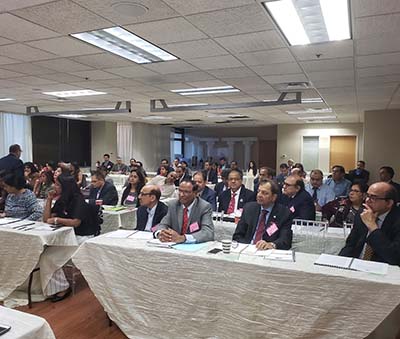
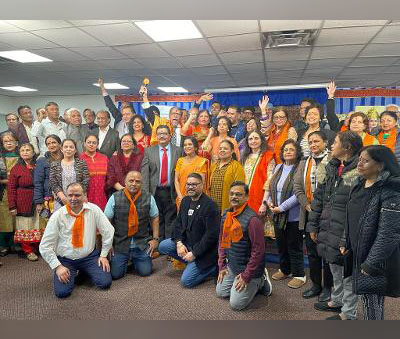
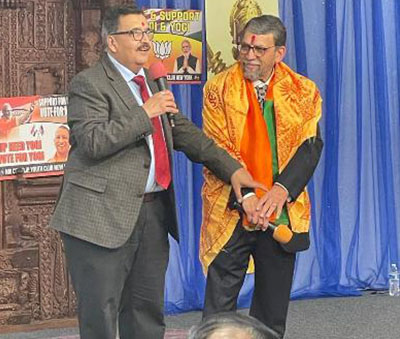
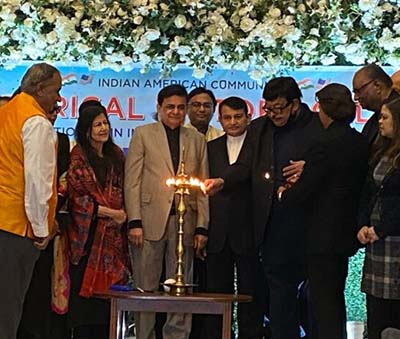
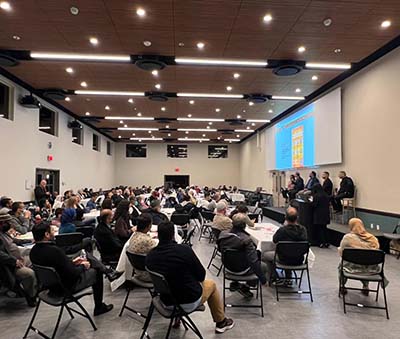
The Indian Overseas Congress (IOC, USA) celebrated the 150 Birth Anniversary of Mahatma Gandhi along with the 115th Birth Anniversary of Late Prime Minister of India Shri Lal Bahadur Shastri at Fairbridge Hotel in New Jersey. The event was attended by over 150 people and had dignitaries like Anil Shastri (Son of Late Prime Minister Shri Lal Bahadur Shastri), Salman Khurshid (Former External Affairs Minister), Himanshu Vyas (Secretary – All India Congress Committee) address the gathering with video messages from India. The Popular Mayor of Parsippany Michael Soriano was the guest of Honor. The event started off with a beautiful classical dance performance by second-generation kids. Aarush Rompally sang the American and Indian National Anthems.

The event started with videos on the life of Mahatma Gandhi and Lal Bahadur Shastri with bhajans that both the leaders had liked. The event was attended by Indian Overseas Congress President Mohinder Gilzian, Vice Chairman – George Abraham, Harbachan Singh (Secretary-General), Malini Shah (Vice President) Leela Maret (Kerala Chapter President) along with several dignitaries from the Indian Community like Viru Patel (Councilman, Edison), Bharat Patel, Chandu Patel, Harkesh Thakur, Ram Gadula etc. The event was supported by the Gandhi Ashram Trust run by Bhadra Butala, who gave free biographies of Mahatma Gandhi to all the attendees.

The Mayor – Michael Soriano spoke on the influence of Mahatma Gandhi on his ideal – Martin Luther King and said that the values of Mahatma Gandhi were an inspiration to all generations across the world. He said that the Mahatma’s message of inclusion and service to all human beings, honestly with Integrity are universally accepted principles of good human behavior.

He gave away awards to the following people for Community Service. Lal Bahadur Shastri Award for Community Service – Colonel Virander Tavatia. Mahatma Gandhi Award for Community Service to Mukesh Kashiwala, Ravinder Thota, and Bhadra Butala.

Sam Pitrioda addressed the event from Chicago on Facebook Live. He spoke on the influence of the Mahatma Gandhi had on his life and spoke on how he was influenced by the great man very early in his childhood. He spoke on the portal that they had built under the UPA Government with the help of former Prime Minister Manmohan Singh. He added that the value system Mahatma had espoused is currently under attack and  those universal values would inspire more people today and keep India secular and united.

Anil Shastri spoke on how the Mahatma has influenced people across different countries and also said that there were over 2 dozen of the Mahatma’s statues in the USA, a country he had never visited. He also spoke on how his own father Late Prime Minister Lal Bahadur Shastri was influenced by the Mahatma. Salman Khurshid spoke on the relevance of Gandhi’s message in the present context and appreciated the fact that there are still many people who valued the principles of the Mahatma.

He also praised the role of Lal Bahadur Shastri in giving importance to farmers and soldiers and the way he administered the country in critical times after the death of Nehru. Himanshu Vyas spoke on how Gandhi’s message of peace, honesty, environment, service to the underprivileged was still relevant in the present context. He also praised the way Lal Bahadur Shastri guided the country in difficult times with his slogan – Jai Jawan, Jai Kisan.

Mohinder Gilzian spoke of the great role of Mahatma Gandhi in shaping a nation with high morals and principles. ‘He has taught us to love everyone – different people, different religions, rich and poor. We should celebrate the differences and make the world a positive place for the generations to come,’ Mr. Gilzian added. He also mentioned the way Lal Bahadur Shastri ran the country and endeared himself to the nation in a short time.

George Abraham spoke about the transformational impact Gandhi continues to have impacted millions of people across the world. He added, ‘Gandhi taught us to accept suffering and even court suffering if we want personal transformation. Gandhi advocated powerlessness as the path to God, and his teachings continue to challenge us to seek God through our own active pursuit of truth and non-violence, and his philosophy is more relevant today than ever’. He also spoke on the high honesty and Integrity of Lal Bahadur Shastri. Harbachan Singh spoke on the value system that the Mahatma has inculcated to the people of India, Malini Shah spoke on the life Mahatma and his message that was conveyed by the way he lived. She also mentioned that she would be hosting her own event on the Mahatma in January 2020. Leela Maret spoke on how the Mahatma has influenced generations of people and continues to inspire people with the way he had lived his life with simplicity and honesty.

The event was planned and organized by Rajendar Dichpally and Dr.Jayesh Patel and supported by Chandu Patel and Harkesh thakur. Ashok Shah helped in arranging the hall and furniture for the event. The event was assisted by the Lal Bahadur Shastri Foundation(India) and Gandhi Ashram (Edison, USA).

A hero to the world, Gandhi is increasingly controversial in India

India is marking the 150th birthday of Mohandas Gandhi, the man known as the father of the nation, and across the country there are exhibits, commemorations, marches, prisoner releases and even a 1,000-foot-long greeting card.

But the celebrations this week mask a deeper unease. A century and a half after the birth of the revered leader of India’s independence struggle, Gandhi and his legacy are getting an update — and much of it is not positive.

Even as admiration for Gandhi remains widespread, aspects of his life and philosophy are increasingly a source of controversy. Scholars have highlighted the racist language he used as a young man living in South Africa as well as his defense of India’s caste system.

Meanwhile, on the other side of the political spectrum, India’s right-leaning Hindu nationalist ideologues have long had an ambivalent relationship with Gandhi. Some view his dedication to nonviolence as a form of weakness, or think he betrayed the cause of Hindus with his support for religious pluralism. Earlier this year, one politician from the ruling party even described the man who assassinated Gandhi as a “patriot.”

In many parts of the world, “Gandhi is seen broadly as a nice, decent, open-minded, reasonable guy who advocated nonviolence, justice, peace and so on,” said Ramachandra Guha, a historian and author of a two-volume biography of Gandhi. But in India, “his ideas and legacy have been deeply contested.”

Gandhi is often given the title “Mahatma,” or “great soul,” and many in India refer to him simply as “Bapu,” a word for father. He inspired leaders such as Nelson Mandela and the Rev. Martin Luther King Jr., who wrote that Gandhi served as a “continual reminder” that “it is possible to resist evil and yet not resort to violence.” But in his long life in the public eye — his collected works comprise nearly 100 volumes — Gandhi delved not only into politics, but also economics, religion, sexuality, sanitation and even diet.

One recent critique centers on Gandhi’s two decades in South Africa as a younger man. During that time, he repeatedly referred to black South Africans using a racial slur and described them as inferior to Indians, views that prompted a university in Ghana to remove a statue of Gandhi late last year.

A growing number of writers and scholars have also criticized Gandhi for his views on India’s caste system, saying he was a conservative who believed in preserving hereditary roles for different caste groups in Indian society rather than eradicating them.

Gandhi denounced the practice of treating certain people as “untouchable” or somehow polluting. Yet he also believed in having a “harmonious social order,” said Anand Teltumbde, one of India’s preeminent scholars on caste and the author of a recent manuscript on Gandhi. “The caste system provided that order,” Teltumbde said.

Other scholars say that Gandhi advocated a gradual reform of the system because he did not want to alienate the upper castes, which were crucial to the independence struggle.

On Wednesday, Indian Prime Minister Narendra Modi paid tribute to Gandhi at an event in Gujarat, the home state of both men. Gandhi was an advocate for better sanitation, and Modi is using his 150th birthday to celebrate the government’s “Clean India” campaign, which has constructed millions of toilets nationwide. Because of the program, India’s rural areas have essentially eradicated the practice of defecating outside, Modi said, although experts cast doubt on that claim.

Modi also praised Gandhi in an opinion piece published in the New York Times, saluting him for giving “courage to millions globally” and for envisioning “a world where every citizen has dignity and prosperity.” Modi challenged “thinkers, entrepreneurs and tech leaders” to find innovative ways to spread Gandhi’s ideas.

Modi’s emphasis on honoring Gandhi in association with the cleanliness campaign strikes some of those who knew him as a strategic choice. Although Gandhi did advocate improved sanitation, they say, it was not his central message. Those connected to the current Indian regime are using a fragment of Gandhi to destroy the core of Gandhi,” said his grandson Rajmohan Gandhi, a professor at the University of Illinois at Urbana-Champaign. “The core of Gandhi is equality and especially minority rights.”

Modi “exalts Gandhi as a prophet of cleanliness and recycling,” added Guha, Gandhi’s biographer. “He never talks about what Gandhi lived and died for, which was Hindu-Muslim harmony.”

Gandhi was assassinated in January 1948 by Nathuram Godse, a Hindu extremist. Godse was a former member of the Rashtriya Swayamsevak Sangh, a Hindu nationalist organization that is the ideological parent of the ruling Bharatiya Janata Party. (Modi spent much of his life as a full-time RSS worker.)

In May, Pragya Thakur, days before she was elected to India’s Parliament for the BJP, hailed Gandhi’s assassin Godse as a “patriot.” Modi said Thakur’s remarks were “condemnable” and she apologized, but the party ultimately took no action against her.

Some rue the fact that Gandhi is becoming irrelevant in today’s India. He has been reduced “to a ritualistic presence in our collective life,” Apoorvanand, a professor at Delhi University who goes by only one name, wrote this month. “He has been made a lifestyle guru, a feel-good presence — something he never was.” To embrace Gandhi would mean reviving “a politics of dissent . . . which sometimes requires going against one’s own people.”

When Gandhi was assassinated in New Delhi, his grandson Rajmohan was 12. Now Rajmohan is 84, older than Gandhi was when he died. Rajmohan said he took heart from a recent video of an Indian high school student reciting a poem praising Gandhi that went viral.

“There is a stubborn core of people who have understood him and know that Gandhi represents the better angels of the Indian nature,” said Rajmohan. Gandhi is “not finished in India — no, sir.”

Gandhi Alone is the ‘Father of India’

The ‘Howdy Modi’ event in Houston was an eye catcher for more reasons than one. While Modi was saying ‘All is Well’ in India, thousands of protestors outside were showing the real mirror to state of affairs in India. At the same time Donald Trump, US president, while on one hand due to face the process of impeachment, on the other he was trying to promote his electoral prospects in the next US elections.

As is his wont he does flatter visiting dignitaries, for achieving goals of his diplomacy. He went on to praise Modi to the sky; as a great leader; saying, “I remember India before was very torn. There was a lot of dissension; fighting and he (Modi) brought it all together. Like a father would. Maybe he is the ‘father of India’.”

Right within US there are many views about Modi. The last time the similar debate cropped up was just before Indian General Elections of 2019. On the eve of the elections US premier magazine Time came out with a cover story “Modi: the Divider in Chief’. Of course in another article in the same issue of the magazine he was presented as the one who is central to the process of economic reforms in India. What we see here in India and what the lead article of Time magazine presented was on the dot, the divisive role of Modi.

The observation here has been that Modi’s coming to power has strengthened the divisive forces, the forces who want Hindu nation. It is precisely these forces who have gone on rampage to unleash their agenda around Cow-Beef, the communal divisions have been deepened and identity issues have come to the fore like never before.

The minorities are being alienated and dalits-Adivasis are being marginalized. Even language wise talk has been floated to make Hindi as national language. The identity issues, which create emotive atmosphere and divide the people are to the fore. While Trump is talking in one tone, the earlier hopeful in previous Presidential elections in America, Bernie Sanders in a tweet hinted that Trump is emboldening the authoritarian leaders like Modi, the leaders who are presiding over religious persecution, repression and brutality against minorities.

Till few years ago Modi himself spoke very divisive language. Now this job has been passed down to his associates. Yogi Adityanath’s anti Muslim utterances abound. Anantkrishna Hegde like many of his ilk have been openly been talking of Hindu nation. To add to the list Sadhvi Pragya Singh Thakur, the accused in Malegaon blast, out on bail, has been praising Gandhi’s killer Godse among other things. Lately the way Article 370 has been abrogated the alienation of people of Kashmir is going up.

In a way Time magazine’s cover story did capture the state of things prevalent here. Trump is no scholar of history, ignorant of the fact as to why India regards Mahatma Gandhi as the ‘father of the nation’.

Trump’s considerations are driven by his political contingency of gradually shifting America’s closeness to India. The reason for US favoring Pakistan in yesteryears was the compulsion of cold war era. Later it kept siding with Pakistan as US designs of controlling oil wealth of West Asia were its prime motive and Pakistan was made a part of American designs in West Asia.

Now with emergence of China as a major power, and China being close to Pakistan, US gradually want to become close to India. These may be some of the factors due to which Trump is making such utterances. But that’s not about all. US is also keeping its Pakistan relationship on some scale and very shrewdly Trump did say that Modi had made aggressive remarks in Houston rally. He seems to be buttering his bread from both the sides at present.

Many a reaction to Trump’s formulations showed his hollowness. Gandhi’s grandson Tushar, tweeted that whether Trump will like to replace George Washington as one of the founding fathers of America?

What Trump has stated has pained those for whom Gandhi is the ‘father of the nation’. Any way the followers of Modi ideology do not regard Gandhi as the father of the nation. Their argument is that India the Hindu nation; is there from times immemorial and so how can Gandhi be its father. Gandhi being father of the nation also relates to the concept of nationalism.

All those who were part of ‘India as a nation in the making’ see Gandhi as the central uniting figure. During freedom movement in the anti colonial movement, it was Gandhi who played the role of uniting the country which was scattered along the lines of religion, region, caste and language. The communalists like the followers of Muslim League saw Gandhi as a Hindu leader and Hindu communalists saw Gandhi as the appeaser of Muslims.

Through the very profound and complex process, India emerged as a Nation with the principles of Liberty, Equality and Fraternity. Surely the likes of Bhagat Singh, Ambedkar, Nehru and Patel played great role in making of the modern India. The process had multiple components, anti colonialism being the core where the likes of Bhagat Singh inspired the idea and Gandhi led the greatest ever mass movement, the movement directed against British Empire.

It is due to this that Subhashchandra Bose on July 6 1944, in broadcast from Singapore Radio, sought blessings of Gandhi, addressing him as Father of Nation. Sarojini Naidu on April 6, 1947, on the eve of Independence, addressed Gandhi as Rashtrapita (Father of the Nation). So where do we go from here, the Hindu nationalist followers are going euphoric about what Trump said and all those whole identify with India’s struggle for Independence and uphold democratic values are in anguish due to this statement from US President. Trump’s superficial observation is neither sound in history of India nor knowing of what is happening in India, it’s a mere diplomatic ploy to please the visiting leader.

Nobel laureate Kailash Satyarthi calls on Harvard community to help fight child labor

By Amy Roeder

(Reprinted from Harvard T.H. Chan School of Public Health News)

In shaky, handheld camera footage from the film The Price of Free, Kailash Satyarthi and colleagues burst into an urban Indian factory, demanding, “Where are the children?” They run through the building in a desperate search, before finally finding a group of scared young boys hiding among bags of product. “Those who think that slavery has been abolished,” Satyarthi says in the clip, “they are wrong.”

Satyarthi spoke at a screening of clips from the film—a documentary about his fight against child labor and exploitation—at Harvard’s Sanders Theatre on September 27, 2019. The event was sponsored by Harvard T.H. Chan School of Public Health and the Faculty of Arts & Sciences.

In introductory remarks, Harvard Chan Dean Michelle Williams spoke about the physical and mental health toll on the 152 million children forced to work in factories, brothels, and other dangerous settings in countries including the U.S. She said that she hoped that the film would raise awareness, the first step toward addressing a crisis.

Satyarthi founded the organization Bachpan Bachao Andolan (Save Childhood Movement) in 1980, which has gone on to free more than 80,000 children from forced labor. He won the Nobel Peace Prize in 2014 for his work.

During a discussion following the screening, he shared success stories of a few of the children he has helped, including a young man in India who became a lawyer and took on an exploited girl as his first client. Satyarthi encouraged the many students in the audience to educate themselves about child labor, and to demand supply chain transparency and accountability from companies.

“We’d like to see universities become strong champions for the cause,” he told the Harvard Gazette in an interview prior to the event. “My mission in life is that every child on the earth is free; free to walk to school, free to laugh, free to play. When every child is free to be a child, only then my dream will come true.”

Before inviting audience members on stage to take a selfie with him, Satyarthi concluded his remarks with a folk tale that he said inspires him: When a forest catches on fire, most of its animal inhabitants run away, complain, and despair. But a hummingbird decides to do what she can to help, filling her small beak with water to try to extinguish the flames drop by drop. In doing so, she inspires others to join in to tackle a seemingly insurmountable problem one small piece at a time.

Rutgers University signs MOUs to collaborate with academic institutions in India

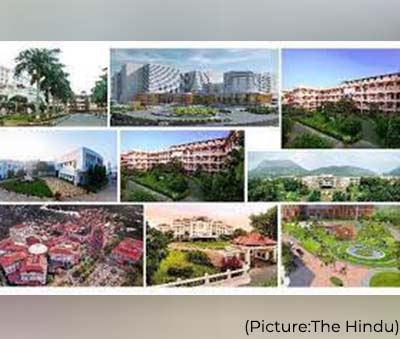
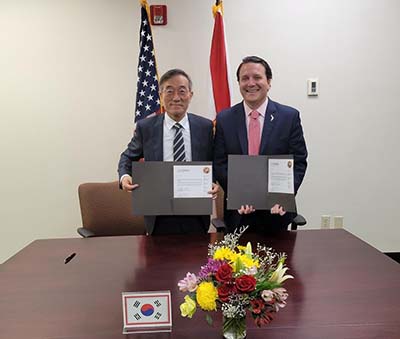
Three Memorandums of Understanding (MOUs) between Rutgers, The State University of New Jersey and two academic institutions in India were signed as part of a seven-day, six-city trade mission led by Governor Phil Murphy to strengthen economic ties and promote business investments in New Jersey.

Two MOUs were signed with the Shreemati Nathibai Damodar Thackersey Women’s University (SNDT) and one with the Indian Institute of Technology Gandhinagar (IITGN).

Rutgers and SNDT will collaborate on scientific research in agricultural, nutrition and food technology innovation and pursue the development of an AgriFood accelerator and incubator programs. The agreement with IITGN will promote student and faculty exchanges between the institutions and collaborative research projects, workshops or conferences, according to a press release.

“Rutgers understands the value of international partnerships in fostering academic and research opportunities in today’s interconnected world,” said S. David Kimball, Senior Vice President for Research and Economic Development at Rutgers University. “We look forward to these alliances with SNDT and IITGN and promoting the advancement of academic, research and educational exchanges that will open new doors for faculty and students at all three institutions.”

IITGN also signed academic exchanges with three other New Jersey universities: Rowan University, New Jersey Institute of Technology (NJIT), and New Jersey City University (NJCU).

“Globalization is one of the core pillars of IIT Gandhinagar’s educational philosophy. We are excited about partnering with some of New Jersey’s leading public universities to create new opportunities for students and faculty of all our institutions for academic and research collaborations,” said IITGN Director Sudhir Jain.

Pavita Howe, director of the Office of Research and Economic Development’s TechAdvance Fund, represented Rutgers University on the economic mission trip to India as part of the New Jersey delegation that joined Governor Murphy.

“India is a major source of cutting-edge research as well as entrepreneurial creativity, and this business mission was an important first step in developing new relationships that will result in valuable research collaborations and business opportunities,” added Howe.

New Jersey has one of the fastest growing Indian population with nearly 300,000 Indians living in the state according to the Census. The delegation’s mission was to highlight the state’s innovation ecosystem with one of New Jersey’s largest trade and investment partners, cultivate international investment opportunities in the Garden State, and deepen cultural and educational ties between New Jersey and India.

The New Jersey delegation included First Lady Tammy Murphy, Choose New Jersey President and CEO Jose Lozano, New Jersey Economic Development Authority (NJEDA) CEO Tim Sullivan, and other senior administration, Choose New Jersey officials and representatives from NJIT, Rowan, Princeton University, and New Jersey City University.

Rutgers, The State University of New Jersey, is a leading national research university and the state of New Jersey’s preeminent, comprehensive public institution of higher education. Established in 1766, the university is the eighth oldest higher education institution in the United States. More than 70,000 students and 23,400 full- and part-time faculty and staff learn, work, and serve the public at Rutgers locations across New Jersey and around the world.

Arun Agarwal appointed to Texas Medical Board

(October 8, 2019 – Dallas, TX) Texas Governor Greg Abbott appointed Dallas-based, textiles entrepreneur Arun Agarwal to the Medical Board last week. The board’s mission is to protect and enhance the public’s health, safety and welfare by establishing and maintaining standards of excellence used in regulating the practice of medicine and ensuring quality health care for the citizens of Texas through licensure, discipline and education. Agarwal is one of six Texans to receive this appointment; the others are Devinder S. Bhaita, M.D., Vanessa Hicks-Callaway, Satish Nayak, M.D., Jason Tibbels, M.D. and reappointed Robert David

Martinez, M.D. “I am honored and humbled to serve on the Texas Medical Board for the next five years,” said Agarwal. “Texans deserve the best standards in health care, and it will be our duty to regulate the practice of medicine in the state. It will be one of the highlights of my professional career.”

Arun Agarwal of Dallas is Chief Executive Officer of Nextt and has business interests in textiles, cotton trading and real estate. He is on the board of the US India Friendship Council, Big Brother Big Sisters, Texas Public Policy Foundation Education Committee, and the US Global Leadership Coalition. In addition, he volunteers with the Living Dreams Foundation. Agarwal received a Master’s in Business Administration from IMT, Ghaziabad, a Master’s in Computer Information Systems from Southern New Hampshire University and International Business from Harvard University.

United States will face shortage of up to 121,900 doctors by 2032

By Richard Liebowitz

Tens of thousands of Americans apply to U.S. medical schools each year. Only a fraction gain admission. The University of Arizona, for instance, posted a 1.9 percent acceptance rate in 2018. UCLA, Florida State University, and Wake Forest accepted fewer than 3 percent of applicants.

Many U.S. medical schools are proud of their microscopic admission rates. But they have negative ramifications for the nation’s healthcare system.

The United States will need up to 121,900 more physicians by 2032 to care for its aging population. U.S. medical schools aren’t producing enough graduates to meet that demand — and don’t have the capacity to expand anywhere close to that degree.

International medical schools are America’s best hope for addressing its physician workforce needs. They’re a crucial alternative for the thousands of qualified students who find themselves on the wrong end of a med school admissions decision as a result of the mismatch between qualified applicants and available seats.

Applying to med school has become a numbers game. In the 2018-2019 cycle, U.S. medical schools received over 850,000 applications from nearly 53,000 students. The average student applies to 16 schools.

Many students who would make terrific doctors fall through the cracks. In a recent interview with U.S. News and World Report, Dr. Robert Hasty, the founding dean and chief academic offer of the Idaho College of Osteopathic Medicine, said, “We hear from high-quality applicants every day . . . and these are people with really high MCAT scores and GPAs, that this is their second year, third year or even fourth year applying to medical schools. And years ago, they would have gotten accepted the first time through, but the demand is just incredible.”

In other words, the status quo is failing thousands of qualified applicants — and the U.S. healthcare system, which needs more doctors.

U.S. medical schools don’t appear capable of growing to address this problem. Enrollment is up only 7 percent over the past five years. That kind of modest growth won’t get us anywhere close to narrowing our nation’s projected shortage of physicians.

International medical schools can address these issues, providing opportunity to talented students and supplying the physicians America needs.

Many international schools provide an education every bit as good as those offered by U.S. schools. For example, 96 percent of first-time test takers from St. George’s University in Grenada — the school I lead — passed Step 1 of the U.S. Medical Licensing Exam in 2018. That’s the same rate as graduates of U.S. medical schools.

Research confirms that international schools produce high-caliber doctors. According to one study published by the BMJ, a leading medical journal, patients treated by doctors trained overseas had lower mortality rates than those treated by U.S.-educated doctors.

Internationally trained doctors also practice where the U.S. healthcare system needs them most. In areas where per-capita income is below $15,000 annually, more than four in ten doctors received their degrees abroad.

Americans are increasingly turning to international schools. More than 60 percent of licensed medical graduates of international schools in the Caribbean are U.S. citizens. Three-quarters of the medical students at St. George’s are U.S. citizens.

The odds of gaining admission to U.S. medical schools are growing longer. But bright young Americans don’t have to give up their dreams of becoming doctors. They can turn to top-notch international medical schools. Their future patients will surely thank them.

(Dr. Richard Liebowitz is vice chancellor of St. George’s University (www.sgu.edu). He previously served as president of New York-Presbyterian Brooklyn Methodist Hospital.)

U.S. lawmakers take a step against India on Kashmir – Senate panel adds appeal to end the “humanitarian crisis” in Kashmir in its report.

In what could become the first step towards legislative action by American lawmakers against India on the situation in Jammu and Kashmir, the United States Senate Committee on Foreign Relations has added an appeal to end what it calls a “humanitarian crisis” in Kashmir in its report ahead of the annual Foreign Appropriations Act for 2020.

The amendment was proposed by Senator Chris Van Hollen, who visited Delhi this week as a part of a congressional delegation that discussed the Kashmir situation as well as India-U.S. bilateral relations, trade ties and defence purchases with key officials.

According to the report, which was submitted to the Senate by Lindsey Graham, senior Senator and key Republican leader known for his close ties to President Donald Trump, the committee on Appropriations “notes with concern the current humanitarian crisis in Kashmir and calls on the Government of India to: fully restore telecommunications and Internet services; lift its lockdown and curfew; and release individuals detained pursuant to the Government’s revocation of Article 370 of the Indian constitution.”

What makes the report as well as the tough language on Kashmir more startling is that the document was submitted on September 26, while Prime Minister Narendra Modi was still in the US, and came just a few days after his joint address at the ‘Howdy, Modi!’ event in Houston with Mr. Trump, as well as their bilateral meeting in New York.

“This amendment, which was accepted unanimously by the bipartisan committee, is a strong expression of concern by the Senate about the situation in Kashmir and sends the signal that we are closely monitoring the human rights situation there, and would like to see the Government of India take those concerns seriously,” Mr. Van Hollen told The Hindu here, adding that he had “hoped to share his concerns privately” with Prime Minister Modi, but had not been able to meet him.

Van Hollen had met with External Affairs Minister S. Jaishankar in Washington last week and Senator Bob Menendez, also a part of the delegation, met with Commerce and Industries Minister Piyush Goyal this week in Delhi. Both Senators have made public statements in the last two months on the Kashmir situation.

While it is unclear whether their concerns over Kashmir elicited any responses from the government, The Hindu has learnt that Senator Van Hollen was rebuffed when requested permission to visit Srinagar in an effort to assess the situation on the ground.

When asked, MEA officials said the Ministry of Home Affairs handled such requests. No diplomat or foreign journalist has yet been given clearance to visit Kashmir since the government’s decision on Article 370 on August 5.

Speaking at the World Economic Forum’s India Economic Summit in Delhi on Friday, Mr. Jaishankar said many key decision-makers in the US had been “misinformed by their media” and that he had spent considerable efforts in the past few weeks to clear misconceptions on the government’s decision to drop the “temporary” Article 370.

Amnesty Reports, Hate Crimes in India Rose in 2019

Amnesty India’s hate crime tracker has recorded 181 incidents of alleged hate crimes in the first half of 2019, the steepest rise in such incidents since 2015. The count is almost double that of the same period last year, when 100 such cases were recorded.

Over two-thirds of the victims were targeted because they were Dalits, while 40 of them suffered on account of their Muslim identity. In 37 reported incidents, the victims were killed. In 30 cases, victims were raped or sexually assaulted, with sexual harassment in another 19 cases.

Between January and June 2019, 72 mob attacks were reported. Of the 37 such attacks against Muslims, the victims were lynched to death in five cases. Dalit victims were lynched to death in eight of the 28 mob attacks targeting them. There were seven honour killings and 12 cases of violence against Adivasis.…

https://www.thehindu.com/news/national/amnesty-report-hate-crimes-rose-sharply-the-first-half-of-2019/article29598191.ece

SEE ALSO:

Behind ‘Bhagwa’ Music: How Hate Is Being Sold As Entertainment (Oct 6, 2019, The Quint)
https://www.thequint.com/videos/documentaries/jo-na-bole-jai-shri-ram-song-how-spreading-hate-is-now-entertainment

Not religion but religious leaders spreading hatred, says Ramayana actor Arun Govil (Oct 7, 2019, Indian Express)
https://indianexpress.com/article/india/arun-govil-interview-ramayan-ram-mandir-6055947/

‘It’s India vs Pakistan’: From Cricket to Polls, Fight Now Shifts to MP as BJP Leader Makes Bizarre Call (Sep 30, 2019, News18)
https://www.news18.com/news/politics/its-india-vs-pakistan-from-cricket-to-polls-fight-now-shifts-to-mp-as-bjp-leader-makes-bizarre-call-2328787.html

Monkey’s Death Takes Communal Turn in UP’s Shamli, Area Tense After Bajrang Dal Protests (Oct 6, 2019, News18)
https://www.news18.com/news/india/monkeys-death-takes-communal-turn-in-ups-shamli-area-tense-after-bajrang-dal-protests-2335251.htm

The India Center Foundation – Beacon for South Asian Visual, Performing & Literary Arts in the U.S.

With a deep passion to expose mainstream and Diaspora audiences to Indian arts and culture and a board of directors committed to cultivating and promoting Indian-American artists, The India Center Foundation (ICF) is quickly becoming a premier arts destination for South Asians around the country because of its innovative programming and ground-breaking collaborations.

Founded in 2016 by a group of friends and colleagues who noticed a gap in the Indian-American cultural scene, ICF is quickly becoming the epicenter of cross-cultural collaborations, curated salon events and quirky, artist pop-ups. Founding Director and Board President Raoul Bhavnani states: “There are so many talented artists living and working in the U.S., particularly in the New York City area, and we felt many were not being noticed and supported by the community-at-large. Artists from India already have a lot of organizational support; thus, we created the India Center Foundation to fill that void for Indian-American artists and cultural organizations and serve as a platform to encourage their creativity and help them build share of voice and influence on a larger stage.”

Priya Giri Desai, Founding Director and Board Secretary, adds: “To date, there has not been a single, stand-alone organization in this country dedicated to the cultural life of Indians in America. ICF’s mission is to create and foster programming that speaks to Indian-Americans in a vocabulary and context they understand and that resonates with younger generations.  We are also seeking to galvanize the next generation of philanthropy to support this vibrant sector.”

ICF’s programming centers around conversations and collaborations between artists, institutions and experts, as seen at their recent string of events: a book reading in conjunction with the New York Public Library with author Chandrahas Choudhury in conversation with noted journalist and author Cheryl Lu-Lien Tan; a studio tour with Assam-born artist Natasha Das in conversation with Darielle Mason, Department Head of South Asian Art at the Philadelphia Museum of Art; and a storytelling, musical production held at a rooftop in Downtown Brooklyn with Kavita Das, writer and author of Poignant Song: The Life and Music of Lakshmi Shankar and the STARR Ensemble, an ensemble of talented women musicians.  ICF has also had long-running collaborations with presenting organizations like The Lincoln Center, Museum of the Moving Image, Asia Society and The Rubin Museum.

Future initiatives include one-of-a-kind pop-up events, the development of new musical work and a partnership with the inaugural New York City South Asian Film Festival (NYC SAFF). ICF is also launching a web series titled, The Road Less Traveled, which is a series of short films on interesting and emerging South Asian leaders in creative fields.

For more information about these and other events, please visit theindiacenter.us and follow us on social media @theindiacenter.

Harvard ruling backs status quo on race in college admissions rejecting discrimination claims by Indian/Asian-Americans

The first round in the lawsuit against Harvard University’s admissions program yielded a decisive victory for the status quo on affirmative action in higher education, with a federal judge ratifying how one of the world’s most prestigious schools uses race and ethnicity to choose a class and rejecting claims of discrimination against Asian Americans.

But the plaintiff, Students for Fair Admissions, which lost on all counts in the judge’s ruling this week, pledged an appeal to the U.S. Court of Appeals for the 1st Circuit. Eventually, the case could reach the Supreme Court. That would provide opponents of affirmative action another potential opening to overturn decades of precedent from the high court allowing race-conscious admissions, in a limited way, without racial quotas.

Most observers read Tuesday’s decision from U.S. District Judge Allison Burroughs in Boston as an endorsement of an admissions system used at many selective colleges. That system, known as “holistic review,” takes race into account as one among many factors in a prospective student’s background.

“It appears to be a slam dunk for Harvard,” Peter McDonough, vice president and general counsel for the American Council on Education, said after the ruling. “It is close to a slam dunk for colleges and universities across the country.” The council, a prominent advocate for higher education, had joined with other groups in a friend-of-the-court brief supporting the Harvard model.

McDonough acknowledged that a potential Supreme Court showdown looms. “But for today the story line is the unambiguous nature of the judge’s ruling,” he said. “The judge has taken 130 pages to forcefully say ‘Harvard wins.’ ”

Critics of race-conscious admissions lamented the ruling. They accused Burroughs of shrugging off questions the suit raised about why Asian American applicants tended to receive lower ratings from Harvard admission officers for their personal qualities.

“Today marks a dark day for millions of Asian American children nationwide,” Yukong Zhao, president of the Asian American Coalition for Education, said in a statement. “Our nation has witnessed another immoral attempt by America’s ruling class to continue their institutionalized discrimination against Asian American children and treat them as second-class citizens with regard to educational opportunities.”

Another group applauded the decision as a “critical victory” for Asian American students. “While we must do more to ensure that Asian American students do not face unequal opportunities through harassment, stereotyping and language barriers,” said Aarti Kohli, executive director of Advancing Justice-Asian Law Caucus, “the use of race-conscious admissions policies – which safeguard against discrimination – is an important step.”

Roger Clegg, general counsel of the Center for Equal Opportunity, which opposes what he described as racial preferences, said the ruling was not a surprise. “I don’t think it’s going to change the trajectory of what I think everybody expects to be a case that ends up before the Supreme Court,” he said. Clegg pointed to survey data from the Pew Research Center showing most Americans don’t support the use of race in admissions.

Affirmative action is not a universal practice in admissions. Several states, including California, ban race-conscious admissions in public universities. But a substantial number of competitive private and public schools acknowledge taking race into account.

Students for Fair Admissions, which says it represents rejected Asian American applicants, filed its suit in November 2014, alleging violations of civil rights law and of Supreme Court mandates. The group claimed that Harvard intentionally discriminated against Asian Americans, that it sought to “balance” its admitted class to meet preconceived targets for racial and ethnic groups, that it leaned too heavily on race as a factor in admission deliberations, and that it failed to give adequate consideration to race-neutral alternatives.

Burroughs rejected all the claims. The judge wrote that testimony from Harvard admission officers denying discrimination was “consistent, unambiguous and convincing.” She also noted that the plaintiff chose not to put an individual face onto its case. There was no individual analogue to Bakke, Grutter, Gratz or Fisher – all surnames of plaintiffs from previous eras who became part of the Supreme Court’s record on affirmative action.

Students for Fair Admissions, Burroughs wrote, “did not present a single Asian American applicant who was overtly discriminated against or who was better qualified than an admitted white applicant when considering the full range of factors that Harvard values in its admissions process.”

The judge wrote that Harvard’s record was not perfect. In a footnote, she wrote that “some slight implicit biases among some admission officers” may have affected the personal ratings of certain applicants. “While regrettable,” she wrote, such biases “cannot be completely eliminated in a process that must rely on judgments about individuals.”

She also admonished Harvard to follow the Supreme Court’s dictate from its most recent ruling on affirmative action, in 2016: that universities must continue to use data to scrutinize the fairness of their admissions programs and “assess whether changing demographics have undermined the need for a race-conscious policy.”

But Burroughs generally accepted the premise behind Harvard’s efforts: that consideration of race was necessary for the university to maintain a diverse campus. The judge cited the experience of Ruth Simmons, former president of Brown University and current president of Prairie View A&M University, as “perhaps the most cogent and compelling testimony presented at this trial.” Born in a sharecropper’s shack in Texas, Simmons became a pioneering African American leader in higher education.

Burroughs quoted Simmons at length in the conclusion of her ruling. “It’s very hard for me to overstate my conviction about the benefits that flow to all of these areas from a diverse undergraduate student body,” Simmons testified. “I know something about the lack of diversity in one’s education. . . . My father was a janitor, my mother was a maid. They had been sharecroppers, they had few opportunities. I lived through that. I remember it. So to me, the benefits that flow to students is they get a better education, a deeper education, a truer education to deal with what they’re going to have to deal with in life.”

The judge then added: “For purposes of this case, at least for now, ensuring diversity at Harvard relies, in part, on race conscious admissions.”

Number of people in the average U.S. household is going up now after 160 years

BY RICHARD FRY

Over the course of the nation’s history, there has been a slow but steady decrease in the size of the average U.S. household – from 5.79 people per household in 1790 to 2.58 in 2010. But this decade will likely be the first since the one that began in 1850 to break this long-running trend, according to newly released Census Bureau data. In 2018 there were 2.63 people per household.

Households are increasing in size mathematically because the growth in the number of households is trailing population growth. The newly released data indicates that the population residing in households has grown 6% since 2010 (the smallest population growth since the 1930s), while the number of households has grown at a slower rate (4%, from 116.7 million in 2010 to 121.5 million in 2018).

The increase in household size is significant because it could have implications for national economic growth. Rising household size reduces the demand for housing, resulting in less residential construction and less demand for home appliances and furniture. In general, it leads to a less vigorous housing sector – fewer apartment leases and home purchases, as well as less spending related to housing, such as cable company subscriptions and home accessories suppliers.

The long-running decline in American household size can be tied to at least two demographic trends. The size of immediate families has declined over time as women have had fewer children. In 1790, the total fertility rate of white women was 7.0 births (meaning a white woman had, on average, seven births in her lifetime). By 1870 it had fallen to 4.6 births, and by 1940 it stood at 2.2. For black women, the total fertility rates were 7.7 and 2.8 births for 1870 and 1940, respectively.

Furthermore, the rise of the nuclear family resulted in fewer extended family living arrangements and smaller households. In 1850, almost 70% of those ages 65 and older lived with their adult children. By 2000, fewer than 15% did so. These demographic changes may reflect more fundamental societal changes such as industrialization, urbanization, rising living standards (especially for older adults) and constricted immigration in the first half of the 1900s.

This decade’s likely upturn in average household size reflects several demographic trends.

A growing share of the population resides in multigenerational family households. By 2016, 20% of Americans lived in a multigenerational household, up from 12% in 1980. On average, these families have about two more members than other households. This partly reflects the country’s increasing racial and ethnic diversity. The Asian, black and Hispanic populations are more likely to live in multigenerational households than non-Hispanic whites.

In addition, more Americans in the wake of the Great Recession are “doubled up” in shared living quarters. This arrangement refers to the presence of an “extra adult” in the household, who might be an adult child or parent of the householder, or simply a roommate or boarder in the household. In 2019, 20% of households are shared households, up from 17% in 2007.

Most age groups are living in larger households this decade. The change is most apparent for adults ages 35 and older. For example, in 2017, 67% of 35- to 54-year-olds lived in a household with three or more people, an increase from 64% in 2010. A similar increase in households of three or more is apparent among 55- to 64-year-olds.

While bigger households may be bad for the wider economy, they are often advantageous for the households themselves. The additional household members may be working adults who contribute to household income. The widely noted arrangement of young adults residing with their parents demonstrates the economic benefits of bigger households. Last year, 6% of families that had at least one adult child age 25 to 34 living in the home were in poverty. The Census Bureau estimates that the poverty rate for these families would have been 11.5% if the young adult were not a member of the household.

Average household size will likely exceed 2.58 persons in 2020 if the current pace of household growth holds.

Note: There are two ways to look at trends regarding households in the U.S. In this analysis, which treats all households equally, the average household has 2.6 people. Other analyses look at it through the prism of the average person and find that the average person lives in a household with 3.4 people. The average based on people gives more weight to larger households since there are more people residing in them.

Aliens will likely be discovered within 30 years, Nobel Prize-winning astronomer says

A Nobel prize-winning astronomer has predicted that humans will find evidence of alien life in the next 30 years.  On Tuesday, Professor Didier Queloz, from Switzerland, said he was “convinced” of the existence of extraterrestrial life after winning the 2019 Nobel Prize in Physics.

“I can’t believe we are the only living entity in the universe,” the Cambridge University professor said while speaking at the Science Media Centre in London, according to The Telegraph. “There are just way too many planets, way too many stars, and the chemistry is universal.

“The chemistry that led to life has to happen elsewhere. So I am a strong believer that there must be life elsewhere. “Life doesn’t just mean a green man coming to you, life started way before animals were crawling on the surface of earth.”

According to the professor, he is certain that humans will have detected alien life in 100 years’ time.  However, he is convinced it will happen much sooner than that, once we have built more advanced technology capable of detecting life on distant planets.

Professor Queloz, who discovered the first planet outside our solar system while still a PhD student, won the Nobel Prize alongside fellow researcher Michel Mayor, his PhD supervisor at Princeton.

In 1995, Professor Queloz and Professor Mayor discovered the exoplanet 51 Pegasi b using the Doppler spectroscopy technique, which measures wobbles of a star as a planet orbits around it.

Since their initial discovery, more than 4,100 additional exoplanets have been found.

The Nobel Prize was awarded to the scientists for “contributions to our understanding of the evolution of the universe and Earth’s place in the cosmos”, with half of the prize awarded to James Peebles, for “theoretical discoveries in physical cosmology”.

New South Asian Film Festival to be held in New York

After the roaring success of the 5th annual Dallas-Fort Worth South Asian Film Festival (DFW SAFF), Toyota Motor North America presents its second film festival in the United States, the New York City South Asian Film Festival (NYC SAFF), gearing up to make its debut in mid-November at various venues around Chelsea in Manhattan.

“Cultural diversity is something we celebrate every day at Toyota,” said Vinay Shahani, vice president, integrated marketing operations, Toyota Motor North America, in a statement. “After the success of our partnership with DFW SAFF, we look forward to continuing the celebration of storytelling at the first-ever NYC SAFF, and we hope that festival-goers are inspired by the films.”

Produced by Jingo Media, a NYC and Dallas-based events and public relations company, the inaugural, three-day festival boasts world, U.S. and New York City premieres of more than 25 shorts, documentaries and feature films focused on the unique stories of the South Asian Diaspora and those of our brothers and sisters back home. Jingo Media is also the parent company of DFW SAFF, which was conceptualized and created in 2015.

“We are so proud to create yet ANOTHER platform for world-class independent cinema from India, Nepal, Pakistan, Bangladesh, Sri Lanka, Bhutan, Afghanistan and the Maldives,” said Jitin Hingorani, CEO/Principal of Jingo Media, a public relations company that launched in New York City in 2010. “We’re coming full circle with this festival because Manhattan is where it all began for us almost 10 years ago. We are certain that the community-at-large will embrace us and celebrate our joyous homecoming.”

NYC SAFF has also partnered with The India Center Foundation (ICF), a New York City-based nonprofit organization dedicated to the study of the Indian subcontinent, the promotion of its cultural life and the unique relationship between India and the United States.

“To partner with NYC SAFF means that ICF is reaching the audience we wish to serve: contemporary, aware, woke desis and lovers of Indian and Diasporic creativity and storytelling. As a filmmaker whose film was so lovingly received at DFW SAFF, I know we are working with a staff who is dedicated and eager to give New Yorkers the film experience they deserve when it comes to screening South Asian cinema. We are looking forward to partnering on great conversations and panels around the films we see together,” said Priya Giri Desai, Founding Director of ICF.

NYC SAFF’s exclusive music partner is JioSaavn (founded in 2007 as Saavn), the online music streaming service and a digital distributor of Bollywood, English and other regional Indian music across the world.

“Music has always been an integral part of South Asian culture. We have all experienced a range of it in classical Indian cinema to contemporary Bollywood to  regional films to completely new and independent genres. We look forward to the next generation of visual arts conceived in the South Asian Diaspora, and that’s why JioSaavn is proud to partner with NYC SAFF and ICF to help create more awareness of their artists’ creative work and engaging stories,” said Vinodh Bhat, Co-Founder, President and Chief Strategy Officer.

The inaugural NYC SAFF will take place from November 15 to 17, 2019. The opening night film, red carpet and VIP party will be held the Altman Building (135 W 18th, between 6th and 7th). The film screenings on Saturday and Sunday will be at the AMC 34th Street (between 8th and 9th). Centerpiece party will be held at Tailor Public House (505 8th Avenue), and the closing night festivities and awards ceremony take place at the brand new Rumi Event Space (229 W 28th, between 8th and 9th). The entire festival lineup and schedule will be unveiled in mid-October at www.nycsaff.com, according to a press release.

Kareena Kapoor says, she will be acting until she dies

Actress Kareena Kapoor Khan, who has almost completed two decades in the industry, says she was born to act and that she will hopefully do it till the end of her life. Kareena made her acting debut with “Refugee” along with Abhishek Bachchan in 2000.

Since then, she has been part of some of the most successful films like “Jab We Met”, “Udta Punjab”, “Veere Di Wedding”, “Chameli” and “Asoka”.

“It has been an amazing 20 years. It has been a fabulous journey working with some amazing people. I was born to act because I feel that’s where my passion is and I will hopefully act till the end of my life.”

Now, Kareena is looking forward to working with Aamir Khan for the third time in “Laal Singh Chadha” and has hailed the superstar a cinematic genius.

“I can’t talk about the film because it’s very special but when the time is right we will definitely talk about it. It’s going to be an absolute honour for me to be in the same frame with Aamir because I am always been a huge fan of Aamir,” Kareena was interacting with the media at the Elle Beauty Awards 2019 on Saturday here.

Kareena has previously shared screen space with Aamir Khan in Reema Kagti’s “Talaash” and Rajkumar Hirani’s “3 Idiots”.

“It’s always been a dream come true moment whenever I work with him. He is a cinematic genius and sharing a frame with him again would be an absolute dream come true moment for me,” she added.

“Laal Singh Chadha” is an official remake of the Hollywood classic “Forrest Gump”. It is written by Atul Kulkarni, directed by Advait Chandan and co-produced by Viacom18 Studios with Aamir Khan Productions.

The movie is slated to hit theatres during Christmas 2020.

The actress is returning with the second season of her radio chat show “What Women Want”, and it seems she is getting even more personal this time.

Kareena will have husband Saif Ali Khan as one of the first guests of Season 2.

“Finally, we have Saif (Saif Ali Khan) also on ‘What Women Want’. In the show, he will be talking about modern marriages. I think season one was such a big success and people talked so openly about different matters of their life in it.

“I am very happy because this time we have some amazing and exciting guests. We have shot with my mother-in-law (Sharmila Tagore), so I think it’s going to get better than season one.”

Trump and Modi address Indian-Americans at HowdyModi! Event in Houston

While praising their own achievements, Indian Prime Minister Narendra Modi and U.S. President Donald Trump hailed the friendship between the world’s oldest and largest democracies at the HowdyModi! event at the NRG stadium Sept. 22, attended by over 50,000 people from across the nation.

For Modi, it was a political victory when the leader of the most powerful nation seemingly endorsed his position on Pakistan as a key problem in the fight against global terrorism, as well as the controversial step downgrading Article 370 relating to Kashmir’s special status; For Trump it was an opportunity to join Modi in showering high praise on the Indian-American community and its accomplishments, cashing in on an estimated 50,000-strong captive audience in an election year.

In his speech, Modi lashed out at Pakistan without naming it, for fomenting terrorism in South Asia, and justified his steps to end Kashmir’s special status saying it brought Kashmiris on par with the rest of Indians.

President Trump said that just as he had promised before his election, “You have never had  a better friend than Donald Trump,” in the White House. Trump paid lavish compliments to Indian-Americans. “I’ve also come to express my profound gratitude to the nearly 4 million amazing Indian Americans all across our country.  You enrich our culture, you uphold our values, you uplift our communities, and you are truly proud to be American.  And we are proud to have you as Americans,” the President said in language typical of a campaign rally, adding, “We thank you.  We love you.  And I want you to know my administration is fighting for you each and every day.”

This rally has been called a win-win for both the leaders. For President Trump, it was a chance to court Indian-Americans for the 2020 presidential election race where Texas could emerge as a battleground state. For Mr Modi, a PR triumph and picture with the president of the United States may help him shrug off the criticism over his recent strong-arm polices at home.

Houston’s NRG Stadium, where the event was hosted, was the first stop for Mr Modi, whose Hindu nationalist Bharatiya Janata Party (BJP) won a landslide victory in this year’s Indian elections.

Greeted by a standing ovation, Mr Trump used his speech to heap praise on Mr Modi, who he said was doing a “truly exceptional job for India” and its people.

Mr Trump also paid tribute to the Indian-American community, telling them “we are truly proud to have you as Americans”.

The US has a population of about 4 million Indians who are seen as an increasingly important vote bank in the country.

Apart from Mr Trump, organisers also invited Democrats to the event – House Majority Leader Steny Hoyer was among those who spoke.

The 2010 US census shows that Texas is home to the fourth-largest Indian-American population in the country after California, New York and New Jersey.  Analysis of voting patterns shows the community tends overwhelmingly to support the Democrat party.

The rally gave Trump an opportunity to appeal to Indian-American voters in Harris County, which has been at the heart of Texas’ gradual shift from reliably Republican to competitive battleground. Modi, who is set to attend the United Nations General Assembly this week, could help give Trump a bump in his battle for reelection.

On stage, Modi introduced Trump as India’s “true friend” in the White House, and he invoked Trump in his signature campaign slogan, “Ab ki baar, Modi sarkar,” which translates to “This time, Modi government.” On stage, Modi replaced his name with Trump’s.

He commended the Trump administration for celebrating Diwali at the White House, and he invited Trump and his family to come to India.

Modi said he is “certain that some positive developments” will come out of upcoming talks at the UN. “President Trump calls me the top negotiator but he himself is great at the ‘Art of the deal’ and I am learning a lot from him,” he said.

The event was the first of two events on Sunday with foreign leaders in battleground states. After the rally, Trump flew to Wapakoneta, Ohio, to tour an Australian-owned cardboard manufacturing plant alongside Australian Prime Minister Scott Morrison, who Trump feted with a state dinner on Friday.

The events were an opportunity for both Modi and Morrison to show the US President they can deliver in ways that are especially appealing to Trump.

The exhibition of bonhomie with lots of hand-holding and hugs, culminated in a victory lap with both leaders joining hands and intermittently holding their arms aloft, around the track of the stadium to standing ovation. Modi appeared in control of the agenda at the massive gathering, as according to some news reports, the walk around the stadium was unscripted and spontaneous.

For his part, Modi showered exuberant praise on President Trump while introducing him as the first speaker, saying the American President’s “every word is followed by tens of millions,” and that his name “is familiar to every person on the planet,” and even praised Trump for having “left a lasting impact everywhere.”

The Indian leader extended an invitation to Trump to visit India with his family, and Trump in his speech joked that he may suddenly land up to watch the first ever NBA match to be played in Mumbai next month.

Both India and the U.S. stand against “radical Islamic terrorism,” Trump said. “We’re especially grateful to be joined by over 50,000 incredible members of our nation’s thriving, prospering, flourishing, and hardworking Indian American community.  Thank you,” said President Trump. He had more to say in a year when election campaigns are the order of the day. “Prime Minister Modi and I have come to Houston to celebrate everything that unites America and India: our shared dreams and bright futures,” Trump said.

Indian-Americans are the highest educated, highest earning minority in the country, and their  rising importance in U.S. politics was more than clear when Trump sat through Modi’s nearly forty-minute speech after delivering his own.

Modi got his share of praise when Trump said he had done “a truly exceptional job for India and for all of the Indian people. Under Prime Minister Modi’s leadership, the world is witnessing a strong, sovereign, and thriving Republic of India.  (Applause.)  In a single decade, with the help of Prime Minister Modi’s pro-growth reforms, India has lifted nearly 300 million people out of poverty, and that is an incredible number.  Incredible.  That’s incredible.  In the next decade, 140 million Indian household will rise to the middle class,” Trump said.

Close to 20 U.S. lawmakers representing both parties, jump-started the event by lining up on stage with brief speeches by House Majority Leader Steny Hoyer, D-Maryland, and senior Texas Sen. John Cornyn, R-Texas.

Congressman Raja Krishnamoorthi, D-Illinois, was the only Indian-American lawmaker from among the four elected representatives currently in the House of Representatives, and an Indian-American Senator. Among other notable officials who attended were Reps. Carolyn Maloney, D-NY, Sheila Jackson Lee, D-Texas, and Sen. Ted Cruz, R-Texas.

Cornyn said Texas was unmatched among the U.S. states, in engaging with India, and praised the large Indian-American community in Houston; Hoyer introduced Modi saying House Speaker Nancy Pelosi also welcomed him, and in being present, delinked domestic politics from international diplomacy, while keeping Kashmir out of the equation. Every speaker made mention of “common” values of democracy, the people-to-people ties, and the contributions of Indian-Americans to this country.

“Today we are seeing new history being made,” said Modi who spoke in Hindi. “And a new chemistry.” The presence of President Trump, the bipartisan lawmakers is a sign of the respect they hold for 1.3 billion Indians, he said.  “Unity in diversity is our specialty. India’s diversity is proof of our democracy. It is our strength and our wish,” the Prime Minister said. “Wherever we go we take our diversity with us,” he added. “In this stadium, the more than 50,000 people represent our ancient history,” he said. “There are many among you who participated in the 2019 election,” which he noted saw 610 million come to the polling booth, two times the size of the American population.

A 21st Century India, Modi said, is impatient to become a “new India” and working to “challenge ourselves, we are changing ourselves.” He then trotted out figures to prove the expansion of electricity, cooking gas, rural road connectivity, bank accounts, to achieve “ease of living.” Modi also promised American investors India presented a “great opportunity” for them.

Outside the NRG Stadium, scores of protesters held placards and shouted slogans criticizing Modi, as did supporters of the Prime Minister. Two opposing opinions were also apparent in social media, and in statements released.

On the other side, were commentators like Houstonians Swati Narayan, director of the non-profit Culture of Health Advancing Together which works with immigrant and refugee families, and Manpreet K. Singh, director and trustee with the Texas chapter of the Sikh Coalition and the American Civil Liberties Union. They wrote an opinion on CNN, entitled, “Why we won’t be cheering Modi and Trump in Houston,” which condemned actions in Kashmir, saying, .. we want the people of Kashmir to have a voice in their own state, and we want democracy restored. And most of all, we want India to live up to the pluralist and secular society it claims to be.”

Pope Francis Tells UN Climate Summit 2019 ‘Three Words’ He Wishes to Be at the Heart of Their Work

“I would like these three key words – honesty, courage and responsibility – to be at the heart of your work today and tomorrow.”

The Holy Father expressed this in a video message he sent on Monday, Sept. 23, to participants at the United Nations Climate Action Summit 2019 in New York, while noting the situation is not good and the planet is suffering, Francis said, “the window of opportunity is still open. We are still in time.”

“Let us open it,” he said, “with our determination to cultivate integral human development, to ensure a better life for future generations.”

The problem of climate change, Francis stressed, is related to issues of ethics, equity and social justice, adding that the current situation of environmental degradation “is connected with the human, ethical and social degradation that we experience every day.”

“This,” he recognized,  “forces us to think about the meaning of our models of consumption and production, and the processes of education and awareness, to make them consistent with human dignity.”

He reminded that there are a numerous solutions “within everyone’s reach, if we adopt on a personal and social level a lifestyle that embodies honesty, courage and responsibility.”

The Holy Father prayed those words accompany them together with his best wishes and prayer. Here is the Vatican-provided text of the Holy Father’s video-message.

I would like to thank the United Nations Secretary-General, Mr António Guterres, for convening this meeting and for drawing the attention of Heads of State and Government – and of the entire international community and world public opinion – to one of the most serious and worrying phenomena of our time: climate change.

This is one of the principal challenges we have to face. To do so, humanity is called to cultivate three great moral qualities: honesty, responsibility and courage.

With the Paris Agreement of 12 December 2015, the international community became aware of the urgency and need for a collective response to help build our common home. However, four years after that historic Agreement, we can see that the commitments made by States are still very “weak”, and are far from achieving the objectives set.

Along with so many initiatives, not only by governments but by civil society as a whole, it is necessary to ask whether there is a real political will to allocate greater human, financial and technological resources to mitigate the negative effects of climate change and to help the poorest and most vulnerable populations, who suffer the most.

While the situation is not good and the planet is suffering, the window of opportunity is still open. We are still in time. Let us not let it close. Let us open it with our determination to cultivate integral human development, to ensure a better life for future generations. It is their future, not ours. “Although the post-industrial period may well be remembered as one of the most irresponsible in history, nonetheless there is reason to hope that humanity at the dawn of the twenty-first century will be remembered for having generously shouldered its grave responsibilities” (Laudato si’, 165).

With honesty, responsibility and courage we have to put our intelligence “at the service of another type of progress, one which is healthier, more human, more social, more integral” (Laudato si’, 112), capable of placing economy at the service of the human person, building peace and protecting the environment.

The problem of climate change is related to issues of ethics, equity and social justice. The current situation of environmental degradation is connected with the human, ethical and social degradation that we experience every day. And this forces us to think about the meaning of our models of consumption and production, and the processes of education and awareness, to make them consistent with human dignity. We are facing a “challenge of civilization” in favour of the common good. And this is clear, just as it is clear that we have a multiplicity of solutions that are within everyone’s reach, if we adopt on a personal and social level a lifestyle that embodies honesty, courage and responsibility.

I would like these three key words – honesty, courage and responsibility – to be at the heart of your work today and tomorrow. May they accompany you together with my best wishes and with my prayer.

Thank you very much.

Pope Francis

Protesting Climate Change, Young People Take to Streets in a Global Strike

“We are in a deep climate hole. To get out, we must first stop digging,” he said. “Is it common sense to build ever more coal plants that are choking our future? Is it common sense to reward pollution that kills millions with dirty air and makes it dangerous for people in cities around the world to sometimes even venture out of their homes?”

The speeches inside the green-marbled General Assembly hall on Monday stood in sharp contrast to the anger that spilled onto the streets Friday, when masses of children and young people protested around the world. On Monday, protesters blocked traffic in Washington to demand a swift pivot away from the world’s fossil fuel-based economy. More youth protests are planned for later in the week.

Laurence Tubiana, a former climate negotiator from France, said she was struck by the fact that several leaders said they heard the message from young people in the streets. “Everyone said, ‘We hear you,’” she said. “But they are tone deaf.”

Studies show that if emissions continue to rise at their current pace, the number of people needing humanitarian aid as a result of natural disasters could double by 2050. And a sweeping report from 13 United States federal agencies last year warned that failing to rein in warming could shave 10 percent off the country’s economy by century’s end.

Rajiv Gandhi’s statesmanship accomplished peace inside and outside India: Mani Shankar Aiyar

Delivering the inaugural Rajiv Gandhi Lecture, Congress party leader Mani Shankar Aiyer offered a blistering critique of policies of Prime Minister Narendra Modi’s government and the overall direction India is currently moving toward.

In his speech, which lasted more than 70 minutes, the former cabinet minister spoke about the lasting impact of various policies and initiatives introduced by Gandhi, who served as prime minister of India from October 1984 to December 1989.

The Rajiv Gandhi Lecture was organized by the Washington, DC, chapter of the Indian Overseas Congress USA on September 17. The lecture series was instituted by the DC Chapter to commemorate the 75th birth anniversary of India’s sixth prime minister.

Aiyer, a former Indian Foreign Service officer and contemporary of Gandhi at Dehra Doon’s Doon School, offered an insider’s view — he served under the former prime minister in various roles — on a number of challenges Gandhi tackled during his tenure.

The former member of Rajya Sabha, the upper chamber of India’s parliament, compared Gandhi’s leadership with that of Modi.

He was especially critical of the current government’s Kashmir policy and its treatment of the minorities. India downgraded the status of Jammu and Kashmir from a state to a union territory, under the control of New Delhi, on August 5. Since then there has been a massive security clampdown and a communication blockade in the region.

“Can we have the territory of Kashmir, without the people of Kashmir?” Aiyer asked. “If the people of Kashmir are with us, as the government is claiming, then why don’t you leave them free to carry [National Security Advisor to the Prime Minister of India] Ajit Doval on their shoulders and say what a great man he is. Why don’t you let them out to put up posters saying ‘Modi zindabad! [Home Minister] Amit Shah Zindabad!’”

Contrasting Modi’s policies in Kashmir and Assam, where the government is implementing a controversial citizenship rule that critics say will rob millions of Muslims of Indian citizenship, Aiyer highlighted a number of accomplishments of Gandhi, both domestically and on foreign policy front, including his rapprochement with Pakistan and China, and signing of peace treaties with rebels in Punjab, Assam, Mizoram and Sri Lanka,

In a span of 18 months, Rajiv Gandhi was able to settle the perennial challenges to the country’s integrity whether in Punjab, Assam or Mizoram, Aiyar said.

He said Gandhi’s reconciliatory measures was instrumental in ending an insurgency in Punjab, He pointed out that the prime minister visited Punjab within four months after the anti-Sikh riots — which he called a pogrom — in Delhi following the assassination of Prime Minister Indira Gandhi, at the height of hostilities, and appointed Arjun Singh as governor to hold talks and enter into a peace accord.

This should serve as a lesson to negotiate peace with Kashmiris, 25 percent of whom were “with us” before revocation of Article 370 but 100 percent “against us” now, Aiyer said.

Referring to the Assam situation, he said Assam was tackled by Rajiv Gandhi similarly by negotiating a successful peace accord with the agitating Assam students and even sacrificing the incumbent Congress government in the state. In ensuing elections, “Congress was hopelessly defeated but India won,” he recalled.

In Mizoram, a 20-year-old insurgency was ended by handing over power to rebel leader Laldenga, who became chief minister replacing a Congress party government. Contrast this with how the insurgency in Nagaland is being handled now, Aiyer said. Five years ago, there was a Naga agreement but still no details are made public, he said.

On the foreign policy front, Gandhi became the first prime minister after Nehru to visit Pakistan, and it paved the way for better relations and opening bilateral talks, Aiyer said.

Referring to India’s effort to end a civil war in Sri Lanka and station an Indian Peace Keeping Force, he said: “Rajiv Gandhi has often been denigrated as a man with failure but how do you get acceptance of a neighbor without acceding to their request? When Maldives was beset with a coup, Rajiv sitting in Harare had sent Indian forces to restore democracy there.”

Even with Pakistan, Gandhi repeatedly met with then-Pakistan President Zia-ul-Huq, Aiyer said. After his return from a vacation in Andamans, Gandhi found that the border situation has escalated to the brink of a war as Operation Brasstracks and he managed to invite Huq to Delhi to resolve the tension peacefully. A prime minister should be able to defuse the tension and strive to arriving at a political settlement, Aiyar said.

Gandhi loved quoting Buddha’s words often: “The only victory is the one where there are no victors,” and he cited these words even at a UN address, the Congress leader said.

Another major accomplishment of Rajiv Gandhi was his visit to China in 1988, which defeated India in 1962. At the Great Hall of the People in Beijing, Chinese leader Deng Xia Ping held Gandhi’s hand throughout the parade sending a strong signal to the world. “We talk to China often, though we were defeated by them, but never hold talks with Pakistan, whom we had defeated,” said Aiyar who had served in Islamabad as a diplomat in the early 1980s.

“If you don’t trust Pakistan, you are putting yourself on the path of a nuclear bomb,” Aiyer said. “If you don’t trust Pakistanis the way I do, they are not so stupid to use a bomb… If you don’t talk, rifle is the answer. You will have the satisfaction of destroying Pakistan and they will have the satisfaction of destroying you. Nearly 1.5 billion people will be vanished. Is that the answer?”

Among Gandhi’s domestic accomplishments was the passage of an anti-defection law and keeping it under the Tenth Schedule of the Constitution, Aiyer said. It helped stem the “Aayaram, Gayaram” trend in Indian politics, the former parliamentarian said, terming it as a “disease of Indian democracy (that) was removed by Rajiv Gandhi within a week or so of his becoming the prime minister with an electoral majority, the largest majority that any Prime Minister in India ever received,” he said.

The introduction of reservation for women and socially backward segments of the Indian society helped achieve balance in people’s representation at local levels, Aiyer said. Thanks to Gandhi, who made democracy at the grassroots level a reality, there are 86,000 women who are running Panchayats in India now, he pointed out.

Another legacy of Gandhi, according to Aiyer, was the lowering of the voting age to 18 years, which made India’s youth part of the decision-making process.

Aiyer’s speech was tinged with anecdotes. He recalled his first meeting with Gandhi at Doon school, where the former prime minister was three years junior and again at Cambridge University. Aiyar said Gandhi canvassed for him when he contested student Cambridge Union election.

“Rajiv began his political career by canvassing for me, so I think it is appropriate that I ended up in PMO and supported him,” he noted in his address at the lecture, organized by the Indian Overseas Congress on September 17, 2019.

At the event, Aiyer also inaugurated the re-organized DC Chapter of Indian Overseas Congress USA.

IOC USA President Mohinder Singh Gilzian and Vice Chairman George Abraham spoke on the occasion. The organization’s Chairman Sam Pitroda addressed the gathering from Chicago via Skype.

Other speakers included the newly appointed president of the DC Chapter Johnson Myalil and chapter committee members Ashok Batra and Rohit Tripathi.

Video link: https://youtu.be/z2pmRJmRIUA

At U.N. Climate Summit, Few Commitments and U.S. Silence

The United Nations Climate Action Summit on Monday, September 24th  was meant to highlight concrete promises by presidents, prime ministers and corporate executives to wean the global economy from fossil fuels to avoid the worst effects of global warming.

But despite the protests in the streets, China on Monday made no new promises to take stronger climate action. The United States, having vowed to pull out of the Paris Agreement, the pact among nations to jointly fight climate change, said nothing at all. A host of countries made only incremental promises.

The contrast between the slow pace of action and the urgency of the problem was underscored by the Swedish climate activist Greta Thunberg, 16, who excoriated world leaders for their “business as usual” approach. “The eyes of all future generations are upon you,” she said, her voice quavering with rage. “If you choose to fail us, I say we will never forgive you.”

There were some concrete measures. By the end of the day, 65 countries had announced efforts to achieve net-zero emissions by 2050, several asset fund managers said they would aim to get to a net-zero portfolio of investments by the same year, and dozens of businesses said they would aim to abide by the Paris Agreement targets.

The summit comes at a time when the latest science shows that the world is getting hotter faster and the dangers of global warming are increasingly clear, with more intense hurricanes, longer droughts and heat records being broken. It was an opportunity to show that the world’s most powerful countries could step up. Advocates and diplomats who have been following climate talks for years said they were disappointed.

Andrew Steer, head of the World Resources Institute and a former World Bank official, said most of the major economies fell “woefully short” of expectations. “Their lack of ambition stands in sharp contrast with the growing demand for action around the world,” he said.

The United States did not request a speaking slot at the summit, but President Trump unexpectedly dropped into the General Assembly hall with Vice President Mike Pence in the late morning. Michael R. Bloomberg, the former New York City mayor who is now a United Nations special envoy for climate, welcomed Mr. Trump’s presence and addressed the president directly by saying, “Hopefully our discussions here will be useful for you when you formulate climate policy.”

That was followed by laughter and applause. It signaled a sharp contrast from just a few years ago, when the United States was credited with pushing other countries, including China, to take climate change seriously. The United States has said it intends to withdraw from the 2015 Paris climate accord. It is not on track to meet its voluntary pledges under the agreement in any case. And the Trump administration has rolled back a host of environmental regulations that were meant to curb greenhouse gas emissions from automobile tailpipescoal plants and oil and gas wells.

As for China, it did not signal its readiness to issue stronger, swifter targets to transition away from fossil fuels, as many had hoped. Wang Yi, a special representative for President Xi Jinping, noted that his country was keeping the promises it made under the 2015 Paris Agreement and that “certain countries” — a clear reference to the United States — were not.  “China will faithfully fulfill its obligations,” Mr. Wang said.

China’s decision to not signal higher ambition reflects, in part, concerns about its own slowing economy against the backdrop of conflicts with the United States on trade. It also reflected Beijing’s reluctance to take stronger climate action in the absence of similar moves from richer countries. The European Union has not signaled its intention to cut emissions faster either, and the United States is nowhere on track to meet its original commitments under the Paris accord.

President Emmanuel Macron of France also had a message on trade for the United States, telling the assembly, “I don’t want to see new trade negotiations with countries who are running counter to the Paris Agreement.”

The statement could create a new stumbling block in talks between the United States and the European Union for a free-trade agreement. Those negotiations are already complicated by deep differences over agricultural policy and threats by Mr. Trump to impose tariffs on automobile parts from Europe if the talks fail to make progress.

Prime Minister Narendra Modi of India said his country would increase its share of renewable energy by 2022, without making any promises to reduce its dependence on coal. Chancellor Angela Merkel of Germany promoted a new plan worth $60 billion over 10 years to speed a transition to clean power.

Russia announced that it would ratify the Paris Agreement, but nothing more about how to cut emissions from its sprawling state-owned petroleum industry.

The summit unfolded against the backdrop of new data that showed the quickening pace of warming.  The world is getting hotter faster, the World Meteorological Organization concluded in its latest report Sunday, with the five-year period between 2014 and 2019 the warmest on record. Emissions of carbon dioxide, a major contributor to global warming when it is pumped into the atmosphere, are at record highs. The seas are rising rapidly. The average global temperature is 1.1 degrees Celsius higher than what it was in the mid-19th century, and at the current pace, average global temperatures will be 3 degrees Celsius higher by the end of this century.

“I will not be there, but my granddaughters will, and your grandchildren, too,” Mr. Guterres said in his opening remarks. “I refuse to be an accomplice in the destruction of their one and only home.”

Mr. Guterres’s most direct call went to those countries that use money from their taxpayers to subsidize fossil fuel projects that, as he put it, “boost hurricanes, spread tropical diseases and heighten conflict.”

At the U.N., It Was the Day of Populist Strongmen

UNITED NATIONS, Sep 25 2019 (IPS) – The United Nations is an institution which promotes multilateralism and preaches some of the basic tenets of multiparty democracy and liberalism, including the rule of law, universal human rights, free speech, civil liberties, the rights of refugees and freedom of the press.

But, paradoxically, the first four speakers during the opening day, September 24, of the 74th session of the U.N. General Assembly—Brazil’s Jair Bolsonaro, U.S. president Donald Trump, Egypt’s President Abdel Fattah al-Sisi and Turkish President Recep Tayyip Erdogan —represented the very anti-thesis of what the world body stands for.

They have been best described either as rightwing nationalists, populist strongmen or authoritarian leaders—who, like Al-Sisi, presides over a repressive regime.

Martin S. Edwards, Associate Professor and Chair, School of Diplomacy and International Relations at Seton Hall University, told IPS, “I watched these speeches with students from several of these countries.  To be sure, the rhetoric can scare you.”

But these students were not scared, because of two things, he pointed out.

First, they know history. Just as President Trump spoke of national renewal, there is also a reformist tradition in the US as in other countries that practices a politics based on inclusion and not fear. These traditions haven’t gone away, and they will return, he said.

Second, they know facts.

“The U.N. is tremendously popular across the globe, and they know that we can no more deny the necessity for international cooperation than we can deny the existence of gravity,” said Edwards, who is also director of the Center for U.N. and Global Governance Studies.

So, many called today—the opening day of the General Assembly sessions–“the day of populist strong men”. But their time won’t last, he predicted.

And it’s interesting to juxtapose their speeches with student activist Greta Thurnberg’s on the climate change crisis on Monday.

Secretary-General Antonio Guterres is banking on the optimists, and the rest of the week will be about their loud reply to today’s early speeches, Edwards said.

Abby Maxman, President of Oxfam America, was quick to point out that President Trump, once again, led with a tired, nationalistic foreign policy of fear and blame, “seeking to discredit and undermine the multilateral institutions and the international cooperation that is so critical to promoting our shared prosperity and security”.

She said that Trump restated his foreign policy’s central false premise: that necessary efforts to build a better, safer world are somehow a threat to Americans.

He pointed fingers at others for some of the biggest challenges, like the crises in Yemen and Syria, but took no responsibility for his administration’s role in fuelling them, and failed to commit to do his part to stop the violence and save lives.

“The challenges we are all facing – growing inequality, influx of forced migration, the climate crisis — are the same for families and countries around the world. At a time when all of us are worried about the future, we must work together to build and renew international cooperation – not tear it down.

“But as usual, President Trump’s rhetoric falsely pits Americans’ love of country and passion for our planet and all its people against our interests. It’s not a choice we have to make. We can, and must, choose both.”

Amnesty International came down heavily both on Bolsonaro and Al-Sisi, singling out Bolsonaro’s dangerous rhetoric at the General Assembly as a “blow to human rights”.

Jurema Werneck, executive director of Amnesty International Brazil, expressed concern over Bolsonaro’s statement about confronting the media and the work of the national and international press.

She said these are fundamental to the right to freedom of expression, due to their role in denouncing human rights violations and addressing other political, environmental, social and economic problems.

“Without freedom of expression, the promotion and protection of human rights would be in grave danger. The government must also respect the right of civil society to monitor, demand accountability and take action to promote and protect the rights of all people,” Werneck added.

Meanwhile, Amnesty International also called on world leaders to confront Egypt’s Al- Sisi and “utterly condemn the crackdown he has waged to counter the outbreak of protests in recent days”.

Amnesty said it has documented how the Egyptian security forces have carried out sweeping arrests of protesters, rounded up journalists, human rights lawyers, activists, protesters and political figures in a bid to silence critics and deter further protests from taking place.

The government has also added the BBC and Alhurra news to the list of 513 other websites already blocked in Egypt and disrupted online messaging applications to thwart further protests.

“The government of President Abdel Fattah al-Sisi is clearly shaken to its core by the outbreak of protests and has launched a full-throttle clampdown to crush demonstrations and intimidate activists, journalists and others into silence,” said Najia Bounaim, North Africa Campaigns Director at Amnesty International.

“The world must not stand silently by as President al-Sisi tramples all over Egyptians’ rights to peaceful protest and freedom of expression. Instead of escalating this repressive backlash, the Egyptian authorities must immediately release all those detained for peacefully exercising their rights to freedom of expression and assembly and allow further protests on Friday to go ahead.”

Amnesty International said it has documented the arrests of at least 59 people from five cities across Egypt during protests that took place on the nights of Sept. 20 and 21.

Local human rights organisations have reported hundreds of arrests all over Egypt. The Egyptian Center for Economic and Social Rights reported that 964 individuals have been arrested in relation to the protests between September 19 and 24.

In New York, President Al-Sisi responded to questions from the media claiming that the protests were instigated by “political Islam.”

However, Amnesty International said it found that, in fact, the protesters came from an extremely diverse range of age, socioeconomic, gender and religious backgrounds, including non-political backgrounds. All those detained faced the same “terrorism”- related charges.

In its 2018 World Report, Human Rights watch was strongly critical of the authoritarian tendencies of the Turkish government. An April 2017 referendum, which voters approved by a slim margin, introduced constitutional amendments switching Turkey to a presidential system of governance, the most significant change to its political institutions in decades, said HRW.

The referendum took place under a state of emergency imposed after the July 15, 2016 attempted military coup, and in an environment of heavy media censorship, with many journalists and parliamentarians from the pro-Kurdish opposition in jail.

The new presidential system, which consolidates the incumbent’s hold on power, is a setback for human rights and the rule of law. It lacks sufficient checks and balances against abuse of executive power, greatly diminishing the powers of parliament, and consolidating presidential control over most judicial appointments. The presidential system will come fully into force following elections in 2019, according to the report.

Narendra Modi Given Global Goalkeeper Award

Prime Minister Narendra Modi was conferred the Global Goalkeeper Award by the Bill and Melinda Gates Foundation for the Swachh Bharat mission on September 24th. The PM said the honor bestowed on him was for the millions of Indians who participated in the mission.

He said receiving the award on Mahatma Gandhi’s 150th anniversary is especially significant for him, for it shows people’s power – of the determination of 1.3 billion people to achieve any goal.

Three Nobel prize laureates – Shirin Ebadi, an Iranian activist, Mairead Maguire, a peace activist from Northern Ireland who was honoured in 1976, and Yemini journalist Tawakkol Abdel-Salam Karman – wrote an open letter urging the foundation to change its decision to give the award to Modi.

“We were deeply disturbed to discover that the Bill and Melinda Gates Foundation will be giving an award to Indian prime minister Narendra Modi later this month,” they wrote. “Under prime minister Modi’s leadership, India has descended into dangerous and deadly chaos that has consistently undermined human rights, democracy. This is particularly troubling to us as the stated mission of your foundation is to preserve life and fight inequity.”

Modi said that when he first talked about the Clean India campaign five years ago, there were “different reactions”, but “if you are committed to your goal then these are of no importance. What is important is the united efforts to make India clean and the development of a mindset in 1.3 billion Indians, and every single effort that people make for this effort. I therefore dedicate this award to those who made cleanliness the highest priority in their daily lives,” he said.

He said though the Swachh Bharat mission was begun by his government, the people took charge of it. “I think of the woman who sold her sheep to build a toilet, of the retired man who donated his pension for a toilet, or the lady who sold her mangalsutra to build a toilet. Such a campaign has been unheard of in recent times,” the PM said.

When he took over in 2014, less than 40 per cent homes had toilets in the country, and now it is close to 100 percent. He said the success of the Clean India mission has benefited women the most, as in rural areas women had to wait for it to get dark to venture to the fields to relieve themselves. “For mothers and sisters, not having a toilet at home is the biggest difficulty, it also goes against their self-respect,” the PM said.

He said lack of toilets in schools would force girls to give up their studies and sit at home. He said the Clean India Mission has also helped save thousands of lives, and cited a WHO report that said building toilets in homes helped save 300,000 lives. He cited a UNICEF study that said that every family with a toilet will be able to save Rs 50,000 a year, while a Bill and Melinda Gates report said that increase in sanitation has improved the BMI of women.

“I recall that Mahatma Gandhi said he believes that cleanliness is more important that independence. I am very happy that the dream of Mahatma Gandhi of cleanliness is going to become a reality.”

He said the main objective of the UN is to make peoples’ lives better and the Clean India Campaign plays an important role in achieving the UN goal. He said that the construction of so many toilets had also generated employment opportunities for poor people in rural areas.

“Our government has tried to change governance to cooperative federalism in the way different states have taken part in the campaign, through creating awareness, constructing toilets, through training. The states were given full assistance to fulfil the resolution,” he said.

Modi said that states now compete among themselves to rank higher in a cleanliness survey competitions. Modi said that India is ready to share its experiences with other countries.

“India is very close to achieving its goals, we are working at a fast pace. Through Fit India movement for preventive healthcare, and we have made 2025 the target to make India Tuberculosis free. We are making fast progress in the National Nutrition Mission, and will be able to overcome malnutrition. The Jal Jeevan Mission has been launched to provide regular supply of clean water to every home. We have also decided to stop single use plastic by 2022,” said Modi.

“I have complete faith in 1.3 billion Indians,” he said. He was conferred the award by Bill Gates at an event on the sidelines of the UNGA.

Memorable 5th Annual Picnic of Friends of MP NYNJ in Rosedale Park, Pennington, NJ

Friends of MP NYNJ had its 5th Annual Picnic on Sat Sept 21 in Pennington, NJ. Around 300 members attended, hailing from 5 North East states in USA. And all these have roots in different cities and towns of Madhya Pradesh (MP).

It was excellent sunny weather, beautiful park sorrounding and participants of all age brackets had an amazing time. Highlight of MP are its food delicacies. The morning ‘Indore ka Sarafa’ was Pohe, Jalebi, Garadu ; followed by sumptuous tasty lunch of Puri, Shrikhand, Aamras. Lunch was served by volunteers of Friends of MP wearing the Malwi Pagdi. Midday was chilled Jaljeera, Guddi ke Baal, Baraf Gola.

In addition to the usual fun, activities and entertainment, these were some of the highlights of the Picnic this year.

# To preserve the environment, FMP Ladies team made Table Covers of reusable cloth (which used of plastic earlier ). There was a game for kids called ‘Best out of Waste’ to make things of value/decoration. Gift tokens to Elder citizens were plants.

# To promote knowledge of MP , there was a scavenger hunt made about Narmada river. The teams were named after famous Ladies from MP :Sumitra, Ahilya, Lata, Sushma, Aryama, Manikarnika .

# The whole Photo area was made by the theme of a Village (Gaanv) complete with Charpai, Hukka, Well, and other Props, which was very popular for attendees.

# Even the Housie/Tambola game was made around famous spots in MP.

# In addition, there were many games and creativity activities for toddlers, young kids, teenagers and Adults.

# Above all, the underlying theme of any Picnic of Friends of MP is the ‘personal connect’ of participants. People got to meet their old school buddies, found common bonds by chance. The entire day was focused in enabling maximum personal interaction. To facilitate, many of the first- time attendees shared their short Introductory Video Clips which made ‘breaking the ice’ much easier. There was a large number of families who attended the Picnic for the first time.

# Team of Volunteers lead by families of Jitendra Muchhal, Raj Bansal, Rajesh Mittal, Pankaj Gupta, Sandeep Jain, Anupam Sarwaikar, Anjani Mittal had been working for last many months to bring this Picnic alive. There were many who got chance to attend picnic after 2 years wait, as it becomes houseful every year soon.  www.friendsofMPNYNJ.com

NY GALA AND BENEFIT CONCERT USHER IN 25th ANNIVERSARY OF PRATHAM

New York, NY – On Saturday, September 14, 2019, Pratham, one of India’s largest and most successful education-focused charitable organizations, celebrated a quarter-century of transforming lives with an exhilarating gala and benefit concert that raised an impressive $4 million to help expand Pratham’s work into 10,000 communities.

Rahul Mahajan, president of the NY Tri-State Chapter, welcomed guests for cocktails and a medley of Indian street-food in the iconic atrium of 60 Wall Street before they walked across Wall Street, which had been closed specifically for the event, to the Cipriani ballroom for dinner and an intimate Sufi Music concert by the famed Indian composer and musician A. R. Rahman.

“It is so heartening to see the Tri-State community come together to support Pratham,” declared Mahajan. “Their generosity has enabled us to achieve our fundraising goal and help Pratham expand its literacy and learning programs to hundreds more communities.”

Pratham USA Chairman Deepak Raj echoed the sentiment: “We are incredibly grateful to the donors and volunteers who support our work. What Pratham has accomplished over the last quarter century is truly remarkable. We look forward to transforming many more lives in the years ahead.”

“In our 25 years, we have worked on every child in school and learning well,” reflected Pratham CEO Dr. Rukmini Banerji. “More and more children are in school and today over 95% of kids are in school.” In a keynote address detailing the next phase of Pratham, Dr. Banerji outlined the organization’s shift from helping children who have fallen behind–what she calls “catch up”–to investing in them early so they can “make the leap forward,” with a broader goal of increasing community involvement in education.

Banerji was later joined on stage by twin sisters Anjali and Anchal Purabiya, both graduates of Pratham’s Second Chance program, which assists female dropouts in attaining their secondary school certificates. In a Q&A, the girls, who are competitive athletes, elaborated on Pratham’s role in allowing them to continue their education and pursue their dreams of one day competing in the Olympics.

The milestone anniversary was commemorated with a celebratory video featuring some of the first children to attend a Pratham program in the slums of Mumbai. Today they are teachers, social workers and engineers.

The night concluded with a two-hour concert by A. R. Rahman showcasing popular Sufi film compositions, rearranged versions of the masters of Qawwali and culturally inspired collaborations. Featuring an international cast of virtuoso musicians and accompanied by an immersive light show, the hypnotic performance left the audience in a reflective mood befitting the evening’s purpose.

“Our long-time dream of performing Sufi music for human causes came true with this wonderful opportunity with Pratham, Rahman tweeted during the evening. “Thank you for being respectful and extremely generous with the cause today.”

Among the prominent attendees were Consul General of India Sandeep Chakravorty and his wife Taruna Chakravorty and Mayor of Hoboken Ravi Bhalla and his wife Navneet K. Patwalia Bhalla. Sponsors included Persistent Systems, Better.com, TCS, Dome Equities, and Plus 1 Multiline by Orbic.

Pursuing its mission of “every child in school and learning well,” Pratham promotes basic literacy as a means to establish a secure foundation for learning, both in and out of school. Pratham collaborates with governments, communities, educators, and industry to focus on innovative ways to address gaps in India’s education system. By bridging the divide between stakeholders, Pratham raises standards and increases accountability, thereby transforming the lives of children, families and entire communities.

Pratham’s vast network spans 21 Indian states and has reached more than 60 million children and youth since its inception. Pratham’s work has been recognized through major International awards, including the Asia Game Changer Award, the BBVA Frontiers of Knowledge Award, the WISE Prize for Education, the Henry R. Kravis Leadership Prize, the Skoll Award for Social Entrepreneurship, and most recently the 2018 LUI Che Woo Prize in the Positive Energy category.

Asian Indian Chamber Of Commerce Celebrates 25th Anniversary

The Asian Indian Chamber of Commerce (AICC) celebrated its 25th Anniversary with Achievement Awards and a Gala Dinner held Sept. 20, at the Westin Hotel at Forrestal Village in Princeton, NJ.

President Priti Pandya Patel praised all the members, sponsors, past presidents and boards of directors, current and past in her speech. She pledged to continue making more positive changes during her term working to increase membership and seek participation from all businesses to work together, build relationships and grow with each other.

One of the founders of AICC, Paul Rajan, Esq., addressed the gala via with his video message, speaking of the history and founding of the organization. “It looks like only yesterday some of us were toiling with the idea of creating a new organization to pull together in my office in Iselin NJ and started brainstorming what needed to be done,” he recalled. He pointed to the “complete vacuum” in representing the interests of the Indian-American business community, so the AICC came about to benefit the business professionals, high tech companies, pharmaceutical enterprises, retail and wholesale entrepreneurs, importers and exporters of Asian Indian origin and/or background. Rajan recalled the intense discussions that were held to make the organization a reality, adding, “We must not forget ‘None of us is as strong as all of us’,”.

At the Achievement Awards and Gala Dinner, well-known Canadian singer/songwriter Raghav, along with additional musicians and dancers, including Cube Dance, Ribbon Dance, and Bollywood Dances, performed.

Past President Anil Bansal also addressed the Gala with his welcome message. New Jersey Governor Phil Murphy, who is traveling abroad, sent his representative Rajpal Bath with his personal letter, congratulating the AICC on its 25th Anniversary Gala and included a proclamation.

The Mayor of Princeton, NJ, Liz Lempert, sent her video message and proclamation; Mayor of Plainsboro Township Peter Cantu, , Mayor of Franklin Township Phillip Kramer, and Thomas Lankey, Mayor of Edison, NJ, also sent their messages of praise for AICC.

Mayor, Sadaf Jaffar from Montgomery Township, attended the gala as a special guest.

On this occasion AICC presented awards to the following awardees:

Excellence in Government Awards were given to: Gurbir Grewal, Attorney General of New Jersey, Upendra Chivukula, Commissioner of the NJ Board of Public Utilities, and Ravinder Bhalla, Mayor of Hoboken. Lifetime Achievement Award was given to: Padma Shri Dr. HR Shah, TV Asia. Citizen’s Award went to Navneet Bhalla, Executive Director of Manavi. Excellence in Medicine & Law Award was gven to Padma Shri Dr. Sudhir Parikh, Center for Asthma & Allergy and Sheela Murthy, Murthy Law Firm. Outstanding Achievement in Hospitality and Business went to Hasu Shah, Hersha Group, Shoham Amin, Excel Group, and Komal Arora, Arora Hospitality Group. Outstanding Achievement in Entertainment was given to Falu Shah, Grammy Nominated Artist. Community Service Awards were bestowed on: Thoman M. Coughlin, CEO and President BCB Indus American Bank; Sejal Dave Sharma, Director of Business Development, RWJ; Munmeet K. Singh, United Healthcare; and, Richard Satyavan, AARP.

The Asian Indian Chamber of Commerce evolved to meet the need for entrepreneurial leadership in the Asian Indian business community. It organizes and supports business expos, nonprofit cultural events, symposiums, and humanitarian causes. Based in NJ, the Chamber has memberships all over the country and has sent delegations to India.

A Tribute to Past GOPIO Chairman Inder Singh

GOPIO’s Founding Life Member, former President and Chairman and current Executive Trustee of GOPIO Foundation has passed away this morning at a hospital in the Los Angeles area. GOPIO Treasurer Kewal Kanda has informed me about one hour back. He is going to the hospital now.
I had spoken to Inder last Friday, Sept. 20th. He told me that he would go to the hospital again on Sunday and hopefully return back early this week. In fact, he told me that he had drafted a letter for the GOPIO Election announcement since GOPIO E.C. had entrusted him to conduct the election. He told me that if he could, he would send out the letter this week. From Monday onwards, I tried to call him and couldn’t get him on the phone. So yesterday I called Kewal who told me that he visited Inder in his hospital and that he was not doing well. It is a great loss for all of us, GOPIO, Indian community in the USA and the Indian Diaspora. May his soul rest in peace.
It was in the late 1981, after I founded Federation of Indian Associations (FIA) in New York and served as its president for 5 years, I saw a news item in India Abroad about Inder Singh who organized an India Independence Day Celebration in Los Angeles area under a platform of India Independence Day Celebration Committee.
I called him up and shared our successful experience of bringing all Indian community groups in the New York area under one umbrella of the FIA and suggested him to do so. He immediately changed the group to FIA Southern California and organized the next celebration under that banner. Since then, I had worked with him very closely and brought him into the National Federation if Indian American Associations (NFIA) and organized a very successful national convention in 1986 in Los Angeles.
I handed over the NFIA presidency to Inder in 1988. In the same year, he came to testify before the Senate Foreign Relations Committee against massive military aid to Pakistan. In 1989, when NFIA did the First Global Convention of People of Indian Origin in New York, Inder was NFIA President and was a great team player and travelled to Canada to reach out our community and bring them to the convention. He took over as the President of the Global Organization of People of Indian Origin (GOPIO) in 2004 and served as its Chairman from 2009 to 2016. Later he became the Executive Trustee of GOPIO Foundation till his death.
One of the major contribution of Inder in Southern California is launching Indian Heritage Foundation a society that celebrates and honors academic excellence and achievements of Indian American youth. Since 1987, Inder and his team had honored Indian American high school students who excelled in academic field as well as in extracurricular activities.
Inder has also been responsible to honor the forgotten Gaddar heroes. He, as President and later as Chairman of GOPIO sensitized India Govt.  to organize a symposium on Gaddar heroes and their contribution to the India Independence movement during the Pravasi Bharatiya Divas. He was also instrumental on Govt. of India deciding to renovate and establish Gaddar Center as a museum in San Francisco.
A Republican, Inder, Singh also co-founded the Asian & Pacific American Republicans Coalition which became an officially chartered organ of the California Republican Party in the 1990s. In the late 1990s, he was involved with the National Asian Pacific Center on Aging. With offices in most states, the National Body of Asian Americans caters to the needs of Asian seniors.
“I have had the longest association with Inder Singh in the Indian community activities, he became an Indian Diaspora Institution in Southern California and whenever, any broad based pan-Indian community event happened in Southern California, it was always under the leadership of India Singh.” Said Dr. Thomas Abraham, Founder President and Chairman of GOPIO International.
“It is a great loss for all of us, GOPIO, Indian community in the USA and the Indian diaspora. May his soul rest in peace,” added Dr. Abraham.

Heartfelt Condolences To The Family Of Anwar Feroz Siddiqi

Anwar Feroz Siddiqi, a member of the Advisory Board of The Universal News Network (ww.theunn.com) passed away peacefully the morning of Saturday, September 21st at his home in Hillsborough, New Jersey after battling Cholangiocarcinoma. He was 69 years old.

Born in Rajasthan, India, Anwar led a remarkable life, immigrating with his family to Canada in 1980 and working his way from newspaper deliveries to eventually establishing himself as a business leader in the pharmaceutical industry. He spent the bulk of his career at Johnson & Johnson in New Jersey, where one of the highlights of his career was establishing and serving as Executive Director of a group aimed at serving long term care and eldercare patients. He held several key appointments throughout his career, including serving as a Delegate to the White House Conference on Aging in 2005. He also touched the lives and careers of hundreds of people who he led during that time. He eventually used this experience to launch his own consulting firm, Paradigm LTC, which was his “retirement”.

He spent a decade as a Strategic Advisor for the American Association of Physicians of Indian Origin (AAPI), where he established connections between the Indian healthcare community and doctors of Indian origin in America through an annual conference in India. During this time, he drove initiatives to eradicate diabetes and build awareness of traumatic brain injury among others. He was also President of the Association of Indians in America – South Jersey and led an annual initiative to build awareness of Gandhi’s teachings of non-violence, where thousands of students shared what it meant to them through essays and art-work. He also had served on several non-profit boards over the years, including the Visiting Nurses Association of Mercer County, NJ and Association for Advancement of Mental Health in Princeton.

His pride and joy and how he most loved to spend his time was with his family. He took care of his parents, wife and raised two wonderful children. He was a nature lover and enjoyed annual camping trips in Canada. He loved traveling with family and visited everywhere from the Caribbean to Morocco and France over the years. He was a party planner extraordinaire and shared his passion of Indian food with friends and family through an annual backyard bash. More recently he completely doted on his grandchildren who affectionately call him, “Dada” and “Nana”.

He is survived by his father, Ainul Haq Siddiqi, beloved wife Rana Siddiqi, children Aamir (Karen) Siddiqi, Arshi (Matthew) Duffley, three adoring grandchildren (Alina & Elijah Siddiqi and Zachary Duffley). He’s also survived by his brothers Zia (Parveen) Siddiqi, Parvez (Zehra) Siddiqi, and his sister Shahina (Mashood) Siddiqi.

The funeral was held on Sunday, September 22nd, and the family will host a celebration of life at a later date. In lieu of flowers, please send donations to: Cycle for Survival, which invests in research toward rare cancers or Islamic Society of Central Jersey

Florida and Florida Real Estate – Part II: Tax Benefits of Living, Working, Doing Business, and Owning Real Estate in Florida

By Chacko Zachariah

(Licensed Real Estate Broker and Realtor, Fabulous Homes, Inc., 954-491-7600, CZachariah2000@Yahoo.com)

Florida offers several Tax Savings and Benefits for Living, Working, Doing Business, and Owning Real Estate in Florida. Florida does not have any State or Local Personal Income taxes nor any Intangible Personal Property Taxes on most items. Florida offers the standard Homestead Exemption and additional Homestead Exemptions based on specific eligibility requirements. It puts an Annual Cap on the Assessed Value of your Homestead Property and allows Portability of the Accumulated Assessment Savings from one Homestead Property to the Next. Florida has a Cap on the Maximum Tax that you have to pay when buying a Yacht or Vessel (for example; even if you buy a US $100 Million Yacht in Florida, the Maximum Sales Tax you have to pay is capped at just US $18,000; instead of the usual sales tax of US $ 6 to 7 Million!). C corporations are the only types of businesses that pay Florida’s state income tax, while other types of corporations and sole proprietorship pay no Florida income tax irrespective of how big they are. In addition, Florida offers numerous Tax Incentives and Tax Credits for Businesses starting, expanding, or relocating to Florida.

(A) No State or Local Personal Income Taxes

Florida is the one of the very few states in USA that has No State or Local Personal Income Taxes. With the new US Tax Laws enacted in 2017, most people in the USA are encountering double taxation, while Florida is the one of the very few states in the USA where you can escape all or some of the double taxation and save money and thus avoid some of the adverse effects from the restrictions placed on the SALT (Sales And Local Tax) deduction. SALT tax includes the State and Local (City) Income Taxes, Intangible Personal Property Taxes, the Local Sales Taxes, and the Real Property Taxes. Thus, with these new restrictions placed on the SALT deduction, most people are now taxed twice on the same earned income. (The famous Boston Tea Party during our Independence struggle almost 250 years ago was on “Taxation Without Representation”.)

It should be of great interest to know that by allowing taxpayers the ability to deduct state and local taxes (SALT), taxpayers avoided double taxation and ended up with more net income. Further, deduction for property taxes along with the full deduction of mortgage interest always provided a strong incentive for individual home ownership which also led to increase in personal wealth and the standard of living. This created a boom in the home building, development, and construction industries, and stimulated real estate, mortgage, finance, other related businesses throughout the U S. This led to a stronger U S economy and brought about a faster and stronger growth of the U S GDP. These were the reasons for the enactment of these laws several decades ago allowing such deductions and had been used by taxpayers for generations for great benefits. However, several Presidents and Congresses, starting in the early 1980s, had been slowly chipping away and ripping off the taxpayers by lowering the amounts of deductions they could take on these items and using the additional taxes collected as a result to subsidize and benefit their favorite special interest groups and use it as additional welfare programs for big businesses.

Since Florida is the only state that also offers that combination of beautiful coastlines, beaches, weather, and island resort style living along with tremendous savings from not having to pay any individual state or local income and other taxes, a healthy and rapid migration to Florida of the well to do and the wealthy has begun to materialize in the last couple of years. They have been buying fabulous properties at bargain prices and are setting up permanent residences and businesses in Florida.

(B) The Homestead Exemption

The Homestead Exemption is a legal principle enacted in various states in USA to protect a homeowner’s primary (permanent) residence (the homesteaded property) from certain types of creditors. In Florida, January 1st of each year is the date on which permanent residency is determined.

The Florida Constitution also provides additional tax-saving exemptions for the homestead property on the first and third $25,000 of the assessed value of an owner-occupied residence. However, that third $25,000 exemption applies only to the non-schools portion of an homestead property’s assessed value.

Further, Florida law allows several other additional Property Tax Exemptions and Reductions for the homestead property owner depending on eligibility. They include:

$500 Disability Exemption
$500 Disability Exemption for Blind Persons
$500 Exemption for Widowed Persons
Additional Exemption for Low-Income Seniors
Full Exemption for Low-Income Seniors who have lived in their home for at least 25 years.
Exemption for Deployed Military Personnel
$5,000 Veteran’s Disability Exemption
Additional Exemption for Combat-Wounded Florida Disabled Veterans
Full Exemption for Veteran’s Service-Connected Total and Permanent Disability
Full Exemption for Totally and Permanently Disabled Persons
Full Exemption for Totally and Permanently Disabled First Responders
Surviving Spouse of Military Veteran or First Responder
Historic Property Exemption for property on the National or Florida Registers of Historic Properties
“Granny Flat” Exemption – Taxpayers who build additions onto an existing Homestead or perform extensive renovations to an existing Homestead to provide living quarters for a parent or grandparent may be entitled to a special exemption equal to the amount of the new construction (up to 20% of the homestead value).

(C) “Save Our Homes” (SOH) Amendment

Further, in Florida, pursuant to the 1992 SOH Amendment to the Florida Constitution, the assessed value of your Homestead property can increase by no more than 3% (three percent) above the previous year’s assessed value or the consumer price index, whichever is less. The Florida Department of Revenue certifies the annual percentage amount for each year. This law capped the maximum the assessed value of your homestead property can increase from year to year. This was a great help to the homeowners.

(D) Save Our Homes Portability Amendment (SOH Portability)

Prior to 2008, even if you had homestead on your property and the assessed value of your Homestead property only increased by no more than 3% above the previous year’s assessed value or the consumer price index, whichever was less, when you sold that property and either ‘up-sized’ or ‘downsized’ to a new home in value, you ended up having to pay higher property taxes on your new home compared to what you had been paying on your previous home, even if it was worth much less than your previous home. This is because: (a) you lost all the “Save Our Homes Savings” that you had accumulated over the years (savings on your home’s assessed value) by owning your previous homesteaded property in Florida, and (b) the assessed value of the your new home is its market value and in most cases is the purchase price you paid for it.

Many homeowners who wanted to ‘up-size’ or ‘downsize’ to a new home for some reason or another were shocked to find that because the property tax on their new home in many cases was much higher than what they had been paying on their previous homesteaded property they would be unable to move and this made their situation untenable.

In order to alleviate this situation and help homeowners, the “Portability of Save Our HomesAmendment to the Florida Constitution was passed in 2008 to allow eligible homesteaded homeowners to move the accumulated savings on the home’s assessed value from one homesteaded property to another. As a result, Homesteaded homeowners are now allowed to move their Save Our Homes (SOH) benefit up to a maximum of $500,000 from one homesteaded property to another in Florida.

The new law allows that Portability may be used an unlimited number of times and may be used for moves to anywhere within Florida. Portability does not require you to sell your previous home, but merely that you can no longer claim it anywhere as your primary (permanent) residence.

Portability applies to both ‘up-sizing’ and ‘downsizing’ in value of the new property. If the new homestead has a higher just value than the previous one, the accumulated benefit can be transferred; if the new homestead has a lower just value, the amount of benefit transferred will be reduced. The local County Property Appraiser provides these figures for each homestead property in its jurisdiction by calculating it based upon specified formulas mandated by the State Law.

To be eligible to move these SOH Portability savings to a new primary residence, the new homestead must be established within two tax years of the “abandonment” of homestead at the previously homesteaded property. Owners of homesteaded properties sold (or “abandoned as homestead”) are eligible to move their SOH savings to a newly purchased property so long as the owner obtains homestead on the new property within the strict period allowed by law.

Therefore, if you purchase another home as your primary Florida residence and want to obtain Homestead Exemption for that property and if you held a Homestead Exemption on a previous property within the previous two (2) tax-years anywhere in Florida, you must also submit a Portability application with your Homestead application. The Portability application transfers any tax savings you have earned on your previous homesteaded primary residence to the new eligible primary residence, but it does NOT transfer your Homestead Exemption from one property to another. You MUST first apply for a Homestead Exemption in order to be eligible for Portability. Thus, you must submit an application for Homestead Exemption for your new primary residence and also an application for SOH Portability.

(E) Maximum Sales and Use Tax on Boats and Vessels in Florida

Florida residents used to buy expensive Yachts and register them in foreign countries; in the Islands off the coast of Florida and other countries around the world which offered several tax havens and other benefits. In order to encourage large Yacht manufacturing and sales in Florida, to support the Boating and Marine Industries and to bring in more revenues to the state and local governments, the Florida Legislature changed the laws pertaining to selling, owning, and registering Boats and Vessels in Florida in 2010. As a result, the maximum that can be taxed when purchasing a boat or vessel and registering it in Florida is capped at US $18,000!

This $18,000 total includes all sales and use taxes, plus any discretionary sales surtax. This is to encourage purchasing, registering, and using yachts in Florida year round. Thus for example, you can now buy a US $100 Million Yacht in Florida and or register it in Florida and the maximum you get taxed is US $18,000! After that all you have to pay is the nominal annual boat registration license tag renewal fees. For more information and detailed instructions on this maximum tax, please see Florida Department of Revenue’s Tax Information Publication (TIP) 10A01-07 issued on June 22, 2010.

Incidentally, the world famous Fort Lauderdale International Boat Show is celebrating its 60th year this year and will be held from October 30 – November 3, 2019. Similar Boat Shows are held in Miami and Palm Beach and other major coastal towns in Florida every year. Thousands of Yacht manufacturers and dealers from around the world exhibit at these shows and hundreds of thousands of visitors from the U S and abroad come to theses shows. These shows generate billions of dollars worth of business for the boating industry as numerous boats and related equipment are sold, billions for hotels, restaurants, and tourism, and billions of dollars in tax revenues for the state and local governments each year. Further, the visitors to these shows also engage in numerous real estate transactions throughout the regions where these boat shows are held, thus also benefiting the real estate and construction businesses.

(F) Intangible Personal Property Tax

Florida repealed the Intangible Personal Property Tax on most items on January 1, 2007. Therefore, there are NO Intangible Personal Property Taxes on items such as stocks, bonds, mutual funds, money market funds, unsecured notes, certificates of deposits, patents, copyrights, life insurance, partnership interests, etc. There remains intangible personal property tax only on two items: mortgage deeds and leases of government owned properties to nongovernmental entities. This is another benefit to living in Florida. For more information, see the Florida Department of Revenue’s Tax Information Publication, TIP 07C02-01, Dated: January 2, 2007.

Before the repeal of the Florida Intangible Personal Property Tax, individuals possessing intangible property above a certain limit had to file the Florida Intangible Personal Property Tax forms and pay the taxes every year. Now you don’t have to file them anymore.

(G) Florida is a Business Friendly State

Individuals are not the only ones who benefit from Florida’s tax structure. Businesses in Florida pay less taxes than in many other states in the USA. C corporations are the only ones that pay Florida’s state income tax, while other types of corporations as well as sole proprietorships pay no Florida income tax irrespective of how big a business they are.

The State of Florida and its Counties and Cities encourage businesses to operate, relocate, expand, or open branches and divisions in Florida and offer several Tax Incentives and Tax Credits to medium and large businesses to relocate to Florida, set up operations, and create jobs. There are several categories of these incentives and tax breaks and some of them last for several years. Florida tries its best to promote itself as a business friendly state.

Further, in the past three decades Florida has become the gateway for banking, finance, and trade, and other businesses to the Caribbean, Central America, and South America. Therefore, several U S and foreign companies have set up their South American headquarters in Florida for conducting their businesses in various countries in the Caribbean, Central America, and South America while utilizing Florida’s business friendly climate.

Florida’s population has now grown to 22 Million, thus offering a large customer base. When you combine that with its spectacular coastlines and beaches, beautiful weather, vibrant cosmopolitan culture, availability of all the amenities at your finger tips, along with the low taxes and tax breaks for doing business, it sure makes it a great place to set up a new business, expand, or relocate one.

As you can see, Florida is the only state in the USA that also offers that combination of beautiful beaches, coastlines, weather, and resort style living, while also offering all the amenities that you can think of as well as all these tax savings that you obtain from owning Florida Real Estate or doing Business. These show what a beautiful, vibrant, and enchanting place Florida is to live, work, and play as well as a great place to set up a new business or relocate one. Residential properties along Florida’s coastal regions sell for anywhere from the US $300,000s to $100 Million.

Next in Part III of this series on ”Florida and Florida Real Estate” will be a brief explanation of Florida’s Economy and its Real Estate.

Chacko Zachariah, has been a Licensed Real Estate Broker and Realtor with Fabulous Homes, Inc., in Florida, selling Luxury Homes, Condominiums, Commercial, and Industrial Properties for over the past 30 years. He can be reached at 954-491-7600 or CZachariah2000@Yahoo.com

52% of Americans are considered ‘middle class’—here’s how much money they earn

According to a 2018 report from the Pew Research Center, 52% of American adults live in “middle class” households. The median income of that group was $78,442 in 2016.

Pew defines the middle class as adults whose annual household income is two-thirds to double the national median. That’s after incomes have been adjusted for household size, since smaller households require less money to support the same lifestyle as larger ones.

About one-fifth of American households, 19%, are considered upper class, while 29% are lower class. The median income of upper class households was $187,872 in 2016. For lower income households, it was $25,624.

These numbers are in 2016 dollars and scaled to reflect a three-person household.

Pew looked at various household sizes. Here’s the income range you’d have to earn each year to be considered middle class, depending on the size of your family:

Household of one: $26,093 to $78,281
Household of two: $36,902 to $110,706
Household of three: $45,195 to $135,586
Household of four: $52,187 to $156,561
Household of five: $58,347 to $175,041

The share of U.S. adults considered middle class varies depending on where you live, Pew notes: “The 10 areas with the highest concentrations of middle class adults are located in the Midwest or the Northeast, with the exception of Ogden-Clearfield, Utah. These areas are also more reliant on manufacturing than the nation overall.”

The metro with the highest share is Sheboygan, Wisconsin, where 65% of adults are considered middle class. Use Pew’s income calculator to find out which group you are in, compared to other adults in your metro and among American adults overall. It also lets you find out which group you’re in compared with other adults similar to you in education, age, race or ethnicity and marital status.

Unmarried Partners Living Together in US Nearly Triples in Two Decades From 6 Million to 17 Million

The number of unmarried partners living together in the United States nearly tripled in two decades from 6 million to 17 million, 7% of the total adult population.

As more unmarried couples opted to live together, their profile changed significantly, according to a new study from the U.S. Census Bureau: “Cohabitation over the Last 20 Years: Measuring and Understanding the Changing Demographics of Unmarried Partners, 1996-2017.”

The latest estimates from the Current Population Survey’s Annual Social and Economic Supplement (CPS ASEC) show unmarried partners are now older, more racially diverse, more educated and more likely to earn higher wages.

In 1996, only 2% of partners in cohabiting households were ages 65 or older; by 2017, that had tripled to 6 percent.

Other studies have also noted a significant jump in cohabitation among older adults, particularly in the last 10 years as divorce rates went up among this group. Divorcees make up a large proportion of older cohabiters.

Ethnic and Racial Diversity

A higher proportion of unmarried partners identified as Hispanic in 2017 (16%) than in 1996 (11%).

Partners in interracial relationships increased from 6% to 10% of all cohabiters during this same period.

This may reflect broader population trends toward more racial and ethnic diversity across the nation.

The Hispanic population grew significantly and interracial/interethnic relationships became more prevalent between 1996 and 2017.

Education and Income

Cohabitation may represent an alternative to marriage for socioeconomically disadvantaged groups, but there is now a larger proportion of unmarried partners with higher educations and incomes.

In 1996, 16% of unmarried partners had a bachelor’s degree or higher compared to 28% in 2017.

Unmarried partners now also earn more on average. The proportion making less than $30,000 annually (in 2017 dollars) dipped from 64% in 1996 to 53% in 2017.

At the same time, the percentage of those making more than $30,000 rose significantly. This suggests that cohabitation has become increasingly accepted by a broad swath of social and demographic groups.

How are Unmarried Partners Counted?

Not all unmarried partners were included in this study.

Prior to measurement changes in 2007, only those in relationships with the householder (the person who owns/rents the home) were counted. The CPS ASEC started allowing all respondents to identify a potential partner/boyfriend/girlfriend in the household in 2007.

Unmarried partnerships that do not include the householder tend to be younger and more socioeconomically disadvantaged, significantly shifting the characteristics of all unmarried partners in ways that make comparisons to 1996 estimates potentially inaccurate. Because of this, partnerships that did not include the householder were excluded from this study.

(Benjamin Gurrentz is a Survey Statistician in the Fertility and Family Statistics Branch of US Census Bureau.)

Venus was likely habitable for 3B years. Then something mysterious happened

Although it’s possible Mars once supported life, Earth is the only planet in the solar system currently known to do so. However, a new study notes that Venus may have been habitable for a few billion years — until something mysterious happened.

The research, presented at the European Planetary Science Congress – Division for Planetary Sciences Joint Meeting 2019, notes that Venus potentially had stable temperatures and was home to “liquid water” for 2 to 3 billion years, until a “dramatic transformation” started happening more than 700 million years ago that completely reshaped the planet and resurfaced approximately 80 percent of it.

“Our hypothesis is that Venus may have had a stable climate for billions of years. It is possible that the near-global resurfacing event is responsible for its transformation from an Earth-like climate to the hellish hot-house we see today,” said Dr. Michael Way, the study’s lead author, in a statement.

Coming back to the present day, Venus has a surface temperature of 864 degrees Fahrenheit. However, in the five outcomes that Way and the researchers ran for the study, they found that Venus was able to maintain stable temperatures scenarios between minus 20 degrees Celsius (-4  degrees Fahrenheit) and 50 degrees Celsius (122 degrees Fahrenheit) for approximately 3 billion years.

Then something mysterious caused a mass explosion of carbon dioxide on the planet between 700 million and 750 million years ago, an event that Way believes could be linked to the volcanic activity on the planet.

“Something happened on Venus where a huge amount of gas was released into the atmosphere and couldn’t be re-absorbed by the rocks,” Way added. “On Earth we have some examples of large-scale outgassing, for instance the creation of the Siberian Traps 500 million years ago which is linked to a mass extinction, but nothing on this scale. It completely transformed Venus.”

Venus is closer to the Sun and its extreme surface temperature makes the existence of liquid water on the planet a moot point. But during the simulations, the researchers added an ocean 310 meters (1,017 feet) deep, one that was 10 meters (32 feet) deep, as well as putting some water in the soil.

There was also a scenario where they used Earth’s topography and the 1,017-foot deep ocean, as well as a planet “completely covered” by an ocean 158 meters (518 feet) deep and found that even though Venus is closer to the Sun than the Earth, liquid water could have been present.

WATER DETECTED ON POTENTIALLY ‘HABITABLE’ EXOPLANET FOR FIRST TIME, SCIENTISTS SAY

“Venus currently has almost twice the solar radiation that we have at Earth,” said Way. “However, in all the scenarios we have modeled, we have found that Venus could still support surface temperatures amenable for liquid water.”

Whether it was the planet’s volcanic activity or something else, Venus is now too hot to be supportive of liquid water. Way said that more research is needed to understand the planet’s history and how it might affect the search for exoplanets, including ones that may hold liquid water.

“We need more missions to study Venus and get a more detailed understanding of its history and evolution,” Way said. “However, our models show that there is a real possibility that Venus could have been habitable and radically different from the Venus we see today. This opens up all kinds of implications for exoplanets found in what is called the ‘Venus Zone’, which may in fact host liquid water and temperate climates.”

Earlier this month, scientists detected water vapor in the atmosphere of a “super-Earth” exoplanet with potentially habitable temperatures, K2-18b, 110 light-years from Earth.

Too much butter, sugar, white bread: Study says US diets still lacking in healthy foods

Snack foods, hot dogs, fatty beef, butter, sugar, white bread and artery-clogging fat.

A new study suggests Americans are still eating too much bad food.

Though Americans’ diets are a little less sweet and a little crunchier.

Overall, the authors estimated there was a modest improvement over 16 years on the government’s healthy eating index, from estimated scores of 56 to 58. That’s hardly cause for celebration — 100 is the top score.

Diets are still too heavy on foods that can contribute to heart disease, diabetes, obesity and other prevalent U.S. health problems, said co-author Fang Fang Zhang, a nutrition researcher at Tufts University near Boston.

The study was published Tuesday in the Journal of the American Medical Association. The results are from an analysis of U.S. government health surveys from 1999 to 2016 involving nearly 44,000 adults.

“Despite observed improvements,” the authors wrote, “important dietary challenges” remain.

Among them: getting Americans to cut down on snack foods, hot dogs, fatty beef, butter and other foods containing saturated fats. The study found these unhealthy fats increased from 11.5 percent to almost 12 percent of daily calories, above the recommended 10 percent limit.

And while the biggest change was a small drop in added sugars, from about 16 percent to roughly 14 percent, that’s still too high. The government says less than 10 percent of daily calories should come from added sugars. Researchers think fewer sweetened sodas contributed to the decline, but Zhang noted added sugars are often found in foods that don’t even seem sweet, including some yogurts and tomato sauce.

Fruits, nuts, oatmeal and other whole grains are among the types of foods of which adults ate slightly more. Still, each of those contributed to less than 5 percent of daily calories in 2016, the study found.

Salt intake dipped slightly and a small decline in fruit juice contributed to a drop in low-quality carbs. But these still amount to 42 percent of daily calories, including many likely from highly processed white bread and other refined grains, Zhang said.

The study is based on in-person health surveys conducted every two years that ask adults to recall what foods they ate in the previous 24 hours. Starting in 2003, adults were asked that question twice several days apart.

The study lists food groups rather than individual foods; for example “whole grains,” not oatmeal, and “refined grains,” not white bread but Zhang said those two foods are among the most common grains in the U.S. diet.

U.S. dietary guidelines recommend a “healthy eating pattern” to reduce chances of developing chronic disease. The focus should be on nutrient-dense foods including vegetables, fruits, whole grains, low-fat dairy products; plus varied proteins sources including seafood, lean meats and poultry, eggs nuts and seeds, the recommendations say.

During the study years, U.S. diabetes rates almost doubled, to more than 7 percent; obesity rates increased during many of those years, with about 70 percent of U.S. adults now overweight or obese. Heart disease remains the leading cause of death.

Besides continued public health efforts, “Cooperation from the food industry” is key, a journal editorial said, including reducing sugar, salt and saturated fats in foods.

The Associated Press contributed to this report

USA’s Christian Coleman is the fastest man in the world

USA’s Christian Coleman stormed to gold in the event at the 2019 IAAF World Athletics Championships at the Khalifa International Stadium in Doha, Qatar on Sunday, completing a flawless campaign after being the only athlete to duck under 10 seconds in both Friday’s opening rounds and Saturday’s semi-finals.

The 23-year-old swept over the finish line in a world-leading personal best of 9.76 secs — making him the sixth-fastest man in history — to claim his first major outdoor championship gold. Defending champion and fellow American Justin Gatlin (aged 37) took silver in 9.89 secs while Canada’s Andre De Grasse claimed bronze in 9.90 secs. FYI: The 100 m world record of 9.58 secs still belongs to Bolt.

But is Coleman a champion to cherish? Up until three weeks ago, his participation in the championships had been in doubt. Having strongly denied ever using performance-enhancing drugs, he was left facing a lengthy suspension in August after it emerged he had registered three drug-testing “whereabouts” failures in a 12-month period. The violation is regarded as equivalent to a failed drug test and often followed by a ban of up to two years.

Yet Coleman avoided a sanction when the case against him was dropped in early September because of a technicality. Coleman had recorded his first whereabouts failure on June 6 last year, before two more offences in January 16 and April 26 this year. However the United States Anti-Doping Agency (USADA) abruptly withdrew the charges on September 2 after a review of the rules regarding how the 12-month window should be calculated.

As such, Coleman’s triumph on Sunday drew only cold indifference from the crowd — which by the start of the 100 m final had thinned to more than a thousand — which suggested the sport was missing Bolt, its biggest star. That said, Coleman is now the runaway favourite for gold at next summer’s Tokyo Olympics. (In Doha, he has set the quickest time in the world this year.) But not even the staunchest supporter can argue that a one-two of Coleman and Gatlin — the latter being a two-time drug cheat — represents any kind of golden dawn.

Pandit Jasraj joins ‘minor planet’ gharana

A minor planet, traversing the cosmos between the orbits of Mars and Jupiter, has been named after classical vocalist Pandit Jasraj. Discovered on Nov. 11, 2006, the International Astronomical Union (IAU) named minor planet 2006 VP32 (number -300128), as ‘Panditjasraj’.

With the honour, the Padma Vibhushan recipient belonging to the Mewati gharana, became the first Indian musician to join the galaxy of immortal composers like Mozart, Beethoven and Tenor Luciano Pavarotti, to receive the honour. “Blessed… in this honour one can experience only god’s grace,” said the 89-year-old maestro from the US.

“It was made official by IAU on September 23, followed by a citation,” his daughter Durga Jasraj told PTI. The citation reads,”Sangeet Martand Pandit Jasraj is an exponent of Indian classical vocal music. A life dedicated to music, Jasraj is recipient of many awards, honours and titles. His distinctive voice traverses remarkable four-and-a-half octave.”

As minor planet discoveries are confirmed, they are given a permanent number by IAU’s Minor Planet Centre. The Panditjasraj minor planet can be seen on their official website with the number 300128, his date of birth in reverse order.

Erasing Borders Dance Festival Enthralls New York Audience

The Indo-American Arts Council (IAAC)’s 11th Erasing Borders Dance Festival was held over three days this past weekend. The festival consisted of two shows in Queens and Manhattan boroughs of New York City and four workshops. The artists came from a variety of dance backgrounds from classical to contemporary.

On September 15th, the main show was held at the Alvin Ailey Citigroup Theatre in New York City with inaugural addresses by Sunil Hali, IAAC Executive Director, Dr.Nirmal Mattoo, IAAC Chair, Festival Director Deepsikha Chatterjee and Curator Uttara Coorlawala. The opening performance by Radhe Jaggi, a graduate of Kalakshetra Foundation, disciple of Leela Samson and also daughter of Sadhguru, enthralled the audience with a Bharatnatyam piece Sankara Srigiri choreographed by Leela Samson. This was followed by IndianRaga trio of Isha Parupudi, Swathi Jaisankar and Sophia Salingaros who performed a medley of their works – Shiva Shambho, Mohanakalyani Thillana, Depression and Kaa Vaa Vaa.

Brinda Guha brought in her group Kalamandir Dance Company to perform urbanJATRA, a contemporary piece drawing from Kathak & other Indian Classical movements. In Parijat Desai’s Pardon My Heart, which was the final performance, the choreography weaved together dance with recitation of contemporary verse and with Hindustani khayal and tarana music.

Post performance, the talk back was moderated by Parul Shah, dancer, choreographer and one of the curators at the festival. On the agenda were gender issues and contemporary interpretations as compared to classical dance forms.

The prior evening, on September 14th, the first of the two shows opened to welcoming crowds at the Community center in Flushing. This was the first time the event had extended to Queens bringing the festival to a wider audience. The post show talk back, moderated by Uttara Coorlawala, IAAC dance curator, revealed an interesting gap in audience expectation and performers’ ambitions. Upon learning how the audience had difficulty understanding the contemporary vocabulary of dance, artist Brinda Guha who was one of the performers that evening, demonstrated how she combined different forms, from folk to Kathak and Manipuri to Western African drums in her work. This garnered appreciative applause from the audience.

With the intention of giving back to the dance community, this year IAAC also held four workshops, two at Alvin Ailey Citigroup Theatre on September 15 from 1:30PM to 4:30PM and two at Barnard College, New York City from 1:10PM to 5:25PM. The first session “Growing your company, Fundraising and Grants” had panelists Aparna Ramaswamy of Ragamala Dance Company and Nolini Barretto who most recently was Co-Curator of Dance on Camera Festival at Lincoln Center.

IAAC dance curator Sruthi Mohan moderated the conversation. A very informative session, it had participants who came from various parts of the country such as Arizona, Texas and Colorado, to attend, learn and network with the dance community. This was followed by a workshop in Body Scripting: An approach to Choreography presented by Tamar Rogoff who had one advise to the aspiring and emerging dancers “Be original and let your spirit come through in your work.”

On Monday September 16, IAAC Curator Uttara Coorlawala moderated a session on “Dancing Identity/Dancing Indianness” with artists Brinda Guha, Parijat Desai, Isha Parupudi and Radhe Jaggi in attendance. Students of dance at the Barnard College of Columbia University participated in the very engaging dialogue and were very receptive during the question and answer session. The second session was a dance workshop led by Radhe Jaggi in Bharatnatyam.

Sunil Hali, IAAC Executive Director, noted there was positive feedback about the festival. “The way the community responded to this event leading to a sold out show is very heartening” he said. “We want to grow strength to strength by showcasing the best and finest Indian dance performances to the New York community.” he added.

For photos and videos Click here
https://iaac.us/erasing-borders-dance-festival/#photos
https://iaac.us/erasing-borders-dance-festival/#videos 

Study finds musical tastes predict personality traits and political orientation

New research published in the journal Psychology of Music provides evidence that musical preferences are related to aspects of personality and political beliefs.
“There is a lot of research on music and personality but it tends to identify only weak relationships. We thought that this is because it has tended to look at how liking for a particular musical style relates to only very broad domains on personality (such as openness to experience, conscientiousness, extraversion, agreeableness, and neuroticism),” explained study author Adrian C. North of Curtin University.
“We tested the idea that a more fine-grained approach to personality might explain this. Rather than looking at each of the Big Five personality dimensions as a whole, we looked at the sub-components of each dimension.”
The researchers surveyed 157 Australian university students (aged 17 to 55 years) regarding their musical preferences, their personality, and their political beliefs. The measure of personality, known as the Big Five Aspects Scale, breaks each trait down into two subcomponents, resulting in a total of ten aspects of personality.
The findings confirmed that there were some relationships between musical tastes and personality. “However, this relationship is much stronger when you look at the specific aspects that make up each of the main personality domains,” North told PsyPost.
“For example, liking for rhythmic music (rap, hip hop, soul, R&B, and reggae) was not related to the broad domain of agreeableness, but was related to the aspects that make up agreeableness, namely compassion and politeness.”
“In particular, liking for rhythmic music was related positively to compassion but related negatively to politeness: at the broad domain level each cancelled out the other (which is why there was no relationship at the domain level of agreeableness), but masked significant relationships at the level of the specific aspects,” North said.
A preference for intense and established musical genres was also associated with a liberal political orientation. In other words, people who enjoyed these types of music were more likely to to believe in advocating for social change and equality.
“Liberalism was related positively to intense music (i.e., punk, metal, rock, and indie) and established music (folk, jazz/blues, classical music, and country). Your world view in general relates to your musical taste,” North told PsyPost.
However, it is unclear how well the results of the study generalize to other populations. “The research was conducted in Australia and so we cannot say if these same findings would be found in other cultures,” North noted.
The study, “Predicting musical taste: Relationships with personality aspects and political orientation“, was authored by Scott P. Devenport and Adrian C. North.

Norwalk Public Library Unveils India Collection

Norwalk Public Library in Connecticut unveiled India Collection at its main library at One Belden Ave on Sunday, November 15th. The books were donated by Govt. of India. It was an initiative of the Connecticut Chapter of the Global Organization of People of Indian Origin (GOPIO-CT).

The program started with a welcome by Library Board President Alex Knoop followed by Norwalk Mayor Harry Rilling who welcomed everyone to Norwalk. President Knoop introduced GOPIO-CT Committee Chair Divya Misra, who is also staff at the library, and thanked her for her effort in making this happen. Divya in turn thanked all the library staff and volunteers for helping to put together the program.

Mayo Rilling said that Norwalk is a place where all communities and nationalities stay harmoniously and complimented GOPIO and the Indian American community for its constitution to the city such as offering scholarships at Norwalk Community College.

“I have met GOPIO delegation three times in the last several years in my office and they always emphasize on how they can help the city rather than asking for any help.”  Mayor Rilling said.

Senator Bob Said that he has very friendly relations and interaction with the community and works very closely with the community.

Library Director Christine Bradley was very enthusiastic about the new collection for the Library and said that most of the books have been catalogued and the books can be taken out right away by card holders. Bradley thanked the Indian Consulate and GOPIO-CT for making this happen.

GOPIO Chairman Dr. Thomas Abraham conveyed greetings from GOPIO International and said that the objectives of the GOPIO chapters are to involve and help the local communities. “GOPIO-CT has been going great job in that respect by organizing soup kitchens, offering scholarships and other charitable activities,” said Dr. Abraham.

India’s Consul General in New York Ambassador Sandeep Chakravorty was the chief guest who complimented GOPIO-CT and the Library for making this happen.

“It was an idea which came up during my meeting held at Mayor Rilling’s office in May this year and now you have completed that task,” Ambassador Chakravorty complimenting GOPIO and the Library. He further said that he would be happy to work with Norwalk Community College. Amb. Chakravorty offered to provide books for other libraries too.

Other dignitaries attending program included CT Assemblywoman Lucy Dathan and Norwalk Common Councilman Greg Burnett.  It was a house full program with only standing room for many.

It was another successful event by GOPIO-CT. The program was put together by a committee headed by Divya Misra along with Saritha Akarapu and Prachi Narayan. Rajneesh Misra served as the Master of ceremony for the program which had music and dances from India.

One nation under Hindutva speaking Hindi

If there is anything that the Sangh Parivar detests the most, it is a free spirit and an open mindset.

India’s Home Minister Amit Shah’s recent statement on Hindi being the one necessary language for India has stirred quite a big controversy. Shah, on the occasion of “Hindi Divas,” said: “Diversity of languages and dialects is the strength of our Nation. But there is a need for our Nation to have one language so that foreign languages don’t find a place. This is why our freedom fighters envisioned Hindi as Raj Bhasha.”

There is no surprise in Shah’s pronouncement, as the BJP/RSS combine has long dreamed of converting all Indians into Hindi speaking subjects who would adhere to their ardent philosophy of uniformity that is essential for indoctrination and control. If there is anything that the Sangh Parivar detests the most, it is a free spirit and an open mindset. With a brute majority in the Lok Sabha and a dispirited and divided opposition, they are finding it an opportune moment to steamroll and impose their Hindi agenda on India, especially on the people in the South.

There is a misconception among many in India that include some in the NRI community that Hindi is the national language of India. However, it is far from the truth, and according to the Indian constitution, India does not have a national language but has two official languages, Hindi and English, in which Government would conduct its business. Therefore, the agenda in Shah’s statement is no mystery: to marginalize the regional languages by blessing Hindi as the prominent language and to ultimately remove English as an official language. In addition, Hindi would likely be the medium of instructions in academia as well as the language of proceedings in the Judiciary.

The latest data shows that Hindi is the mother tongue of 25% of the Indians, though 44% of the people say they know it. It is still short of a ‘majority’ as it is propagated by the Hindi advocates as a reason for it to be the National language. It reminds me of Annadurai, the erstwhile leader of DMK and former Chief Minister of Tamil Nadu who was once quoted as saying “Is it because majority speak Hindi? Then why Peacock is our national bird and not crow despite being in the majority?” He may have said it out of his pride for the Tamil, a Dravidian language which has a 4,500-year history and is one of the classical languages in the world. Nevertheless, it is another clear indication as to how many Indians consider the richness and heritage of their own mother tongues.

Although Hindi is now popular and spoken in many parts of the South India, thanks mostly to Bollywood, caste prejudice and cultural arrogance once prevented it from full development. Ironically, it is Christian missionaries such as William Carey who took it upon themselves to develop the language with dictionaries and printing fonts. It is to be noted that the Bible was the first prose printed in Hindi. Also, in many Indian languages, the first novel, drama, travelogue or biography was published by these missionaries. In debating the virtues of Hindi or other vernaculars, the contributions of these missionaries in the development of these languages and the education of India’s backward castes are the most underreported story of our time.

The most acrimonious debate in the Constituent Assembly was not on a Uniform civil code but on the question of the official language for the nation. If we are to go back in recent history, one significant set of events took place in 1965 when Hindi became the official language of India. The architects of modern India felt that India needed an official language as a unifying force for such a diverse nation. However, they wanted to give several more years to this effort as they were very conscious of the sentiment of non-Hindi speaking folks, particularly in South India. However, some of the Hindi zealots in the north were pressing hard to make that a reality soon although many of their sons are daughters were sent to U.K. or USA for English education and higher professional studies. Protests and riots erupted across South India and most of the violent confrontations occurred in Tamil Nadu where men immolated themselves to resist the colonizing power of Hindi. Finally, the Central Government relented and made English the sub-official language of the nation.

When Amit Shah was talking about preventing foreign languages finding a place in India, he is indeed training his guns on the English language which may have become a stumbling block to the current regime in their overall strategy in achieving their pan-India dream — which stretches from Burma to Afghanistan. The BJP’s incessant failure to take control of the power centers in South India may have also factored in for their current pursuit for language uniformity.

Those who are deriding English should pause and think of an India without English. Despite the oppressive and exploitive British rule, the English language brought us Western education, modern nationalism, self-determination, and democracy. Above all, it enabled India in developing software technology or providing high-quality services to multinational companies in the West. Since most of the advanced computing instructions and training materials were written in English, and the project management was conducted using the same, Indians gained a natural advantage over others gaining that expertise and excelling in it. Today, India exports about 150 billion dollars’ worth of software services that provided upward mobility to millions of young people in the global arena. It was learning the language English together with the restructuring of the telecommunication policies by our dynamic and visionary leader Rajiv Gandhi (with the assistance from Sam Pitroda) that has catapulted India to the pinnacle of technology supremacy. It has brought us fame and fortune and probably more respectability around the globe. It is relevant here to recollect a conversation I have had with my superior, an American, at the United Nations while working as the Chief Technology Officer for the U.N. pension Fund: while discussing awarding a software development contract to a vendor from India as opposed to a different country, he said “give to Indians, at least, I can talk to them.’ That answer summarizes our success all across the global arena.

The imposition of Hindi on the Southern States will not only create challenges to the federalist system of government but may also pose a direct threat to the very unity of the Nation. However, a majoritarian government with blind ambitions having utter disdain for the cultural diversity and the linguistic differences of India, the pipe dream of promoting Hindi as the official language at the expense of English takes on nightmarish proportions. The constant stream of uneducated and unskilled labor from the north flocking southwards to engage in low-end jobs the natives refused to do is a poor advertisement for Amit Shah’s much-touted potential of the Hindi language.

———–

George Abraham is a former Chief Technology Officer of the United Nations.

Infosys opens center in Arizona, to hire 1,000 techies

Global software major Infosys has opened a technology centre at Phoenix in Arizona, US, to accelerate innovation for its American enterprises. “We will hire 1,000 American techies over four years to work at the centre in the southwestern state for the local enterprises,” said the city-based IT behemoth in a statement, here last week.
Arizona Governor Doug Ducey inaugurated the centre in the presence of state officials, company executives, employees and representatives of a few enterprises.
The centre, housed at the Arizona State University (ASU), will focus on autonomous technologies, Internet of Things (IOT), full-stack engineering, data science and cyber security.
“Our investment in the centre will attract local and global talent. Hiring is underway to recruit around 500 techies by 2020 and reduce the IT skills gap in the state,” it said.
Infosys Chief Executive Salil Parikh said the Arizona centre, the company’s sixth of its kind in the US since 2017, was set up to help local enterprises go for digital transformation at the earliest.
“The centre allows us to collaborate with our clients across the country in an agile manner,” said Parekh.
The centre will also leverage and empower the workforce to bridge the skill gap in the market and accelerate the digital agenda of its clients.
“Our focus will be on harnessing, modelling and scaling a new model for workforce development in the US, where the private sector has a key role to implement it (model) or learning and on-the-job training,” said company’s president Ravi Kumar.
The centre boasts of living labs, showcasing prototypes in virtual reality, augmented reality and robotic technologies and will help foster co-creation, training and collaboration.
Lauding Infosys for foraying into the state, Ducey said its presence reinforced Arizona’s reputation as a tech hub and one of the best places to relocate and expand.
The centre will allow the company to develop cross-functional solutions to pressing business challenges in machine learning, artificial intelligence, user experience and advanced digital technologies, such as big data and cloud.
As part of its commitment to workforce development and bridging the STEM (Science, Technology, Engineering and Mathematics) skill gap in the US, the $11 billion outsourcing firm also announced a partnership with InStride to allow its employees complete degree programmes and education courses through ASU.
“Infosys’ commitment to Arizona and learning speaks of the strength of talent in our community. We welcome it as a partner that will boost our competitiveness in the global economy,” said ASU president Michael Crow. (IANS)

At 17.5 million, Indian diaspora remains largest in world

India was the leading country of origin of international migrants in 2019 with a 17.5 million strong diaspora, according to new estimates released by the United Nations, which said the number of migrants globally reached an estimated 272 million.

The International Migrant Stock 2019, a dataset released by the Population Division of the UN Department of Economic and Social Affairs (DESA) today, provides the latest estimates of the number of international migrants by age, sex and origin for all countries and areas of the world.

The estimates are based on official national statistics on the foreign-born or the foreign population obtained from population censuses, population registers or nationally representative surveys.

The report said that the top 10 countries of origin account for one-third of all international migrants. In 2019, with 17.5 million persons living abroad, India was the leading country of origin of international migrants.

Migrants from Mexico constituted the second largest diaspora (11.8 million), followed by China (10.7 million), Russia (10.5 million), Syria (8.2 million), Bangladesh (7.8 million), Pakistan (6.3 million), Ukraine (5.9 million), the Philippines (5.4 million) and Afghanistan (5.1 million).

India hosted 5.1 million international migrants in 2019, less than the 5.2 million in 2015. International migrants as a share of total population in India was steady at 0.4 per cent from 2010 to 2019.

The country hosted 207,000 refugees, the report said adding that refugees as a share of international migrants in the country was four per cent.

Among the international migrants in the country, the female population was 48.8 per cent and the median age of international migrants was 47.1 years. In India, the highest number of international migrants came from Bangladesh, Pakistan and Nepal.

In 2019, regionally, Europe hosted the largest number of international migrants (82 million), followed by Northern America (59 million) and Northern Africa and Western Asia (49 million).

At the country level, about half of all international migrants reside in just 10 countries, with the United States of America hosting the largest number of international migrants (51 million), equal to about 19 per cent of the world’s total.

Germany and Saudi Arabia host the second and third largest numbers of migrants (13 million each), followed by Russia (12 million), the United Kingdom (10 million), the United Arab Emirates (9 million), France, Canada and Australia (around 8 million each) and Italy (6 million).

The share of international migrants in total population varies considerably across geographic regions with the highest proportions recorded in Oceania (including Australia and New Zealand) (21.2 per cent) and Northern America (16.0 per cent) and the lowest in Latin America and the Caribbean (1.8 per cent), Central and Southern Asia (1.0 per cent) and Eastern and South-Eastern Asia (0.8 per cent).

A majority of international migrants in sub-Saharan Africa (89 per cent), Eastern and South-Eastern Asia (83 per cent), Latin America and the Caribbean (73 per cent), and Central and Southern Asia (63 per cent) originated from the region in which they reside.

By contrast, most of the international migrants that lived in Northern America (98 per cent), Oceania (88 per cent) and Northern Africa and Western Asia (59 per cent) were born outside their region of residence.

UN Under-Secretary-General for DESA Liu Zhenmin said that These data are critical for understanding the important role of migrants and migration in the development of both countries of origin and destination.

Facilitating orderly, safe, regular and responsible migration and mobility of people will contribute much to achieving the Sustainable Development Goals.

The report added that forced displacements across international borders continues to rise. Between 2010 and 2017, the global number of refugees and asylum seekers increased by about 13 million, accounting for close to a quarter of the increase in the number of all international migrants.

Northern Africa and Western Asia hosted around 46 per cent of the global number of refugees and asylum seekers, followed by sub-Saharan Africa (21 per cent).

Turning to the gender composition, women comprise slightly less than half of all international migrants in 2019. The share of women and girls in the global number of international migrants fell slightly, from 49 per cent in 2000 to 48 per cent in 2019.

The share of migrant women was highest in Northern America (52 per cent) and Europe (51 per cent), and lowest in sub-Saharan Africa (47 per cent) and Northern Africa and Western Asia (36 per cent).

In terms of age, one out of every seven international migrants is below the age of 20 years.

AIF Circle of Hope Brings Awareness of Women With Disabilities

AIF Circle of Hope kicked off its third year awareness of women with disabilities event. The kick off event was organized by AIF Circle of Hope founding members Farida Kathawalla and Nirmala Garimella

“One in five women are women with disabilities and they are leading the way towards inclusive disability and women’s rights movement around the world,” said Diana Samarasan, Founding Executive Director of the Disabilities Rights fund.

This is the third year of the women’s giving circle based out of Boston that brings women’s philanthropists together to work towards AIF programs impacting women and girls in India.

Ms. Samarasan said that her organizations puts people of disabilities in the decision-making process which is critical to their work as they are the best people to understand the issues and help in policy making.

“Women everywhere in the world who have some form of disability are the most vulnerable and need support. Many of them live in rural areas and do not have access to the opportunities and benefits that can help them” she said.

The Disability fund helps shape policy and puts pressure on governments to pay attention to these issues.

The discussion tied up neatly with the funding that Circle of Hope members had allocated to a program in India called RAISEWISE (Raise women with disability in Social Engagement) in Bangalore last year that ended successfully with 100 women with disability  learning self-defense techniques and life skills.

This year, the Project will train 500 girls and women with disabilities in self-defense through the TOT model working with local partners and the women and the girls chosen from the program will be around Delhi NCR. Circle of Hope Boston will fund this program again with a $25,000 grant.

Neeru Oberoi, one of COH earliest members remarked: “An insightful evening. For me personally I never realized that rights, policies and implementation for the disabled requires private funding”

Vibhu Nagral, COH member commented “Beautiful warm evening and thought-provoking insight into giving and supporting people with disabilities.”

Tanuja Sud, also COH member, said:“I am glad that COH is continuing the self defense program that teaches women to take care of themselves.”

All the women members of Circle of Hope hail from New England. They are: Preetha Chally, Neeru Oberoi, Pratima Srinivasan, Nalini Sharma, Anu Chitrapu, Mona Godbole, Namita Krishnan, Sangita Thakore, Asha Shah, Maegan Oberoi,Tanuja Sud, Mithu Bhargava, Vibhu Nagral, Deepa Acharya- Gupta, Sharda Kaul and Alankrita Narang besides the two co-founders Farida Kathawalla and Nirmala Garimella.

Sasha Ahuja appointed Commissioner of Gender Equity agency in New York City

An Indian American, Sasha Ahuja, is among six new Commissioners to the Commission on Gender Equity (CGE), an agency tasked with supporting New York City agencies in dismantling institutional barriers for women, girls, transgender and gender non-binary New Yorkers.

The list of new appointees announced by Mayor Bill de Blasio includes strong leaders across a variety of diverse fields including healthcare, law, and nonprofit. The new Commissioners will work with CGE and the current Commissioners as partners and ambassadors for CGE’s work and the broader gender equity efforts of the de Blasio Administration. The newly appointed Commissioners are:

  • Sasha Ahuja, Chief of Staff at Girls for Gender Equity and Chair of New York City’s Equal Employment Practices Commission
  • Ivelyse Andino, CEO, Radical Health
  • Sherry Hakimi, Executive Director, genEquality
  • Chanel Porchia-Albert, Founder, Ancient Song Doula Services
  • Ellyn Toscano, Senior Director for Programming, Partnerships and Community Engagement, NYU in Brooklyn
  • Dr. Jillian Weiss, Special Counsel, Outten & Golden

“New York City is committed to using every tool we have to create a truly equal city for all New Yorkers, no matter their gender,” said de Blasio. “These new members bring invaluable expertise to the Commission and will continue our work in the fight for gender equity.”

“We are excited to welcome this dynamic group of leaders to the Commission on Gender Equity. Their passion, commitment and wealth of experience will contribute significant vigor to ending systemic inequality in our city. I look forward to working with our new Commissioners to create a safer, more inclusive, and economically fair city for all New Yorkers,” said First Lady Chirlane McCray, Co-Chair of the Commission on Gender Equity, in a statement.

Established in June 2015, CGE works to effectively address issues of inequity and discrimination facing women, girls, transgender, and gender non-binary individuals regardless of their ability, age, ethnicity/race, faith, gender expression, immigrant status, sexual orientation, and socioeconomic status. CGE works with various city agencies to help progress the Mayor’s goal of reducing gender-based inequity, by advancing a safer, more inclusive and economically mobile city for all New Yorkers.

“New York City’s mandate to promote gender equity – especially through a racial justice lens – could not be more urgent. I am eager to use my role as a Commissioner on New York City’s Commission on Gender Equity to ensure that folks most directly impacted by systemic inequity in our city have a seat at the decision making table to influence policy that impacts their lives,” said Ahuja, in a statement.

Ahuja is a community organizer who has worked to lead advocacy efforts and campaigns rooted in racial and gender equity. She got her start in the movement for social justice almost 15 years ago at the New York Taxi Workers Alliance.

Since then, she has built her career facilitating community-driven policy change in government, in the labor movement and at local and national progressive organizations. Sasha served as Deputy Director of the Policy Division at the New York City Council under former New York City Council Speaker Melissa Mark-Viverito where she helped New York City respond to a national call to action to invest in cis and Trans girls of color. At the Speaker’s office, she designed and executed the New York City Young Women’s Initiative (YWI), a participatory policymaking process to lift up young women and girls of color, engaging +200 advocates, senior officials across City agencies and the Mayor’s Office.

Ahuja currently serves as Chief of Staff at Girls for Gender Equity, a Brooklyn-based organization that led the New York City Young Women’s Initiative and has served as a hub for the movement to end gender-based violence, centering girls of color. In July 2019, she was also appointed to Chair New York City’s Equal Employment Practices Commission. Sasha is an Adjunct Instructor of Social Policy at several schools of Social Work across New York City. She holds a BA from the Macaulay Honors College at Hunter College and a MS in Social Work from Columbia University.

Asia Society’s Sixth Annual Asia Game Changer Awards To Celebrate Female Honorees

Asia Society’s sixth annual Asia Game Changer Awards, held this year at Cipriani in New York on October 24, celebrates individuals and groups who have made a tremendous impact.

This year, for the first time, all of our honorees are women. The honorees include Tokyo Governor Yuriko Koike, whose political career has shattered glass ceilings in Japan; Chhaya Sharma, a police official who has solved high-profile murder cases in India; Jane Jie Sun, the trailblazing CEO of China’s Ctrip, a $25 billion travel company where more than half the employees are women; and Faiza Saeed, who became the first woman to lead Cravath, Swaine & Moore, a 200-year-old law firm.

There’s Sana Mir, one of the world’s greatest cricketers and former captain of Pakistan’s national team; Sheikha Hoor Al Qasimi, a pioneer in the art world who has tirelessly promoted understanding and cultural exchange in the Middle East; and the Kung Fu Nuns of the Drukpa Lineage, who have used their martial arts skills to empower girls and women in the Himalayan region and beyond.

In addition to a celebration of these remarkable women, this year’s Asia Game Changer Awards will feature special presentations from, among others, celebrated businesswoman Indra Nooyi and figure skating champions Alex and Mai Shibutani.

Click here to learn more about the Asia Game Changer Awards and this year’s slate of honorees.

Inappropriated – The Toy Gandhi Exhibition at Aicon Gallery

Aicon Contemporary is delighted to invite you to the Opening Reception & Press Preview for Inappropriated – The Toy Gandhi on October 2nd 2019, from 6:00 – 8:00 PM. The exhibit will show new sculptural work by the Kolkata based Debanjan Roy, and coincides with the 150th birth anniversary of Mahatma Gandhi.

Mahatma Gandhi has been appropriated by all comers. Civil rights activists have marched on Washington wearing his signature cap. Apple has put Gandhi on their advertisement encouraging buyers to “Think Different”. Dictators have issued postage stamps with his picture on it. Restaurant owners have named their all-you-can-eat-buffet establishments after him, Indeed, the organization his assassin belonged to, has co-opted his legacy. Gandhi, the icon, if not the man, has become all things to all people, a veritable toy.

The opening will also feature a lecture by Prof. Sumathi Ramaswamy, the James B. Duke Professor of History, and Chair of the History Department, Duke University. Prof. Ramaswamy is a cultural historian of South Asia and the British Empire. Her research over the last few years has been largely in the areas of visual studies, the history of cartography, and gender. She has studied and written extensively about Gandhi and his role in India’s visual culture.

Northwestern University Opens First Media Museum in Arab Region

Doha, Qatar – September 18, 2019 – Located in the heart of one of the most advanced media and communication schools in the world, The Media Majlis at Northwestern University in Qatar, which is dedicated to the exploration of journalism, communication, and media in the Arab region, has opened at Northwestern University’s campus in Doha.

The Media Majlis features a multi-screen façade, as well as space where exhibition content and technology converge. The technology elevates visitors’ experience by inviting them to participate in a global conversation on a continually changing media landscape.

Drawing its name from the traditional Arab majlis—or gathering place—the museum seeks to be a vital source of interpersonal communication that connects values of local culture to universal and global concerns. All exhibitions are bilingual in English and Arabic, adding to the museum’s global essence and eliminating language barriers from telling the full story.

“The Media Majlis, a decade in the making, is a space where our students and faculty, as well as the general public can engage with content that examines media influences and impact,” said Everette E. Dennis, dean and CEO at NU-Q. “The museum’s programming, which will explore everything from Arab representations in film, to censorship and identity, underscores the importance of media in society and draws on images and materials from local sources and global collections.”

A group of international media scholars and experts formed a Content Advisory Board that advised the university as it developed this unique museum where its exhibitions and programs are incorporated into the school’s curriculum and all exhibitions and programming is open to the public.

A member of the advisory board, Lisa Corrin, the director of the Block Museum of Art at Northwestern University in Evanston, noted the connection between the mission of the Media Majlis and the academic program at NU-Q.

“The museum’s mission is to amplify the raison d’etre of Northwestern University – to be a portal through which young minds can learn to think critically about how the vast media landscapes shape our world and in turn how they can use these platforms to have influence in and beyond Qatar,” she said.

Exhibitions at the Media Majlis are curated so that visitors can journey through media-centric themes, exploring hundreds of images and films, as well as scores of original interviews – developed in-house – with scholars and professionals who are experts on the museum’s current exhibition topic.

The Media Majlis’s inaugural exhibition, Arab Identities, images in film, considers how over a century of film history has shaped and been shaped by notions of Arab identities. The exhibition, which features clips from more than 200 films ranging from the 1880s to the present day, is accompanied by loans posters, lobby cards and drawings from regional private collections in Kuwait and Beirut, as well as international, including a print from 1851 on loan from the Victoria and Albert Museum in London. The exhibition will be on view through December.

The Media Majlis is surrounded by academic resources and learning spaces. Located in the building that houses Northwestern’s campus in Qatar, it has access to a projection theatre for screening films, a black box for theatrical dramas, and a world-class fully-automated Newsroom, along with an auditorium that seats more than 100.

This space provides the Media Majlis with the opportunity to offer programming tied to each exhibition. Pamela Erskine-Loftus, director of the Media Majlis said, “Our exhibitions are complemented by a series of programs and publications that examine and discuss various angles to provide audiences with a 360-degree engagement experience, leaving them more empowered and knowledgeable to make their own opinion on the subject at hand.”

For the current exhibition, Arab Identities, images in film, programming includes exclusive film screenings with prominent filmmakers such as the director of the Academy Award nominated “Paradise Now,” Hany Abu-Assad; Palestinian filmmaker Annemarie Jacir; and the Syrian directors and sisters Soudade Kaadan and Amira Kaadan.

In addition to the screenings, programming also includes panel discussions on topics such as the art of critiquing film, the challenges of becoming an Arab filmmaker, and how the history of the Arab world changes alongside an ever-changing environment of film and journalism.

The Media Majlis was officially dedicated by Her Highness Sheikha Moza bint Nasser, chairperson of the Qatar Foundation, along with Her Excellency Sheikha Hind bint Hamad, vice-chairperson and CEO of the foundation; Morton Schapiro, president of Northwestern University; Jonathan Holloway, provost; and Dean Dennis.

To learn more about the museum and its programs, please visit: https://mediamajlis.northwestern.edu/en

Northwestern University in Qatar draws from its parent organization, Northwestern University (Evanston, Illinois), a distinguished history, famous programs, and an exceptional faculty. Founded in partnership with the Qatar Foundation, NU-Q provides a framework through which students explore the world and, ultimately, shape its future through its distinguished programs in communication and journalism and strategic communication, and the liberal arts.

“Scholarship Programme for Diaspora Children”

Government of India launched a scheme called “Scholarship Programme for Diaspora Children” (SPDC), in the academic year 2006-2007, for the wards of Persons of Indian Origin (PIOs) and Non-Resident Indians (NRIs) to assist them in pursuing Under Graduate courses in Indian Universities/Institutes.

Under SPDC scheme financial assistance for specific undergraduate courses in Professional and Non-Professional courses (except Medical and related courses)is provided towards tuition fee, admission fee and post admission services. The scheme is applicable to NRIs and PIOs from 66 countries.

Under the scheme, PIO/NRI students are awarded a scholarship of up to US$4,000 per annum for payment of tuition fee, admission fee and post admission services for Undergraduate courses in Engineering, Technology, Humanities, Liberal Arts, Commerce, Management, Journalism, Hotel Management, Agriculture, Animal Husbandry and other courses. The scholarship is applicable to students who have already secured admission in an Indian institution. Admission is  permitted only in Central Universities, NAAC “A” Grade Institutions, National Institute of Technologies (NITs), School of Planning & Architecture (SPAs), and Indian Institute of Information Technology (IIITs) as covered under Direct Admission of Students Abroad (DASA) scheme.

In case of any technical assistance, please contact following: SPDC Portal Support Team, EG & IT Division, MEA, 1025, A Wing, Jawaharlal Nehru Bhavan, 23-D Janpath, New Delhi 110011, Email: technicalcellegit@mea.gov.in, Tel. +91 11 4901 8371

In case of any assistance/clarification regarding Scholarship Programme for Diaspora Children, please contact following: Section Officer, OIA II Division, MEA, 925, Akbar Bhawan, Chankyapuri, New Delhi 110021, Email: so1oia2@mea.gov.in, Tel.: +91 11 2419 7927; Or Visit www.spdcindia.gov.in

Overseas Citizen of India, or OCI, Application Process Simplified in USA, Effective Sept. 20, 2019

The Overseas Citizen of India, or OCI, application process in the United States is being simplified with effect from September 20, 2019, Indian Embassy said in a statement.
Instead of a two-step application process, the applicant will now submit the OCI application form and upload related documents directly at the Government of India website (https://ociservices.gov.in/welcome).
Beginning September 20, 2019, there will also be no restriction of Consular Jurisdiction for OCI applicants. The applicant will be free to apply at Indian Embassy Washington DC or any of the Consulates General of India (CGI) in Atlanta, Chicago, Houston, New York or San Francisco. While submitting the application on the Government of India website, the applicant will need to select the location where he/she wants the OCI application to be processed.
On completion of online application process, the applicant should print the form, related documents and affidavits and submit them at the Outsourcing Partner, Cox & Kings Global Services (CKGS) office in the selected location.
Details regarding the form filling process, requirement of documents and payment of fees, can be checked at the CKGS website (https://www.in.ckgs.us/oci/how-to-apply).

‘Gully Boy’ is India’s entry for best international film at Oscars

Zoya Akhtar’s “Gully Boy” has been selected as the official entry from India for the 92nd Academy Awards in the Best International Feature Film category.

The film, starring Ranveer Singh and Alia Bhatt, is set in the Dharavi slums of Mumbai. It follows the journey of an aspiring rapper Murad Ahmed who is fighting against the odds to follow his dreams. “Gully Boy” was inspired by the lives of Indian street rappers Divine and Naezy.

It was written by Akhtar and Reema Kagti, and produced by Tiger Baby and Excel Entertainment. The film, a box-office success also featured Siddhant Chaturvedi, Kalki Koechlin, Amruta Subhash, Vijay Varma and Vijay Raaz. Gully Boy went on to be the fourth highest-grossing Bollywood film of 2019 and the year’s highest-grossing Bollywood film overseas.

The film’s co-producer Farhan Akhtar took to social media to share the news. “#GullyBoy has been selected as India’s official entry to the 92nd Oscar Awards. #apnatimeaayega Thank you to the film federation and congratulations #Zoya @kagtireema @ritesh_sid @RanveerOfficial @aliaa08 @SiddhantChturvD @kalkikanmani & cast, crew and hip hop crew,” he wrote.

India has been submitting to the category formerly known as foreign language film since 1957.

The country has been nominated three times, beginning with its first entry “Mother India” in 1957, followed by “Salaam Bombay” in 1988 and “Lagan” in 2001. It is yet to win the category.

Last year, Rima Das’ Assamese film “Village Rockstars” was selected as India’s official entry to the 91st Academy Awards, but didn’t make it to the nominations. Alfonso Cuarón’s “Roma” won the award last year.

To Tell Someone They’re Wrong, First Tell Them They’re Right

A philosopher’s 350-year-old trick to get people to change their minds is now backed up by psychologists.

The 17th century philosopher Blaise Pascal is perhaps best known for Pascal’s Wager which, in the first formal use of decision theory, argued that believing in God is the most pragmatic decision. But it seems the French thinker also had a knack for psychology. As Brain Pickings points out, Pascal set out the most effective way to get someone to change their mind, centuries before experimental psychologists began to formally study persuasion:

When we wish to correct with advantage, and to show another that he errs, we must notice from what side he views the matter, for on that side it is usually true, and admit that truth to him, but reveal to him the side on which it is false. He is satisfied with that, for he sees that he was not mistaken, and that he only failed to see all sides. Now, no one is offended at not seeing everything; but one does not like to be mistaken, and that perhaps arises from the fact that man naturally cannot see everything, and that naturally he cannot err in the side he looks at, since the perceptions of our senses are always true.

Pascal added: People are generally better persuaded by the reasons which they have themselves discovered than by those which have come into the mind of others.

Put simply, Pascal suggests that before disagreeing with someone, first point out the ways in which they’re right. And to effectively persuade someone to change their mind, lead them to discover a counter-point of their own accord. Arthur Markman, psychology professor at The University of Texas at Austin, says both these points hold true.

“One of the first things you have to do to give someone permission to change their mind is to lower their defenses and prevent them from digging their heels in to the position they already staked out,” he says. “If I immediately start to tell you all the ways in which you’re wrong, there’s no incentive for you to co-operate. But if I start by saying, ‘Ah yeah, you made a couple of really good points here, I think these are important issues,’ now you’re giving the other party a reason to want to co-operate as part of the exchange. And that gives you a chance to give voice your own concerns about their position in a way that allows co-operation.”

Markman also supports Pascal’s second persuasive suggestion. “If I have an idea myself, I feel I can claim ownership over that idea, as opposed to having to take your idea, which means I have to explicitly say, ‘I’m going to defer to you as the authority on this.’ Not everybody wants to do that,” he adds. In other words, if it wasn’t enough that Pascal is recognized as a mathematician, physicist, and philosopher, it seems he was also an early psychologist.

(This article was originally published on September 11, 2016, by Quartz)

Biden Carries the Day at Democratic Party Debate

The Democratic candidates met in Houston on Thursday night for a third round of televised debates. This time the format was limited to a single night with 10 participants, which meant that for the first time, all the top-tier candidates were onstage together.

At the third Democratic party presidential candidates debate, the sparred over hot-button issues such as health care and immigration. Aside from Biden’s generally strong performance, he compellingly and convincingly delivered his core message of restoring, protecting and rebuilding the Obama-Biden record.

This was the first time that frontrunners Sen. Elizabeth Warren and former Vice President Joe Biden shared the debate stage. At the end of the night, Joe Biden emerged as the winner and Warren and Sen. Bernie Sanders were the surprise losers, according to many analysts.

Warren and Biden exhibited stark differences on style, policy and vision for the Democratic Party, embodying two opposing theories of what the party should be. This divide was apparent during an explosive debate over health care, during which Biden went on the attack against Warren, D-Mass., and Sen. Bernie Sanders, I-Vt., for the hidden costs associated with their “Medicare-for-all plans.”

Warren deflected when asked if middle-class taxes will go up to pay for “Medicare for all,” saying total costs would go down – but not explicitly stating whether taxes for middle-class families would increase. “What we’re talking about here is what’s going to happen in families’ pockets,” Warren said. “This is about candor, honesty,” Biden retorted. “There will be a deductible – in your paycheck … someone making 60 grand with three kids, they’re going to end up paying $5,000 more.”

Though many were watching Warren expecting her to deliver a knockout performance, the senator fell somewhat short of that expectation. While this will likely not impact Warren’s standing in the presidential race at this early stage – which according to most polls is a close second behind Biden – she did not have the debate moment that many were anticipating. She was a surprise loser when the evening was over.

Unlike prior debates, where Biden struggled for words and seemed surprised by criticism from fellow Democrats, he largely delivered crisp, aggressive responses. He called Sanders “a socialist,” a label that could remind voters of the senator’s embrace of democratic socialism. And Biden slapped at Warren’s proposed wealth tax.

A two-term vice president under Barack Obama, Biden unequivocally defended his former boss, who came under criticism from some candidates for deporting immigrants and not going far enough on health care reform.

“I stand with Barack Obama all eight years, good, bad and indifferent,” Biden declared. His vulnerabilities surfaced, however, in the final minutes of the debate, when he was pressed on a decades-old statement regarding school integration. Biden rambled in talking about his support of teachers, the lack of resources for educators and at one point seemed to encourage parents to play records for their children to expand their vocabulary before segueing into talk of Latin America.

Sen. Kamala Harris pointed to her many uphill battles on her way to becoming a U.S. Senator: “I was the only black elected — woman black elected attorney general in the state, in the country. And each time, people would say, it’s not your time, it’s not your turn, it’s going to be too difficult, they’re not ready for you, and I didn’t listen.”

But most of the candidates in the field seem to be acting as if there’s some law of nature that will magically cause him to lose even without anyone really going after him in a persuasive way. The voters’ current views, however, seem very clear. A large minority of them want a left-winger like Sanders or Warren but the majority do not, and that more moderate majority sees Biden as their champion. Sanders or Warren could change that dynamic by trying to assuage Democrats worries that they are too far left, but currently they are too locked in a Cold War with each other to do that.

And, crucially, the Democratic Party primary electorate as a whole is more moderate than Biden’s two main rivals, Sens. Elizabeth Warren and Bernie Sanders. Warren and Biden used their stage time Thursday to remind voters of this, flanking Biden to his left — and left of the typical primary voter. The rest of the field by and large didn’t even bother to attack him.  If these dynamics hold, Biden could easily cruise to victory.

Gopio-Ct Hosts New Students From Uconn Business School

GOPIO-CT organized a program of welcoming new Indian students at the Univ. of Connecticut, School of Business from its Stamford campus with a networking dinner on Friday, Sept. 13th at the Hampton Inn and Suites in Stamford. While it was networking event for the students and the Indian American community, it also served as an interactive session with a high-profile panel of Indian American Corporate Achievers from Facebook, Amazon and Vice Media as well as three other entrepreneurs and businessmen.
The program started with a welcome by GOPIO International Chairman Dr. Thomas Abraham and greetings from Ms. Laurissa Berk, UConn’s Associate Director for Risk Management Programs at UConn School of Business. The panelists included Joseph Simon, Chief Technology Officer at Vice Media; Shailesh Naik, President of Charles Manganaro Consulting Engineers; Bhavna Juneja, Senior President of IT Services (Stamford, CT); Terrence Moduthagam, Manager Strategy Partnership at Amazon; Anand Chavan, CEO of GuardX, Inc. and Gaurav Venkateswar, Client Solutions Manager at Facebook. The panel session was moderated by Viresh Sharma, President, Laser Systems, Inc.
The students asked the panelists several questions including marketing themselves to get a job, branding, how to reach out the right person within Corporate America, trends in the job market and difficulty of getting jobs after study completion with a practical training visa.
“It was highly successful program with larger interaction by the new students with the panelists,” said Dr. Abraham. Abraham also told the students that when he came to the country in the 1970s, there was a system of a host family to the foreign students since here was not much communication for the students back home. With advent of new communication with WhatsUp and other social media, the host family concept is already gone. Abraham told the students that the community is the host family for the students. The program was concluded by GOPIO-CT Secretary Prasad Chintalapudi, Vice President of Panzer Solutions.

Florida and Florida Real Estate Part I – Benefits of Buying Real Estate in Florida

By Chacko Zachariah,

(Mr. Chacko Zachariah is a Licensed Real Estate Broker and Realtor, Fabulous Homes, Inc., 954-491-7600, CZachariah2000@Yahoo.com)

Florida means “full of flowers”, and it was named in honor of Spain’s Easter celebration known as “Pascua Florida,” or “Feast of Flowers” by the Spanish conqueror and explorer, Juan Ponce de Leon. On April 2, 1513, during Easter week (Passion week), which in Spanish is “Pascua Florida” or “La Pascua de la Florida” (in English “Flowery Easter”; as Easter is celebrated in spring and flowers are in bloom), he discovered the Florida peninsula, claimed it for Spain and named it “La Florida”, even though various American Indian Tribes had been living here for centuries.

La Florida (Spanish Florida) included the present State of Florida plus large parts of several of the southeastern states of the United States and remained a Spanish Colony as part of the Captaincy General of Cuba under the Spanish Empire for a period of over 200 years. Spanish settlers started settling in La Florida, introduced Christianity to La Florida, converted some of the native Americans to Christianity, and thus Spain became the first country to establish Christianity in North America.

The city of Saint Augustine in northeast Florida was the capital of La Florida for over 200 years and is the oldest European settlement in North America. After the British and French colonization of America, Spain lost most of the northern parts of La Florida.  Spain eventually sold what remained of La Florida to the United States, which later became its 27th State, the State of Florida, in 1845. Presently, Florida is referred to as the ‘Sunshine State’ for its year round sunshine, great weather, beautiful beaches, and landscape.

Florida is a peninsula surrounded on three sides by water – the Atlantic Ocean on the east, the Straits of Florida on the south, and the Gulf of Mexico on the west, with beautiful beaches all around the coast making it truly a paradise. Thus it is surrounded by beautiful beaches on three sides for you to enjoy. Additionally, there are numerous bodies of water in the interior, including several lakes, canals, bays, and rivers, and some of these canals and rivers connect to the Atlantic Ocean or the Gulf of Mexico at various inlets along the coasts.

This combination makes it a recreational paradise for Swimming, Boating, Yachting, Fishing, Vacationing, Relaxing, as well as for Sporting events and living here yearround.  Its climate and beauty is akin to that of Kerala, except that Kerala has mountains while the only mountains you come across in Florida are a couple of ‘waste mountains’ created  from waste dumps. (Kerala is India’s southwestern coastal state and is considered one of the most exotic places on earth. Kerala has Arabian Sea to its west, the Indian Ocean to its south, and mountains called the Western Ghats to its east.) Then there is the Everglades running along the middle of Southern Florida and ending at the Florida Bay. Everglades is a natural wetlands ecosystem which happens to be a very unique ecosystem in the world where numerous species of plants and animals have been coexisting in harmony for thousands of years.

Florida is indeed one of the most beautiful and exotic places that God created; it is a land of milk and honey.

Tax Benefits of Living, Working, Doing Business, and Owning Real Estate in Florida

Florida is the one of the very few states in USA that has NO State or Local Income Taxes. Further, with the new US Tax laws enacted in 2017, most people in the USA are encountering double taxation, while Florida is the one of the very few states in the USA where you can escape all or some of the double taxation and save money and thus avoid some of the adverse effects from the restrictions placed on the SALT (Sales And Local Tax) deduction. SALT tax includes the State and Local (City) Income Taxes, the Local Sales Taxes, and the Real Property Taxes. Thus, with these new restrictions placed on the SALT deduction, most people are now taxed TWICE on the same EARNED income.  (The famous Boston Tea Party during our Independence struggle almost 250 years ago was on “Taxation Without Representation”.)

Further, Florida offers property owners several other great tax benefits through Homestead Exemptions, Portability Law Provisions, “Save Our Homes” Laws, etc., some of which are available only in Florida.

This has set off a migration to Florida of the well to do and the wealthy who are snatching up fabulous properties at bargain prices as they can now save large amounts in taxes since they don’t have to pay any state or local income taxes, obtain tax savings from Homestead Exemptions, Portability Law Provisions, “Save Our Homes” Laws, etc.

As you can see Florida is the only state in the USA that also offers that combination of beautiful beaches, coastlines, weather, and resort style living, while also offering all the amenities that you can think of as well as all these tax savings that you obtain from owning Florida Real Estate.

Florida’s Economy and its Real Estate

Along these coasts of Florida’s beautiful waterways line fabulous residential and commercial properties – spectacular homes, condominiums, apartments, hotels, restaurants, shopping centers, office buildings, mixed use properties, etc., and you will also find innumerable numbers of boats, yachts, and marinas lined up along the banks and coasts of these waterways.  By night fall, several of these coastal areas light up like Paris, the city of lights.

Even though, tourism had been one of the main engines that drove Florida’s economy in the past, it is now very diversified with significant contributions from recreational and entertainment facilities, agriculture, farming, ranching, cruises, shipping, construction, banking and finance, world renowned education, healthcare, science, and research establishments, manufacturing, military bases, world renowned art, antique, auto, boat, design, and home shows, air and sea shows, conventions, and so forth.

Florida used to be just a seasonal tourist and retirement place, but that had been changing rapidly in the past four decades and is now an year-round destination. People have been migrating to Florida in large numbers for its beautiful beaches and weather, spectacular waterways, status as a “no state and local income tax” state, thriving year round trade and commerce, jobs, access to world class universities, colleges and healthcare facilities, the availability of spectacular residences, hotels, restaurants, existence of myriad of cultures and cuisines, access to travel to anywhere in the world by air, sea, and land.

Further, in the past three decades Florida has become the gateway to the Caribbean, Central America, and South America for banking, finance, trade, and other businesses. As a result, several US and European Companies have set up their Southern Headquarters in South Florida for conducting their businesses in various countries in the Caribbean, Central America, and South America.  Further, many countries in the Caribbean, Central America, and South America have set up their Consulates in South Florida.

With the availability and accessibility to almost everything through the web for the past several years, people now live, work, and play here in Florida year round while conducting most businesses. This has accelerated the migration of the wealthy and the well to do to Florida.  Florida’s population has now grown to over 22 Million

Cosmopolitan Character of Florida and its Influence on its Economy, Culture, and Vibrancy.

Florida has a very diverse population of people from all over the world. As stated above, Florida used to be a Spanish Colony. Several areas of Florida have become cosmopolitan as they have significant numbers of people from all over the world and from different backgrounds and cultures living in harmony and making it a better place to live. Of these areas, Southeast Florida is the most cosmopolitan.

Southeast Florida consists of the three major metropolitan areas of Miami, Fort Lauderdale, and Palm Beach, which are three adjacent coastal cities, with Fort Lauderdale sandwiched between Miami to the south and Palm Beach to its north.

Southeast Florida, is akin to the French Riviera, but it is a much better and cheaper place to live as you have access to all your needs year-round from world class facilities. Cost of living is much cheaper and prices for most things, especially Real Estate, is only a fraction of what you have to pay in other similar places around the world. In addition, you enjoy the safety, security, and stability of being part of the USA while living on a peninsula.

Southeast Florida is a multi-cultural melting pot made possible by a very diverse population coming together from various cultural and racial backgrounds and ethnicities from several parts of the world and making it their home while cultivating and enjoying different traditions, practices, ideas, beliefs, and religions, and speaking several languages. Sprinkled throughout the area are numerous restaurants and shops offering a myriad of cuisines and foods from various parts of the world, shops offering variety of arts and crafts, clothes and wares, as well as art galleries and museums showcasing art from around the world..

Throughout the year there are numerous lively multi-ethnic festivals, shows, celebrations, and parades, music and concerts all showing the vibrancy of the presence of different cultures from around the world which provide great vibrancy to the area while making Florida a great place to live, work, and play. You also get to enjoy great nightlife, watch amateur and professional sports, you name it, it is here. In a nut shell it is a vibrant cosmopolitan environment and region.

These show what a beautiful and vibrant place Florida is to live and work. Residential properties along Florida’s coastal regions sell for anywhere from the US $300,000s to 100 Million Dollars. Coming up in this series of articles we will elaborate on these and other topics in relation to real estate.

Next in Part II of this series on ”Florida and Florida Real Estate” will be a brief explanation of the Tax Savings and Benefits of owning Florida Real Estate: the SALT tax, Homestead Exemption, Portability Law Provisions, “Save Our Homes” Laws, and other Tax Benefits for owning Residential and Commercial Properties in Florida.

Chacko Zachariah, has been a Licensed Real Estate Broker and Realtor with Fabulous Homes, Inc., in Florida selling Luxury Homes, Condominiums, Commercial, and Industrial Properties for over the past 30 years.  He can be reached at 954-491-7600 or CZachariah2000@Yahoo.com .

50,000 Expected at “Howdy, Modi!” in Houston

Nearly 50,000 attendees are expected to attend “Howdy, Modi!” event on Sunday, September 22 at NRG Stadium in Houston, Texas, organizers of the spectacular event say. They will get to see “Woven: The Indian-American Story,” a 90 minute cultural program that is a celebration of Indian-Americans and their contributions to the cultural, intellectual, and social landscape of the United States.

Prime Minister Narendra Modi is visiting the United States to address the United Nations General Assembly next week and will be visiting Houston address the event.

Presented by the Texas India Forum, Woven is a 90-minute music, dance, and multimedia show featuring close to 400 artists and community members from Texas and across the nation. There are 27 groups performing in a seamless live and multimedia experience that will showcase the diversity in the Indian-American community. Two original songs have been written for the program, which will trace the journey of Indian-American youth learning their roots to understanding how to put that together with the contemporary world.

“A challenge that many second and third generation Indian-Americans go through is navigating the complexity of having a hyphenated identity as an Indian and an American. Woven showcases the multiplicity of Indian-American experience. Our hope is that each person sees themselves in at least one form of expression and recognizes that whatever mix of Indian and American they are, it is just right,” said Heena Patel, CEO of MELA Arts Connect and co-producer of the program.

The show will also shine a light on unsung heroes in the Indian-American community who have undertaken selfless acts benefiting the broader American community without any need of recognition. From the classical and folk traditions passed on in basements across America to the creative exchange between Eastern and Western arts and ideas, Woven illuminates the stories of generations of Indian Americans and snapshots of home, and builds on the theme of “Shared Dreams, Bright Futures” that is the foundation of the event.

“We really look forward to presenting this unique and interesting cultural show at the event, which will tell the story of our community in a way that’s never really been done before. We want all the attendees and those watching from home to connect with a program that shows the Indian-American community and understand what drives our community to be part of the larger American experience,” said Gitesh Desai, spokesperson for the event.

The Texas India Forum, Inc. (TIF) is a not-for-profit organization that encourages cooperation between the United States and India, advancing the shared values of democracy, inclusive economic development, and mutual respect. TIF brings together Indian-American organizations and institutions to encourage collaboration within the region and expand opportunities for engagement with India.

For more information about the “Howdy, Modi!” community summit, please visit www.howdymodi.org. Texas India Forum 12600 Cardinal Meadow Dr. Sugar Land, Texas 77478 832.356.MODIinfo@howdymodi.org www.howdymodi.org

Modi keynote speaker at Bloomberg Global Business Forum

Prime Minister Narendra Modi will deliver the keynote address at the 3rd Bloomberg Global Business Forum, which will feature several top global political and business leaders, on September 25 during his visit to New York.
After his address, Modi will participate in a conversation with entrepreneur and climate change activist Michael Bloomberg.
The forum on the theme “Restoring Global Stability” will focus on “aligning governments and businesses on combating the greatest current threat to global prosperity — the rise of economic and environmental instability,” according to the organizers.
“Meeting big challenges requires governments and businesses to work together, especially at a time when tensions and temperatures are both rising around the world,” said Bloomberg, who is the United Nations Special Envoy for Climate Action, and WHO Global Ambassador for Non-communicable Diseases.
Listed as participants in the forum are titans from the business and political world, including former US President Bill Clinton; Christine Lagarde, incoming President of the European Central Bank and former head of the International Monetary Fund; New Zealand Prime Minister Jacinda Arden; Bank of England Governor Mark Carney; and CEOs Bob Iger of Walt Disney, David Solomon of Goldman Sachs, Jamie Dimon of JPMorgan Chase, Michael Corbet of Citibank, Tidjane Thiam of Credit Suisse and Dara Khosrowshahi of Uber.
Mahindra Group is one of the partners of the forum. Bloomberg, a former Mayor of New York, is also the founder of Bloomberg financial information company and a philanthropic foundation. Former British Prime Minister Theresa May was the keynote speaker at last year’s forum.

Gates Foundation criticized over award to Indian PM Modi

A petition with nearly 100,000 signatures calls on Bill and Melinda Gates Foundation to rescind its decision. A decision by the Bill and Melinda Gates Foundation to honor Prime Minister Narendra Modi for his campaign to improve sanitation in India has come under fire from activists and members of the civil society.

The award comes in recognition of the Hindu nationalist leader’s Swachh Bharat Abhiyaan (Clean India Mission) program under which millions of toilets have been built across India, where open defecation is a major problem.

petition circulated by a group of South Asian American academics, lawyers and activists has called on the Gates Foundation, known to be philanthropic, to rescind its decision, citing human rights violations committed under the Modi rule.

“While we understand the award was given for [Modi’s sanitation initiative], it nevertheless seems inconsistent to give a humanitarian award to a man whose nickname is the ‘Butcher of Gujarat’,” the statement said.

Modi has been accused of inciting and condoning the 2002 Gujarat riots, in which more than a thousand Muslims were killed during his time as chief minister of the western state. However, Indian courts have cleared him of complicity in modern India’s worst anti-Muslim violence.

As a result of the Gujarat violence, the US government – under its International Religious Freedom Act – denied Modi a visa in 2005. The ban remained in place until 2014, the year he was elected as India’s prime minister.

The petition, which at the time of publication had garnered more than 95,000 signatures, said the award “could not have come at a more awkward time”, pointing to the current crackdown in Indian-administered Kashmir and a citizenship exercise that has excluded nearly two million people in the northeastern state of Assam.

Modi’s Hindu nationalist government has been accused by the critics of pursuing exclusionary policies against the minorities in India as part of its far-right agenda.

Last month, India stripped Kashmir of its special status and imposed a crippling security lockdown in the Muslim-majority region, which has entered its second month. “In Kashmir, more than 800,000 Indian armed forces have kept eight million Kashmiris detained in their own homes without phones or internet services for the last month,” the petition said.

“Since the Bharatiya Janata Party [BJP] came to power in 2014, the use of organised mobs and militias have undermined the rule of law so frequently that the Indian Supreme Court warned that these ‘horrendous acts of moboracy cannot be permitted to inundate the law of the land’.

In a statement to Al Jazeera, the Gates Foundation stood by its decision to honour Modi “for the progress India is making in improving sanitation” as part of its drive in achieving the UN Sustainable Development Goals.

“Sanitation is a key factor in improving the health and wellbeing of millions of people, especially women and children,” the foundation said. “Before the Swachh Bharat mission, over 500 million people in India did not have access to safe sanitation, and now, the majority do,” the statement continued, adding that the mission can serve as a model for other countries struggling with poor sanitation.

Yet critics have slammed the foundation’s rationale, arguing that hygiene and cleanliness cannot compensate for rights abuses. “Modi’s sanitation campaign has no doubt benefitted people, but how can access to a clean toilet outweigh the violence and persecution they may face in the rest of their lives?” an opinion editorial in The Washington Post asked. “If the Gates Foundation really wants to amplify sanitation efforts in India, it should give the award to community workers instead of a far-right nationalist.”

Protests Planned Against Modi Visit to USA

Several groups of Indian Americans have planned to stage protest rallies during India’s Prime Minister Narendra Modi’s scheduled to visit the U.S. this month, who is scheduled to address the Indian community at NRG Stadium in Houston on 09/22/19 and the United Nations in NY on 09/28/19.

Indian American Muslim Council (IAMC) has pointed out that Modi’s government has been orchestrating a pogrom of hate, violence, and religious persecution against Christians, Muslims and Dalits in India. The Modi regime is also rapidly amending existing laws to expand its powers in an unprecedented fashion, from designating individuals as terrorists without trial, to doing all it can to weaken India’s federal system. Most recently, the Modi government resorted to unconstitutional and undemocratic means in order to change the constitutionally mandated special status of Jammu and Kashmir, split it into two, and brought both under the central government’s direct control.

It did this by sending tens of thousands of additional military personnel to the Muslim-majority Kashmir valley, placing Kashmiri political leaders under house arrest, blocking all phone and internet connectivity, and imposing a complete lockdown. It has curbed free reporting by journalists and human rights’ activists, while its forces continue to brutalize the population.

“We call upon all people of conscience in the US to join us in protesting Modi’s visit and exposing the retrograde, near-fascist politics of Modi’s government,” the Indian American Muslim Council (IAMC), in a statement here, while urging all those who care about justice and human rights in India, in the United States, and in the world at large to express their condemnation of cruelties against Minorities in India.

.Modi, his party the Bhartiya Janata Party (BJP) and their affiliates – including the Rashtriya Swayamsewak Sangh (RSS), the Vishwa Hindu Parishad (VHP) and Bajrang Dal – have a long history of indulging in politics of violence and hate. They are adherents of an ideology called Hindutva, distinct from Hinduism, that openly extols Hitler and Aryan supremacist views. This virulent ideology’s stated objective is to make India a homeland of Hindus and those who profess other faiths can live in the country only at the sufferance of Hindus. Modi and BJP pursue the Hindutva ideology of pushing attrition, bigotry, and religious persecution of minorities as state policy.

In 2002, as Chief Minister, Modi oversaw riots that targeted Muslims in Gujarat – over two thousand people were killed; thousands more were forced to leave their homes and businesses, and Muslim women were raped. Since Modi came to power in 2014, India, a pluralistic and multi-ethnic democracy, has seen a sharp escalation in religious violence, lynchings, and denial of fundamental rights. Violent mobs, mostly inspired by the atmosphere of hate perpetrated by the BJP, now attack and lynch Muslims, Christians, and Dalits on a daily basis with complete impunity. Criminals in all these cases have not been punished thanks to the complicity of the ruling party and its machinery.

The U.S. Department of State, USCIRF, U.N. Office of the High Commission for Human Rights (OHCHR), Amnesty International and Human Rights Watch, among others, have noted that Mr. Modi’s Hindu extremist BJP party encourages sectarian violence, and the BJP’s federal and state governments provide impunity to perpetrators, pushing bigotry and religious persecution as part of state policy, the organiers of the protests rally pointed out.

World Hindu Council of America Announces Three-Day, Inaugural Threads 2019 Conference in Boston

World Hindu Council of America, a national cultural organization dedicated to raising awareness, serving the community and cultivating Hindu values, announced that it will hold its first national Threads 2019 Conference in Boston on Nov. 1-3, 2019.

The Threads Conference, which will be held at Hilton Woburn Hotel in Woburn, MA, is the first of its kind, with a mission to tell the story of Hindu-Americans and their contribution to American business, society, technology, education and health, among other areas. Thread aims to bring together thinkers, educators, public policy makers, scientists, entrepreneurs, business leaders and more to share their stories, engage with each other face-to-face, explore how their roots have made them successful, and share their ideas for brighter, better America.

Threads is a conference which focuses on inclusion and collaboration and showcases the strength of unity in diversity. Threads is not a religious conference and the term Hindu refers only to a people and a civilization. The conference is educational in character. It is about reaching out and engaging with the American community to shape a collective future. Thus, Threads invites delegates and guests from various communities to educate them about the multi-dimensional contributions of Hindu-Americans as well as learn from them.

 “Hindu-Americans immigrated to the United States from across the world and are deeply interwoven in the fabric of America today. They are strengthening American culture, knowledge, community engagement and enterprise, and have enriched all aspects of American life with their contributions,” said Abhaya Asthana, Ph. D., President of the World Hindu Council of America. “We are excited to bring people from all walks of life to engage, explore and share ideas for a better world.”

Speakers for this conference include luminaries from various fields. Their names will be announced later this month. The 3-day conference will welcome people of all disciplines, denominations and cultures who seek a deeper understanding of the Hindu-American narrative. Planned events include keynotes and panels covering a broad array of topics, as well as lightening talks on unique projects and poster presentations.

World Hindu Council of America is an independent, nonprofit, tax exempt 501(c)(3) and volunteer-based charitable (socio-cultural-spiritual) organization serving the needs of Hindu community in the United States. World Hindu Council of America was founded on October 19, 1970 and incorporated in the state of New York on May 16, 1974 to address social, educational, cultural, intellectual and spiritual needs of the Hindu society in the US and to network with other Hindu organizations with humanitarian causes worldwide.

According to World Hindu Council of America, Hindus are those who believe in, practice, or respect the spiritual and religious principles having origins in Bharat (India), which includes Jains, Buddhists, Sikhs and people, worldwide, of various religious sects within the Hindu ethos. For more information and to register, visit www.threads2019.org or contact info@threads2019.org.

Amit Jani from New Jersey joins Joe Biden Presidential Campaign Team

Amit Jani, an Indian-American has been hired by the Biden campaign to head its outreach to Asian Americans and Pacific Islanders. Amit Jani, currently in Governor of New Jersey Phil Murphy’s administration, is quitting to join Democratic Presidential candidate Joe Biden’s campaign Sept. 16, 2019. (Photo njlead.org)

Amit Jani, currently with the New Jersey Governor Phil Murphy’s administration, is going to join former Vice President Joe Biden’s campaign as his National Asian American Pacific Islander director. Jani told News India Times he starts in his new position Sept. 16.

In an interview with this writer immediately after the first round of presidential candidate debates, Jani saw Biden as a front runner. “I like Joe Biden because he is more centrist. A lot of folks are going far left. Biden is more in line with the South Asian community which tends to generally be more centrist,” Jani said at that time.

In a press release from South Asians for America, Jani says, “It’s an honor to join a candidate in Vice President Joe Biden, with whom the Asian American Pacific Islander community can trust to represent and reflect the community’s values and principles.”

Jani has also served as the Director of Asian American and Pacific Islander (AAPI) Outreach for the Murphy-Oliver Gubernatorial Campaign, U.S. Senator Bob Menendez and the New Jersey Democratic State Committee. This is a significant step up as Jani will be working on a national level in a front-runner’s race. Biden continues to lead the pack of more than 10 presidential contenders for the Democratic Party primaries in various states concluding with the national convention.

“It is encouraging that campaigns like that of Vice President Joe Biden are making the Asian American Pacific Islander community a priority, given the community’s rapid growth and success in the United States,” said Neha Dewan, co-chair of South Asians For America, adding, “We are proud that Amit Jani will be representing the community at this level and know he will do a tremendous job at making sure the community is visible and it’s input is considered at the grassroots level nationally.”

Jani previously served as a Congressional aide for Congressman Frank Pallone, Jr., D-N.J., in the state’s 6th Congressional District. He is also savvy about matters inside the Beltway, having worked in a legislative capacity for Congresswoman Judy Chu in Washington, D.C., as well as the Congressional Asian Pacific American Caucus (CAPAC).

He has also served as Committeeman for the Middlesex County Democratic Committee and currently serves on the Advisory Board for the Hudson County Schools of Technology Foundation.

Jani helped establish the  New Jersey Leadership Program (njlead) in 2015, a non-profit that helps place South-Asian youth in local government summer internships, and schools them on government, politics and community engagement.

A graduate of Rutgers University, Jani was named as a “30 Under 30 in New Jersey Politics” by Observer Magazine. He also hosts a podcast called Politics and Spice.

Hrithik Roshan and Vaani Kapoor Burn Up The Dance Floor In Ghungroo

Yash Raj Films action entertainer War, the biggest action spectacle of Bollywood, released it’s first song, Ghungroo. The party track of the year featuring the best dancer of India, Hrithik Roshan, and Vaani Kapoor is a groovy dance number that will surely be a chartbuster! Hrithik and Vaani will be seen scorching up the screen in this lavishly pictured number and their infectious chemistry is sure to be the highlight of Ghungroo. Vaani has also proven her superb abilities to dance in her earlier films and in Ghungroo, she will be seen pushing her body to the hilt to pull off breath-taking and risky acrobatic choreography.

Ghungroo has achieved a unique feat by being the first Hindi song ever to be shot at the luxurious Amalfi Coast. Composed by Vishal-Shekhar, Arijit Singh and Shilpa Rao have sung this out and out dance track. Fun and foot tapping, Ghungroo is set to become the party anthem of this festive season.

War is a high-octane action entertainer that promises to be the biggest action spectacle of all times. It has two of the biggest action heroes of our country Hrithik Roshan and Tiger Shroff pitted against each other in a massive showdown. Produced by Yash Raj Films, the film is set to release in Hindi, Tamil, and Telugu on the big national holiday of Gandhi Jayanti (October 2nd)! Watch here: https://youtu.be/qFkNATtc3mc

“Lakshmi Shankar: A Musical Evolution in One Night” in Brooklyn, NY

Kavita Das, writer and author of Poignant Song: The Life and Music of Lakshmi Shankar and the STARR Ensemble (an ensemble of talented women musicians), in partnership with the India Center Foundation, brings you “Lakshmi Shankar: A Musical Evolution in One Night,” a storytelling musical production that features curated readings from Poignant Song: The Life and Music of Lakshmi Shankar and musical pieces that immersively trace Shankar’s artistic evolution and expansiveness.

Shankar was born into a South Indian family in a small town in India, flouted social conventions to learn Bharatnatyam and dance as a teenager in the country’s most innovative dance troupe, lent her voice to the award-winning film Gandhi, and earned a Grammy nomination for her Hindustani classical music and legions of fans the world over. Her story offers a new perspective on the journey of Indian music to the West, – that of an Indian female musician. And her more-than-seventy-year career, spanning both South and North Indian musical traditions, as well as pop and fusion, offers the chance to explore Shankar’s evolution as an artist and how these varied traditions came together in her.

STARR Ensemble (Sisterhood of Trina, Amali, Roshni, and Roopa) consists of talented women artists from the South Asian Diaspora including violinist Trina Basu, vocalist Roopa Mahadevan, tabla player Roshni Samlal and cellist Amali Premawardhana. Taking from their rigorous training in Indian classical, jazz, western classical, folk and other genres, they bring to their music an emotional sensitivity, authentic approach to improvisation and openness to new forms. They are part of the Brooklyn Raga Massive Music Collective, as well as several other groups and solo music projects.

Kavita Das writes about culture, race, feminism and their intersections. Nominated for a 2016 Pushcart Prize, Kavita’s work has been published in Tin House, Longreads, The Atlantic, Los Angeles Review of Books, The Washington Post, Kenyon Review, NBC News Asian America, Guernica, Quartz and elsewhere. Her first book, Poignant Song: The Life and Music of Lakshmi Shankar, is a biography about the Grammy-nominated Hindustani singer who played a pivotal role in bringing Indian music to the West (Harper Collins India, June 2019). Kavita has taught nonfiction writing focused on social issues at The New School and Catapult and is a frequent panelist, speaker and reader at various literary and journalism events. For more information about her, please visit www.kavitadas.com.

Drink tea to boost your brain function: Study

Researchers have found that regular tea drinkers have better organized brain regions and this is associated with healthy cognitive function as compared to non-tea drinkers.
“Our results offer the first evidence of positive contribution of tea drinking to brain structure, and suggest that drinking tea regularly has a protective effect against age-related decline in brain organisation,” according to a study authored by Feng Lei, Assistant Professor from the National University of Singapore.
Previous researchers have demonstrated that tea intake is beneficial to human health and the positive effects include mood improvement and cardiovascular disease prevention.
For the study published in the journal Aging, the research team recruited 36 adults aged 60 and above and gathered data about their health, lifestyle and psychological well-being.
The elderly participants also had to undergo neuropsychological tests and magnetic resonance imaging (MRI). The study was carried out from 2015 to 2018.
Upon analysing the participants’ cognitive performance and imaging results, the research team found that individuals who consumed either green tea, oolong tea, or black tea at least four times a week for about 25 years had brain regions that were interconnected in a more efficient way.
“We have shown in our previous studies that tea drinkers had better cognitive function as compared to non-tea drinkers,” Lei said.
“Our current results relating to brain network indirectly support our previous findings by showing that the positive effects of regular tea drinking are the result of improved brain organisation brought about by preventing disruption to interregional connections,” he added. (IANS)

Treasure Trove: Largest-ever ancient-DNA study illuminates millennia of South and Central Asian prehistory

The largest-ever study of ancient human DNA and the first genome of an individual from the ancient Indus Valley Civilization reveal in unprecedented detail the shifting ancestry of Central and South Asian populations over time.

The research, published online Sept. 5 in a pair of papers in Science and Cell, also answers longstanding questions about the origins of farming and the source of Indo-European languages in South and Central Asia.

Geneticists, archaeologists and anthropologists from North America, Europe, Central Asia and South Asia analyzed the genomes of 524 never before-studied ancient individuals. The work increased the worldwide total of published ancient genomes by about 25 percent.

By comparing these genomes to one another and to previously sequenced genomes, and by putting the information into context alongside archaeological, linguistic and other records, the researchers filled in many of the key details about who lived in various parts of this region from the Mesolithic Era (about 12,000 years ago) to the Iron Age (until around 2,000 years ago) and how they relate to the people who live there today.

“With this many samples, we can detect subtle interactions between populations as well as outliers within populations, something that has only become possible in the last couple of years through technological advances,” said David Reich, co-senior author of both papers and professor of genetics in the Blavatnik Institute at Harvard Medical School.

“These studies speak to two of the most profound cultural transformations in ancient Eurasia—the transition from hunting and gathering to farming and the spread of Indo-European languages, which are spoken today from the British Isles to South Asia—along with the movement of people,” said Vagheesh Narasimhan, co-first author of both papers and a postdoctoral fellow in the Reich lab. “The studies are particularly significant because Central and South Asia are such understudied parts of the world.”

“One of the most exciting aspects of this study is the way it integrates genetics with archaeology and linguistics,” said Ron Pinhasi of the University of Vienna, co-senior author of the Science paper. “The new results emerged after combining data, methods and perspectives from diverse academic disciplines, an integrative approach that provides much more information about the past than any one of these disciplines could alone.”

“In addition, the introduction of new sampling methodologies allowed us to minimize damage to skeletons while maximizing the chance of obtaining genetic data from regions where DNA preservation is often poor,” Pinhasi added.

Indo-European languages—including Hindi/Urdu, Bengali, Punjabi, Persian, Russian, English, Spanish, Gaelic and more than 400 others—make up the largest language family on Earth.

For decades, specialists have debated how Indo-European languages made their way to distant parts of the world. Did they spread via herders from the Eurasian Steppe? Or did they travel with farmers moving west and east from Anatolia (present-day Turkey)?

A 2015 paper by Reich and colleagues indicated that Indo-European languages arrived in Europe via the steppe. The Science study now makes a similar case for South Asia by showing that present-day South Asians have little if any ancestry from farmers with Anatolian roots.

“We can rule out a large-scale spread of farmers with Anatolian roots into South Asia, the centerpiece of the ‘Anatolian hypothesis’ that such movement brought farming and Indo-European languages into the region,” said Reich, who is also an investigator of the Howard Hughes Medical Institute and the Broad Institute. “Since no substantial movements of people occurred, this is checkmate for the Anatolian hypothesis.”

One new line of evidence in favor of a steppe origin for Indo-European languages is the detection of genetic patterns that connect speakers of the Indo-Iranian and Balto-Slavic branches of Indo-European. The researchers found that present-day speakers of both branches descend from a subgroup of steppe pastoralists who moved west toward Europe almost 5,000 years ago and then spread back eastward into Central and South Asia in the following 1,500 years.

“This provides a simple explanation in terms of ancient movements of people for the otherwise puzzling shared linguistic features of these two branches of Indo-European, which today are separated by vast geographic distances,” said Reich.

A second line of evidence in favor of a steppe origin is the researchers’ discovery that of the 140 present-day South Asian populations analyzed in the study, a handful show a remarkable spike in ancestry from the steppe. All but one of these steppe-enriched populations are historically priestly groups, including Brahmins—traditional custodians of texts written in the ancient Indo-European language Sanskrit.

“The finding that Brahmins often have more steppe ancestry than other groups in South Asia, controlling for other factors, provides a fascinating new argument in favor of a steppe origin for Indo-European languages in South Asia,” said Reich.

“This study has filled in a large piece of the puzzle of the spread of Indo-European,” said co-author Nick Patterson, research fellow in genetics at HMS and a staff scientist at the Broad Institute of MIT and Harvard. “I believe the high-level picture is now understood.”

“This problem has been in the air for 200 years or more and it’s now rapidly being sorted out,” he added. “I’m very excited by that.”

Agriculture origins

The studies inform another longstanding debate, this one about whether the change from a hunting and gathering economy to one based on farming was driven more by movements of people, the copying of ideas or local invention.

In Europe, ancient-DNA studies have shown that agriculture arrived along with an influx of people with ancestry from Anatolia.

The new study reveals a similar dynamic in Iran and Turan (southern Central Asia), where the researchers found that Anatolian-related ancestry and farming arrived around the same time.

“This confirms that the spread of agriculture entailed not only a westward route from Anatolia to Europe but also an eastward route from Anatolia into regions of Asia previously only inhabited by hunter-gatherer groups,” said Pinhasi.

Then, as farming spread northward through the mountains of Inner Asia thousands of years after taking hold in Iran and Turan, “the links between ancestry and economy get more complex,” said archaeologist Michael Frachetti of Washington University in St. Louis, co-senior author who led much of the skeletal sampling for the Science paper.

By around 5,000 years ago, the researchers found, southwestern Asian ancestry flowed north along with farming technology, while Siberian or steppe ancestry flowed south onto the Iranian plateau. The two-way pattern of movement took place along the mountains, a corridor that Frachetti previously showed was a “Bronze Age Silk Road” along which people exchanged crops and ideas between East and West.

In South Asia, however, the story appears quite different. Not only did the researchers find no trace of the Anatolian-related ancestry that is a hallmark of the spread of farming to the west, but the Iranian-related ancestry they detected in South Asians comes from a lineage that separated from ancient Iranian farmers and hunter-gatherers before those groups split from each other.

The researchers concluded that farming in South Asia was not due to the movement of people from the earlier farming cultures of the west; instead, local foragers adopted it.

“Prior to the arrival of steppe pastoralists bringing their Indo-European languages about 4,000 years ago, we find no evidence of large-scale movements of people into South Asia,” said Reich.

Map showing the reconstructed migrations and genetic contributions of people with steppe pastoralist ancestry. Image: Oliver Uberti/Science via Harvard Medical School

First glimpse of the ancestry of the Indus Valley Civilization

Running from the Himalayas to the Arabian Sea, the Indus River Valley was the site of one of the first civilizations of the ancient world, flourishing between 4,000 and 5,000 years ago. People built towns with populations in the tens of thousands. They used standardized weights and measures and exchanged goods with places as far-flung as East Africa.

But who were they?

Before now, geneticists were unable to extract viable data from skeletons buried at Indus Valley Civilization archaeological sites because the heat and volatile climate of lowland South Asia have degraded most DNA beyond scientists’ ability to analyze it.

The Cell paper changes this.

After screening more than 60 skeletal samples from the largest known town of the Indus Valley Civilization, called Rakhigarhi, the authors found one with a hint of ancient DNA. After more than 100 sequencing attempts, they generated enough data to reach meaningful conclusions.

The ancient woman’s genome matched those of 11 other ancient people reported in the Science paper who lived in what is now Iran and Turkmenistan at sites known to have exchanged objects with the Indus Valley Civilization. All 12 had a distinctive mix of ancestry, including a lineage related to Southeast Asian hunter-gatherers and an Iranian-related lineage specific to South Asia. Because this mix was different from the majority of people living in Iran and Turkmenistan at that time, the authors propose that the 11 individuals reported in the Science paper were migrants, likely from the Indus Valley Civilization.

None of the 12 had evidence of ancestry from steppe pastoralists, consistent with the model that that group hadn’t arrived yet in South Asia.

The Science paper further showed that after the decline of the Indus Valley Civilization between 4,000 and 3,500 years ago, a portion of the group to which these 12 individuals belonged mixed with people coming from the north who had steppe pastoralist ancestry, forming the Ancestral North Indians, one of the two primary ancestral populations of present-day people in India. A portion of the original group also mixed with people from peninsular India to form the other primary source population, the Ancestral South Indians.

“Mixtures of the Ancestral North Indians and Ancestral South Indians—both of whom owe their primary ancestry to people like that of the Indus Valley Civilization individual we sequenced—form the primary ancestry of South Asians today,” said Patterson.

“The study directly ties present-day South Asians to the ancient peoples of South Asia’s first civilization,” added Narasimhan.

The authors caution that analyzing the genome of only one individual limits the conclusions that can be drawn about the entire population of the Indus Valley Civilization.“My best guess is that the Indus Valley Civilization itself was genetically extremely diverse,” said Patterson. “Additional genomes will surely enrich the picture.”

Early access experiment

The team released most of its data for the Science study in early 2018 on the preprint server bioRxiv. The material has already been used in multiple published papers by other teams as well as a book. Researchers also spotted previously unnoticed patterns in the data.

“We wanted to see what would happen if we allowed other researchers to question our conclusions and come to new insights,” said Narasimhan. “These findings from the community substantially improved the final version of the manuscript.”

“We feel that this experiment in open-notebook and crowd-sourced science was an unmitigated success,” said Reich. “We are eager to find other ways to make data available early so we can leverage the broad interest in this work to make the science even better and to ensure that the conclusions we draw are as robust and nuanced as possible.”

Funding and authorship

  1. “The formation of human populations in South and Central Asia,” Science, 5 September 2019

Narasimhan and Patterson are co-first authors. Patterson conducted the research while a fellow at the Radcliffe Institute for Advanced Study at Harvard University.

Frachetti, Pinhasi and Reich are co-senior authors.

This study was supported by the Burroughs Wellcome Fund (CASI award), National Institutes of Health (GM100233, GM007753), Russian Science Foundation (project 14-50-00036), Russian Foundation for Basic Research (grant 18-09-00779), European Research Council (ERC-2011-AdG 295733 grant), Ministry of Education and Sciences of the Russian Federation (No. 33.1907 2017/P4, 33.5494, 2017/BP), National Science Foundation (BCS-1460369, BCS-1725067, BCS-1032255), Council of Scientific and Industrial Research of the Government of India (NCP fund MLP0117), Max Planck Society, Allen Discovery Center and John Templeton Foundation (grant 61220).

  1. “An Ancient Harappan Genome Lacks Ancestry from Steppe Pastoralists or Iranian Farmers,” Cell, 6 September 2019

Co-first authors are Vasant Shinde of Deccan College Post-Graduate and Research Institute in Pune, India, and Narasimhan.

Co-senior authors are Niraj Rai of the Birbal Sahni Institute of Palaeosciences in Lucknow, India, and Reich.

This study was supported by the Council of Scientific and Industrial Research of the Government of India, National Science Foundation (HOMINID grant BCS-1032255), National Institutes of Health (grant GM100233), Allen Discovery Center and John Templeton Foundation (grant 61220).

Donald Trump agrees to Modi’s wish to keep US away from Kashmir issue

US President Donald Trump has said Prime Minister Narendra Modi feels he has the situation in Kashmir “under control” and that India and Pakistan could handle the issue on their own, reiterating New Delhi’s position that the issue is a bilateral one.
The two leaders, who met for the first time since India scrapped the special status to Jammu and Kashmir, also agreed to a meeting of trade ministers ahead of Modi’s September visit to New York to address sticky trade issues that the two countries have been working at ironing out.
Trump’s remarks on Kashmir, made ahead of a bilateral meeting with Modi on the margins of the G7 Summit in Biarritz, France, came a month after he angered New Delhi by saying the Indian premier had asked him to mediate on the issue. Modi said India welcomed suggestions from the US on many matters but did not reach out to other countries to resolve bilateral issues with Pakistan.
“We spoke last night about Kashmir and the prime minister really feels he has it under control. They speak with Pakistan and I’m sure that they will be able to do something that will be very good,” Trump said in response to a question from a reporter.
Modi added: “All the issues between India and Pakistan are of bilateral nature and because of this, we do not trouble any country of the world about these issues. I believe India and Pakistan, which were one before 1947, we can together discuss our problems and solve them.”
The Q and A session with Trump and Modi was marked by bonhomie and banter. At one point, as Modi was finishing responding in Hindi to a question, Trump quipped that the Indian Prime Minister actually speaks very good English but chooses not to.
The two enjoyed a laugh over the quip, clasped hands briefly, and Modi playfully slapped the US President’s arm. If the idea was to convey that the two leaders and countries shared a warm relationship, it worked.
Pressed by another reporter on his offer of mediation on the Kashmir issue, Trump replied: “I’m here, we have a very good relationship with both gentlemen (Modi and Pakistan Prime Minister Imran Khan), and I’m here. If for any reason, but I think they can do it themselves, they’ve been doing it for a long time.” Modi said there were many bilateral issues between India and Pakistan and that he had told Khan soon after his election last year that the two countries have to fight poverty, illiteracy and disease.
“I have given this message to the Pakistan prime minister and with President Trump, I always talk about bilateral issues between us,” he added.
Pakistan has stepped up efforts to internationalise the Kashmir issue since India revoked Jammu and Kashmir’s special status on August 5. On Monday, Khan said during an address to the nation that Modi’s decision was a “historic blunder” that had opened the doors for “Kashmir’s freedom”.
US officials had said ahead of the meeting on the margins of the G7 Summit that Trump intended to raise a security lockdown and communications blackout in Kashmir with the Indian side. It was not immediately clear whether this issue had figured in discussions between Trump and Modi during a dinner on Sunday night.
A US readout of the 40-minute meeting said Trump had “reaffirmed the need for dialogue between India and Pakistan to reduce tensions and acknowledged India’s role as a critical partner in Afghanistan”.
Briefing the media in Biarritz, foreign secretary Vijay Gokhale said Modi had made India’s position on Kashmir clear to Trump on Sunday night and there was no further discussion at Monday’s meeting. The Kashmir issue also hadn’t figured in Modi’s meeting with UK Prime Minister Boris Johnson on Sunday, he added.
There was “some discussion” on the Kashmir issue when Modi met UN Secretary General Antonio Guterres on Sunday, and the prime minister laid out India’s position on Article 370 of the Constitution being an internal matter, and that New Delhi had taken no step on the international front “in any way or form to threaten regional peace and stability”, Gokhale said.
He contended normalcy was returning to Jammu and Kashmir and restrictions had been substantially eased or entirely removed in many areas. Gokhale said Modi had underlined the primary threat was the terrorism faced by the people and the state for more than 30 years.
Gokhale said Monday’s meeting between Modi and Trump was focussed on trade and energy. The two leaders agreed that before Modi’s visit to Washington in September, the trade ministers of the two sides should discuss the whole range of trade issues, he said.
Robust ties between India and the US have been buffeted by differences on a range of trade issues, including tariffs, market access and withdrawal of benefits under the Generalised System of Preferences programme.
Gokhale said Modi spoke of the importance of energy imports from the US, including $4 billion in imports already in the pipeline and India’s expectation “to step it up”.
Modi also said he intended to hold a roundtable with CEOs of top energy companies in Houston during his US visit to see how to import more energy from the US and to boost Indian investments in the US energy sector.
Modi also told Trump India is now in a “forward-looking position” on trade issues following his re-election and he reiterated his offer to send commerce minister Piyush Goyal to Washington to discuss all trade issues.
(With agency inputs from Biarritz)

RAJMAAI Annual Convention held in Canada

RAJMAAI (Rajasthan Medical Alumni Association) Annual meeting was organized by the President Dr. Vinod Sancheti. Several hundreds  of Indian physicians from Medical Alumni of Rajasthan met during the weekend of August 16-18th, 2019, Double Tree Hotel in Downtown Toronto, Canada.
The meeting was studded with world class medical workshops and State of the Art CMEs. The evenings were filled with sumptuous dinners with delicious delicacies from Rajasthan. All the men and women wearing beautiful colors from Rajasthan was an added attraction.
 
Dr. Suresh Reddy, President of AAPI graced the occasion. He immensely thanked the Rajasthan Alumni for their unconditional support throughout his journey in AAPI and requested the continued support during his presidency.
On behalf of AAPI, Dr. Reddy thanked RAJMAAI for giving AAPI some great leaders such as, Past Presidents: Dr. Ajeet Singhvi and Dr. Ajay Lodha. Past BOT Chairs from the group included Dr. Krishan Agarwal; Dr. Surendra Purohit; Dr. Ram Upadyay; Dr. Rajender Gupta; Dr. Shashi Shah; Dr. Ajeet Singhvi, and Dr. Madhu Aggarwal Charitable Organization chairs who are part of RAJMAAI included: Dr.Krishan Aggarwsl; Dr. Brahma Sharma; Dr. Shashi Shah; Dr. Madhu Aggarwal; and, Dr. Rakesh Gupta.  Other prominent AAPI leaders who attended the meeting included, Dr. Ravi Kolli, Dr. Amit Chakrabarty, Dr. Manju Sachdev, Dr. Anjana Samaddar, Dr. Satheesh Kathula and several others.
Rajasthan Medical Alumni Association (RAJMAAI), established in 1987, is a body of medical professionals all over the country who have graduated from any of the medical institutions in Rajasthan (or of Rajasthani Heritage) and have an interest in its culture and activities. RAJMAAI establishes fraternities and exchanges social and cultural activities locally, nationally, and internationally. Our members meet regularly every year for continuing medical education and also bring along their families to socialize and enjoy each other’s company.

India Day celebrated at Nassau County legislative chambers

The office of Nassau County Executive Laura Curran Nassau County Legislator Ellen W. Birnbaum (D-Great Neck), the Nassau County Office of Asian American Affairs, Indian-AmericanForum ,IDPUSA, India Association of Long Island and Community Leaders  celebrated the 73rd anniversary of India’s independence with a flag-raising ceremony in the Ceremonial Chamber of the Theodore Roosevelt Executive and Legislative Building on Aug 15.
 
“I recognize and honor your culture, and at these trying times in our nation, we really have to celebrate our diversity and get to know one another even better,” Legislator Birnbaum said.
 
The program included remarks by Indian American Forum Chairperson Indu Jaiswal, IDPUSA President Jasbir Jay Singh,  Asian American Affairs Director Farrah Mozawalla.  
Geeta Setia, , Dr. Rajpal Chopra, Jyoti Gupta, and Anjali Purohit sang patriotic Indian songs.
Honorees included  Dr Tarun Wasil, Champak Parikh, and Mr Davendra  Kumar Verma .
Members of  Indian Veterans Association and , Community Leaders Led the Flag March and joined in the Celebrations.  . 
 
Town of North Hempstead Supervisor Judi Bosworth, Nassau County Comptroller Jack Schnirman and Nassau Legislator Debra Mulé (D-Freeport), Dr Kishore Kuncham, Superintendent Freeport Schools , Air Marshall Rao  were among dignitaries who graced the ceremony.

Trump likely to end birthright citizenship

President Donald Trump offered a dramatic, if legally dubious, promise in a new interview to unilaterally end birthright citizenship, ratcheting up his hardline immigration rhetoric with a week to go before critical midterm elections.
Trump’s vow to end the right to citizenship for the children of non-citizens and unauthorized immigrants born on US soil came in an interview with Axios released Tuesday. Such a step would be regarded as an affront to the US Constitution, which was amended 150 years ago to include the words: “All persons born or naturalized in the United States and subject to the jurisdiction thereof, are citizens of the United States.”
Trump did not say when he would sign the order, and some of his past promises to use executive action have gone unfulfilled. But whether the President follows through on his threat or not, the issue joins a string of actions intended to thrust the matter of immigration into the front of voters’ minds as they head to polls next week.
“We’re looking at that very seriously,” Trump told reporters when leaving the White House for the US state of Kentucky, the Xinhua news agency reported.
“Birthright citizenship, where you have a baby on our land – walk over the border, have a baby, congratulations, the baby’s now a US citizen,” said the President. “It’s, frankly, ridiculous.”
Trump promised ending the birthright citizenship during his 2016 presidential campaign and once revived the idea last year, according to a report of The Hill.
Earlier Wednesday, acting Homeland Security Secretary Kevin McAleenan unveiled new policies which will allow the government to detain families crossing the US-Mexico border longer than before. If the new rule survives court challenges, the policy change could permit authorities to detain families through the duration of their immigration proceedings.
The US federal government has sought various ways to curb illegal and legal immigration since Trump was sworn in January 2017. (IANS)

Are stocks being sold like it was in 2007

The leaders of Corporate America are cashing in their chips as doubts grow about the sustainability of the longest bull market in American history.  Corporate insiders have sold an average of $600 million of stock per day in August, according to TrimTabs Investment Research, which tracks stock market liquidity.
August is on track to be the fifth month of the year in which insider selling tops $10 billion. The only other times that has happened was 2006 and 2007, the period before the last bear market in stocks, TrimTabs said.
Investors often view insider buying and selling — transactions performed by top executives, leading shareholders and directors — as a signal of confidence. Even though the stock market is much larger than it was in 2007, so the $10 billion mark may not mean as much now as it did then, the acceleration of insiders heading for the exits could indicate concern about the challenges ahead, especially as the US-China trade war threatens to set off a recession.
“It signals a lack of confidence,” said Winston Chua, an analyst at TrimTabs. “When insiders sell, it’s a sign they believe valuations are high and it’s a good time to be outside the market.”
Recession fears have ignited a burst of market volatility over the past year, punctuated by the worst December since the Great Depression. Although the S&P 500 remains up 14% in 2019, markets have tumbled in August as the trade war escalated. The Dow dropped 623 points, or 2.4%, on Friday. It regained about a third of those losses Monday.
Heavy insider selling is often considered an ominous signal about a given company because execs presumably have a better idea about where the stock is going than the average investor. The thinking is that if they thought the stock was going straight up, they wouldn’t leave cash on the table by selling.
But Nicholas Colas, co-founder of DataTrek Research, noted insider selling is not always a helpful indicator at a high level. Rather than reflecting a lack of confidence, he said, the selling may simply be the result of insiders bracing for leaner compensation.
“Most managers get paid on earnings growth. If they anticipate bonuses will be slower, they will sell stock to make up the gap,” Colas said. “It’s one more sign that managements know this will be a tough year for growing earnings.”
Other executives may sell stock to diversify their holdings or to raise money to pay taxes. To avoid tripping insider trading rules or spooking shareholders, some executives schedule periodic stock sales.
Still, the TrimTabs report makes it clear that insiders are selling more than they have at any other point during the bull market, which began in March 2009.
Last week alone, top executives from Salesforce (CRM), Slack (WORK), Chipotle (CMG), Visa (V) and Home Depot (HD) all sold shares, according to OpenInsider, a site that tracks insider stock sales.
Buybacks, another sign of confidence, have also slowed, albeit from extremely elevated levels.  US companies announced $2 billion of buybacks per day during earnings season, according to TrimTabs. That’s the weakest pace in two years.
Completed buybacks by S&P 500 companies declined 13% during the second quarter to $165.7 billion, according to S&P Dow Jones Indices. However, buybacks remain above the pace of 2017, the final year before the Republican tax law that created a huge windfall for companies.

International Ahimsa Foundation Marches for Non Violence and Peace at India Day Parade

International Ahimsa Foundation USA marched at the Federation of Indian Associations’ India Day Parade on August 18 with a strong call for Non Violence and Peace—“A Message of Lord Mahavir, Live and Let Live!”
Dr. Neeta Jain, President and Founder of International Ahimsa Foundation, welcomed the Congresswoman Carolyn Maloney on the IAF float, saying “We are honored to have Congresswoman Carolyn Maloney at our IAF Float. She is a big fan of Mahatma Gandhi and she is working tirelessly on a Congressional Gold Medal for Mahatma Gandhi. She was the champion of getting the Diwali stamp. We are very thankful for your hard work.”
 
Congresswoman Carolyn Maloney, NY Senator John Liu, Assemblyman David Welprin, NYS Senator Kevin Thomas, Consulate General of India in NY Ambassador Sandeep Chakravorty, and Dr. Jain along with Grand Marshal Bollywood actor Suniel Shetty kicked off the parade.
 
Other distinguished guests on the IAF float were Consulate General of India in NY Sandeep Chakravorty, Ms. Taruna Chakravorty, AIA President Harish Thakkar, guest of honor actress and model Nargis Fakhri, Miss Glamours World Angle Tetatbe, singer Archit Aryasri, the Masala Bhangra workout dance team marched alongside the float.
 
Dr. Jain made welcoming remarks to the global community, reiterating the importance of Non Violence, Peace and teachings of Lord Mahavir and Mahatma Gandhi, now more than ever before, and emphasized why and what motivated her to start the IAF organization.
 
Congresswoman Carolyn Maloney said “I am so thrilled to be here. Live and Let Live, one of the principles of humanity and teachings of Lord Mahavir. I stand here with Dr. Neeta Jain and with my friends. I appreciate India, is the world’s largest democracy and America is the oldest democracy. And its appropriate that we are such good friends and allies. It is long past due that Gandhi become the Congressional Gold Medal. Its on Diwali stamp. It shows the strong partnership between America and India supporting good over evil, light or darkness, when we think of Gandhi.”
 
The congresswoman continued: “Today we honor the 73rd anniversary of Indian independence which began a nation that, to this day, remains a critical strategic, cultural, and economic partner to the United States. The Indian independence movement, led by Mahatma Gandhi and so many other inspiring men and women, proved to the world that freedom and self-determination do not require violence, but rather can be achieved through peaceful civil disobedience.
“Today India celebrates 73 years as the world’s largest democracy – a nation who’s growth, vitality and resilience is powerful evidence against the forces of tyranny, dictatorship and oppression. 
Congresswoman Maloney added that Mahatma Gandhi’s historic Satyagraha (Sanskrit for “soul-force”) movement of nonviolent resistance inspired a nation and the world. She  said: “His example energizes us to devote ourselves to the service of others and inspired civil rights movements around the globe, from Martin Luther King Jr ’s movement for racial equality to Nelson Mandela’s fight against apartheid. Gandhi’s achievements and legacy deserve our attention and recognition, which I why I introduced H.R. 1127 to award Mahatma Gandhi the Congressional Gold Medal. 
“As we celebrate Indian independence, let us remind ourselves of the great contributions that India has given not only New York City but to the rest of the world as well. May we all follow Gandhi’s directive to ‘be the change you wish to see in the world.”
IAF Guest of honor, actress and model Nargis Fakhri, said in her remarks that “I am so excited to join IAF on their float. I am happy to support the foundation’s mission of Non Violence and Peace. Also thanks to Dr. Neeta Jain for organizing and spreading thw awareness of peace and non violence in the world.”
 The day was concluded with a lunch at Utsav Indian restaurant to all IAF members and supporters who were invited by Dr. Neeta Jain and Mr. Pramod Jain.
 The IAF Float and march for Non Violence and Peace at India Day Parade was supported by Associations of Indians in North America (AIA), Dropadi Jigyasu Ashram, Hindu Center Inc, India Home, Jain Samaj of USA Inc, New Jersey, Jain Vishwa Bharti of North America  NJ, Lohana Samaj of NY, Rotary Club of NY Queens, World Yoga Community, and Planned Act of Kindness.
Dr. Jain, the only Indian-American female elected official in New York City. She is a Democratic District Leader for Assembly District 25 Part B in Queens, which includes Flushing, Kew Gardens Hills, Hillcrest and Hillside Avenue.
She was nominated by the Consul General of India in NY, Ambassador Sandeep Chakravorty, and was honoured by the Society of Foreign Consuls in New York, Inc. on International Women’s Day for her tireless work in the South Asian Community. 
International Ahimsa Foundation Inc. was formed in 2012 to spread the message of non-violence and peace from Jain principles to the community. The goal of the foundation has been to promote the teachings of non-violence and peace in thought and action by providing dialogue, peace-building activities, and civic engagement across cultures. The Foundation hopes to encourage students and the community at large to get involved in creating a better world.

Manipuri Dancers from India enthrals New Yorkers

The talented Manipuri Dancers who came to New York in relation to the 75th India Day Celebration, gave a special performance in Flushing, New York  on August 16, 2019.  This was arranged by the Indo-American Arts and Culture Form, Inc. in collaboration with the Consulate General of India.
Mr. Harbachan Singh, Chief Executive Director of IAACF, who MC’d the event introduced Ms. Malani Shah, President of IAACF to welcome the audience and the artists.
Special Guest, Ms. Arti Patel, who hails as the best artist in Ahmedabad, Gujrat addressed the audience who gave her a rousing applaud.  Having been the lead actress in 35-40 films, she received award from Chief Minister Mr. Andiben Patel.  She is also acclaimed as a classical dancer and is currently Director of Media Award Group.
Introducing the lead performer Ms. Padmashri Darshana Jhaveri, whose name has become synonymous with the Manipuri Dance, Mr. Harbachan Singh said that she has been performing for over 60 years both in India and abroad.  Likewise, Mr. Singh gave the impressive backgrounds of each of the nine artists which included three who performed the drum dances. All artists had the honor of having received awards for their talents in their respective carriers.
Mr. Singh narrated the setting and story depicted by each dance before each performance.  Evidently and throughout, the music, performance, costumes and expressions kept the audience spell bounded.
After the grand finale standing ovation, Ms. Malini and Mr. Singh handed out citations and bouquet of flowers to each performer.   Mr. Singh characterized the dances as highly professional, masterful movements, smooth, elegant and thoroughly entertaining
Heads of several Indian fine arts and cultural organizations and representatives from the non-Indian community also attended.

Long Island Celebrates India’s Independence Day With Parade

Under the banner of India Day Parade USA and the slogan “Jai Jawan-Jai Kisan” Indians, Indian-Americans, and South Asians, in Hicksville, N.Y. celebrated India’s 73rd Independence Day Aug. 4.
The 7th Annual Parade was organized by IDP USA and started from Patel Brothers on Broadway and ended with festivities at E Barclays Street.
They had celebrity Grand Marshalls, the Consul General of India in New York Sandeep Chakravorty, Bollywood actor Rajkummar Rao, Naveen Shah of Navika Capital, businessman Chintu Patel. Also present were elected officials including Democratic Congressman Tom Suozzi; Nassau and Suffolk County State Senators Kevin Thomas and Anna Kaplan; Nassau County Executive Laura Curran; Supervisor of North Hempstead Judy Bosworth; Supervisor of Oyster Bay Joseph Saladino; Supervisor of Hempstead Laura Gillen; State Assembly Members Laura Schaefer and Rose Marie Walker; Farrah Mozawalla of the Nassau County Minority Affairs office; Suffolk County Human Rights Commissioner and 3 times Past President of IDP Beena Kothari; and Nassau Human Rights Commissioner Zahid Syed. Other notable attendees included the President of the parade Jasbir (Jay) Singh, Kamlesh C Mehta, and several community leaders as well as invited guest Arti Patel, co-CEO of Vass Pipe & Steel Co; Sunil Jain, Chanchal Shah.
Advisors for the parade Indu Jaiswal, Sir Peter Beddah, Beena Kothari, Mukesh Modi and other Committee members Mohinder Taneja, Bina Sabapathy, Shashi Malik, Gautam Sanghvi to name a few, inaugurated the parade at Patel Brothers. Satbir Bedi was the emcee for the day. Breakfast was hosted by Patel Brothers and HAB Bank before the flag off.
“The South Asian Community has become an integral part and changed the face of Long island and made Hicksville a prominent, ever developing multicultural home for all Indians sharing pride, passion, presence and social bond as patriotic American Indians,” said a press release from organizers.
Many in the crowd held India’s Flag tricolor umbrellas sponsored by Mohinder Singh Miglani of Aero World. Many organizations from Long Island marched in groups and the tricolor decorated festive floats sponsored by local organizations. Flowers were showered by a helicopter on the whole parade presenting a spectacle for the local residents and visitors.
At the festival grounds, cultural dances by children and students of local dance schools were performed at the beginning and other celebrities were invited to perform on stage after the parade reached E Barclays Street.

Bollywood singer Deepak Kumar of Satellite India and Punjabi stage artist and singer Pooja, had the crowd cheering, taking videos and pictures. A fashion show by Nishi Behl sponsored by Bhavna Sharma of Sarashiva, was held accompanied by upbeat music and beautiful clothes and glamorous ladies.
Naveen Shah of Navika Capital presented a BMW SUV as the super prize of the raffle which had several other prizes including two 50” LG smart TVs. The raffle made sure the crowd kept going back to the three IDP raffle booths. All prizes were drawn on stage and the BMW was won by an especially abled individual.
The recipients of part of the proceeds from the parade were ‘Akshay Patra’ and ‘CRY’, “two organizations that have led by example and changed the lives of thousands with their selfless mission for providing school lunch to poor children and for restoring children’s rights,” the press release said.
The organization IDP USA was started in 2012 and founded by Bobby Kumar Kalotee, Kamlesh Mehta and prominent community leaders. IDP USA 2019 was supported by a 108-member team, countless volunteers, and numerous business sponsors.
The 7th Annual India Day Parade was held in Hicksville, N.Y. Aug. 4, 2019. The slogan of the Parade was “Jai Jawan-Jai Kisan” to recognize the contributions of India’s troops and farmers. Many important public officials and community leaders showed up to register their support for India’s memorable 73rd Independence Day celebrations organized by IDP-USA.

Dr. Sangita Rangala using artistic talent to raise funds for hospital

An Indian-American physician who is also an accomplished classical dancer, is performing at an event to raise funds for the healthcare facility where she works.
Dr. Sangita Rangala, medical director of the Edward Hospital Care Center, is partnering with the Edward Foundation and Anand Dance to produce “Sacred,” a live Indian dance event that will benefit the Care Center which provides medical examinations, evidence collection and related referral services for sexually abused children and special needs adults.
“Sacred” will feature an original work of Indian classical dance and music created to honor survivors of child abuse, which will be performed Sept. 8, at Pfeiffer Hall on the campus of North Central College, in Naperville, Illinois, according to a press release from the Care Center.
The best of us forget our innate value sometimes,” Dr. Rangala is quoted saying in the press release, adding, “Children who have been mistreated and misused – they tend to forget even more. They start to believe there is no value, that there’s nothing inside. If we can shine a light for them, wake them up and help them see what we see – that they are true heroes, shining lights that inspire the rest of us, bright souls, worthy of respect, deserving of dignity, undeniably perfect. If we can help them to consider that idea, then there’s no stopping them.”
Dr. Rangala has headed the institution since 2001 and has been on 24-hour call for most of the past 18 of the 29 years that the Care Center has been in existence.
Established in 1990, the Care Center serves a nine-county area, as well as the FBI, military bases and Department of Homeland Security.
In addition to being an Emergency Medicine specialist, Dr. Rangala is a dancer and choreographer in the Kuchipudi and Odissi styles of Indian classical dance, trained by renowned gurus Dr. Vempati Chinna Satyam and Kelucharan Mohapatra.
Featuring original choreography and a live orchestra, “Sacred” seeks to bring together the Indian-American community, art lovers, healthcare professionals, law enforcement, social service agencies and all in Chicagoland who care about children’s welfare and protection, the press release said.
“So many Indo-Americans, like me, care deeply about children and work in health care and social services,” says Dr. Rangala. “I want to use Indian classical dance, my art form, to help unite everyone in this community who cares about preventing and overcoming sexual abuse.”
The recent passage of House Bill 5245 requires Illinois hospitals to provide sexual abuse examinations or have a referral agreement with an area provider.
Since most hospitals don’t provide these types of examinations for children, Care Center patient volumes are expected to increase, which means more of the Center’s nurses will need Sexual Abuse Nurse Examiners (SANE) training, the press release said.
Proceeds from “Sacred” will offset educational costs for nurses to achieve SANE certification and fund patient care expenses for children seen at the Care Center.
In the past year, the Care Center treated nearly 160 patients from multiple counties including Cook, DuPage, Grundy, Kane, Kendall, McLean and Will. Entities and individuals referring children include Illinois Dept. of Children & Family Services, local police departments, FBI, Homeland Security, social service agencies, parents, friends, schools, military bases, healthcare professionals, hospital emergency departments and Children’s Advocacy Centers.
For more information, to purchase tickets to or become a sponsor of the event, visit www.EEHealth.org/Sacred or call (630) 527-3954.

Ansari in Forbes List of Highest-Earning Stand-Up Comedians Of 2019

In an Aug. 16, 2019 article in Forbes, Ansari squeaked into the top 10 list of Highest-Earning Stand-Up Comedians of 2019, with an income of  $13 million, behind Jeff Dunham with $15 million and Amy Schumer with $21 million, the only woman among the top ten.
Following his downfall of sorts as a result of the accusations of sexual misconduct by a date who remains unidentified to date, back in 2017, Ansari made a comeback to touring with small and then bigger appearances from earlier this year, mainly as a stand-up. This July 2019, on Netflix, Ansari addressed the accusations to mixed reactions. But his bottom line appears strong.
Aziz Ansari and Lena Waite accept the award for Outstanding Writing for a Comedy Series for “Master of None.” 
The film-maker who made hit series like Master of None and authored a book with the same name, the Emmy-winning Ansari who virtually defined comedy for a while, suffered a blow that he has slowly begun recovering from.
The Forbes list puts Kevin Hart as the highest-earning stand-up earning a whopping $59 million, followed by Jerry Seinfeld at 2nd place with $41 million.

Longest Flight – 8 hours? Maybe 12? How about 19 hours, with no stop in between?

Australian flag carrier Qantas Airways is planning to begin test runs of non-stop flights between Sydney and New York and between Sydney and London later this year. The estimated duration of the flight: 19 hours. The test flights on Boeing 787-9s will only include crew and employees, and no tickets will be sold to the public. One of the objectives is to find out if people can really endure such long hours in a plane.

Qantas isn’t new to long haul aviation. Last year it launched a non-stop service between Perth and London that takes about 17 hours and 20 minutes. Its Sydney-Dallas non-stop flight takes about 17 hours and 15 minutes. In fact, folks in Sydney have endured long flights outside of Qantas — a United Airlines flight between the Australian city and Houston takes 17 hours and 20 minutes.

But that isn’t the longest flight by duration. Poor folks who board the Singapore Airlines non-stop flight from Singapore to New York have to spend 18 hours and 25 minutes pretending to read or endure inane conversations. The Qatar Airways flight between Auckland and Doha is not far behind with a duration of 17 hours and 40 minutes. But at least Qatar Airways and Singapore Airlines are the world’s best two airlines, according to Skytrax. Qantas? Ranked 8. The consolation. If one could endure 17 hours or so on a United flight (ranked 68, 10 places behind Indigo), then 19 hours in Qantas should be a breeze, right?

AIR INDIA FLIES OVER NORTH POLE CREATES HISTORY ON AUGUST 15

New Delhi: Air India’s Delhi-San Francisco non-stop service on August 15, India’s 73rd Independence Day, created history at 12.27 am — it became the first Indian commercial flight to fly over the Polar region, according to a newsitem in The Hindu BusinessLine.
The flight did its bit to save the environment and also ensured that the journey between the two cities becomes shorter. Air India flight 173 flew with a full complement of passengers.
“Planning for the flight was a challenge. A number of issues had to be addressed, including solar activity in the polar region and magnetic interference in communication, to name just two,” says Amitabh Singh, Director-Operations, Air India, who was involved in planning the flight.
All passengers flying on AI 173 on the August 15 flight were given a certificate that recorded the feat — that the passengers travelled on board the Boeing 777-200 Long Range aircraft marking the commencement of Air India’s commercial flights over the North Pole.
Asked why the Polar route is so important, Capt Digvijay Singh, who operated the August 15 departure, says the time saved will range from five minutes to 75 minutes. “We have taken an average of 20 minutes for every Polar flight which, on the Boeing 777, means about 2,500 kg of fuel saving and about 7,500 kg of carbon emission reduction. Passengers benefit because the flight time is shorter. The airline benefits because the fuel cost is lower and the environment benefits because carbon emissions come down,” adds Singh. Currently the flight covers the distance in 15 hours and 45 minutes.
Passengers following the flight path on their television screens could see the aircraft flying close to the North. The cabin crew also made an announcement on the public address system.
The opening of the Polar route will help Air India’s operations to all the five cities in the US that it flies to — New York, Newark, Chicago, San Francisco and Washington DC.
Potentially, the opening of the Polar route could lead to Air India no longer operating the ‘around the world’ flight that it currently plies to reach San Francisco. The Delhi-San Francisco route was launched in 2015.

“Ekal Vidyalaya Foundation” Rapidly Approaching 100,000 Schools Target”

Considering Ekal Vidyalaya Foundation’s (‘EVF’ or ‘Ekal’) profound impact and rapid growth at the grass-root level, Honorable Indian PM Narendra Modi in 2017 gave ‘Ekal’ a unique goal of establishing 100,000 schools by Yr. 2022. In India’s history, Yr.2022 has a very distinctive significance. It happens to be the 75th anniversary of India’s Independence. On this front, the most exciting new development is that EVF is undoubtedly going to ring the ‘target-bell’ by early 2020 itself. As of this moment, Ekal already has 93,000 schools in the same number of villages that are grooming 2.55 million children & youths each year for life’s major challenges.
The most remarkable thing about these staggering numbers is, more than half of them are girls. Moreover, quite a few of its alumni have gone on to become high-caliber teachers, District Officers, company administrators and technocrats in their adult life. Although rooted in Education, Ekal has blossomed into healthcare, integrated village development and economic empowerment. Recently, ‘United Nations Educational, Scientific and Cultural Organization (UNESCO) confirmed that, defying global trend, India is likely to meet 100% child enrolment and school completion target set by them, in 2030. This heartening affirmation is nothing but a consequential endorsement of EVF’s educational mission in rural and tribal areas of India. This year, “Ekal Abhiyan Trust’ (an umbrella Orgz for various off-shoots of Ekal) was bestowed with Iconic National Honor  – “Gandhi Peace Prize” – by the Govt of India, for its contribution to Education in remote areas, with gender and social equality. ‘EVF’ is the largest literacy movement undertaken by the Indians and NRIs in dozen countries.
In last one year alone, Ekal has successfully added 20,000 schools. This meteoric rise has been partly due to high-end “Future of India” GALAs that Ekal has started hosting in various metropolitan areas since 2017. Last year, between October 6 -13, it hosted three Galas – Houston, Washington & New York – and raised over $5 Million. This was in addition to $6 Million it had already raised through its annual fund-raising concerts across USA in 55 cities.
This year, two Galas have been planned – one in Los Angeles (LA) area and another in New York City (NYC). LA-Gala is being hosted on Saturday, September 14 at ‘Hyatt Regency’ (200 South Pine Ave, Long Beach, CA), and NYC-Gala is taking place on Saturday, November 9 at the majestic ‘Gotham Hall’ (1356 Broadway, NYC, NY 10018). For details of ticket purchase, sponsorship or special-project enquiry, please check www.lagala.ekal.org OR www.nycgala.ekal.org for respective Galas. At LA-Gala, the keynote speaker is going to be ‘Emily Church’, Exec Dir of ‘XPrize Foundation’ with Bollywood heart-throb ‘Vivek Oberoi’ as the special guest. The entertainment at LA will be provided by Bollywood Comedian ‘Omi Vaidya’ which will be capped by a fusion-music Concert by ‘Nauzad’. ‘EVF’ is a duly registered non-profit Charitable Organization 501(C) in USA and dispenses all its assistance in rural areas irrespective of recipient’s religion, creed, caste and region. Its overhead is hardly around 10%. 
Suresh Iyer, President of ‘Ekal-USA’, has confirmed that, so far this year, Ekal has raised almost $5.5 Million. Attributing this stunning achievement to thousands of its devout Donors and dedicated volunteers, Suresh is confident that, with two Galas, Ekal, will once again cut through $10 Million mark by the year’s end. In 2017, Bajrang Bagra, CEO of ‘Ekal Abhiyan Trust’ initiated a special literacy project for ‘troubled spots’ in border region. He recently confirmed that as of now almost 6,000 Ekal schools are in operation in Jammu-Kashmir and that has resulted in establishing peace, tranquility, and life-normalcy in people’s lives there. The schools there are run by the locals under Ekal’s guidance

Israel winery uses Indian music to improve quality

An organic winery perched on a hill surrounded by holm oaks and olive trees in Israell’s biblical region of Galilee produces innovative wines whilst spiritual Indian music play which allegedly improves the quality.
For the Jonatan Koren winery, music is a key element of the production process with winemaker Koren convinced that it has a knock-on positive effect on the wine.
“We put spiritual music on, like Indian mantra, Tibetan mantra, Peruvian and Brazilian spiritual music, a little bit of Arabic classical music, Hebrew old fashioned music,” the winemaker told Efe news.
“We believe that wine is art and we are spiritual people in the end and music is part of it,” the winemaker told Efe as he swirls the wine around that has macerated in dozens of wooden barrels exposed all year round to the sound of music, a method that is also used some wineries in Italy or South Africa.
He is convinced that some musical styles generate frequencies that help the molecules of the water contained in the wine to be more symmetrical, an effect that causes a chain of chemical connections within the product that makes it much better, the expert continued.
“Music opens people, it opens the soul and opens the heart and it is the same with the wine,” Koren added.
“It reflects the wine, it reflects the molecules of the water and in the end, it makes the wine much better. That’s the reason we put music on.”
The Israeli winemaker has allegedly proven this theory with several experiments.
In one of them he subjected a wine that contained a virus to “music therapy”, and the germ “disappeared by 80 per cent”.
In another case, he submitted a wine of the same harvest to a quality test. After 10 years applying the same method and producing entirely organic wines, Koren turns-over 40,000 bottles annually, sells them in the local market, focuses on an alternative audience and has a large part of his vineyards in Galilee, a region in that alongside the occupied territory of Golan Heights, harbours 41 per cent of Israeli vineyards.
Galilee, where the Christian tradition states that Jesus Christ turned water into wine, “is ideal for wine production”.
Its northern side is especially suitable with a height of between 600 and 900 meters above sea level, its abundant rains and cold winter temperatures, wine expert Ronny Ohayon told Efe.
Flanked by its valleys and mountainous geography, it has a land “deep, with a lot of clay”, and “a dry climate with low humidity” that has attracted dozens of wineries and has turned the region into the area where wine of the highest quality in the country is produced, Ohayon said.
Compared to European countries such as France, Italy or Spain, where wine production is steeped in historical tradition, the Israeli wine industry is young.
Its beginnings date back to the 1980s and 90s when several farmers started from scratch and launched their wineries.
Average wine consumption in Israel remains one of the lowest in the world but the sector has boomed in the last few decades with 20 per cent of its production exported abroad.
The local industry sold more than 42 million bottles during 2018, and in its entirety, this market generates profits of more than 500 million euros annually.

What Americans really think about mass shootings and gun legislation

The recent spate of mass shootings has propelled gun safety to the center of public concern, and the share of Americans demanding swift action has increased substantially. But discussion of this issue has been pervaded by myths about what the American people want, and why, and these misperceptions have made an inherently divisive debate even more difficult to resolve. Fortunately, recent survey research helps us clarify this murky issue. In sum: Most Americans are dissatisfied with the status quo and want to do something about it. Although they are divided as to the causes of gun violence and the ability of legislation to reduce it, they come together on a number of options for addressing it. But they don’t expect Congress to act, no matter how urgent the need.
Here, in greater detail, are eight facts about the state of public sentiment on this life-and-death issue.
Fact 1: The perceived threat of mass shootings by American citizens now dwarfs the threat of attacks by Islamist terrorists. 60 percent fear the former more than the latter; only 17 percent disagree. This holds true for Democrats and Republicans, liberals and conservatives, men and women, whites with and without a college degree, urban, suburban, and rural residents, and (by a margin of 53 percent to 23 percent) gun owners. But despite the urgency of this threat, only 15 percent of Americans, and fewer than one-third of Republicans, believe that the Trump administration has made the country safer from mass shootings (Fox).
Fact 2: When it comes to the causes of gun violence, the people are all over the map. Roughly equal majorities identify deficiencies in the mental health system and easy access to guns, especially assault-style weapons, as prime factors. Substantial minorities finger media coverage, bigotry of all sorts, and inadequate parenting. As expected, Democrats are substantially more likely than Republicans to cite factors such as access to guns, anti-immigrant sentiments, and the rise of white nationalism, while Republicans are more likely than Democrats to cite inadequate parenting and violent video games. The one exception: majorities of both Democrats and Republicans identify inadequate services for mentally ill individuals displaying violent tendencies as a contributor to acts of mass violence.
Fact 3: Surveys conducted during the past four months have shown strong public support for a range of measures to regulate the sale and possession of firearms.
Fact 4: When the issue is posed more generally and thematically, however, the results are less clear. For example, when the POLITICO/Morning Consult poll asked respondents which was more important, protecting the right of Americans to own guns or limiting gun ownership, respondents were evenly divided, with 44 percent for each option. The NBC/WSJ survey found that 45 percent of Americans were more concerned that the federal government would go too far in restricting gun ownership, while 50 percent were more concerned that the government wouldn’t go far enough. When Fox posed an even broader question, “Would you rather live in a country where people can own guns or where guns are banned,” 57 percent chose the former, which might be termed the “American” option, and only 34 percent the latter, the “European” option. These results reflect deep partisan divisions along the expected lines.
 
Fact 5: Despite these divisions, there are legislative proposals that could unify Americans. Ninety-two percent of Democrats favor criminal background checks on all gun buyers; so do 89 percent of Republicans. Eighty-eight percent of Democrats and 75 percent of Republicans support red flag laws (Fox). Ninety-two percent of Democrats would require individuals to obtain a license before purchasing a gun; 65 percent of Republicans agree (Quinnipiac).
Fact 6: While support for “stricter” gun laws has risen from its low of a decade ago, it remains below where it stood in the mid-1990s, the last time the federal government enacted such laws. In June of 1995, for example, just 35 percent of Americans were more concerned that the federal government would go too far, 10 points below today’s level, while 58 percent were more concerned that the government wouldn’t do enough, 8 points above the most recent reading (NBC/WSJ).
 
At the same time, the number of Americans who say it is more important to control gun ownership has steadily fallen over time while the number of Americans who believe it is more important to protect the right of Americans to own guns has increased.
 
Fact 7: Despite the widespread impression that Republicans care more about this issue than do Democrats, recent survey research shows that this is no longer true (if it ever was). When Gallup asked respondents whether they would only vote for candidates who shared their views on guns, 23 percent of Republicans and 25 percent of Democrats responded affirmatively. In 1999, 18 percent of Democrats compared to just 9 percent of Republicans said that they would only support such a candidate.
There is a divergence between partisan identification and ideology, however. Two decades ago, by a margin of 19 percent to 14 percent, liberals were more likely than conservatives to vote only for candidates who shared their views on guns. By 2017, this had reversed, with 32 percent of conservatives but only 23 percent of liberals requiring agreement as a condition of their support.
Fact 8+: Although substantial numbers of Americans believe that federal legislation would make a difference, they are dubious (if not downright cynical) that Congress will enact it. For example, Fox found that 42 percent of Americans believe the federal government can do “a great deal” to reduce gun violence, but the same percentage regard it as “not at all” likely that Congress will do so anytime soon.
The efficacy of legislation is contested across party lines, however. Almost two-thirds of Democrats believe that federal action would make a big difference, compared to just 21 percent of Republicans. This makes Republicans’ willingness to support a range of legislative measures all the more noteworthy. It appears that the felt need to go beyond the disturbing status quo is counteracting their skepticism that government action can improve the situation.

Is The Deep Water Sea Project In Kerala An Environmental And Livelihood Threat?

Courtesy: The First Post

The mighty Arabian Sea could be seen advancing rapidly onto the coast, destroying, almost completely, the lone road that runs parallel to the famous Shanghumukham beach, which connects Kerala’s capital Thiruvananthapuram with its domestic airport. Vehicles bound for the airport had to take the extreme risk of traversing the portions of the road which the sea had eaten into in the absence of an alternative route. A little away, police constables could be seen cordoning off the beach with ropes and safety barriers, as the district administration had by this time banned the entry of tourists into the area on account of the continuing sea erosion.
With the sea continuing to erode the airport road, the administration is now soliciting scientific and technical assistance for the reconstruction of this road through an alternative route skipping the Shanghumukham beach area.
Within the city, loudspeakers could be heard cautioning people against offering Karkidakavavu bali (a Hindu ritual) at Shanghumukham beach in view of the heavy depletion of land mass caused by the constant buffeting of waves ever since the onset of the monsoon this year. People were advised by the authorities to offer the ritual at safer locations such as Varkala, Thiruvallam, Aruvikkara, Aruvippuram, and other ghats in the district. At many places on the Thiruvananthapuram coast such as Kovalam, Valiyathura, Bheemapalli, Vizhinjam and Veli, the might of the waves is destroying the sea walls and continuing to devour large tracts of the beach.
In fishing villages like Valiyathura, Kallumoodu and Muttathara, 603 people from 143 families have already been shifted to relief camps after their houses had been devoured by the sea. Local schools and community centres have been turned into relief camps and more families are expected to land up in them in the coming days with the sea continuing to remain hostile during this season.
“These are all recent phenomena that started occurring ever since the construction of the Vizhinjam International Port began. The entire coastal region and the lives of the fisherfolk are now under threat. People in the city are only worried about the lack of connectivity to the domestic airport, and are least concerned about the Adimalathura-Poovar Road, the lifeline of the fishing community, vanishing. In places such as Vettukad, Kannamthura, Kochuthoppu and Cheriya Thura coastal erosion has destroyed houses, schools, dispensaries, community halls and centres of worship. We are in a do or die situation,” laments T. Peter, secretary of National Fish Workers Forum and a resident of Veli beach. ​According to him, once the 3,000-metre breakwater reef is completed, the Thiruvananthapuram airport and the Indian Space Research Organisation (ISRO) units located on the coast would feel the repercussions. “When dredging started adversely affecting the marine life here, fishermen began switching over to other jobs. What we require is a long-term solution,” said Peter.
The Rs 7,525-crore seaport is being implemented by Adani Ports and Logistics as the concessionaire for the Government of Kerala’s Vizhinjam International Seaport Ltd. Ever since the construction began four years ago, the fishermen and the local community have been expressing their apprehensions about the port causing large scale coastal erosion.
On land reclaimed from sea
Expected to be commissioned in October 2020, the multi-purpose deep water sea port coming up in 360 acres of land (of which 130 acres have been reclaimed from the sea) would be the largest of its kind in the country when complete, compared to existing ports.  As per claims, it can handle 80 percent of the country’s cargo trans-shipments. The Kerala government, which once claimed the port would not cause any disturbance to the ecology of the coast or livelihood, has now admitted that there is an element of truth in the allegations raised by the fisherfolk here.
At a recent meeting on coastal livelihood issues, Kerala Fisheries Minister J. Mercykutty Amma said the construction of the breakwater reef for the port has had repercussions on the lives and livelihood of the fishing community in Thiruvananthapuram district.
“There were assertions that the port wouldn’t have any impact on coastal livelihood and ecology. But now we are finding that there are repercussions,” the minister said.  The breakwater reef, when completed, would be 3,000 metres long. Now only the first 600 metres of it have been completed, and already the sea has been responding in a ferocious manner, causing huge tides,” the minister said. “We need development, and we are not in a mood to scuttle the port project. Our focus now is on alternatives and solutions that can minimise coastal erosion. In all probability, the problem will get worse when the construction of the breakwater reef is completed,” she added.
According to Richens Morais, a fisherman in Vizhinjam, the minister’s statement had vindicated their stand on the issue. “Coastal erosion has been aggravating during the monsoon every year ever since the dredging for the port began in 2015. Mighty waves have been destroying houses in the coastal region, and those living in them are forced to move into relief camps. Even the sea walls have failed to protect our houses,” he said.
Coastline-altering project
“Curiously, the crucial issue of coastal erosion has not been sufficiently addressed in the environmental impact assessment of the project,” alleges A.J. Vijayan, a Thiruvananthapuram-based expert on coastal issues. He said the National Centre for Sustainable Coastal Management, a government body, had many times pointed out that the coastline in Thiruvananthapuram district was more prone to erosion than the coastline in other districts in Kerala.
“As far as Vizhinjam is concerned, neither the changes that human intervention could bring about have been analysed, nor have the effects of the erosion and shoreline build up been seriously discussed. The terms of reference for environmental clearance specify that the project should not be implemented in high erosion zones,” he said. According to Vijayan, the construction of breakwater reef along with the dredging of underwater rock and sand-mining would further undermine the security of the coastal villages adjacent to Vizhinjam.
According to fisheries scientist K.V. Thomas, an ecologically sensitive area known as Wadge Bank, where abundant varieties of fish breed, is not far from the Vizhinjam coast, and constant movement of ships through this pocket could severely affect fishes’ sustenance.
“Though it is very late, what the region requires is an expert study on how to protect lives and livelihood of the fisherfolk in villages in and around Vizhinjam, which has a long history of beach erosion. Now, with the construction of the breakwater reef the situation seems to be getting out of control. The first breakwater reefs in Kerala came up here in 1970 when the fishing harbour was built. Erosion is affecting the sand movement in the ecosystem. The beaches most eroded are on the northern side of Vizhinjam, areas that include Panathura and Poonthura, while there is sand accretion in the villages on the southern side,” says Thomas. During monsoons, sand and sediments move from the south to the north. Breakwater reefs obstruct this natural movement, and as a result, sand and sediments tend to stay on the southern side of the structure, resulting in accretion in the south and erosion in the north.
Extensive damages to houses and property
According to Sheeba Patrik, Valiyathura ward councillor in Thiruvananthapuram City Corporation, beach erosion begins in Vizhinjam every year with the onset of the southwest monsoon. Last year, as a result of erosion, the concrete building of the National Centre of Earth Science Studies collapsed and the Valiyathura pier was damaged.
“Three rows of houses have been lost in sea erosion here in the last four years. There was a time when local children played football on the beach. Now the whole area has been swallowed by the sea,” said Vipin Das Thottathil of the Coastal Students Cultural Forum.
Officials at Adani Group, when questioned by Mongabay-India in person and over the phone, preferred not to talk about the apprehensions of the local community. The minister’s office said efforts were on to constitute an expert committee to look into the fears and anxieties of the coastal community. A livelihood impact assessment committee is in place with the district collector as its chairman, it has however, failed to address the core concerns of the local community so far.
Meanwhile, sources in the company said the company was doing a lot of charity work for the fishermen community but belives that rehabilitation and resettlement are matters that should be addressed by the state government.
Interestingly, just a week ago, the Kerala coastal zone management authority (KCZMA) decided to issue clearance to the temporary barge load-out facility and transit stock yard meant for storing and transporting rocks to Vizhinjam for constructing the breakwater reef. KCZMA had earlier denied clearance following a writ petition filed in the Kerala High Court against the construction of the load-out facility without obtaining CRZ clearance.
It was in August 2015 that the Kerala government and the Adani Group signed an agreement on developing the Vizhinjam International Deepwater Seaport Project. The agreement courted controversy after the Comptroller and Auditor General, in May 2017, released a highly critical report questioning the project’s viability and the manner in which it had been awarded to the Adani group. A three-member judicial commission, headed by retired Kerala High Court judge C.N. Ramachandran Nair, was formed to probe into the allegations raised by many people against the project. The commission is expected to give its report in a couple of months from now. In the meanwhile, construction works were initiated following clearance from National Green Tribunal.
Find our entire collection of stories, in-depth analysis, live updates, videos & more on Chandrayaan 2 Moon Mission on our dedicated #Chandrayaan2TheMoon domain.

Thousands Salute India at India Day Parade in New York City

India’s cultural diversity and economic and technological progress was on display on Madison Avenue in Manhattan August 18th as thousands of men, women and children packed the barricaded sidewalks to watch the 39th India Day Parade, marking the country’s 73rd anniversary of India’s Independence Day celebrations.

Organized by the Federation of Indian Associations, New York, New Jersey and Connecticut (FIA-NY, NJ, CT), the annual parade, described as the largest India Day parade in the world, saw thousands marching with Indian flags and chanting Bharat Mata Ki Jai, sharing their patriotism and love for their motherland, India.

Grand Marshal Suniel Shetty, the star of yester years, Adam Silver of NBA, actress Hina Khan, a native of Kashmir, Gulshan Grover, the ‘bad man’ of Bollywood, Consul General Sandeep Chakravarty, Indian American State Senator Kevin Thomas, State Senator John Liu were among the other stars of attraction.

Thousands Salute India at India Day Parade in New York CityThe cultural show on the stage near the Madison Square Garden after the parade too drew very few people than earlier years, thanks to the rising temperature.  Participation from different religious groups was noteworthy this year too – Hindu, Jain, Sikh, Muslim (Ahmadiyya) and Christian groups marched in the parade with their banners showcasing the inclusive culture of India.

As usual, the Brahma Kumaris, dressed in white, marched in large numbers carrying billboards calling for peace and respect for all. The Jains of America and several Hindu groups marched with their own billboards advocating peace and love.

As in earlier years, TV Asia, Parikh Worldwide Media, and Royal Albert’s Palace, Air India, SIEA, the Consulate and others came out with colorful floats.

The many marching bands and dancing on the street by women captivated the people. The Maratha contingent, with colorful dress, drum beating and dances stole the hearts. Bands with colorful dress added sound and charm to the festivities.

The marching groups included the following among several others- Ananda Marga, Bharati Center/ISCKON, CRY-Child Rights and You, Cultural Association of Bengal, Dada Bhagwan Institute, Dhol Tasha Jellosh, USA, Heart and Hands for the Handicapped, Jai Bharati Dhol Tasha, USA, Share and Care Foundation, National Association of Asian Indian Christians in the USA, to name a few.

Thousands Salute India at India Day Parade in New York CityA few people associated with an organization named ‘standwithkashmir.org’ organized a protest march on the pavement. They claimed that the ‘people of Kashmir are in the grip of state terror imposed by the Indian state–a human rights crisis of massive proportions is unfolding behind a communications blockade.’ One of the marchers said they object fascism everywhere.

‘Support our troops, Salute our troops’ was the theme of the parade. ‘This year’s Parade is dedicated to those who have and continue to sacrifice their lives for the citizens of both our adopted country, America and our motherland India. These men and women who risk their lives go beyond the call of duty to keep us safe are the real reason we are here..’ Alok Kumar, president of FIA said earlier. ‘The parade is an embodiment of our culture and provides a way for us to interact with the community,’ he noted.

Secretary Amit Yadav stated, ‘It is my extreme pleasure to convey my heartiest greetings to you on the occasion of celebrations of 73rd Independence Day of India. I would like to take this opportunity to salute and pay respects to the brave men and women who sacrificed their lives for the freedom of India. It is my honor to be part of the next generation of FIA servers.’

GOPIO-CT Celebrates India’s Independence Day with Flag Hoisting, Kite Flying, Cultural Events

The Mill River Park in Stamford, CT on Saturday, August 17th wore a festive look as Indian Americans gathere din large numbers to celebrate India’s 73rd Independence Day wit an annula India Festival. Dressed in colorful traditional Indian attire, with melodious music from the popular Bollywood world, dances depicting the wide variety of Indian culture, kite flying, spicy Indian cuisine, colorful booths decorated with Indian dresses and face art.

Earlier at the City Center, during the flag hoisting ceremony, Stamford Mayor David Martin proclaimed August 17th as India Day to commemorate Indian Independence when Prime Minister Pandit Jawaharlal Nehru raised the Indian flag at the Red Fort on August 15, 1947.

GOPIO-CT Celebrates India’s Independence Day with Flag Hoisting, Kite Flying, Cultural EventsThe City joined hands with the Indian Diaspora in Connecticut for a celebration organized by the Connecticut Chapter of Global Organization of People of Indian Origin (GOPIO-CT) by hoisting American, Indian and Connecticut flags at the Government Center in Stamford. Mayor Martin, who was present at the flag hoisting ceremony along with Indian Consul Vipul Mesariya, and Connecticut Attorney General William Tong.

In his proclamation Mayor Martin said that the Indian Independence was marked largely by non-violent resistance and civil disobedience and the Independence Day is celebrated by the Indian Diaspora worldwide. The proclamation further noted that Stamford city will honor Indian community which is an integral part of city’s diversity, success and great future.

 In her presidential address, Anita Bhat described the many flagship events the organization organizes every year. “Our mission at GOPIO-CT is to be active participants in the local community through involvement in community events and local politics, and by providing services to the Indian community at large here in Connecticut.

“The India Festival in Stamford, CT is a tribute to a strong and vibrant Indian-American community that has excelled in almost all areas of life in this adopted nation of ours,” Dr. Thomas Abraham, Founder President and chairman of GOPIO International, who is also a Trustee of GOPIO-CT, said.

GOPIO-CT Celebrates India’s Independence Day with Flag Hoisting, Kite Flying, Cultural EventsThe celebration sponsors are First County Bank and Wadia Associates of New Canaan.  The program included remarks by the honored dignitaries, brief entertainment of music, presenting a community service award and recognizing high school graduates followed by flag hoisting. If you know any 2019 high school graduates from Connecticut School Systems,.

Independence Day Liberty Award 2019 Recipient for Service to GOPIO-CT and Community Causes was given to Pradeep Govil, who has served as a Board Member and the Executive Vice President of GOPIIO-CT for several years. Pradeep is Program Manager at the World’s largest and successful semiconductor company ASML. He has received over 21 patents and published numerous articles in international journals. Pradeep is an Adjunct Professor at Fairfield University since the early 90’s.

Dr. Krishan Kumar Honored with Excellence Award by India’s Minister for Health During AAPI’s 13th Global Healthcare Summit

Dr. Krishan Kumar, a pediatric emergency medicine physician in East Meadow, New York and is affiliated with multiple hospitals in the area, including Nassau University Medical Center and North Shore University Hospital, was awarded with Excellence Award during the 13th annual Global healthcare Summit by AAPI on July 21st in Hyderabad, India. .

Dr. Harsh Vardhan, India’s Minister for Health and family Affairs gave the award to Dr. Kumar at a glittering ceremony attended by over 1,000 physicians of Indian Origin on the inaugural day of the Summit. “It is your love for your motherland that has brought you here today,” Dr. Vardhan said as the audience cheered him loudly. While describing them as leading luminaries, excelling in the medical field, contributing to make a positive impact in the healthcare sector through their dedication, commitment, knowledge and skills.”

A recipient of the prestigious Parvasi Bharatiya Diwas Award, Dr. Krishan Kumar, served as the Chair and Program Director, Department of Pediatrics, Nassau University Medical Center, from January, 2017-April 2019. Dr. Kumar is a Clinical Professor of Emergency Medicine at NY College of Osteopathic Medicine and Clinical Professor of Pediatrics at  NY College of Osteopathic Medicine.  He has served as the Medical Director, Fire Police EMS Academy- County of Nassau, NY from 2000 to January 2019.

He was an Associate Professor of Pediatrics, State University of New York at Stony Brook, NY, and was an Assistant Professor of Emergency Medicine, New York Medical College, NY until June 1, 1994. He received his medical degree from G.S.V.M Medical College Kanpur and has been in practice for more than 20 years.

Board Qualified in Emergency Medical Services  from the American Board of Emergency Medicine, he is a Board Qualified – Child Abuse Pediatrics      from American Board of Pediatrics. In 1995, he received Doctor of Medicine (M.D.) degree from The University of State of New York. Prior to his coming to the US, he had received a Doctor of Medicine (Pediatrics) degree  in 1980 from GSVM Medical College, India.

Dr. Kumar is certified in New York State mandated course on “Child abuse and Maltreatment” and is an expert in and teaches: Basic Life Support; Advanced Cardiac Life Support; Pediatric Advanced Life Support; Advanced Trauma Life Support; and Neonatal Advanced Life Support

Dr. Kumar has published and co-wrote several books and articles in Medicine. He has led Grand Rounds and multiple lectures to medical student, Pediatric/ Emergency Medicine residents, pediatric ambulatory fellow, EMS students on Pediatric Emergencies including identification and reporting of chills Abuse, Maltreatment and Neglect”. This also includes Sexual, Physical, Psychological, Verbal and Emotional Abuse.

He was the Convention Chair, INTEM in 2006  on “International Emergency Medicine and Disaster Planning Conference” He has severed as Chair- Liaison committee, American Association of Physician of Indian Origin, Philadelphia,

Dr. Kumar helped develop Emergency Medicine residency and MD in Emergency Medicine in India with the help of Government of India, Medical Council of India, Society of Emergency Medicine in India and Indo-US Emergency and Trauma, and delivered multiple lectures and workshops in India and US to promote the concept of good health and emergency management of diseases.

His community service had no boundaries. He worked as a volunteer doctor in medical camps in El Salvador and with the help of other doctors, treated more than 6000 patients. He was instrumental in developing Vision 2020 by 2020, by helping develop a charitable eye hospital in association of Sankara Eye Foundation in Kanpur, India. The hospital will treat more the 50,000 patient/ year for free and has been a Volunteer doctor in India from 1977 till now.

Dr. Kumar is an Invited International Speaker on various themes related to International Emergency Medicine and Advanced Cardiac Life Support. He led the Development of Emergency Program in India during the Indo US Health Care Conference, 2008. He has served as the Chair of CME Committee, the last being in 2019 during the GHS by AAPI in Hyderabad, Jordan and Israel.

Realizing his expertise and commitment, the NY state and local governments have generously used his services in various Committees of Hospitals relating to Credentialing, Utilization Review and Medical Staff.  He has been a Fellow at the American Academy of Pediatrics, American College of Emergency Medicine,    American College of Sports Medicine, and Indian Academy of Pediatrics.

A recipient of numerous Awards, Recognitions, he received the “Dr. J.R. Srivastava Oration award” 2007 for best Pediatrician – Kanpur Medical College, India. He got Honorable Mention “PHYSICIAN OF EXCELLENCE 2006” Award from the Nassau Regional Emergency Services Council, NY in 2006, he received the Nassau Regional EMS Council Award   in “Recognition of outstanding dedication and service to the residents of our region, and for your continuing efforts in maintaining the provision of the highest level of Emergency Medical Care possible- Honorable Mention- Physician of Excellence.”

The Nassau Regional EMS Council Award was given to him in “Recognition of outstanding dedication and service to the residents of our region, and for your continuing efforts in maintaining the provision of the highest level of Emergency Medical Care possible- Physician of Excellence in 2007. He received the Medical Director of Excellence Award for “outstanding contribution to paramedic education- Nassau County Fire Police EMS Academy” in 2009.

Dr. Kumar was recognized among America’s Top Pediatricians by Consumer’s Research Council of America- Excellence 2010. The Congressional Certificate of Merit Award- given by Peter King, Chairman, Home Land Security, for “In recognition of being awarded the 2011 community service and leadership award by the South Asian Political Action Committee   in October, 2011.

He is a Board Member- Office of the Minority Affairs, County of Nassau, and State of New York. Appointed by C.E. Hon. Ed. Mangano in Sept. 2012. He was a Board Member- Nassau Health Care Corp, County of Nassau, State of New York, which is the only hospital in Long Island, NY, to treat President of America for any emergency.

GOPIO-CT Honors Six Indian American Achievers At Its 13th Annual Awards Banquet In Stamford

“It was again a celebration not just of the accomplishments of our awardees, but also a tribute to a strong and vibrant Indian-American community that has excelled in almost all areas,” Dr. Thomas Abraham, Founder President and chairman of GOPIO International, who is also a Trustee of GOPIO-CT and chairman of the Awards Committee, said, in his opening remarks, while setting the tone for the 13th annual Gala and Awards Nite.

Organized by The Global Organization of People of Indian Origin (GOPIO)-Connecticut Chapter in the Ballroom at the Sheraton Stamford Hotel on Saturday, July 27th, 2019, the event honored six distinguished Indian Americans for their achievements and contributions to the greater good of the larger society. The theme for the banquet this year was titled ‘A Better Tomorrow, Green Carpet Gala’ with emphasis on environmental balance and social justice.

Welcoming everyone, GOPIO-CT President Anita Bhat said, “Our mission at GOPIO-CT has been to, actively participate in the local community through involvement in community events and providing advocacy on issues important to Indian Americans. This lofty goal of providing services and a political voice to the local Indian population has evolved into an exemplary community service organization thanks to the tremendous support of our local Indian community.”

Bhat described the many flagship events the organization conducts every year. “We take pride in serving at local soup kitchens, addressing important issues through speaker series, participating in local walkathons, celebrate Diwali festival, India’s Independence Day, Cricket matches, organize Health Series, recognize high achievers and our scholarship program funds many students’ education, Bhat added.

The 2019 awardees are: Connecticut State Representative Raghib Allie-Brennan for achievement in Political involvement; Dr. Ravi Dhar is George Rogers Clark Professor of Management and Marketing, Yale School of Management and Professor of Psychology at Yale University for Business Management; Dr. Sathya Motupally, Chief Operating Officer (COO), Doosan Fuel Cell America for Engineering; Dr. D.R. Nagaraj, Principal Research Fellow at Cytec Solvay for Applied Sciences and Dinyar Wadia, Principal of Wadia Associates for Architecture. In addition, GOPIO-CT President’s Award for a young professional was presented to Dr. Asha Kapur Shah, Associate Hospital Epidemiologist and Associate Director of Infectious Diseases at Stamford Hospital.

GOPIO-CT Honors Six Indian American Achievers At Its 13th Annual Awards Banquet In StamfordIndia’s Consul General from New York Sandeep Chakravorty, in his address, thanked GOPIO for playing a major role in cementing US-India relations and appealed to lawmakers including Senator Richard Blumenthal who was in the audience for their support to promote bilateral relations.

“India has a special relation with Connecticut since Indian companies are setting up their office in Connecticut as Infosys opened its Technology and Innovation Hub in Harford,” said Consul General Chakravorty.

Consul General Chakravorty also complimented the Indian American community for its achievements in education, income level, economic standing and contributions to the American society. Chakravorty invited the community to attend public the reception for Prime Minister Narendra scheduled to be held in Houston on September 22nd.

Senator Richard Blumenthal said that there are bilateral issues between the US and India which need to be resolved. A previous Friend of India award recipient from GOPIO-CT, Senator Blumenthal said that US-Indian relations would emerge stronger.

Norwalk Mayor Harry Rilling said that Norwalk Public Library would have an India collection of books which will be launched on September 15th at the library.

Prominent among those who had attended and spoke at the annual gala included, Connecticut State Senator Tony Hwang and CT State Assemblymen Dr. Prasad Srinivasan. Echoing similar sentiments, Connecticut Assemblyman Dr. Prasad Srinivasan, in his eloquent speech highlighted the need for Indian Americans to come together, stand united and work for the greater good of the larger American society. Senator Hwang congratulated GOPIO for bringing the community together. New Canaan First Selectman Kevin Kevin Moynihan said that New Canaan was happy to have Indian Americans who have made outstanding contributions to the society.

The sold out and much anticipated event was attended by over 250 guests from across the state of Connecticut and New York, including community leaders, elected officials, and honorees and their families. The gala included a cocktail reception, dinner, music, and eloquent speeches, touching life-stories and inspiring narratives on the lives of the six distinguished honorees. The program was compered by GOPIO-CT’s immediate past president Shailesh Naik and Vice President Bhavna Juneja. The gala began with a mesmerizing Kuchipudi dance ‘Swara Pallavi’ by Roopa Modha. Comedian Dr. Sandip Sen took the stage after the award ceremony with his clean jokes on he community and society at large.

For the fifth year in a row, GOPIO-CT Scholarship for College Tuitions were given to four young students from Connecticut towards their higher education. The scholarships were presented to Rahul Katre who graduated from The Academy of Info Technology and Engineering, Stamford; Rishabh Sahu, who graduated from Stamford’s Westhill High School; Annwesha Roy Chowdhury who is enrolled at the Norwalk Community College and Anne Jordan Nanai who graduated from Greenwich High School.

The GOPIO-CT executive committee consists of Anita Bhat, President; Santosh Gannu, Exec. Vice President; Bhavna Juneja, Vice President; Prasad Chintalapudi, Secretary; Gayatri Mahesh, Jt. Secretary; Viresh Sharma, Treasurer; and Shelly Nichani, Immediate Past President. Board of Trustees are: Shailesh Naik – Chair; Dr. Thomas Abraham – Secretary and Comptroller; Srinivas Akarapu, Neelam Narang, Varghese Ninan, Sanjay Santhanam and Anita Bhat- Ex-Officio. The Scholarship Committee has Shelly Nichani (Chair), Pradeep Govil, Bavna Juneja and Viresh Sharma as its members. Board Members are:  Meera Banta, Louella D’Silva, Jaya Daptadar, Ritu Johorey, Rajneesh Misra, Udaya Neelam, Beena Ramachandran and Ramya Subramanian.

After the award ceremony Miss India Connecticut Alka Marala and Mamatha Puttaswamy performed Bollywood dances following which the audience joined in.

Over the last 13 years, GOPIO-CT, a chapter of GOPIO International has become an active and dynamic organization hosting interactive sessions with policy makers and academicians, community events, youth mentoring and networking workshops, and working with other area organizations to help create a better future. GOPIO-CT – Global Organization of People of Indian Origin – serves as a non-partisan, secular, civic and community service organization – promoting awareness of Indian culture, customs and contributions of PIOs through community programs, forums, events and youth activities. It seeks to strengthen partnerships and create an ongoing dialogue with local communities.

Navneeth Murali from New Jersey wins 2019 South Asian Spelling Bee

Navneeth Murali, 13 of Edison, New Jersey correctly spelled the word “flipe” meaning, to strip off by or as if by peeling,” during the 2019 South Asian Spelling Bee finals to clinch the title of national champion and took home a cash prize of $3,000. Hephzibah Sujoe, 13 of Fort Worth Texas along with Pranav Nandakumar, 13 of Austin Texas, and Vayun Krishna, 12 of Sunnyvale, California tied for National Runner-Up position.

The initiative was organized by leading multicultural advertising firm, Touchdown Media Inc. Sony Entertainment Television Asia will broadcast the initiative across the globe in over 120 countries, Kawan Foods returned as the powered by sponsor for the initiative which is now in its 12th year.

“It fills my heart to see such talented young spellers from across the country who make us proud as a community. The initiative is unique in its reach and engagement and with the help of the SAS-Bee program, we were able to give even more spellers the opportunity to win it all and raise the bar even higher. My heartiest congratulations to the winner,” said Rahul Walia, Founder.

The initiative was open to children up to 14 years of age and was held in 5 regional centers across the United States. These areas included, New Jersey, DC Metro area, Dallas, Bay Area, and Charlotte.

Over 600 spellers from these centers participated from which 15 finalists took the stage at the Finals. “We are extremely happy with Naveneeth’s win at the Bee as it goes to show that todays South Asian kids are all well-rounded and highly dedicated to their craft. We produced a special section called “Meet the Spellers where the viewers will have an opportunity to get to know some of the spellers better,” said Tim Tan, Managing Director, Kawan Food, makers of the world’s most popular Roti Paratha Brand in the world – Kawan Paratha.

“It’s amazing to see the pool of talent from our community and am happy for Navneeth Murali’s win and excited to get to know him and some of the other spellers better in the “Meet the Speller” series airing shortly on Sony,” said Jaideep Janakiram, Head of North America, Sony Entertainment Television-Asia.

Touchdown Media Inc. is a specialized South Asian advertising and promotions firm based in New Jersey. Now in its 16th successful year, Touchdown has helped clients, both mainstream and otherwise, reach out to the lucrative South Asian market. Touchdown Media represents more than 35 years of collective experience in this niche market. As a full-service ad firm, Touchdown has helped many clients achieve their media and marketing goals within the South Asian diaspora in the United States.

Registration for 2020 will open in October this year and for more information and to register your child, please visit www.SouthAsianSpellingBee.com. Find us on Facebook & Instagram at South Asian Spelling Bee.

Four persons of Indian-origin among Asia 21 Young Leaders

Megha Rajagopalan, a 2018 Human Rights Press Awardee and an international correspondent for BuzzFeed News, Suhani Jalota, Founder & CEO, Myna Mahila Foundation, and Nikhil Pahwa, Founder & Editor, MediaNama, and Rhea Singhal, from Canada, Founder & CEO, Ecoware, are among the 2019 Class of Asia 21 Young Leaders, selected by Asia Society.

The 13th class join an unparalleled network of accomplished individuals under the age of 40 from across the Asia Pacific region, representing the private, public, and nonprofit sectors. Made up of 39 visionary leaders from 31 countries, this year’s class includes activists, artists, educators, journalists, scientists, and social entrepreneurs.

The 2019 class will meet on November 15-17 in San Francisco and Silicon Valley, at the annual Asia 21 Young Leaders Summit. The summit – the first to be held in the United States – will carry the theme “Technology & Humanity: Roadmaps for the Future.” Since the first Asia 21 summit, held in Seoul in 2006, the initiative has connected people from the region and facilitated collaborations in tackling the common challenges of the 21st century, according to a press release.

Other awardees include Esra’a Al Shafei, who founded a network of online platforms to represent marginalized communities in Bahrain; Van Ngoc Ta, chief lawyer at a Vietnamese charity that rescues children in crisis and the first-ever recipient of Thomson Reuters Foundation’s “Trust Women Anti-Trafficking Hero Award”; Maryam Al-Subaiey, a women’s rights advocate from Qatar, who develops local talents in the creative industry and recently became the first female jockey to participate in the Emir’s Cup; and Farhad Wajdi, who helped build a school in a refugee camp in Pakistan at the age of 14 and later founded a non-profit rganization that challenges gender inequality in Afghanistan.

Also in this year’s class are entrepreneurs and innovators such as Bing Chen, Co-Founder and Chairman of Gold House Foundation and one of the original architects of YouTube; Rhea Singhal, from Canada, who introduced a fully compostable alternative to plastic and created the first and largest sustainable packaging company in India; Nat Ware, a Rhodes Scholar dubbed a “father of social impact economics”, who started an organization in Australia that provides affordable consulting services by utilizing university students; and Shahab Shabibi, an Iranian based in the Philippines, who provides financial and management support to new enterprisers and was on Forbes magazine’s recent list of Asia’s most influential entrepreneurs under the age of 30.

“This group of next-gen leaders are re-imagining and reshaping the relationship between Asia and the world,” said Asia Society President and CEO Josette Sheeran, in a statement. “Asia 21 builds a unique, global network to connect this group of change-makers and channels their innovation, energy and vision into a platform to elevate and amplify these future leaders as they take on some of the toughest and most meaningful challenges in the world today.”

Asia 21 alumni now number roughly 1,000, many of whom will return for the 2019 Summit in November. The agenda will include cutting-edge discussions and events that will showcase the best of the Bay Area: technology, history, education, and food & culture. Highlights will include a fireside chat with the first female Dean of the College of Engineering at UC Berkeley, Tsu-Jae King Liu, a behind-the-scenes tour of the Computer History Museum, entrepreneurship workshops at Draper University, and visits and discussions with innovative leaders and tech companies in Northern California.

Asia 21 alumni include Foreign Policy managing editor Ravi Agrawal; SCB ABACUS CEO Sutapa Amornvivat; One Earth Designs co-founder and CEO Catlin Powers; former captain of the Pakistan national women’s cricket team Sana Mir; Senior Counsel at the Supreme Court of India Menaka Guruswamy; former Deputy Governor of Jakarta Sandiaga Uno; Global Head of ESG at Manulife Asset Management Emily Chew; former Philippines Senator Paolo Benigno “Bam” Aquino IV; Los Angeles Mayor Eric Garcetti; Moby Group Chairman Saad Mohseni; Rockefeller Foundation President Rajiv Shah; Bank of America Merrill Lynch Global Head of Equity Distribution Managing Director Soofian Zuberi; and President of Afghanistan Women’s Chamber of Commerce and Industry Manizha Wafeq.

Indian American physician couple, daughter dies in plane crash in Pennsylvania

An Indian American physician couple, and their teenage daughter died in Montgomery County, Pennsylvania, on August 8, when the private single-engine aircraft Beechcraft Bonanza they were in crashed. The victims have been identified as 60-year-old Dr. Jasvir Khurana, his wife, 54-year-old Dr. Divya Khurana, and their daughter, 19-year-old Kiran Khurana.

Local police officials said no distress call was made prior to the plane crash, reported CBS Philly. Nobody was injured on the ground.

The NTSB says the plane left Northeast Philadelphia Airport shortly after 6 a.m. and was heading to The Ohio State University Airport. The flight lasted for about three minutes before the plane went down. The plane’s final destination was supposed to be St. Louis.

Chris Crane told Eyewitness News he heard a “thunderous bang” and his house shook when the small plane crashed in his neighbor’s backyard.

“I thank God that it missed our homes,” Crane said. Crane added that there was a strong smell of fuel following the crash. “When I walked outside all you could smell was fuel, no flames, no anything else, but the smell of fuel was strong,” Crane said.

Dr. Jasvir Khurana was a faculty member in the Department of Pathology at Temple University. “Dr. Khurana has been a valued faculty member in the Department of Pathology at the Lewis Katz School of Medicine at Temple University since 2002. Our thoughts are with his family and loved ones,” the university said in a statement.

His wife, Dr. Divya Khurana, was a doctor at St. Christopher’s Hospital for Children. She was a professor of pediatrics and neurology at the Drexel University College of Medicine, specializing in pediatrics, sleep medicine and pediatric neurology. She was also a nationally recognized leader in epilepsy and mitochondrial disorders, according to the hospital, where she had worked for more than two decades.

“[Divya] was loved by her patients and students alike. Her sudden passing has left a void in the hearts of all who knew and loved her,” St. Christopher’s said in a statement.

The couple’s daughter, Kiran, graduated from Harriton High School in Bryn Mawr, Pennsylvania, in 2018, reported NBC.

“One of our kindest students,” Harriton High School principal Scott Weinstein said. “She was humble, serving of others and had an extremely bright future. We are deeply saddened by this tremendous loss.” The couple is survived by their oldest daughter who was not on the plane at the time of the crash.

NBC10 obtained audio of Dr. Jasvir Khurana, who had a pilot’s license and was the pilot of the aircraft, speaking to air traffic control moments before the flight took off. In the audio, Dr. Khurana incorrectly repeats back parts of the route that were dictated to him by the tower controller. A frequency mix up is then heard.

When the police came to the crash site, debris could be seen strewn across a length of more than a football field that covers four yards. The aircraft came to rest in a wooded area after striking the ground, a gazebo, backyard shed, fence and several trees.

“There are pieces of debris spread out over four backyards,” Upper Moreland Township Police Chief Mike Murphy said.

The flight-tracking site Flight Aware reports that the plane, tail No. N4082S, reached an estimated altitude of about 1,200 feet before quickly dropping. Flight Aware listed the estimated duration for Thursday’s flight plan to be around 2 hours, 38 minutes.

The previous two flights registered to that tail number both originated and landed at Northeast Philadelphia Airport two weekends ago and lasted less than an hour.

The National Transportation Safety Board arrived at the scene, and their investigation is underway, according to Adam Gerhardt, an air traffic investigator with the agency, reported LehighValleylive.com.

Anusha Venkatraman appointed New York City Chief Service Officer

Mayor Bill de Blasio announced on August 12 Anusha Venkataraman as the new New York City Chief Service Officer. Venkataraman will assume the role effective October 9th. “Anusha is a dynamic leader with the skills and grassroots experience necessary to further the great work of NYC Service citywide,” said de Blasio, in a statement. “With her at the helm, we’ll be able to inspire more New Yorkers than ever before to get involved and help build a fairer city for all.”

Venkataraman brings extensive programmatic experience to NYC Service. She is currently a Senior Advisor in the NYC Office of the Deputy Mayor for Housing and Economic Development, and prior to her role at City Hall she worked at the NYC Department of Housing Preservation & Development as Senior Director of Neighborhood Planning & Preservation, and as Director of the Green Light District with the community organization El Puente in Brooklyn.

Venkataraman is a graduate of Pratt Institute with a master’s in City and Regional Planning and has a bachelor’s from Brown University in International Relations.

“I am thrilled for the opportunity to lead NYC Service,” said Venkataraman. “I began my career as an Americorps *VISTA member, awakening a devotion to civic engagement and a deep respect for the nonprofit organizations and volunteers that are the backbone of our communities. I am excited to continue the strong work of NYC Service, and find new ways to advance equity and leverage the incredible human capital of New York City to address our greatest challenges.”

“I am grateful to Mayor de Blasio for the opportunity to have served as Chief Service Officer,” said Patricia Eng. “It has been an honor to serve the City that I have called home my entire life, contributing to the City’s efforts to inspire and activate lifelong civic engagement as a core component of thriving, interconnected communities. I am proud of NYC Service’s work to honor and celebrate the full diversity of what volunteerism and service look like in each of New York City’s communities.”

Eng will step down from her role as NYC Chief Service Officer on August 29th to become the President and CEO of Asian Americans/Pacific Islanders in Philanthropy (AAPIP). Starting August 29th, NYC Service Chief of Staff, Dabash Negash, will serve as Interim Chief Service Officer prior to Anusha Venkataraman starting this new role.

“I am very pleased that Mayor de Blasio has appointed Anusha Venkataraman to lead NYC Service,” said Congress Member Nydia Velázquez. “Anusha is exactly the type of grassroots leader we need in leadership in government and I am excited to support her efforts to deepen civic engagement and volunteerism across New York City.”

“Anusha Venkataraman is an inspired choice to lead NYC Service,” said Council Member Antonio Reynoso. “I have worked closely with Anusha for years and have been impressed by her exceptional integrity, unwavering dedication to social justice, and commitment to empowering marginalized communities. I look forward to partnering with her as NYC Chief Service Officer.”

“Anusha Venkataraman is a superb choice to be the NYC Chief Service Officer,” said Frances Lucerna, co-founder and executive director of El Puente. “During her years leading El Puente’s Green Light District, a strategic plan to sustain, grow, green and celebrate Williamsburg’s Southside community, she demonstrated herself to be an expert organizer committed to empowering New Yorkers on issues relating to the arts, environmental justice, housing, and open space.”

“Anusha Venkatamaran is an outstanding appointment. I have known Anusha as a student, colleague, and friend for over a decade. She brings a combination of creativity and commitment, coupled with a unique understanding of the social, economic, cultural and environmental issues facing the city and its neighborhoods. Her ability to navigate community, city government and the private sector, I believe makes her an innovative and refreshing choice for this important position. Kudos to the Mayor on this excellent appointment,” said Ronald Shiffman, Professor Emeritus, Pratt Graduate Center for Planning and the Environment.

NYC Service, a division of the Mayor’s Office, builds partnerships to deepen and expand civic engagement through volunteerism and service programs, creating sustainable change for our city’s greatest needs. Its vision is to unite New Yorkers in service to advance lifelong civic engagement for a more equitable and inclusive city.

WHC to Hold 3-Day Conference ‘THREADS 2019’ in Boston

The World Hindu Council of America has announced that it will hold a three-day conference here from November 1-3, 2019. The purpose of the event is two-fold: exploring and chronicling the contributions of Hindus to America and, paying tribute to the largesse of America and its warm embrace of Hindus.

WHC’s conference ‘Threads 2019: Share, Appreciate and Engage-To Shape a Collective Future’ will bring together a community that is maturing and making its mark every day in America. Speakers who are leaders, scholars and leading lights in various aspects of life – philanthropy, science, arts, technology, media, business, medicine and academia – will narrate their story so each thread can be picked up and woven into a fabric that tells the larger tale of the impact of Hindus on American society.

Conference Convener Dr.Jai Bansal said, “The aim is also to look forward.  We are bringing together people in one place so they can meet and engage in a way that ideas for a roadmap for the community, on how to keep gainfully contributing to America will emerge.”

Attendees will be treated to a wealth of details which will inform, empower and nurture. The conference will cover a broad range of topics: Science and Technology, Arts and Literature, Holistic Living, Education, Medicine, Industry and Commerce, Public Service and Advocacy, Service and Philanthropy. There will also be lightening talks on unique ideas, projects and poster presentations.

The three-day conference welcomes people from all disciplines, denominations and cultures who seek a deeper understanding of the Hindu-American narrative.  Registration is open at:www.threads2019.org.

The World Hindu Council of America is an independent, nonprofit and volunteer-based charitable organization serving the needs of the Hindu community in the US since 1970.

The Indian rupee is falling fast– and there are both winners and losers

The Indian rupee is near its weakest level against the dollar this year. And the fall has been sharper in the last three weeks. One of the biggest reasons for the dollar getting stronger is Donald Trump’s trade war against China. Traders around the world are on the edge wondering how the negotiations between Washington and Beijing may pan out, and in the mean time, they are betting on the greenback that is considered to be the safest global currency.

For the Indian rupee, it’s a double whammy– both global risks and a local economic slowdown are weighing it down. In fact, it took the Indian currency took 18 days to give up all the gains made in 42 sessions before that. Such a sharp fall, in such a quick time, only signals that traders are preparing to beat the rupee down further in the coming days. The Indian rupee’s record low is near 74 against the dollar, and current it is trading at about 71.24.

The USDINR fell sharply for 42 sessions from 13 May to July 11. It recouped all its losses in 18 sessions from July 12 to Aug 13. A bullish $ results in “imported inflation” higher corporate interest outgo on forex loans among other pressures.#Trading #TechnicalAnalysis

Aside from the global risk aversion, the weakness in rupee has many factors at play but most important among them is the market’s perception of the strength of the Indian economy. The Reserve Bank of India cut its forecast for India’s GDP growth in the current financial year to 6.9% from 7% earlier but many experts believe that the slowdown may be much worse than what the data suggests.

All crucial areas from employment to consumer demand, industrial growth to inflation, car sales to airline traffic, exports to credit growth, reflect a fragile economy with limited prospects of a quick recovery. The rupee is taking the fall as traders digest the flow of macro economic data, and the bleak future that they point towards.

The weakness in the rupee against the dollar may be further setback for some firms while for a few others it may be the much-needed cushion.

A weaker rupee will lend some competitiveness to India’s ailing exporters because it makes products cheaper for the buyer in dollar terms. However, it does not hold true for the entire economy.

Boston Health-tech Entrepreneurs Reacquire, Revamp and Relaunch Skyscape

After reacquiring Skyscape, entrepreneurs Sandeep Shah and Kartik Shah have revamped the company, added new products and have turned it into a leading provider of decision-making tools for the healthcare community.

“Our mission is to provide secure medical information and tools to help make critical decisions at the point-of-care and between healthcare providers and patients,” said Sandeep Shah, who had pioneered  mobile health technology when he founded Skyscape in 2000 and later successfully sold it to a private equity-backed firm. “When the opportunity presented itself, we bought back the company, relaunched it with the familiar Skyscape brand. And now with our modernized our mobile and cloud technology, we are supporting the decision support at the point of care.”

Skyscape today provides a mobile medical library platform with free and premium medical content.  The established user-base can choose from over 400 popular and trusted medical textbooks and publications, including test preparation content, aggregated through partnerships with the world’s leading publishers and medical societies. Skyscape’s continuously aggregated and updated portfolio, along with its patented SmartLinkTM and CloudLinkTM offering enables our healthcare professionals to network to make quick and confident clinical decisions.

“Our professional audience appreciates the freedom to spend more time with their patients, rather than searching for answers,” Shah added. “As a part of our focus on bringing innovative solutions to the market through our R&D and our commitment to our health professionals network, we are about to launch a new, ground-breaking real-time communication platform to transfer and access highly sensitive medical information.”

Apart from finding the correct therapeutic answers to a given problem, a clinician is constantly confronted with a need to send patient- and care-specific information via the modalities like text, dictations, images, reports, EKGs, videos and more.  As an important milestone of its relaunch, Skyscape plans to announce a HIPAA-secure platform that simplifies real-time and on-the-go communications between healthcare providers. It will streamline the healthcare professionals workflow by replacing the multiple modes of communication such as phones, faxes, pagers.

About Skyscape

Headquartered in Marlborough, MA, Skyscape Medpresso, Inc. is a premier mobile technology pioneer, with a robust technology platform to support innovative and secure medical information and tools to help make critical decisions and communicate with other healthcare providers and patients in real-time in a HIPAA-secure fashion, both at the point-of-care as well as being remote.

Governor Reynolds, Senator Ernst Partner with Hotel Industry to Combat Human Trafficking

DES MOINES, Iowa, Aug. 13 – Today, Governor Kim Reynolds and U.S. Senator Joni Ernst are partnering the American Hotel & Lodging Association (AHLA) and AAHOA to raise awareness across the state for a unified approach to combatting human trafficking. As part of this effort, they will join the hotel industry for a human trafficking prevention training session with hotel employees at the Holiday Inn Mercy Campus in Des Moines.

The training session comes on the heels of the launch of AHLA’s No Room for Trafficking campaign and AAHOA’s Human Trafficking Awareness Training, which build upon the hotel industry’s long-standing commitment to combatting human trafficking by unifying around the goal of training every hotel worker. Already each year, thousands of hotel employees are trained on how to identify and stop trafficking, and this campaign unites the industry around the shared goal to end human trafficking

“Thanks to our dedicated hoteliers across the country, our industry already has a strong record of combating trafficking and supporting survivors.  Today, we are thrilled to continue building on this legacy by partnering with Governor Reynolds and Senator Ernst who are playing a critical role in the fight against human trafficking here in Iowa and throughout the United States,” said Chip Rogers, president and CEO of AHLA. “While there is still much more to do, we believe our partnership with lawmakers as well as our commitment to training and education will continue to make a difference.”

Today’s event is the first in a series of regional events across the country where the hotel industry will partner with lawmakers and human trafficking prevention partners to raise public awareness and facilitate collaboration with government, law enforcement and hoteliers on best practices for policies, procedures and training to enhance our human trafficking prevention efforts.

“Iowa is committed to leading the charge in the fight against human trafficking, and we are proud to partner with the hotel industry to prevent these horrific acts,” said Gov. Reynolds. “Iowa has already made significant strides in training hotel employees on the signs of trafficking, but there is more to be done to win the war on human trafficking.”

“Collaborating with our industry partners and across all levels of government, Iowa is leading the fight to combat human trafficking. I’m proud to join with the hotel industry and to be a part of their efforts to train every employee in trafficking prevention. Working together, we can end trafficking not only in Iowa, but across the country,” said Sen. Joni Ernst.

“Hoteliers and their employees are the first line of defense to combat human trafficking in the hospitality industry. Education and training initiatives by AAHOA, AHLA, and brands continue to help hotel staff identify traffickers and the victims they exploit and take appropriate action that can save lives,” said Rachel Humphrey, interim president and CEO of AAHOA. “Our industry’s efforts are strengthened when elected officials, such as Senator Ernst and Governor Reynolds, partner with us to raise awareness of this serious issue that affects communities not just here in Iowa but across the nation.”

The hotel industry has long recognized the critical role it plays in ending the scourge of human trafficking, and through innovative techniques and employee training has played an instrumental role in identifying, reporting and stopping instances of human trafficking.

AAHOA is the largest hotel owners association in the world. The over 18,500 AAHOA members own almost one in every two hotels in the United States. With billions of dollars in property assets and hundreds of thousands of employees, AAHOA members are core economic contributors in virtually every community. AAHOA is a proud defender of free enterprise and the foremost current-day example of realizing the American dream.

Serving the hospitality industry for more than a century, the American Hotel & Lodging Association (AHLA) is the sole national association representing all segments of the U.S. lodging industry. Headquartered in Washington, D.C., AHLA focuses on strategic advocacy, communications support and educational resources for an industry that supports 8 million jobs.  Learn more at www.ahla.com.

Over 2 hours screen time daily will make your kids impulsive

Nine-11 hours of sleep and no more than two hours of recreational screen time a day is what can save your children from becoming impulsive and make poorer decisions in life, find researchers.

Impulsive behavior is greatly linked to sleep and screen time, found Healthy Active Living and Obesity Research Group (HALO) at the CHEO Research Institute in Ottawa.

“Impulsive behavior is associated with numerous mental health and addiction problems, including eating disorders, behavioral addictions and substance abuse,” said Dr Michelle Guerrero, lead author from CHEO Research Institute and University of Ottawa.

The paper, published in the journal Pediatrics, analyzed data for 4,524 children from the first set of data of a large longitudinal population study.

In addition to sleep and screen time, the study also captured data related to physical activity — at least 60 minutes of moderate to vigorous exercise daily.

The ABCD study allowed Guerrero and her team to look at the three pillars of the movement guidelines against eight measures of impulsivity, such as one’s tendency to seek out thrilling experiences, to set desired goals, to respond sensitively to rewarding or unpleasant stimuli, and to act rashly in negative and positive moods.

The results suggested that meeting all three pillars of the movement guidelines was associated with more favorable outcomes on five of the eight dimensions. (IANS)

Extreme climate change has arrived

Before climate change thawed the winters of New Jersey, this lake hosted boisterous wintertime carnivals. As many as 15,000 skaters took part, and automobile owners would drive onto the thick ice. Thousands watched as local hockey clubs battled one another and the Skate Sailing Association of America held competitions, including one in 1926 that featured 21 iceboats on blades that sailed over a three-mile course.

In those days before widespread refrigeration, workers flocked here to harvest ice. They would carve blocks as much as two feet thick, float them to giant ice houses, sprinkle them with sawdust and load them onto rail cars bound for ice boxes in New York City and beyond.

New Jersey’s average temperatures have risen nearly 2 degrees Celsius since 1895 — double the average for the Lower 48 states. “These winters do not exist anymore,” says Marty Kane, a lawyer and head of the Lake Hopatcong Foundation.

That’s because a century of climbing temperatures has changed the character of the Garden State. The massive ice industry and skate sailing association are but black-and-white photographs at the local museum. And even the hardy souls who still try to take part in ice fishing contests here have had to cancel 11 of the past dozen competitions for fear of straying onto perilously thin ice and tumbling into the frigid water.

New Jersey may seem an unlikely place to measure climate change, but it is one of the fastest-warming states in the nation. Its average temperature has climbed by close to 2 degrees Celsius since 1895 — double the average for the Lower 48 states.

Over the past two decades, the 2 degrees Celsius number has emerged as a critical threshold for global warming. In the 2015 Paris accord, international leaders agreed that the world should act urgently to keep the Earth’s average temperature increases “well below” 2 degrees Celsius by the year 2100 to avoid a host of catastrophic changes.

The potential consequences are daunting. The United Nations Intergovernmental Panel on Climate Change warns that if Earth heats up by an average of 2 degrees Celsius, virtually all the world’s coral reefs will die; retreating ice sheets in Greenland and Antarctica could unleash massive sea level rise; and summertime Arctic sea ice, a shield against further warming, would begin to disappear.

A Washington Post analysis of more than a century of National Oceanic and Atmospheric Administration temperature data across the Lower 48 states and 3,107 counties has found that major areas are nearing or have already crossed the 2-degree Celsius mark.

— Today, more than 1 in 10 Americans — 34 million people — are living in rapidly heating regions, including New York City and Los Angeles. Seventy-one counties have already hit the 2-degree Celsius mark.

— Alaska is the fastest-warming state in the country, but Rhode Island is the first state in the Lower 48 whose average temperature rise has eclipsed 2 degrees Celsius. Other parts of the Northeast — New Jersey, Connecticut, Maine and Massachusetts — trail close behind.

— While many people associate global warming with summer’s melting glaciers, forest fires and disastrous flooding, it is higher winter temperatures that have made New Jersey and nearby Rhode Island the fastest warming of the Lower 48 states.

The average New Jersey temperature from December through February now exceeds 0 degrees Celsius, the temperature at which water freezes. That threshold, reached over the past three decades, has meant lakes don’t freeze as often, snow melts more quickly, and insects and pests don’t die as they once did in the harsher cold.

The freezing point “is the most critical threshold among all temperatures,” said David A. Robinson, New Jersey state climatologist and professor at Rutgers University’s department of geography.

The uneven rise in temperatures across the United States matches what is happening around the world. Rhode Island is the first state in the Lower 48 whose average temperature rise has eclipsed 2 degrees Celsius.

In the past century, the Earth has warmed 1 degree Celsius. But that’s just an average. Some parts of the globe — including the mountains of Romania and the steppes of Mongolia — have registered increases twice as large. It has taken decades or in some cases a century. But for huge swaths of the planet, climate change is a present-tense reality, not one looming ominously in the distant future.

To find the world’s 2C hot spots, its fastest-warming places, The Post analyzed temperature databases, including those kept by NASA and NOAA; peer-reviewed scientific studies; and reports by local climatologists. The global data sets draw upon thousands of land-based weather stations and other measurements, such as ocean buoys armed with sensors and ship logs dating as far back as 1850.

In any one geographic location, 2 degrees Celsius may not represent global cataclysmic change, but it can threaten ecosystems, change landscapes and upend livelihoods and cultures.

In Lake Hopatcong, thinning ice let loose waves of aquatic weeds that ordinarily die in the cold. This year, a new blow: Following one of the warmest springs of the past century, harmful bacteria known as blue-green algae bloomed in the lake just as the tourist season was taking off in June. New Jersey’s largest lake was shut down after the state’s environmental agency warned against swimming or fishing “for weeks, if not longer.”

The nation’s hot spots will get worse, absent a global plan to slash emissions of the greenhouse gases fueling climate change. By the time the impacts are fully recognized, the change may be irreversible.

Daniel Pauly, an influential marine scientist at the University of British Columbia, says the 2-degree Celsius hot spots are early warning sirens of a climate shift. “Basically,” he said, “these hot spots are chunks of the future in the present.”

America’s hot spots

Nationwide, trends are clear. Starting in the late 1800s, U.S. temperatures began to rise and continued slowly up through the 1930s. The nation then cooled slightly for several decades. But starting around 1970, temperatures rose steeply.

At the county level, the data reveals isolated 2-degree Celsius clusters: high-altitude deserts in Oregon; stretches of the western Rocky Mountains that feed the Colorado River; a clutch of counties along the northeastern shore of Lake Michigan — home to the famed Sleeping Bear Dunes National Lakeshore near Traverse City.

Along the Canadian border, a string of counties from eastern Montana to Minnesota are quickly heating up. The topography of warming varies. It is intense at some high elevations, such as in Utah and Colorado, and along some highly populated coasts: Temperatures have risen by 2C in Los Angeles and three neighboring counties. New York City is also warming rapidly, and so are the very different areas around it, such as the beach resorts in the Hamptons and leafy Westchester County.

The smaller the area, the more difficult it is to pinpoint the cause of warming. Urban heat effects, changing air pollution levels, ocean currents, events like the Dust Bowl, and natural climate wobbles such as El Niño could all be playing some role, experts say.

The one U.S. region that has not warmed since 1895: the South, where data in some cases even shows a modest cooling. The only part of the United States that has not warmed significantly since the late 1800s is the South, especially Mississippi and Alabama, where data in some cases shows modest cooling. Scientists have attributed this “warming hole” to atmospheric cycles driven by the Pacific and Atlantic oceans, along with particles of soot from smokestacks and tailpipes, which have damaging health effects but can block some of the sun’s intensity. Those types of pollutants were curtailed by environmental policies, while carbon dioxide remained unregulated for decades. Since the 1960s, however, the region’s temperatures have been increasing along with the rest of the country’s.

The Northeast is warming especially fast.

Anthony Broccoli, a climate scientist at Rutgers, defines an unusually warm or cold month as ranking among the five most extreme in the record going back to the late 1800s. In the case of New Jersey, he says, “since 2000, we’ve had 39 months that were unusually warm and zero that were unusually cold.”

Scientists do not completely understand the Northeast hot spot. But fading winters and very warm water offshore are the most likely culprits, experts say. That’s because climate change is a cycle that feeds on itself.

Warmer winters mean less ice and snow cover. Normally, ice and snow reflect solar radiation back into space, keeping the planet relatively cool. But as the ice and snow retreat, the ground absorbs the solar radiation and warms.

NOAA data shows that in every Northeast state except Pennsylvania, the temperatures of the winter months of December through February have risen by 2 degrees Celsius since 1895-1896. And U.S. Geological Survey data shows that ice breaks up in New England lakes nine to 16 days earlier than in the 19th century.

This doesn’t mean the states can’t have extreme winters anymore. Polar vortex events, in which frigid Arctic air descends into the heart of the country, can still bring biting cold. But the overall trend remains the same and is set to continue. One recent study found that by the time the entire globe crosses 2 degrees Celsius, the Northeast can expect to have risen by about 3 degrees Celsius, with winter temperatures higher still.

In Rhode Island, Narragansett Bay has warmed as much as 1.6 degrees Celsius in the past 50 years, and for want of cooler water, the state’s lobster catch has plummeted 75 percent in the past two decades. Along the shoreline, the hotter and higher sea is shuffling the lineup of oceanfront homes.

5 facts about student loans

Americans owed about $1.5 trillion in student loans at the end of March 2019, more than two times what they owed a decade earlier. The increase has come as historically high shares of young adults in the United States go to college and the cost of higher education increases.

Here are five facts about student loans in America, based on a Pew Research Center analysis of recently released data from the Federal Reserve Board’s 2018 Survey of Household Economics and Decisionmaking:

  1. About one-third of adults under age 30 have student loan debt. Among adults ages 18 to 29, 34% say they have outstanding student loans for their own education. (This includes those with loans currently in deferment or forbearance, but excludes credit card debt and home and other loans taken out for education.) Looking only at young adults with a bachelor’s degree or more education, the share with outstanding student debt rises to 49%.

Student debt is less common among older age groups. Roughly one-in-five adults ages 30 to 44 (22%) have student loan debt, as do 4% of those 45 and older.

While age differences may partly reflect the fact that older adults have had more time to repay their loans, other research has found that young adults are also more likely now than in the past to take out loans to pay for their education. About six-in-ten college seniors ages 18 to 24 took out loans for their education in the 2015-2016 school year, up from about half in the 1999-2000 school year, according to the National Center for Education Statistics.

  1. In 2016, the amount students owed varied widely, especially by degree attained. The median borrower with outstanding student loan debt for their own education owed $17,000 in 2016. The amount owed varied considerably, however. A quarter of borrowers with outstanding debt reported owing $7,000 or less, while another quarter owed $43,000 or more. (Because of changes to the survey questions, it is not possible to determine the amount owed in 2018.)

Educational attainment helps explain this variation. Among borrowers of all ages with outstanding student loan debt, the median self-reported amount owed among those with less than a bachelor’s degree was $10,000 in 2016. Bachelor’s degree holders owed a median of $25,000, while those with a postgraduate degree owed a median of $45,000.

Relatively few with student loan debt had six-figure balances in 2016. Only 7% of current borrowers had at least $100,000 in outstanding debt, which corresponds to 1% of the adult population. Balances of $100,000 or more were most common among postgraduate degree holders. Of those with a postgraduate degree and outstanding debt, 23% reported owing $100,000 or more.

  1. Young college graduates with student loans are more likely than those without loans to report struggling financially. Student loan holders give a more downbeat assessment of their personal financial situation compared with their peers who don’t have outstanding student debt. College graduates ages 25 to 39 with loans are more likely than graduates without loans to say they are either finding it difficult to get by financially or are just getting by (22% vs. 11%). About three-in-ten young college graduates with student loans (32%) say they are living comfortably, compared with 51% of college graduates of a similar age without outstanding loans.
  2. Young college graduates with student loans are more likely to live in a higher-income family than those without a bachelor’s degree. For many young adults, student loans are a way to make an otherwise unattainable education a reality. Although these students have to borrow money to attend, the investment might make sense if it leads to higher earningslater in life.

On average, those ages 25 to 39 with at least a bachelor’s degree and outstanding student debt have higher family incomes – the individual’s income plus that of their spouse or partner – than those in this age range lacking a bachelor’s degree (regardless of loan status). About half of young college graduates with student loans (52%) live in families earning at least $75,000, compared with 18% of those without a bachelor’s degree. However, they are still less likely to earn this level of family income than young college graduates without outstanding student loans (64%). (Family income reflects more than just an individual’s personal returns from higher education, including the fact that college graduates are more likely to marry.)

About half of young adults without a bachelor’s degree (53%) live in families earning less than $40,000, compared with 21% of young college graduates with student loans.

  1. Compared with young adults who don’t have student debt, student loan holders are less upbeat about the value of their degree. About a third (36%) of those ages 25 to 39 with at least a bachelor’s degree and outstanding student loan debt say that the lifetime financial costs of their degree outweigh the benefits. By comparison, 15% of young college graduates without outstanding student loans say the lifetime costs outweigh the benefits.

Dr. Kiran C. Patel High School Opens in Florida

A new high school in Tampa, Florida, built by and named after a highly successful Indian-American cardiologist, businessman and philanthropist, Dr. Kiran C. Patel, opens its doors this week to some 300 students with a mission to prepare youth for 21st Century knowledge and skills acquired through project-based pedagogy.

The Dr. Kiran C. Patel High School scheduled to open Aug. 12, has an inaugural class of 300 students in the 9th Grade. It has a capacity of just 600 students in total in grades 9 through 12, a press release on its website says.

The tuition-free school will offer an advanced curriculum and focus on the school’s mission statement, which emphasizes up-to-date knowledge and skills, personalized and innovative instruction, partnerships between the school and the community, social responsibility and leadership, the website says.

The school is open to anyone who is close enough to commute, including residents of Pasco County, a news report on neighborhoodnewsonline.net said. “Simply because you belong to a certain neighborhood should not force you to stay in that neighborhood (for school),” Patel is quoted telling Neighborhood newsonine. The report also said Dr. Patel had committed $20 million to launch the school.

“Inquiry and problem-based approaches to instruction will immerse Patel High School students in real-world problems and solutions, cultivating a profound understanding of their civic and leadership responsibilities, both locally and globally,” the school says.

The school’s first head is Principal Marlee Strawn, who has 10 years of experience in the Hillsborough School District. She has in the past taught Advanced Placement World History and European History at Tampa Bay Technical High School, and has received several honors for her service.

The architecture of the school itself is considered a learning tool presenting learning opportunities over the entire campus, including school grounds and landscaping, the website says.

Patel has given to numerous projects and causes in India and the United States. Born in Zambia in 1950, and educated in India and the U.S., Patel completed his specialization in cardiology in Gujarat. His businesses include healthcare, health insurance, and real estate development. Another institution named after him is the Dr. Kiran C. Patel Center for Global Solutions at the University of South Florida in Tampa, Florida. He is married to Dr. Pallavi Patel. The Kiran C. and Pallavi Patel Family Foundation engages in projects across the globe, particularly in Florida, Africa and India, according to their bio available on nova.edu.

Dr. Kiran Patel received the Pravasi Bharatiya Samman award from the Indian government this year in recognition of his philanthropic work and achievements.

Scrapping of Article 370 for Kashmir Receives Mixed Responses

The decision by Narendra Modi’s recently re-elected government to remove Kashmir, the Himalayan region’s special status under the Indian Constitution, has been described as a statement of intent and ideology.

India on Monday, August 5th, revoked the special status of Kashmir, the Himalayan region that has long been a flashpoint in ties with neighboring Pakistan, moving to grasp its only Muslim-majority region more tightly.

In the most far-reaching political move in one of the world’s most militarized regions in nearly seven decades, India said it would scrap a constitutional provision that allows its state of Jammu and Kashmir to make its own laws.

Prime Minister Narendra Modi called it a ‘momentous occasion’ and said, “Together we are, together we shall rise and together we will fulfill the dreams of 130 crore Indians.” Modi said Jammu and Kashmir is now free from the shackles of “vested interest groups”, who believed in emotional blackmail and never cared for people’s empowerment. He lauded people of Jammu, Kashmir and Ladakh for their courage and resilience. “A new dawn, better tomorrow awaits,” Modi wrote on Twitter.

“The entire constitution will be applicable to Jammu and Kashmir,” Home Minister Amit Shah told India’s Parliament, as opposition lawmakers voiced loud protests against the repeal.

The government has also decided to split the state into two federal territories, one formed by Jammu and Kashmir, and the other consisting of the enclave of Ladakh, citing internal security considerations. Turning the state into a federal territory allows Delhi to exert greater control.

As the predominantly Hindu India’s only Muslim majority state, adherents of the country’s secular tradition of politics have long seen Kashmir’s continuing inclusion within the vast democracy as evidence that all faiths can thrive together. This contrasts India’s immense religious diversity with neighboring Pakistan’s strong Muslim identity.

But for Hindu nationalists such as Modi and his Bharatiya Janata party (BJP), the privileges granted by article 370 of the constitution to Kashmir were concessions that a strong India united under their saffron banner no longer needed to make.

The provisions for Kashmir have their origin in the deal made when the former princedom opted to join India in the immediate aftermath of its independence from Britain in 1947. Introduced decades ago, the constitutional provisions reserved government jobs and college places for Kashmir’s residents, among other limits aiming to keep people from other parts of the country from overrunning the state.

Their sudden cancellation will have consequences that are difficult to predict. The issue of Kashmir is fiercely emotive in neighboring Pakistan, which has fought three full-scale wars with India, two over the disputed province.

Both the Houses of Parliament gave the go-ahead to immediately scrap Article 370, a historical provision that had extended a special status to Jammu and Kashmir for nearly seven decades, and carve two union territories out of the Himalayan state. The two changes that would bring the state under the direct control of the Centre, the government insists, would help curb terrorism backed by Pakistan and fast track development.

India lifted a ban on property purchases by non-residents, opening the way for Indians to invest and settle there, just as they can elsewhere in India, although the measure is likely to provoke a backlash in the region.

Pakistan, which also claims Kashmir, said it strongly condemned the decision, which is bound to further strain ties between the nuclear-armed rivals. “As the party to this international dispute, Pakistan will exercise all possible options to counter the illegal steps,” its foreign ministry said in a statement.

Islamabad issued a terse statement that it would “exercise all possible options to counter the illegal steps” and that the region was internationally recognized as a disputed territory. Leading Pakistani politicians spoke of Kashmir as their country’s jugular vein.

India and Pakistan have fought two of their three wars over Kashmir, convulsed by a nearly 30-year armed revolt in which tens of thousands of people have died, with hundreds of thousands of Indian troops deployed to quell it. India blames that rebellion on Pakistan, which denies the accusation, saying that it backs the right to self-determination for Kashmir.

Hours earlier the Indian government launched a security crackdown in the region, arresting local leaders, suspending telephone and internet services and restricting public movement in the main city of Srinagar.

Regional leaders have previously said stripping Kashmir’s special status amounts to aggression against its people. The streets in Srinagar were largely deserted as travel curbs kept people indoors, said a Reuters photographer who found a telephone connection in a restaurant near the city’s airport. There was heavy deployment of security forces across Srinagar, but no signs of protest.

“Politically, it’s advantage BJP,” said Happymon Jacob, a professor at Jawaharlal Nehru University in the Indian capital. “The scrapping of Article 370 of the constitution is likely to set off a slew of political, constitutional and legal battles, not to speak of the battles on the streets of Kashmir.”

 “Today marks the darkest day in Indian democracy,” said one of the leaders placed under house arrest, Mehbooba Mufti, a former chief minister of Jammu and Kashmir. “It will have catastrophic consequences for the subcontinent,” she said in a post on Twitter.

India’s interior ministry ordered all states to put security forces on “maximum alert” to maintain public order and quash the spread of any rumors. Tension had risen in Kashmir since Friday, when Indian officials issued an alert over possible militant attacks by Pakistan-based groups. Pakistan rejected those assertions, but thousands of alarmed Indians left the region over the weekend.

US says no change in its policy on Kashmir

The US has said that there has been no change in its policy on Kashmir and reiterated its call for India and Pakistan to maintain “calm and restraint”, amid heightening tensions between the two neighbours after New Delhi revoked special status for Jammu and Kashmir.

When asked by reporters on Thursday if there has been any change in the Trump administration’s policy on Kashmir, State Department spokesperson Morgan Ortagus replied: “No.”

“And if there was, I certainly wouldn’t be announcing it here, but no, there’s not,” Ortagus said in response to a follow-up question during a press briefing.

“I mean, I think obviously this is something that we watch incredibly closely. It’s something that we’ve called for calm and restraint by all parties. We want to main peace and stability, and we, of course, support direct – the direct dialogue between India and Pakistan on Kashmir and other issues of concern.”

Responding to a question on Pakistan’s Prime Minister Imran Khan’s statement that “India was carrying out a genocide in Kashmir”, Ortagus said that the US urges the rule of law, respect for human rights and respect for international norms.

“Yeah, I mean, I really don’t want to go beyond what we’ve said, because it’s such a tenuous issue. It’s something that we’re talking to them about quite closely. We obviously, whenever it comes to – whenever it comes to any region in the world where there are tensions, we ask for people to observe the rule of law, respect for human rights, respect for international norms. We ask people to maintain peace and security and direct dialogue.

“There are reports, as you’ve mentioned, of detentions and restrictions of residents in Jammu and Kashmir. And again, that’s why we continue to monitor this very, very closely,” she added.

The spokesperson reiterated that the US was neither consulted nor informed by India about its decision to scrap Articles 370 and 35A of its Constitution. “There was no heads up given,” she said. The US urged for peace and stability along the Line of Control.

The statement read: “We are closely following the events in the state of Jammu and Kashmir. We take note of India’s announcement revising the constitutional status of Jammu and Kashmir and India’s plan to split the state into two union territories.

“We note that the Indian government has described these actions as strictly an internal matter. We are concerned about reports of detentions and urge respect for individual rights and discussion with those in affected communities. We call on all parties to maintain peace and stability along the Line of Control,” the statement said.

J & K events unfolding as per Nazi-inspired RSS ideology: Imran Khan

After accusing India’s BJP government of having a “racist” ideology and Indian Prime Minister Narendra Modi of having the “mindset of Hitler”, Pakistan Prime Minister Imran Khan on Sunday said the events in Jammu and Kashmir were unfolding “exactly according to RSS ideology inspired by Nazi ideology”.

The Pakistan Prime Minister, whose diplomatic overtures to get the global leaders to denounce India’s moves on Kashmir have failed to yield any result, also wondered if the world would “watch and appease” the events in Jammu and Kashmir “as they did Hitler at Munich”.

In two loaded tweets, on the eve of Eid ul-Adha, Imran Khan tweeted: “The curfew, crackdown and impending genocide of Kashmiris in IOK (Indian occupied Jammu and Kashmir) is unfolding exactly according to RSS (Rashtriya Swayamsevak Sangh) ideology inspired by Nazi ideology. Attempt is to change demography of Kashmir through ethnic cleansing. Question is: Will the world watch & appease as they did Hitler at Munich?

“I am afraid this RSS ideology of Hindu Supremacy, like the Nazi Aryan Supremacy, will not stop in IOK; instead it will lead to suppression of Muslims in India and eventually lead to targeting of Pakistan. The Hindu Supremacists version of Hitler’s Lebensraum,” he posted.

His comments come as India relaxed curfew in Jammu and Kashmir, days after revoking its special status, to allow people to make preparations for celebrating Eid on Monday.

The Indian government has strongly denied media reports, including by the BBC, alleging police had fired on demonstrators in Kashmir. India has termed the media reports as “mischievous and motivated”.

Pakistan, which has termed India’s revoking J&K’s special status and dividing the state into two Union Territories an act of “annexation”, has approached the UN Security Council over it. Imran Khan has been dialling world leaders, including many from the Muslim majority nations, to get them to censure India, but he has failed in his efforts so far.

As part of unilateral actions, Pakistan has expelled the Indian High Commissioner in Islamabad, suspended bilateral trade, and also permanently suspended two cross-border train services and a bus service.

In his address to the special joint session of Parliament that was called on August 6 to censure India’s moves, Imran Khan had accused India’s BJP-led government of having a “racist” ideology, which he said was behind changing the status of J&K in order to “put Hindus above all other religions” and “establish a state that represses all other religious groups”.

Khan had said the decision by India to abrogate Article 370 that provided special status to Jammu and Kashmir was “not a decision they (the BJP) have taken out of the blue. It was part of their election manifesto all along. It is, in fact, ingrained in their ideology that puts Hindus above all other religions and seeks to establish a state that represses all other religious groups”.

He had also said the act would incite more “Pulwama-like incidents”, referring to the February 14 terror attack in Pulwama in which a Pakistan-based Jaish-e-Mohammed militant killed over 40 security personnel in a suicide attack.

On August 9, Imran Khan, while speaking to select journalists in Islamabad, had said that Indian Prime Minister Narendra Modi has the “mindset of Hitler” who can do anything, and that India will get a “befitting response” from Pakistan if it decides to go to war.

Imran Khan said that Pakistan will take the issue of Indian violence against Kashmiris to the United Nations and that the international community will be apprised of the “Indian tactics, such as ethnic cleansing and plans to change demography of occupied Kashmir”. (IANS)

Congressman Souzzi Withdraw Your Statement: Demands Jagdish Sewhani

Congressman Suozzi and Leaders of the Indian American community:

Thank you for coming here in such a large number at such a short notice. This is reflective of the strong sentiment of we Indian Americans, which have been hurt by the letter written by Congressman Suozzi to Secretary of State Pompeo.

In fact, we are agitated by the tone and tenor of the letter. We demand that the Congressman withdraw this letter.

We believe Jammu and Kashmir is an internal matter of India. The removal of discriminatory Article 370 and Article 35 A of the Indian constitution – which by the way was a temporary provision that got to live for 70 years – was purely constitutional and reflects the will of the people of India. It was passed by the Rajya Sabha and Lok Sabha by an overwhelming majority. The debate on this was live. The entire world watched it. Even members of the opposition party voted for it.

Congressman Suozzi, I will like to tell you that, revocation of Articles 370 and 35A and reorganization of the State has not made any changes in either the international boundary or the line of control.

Secondly, Congressman Suozzi, the internal matter of India has nothing to do with the situation in Afghanistan. I will like to draw your attention to the statement issued by the Taliban in which it distances itself from the Pakistani effort to link and says that Afghanistan and Kashmir should not be linked together.

Yes, India has deployed a large number of troops in Kashmir and taken several steps that has caused temporary inconvenience to the people there. But these steps have been taken to maintain peace and stability in Jammu and Kashmir. This is because, we Indian Americans believe, of the past bitter experiences that India has had.

Congressman Souzzi, I hope you know it very well, thousands of terrorists are as we speak being trained inside Pakistan by several terrorist organization like Lashkar-e-Taiba or LeT, which has been declared a terrorist organization by the UN and the United States to create disturbance inside Jammu and Kashmir. These terrorists and terrorist groups are being provided shelter and their armed training and finances are being facilitated by the State of Pakistan.

I hope you are aware of not only Congressional records, but also statements made by the top administration officials. For the past several years, the US has been demanding Pakistan to take “irreversible and decisive actions” against terrorist groups.

India has deployed additional troops to stop infiltration of these terrorist groups from across the border to create panic and havoc inside Jammu and Kashmir. We all know the track record of Pakistan in this regard. If any letter you need to write to Secretary Pompeo should be about the nefarious actions of Pakistan.

What India has done is within its boundary. And Pakistan including its leader Prime Minister Imran Khan – please listen to his speech in his parliament – are openly threatening against India, including the N-word. Please use your influence, if any, to ask Prime Minister to stop interfering in India’s internal affairs and take decisive and irreversible actions against terrorists.

Last but not the least, situation in Kashmir is improving.  As such, we Indian Americans demand that you immediately withdraw this letter written to Secretary Pompeo.

(Jagdish Sewhani, President, The American India Public Affairs Committee)

Donald Trump’s administration in dramatic immigration crackdown that could ban green cards being given to anyone on food stamps or Medicaid for a year

The Trump administration is cracking down on green cards for immigrants who’ve spent more than a year on food stamps, Medicaid or other public benefits designated for low-income residents.
Ken Cuccinelli, the acting director of U.S. Citizenship and Immigration Services, said Monday that beginning Oct. 15 any ‘individual who receives one or more designated public benefits for more than 12 months in the aggregate within any 36 month period’ will not be eligible for a green card. 
Individuals who take two public benefits will see that time cut in half, he explained during a briefing at the White House. 
‘Our rule generally prevents aliens who are likely to become a public charge from coming to the United States or remaining here and getting a green card,’ he stated. Public benefits are defined in the rule as state, local and federal income-based assistance and some non-cash benefits. That includes Supplemental Security Income (SSI), Supplemental Nutrition Assistance Program (SNAP), Temporary Assistance to Needy Families (TANF), and most forms of Medicaid. 
It does not include benefits for children and pregnant women like the National School Lunch Program or The Special Supplemental Nutrition Program for Women, Infants, and Children (WIC), Cuccinelli said.
Medical assistance, disaster relief, homeless shelters and Head Start are not part of the rule. 
The rule will take effect on Oct. 15 and Cuccinelli said that career officials processing forms will not consider certain non-cash benefits that migrants received prior to that date.
Age, health, family status, assets, resources, financial status, education and skills will all be assessed in the application process, he said.
‘No one factor alone will decide an applicant’s case,’ he said of the green cards.
Additionally, migrants that do not meet the qualifications will have the option to adjust their status to that of a Legal Permanent Resident (LPR) through the purchase of a public charge bond that the government plans to sell for a minimum of $8,100 a person, and possibly more, depending on the individual’s circumstances.
Cuccinelli insisted that the new rule will ‘help promote immigrant success’ and ‘self-sufficiency’ of immigrants seeking to become Americans.
It’s that same ‘hard-working spirit’ that’s made the U.S. a beacon, he claimed.
Refugees and asylums seekers will not not be affected, nor will human and sex trafficking victims. An exemption for members of the military and their spouses will also be made.  
The administration first signaled that it would seek to adjust the legal definition of a ‘public charge’ in September 2018 to make the standards for citizenship more rigorous than they had been.   
‘Congress has never defined the charge public charge in the law,’ Cuccinelli said Monday. ‘Well that is what changes today with this rule.’ 
He announced, ‘Through the public charge rule, President Trump’s administration is reinforcing the ideals of self-sufficiency and personal responsibility. Ensuring that immigrants are able to support themselves and becoming successful in America.’ 
Essentially, U.S. officials are seeking to isolate immigrants they suspect will be a burden to taxpayers by taking citizenship and the legal rights that come with it off the table for needy migrants. 
Cuccinelli said that the rule update will merely ensure that existing law is ‘meaningfully enforced’ and puts into effect the authority that Congress has already given the administration.  
A White House fact sheet revealed that the administration also plans to use the new rule to keep migrants from ever stepping foot in the country, if the administration decides they’re too risky, based on the updated guidance.
‘Aliens will be barred from entering the United States if they are found likely to become public charges,’ it says.
‘Aliens in the United States who are found likely to become public charges will also be barred from adjusting their immigration status.’
It claimed that non-citizens are abusing welfare benefits intended for poor Americans and taking advantage of the nation’s generosity.   
The White House said that that 58 percent of all households that fall into this category are using at least one welfare program and half have at least one person on Medicaid.
Donald Trump has long sought to recast the number of migrants who are allowed to enter country through familial ties via a process called chain migration, where one family member living in America sponsors another, and another, and another.
The process creating a chain of people who might not have the kinds of workplace skills that a growing and industrialized economy warrants. 
He also wants to do away with the diversity visa lottery system, that picks applicants for approval at random. 
They’re heavily vetted by the State Department before they’re approved for residency. The president has claimed for years, incorrectly, that countries are sending over degenerates.
‘The people that are sent to our country are not the people that we want,’ Trump said earlier this year. ‘They come in through the lottery, they come in through chain migration.’

Voice of Specially Abled People Been Awarded Special Status by the UN

A Special Consultative Status to the UN Economic and Social Council (ECOSOC) was conferred on Voice of Specially Abled People (VOSAP). The US based non-profit, which received this rare honor in August, is one of four NGOs working in India in the disability sector to have received this status. It marks a huge step forward for the organization which empowers Specially Abled people by pushing for greater accessibility in public places, economic opportunities, inclusion, and their right to live a life of equality and dignity.

Some of the privileges this status brings are opportunities to consult with member states and the UN system, access to UN’s offices in New York, Geneva and Vienna and the use of their facilities. It also enables ECOSOC to tap VOSAP for its expertise.

For VOSAP’s Founder Pranav Desai who calls this a “milestone achievement,” the cause is very personal. At the age of 4, Desai was stricken with polio and lost the use of both his legs. Tested by daily challenges from climbing stairs (the family lived on the 4th floor for 10 years) to convincing educational institutions to admit him, he credits his parents for never treating him differently from his siblings nor making any particular concessions for him. This matter-of-fact “acceptance of reality” and his own innate drive, he retrospects, allowed him to believe in himself and make a mark in the mainstream world.

Desai’s Engineering and MBA degrees coupled with his expertise in SAP software brought him to the US in 1999. He is currently VP at Nippon Telegraphs and Telephones Data and based out of Los Angeles.  Citing his own life as an example, he points to his cane and braces which help him walk, he drives his own car and as Head of Sales travels extensively. He is thankful for these opportunities and his singular goal is to help others achieve the same.

VOSAP, the Ahmedabad native explains, is a global team of 8000 plus volunteers who have come together to help Specially Abled people rise above their disabilities. His wife, Usha is a co-founder and the couple’s efforts has already made a significant impact in India with its “Accessible India” campaign.

Sharing a unique perspective, Desai says that each of us is “temporarily abled.” One mishap, one misstep or the inevitable process of aging can make us disabled. He emphasizes the importance of coming together to uplift the millions of people whose needs and aspirations are largely ignored due to their disability.

The organization’s volunteers reach out to corporations, religious organizations, social and political leaders to “sensitize” them, foster conversations about disability and bring about a greater acceptance for them. Sewing machines, wheel chairs and hearing aids are distributed on a monthly basis, made possible by fundraisers and generous donors. Sparsh Shah, the singing prodigy who was born with the Brittle Bones Disease, is VOSAP’s articulate Youth Ambassador.

According to WHO’s statistics, 15% of the world’s population suffers from some disability but   India’s figures are dubious due to social stigma, lack of benefits and its vague definition. Some estimates put the number at seven crores. Additionally, special facilities are scarce to non-existent.

However, this seems to be changing. When the Modi government came to power in 2014, Desai met the Prime Minister in a one-on-one meeting to work on a comprehensive new law for people with disabilities. When the proposals were presented to Modi after 2 years, it was approved by him in six hours, passed through both the Houses of Parliament and went to the President for his signature all “within 30 days.” The law provides for greater awareness of disability, revised building codes, 4% reservation for public sector jobs, insurance and reimbursed training. Desai is also an Advisor to the Department of Empowerment of People with Disability in the Ministry of Social Justice and Empowerment, Government of India.

Desai has also created an App (VOSAP) which allows volunteers to photograph a building’s accessibility. The App updates this information using GPS and helps people in wheelchairs find places they can visit based on accessibility ratings and comments.

A motivational speaker, Pranav wants to use his voice for the Specially Abled in every part of the world. Be the change maker in your community, he urges, be compassionate and most importantly, be accepting of those with disabilities. To learn more about the organization, download the App or visit www.voiceofsap.org.

Kashyap Patel Appointed Senior Counsel for Counterterrorism

Indian-American attorney Kashyap ‘Kash’ Pramod Patel, 38, the former Senior Counsel for Counterterrorism at the House Select Committee on Intelligence and key aide to then chairman Rep. David Nunes, when the Republicans were in the majority, has been appointed senior director of Counterterrorism Directorate of the National Security Council housed in the White House.

But the White House has declined to comment and refused to confirm the appointment of Patel, an avowed Trump acolyte, first reported by The Daily Beast, which also reported early last year along with the New York Times — before the Democrats took over the House — that Patel was the primary author of the controversial memo and the key “drafter and pusher of the memo,” released earlier by Nunes, of alleged bias by the Justice Department and the FBI against President Trump and pushing back against and attempting to discredit the FBI’s investigations of Trump’s collusion with Russia.

When the GOP ceded authority to the Democrats following their rout in the 2018 mid-term elections and Rep. Adam Schiff took over the helm of the Intelligence Committee, Patel left Capitol Hill and joined the NSC’s Directorate of International Organizations and Alliances, and according to the Beast, he has now been promoted to head its counterterrorism bureau.

In its report, the Beast said that while “the vast majority of Hill staffers stay studiously out of the news, Patel drew national attention in early 2018, when Nunes oversaw the production and release of the memo on surveillance of Trump campaign advisor Carter Page,” which enraged DOJ and FBI officials, who said that they had no say in its creation and that it unfairly characterized standard intelligence-gathering practices.

But at the time, as the Beast said, “It was a watershed moment for the right’s critics of the (Special Counsel Robert) Mueller probe and of senior DOJ leadership.”

During his time on the Hill working for Nunes, Patel also sparred with Acting Attorney General Rod Rosenstein who at the time was supervising the Russia probe as then Attorney General Jeff Sessions had recused himself from the Russia probe.

Fox News at the time reported that in e-mails Patel wrote, Rosenstein had threatened to subpoena the committee’s emails and records, and had issued “direct threats” to Patel, in an effort “to keep these people quiet, to keep the American people from hearing the truth.” But the issue faded when Rosenstein denied under oath that he threatened committee staff.

The Beast said in its report last month that “the alums of the Russia saga have, mostly, moved on. Rosenstein stepped down from the DOJ and returned to private life. Nunes lost his post as chairman when Democrats flipped the House. Mueller, after marathon Congressional testimony, returned to civilian life. And now Patel has moved from countering the Deep State to counterterrorism.”

But at the time Patel was being credited with writing this controversial “Kash Memo,” senior Congressional sources pushed back on the reports in the Daily Beast and the New York Times that he was the primary author of the controversial memo.

Patel, was born and raised in Garden City, New York to parents with Gurajati roots who immigrated from East Africa — who came to the U.S. by way of Canada in 1970 — and is an alumnus of the University of Richmond (Class of 2002), and according to his Facebook page claims that he earned a certificate in international law from the University College London Faculty of Laws and graduated from Pace University’s law school in 2005, and then spent  part of his career in the Miami area as a federal public defender in Florida before taking a job at the Justice Department in 2014.

-+=