Scientists Call For Halt To AI Race Sparked By CHATGPT

Are tech companies moving too fast in rolling out powerful artificial intelligence technology that could one day outsmart humans?

That’s the conclusion of a group of prominent computer scientists and other tech industry notables such as Elon Musk and Apple co-founder Steve Wozniak who are calling for a 6-month pause to consider the risks.

Their petition published Wednesday is a response to San Francisco startup OpenAI’s recent release of GPT-4, a more advanced successor to its widely-used AI chatbot ChatGPT that helped spark a race among tech giants Microsoft and Google to unveil similar applications.

WHAT DO THEY SAY?

The letter warns that AI systems with “human-competitive intelligence can pose profound risks to society and humanity” — from flooding the internet with disinformation and automating away jobs to more catastrophic future risks out of the realms of science fiction.

It says “recent months have seen AI labs locked in an out-of-control race to develop and deploy ever more powerful digital minds that no one – not even their creators – can understand, predict, or reliably control.”

Picture : Fox

“We call on all AI labs to immediately pause for at least 6 months the training of AI systems more powerful than GPT-4,” the letter says. “This pause should be public and verifiable, and include all key actors. If such a pause cannot be enacted quickly, governments should step in and institute a moratorium.”

A number of governments are already working to regulate high-risk AI tools. The United Kingdom released a paper Wednesday outlining its approach, which it said “will avoid heavy-handed legislation which could stifle innovation.” Lawmakers in the 27-nation European Union have been negotiating passage of sweeping AI rules.

WHO SIGNED IT?

The petition was organized by the nonprofit Future of Life Institute, which says confirmed signatories include the Turing Award-winning AI pioneer Yoshua Bengio and other leading AI researchers such as Stuart Russell and Gary Marcus. Others who joined include Wozniak, former U.S. presidential candidate Andrew Yang and Rachel Bronson, president of the Bulletin of the Atomic Scientists, a science-oriented advocacy group known for its warnings against humanity-ending nuclear war.

Musk, who runs Tesla, Twitter and SpaceX and was an OpenAI co-founder and early investor, has long expressed concerns about AI’s existential risks. A more surprising inclusion is Emad Mostaque, CEO of Stability AI, maker of the AI image generator Stable Diffusion that partners with Amazon and competes with OpenAI’s similar generator known as DALL-E.

WHAT’S THE RESPONSE?

OpenAI, Microsoft and Google didn’t respond to requests for comment Wednesday, but the letter already has plenty of skeptics.

“A pause is a good idea, but the letter is vague and doesn’t take the regulatory problems seriously,” says James Grimmelmann, a Cornell University professor of digital and information law. “It is also deeply hypocritical for Elon Musk to sign on given how hard Tesla has fought against accountability for the defective AI in its self-driving cars.”

IS THIS AI HYSTERIA?

While the letter raises the specter of nefarious AI far more intelligent than what actually exists, it’s not “superhuman” AI that some who signed on are worried about. While impressive, a tool such as ChatGPT is simply a text generator that makes predictions about what words would answer the prompt it was given based on what it’s learned from ingesting huge troves of written works.

Gary Marcus, a New York University professor emeritus who signed the letter, said in a blog post that he disagrees with others who are worried about the near-term prospect of intelligent machines so smart they can self-improve themselves beyond humanity’s control. What he’s more worried about is “mediocre AI” that’s widely deployed, including by criminals or terrorists to trick people or spread dangerous misinformation.

“Current technology already poses enormous risks that we are ill-prepared for,” Marcus wrote. “With future technology, things could well get worse.”

Massive ‘Ocean’ Beneath Earth’s Surface Bigger Than All The Seas Above Land

Did you know that 71 percent of the Earth’s surface is covered in water?  Okay, maybe that one was too easy. But try this one on for size: Did you know that there’s an absolutely massive supply of water hidden underneath the Earth’s crust that’s three times bigger than the oceans that sit on the surface?

Back in 2014 scientists discovered that we essentially have a reservoir of water hidden beneath our feet – though it might not look that way at first.

This huge supply of water is buried a whopping 400 miles underground, so it’s not exactly accessible. Plus, it’s contained inside a blue rock known as ‘ringwoodite’ in the Earth’s mantel, which acts as a sort of sponge for that huge body of H2O.

Picture :UNILAD

So it’s not a liquid, solid, or gas, but a fourth molecular structure of water contained inside the mantle rock. “The ringwoodite is like a sponge, soaking up water, there is something very special about the crystal structure of ringwoodite that allows it to attract hydrogen and trap water,” said geophysicist Steve Jacobsen, who was part of the monumental discovery. “This mineral can contain a lot of water under conditions of the deep mantle.”

The watery rock was discovered by scientists from Northwestern University in Illinois using seismometers to measure the waves being generated by earthquakes across the US.

In their research, they found that the waves weren’t limited to the Earth’s surface, but moving throughout the planet’s core.

By measuring the speed and depth of those waves, researchers were able to work out what sort of rocks the water was being contained in – landing on ringwoodite in the end. Research has found that ringwoodite can contain up to 1.5 percent water.

If the ringwoodite under the surface has just 1 percent water in its molecular build-up, it would mean that it holds three times more water than all of the oceans on the Earth’s surface.

It’s also contained inside a rock called ringwoodite – so good luck getting to it. Credit: Pixabay

This discovery could help scientists determine how Earth was formed, furthering the theory that the Earth’s water ‘came from within’, rather than from asteroids and comets.

Jacobsen explained at the time: “I think we are finally seeing evidence for a whole-Earth water cycle, which may help explain the vast amount of liquid water on the surface of our habitable planet.

The watery rock was discovered by scientists from Northwestern University in Illinois using seismometers to measure the waves being generated by earthquakes across the US.

In their research, they found that the waves weren’t limited to the Earth’s surface, but moving throughout the planet’s core.

By measuring the speed and depth of those waves, researchers were able to work out what sort of rocks the water was being contained in – landing on ringwoodite in the end.

Research has found that ringwoodite can contain up to 1.5 percent water.

This discovery could help scientists determine how Earth was formed, furthering the theory that the Earth’s water ‘came from within’, rather than from asteroids and comets.

Jacobsen explained at the time: “I think we are finally seeing evidence for a whole-Earth water cycle, which may help explain the vast amount of liquid water on the surface of our habitable planet.

For now, researchers have only found evidence of the ringwoodite rock beneath the surface of the US. Now, Jacobsen and his team want to determine whether or not this layer wraps around the entire planet Earth.

AI Could Impact 300 Million Jobs

As artificial intelligence products like ChatGPT aim to become a part of our everyday lives and we learn more about how powerful they can be, there’s one thing on everyone’s mind: how AI could impact jobs.

“Significant disruption” could be on the horizon for the labor market, a new Goldman Sachs report dated Sunday said. The bank’s analysis of jobs in the U.S. and Europe shows that two-thirds of jobs could be automated at least to some degree.

In the U.S., “of those occupations which are exposed, most have a significant — but partial — share of their workload (25-50%) that can be replaced,” Goldman Sachs analysts said in the resarch paper.

Around the world, as many as 300 million jobs could be affected, the report says. Changes to labor markets are therefore likely – although historically, technological progress doesn’t just make jobs redundant, it also creates new ones.

The use of AI technology could also boost labor productivity growth and boost global GDP by as much as 7% over time, Goldman Sachs’ report noted.

The jobs most and least affected by A.I. automation

Certain jobs will be more impacted than others, the report explains. Jobs that require a lot of physical work are, for example, less likely to be significantly affected.

In the U.S., office and administrative support jobs have the highest proportion of tasks that could be automated with 46%, followed by 44% for legal work and 37% for tasks within architecture and engineering.

The life, physical and social sciences sector follows closely with 36%, and business and financial operations round out the top five with 35%.

On the other end of the scale, just 1% of tasks in the building and ground cleanings and maintenance sector are vulnerable to automation. Installation, maintenance, and repair work is the second least affected industry with 4% of work potentially being affected, and construction and extraction comes third from the bottom with 6%.

Data for Europe is slightly broader, but paints a similar picture with clerical support roles being most affected as 45% of their work could be automated, and just 4% of work in the crafts and related trades sector being vulnerable.

Overall, 24% of work in Europe could be automated — just below the 25% average in the U.S.

The countries most affected

These figures shift when looking at automation through AI on a global scale. “Our estimates intuitively suggest that fewer jobs in EMs [emerging markets] are exposed to automation than in DMs [developed markets], but that 18% of work globally could be automated by AI on an employment-weighted basis,” the Goldman Sachs report said.

According to the bank’s analysis, Hong Kong, Israel, Japan, Sweden and the U.S. are likely to be the top five most affected countries. Meanwhile, employees in mainland China, Nigeria, Vietnam, Kenya and, in last place, India, are the least likely to see their work being taken over by AI technology.

But while the data shows that AI will undoubtedly impact the labor market, it’s not yet clear how disruptive it will really be, the report concludes.

“The impact of AI will ultimately depend on its capability and adoption timeline,” it says, adding that two key factors will be how powerful AI technology really becomes and how much it is used in practice.

People With High Emotional Intelligence Use 5 Simple Words To Become Exceptionally Persuasive

I think it’s worth the effort of a little bit of simple memorization.

Here’s a powerful strength I developed by solving a personal weakness.

First, the weakness: I can be a little impatient, maybe even a little bit lazy. I’ll follow through on my word, but sometimes my more complicated plans wind up abandoned.

But the powerful strength? It’s that I’ve developed radar for simple things you can do to improve your life.

Truly, the simpler the better, because I’ve learned that otherwise I’m not likely to do them.

Picture : Science of People

I think that’s part of why I’ve been so drawn to the concept of emotional intelligence, and especially to the idea that there are very simple things you can change about your behavior — as simple as memorizing a few basic words and concepts — to leverage emotions and increase the odds that you’ll achieve your goals.

For example, people with high emotional intelligence keep five simple words in mind when they hope to persuade someone else of something, because remembering them guides their verbal behavior.

It will all make more sense if we simply list the words and explain what they’re meant to symbolize, one by one.

They’re alliterative — starting with p, just like persuasion: prefacing, prioritizing, pausing, politeness, and phrasing. Here’s why they matter:

  1. Prefacing

Emotionally intelligent people become more persuasive by using a smart preface to whatever else they have to say.

If you want to persuade someone of anything — that they should buy your product, or go out with you on a date, or join your side of the jury and vote not guilty — you’re often best off starting out by being up front about what you’re going to say next.

Sometimes, you can be very direct: “I need you to show more interest at work, or I’m afraid you’ll risk losing your job. Here’s why … ”

But sometimes, you want to be more subtle:

“I have an idea I’d like to ask you to consider.”

“I noticed something about your performance today. Do you mind if I offer some advice?”

“I want to tell you a story; I hope you’re going to find it interesting — maybe even instructive.”

I’m sure you can appreciate the differences. The point is that you signal to the other person in a conversation that you’d like them to pay attention to what comes next, but you also work to signal that what you have to say is both useful and nonthreatening.

  1. Prioritizing

Emotionally intelligent people become more persuasive by organizing their arguments so that their most important points don’t get lost.

There’s an old saying that if you don’t know where you’re going, any route will take you there. People with high emotional intelligence basically try to do the opposite of that.

In short (and, “short” is usually a good thing in this context), if you can’t quickly explain the pillars of whatever position you want to advocate, you probably haven’t thought it through well enough. And the easiest and most tried and true method to prioritize is probably to use the Rule of 3.

We’re hardwired to look at things in groups of three: everything from the Christian Trinity, to children’s stories like the “Three Little Pigs,” to the three bullet-pointed quotes in the previous section of this article.

Sometimes you’ll want to announce the road map of your argument to the person you’re talking to; sometimes you won’t. But you’ll always want to have it mapped out in your head, so that you satisfy the other person’s hardwired emotional desire for conversational geometry.

  1. Pausing

Emotionally intelligent people become more persuasive by using pauses in conversation as a tool to trigger desired responses.

A decade ago, a Dutch psychologist named Namkje Koudenburg of the University of Groningen wrote about an experiment she’d done in which she calculated what happens when people pause for about four seconds in their conversations.

In short, that’s the point at which people start to feel emotional responses including, sometimes, fear and anxiety. So people with high emotional intelligence learn to leverage that knowledge.

Want to offer relief and comfort? Pause two seconds or less in your discussion.

Want to raise the possibility that the other person will feel more compelled to respond or engage to what you have to say — maybe sometimes even concede? Have the discipline to wait as many as four full seconds after making a point.

  1. Politeness

Emotionally intelligent people default toward politeness, and leverage it to avoid creating resistance where it doesn’t need to exist.

There’s a bagel shop within walking distance of my house. The bagels are good, the price isn’t too high, and my daughter used to like to go there with me when she was little. But just one time, the owner of the place was rude to me.

A few weeks later, I realized that while I hadn’t made a conscious decision to avoid the place, I simply hadn’t gone back. None of the practical reasons why it was a good place to buy bagels mattered anymore; the fact that I hadn’t been treated politely trumped everything.

Another example: A few years back, researchers published a study in MIS Quarterly showing that even when the substance of answers was identical, people responded better to answers that were also polite.

The point is that we all have these emotional reactions; emotionally intelligent people understand that you should only be impolite when you have a good, strategic reason for doing so. But the default is politeness.

  1. Phrasing

Emotionally intelligent people tend toward specific phrases that they’ve thought through so that they don’t accidentally trigger unintended emotions.

Truly, this is the simplest habit — symbolized by a single word. Think through the phrases you plan to use at different points in conversation ahead of time.

For example, imagine a situation in which you think someone else is just flat-out mistaken and stubborn. You plan that if this happens, you’ll want to respond with one of the following three phrases, depending on the reaction you hope to prompt:

“You’re flat out wrong.”

“I can’t understand how you could possibly think that.”

“Can you help me think this through and understand your position better?”

I can (and have) written entire articles about specific phrases and how they can spur positive or negative reactions. But before we move on, let’s talk about one other specific type of phrase.

These are the ones to have thought through for situations in which you realize that no matter how many tricks of emotional intelligence you try, you’re unlikely to persuade the other side. I’m thinking of responsive phrases like:

“Lots to think about here. Let’s pick it up at the next meeting.”

“Please, don’t make a decision now. Let me get the answers to the questions you posed.”

“It seems like we have a few issues to resolve. Why don’t I write up a draft on what we’ve agreed on, and we can go from there?”

Sometimes — not always, but sometimes — if you can’t seem to win, you might be better off making sure that the game hasn’t actually ended.

Look, as I write in my free e-book 9 Smart Habits of People With Very High Emotional Intelligence, increasing your emotional intelligence is a lot easier when you focus on things that are simple. Bonus points if helps you overcome a personal weakness like my impatience.

Indian-Origin Sikh Sworn-In As Connecticut’s First Assistant Police Chief

Indian-origin Sikh Manmeet Colon has been sworn in as first assistant police chief of Connecticut’s New Haven city, becoming the department’s first Indian-American and second female assistant chief of color to rise to the top position.

The Board of Police Commissioners in New Haven unanimously approved the appointment of Colon, 37, who was previously a lieutenant in the internal affairs office, The New Haven Independent reported.

Mumbai-born Colon moved with her family to Queens when she was 11, and studied criminal justice at the University of New Haven.

Picture : Daily Pioneer

Colon hoped that her status as the department’s first Indian-American assistant chief inspires others from similar backgrounds to pursue careers in law enforcement.

“I come from a Sikh family. I speak Punjabi. I’m very proud of my heritage,” Colon was quoted as saying in The New Haven Independent.

“More important is the mission and the values of the department. To me, it’s all about being fair and impartial. My background, my morals, my family values and traditions a I feel like I bring a lot to the table. I’m glad there’s a space for me at the table,” she added.

Colon’s daughter pinned the new assistant chief badge on her mother’s uniform, as Mayor Justin Elicker then administered the oath of office earlier this month.

“A trailblazer, AC Colon is the 2nd woman of colour & the 1st of Indian descent to serve in the position in the history of the NHPD – and I’m confident she will continue to serve our city w/honor & distinction in this new role,” Elicker tweeted.

In her tenure with the New Haven Police Department (NHPD), Colon has worked in patrol, as a detective in the special victims unit, as a sergeant supervising the robbery and burglary unit, as a lieutenant and district manager for Newhallville and Dixwell, and most recently as the head of the Internal Affairs division.

Police Chief Karl Jacobson, who had recommended Colon, hoped that the Indian-American’s appointment will inspire more women to join the New Haven Police Department, which is currently 17 per cent female.

“This is a great day for the City of New Haven, and also for the Indian community and women of colour in the city and state; another glass ceiling has been broken,” Police Commission Chair Evelise Ribeiro said. (IANS)

Dalai Lama Names US-Born Mongolian Boy As 3rd Highest Leader In Buddhism

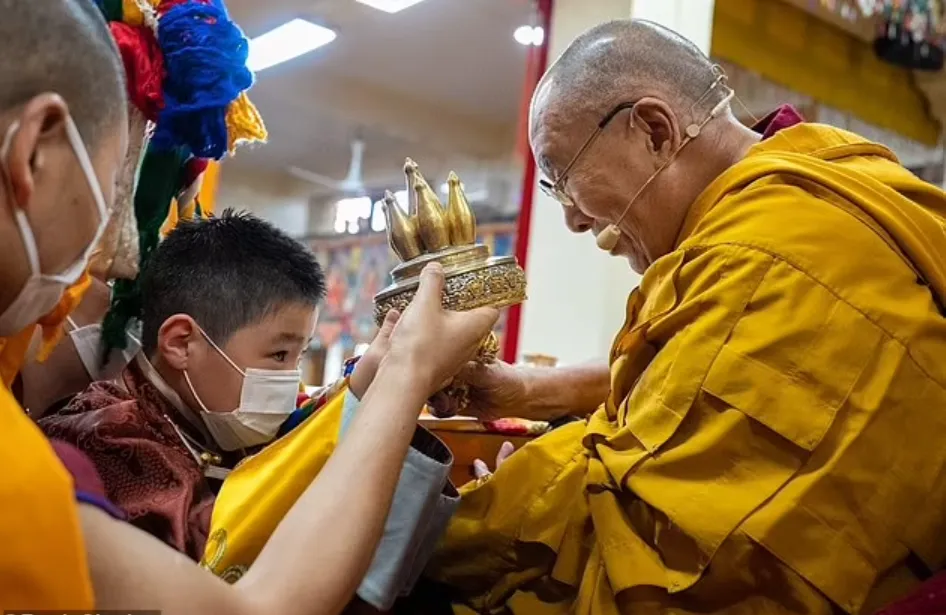
Tibetan spiritual leader the Dalai Lama has named an eight-year-old US-born Mongolian boy as the reincarnation of a spiritual leader.

He has been recognised as the reincarnation of the third most important leader in Tibetan Buddhism as the 10th Khalkha Jetsun Dhampa Rinpoche.

The elderly spiritual leader was pictured with the boy during a ceremony recognising him as the 10th Khalkha Jetsun Dhampa Rinpoche. The ceremony took place earlier this month in Dharamsala, where the Dalai Lama (87) lives in exile.

“We have the reincarnation of Khalkha Jetsun Dhampa Rinpoche of Mongolia with us today,” the Dalai Lama said during the ceremony which was attended by 5,000 monks and nuns, 600 Mongolians and other members.

Picture : Republic World

Pointing to the small boy sitting to his left, the Dalai Lama told the gathering, “We have the reincarnation of Khalkha Jetsun Dhampa Rinpoche of Mongolia with us today. His predecessors had a close association with the Krishnacharya lineage of Chakrasamvara. One of them established a monastery in Mongolia dedicated to its practice. So, his being here today is quite auspicious.”

As the session came to a close on that day, the Dalai Lama met briefly with a significant contingent of Mongolians who are the patrons of this teaching.

“Tantra spread widely in Tibet. With regard to Chakrasamvara, the Ghantapada and Luipa traditions were popular, but this Krishnacharya lineage was quite rare. I received it from Tagdrag Rinpoche and have long felt a close affinity for the practice.

“Chakrasamvara is classified as a mother tantra. It belongs to the highest yoga tantras. While Guhyasamaja emphasises the illusory body, Chakrasamvara focuses on the clear light. However, if you make the illusory body your primary practice, the clear light also arises.

“As I said, I feel a close affinity to the Krishnacharya tradition. I have received the empowerment and undertaken the requisite retreat. This may seem somewhat boastful, but I also feel I have some connection with the great Mahasiddha Krishnacharya.

“This empowerment requires the preliminary practices that we’ll do today. I’ve done the self-generation and visualised myself as Chakrasamvara.”

The crowd dispersed and the view in every direction was filled with the upstanding stems of kusha grass the initiates held in their hands, said a post on the official website of the Dalai Lama. (IANS)

Netanyahu Succumbs To Mass Protests, Delays Judicial Overhaul

(AP) — Bending to a wave of mass protests, Israeli Prime Minister Benjamin Netanyahu delayed his contentious judicial overhaul plan Monday and said he wanted “to avoid civil war” by making time to seek a compromise with political opponents.

The announcement appeared to calm some of the tensions that have fueled three tumultuous months of unrest. But it failed to address the underlying issues that have polarized the nation, and the anti-government protest movement vowed to intensify its efforts.

In his prime-time address, Netanyahu, who had previously rejected calls to delay the legislation, took a more conciliatory tone than in recent speeches. He acknowledged the deep divisions in the country and said he was hitting the pause button “to prevent a rift in the nation.”

“When there’s an opportunity to avoid civil war through dialogue, I, as prime minister, am taking a timeout for dialogue,” he said. He vowed to reach a “broad consensus” during the summer session of parliament, which begins on April 30.

He spoke after tens of thousands of Israelis demonstrated outside parliament, and the country’s largest labor union launched a nationwide strike in a dramatic escalation of the mass protest movement against his plan.

Netanyahu and his religious and ultranationalist allies presented the overhaul in January just days after forming their government, the most right-wing in Israel’s history.

The proposal has plunged Israel into its worst domestic crisis in decades. Business leaders, top economists and former security chiefs have all come out against the plan, saying it is pushing the country toward an autocracy. Fighter pilots and military reservists have threatened not to report for duty, and the country’s currency, the shekel, has tumbled in value.

The plan would give Netanyahu, who is on trial on corruption charges, and his allies the final say in appointing the nation’s judges. It would also give parliament, which is controlled by his allies, authority to overturn Supreme Court decisions and limit the court’s ability to review laws.

Netanyahu has argued that the overhaul is needed to rein in a liberal and overly interventionist court of unelected judges. But his opponents say the package would damage the country’s system of checks and balances by concentrating power in the hands of Netanyahu’s allies. They also say that he has a conflict of interest as a criminal defendant.

Tens of thousands of people, largely secular, middle-class Israelis, have regularly joined mass protests against the plan.

Those demonstrations ramped up Sunday night after Netanyahu abruptly fired Defense Minister Yoav Gallant, who had urged the prime minister to put his plan on hold, citing concerns about damage to the Israeli military.

The firing sparked a spontaneous outburst of anger, with tens of thousands of people taking to the streets in just one hour.

Chanting “the country is on fire,” they lit bonfires on Tel Aviv’s main highway, closing the thoroughfare and many others throughout the country for hours.

Demonstrators continued Monday outside the Knesset, or parliament, turning the streets surrounding the building and the Supreme Court into a roiling sea of blue-and-white Israeli flags dotted with rainbow Pride banners.

“This is the last chance to stop this move into a dictatorship,” said Matityahu Sperber, 68, who joined a stream of people headed to the protest outside the Knesset. “I’m here for the fight to the end.”

Israel’s main trade union, the histadrut, declared a general strike in what it said was the first time it has carried out such an action over a political issue.

The chaos shut down much of the country and threatened to paralyze the economy. Departing flights from the main international airport were grounded, stranding tens of thousands of travelers.

Large mall chains and universities closed their doors, and the union called for its 800,000 members to stop work in health care, transit, banking and other fields.

Diplomats walked off the job at foreign missions, and local governments were expected to close preschools and cut other services. The main doctors union announced that its members would also strike.

In a sign of easing tensions, the union said late Monday that it was halting the strike in response to Netanyahu’s delay.

The announcement appeared to buy the embattled Netanyahu several weeks of quiet. But it was far from clear whether the disputes could be resolved.

The country’s figurehead president, Isaac Herzog, said pausing the legislative blitz was “the right thing.”

“This is the time for frank, serious and responsible discussion that will lead urgently to calming spirits and lowering the flames,” he said.

Opposition leader Yair Lapid said he was willing to hold a “genuine dialogue” under Herzog’s sponsorship.

National Security Minister Itamar Ben-Gvir, an ultranationalist who has pushed for quick passage of the package, said he would respect the delay but showed few signs of compromise.

“The reform will pass,” he tweeted. “No one will scare us.”

The first of a series of laws — giving the coalition control over judicial appointments — had been scheduled to pass this week.

Before Netanyahu’s speech, some 20,000 right-wing Israelis attended a counter demonstration in support of the prime minister. That demonstration also took place near parliament and passed without violence.

“They won’t steal the election from us,” read a flyer for event, organized by Religious Zionist party. Netanyahu said he was “moved” by the show of support.

Shikma Bressler, one of the leaders of the anti-government protest movement, said the campaign would continue until the legislation is canceled.

“This is just an attempt to weaken the protests in order to enact Netanyahu’s dictatorship,” she said. “Now is not the time to reduce the pressure, but to increase it.”

Dozens of protesters from rival sides faced off late Monday in central Tel Aviv. The sides, kept apart by police, exchanged insults, but there was no violence. Police used a water cannon to disperse anti-government protesters.

Israel’s Palestinian citizens have largely sat out the protests. Many say Israel’s democracy is tarnished by its military rule over their brethren in the West Bank and the discrimination they themselves face.

The Biden administration, which has been uneasy with Netanyahu and the far-right elements of his government, welcomed the announcement as “an opportunity to create additional time and space for compromise,” White House press secretary Karine Jean-Pierre told reporters.

New Microchip Links Two Nobel Prize-Winning Techniques

Newswise — Physicists at Delft University of Technology have built a new technology on a microchip by combining two Nobel Prize-winning techniques for the first time. This microchip could measure distances in materials at high precision, for example underwater or for medical imaging. Because the technology uses sound vibrations instead of light, it is useful for high-precision position measurements in opaque materials. The instrument could lead to new techniques to monitor the Earth’s climate and human health. The work is now published in Nature Communications.

Simple and low-power technology

The microchip mainly consists of a thin ceramic sheet that is shaped like a trampoline. This trampoline is patterned with holes to enhance its interaction with lasers and has a thickness about 1000 times smaller than the thickness of a hair. As a former PhD candidate in Richard Norte’s lab, Matthijs de Jong studied the small trampolines to figure out what would happen if they pointed a simple laser beam at them. The trampoline’s surface started vibrating intensely. By measuring the reflected laser light from the vibrating surface, the team noticed a pattern of vibrations in the shape of a comb that they hadn’t seen before. They realised that the trampoline’s comb-like signature functions as a ruler for precision measurements of distance.

This new technology could be used to measure positions in materials using sound waves. What makes it special is that it doesn’t need any precision hardware and is therefore easy to produce. “It only requires inserting a laser, and nothing else. There’s no need for complex feedback loops or for tuning certain parameters to get our tech to operate properly. This makes it a very simple and low-power technology, that is much easier to miniaturise on a microchip”, Norte says. “Once this happens, we could really put these microchip sensors anywhere, given their small size.”

Unique combination

The new technology is based on two unrelated Nobel Prize-winning techniques, called optical trapping and frequency combs. Norte: “The interesting thing is that both of these concepts are typically related to light, but these fields do not have any real overlap. We have uniquely combined them to create an easy-to-use microchip technology based on sound waves. This ease of use could have significant implications for how we measure the world around us.”

Overtones

When the researchers pointed a laser beam at the tiny trampoline, they realised that the forces that the laser exerted on it were creating overtone vibrations in the trampoline membranes. “These forces are called an optical trap, because they can trap particles in one spot using light. This technique won the Nobel Prize in 2018 and it allows us to manipulate even the smallest particles with extreme precision”, Norte explains. “You can compare the overtones in the trampoline to particular notes of a violin. The note or frequency that the violin produces depends on where you place your finger on the string. If you touch the string only very lightly and play it with a bow, you can create overtones; a series of notes at higher frequencies. In our case, the laser acts as both the soft touch and the bow to induce overtone vibrations in the trampoline membrane.”

Bridging two breakthrough fields

“Optical frequency combs are used in labs around the world for very precise measurements of time, and to measure distances”, Norte says. “They are so important to measurements in general that their invention was given a Nobel Prize in 2005. We have made an acoustic version of a frequency comb, made out of sound vibrations in the membrane instead of light. Acoustic frequency combs could for instance make position measurements in opaque materials, through which vibrations can propagate better than light waves. This technology could for example be used for precision measurements underwater to monitor the Earth’s climate, for medical imaging and for applications in quantum technologies.”

I am fighting for India’s voice, ready to pay any price: Rahul Gandhi

Hours after being expelled from the Parliament following his conviction in a criminal defamation case, senior Congress leader Rahul Gandhi said on Friday that he is ready to pay any price for expressing the voice of India.

“I Am Fighting For India’s Voice… Ready To Pay Any Price,” Rahul Gandhi

Rahul Gandhi was suspended from the Lok Sabha following his conviction in a criminal defamation case last week. The Lok Sabha Secretariat also declared his constituency in Kerala’s Wayanad as vacant.

According to the Representation of the People Act, a lawmaker sentenced to imprisonment for two years or more shall be disqualified “from the date of such conviction” and remain disqualified for another six years after serving prison time.

Last week, a court in Surat found Rahul Gandhi guilty and sentenced him to two years in prison in a 2019 criminal defamation case over his remarks about Prime Minister Narendra Modi’s surname. The Congress leader, however, was granted bail and his sentence was suspended for 30 days to allow him to appeal the Surat court verdict.

The case was filed against Rahul Gandhi by BJP MLA and ex-Gujarat minister Purnesh Modi for saying “how come all thieves have the common surname Modi” while campaigning in Karnataka ahead of the 2019 Lok Sabha elections. (IANS)

Nikhat Zareen Wins 2nd World Title In Boxing

It was the culmination of an arduous tournament in which she had to overcome as many as six challengers owing to her unseeded status.

Teary eyes and a roar towards the camera — Nikhat Zareen went through the full wringer of emotions after a closely-fought gold-medal match that saw her emerging as World Champion for the second straight year. It was the culmination of an arduous tournament in which she had to overcome as many as six challengers owing to her unseeded status.

Winning back-to-back golds at the IBA Women’s World Boxing Championships was a feat achieved only by the legendary Mary Kom. At just 26 years, Nikhat is slowly filling those giant shoes. The crowd-favourite beat Vietnam’s Nguyen Thi Tam 5-0 at a packed KD Jadhav Indoor Hall in New Delhi on Sunday. But the unanimous decision was no reflection of how close the bout was.

“It’s a special day, a second World Championship gold, that too in a new weight category. Today’s bout was my toughest so far, facing an Asian champion. The next target is the Asian Games, so to win against her, in the first big championships since changing categories… The strategy was to use all the energy I had left, despite a tough tournament, and I threw everything at it,” said Nikhat after the match.

Shortly after Nikhat’s bout, Lovlina Borgohain won a contentious 5-2 decision against Australia’s Caitlin Parker to claim her first ever Women’s World Boxing Championship gold medal. The middleweight Assam boxer was awarded the fight 3-2 in a split decision. She then got two points from the evaluator and the observer under IBA’s new bout review system.

These two wins capped a dream weekend for Indian boxing after the two gold medals on Saturday.

It was a change in weight category, from 52 kg to 50 kg, that had left Nikhat unseeded at these World Championships. In her six gruelling, physically taxing bouts, she spent a cumulative 45 minutes ducking, weaving and charting a path over the roughest of seas to get her second World Championship gold.

In all these bouts, Nikhat was rarely allowed to play her natural game. She needed to think on her feet, change strategy and innovate. A mid-range boxer, she has the ability to stay just beyond the reach of her opponent, while being close enough to avoid an attack and then land a punch of her own. It’s that unique ability, mastered over years of practice with multiple international coaches, that has resulted in her becoming one of India’s top boxers.

“I think it’s because she’s got so much confidence in her own abilities. She actually enjoys boxing. She actually enjoys the challenge of having that combat,” said John Warburton, the boxing head of Inspire Institute of Sport and one of the international coaches who worked with Nikhat recently. “The way she’s fighting, she’s making a statement. ‘I can beat you in any way I want to beat you. I can beat you at long range, I can brawl with you and beat you’, and that’s her mindset,” he told The Indian Express.

Nikhat’s boxing journey came into prominence when she won the gold medal at the 2011 Youth World Boxing Championships. The Nizamabad native has now added the World Championship medals as well as the 2022 Commonwealth gold to that initial spark. Her next stop: the Asian Games in Hangzhou. And if the same performances continue: the 2024 Olympics in Paris.

It is a target that has been part of her life since the day she won her Youth World Championship medal. Early in her career, Nikhat had been under the towering shadow of Mary Kom. She has had her own fair share of battles against the celebrated Manipuri boxer, most notably before the last Olympics where she demanded a trial and lost. With Mary Kom’s age ruling her out of the next Olympics, Nikhat has positioned herself to finally take over that weight category.

While still bitter about missing out previously, her father Mohammad Jameel Ahmed feels that it was just a matter of time: “She has missed out on two Olympics at the peak of her career. Not just as a father, as a mentor and as someone who plans her career, it was disappointing for me to see things go this way. But there was nothing we could do except focus on the next target. Upar wala likhega, toh bilkul aayega. Hum toh chhodne wale nahi hai (If god wills, our time will come. But we won’t stop trying),” he said.

Sunday’s bout was among the toughest Nikhat faced at this competition. Her Vietnamese opponent, taller and longer in range, won the second round and almost seemed to have taken the third. But the judges scored all rounds in favour of the Indian.

Warburton thinks her abilities are special, and now with an Olympic weight category solely hers, she just has to continue boxing in the same vein as she has been doing over the last couple of years.

“She’s going to be World Champion two years running. She will likely be the Asian Champion. She will qualify for the Olympics, and in my opinion, she will win gold. I’ve worked with lots of people who have won Olympic medals, gold medallists, silvers, bronzes and World medallists. She has all the same characteristics that they have. The attitude, the willpower, and the technical and tactical abilities — she’s got the lot,” said Warburton.

As for Lovlina, luck may have played its part in her bout. The judges scored the contest in her favor and so did the evaluator and observer, despite a shaky performance and an especially poor third round.

She recently made the move to the 75-kg weight category as her previous weight was not a part of the 2024 Paris Olympics boxing programme. Before this win, her trophy cabinet was adorned with two World Championship bronze medals and an Olympic bronze, all in the 69-kg category.

Speaking about her gold later, she said: “I was a little stressed before the final. I tried to play how the coaches asked me to play. It wasn’t a complete success but I thought it was 90 per cent successful. It feels very good to win a gold medal and become a champion.”

Innocent (1948-2023): An Actor Par Excellence Is No More

Innocent, a versatile film actor and former member of the Indian Parliament, who also served as the president of A.M.M.A for 15 years, passed away on Sunday, march 26th, 2023, ending a long career as an actor who has touched millions of lives through his brilliance and ability to make people laugh though his innovative natural talents. The iconic actor will be cherished for his flawless ability to elicit laughter, both on and off-screen.

Innocent breathed his last on Sunday at the age of 75 after battling cancer several times over the last 10 years. The former Lok Sabha member, who also served as the president of the Association of Malayalam Movie Artists (A.M.M.A) from 2003 to 2018, was taken to the VPS Lakeshore Hospital in Kochi on March 3 due to breathing issues and uneasiness.

Cancer Wardile Chiri (Laughter in the Cancer Ward) was the title Innocent gave to his memoir which detailed his battle with cancer, and it was a fitting one. “Innocent is the cure to cancer. His comedic approach to the illness proved to be more successful than the medical care he had, I can attest,” cancer specialist Dr VP Gangadharan, under whom the actor began the treatment in 2012, said commenting on the book.

An actor par excellence, Innocent was, for many decades, the epitome of comedy for Malayalam film audiences. In his illustrious career spanning over 50 years, which started with AB Raj’s Nrithasala (1972), Innocent has acted in 750+ films.

Though Innocent started his journey in the early 1970s, his acting career didn’t really take off until 1981. That year, he donned the hat of a producer for the first time and, along with David Kachappilli, brought to life the film Vida Parayum Munpe which was directed by Mohan and scripted by John Paul.

Picture : Indian Express

Innocent, the actor, too turned a lot of heads when the movie debuted to widespread critical acclaim. With Bharathan’s Ormakkayi (1982) and K G George’s Panchavadi Palam (1984), he continued the run. Although Innocent received only three to four films a year till 1984, the tide turned in 1985 and the actor starred in at least 17 films that year. The number increased further in 1986 when he appeared in over 30 movies, becoming a staple of Malayalam cinema, and Innocent was never forced to look back.

The most appealing aspect of Innocent was his ability to effortlessly adopt any persona and reveal all of its nuances. Some of the characteristics that made Innocent an unrivalled talent included his facial expressions, gestures, diction, and how naturally he used his body. This was demonstrated by his roles in movies like Akkare Ninnoru Maran (1985), Gandhinagar 2nd Street (1986), Unnikale Oru Kadha Parayam (1987), Nadodikkattu (1987), and Vadakkunokkiyantram (1989). He rarely dropped any stones while performing comedic scenes. Because of the pair’s no-holds-barred performances, people still chuckle at Innocent and actor Jagathi Sreekumar’s superb combination scenes in Priyadarshan’s Mukunthetta Sumitra Vilikkunnu (1988).

Innocent’s career, however, peaked in 1989 with Siddique-Lal’s debut film, Ramji Rao Speaking, in which he played a character named Mannar Mathai, the owner of a theatre troupe. Much attention was drawn to his comedic timing and the subtleties he added to the character. To put it into other words, for non-Malayalis to understand how great his performance was, it was based on this character (and the movie) that Priyadarshan later developed the character Baburao Ganpatrao Apte aka Babu Bhaiya (and the 2000 film Hera Pheri). Due to the abundance of humour the director duo Siddique and Lal, who also penned the story, managed to include in the film, the part offered Paresh Rawal one of his biggest career hits and did the same for Innocent. Since Ramji Rao Speaking was a slapstick comedy, the character Mannar Mathai had various scenes that were exaggerated versions of actual events. But Innocent demonstrated his mastery of comedy by never going overboard and staying in line at all times while making sure the exaggerated components persisted.

Further, his performances in Peruvannapurathe Visheshangal and Mazhavil Kavadi (1989), Thoovalsparsham, Gajakesariyogam and Dr Pasupathy, No.20 Madras Mail, and Kottayam Kunjachan (1990) awed spectators.

The year 1991 witnessed a never-seen-before Innocent as he played a wide range of characters that appeared to be outside of his comfort zone, but in reality, never were. While his portrayals of Kittunni in Kilukkam and Yashwant Sahai, a politician from north India, in Sandesham brought about laughter, the actor’s performances as Lazer, the crooked antagonist, in Bharathan’s Keli and Sheshadri Iyer, a corrupt police officer in Priyadarshan’s Adhwaytham, made it clear that he could play any role and that he was underutilised. Innocent replicated the feat in 1993 as well with his outstanding performances in Siddique-Lal’s Kabooliwala and Vietnam Colony, and IV Sasi’s Devaasuram. Warrier in Devaasuram is considered one of the best performances of the veteran actor.

Even while associating with filmmakers who predominantly made comedy movies, Innocent was always one of the favourites of parallel cinema makers too. He also worked in the films of master directors like K G George, G Aravindan, Padmarajan, Bharathan and Lenin Rajendran, among others. In addition to Vida Parayum Munpe, the actor produced three movies at the beginning of his career: Ilakkangal, Ormakkayi, and Lekhayude Maranam Oru Flashback; and, needless to say, all of them were unconventional works that later gained a cult status. Lekhayude Maranam Oru Flashback by K G George, said to be based on the tragic life of yesteryear actor Shoba, is now regarded as a seminal work in Malayalam cinema. The actor also penned stories for two films – Pavam IA Ivachan (1994) and Keerthanam (1995).

For Malayali moviegoers, his collaborations with actors Mohanlal, KPAC Lalitha, Jagathi Sreekumar, Thilakan, Kalpana, Urvashi, Jagadish, Mukesh, and Nedumudi Venu are still highly memorable.

Yet with all of this, the most potent weapon in his arsenal was his capacity to make people laugh, both on and off-screen. Even when his battle with cancer was at its worst Innocent never missed an opportunity to make people laugh, including those who were taking care of him at the hospitals and his colleagues within the film industry and political circles.

Speaking to Mumbai Mirror in 2015, Kerala Minister M B Rajesh dearly recalled Innocent’s humour sense while the two were members of the Lok Sabha. “In the middle of a heated debate, when tempers are high, Innocent will creep up behind you and slowly whisper, ‘Shall I jump into the well? I am not scared of anyone.’” According to the Mumbai-based newspaper, stories about him were legends in the Central Hall of Parliament. He, apparently, once asked businessman and then Rajya Sabha MP Vijay Mallya to get him three cups of coffee, confusing the latter for a Coffee Board waiter.

At the same time, the actor’s bravery in his fight against cancer and the way he used to talk about it without inhibitions have been praised numerous times by people, including his coworkers. He was also one of the first Malayalam celebrities to openly discuss his battle with cancer, an illness that still carries a lot of taboos. In one of the episodes of Kairali TV’s JB Junction, a Malayalam chat show hosted by CPI(M) Rajya Sabha MP and the channel’s managing director John Brittas, Innocent spoke candidly about this and stated: “I think a lot of people gained from that (him addressing his disease). Fear ebbed away for them. There is a lot of false information floating around regarding cancer. There are a lot of fake doctors who offer bogus medical care around us.”

But the one time Malayalis witnessed an entirely broken Innocent was when his wife Alice was diagnosed with breast cancer. Even then, the two did not concede defeat and both of them emerged victorious yet again. The three-time recipient of the Kerala State Film Awards shared a close with his family, especially his grandkids Anna and Innocent Jr.

Even after being diagnosed with cancer, Innocent never left the silver screen. Even while receiving treatment, he balanced acting with his duties at the A.M.M.A. Since 1980, the only year in which Innocent did not appear in any movies was 2020, as he was undergoing treatment. But he returned to the world of motion pictures in 2020 and did five more movies. The actor was last seen in Shaji Kailas’ Kaduva (2022). Nonetheless, thousands of moviegoers will have the opportunity to bid farewell to the legend as his final movie, Paachuvum Albhuthavilakkum by Akhil Sathyan, will be released posthumously on April 28.

Kerala: A Ghost Town In The World’s Most Populated Country

As India overtakes China as the world’s most populous nation, there is a crisis of population in parts of the country where fertility has fallen below replacement levels and migration has left behind ghost towns inhabited by the elderly. The BBC’s Soutik Biswas travels to Kumbanad, a town in Kerala state which is grappling with the consequences of an ageing society.

For years, schools in a drowsy town in Kerala have been facing an unusual problem: students are scarce and teachers have to go out looking for them. They also have to pay from their pockets to bring students to the school.

A 150-year-old government upper primary school – which educates students up to the age of 14 – in Kumbanad has 50 students on its rolls, down from about 700 until the late 1980s. Most of them are from poor and underprivileged families who live at the edge of the town. With only seven students, grade seven is the largest class. In 2016, the class had only one student.

Picture : BBC

Getting enough students to the school is a challenge. Each of its eight teachers fork out 2,800 rupees ($34; £28) every month to pay for auto rickshaws (tuk-tuks) ferrying students from home to school and back. They also go door-to-door looking for pupils. Even the few private schools in the area are sending out teachers to look for students – the biggest one has barely 70 students.

On a muggy afternoon recently at the upper primary school, you could barely hear the hum of lessons and hubbub of squeals that form the soundscape of a busy schoolhouse. Instead, teachers taught a few children in dark, quiet classrooms. Outside, in the sun-baked courtyard ringing the building, a few students wandered around desultorily.

Some 15% of the homes are locked up because residents have migrated or are staying with their children abroad. “What can we do? There are no children in this town. I mean, there are barely any people living here,” said Jayadevi R, the principal, wryly.

She is right. Kumbanad lies at the heart of Kerala’s Pathanamthitta district where the population is declining and ageing. This in a country where 47% of people are below the age of 25; and two-thirds were born after India liberalised its economy in the early 1990s.

Kumbanad and half-a-dozen verdant villages around it are home to some 25,000 people. Some 15% of the 11,118 homes here are locked up because the owners have migrated or live with their children abroad, says Asha CJ, the local village council chief. There are 20 schools, but very few students.

One hospital, a state-run clinic, more than 30 diagnostic centres and three old-age homes are pointers to its greying population. More than two dozen banks – including eight branches within less than half a kilometre – vie for remittances from townspeople who live and work all over the world. Around 10% of the $100bn in remittances that India mopped up from Indians living abroad last year came to Kerala.

Kerala – along with neighbouring Tamil Nadu – is some sort of an outlier in teeming India: the decadal rise in population here between 2001 and 2011 – when the last census was conducted – was lowest (4.9%) among states. A new-born in Kerala can expect to live for 75 years against the national average of 69.

Fertility rates in the state have dipped below replacement levels – 1.7 to 1.9 births per woman – for at least 30 years now. Smaller families ensure that children are educated well. This leads to the young migrating quickly within and outside the country for opportunities, leaving their parents at home.

“Education makes children aspire for better jobs and lives, and they migrate,” said Prof KS James of the Mumbai-based International Institute for Population Sciences.

“Their native places are then populated by their elderly parents, many of them living alone.”  Behind the tall metal security gates of her two-storey red tiled home in Kumbaud, Annamma Jacob, 74, has been living alone for as long as she can remember.

Her husband, a mechanical engineer with a state-owned oil company, passed away in the early 1980s. Her 50-year-old son has been living and working in Abu Dhabi for more than two decades. A daughter lives a few miles away, but her husband has been working as a software engineer in Dubai for three decades.

Her next-door neighbours are absent: one locked up her house and took her parents to Bahrain, where she worked as a nurse; the other moved to Dubai and rented their place to an elderly couple.

The neighbourhood is a picture of desolation. Amidst a lush landscape of tapioca, banana, and teak trees, handsome houses with expansive yards stand vacant, their driveways scattered with dried leaves and cars covered in dust. CCTV cameras have taken the place of guard dogs.

In vivid contrast to the cacophony of India’s chaotic and bustling towns, swathes of Kumbanad are surreally deserted and half-frozen in time. It is a town abandoned by many of its inhabitants but it is not languishing in ruins. The deserted houses are painted regularly, almost like they expect people any day. Except, they hardly come.  “It is a very lonely life. I am also not keeping good health,” Ms Jacob said.

Despite her heart disease and arthritis, Ms Jacob has travelled abroad to spend time with her son and grandchildren, and has vacationed in Jordan, Abu Dhabi, Dubai and Israel with her children.

The things strewn around in her carpeted living room tell you something about her links with the world: imported paracetamol tablets, pistachios and cashew nuts, yellow paper flowers stuffed in China-made vases; and a bottle of imported body wash.

I asked her why she built a sprawling 12-room house only to live alone. “Everyone builds big houses here,” she smiled. “It’s about status.”

She spends a lot of time in her backyard farm where she grows tapioca, bananas, ginger, yam and jackfruit. At other times, she meditates and reads newspapers. She has a dog called Diana in a kennel outside.  “Some days, I only talk to Diana. She understands me.”

At her age and with her failing health, it is exhausting to work on the farm. Ms Jacob said she cannot afford a farm hand. A shortage of labour has meant steep work wages for the few who look for work. A daily labourer charges a thousand rupees for a six-hour day looking after the farm. Even Ms Asha’s village council is not able to find and afford people to digitise its records.

A few lanes away, Chacko Mammen, who suffers from heart disease and diabetes, works in his little farm for four hours every day, growing bananas. The 64-year-old worked in Oman for three decades as a salesperson before returning home. He shut a small business after six years because he did not find enough people to work for him. Now, after a lot of effort, he grows and sells about 10kg of bananas every day from his farm. “I just cannot afford a worker,” he said.

Shoring up the work force in an ageing society is always difficult. Even migration of workers from other states doesn’t always work, sometimes because of a distrust of outsiders. Ms Jacob said she did not prefer hiring a migrant. “I live alone. What if they kill me?” she said.

In this mellow town of elderly people and shuttered homes, there is very little crime. The police said thefts are rare because people don’t keep much money and valuables at home. They don’t remember the last time a murder took place here.

“It’s all very peaceful. We only get complaints about cheating. Old people being cheated by their relatives or domestic helps who forge their signatures and withdraw their money from banks,” said Sajeesh Kumar V, the chief inspector of the local police station.

A year ago, a relative of an elderly resident embezzled nearly 10m rupees by faking her signature. Last year the police arrested four promoters of a private financial firm which set up shop in the town and promised steep returns on deposits. When it began to default in what looked like a ponzi scheme, some 500 local depositors went to the police.

“That was a big crime for this area,” said Mr Kumar. “Otherwise we are mainly dealing with minor fights among residents – about some noise, or rubbish being dumped outside their home, someone’s wild tree branch encroaching on a neighbour’s farm. Those sort of things.”

The lack of crime means that the police spends most of its time looking after the old. They regularly check in on 160 single and ailing people; and have given away mobile alarms in some of their homes so they can alert neighbours during emergencies. In 2020, the police broke down the door of a house when no one answered the doorbell and found the resident, an elderly woman, lying on the floor.

“We took her to the hospital, where she recovered, One of our jobs is also moving residents to old-age homes. We check on old people, we take them to doctors,” said Mr Kumar.

“Old age is the only problem here,” said Father Thomas John, who runs a geriatric centre in Kumbanad.

The town has three wheelchair accessible old-age homes with open spaces, wide doorways and hallways. The Alexander Marthoma Memorial Geriatric Centre, a five-storey building alongside a 150-bed hospital, takes care of more than 100 locals, aged between 85 and 101. Almost all are bedridden, and their families pay 50,000 rupees every month for their care. Sometimes the children come and stay with them at the 16-year-old centre.

“Most of the children live abroad and have no option but to move the very old parents to old-age homes,” said Father John.

Not far away, the 75-year-old Dharmagiri Old Age Home houses 60 locals, all above 60 years of age. Last year there were 31 new admissions. There are separate buildings for men and women. The waiting list is growing: a new 30-room building that can accommodate 60 elders is coming up.

“Most of the women who stay with us are victims of cheating. Some of them have been abandoned by their families,” said Father KS Mathews, who runs the home.

The ailing elderly, old-age homes, labour shortages, migration of the young, declining population, ghost towns.

“This is a story of any demographic change. This will be the story of the whole of India, finally,” said Prof James.

BBC News India is now on YouTube. Click here to subscribe and watch our documentaries, explainers and features. (Courtesy: BBC.com)

The 10 Most Expensive U.S. States To Retire In — California Didn’t Make The List

In addition to being home to the most expensive city to live in worldwide, New York is the least affordable U.S. state to retire in.

That’s according to WalletHub’s “2023 Best States to Retire,” which compared all 50 states across three main categories: affordability, quality of life and health care.

Picture : Money Talks News

For the affordability metric, WalletHub used data from various agencies such as the U.S. Census Bureau and the Council for Community and Economic Research. The ranking looked at adjusted cost of living, general tax-friendliness and annual cost of in-home services, as well as other factors.

While New York ranked 10th in the quality-of-life category and 16th in health care, it came in 50th for affordability. That’s likely due to having the second-highest adjusted cost of living, behind Alaska, and the third-highest tax rate, according to WalletHub.

Even $1 million in retirement savings would cover your living costs for only about 14 years, a fraction of the 25 years or more retirement typically lasts.

Don’t expect to find affordability across the Hudson River either: New Jersey ranks as the second most expensive state to retire in.


Here are the top 10 most expensive states to retire in, according to WalletHub:

  • New York
  • New Jersey
  • Vermont
  • Massachusetts
  • Maryland
  • Washington
  • Connecticut
  • Maine
  • Illinois
  • Oregon

Retirement will look different to everyone, and there are several factors to consider.

While a state’s cost of living is often important, retirees may also think about how close they’ll be to family and how easily they’ll be able to access health care and engage in social activities, Alan Castel, a professor at the University of California, Los Angeles, and author of “Better with Age: The Psychology of Successful Aging,” said in WalletHub’s report.

If you’ll be living on a fixed income in retirement, it’s important to regularly review your budget and future financial commitments, said Castel.

“Sometimes our spending habits need to be re-evaluated, and many senior discounts can be utilized to lower bills,” he said. “It may also be useful to consider downsizing or minimizing certain costs that are no longer needed.”

DON’T MISS: Want to be smarter and more successful with your money, work & life? Sign up for our new newsletter

Get CNBC’s free Warren Buffett Guide to Investing, which distills the billionaire’s No. 1 best piece of advice for regular investors, do’s and don’ts, and three key investing principles into a clear and simple guidebook.

Telangana Telugu Association Celebrates Women’s Day And Maha Shivratri

New York Telangana Telugu Association (NYTTA) held Maha Shivratri and Women’s Day celebration March 4, 2023, at the Hindu Temple Auditorium in Flushing, NY.

NYTTA founder Srivinas Guduru told Desi Talk that Shiv Ratri is celebrated in Telangana with fasting during the day and keeping a ‘jaagran’ at night, singing devotional songs. Shiv Ratri is also the day when the mother goddess Parvati was married to Shiva, Guduru said. “We thought it would be apt to celebrate Women’s Day offering prayers to Parvathi on Maha Shivratri,’ he said.

Attended by more than 600 devotees and special guests from New York, Long Island, New Jersey and Connecticut, the 8-hour long celebrations included dance and music performances by children and adults, and by visiting artists from India. A highlight of the celebration was a dinner with special Telangana items, some of which were specially brought from India, Guduru said.

Congratulating the gathering, Chief guest Dilip Chauhan, Deputy Commissioner for Trade, Investment and Innovation at the Mayor’s Office for International Affairs, said it was heartening to see that Telugu families were promoting their culture in their children in the U.S. Chauhan said the Telugu community has emphasized professional education and had been contributing to the local economy.

Founder Guduru spoke about the goals of NYTTA.  Chairman, Dr. Rajender Jinna, and President Mr. Sunil Reddy Gaddam, spoke about the upcoming events and the social work by the organization in India.

Bihar Foundation Celebrates ‘Bihar Diwas 2023’ At Indian Consulate, NY

The Bihar Foundation of USA (East Coast) hosted the “Bihar Diwas Celebration” on Tuesday, March 21, 2023, evoking memories of home for the Indian-origin community living abroad.

On the occasion, Bihar Chief Minister Nitish Kumar sent a special congratulatory message, lauding the efforts of Bihar Foundation USA in promoting the state’s heritage and traditions in America and for supporting a wide range of voluntary and philanthropic activities.

Consul General of India in New York Randhir Jaiswal appreciated the contributions of the diaspora from the state in the U.S., and also noted their philanthropic activities. He said through their determination and eagerness to work for the betterment of their home state, the aim of Bihar 2.0 will be achieved and fulfilled in 2023.

Picture : TheUNN

“From the famous ‘Litti Chokha’ to the popular ‘Jhijhiya’ song and dance, traditional dialects, and textiles, the celebration was seeped in colors and vibrant traditions of  Bihar and invoked among those present memories of their homes and childhood,” organizers said in a press release March 26.

Bihar Foundation of US (East Coast Chapter) Chairman and former President of the Federation of Indian Associations (FIA) Alok Kumar said the foundation aims to act as a bridge to support and guide members of the diaspora who wish to take up development and social projects in their state. It also seeks to offer assistance to those coming from Bihar, including students, as they navigate in the U.S.

Vice Chairman Ranjeet Kumar congratulated and thanked the team, Secretary Chandan Trivedi, Treasurer Alok Kashyap, and Joint Treasurer Anand Gupta for their efforts in making the event successful.

Trivedi thanked executive committee members Santa Mishra, Rajnish Ojha, and Manish Kumar who drove from the neighboring states to participate in the events. He conveyed special thanks to Sanjeev Jha and Pramod Kumar who drove all the way from Boston.

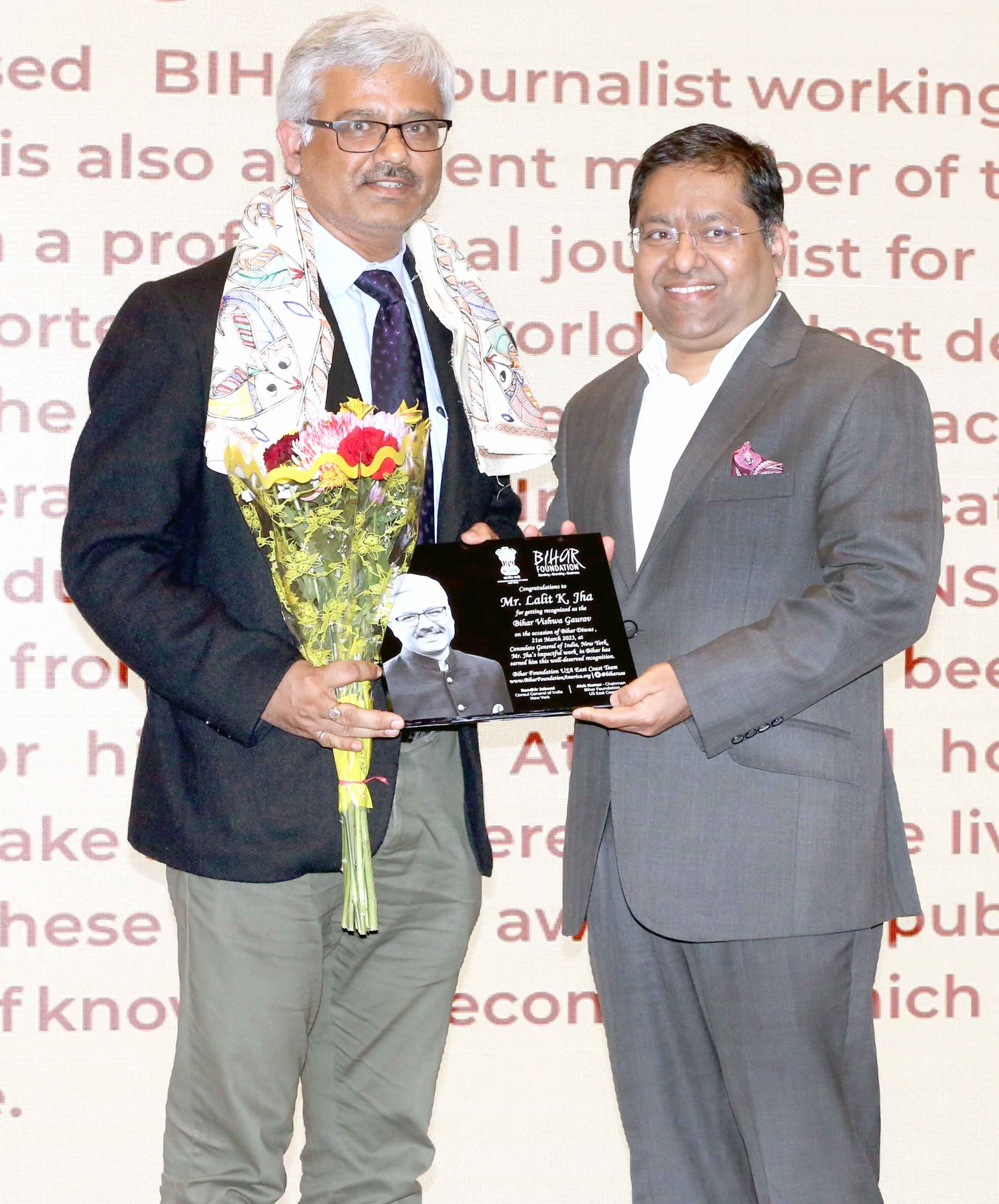
Three individuals hailing from the state were honored with the ‘Bihar Vishwa Gaurav’ award for their achievements and contributions. They included Padma Bhushan awardee,  renowned sociologist and social entrepreneur, founder of Sulabh International Dr. Bindeshwar Pathak; entrepreneur Ajay Singh who leads the Pokhrama Foundation and is the founder and CEO of Slayback Pharma, and Washington-based journalist and member of the White House Press Lalit Jha. In a special video message for the occasion, Super 30 founder Anand Kumar congratulated the honorees.

Friends of HUA Gala” in Houston on March 26, 2023

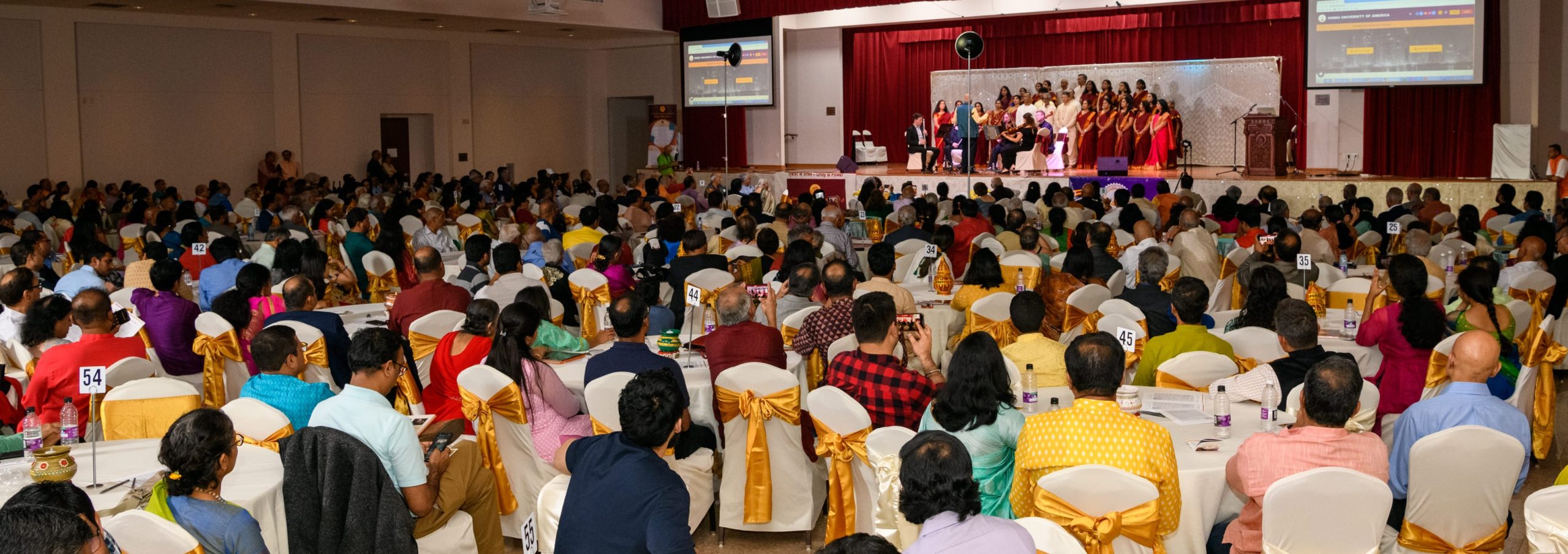
Hindu University of America (HUA) in association with Hindus of Greater Houston (HGH) hosted a Friends of HUA Gala evening on 26 March 2023, at VPSS Haveli, Houston. The gala, which was attended by about 500 community members, honored Kiran and Ramesh Bhutada and their family for their generous gift of one million dollars to HUA. Ramesh Bhutada, CEO of Star Pipe Products, is a successful Houston-based businessman and philanthropist.

The Gala opened with the auspicious lighting of the lamp followed by a scintillating music performance by HUA faculty Dr Kanniks Kannikeswaran. His ensemble of Hindu classical singers accompanied by western music instrumentalists set the tone for the evening. He engaged the audience by having them hum along as well as sing some of the lyrics. His performance received a standing ovation.

This was followed by a short video on HUA’s courses and programs, as well as the experiences of students and faculty. Chairman of the HUA Board and Padma Bhushan awardee Ved Nanda and HUA President Kalyan Viswanathan spoke about the rejuvenation of HUA, its current state, and future roadmap. Houston-based faculty members Dr. Raj Vedam and Chandra Raghu shared their thoughts as well.

Picture : TheUNN

The evening’s highlight was Ramesh Bhutada’s address where he shared why he chose to support HUA.  Despite being born and raised in a traditional Hindu family and a member of several prominent Hindu organizations and traditions, he stated that he “did not really understand the essence of Hindu Dharma.” It took him 60 years to recognize the silver spoon that he was born with, that is, to understand the true essence of Hindu Dharma “which teaches us how to live in harmony within ourselves, with our family, friends, colleagues, and with the entire world. Other universities may impart knowledge for students to earn a livelihood. Only an institution like HUA can impart Hindu knowledge that teaches a student how to live their life.”

Stressing the fact that he did not want the next generation of Hindus to take as long as he did, Ramesh Bhutada urged the attendees to support HUA so that the youth of today and tomorrow can gain the knowledge and understanding of Hinduism much earlier in life, enabling them to live happy, productive lives for themselves and for the benefit of the entire world.

Drawing on his personal experiences as well as narratives from the Hindu American community, Ramesh Bhutada noted that the traditional Hindu upbringing and teachings about Hinduism within the family and home environment alone is not sufficient. Knowledge, he underlined, imparted by established educational institutions in the modern academic setting is critical to ensure the younger generations understand and apply Hinduism in their lives.

HUA President Kalyan Viswanathan also called on all the attendees to “come together to build a Hindu university that lasts a 1000 years just like the Brihadeeswara Temple in Thanjavur which has stood strong for over 1000 years, or like the Nalanda University that was a beacon to the world for 1700 years before it was destroyed.” He further shared that “over the next five years, HUA aspired to become self-sustaining, and establish itself as a shared platform for all Hindu traditions and organizations to offer their teachings.”

Proclaiming that the institution belongs to the entire Hindu community, HUA Chairman Ved Nanda stated that HUA “will seek to become an authoritative voice in the academic domain for all matters pertaining to Hindu Dharma, not only in the United States, but also globally.” He invited friends and well-wishers from all Hindu-American organizations, community leaders and members to support HUA’s efforts in becoming a leading hub for Hindu knowledge and learning.

Other remarks included well known Houston-based Physicist and Yoga Instructor Robert Boustany who stated that the “awareness dinner of HUA highlighted the necessity of all our seva in developing an educational system true to the deepest history of India in order to preserve that wisdom and value for our children and grandchildren” Chairman of HGH Board of Advisors Rasesh Dalal said, “Hindus can work wonders  when they work diligently with unity. The success of the HUA event is a live example!” Emcee Ahimsa Yukta, a freshman at University of Texas, Dallas, said that HUA’s motto – “That is knowledge which liberates”, was so inspiring that he was motivated to take a course at the university.   Volunteer support was provided by members of Hindu Swayamsevak Sangh, Houston.

15 % Of Indian Pilots Are Women, 3 Times More Than Global Average

As per an assessment, India may need an additional 1,000 pilots every year over the next five years. India’s civil aviation regulatory body, Directorate General of Civil Aviation (DGCA)’s which released statistics on the country’s pilot strength informed that fifteen per cent of the pilots in the country are women, which is three times the global average of five per cent.

As per the data released from various Indian scheduled airlines, a total of 244 pilots have been recruited in 2021. And, data estimates that India may need an additional 1,000 pilots every year over the next five years.

However, currently, there is no special programme in the government to encourage pilot training for women and backward classes including SCs/STs, the regulatory body said. As of now, India has 67 foreign pilots working with different air operators, it said.

According to the release, there are 35 DGCA-approved Flight Training Organisations (FTOs) in the country, operating at 53 bases.

The International Society of Women Airline Pilots’  report on gender equality in the aviation sector in 2021 underlined that at 12.4 per cent India ranked top in gender equality at the flight deck in 2021, followed by Ireland, South Africa, Australia, Canada, Germany, USA, UK, and New Zealand.

Devdas – The Musical Set For World Premiere In Singapore

There will be two shows in Hindi with English subtitles on April 21 and 22, and two shows in English with Mandarin subtitles on April 22 and 23.

India’s leading live theatre producer AGP World, along with Arte Compass and Zee TV APAC, inspired by Sarat Chandra Chattopadhyay’s classic novel, brings Ashvin Gidwani’s ‘Devdas – The Musical for the world’ premiere in Singapore on April 21, 2023, at the Esplanade Theatre. The news release said that the 100-minute multi-starrer explores the saga of star-crossed lovers Devdas and Paro, torn apart by unfortunate circumstances.

Picture : TheUNN

This multifaceted production features performances from popular Bollywood actors such as Sunil Kumar Palwal, Aanchal Chauhan, Bhavna Pani, Jayesh Thakkar and Smita Jaykar, who play key roles in the musical. Actor Arif Zakaria w plays Sarat Chandra Chattopadhyay, the writer of the classic tale. The musical also features songs from the Bollywood movie Devdas such as Woh Zindagi Hi Kya, Shyam Tore Rang Me, and Toota Re Manwa, sung by prominent singers, including Shaan, Kailash Kher, Alka Yagnik, Suresh Wadkar, Shail Hada, Bhoomi Trivedi and Antara Mitra.

Ashvin Gidwani, Producer & MD, AGP World, expressed delight to bring this classic on stage and showcase the first World Premiere in Singapore. The press statement said that there will be two shows in Hindi with English subtitles on April 21 and 22, and two shows in English with Mandarin subtitles on April 22 and 23. British theatre director, writer, actor, and teacher Toby Gough is the creative director for the grand musical which is co-directed by Indian director Ranga Godbole. The team also includes technical director and production designer Tom Kitney.

“Devdas has witnessed several renditions in the Indian cinema, yet there is something about the epic that connects with the audience. A saga of love presented by multiple onstage and offstage talents; Devdas promises to be a production never seen before on the Indian Stage,” Gidwani said.

Sanmesh Thakur, EVP – APAC, Zee Entertainment Enterprises Ltd, said, “Zee in Singapore has been known to support and co-produce high-quality productions. We are extremely proud and excited to be associated with Devdas, one of the most highly awaited shows of 2023!”

South Asian House At SXSW Showcased

Picture : TheUNN

Created through sponsorships from The Auntie Network, Tasveer, One Minute Saree, URL Media, The Partnership Inc., Sway with Pray, Indie Meme, and Lailit Vadlamani & Shubha Iyengar, the first-ever South Asian House (SAH) kicked off at Fourth & Co in downtown Austin during the first weekend of the 37th annual SXSW®.

Featured speakers at the two-day, cultural pop-up included industry professionals from business, tech, film, TV, theater, music, and fashion. SAH also hosted a networking event with  happy hour each day, as well as live music and a DJ set each night. Local Bollywood dance company Sway With Pray organized flash mobs around the city, and to conclude the weekend, Tasveer presented a Red Carpet Awards Ceremony and a live Oscar Viewing Party on Sunday, March 12. Several South Asian nominees and celebrities were cheered on by the House during the Academy Awards.

The inaugural event opened with welcome remarks from the co-founders of the South Asian House and from SXSW’s Director of Sales, Neil Minocha, followed by a fireside chai & chat moderated by Ms. Media CEO and SAH co-founder Monika Samtani and featured movie producer Rishi Rajani (CEO, Hillman Grad Productions), actor Reema Sampat (Orange is the New Black), and journalist/entrepreneur Snigdha Sur (Founder & CEO, The Juggernaut). The fireside was sponsored by Catalyst Media and Lalit Vadlamani & Shubha Iyengar. SAH’s programming also included two noteworthy panels on film and television Saturday. Warm SriLankan Chai was provided by Kola Goodies.

The first, “Creating South Asian Content for a Global Audience,” was an hour-long discussion with actor Rizwan Manji (“Schitt’s Creek,” “Peacemaker”), Executive Producer of VICE TV, Falguni Adams, and Apoorva Bakshi, Emmy award-winning producer of the hit TV series “Delhi Crime,” moderated by CEO of Jingo Media and co-founder of SAH, Jitin Hingorani.

The second panel, “Investing in the Future of Our South Asian Stories,” was an important conversation that included CEO and Co-founder of URL Media S. Mitra Kalita, actor Kausar Mohammed (“4400,” “The Flash”), and Atit Shah, CEO of Create Entertainment, moderated by co-founder of Box Office Guru Media Gitesh Pandya.

Women in Film and Television, Austin presented the Pilot reading hour of Rehana Lew Mirza’s script ‘Don’t Hate’ with a full slate of talent cast by Ashley Guaragna Casting with this pilot to be produced by SAH co-founder Rohi Mirza Pandya under the sisters joint production company banner. EarlierThe Leadership Program took a deep dive into the successful leadership mindset followed by one-on-one mentorship sessions with industry leaders Pooja Kumar (Actress/Producer & former Miss India USA), Milan Chakraborty (Head of Film at Marginal MediaWorks), Sid Shah (Founder of Trackmind), and James A. Mathew (CEO of The Outer Voice Company). The Leadership Program was facilitated by SAH co-founders, Rohi Mirza Pandya and Monika Samtani, as well as their production company Catalyst Media+ sponsors Lalit Vadlamani & Shubha Iyengar.

South Asian House attendees enjoyed Happy Hours hosted by our partners Brown Girl Magazine and Austin’s very own Indie Meme Film Festival.

The Auntie Network, a Texas dating and marriage website for South Asian singles, presented The StoryLounge Variety Show, hosted by Vick Krishna and Samrat Chakrabarti, and included comics Proma Khosla, Tanveer Arora, and Aizzah Fatima, with musical guest on the table, Mayookh Bhaumik. The evening’s entertainment concluded with live music by Chloe Choudhury with SUNNN, Meetu Chilana, Aditya Rao, and DJ Anupi. The world renowned percussionist Drums Sivamani surprised all guests with an impromptu performance.

Fashion brand One Minute Saree presented Sunday’s Desi Drag Brunch, featuring New York drag queen Tara Ryst and local drag queens Darshan and Jayan, who draped the sarees on stage during their live Bollywood performances. The event was supported by Austin’s South Asian LBGTQ+ organization, Khush Texas.

The afternoon included a series of shorts content, curated by Jitin Hingorani, Founder and Festival Director of DFW South Asian Film Festival, which culminated with the launch of the title track music video from an upcoming Austin based AAPI project WHERE THE STARS ARE, a Banskota Productions feature film co-directed by Kirtana Banskota and Andy Yang. Oscar Sunday evening kicked off with a red carpet and the Uniquely South Asian awards ceremony presented by Tasveer’s Founder Rita Meher. Awardees included all the afore-mentioned panelists and other thought leaders who are uplifting the Diaspora through their unique contributions to the community at large. The Oscar Watch Party was followed by live sets from  Kiss Nuka Live (Mumbai & Goa) and Austin’s DJ Anup USA.

“And that’s a wrap!” exclaimed producers Mirza Pandya, Hingorani, Samtani, and Banskota. “We are just thrilled at the reception we’ve received from the South Asian community at SXSW, and we can’t wait to come back bigger and stronger next year. A huge shoutout to all our volunteers without whom this event would not be possible.”

About South Asian House: An initiative that aims to connect a thriving community of thought leaders from various sectors in the business, tech, film, television, fashion, music, ad theater idustries from seven different South Asian countries including Bangladesh, Bhutan, India, Pakistan, Maldives, Nepal, and Sri Lanka. The initiative was created by veteran producers, curators, and programmers Rohi Mirza Pandya (Box Office Guru Media), Jitin Hingorani (Jingo Media), Monika Samtani (Ms. Media), and Kirtana Banskota (Banskota Productions). For more information on SXSW’s first ever South Asian House please visit HERE.

AAHOA Members Testify in Support of New Jersey Bill Advancing Fair

Members of the Asian American Hotel Owners Association testified in support of New Jersey Assembly Bill 1958, which advances several key components of AAHOA’s 12 Points of Fair Franchising to sustain a mutually beneficial relationship between Franchisors and Franchisees.

The Assembly Commerce and Economic Development Committee reported the bill out of Committee with amendments. Six members voted yes, zero members voted no, and three members abstained. About 30 AAHOA Members attended the hearing and several offered testimony.

AAHOA, the largest hotel owners association in the world, has been at the forefront of advocating for fair franchising standards that protect hotel owners’ investments, safeguard a mutually beneficial relationship with hotel brands, and promote the hospitality industry and top-notch guest experiences. AAHOA Members own 45.4% of New Jersey hotels, representing 46,124 rooms.

“As the largest hotel owners association, representing the exclusive interests of America’s hotel owners, AAHOA showed up in New Jersey to testify in support of amendments to the legislation to improve the franchise model,” said AAHOA Chairman Nishant (Neal) Patel. “I’m heartened by the strong show of support by AAHOA Members who came to Trenton to speak on behalf of our industry.”

Last May, a contingent of AAHOA Members testified in favor of the bill in front of the New Jersey Assembly Judiciary Committee.

“Multiple major hotel franchises are helping to pave the way for fair franchising that is both fair and free – free from arbitrary and undisclosed fees, free from one-sided terms and conditions, and free from anti-competitive procurement rules,” said AAHOA President and CEO Laura Lee Blake. “As a state that is home to thousands of hard-working entrepreneurs, including immigrants from around the world, New Jersey can be an example to the rest of the country in supporting franchising practices that allow hotel owners to achieve the American dream.”

“Yesterday, there was a strong showing of testimony and support from our local members concerning the most important principles of this bill, which we have been underscoring from the beginning,” said Bharat Patel, AAHOA Vice Chairman. “The Committee heard us and voted to pass this bill with the changes we had identified. We thank the New Jersey Assembly Members for understanding our concerns, and we look forward to continuing to work together to address these important issues.”

Assembly Bill 1958 has four key provisions that support fair franchising practices:

Franchisors and Hotel Brands should not require hotel owners to purchase goods and services only from mandated vendors if the same goods and services of comparable quality are available from other sources at competitive prices.

If a Franchisor or Hotel Brand receives commissions / rebates from a vendor based on purchases by the Franchisee hotel owners, then such commissions / rebates must be fully disclosed and returned to the Franchisee hotel owners for the betterment of the system.

New franchise fees should not be unilaterally added that were not previously disclosed in the Franchise Disclosure Document (FDD) without prior approval from the FACs or the Franchisee hotel owners.

AAHOA shall not support the Hotel Franchisors or Brands selling loyalty points for a profit without providing reasonable compensation for the hotel owners.

Donald Trump Is Indicted

A grand jury has reportedly indicted Donald Trump on criminal charges stemming from his role in a hush-money payoff to the porn star Stormy Daniels. This historic event is a tragedy for the American republic not because of what it has revealed about Trump, but because of what it is revealing about us as voters and citizens.

Picture : Forbes

Donald Trump is said to have been charged with crimes in New York. This is a good day for America, because it shows, in the most direct way possible, that no one in this country is above the law. Trump’s status as a former president has not shielded him from answering for his alleged crimes.

The indictment itself is shot through with tension, because Trump is, in fact, a former president and a current leading presidential candidate—which underscores the ghastly reality that no matter how much we learn about this crass sociopath, millions of people voted for him twice and are still hoping that he will return to power in the White House.

The Manhattan DA’s office wanted Trump to surrender on Friday, but Trump’s lawyers “rebuffed the request, saying that the Secret Service, which provides security detail for the former president, needed more time to prepare”, Politico reports, citing an unnamed source but saying the exchange was confirmed by Trump lawyer Joe Tacopina.

A grand jury in Manhattan voted Thursday to indict Donald Trump — the first time a former U.S. president has faced criminal charges. The historic indictment comes in a case centered on $130,000 in payments to adult film star Stormy Daniels during the closing days of the 2016 presidential campaign. Daniels claimed she slept with the married Trump in 2006, a claim the former president has denied. Trump had classified his reimbursement of the payout as a legal expense.

A spokesperson for the DA’s office confirmed the indictment in a statement Thursday night. “This evening we contacted Mr. Trump’s attorney to coordinate his surrender to the Manhattan D.A.’s Office for arraignment on a [New York] Supreme Court indictment, which remains under seal,” the spokesperson said. “Guidance will be provided when the arraignment date is selected.”

Trump attorney Susan Necheles told NBC News that the former president, who lives in Florida, is expected to be arraigned on Tuesday. He is expected to surrender to the Manhattan district attorney’s office, Trump attorney Joe Tacopina said earlier Thursday.

“President Trump has been indicted. He did not commit any crime. We will vigorously fight this political prosecution in Court,” Necheles and Tacopina said in a joint statement.

The tentative plan is for Trump to appear before acting Justice Juan Merchan after 2:15 p.m. on Tuesday for his felony arraignment, two officials familiar with the matter said. Merchan presided over the DA’s successful tax fraud prosecution of Trump’s company last year.

Trump blasted the news in a statement Thursday evening. “This is Political Persecution and Election Interference at the highest level in history,” Trump said in a statement. “The Democrats have lied, cheated and stolen in their obsession with trying to ‘Get Trump,’ but now they’ve done the unthinkable — indicting a completely innocent person in an act of blatant Election Interference.”

Trump has repeatedly denied any wrongdoing related to the probe and called the investigation by Democratic Manhattan DA Alvin Bragg’s office a continuation of the partisan “witch hunt” against him. He’s also accused Bragg, who’s Black, of being a “racist.”

The decision is sure to send shockwaves across the country, pushing the American political system – which has never seen one of its ex-leaders confronted with criminal charges, let alone while running again for president – into uncharted waters.

Desantis May Beat Biden, Could Beat Trump By 2 Points In A Hypothetical 2024 Matchup

The polls do not bear well for President Joe Biden if he chooses to stand for reelection in 2024. Biden is locked in close hypothetical races with the two leading candidates for the Republican Party’s 2024 presidential nomination, according to a new poll.

A Quinnipiac University poll released this week found Biden leading former President Trump in a hypothetical 2024 rematch, with Biden receiving 48 percent support and Trump getting 46 percent among registered voters.

In a hypothetical election between Biden and Florida Gov. Ron DeSantis (R), the other front-runner at the moment for the GOP nomination, Biden trails 46 percent to DeSantis’s 48 percent.

Picture : NBC

The poll found Trump leading DeSantis in a head-to-head Republican primary matchup, with the former president earning 52 percent support to DeSantis’s 42 percent.

Biden, Trump, and DeSantis all had similar favorability ratings among registered voters, as well. For Biden, 37 percent of respondents said they had a favorable view of the president, compared to 56 percent who had an unfavorable view.

Meanwhile for Trump, 36 percent had a favorable view, and 58 percent had an unfavorable view. And 36 percent had a favorable view of DeSantis, while 39 percent had an unfavorable view, and 24 percent said they did not know enough about the governor.

The poll surveyed 1,600 registered voters from March 23-27. It has a margin of error of 2.5 percentage points.

The results reflect that Biden may be vulnerable in a reelection bid, with voters consistently concerned about his handling of the economy in particular. But it also underscores a persistent concern among Republicans, that Trump may be the one candidate who would lose to Biden in 2024.

Trump has already declared his candidacy for 2024, as has former Ambassador to the United Nations Nikki Haley. DeSantis is widely expected to enter the race in the coming months, but he has not yet formally launched a bid.

And while Biden’s intention to run for a second term does not seem to be in significant doubt, the president thus far has only reiterated his “intention” to run for the White House again.

Both Parties Fail On The Economy, Crime, And Transgender Rights

(NPR) The economy continues to dominate as the most important issue facing the country, followed by preserving democracy, according to the latest NPR/PBS NewsHour/Marist poll.

Democrats face vulnerabilities when it comes to the economy, crime and whether to ban TikTok, while Republicans risk overstepping on transgender rights and business practices, the survey found.

“The image of the Republican Party has gotten even more extreme than it was” before the 2020 election, said Lee Miringoff, director of the Marist Institute for Public Opinion, which conducted the survey. “If winning the election in 2024 is predicated on picking up some swing voters in the middle, they’re moving in the opposite direction.

“For the Democrats, as much as the progressive wing is allowing President Biden some freedom to move toward the middle, you look at the issues on the economy and crime, and he is not where he wants to be in tying down the middle, either.”

The survey of 1,327 adults, including 1,226 registered voters, was conducted March 20 through Thursday, March 23 via live telephone callers to cellphones and landlines, through online research panels and via text message in English and in Spanish. It has a margin of error of +/- 3.5 percentage points, meaning results have a range of about 4 points lower or higher than the number reported.

The top issues facing the country

With inflation stubbornly high and interest rates increasing, there is plenty of economic uncertainty at the moment, and it remains the top issue for respondents in the survey — 31% said so, followed by preserving democracy (20%).

No other issue broke double-digits. Health care was third at 9%, then immigration and climate change at 8%. Crime, gun policy, abortion and education rounded out the topics people were asked about.

The policy priorities, as expected, are different by party — with Republicans and independents more focused on the economy and Democrats saying preserving democracy is tops, followed by the economy, health care and climate change.

Immigration and preserving democracy followed the economy for Republicans.

Biden struggles on the economy and crime

When it comes to the economy, Biden continues to get poor marks.

Just 38% approve of how he’s handling it, including just 28% of independents. The White House and Democratic strategists know Biden, who is expected to run for reelection, has to improve in how Americans view him on the economy in the next year and a half before the 2024 election.

Overall, Biden gets a 42% job approval rating. That’s about where it had been before his State of the Union address in February. An NPR survey that month, taken after Biden’s address, showed him getting a slight bounce. That appears to have receded.

On crime, Biden is particularly vulnerable. Just 35% approve of how he’s handling it, including just 27% of independents. There is a lack of approval across some key Democratic coalition groups, too, like nonwhites (37%) and people under 45 (34%).

Even though crime continues to not register as a top issue in polling, most people, by a 68%-to-31% margin, said it is a real threat to most communities and not an issue blown out of proportion by politicians as a way to win voters.

That includes 58% of Democrats and 7 in 10 independents. Notably, nonwhites, who are a pillar Democratic group, are among the most likely to say it’s a real threat. That’s in line with several core groups vital to former President Donald Trump’s political fortunes — whites without college degrees, white evangelical Christians and people who live in small towns.

Republicans have focused on increases in crime and brazen acts like smash-and-grabs and carjackings in big cities across the country.

Republicans vulnerable on transgender rights and business practices

Republican governors, legislatures and candidates across the country have focused on gender identity issues, something they see as a political wedge issue.

There is some evidence for that — 50% in the 2022 midterm exit polls, for example, said society’s values on gender identity and sexual orientation are changing for the worse.

And there has been an increase in support for criminalizing gender transition-related medical care for minors, from 28% in April of 2021 to 43% now. Almost two-thirds of Republicans support it.

But Republicans risk going too far. A majority, 54%, still oppose criminalizing this type of medical care, including 56% of independents.

There is also a big split between parents of children who are under 18 and those without kids — 59% of parents support criminalizing the practice, while 59% of people who aren’t parents are opposed.

What’s more, a majority of respondents said they oppose laws that would restrict drag shows or performances in their states. Earlier this month, Tennessee passed a bill to do just that, while in more than a dozen other states, there are GOP efforts afoot to do the same.

But the majority is not on their side — 58% oppose such laws. Republicans, on yet another issue, stand out against the majority, as 61% support these laws. Just a quarter of Democrats and fewer than 4 in 10 independents do.

It’s a similar story when it comes to socially conscious business practices.

Three-quarters said it would be more important to invest their money with companies that make money, but are also mindful of their business practices and impact on the environment and society, as opposed to investing in companies that make the most money regardless.

Even 63% of Republicans said they would rather invest with companies mindful of their impact on the environment and society. Many in the GOP have made ESG (Environmental, Social and Governance) and DEI (Diversity, Equity and Inclusion) practices in companies bogey men.

Some Republicans blamed the recent collapse of Silicon Valley Bank, for example, on these practices, when, in reality, the bank’s collapse was the result of bad investments, increased interest rates and depositors asking for their money back.

Younger people, in particular, believe in universal health care

Despite the patchwork health care system in this country, 83% said they believe that all Americans have a basic right to health care coverage. That includes 7 in 10 Republicans.

The disagreement comes in the intensity of that belief — and with who provides it.

Three-quarters of Democrats and 61% of independents strongly agree that health care is a basic right, while just a quarter of Republicans feel that way.

Americans want Congress to deal with the debt ceiling. How to do it is complicated

When asked if people think it’s the responsibility of the federal government to make sure all Americans have health care coverage, almost two-thirds say yes. That includes 9 in 10 Democrats, a majority (57%) of independents, but just a third of Republicans.

While “government” continues to be the brightest of dividing lines in this country, what also stands out on this question is the generational divide. Three-quarters of members of the Gen Z and Millennial generations say it’s the government’s responsibility, but just 60% of Gen Xers do, followed by 56% of Baby Boomers and 49% of the Silent/Greatest generation.

The finding is yet another example of younger Americans being more likely to want the government to step in on pocketbook issues, like raising taxes on the wealthy to help close the national debt and raising the minimum wage to $15 an hour.

The clock is ticking on TikTok, but there’s a risk for Biden

A majority of Americans support a ban on the popular social media app TikTok — 57% said so.

Three quarters said TikTok represents either a major or minor threat to national security. And it’s bipartisan — 7 in 10 Democrats and 8 in 10 Republicans see it the same way, though Republicans are more likely to see TikTok as a major threat.

Can US Ban Tik Tok?

Nearly two-and-a-half years after the Trump administration threatened to ban TikTok in the United States if it didn’t divest from its Chinese owners, the Biden administration is now doing the same.

TikTok acknowledged this week that federal officials are demanding the app’s Chinese owners sell their stake in the social media platform, or risk facing a US ban of the app.

The new directive comes from the multiagency Committee on Foreign Investment in the United States (CFIUS), following years of negotiations between TikTok and the government body. (CFIUS is the same group that previously forced a sale of LGBTQ dating app Grindr from Chinese ownership back in 2019.)

There’s a generational divide here, which is to be expected, considering younger Americans are more likely to use the app. Gen Z and Millennials, though they are split, are less likely to support a ban, and they are far less likely to see it as a national security threat.

Fifty-one percent of Gen Z/Millennials oppose banning TikTok, the most of any group, and just 27% see it as a major threat, the least of any group.

Biden has a precarious decision to make on TikTok. Ahead of his expected run for reelection, he has to balance whether to ban something the intelligence community clearly sees as a potential national security risk — or to finesse something less than a ban to stem the potential loss of support among a key voting demographic group that lives online.

Some in Washington have expressed concerns that the app could be infiltrated by the Chinese government to essentially spy on American users or gain access to US user data. Others have raised alarms over the possibility that the Chinese government could use the app to spread propaganda to a US audience. At the heart of both is an underlying concern that any company doing business in China ultimately falls under Chinese Communist Party laws.

Other concerns raised are not unique to TikTok, but more broadly about the potential for social media platforms to lead younger users down harmful rabbit holes.

Wait, didn’t all of this happen before?

If this latest development is giving you déjà vu, that’s because it echoes the saga TikTok already went through in the United States that kicked off in 2020, when the Trump administration first threatened it with a ban via executive order if it didn’t sell itself to a US-based company.

Oracle and Walmart were suggested as buyers, social media creators were in a frenzy, and TikTok kicked off a lengthy legal battle against the US government. Some critics at the time blasted then-president Donald Trump’s crusade against the app as political theater rooted in xenophobia, calling out Trump’s unusual suggestion that the United States should get a “cut” of any deal if it forced the app’s sale to an American firm.

Denying Fundamental Rights To Citizens, Modi Claims India As The Mother Of Democracy

Describing India as the mother of democracy, Prime Minister Narendra Modi on March 29th, 2023 said the India has become the fastest-growing major economy despite many global challenges and this proves that democracy can deliver. In a virtual address to the Summit for Democracy 2023, Modi said every initiative of his government is powered by collective efforts of the citizens of India.

“India is a democracy because we believe in saamanjasya (harmony)….. We are often told that India is the largest democracy. I would like countrymen to remember that we are not just the largest; India is the mother of all democracies,” Modi said.

“Democracy is not just a structure; it is also a spirit. It is based on the belief that the needs and aspirations of every human being are equally important. That is why, in India, our guiding philosophy is “Sabka Sath, Sabka Vikas”, meaning ‘’striving together for inclusive growth‘’, he went on to say.

The US State Department has said that respect for the rule of law and judicial independence is the cornerstone of any democracy and that Washington was watching Rahul Gandhi’s court case that resulted in his disqualification from the Lok Sabha. The US reaction came in the wake of large-scale protests by the Congress inside and outside Parliament over the issue.

The second Summit for Democracy is being co-hosted by US President Joe Biden, Costa Rica President Rodrigo Chaves Robles, Zambia President Hakainde Hichilema, the Netherlands Prime Minister Mark Rutte and South Korea President Yoon Suk Yeol.

In his address, Modi said the idea of elected leaders was a common feature in ancient India long before the rest of the world — “Our epic Mahabharata describes the first duty of citizens as choosing their own leader. Our sacred Vedas speak of political power being exercised by broad-based consultative bodies. There is also historical evidence of republic states in ancient India where rulers were not hereditary.”

“There are also many historical references to republic states in ancient India where the rulers were not hereditary. India is, indeed, the mother of democracy,” Modi said.

Modi had earlier referred to India as the “mother of democracy” in his speech at the United Nations General Assembly (UNGA) in September 2021, countering the generally held perception that the Athenian city-state, founded in Greece in the 6th century BCE, which gave the terms ‘Demos’ and ‘Kratos’ to mean people’s rule, preceded it.

India was among about 120 countries invited to the second edition of the virtually held Summit for Democracy. In a repeat of the first edition in 2021 the U.S. decided to invite India, Nepal and Maldives, while not including Bhutan, Bangladesh and Sri Lanka to the event.

A major theme of this week’s summit is to working to ensure technology is used to benefit democracy. Biden on Monday signed an executive order prohibiting the use of commercial spyware that poses a security risk to the U.S. government or risks improper use by foreigners.

A senior administration official said the summit is intended to highlight “a critical issue of our time. As President Biden has said, we’re currently at an inflection point when it comes to the future of democracy both within the United States and globally,” the official said. “When the president came into office, he said that a defining question of this moment is whether democracies will deliver for their people.”

The Biden administration hosted the first edition of the summit in late 2021 as part of the president’s broader efforts to strengthen democracies globally and combat the influence of authoritarian nations like Russia and China.

Russian President Vladimir Putin and Chinese President Xi Jinping earlier this month held talks amid concerns from the U.S. that China could provide support to Russia in its war effort.

This week’s summit is also taking place as concerns play out over whether some U.S. allies are backsliding with moves to weaken democratic institutions.

Biden administration officials have raised alarm over a proposal by Israeli Prime Minister Benjamin Netanyahu to give lawmakers more control over the country’s top court. Netanyahu agreed to pause the judicial reforms in the face of widespread protests this week.

Mexico in February passed a law that critics said weakened the agency that helps administer and oversee the country’s elections.

And Brazil in January saw supporters of former President Jair Bolsonaro storm federal government buildings after he was defeated in the country’s elections last year in images that evoked the chaos of Jan. 6, 2021, at the U.S. Capitol.

Opening the first session on Wednesday, UN Secretary-General Antonio Guterres made a special mention of attacks against democratic principles and freedom of the media worldwide.

“Freedom of expression is in freefall, dissenting voices are silenced. Human Rights Defenders face persecution, while prosecutors fighting corruption face reprisals, journalists confront censorship, detention and violence. The number of media workers killed across the world last year rose by a horrific 50%,” Mr. Guterres said, referring to a rise in the “siren songs of enlightened despotism”, which isn’t very “enlightened”, worldwide.

Speaking during the same session on “Democracy Delivering Growth and Shared Prosperity”, several leaders, particularly from the EU, referred in their speeches to the war in Ukraine, casting Russia, which was not invited, as carrying out an “attack on a democratic country”.

Vimal Kapur Appointed CEO Of Honeywell

US-based consumer tech conglomerate Honeywell has announced that Vimal Kapur, President and Chief Operating Officer, will succeed Darius Adamczyk as CEO on June 1.

Having graduated from the Thapar Institute of Engineering in Punjab’s Patiala as electronics engineer with a specialization in instrumentation, Kapur was also appointed to the company’s board of directors, effective March 13.

Adamczyk will continue to serve as Executive Chairman of Honeywell, said the company, adding that these moves ensure a seamless leadership transition and position Honeywell for continued outperformance versus peers.

“Kapur brings 34 years of deep knowledge about our businesses, end markets and customer needs. His ability to drive our key sustainability and digitalisation strategic initiatives, along with his advancement of our world class operating system – Honeywell Accelerator – throughout the organization, gives him an outstanding platform to drive continued outperformance for our shareowners,” said Adamczyk.

Kapur, 57, was named President and COO in July 2022, and has been leading the creation of new solutions to help customers drive their sustainability transformations and accelerate their digital transformation journeys.

As COO, Kapur has also overseen the continued integration of Honeywell Accelerator across the organization and furthering its adoption as an operational system for everything that Honeywell does.

Prior to his role as COO, he served as President and CEO of Performance Materials and Technologies (PMT), an $11 billion global leader in the development of high-performance products and solutions.

Kapur said that it has been a privilege to work in a variety of businesses and functions over his three decades with Honeywell. “Honeywell is playing a major role in making the world a better place, and I am both proud and humbled to take on the CEO role of this great company,” he said.

Prior to leading PMT, Kapur served as President and CEO of HBT, a $6 billion global leader in building technology offerings. Adamczyk, 57, was named COO in 2016, CEO in 2017 and Chairman and CEO in 2018, and has led Honeywell to significantly and consistently outperform peer companies. Under his leadership, Honeywell’s market capitalisation grew from $88 billion to $145 billion. (IANS)

Money Can Buy Happiness, Scientists Say

People get happy as they earn more, according to a new study which overturns the dominant thinking that money cannot buy happiness.

The study published in Proceedings of the National Academy of Sciences paper, shows that, on average, larger incomes are associated with ever-increasing levels of happiness.

Two prominent researchers, Daniel Kahneman from Princeton University and Matthew Killingsworth from the University of Pennsylvania, surveyed 33,391 adults aged between 18 and 65 who live in the US, are employed and report a household income of at least $10,000 a year.

For the least happy group, happiness rose with income until $100,000, then showed no further increase as income grew. For those in the middle range of emotional well-being, happiness increases linearly with income, and for the happiest group the association actually accelerates above $100,000.

“In the simplest terms, this suggests that for most people larger incomes are associated with greater happiness,” said lead author Killingsworth.

“The exception is people who are financially well-off but unhappy. For instance, if you’re rich and miserable, more money won’t help. For everyone else, more money was associated with higher happiness to somewhat varying degrees,” he added.

The researchers said that the study shows both a happy majority and an unhappy minority exist.

For the former, happiness keeps rising as more money comes in; the latter’s happiness improves as income rises but only up to a certain income threshold, after which it progresses no further.

These findings also have real-world implications, according to Killingsworth.

For one, they could inform thinking about tax rates or how to compensate employees. And, of course, they matter to individuals as they navigate career choices or weigh a larger income against other priorities in life, Killingsworth said.

However, he adds that for emotional well-being money isn’t all. “Money is just one of the many determinants of happiness,” he says. “Money is not the secret to happiness, but it can probably help a bit.”  (IANS)

39 Indian Cities Among World’s 50 Most Polluted

The Swiss firm IQAir in its ‘World Air Quality Report’ released last week ranked India the world’s eighth most polluted country in 2022, dropping from fifth place the previous year. In the list of most polluted cities in the world, out of the 50 cities, 39 are in India.

Chad, Iraq, Pakistan, Bahrain, Bangladesh, Burkina Faso, Kuwait, India, Egypt and Tajikistan were the top 10 most polluted countries while Australia, Estonia, Finland, Grenada, Iceland, and New Zealand met the World Health Organization (WHO) PM2.5 guideline (annual average of 5 Aug/m3 or less).

The data from 131 countries was taken from over 30,000 ground-based monitors, either government or non-government operated.

As per the report, In India, the transportation sector causes 20-35 per cent of the PM2.5 pollution while other sources of pollution are industrial units, coal-fired power plants and biomass burning.

After the two top most-polluted cities, Lahore in Pakistan and Hotan in China, Rajasthan’s Bhiwadi is in third place and Delhi ranked fourth.

Delhi’s PM2.5 level is almost 20 times the safe limit, the report stated.

Delhi has so far been the most polluted capital in the world and the report made a distinction between ‘greater’ Delhi and New Delhi the capital. Both are in the top 10 and the infamous distinction of being the world’s most polluted capital goes to Chad’s N’Djamena.

National Capital’s peripherals– Noida, Ghaziabad, Gurugram and Faridabad have seen a decline in pollution levels. The report said that there is a 34 per cent decline in Gurugram to 21 per cent in Faridabad if compared to the average PM2.5 levels reported in previous years.

Delhi has seen a decline of eight per cent.

The report said that worldwide, poor air quality accounts for 93 billion days lived with illness and over six million deaths each year.

“The total economic cost equates to over $8 trillion dollars, surpassing 6.1 per cent of the global annual GDP. Exposure to air pollution causes and aggravates several health conditions which include, but are not limited to, asthma, cancer, lung illnesses, heart disease, and premature mortality,” the report said.

According to the report, 31 cities including 10 cities in Uttar Pradesh and seven in Haryana, have seen a steep percentage decline in pollution levels.

“A total of 38 cities and towns have seen a rise in pollution compared to an average of previous years,” stated the report.

As per the report, among the six metro cities, Kolkata was ranked the most polluted after Delhi. However, Chennai was stated to be the cleanest with pollution ‘just’ 5x the WHO’s safe level. The metro cities — Hyderabad and Bengalurua — saw pollution levels uptick over the average since 2017. (IANS)

India, Australia To Meet In World Test Championship Final

India secured a 2-1 series win over Australia after the fourth Test petered out into a draw last week in Ahmedabad, India. The tourists batted throughout day five in Ahmedabad and declared on 175-2 with a lead of 84 before the teams shook hands.

India secured their place in the World Test Championship final after Sri Lanka’s earlier final-ball defeat by New Zealand. They will play Australia for the Test title at The Oval on 7-11 June.

India’s place in the World Test Championship final against Australia is locked in after New Zealand ended Sri Lanka’s slim hopes of reaching the decider.

Sri Lanka needed to win their series in New Zealand 2-0 and rely on India not winning their fourth and final Test against Australia in Ahmedabad.But a classic knock of 121 not out from Black Caps star Kane Williamson steered New Zealand to a thrilling two-wicket win against Sri Lanka on the final ball of the match in Christchurch.

Australia started the day trailing by 91 runs on first innings after India amassed 571, with Virat Kohli scoring a majestic 186.  But Australia’s batters defied India on a flat wicket as Marnus Labuschagne finished unbeaten with a gritty 63 from 213 balls.

Earlier, opener Travis Head made 90 from 163 balls in a partnership of 139 for the second wicket with Labuschagne. Nightwatchman Matthew Kuhnemann was the first wicket to fall for six to Ravichandran Ashwin, with spinners bowling the majority of the overs in batter-friendly conditions.

It was India’s 16th consecutive series win at home, and will be their second appearance in the World Test Championship final after they lost to New Zealand in the previous final in 2021.

Australia’s place was confirmed after their victory over India in the third Test in Indore, but India were still battling with Sri Lanka for the second spot.

With India avoiding defeat, it means Sri Lanka can no longer qualify even if they beat New Zealand in the second Test of their series, which starts on Friday.

The draw also ensured India won the Border-Gavaskar trophy for the fourth successive time. India will next face Australia in three one-day internationals, with the first on Friday. India and Australia will meet in the second WTC final at The Oval in London, starting on 7 June.

Meta Exploring Plans For Twitter Rival

Meta, the parent firm of Facebook and Instagram, is working on a standalone, text-based social network app. It could rival both Twitter and its decentralized competitor, Mastodon.

A spokesperson told the BBC: “We’re exploring a standalone decentralized social network for sharing text updates. “We believe there’s an opportunity for a separate space where creators and public figures can share timely updates about their interests.”

“We’re exploring a standalone decentralized social network for sharing text updates. We believe there’s an opportunity for a separate space where creators and public figures can share timely updates about their interests,” a Meta spokesperson told Reuters in an emailed statement.

A Twitter-like app would allow Meta to take advantage of the current chaos at the Elon Musk-led company, where cost-cutting has been rampant. Twitter has been struggling to hold on to its advertising base since Mr Musk’s takeover of the platform late last year.

Companies have pulled back spending following Twitter’s move to restore suspended accounts and release a paid account verification which resulted in scammers impersonating firms. According to MoneyControl, the new app is codenamed P92, and will allow users to log in through their existing Instagram credentials.

Meta’s app will be based on a similar framework to the one that powers Mastodon, a Twitter-like service which was launched in 2016. The new app would be decentralized – it cannot be run at the whim of a single entity, bought or sold.

Meta’s plans come at a time when its biggest platform, Facebook, is struggling to attract the attention of a younger audience. It has also heavily invested in the metaverse, a virtual world where users interact and work – which has yet to come to fruition.

Its video-sharing app, Instagram, is also facing stiff competition as content makers or hit influencers abandon the platform for TikTok. It was not immediately clear when Meta would roll out the new app.

It was not immediately clear when Meta would roll out the new app. “The history of Meta is that they are much better acquirers than they are innovators or developers … as far as copying Twitter, this is just a defensive move,” said Thomas Hayes, chairman and managing member of New York-based Great Hill Capital.

“They’re just trying everything… at least with a mini blogging site like Twitter, there’s some expectation that it could start to make money out of much quicker timeline than the metaverse investment.” Meta’s investments in the metaverse will not drive revenue growth until 2030, analysts have said.

Meta shares were marginally higher at $181.7 in early trade on Friday. They have gained about 51% so far this year.

Aramco, Saudi-Owned Oil Giant Sees Record Profit Of $161bn

Saudi oil giant Aramco has announced a record profit of $161.1bn (£134bn) for 2022, helped by soaring energy prices and bigger volumes. It represents a 46.5% rise for the state-owned company, compared with last year.

It is the latest energy firm to report record profits, after energy prices spiked following Russia’s full-scale invasion of Ukraine in February 2022.

America’s ExxonMobil made $55.7bn, and Britain’s Shell reported $39.9bn. Aramco also declared a dividend of $19.5bn for the October to December quarter of 2022, to be paid in the first quarter of this year.

Most of that will go to the Saudi government, which owns nearly 95% of the shares in the company. Brent crude oil, the benchmark oil price, now trades at around $82 a barrel – though prices exceeded $120 a barrel last March, after Russia’s invasion, and June.

“Aramco rode the wave of high energy prices in 2022,” said Robert Mogielnicki of the Arab Gulf States Institute in Washington. “It would have been difficult for Aramco not to perform strongly in 2022.”

In a statement on Sunday, Aramco said the company results were “underpinned by stronger crude oil prices, higher volumes sold and improved margins for refined products”.

Aramco’s president and CEO Amin Nasser said: “Given that we anticipate oil and gas will remain essential for the foreseeable future, the risks of underinvestment in our industry are real – including contributing to higher energy prices.”

To address those challenges, he said, the company would not only focus on expanding oil, gas and chemicals production – but also invest in new lower-carbon technologies.

Aramco – the world’s second-most valuable company only behind America’s Apple – is a major emitter of greenhouse gas emissions that contribute to climate change.

Responding to Aramco’s announcement, Amnesty International’s secretary general Agnès Callamard said: “It is shocking for a company to make a profit of more than $161bn in a single year through the sale of fossil fuel – the single largest driver of the climate crisis.”

She added: “It is all the more shocking because this surplus was amassed during a global cost-of-living crisis and aided by the increase in energy prices resulting from Russia’s war of aggression against Ukraine.”

Saudi Arabia is the largest producer in the oil cartel OPEC (Organization of the Petroleum Exporting Countries). The Gulf kingdom has been condemned for a range of human rights abuses: its involvement in the conflict in neighboring Yemen, the murder in 2018 of journalist Jamal Khashoggi, for jailing dissidents, and for the widespread use of capital punishment.

In a separate development on Sunday, Iran said its oil exports had reached their highest level since the re-imposition of US sanctions in 2018. Oil Minister Javad Owji said exports increased by 83 million barrels in 2022 compared with the previous 12 months. In Iran, a new year starts in March.

Analysts say the rise is due to greater shipments to Iranian allies China and Venezuela. Tehran’s export revenues took a significant hit after then-US President Donald Trump pulled out of a landmark nuclear deal five years ago.

The US sanctions, coupled with economic mismanagement and corruption, have meant that the Iranian economy has not had any substantive growth in the past decade. And by some measures, it is still 4-8% smaller than it was back in 2010.

Biden’s $5 Trillion Tax Gambit Catches Congress By Surprise

President Biden went big in his $6.8 trillion annual budget proposal to Congress by calling for $5 trillion in tax increases over the next decade, more than what lawmakers expected after the president downplayed his tax agenda in earlier meetings.  It’s a risky move for the president as he heads into a tough reelection campaign in 2024.

Senate Democrats will have to defend 23 seats next year, including in Republican-leaning states such as Ohio, Montana and West Virginia, and Americans are concerned about inflation and the direction of the economy.

Republicans say Biden’s budget plan marks the return of tax-and-spend liberal politics; they warn higher taxes on corporations and the wealthy will hurt the economy.  Biden, however, thinks he can win the debate by pledging that he won’t raise taxes on anyone who earns less than $400,000 a year.

Sen. Mike Crapo (R-Idaho), the ranking member of the Senate Finance Committee, called Biden’s ambitious tax plan “jaw-dropping.”

“This is exactly the wrong approach to solving our fiscal problems,” he said of the $5 trillion aggregate total of proposed tax hikes. “I think this sets a new record, by far.”

Grover Norquist, the president of Americans for Tax Reform, a group that advocates for lower taxes, said “in dollar terms, it’s the largest tax increase in American history.”

A surprise and a ‘negotiating position’

Many lawmakers were expecting Biden to propose between $2 trillion and $2.5 trillion in tax increases, based on what he said in his State of the Union address on Feb. 7 and on what media outlets reported in the days before the White House unveiled its budget plan.

The $5 trillion in new tax revenues is more than what the president called for last year, when Democrats controlled the House and Senate.

In October of 2021, when Biden was trying to nail down a deal with Sen. Joe Manchin (D-W.Va.) on the Build Back Better agenda, he proposed a more modest $2 trillion in tax increases.

The headline number even surprised some Democratic policy experts, though they agree the federal government needs to collect more revenue.

“I didn’t expect to see a number that big, but I’m not alarmed by it. I think it’s a negotiating position,” said Jim Kessler, the executive vice president for policy at Third Way, a centrist Democratic think tank.

Biden told lawmakers at his State of the Union address that his budget plan would lower the deficit by $2 trillion and that he would “pay for the ideas I’ve talked about tonight by making the wealthy and big corporations begin to pay their fair share.”

The president then surprised lawmakers with a budget proposal to cut $3 trillion from deficit over the next decade and to do it almost entirely by raising tax revenues.

Biden has called for a 25 percent tax on the nation’s wealthiest 0.01 percent of families. He has proposed raising the corporate tax rate from 21 percent to 28 percent and the top marginal income tax rate from 37 percent to 39.6 percent. He wants to quadruple the 1 percent tax on stock buybacks. He has proposed taxing capital gains at 39.6 percent for people with income of more than $1 million.

Kessler noted that Biden’s budget doesn’t include significant spending cuts nor does it reform Social Security, despite Biden’s pledge during the 2020 election to reduce the program’s imbalance.  Kessler defended the president’s strategy of focusing instead on taxing wealthy individuals and corporations.

“The amount of unrealized wealth that people have at the top dwarfs anything that we’ve ever seen in the past,” he said.  “These are opening bids” ahead of the negotiations between Biden and Speaker Kevin McCarthy (R-Calif.) to raise the debt limit.

Senate Republicans are trying to chip away at Biden’s argument that his tax policy will only hit wealthy individuals and companies. “It’s probably not good for the economy. Last time I checked, most tax increases on the business side are passed on to consumers, and I think we need to control spending more than adding $5 trillion in new taxes,” said Sen. Lindsey Graham (R-S.C.).

Norquist, the conservative anti-tax activist, warned that if enacted, raising the corporate tax rate would reverberate throughout the economy.  “The corporate income tax, 70 percent of that is paid by workers and lower wages,” he said.

He said raising the top marginal tax rate and capital gains tax rate would hit small businesses that file under subchapter S of the tax code. “When you raise the top individual rate, you’re raising taxes on millions of smaller businesses in the United States,” he said. “Their employees end up paying that because that’s money they don’t have in the business anymore.”

How does Biden compare to predecessors?

Norquist noted that Obama and Clinton both cut taxes during their administrations, citing Clinton’s role in cutting the capital gains rate and Obama’s role in making many of the Bush-era tax cuts permanent.  “Both of them ran a more moderate campaign. This guy is going Bernie Sanders,” he said of Biden, comparing him to the liberal independent senator from Vermont.

Biden’s budget is a significant departure from the approach then-President Obama took 12 years ago, when he also faced a standoff with a GOP-controlled House over the debt.

In his first year working with a House GOP majority, Obama in his fiscal 2012 budget proposed cutting the deficit by $1.1 trillion, of which he said two-thirds should come from spending cuts and one-third from tax increases.  Obama later ramped up his proposal in the fall of 2011 by floating a plan to cut the deficit by $3.6 trillion over a decade and raise taxes by $1.6 trillion during that span.

Concerning for some Democrats

Republican strategists say they’ll use Biden’s proposed tax increases as ammunition against Democratic incumbents up for reelection next year.  National Republican Senatorial Committee Chairman Steve Daines (Mont.) said Biden’s budget provides “a contrast” ahead of the election.

Sen. Jon Tester (D-Mont.), who faces a tough re-election in a state that former President Trump with 57 percent of the vote, said he’s leery about trillions of dollars in new taxes.

Asked last week if he’s worried about how Montanans might react to Biden’s proposed tax increases, Tester replied: “For sure. I got to make sure that will work. I just got to see what he’s doing.”

McCaul says Jan. 6 tapes not going to show ‘tourism at the Capitol’  Porter on Silicon Valley Bank collapse: ‘You can’t bet on’ interest rates staying low forever

Manchin, who is up for reelection in another red state, has called on his fellow Democrats to focus more on how the federal budget has swelled from $3.8 trillion in 2013 to $6.7 trillion today.

“Can we just see if we can go back to normal? Where were we before COVID? What was our trajectory before that?” he asked in a CNN interview Thursday.   “How did it grow so quickly? How do we have so many things that are so necessary that weren’t before?” he said of the federal budget and debt.

The White House branded the House Freedom Caucus’ deficit plan as “tax breaks for the super wealthy and wasteful spending for special interests,” as the two sides continued to trade jabs amid an escalating debt ceiling battle.

“MAGA House Republicans are proposing, if spread evenly across affected discretionary programs, at least a 20 [percent] across the board cut,” White House Communications Director Ben LaBolt said in an initial analysis of the proposal.

LaBolt pointed to several typically Republican issue areas that would be impacted by such cuts, including law enforcement, border security, education and manufacturing.

“The one thing MAGA Republicans do want to protect are tax cuts for the super-wealthy,” he added. “This means that their plan, with all of the sacrifices they are asking of working-class Americans, will reduce the deficit by…$0.”

The Freedom Caucus on Friday unveiled its initial spending demands for a possible debt ceiling increase, as the potential for default looms this summer. The proposal would cap discretionary spending at fiscal 2022 levels for 10 years, resulting in a $131 billion cut from current levels. Defense spending would be maintained at current levels.

LaBolt claimed that the proposal would also defund police and make the border less secure, turning around two accusations that Republicans have frequently lobbed at the Biden administration.

Such spending cuts would, according to LaBolt’s analysis, eliminate funding for 400 state, local and tribal police officers and several thousand FBI agents and personnel and “deny the men and women of Customs and Border Protection the resources they need to secure our borders.”

He also criticized the Freedom Caucus’s calls to end President Biden’s student loan forgiveness plan and to rescind unspent COVID-19 and Inflation Reduction Act funds, claiming they would increase prescription drug and energy costs and ship manufacturing jobs overseas.

The analysis also accused the group of hard-line conservatives of making plans that would actually increase the federal deficit by $114 billion, and allow “the wealthy and big corporations to continue to cheat on their taxes.” Biden’s $6.8 trillion budget released on Thursday included tax hikes on the wealthy.

LaBolt’s 20 percent number represents a slight adjustment from Biden’s claim on Friday that the plan would require a 25 percent cut in discretionary spending across the board.

“If what they say they mean, they’re going to keep the tax cuts from the last president … no additional taxes on the wealthy — matter of fact reducing taxes — and in addition to that, on top of that, they’re going to say we have to cut 25 percent of every program across the broad,” Biden said during remarks on the economy. “I don’t know what there’s much to negotiate on.”

House Freedom Caucus Chairman Scott Perry (R-Pa.) hit back at the president on Friday, accusing him of misrepresenting their proposal. “For him to mention things like firefighters, police officers and health care — obviously, either he didn’t watch the press conference, he can’t read, or someone is, you know, got their hand up his back and they’re speaking for him, because those are just abject lies,” Perry told The Hill. “It’s the same old, you know, smear-and-fear campaign by the Biden administration.” (Courtesy: CNN)

Arun Agarwal Appointed As Chair Of Community Bond Task Force Of Dallas

Mayor Eric L. Johnson announced last week he has appointed Arun Agarwal to serve as Chair of the Community Bond Task Force (CBTF) Committee as part of the 2024 Capital Bond Program development process.

Agarwal currently serves as the President of the Dallas Park and Recreation Board, the CEO of Dallas-based textile company Nextt, and the Vice Chair of the Texas Economic Development Board, in addition to his other civic and business endeavors.

Picture : ET

The CBTF is a 15-member group that will assist the Dallas City Council and city staff in reviewing and selecting projects for possible inclusion in the 2024 Capital Bond Program. Agarwal and his colleagues on the task force will assess the city’s $13.5 billion needs inventory and recommend to the Dallas City Council a $1 billion package of priorities. The City Council will ultimately make the final decisions on ballot propositions and whether to call a bond election.

Mayor Johnson said that he wants the city’s next bond program to focus primarily on improving the “Three P’s” — public safety, potholes, and parks. “We are working every day to make Dallas a safer, stronger, and more vibrant city — and we are making substantial, measurable progress,” Mayor Johnson said. “The upcoming bond program will provide us with a critical opportunity to build for our future by investing in public safety, in infrastructure, and in our most significant needs. Arun Agarwal has proven to be an effective and engaged leader in our city, and I am confident he will advocate for the right priorities for the people of Dallas.”

Bond programs, which must receive voter approval, are meant to pay for the city’s capital needs. That means the authorized funds cannot legally pay for salaries, benefits, and other ongoing programmatic costs.

Mayor Johnson said Agarwal’s appointment underscores his administration’s commitment to ensuring that parks are treated as a top priority in the bond program.

“While Dallas has many needs to address through our bond program, I believe parks, trails, playgrounds, and recreation centers are critical infrastructure in a modern city,” Mayor Johnson said. “When I was growing up in West Dallas and Oak Cliff, families like mine — folks who didn’t have access to private swimming pools, gym memberships, or country club memberships — depended on our city’s parks, trails, and recreation centers. Parks are a great equalizer for our communities, as well as an excellent driver of economic development. And I am confident that Arun Agarwal will be a strong advocate for our green spaces.”

Agarwal said he is “honored to be appointed as chair of this community-focused group that will help guide critical discussions about our city’s future.”

“I am particularly excited to help make major investments in parks, trails, and recreational facilities,” Agarwal said. “Mayor Johnson has been a true champion for our city’s parks and for the efforts to build a safer and more vibrant city. I look forward to working with Mayor Johnson, my colleagues on the task force, and the residents of Dallas as we prioritize our city’s most pressing needs.”

Indian Consulate Building In San Francisco Attacked

Even as the brouhaha over the incident of the tricolour being pulled down at the Indian High Commission building in London had barely died down, videos of a mob attacking the Indian consulate in the US city of San Francisco have surfaced.
As per reports, with loud music playing in the background, a large mob is seen in the video, attacking the Indian consulate, spray-painting a huge graffiti on its outer wall, saying “Free Amritpal”.
In fact, according to reports, several videos, apparently filmed by the miscreants themselves, showed men breaking glass doors and windows of the consulate building with butts of poles with Khalistani flags.
Employees of the consulate were later seen removing the flags in the videos, when suddenly a mob can seen breaking through a barricade from behind which they were shouting slogans. The employees can be seen running inside the building with the protestors trying to follow them.
Videos further showed that after doors of the consulate were slammed shut on their faces, the protestors starting hitting them with flags, while one of them smashed the windows of the building with a sword. (IANS)

Talks Between Xi And Putin’s Talks In Moscow Fail To End Ukraine War

Chinese leader Xi Jinping and Russian President Vladimir Putin met in  Moscow this week for a bilateral Summit. As per reports, the meetings yielded no breakthrough on resolving the conflict in Ukraine.

Both leaders called for the cessation of actions that “increase tensions” and “prolong” the war in Ukraine, according to their joint statement released by China’s Foreign Ministry. The statement did not acknowledge that Russia’s invasion and military assault were the cause of ongoing violence and humanitarian crisis in Ukraine.

The leaders also urged NATO to “respect the sovereignty, security, interests,” of other countries – a reference that appeared to echo long-standing rhetoric from both countries blaming the Western security alliance for provoking Russia to invade.

Discussion of China’s murky proposal to end the war in Ukraine appeared only in the last section of their joint statement, offering no specifics about a way forward. In a warning to Western countries supporting Ukraine, it said that any settlement to the crisis must “prevent the formation of confrontational blocs that add fuel to the flames.”

China’s peace plan for Ukraine could be used as a basis to end the war, Vladimir Putin has said. But, Putin said the plan could be put forward only when they are ready “in the West and Kyiv”.

China’s plan, published last month, does not explicitly call for Russia to leave Ukraine.

Listing 12 points, it calls for peace talks and respect for national sovereignty, without specific proposals. But Ukraine has insisted on Russia withdrawing from its territory as a condition for any talks – and there is no sign that Russia is ready to do that.

In a joint news conference after talks with Xi, Putin said: “Many provisions of the Chinese peace plan can be taken as the basis for settling of the conflict in Ukraine, whenever the West and Kyiv are ready for it.” But Russia had yet to see such “readiness” from the other side, he added.

Xi Jinping has wrapped up a state visit to Moscow, where he held nearly three full days of talks with Russia’s President Vladimir Putin. The two men have a close relationship and have met 40 times now in the last decade.

Putin had long been shunned by Western leaders over the invasion. And yet in meetings with Xi before cameras, the Chinese leader praised Putin’s “strong leadership” — even encouraging Russians to support another term for their president when he stands for reelection in 2024.

Xi said he was “very happy” to be in Moscow and described talks with President Putin as “frank, open and friendly”. His visit to Russia came days after the International Criminal Court issued an arrest warrant for President Putin on war crimes allegations.

The New York Times summed up the visit this way: “Talk of Ukraine was overshadowed by Mr. Xi’s vow of ironclad solidarity with Russia as a political, diplomatic, economic and military partner: two superpowers aligned in countering American dominance and a Western-led world order. The summit showed Mr. Xi’s intention to entrench Beijing’s tilt toward Moscow against what he recently called an effort by the United States at the full-fledged “containment” of China.”

Dr. Jaya Daptardar-Led Team Assumes Charge Of GOPIO-CT

“Global Organization of People of Indian Origin (GOPIO) – Connecticut Chapter is a vibrant organization that brings rich contributions for Stamford spanning education to business, innovation, arts and culture,” said Stamford Mayor Caroline Simmons who was present to administer the Oath of office for the newly elected GOPIO-CT executive council and board of trustees on Friday, March 17, 2023 at the Stamford Hampton Inn and Suites in Stamford, Connecticut.

The program, put together by Ms. Ashvini Persaud and Dr. Anita Mathur, started with a prayer and an introduction about GOPIO by its founder and chairman Dr. Thomas Abraham, who said that Indian Diaspora has achieved political mainstream in many countries and currently serves heads of state in the UK, Ireland, Guyana, Suriname, Seychelles and Mauritius.

Dr. Abraham said, “Indian Diaspora is proud of its achievement in the political arena as well as in the corporate world with many persons of Indian origin heading large multinational companies.”

All through the evening, fabulous singers Sreenivas Gunupuru, Sonali Gannu and Anthony Persaud with DJ Ryan Persaud, entertained the audience.

Mayor Simmons started off thanking Dr. Abraham, all members of GOPIO-CT and the entire leadership team for everything they do for Stamford City and the generous contributions for the local community.

“How proud we are to the Indian American community and the rich contributions brought to our city for so many years – everything from education to business, innovation, arts and culture as well as the organization’s activities have brought so much vibrancy to our city,” said Mayor Simmons.

Picture : TheUNN

GOPIO-CT has been funding a local community service organization every year. For 202, the chapter selected Mill River Park Collaborative (MRPC) which organizes activities for children and adults of all ages as well. A check for $5000 was presented by GOPIO-CT’s immediate past president Ashok Nichani to the MRPC Board Chairman Arnold Karp and the Director of Operations Dianne Houtz in the presence of Mayor Simmons. The activities for the year were inaugurated by the Chief Guest Mayor Caroline Simmons.

Mayor Simmons said that she and her team look forward to working with GOPIO-CT and supporting its initiatives to build a more inclusive and equitable society. She then administered the oath of office to the newly elected 2023 Executive Committee, Board, Trustees and the new president. Delegates from various service organizations were present at the event including Women’s Mentoring Network, Future 5 and Stamford Public Library.

President Dr. Jaya Daptardar officially welcomed new GOPIO CT Executive board members team Executive VP Mahesh Jhangiani, Vice President Prachi Narayan, Secretary Sushanth Krishnamurthy, Joint Secretary Ashwini Persaud, Treasurer Srinivas Akarapu, Immediate past President Ashok Nichani who served from 2019 to 2022; Board members: Meera Banta, Dilli Bhatta, Ruby Chadda, Ravi Dhingra, Sonali Gannu, Nandu Kuppusamy, Manish Maheswari, Dr. Anita Mathur, Vikas Mathur, Ravi Nichani, Mangal Shah and Dr. Sujata Gadkar-Wilcox; Trustees: Shelly Nichani, Prasad Chintalapudi, Joe Simon, Shailesh Naik, Dr. Thomas Abraham and Neelam Narang. “We will all work together with GOPIO Chairman, trustees and board members to serve the community and will make sure to make the difference,” Dr. Daptardar added.

The newly elected President Dr. Jaya Daptardar spoke about the recent fundraiser. She said “On Feb 6th earthquake struck southern and central Turkey and northern and western Syria. GOPIO CT executive team came together in raising funds for Turkey disaster relief. Our GOPIO CT immediate past president Mr. Ashok Nichani contacted Turkey embassy and found resources to send the required aid. We couldn’t find reliable resources to send relief to Syria but we did as much as we could for the survivors in Turkey. Together 5000 dollars of needed supplies such as food, tent, men’s and women’s jackets, baby formulae, children’s clothes and orthopedic supplies were sent by Turkish Airlines.”

Dr. Daptardar presented the 2023 GOPIO events and activities overview which includes a seminar on investments and tax tips in April, Health and Wellness seminar in May on Mental Health as part of the Mental Health Awareness, “Hope in Motion’ Walkathon on June 11th to raise funds for Bennet Cancer Center of the Stamford Hospital, India Day Celebration on August 6th, Welcome Dinner for Indian students at UConn in September, Diwali party in November and partnering with community Diwali event at Ferguson library in Stamford and finally Holiday Party in December which will raise funds for a local charity.

Sponsors of the event were International Museum of the Saree (Queens, NY), Infinity Solutions (Stamford, CT), Wayne Purville of Cero Communications (Mount Vernon, NY), Braj Agrawal CPA (Jackson Heights, NY), Dr. Rajesh Kalra of NCR Care (Queens, NY). GOPIO-CT Vice President Prachi Narayan gave the vote of thanks. The program continued with Bollywood music and dance.

Over the last 17 years, GOPIO-CT, a chapter of GOPIO International has become an active and dynamic organization hosting interactive sessions with policy makers and academicians, community events, youth mentoring and networking workshops, and working with other area organizations to help create a better future. GOPIO-CT – Global Organization of People of Indian Origin – serves as a non-partisan, secular, civic and community service organization – promoting awareness of Indian culture, customs and contributions of PIOs through community programs, forums, events and youth activities. It seeks to strengthen partnerships and create an ongoing dialogue with local community.

International Criminal Court Issues Arrest Warrant For Putin

The International Criminal Court has reported that it has issued an arrest warrant for Russian President Vladimir Putin for war crimes, accusing him of personal responsibility for the abductions of children from Ukraine.

According to reports, this is the first time the global court has issued a warrant against a leader of one of the five permanent members of the U.N. Security Council. The ICC said in a statement that Putin “is allegedly responsible for the war crime of unlawful deportation of (children) and that of unlawful transfer of (children) from occupied areas of Ukraine to the Russian Federation.”

ICC President Piotr Hofmanski said in a video statement that while the ICC’s judges have issued the warrants, it will be up to the international community to enforce them. The court has no police force of its own to do so.

The ICC said its pre-trial chamber found “reasonable grounds” that Putin “bears individual criminal responsibility” for the child abductions “for having committed the acts directly, jointly with others and/or through others” and for failing to “exercise control properly over civilian and military subordinates who committed the acts.”

If tried and found guilty, the ICC can impose a maximum sentence of life imprisonment “when justified by the extreme gravity of the crime,” according to its founding treaty, the Rome Statute, that established it as a permanent court of last resort to prosecute political leaders and other key perpetrators of the world’s worst atrocities — war crimes, crimes against humanity and genocide.

The move was immediately dismissed by Moscow — and welcomed by Ukraine as a major breakthrough. Its practical implications, however, could be limited as the chances of Putin facing trial at the ICC are highly unlikely because Moscow does not recognize the court’s jurisdiction or extradite its nationals.

But the moral condemnation will likely stain the Russian leader for the rest of his life — and in the more immediate future, whenever he seeks to attend an international summit in a nation bound to arrest him.

Ukraine’s human rights chief, Dmytro Lubinets, has said that based on data from the country’s National Information Bureau, 16,226 children were deported. Ukraine has managed to bring back 308 children.

“So, Putin might go to China, Syria, Iran, his … few allies, but he just won’t travel to the rest of the world and won’t travel to ICC member states who he believes would … arrest him,” said Adil Ahmad Haque, an expert in international law and armed conflict at Rutgers University.

Others agreed. “Vladimir Putin will forever be marked as a pariah globally. He has lost all his political credibility around the world. Any world leader who stands by him will be shamed as well,” David Crane, a former international prosecutor, told The Associated Press.

The court also issued a warrant for the arrest of Maria Lvova-Belova, the commissioner for Children’s Rights in the Office of the President of the Russian Federation. The AP reported on her involvement in the abduction of Ukrainian orphans in October, in the first investigation to follow the process all the way to Russia, relying on dozens of interviews and documents.

Still, the chances of Putin or Lvova-Belova facing trial remain extremely remote, as Moscow does not recognize the court’s jurisdiction — a position it vehemently reaffirmed last week. Kremlin spokesman Dmitry Peskov said Russia doesn’t recognize the ICC and considers its decisions “legally void.” He called the court’s move “outrageous and unacceptable.” Peskov refused to comment when asked if Putin would avoid making trips to countries where he could be arrested on the ICC’s warrant.

Lvova-Belova, who was also implicated in the warrants, reacted with dripping sarcasm. “It is great that the international community has appreciated the work to help the children of our country, that we do not leave them in war zones, that we take them out, we create good conditions for them, that we surround them with loving, caring people,” she said.

Ukrainian President Volodymyr Zelenskyy called it a “historic decision, from which historic responsibility will begin.” Sergiy Kyslytsya, Ukraine’s U.N. ambassador, recalled that on the night of Russia’s invasion, “I said at the Security Council meeting that there is no purgatory for war criminals, they go straight to hell. Today, I would like to say that those of them who will remain alive after the military defeat of Russia will have to make a stop in The Hague on their way to hell.”

In Washington, President Joe Biden called the ICC’s decision “justified,” and that Putin “clearly committed war crimes.” While the US does not recognize the court either, Biden said it “makes a very strong point” to call out the Russian leader’s actions in ordering the invasion.

While Ukraine is also not a member of the global court, it has granted it jurisdiction over its territory and ICC prosecutor Karim Khan has visited four times since opening an investigation a year ago. Besides Russia and Ukraine, the United States and China are not members of the 123-member ICC.

During a visit this month, ICC prosecutor Khan said he went to a care home for children 2 kilometers (just over a mile) from front lines in southern Ukraine. “The drawings pinned on the wall … spoke to a context of love and support that was once there,” he said in a statement. “But this home was empty, a result of alleged deportation of children from Ukraine to the Russian Federation or their unlawful transfer to other parts of the temporarily occupied territories. As I noted to the United Nations Security Council last September, these alleged acts are being investigated by my office as a priority. Children cannot be treated as the spoils of war,” Khan said.

And while Russia rejected the allegations and warrants, others said the ICC action will have an important impact. “The ICC has made Putin a wanted man and taken its first step to end the impunity that has emboldened perpetrators in Russia’s war against Ukraine for far too long,” said Balkees Jarrah, associate international justice director at Human Rights Watch. “The warrants send a clear message that giving orders to commit, or tolerating, serious crimes against civilians may lead to a prison cell in The Hague.”

Crane, who indicted Liberian President Charles Taylor 20 years ago for crimes in Sierra Leone, said dictators and tyrants around the world “are now on notice that those who commit international crimes will be held accountable.” Taylor was eventually detained and put on trial at a special court in the Netherlands. He was convicted and sentenced to 50 years’ imprisonment.

On Thursday, a U.N.-backed inquiry cited Russian attacks against civilians in Ukraine, including systematic torture and killing in occupied regions, among potential issues that amount to war crimes and possibly crimes against humanity. The sweeping investigation also found crimes committed against Ukrainians on Russian territory, including deported Ukrainian children who were prevented from reuniting with their families, a “filtration” system aimed at singling out Ukrainians for detention, and torture and inhumane detention conditions.

Although the International Criminal Court (ICC) in The Hague has issued a warrant for President Vladimir Putin’s arrest, it is no more than the first step in a very long process. The United Nations clearly believes there is sufficient evidence to accuse the Russian leader of war crimes in Ukraine.

The court was established in 2002 by a treaty known as the Rome Statute. This statute lays down that it is the duty of every state to exercise its own criminal jurisdiction over those responsible for international crimes. The ICC can only intervene where a state is unable or unwilling to carry out the investigation and prosecute perpetrators. In all, 123 states have agreed to abide by it, but there are some significant exceptions, including Russia.

The idea of trying people for crimes against humanity pre-dates the existence of the ICC. It began in 1945 after World War Two with the Nuremberg Trials, which were held to punish key members of the hierarchy in Nazi Germany for the Holocaust and other atrocities.

Those included Nazi leader Adolf Hitler’s deputy Rudolf Hess, who was sentenced to life imprisonment and died by his own hand in 1987. Putin has not actually been charged with crimes against humanity, even though US Vice-President Kamala Harris has argued that he should be.

The arrest warrant is being seen as a signal from the international community that what is taking place in Ukraine is against international law. The court says the reason it is going public with these warrants is that these crimes are continuing. In doing so, it is trying to deter further crimes taking place.

Trump Claims, He Will Be Arrested; Urges His Supporters To Protest

After years of facing investigation after investigation, former President Donald Trump says one of those probes will lead to his arrest. President Trump reported that he expects to be arrested, and has urged his supporters to launch mass protests. Trump claimed in a post on his social media platform that he would be arrested related to the Manhattan district attorney’s investigation into hush money payments made to adult film star Stormy Daniels ahead of the 2016 presidential election.

On Saturday last week, Trump wrote on his social networking site Truth Social that “illegal leaks” from the Manhattan district attorney’s office “indicate” he would be arrested on Tuesday, March 21st. As part of the post, Trump also called on his supporters to protest.

His lawyer is reported to have said there had been no communication from law enforcement and the former president’s post was based on media reports. Trump’s lawyer, Susan Necheles, said her team had not heard anything from law enforcement officials. The district attorney’s office has not yet commented. “Since this is a political prosecution, the district attorney’s office has engaged in a practice of leaking everything to the press, rather than communicating with President Trump’s attorneys as would be done in a normal case,” she said.

In a statement, a Trump spokesperson appeared to walk back the comments. The spokesperson said there is no notification the DA “has decided to take his Witch-Hunt to the next level. President Trump is rightfully highlighting his innocence and the weaponization of our injustice system. He will be in Texas next weekend for a giant rally.”

This case focuses on alleged hush money paid on Trump’s behalf by his lawyer to porn star Stormy Daniels prior to the 2016 presidential election. It is one of several cases in which the 76-year-old is currently being investigated, although he has not yet been charged in any and denies wrongdoing in each.

The Stormy Daniels case is about how Trump reimbursed his lawyer Michael Cohen after Cohen paid Ms Daniels $130,000. The record for the payment reimbursing Cohen says the payment was for “legal fees”. Prosecutors may say this amounts to Trump falsifying business records, a misdemeanor in New York.

Cohen has said that at Trump’s direction, he arranged payments totaling $280,000 to porn actor Stormy Daniels and Playboy model Karen McDougal. According to Cohen, the payouts were to buy their silence about Trump, who was then in the thick of his first presidential campaign.

Cohen and federal prosecutors said the company paid him $420,000 to reimburse him for the $130,000 payment to Daniels and to cover bonuses and other supposed expenses. The company classified those payments internally as legal expenses. The $150,000 payment to McDougal was made by the then-publisher of the supermarket tabloid National Enquirer, which kept her story from coming to light.

The case of Stormy Daniels is one of several legal woes facing the former US President. Donald Trump faces a separate criminal investigation over efforts to overturn his narrow loss in the state of Georgia in the 2020 presidential election – though it is not known if the former president is being directly investigated.

The Department of Justice is also looking at whether classified government documents were handled incorrectly after Trump left office, as well as broader efforts to undermine the results of the presidential election three years ago – including the January 6th attack.

Meanwhile, Trump has pledged to continue his campaign to become the Republican nominee in the 2024 presidential election, even if he is indicted. Any indictment would create a complicated calculation for Trump’s rivals within the Republican Party, as they decide whether to up their attacks on the former president while he is potentially distracted or keep their heads down and hope for the best.

Trump’s former personal lawyer, Michael Cohen, and ex-aides Kellyanne Conway and Hope Hicks, are among those reported to have given evidence so far. The Trump team has said the former president declined an invitation to appear, a sign the case is almost over, according to experts. Reports suggest one final witness could give evidence, possibly on Monday.

Once the investigation is complete, the grand jury votes on whether to recommend criminal charges. However, their verdict is not binding. Ultimately, it is up to Manhattan District Attorney Alvin Bragg to determine what, if any, charges to bring. There is no deadline for this. It is a legal decision – what does he believe can he prove beyond a reasonable doubt to win a conviction – but also a deeply political one.

A former US president has never been indicted before but Trump’s lawyer said he would follow normal procedure. Typically, a defendant is either arrested or surrenders to the authorities – if they are facing a more serious felony charge they would be handcuffed. They then have their photo and fingerprints taken. After an initial hearing – called an arraignment – a defendant in a white-collar crime case like this is usually released until the next court date.

The Republican Speaker of the US House of Representatives, Kevin McCarthy, has hit out at the investigation, calling it “an outrageous abuse of power by a radical DA [district attorney]”. In a tweet, he also promised to investigate whether federal money was being used to interfere in elections “with politically motivated prosecutions”.

According to analysts, past efforts to investigate him, including two impeachment trials, the Russia investigation and the Mar-a-Lago raid, have tended to make him more popular with his base, so an indictment could have a similar effect.

Trump has a loyal base of followers, and the January 6th attack on the US Capitol by his supporters following his repeated calls to protest has proven that a fraught situation can quickly escalate into violence.

Trump denies the encounters occurred, says he did nothing wrong and has cast the investigation as a “witch hunt” by a Democratic prosecutor bent on sabotaging the Republican’s 2024 presidential campaign.  “Democrats have investigated and attacked President Trump since before he was elected — and they’ve failed every time,” campaign spokesperson Steven Cheung said in a statement Thursday about the inquiry.

Manhattan District Attorney Alvin Bragg’s office has apparently been examining whether any state laws were broken in connection with the payments or the way Trump’s company compensated Cohen for his work to keep the women’s allegations quiet.

As per reports, prosecutors have been looking at a possible indictment of Trump. Reports say it could come next week. If he is indicted, it would be the first criminal case ever brought against a former US president. There has been no public announcement of any timeframe for the grand jury’s secret work, including any potential vote on whether to indict the ex-president.

Law enforcement officials in New York are making security preparations for the possibility that former President Donald Trump could be indicted in the coming weeks and appear in a Manhattan courtroom in an investigation examining hush money paid to women who alleged sexual encounters with him, law enforcement officials have been quoted to have said.

US media organizations say law enforcement agencies in New York are preparing for the possibility of Trump being indicted and appearing in a Manhattan courtroom as early as next week. According to the Associated Press, they are considering the practicalities of taking a former president into court, including questions around security.

It is not yet known if he is going to be criminally charged this week or even, beyond broad strokes, what those charges might be. But with the former president predicting an arrest, and calling for mass protests, this is a journey into unknown territory.

Senate Resolution Expresses US Support, Recognizing Entire Arunachal As Integral Part Of India

US Senators Bill Hagerty and Jeff Merkley have introduced a bipartisan Senate resolution reaffirming the US’ recognition of the Indian state of Arunachal Pradesh as an “integral part of the Republic of India”.

The resolution comes following a major clash between India and China in the Eastern Sector along the Line of Actual Control in six years.

China claims India’s Arunachal Pradesh as part of its territory, calling it “Southern Tibet”. The two countries fought a bloody battle in 1962 in the region.

Named after British official Sir Henry McMahon, it’s a frontier between Tibet and colonial India in the eastern sector which was negotiated during the 1914 Simla Convention. China has never recognized this boundary though.

The present de facto border, the Line of Actual Control (LAC), runs from Arunachal Pradesh in the east to Ladakh in the west.

Picture : Monday India

“This bipartisan resolution expresses the Senate’s support for unequivocally recognizing the state of Arunachal Pradesh as an integral part of India, condemning China’s military aggression to change the status quo along the Line of Actual Control,” Senator Bill Hagerty, who along with Senator Jeff Merkley introduced a resolution in the Senate, said on Tuesday.

 Furthermore, the resolution commends India for taking steps to defend itself against aggression and security threats from China. These efforts include securing India’s telecommunications infrastructure; examining its procurement processes and supply chains; implementing investment screening standards; and expanding its cooperation with Taiwan in public health and other sectors.

“At a time when China continues to pose grave and gathering threats to the Free and Open Indo-Pacific, it’s critical for the US to stand shoulder-to-shoulder with our strategic partners in the region — especially India,” said Senator Hagerty in a statement.

“This bipartisan resolution expresses the Senate’s support for unequivocally recognizing the state of Arunachal Pradesh as an integral part of India, condemning China’s military aggression to change the status quo along the Line of Actual Control, and further enhancing the US-India strategic partnership and the Quad in support of the Free and Open Indo-Pacific.

“America’s values supporting freedom and a rules-based order must be at the center of all of our actions and relationships around the world — especially as the Chinese government pushes an alternative vision,” said Senator Merkley.

“This resolution makes clear that the US views the Indian state of Arunachal Pradesh as part of India — not China — and commits the US to deepening support and assistance to the region, alongside like-minded international partners and donors.”

The resolution reaffirms that the US recognizes the McMahon Line as the international boundary between China and the Indian state of Arunachal Pradesh, and pushes back against China’s claims that Arunachal Pradesh is its territory, which is a part of China’s increasingly aggressive and expansionist policies, the statement said.

The Senators’ resolution condemns additional Chinese provocations, including China’s use of military force to change the status quo along the Line of Actual Control, construction of villages in contested areas, publication of maps with Mandarin-language names for cities and features in the Indian state of Arunachal Pradesh, and expansion of Chinese territorial claims in Bhutan.

Furthermore, the resolution commends the Indian government for taking steps to defend itself against aggression and security threats from China. These efforts include securing India’s telecommunications infrastructure; examining its procurement processes and supply chains; implementing investment screening standards; and expanding its cooperation with Taiwan in public health and other sectors, the Senators said.

Bipartisan Bill Introduced In US House To Eliminate Visa Backlogs

A bipartisan bill has been introduced in the U.S. House of Representatives to properly utilize the employment-based visas currently allocated each year under existing federal immigration law.

Democrat Indian-American Congressman Raja Krishnamoorthi and Republican Larry Bucshon introduced the Eliminating Backlogs Act of 2023 to provide “greater flexibility to use existing allotted work visas”.

“Even as our country’s high-skilled immigration system helps us draw top talent from around the world, current law caps the number of employment-based visas available based on workers’ country of origin, leaving thousands of visas that would otherwise help our economy unused,” Krishnamoorthi said. The legislation is aimed at ending country-based discrimination in high-skilled immigration to ens

Every year Congress allows for a set number of foreign nationals with specific skills and training to come to the U.S. for work. This helps ensure that American businesses have access to the skilled labor force they need to succeed. Each nation is capped at receiving only seven percent of the allotted employment-based slots in any year. Due to this per-country limitation and bureaucratic delays, U.S. immigration officials failed to utilize approximately 9,100 employment-based visas in FY2020 and over 66,000 in FY2021.

In 2022, the U.S. saw record demand for technology workers, which resulted in a lower likelihood of being selected than in previous years, overall. USCIS received 483,927 registrations in 2022, which was a 57% increase over the 308,613 received in 2021 and a 76% increase over the 274,237 received in 2020. Individuals from India and China account for an estimated 80% of registrations, per USCIS.

While USCIS selected 42% of the registrations in 2021 over three different rounds of selection, in 2022 USCIS completed the cap in a single round of selection, selecting 127,600 registrations for the 85,000 spots available. This amounted to a 26% selection rate, a significant decrease over the year prior.

By removing the per-country cap, individuals from countries with higher numbers of H-1B applicants, like India and China, will be available to fill much-needed roles.

This is the latest effort to address employment-based visa backlogs. In 2022, the Equal Access to Green cards for Legal Employment (EAGLE) Act proposed a similar approach, among other efforts. The Build Back Better Act also included proposed changes to immigration processes. Neither of those proposed efforts saw any forward movement around immigration law.

Senate Majority Leader Chuck Schumer Meets With Indian American Leaders

Senator Charles Schumer, Senate Majority Leader, who has just returned from a trip to India, wherein he led a Congressional delegation of nine Senators followed up with a meeting with the Indian American community here to address the concerns of the fast growing community in the United States. Following his visit to New Delhi, the powerful Senate Leader and a close friend of India has stated, India is precisely the kind of partner the US needs to provide a check against China, powerful American Senator Chuck Schumer told his colleagues.

The meeting with the Indian America leaders was initiated by Dr Raj Bhayani, Mohinder Taneja, Sunil Modi, Dr Sunil Mehra, and Govind Batheja, and was attended among others virtually by New York state Assembly woman Jenifer Rajkumar, Consul General Randeep Jaiswal, Dr. Sudhir Parikh, Dr Raj Narayan, Dr Raj Jinnah, Bobby Kalote and Dr. Mihir Meghani along with 200 national Indian leaders.

Dr Raj Bhayani, Sunil Modi and Mohinder Taneja moderated the meeting and welcomed Majority leader. Sen. Schumer provided an update about his India visit last month. He was exuberantly happy about his meeting with Prime Minister Narendra Modi. He applauded various programs initiated by Modi government such as gas connections and easy remote internet access empowering rural India.

The Senate Majority Leader led one of the most powerful United States Delegations to India, comprising of eight Senators and several other leaders as part of the US delegation to India, Several initiatives were launched along with strong emphasis on stronger U.S.-India ties in view of the rising Chinese threat. Sen. Schumer said,  Prime Minister Narendra Modi appreciates that the two largest democracies of the world need to work together against the hegemony of the China.

In response to a question asked by Dr Raj Bhayani, Sen. Schumer promised to reverse the Medicare cuts this year. In addition, he assured that the Green Card backlog will be cleared soon. He believes high skilled workers such as physicians should be given direct Green Cards instead of H1 or J1 visa and he will work on making it happen.

Senate Majority Leader Chuck Schumer (D-N.Y.) says ties between the U.S. and India are a “crucial counterweight to outcompete China.” Among the countries’ shared strategic interests, Schumer listed “outcompeting China, combating climate change, increasing trade and deepening bonds between our two countries” as well as “close cooperation between the U.S. and India in areas such as AI, green hydrogen and advanced tech manufacturing.”

The delegation visited several sites such as Raj Ghat and Jaipur foot and had dinner hosted by Anand Mahindra apart from various joint meetings with Indian government.  “I strongly believe the continued and strengthened U.S.-India relationship will be the great story that will define the 21st century,” Schumer said.

At the conclusion of meeting, the Senate Majority Leader promised that he plans to organize regular meetings every quarter with an objective of strengthening Indo-US relationship and to address the concerns of the Indian Americans in the United States.

Everything Everywhere All At Once Triumphs At Oscars

In addition to India making a remarkable mark on world stage, the 95th Academy awards were significant for another reason. It was not just India’s night, but all of Asia, with ‘Everything Everywhere All At Once’ making a clean sweep of almost every award it was nominated for. Michelle Yeoh as the first Asian Best Actress winner, and only the second person of colour to win that trophy after Halle Berry in 2002 for ‘Monster’s Ball’, spoke of her Oscar as ‘a beacon of hope and possibilities’.

Everything Everywhere All at Once has dominated this year’s Oscars, winning seven awards including best picture on a big night for Asian and Asian American representation.

The manic multiverse fantasy, about a fractured family swept up in an interdimensional adventure, also delivered wins for best actress, best director, best supporting actor, best supporting actress, best editing and best original screenplay at the 95th Academy Awards ceremony held on Sunday, March 12th, 2023. It was the most nominated film of the night.

Michelle Yeoh became only the second woman of color to win the best actress Oscar, following in the footsteps of Halle Berry in 2002. “For all the little boys and girls who look like me watching tonight this is a beacon of hope and possibility,” she said, before adding: “Ladies don’t ever let anyone tell you you are past your prime.”

Ke Huy Quan was named best supporting actor for his role in the film, beating Barry Keoghan and Judd Hirsch. He is the first Vietnam-born actor to win an Oscar. “Mom, I just won an Oscar!” he said tearfully. “They say stories like this only happen in the movies, I cannot believe this is happening to me.”

Picture : Rolling Stone

The win built on the tremendous 2020 ‘Parasite’ sweep when Bong Joon Ho won the best director, and the film won both the best picture AND the best international feature film. EEAAO won seven, yes count them, Oscars. Vietnam-born Ke Huy Kwan won Best Supporting Actor, Jamie Lee Curtis, who really should have won for her breakout perf in A Fish Called Wanda ( yes, way back in 1988), finally got hers with a Best Supporting Actress, the Daniels won the Best Director: the film also picked up awards for Best Original Screenplay and Editing.

In an industry where race and representation have mostly stayed buzz words, the ‘Everything Everywhere..’ triumph feels like a shift, where people of colour are being seen and celebrated for who they are, and what they bring to the table, even if the film often feels laden with too many nods to Asians-in-America stereotypes. But what a performance from Yeoh, and a well-deserved win: there was no better film to have got this award in this year.

I’m sad that the fabulous ‘Banshees of Insherin’, a tale of two most unusual best friends buoyed by a terrific performance from Colin Farrell (an infinitely harder one to pull off as compared to Brendan Fraser’s prosthetic-laden turn in ‘The Whale’, which won the latter the Best Actor) and the gentle donkey Jenny, lost out the Best Picture to EEAAO, but I’m very happy that the latter won, won big, and won so emphatically. Thus proving that it is quite possible to be happy and sad at the same time. Now excuse me while I play ‘Naatu Naatu’ at full volume, all over again.

Indian Startups With Millions Of Dollars Stuck In Silicon Valley Bank Failure

Indian startups that have millions of dollars stuck with the troubled Silicon Valley Bank are waiting for business hours in the US to resume Monday and could withdraw all their money from the bank en masse. The only thing that could stop that is if the US government manages to find a buyer for the beleaguered bank, reports said.

Courtesy a maneuver of the US government on March 12th, businesses with accounts at Silicon Valley Bank (SVB) will have full access to their deposits, unlike a previous measure where only an insured amount of $250,000 would have been immediately accessible. As of December 2022, SVB had $209 billion in total assets and about $175 billion in total deposits.

SVB collapsed Friday morning after a stunning 48 hours in which a bank run and a capital crisis led to the second-largest failure of a financial institution in US history. The chaos instigated by high interest rates led to an old-fashioned bank run on Thursday, in which depositors yanked $42 billion from SVB.

When the FDIC took control of the bank Friday, it said it would pay customers their insured deposits on Monday, which only covers up to $250,000. But there’s a lot of money – and influence – at stake. SVB provided financing for almost half of US venture-backed technology and health care companies. At the end of 2022, the bank said it had $151.5 billion in uninsured deposits, $137.6 billion of which was held by US depositors.

Though a lot of money may have come out during the bank run and customers could receive some uninsured funds as the government liquidates SVB, they are still unsure if they can recover all their cash.

Fearing a larger fall out from the bank collapse, the United States government mobilized immediately in response to the collapse of Silicon Valley Bank (SVB) and Signature Bank, working over the weekend to insure depositors who had more than $200 billion of venture capital and high-tech start-up money stored in the two banks.

But unlike the 2008 financial crisis, during which Congress passed new legislation in order to salvage the country’s largest banks, the current rescue plan is smaller in scale, pertains to only two banks, and isn’t additional taxpayer money — for now.

In order to make sure depositors can still withdraw funds from their accounts — the vast majority of which exceeded the $250,000 limit for standard insurance from the Federal Deposit Insurance Corporation (FDIC) — regulators say they’re pulling from a special fund maintained by the FDIC called the deposit insurance fund (DIF).

“For the two banks that were put into receivership, the FDIC will use funds from the deposit insurance fund to ensure that all of its depositors are made whole,” a Treasury official told reporters on Sunday night. “In that case the deposit insurance funded is bearing the risk. This is not funds from the taxpayer.”

Where the money comes from

The money in the DIF comes from insurance premiums that banks are required to pay into it as well as interest earned on funds invested in U.S. bonds and other securities and obligations.

This is why some observers have been saying that the term “bailout” shouldn’t be used in reference to the current government intervention — because it’s bank money plus interest that’s being used to insure depositors, and it’s only being administered by the federal government.

But standing behind the DIF is the “the full faith and credit of the United States government,” according to the FDIC, meaning that if the DIF runs out of money or encounters a problem, the Treasury could call on taxpayers as a next resort.

This is not an impossibility. The DIF had a $125 billion balance as of the last quarter of 2022 and SVB reported $212 billion in assets in the same quarter. Treasury officials sounded confident on Sunday night the money in the DIF would be more than enough to cover SVB’s deposits.

The Fed steps in for backup

To settle fears of a potential shortfall, the Federal Reserve announced an additional line of credit known as a Bank Term Funding Program, offering loans of up to one year to banks, credit unions, and other types of depository institutions. For collateral, the Fed will take U.S. bonds and mortgage-backed securities, and the line of credit will be backed up by $25 billion from the Treasury’s $38 billion Exchange Stabilization Fund.

“Both of these steps are likely to increase confidence among depositors, though they stop short of an FDIC guarantee of uninsured accounts as was implemented in 2008,” analysts for Goldman Sachs wrote in a Sunday note to investors.

“The Dodd-Frank Act limits the FDIC’s authority to provide guarantees by requiring congressional passage of a joint resolution of approval, which is only marginally easier than passing a new legislation. Given the actions announced today, we do not expect near-term actions in Congress to provide guarantees,” they wrote.

Even as the US government scrambles to find a buyer for the bank, SVB’s UK arm was sold to HSBC for £1, the Bank of England and the British government announced Monday morning. Sheila Bair, former chairperson of the US Federal Deposit Insurance Corporation (FDIC) – which took over the bank after it was shut down –told the US press that finding a buyer for SVB was “the best outcome.”

India impact

While the British arm of SVB has managed to find a buyer in the UK, that is unlikely to calm Indian startups since they primarily have deposited their money with the US-based SVB, which is headquartered in New York.

The fallout of SVB’s collapse could be far-reaching. Startups may be unable to pay employees in the coming days and venture capital firms may be unable to raise funds. The tech industry is the biggest customer of SVB with a large number of Indian startups, especially in the SaaS (software as a service) sector that services US clients, having accounts at the bank.

Additional loans

Instead of a total government bailout that would have required taxpayer money, the United States’ Federal Reserve announced that it would make available additional loans to eligible depository institutions to help assure that banks have the ability to meet the needs of all their depositors.

A new entity called the Bank Term Funding Program (BTFP) will be created and it will offer loans of up to one year in length to banks, savings associations, credit unions, and other eligible depository institutions. Those taking advantage of the facility will be asked to pledge high-quality collateral such as Treasuries, agency debt and mortgage-backed securities.

While relatively unknown outside Silicon Valley, SVB was among the top 20 American commercial banks, with $209 billion in total assets at the end of last year, according to the FDIC. It’s the largest lender to fail since Washington Mutual collapsed in 2008.

After Saudi-Iran Deal, China Seeks Bigger Global Role

When Saudi Arabia and Iran buried the hatchet in Beijing last week, it was a game-changing moment both for a Middle East shaped by their decades-old rivalry, and for China’s growing influence in the oil-rich region.

The announcement was surprising yet expected. The two regional powerhouses have been in talks to re-establish diplomatic relations for nearly two years. At times, negotiators seemed to drag their feet, the deep distrust between the two countries appearing immovable.

Iran’s talks with Saudi Arabia were unfolding at the same time as negotiations between Iran and the United States to revive the 2016 nuclear deal were faltering. The outcomes of both sets of Iran talks seemed interlinked – Riyadh and Washington have long walked in lockstep on foreign policy.

Picture : NBC

But a shift in regional alliances is afoot. Saudi Arabia’s relationship with the US has become strained in recent years, while China’s standing has risen. Unlike Washington, Beijing has shown an ability to transcend the many rivalries that crisscross the Middle East. China has forged good diplomatic relations with countries across the region, driven by strengthening economic ties, without the Western lectures on human rights.

Meanwhile, President Xi Jinping has called for China to play a bigger role in managing global affairs after Beijing scored a diplomatic coup as the host of talks that produced an agreement by Saudi Arabia and Iran to reopen diplomatic relations.

Xi gave no details of the ruling Communist Party’s plans in a speech to China’s ceremonial legislature. But Beijing has been increasingly assertive since he took power in 2012 and called for changes in the International Monetary Fund and other entities it says fail to reflect the desires of developing countries.

China should “actively participate in the reform and construction of the global governance system” and promote “global security initiatives,” said Xi, the country’s most powerful leader in decades. That will add “positive energy to world peace and development,” Xi said.

Last week, Xi was named to another term in the ceremonial presidency after breaking with tradition in October and awarding himself a third-five year term as general secretary of the ruling party, putting himself on track to become leader for life.

The National People’s Congress on March 12th cemented Xi’s dominance by endorsing the appointment of his loyalists as premier and other government leaders in a once-a-decade change. Xi has sidelined potential rivals and loaded the top ranks of the ruling party with his supporters.

The new premier, Li Qiang, tried Monday to reassure entrepreneurs but gave no details of possible plans to improve conditions after Xi’s government spent the past decade building up state companies that control banking, energy, steel, telecoms and other industries.

Li’s comments echoed promises by other Chinese leaders over the past six months to support entrepreneurs who generate jobs and wealth. They have vowed to simplify regulations and taxes but have given no indication they plan to rein in state companies that entrepreneurs complain drain away their profits.

The ruling party will “treat enterprises of all types of ownership equally” and “support the development and growth of private enterprises,” Li said. “Our leading cadres at all levels must sincerely care about and serve private enterprises,” he said.

Chinese officials earlier indicated anti-monopoly and data security crackdowns that knocked tens of billions of dollars off the stock market value of e-commerce giant Alibaba Group and other tech companies were ending. But entrepreneurs were rattled anew in February when a star banker who played a leading role in tech deals disappeared. Bao Fan’s company said he was “cooperating in an investigation” but gave no details.

Li said Beijing will make a priority of job creation as it tries to revive economic growth that sank to 3% last year, the second-lowest level in decades. This year’s official growth target is “around 5%.”

The premier expressed confidence China can cope as its workforce shrinks. The number of potential workers age 15 to 59 has fallen by more than 5% from its 2011 peak, an unusually abrupt decline for a middle-income country.

Li said that while China is losing its “demographic dividend” of young workers, better education means it is gaining a “talent dividend.” He said some 15 million people still enter the workforce every year. “Abundant human resources is still China’s outstanding advantage,” he said.

Abroad, Beijing also has built on China’s growing heft as the second-largest economy to promote trade and construction initiatives that Washington, Tokyo, Moscow and New Delhi worry will expand its strategic influence at their expanse.

Those include the multibillion-dollar Belt and Road Initiative to construct ports, railways and other trade-related infrastructure across an arc of countries from the South Pacific through Asia to Africa and Europe. China also is promoting trade and security initiatives.

A “Global Security Initiative” issued in February said China is “ready to conduct bilateral and multilateral security cooperation with all countries.” It offered to help African countries resolve disputes and to set up a “new security framework in the Middle East.”

Also last month, Beijing called for a cease-fire in Russia’s war against Ukraine. Ukrainian President Volodymyr Zelenskyy welcomed Chinese involvement but said success would require action in addition to words. Beijing has refused to criticize President Vladimir Putin’s attack on Ukraine and has accused Western governments of provoking the invasion.

The agreement between Iran and Saudi Arabia could herald the end of a blood-drenched era in the Middle East. Riyadh and Tehran have been at ideological and military loggerheads since Iran’s Islamic Revolution installed an anti-Western, Shia theocracy in 1979.

Those tensions began to escalate into a region-wide proxy war after the 2003 US invasion of Iraq spiraled into civil conflict, with both Iran and Saudi Arabia vying for influence in the petrol-rich Arab country. Armed conflict that pitted Saudi-backed militants against Iran-backed armed groups washed over much of the region in the decade and a half that followed.

In Yemen, a Saudi-led coalition military campaign to quash Iranian-backed rebels triggered one of the world’s worst humanitarian crises. In Syria, Iran supported President Bashar al-Assad as he brutalized his own people, only to find his forces facing off with rebels backed by Saudi Arabia and other Gulf countries. In Lebanon too, Iran and Saudi Arabia have backed different factions, contributing to a two-decade-long political crisis that has exacted a huge economic and security toll on the tiny eastern Mediterranean country.

Diplomatic relations were officially severed in 2016 when Saudi Arabia executed prominent Shia Saudi cleric Nimr al-Nimr, leading rioters in Tehran to torch the Saudi embassy.

But a slew of economic problems triggered by the pandemic and costly wars may have eroded the appetite for conflict, and Saudi and Iranian officials say they are eager to turn the page on that dark chapter.

The détente appears to go far beyond the resumption of diplomatic relations. Saudi and Iranian officials say they will also work to reimplement a decades-old security cooperation pact and revive an even older agreement on technology, and trade.

It’s a rare piece of good news for a region still reeling from their rivalry. How that plays out – and whether it can undo the havoc wreaked by the rivalry – remains to be seen.

But analysts say that China’s growing leverage in the region helped hedge both countries’ bets, changing a now-outdated political calculus that once made Western capitals the most likely venue for watershed regional accords.

“China is now the godfather of this agreement and given China’s strategic importance to Iran, that holds tremendous weight,” said Ali Shihabi, a Saudi analyst familiar with the Saudi leadership’s thinking.

An 85-Year Harvard Study On Happiness Found The No. 1 Retirement Challenge That ‘No One Talks About’

In 1938, Harvard researchers embarked on a study that continues to this day to find out: What makes us happy in life?

The researchers gathered health records from 724 people from all over the world, asking detailed questions about their lives at two-year intervals.

As participants entered mid- and late-life, the Harvard Study often asked about retirement. Based on their responses, the No. 1 challenge people faced in retirement was not being able to replace the social connections that had sustained them for so long at work.

Retirees don’t miss working, they miss the people

When it comes to retirement, we often stress about things like financial concerns, health problems and caregiving.

But people who fare the best in retirement find ways to cultivate connections. And yet, almost no one talks about the importance of developing new sources of meaning and purpose.

One participant, when asked what he missed about being a doctor for nearly 50 years, answered: “Absolutely nothing about the work itself. I miss the people and the friendships.”

Leo DeMarco, another participant, had a similar feeling: After he retired as a high school teacher, he found it hard to stay in touch with his colleagues.

“I get spiritual sustenance from talking shop. It’s wonderful to help someone acquire skills,” he said. “Teaching young people was what started my whole process of exploring.”

Taking on hobbies might not be enough

For many of us, work is where we feel that we matter most — to our workmates, customers, communities, and even to our families — because we are providing for them.

Henry Keane was abruptly forced into retirement by changes at his factory. Suddenly he had an abundance of time and energy.

He started volunteering at the American Legion and Veterans of Foreign Wars. He put time into his hobbies — refinishing furniture and cross-country skiing. But something was still missing.

“I need to work!” Keane told the researchers at age 65. “Nothing too substantial, but I’m learning that I just love being around people.”

To retire happy, invest in your relationships now

Keane’s realization teaches us an important lesson not only about retirement, but about work itself: We are often shrouded in financial concerns and the pressure of deadlines, so we don’t notice how significant our work relationships are until they’re gone.

To create more meaningful connections, ask yourself:

Who are the people I most enjoy working with, and what makes them valuable to me? Am I appreciating them?

What kinds of connections am I missing that I want more of? How can I make them happen?

Is there someone I’d like to know better? How can I reach out to them?

If I’m having conflict with a coworker, what can I do to alleviate it?

Who is different from me in some way (thinks differently, comes from a different background, has a different expertise)? What can I learn from them?

At the end of the day, notice how your experiences might affect your sense of meaning and purpose. It could be that this influence is, on balance, a good one. But if not, are there any small changes you can make?

“When I look back,” Ellen Freund, a former university administrator, told the study in 2006, “I wish I paid more attention to the people and less to the problems. I loved my job. But I think I was a difficult and impatient boss. I guess, now that you mention it, I wish I got to know everyone a little better.”

Every workday is an important part of our personal experience, and the more we enrich it with relationships, the more we benefit. Work, too, is life.

Robert Waldinger, MD, is a professor of psychiatry at Harvard Medical School, director of the Harvard Study of Adult Development, and director of Psychodynamic Therapy at Massachusetts General Hospital. He is a practicing psychiatrist and also a Zen master and author of “The Good Life.” Follow Robert on Twitter @robertwaldinger.

Marc Shulz, PhD, is the associate director of the Harvard Study of Adult Development, and a practicing therapist with postdoctoral training in health and clinical psychology at Harvard Medical School. He is also the author of “The Good Life.”

Virat Kohli Joins Tendulkar, Sehwag With First Fifty After Longest Wait

Virat Kohli finally put an end to his run-drought in Test cricket by hitting his first half-century in red-ball cricket in 16 innings – the longest for him without a Test fifty. Kohli did that on Day 3 of the India vs Australia fourth and final Test in Ahmedabad. In the process, Kohli also became the fifth Indian to reach 4000 Test runs at home, joining an illustrious list headed by Sachin Tendulkar, Rahul Dravid, Sunil Gavaskar and Virender Sehwag.

Virat Kohli now has more than 4000 Test runs in India at an average of 58.82. This is the best among batters who have scored more than 4000 Test runs in India.

Picture : HindustanTimes

Kohli is the third fastest to reach 4000 Test runs in India. Kohli did it in his 77th innings in India. He went past current India head coach Rahul Dravid (88) and the legendary Sunil Gavaskar (87). Kohli needed 42 runs to reach the milestone and he got there in the final session on Saturday with a boundary off Nathan Lyon.

A few minutes later, Kohli also reached his fifty. This was his first Test fifty in close to 14 months. The last time he had reached half a ton was back in January, 2022 against South Africa.

Kohli now has more than 4000 Test runs in India at an average of 58.82. This is the best among batters who have scored more than 4000 Test runs in India.

Sehwag is the fastest to reach 4000 Tests in India in just 71 innings. At No.2 is Tendulkar in 78 innings. The little master, however, sits on top among the highest run-scorers in Tests in India with 7216 runs in 153 innings. He is followed by Dravid (5598), Gavaskar (5067) and Sehwag (4656).

Kohli came to the crease after India lost Cheteshwar Pujara just at the stroke of Tea on Day 2. India were in a good position but they were still a long way behind Australia’s first innings total of 480. India needed Kohli to stand up and put another noteworthy stand with Shubman Gill, who had just reached his century.

The former captain had a few nervous moments before the Tea break against Nathan Lyon. He got beaten once and got an outside edge that thankfully did not carry to Steve Smith at first slip. But Ahmedabad saw a different Kohli in the last session. He was confident and assured.

He made good use of the best pitch of the series and slowly started to make the scoreboard ticking. He put up a 58-run stand with Gill before the latter was dismissed for a well made 128.

Ravindra Jadeja then joined hands with Kohli and the two made sure there was no further damage. Kohli was unbeaten on 59 and Jadeja was batting on 16 when stumps was called on Day 2 with India at 289/3, trailing Australia by 191 runs.

Arun Subramanian Confirmed As District Court Judge In Southern District Of New York

Indian American Presidential nominee Arun Subramanian,43, was confirmed March 7, 2023, by the U.S. Senate, as a District Judge on the U.S. District Court for the Southern District of New York, considered one of the most active court on white-collar crimes in the country. Subramanian becomes the first Indian American and South Asian Judge to serve in the District Court of SDNY. He was confirmed with a 57-39 vote.

Born in Pittsburgh, Pennsylvania to parents who immigrated to America from India in the early 1970s, Subramanian graduated summa cum laude from Case Western Reserve University in 2001 with a bachelor’s degree in computer science and English. Three years later, he earned his law degree from Columbia Law School as a James Kent & Harlan Fiske Stone Scholar. He also served as executive articles editor for the Columbia Law Review.

A consumer protection expert, Subramanian currently serves as a partner with Susman Godfrey where he has dealt with cases on behalf of consumers and individuals injured by unfair and illegal practices, including public entities and whistleblowers. He’s also defended victims of trafficking in child pornography.

The Susman Godfrey website recounts his victories in court during his career.  “Arun has tried and arbitrated high-stakes cases on both sides of the “v,” and has successfully recovered over a billion dollars for public and private entities who were the victims of fraud and other illegal conduct,” susmangodfrey.com says.

“Arun’s expertise isn’t limited to any practice area. He has taken up the cause of public entities and whistleblowers in False Claims Act cases, victims of trafficking in child pornography, consumers and individuals injured by unfair and illegal practices, and has for over a decade focused on complex commercial litigation, including antitrust, patent infringement, and breach of contract cases,” the site says.

Some of his major victories listed on susmangodfrey.com include securing over $400 million for state and federal governmental entities in United States ex rel. Kester v. Novartis Pharmaceuticals Corp.; Recovering $590 million in settlements in the ongoing LIBOR price-fixing class action;Achieving a complete jury victory in Tyler, Texas as co-lead counsel on behalf of defendant Globus Medical in a spinal insert patent infringement suit brought by Flexuspine, a local Tyler company; and securing what his law firm says is “a trailblazing judgment victory” of more than $100 million for client Assured Guaranty against Flagstar Bank in one of the first trials concerning repurchases of faulty RMBS—”a significant milestone in forcing banks to honor contractual commitments made which they sought to avoid after the financial crisis.”

He has served as a law clerk to Judge Dennis Jacobs on the Second Circuit Court, Judge Gerard Lynch in the Southern District of New York, and the late Justice Ruth Bader Ginsburg of Brooklyn, New York. He was also appointed by Chief Justice John Roberts to serve on the court’s AdvisoCommittee for the Federal Rules of Evidence.

Subramanian has engaged in considerable pro bono work for years, serving on the pro bono panel for the United States Court of Appeals for the Second Circuit. He serves as Chairperson of  Susman Godfrey’s 2022 Pro Bono Committee, his law firm said. He is also a longtime Director of the Columbia Law Review. He was recently named a member of the Development Committee for The Appellate Project, an organization that provides minority lawyers and law students opportunities in the field of appellate law.

Upon his confirmation by the U.S. Senate, Sen. Charles Schumer who championed Subramanian’s nomination with the Biden-Harris Administration, described the Indian American as a “first-rate legal mind” who has defending consumers through his career.

“Arun Subramanian is the epitome of the American Dream and a history maker: the child of hard-working immigrants from India, he will become the first South Asian on the Southern District bench, in an area with a deep and diverse South Asian community,” Schumer said, adding, “I was proud to recommend Mr. Subramanian to President Biden and I’ve worked to confirm him as soon as possible. I am confident he will bring remarkable legal talent and experience, integrity and professionalism to the federal court. He will follow the law where it takes him, in the pursuit of fair and impartial justice.

AAHOA’s Spring National Advocacy Conference Brings Together Lawmakers and 200+ AAHOA Members

Hundreds of Asian American Hotel Owners Association (AAHOA) Members and leaders from across the United States flew into Washington D.C. for AAHOA’s Spring National Advocacy Conference (SNAC) earlier this week to discuss critical issues impacting America’s hotel owners.

As the premier voice of hotel owners, AAHOA seeks to partner with elected officials in Washington, D.C. to identify viable solutions to the biggest challenges facing the industry. The 2023 AAHOA SNAC provided the opportunity for America’s hoteliers to meet with and cultivate relationships with more than 200 elected officials in Washington, D.C.

AAHOA Members focused on obtaining greater access to capital and addressing the severe labor shortages plaguing the industry. AAHOA leaders helped expand lawmakers’ knowledge around the importance of hotels to their communities and the economy at large. When AAHOA Members receive assistance, their local business communities see an uptick in employment rates, profitability, state and local tax contributions, and business sustainability.

“It was an honor to attend my final advocacy conference as Chairman of AAHOA. We brought nearly 200 AAHOA leaders to Washington, D.C., to advocate on behalf of our industry and on behalf of AAHOA’s 20,000 members,” said AAHOA Chairman Nishant (Neal) Patel. “Creating relationships with our elected officials is a top priority for AAHOA, and we will continue to work on your behalf, strengthening relationships so we can continue to represent the entire hospitality industry with your best interests at heart.”

Political affiliations aside, those in attendance were representing the interests and issues that are important to America’s hoteliers and the broader travel and hospitality industry.

“AAHOA provides a platform to voice our concerns by continuing to strengthen its position and influence in the hospitality industry, as well as in key political circles at the federal, state, and local levels,” said AAHOA President & CEO Laura Lee Blake. “We are making a true difference for the benefit of our members, and it is fantastic to see the impact we are having. I know policymakers will remember us the next time they make decisions affecting the hospitality industry.”

To ensure the sustainability of hotels and the broader American travel industry, AAHOA Members urged Congress to support the following four issues:

Promote access to capital by increasing SBA loan caps/limits

SBA 7(a) and 504 Loan Limits to $10 Million: Obtaining access to capital is a critical factor for small businesses to operate and thrive in a challenging economy. Currently, Small Business Administration (SBA) 7(a) and 504 loans are capped at $5 million, which was last set in 2010. For hoteliers, the costs of constructing and purchasing properties have skyrocketed over the past decade.

Permanently Expand the Earned Income Tax Credit (EITC)

Business owners across the country face critical labor shortages. Earned Income Tax Credit (EITC) improvements affecting workers without children that expired at the end of 2021 should be made permanent.

Address the industry’s labor shortage by significantly increasing the number of H-2B visas and creating a new H-2C visa.

Address the Hospitality Labor Shortage with H-2B visas: The unemployment rate in the leisure and hospitality sector is 5.2%, which is 36% higher than the 3.6% overall unemployment rate for the country, according to the latest February 2023 data from the U.S. Bureau of Labor Statistics.

Picture : Hotel Business

The Biden Administration announced its expansion of an additional 64,000 temporary nonagricultural worker H-2B visas for FY 2023. This is in addition to the 66,000 H-2B visas that are normally available each year. However, the total number of available visas does not come close to the estimated 1.5 million open jobs in the industry.

AAHOA seeks for Congress to: Eliminate caps on the H-2B visa program altogether so there are no constraints on addressing employers’ needs for additional seasonal workers. Also, if an already-approved worker is brought back, they should not be counted against the cap of a new visa.

Allow these visas to be valid for multiple years, so businesses do not have to undergo the onerous filing process every year.

Cosponsor the Essential Workers for Economic Advancement Act

The Essential Workers for Economic Advancement Act (EWEA) would help business owners address the critical labor shortage by filling a need currently unaddressed in the U.S. immigration system.

The EWEA creates an H-2C visa program for nonimmigrant, nonagricultural service workers. It is intended for small businesses in industries with lower educational thresholds and comparatively low sales per employee.

AAHOA further offers numerous opportunities for elected officials to utilize and learn about the needs of AAHOA Members and to speak directly with key constituents back home. These include attending regional conference meetings and speaking at AAHOA town halls as well as participating in interviews with Today’s Hotelier, AAHOA’s monthly magazine distributed to 20,000 Hoteliers.

AAHOA rounded out the event with a HerOwnership Panel with Sonali Desai, Executive Director of the House Democratic Caucus, along with Women Hotelier Directors Lina Patel and Tejal Patel. This panel was held in celebration of International Women’s Day, and focused on championing women in entrepreneurship in D.C. and giving women hoteliers the tools to take charge of their hospitality careers.

To learn more about AAHOA’s policy priorities and issues advocated for at the 2023 AAHOA SNAC, download our Spring National Advocacy Conference Policy Backgrounder and Guide.

AAHOA is the largest hotel owners association in the nation, with Member-owned properties representing a significant part of the U.S. economy. AAHOA’s 20,000 members own 60% of the hotels in the United States and are responsible for 1.7% of the nation’s GDP. More than one million employees work at AAHOA member-owned hotels, earning $47 billion annually, and member-owned hotels support 4.2 million U.S. jobs across all sectors of the hospitality industry. AAHOA’s mission is to advance and protect the business interests of hotel owners through advocacy, industry leadership, professional development, member benefits, and community engagement.

Professor Lakshmi Balachandra Sues US College For Discrimination

Indian-origin Lakshmi Balachandra, an associate professor of entrepreneurship at Babson College’s Wellesley Business School, Massachusetts filed a gender discrimination lawsuit in the US District Court in Boston against the institution.

According to a Boston Globe report the lawsuit alleges that Balachandra was subjected to gender and racial discrimination at the institution. “Babson favours white and male faculty and predominantly reserves awards and privileges for them,” the complaint filed in the court reads.

Lakshmi Balachandra alleged she lost career opportunities and faced economic losses, emotional distress, and harm to her reputation because of mistreatment and administrators’ failure to investigate her concerns, The Boston Globe newspaper reported on February 27.

Lakshmi Balachandra joined Babson’s faculty in 2012 and earned tenure in 2019. In her lawsuit, she called out Andrew Corbett, a professor and former chair of the college’s entrepreneurship division, as the “primary direct perpetrators of the discriminatory work environment.”

According to the complaint filed in US District Court in Boston dated February 27, Lakshmi Balachandra alleged that Corbett, who oversaw teaching assignments, class scheduling, and annual reviews, only allowed her to teach required courses in entrepreneurship despite her requests to teach electives – even though she had taught such classes previously at MIT Sloan School of Management and Harvard Business School.

“Babson favours white and male faculty and predominantly reserves awards and privileges for them,” Lakshmi Balachandra’s complaint alleged. According to the complaint, despite her research record, expressed interest, and service to the college, she was denied numerous leadership positions and opportunities for more time to conduct research and write.

“Such privileges are routinely given to white male faculty in the entrepreneurship division,” the complaint read. Lakshmi Balachandra’s attorney, Monica Shah, said that the professor has also filed a charge of discrimination with the Massachusetts Commission Against Discrimination.

Meanwhile, Babson College has responded that it takes concerns or complaints seriously and has well-established protocols and resources in place to thoroughly investigate and address them.

“The college is home to a diverse global community where equity and inclusion are valued and incorporated across every facet of campus, and where discrimination of any kind is not tolerated,” a spokesperson of Babson College was quoted as saying. Lakshmi Balachandra, who is currently on leave for a fellowship at the National Science Foundation, is seeking unspecified damages, the report added.

Naatu Naatu, The Elephant Whisperers & Padukone Make India Shine At Academy Awards

India shone bright at the 95th Academy awards. As an ecstatic MM Keeravani sang out his thanks in tune with that Carpenter’s immortal sappy ditty, the auditorium exploded in hoots, whistles and loud cheers. His ‘namaste’, a delightful little tailpiece to his acceptance speech, echoed the sentiments of a billion Indians on the top of the world after ‘Naatu Naatu’ won the Best Original Song at the Academy awards.

With “Naatu Naatu”, the hit dance track from “RRR”, documentary feature “All That Breathes” and short documentary “The Elephant Whisperers” up for an Oscar, the 95th Academy Awards could well be India’s moment to shine at perhaps the most glittering of all showbiz stages today. It is the first time that India-made productions have earned so many Oscar nominations.

India’s win at Oscars 2023 brings up one of our major strengths, which is being unafraid of sentiment, of bringing something real and emotional to a world that has been taken over by pallid superheroes and their even more pallid tales.

Picture : India Glitz

It’s not just the song which had had the globe dancing to its tune from S S Rajamouli’s blockbuster ‘RRR’ that made history at this edition of the Oscars. It was also the Best Documentary Short award for the ‘The Elephant Whisperers’, a heartwarming film on the deep bond between a pair of elephants and their humans, directed by Kartiki Gonsalves, and produced by Guneet Monga. If you haven’t seen the 40 minute film on Netflix, featuring the charming Raghu and Ammu, and Bomman and Bellie, get right to it: it truly is a testament to, as Gonsalves said, the ‘sacred bond between us and the natural world and respect for indigenous

Naatu Naatu was the first Indian win in the Best original song category, and Gonsalves the first Indian to win in the short docu category. India’s cup would have brimmeth over if Shaunak Sen had won the Best Documentary Feature for ‘All That Breathes’, a haunting film about a pair of Delhi-based brothers who care for injured kites falling from the skies. That loss will be a lasting regret.

Shaunak Sen didn’t win the Best Documentary Feature for ‘All That Breathes’. But even as Sen’s film kept winning hearts on the festival circuit, from Sundance to Cannes, and we kept our fingers and toes tightly crossed, it was ‘Navalny’, about the imprisoned Russian dissident and hardcore Putin critic Alexei Navalny which had been gathering momentum in the build-up to the Oscars. This was always going to be the year that anti-war sentiment was everywhere, with ‘All Quiet On The Western Front’ the front-runner in the race, which lost out, quite rightly, to Everything Everywhere All At Once.

The German war epic, directed by Edward Berger, had to be content with the Best International Feature, original score, production design and cinematography, and it lost out, quite rightly to the totally bonkers genre-bending multiverse sci-fi-action-adventure ‘Everything Everywhere All At Once’, directed by Daniel Kwan and Daniel Scheinert.

Still, two out of three is not a bad strike. History doesn’t always have to be grand sweeps. It can be made out of these small incremental steps, because of what they mean once the hurly burly of the awards night and the zillion pre-Oscars and post-Oscars after parties are done and dusted.

An award on a stage where the world is watching opens up doors not just for the film and its makers, but also the country they represent. Those who’ve been dismissing the ‘song-and-dance’ spectacles of Indian mainstream movies, are now dancing to the infectious rhythms of ‘Naatu Naatu’, even as SS Rajamouli’s RRR will always come with a caveat of whether or not it was truthful to the lives of the revolutionaries it was based on.

Picture : NDTV

But this is a time to celebrate, not nit-pick. As first-time Oscar presenter Deepika Padukone, the lights on stage making her even more luminous, asked the audience quite rhetorically: do you know ‘Naatu Naatu’, and it played out on stage, it was a moment.

That live performance may not have matched the mad energy of the song that you see in the film, but the win, which had looked like a shoo-in from the time it was nominated, brings to the fore the joyousness of music, and the stories that can be told via song when words fail. It brings up one of the major strengths of Indian cinema, which is being unafraid of sentiment, of bringing something real and emotional to a world which has been taken over by pallid superheroes and their even more pallid tales which all look and feel similar.

Lal Motweani-Led GOPIO International Team Assumes Office

Global Organization of People of Indian Origin (GOPIO) conducted its election last month and the new team was sworn-in on March 4th at a virtual Zoom ceremony with veteran community leader from New York Mr. Lal Motwani as its president. Motwani has been a Founder Life member from GOPIO inception in 1989 and was serving as the International Coordinator-at-Large and later as Executive Trustee of GOPIO Foundation in his last term.

Others sworn in at the ceremony are media and community leader Mr. Umesh Chandra from Brisbane, Australia as Executive Vice President; Los Angeles area community leader Kewal Kanda as Vice President, New Jersey businessman Prakash Shah as Global Ambassador and former IBM official and community activist Ms. Jasbir ‘Nami’ Kaur as International Coordinator-at-Large.

Five additiona Regional International Coordinators were sworn-in as follows: Businessman Roger Latchman from Johannesburg, South Africa as Africa Coordinator; Engineering Entrepreneur Deo Gosine (Trinidad and New York) as Caribbean Coordinator; Real Estate Investor Ashok Madan of Southern California as North America Coordinator; former engineer Harmohan Singh Walia of Sydney, Australia as Oceania Coordinator and New Delhi businessman Dhiraj Ahuja as South Asia Coordinator.

The election was conducted according to the GOPIO bylaws by a team of the Interim Committee which was appointed by the GOPIO General Body Meeting held on January 14th consisting of Mr. Ram Gadhavi (Wayne, New Jersey, USA), Mr. Mahavir Arya (Sydney, Australia) and Mr. Mridul Pathak (New York). In a spirit of unity, nominees with multiple nominations withdrew from their multiple nominations except one, making it a unanimous choice for all positions.

The ceremony started with a universal prayer song by Ms. Devika Gadhavi, who is a young professional working for the New York Times. Dr. Thomas Abraham, Chairman of GOPIO welcomed the participants from all continents and provided a brief introduction to the birth of GOPIO and many of its achievements in the last 34 years. Dr. Abraham also highlighted the great services provided by GOPIO Chapters during the pandemic such as providing food to the frontline workers at the beginning of the lockdown, getting N95 masks to the hospitals, replenishing food pantries and sending oxygen concentrators to India when the pandemic was at its highest level.

“GOPIO chapters around the world have been doing a lot of organizational ground work in many countries to promote leadership in public service and the thrust have been to promote and involve the Indian Diaspora in the larger society and local communities wherever they live,” said Dr. Abraham.

Congratulating the new team, former GOPIO President Niraj Baxi said that the ceremony on March 4th signifies marching forward for GOPIO.  The program ended with a melodious Bollywood celebration song by GOPIO-Edison President Pallavi Belwariar.

Lal Motwani has been termed a strong community leader who has been involved in several community groups and served as President of the National Federation of Indian American Associations (NFIA), Society of Indian American Engineers and Architects (SIAEA) and Alliance of Global Sindhi Associations. He was the Executive Trustee of GOPIO Foundation from Sept. 2021 to Jan. 2023.

An architect by profession, Motwani retired as the Assistant Director of New York City’s Housing Authority, Office of Facility Planning and Administration. Motwani has been able to leave his “mark” on a number of New York City landmarks, be it John F Kennedy (JFK) airport, LaGuardia Airport, World Trade Center, American Express, Port Authority of NY/NJ, City Bank, Chase Manhattan Bank and New York City Housing Authority, the world’s largest public housing facility housing 1/8 of the NYC population.

In his acceptance speech, President Motwani said, “We will soon activate those regions which are not active now and we will get all the councils to become active again. We need many volunteers to get involved in the Councils such as Human Rights, Cultural, Academic, Women, Science and Technology, Youth and Young Professionals, Media, Health and Wellness and on Seniors. We will officially launch GOPIO Chamber of Commerce (GICC) in different parts of the world.”

PM Modi Plans Visit To US In June

Indian Prime Minister Narendra Modi might embark on a state visit to the United States in the third week of June. To decide on the visit’s dates, both parties have been involved in diplomatic negotiations. Modi’s visit to the United States is in the works and amongst things on the menu is a mega event on International Yoga Day on June 21, according to media reports.

Sources say that the Big Apple will be the likely venue and the UN building is being looked at where PM Modi may perform Yoga with the UN Secretary-General and other dignitaries and send the message of Yoga as the unifier in the world. This is expected to be a big message to the American people also as Yoga has been embraced as a key fitness regime in America.

“June 21 to 25 is a possible window both sides are looking at. There will be an announcement at the appropriate time,” said a source. US President Joe Biden’s team had reportedly extended an invitation to Modi for a bilateral summit later this year.

Reports say that the official state visit will begin in Washington DC with President Joe Biden rolling out a red carpet for the Indian Premier. Besides, delegation-level talks and a one-on-one meeting are also being planned.

Picture : Reuters

From security cooperation to trade, education, cyber security, defense and climate change, the menu is quite large. The indication that a special welcome awaits Prime Minister Narendra Modi was given by the US Secretary of State Anthony Blinken when he was in Delhi for the G-20 Foreign Ministers meeting earlier this month.

In Washington DC, the Prime Minister’s full agenda is still being worked out but from the captains of the business to lawmakers and the Indian diaspora there will be a packed schedule for PM Modi. On June 22 or June 23, a state dinner is being planned in the White House.

Post that Prime Minister Modi is expected to be in Chicago on June 24, where a big diaspora event is being planned along the lines of the Madison Square Garden event and Howdy Modi in Houston.

In Washington, there is complete unanimity that India is the chosen partner for the US and behind closed doors, they will continue to press each other to do more on issues of democracy and human rights, but on a broader canvas this is the best time for the relationship, and they must now let the momentum slip away.

Modi met Biden last on the margins of the G20 Leaders’ Summit in Bali, Indonesia, where both the leaders discussed global and regional developments. At the time, Biden said that he looks forward to continuing to support the G20’s work under India’s Presidency. The visit will be crucial against the backdrop of Ukraine war. India’s recent G20 meetings have been overshadowed by the West with no consensus over the ongoing conflict in Europe.

US and India have a strategic alliance. The leaders in their last in-person meeting in Indonesia took into account areas like crucial and emerging technologies and artificial intelligence. “They reviewed the continuing deepening of the India-US strategic partnership including cooperation in future oriented sectors like critical and emerging technologies, advanced computing, artificial intelligence, etc,” the MEA had said in a statement.

In the wake of the Ukraine conflict the leaders also discussed “topical global and regional developments” in the meeting held on the sidelines of the G20 Summit in Bali. Modi and Biden underlined the close collaboration between the US and India in groupings like Quad and I2U2. India, Israel, the US, and the United Arab Emirates are the members of the I2U2, whilst the Quad is made up of India, the US, Australia, and Japan.

Millions Of Israelis Protesting Against Netanyahu’s Judicial Overhaul

Demonstrators across the nation blocked streets and major highways throughout Israel on March 16, 2023 continuing nationwide protests over Prime Minister Benjamin Netanyahu‘s plan to overhaul the country’s judicial system. Despite the widespread unrest, the conservative administration appeared determined to move forward with legislation that would upend Israel’s legal system by handing Netanyahu’s government full control over the country’s judiciary, with the sovereignty of the Supreme Court also at stake.

Netanyahu and his allies say the country’s unelected judges have too much power and need to be reined in. His opponents say that Netanyahu, who is on trial for corruption charges, has a deep conflict of interest. They say his planned overhaul will destroy the country’s democratic checks and balances and is a poorly disguised plot to make his criminal case go away.

Picture : CNN

Last week, half a million Israelis took to the streets in the tenth consecutive week of protests against plans by the government of Benjamin Netanyahu to overhaul the country’s judicial system, organizers claimed. Israel has a population of just over 9 million, so if organizers’ estimates are correct, about 5% of Israelis came out to voice their opposition to the proposed reforms.

Nearly half of the protesters – about 240,000 – gathered in Tel Aviv, the organizers said. In Jerusalem, several hundred demonstrators gathered in front of President Isaac Herzog’s house. They carried Israeli flags and chanted slogans including “Israel will not be a dictatorship.”

On Thursday, Herzog – whose role is largely ceremonial – urged the Netanyahu government to take the judicial overhaul legislation off the table. Protesters and critics of Netanyahu’s plan say it would weaken the country’s courts and erode the judiciary’s ability to check the power of the country’s other branches of government.

The package of legislation would give Israel’s parliament, the Knesset, the power to overrule Supreme Court decisions with a simple majority. It would also give the government the power to nominate judges, which currently rests with a committee composed of judges, legal experts and politicians.

It would remove power and independence from government ministries’ legal advisers, and take away the power of the courts to invalidate “unreasonable” government appointments, as the High Court did in January, forcing Netanyahu to fire Interior and Health Minister Aryeh Deri.

Critics accuse Netanyahu of pushing the legislation in order to get out of corruption trials he is currently facing. Netanyahu denies that, saying the trials are collapsing on their own, and that the changes are necessary after judicial overreach by unelected judges.

Israel does not have a written constitution, but a set of what are called Basic Laws. “We are done being polite,” said Shikma Bressler, an Israeli protest leader. “If the laws being suggested will pass, Israel will no longer be a democracy.”

About two out of three (66%) Israelis believe the Supreme Court should have the power to strike down laws incompatible with Israel’s Basic Laws, and about the same proportion (63%) say they support the current system of nominating judges, according to a poll last month for the Israel Democracy Institute.

“The only thing this government cares about is crushing Israeli democracy,” opposition leader and former Prime Minister Yair Lapid said. The proposal has touched off deep political discord in Israel in recent weeks, with public turmoil reaching a fever pitch one day after Netanyahu and members of his right-wing coalition snubbed a proposal by President Isaac Herzog that was widely supported as a viable alternative to the controversial shakeup.

Herzog and protest leaders have continued to warn that political chaos gripping the nation had potential to ignite a civil war unless a compromise could be reached soon.

Eric Garcetti Confirmed By Senate As Envoy To India

Former Los Angeles Mayor Eric Garcetti won confirmation on March 15th from a divided Senate as the nation’s next ambassador to India, more than a year and a half after he was nominated by President Joe Biden.

The 52-42 vote gave the administration a long-sought victory with several Republicans breaking party discipline for the vote that they said was critical to fill one of the country’s highest-profile diplomatic posts. “It’s a national security imperative to immediately have an ambassador in place in India. We can’t afford to wait any longer,” said Indiana Sen. Todd Young, one of the Republican crossover votes.

The day began with uncertain prospects for Garcetti, a two-term, progressive Democrat first nominated to the diplomatic post by Biden in July 2021. With several Democrats defecting, Garcetti’s fate rested with Republican senators in a chamber often divided along partisan lines. He secured seven GOP votes, more than enough to make up for the Democratic breakaways.

Kansas Republican Roger Marshall said having an ambassador in place in India was vital in advancing relations among members of the “quad” — the U.S. India, Australia and Japan, which he said puts pressure on China. “We don’t agree on all the different policies he did as mayor, but I think he’s a good person at heart and he would be a good ambassador,” Marshall said. He said on the allegations: “He answered my questions adequately.”

At the White House, spokesperson Olivia Dalton said Biden “believes that we have a crucial and consequential partnership with India and that Mayor Garcetti will make a strong and effective ambassador.” The vacancy in the ambassadorship had left a significant diplomatic gap for the administration at a time of rising global tensions, including China’s increasingly assertive presence in the Pacific region and Russia’s war with Ukraine.

India, the world’s most populous democracy, is continuing to buy oil from Russia, while Western governments move to limit fossil fuel earnings that support Moscow’s budget, its military and its invasion of Ukraine. Russia also provides the majority of India’s military hardware.

The nomination had been freighted with questions about what the former mayor knew, and when, about sexual harassment allegations against his friend and once-close adviser, Rick Jacobs. A lawsuit alleges that Jacobs frequently harassed one of the then-mayor’s police bodyguards while Garcetti ignored the abuse or laughed it off.

Picture : AP News

Garcetti, the son of former Los Angeles district attorney Gil Garcetti, has repeatedly denied the claims. Jacobs has called the allegations against him “pure fiction.” The case is scheduled to go to trial later this year. At a Senate committee hearing in December 2021, Garcetti said, “I never witnessed, nor was it brought to my attention, the behavior that’s been alleged. … If it had been, I would have immediately taken action to stop that.”

Wednesday’s vote tested Democratic loyalty to Biden, and also measured assessments of Garcetti’s judgment and trustworthiness, stemming from the City Hall allegations that shadowed him in the #MeToo era. “I think we can find somebody that will do the job better,” said Sen. Sherrod Brown of Ohio, one of the Democrats who opposed Garcetti. Garcetti also failed to win over Democrat Mark Kelly of Arizona, who said he had “serious concerns.”

Rachel Rizzo, a nonresident senior fellow at the Atlantic Council, said she sensed frustration about the lack of an ambassador during a recent trip to India. She said it gave “an impression that the relationship isn’t important.” “It really points to the internal dysfunction in the U.S. Congress at the moment, and it makes it very hard for us to send the messages that we’re trying to send when it looks to our diplomatic partners that we don’t have our house in order,” she said.

Last May, a top Senate Republican released an investigation t hat concluded Garcetti “likely knew or should have known” that Jacobs was alleged to be sexually harassing city employees, a finding that appeared to contradict the mayor’s assertion that he was unaware of any inappropriate behavior. The 23-page report released by Sen. Chuck Grassley of Iowa found it was “extremely unlikely” that the mayor would not have been aware. The White House called that report a partisan smear.

The nomination, first announced in July 2021, cleared the Senate Foreign Relations Committee in January 2022 but was not considered by the full Senate. Biden renominated Garcetti early this year, and the White House has defended him as a well-qualified candidate.

On a politically divided vote, the committee again advanced the nomination to the full Senate early this month, though Jim Risch of Idaho, the top Republican on the panel, said that “new evidence” had raised questions about Garcetti’s judgment and prompted him to oppose the nomination.

Garcetti’s confirmation follows a contentious tenure at Los Angeles City Hall framed by rising homelessness, the pandemic and high crime rates as well as sexual harassment and corruption scandals. The Los Angeles area, once known for boundless growth, has seen its population decline.

Garcetti took office in 2013 with a “back to basics” agenda that centered on fixing L.A.’s notoriously cratered streets and sidewalks. But those early ambitions faded as out-of-control homeless encampments transformed the city and then the government shuttered businesses, restaurants and schoolrooms — and shed hundreds of thousands of jobs — in the depths of the pandemic.

Still, the former mayor has been credited with continuing a transit buildup in a city choked with traffic and establishing tougher earthquake safety standards for thousands of buildings. An Ivy Leaguer and Rhodes Scholar, he spent two decades in city government either as mayor or a city councilman and took a circuitous path toward the diplomatic corps. Ambassadorships are frequently a reward for political supporters.

Garcetti considered a 2020 White House run but later became part of Biden’s inner circle, emerging as a widely discussed possibility to join the Cabinet. He took himself out of the running after many of the plum jobs had been filled, saying the coronavirus crisis at the time made it impossible for him to step away from City Hall.

Vish Mishra, Venture Director, Clearstone Venture Partners, a former president and trustee of The Indus Entrepreneurs (TiE) Silicon Valley, said: “You never leave the ambassador’s spot vacant in any country with which you are candid and friendly,” he said. “We don’t have an ambassador spot vacant in Germany, France, England, or any other friendly country. But India is the exception. It’s been two years, and something needs to be done. I wish to ask the administration, why can’t you appoint an ambassador to India?”

Senator Mark Warner, Chairman of the Senate Select Committee on Intelligence, minced no words on the issue: “It is an embarrassment that we say this is one of the most valuable relationships in the world, and yet we’ve not appointed an ambassador.”

Warner was part of a Congressional delegation to India recently. He also said that Indians also raised the issue of the absence of an ambassador at this important time. Warner is co-chair of the Senate India Caucus, the largest and only country-specific caucus in the Senate.

Trump May Be Sued For Jan. 6 Riots On Capitol

(AP) — Former President Donald Trump can be sued by injured Capitol Police officers and Democratic lawmakers over the Jan. 6, 2021, insurrection at the U.S. Capitol, the Justice Department said Thursday in a federal court case testing Trump’s legal vulnerability for his speech before the riot.

The Justice Department told a Washington federal appeals court in a legal filing that it should allow the lawsuits to move forward, rejecting Trump’s argument that he is immune from the claims.

The department said it takes no position on the lawsuits’ claims that the former president’s words incited the attack on the Capitol. Nevertheless, Justice lawyers told the court that a president would not be protected by “absolute immunity” if his words were found to have been an “incitement of imminent private violence.”

“As the Nation’s leader and head of state, the President has ‘an extraordinary power to speak to his fellow citizens and on their behalf,’ they wrote. “But that traditional function is one of public communication and persuasion, not incitement of imminent private violence.”

Picture : Yahoo

The brief was filed by lawyers of the Justice Department’s Civil Division and has no bearing on a separate criminal investigation by a department special counsel into whether Trump can be criminally charged over efforts to undo President Joe Biden’s victory in the 2020 presidential election ahead of the Capitol riot. In fact, the lawyers note that they are not taking a position with respect to potential criminal liability for Trump or anyone else.

Trump’s lawyers have argued he was acting within the bounds of his official duties and had no intention to spark violence when he called on thousands of supporters to “march to the Capitol” and “fight like hell” before the riot erupted.

“The actions of rioters do not strip President Trump of immunity,” his lawyers wrote in court papers. “In the run-up to January 6th and on the day itself, President Trump was acting well within the scope of ordinary presidential action when he engaged in open discussion and debate about the integrity of the 2020 election.”

A Trump spokesperson said Thursday that the president “repeatedly called for peace, patriotism, and respect for our men and women of law enforcement” on Jan. 6 and that the courts “should rule in favor of President Trump in short order and dismiss these frivolous lawsuits.”

The case is among many legal woes facing Trump as he mounts another bid for the White House in 2024.   A prosecutor in Georgia has been investigating whether Trump and his allies broke the law as they tried to overturn his election defeat in that state. Trump is also under federal criminal investigation over top secret documents found at his Florida estate.

In the separate investigation into Trump and his allies’ efforts to keep the Republican president in power, special counsel Jack Smith has subpoenaed former Vice President Mike Pence, who has said he will fight the subpoena.

Trump is appealing a decision by a federal judge in Washington, who last year rejected efforts by the former president to toss out the conspiracy civil lawsuits filed by the lawmakers and police officers. U.S. District Judge Amit Mehta ruled that Trump’s words during a rally before the violent storming of the U.S. Capitol were likely “words of incitement not protected by the First Amendment.”

“Only in the most extraordinary circumstances could a court not recognize that the First Amendment protects a President’s speech,” Mehta wrote in his February 2022 ruling. “But the court believes this is that case.”

One of the lawsuits, filed by Rep. Eric Swalwell, D-Calif., alleges that “Trump directly incited the violence at the Capitol that followed and then watched approvingly as the building was overrun.” Two other lawsuits were also filed, one by other House Democrats and another by officers James Blassingame and Sidney Hemby.

The House Democrats’ lawsuit cites a federal civil rights law that was enacted to counter the Ku Klux Klan’s intimidation of officials. The cases describe in detail how Trump and others spread baseless claims of election fraud, both before and after the 2020 presidential election was declared, and charge that they helped to rile up the thousands of rioters before they stormed the Capitol.

The lawsuits seek damages for the physical and emotional injuries the plaintiffs sustained during the insurrection. Even if the appeals court agrees that Trump can be sued, those who brought the lawsuit still face an uphill battle. They would need to show there was more than fiery rhetoric, but a direct and intentional call for imminent violence, said Laurie Levenson, a Loyola Law School professor and former federal prosecutor.

“We are really far away from knowing that even if the court allows the lawsuit to go forward whether they would be successful,” she said. “Even if the court says hypothetically you can bring an action against a president, I think they’re likely to draw a line that is very generous to the president’s protected conduct.”

In its filing, the Justice Department cautioned that the “court must take care not to adopt rules that would unduly chill legitimate presidential communication” or saddle a president with burdensome and intrusive lawsuits.

“In exercising their traditional communicative functions, Presidents routinely address controversial issues that are the subject of passionate feelings,” the department wrote. “Presidents may at times use strong rhetoric. And some who hear that rhetoric may overreact, or even respond with violence.”

Andhra Pradesh Inks Business Deals Worth US$ 159 Billion

The Andhra Pradesh Global Investment Summit (GIS) 2023 turned out to be a huge success, as 352 Memoranda of Understanding (MoUs), amounting to about US$ 159 billion were finalized, which will create approximately  6,03,223 jobs in the state. The summit was attended by domestic and international business leaders, who made massive investments especially in the green hydrogen energy sector.

Picture : TheUNN

Inaugurated by Union Transport Minister, Nitin Gadkari and Chief Minister YS Jagan Mohan Reddy, the event had the presence of India’s top business leaders including Reliance Industries chairman and MD, Mukesh Ambani, Jindal Steel & Power Ltd, chairman Naveen Jindal, Adani Ports and SEZ Ltd CEO, Karan Adani, Dalmia Group managing director, Puneet Dalmia and others.

In his address at the GIS 2023, the CM said, “It is a proud moment to announce that the state has received 340 investment proposals with an investment of about Rs 13 lakh crore (US $159 billion) providing employment to almost six lakh people across 20 sectors.”

At the inauguration, Mukesh Ambani commended the state’s industrial development and its advantages and expressed confidence that the state would play a significant role in India’s growth story. “Reliance will create 50,000 new job opportunities in Andhra Pradesh and will promote sale of products made in the state through retail business,” he announced.

Naveen Jindal revealed that the firm will be setting up a 3 million tonne per annum steel plant in the state that will create jobs for over 10,000 people directly or indirectly.

According to Reddy, the state’s Energy Department received significant investment proposals especially in green hydrogen. The IT and ITES department managed to get 56 proposals, whereas the Tourism department got 117 proposals.

The two-day Global Investors Summit 2023 organized at the Andhra University Engineering College, Visakhapatnam concluded on March 4 with cultural performances by various dance groups.

British PM Warns Against Illegals Coming To UK

The Prime Minister of England, Rishi Sunak insisted he will give the country back control over its borders as he vowed to end the small boats crisis within two years. The Prime Minister said he will “break the cycle” of illegal migration by introducing tough new laws that will deter people from making the perilous journey across the channel.

“Make no mistake, if you come here illegally, you will not be able to stay,” UK prime minister Rishi Sunak said in an interview published on Sunday. Sunak has been under pressure to find a solution to the flow of migrants arriving in Britain across the channel from Europe. More than 45,000 people made the perilous crossing last year.

A new law to tackle the issue is due to be set out on Tuesday, the newspaper reported.

Picture : TheUNN

Last year, former prime minister Boris Johnson agreed a deal to send tens of thousands of migrants to Rwanda, but it has faced a legal battle after the first planned deportation flight was blocked by a last-minute injunction granted by the European Court of Human Rights.

India connection?
Indians have become the third-largest group of migrants entering UK shores illegally across the English Channel, a UK media report quoting Home Office sources said last month.

‘The Times’ newspaper reported that about 250 Indian migrants have made the dangerous crossing this year alone, more than 233 who crossed the Channel in the last year – making them the third largest cohort after Afghans and Syrians.

According to official Home Office statistics published in early November last year for these illegal Channel crossings in the first six months of 2022, over half (51%) of small boat arrivals were from three nationalities – Albanian (18%), Afghan (18 %) and Iranian (15%). Indians have not been among the nationalities referenced in official statistics of this illegal route so far.

According to him, illegal immigration is not fair for British taxpayers and those who come here legally. He added that criminal gangs should not be allowed to continue their activities, which he called “immoral trade.” Sunak said, “Illegal migration is not fair on British taxpayers, it is not fair on those who come here legally and it is not right that criminal gangs should be allowed to continue their immoral trade. I am determined to deliver on my promise to stop the boats.”

The Sunak-led Conservative government is expected to push legislation cracking down on illegal immigration with a special emphasis on illegal immigrants arriving in boats across the English channel. The new legislation, if passed, would prevent migrants from claiming asylum in the first place.

The legislation would place a duty on the Home Secretary to remove anyone arriving on a small boat to Rwanda or a “safe” third country “as soon as reasonably practicable” and ban them from returning on a permanent basis.

Dr. Solymole Kuruvilla Receives Legacy of Caring Award

NYC Health + Hospitals/Jacobi and North Central Bronx CEO Christopher Mastromano announced  that Solymole Kuruvilla, PhD, RN, ACNP-BC, the Associate Director of Occupational Health Services for Jacobi and North Central Bronx, has been awarded the “Legacy of Caring Award” from the National Association of Indian Nurses of America (NAINA).

The award honors outstanding nurses who embody and exemplify excellence in patient advocacy, creativity, compassion, and leadership in the nursing practice.

Picture : TheUNN

Solymole has served at NYC Health + Hospitals/Jacobi and North Central Bronx for nearly 30 years, almost immediately upon immigrating to this country from India in 1992. For her first six years, she worked in Jacobi’s Surgical and Medical Intensive Care Units and Coronary Care Unit. During that time, she returned to school, receiving her Master of Science in Nursing from the College of New Rochelle, becoming an Adult-Acute Care Nurse Practitioner.

In 1999, Solymole joined the Occupational Health Services Team, becoming the Associate Director in 2015. In this capacity, she supervises both facilities’ nurse practitioners, nurses, and other support staff. As she puts it, it comes with a significant personal plus- “I get to know everyone in the hospital!”

“Solymole is an important part of the fabric of our facility,” said Mr. Mastromano. “She represents the dedication many of our staff bring to their everyday care of our patients.”

“I find my job very rewarding. I get to make a difference in the lives of our staff. If our employees are not healthy, there is no safe delivery of quality patient care in the hospital,” explained Solymole.

She lives in Westchester with her husband and son. She also holds a Ph.D. in Biblical Counseling and considers her faith a driving force. She also regularly volunteers with NAINA and its local chapter, Indian Nurses Association of New York (INA-NY), hosting numerous virtual forums and talk shows to discuss the importance of vaccinations, particularly the COVID-19 vaccination, within the Nursing and Indian-American Communities.

“I think it’s so important that people, particularly healthcare professionals, get vaccinated,” said Solymole. “We have seen that as vaccination rates go up, mortality rates go down.”

NYC Health + Hospitals/Jacobi is a 457-bed teaching hospital affiliated with the Albert Einstein College of Medicine. The facility has earned numerous Center of Excellence designations, accreditation, and recognition for its renowned Level 1 Trauma Center, Burn Center, Surgical Intensive Care Unit, regional Stroke Center, Snakebite Treatment Center, Breast Health Center, Bariatric Surgery Center, and Cancer Service. T

NYC Health + Hospitals/North Central Bronx (NCB) is a member facility of the New York City Health + Hospitals system, one of eleven acute care facilities within the City of New York. A 215-bed community hospital, NCBH specializes in women’s and children’s services. It also provides Behavioral Health acute and ambulatory care.  NYC Health + Hospitals is the largest public health care system in the nation. We are a network of 11 hospitals, trauma centers, neighborhood health centers, nursing homes, and post-acute care centers.

Jatin Patel Receives Lifetime Achievement Award From President Biden

Multi-sport coach Jatin Patel received the Lifetime Achievement Award, from President Joe Biden, for his lifelong commitment aimed at building a strong nation through volunteer service.  He also received an individual letter signed by the President.

His nomination based on his commitment and sincerity to public service is highly commendable. White House recognized his volunteerism since he moved to the USA in 1987 to empower communities through various non-profit organizations, Air Force and the Army.

“Receiving The President’s Lifetime Achievement Award with the words, ‘with grateful recognition the AmeriCorps and the office of the President of the United States honors Jatin Patel with The President’s Lifetime Achievement Award for their lifelong commitment to building a strong nation through volunteer service’ and signed by President Joseph R Biden, is one of the greatest honors I have ever received.” said Patel.

Picture : TheUNN

Patel is a Cricket Hall of Famer, multisport (cricket, soccer and baseball) coach, and Professional Sports Performance Analyst accredited by International Society of Performance Analysis of Sport (ISPAS) and Holds Advance Sport Performance and Analysis Diplomas (FIFA & Olympic Soccer repute). He is a renowned name in the Indian community for his various roles in cricket establishment in the USA.

Beyond helping US Air Force as Health Professionals Honorary Recruiter and US Army —Spartan medal & Certificate of Appreciation for Medical Recruiting during his early days / career in USA, he also contributed his free time and weekends to help communities through various non profit & charitable organizations and projects intended to help others in need for last three and half decades.

“Receiving an award of such high recognition signed by the President of the United States for volunteer service is beyond comparison and I send my heartfelt gratitude for the nomination. To be more precise, I can honestly say, all credits go to my parents, family and friends who supported me over the years. No doubt, count our forefathers and mentors who provided inspiration and motivation to serve others” said Patel.

Deepika Padukone To Present Award At Oscars 2023

Indian Actress Deepika Padukone is one of the chosen few from the world who will be presenting an award at the Oscars 2023 ceremony.

Deepika joins the likes of Emily Blunt, Samuel L. Jackson, Dwayne Johnson, Michael B. Jordan, Janelle Monae, Zoe Saldana, Jennifer Connelly, Riz Ahmed, Melissa McCarthy among a few others to be part of this honor. The 95th Oscars will air live on ABC on Sunday, March 12, 2023.

A list of names was shared on The Academy’s Instagram handle. The caption read: “Meet your first slate of presenters for the 95th Oscars. Tune into ABC to watch the Oscars LIVE on Sunday, March 12th at 8e/5p! #Oscars95.”

On the work front, Deepika will next be seen in ‘Fighter’ starring Hrithik Roshan and Anil Kapoor. The film is directed by Siddhant Anand.  She will also be seen in ‘Project K’, alongside Prabhas and Amitabh Bachchan.

With this, Deepika will be the third Indian presenter at the Oscars so far, according to Vogue. In 2016, Priyanka Chopra presented the award for Achievement in Film Editing to Margaret Sixel for Mad Max: Fury Road.

Deepika shared a picture which included the names of all the award presenters at the 95th Oscars. The list includes Riz Ahmed, Emily Blunt, Glenn Close, Jennifer Connelly, Ariana DeBose, Samuel L Jackson, Dwayne Johnson, Michael B Jordan, Troy Kotsur, Jonathan Majors, Melissa McCarthy, Janelle Monae, Questlove, Zoe Saldana, Donnie Yen.

Deepika was also the only Indian on the Cannes Jury for the 75th Cannes Film Festival in 2022 and went on to unveil the FIFA World Cup trophy the same year. The actress has also been signed as the face of Louis Vuitton, the designers who will be behind her Oscars outfit as well.

The 95th Academy Awards ceremony, to be held at the Dolby Theatre in Hollywood, Los Angeles, will air live on ABC on Sunday, March 12, 2023 (March 13 early morning, as per Indian Standard Time).

Deepika’s latest outing Pathaan went on to make box office history with over Rs 1000 crore in earnings worldwide. She will be seen next in Fighter opposite Hrithik Roshan, scheduled for a January 25 release next year.

CT Humanities Awards US$12,500 Grant To India Cultural Center

Connecticut (CT) Humanities, a statewide, nonprofit affiliate of the National Endowment for the Humanities (NEH) awarded a US$12,500 grant to India Cultural Center (ICC), Greenwich, for the second time in a row in 2023.

The Connecticut Cultural Fund Operating Support Grant will aid ICC continue its mission of fostering inclusion by educating and engaging the community in Indian culture. A non-profit organization, ICC’s cultural awareness programs are targeted towards both the Indian-American diaspora and the community at large.

According to a media report, the funding will enable ICC invest in marketing and event management support, to attract more attendees to its ICC Speaker Series and HoliFest celebrations.

Last year, their HoliFest drew over 700 attendees, and this year, ICC is targeting over 1,000 attendees at the event, which will take place on May 6 at Roger Sherman Baldwin Park.

CT Cultural Fund Operating Support Grant Awards grant was part of the US$8.5M to 724 non-profit organizations. Funding for CT Cultural Fund Operating Support Grants is provided by the Connecticut State Department of Economic and Community Development/Connecticut Office of the Arts (COA) from the Connecticut State Legislature.

Tech Industry Visa Holders At Risk Of Deportation Amid Layoffs

The massive crush of layoffs washing through the United States tech sector is sparking panic among large numbers of immigrants, who are scrambling to stay employed or risk losing their right to live in this country.

These workers, primarily Indian nationals, are in the country on temporary visas designed to help U.S. firms employ an exceptionally skilled and educated workforce. Many have been here for years, in some cases decades.

But now that many have been laid-off, their visas are set to expire in 60 days. They must leave the country unless they can find a new employer willing to navigate complex immigration rules and pay fees that can mount into thousands of dollars to hire them.

The situation is becoming a crisis for families in the Silicon Valley and beyond, while exposing anew lawmakers’ inability to fix the nation’s immigration system, even on matters where there is broad agreement.

“It’s upsetting because things were going good and soon my wife will be delivering a baby,” said Indu Bhushan, 36. He was laid off from his job as a network engineer at PayPal this month.

Bhushan, who lives in Methuen, Mass., a suburb of Boston, said he’s been looking for new work but has found that competition is fierce and some companies are not willing to go to the trouble of sponsoring his visa, known as an H1B.

“All over the U.S. there are many people laid-off and everyone’s on the hunt,” said Bhushan. He has lived in the United States since getting his master’s degree at the New York Institute of Technology in 2013.

“Returning to India just because my H1B is not being supported is the worst way to leave a country which is known as the opportunity place,” he added.

The high-tech visa mess has caught the attention of advocacy groups and some Democratic lawmakers, who’ve begun lobbying the Department of Homeland Security and U.S. Citizenship and Immigration Services to extend the length of time that high-tech visa holders can remain in the country after losing their jobs, from 60 to 120 days.

In a Jan. 25 letter to Reps. Anna G. Eshoo and Zoe Lofgren of California, USCIS Director Ur M. Jaddou told them that extending the grace period would require a regulatory change that would “take considerable time to complete.” Instead, the USCIS is suggesting that fired high-tech visa holders buy themselves time by applying for some other visa, such as a tourist visa, although that would prohibit them from working.

Eshoo, who represents much of the Silicon Valley, said in an interview that the letter didn’t satisfy her concerns over the issues confronting laid-off constituents on high-tech visas. She recently convened a meeting in her office of high-ranking USCIS officials, only to hear them echo Jaddou’s advice.  “This is urgent,” Eshoo said. “These H1B visa holders don’t have the luxury of time.”

Tech companies went on a hiring binge in the early days of the coronavirus pandemic, as demand for their products skyrocketed with workers stuck at home and kids doing virtual schooling. But their bet that demand would persist proved mistaken. Even as other sectors of the economy fared decently, with some scrambling to hire new workers, the tech sector began spiraling downward, with major companies like Google, Meta and Amazon firing workers by the thousands.

Some of the companies now laying off H1B workers had previously lobbied Congress to raise the cap on how many of these visas could be issued annually. That figure currently stands at 85,000, with Indian nationals typically making up around 75 percent of applicants.

Counting H1B visa holders who arrived in previous years, there were close to 600,000 of these immigrant workers in the United States as of 2019, according to a Homeland Security Department report widely cited as the most accurate count available. The H1B visa lottery for 2024 opens in March, so it will soon become clear whether demand for high-skilled workers remains as strong as it has been.

Bhushan’s concerns after getting laid-off from PayPal echo those shared by multiple others trading stories on anonymous messaging apps like Blind, or posting on the job site LinkedIn.

Another H1B visa holder – who spoke on the condition of anonymity so his parents in India wouldn’t find out he had lost his job – voiced frustration that he’d been courted by recruiters in the past, but is now struggling to find a job so he and his wife don’t get deported.

“It’s very hard. … I’ve been here 10 years but I’m on the 60-day clock,” said the software engineer laid-off by Amazon in January. For the past two years the market was good and the salaries were getting higher. Now, even though you’re experienced you’ll have to compromise a lot,” he said. “I’ll probably end up at a start-up with one-third of my pay. They know I’m desperate, I have no negotiating power.”

The prevalence of Indian Americans in the tech sector is one explanation for why they dominate the ranks of those fearing deportation after waves of tech layoffs have cost many tens of thousands of workers in the United States their jobs in recent months – including around 80,000 in the San Francisco Bay Area since the beginning of 2022, according to layoff tracking website layoffs.fyi. Advocates estimate that some 30,000 or more foreign-born workers on temporary visas are among those who’ve gotten fired.

Another reason so many Indian nationals are at disproportionate risk of deportation is that the United States imposes per-country caps on employment-based green cards – the coveted ticket to U.S. citizenship.

No individual country is allowed to receive more than 7 percent of the roughly 140,000 green card visas issued annually. For high-skilled immigrants from most countries, there are plenty to go around and the wait to apply is relatively short. But for immigrants from India and to a lesser-extent China – which sends the second-most high-tech workers to the United States – the wait can stretch for decades.

As a result, many Indian immigrants have little hope of ever obtaining a green card, even if they spend their whole lives trying. That means they’re uniquely vulnerable if they lose their job, and with it their work visa; without citizenship or a green card, their entire life in the United States is at risk.

“There’s a lot of anxiety and a lot of stress currently within the community,” said Aman Kapoor, head of Immigration Voice, which has been pushing Congress – unsuccessfully – to eliminate the per-country cap on green card applications. “With the endless backlogs and people in this dynamic where the situation changes so quickly, it’s a very, very stressful environment.”

The widespread uncertainty has sowed fear among the community of foreign-born tech workers who have helped turn the Silicon Valley around from the dot-com crash two decades ago, transforming it into the unstoppable jobs and innovation juggernaut it appeared up until recently to be. Along the way, the many Indian-born workers who settled in the Bay Area helped grow what has become one of the largest Indian American populations in the United States.

But now, many of the workers who not long ago were welcomed back into offices that had shuttered during the pandemic are back home again, simultaneously searching job boards for leads on new employment – and weighing their options for what to do should they not find it. For at least some of the Indian workers who came to the United States years ago, it feels like the same companies – and country – that courted them aggressively when times were good are now shutting the door in their face.

“It’s almost like the U.S. no longer wants H-1Bs,” said the laid-off Amazon software engineer. The San Jose resident, who is 35, reflects that if he “was anyone but Indian” he’d in all likelihood have a green card by now.

Congress has tried and failed repeatedly in recent years to pass reforms to the nation’s immigration system, which lawmakers of both major parties say is broken even if they can’t agree on how to fix it. Comprehensive legislation has seemed politically untenable since the last major attempt failed a decade ago. There is strong bipartisan support for eliminating or increasing the per-country cap on green card applications, but disagreements over how to design this change has prevented it from passing.

Immigration Voice supports legislation to eliminate the per-country cap, which would disproportionately help Indians who have been waiting endlessly in the backlog. But others argue that unless the total number of green cards is also increased, immigrants from other countries could instead be forced to endure those lengthy waits. Given Congress’s track record on immigration, legislation resolving the dispute looks unlikely to pass anytime soon.

But Bhushan takes comfort in the thought that even if he and his wife are forced to return to India, the infant daughter in their arms will be a U.S. citizen. His wife’s due date is in April, but PayPal is maintaining his visa status until mid-May as part of a severance deal.

“We thought at least the child should be a U.S. citizen,” Bhushan said. “If you’re a citizen then definitely opportunities will be open for you.”

MIT Professor Hari Balakrishnan Awarded 2023 Marconi Prize

Indian-origin professor Hari Balakrishnan has been awarded the 2023 Marconi prize for his fundamental discoveries in wired and wireless networking, mobile sensing, and distributed systems.

Balakrishnan is the Fujitsu Professor in the MIT’s Department of Electrical Engineering and Computer Science (EECS) and a principal investigator in the MIT Computer Science and Artificial Intelligence Laboratory (CSAIL).

“Hari’s unique contributions have shaped the course of research and discovery in multiple fields, saved lives, and enabled users to have better experiences with network-based services,” Vint Cerf, chair of the Marconi Society and 1998 Marconi Fellow, said in an MIT News statement.

“His focus on scientific excellence that creates positive impact at scale, along with his humanitarian contributions, makes him a perfect choice for the Marconi Prize,” Cerf said.

The Marconi Prize, widely considered to be the top honour within the field of communications technology, is given annually to “innovators who have made significant contributions to increasing digital inclusivity through the advancement of information and communications technology”.

Balakrishnan’s research has focused on improving the reliability, performance, and efficiency of computer systems, with special emphasis on networking, mobile computing, and distributed systems.

At present, his research focuses on networking, sensing, and perception for sensor-equipped mobile devices connected to edge and cloud services, and on designing architectures for more resilient networked systems.

His research in networking has led to better communication protocols for mobile devices communicating over the internet, such as the techniques he developed to understand and improve the performance of data transport over wireless networks.

Between 1999 and 2004, Balakrishnan led the development of Cricket, an indoor location system using a novel approach to distance estimation using ultrasonic and radio signals.

Balakrishnan received his PhD in 1998 from the University of California at Berkeley’s Electrical Engineering and Computer Science Department, which named him a distinguished alumnus in 2021.

He also earned a B.Tech in 1993 from the Indian Institute of Technology at Madras, which named him a distinguished alumnus in 2013.

He was elected to the National Academy of Engineering in 2015 and to the American Academy of Arts and Sciences in 2017. (IANS)

Vladimir Putin Has Already Lost His War On Ukraine

One year into his war with Ukraine, Vladimir Putin’s world has shrunk. He’s lost his claim to be a global leader. Prior to his launching the invasion of Ukraine a year ago, the world treated Russia as a great power with a seat at the table on major international issues. Relations with the West may have been tense, but European and American officials continued to engage with Russia. Russia was an energy superpower with the geopolitical heft that went with that, and Putin had just established a “no limits” partnership with China’s President Xi. And Ukrainians were divided over how they viewed Russia.

What a difference a year has made. The devastation wreaked by Russians on the Ukrainian people has consolidated the entire country against them and ensured that Ukrainians will despise their large neighbor for a long time to come. Ukraine will emerge from this war with one of the most effective armies in Europe and with the prospect of European Union membership and close ties to NATO. Ukraine, as numerous officials reiterated at last weekend’s Munich Security Conference, will become part of the European family, the exact opposite of what Putin hoped to achieve with this war.

Putin visits mobilized troops as chaos plagues military draft

Russia’s relations with the West are broken and will remain so for the foreseeable future. Few Western leaders advocate engaging Russia anymore. And the collective West is united in its opposition to the war as it increases sanctions on Russia and severs economic ties. Russian officials are sanctioned, no longer welcome in many international fora. And Russian oligarchs have lost access to their homes and yachts in Europe.

Putin may have believed a year ago that Europeans were so dependent on Russian hydrocarbons that they would not jeopardize their access to them by opposing the war. But Europe has managed to wean itself from Russian oil and gas in a remarkably short time, jettisoning 50 years of energy interdependence. Russia will no longer have the geopolitical influence that had qualified it as an energy superpower even as it sets its sights on the Asian market.

Putin has closed the window on the West which his much-invoked favorite Tsar Peter the Great opened three centuries ago. But Russia’s ties with China remain strong. China repeats the Russian narrative about the West being responsible for the war, while indirectly criticizing Putin’s threats that Russia might use nuclear weapons. China does not want Russia to lose this war because of concerns that a leader who might succeed Putin might re-evaluate Russia’s ties to China. China needs Russia for ballast in this new era of great power competition. So China remains the anchor of Putin’s world, even as the relationship increasingly makes clear that Russia is the junior partner.

In one part of the world Russia is still a player. Since Russia’s 2014 annexation of Crimea, Putin has assiduously courted the developing world, the global South, and this part of his world has expanded in the past year. No country in Africa, the Middle East or Latin America has sanctioned Russia and some have abstained on United Nations resolutions condemning the invasion and subsequent annexation of four territories in Ukraine. Foreign Minister Sergei Lavrov was recently in South Africa, where he and his South African counterpart agreed to conduct joint naval exercises with China this week. Russia’s influence on the African continent has grown this year with the mercenary group Wagner becoming increasingly active in supporting autocratic leaders and profiting from their ample natural resources. Many countries in the global south view the Russia-Ukraine war as a regional European conflict of little relevance to them and refuse to take sides. Ironically, given their own experience of colonialism, they do not view Russia as a colonial power seeking to restore its lost empire.

Putin’s world may have shrunk, but he has used this past year to consolidate his power at home. The poor performance of the Russian military and the significant casualties — over 200,000 killed or severely wounded — have not damaged his political position. As many as 1 million Russians have left the country in the past year, many of them coming from the most dynamic parts of the economy, but those that remain by and large support the war or are indifferent to it. Greater repression and jail time for those who dare to question the “special military operation,” plus an endless barrage of propaganda about Russia fighting “Nazis” and NATO in Ukraine, have acted as a disincentive to oppose the war. Unlike during the Soviet-Afghan war, there is no independent Soldiers’ Mothers committee to protest. When Putin met recently with the mothers of dead soldiers, the cold-blooded words he offered them was that it was better that their sons die as war heroes than drink themselves to death.

‘Big mistake’: Biden responds to Putin’s nuclear treaty suspension

Putin has also made the Russian political elite accept the war by making clear that there is no alternative. Very few of them have left, perhaps out of fear about what might happen to them if they do. The rest, including those once known as pragmatic technocrats who favored ties to the West, have adapted to the war and its constraints. There is no obvious challenger to Putin. The Russian people have been told that Putin is the leader of great power fighting the West just as the USSR fought Nazi Germany in World War II and that Russia will prevail because, according to Putin, there’s no alternative. The degree of state control and repression which has grown in the last year, where anyone who dissents is branded a traitor, makes it unlikely that Russia’s fading international stature will backfire on him domestically.

Putin launched this war hoping to reincorporate Ukraine into the Russian state and gather in other lands which, he believes, Russia has a right to rule. Russia would emerge from the conflict a larger, stronger power with a sphere of influence in its neighborhood, regaining aspects of great power status which were lost when the USSR collapsed.

But Putin will emerge from this war no longer the leader of a great power. His status as a competent leader has been diminished by his army’s poor performance and by the West’s isolation of him. Russia may still have the largest number of nuclear warheads and a veto on the U.N. Security Council, but it will have lost its seat at the table of global leadership. (Angela Stent is a senior fellow at the Brookings Institution and the author of Putin’s World: Russia Against the West and with the Rest.)

Bill Gates Calls India An Innovation Hub

India has the potential to develop into a hub of “innovation and ingenuity,” to herald a “new era of global partnership” which can overcome the world’s greatest challenges, author, philanthropist, investor, technology founder, and co-chair and trustee of the Bill and Melinda Gates Foundation said, delivering the Fifth Ramnath Goenka Memorial Lecture in New Delhi.

The first 25 weeks of the Covid pandemic destroyed 25 years of progress in global health and three years later, most countries’ health systems are still not completely back on track, said Bill Gates Wednesday, adding that the pandemic “catalysed” a wave of health innovation in India.

With its record of vaccine development and digital public infrastructure platform, India has the potential to develop into a hub of “innovation and ingenuity,” to herald a “new era of global partnership” which can overcome the world’s greatest challenges, Gates said, delivering the Fifth Ramnath Goenka Memorial Lecture here.

Picture : TOI

Underlining the power of innovation to bridge divides and the role of India in the “big, global innovation boom,” Gates said: “When I was at Microsoft, we chose to put a development centre here in 1998. And we did that because we knew India was going to play a major role in the global innovation ecosystem – not just as a beneficiary of new breakthroughs, but as an innovator of them. In addition, as a scaler of breakthroughs. India can develop high-quality yet cost-effective innovations and drive their rapid adoption. Vaccines are a prime example.”

When it comes to overcoming the world’s greatest challenges like climate change or healthcare, India has a significant role to play, Gates said, flagging the country’s low-cost innovations like the rotavirus vaccine that saved lives globally, and affordable solutions like making biofuels and fertilizers from waste to address climate change.

The subject of the lecture was “Creating an Equal World: The Power of Innovation.”   Bill Gates began his lecture by talking about a front-page article in The New York Times that talked about 3 million children dying of diarrhoea every year, 90% of whom were from developing countries. He said he had a list of concerns for his newborn daughter but diarrhoea was not among them. He spoke of India’s journey from there to a point where 83% of one-year-olds in the country receive the rotavirus vaccine, saving 200,000 lives each year.

“Some of the focuses of our organization are global health and inequities reduction,” said the Microsoft founder during the lecture.   Gates said that although childhood immunization levels were bouncing back to pre-pandemic levels in India, for many other countries it might take another three years to get back on track. He spoke about innovations during Covid-19 and India’s ability to develop cheaper kits and scale up testing.

Later, in a conversation with Anant Goenka, Executive Director, The Indian Express, on being asked about the balance between incentivizing innovation and sharing of technology, Gates said that a “kind of ideal” solution does exist in the field. He said the return of investments for companies comes primarily from sales in rich countries, somewhat from middle income countries, and for the lower income countries, the price should be just what it costs to make the medicine. As for climate technologies, market competition and political processes “will kick in.”

Co-chair and trustee of the Bill and Melinda Gates Foundation, Bill Gates took the stage weeks after the release of his latest book: How to Prevent the Next Pandemic.

He said that big pharma has done incredible innovations, bringing out new class of obesity drugs and continuing research for an Alzheimer’s drug, and so “I wouldn’t want to get rid of profit motive in medical innovation.”

Speaking on the climate crisis, Gates said: “Most of the emissions come from the rich countries and yet most of the damage will be in middle income and lower income countries that are near the Equator. It’s an incredible injustice. And, even though it creeps up on you, we need to act now, we need to act in a very big way.”

One of the challenges though with climate change, Gates said, is the “green premium” that comes with products made without emitting greenhouse gases. He said: “If you try to buy jet fuel that’s green, it’s twice as expensive. If you want to buy cement without emission, it’s twice as expensive. Now someone could say that climate is important so let’s get somebody to write a cheque for that extra cost. But sadly that will be trillions of dollars a year. And, there just is no fund… even in the rich countries,” he said, adding that the climate crisis is an innovation challenge that shrinks the green premium.

Earlier, in his welcome address, Raj Kamal Jha, Chief Editor, The Indian Express, said that Gates brought “science and hope” to the enduring questions of the day. Quoting his remark that “Innovation is a hammer and I use it on every nail I see,” Jha said that the nails Gates saw – from education to public health — were “pegs for social change and expanded the common good.”

‘How to Prevent the Next Pandemic’ is a veritable action plan – informed by technology and the latest in vaccine research — to anticipate and address the next health challenge.

The lecture, named after the founder of The Indian Express, has been delivered by then RBI governor Raghuram Rajan; then President of India Pranab Mukherjee; then Chief Justice of India Ranjan Gogoi; and External Affairs Minister S Jaishankar.

On climate change, Gates said the challenge was innovation on a “massive scale,” to ensure that the world gets to net-zero emissions “without the penalty of higher prices for going green.”

“As the founder of The Indian Express, Ramnath Goenka instituted some of the highest standards of journalism in India,” noted Gates.  “It is an injustice that the people who have done the least to cause climate change are the ones suffering the most from it,” he said. “In my lifetime I’ve never been so optimistic about the potential for new technologies to improve the world,” he added.

Earlier in the day, Gates spoke about Aadhaar and India’s digital networks and payment systems, while hailing the country’s reliable and low-cost connectivity. He said this will be the world’s cheapest 5G market. He was speaking at a session on ‘Building resilient and inclusive economies – the Promise of Digital Public Infrastructure’ under India’s G20 presidency.

Gates also visited the Indian Agricultural Research Institute (IARI), and met Minister of State for Electronics and IT Rajeev Chandrasekhar.  Among the guests at the lecture were Chandrasekhar, Niti Aayog Vice Chairman Suman Bery, Niti Aayog Member Dr VK Paul, Chief Economic Advisor V Anantha Nageswaran, Bharat Biotech Founder and Chairman Dr Krishna Ella, Plaksha University Vice Chancellor Rudra Pratap, Medanta CMD Dr Naresh Trehan, and Public Health Foundation of India’s Srinath Reddy.

Meeting With Principal Scientific Advisor

With a view to understand the priority areas and explore further collaborations, billionaire-philanthropist Bill Gates, co-chair and trustee of Bill and Melinda Gates Foundation, visited the office of the Principal Scientific Advisor (PSA) to the Government of India, Ajay K. Sood, here on Monday.

During Gates’ visit, Sood gave an overview of the PSA office’s wide-ranging engagements, including the national missions on One Health, Quantum Technologies, Livelihood, Green Hydrogen, One Nation One Subscription etc.

The discussion focused majorly on the priority engagements of One Health Mission and Waste to Wealth Mission with the Bill and Melinda Gates Foundation.

Gates appreciated the focus on science and technology initiatives, as he expressed interest in supporting the government’s efforts for the upcoming One Health Mission and the power of environmental surveillance for disease control.

He stressed the need for innovations to address animal health, disease modelling and novel diagnostics technologies. gates also emphasised the opportunity for India to support both domestic and global challenges in these areas.

Gates was accompanied by Trevor Mundel, President of Global Health; Hari Menon, Country Director-India; and Harish Iyer, Deputy Director, Digital and Health Innovation.  They also met Parvinder Maini, Scientific Secretary, Office of the PSA, among other senior officials. (IANS)

Think Tank CPR’s FCRA Suspended, Gets I-T Notice On Tax Exemptions

Centre for Policy Research (CPR), one of the leading public policy think tanks, said last week that it has been “intimated” by India’s Ministry of Home Affairs that its registration under the FCRA had been “suspended for a period of 180 days.”

Weeks before it was informed that its registration under the Foreign Contribution (Regulation) Act (FCRA) had been suspended, the Centre for Policy Research (CPR) received a show cause notice from the Income Tax Department, asking why the registration granting it tax exemptions should not be cancelled.

The CPR had been granted tax exemption status until 2027 under Section 12A of the Income Tax Act. That status has now been questioned by the I-T officials, who collected huge amounts of documents and data during a survey on September 7, 2022 and followed it up by dispatching over a dozen summons to its staff — from its senior researchers to the office peon.

The I-T Department challenged the tax exemptions with a 33-page show cause notice, sent on December 22, 2022 alleging that the CPR was in violation of being involved in activities which were “not in accordance with the objects and the conditions subject to which it was registered”.

The I-T Department included in the show cause notice several observations and allegations not directly related to its operations as an entity.

For instance, there is a list of 19 persons, described as “non-filers” – mostly members of its staff who have either not filed or filed their I-T returns irregularly. The office peon has been included in the list of “non-filers” and the CPR asked to explain how the Rs 2.49 crore given to these individuals collectively (mostly remunerations paid between 2017 and 2021) were payments related to the objectives of the CPR.

The I-T has described the “non-filers” as “persons whose “genuineness is questionable” or not as per the mandate of the CPR.  After scrutinizing accounts, the I-T Department has also questioned activities of the think tank such as bearing the cost of publishing books of its employees.

The show cause notice contains a list of seven authors and observed that while CPR has subsidized the publication of their books, it does not draw any financial benefit from it.

The CPR has been asked to explain how publication of books could be categorized as a “charitable” activity, and told to submit all expenses incurred during the book launches.  The CPR has been challenging the allegations contained in the post-survey summons and notices received.

On the issues raised by the I-T in its show cause notice, Yamini Aiyar, President and Chief Executive of CPR, told The Indian Express, “There is no question of our having undertaken any activity that is beyond our objects of association and compliance mandated by law.”

“Our work and institutional purpose is to advance our Constitutional goals and protect Constitutional guarantees. We are absolutely confident that the matter will be resolved speedily, in fairness and in the spirit of our Constitutional values.”

Some of the ineligible “activities” listed by the I-T Department include:

* Funds to the tune of Rs 10.19 crore (since 2016) from the Namati-Environmental Justice Program. These funds, according to the I-T Department, “are used to file litigation and complaints instead of carrying out any research or educational activity”. The CPR has been asked to provide details of how funds received under the Namati project were used and how they relate to the objectives of the CPR.

* The I-T has show caused CPR for being “involved” in the Hasdeo movement (launched by activists against coal mining in the Hasdeo forests of Chhattisgarh) through the Jan Abhivyakti Samajik Vikas Sanstha (JASVS). The I-T has shown calculations that in the past four years, the JASVS received between 87%-98% of its donations from the CPR and, according to them, this too, “was not in pursuance of its approved objectives”.

* There are a whole bunch of allegations which have been conveyed to the CPR in the show cause notice on how they were in violation of provisions of the FCRA.

The show cause lists alleged “sub-grants” by the CPR and states that financials provided by the CPR show that its FCRA funds have got “mixed up” with its core funds. The observation, “CPR appears to be crediting the commercial receipts and foreign contribution in FCRA designated accounts and thus, there is an intermingling of funds, which is in violation of provisions of FCRA”.

Calculations have been provided to the CPR on how there was wide discrepancy between its annual receipts of funds as per their Income Tax filings and the funds received as per their account books. The “discrepancy” has been, for instance, calculated at Rs 1.43 crore for the year 2017-2018 to Rs 81.45 lakh for the year 2021-2022.

Yamini Aiyar told The Indian Express that replies to specific allegations could not be made by CPR since it would be outside the remit of the process and would undermine its objectivity and confidentiality.

“As an academic institution, whose primary objective is to produce high quality education and training related work, we enjoy tax exemption status accorded to us under Section 12 (A) of the Income Tax Act. Our work, including books written by our faculty, and research related partnerships are in pursuit of these objectives. We are in complete compliance with the law and are routinely scrutinised and audited by government authorities including the Comptroller Auditor General of India and the Ministry of Home Affairs, FCRA division. We have annual statutory audits and all our annual audited balance sheets are in the public domain,” she said. (The Indian Express)

America’s Younger Voters Are Poised To Upend American Politics

Political scientists and forward-looking politicians have been debating the ultimate impact of the two youngest American generations — Plurals (Gen Z) and Millennials — on the nation’s partisan future for some time. With these two generations scheduled to become a majority of the American electorate later this decade, election results and a spate of recent data from Pew research are providing an increasingly persuasive answer. Younger voters should be a source of electoral strength for Democrats for some years to come.

Let’s start with the simple fact that, as Figure 1 illustrates, the Millennial generation is the largest generation in America today and the largest in American history.

FIGURE 1.

Population of Current U.S. Generations As Figure 2 illustrates, Millennials and some of their younger siblings, will be a majority of the electorate in just six years.

FIGURE 2.

Millennials and Plurals Will Be a Majority of Potential Voters by 2028 — Over Sixty Percent by 2036 Research on individual voting behavior over time supports the idea that early partisan predilections persist over an individual’s life span. Republicans need to take steps now to reverse these trends among young people before they become an unbreakable barrier to GOP electoral success and Democrats need to focus on Plurals and Millennials in the years ahead to take advantage of the opportunity that this emerging majority presents.[1]

Younger Americans are tilting the electoral playing field strongly towards the Democrats and making it very likely that the “over/under” line in American politics will be 45, if not 50, for at least the rest of this decade.

For instance, the results of the 2022 midterm elections surprised many who didn’t believe the Harvard Institute of Politics (IOP) surveys that showed young people were very enthusiastic about voting in the 2022 midterms. Their influence enabled the Democrats to win almost every battleground statewide contest and increase their majority in the U.S. Senate, as illustrated in Figures 3 and 4.

FIGURE 3.

The 2022 Democratic Advantage Among Young Voters in Battleground States Allowed the Democrats to Recapture Senate Control The 2022 Democratic Advantage Among Young Voters in Battleground States Allowed the Democrats to Recapture Senate ControlAnd even though the Democrats failed to retain their majority in the House of Representatives, the preference for Democratic candidates among members of the Pluralist and Millennial generations limited the size of the new Republican majority to just five votes.

FIGURE 4.

America’s Youngest Generations Voted Overwhelmingly Democratic for Congress in the 2022 Midterm Elections

What should be of even greater concern to Republicans is that this Democratic advantage, at least in the 2022 midterm election, was particularly strong among African American and Hispanic voters under the age of 45. Moreover, despite Republican efforts to make inroads in these communities and a large Republican vote among Hispanics in places like Florida, young minority voters supported Democrats by substantial margins. Eighteen to 29-year-old white voters also supported Democratic congressional candidates over Republican ones by a 58% to 40% margin, validating IOPs pre-election predictions as shown in Figure 5.

FIGURE 5.

The Democratic Advantage Among Young Voters Is True Among Key Racial and Ethnic Groups  

Although the impact of Millennials’ and Plurals’ preferences for Democratic candidates among racial and ethnic voters varies based on congressional district lines and the nature of each’s state’s population, when it comes to voters under 45, and particularly among female voters of that age, their presence can be felt in every precinct in the country. See Figure 6.

FIGURE 6.

Young Female Voters Voted Overwhelmingly for Democrats in 2022 Linear projections of past trends are never definitive, especially in politics, and one election does not a trend make. But young people have now been voting solidly Democratic, and in increasing numbers, in every election since Donald Trump’s victory in 2016. In the 2018 midterm election, more than two-thirds (68%) of voters under 45 cast ballots for Democratic congressional nominees and in 2020, 58% voted for President Biden.

The rising importance of the Millennial and Pluralist generation brings with it three challenges Republicans will need to deal with if they want to win national elections in the future.

First, younger voters overwhelmingly support the Democratic Party’s positions on issues like abortion and inclusion that Republicans have traditionally opposed. Even worse for the GOP’s future, a majority of younger Republican voters are closer to the Democratic Party’s positions on these cultural issues than they are to their own party’s posture. However, the Republican generational gap is not significant on economic issues. To take advantage of this potential opening with younger voters, the Republican Party would have to reverse their current emphasis on “wokeness” and pound away on the country’s economic unease instead. See Figure 7.[2]

FIGURE 7.

Younger and Older Republicans Diverge Significantly on Social Issues, Democrats Broadly United Second, this divide by age on social issues within the Republican electorate is accompanied by a shrinking gender gap among younger voters, further unifying Democrats and making it harder for machismo-type Republican candidates to expand their appeal. Fifty-five percent of white male voters under 45 voted Democratic in 2022, as did 52% of younger white females. As Figure 8 illustrates, upwards of nine in ten male and female African American voters under 45 also voted Democratic in the midterms. Among both male and female Hispanics under 45, two-thirds voted for Democratic congressional candidates. To the extent that a gender gap still exists, in 2022 it is centered among older white and Hispanic voters. As Plural and Millennial voters become a larger and larger part of the American electorate, the gender gap in American politics is likely to shrink faster than the ozone layer.

FIGURE 8.

Democratic Advantage Among Plural and Millennial Voters Spread to All Racial and Ethnic Groups With Minimal Gender GapIf those two challenges weren’t enough to deal with, Republicans reliance on broadcast media, such as Fox News and talk radio, means their message isn’t even being heard by Plurals and Millennials who live in an entirely different information ecosystem, built around social media, especially TikTok and YouTube.[3] Figure 9 shows how different younger voters are when it comes to trust in media.

FIGURE 9.

Reaching Younger Voters Requires Using Social Media (Plurals and Millennials Prefer To Use Digital To Get News and Trust It More as a News Source) Of course, the Democratic party is not without its own challenges in adapting their strategies to an electorate dominated by younger voters. Older, embedded media commentators, pollsters, and campaign consultants, who make up the Democratic “permanent campaign complex,” are often slow to learn new tricks and less familiar with how to communicate with younger voters using their preferred platforms to talk about their policy priorities. For example, even in 2022, Democratic candidates for Senate in swing states such as Colorado and Ohio, recoiled in horror from President Biden’s proposal to forgive a portion of the two generations’ student debts, even though one of younger voters’ top priorities is making college more affordable, if not tuition free — ranking right up there with preserving reproductive rights and dealing with climate change.

If Democrats don’t run campaigns that focus on voters under 45, wherever they live and whatever their current political preferences, they could not only lose their chance for a sweeping victory in 2024 but potentially lose the allegiance of the large and growing majority of American voters for decades to come.

Best Way To Beat Burn Out

With burnout rates at historic highs, businesses are scrambling to find practical ways to retain staff — or at least so they should be.  As burnout continues to burn businesses, the problem is that the strategies that work best often seem backward. Take for example the strangest Great Resignation strategy, which is also the most effective, or Google’s wildly simple trick to increase productivity, which also decreases burnout.

What we see is that when it comes to keeping staff, oftentimes the most evident methods prove counterproductive. Meanwhile, the seemingly counterintuitive methods can work wonders.

Finding a viable solution is crucial. And not just for businesses looking to stave off the effects of burnout — such as decreased productivity, increased employee turnover, and damage to the overall ethos of a workplace — but for those who feel its sting first-hand along with its laundry list of symptoms, from chronic fatigue to brain fog, lack of focus, and even trouble sleeping.

The standard solution is something we can all get behind — and use more of: vacation time.

After all, time off is a much-welcomed reprieve from work, the stress at the office, and the burden of persistent pressure and endless responsibilities. With vacation time to burn and burnout to battle, many envision a blissful vacation beachside with zero expectations, time at home with nowhere to be, or an awe-inspiring adventure that will magically distract you from any lurking stresses long enough to magically dissipate them into thin air.

While the hope is that a vacation will recharge our proverbial batteries, the reality is that we often come back with even less patience for the things that we have little patience for. Rather than returning refreshed, we return worn out, disconnected, and even more disinterested.

Following a week of doing whatever it is we want to do is a week — and years — of the work that requires us to do what we have to do. In that stark contrast, feelings of discontent may magnify.

According to research recently published by the Harvard Business Review, vacations are not the most effective way to reduce burnout. But that doesn’t mean less time off is the answer.

In fact, more time off is.

What the Harvard researchers found is that employees need an extended period of time off in order to recharge and return to work with a rejuvenated perspective and renewed motivation.

In other words, the solution to burnout is a sabbatical. But the traditional sabbatical as we know it is not the sole antidote for a modern workplace.

Absence makes the heart grow fonder

It’s not a common application of the classic quote, and yet when it comes to work, it works.

Especially in the case of a sabbatical. Because even though an extended amount of time off sounds like a dream, the reality is that after a point it gets old.

As humans, we need time for the excitement of our time off to wear off. For our to-do list to diminish. And for boredom to creep in.

For example, if you played your favorite song on repeat, you would eventually want to hear something else. As fun as it would be to eat at your favorite restaurant every day, there would only be so many days until you got tired of it and began to desire something else.

There are only so many movies and shows we want to watch on Netflix. Only so much time our family and friends have to spend with us. Only so much we can do to entertain ourselves during the day before we actually begin to miss work.

That’s right, I said it. After enough time, you might actually miss work, the intrinsically rewarding feeling of being productive, the chase, the colleagues, the clients or customers, and in the case of an unpaid sabbatical, the money.

Burnout recovery doesn’t have to burn business

Vacation time can be enough of a burden on businesses that struggle to carry on in the absence of staff. So the idea of an extended leave can simply seem out of the question. However, as Harvard researchers suggest, sabbatical leave can come in many forms. And it surely doesn’t have to burn your business to help your employees recover from burnout.

For example, while there are both paid and unpaid sabbaticals, there are also working sabbaticals where employees have the opportunity to work remotely — and independently — from anywhere in the world, whether that be their living room or a land far away.

The difference with a working sabbatical is that while remote work has become increasingly commonplace, that doesn’t always mean that staff have the freedom to work from other time zones, or even just work on a schedule that works best for them.

By giving employees the time and space to live more freely and enjoy their lives more fully, employees are not only more satisfied with their role but more grateful for it.

Sabbaticals do more than recharge staff — they elicit gratitude

It’s within this time away that we begin to regain (or simply gain) an appreciation for the jobs we have, the people we work with, and what our role affords us — mentally or financially.

In other words, what a sabbatical affords us is the ability to appreciate what we have and what our positions afford us in life.

It gives us perspective, and with that, it helps us reconnect to our why. The reality is that most aren’t necessarily in love with the work that they do. But when they can see that it gives them the things they want in life — whether that’s the money to live in a home they love, the flexibility to be a present parent, or the space to enjoy life outside of work — they realize why they do what they do because they see what they do it for.

Employers have a tendency to fear that employees won’t return after a sabbatical. But when employees are given the opportunity to take an extended leave, research shows that they tend to stay. Because most would hold onto an employer that provides them with the freedom to go — and come back.

More Than Half Of Humans Likely To Be Obese/Over Weight By 2035

9More than half of the world’s population will be overweight or obese by 2035 unless governments take decisive action to curb the growing epidemic of excess weight, a report has warned. About 2.6 billion people globally – 38% of the world population – are already overweight or obese. But on current trends that is expected to rise to more than 4 billion people (51%) in 12 years’ time, according to research by the World Obesity Federation.

More than half of the world’s population will be obese or overweight by 2035, according to a new report from the World Obesity Federation.

In the 2023 World Obesity Atlas report, the organization projected that 51% of the global population will be “living with overweight and obesity within 12 years if prevention, treatment and support do not improve.”

If current trends prevail, the report also predicts childhood obesity could more than double compared to 2020 levels.  “Rates are predicted to double among boys to 208 million (100% increase) and more than double among girls to 175 million (125% increase) and are rising more rapidly among children than adults,” the report states.

The World Health Organization defines overweight and obesity “as abnormal or excessive fat accumulation that presents a risk to health. A body mass index (BMI) over 25 is considered overweight, and over 30 is obese.”

Without widespread use of tactics such as taxes and limits on the promotion of unhealthy food, the number of people who are clinically obese will increase from one in seven today to one in four by 2035. If that happens, almost 2 billion people worldwide would be living with obesity. Evidence shows that obesity increases someone’s risk of cancer, heart disease and other diseases.

More than half of the world’s population could be overweight or obese by 2035, with childhood obesity predicted to more than double, a report from the World Obesity Federation has warned.

The report predicts that the economic impact of the condition could exceed $4.32 trillion per year by 2035, representing almost 3 per cent of global gross domestic product, if prevention and treatment measures are not improved.

More than half of the global population is expected to have a high body mass index (BMI) by the end of this period, with one in four people living with obesity, compared to one in seven today.

Childhood obesity rates are predicted to double among boys by 2035 and to increase by 125 per cent among girls, with lower income countries facing the most significant increases in obesity.

Nine of the 10 countries with the highest expected increases in obesity are low- or lower-middle-income countries in Africa and Asia.

The federation’s latest World Obesity Atlas annual report calls for comprehensive national action plans to be developed to prevent and treat obesity and support those affected. It also warns that without urgent and coordinated action, rates of obesity will continue to rise.

The report will be presented at a high-level policy event on March 6 to UN policymakers and member states.

While obesity is often considered a problem for higher income countries, the report reveals that obesity levels are increasing most rapidly in lower income countries, which are often the least able to respond to obesity and its consequences.

What is Obesity?

Obesity is a condition characterized by excessive body fat that can have negative effects on health. Adults are generally considered obese if they have a body mass index of 30 or above.

BMI is a value derived from the mass and height of a person. The BMI is defined as the body mass divided by the square of the body height, expressed in units of kg/m².

An adult is generally considered overweight if their BMI is between 25 and 29.9.

BMI is not a perfect measure of body fatness, as it does not take into account factors such as muscle mass or body composition. However, it is a useful tool for quickly estimating a person’s level of body fat and assessing their risk for certain health conditions.

‘Clear warning’

Prof Louise Baur, President of the World Obesity Federation, said: “This year’s Atlas is a clear warning that by failing to address obesity today, we risk serious repercussions in the future. It is particularly worrying to see obesity rates rising fastest among children and adolescents. Governments and policymakers around the world … need to look urgently at the systems and root factors that contribute to obesity, and actively involve young people in the solutions.”

Rachel Jackson Leach, Director of Science at the federation, said: “If we do not act now, we are on course to see significant increases in obesity prevalence over the next decade.”

“The greatest increases will be seen in low and lower-middle income countries, where scarce resources and lack of preparedness will create a perfect storm that will negatively impact people living with obesity the most”, she said.

More than half of the world’s population will be obese or overweight by 2035, according to a new report from the World Obesity Federation.

In the 2023 World Obesity Atlas report, the organization projected that 51% of the global population will be “living with overweight and obesity within 12 years if prevention, treatment and support do not improve.”

If current trends prevail, the report also predicts childhood obesity could more than double compared to 2020 levels.

“Rates are predicted to double among boys to 208 million (100% increase) and more than double among girls to 175 million (125% increase) and are rising more rapidly among children than adults,” the report states.

The World Health Organization defines overweight and obesity “as abnormal or excessive fat accumulation that presents a risk to health. A body mass index (BMI) over 25 is considered overweight, and over 30 is obese.”

The increases forecast in the report would mean 1 in 4 people will be living with obesity, compared to 1 in 7 today.

“This year’s Atlas is a clear warning that by failing to address obesity today, we risk serious repercussions in the future. It is particularly worrying to see obesity rates rising fastest among children and adolescents,” said Louise Baur, president of the World Obesity Federation, in a statement about the report. “Governments and policymakers around the world need to do all they can to avoid passing health, social, and economic costs on to the younger generation. That means looking urgently at the systems and root factors that contribute to obesity, and actively involving young people in the solutions.”

While obesity is often seen as an issue for wealthier countries, where rates are generally higher, the report found lower income countries are facing rapid increases‚ adding that these countries are the “least able to respond to obesity and its consequences.”

$8.8 Bn Lost To Scams In 2022

The consumers in the US lost nearly $8.8 billion to scams in 2022, an increase of more than 30 per cent over the previous year, a new report has shown. According to the US Federal Trade Commission (FTC), consumers reported losing more money to investment scams — more than $3.8 billion — than any other category in 2022.

That amount more than doubles the amount reported lost in 2021.  Moreover, the report showed that imposter scams caused the second-highest loss amount — $2.6 billion, up from $2.4 billion in 2021.

Prizes, sweepstakes, lotteries, investment-related scams, and business and job opportunities rounded out the top five fraud categories.  Nearly 2.4 million consumers reported fraudulent activity on their accounts last year, most commonly imposter scams, followed by online shopping scams, the report said.

Earlier this month, the FTC released a similar report, saying romance scammers received a hefty payout last year, involving 70,000 victims who lost a combined $1.3 billion.

The report showed that romance scammers often use dating apps to target people looking for love.  Nearly 40 per cent of people who lost money to a romance scam last year, said the contact started on social media, while 19 per cent said it started on a website or app.

Many people mentioned that the scammer then quickly moved the conversation to WhatsApp, Google Chat or Telegram. (IANS)

Researchers Predict How Fast Ancient Magma Ocean Solidified

Newswise — Early in the formation of Earth, an ocean of magma covered the planet’s surface and stretched thousands of miles deep into its core. The rate at which that “magma ocean” cooled affected the formation of the distinct layering within the Earth and the chemical makeup of those layers.

Previous research estimated that it took hundreds of million years for that magma ocean to solidify, but new research from Florida State University published in Nature Communications narrows these large uncertainties down to less than just a couple of million years.

“This magma ocean has been an important part of Earth’s history, and this study helps us answer some fundamental questions about the planet,” said Mainak Mookherjee, an associate professor of geology in the Department of Earth, Ocean and Atmospheric Science.

When magma cools, it forms crystals. Where those crystals end up depends on how viscous the magma is and the relative density of the crystals. Crystals that are denser are likely to sink and thus change the composition of the remaining magma. The rate at which magma solidifies depends on how viscous it is. Less viscous magma will lead to faster cooling, whereas a magma ocean with thicker consistency will take a longer time to cool.

Like this research, previous studies have used fundamental principles of physics and chemistry to simulate the high pressures and temperatures in the Earth’s deep interior. Scientists also use experiments to simulate these extreme conditions. But these experiments are limited to lower pressures, which exist at shallower depths within the Earth. They don’t fully capture the scenario that existed in the planet’s early history, where the magma ocean extended to depths where pressure is likely to be three times higher than what experiments can reproduce.

To overcome those limitations, Mookherjee and collaborators ran their simulation for up to six months in the high-performance computing facility at FSU as well as at a National Science Foundation computing facility. This eliminated much of the statistical uncertainties in previous work.

“Earth is a big planet, so at depth, pressure is likely to be very high,” said Suraj Bajgain, a former post-doctoral researcher at FSU who is now a visiting assistant professor at Lake Superior State University. “Even if we know the viscosity of magma at the surface, that doesn’t tell us the viscosity hundreds of kilometers below it. Finding that is very challenging.”

The research also helps explain the chemical diversity found within the Earth’s lower mantle. Samples of lava — the name for magma after it breaks through the surface of the Earth — from ridges at the bottom of the ocean floor and volcanic islands like Hawaii and Iceland crystallize into basaltic rock with similar appearances but distinct chemical compositions, a situation that has long perplexed Earth scientists.

“Why do they have distinct chemistry or chemical signals?” Mookherjee said. “Since the magma originates from underneath the Earth’s surface, that means the source of the magma there has chemical diversity. How did that chemical diversity begin in the first place, and how has it survived over geological time?”

The starting point of chemical diversity in the mantle can be successfully explained by a magma ocean in the Earth’s early history with low viscosity. Less viscous magma led to the rapid separation of the crystals suspended within it, a process often referred to as fractional crystallization. That created a mix of different chemistry within the magma, rather than a uniform composition.

Doctoral student Aaron Wolfgang Ashley from FSU as well as Dipta Ghosh and Bijaya Karki from the Department of Geology and Geophysics at Louisiana State University were co-authors of this paper.  This work was funded by the National Science Foundation.

Temperatures Are Trending Upward

A tweet shared by thousands by Steve Milloy, founder of Junk Science and former member of the EPA transition team under the Trump Administration, says, “Zero US warming in 18 years, per US Climate Reference Network temp stations. That’s no US warming despite 30% of total manmade CO2.”

This claim is similar to ones in the past where skeptics of human-caused climate change cherry-pick data (using a fraction of the data to prop up claims that are false globally) to suit their ideology. It is simply false to claim that data from the Climate Reference Network show no warming over the last 18 years. There is a warming trend. Even if it was true, the US represents only 1.9 % of the Earth’s surface. It’s hard to extrapolate much about global temperature change from an 18-year period in 2% of the globe.

Picture : TheUNN

According to data from the National Oceanic and Atmospheric Administration (NOAA), nine of the top 10 warmest years on record for the contiguous 48 states have occurred since 1998, and 2012 and 2016 were the two warmest years on record. Some parts of the United States have experienced more warming than others. According to NOAA, the North, the West, and Alaska have seen temperatures increase the most, while some parts of the Southeast have experienced little change. This warming trend is consistent with the long-term trend of global warming, primarily driven by human activities, particularly the burning of fossil fuels that release greenhouse gases into the atmosphere.

Chris Cappa, chair of the Department of Civil and Environmental Engineering, University of California, Davis has this to say…

As usual, Steve Milloy is contributing to a disinformation campaign about the reality and seriousness of climate change through selective cherry picking of information. He conveniently ignores the undeniable global trend in surface temperatures to mention only the continental US, which is only 2% of the total Earth surface area. He misleads the public here by spinning a tale that is the equivalent of someone living in Chicago and saying they don’t believe that hurricanes are real because they’ve never seen one. Milloy peddles this same nonsense year after year and refuses to engage with the actual science.

‘Historic’ Deal To Protect High Seas Agreed By UN Member States

More than 100 UN member-states have finally agreed, following years of talks, to a draft of the first international UN treaty to protect the high seas, a fragile and vital treasure that covers nearly half the planet. After years of negotiations, negotiators from more than 100 countries completed the UN treaty – a long-awaited step that environmental groups say will help reverse marine biodiversity losses and ensure sustainable development.

Once adopted, the treaty will be legally binding on the member-states. Pending for 15 years. Aimed at conserving and ensuring the sustainable use of ocean biodiversity, this treaty’s draft was agreed upon on Saturday, a day after the original deadline, in New York after 15 years of negotiation.

Among the contentious issues was an agreement to share the benefits of “marine genetic resources” used in biotech and other industries, dragging out the talks.

In June 2022, UN Secretary-General Antonio Guterres had declared an “ocean emergency” at the UN Ocean Conference in Portugal, citing threats to the world’s oceans.

What are the high seas?
High seas are oceanic areas beyond the Exclusive Economic Zones (EEZ) — beyond 200 nautical miles from the coastlines — of the countries. They are under the jurisdiction of no country.

High seas comprise more than 60% of the world’s oceans, and nearly half the planet’s surface.

Only about 1% of the high seas are currently protected.

Nearly 10% of marine species are facing the risk of extinction, according to the International Union for Conservation of Nature (IUCN). Oceans regulate global climate in — providing oxygen for human and animal life, driving weather systems and storing about 25% of the carbon dioxide generated by human activities.

The legally binding pact to conserve and ensure the sustainable use of ocean biodiversity, under discussion for 15 years, was finally agreed after five rounds of protracted UN-led negotiations.

The treaty is seen as a crucial component in global efforts to bring 30 percent of the world’s land and sea under protection by the end of the decade, a target known as “30 by 30” agreed in Montreal, Canada, in December last year.

The treaty will also oblige countries to conduct environmental impact assessments of proposed activities on the high seas.

Economic interests were a major sticking point throughout the latest round of negotiations, which began on February 20, with developing countries calling for a greater share of the spoils from the “blue economy”, including the transfer of technology.

An agreement to share the benefits of “marine genetic resources” used in industries like biotechnology also remained an area of contention until the end, dragging out talks.

What are high seas?

The high seas begin at the border of countries’ exclusive economic zones, which extend up to 370km (200 nautical miles) from coastlines.  Beyond that point, the seas are under the jurisdiction of no country.

Even though the high seas comprise more than 60 percent of the world’s oceans and nearly half the planet’s surface, they have long drawn far less attention than coastal waters and a few iconic species.

Ocean ecosystems create half the oxygen humans breathe and limit global warming by absorbing much of the carbon dioxide emitted by human activities. But they are threatened by climate change, pollution and overfishing.

Only about 1 percent of the high seas are currently protected.

‘Victory for multilateralism’

UN Secretary-General Antonio Guterres commended the delegates, according to a spokesperson, who said the agreement was a “victory for multilateralism and for global efforts to counter the destructive trends facing ocean health, now and for generations to come”.

“It is crucial for addressing the triple planetary crisis of climate change, biodiversity loss and pollution,” a UN statement said.

Greenpeace says 11 million square km (4.2 million square miles) of ocean needs to be put under protection every year until 2030 to meet the target.

“Countries must formally adopt the treaty and ratify it as quickly as possible to bring it into force, and then deliver the fully protected ocean sanctuaries our planet needs,” said Laura Meller, a Greenpeace oceans campaigner who attended the talks.

“The clock is still ticking to deliver 30 by 30. We have half a decade left, and we can’t be complacent.”

G-20 Concludes In India With Divisions On Ukraine War

The G20 Foreign Ministers’ meeting was unable to agree to a joint communique here Thursday over sharp differences on the Russia-Ukraine war between the US-led West on one side and Russia-China on the other.

Top diplomats from the Group of 20 industrialized and developing nations ended their contentious meeting in New Delhi on Thursday, March 2nd with no consensus on the Ukraine war, India’s foreign minister said, as discussions of the war and China’s widening global influence dominated much of the talks.

Indian Foreign Minister Subrahmanyam Jaishankar said there were “divergences” on the issue of war in Ukraine that “we could not reconcile, as various parties held differing views.”

“If we had a perfect meeting of minds on all issues, it would have been a collective statement,” Jaishankar said. He added that members agreed on most issues involving the concerns of less-developed nations, “like strengthening multilateralism, promoting food and energy security, climate change, gender issues and counter-terrorism.”

Picture : Reuters

Jaishankar, who chaired two sessions of discussions at the G20 Foreign Ministers meeting on March 2, 2023 said that the twenty countries that make up the G20 were in agreement on a range of global issues. Speaking at a press meet after the meeting, Jaishankar said, “Despite the challenges of the divergent positions on the conflict in Ukraine, the G20 foreign ministers were able to come to a consensus on addressing key challenges.”

As per reports, China and Russia objected to two paragraphs taken from the previous G-20 declaration in Bali last year, according to a summary of Thursday’s meeting released by India. The paragraphs stated that the war in Ukraine was causing immense human suffering while worsening weak spots in the global economy, and affirmed the need to uphold international law and that “the use or threat of use of nuclear weapons is inadmissible.”

A summary issued by Host India stated: “The war in Ukraine has further adversely impacted the global economy. There was a discussion on the issue. We reiterated our national positions as expressed in other fora, including the UN Security Council and the UN General Assembly, which, in Resolution No. ES-11/1 dated 2 March 2022, as adopted by majority vote (141 votes for, 5 against, 35 abstentions, 12 absent) deplores in the strongest terms the aggression by the Russian Federation against Ukraine and demands its complete and unconditional withdrawal from the territory of Ukraine.

“Most members strongly condemned the war in Ukraine and stressed it is causing immense human suffering and exacerbating existing fragilities in the global economy – constraining growth, increasing inflation, disrupting supply chains, heightening energy and food insecurity, and elevating financial stability risks. There were other views and different assessments of the situation and sanctions. Recognizing that the G20 is not the forum to resolve security issues, we acknowledge that security issues can have significant consequences for the global economy.”

Host India had appealed for all members of the fractured G-20 to reach consensus on issues of deep concern to poorer countries even if the broader East-West split over Ukraine could not be resolved. While some attendees, including U.S. Secretary of State Antony J. Blinken, chose to highlight their positive roles in addressing world crises, the divide was palpable.

The talks began with a video address to the foreign ministers by Indian Prime Minister Narendra Modi. He urged them not to allow current tensions to destroy agreements that might be reached on food and energy security, climate change and debt.

“We are meeting at a time of deep global divisions,” Modi told the group, which included Blinken, Chinese Foreign Minister Qin Gang and their Russian counterpart, Sergei Lavrov, whose discussions would naturally be “affected by the geopolitical tensions of the day.”

Modi said: “We all have our positions and our perspectives on how these tensions should be resolved. … We should not allow issues that we cannot resolve together to come in the way of those we can.”

While, on the surface, this is a repeat of stated positions, what is significant is that both US and India said that the outcome document was approved by an overwhelming majority. In what marks a calibrated step forward, Washington backed Delhi’s statement that the Chair’s summary – put out by India as Chair of the G-20 — was a product of consensus on a variety of issues.

“With the foreign ministers of the Group of 20 leading economies meeting  in New Delhi, host India is promoting itself as a rising superpower while leveraging its position on the global stage to bridge the gap between the West and Russia,”  analysts stated.

AAPI’s New Jersey Chapter Raises Funds to Support Earthquake Victims in Syria, Turkey

“It all began with a colleague of mine working at St. Barnabas Hospital reaching out to me, seeking help for the victims and their families, who are impacted by the earthquake,” recalls Dr. Hemant Patel, past president of the American Association of Physicians of Indian Origin (AAPI) and a founding member of the New Jersey Chapter of AAPI. “I contacted the local New Jersey Chapter leaders, including Dr Binod Sinha and Dr Kishore Ratkalkar, who have been gracious and enthusiastic about the cause. And thus, began the campaign to support the earthquake victims in Turkey and Syria.”

Though the campaign to raise funds and material support to those who were impacted by the earthquake began in early February, a fundraiser was organized at the King Palace in New Jersey on February 24th, 2023. Attended by over 120 local leaders and members of AAPI, the NJ Chapter of AAPI under the leadership of Dr Binod Sinha, Dr Hemant Patel, Dr Kishore Ratkalkar, and Dr. Pradip Shah raised nearly $213,000 in cash, material supplies including temporary housing, wheelchairs, and medical supplies to help and support the victims of the devastating earthquake.

On behalf of national AAPI, Dr. Ravi Kolli, President of AAPI donated $5,000 as a partner of the event. According to Dr. Hemant Patel, AAPI’s national Charitable Foundation has committed to support this noble endeavor. Rakesh Jain of Mobility Ideal Healthcare committed to provide money and materials worth $150,000 to help the suffering people of Turkey and Syria.

Picture : TheUNN

Lauding the initiatives and the coordinated efforts to support the earthquake victims, Dr. Kolli, said, “I am grateful for the leadership of Dr Hemant Patel, Dr Binod Sinha, Dr Kishore Ratkalkar and Dr. Pradip Shah, who rose to the occasion and have come forward to support the needy in Turkey and Syria. Their efforts and the contributions of NJ AAPI members and the local community are a testament to AAPI’s larger commitment to humanity as a whole, helping and supporting people, reaching beyond the boundaries of nationhood, ethnicity, creed, and political affiliations.”

The recent earthquake in Syria and Turkey has caused widespread devastation, leaving thousands dead and many more injured or homeless. It has left thousands of families without shelter in freezing temperatures. Thousands of people in Turkey and Syria are reeling from deadly earthquakes and aftershocks that struck the region in February, killing more than 50,000 people.

“We are grateful to the generous donors who have come forward to support this noble gesture from AAPI,” said Dr. Pradip Shah, President of NJ Chapter of AAPI. “Your contributions will help us in supporting hospitals and donating emergency medical kits and other much needed resources that are much needed for the thousands affected by the calamity.”

According to Dr Binod Sinha, Chair of the BOT, NJ Chapter of AAPI, “This event and the fundraising efforts are truly unique, as no other physicians’ community or physicians’ organization has organized a formal fundraiser for this cause. When Dr. Patel contacted me, I expressed my wholehearted support and worked hard to support those who have lost their dear ones, their livelihood, and their belongings in the aftermath of this deadly natural calamity.”

Picture : TheUNN

“As the death toll continues to rise in Syria and Turkey following the massive 7.8 magnitude earthquake, we at the NJ Chapter of AAPI, continuing with the mission of AAPI, rose to the occasion and mobilized all possible efforts to support the needy,” said Dr Kishore Ratkalkar, Cahir of BOT, NJ Chapter of AAPI. “We are continuing to receive contributions from several members and, we shall be able to offer more help to those impacted by the tragedy. I urge the generous Indian American community to join in our efforts to help the victims of Turkey and Syria. we are asking the community for financial and material donations to help with the efforts that are likely to continue for weeks and months.”

During the Fundraiser, Turkish Physician, Dr. Vedat Obuz, who represents TASC gave an update on the current situation in Turkey. A Syrian physician, Dr. Haythem Albizem, who is the founder of Global Justice provided an update on the grave situation in Syria.  “There is a sense of panic, including among children. Many people, including children, are displaced and remain outside in streets and open areas. The government in Syria closed schools and universities for today and some are being used as shelters. The psychological impact on some people we met is grave,” UNICEF said in a statement.

Among those who participated at the event were Ambassador of Turkey Murat Mercan and Consul General of Turkey Rehan Ozgur. During his comments, the Ambassador Mercan said, “This is a unique and one of a kind of an event,” and appreciated the organizers “from the bottom of my heart for this great humanitarian gesture.”

Others who attended the event included representatives of JFK/HMH, President & Chief Executive, Amie Thornton, JFK University Hospital Vice President of Operations, Jaikumar Sreekanth, JFK University Hospital Regional Chief of Surgery HMH Dr Faiz Bohra, Foundation Executive Director JFK University Hospital Sheri Marino, and Frank Babar, JFK University Foundation Board Member. They announced stronger collaboration with the New Jersey State Chapter of AAPI. Sangeeta Malik, the coordinator of event who served as the master of ceremony was instrumental in raising funds by conducting the auction during the fund raiser.

“This event has helped in fostering a great sense of gratitude by the members of the Turkish and Syrian community towards the Indian American community for this great humanitarian gesture, as expressed by many in attendance at the fund raiser,” Dr. Hemant Patel said. According to him, the fund-raising committee members will soon be meeting the Ambassadors of Turkey and Syria to present the check, expressing their solidarity with the victims of the earthquake. For more details and to donate and many other noble initiatives of AAPI, please visit: www.aapiusa.org

Indian American Forum Recognizes ‘Outstanding Women’

More than 300 people attended the Indian American Forum (indianamericanforum.org) gala where several distinguished women were celebrated and recognized for their achievements Sunday March 5, 2023.

The event was the 12th Outstanding Women’s Achievements Gala, part of Women’s History Month and International Women’s Day Celebrations, Indu Jaiswal, chairperson of IAF told Desi Talk. “It was very successful, sold out event. We had to turn people away,” she said, adding that this year second general women were included in the awardees.

Held at the Metropolitan Caterers in Long Island, New York, the gala was organized under the leadership of Jaiswal and Gala Chair Shammi Singh, and their team members. They welcomed all the guests and congratulated the honorees praising their efforts in achieving success.

Dr. Purvi Parikh – an allergist and immunologist at Allergy and Asthma Associates of Murray Hill. She is currently on faculty as Clinical Assistant Professor in both departments of Medicine and Pediatrics at New York University School of Medicine. Dr. Parikh has published articles in allergy, asthma, and immunodeficiency syndromes in various peer reviewed journals and textbooks. Dr Parikh is also involved in local and National Medical Societies.

Picture : TheUNN

Vandana Jauhar, a leading musical artist and singer with her popular albums “Albela” and “Papa”. Check her melodious singing on https://vandanajauhar.hearnow.com/. Vandana has been composing and singing for several years. She is also involved in Nargis Dutt Foundation with charitable contributions.

Dr. Parul Dua Makkar, the owner of PDM Family Dental in Long Island, NY. She has co-authored of the book ‘Life Interrupted, Dr. Dua’s Survival Guide’ which is a winner for the Best Inspirational/Motivational CIPA Evy Award. Dr Dua also is involved in workshops and programs for prevention of Oral Cancer.

Sandhya Bhatia, Branch Manager, Vice president ·of Flushing Bank, who has demonstrated a history of working in the financial services industry. She is skilled in Portfolio Management, Business Relationship, Risk Management, Banking, and Strategic Partnerships.

Nayana Brahmbhatt, a BAPS volunteer who has volunteered in various capacities since 1989, including community outreach, public relations, hosting annual women’s conferences, served in kitchen department and participated in training and nurturing young girls,  Diwali events, organizing mandir activities. She is also a tennis player and helping young students.

Young Achiever-Ria Parashar, a volunteer at Children’s Hope who helps the special needs community also received recognition.

Dr. Purvi Parikh, center with bouquet in hand, recognized at the March 5, 2023, hosted by the Indian American Forum. Seen beside her is husband Dr. Dan Sraow

Elected women officials of New York attended, including New York State Assemblywoman Jenifer Rajkumar, and Town of North Hempstead Clerk Ragini Srivastava.

Indian American Forum board members and special guests conducting the lamp-lighting ceremony at the 12th gala for women achievers held in Long Island, NY, March 5, 2023. Photo: courtesy IAF

Dr. Bobby Kalotee of IAF, who is Chairman Human Rights Commission Nassau County New York, and on the Board of Directors Nassau University Medical Center, welcomed and praised the achievements of Rajkumar and Srivastava saying they portrayed women’s empowerment and success.

Sunita Sadhnani entertained the audience with her singing. Dr. Bobby Kalotee speaking to the gathering at the Indian American Forum event to honor women achievers, March 5, 2023, in Long Island, N.Y. Photo: courtesy IAF

Traditional performances by Desi Beats and Angel Shah that symbolized the significance of Holi as a festival of colors, were enjoyed by the audience.

The 5 women achievers were also presented with Citations from  Deputy Supervisor Dorothy Goosby from Town of Hempstead, Supervisor Town of Oyster Bay Joseph Saladino, Elaine Phillips from the Nassau County Comptroller Office, and Town of North Hempstead Clerk Ragini Srivastava.

The awards ceremony was moderated by Ratna Bhalla, Inesha Joneja, Chanbir Sethi, Roopam Maini, Dr. Prachi Dua, Dr. Pallavi Singh and Sunita Manjrekar.

Among those present during the event were Padma Shri recipient Dr Sudhir Parikh, Dr Sudha Parikh, Dr Bobby Kumar Kalotee, founder of IAF, Dr Urmilesh Arya, Dr Bhupendra Patel, Surinder Rametra,  Beena Kothari, Vijay Goswamy, Anju Sharma, Sanju Sharma, Jasbir Jay Singh, Flora Parekh, president of Gift of Life USA, Anil Shah from VTNY, Sunil Jain from Vass Pipe, Rizwan Qureshi  from HAB Bank, Madhu Pareek from Navika, Anuj Rihal, Dr. Harshad Bhatt from BAPS, Gobind Munjal President National AIA, Smiti Khanna, Dr Dina Pahlajani President Children’s Hope, members of AAPIQLI, Harry Malhotra, Jasbir Jay Singh several past honorees and many distinguished community and organization leaders. Aashmeeta Yogiraj emceed the event.

“Indian Democracy Is Under Pressure And Under Attack:” Rahul Gandhi At Cambridge

“Indian democracy is under pressure and under attack. The institutional framework which is required for a democracy … the Parliament, free press, the judiciary, just the idea of mobilization — these are all getting constrained. We are facing an attack on the basic structure of democracy,” Congress Party leader Rahul Gandhi, while accusing the Modi-led government in India of unleashing an attack on the basic structure of Indian democracy.

Gandhi was addressing students at Cambridge University last week. He alleged that the Israeli spyware Pegasus had been used to snoop on him and several other politicians. He alleged that he had been warned by intelligence officers to be “careful” while speaking on the phone as his calls were being recorded.

Rahul Gandhi noted that in the Indian Constitution, the country is described as a Union of States and that Union requires negotiation and conversation. “It is that negotiation that is under attack and threat…there is also attack on minorities and press.

“I myself had Pegasus on my phone. Large number of politicians have Pegasus on their phones. I’ve been called by Intelligence officers who say please be careful of what you say on your phone as we are recording the stuff,” the Congress leader had said, according to news agency ANI.

Gandhi said, “This is a constant pressure that we feel. I’ve got a number of criminal liable cases registered against me for the things which, under no circumstances, be criminal cases. And that’s what we are trying to defend.”

He continued, “As the Opposition, it is very difficult to communicate with people when you have this type of an assault on media and on the democratic architecture.”

Picture : IYC

Hitting back at him, India’s Minister of Information and Broadcasting, Sports and Youth Affairs, Anurag Singh Thakur, claimed that the Congress leader was “once again crying on an international platform”. Addressing a press conference, he said: “He knew the consequences of doing this … The matter of Pegasus has occupied a deep corner in his head and heart.”

“Today, the kind of respect that Modiji has in the entire world and the recognition that India has gained under the leadership of Modiji … If no one, Rahul Gandhi should have at least listened to Italy’s Prime Minister and its leaders,” he added.

Dispensing with the long beard and white shirt that became his trademark look during the Bharat Jodo Yatra, Congress leader Rahul Gandhi appeared last week looking sharp in a suit and trimmed beard ahead of his lecture at his alma mater Cambridge University.

Gandhi was set to deliver a student-only lecture at the university on “Learning to Listen in the 21st Century”. This is a part of his week-long tour in the United Kingdom, where he is also set to talk to diaspora groups.

Speaking at the India@75 event at Cambridge University’s Corpus Christi College on May 23 last year, Rahul said, “My problem with the RSS and the Prime Minister is that they are fiddling with the foundational structure of India. When you play the politics of polarisation, when you isolate and demonise 200 million people, you are doing something extremely dangerous and you are doing something that is fundamentally against the idea of India.”

He also accused Prime Minister Narendra Modi of creating a vision of India that is not “inclusive”. He added, “I have studied Hinduism in enough detail to tell you that there’s absolutely nothing Hindu about wanting to murder people and beat people up.”

Six years earlier, he addressed a similar event – India@70 – at University of California, Berkeley. In the speech, he said “hatred, anger and violence and the politics of polarisation had raised its ugly head in India today”, and liberal institutions were being eroded.

During his online interviews and interactions in March and April 2021 for different American universities, Rahul said the BJP and the RSS had captured India’s institutional framework. He spoke with Prof Kaushik Basu for Cornell University, Prof Ashutosh Varshney for Brown University, and US diplomat Nicholas Burns for Harvard.

“There is not a single institution that is not under attack and it is systematically done. The judiciary, the press, the bureaucracy, the Election Commission … every single institution is systematically being filled by people who have a particular ideology and belong to a certain institution … I would not say eroding, I would say strangling,” he said during one such interaction.

In his conversation with Basu, he said that even if the BJP were defeated, it would be hard to get rid of people in the “institutional structure”. Rahul told Varshney, “Even Saddam Hussain and Gaddafi used to have elections and win those, but there was no institutional framework to protect that vote.” He also said that electoral democracy can be “destroyed” in the 21st century if one can control social media and have financial dominance.  Speaking to students of IMT Business school in Dubai in January 2019, Gandhi said India’s “ethos” was built on “tolerance”.

The Seventh Vision (28 February, 2023)

Mother is like a bubble. She floats from the depths of the ocean upwards towards the surface. When Mother reaches the surface she is like a pearl. She grows bigger, thicker, harder. The pearl cracks, emanates heat, then becomes a dust over the ocean. The dust forms a tract on which Mother can stand. She is nowhere and she is everywhere. She is like a teardrop staining the dryness of land, only she is the substance, and the water is that which expands infinitely around.

Who are you? 

Are you also lost? 

If so, can you help me?

I am at the entrance of Okeanos.

I want to return to Earth. 

The water is a tinged aquamarine. The waves crash and bellow and storm. The voice that Mother has heard echoes but is lost against the salty slaps of the breeze. Mother wonders if the voice belonged to someone real, or was a figment of Mother’s imagination. Mother recalls the name the woman mentioned. Okeanos. The river which circumferences the limits of the earth. And yet Mother smells pungent bream, tastes olive in the air, sees in the distance a far off island with castles and houses and shoreline.

Is she truly at the world’s last border?

She recalls this island upon which she stares at. It is a land of dry dust and pointed shrubs and white painted buildings. She knows where she is at and yet it feels so far. This is because of the storm which tore apart the stitches of time for ten days. The winds howled and tossed the great waters of the world about and cracked the earth apart. Spirits and flames and sunbeams danced at the chaos. And in the midst of that a great voice called out to find his home. That man knew decades of agony, which came from decades of knowing who he was and who he belonged to, but with no discernible path to get back to his loved ones. At the end of this journey the man returned to his land but as a result of great sacrifice.

Mother does know how many serpents or cyclops she would have to slay to return.

She must return. No matter how much she circles the earth she knows which land has given her ancestry, her family, and her sense of self. She has love for the people who have made her life what it is. She knows it is they that she must serve.

But where is the direction homeward, when all she sees is ocean?

Small stars are bathing in the waves. They shoot back and forth from the sky, boiling the water as they emerge. Milky foam bubbles. And in those bubbles are other voices, trying to find their way home.

Where am I? 

How do I return? 

I am a good person who deserves to be back in the world.

I will find the right path as long as you can help me.

Mother is not like Charon. She is no guide of this world. The voices screech and bawl until Mother shuts her ears with her hands. The stars take their orbital shapes, and they throw themselves back into the universe as if they are deserting this earth. Giant whirlwinds swirl in their departure. The waters of Okeanos hiss and crackle and cry.

Mother taps her feet against the surface. Her feet do not quiver or trip. She takes a step forward.

Water becomes salt.

She takes another step forward.

The salt becomes a cake under her feet.

Mother asks herself where she is going. Her mind gives no answer.

Yet Mother plunges forwards.

Mother walks through the depths of the ocean on the path she creates for herself.

Connecticut Is 3rd Happiest State In U.S

Conn. (WTNH) — When choosing where you should live, happiness should certainly play a role. So, where do people find themselves most happy?

All 50 states were analyzed on a Happiness Index Score in a new study, conducted by the CBD experts at Joy Organics.

Each state was scored based on ten factors relating to well-being and happiness: suicide rates, average hourly wage, severity of depression and anxiety, unemployment rates, number of primary care and mental health providers, adverse childhood experiences, neighborhood amenities, and percentage of sleep-deprived residents.

Connecticut took the No. 3 spot with a happiness score of 83.9%. It had the third lowest mean severity score for anxiety across the country, and just 12% of its residents reported having an adverse childhood experience like witnessing domestic violence or death of a parent.

Massachusetts was ranked as the happiest state in the U.S., scoring 94.5 out of 100 with the highest number of mental health providers, the highest number of primary care providers, and the highest average hourly wage of any state at $28.14. Additionally, Massachusetts had the third lowest suicide rate.

New Jersey ranked well with the lowest suicide rate of any state, while Nebraska had the lowest levels of anxiety and depression. A spokesperson for Joy Organics noted that there are “lots of ideas as to what constitutes happiness for different people.”

“Mental wellbeing, support and suicide rates were weighted more heavily in the ranking, accounting for a larger proportion of each state’s overall score, as these were deemed to be the most important factors,” the spokesperson said. “Of course, there is much more that determines happiness than these specific factors alone, but they can help to build a picture of each state’s overall wellbeing levels.”

Additionally, mental health concerns are also underreported in more states than others due to a level of stigma, the spokesperson said, noting that some states may appear happier than they actually are.

Nikki Haley Wants To Block US Aid To Countries ‘That Hate Us’

Republican presidential candidate Nikki Haley vowed on Friday to strip U.S. aid for countries that she said “hate us” if elected president.  Haley said in an op-ed in The New York Post that taxpayers deserve to know where U.S. foreign aid is going and would be “shocked” to learn that much of it is supporting “anti-American” countries and causes.

She claimed that the United States has given more than $1 billion in recent years to Iraq, which she said is increasing ties to “murderous thugs” in Iran who have shouted “Death to America.” Iraq and Iran have improved their relations in recent years after a long history of being adversaries.

Haley noted that the U.S. has sent aid to Pakistan despite more than a dozen terrorist organizations residing there and China for “ridiculous” environmental programs.

“This is not just Joe Biden. It’s been happening for decades under presidents of both parties. Our foreign-aid policies are stuck in the past,” she wrote. “They typically operate on autopilot, with no consideration for the conduct of the countries that receive our aid.

She added that she is running for president to “restore our nation’s strength,” pride in the country and the public’s trust.  “Backing American allies and friends like Israel and Ukraine is smart. Sending our tax dollars to enemies isn’t,” Haley said. “That’s why I will cut every cent in foreign aid for countries that hate us. A strong America doesn’t pay off the bad guys.”

Haley, who previously served as ambassador to the United Nations under the Trump administration and governor of South Carolina, said she often saw countries that “bashed” the United States in public and then privately “begged” it for money.

She said she supported former President Trump’s decision to cut almost $2 billion in military aid to Pakistan, but it did not go far enough.  Haley became the second major Republican to launch their bid for the GOP nomination for president in 2024 earlier this month, following Trump into the race. Polling has shown Trump and Florida Gov. Ron DeSantis leading in hypothetical Republican primary polls.

Banga’s Nomination Symbolizes Indian-American Success Stories: USISPF

The US-India Strategic Partnership Forum (USISPF) has welcomed the nomination of Indian-American Ajay Banga as the World Bank president, calling it a proud chapter in the success stories of the Indian-American diaspora.

If confirmed by the World Bank Board, Banga will be the first person of Indian descent and first Sikh-American to head the multilateral institution.

“It’s another proud chapter in the success stories of the Indian-American diaspora, and I wish Ajay all the best for this new inning” said USISPF President and CEO, Mukesh Aghi.

The USISPF, an independent not-for-profit institution dedicated to strengthening the US-India partnership, said Banga’s deep expertise and several years of experience in the fields of financial inclusion, public-private partnerships, and climate finance make him a phenomenal leader to head the Bank.

“Ajay’s background in his early years in India, gives him a deep understanding of the emerging market world and bridging the gaps in gender parity and working towards poverty alleviation, issues at the core ethos of the Bank’s mission,” Aghi said in a statement.

A tireless believer in both the strength of US-India ties and strengthening the relationship even further, Banga is also a founding trustee of USISPF.

The former Mastercard CEO has been instrumental in setting up USISPF as a founding board member and a vital pillar in USISPF’s success over the last five years.

Banga’s work with Citigroup, Mastercard, General Atlantic, and USISPF will allow for a seamless transition to mobilising resources in public-private partnerships to tackle issues on climate, water resources, food security, and healthcare, the USISPF said in a statement.

Banga, who was born in India and studied at Delhi’s St Stephen’s College, currently serves as vice chairman at General Atlantic.

While announcing his nomination on Thursday, the White House said that over the course of his career, Banga has become a global leader in technology, data, financial services and innovating for inclusion.

Banga was awarded the Foreign Policy Association Medal in 2012, the Padma Shri Award by India in 2016, the Ellis Island Medal of Honor and the Business Council for International Understanding’s Global Leadership Award in 2019, and the Distinguished Friends of Singapore Public Service Star in 2021. (IANS)

With US President Joe Biden nominating Ajay Banga, the former Indian American head of Mastercard, to head the World Bank, the top posts in the global financial institution will be held by Sikhs.

Before Banga, who is slated to take up job – which, by convention, been reserved for a US citizen – this May, the World Bank already as a Sikh in a top post, with Indermit Singh Gill its Chief Economist.

He is primarily known for pioneering the concept of the “middle-income trap” to describe how countries stagnate after reaching a certain level of income.

Gill, an Indian citizen, studied at St Paul’s School, Darjeeling and St. Stephen’s College, Delhi – where he was probably just a year (or perhaps two) junior to Banga.

Like Banga, Gill is also the son of a senior Indian Army officer.

Before taking over Chief Economist on September 1, 2022, Gill served as the World Bank’s Vice President for Equitable Growth, Finance, and Institutions, where he played a key role in shaping its response to the extraordinary series of shocks that have hit developing economies since 2020. Between 2016 and 2021, he was a professor of public policy at Duke University and non-resident senior fellow at the Brookings Institution’s Global Economy and Development program.

Widely regarded for his contributions to development economics, Gill spearheaded the influential 2009 World Development Report on economic geography, as per his World Bank profile. He has published extensively on key policy issues facing developing countries, among other things, sovereign debt vulnerabilities, green growth and natural-resource wealth, labour markets, and poverty and inequality.

Gill has also taught at Georgetown University and the University of Chicago. He holds a Ph.D. in economics from the University of Chicago

Biden’s nomination of Banga follows his Democratic predecessor, Barack Obama nominating Korean-American ‘Jim’ Yong Kim for World Bank chief to ensure that the World Bank is headed by someone with a developing-country background

Biden was then Vice President.

If confirmed by the World Bank Board, Bang will be the first person of Indian descent to head the World Bank. He will succeed David Malpass, who was appointed to head the bank by then President Donald Trump. (IANS)

India Slips To 43rd Rank In US Chamber Of Commerce’s Intellectual Property Rights Index

India has slipped to the 43rd spot in the US Chamber of Commerce’s latest International Intellectual Property Rights index.

India is ranked 43rd out of 55 countries for 2022. It was ranked 40th in the index in 2021.

The index was launched by the US Chamber of Commerce’s Global Innovation Policy Centre and is closely monitored by the Indian government.

The index has said in its finding that a torrent of proposals – both domestic and international – are threatening to erode intellectual property (IP) rights.

The annual international IP index evaluates the protection of IP rights in 55 of the world’s leading economies, together representing approximately 90 per cent of global GDP.

The report covers everything from patent and copyright laws to the ability to monetise IP assets and the ratification of international agreements.

By analyzing the IP landscape in global markets, the index aims to help nations navigate toward a brighter economic future marked by greater innovation, creativity, and competitiveness.

“As India’s size and economic influence grows on the world stage, India is ripe to become a leader for emerging markets seeking to transform their economy through IP-driven innovation,” said Patrick Kilbride, senior vice president of the US Chamber of Commerce’s Global Innovation Policy Center, which publishes the annual report.

“India has taken steps to improve enforcement against copyright-infringing content and provides a best-in-class framework to promote better understanding and utilization of IP assets. However, address long-standing gaps in its IP framework will be critical to India’s ability to creating a new model for the region and India’s continued economic growth,” Kilbride said. (IANS)

Six Massive Galaxies From Early Universe Could Force Rewriting Of Theory Of Creation

If six galaxies discovered by NASA’s James Webb Space Telescope (JWST) are any indication, either the universe is much older than it has been described to be or galaxies form much quicker than what the current scientific wisdom says.

A paper detailing the JWST findings was published by Nature on February 22. In the three days since its publication the scientific community is agog with questions over what all this means.

In either case, the JWST discovery is threatening to potentially upend astrophysics unlike ever before. What has thrown off the scientific community is that the six galaxies came into existence between just about 500 million years and 700 million years after the Big Bang some 13.7 billion years ago. Typically, galaxies take billions of years to form but if the ones discovered by the JWST formed so quickly, there is a fundamental problem. The idea that the universe could have produced fully-formed galaxies in its own infancy is astounding.

Picture : MDPI

Primordial galaxies of the kind discovered are about ten times bigger than the Milky Way which is confounding scientists. What this discovery can potentially do is force the scientific community to fundamentally rewrite the theory of the creation of the universe. One way to look at the discovery is that if the theory that galaxies take billions of years to form holds true, then the universe ought to have formed much earlier than its 13.7-billion-year-old age. If not that, then galaxies form much more rapidly than so far theorized. So far it appears as if only one of the two can be true.

However, a third explanation being offered is that the six galaxies are an optical illusion. They are, in fact, baby galaxies whose sizes seemed dramatically enlarged because of gravity as a magnifying glass. Gravity can bend space and time to create a magnifying lens. But then there are those scientists who think that the six are monster black holes.

Another finding that is causing a great deal of excitement is that the mass of stars within each of these objects totals to several billion times larger than that of our sun. At least one of the six contains mass that is 100 billion times the mass of our sun, making it much more massive than the Milky Way which contains stars whose mass total 60 billion times that of the sun.

It is, of course, still early days to throw out the old physics about the universe but the discovery is certainly compelling the scientific community to at least consider the possibility of revising the theory of creation almost entirely.

Whatever may turn out to be the case eventually, the $10-billion JWST has been a spectacular success in revealing structures and phenomena across the universe in such breathtaking resolution as never thought possible. (IndiCa News)

Karthik Subramaniam Wins National Geographic’s 2023 ‘Pictures Of The Year’ Award

Karthik Subramaniam of Indian descent, hobbyist photographer is winner of National Geographic’s “Pictures of the Year” Contest. His photo, titled ‘Dance of the Eagles,’ shows a trio of bald eagles battling for a spot on a branch in Alaska’s Chilkat Bald Eagle Preserve. Subramaniam told National Geographic about how he camped out near the shore of the preserve for a week in order to capture the perfect shot.

“Every year in November, hundreds of bald eagles gather at Chilkat Bald Eagle Preserve near Haines, Alaska to feast on salmon. I visited there last two Novembers to photograph them,” he said. Subramaniam began experimenting with wildlife photography during the pandemic, when he explored local nature reserves and city parks while businesses and travel were halted.

Selected from nearly 5000 entries, Subramaniam’s winning image, “Dance of the Eagles” depicts a bald eagle battling its fellows for a prime spot on a tree in the Chilkat Bald Eagle Preserve in Alaska, the magazine announced in a Feb 17 press release.

Subramaniam told National Geographic how he camped out near the shore of this preserve for a week to capture the perfect shot.

Picture : Digital Photo Pro

“Wherever there’s salmon, there’s going to be chaos,” he said. On the last day of Subramaniam’s week-long trip, he watched as bald eagles “swooped in and out of the fishing ground.”

Subramaniam chose a spot near a log where a few birds lingered — and trained his lens on a nearby branch. He was in the right place when he caught an incoming eagle sweep in to bump his bird buddy out of a prime spot on a branch.

He captured the maneuver and named it “Dance of the Eagles,” after George R.R. Martin’s novel “A Dance with Dragons.”

“Every year in November, hundreds of bald eagles gather at Chilkat Bald Eagle Preserve near Haines, Alaska, to feast on salmon. I visited there last two Novembers to photograph them,” Subramaniam said.

“Studying their behavior patterns helped me anticipate some of their actions. For example, when an eagle drags salmon to a dry spot, other eagles in the area would inevitably fly there to claim their share, and that leads to chaotic action.”

“They also seemed to have some favorite spots to hang out, and usually, commotion ensues when an eagle wants an already occupied spot. This photo was taken during one such commotion.”

Subramaniam first began experimenting with wildlife photography while sequestered in his San Francisco home during the coronavirus pandemic. During that time he explored local nature reserves and walked city parks to search for birds and other wildlife.

In recognition of his work, Subramaniam will have his photo featured in the May issue of National Geographic magazine, alongside Nat Geo’s leading photographers, and receive a six-month digital subscription to the magazine.

Nine additional photos were selected as honorable mention winners: Alex Berger, An Li, Bruce Taubert, Eric Esterle, Rhez Solano, Riten Dharia, Tayfun Coskun, Tihomir Trichkov and W. Kent Williamson.

The honorable mention winners will be showcased on National Geographic’s Your Shot Instagram page to more than 6.5 million followers, in addition to receiving a six-month digital subscription to the magazine.

Subramaniam’s “Dance of the Eagles” photo was named grand-prize winner after a rigorous vetting process by a team of seasoned Nat Geo photo editors, it said.

Tied to the brand’s annual Pictures of the Year list featuring National Geographic’s top images of the year — 118 out of more than 2 million total — the photo contest invited aspiring photographers from across the country to submit their own favorite image captured in 2022, broken into four categories: Nature, People, Places and Animals.

Will Eric Garcetti Get Confirmed As US Ambassador To India?

The Senate Committee on Foreign Relations (SCFR) has scheduled a nomination hearing later this month for former Los Angeles Mayor Eric Garcetti and six other nominees to various positions. This hearing will pave the way for a full Senate vote in the new Congress. Garcetti was renominated for the position in January after his first nomination lapsed in 2021.

As the Democrats now have a slim majority in Congress, his new nomination has a higher chance of going through. “Having a senior official on the ground that represents the President makes a big difference,” said Indiaspora member and former US Ambassador to India, Richard Verma, when commenting on the importance of getting a new ambassador chosen as soon as possible.

President Biden had renominated former Los Angeles Mayor Eric Garcetti to be U.S. ambassador to India on in January this year after Garcetti’s confirmation failed to advance through the U.S. Senate last year.

The White House also resubmitted nominations for roughly 60 people for jobs in key administrative posts or national security positions, as well as 25 judicial nominees who failed to win confirmation in 2022. Candidates must be renominated at the start of each new Congress.

Picture : TheUNN

Biden’s support for Garcetti, who was also renominated for the position last year, is notable given how long the nomination has lingered in Washington. The vacant diplomatic post comes as Biden looks to allies to help contain the rise of China and shore up support for Ukraine following Russia’s invasion. Indian Prime Minister Narendra Modi will also host the G-20 leaders in New Delhi in September.

White House Press Secretary Karine Jean-Pierre told reporters that Garcetti is “well-qualified” for the “vital role.” “We’re hopeful that the Senate will confirm him promptly,” Jean-Pierre said.

“I am grateful for the president’s confidence, and strong support on both sides of the aisle in the Senate,” Garcetti said. “I look forward to completing this process, so that I can begin serving in India and advancing this critical partnership as quickly as possible.”

Garcetti was announced as the White House pick for India in July 2021, but a vote on the appointment has never been scheduled following some Democratic senators’ concerns over sexual harassment allegations leveled against former Garcetti aide Rick Jacobs. At the same time, Sen. Joni Ernst (R-Iowa) has placed a hold on Garcetti’s nomination.

The former mayor has waited far longer for confirmation — more than 500 days — than all others whom Biden has designated to be ambassadors, according to the nonprofit Partnership for Public Service.

India’s Supreme Court Denies Gag Order For Media On The Adani Issue

The Supreme Court of India has rejected a plea seeking to gag the media from reporting on the Adani-Hindenburg issue till the court pronounces its order. Rejecting the petition filed by advocate M L Sharma, a bench headed by CJI DY Chandrachud said, “We are not going to issue any injunction to the media.”

The apex court had reserved its order on February 20 on a batch of PILs on the recent Adani Group shares crash triggered by Hindenburg Research’s fraud allegations.

Significance

The top court on February 17 had refused to accept in a sealed cover the Centre’s suggestion on a proposed panel of experts for strengthening regulatory measures for the stock market.

Observing that it wants to maintain full transparency in the interests of investors, it said it would rather not accept the Centre’s suggestion in a sealed cover.

Investors’ interests

On February 10, the top court had said the interests of Indian investors need to be protected against market volatility in the backdrop of the Adani Group stock rout and asked the Centre to consider setting up a panel of domain experts headed by a former judge to look into strengthening the regulatory mechanism.

Till now, four PILs have been filed in the top court on the issue. Adani Group stocks have taken a beating on the bourses after the Hindenburg Research made a litany of allegations, including fraudulent transactions and share price manipulation, against the business conglomerate.

The Adani Group has dismissed the charges as lies, saying it complies with all laws and disclosure requirements.

G-20 Finance Ministers To Address Global Economic Concerns In Bengaluru

(AP) Top financial leaders from the Group of 20 leading economies are gathering in Bengaluru this week to tackle myriad challenges to global growth and stability, including stubbornly high inflation and surging debt.

India is hosting the G-20 financial conclave for the first time in 20 years. Later in the year it will convene its first summit of G-20 economies. The meetings offer the world’s second most populous country a chance to showcase its ascent as an economic power and its status as a champion of developing nations.

The gathering of finance ministers and central bank governors takes place just a year after Russia invaded Ukraine, setting off a cascade of shocks to the world economy, chief among them decades-high inflation. U.S. Treasury Secretary Janet Yellen is expected to address the global economic impacts of the war while at the G-20 meetings.

India is among the countries treading lightly between the Western nations and Russia, eager to claim more global sway but wary of becoming embroiled in antagonisms as its economy benefits from purchases of discounted Russian crude oil.

“India has a growing leadership role globally,” Information Minister Anurag Thakur, said Wednesday, reiterating Indian Prime Minister Narendra Modi’s stance that “today’s era is not of war. Dialogues and discussions are the only way forward.”

As host of more than 200 G-20 meetings in 28 cities leading up to the summit in November, Modi is expected to use that role to burnish India’s stature as a leader in fighting climate change and to act as a bridge between the interests of industrialized nations and developing ones.

Senator Schumer, Congressional Delegation Meet PM Modi In India

A US Congressional delegation of nine Senators led by Senate Majority Leader Charles Schumer called on Prime Minister Narendra Modi Feb 20. The delegation included Senators Ron Wyden, Jack Reed, Maria Cantwell, Amy Klobuchar, Mark Warner, Gary Peters, Catherine Cortez Masto and Peter Welch.

Modi welcomed the Congressional delegation to India and appreciated the consistent and bipartisan support of the US Congress for deepening India-US bilateral ties. PM Modi referred to his recent phone call with President Biden and the shared vision of the two leaders for further elevating India-US Comprehensive Global Strategic Partnership to address contemporary global challenges.

Picture : TheUNN

Senate Majority Leader Charles ‘Chuck’ Schumer, D-NY, in his meeting with Prime Minister Narendra Modi in New Delhi Feb. 20, 2023, stressed the importance of strengthening U.S.-India ties to ‘outcompete’ China, advance tech opportunities and expand democracy. Over the course of his visit the Senator also visited major religious sites in India, including the Sis Ganj Gurudwara, Jama Masjid, Gaurishankar Mandir, and Central Baptist Church.

In a statement released after his meeting with Modi, Schumer said, “I am honored to lead the largest and most senior Senate delegation to India ever to meet with Indian Prime Minister Narendra Modi. This is only my second CODEL (Congressional Delegation) as a senator and my first as majority leader.”

The senior Senator went on to say, “I made India my first CODEL as majority leader to show my commitment to the important U.S.-India relationship,” adding, “We need nations such as India, the world’s largest democracy, to work with us to strengthen democracies in Asia and outcompete China and to counterbalance its aggressions.”

Senator Schumer called India “one of the leading powers of the world,” and emphasized that “a strong U.S.-India relationship is a must for democracy, technology advancement, and a strong world economy. I am proud that the senators of our delegation served as strong representatives of America’s commitment to the U.S.-Indian economic and security partnership,” he went on to say.

Describing the one-hour meeting as “substantive and productive” Sen. Schumer said the conversation covered the growing U.S.-India relationship and the common interests that unite the two largest democracies in the world, as well as their bilateral cooperation “on shared strategic interests including outcompeting China, combatting climate change, increasing trade, and deepening ties between our two countries.”

“I strongly believe a robust U.S.-India relationship will be the cornerstone for stability in the Indo-Pacific region for the 21st century,” the Senator said. “We also discussed with both Prime Minister Modi and the US Embassy the strong desire of our delegation to see our immigration laws for Indian Americans improved,” Sen. Schumer said, adding, “It is in our mutual interest for more Indians to be able to immigrate to America, which will bolster our economy on several levels. For example, being sent home 60 days after losing a job in tech and other industries is unfair for Indian Americans and bad for America.”

“All of us in the delegation expressed our commitment to continue working with Prime Minister Modi’s government to deepen our bilateral relationship to advance our mutual interest. While in India, the Congressional delegation visited Jaipur, and Jaipur Foot, the world’s largest rehabilitation organization, a press release from his office said. “Jaipur Foot has helped rehabilitate over 2 million people, including amputees and polio patients in India and in 27 countries around the world,” Schumer noted.

Schumer also issued statements after visits to each of the religious sites, noting their ideals and social work that they do.

Air India To Hire Over 4,200 Cabin Crew, 900 Pilots After Record Aircraft Deal

In line with its rapid fleet and network expansion plans, Air India is planning to hire over 900 pilots and 4,200 cabin crew trainees this year. The Tata Group airline is also looking to step up hiring of pilots and maintenance engineers going forward.

Tata Group-owned Air India has reported that it planned to hire over 4,200 cabin crew and 900 pilots in 2023, as part of a major revamp that saw the carrier seal orders for a record 470 jets earlier this month.

The overhaul at Air India, once known for its stellar service, started after it returned to the Tata Group’s fold last year, seeking to repair its reputation that declined in the mid-2000s as financial troubles mounted.

The airline, aiming to capitalise on India’s growing base of fliers and strong demand for air travel, earlier this month sealed a record deal for the new planes from Airbus and Boeing.

The airline had recruited over 1,900 cabin crew between May 2022 and February 2023, it said in Friday’s statement.

“We are also looking to step up hiring of more pilots and maintenance engineers,” said Sandeep Verma, head of the airline’s in-flight services.

The airline was in the spotlight last month after the aviation regulator penalized it for the handling of an unruly passenger on one of its flights. Air India de-rostered one pilot and four cabin crew as part of its investigation.

Picture : TheUNN

The current combined fleet size of Air India and Air India Express is estimated at 140 planes, with the majority being narrow-body aircraft. Of the 470 planes ordered by the airline, 70 are wide-body planes while 400 are single-aisle aircraft. Air India expects to take the delivery of 31 of the ordered aircraft this year itself.

The Air India group, which would include a full-service carrier after merger of Air India and Vistara and a low-cost airline after the the merger of Air India Express and AirAsia India, would require thousands of pilots to operate its expanded fleet once all the ordered aircraft are delivered. Some reports have pegged the requirement at over 6,500 pilots.

Ever since Air India returned to the Tata Group a little over a year ago, the new owners have been focused on sprucing up the product offering, while also planning an extensive expansion for the airline. A five-year roadmap – Vihaan.AI – was prepared with the objective of substantially growing the airline’s network and fleet in a bid to put it on a “path to sustained growth, profitability, and market leadership”.

Cricket Hall Of Fame Launches Council To Generate Interest In Cricket

In a development that will help the game of cricket reach the next level in the USA, Cricket Hall of Fame (CHoF) announced their acquisition of the team dedicated to cricket education in the country, the American Cricket Education Council (ACEC).

The first cricket game in the USA was played in 1845 but it has missed adequate and organic education programs with qualified and knowledgeable people to sustain the growth and development of the game here, said a release issued by CHoF.

The ACEC is an important step in making a difference in educational institutions with proper coursework to start or expand programs at schools and colleges.

ACEC is prepared to begin programs with the 2023-24 academic year in the USA through CricEdu.com. The link will also be accessible under Crickethof.org.

Picture : TheUNN

Commenting on the development, CHoF Executive Director, Mr Michael Chambers said, “In an important addition to support our mission and vision to ‘Educate Americans for Cricket’ CHoF has launched the American Cricket Education Council (ACEC) and it supersedes USA Center for Excellence in Cricket (USACEC) which has been around since 2008. Our Hall of Fame members and supporters will offer their time and expertise as key investments to promote and support cricket in western part of the world (Americas).”

The Cricket Hall of Fame (CHoF), first in the world established in 1981 is a non-profit organization dedicated to cost-sharing development of and meaningful support for our heroes (Honorees and Inductees) who have contributed to the game of cricket over the years, from maintaining the grounds to advancing trusted community engagement, and who in the true spirit of the game have also been engaged in quality of life development activities that their local urban or rural communities view as important and sustainable.

CHoF Board Director and Visionary, Mr Jatin Patel said, “Our credentialing is to combine resources, expertise, and infrastructure to empower scholastic cricket to educators and faculty members at colleges / Universities with enhanced resources and professional development opportunities and strengthen the future of the cricket coaches’ / educators and institutional instructors. Our Apex Panel members work in a variety of settings and carry vast experience with expertise in the US education & sports system and field of cricket. CHoF will connect to its vast network of legends and Cricket Hall of Fame inductees, including professionals in all these settings.”

Patel also added that rapid changes in the sport of cricket demands that instructors frequently update and enhance training skills to keep pace with their expanding role and increased responsibility with regards to legal requirements in the USA & to meet sports culture.

“ACEC advocates for rigorous education and training to prepare coaches or instructors at schools and colleges / universities within the USA education and sports system to adhere to best professional practices and promote cricket education in the academic profession through professional activities. Apex panel will lead and manage the programs with plans to expand the team to include other expertise who carry common values to support our vision and mission,” said Patel.

Indian American Doctor Honored For Blending Cardiology With Yoga

Renowned Indian American cardiologist and cardiac electrophysiologist, Dr. Indranill Basu Ray, was awarded a Doctor of Science in Yoga by S-VYASA (Swami Vivekananda Yoga Anusandhana Samsthana), a leading institution in the field of yoga research and education.

The institute recognizes Dr. Ray’s contributions to the field of integrative medicine and his efforts to popularize the health benefits of yoga. “Dr. Basu Ray’s medical expertise has helped him develop a unique perspective on the role of yoga in healthcare,” a news release noted.

Picture : TheUNN

The prominent Indian-American cardiologist had presented a new method at the Indian Science Congress (ISC) in Bengaluru in 2020 to test the effectiveness of yoga as an intervention for treating many diseases. Indranill Basu Ray, a cardiac electrophysiologist at the Veterans Hospital in Memphis, US, presented the “new protocol” at the 107th ISC to be held from January 3-7.

“We proved tobacco was toxic not by doing clinical trials, but by following people who smoke and showing they develop a particular type of lung cancer — it would have been almost impossible to prove this using an RCT other than being phenomenally costly,” he said.

Ray claimed that “same is true for yoga, as a person who has a disease like hypertension that is due to chronic adaptation to stress may be treated with a yoga protocol to eliminate the disease.” With advanced molecular biology and commercially available wearable devices, the adaptive stress-response can be measured with yoga by monitoring hormone levels, a well-established biomarker of stress, Kolkata-born Ray said.

Pope Francis Meets Swami Vijay Kumar Durai

Pope Francis met privately with international media expert Swami Vijay Kumar Durai at the Apostolic Palace in the Vatican last week. During the meeting, the Pope advised Durai not to indulge in fake news and to determine the accuracy and legitimacy of the same.

A charismatic, self motivated and goal driven individual with the potential to positively influence and transform an organisation by employing key analytic and people management skills.

Recognized as an International industry leader in Policy Advocacy, Crisis Management, Reputation Management, Stakeholder Engagement, Sustainability and Marketing Programs. With an entrepreneurial bent of mind, Vijay experience in leading strategic communications, marketing and branding for global companies, Vijay has proficiency in helping clients clearly articulate their value proposition to assist drive and achieve business goals.He has built country’s first Press Conference Portal www.pressconference.co.in / www.pressconference.com.my . The aim is to connect the companies of India , International arena and helping them in organizing Press Conference across the world and making worthwhile for them.

Describing himself as a passionate, workaholic, honest and sincere yet a fervent person, Mr. Vijay embarked his journey in the media relations world as a sub editor and reporter at Central India’s leading English daily Central Chronicle. After polishing his reporting, editing and leadership skills for about a year, he went on to join INC, a division of ICFAI University, Hyderabad as the Media Relations Officer. Showcasing the different dimensions of his prowess in Media and Public Relations, Mr. Vijay added many feathers to his cap. He was nominated for the European Union Media in the year 2005-06 and was selected for the Media Fellowship Programme from FPA India.

A former investigative Journalist, Vijay has an instinctive understanding of how the media tick and what clients really want. His track record covers Education, Automobile, financial services, technology, event marketing and much more besides.

Mathew Veedon Joins  Indo-American Arts Council Advisory Board

The Indo-American Arts Council (IAAC), the organization dedicated to celebrating and showcasing the arts in North America, announced today the induction of strategic corporate leader, Mathew Veedon to its prestigious advisory board.

“Many of our members have followed Veedon’s career to date and we are extremely grateful for this opportunity to welcome him to the IAAC board,” said Dr. Nirmal K. Mattoo, Chairman, IAAC. “As a notable leader, he brings a unique background and perspective. I personally look forward to benefiting from his expertise and guidance.”

Mathew Veedon is a well-known and respected leader with over 25 years of consulting, operating and investing experience across a broad range of industries including consumer goods, healthcare and technology. He focuses on high intervention situations, turnarounds and major transformations for portfolio companies of leading private equity firms.

“Today’s business leaders have to deal with cultural diversity, find opportunities amongst chaos, and tell stories to communicate effectively. These attributes resonate with the IAAC mission to expose North America to the culturally-rich heritage and creativity that India has to offer,” said Mathew Veedon. “This organization’s work is crucial for nurturing and preserving the arts, fostering cross-cultural ties and growing the global economy. I’m privileged to join this esteemed board and look forward to helping to expand the organization’s reach and impact.”

Upon his induction onto the board, Veedon will focus on raising notability and awareness of IAAC within its core constituencies, namely its valued members and its supporters which includes both patrons and corporate sponsors throughout the business world.

“Our board of directors is made up of a dedicated team committed to raising awareness of the artists, whose heritage lies in the Indian subcontinent, and those who are leading the charge to enhance the performing, visual, literary and folk arts in the greater North American region,” said Rakesh Kaul, Vice Chairman, IAAC. “With his vast network and exceptional management expertise, I am confident that Mathew will be a champion for these artists. We are especially delighted that IAAC will have an equal advisor in his spouse, Elizebeth, who is a noted author of science and technology books and was featured at the IAAC Literary Festival 2022.”

Mathew Veedon is a Managing Director at Accordion with over 25 years of consulting, operating, and investing experience across a broad range of industries including consumer goods, healthcare, and technology. He focuses on high intervention situations, turnarounds and major transformations for portfolio companies of leading private equity firms. He has worked with senior executives on cost reduction, business reorganization, merger integration and synergy estimation.

Before joining Accordion, Mathew was the CFO for Corsicana Mattress Company, where he was involved in acquiring a competitor, restructuring the balance sheet and effecting a change of control. At Keyrock Partners, he focused on early-stage growth companies to unlock value with IoT, Cloud and Blockchain technologies. Mathew was also a Senior Advisor to Quest Turnaround advisors and a partner at Redding Consultants. Prior to joining Redding, Mathew was a Principal of NGV Partners Fund LLC, a seed stage technology fund and portfolio manager of Sachem Ventures. Mathew began his career with positions at Arthur Andersen and Accenture.

Mathew graduated from Sydenham College in Mumbai, India. He is a Chartered Accountant and holds an M.B.A. in Finance with a Strategy concentration from Yale University. He lives in New York and is an avid runner, who has completed five marathons.

The IAAC supports all the artistic disciplines in classical, fusion, folk and innovative forms influenced by the arts of India. We work cooperatively with colleagues around the U.S. to broaden our collective audiences and to create a network for shared information, resources and funding. Our focus is to help artists and art organizations in North America as well as to facilitate artists from India to exhibit, perform and produce their work here. The IAAC is a 501(c)(3) tax-exempt organization. All donations are tax-deductible to the fullest extent allowable by law. For information, please visit www.iaac.us .

Pregnancy Kills 1 Woman Every 2 Minutes

Every two minutes, a woman dies during pregnancy or childbirth, said a joint report prepared by multiple UN agencies.

The report, Trends in maternal mortality, reveals alarming setbacks for women’s health in recent years, as maternal deaths either increased or stagnated in nearly all regions of the world.

The sorry state

The report, which tracks maternal deaths nationally, regionally and globally from 2000 to 2020, shows there were an estimated 2,87,000 maternal deaths worldwide in 2020.

This marks only a slight decrease from 3,09,000 in 2016 when the UN’s Sustainable Development Goals (SDGs) came into effect.

Why

Roughly a third of women do not have even four of a recommended eight antenatal checks or receive essential postnatal care.

Some 270 million women lack access to modern family planning methods.

Poorest parts of the world

The poorest regions and conflict zones reported maximum maternal deaths — about 70% in sub-Saharan Africa.

Nigeria had the highest estimated number (82,000) of maternal deaths — 28.5% of all estimated global maternal deaths in 2020.

Nine countries facing severe humanitarian crises reported more than double the global maternal mortality rate — 551 maternal deaths per 1,00,000 live births, compared to 223 globally.

What about India?

India was among three countries with more than 10,000 such deaths. India reported 24,000 pregnancy or childbirth deaths, followed by The Democratic Republic of the Congo (22,000) and Ethiopia (10,000).

Where it worsened

In two of the eight UN regions — Europe and Northern America, and Latin America and the Caribbean — the maternal mortality rate increased from 2016 to 2020, by 17% and 15% respectively.

A hope

Two regions — Australia and New Zealand, and Central and Southern Asia — experienced significant declines (by 35% and 16%) in their maternal mortality rates.

How Breathing Benefits Your Entire Body & Mind

Breathing is a fundamental and automatic process that sustains life. It’s a process that happens without conscious effort, but with a little bit of intention, we can use it to benefit our overall health and well-being. Breathing is the bridge between mind and body, therefore it forms the cornerstone therapy of Mind Body Medicine, a pillar of Wellness at Kshemavana.

There are several different types of breathing techniques, each with its own unique benefits. In this article, we will explore some of the most popular and widely used breathing techniques and their benefits.

Breath control is described by the Sanskrit word pranayama. It’s a technique that originated in ancient India and is widely practiced in yoga. Pranayama breathing involves controlled breathing, using specific patterns and rhythms to regulate the flow of air in and out of the body. Traditional yoga texts describe various pranayama techniques to regulate breathing. Dr. Narendra Shetty, Chief Wellness Officer of Kshemavana shares few pranayamas one can practice depending on specific needs.

Ujjayi/ Ocean’s Breath

Ocean’s Breath provides a quick way to help yourself get unstuck if you’ve been experiencing depression. Inhale through your mouth, pull in your chin so that your throat feels somewhat constricted and touches the chest, exhale while releasing the chin up, and then deliberately and mindfully inhale and exhale through your nose. At least five to ten times should be repeated.

Benefits:

It soothes the nervous system

Calms the mind and increases psychic sensitivity.

It relieves insomnia

Slows down the heart rate

Lowers blood pressure.

Although it is a calming pranayama, it also has a heating effect that encourages oxidation.

Shitali

You can use Shitali to calm yourself down when things become tense, whether emotionally or when the summer heat is at its peak. Roll your tongue in a straw-like motion. Exhale through your nose after holding the inhalation for a few seconds. Repeat.

Benefits:

Reduces excessive pitta.

Lowers body temperature and eliminates surplus heat.

Sparks the appetite and encourages healthy digestion.

Reduces excessive acidity in the gastrointestinal tract.

Relieves inflammatory skin disorders.

Assists in reducing inflammation all over the body.

Promotes mental tranquility by soothing and calming the mind.

Shitkari

You can cool down and calm your nerves by using the yogic breathing technique known as Shitkari. Roll your tongue backward where the tip of the tongue touches the inner edge of the upper palate. Breathe in through the sides of the rolled tongue and close your mouth. Exhale through your nose. Repeat.

Benefits:

Holistic Balance of the Mind and The Body.

It harmonizes the body’s Pitta (Fire Element).

Enhances Mental Health

Removes Heat from the Outside.

Promotes healthy digestion.

Fevers Treatment and Potential Cure.

Reduces high blood pressure.

Detoxifies the entire bodily system and reduces toxins.

Brahmari

If you want to unwind and let go of tension in your body, try using the humming bee breath. Simple yoga breathing techniques include taking a deep breath in through your nose and exhaling with an audible humming sound. One can close your ears with the tip of your index finger as one makes a humming sound. Feel the vibration within.

Benefits:

Reduces stress.

Improves sleep quality.

Increases mindfulness.

Reduces high blood pressure.

Improves lung function.

Enhances cognitive function

Good for Substance abuse as it reduces cravings

Bastrika

To relieve tension and stress, practice Bastrika Pranayama. It also produces a great deal of heat, which can aid in calorie burning for your body. Inhale through your nose while seated in a Lotus position. Force your breath to leave your body through your belly as if it were a “bellows” when you exhale. Do this vigorously for ten breaths, then inhale deeply, hold the breath, and exhale slowly.

Benefits:

Benefits the respiratory and digestive systems.

Drains excess phlegm from the lungs.

Improves blood oxygenation, giving all tissues and organs a boost in vitality.

Strengthens and tones the area around the abdomen.

It soothes the mind.

Energizes the entire body and mind.

Alternate Nostril Breathing

Alternate Nostril Breathing is a type of pranayama breathing technique that involves breathing through each nostril alternatively. It’s believed that this type of breathing helps balance the right and left hemispheres of the brain, resulting in a calm and centered state of mind.

Benefits:

Reduces stress and anxiety

Improves mental clarity and focus

Balances the nervous system

Increases energy and vitality

Diaphragmatic Breathing

Diaphragmatic breathing, also known as belly breathing, is a technique that focuses on deep breathing from the diaphragm, which is the muscle located at the bottom of the ribcage. In diaphragmatic breathing, the diaphragm expands and contracts, causing the lungs to fill with air, resulting in deep, slow breaths.

Benefits:

Reduces stress and anxiety

Improves sleep quality

Enhances respiratory and cardiovascular health

Boosts the immune system

Slow Breathing

Slow breathing is a technique that involves taking slow, deep breaths in through the nose and out through the mouth. It is a quick and easy method that can be used at any time and anywhere.

Benefits:

Reduces stress and anxiety

Improves respiratory function

Lowers blood pressure

Enhances mental clarity and focus

Box Breathing

Box Breathing is a simple but effective breathing technique that involves taking four equal breaths, each with a specific count. The process involves inhaling for four counts, holding the breath for four counts, exhaling for four counts, and holding the breath again for four counts. This process is repeated several times to achieve the desired level of relaxation.

Benefits:

Reduces stress and anxiety

Improves sleep quality

Enhances respiratory and cardiovascular health

Increases mental clarity and focus

4-7-8 Breathing

The 4-7-8 breathing technique is a simple and effective technique that involves counting each inhale, hold, and exhale. The process involves inhaling for four counts, holding the breath for seven counts, and exhaling for eight counts. This process is repeated several times to achieve the desired level of relaxation.

Benefits:

Reduces stress and anxiety

Improves sleep quality

Enhances respiratory and cardiovascular health

Increases mental clarity and focus

Animal Breathing

Bunny Breathing: To increase the amount of oxygen getting to your brain, take several briefs, and rapid breaths.

Bumble Bee Breathing: Slow breaths and buzzing can help reduce your heart rate and stress level.

Lion Breathing: To let out frustration and rage, take long, deep breaths and roar.

Bear Breathing: To induce a state of tranquility and restfulness, concentrate on holding your breath.

Crocodile Breathing: Deep belly breathing can be achieved by using yoga asanas like Makarasana.

Mindful breathing

If you suffer from anxiety, stress, insomnia, or high blood pressure, you might want to try mindful breathing. In order to use this technique effectively, one must fully focus their attention on their breathing. There are many different types of mindful breathing. One straightforward technique is to simply pay attention to your breath’s natural rhythm, without attempting to alter it. The breathing may naturally slow down as a result of this.

To perform mindful breathing, a person should:

find a quiet place without distractions

choose a comfortable position, ideally sitting or lying down

focus on breathing by feeling and listening to the body inhale and exhale.

Be able to let thoughts go through your mind without passing judgment.

Alternatives

Breathing techniques should never replace medical treatment. With other therapies, these exercises function best. Exercise to improve breathing may be a component of pulmonary rehabilitation for lung conditions. Exercise, physical therapy, and health information may also be a part of the treatment.

Each person will experience stress and anxiety differently. Therapy, drugs, and mindfulness practices are all potential treatment options. In stressful circumstances or to establish a regular sleep schedule, breathing exercises may help reduce stress.

Numerous medical conditions, especially stress, and anxiety, can be helped by breathing exercises. When they are a regular part of your schedule, they work best.

When people are relaxed and breathing normally, they can experiment with breathing techniques for the first time. They might benefit from practicing at the same time each day. It may take some practice to become accustomed to a breathing exercise. (IANS)


₹ 305 Crore Of Jewelry Seized From Joyalukkas

The Enforcement Directorate has seized assets worth ₹ 305.84 crore of the popular jewellery chain Joyalukkas on Friday, days after five of the company’s premises were raided by the probe agency. The ED has accused the jewellery chain of violating provisions of the Foreign Exchange Management Act.

The case relates to a huge amount of cash transferred to Dubai from India through Hawala channels and subsequently invested in Joyalukkas Jewellery LLC, Dubai which is 100 per cent owned by Joy Alukkas Verghese. On Tuesday, the company had withdrawn its ₹ 2,300 crore initial public offering or IPO saying it needed more time to incorporate substantial changes to its financial results.

The attached assets include 33 immovable properties valued at ₹ 81.54 crore consisting of land and a residential building in Shobha City, Thrissur. Three bank accounts valued at ₹ 91.22 lakh, three fixed deposits amounting to ₹ 5.58 crore and Joyalukkas shares worth 217.81 crores have also been seized by the Enforcement Directorate.

The company had plans to refile its IPO documents “at the earliest, subject to market conditions,” Chief Executive Baby George told Reuters on Tuesday, without elaborating further.

Post a comment The jewellery retailer, which focuses mainly on Southern India, is the latest to delay or pull its IPO plans amid market volatility and stubbornly high inflation. The company operates showrooms across roughly 68 cities.

Ajay Banga Wins Positive Reviews At G20 Finance Meeting

(Reuters) – The U.S. nominee to lead the World Bank, ex-MasterCard CEO Ajay Banga, gained traction with leading members on Friday, a sign that he will likely have a smooth ride to confirmation by the bank’s executive board.

The finance ministers of France and Germany gave positive reviews to Banga, nominated on Thursday by U.S. President Joe Biden as a surprise choice to lead the institution’s transformation to fight climate change and other global challenges.

German Finance Minister Christian Lindner said on the sidelines of a G20 finance leaders in India that Banga‘s nomination was a “very remarkable” proposal because his private sector experience would be potentially helpful in mobilizing private investment in the fight against climate change and for development projects.

Lindner said that Germany would follow the nomination with “great attention” and expressed “sympathy” for the proposal.

The comments mark a turnabout from Tuesday, when German international development minister Svenja Schulze said the next World Bank chief should be a woman.

“I think he is a good candidate. I need to meet him to know a little bit more about him,” French Finance Minister Bruno Le Maire told Reuters.

Asked whether Europe would try to nominate its own choice, Le Maire said: “You know, we have this (U.S.) candidate, so I think it’s wise to meet him, get to know more about him.”

The G20 ministers meeting is being held on the outskirts of the Indian tech hub city of Bengaluru.

India’s finance ministry has not commented on the nomination of Banga, an Indian-born U.S. citizen, which played prominently in Indian media on Friday.

But the government was expected to support Banga, India’s new executive director at the International Monetary Fund, told Reuters in Washington.

Krishnamurthy Subramanian, the former top economic adviser to the Indian government, called the nomination “an elegant solution”.

ENSURING U.S. LEADER

The United States, the lender’s dominant shareholder, has chosen every World Bank president since the instititution’s founding at the end of World War Two.

U.S. Treasury Secretary Janet Yellen said she did not know whether there would be other nominees for the job, but said Washington moved quickly with a well qualified candidate to ensure that tradition would continue.

“… we’ve tried to find a nominee who was really well qualified and brings a unique set of skills to the job that we think will be attractive,” she said.

Other countries have until March 29 to nominate an alternative candidate and the World Bank board intends to announce a choice by early May.

But with the United States and European countries supporting Banga, along with some key emerging markets, a challenger would have almost no chance of succeeding and would be a largely symbolic effort to protest what is seen by many countries and stakeholders as a non-transparent selection process stacked for too long in Washington’s favour.

Yellen told reporters that Banga has “the right leadership and management skills, experience in emerging markets, and financial expertise” to lead the bank and reform it to boost lending on climate change, while maintaining its core anti-poverty mission.

Good Night’s Sleep Will Add Years To Your Life, Study Finds

Not getting enougha sleep? It could be shortening your life, a new study suggests. According to research from the American College of Cardiology released Thursday, getting the right amount of good sleep each night can play a role in heart and overall health, which could in turn add years to your life. The data also suggests that about 8% of deaths could be attributed to poor sleep patterns.

Dr. Frank Qian, co-author of the study and clinical fellow in medicine at Harvard Medical School, told CBS News that sleep impacts many aspects of health, from hormones and metabolism to mental health and memory. From his and his team’s analysis, he was most surprised with the “potential life expectancy gain… with just fairly simple sleep quality improvements.”

The qualities they identified include:

  • Getting 7-8 hours of sleep a night
  • Having trouble falling asleep no more than twice a week
  • Having trouble staying asleep no more than twice a week
  • Not using sleep medications
  • Waking up feeling rested at least five days a week

While this may resemble a typical nightly routine for some, for others, especially those who rely on medication for a solid night of sleep, meeting the goals on this list could pose a challenge. According to the Centers for Disease Control and Prevention, more than a third of Americans don’t get enough sleep on a regular basis.

The study found that for those who reported meeting all five of the sleep measures listed, life expectancy was 4.7 years greater for men and 2.4 years greater for women, compared to people who met only one or none of the criteria on the list.

For those getting enough hours of sleep but still not feeling rested, Qian says it could indicate a number of things, including going to sleep distracted, sleeping in a less-than-optimal environment or having untreated sleep apnea, a sleep disorder that causes someone to intermittently stop breathing while asleep.

But he admits no one’s sleep is perfect, and that’s OK — to an extent.

“Certainly all of us… have those nights where we might be staying up late doing something or stressed out about the next day,” Qian explains. “If that’s a fairly limited number of days a week where that’s happening, it seems like that’s OK, but if it’s occurring more frequently then that’s where we run into problems.”

The research was an observational study analyzing data from 172,321 people who participated in the National Health Interview Survey between 2013 and 2018, which is fielded each year by the CDC and the National Center for Health Statistics.

More research is needed to understand the differing results between the sexes as well as what types of sleep aids or medicines are a factor and their impact.

Human brain looks years ‘older’ after just one night without sleep

Going just one night without sleep may make the brain look older, as if it had suddenly aged one to two years overnight, a new study suggests. However, these changes seem to disappear after a good night’s rest.

In the study, researchers used machine learning to generate “brain age” estimates from magnetic resonance imaging (MRI) scans of sleep-deprived people’s brains, which they compared to MRIs of those same people’s brains after a full night’s sleep. The results, published Feb. 20 in the Journal of Neuroscience (opens in new tab), suggest that one night of complete sleep deprivation produces changes in the brain similar to those seen after one or two years of aging.

Brain age is “a very interesting measure in terms of looking at how that changes from the sleep loss,” said Judith Carroll (opens in new tab), an associate professor of psychiatry and biobehavioral sciences at the University of California, Los Angeles who was not involved in the study.

The researchers pulled from five existing data sets, which included data from 134 participants in four groups: total sleep deprivation (no sleep for one night), partial sleep deprivation (three hours time in bed for one night), chronic sleep deprivation (five hours in bed each night for five nights) and a control group (eight hours in bed each night). Each group had at least one night of baseline sleep, where they spent eight hours in bed, before sleep deprivation; most groups also had a full night of recovery sleep afterwards.

Everyone had an MRI taken after each night, allowing researchers to compare how their brains looked before and after sleep deprivation, and after a full night’s rest.

The researchers determined the apparent ages of the participants’ brains using a machine-learning algorithm called brainageR, which was trained on data from more than 3,000 people. The publicly available algorithm predicts a person’s chronological age from their brain MRIs based on how healthy brains typically look at given ages, in terms of their tissue and fluid volume. In past tests, researchers found that brainageR could accurately predict age within about four years.

In their new study, the researchers found that, for the group that got no sleep for one night, brainageR estimated that they were one to two years older, on average, than they were predicted to be at baseline. These differences vanished after a night of recovery sleep.

The partial and chronic sleep deprivation groups didn’t have significant differences in their age predictions, compared to control.

These results jibe with earlier research on the effect of sleep deprivation on the brain. There’s evidence that several types of changes take place in the brains of sleep-deprived people, including changes in fluid distribution and gray matter volume.

This “widespread change in brain morphology … would be captured with this method of brain age as well,” study senior author Dr. David Elmenhorst (opens in new tab), a professor in the Institute of Neuroscience and Medicine at the research institution Forschungszentrum Jülich in Germany, told Live Science. Crucially, he framed the results not as actual aging but rather as changes that the machine-learning algorithm interpreted as aging.

Because the study found this effect only in the total sleep deprivation group, it’s hard to say what the results might mean for the effects of sleep deprivation in real life, Carroll said. “I’m not sure that we can say anything about long-term effects of chronic sleep loss, because even the chronic condition’s only five days,” she said.

The study was also relatively small. Elmenhorst said a larger sample size might highlight smaller effects in the other groups, like a brain age increase of a few months. Future research could also incorporate people who experience chronic sleep deprivation, such as people who do shift work, Carroll said.

“A lot of individuals really struggle to sleep [during the day] when they’re awake all night,” she said. “Something that looks more closely at this in those groups, I think could be really valuable and more informative.”

Why Can’t The World Agree On Ukraine?

By Emma Ashford, a columnist at Foreign Policy and a senior fellow with the Reimagining U.S. Grand Strategy program at the Stimson Center, and Matthew Kroenig, a columnist at Foreign Policy and senior director of the Atlantic Council’s Scowcroft Center for Strategy and Security.

Emma Ashford: Hey, Matt! Greetings from sunny Cartagena, Colombia, where I’m talking about U.S. foreign policy. I’m about as far from the war in Ukraine as you can get, yet with the war’s one-year anniversary this week, Ukraine is still looming large in discussions of the United States and its global role.

Matthew Kroenig: Colombia sounds nice. I was a bit closer to Ukraine this weekend at the Munich Security Conference, and Ukraine was obviously the dominant topic on the agenda there too.

How is the war being perceived in the global south?

Picture : Foreign Policy

EA: I’d draw a pretty clear distinction between two groups of countries. First, the Western coalition that the Biden administration has pulled together, which is quite united in its continued opposition to Russia and—at least in general—its willingness to bear some costs to do so. That’s the group you undoubtedly interacted with most in Munich, and I suspect the message you heard from it was quite triumphalist, focused on the success of U.S. and European efforts to arm Ukraine and turn the tide of the war on the ground.

The second group, however, comprises a wide variety of Latin American, African, and Asian states, many of which are conflicted about their response to Ukraine. Most of them oppose the invasion itself, but they’re also wary of damaging their ties with Russia and also extremely worried about spiraling costs created by the conflict in food and energy prices globally. That’s a much more mixed picture for U.S. officials to manage.

Did I characterize the Munich crowd correctly?

In Munich, there was a kind of naive assumption that if the West just takes the right steps, everyone will fall into line.

MK: Yes and no. There seemed to be a consensus that the outcome of the war would have enormous consequences for the future of European and even global security. Accordingly, the common view was that the goal needed to be a Ukrainian victory—and for many also a Russian defeat.

The global south was, however, another major topic of conversation. People were genuinely puzzled as to how so much of the world could be agnostic on the issue of a war of aggression in Europe. The search for answers, however, was often superficial and revealed what former U.S. National Security Advisor H.R. McMaster calls “strategic narcissism.”

The question seemed to be: “What did we do wrong?” Officials and experts wondered, for example, whether wealthy governments should have provided more COVID-19 relief. There was a kind of naive assumption that if the West just takes the right steps, everyone will fall into line. Instead, they should have showed some strategic empathy and tried to understand the issue from the perspective of the global south’s interests.

I assume you were able to see things more from that point of view in Cartagena.

EA: I think it really highlights that for all the valuable things about meetings like the Munich Security Conference, Aspen Security Forum, or World Economic Forum in Davos, Switzerland, they do often have a tendency to produce groupthink among like-minded officials and experts. I hope that some of the African and Latin American delegates in attendance were able to impress upon their European counterparts that it is hardly difficult to understand their viewpoint: They have interests, including the basic economic needs of their own populations, at stake in this conflict.

For that reason, I suspect Chinese Foreign Minister Wang Yi’s speech to the conference—in which he promised that China would shortly be presenting a peace plan for Ukraine, which Beijing has now revealed—might have been popular among some of those delegates. Of course, it seemed to be undermined almost immediately: Wang headed straight to Moscow after the conference, and U.S. officials alleged that Beijing is considering sending arms to Moscow to help its efforts in the war. So much for the appearance of Chinese impartiality!

MK: I’m glad you mentioned China and Russia because they are part of the other major grouping you left out above. The world is increasingly divided into three blocs: the free world (the United States and its formal allies in Europe and Asia), the revisionist autocracies (China, Russia, North Korea, Iran, and a few less capable rogues like Syria, Eritrea, and Belarus), and the new nonaligned movement (everyone else!).

China’s plan at Munich seemed to be to try to drive a wedge between Europe and the United States. Wang’s speech talked about how Europe and China could work together, but “hysterical” Americans have lost their minds and are shooting down weather balloons. You are right that they also tried to be the good guys by offering up promises of a peace plan—never mind that they only talked to the Russians, not the Ukrainians, about the plan.

China’s posturing at the conference was undermined most by the Biden administration releasing intelligence suggesting that China was preparing to provide weapons to Russia. Nothing could have made Beijing more unpopular in Europe than indications that it was getting ready to arm Russian President Vladimir Putin.

It was similar to Biden’s attempts during the early stage of the war in Ukraine to deter actions by revealing intelligence. Let’s hope it works this time.

EA: It was innovative the first time around, but at some point, I imagine it will cease to be an effective approach. Worth a try though, I guess.

The problem with these two conflicting worldviews—Western and Russian/Chinese—is that I think the last year has mostly shown they’re both wrong. The world isn’t fully united in opposing Russia’s invasion of Ukraine, and they’re definitely not on board with the Biden administration’s democracy versus autocracy framing. But at the same time, the world is not united against the United States, and many countries in the global south and elsewhere view Russian and Chinese intentions with deep suspicion. It suggests a more diverse set of global viewpoints.

And for that reason, I was rather disappointed to see Biden double down on his triumphalist rhetoric about democracy and the war in Ukraine in his big Warsaw speech in Poland.

Shall we chat about Biden’s secret trip to Kyiv and his speech in Warsaw?

MK: Sure. Let’s start with the trip to Ukraine’s capital. I think it was a brave show of support for Ukraine. It was also conducted with amazing operational security. It caught everyone by surprise. I chatted with several senior Biden administration officials in Munich, and none of them let out a peep. I assume you were less impressed.

(Courtesy: https://foreignpolicy.com/2023/02/24/why-cant-the-world-agree-on-ukraine/?utm_source=PostUp&utm_medium=email&utm_campaign=Editors%20Picks%20OC&utm_term=70516&tpcc=Editors%20Picks%20OC)

A Rematch Between Biden – Trump in 2024?

The United States is slouching towards a presidential election that almost nobody wants. The 2024 vote seems increasingly likely to be a re-match between President Joe Biden and former President Donald Trump.

It would be only the seventh re-match in the 59 presidential elections in American history and the first since President Dwight D. Eisenhower faced off against Adlai Stevenson for a second time in 1956.

Voters in both major US political parties are looking for fresh faces to run for president in 2024, according to a new Reuters/Ipsos poll. A majority of Democratic voters, at 52 per cent, do not want Mr Biden to seek a second term, while 40 per cent of Republican voters do not want Mr Trump to seek another term in 2024. Trump, who lost the presidency in 2020 and was impeached by Congress for inciting a riot at the US Capitol but ultimately acquitted by the Senate, announced he would run again in November.

Nearly making it certain, . first lady Jill Biden gave one of the clearest indications yet that President Joe Biden will run for a second term, telling The Associated Press in an exclusive interview on Friday last week that there’s “pretty much” nothing left to do but figure out the time and place for the announcement that Biden will run for US Presidency in 2024.

Although Biden has long said that it’s his intention to seek reelection, he has yet to make it official, and he’s struggled to dispel questions about whether he’s too old to continue serving as president. Biden would be 86 at the end of a second term.

“How many times does he have to say it for you to believe it?” the first lady said in Nairobi, the second and final stop of her five-day trip to Africa. She added, “He says he’s not done. He’s not finished what he’s started. And that’s what’s important.”

Granddaughter Naomi Biden, who is on the trip, cheered the first lady’s comments after the interview.  “Preach nana,” she said on Twitter.

Picture : USA Today

The president himself was asked about his wife’s comments just hours later in an interview with ABC News, and laughed when told of her remarks, adding, “God love her. Look, I meant what I said, I’ve got other things to finish before I get into a full-blown campaign.”

During the interview with ABC’s David Muir, Biden, 80, was asked whether he is considering his age when deciding whether to run again, to which he replied no. However, he said it is “legitimate” for people to raise concerns about it.

Biden aides have said an announcement is likely to come in April, after the first fundraising quarter ends, which is around the time that President Barack Obama officially launched his reelection campaign.

The first lady has long been described as a key figure in Biden’s orbit as he plans his future. “Because I’m his wife,” she laughed.

She brushed off the question about whether she has the deciding vote on whether the president runs for reelection.  “Of course, he’ll listen to me, because we’re a married couple,” she said. But, she added later, “he makes up his own mind, believe me.”

The wide-ranging interview took place on the anniversary of the Russian invasion of Ukraine, and Jill Biden recalled her trip into the country last May to meet the besieged country’s first lady, Olena Zelenska.

President Biden said in a new interview that he has “other things to finish” before starting a “full-blown” 2024 presidential campaign. Well, apparently, someone interviewed my wife today, I heard. I gotta call her and find out,” Biden told ABC News’s David Muir when asked if he’s running again.

“No, all kidding aside, my intention … has been from the beginning to run, but there’s too many other things I have to finish in the near-term before I start a campaign,” Biden said.  The president has long said he intends to run for another four years in the White House, and first lady Jill Biden gave a strong indication last week that he’ll do so.

They visited a school that was being used to help migrants who fled the fighting. Some of the families, Jill Biden said, had hid underground for weeks before making their escape.  “We thought then, how long can this go on? And here we are, a year later,” she said. “And look at what the Ukrainian people have done. I mean, they are so strong and resilient, and they are fighting for their country.”

“We’re all hoping that this war is over soon, because we see, every day, the damage, the violence, the horror on our televisions,” the first lady added. “And we just can’t believe it.”

Jill Biden is the only first lady to continue her career in addition to her ceremonial duties, teaching writing and English to community college students. At 71 years old, she said she’s not ready to think about retirement. “I know that I will know when it’s enough,” she said. “But it’s not yet.”

She said she left detailed lesson plans for a substitute teacher while she was on her trip, and she’s been texting with students as she was traveling. She plans to be back in the classroom at 8 a.m. on Tuesday morning, after arriving home from Africa around 3 a.m. Monday.

Education has been a flashpoint in American politics, especially with conservative activists and politicians trying to limit discussion of race and sexuality in classrooms. “I don’t believe in banning books,” she said.

She added: “I think the teachers and the parents can work together and decide what the kids should be taught.” During the interview, Jill Biden reflected on the legacy of former President Jimmy Carter, who recently began home hospice care. The Carter Center, which the former president founded after leaving the White House, was key in helping to eliminate the Guinea worm parasite in African countries.

“That’s the perfect example,” she said. “He’s such a humble man. He didn’t go out and shout, ‘Look what I’ve done.’ He just did the work.” Jill Biden recalled Carter and his wife, Rosalynn, reaching out on the eve of Joe Biden’s inauguration two years ago.  “They called and said congratulations,” she said. “And it meant so much to me and to Joe.”

She also talked about visiting the Carters at their home in Plains, Georgia, early in Biden’s presidency. “It’s not just that here are two presidents. It’s here are two friends,” she said. “Actually four friends, who have really supported one another over the years.

“It’s legitimate for people to raise issues about my age,” he told Muir. “It’s totally legitimate to do that. And the only thing I can say is, ‘Watch me.’” Biden, the oldest president in U.S. history, would be 82 when sworn in if reelected in 2024. Biden’s age has drawn concerns from both sides of the aisle. (Associated Press writer Chris Megerian in Washington contributed to this report.)

-+=