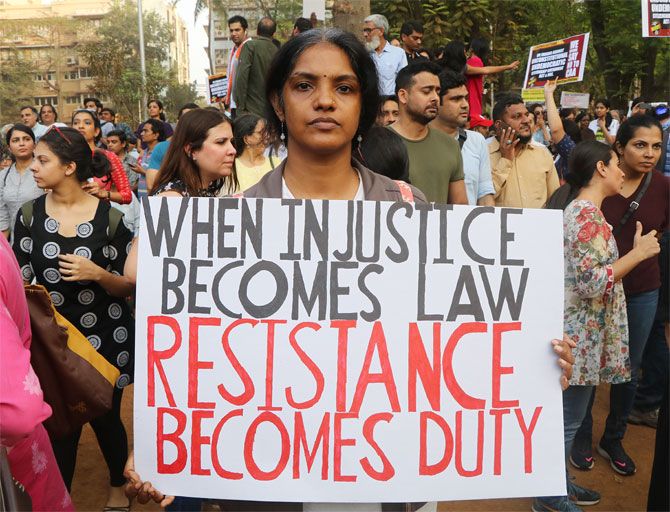
India’s Supreme Court Is Complicit In Modi’s All-Round Assault On Civil Liberties, Human Rights: Veteran Lawyer Prashant Bhushan

India’s most famous lawyer and veteran human rights defender Prashant Bhushan has slammed the country’s Supreme Court saying it is now complicit in Prime Minister Narendra Modi’s comprehensive assault on civil and political liberties of religious minorities such as Muslims; human rights defenders; the civilian population of India’s only Muslim-majority province of Kashmir; the government’s critics; and dissenters.

“The Supreme Court has been virtually abdicating its role as the guardian of civil liberties and human rights of the people in India,” Bhushan said at a Briefing organized Wednesday by US-based civil and political rights groups. “[The Supreme Court has] indeed gone further in some cases to even assault the civil liberties of the citizens.”

The Constitution gave the Supreme Court the “very important responsibility of protecting fundamental rights [and] human rights of the citizens” and ensuring “that the executive and the legislature function within the norms or within the bounds of their power.” But the court had failed to deliver on that mandate to protect civil and political liberties.

In the eight years since Modi came to power in 2014, India had seen a “rampant trampling” of the people’s rights with a “full-blooded assault on minorities. “There are lynch mobs out on the streets. There are lynch mobs on social media. Laws are being made to somehow reduce [Muslims] to second-class citizens.” Muslims were being extra-judicially killed in “fake encounters;” their homes “bulldozed” merely for protesting.

“Civil rights of dissenters” were being crushed. “Anybody who stands up and speaks out against this government, especially journalists or activists,” was targeted

Saying that a “very large number of our activists and journalists are in jail,” many of them falsely accused of carrying out the anti-Muslim violence in Delhi in 2020, Bhushan said activists were being charged under draconian laws such as the Unlawful Activities (Prevention) Act (UAPA) and “kept in prison for years altogether [and] denied bail.

“In such a situation, the role of the Supreme Court and the High Courts…  becomes even greater because it is really their responsibility and their power and duty to protect the rights of people whose rights have been trampled,” Bhushan said.

However, habeas corpus cases, petitions against the anti-Muslim Citizenship (Amendment) Act (CAA), and cases challenging imprisonment on bogus charges of sedition under UAPA, the Penal code, or “even the National Security Act, which allows preventive detention those cases, are not being heard,” Bhushan said.

Bhushan said the Bhima-Koregaon case, so called because it arose from upper-caste Hindu violence against lower-caste Hindus in a village of that name in Maharashtra state, was “clearly a false case. Several forensic experts have shown that the material based on which [the accused] are charged has been planted in their computer. But now it’s been almost four years and these people are still in jail” and the Court has failed to give them bail. Over a dozen human rights defenders are incarcerated in this case.

“There are many people in Kashmir who have been in jail,” and many petitions have challenged the revocation of Constitutional Article 370 that had given special status to Jammu & Kashmir state. But the Supreme Court has refused to hear those petitions.

“In many cases, bail has been denied by the High Court or even sometimes by the Supreme Court,” Bhushan said. The Supreme Court “has been abdicating its responsibility [by] denying bail in obvious cases where the charge is bogus.”

Bhushan said the Supreme Court was “absolutely faulty” in its “interpretation of the draconian provisions of bail” under the UAPA. The “normal principle” is that “bail is the rule, jail is the exception.” Bail can only be denied if there were reasonable grounds to believe the accused would “flee,” “tamper” with the evidence or commit a crime.

Bhushan slammed the Supreme Court for last month upholding the Prevention of Money Laundering Act (PMLA) “reversed” the “burden of proof.” Now anyone accused under PMLA would need to” prove innocence” to get bail. “It is virtually impossible before trial for anybody to prove his innocence before even the trial begins.”

Bhushan also criticized the Supreme Court for its recent ruling that ignored evidence against Modi’s complicity in a pogrom against Muslims in Gujarat state in 2002 and virtually ordered the arrest of human rights defender Teesta Setalvad who had long exposed Modi’s role in that violence 20 years ago. This ruling showed that the Court had taken the abdication of its responsibility to a “different level,” Bhushan said.

He also criticized the Supreme Court’s ruling last month that rejected testimonies from indigenous people in Chhattisgarh state that the police had carried out mass killings.

Celebrating 75 Years of U.S.-India Partnership

Over the past 75 years, India has emerged as the fastest growing large economy in the world, and the partnership between the United States and India has grown to be predominately characterized by alignment in objectives, values, and vision.

This year, we celebrate 75 years of Indian Independence, and of diplomatic relations between the two largest democracies and market economies in the world. In those 75 years, India has emerged as the fastest growing large economy in the world, and the partnership between the United States and India has grown to be predominately characterized by alignment in objectives, values, and vision.

While today our relationship is characterized by convergence, in the mid-20th century, the bilateral relationship was strained by the logic of a Cold-War geopolitical landscape and India’s experiments with an import-substitution development pathway. Bilateral trade was minimal, and the contours of the relationship were need-based.

However, even in those days, there was a vision that the U.S. and India were destined for greater cooperation. With the Indo-Pakistan War presenting a historical low-point to U.S.-India relations in the 1970’s, there was a recognition by both governments that the commercial relationship would need to pull the diplomatic, that the business community—as it often does—needed to lead.

That’s why in 1975, the U.S. and Indian Governments urged the formation of the U.S.-India Business Council to forge stronger trade and investment ties that could serve as the foundation of a productive partnership. The Council’s formation is the embodiment of the optimism that underpins this relationship. In the 47 years of our operation—and especially in the last three decades—we’ve seen tremendous development of our commercial and strategic partnership, and the increasing interdependence of the latter and former.

In 1991, India dismantled the License Raj (a baroque system of commercial licenses and permits), navigated its balance of payments crisis, and began lowering import tariffs

In 2007, Australia, India, Japan and the United States initiated the Quadrilateral Security Dialogue

In 2008, the U.S. and India launched the Civil Nuclear Agreement and the U.S.-India CEO forum

In 2016, the U.S. and India signed the foundational defense agreements, committing to cooperation on logistics, secure communication, and geospatial intelligence

During my tenure at USIBC, I’ve been one of the first to taste sweet India-sourced alphonso mangos on U.S. soil; proudly watched as U.S. pharmaceutical and insurance companies deepened their investments in India as FDI rules were liberalized; and walked with Indian executives and American governors as they visited potential manufacturing sites for lasting Indian investments into the United States. In the past 20 years, India’s FDI flows have expanded 20 times and the U.S. contributes to 18% percent of them.

As our commercial ties have strengthened, so has our relationship as strategic partners. U.S.-India defense trade has increased from near zero in 2008 to over $20 billion in the last decade; today India is characterized as a major defense partner and net security provider in the Indo-Pacific.

During the pandemic, I participated in the unprecedented cooperation between the U.S. and India on global vaccination and pandemic relief. I still remember those early days when a group of global CEOs watched as the second wave of COVID unfolded in India, and I witnessed their determination to help.  Again, business was leading the way. I saw our members mobilize over $46 million to assist India in its COVID-19 response. The USIBC team was proud to facilitate the logistics around the delivery and installation of 1,000 ventilators, procured by the U.S. Chamber of Commerce Foundation. India donated 1.8 million units of lifesaving Personal Protective Equipment to the United States in our time of need – a true signal that we depend on each other.

The U.S.-India economic corridor has emerged from the pandemic with a renewed focus to expand that spirit of cooperation across sectors, and the past two years have seen both sides double down on our partnership for the global good.

In 1949, just two years after Indian Independence, Prime Minister Jawaharlal Nehru told U.S. President Truman:

“I trust that these two republics of the Western World & the Eastern World will find many ways of working together in friendly and fruitful cooperation to our mutual advantage, and for the good of humanity.”

Seventy-five years after Indian Independence, I think you will agree that Prime Minister Nehru’s vision has been realized—the U.S.-India partnership is one of global good. I am the wife of Indian American—fondly called a “Bahu” at home; just like any good family relationship, there have been times of ease and times of strain between our partner nations, but throughout our difficulties we have remained committed to one another, and to a convergent economic agenda that has benefitted our 1.7 billion people.

This is an opportune time to reflect upon and celebrate what the U.S. and India have achieved in our 75-year relationship, and how we can maximize the next 75 years of our partnership for global good. That’s why we’ve chosen the theme of our 47th India Ideas Summit and Annual General Meeting to be Maximizing the Next 75 Years of U.S.-India Prosperity.

I hope you will join me and the rest of USIBC in congratulating India on 75 years of Independence, in reflecting on the importance of our maturing trade and commercial ties, and in celebrating the ideas, the innovations, and the intrepid spirit of our peoples at the USIBC Annual Meeting and Ideas Summit September 6-7. We have made tremendous progress together, but if the last 75 years is any indication, we are just getting started.

(This blog is the first in a series of pieces that highlight the benefits of U.S.-India economic relations, published by U.S.-India Business Council (USIBC), U.S. Chamber of Commerce)

Har Ghar Tiranga: Indian Flag On Every Home This Independence Day

As part of the 75th Independence Day this year, the government of India has launched the ‘Har Ghar Tiranga’ campaign as part of which, Indians have been urged to display or hoist the national flag at their homes between August 13 and 15

As part of the 75th Independence Day this year, the government of India has launched the ‘Har Ghar Tiranga’ campaign as part of which, citizens have been urged to display or hoist the national flag at their homes between August 13 and 15. In addition, the Ministry of Culture has launched a website under the Har Ghar Tiranga campaign that allows Indians to pin a tricolour at their location, which will be considered virtual hoisting.

Reports stated,, over 12.5 million Tricolours have been pinned. “Get featured on our website by pinning a flag in Hotspot Location,” the website said. Also, participants can send their selfies with the national flag to participate in the initiative. The selfies will be displayed on the website. Over 3 million Indians have sent their selfies to the ministry.

The ‘Har Ghar Tiranga’ campaign, part of the Centre’s ‘Azadi ka Amrit Mahotsav’ initiative to celebrate the country’s 75 years of Independence, was launched last month. Launching the campaign, Narendra Modi, Prime Minister of India had said in a tweet that it will “deepen our connect with the national flag”. The idea behind the initiative is to invoke a sense of ownership in the people and to celebrate Azadi ka Amrit Mahotsav in the spirit of Jan Bhagidari (community participation).

“Today, 22nd July has a special relevance in our history. It was on this day in 1947 that our National Flag was adopted. Sharing some interesting nuggets from history including details of the committee associated with our Tricolour and the first Tricolour unfurled by Pandit Nehru,” the PM wrote in a tweet.

On July 22, 1947, the Constituent Assembly adopted our National Flag. The flag that was finally chosen underwent several changes since it was originally designed by Pingali Venkayya in 1923. Since Independence, our relationship with the flag had been more formal and institutional rather than personal.

The initiative aims to encourage people to bring our flag into our homes and hoist it to mark the 75th year of India’s Independence. Various events involving people from all walks of life will be organised at various locations connected with the freedom struggle. This will allow the new generation to discover the many threads of our freedom struggle, while older generations and communities reconnect to the events that led to a free India.

As this is a ground-up initiative, the role of the government has been that of a facilitator. An initiative of such magnitude requires meticulous planning and execution.  “The Central Theme of the program is to inspire every Indian to hoist the National Flag at their home and to invoke the feeling of patriotism in the hearts of the citizen and promote awareness about our National Flag,” the Ministry of Finance said in a notification.

Since the dawn of civilization, flags have had a special place as a symbol of belonging and protection and to rally people together. Stretching back to times immemorial, flags have been a part of the Indian tradition, symbolizing glory and dharma.

Therefore, it is not surprising when this tradition is continued while building India as a modern nation state, drawing from her civilizational ethos. The flag, therefore, is not just a vision for the future, but the values and foundations of our rich and illustrious past.

Billionaires Grow, India Shrinks: Triumph Of Crony Capitalism

Around two months ago, India’s fastest growing businessman remarked that if India became a USD 30-trillion-economy by 2050, no one would go to bed on an empty stomach.

While speaking at a conclave, Gautam Adani said, “We are around 10,000 days away from the year 2050. Over this period, I anticipate we’ll add about USD 25 trillion to our economy. This translates to an addition of USD 2.5 billion to the GDP every day. I also anticipate that over this period, we’ll have eradicated all forms of poverty.”

He anticipated that the stock markets would add about USD 40 trillion in market capitalisation, which translated to an addition of USD 4 billion every day until 2050. “Uplifting the lives of 1.4 billion may feel like a marathon in the short run, but it’s a sprint in the long run,” concluded Adani.

Well, those who attended the conclave would have actually felt that the person, who is now a frontrunner for the richest person in the world, also thinks of the poor. We can only wish that India’s growth story could also lead to the growth of each and every fellow citizen. However, it all seems to be a figment of the imagination!

Incidentally, the industrialist, who runs a slew of businesses from airports to ports to power generation to distribution to cement manufacturing to infrastructure development, has added USD 49 billion to his wealth in 2021! The figure is much higher than the world’s two richest persons – Elon Musk and Jeff Bezos – at that time. Jeff Bezos has moved to the third position recently.

In fact, during 2020 when the entire world came to a standstill due to the pandemic, Adani’s wealth grew at a much higher speed than the coronavirus! Immediately before the onset of the pandemic, he bought a lavish bungalow at one of the posh localities of the national capital. Unlike Ambani’s Antilia, not much has been written about his bungalow. However, the land size is much bigger than that of Ambani, if reports are to be believed.

In the month of February, Adani overtook Ambani to become Asia’s richest person. His net worth stood at USD 88.5 billion at that time. In a matter of five months, it stands at USD 115.5 billion! Be that as it may, his growth rate is certainly exponential!

Of late, Forbes has placed him at the fourth place in the list of world’s richest people. Incidentally, he just crossed Bill Gates, who has been donating his wealth to charity and who wishes to be kicked off this list.

Let us see how India’s economy fared during the last two years. The continuous lockdown in the year 2020 followed by the second wave in a few months from the unlock phase, had jolted the Indian economy. Despite this, we are termed as the fastest growing country. However, there is a caveat to this statement.

The combined fiscal deficit of the Centre and the states is more than 10 percent of the Gross Domestic Product. It only means that the government had to print more money to keep the machinery called the Indian economy going. It is an established fact that growth at the cost of fiscal consolidation is not a good practice.

We saw a similar trend in the pre-liberalisation period. In fact, India has registered a growth rate of 5.3 percent in the 1980s. However, high fiscal deficit had brought the country on the verge of bankruptcy. High fiscal deficit increases the current account deficit leading to inflation and exhaustion of foreign reserves.

During 2020-21, the Centre had a fiscal deficit of 9.6 percent, understandably to combat the emergency posed by the Covid-19 pandemic. The economic slowdown had impacted the revenue. The government had no option but to print more money. The deficit was reduced to 6.9 percent in 2021-22. The finance minister has projected it to be at 6.4 percent, which is at a higher end.

Of late, a lot is being talked about global recession in view of the Russia-Ukraine war. Experts in our country have been maintaining a stand that the Indian economy is strong enough to bear this jolt. At least the economic facts do not validate such statements.

One, foreign investors have been exiting the Indian market. Resultantly, the current value of the Rupee has gone down considerably. The exchange value of the dollar has touched Rs. 80. Generally, recession is tackled by printing more money, which means higher fiscal deficit. In the current scenario, where fiscal deficit is already high, it will be suicidal to increase it to the levels of the covid year.

A government which believes in populism will find it tempting to print more money for political reasons, a move which may not gel well with the foreign investors. The rupee may further plunge, giving way to inflation, making people at the bottom of the pyramid more vulnerable.

While people like Adani may continue to make wealth, the poor will become poorer day by day. The last few years beginning with demonetisation, imposition of GST, the sudden economic closure due to the pandemic, have affected the poor badly. The ongoing war between Russia and Ukraine has triggered retail inflation. Items of daily use have become expensive. Fuel prices have touched new heights.

On the top of it, the government’s decision to levy taxes on essential items will only make their life miserable. If one looks at the latest unemployment data released by the Centre for Monitoring Indian Economy (CMIE), it has shot up to 7.8 percent in June, with a loss of 13 million jobs, mainly in the agriculture sector. Not only this, 2.5 million people lost jobs amongst the salaried employees.

The government reduced the demand for armed personnel of late by announcing a new scheme. The job opportunities in the private equity-funded market have also started reducing. The situation is all-the-more worrying. High inflation coupled with reducing income levels, will only add more people to below the poverty line, increasing the pressure on government-funded schemes like the national food security act (NFSA), NREGA etc.

This only means more fiscal deficit, malnutrition, impacting the lives of children, women and the elderly. The youth who is left with no avenues to earn a livelihood, is more likely to contribute to social evils like drug addiction, crime etc. Uneducated, unskilled, unemployable youth will only add on to the economic burden. Unlike Japan, India will not be able to leverage this period when the young population is higher than ageing ones.

A report from the international food policy research (IFPRI) published a few days ago should set the alarm bells ringing. The institute has estimated that India’s food production is likely to reduce by 16 percent due to climate change. We have already witnessed the plunge in wheat production this year forcing us to stop exports. The quantity of wheat being distributed through the public distribution systems under schemes like NFSA have also been reduced. At many places, wheat has been completely replaced by rice and other cereals.

In view of the current circumstances, the IFPRI has also estimated that the number of people at risk for hunger is expected to increase by 23 percent. In fact, 73.9 million people are expected to be at risk in 2030. The report says that if the effect of climate change is factored in, the number is likely to increase to 90.6 million people in India coupled with reduction in food production. Globally, the production may increase considerably by 2050 but unfortunately people affected by hunger are expected to increase by 500 million people!

One can easily imagine how defective government policies, where the rich are favoured at the cost of the poor, will make the poor poorer year on year. It is because of this reason that India’s growth story has not been able to transform the lives of the marginalised and the underserved.

When it comes to the poor, the government looks at them from the lens of potential voters not as growth catalysts. The likes of Nirav Modi, Vijaya Mallya etc. enjoy the clout to exploit the system to their favour while the common man struggles to get a loan approved for setting up his enterprise.

As far as Adani’s statement is concerned, it certainly speaks about a world that seems to be Utopian. We can only imagine a world where no one sleeps with an empty stomach. It can only happen if the government does a serious introspection, introduces taxes to regulate the unquestioned growth of a few and invests the money for the benefit of the poor, something on the lines of Thomas Pikkety’s world as presented in his book “Capitalism in 21st Century”.

As of now “Sabka saath, Sabka vikas, Sabka vishwas” is a mere slogan, aimed at winning votes of the people not their hearts. We are set to see the rise of Adanis and Ambanis but not of the poor, who will remain trapped in the inter-generational cycle of poverty.

Raghuram Rajan Warns Turning Minority Into 2nd Class Citizens Will Divide India

Former Reserve Bank of India Governor Raghuram Rajan has said India’s future lies in strengthening liberal democracy and its institutions as it is essential for achieving economic growth.

Warning against majoritarianism, he said Sri Lanka was an example of what happens when a country’s politicians try to deflect a job crisis by targeting minorities.

Speaking at the 5th conclave of All India Professionals Congress, a wing of the Congress party, in Raipur, he said any attempt to turn a large minority into “second class citizens” will divide the country.

Rajan was speaking on the topic ‘Why liberal democracy is needed for India’s economic development’.

“.What is happening to liberal democracy in this country and is it really that necessary for Indian development? … We absolutely must strengthen it. There is a feeling among some quarters in India today that democracy holds back India … India needs strong, even authoritarian, leadership with few checks and balances on it to grow and we seem to be drifting in this direction,” Mr Rajan said.

“I believe this argument is totally wrong. It’s based on an outdated model of development that emphasizes goods and capital, not people and ideas,” said the former chief economist of the International Monetary Fund.

The under-performance of the country in terms of economic growth “seems to indicate the path we are going on needs rethinking,” he said.

The former RBI governor further said that “our future lies in strengthening our liberal democracy and its institutions, not weakening them, and this is in fact essential for our growth.”

Elaborating on why majoritarian authoritarianism must be defeated, he said any attempt to “make second class citizens of a large minority will divide the country and create internal resentment.” It will also make the country vulnerable to foreign meddling, Me Rajan added.

Referring to the ongoing crisis in Sri Lanka, he said the island nation was seeing the “consequences when a country’s politicians try to deflect from the inability to create jobs by attacking a minority.” This does not lead to any good, he said.

Liberalism was not an entire religion and the essence of every major religion was to seek out that which is good in everyone, which, in many ways, was also the essence of liberal democracy, Mr Rajan said.

Claiming that India’s slow growth was not just due to the COVID-19 pandemic, Mr Rajan said the country’s underperformance predated it.

“Indeed for about a decade, probably since the onset of the global financial crisis, we haven’t been doing as well as we could. The key measure of this underperformance is our inability to create the good jobs that our youth need,” the former RBI governor said.

Citing the strident protests against the Centre’s ‘Agniveer’ military recruitment scheme, Mr Rajan said it suggested how hungry the youths were for jobs.

“Just a while ago you saw 12.5 million applicants for 35,000 railway jobs. It is particularly worrisome when India has a scarcity of jobs even when so many women are not working outside their homes. India’s female labour force participation is among the lowest in G-20 at 20.3 percent as in 2019,” he pointed out.

Talking about the “vision of growth” of the current government led by Prime Minister Narendra Modi, he said it centres around the term ‘atmanirbhar’ or self-reliance.

“Now, to the extent it emphasizes better connectivity, better logistics, better roads and devotes more resources to it, in some way this (atmanirbhar vision) seems the continuation of the past reformed decades. And that’s good,” he said.

But, the former RBI governor said, in many ways a look at what ‘atmanirbhar’ is trying to achieve takes one back to an early and failed past where the focus was on physical capital and not human capital, on protection and subsidies and not on liberalization, on choosing favourites to win rather than letting the most capable succeed.

Asserting that there was a misplaced sense of priorities, Mr Rajan said the nation was not spending enough on education, with tragic consequences.

“Many (children) not having been to school for two years are dropping out. Their human capital, which is their and our most important asset in the coming years, is something we are neglecting. We are failing them by not devoting enough resources to remedial education,” Mr Rajan said.

Modi Govt. Criticized For “Relentless Campaign Of Vendetta Against Its Political Opponents”

Several Opposition Parties in India have strongly criticized the Narendra Modi led  Bharatiya Janata Party (BJP) Government for targeting its opponents and critics, saying that Modi has “unleashed a relentless campaign of vendetta against its political opponents and critics through the mischievous misuse of investigative agencies”

“Prominent leaders of a number of political parties have been deliberately targeted and subjected to harassment in an unprecedented manner. We condemn this and resolve to continue and intensify our collective fight against the anti-people, anti-farmers, and anti-Constitution policies of the Modi government that is destroying the social fabric of our society,” a statement issued by the Opposition parties said.

The Modi regime’s attack against members of the Indian parliament has led to rising concerns over a shrinking political state and the backsliding towards an authoritarian state.

After questioning Rahul Gandhi, the leader of the Congress Party for three full days, each day for as many as 10 hours,  India’s Enforcement Directorate (ED) has now targeted Sonia Gandhi, the leader of the Opposition party. 

In a show of strength, the Congress staged street protests and its leaders courted arrest across the country last week as the party chief Sonia Gandhi was questioned by the Enforcement Directorate (ED) in a money laundering case related to the National Herald newspaper.
Gandhi, who was recovering from Covid, was summoned again on July 25. The 75-year-old replied to dozens of questions last week, media reports stated. According to Congress leader Jairam Ramesh, the ED said it had nothing to ask of her either Thursday or Friday. After which Sonia Gandhi said she was willing to appear on July 25th, he said. The Congress party slammed the agency’s action against its top leadership and termed it “political vendetta”.

“All Congress MPs and CWC members have courted mass arrest outside our party headquarters in a show of collective solidarity with Sonia Gandhi, a target of ‘Vishguru’s’ political vendetta,” said Congress general secretary Ramesh.

Leaders of 13 political parties, including the DMK, Shiv Sena, RJD and the Left, met at Parliament House and issued a statement accusing the government of unleashing a “relentless campaign of vendetta against its political opponents and critics through the mischievous misuse of investigative agencies”.

According to reports, an alarmingly high volume of cases register by the ED in recent years. The total number of cases registered by the ED under the Foreign Exchange Management Act, 1999 (FEMA) and the Prevention of Money Laundering Act, 2002 (PMLA) has jumped almost three times in the first three years of the second term of the BJP-led government (2019-20 to 2021-22) as compared to the corresponding period in its first term (2014-15 to 2016-17), as per the data shared by India’s Minister of State for Finance Pankaj Chaudhary in a written reply to Lok Sabha on July 25, 2022. 

The ED registered 14,143 cases under FEMA and PMLA between 2019-20 and 2021-22, as compared to 4,913 cases in 2014-15 to 2016-17 — an increase of over 187 per cent. The break-up shows that 11,420 FEMA cases were taken up for investigation in the first three years of the second term, up from 4,424 cases in the first three years of the first term — an increase of over 158 per cent. The cases registered under PMLA increased by more than five times in this period — from 489 between 2014-15 to 2016-17 to 2,723 in 2019-20 to 2021-22 — a jump of over 456 per cent. According to the year-wise data, 2021-22 saw the highest number of money laundering and foreign exchange violation cases in the last eight years of the Modi government. In 2020-21, the ED filed 5,313 cases under FEMA (the previous high was 3,627 cases in 2017-18); and 1,180 under PMLA (up from 981 in 2020-21).

Another tool used by the Indian Government in recent years to contain dissent has been the Unlawful Activities Prevention Act (UAPA). As per the submission by the Ministry of Home Affairs (MHA) before the Parliament on July 20, 2022, there is  a huge gap between the number of persons who are under-trial and those who have been either convicted or acquitted under the Unlawful Activities Prevention Act (UAPA) in the country during 2016-2020.

Out of 6,482 persons under trial, only 80 persons have been convicted and 116 have been acquitted. The increasing number of persons undertrial is concerning and is a poor reflection on the Indian judicial system.It suggests that the law is merely enabling their continued incarceration. “Thus, the Unlawful Activities (Prevention) Act, (UAPA) is allegedly being misused to incarcerate political dissidents by a vindictive regime,” critics pointed out.

In Efforts To Restrict Dissent, India Fines Amnesty India International

Amnesty India International has been critical of India and its human rights violations for several years. The annual reports by the agency that monitors violations by the state/federal government agencies across the nation have come under fire by the ruling party led by Narendra Modi.

The harassment of the Amnesty India International by the Indian Government agencies has led to the suspension of its activities in India in September 2020. “Because of the bank freeze, Amnesty International India has been forced to cease work in India,” reports pointed out. 

Now, as per the latest reports, the Enforcement Directorate (ED) of India has imposed penalties of Rs. 51 crore and Rs 10 crore, respectively, on Amnesty India and its former head Aakar Patel, citing violations of the Foreign Exchange Management Act (FEMA).
The agency said in a statement that Amnesty International UK had been remitting large foreign contributions “through its Indian entities (non-FCRA companies) following the FDI route in order to evade the Foreign Contribution Regulation Act (FCRA)” and expand its activities in India.

This was despite the Home Ministry’s denial of prior registration or permissions to Amnesty International India Foundation Trust and other trusts under the FCRA, it said in a statement last week.

“The Adjudicating Authority of Directorate of Enforcement (ED) has adjudicated a Show Cause Notice issued to M/s Amnesty India International Pvt. Ltd.(AIIPL) and its CEO Shri Aakar Patel for contravention of the provisions of The Foreign Exchange Management Act, 1999 (FEMA) and imposed penalty to the tune of Rs. 51.72 crore and ₹10 crore respectively,” said the ED statement.

The funds were transferred to “expand its NGO activities in India, despite the denial of prior registration or permissions to Amnesty International India Foundation Trust (AIIFT) and other trusts under FCRA by Ministry of Home Affairs, Govt. of India”, the ED statement said.

In 2018, ED began conducting searches of properties of Amnesty India over allegations that AIIPL was formed to receive foreign funding, violating FCRA rules. In 2019, the Central Bureau of Investigation (CBI) filed a case against the NGO alleging violation of foreign exchange rules.

In 2020, the Executive Director of Amnesty International India Avinash Kumar stated: “The continuing crackdown on Amnesty International India over the last two years and the complete freezing of bank accounts is not accidental. The constant harassment by government agencies including the Enforcement Directorate is a result of our unequivocal calls for transparency in the government, more recently for accountability of the Delhi police and the Government of India regarding the grave human rights violations in Delhi riots and Jammu & Kashmir. For a movement that has done nothing but raise its voices against injustice, this latest attack is akin to freezing dissent.”

Droupadi Murmu Is The President Of India

“India’s poor can see their reflection in me:” Murmu reflects on her own life as a lesson for the 1.4 Billion Indians, immediately after she took the oath of office to be the 15th  president of India

Droupadi Murmu, a tribal politician from the Odisha (Orissa) state was sworn in as the 10th successive president of the Republic of India on Monday, July 25th, 2022 in the central hall of Parliament in New Delhi. The 64-year-old former teacher, the country’s first tribal leader has become the constitutional head of India. Chief Justice of the Supreme Court of India N V Ramana administered the oath of office to the youngest ever President of India. Murmu replaces outgoing President Ram Nath Kovind, whose term ended on July 24th.

India, a country with 1.4 billion people and the largest democracy in the world, has a constitutional framework of India is parliamentary, which is led by the elected representative and overseen by the first person of the country, the President of India.

In attendance at the solemn ceremony were: The outgoing President Ram Nath Kovind; Vice President and Chairman of the Rajya Sabha M Venkaiah Naidu, Prime Minister Narendra Modi, Lok Sabha Speaker Om Birla, Members of the Council of Ministers, Governors, Chief Ministers, heads of diplomatic missions, Members of Parliament and principal civil and military officers of the government will attend the ceremony. After the oath ceremony, the President arrived at the Rashtrapati Bhavan, where an inter-services guard of honor was given to her in the forecourt.

The swearing-in ceremony was marked by pomp and grandeur. It began with the arrival of two presidents – the outgoing Ram Nath Kovind and the incoming Droupadi Murmu – in a procession from Rashtrapati Bhavan to the Parliament building. Murmu was then escorted by Prime Minister Narendra Modi, Vice-President and Chairman of the Rajya Sabha M Venkaiah Naidu, Lok Sabha Speaker Om Birla to the Central Hall. After the short ceremony, Murmu and Kovind were escorted out of the Central Hall amid the roll of drums and blowing of trumpets.

Dressed in a white saree with green-and-red border,  in her address immediately after she took the oath as the President of India, Murmu thanked all MPs and MLAs who elected her to the highest office. Murmu, supported by the ruling Bharatiya Janata Party (BJP was elected by the members of both the houses of parliament and of the legislative assemblies of states and federally-administered union territories. “I thank all of you. Your trust and cooperation is my strength. I am the first president who took birth in independent India,” she said.

Murmu said that she started her journey of life from a small tribal village in Odisha in the eastern part of the country. From the background that she came from, it was like a dream for her to get elementary education, she said. Her election to the top constitutional post proves that in India, the poor can not only dream but also fulfill those aspirations, she added.

“I have been elected during an important time when the country is marking 75 years of Independence,” she noted. “Reaching this office is not my personal achievement but that of all the poor people in the country,” Murmu said. It is a matter of great satisfaction that those who have been deprived for centuries and those who have been denied the benefits of development, poor, downtrodden, backwards and tribals are seeing their reflection in her, she pointed out.

Tracing her background to the humble beginning, Murmu said, “I belong to the tribal society, and I have got the opportunity to become the President of India from the Ward Councilor. This is the greatness of India, the mother of democracy. It is the power of our democracy that a daughter born in a poor house, a daughter born in a remote tribal area, can reach the highest constitutional post of India.”

This is the first time that India has a tribal — considered the most original inhabitants of the land but have been on the margins of socio-economic development — as the President. This is happening in the 75th year of Independence, which marks the beginning of the government’s celebration of Amrit Kaal.

At 64, Murmu becomes the youngest person to be the President of India. She scripted history last week, defeating joint-opposition candidate Yashwant Sinha, a former Union minister, in a one-sided contest. She polled 6,76,803 votes against Sinha’s 3,80,177 votes to become India’s 15th President.

Born in 1958 in Baidaposi village of Mayurbhanj district, Murmu belongs to the Santhal community, one of India’s largest tribal groups. Daughter of a village council chief, she studied at the Ramadevi Women’s College in the state capital, Bhubaneswar.

Beginning her career as a clerk for the Odisha government, Murmu served as a junior assistant in the irrigation and energy department from 1979-1983. After she quit her job in Bhubaneswar and returned to Rairangpur to take care of her family at the insistence of her mother-in-law, she took up a job as a teacher at the Sri Aurobindo Integral School.

Her political career began in 1997 when she was elected as a councillor in the local polls in Rairangpur. She was often seen personally supervising sanitation work in the town, standing in the sun as drains were cleaned and garbage cleared.

As a member of the BJP, she was elected to the state assembly twice – in 2000 and in 2009 – from the Rairangpur seat. Murmu came into the limelight in 2017 when it was rrumoreded that the BJP was considering her name for the presidential election that year. She was then serving as the governor of the state of Jharkhand.

Murmu devoted her life to serving society, empowering poor, downtrodden and marginalized sections of society. She has rich administrative experience and an outstanding gubernatorial tenure in Jharkhand. Murmu has made a special identity in public life by spreading awareness about education in tribal society and serving the public for a long time as a public representative.

The Indian president acts as the Supreme Commander of the Armed Forces but the prime minister holds executive powers. he president, nevertheless, has a key role during political crises, such as when a general election is inconclusive, by deciding which party is in the best position to form a government. “A daughter of India hailing from a tribal community born in a remote part of eastern India has been elected our President!” PM Modi said on Twitter.

Chinese President Xi Jinping was among the world leaders to congratulate Murmu and said he was “ready to work” with his new Indian counterpart to strengthen relations, according to Chinese state media.

After Droupadi Murmu took oath as India’s 15th President in Delhi on Monday, celebrations were held at her native place – Rairangpur. To celebrate Murmu’s oath, people from her native performed tribal dance on the beats of the folk music. Notably, Draupadi Murmu is the first tribal and second woman to hold the country’s highest constitutional office.

Righteous Dissent

By, P. A. Chacko At Indian Currents

Righteous dissent is right to dissent; and it is a fundamental right. It is guaranteed by Indian Constitution in Article 19 with the freedom of expression. Dissent shows there is another angle or a different viewpoint.  Decent persons listen to what others have to say in dissent. It is letting others to have their freedom of opinion. It may be a critical observation. It could also be a point which the other party has not seen or taken into consideration or an alternative solution. 

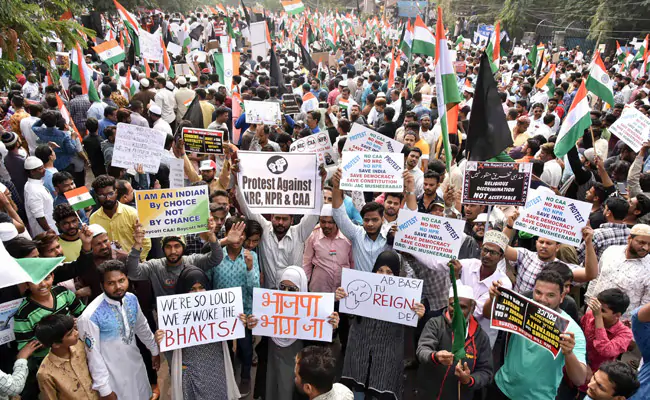
When a government in power does not want to allow such freedom of expression, one smells a rat. If it suppresses dissent with an iron rod, it is the end of the road. Many citizens are of opinion that the ruling BJP deals with every dissenting opinion as unwanted, often dubbed criminal act, sometimes even anti-national. Peaceful demonstrations, representations, meetings, gatherings, etc. are constitutionally guaranteed exercises of democratic freedom of expression. Surprisingly, even such acts or exercises invite the wrath of the powers that are. 
Did not Prime Minister Modi put on a Himalayan stature at the recent G 7 summit in Bavaria when he, along with four other countries, signed the document on protecting the freedom of speech? The Hindu noted that “the joint statement came amidst allegations that the Indian Government was stifling the freedom of speech and the civil society actors…In a joint statement titled ‘2022 Resilient Democracies Statement’ on June 27 during the G 7 Summit, the leaders including Prime Minister Narendra Modi, said they were prepared to defend these principles and are resolved to protect the freedom of expression” (thehindu.com, June 28). 

But, what a contradiction, when, almost at the same time journalist and Alt News co-founder Mohammed Zubair was arrested by Delhi police for a four-year-old quote from a Hindi film accusing him of hurting religious sentiments. According to Justice Deepak Gupta, “Freedom of speech is one of the basic concepts of our democracy. People are put under pressure if they are made to feel that, if they express a certain point of view, they will have to face trouble either from the Enforcement Directorate or a money laundering case” (Interview to The Wire).

In contrast, a BJP spokesperson, who offended the sentiments of the Muslim community by saying insulting words against Prophet Mohammed, has not yet been arrested. Instead, she is being honoured with security cover. Another spokesperson who supported Nupur Sharma too has been given security cover. “If Nupur Sharma was not arrested, Zubair also should not have been arrested,” says Justice Deepak Gupta.

In every country there are opposition parties. They ventilate public grievances through their critical observations and suggestions. United Kingdom, Canada, New Zealand and Australia have shadow Cabinets of opposition parties. Its responsibility is to scrutinise the ruling party’s policies and offer alternative suggestions or amendments.  Unfortunately, India has no such arrangement. Rather, more often than not, the opposition parties are considered unwanted and treated like carbuncles.  

In today’s Indian scenario, public dissent often erupts into violent street theatricals which are not happy solutions. Such exercises may be outbursts of suffocations caused by the iron hand of the government. Instead of dealing with opposing situations through discussions and debates, if they are met with police atrocities and even bureaucratic punishments, the writing on the wall is clear. Executive orders to treat demonstrators as criminals are anti-democratic decisions. 

On the other hand, it is often seen that if you belong to the ruling party, you can go any length to create mayhem and terror. Whether to pull down the Ayodhya mosque or to attack minority communities with impunity, it is, as if, the prerogative of the muzzle men with the blessings of the party bosses.     

The U.P. incidents where Muslim homes were demolished because they allegedly took part in street demonstrations have attracted condemnations the world over. Here righteous dissent was treated with criminal assault. Three Rapporteurs of the United Nations (Housing Rights, Minority Issues and Freedom of Religion), jointly sent a letter to the government of India on 9th June criticizing and protesting against arbitrary demolitions of houses and properties of people, particularly of the Muslim community. The world is watching and is concerned. Yet we in India play the fiddle. 

In a recent Supreme Court case involving Nupur Sharma, Justice Surya Kant (slated to take over as the Chief Justice of India in May 2025) told Nupur’s counsel, “No Mr. Singh, the conscience of the court is not satisfied.” He stated that she should apologize to the nation for her arrogant and insulting remark against the Holy Prophet Mohammed and queried why she was not arrested. He also stated that the fact that she was not arrested shows her clout and power.  

It is highly praiseworthy that the Judge sends the incontrovertible message to the nation that the court has a conscience. It would be equally praiseworthy if all the judicial authorities believed in this message and acted accordingly.  The nation, particularly the common man, looks up to the court to exercise its conscience by pronouncing justice without bias or favor. 

That is where people expect that the courts in India not to keep mum when the nation is taken for a ride by terror outfits or nationalist marauders. When the wheels of justice turn too slow for ordinary people, the conscience of the court should wake up and call a spade a spade. 

When righteous dissent is bulldozed and pulverized by the ruling class or when the minority communities are treated as dirt, the conscience of the court cannot afford to take a blissful nap. The promising sign of the window of justice getting opened by the conscience keepers of the law courts is welcome. However, the suffocation of people suffering from sponsored spiral of violence can be removed only by opening not just a window but all the doors and windows of justice.

Social Realities of Indian Americans: Results From the 2020 Indian American Attitudes Survey

By, Sumitra Badrinathan,  Devesh Kapur,  Jonathan Kay,  Milan Vaishnav

U.S. President Joe Biden remarked in a March 2021 phone call with Swati Mohan, an Indian-origin scientist charged with overseeing the highly anticipated landing of the Perseverance Mars rover for the National Aeronautics and Space Administration: “It’s amazing. Indian—of descent—Americans are taking over the country: you, my vice president [Kamala Harris, whose mother was born in India], my speechwriter, Vinay [Indian American Vinay Reddy]. . . . You guys are incredible.”1

While some in the media interpreted Biden’s off-the-cuff remark as an unfortunate gaffe, others viewed it as affirmation of the growing influence of the Indian American diaspora. In the same exchange, Biden later added: “One of the reasons why we’re such an incredible country is we’re such a diverse country. We bring the best out of every single solitary culture in the world here in the United States of America, and we give people an opportunity to let their dreams run forward.”

Indian Americans are the second-largest immigrant group in the United States. As the number of Indian-origin residents in the United States has swelled north of 4 million, the community’s diversity too has grown.

Today, Indian Americans are a mosaic of recent arrivals and long-term residents. While the majority are immigrants, a rising share is born and raised in the United States. Many Indian immigrants might have brought with them identities rooted in their ancestral homeland, while others have eschewed them in favor of a nonhyphenated “American” identity. And despite the overall professional, educational, and financial success many Indian Americans enjoy, this has not inoculated them from the forces of discrimination, polarization, and contestation over questions of belonging and identity.

There is surprisingly little systematic data about the everyday social realities that Indian Americans experience. How do Indian Americans perceive their own ethnic identity? How do they respond to the dual impulses of assimilation and integration? And how might their self-conception influence the composition of their social networks?

These are not merely academic questions. As the profile of the Indian American community has grown, so too has its economic, political, and social influence. But how Indian Americans choose to deploy this influence remains an open question. To what extent do people of Indian origin encounter discriminatory behavior—on what grounds and by whom? As the United States witnesses a resurgence of violence and hate speech targeting Asian Americans, how might it affect Americans of Indian origin?

This study draws on a new source of empirical data to answer these and other questions. Its findings are based on a nationally representative online survey of 1,200 Indian American residents in the United States—the 2020 Indian American Attitudes Survey (IAAS)—conducted between September 1 and September 20, 2020, in partnership with the research and analytics firm YouGov. The survey, drawing on both citizens and non-citizens in the United States, was conducted online using YouGov’s proprietary panel of 1.8 million Americans and has an overall margin of error of +/- 2.8 percent.

This study is the third in a series on the social, political, and foreign policy attitudes of Indian Americans. The major findings are briefly summarized below.

  • Indian Americans exhibit very high rates of marriage within their community. While eight out of ten respondents have a spouse or partner of Indian origin, U.S.-born Indian Americans are four times more likely to have a spouse or partner who is of Indian origin but was born in the United States.
  • Religion plays a central role in the lives of Indian Americans but religious practice varies. While nearly three-quarters of Indian Americans state that religion plays an important role in their lives, religious practice is less pronounced. Forty percent of respondents pray at least once a day and 27 percent attend religious services at least once a week.
  • Roughly half of all Hindu Indian Americans identify with a caste group. Foreign-born respondents are significantly more likely than U.S.-born respondents to espouse a caste identity. The overwhelming majority of Hindus with a caste identity—more than eight in ten—self-identify as belonging to the category of General or upper caste.
  • “Indian American” itself is a contested identity. While Indian American is a commonly used shorthand to describe people of Indian origin, it is not universally embraced. Only four in ten respondents believe that “Indian American” is the term that best captures their background.
  • Civic and political engagement varies considerably by one’s citizenship status. Across nearly all metrics of civic and political participation, U.S.-born citizens report the highest levels of engagement, followed by foreign-born U.S. citizens, with non-citizens trailing behind.
  • Indian Americans’ social communities are heavily populated by other people of Indian origin. Indian Americans—especially members of the first generation—tend to socialize with other Indian Americans. Internally, the social networks of Indian Americans are more homogenous in terms of religion than either Indian region (state) of origin or caste.
  • Polarization among Indian Americans reflects broader trends in American society. While religious polarization is less pronounced at an individual level, partisan polarization—linked to political preferences both in India and the United States—is rife. However, this polarization is asymmetric: Democrats are much less comfortable having close friends who are Republicans than the converse. The same is true of Congress Party supporters vis-à-vis supporters of the Bharatiya Janata Party (BJP).
  • Indian Americans regularly encounter discrimination. One in two Indian Americans reports being discriminated against in the past one year, with discrimination based on skin color identified as the most common form of bias. Somewhat surprisingly, Indian Americans born in the United States are much more likely to report being victims of discrimination than their foreign-born counterparts.

To some extent, divisions in India are being reproduced within the Indian American community. While only a minority of respondents are concerned about the importation of political divisions from India to the United States, those who are identify religion, political leadership, and political parties in India as the most common factors. (Courtesy: Carnegie Endowment for International Peace)

Righteous Dissent

Righteous dissent is right to dissent; and it is a fundamental right. It is guaranteed by Indian Constitution in Article 19 with the freedom of expression. Dissent shows there is another angle or a different viewpoint.  Decent persons listen to what others have to say in dissent. It is letting others to have their freedom of opinion. It may be a critical observation. It could also be a point which the other party has not seen or taken into consideration or an alternative solution.

When a government in power does not want to allow such freedom of expression, one smells a rat. If it suppresses dissent with an iron rod, it is the end of the road. Many citizens are of opinion that the ruling BJP deals with every dissenting opinion as unwanted, often dubbed criminal act, sometimes even anti-national. Peaceful demonstrations, representations, meetings, gatherings, etc. are constitutionally guaranteed exercises of democratic freedom of expression. Surprisingly, even such acts or exercises invite the wrath of the powers that are.

Did not Prime Minister Modi put on a Himalayan stature at the recent G 7 summit in Bavaria when he, along with four other countries, signed the document on protecting the freedom of speech? The Hindu noted that “the joint statement came amidst allegations that the Indian Government was stifling the freedom of speech and the civil society actors…In a joint statement titled ‘2022 Resilient Democracies Statement’ on June 27 during the G 7 Summit, the leaders including Prime Minister Narendra Modi, said they were prepared to defend these principles and are resolved to protect the freedom of expression” (thehindu.com, June 28).

But, what a contradiction, when, almost at the same time journalist and Alt News co-founder Mohammed Zubair was arrested by Delhi police for a four-year-old quote from a Hindi film accusing him of hurting religious sentiments. According to Justice Deepak Gupta, “Freedom of speech is one of the basic concepts of our democracy. People are put under pressure if they are made to feel that, if they express a certain point of view, they will have to face trouble either from the Enforcement Directorate or a money laundering case” (Interview to The Wire).

In contrast, a BJP spokesperson, who offended the sentiments of the Muslim community by saying insulting words against Prophet Mohammed, has not yet been arrested. Instead, she is being honoured with security cover. Another spokesperson who supported Nupur Sharma too has been given security cover. “If Nupur Sharma was not arrested, Zubair also should not have been arrested,” says Justice Deepak Gupta.

In every country there are opposition parties. They ventilate public grievances through their critical observations and suggestions. United Kingdom, Canada, New Zealand and Australia have shadow Cabinets of opposition parties. Its responsibility is to scrutinise the ruling party’s policies and offer alternative suggestions or amendments.  Unfortunately, India has no such arrangement. Rather, more often than not, the opposition parties are considered unwanted and treated like carbuncles.

In today’s Indian scenario, public dissent often erupts into violent street theatricals which are not happy solutions. Such exercises may be outbursts of suffocations caused by the iron hand of the government. Instead of dealing with opposing situations through discussions and debates, if they are met with police atrocities and even bureaucratic punishments, the writing on the wall is clear. Executive orders to treat demonstrators as criminals are anti-democratic decisions.

On the other hand, it is often seen that if you belong to the ruling party, you can go any length to create mayhem and terror. Whether to pull down the Ayodhya mosque or to attack minority communities with impunity, it is, as if, the prerogative of the muzzle men with the blessings of the party bosses.

The U.P. incidents where Muslim homes were demolished because they allegedly took part in street demonstrations have attracted condemnations the world over. Here righteous dissent was treated with criminal assault. Three Rapporteurs of the United Nations (Housing Rights, Minority Issues and Freedom of Religion), jointly sent a letter to the government of India on 9th June criticizing and protesting against arbitrary demolitions of houses and properties of people, particularly of the Muslim community. The world is watching and is concerned. Yet we in India play the fiddle.

In a recent Supreme Court case involving Nupur Sharma, Justice Surya Kant (slated to take over as the Chief Justice of India in May 2025) told Nupur’s counsel, “No Mr. Singh, the conscience of the court is not satisfied.” He stated that she should apologize to the nation for her arrogant and insulting remark against the Holy Prophet Mohammed and queried why she was not arrested. He also stated that the fact that she was not arrested shows her clout and power.

It is highly praiseworthy that the Judge sends the incontrovertible message to the nation that the court has a conscience. It would be equally praiseworthy if all the judicial authorities believed in this message and acted accordingly.  The nation, particularly the common man, looks up to the court to exercise its conscience by pronouncing justice without bias or favor.

That is where people expect that the courts in India not to keep mum when the nation is taken for a ride by terror outfits or nationalist marauders. When the wheels of justice turn too slow for ordinary people, the conscience of the court should wake up and call a spade a spade.

When righteous dissent is bulldozed and pulverized by the ruling class or when the minority communities are treated as dirt, the conscience of the court cannot afford to take a blissful nap. The promising sign of the window of justice getting opened by the conscience keepers of the law courts is welcome. However, the suffocation of people suffering from sponsored spiral of violence can be removed only by opening not just a window but all the doors and windows of justice.

Social Realities of Indian Americans: Results From the 2020 Indian American Attitudes Survey

U.S. President Joe Biden remarked in a March 2021 phone call with Swati Mohan, an Indian-origin scientist charged with overseeing the highly anticipated landing of the Perseverance Mars rover for the National Aeronautics and Space Administration: “It’s amazing. Indian—of descent—Americans are taking over the country: you, my vice president [Kamala Harris, whose mother was born in India], my speechwriter, Vinay [Indian American Vinay Reddy]. . . . You guys are incredible.”1

While some in the media interpreted Biden’s off-the-cuff remark as an unfortunate gaffe, others viewed it as affirmation of the growing influence of the Indian American diaspora. In the same exchange, Biden later added: “One of the reasons why we’re such an incredible country is we’re such a diverse country. We bring the best out of every single solitary culture in the world here in the United States of America, and we give people an opportunity to let their dreams run forward.”

Indian Americans are the second-largest immigrant group in the United States. As the number of Indian-origin residents in the United States has swelled north of 4 million, the community’s diversity too has grown.

Today, Indian Americans are a mosaic of recent arrivals and long-term residents. While the majority are immigrants, a rising share is born and raised in the United States. Many Indian immigrants might have brought with them identities rooted in their ancestral homeland, while others have eschewed them in favor of a nonhyphenated “American” identity. And despite the overall professional, educational, and financial success many Indian Americans enjoy, this has not inoculated them from the forces of discrimination, polarization, and contestation over questions of belonging and identity.

There is surprisingly little systematic data about the everyday social realities that Indian Americans experience. How do Indian Americans perceive their own ethnic identity? How do they respond to the dual impulses of assimilation and integration? And how might their self-conception influence the composition of their social networks?

These are not merely academic questions. As the profile of the Indian American community has grown, so too has its economic, political, and social influence. But how Indian Americans choose to deploy this influence remains an open question. To what extent do people of Indian origin encounter discriminatory behavior—on what grounds and by whom? As the United States witnesses a resurgence of violence and hate speech targeting Asian Americans, how might it affect Americans of Indian origin?

This study draws on a new source of empirical data to answer these and other questions. Its findings are based on a nationally representative online survey of 1,200 Indian American residents in the United States—the 2020 Indian American Attitudes Survey (IAAS)—conducted between September 1 and September 20, 2020, in partnership with the research and analytics firm YouGov. The survey, drawing on both citizens and non-citizens in the United States, was conducted online using YouGov’s proprietary panel of 1.8 million Americans and has an overall margin of error of +/- 2.8 percent.

This study is the third in a series on the social, political, and foreign policy attitudes of Indian Americans. The major findings are briefly summarized below.

  • Indian Americans exhibit very high rates of marriage within their community. While eight out of ten respondents have a spouse or partner of Indian origin, U.S.-born Indian Americans are four times more likely to have a spouse or partner who is of Indian origin but was born in the United States.
  • Religion plays a central role in the lives of Indian Americans but religious practice varies. While nearly three-quarters of Indian Americans state that religion plays an important role in their lives, religious practice is less pronounced. Forty percent of respondents pray at least once a day and 27 percent attend religious services at least once a week.
  • Roughly half of all Hindu Indian Americans identify with a caste group. Foreign-born respondents are significantly more likely than U.S.-born respondents to espouse a caste identity. The overwhelming majority of Hindus with a caste identity—more than eight in ten—self-identify as belonging to the category of General or upper caste.
  • “Indian American” itself is a contested identity. While Indian American is a commonly used shorthand to describe people of Indian origin, it is not universally embraced. Only four in ten respondents believe that “Indian American” is the term that best captures their background.
  • Civic and political engagement varies considerably by one’s citizenship status. Across nearly all metrics of civic and political participation, U.S.-born citizens report the highest levels of engagement, followed by foreign-born U.S. citizens, with non-citizens trailing behind.
  • Indian Americans’ social communities are heavily populated by other people of Indian origin. Indian Americans—especially members of the first generation—tend to socialize with other Indian Americans. Internally, the social networks of Indian Americans are more homogenous in terms of religion than either Indian region (state) of origin or caste.
  • Polarization among Indian Americans reflects broader trends in American society. While religious polarization is less pronounced at an individual level, partisan polarization—linked to political preferences both in India and the United States—is rife. However, this polarization is asymmetric: Democrats are much less comfortable having close friends who are Republicans than the converse. The same is true of Congress Party supporters vis-à-vis supporters of the Bharatiya Janata Party (BJP).
  • Indian Americans regularly encounter discrimination. One in two Indian Americans reports being discriminated against in the past one year, with discrimination based on skin color identified as the most common form of bias. Somewhat surprisingly, Indian Americans born in the United States are much more likely to report being victims of discrimination than their foreign-born counterparts.
  • To some extent, divisions in India are being reproduced within the Indian American community. While only a minority of respondents are concerned about the importation of political divisions from India to the United States, those who are identify religion, political leadership, and political parties in India as the most common factors. (Courtesy: Carnegie Endowment for International Peace)

US Awaits India’s Nod To Dispatch Covid Vaccines

The United States has said it is waiting for the Indian government to give a green signal for dispatching the anti-Covid vaccines that the US is donating to several countries across the world. “We are ready to ship those vaccines expeditiously when we have a green light from the Government of India,” State Department spokesperson Ned Price said, as reported by news agency PTI. US vaccines have reached Pakistan, Nepal, Bhutan, and Bangladesh. But for India, it is taking time as there are some legal hurdles for emergency import, Ned Price said.

The US earlier announced to share 80 million doses from its domestic stock with countries around the world. Under India’s share, it is supposed to get 3-4 million doses of Moderna and Pfizer from the United States. While Moderna has been approved by the Drug Controller General of India, Pfizer has not yet applied for an emergency approval in India yet.India has sought time to review its legal provision to accept vaccine donation, the United States has said as Pakistan, Nepal, Bhutan, and Bangladesh received vaccines from the US.

What are the legal hurdles?

“Before we can ship those doses, however, each country must complete its own domestic set of operational, of regulatory, and legal processes that are specific to each country. Now, India has determined that it needs further time to review legal provisions related to accepting vaccine donations,” Price said.

Sputnik plans 300 million doses a year

Russia’s Sputnik V vaccine, developed by Gamaleya National Research Institute of Epidemiology and Microbiology in Moscow, was granted emergency use authorisation in India in May. Covishield-maker Serum Institute of India (SII) has added yet another brand to its growing portfolio of Covid-19 vaccines, unveiling plans on Tuesday to manufacture Russia’s Sputnik V over the next two months. SII’s addition to a growing list of Indian partners for Sputnik V would enable the country to churn out over a billion doses of the Russian vaccine every year. It is also likely to help improve supply of the vaccine in India, where a soft launch has already taken place through vials imported from Russia but doses from most domestic manufacturers are still awaited.

SII, through its partnership with the Russian Direct Investment Fund (RDIF), intends to produce over 300 million doses of Sputnik V per year, said Russia’s sovereign wealth fund in a statement. This takes India’s annual production capacity of this vaccine to nearly 1.2 billion doses a year. The Pune-headquartered vaccine maker has already received samples of the cell and vector — crucial components to make the vaccine — from the Gamaleya Research Institute of Epidemiology and Microbiology as part of the technical transfer process. The cultivation process has already begun.

“We hope to make millions of doses in the coming months with trial batches starting in the month of September,” said SII CEO Adar Poonawalla. “We expect the ramp-up to be quite quick…we’ve actually been working with Serum for the last three months,” said RDIF CEO Kirill Dmitriev.

Jaishankar On A Mission To US, Urging Covid Help

With India grappling with the ferocious second wave of Covid-19, External Affairs Minister S Jaishankar is on a vaccine mission to the United States as India fights shortages of doses amidst a virulent second surge.

WashingWith India grappling with the ferocious second wave of Covid-19, External Affairs Minister S Jaishankar is on a vaccine mission to the United States as India fights shortages of doses amidst a virulent second surge.Jaishankar met with several high ranking officials at the UD administration, including US Secretary of State Antony Blinken, Defense Secretary Lloyd Austin, National Security Advisor Jake Sullivan, US Trade Representative Katherine Tai, Director of National Intelligence Avril Haines, USAID Administrator Samantha Power top American lawmakers from both the Democratic and Republican parties, and top American business leaders in Washington DC. Jaishankar is the first Indian Cabinet minister to visit the US after Joe Biden became President on January 20.

At the meetings with the US leaders, Jaishankar discussed vaccine cooperation, contemporary security challenges, support for efficient and robust supply chain, among others. While there was no readout after the meetings, sources said that vaccine cooperation was one of the key areas of conversation between the two sides.Jaishankar’s in-person meetings come days after US President Joe Biden announced that the US will begin shipping 20 million doses of Pfizer-BioNTech, Moderna, and Johnson & Johnson’s Covid-19 vaccines to unspecified needy countries by June-end, in addition to 60 million shots of AstraZeneca.

Although Washington has not yet decided how these 80 million doses will be distributed, India is likely to be one of the beneficiaries — be it AstraZeneca, which is already made and distributed in India as Covishield, or the ones by Pfizer-BioNTech, Moderna, and Johnson & Johnson, or a mix. AstraZeneca’s vaccine is not authorized for use in the United States yet. The US had cited faults in a plant in Baltimore that is manufacturing both the AstraZenenca and J&J vaccines.Jaishankar arrived in New York Sunday, May 23rd  and met UN Secretary General Antonio Guterres and travelled to Washington on May 26th, where he met with Blinken, focusing on vaccine cooperation between the two countries. While India is struggling with a shortage of vaccines, the US has surplus vaccines and raw materials needed to manufacture them.

Blinken described Jaishankar as “my friend and colleague”. “The United States and India are working together on so many of the most important challenges of our time and ones that are putting a profound impact on our lives,” he said. “We are united in confronting Covid-19 together, we (are) united in dealing with the challenge posed by climate change, to partner together directly, through Quad and other institutions in the United Nations in dealing with many of the challenges that we face in the region and around the world,” Blinken said. “The partnership between the United States and India is vital. It’s strong. And I think it’s increasingly predominant,” he said.

Echoing Blinken, Jaishankar said, “We have a lot of issues to discuss. But our relations have grown stronger over the years and I’m very confident we’ll continue to do so, but I also want to take the opportunity to express to the Secretary and through him to the administration of the United States for the strong support and solidarity at a moment of great difficulty for us.”At this point, Blinken said, “We remember, in the earlier days of the pandemic, India was there with the United States. Something we’ll never forget. And now we want to make sure that we’re there for and with India.” Jaishankar and Blinken have spoken at least four times in the past three months, twice in the last fortnight, and once at the Quad Foreign Ministers’ meeting through video-conferencing.

During Jaishankar’s wide-ranging discussions with NSA Sullivan, the two countries agreed that people-to-people ties and shared values are the foundations of the US-India strategic partnership that is helping to end the pandemic, supporting a free and open Indo-Pacific, and providing global leadership on climate change. “Pleased to meet Jake Sullivan. Wide-ranging discussions including on Indo-Pacific and Afghanistan. Conveyed appreciation for US solidarity in addressing the Covid challenge. India-US vaccine partnership can make a real difference,” Jaishankar said in a tweet after the meeting.

“Our people-to-people ties and our values are the foundation of the US-India partnership and will help us end the pandemic, lead on climate, and support a free and open Indo-Pacific,” Sullivan wrote on Twitter after the meeting. After his meeting with US Trade Representative Katherine Tai, Jaishankar tweeted: “Welcomed her positive stance on IPR (Intellectual Property Rights) issues & support for efficient and robust supply chains.”Jaishankar said that he had a “warm meeting” with US Defense Secretary Lloyd Austin, during which they discussed further developing strategic and defense partnership between the two countries and exchanged views on “contemporary security challenges”.

In a statement issued by USAID, it was reported, “The U.S. Agency for International Development (USAID) Administrator Samantha Power met with Indian External Affairs Minister Dr. S. Jaishankar to discuss urgent shared priorities for development and humanitarian assistance during the current surge of COVID-19 across India. Administrator Power and Minister Jaishankar discussed areas for important collaboration on pandemic response efforts in India, as well as strategies to catalyze private capital to save lives, counter the spread of the pandemic, and strengthen health systems for the future. The two leaders also discussed opportunities to strengthen developmental cooperation through the Quad and with India’s Development Partnership Administration, including through collaboration with third-country partners in the Indo-Pacific, Africa, and other regions.”

Jaishankar also had meetings with the top American business leadership hosted by the US India Business Council and the US India Strategic and Partnership Forum. Jaishankar also met influential American lawmakers from both the Democratic and Republican parties and discussed developments about Quad and the cooperation on vaccines with them. He tweeted that he had “good conversations” with co-chairs of the House India Caucus, Congressman Brad Sherman and Rep. Steve Chabot.“The US Congress has been a tremendous pillar of support as India meets the Covid challenge,” he said.

Talking with former US National Security Advisor General HR McMaster in ‘Battlegrounds’ session on ‘India: Opportunities And Challenges For A Strategic Partnership’ at Stanford University’s Hoover Institution, New York, Jaishankar acknowledged  that it is “a very stressful time” for India due to the pandemic.Jaishankar stressed the need for countries to look beyond their national interests to global good. “If countries, especially large countries, pursue their national interest, disregarding everything else, I think the world is going to have some big problems,” he said.

“The number one question on everybody’s mind today is Covid, and the worry which people have — do we have accessible, affordable vaccines? Now, we can’t have a world which is part-vaccinated and part-neglected, because that is not going to be safe. So how do we get through the global challenges in a global way?” Jaishankar said, adding, “I think that’s the big question.”

Nature and Nurture: How the Biden Administration Can Advance Ties With India

As the administration of Joseph R. Biden Jr. is set to begin in the United States, the U.S.-India relationship is facing new tests. Biden, who deemed India a “natural partner” on the campaign trail, will have the task of upgrading a mature relationship at a time of new global dynamics and challenges.

A new Asia Society Policy Institute (ASPI) issue paper, “Nature and Nurture: How the Biden Administration Can Advance Ties with India,” outlines the competing pressures currently shaping U.S.-India relations.

In the paper, ASPI Associate Director Anubhav Gupta provides a blueprint for how the incoming U.S. administration can advance bilateral ties to the next level, nurturing Biden’s idea of a “natural” relationship. Presenting a series of 10 recommendations to strengthen the U.S.-India partnership, the paper suggests that a Biden administration:

  • Expand the scope of the relationship to elevate health, digital, and climate cooperation.
  • Turn the page to a positive commercial agenda that emphasizes reform and openness.
  • Renew U.S. leadership and regional consultation in the face of China’s rise.
  • Emphasize shared values as the foundation of the relationship.

The paper also argues that a growing convergence between the views of New Delhi and Washington regarding Beijing will continue to facilitate a stronger security partnership. However, “despite the increasing convergence with New Delhi on the China threat, Washington should not take for granted that a deeper strategic alignment is inevitable,” Gupta writes.

At the same time, the coronavirus pandemic has devastated both economies and strengthened support for economic nationalism, which may impede stronger commercial cooperation and the two nations’ ability to take on China. Gupta observes that “at a time when the United States and India are starting to decouple from the Chinese economy, they unfortunately have not found ways to draw closer together commercially.” With India embarking on a new campaign of “self-reliance,” an ambitious commercial agenda may be out of reach; however, Gupta argues that “Biden should not shirk from setting an optimistic tone for the relationship that deviates from the recriminations of the past four years.”

Moreover, Gupta notes that a further weakening of democratic norms in India could raise difficult questions for Biden. The incoming U.S. administration “will have to walk a tightrope of emphasizing shared values and standing up for democratic ideals while ensuring that it does not alienate important partners like India in the process.”

(A new issue paper from the Asia Society Policy Institute)

William Burns, Architect Of India-US Nuclear Deal Is Named CIA Chief

US President-elect Joe Biden on Monday named William Burns, who guided the nuclear deal between India and the US but is a strong critic of Prime Minister Narendra Modi, to be the Director of the Central Intelligence Agency.

A former Deputy Secretary of State and a senior director for Near East and South Asian affairs at the National Security Council, and now the President of the think tank Carnegie Endowment for International Peace, he emphasised the importance of relations with India while criticising Modi over Kashmir and the Citizenship Amendment Act.

But he has also acknowledged that “outsiders” cannot resolve these issues.

“I continue to believe strongly in the wisdom of the strategic investment that America and India have made in each other’s success over the past two decades,” Burns wrote last year in an article in The Atlantic magazine.

Recalling his role in bringing about the landmark agreement, he wrote: “I was the diplomat charged with completing the US-India civil-nuclear dealing the summer and fall of 2008.”

The agreement reached while Manmohan Singh was the Prime Minister and George W. Bush the US President enables the two countries to cooperate on civilian nuclear projects and India to have broader access to nuclear technology and materials.

Burns recalled strong-arming European allies to go along with the exemption for India from the Nuclear Supplier Group to enable it to get access to nuclear material and equipment.

“This was about power, and we were exercising it – hardly endearing ourselves to groggy (European) partners, but impressing our Indian counterparts with the strength of America’s commitment to get this done,” he wrote.

As the US grapples with the rise of China and its hostility to Washington’s treaty allies in Asia, Burns will have to balance his nation’s strategic priorities with his personal attitude to Modi and India that he expressed as the head of a liberal think tank.

The announcement of the appointment by Biden’s transition office mentioned the threat from China.

It said, “Whether it’s cyber attacks emanating from Moscow, the challenge China poses, or the threat we face from terrorists and other non-state actors, he has the experience and skill to marshal efforts across government and around the world to ensure the CIA is positioned to protect the American people.”

Drawing on his experience of working with New Delhi, he wrote in what could be his roadmap for relations between New Delhi and Washington emphasising continuity saying that it was bigger than the ties between President Donald Trump and Modi.

“For India and the US to maximise the return on their investments, we must take a long view, keeping in mind why this strategic bet was made in the first place: our common democratic values, a long-term vision of economic openness, and a growing confidence in each other’s reliability,” he wrote in the Atlantic article published last year around Trump’s visit to India.

He criticised both Trump and Modi saying, “As intolerance and division in both societies erode their democracies, I fear that the leaders may reinforce each other’s worst instincts.”

But Trump will be gone next week and Biden will take over with resets of international and domestic issues.

“A battle for the idea of India is under way, between the tolerant constitutional convictions of its founders and the harsher Hindu majoritarianism that has lurked beneath the surface,” Burns said.

It is “testing India’s democratic guardrails in much the same way that the Trump era is testing America’s” but “either struggle will not be settled by outsiders – but both will shape the nature of Indian-American partnership in the years ahead,” he wrote.

In criticising Modi and the BJP, he listed the revocation of Article 370 of the Indian Constitution that gave a special status to Kashmir, the CAA that he asserted “discriminates against Muslims seeking refuge in India”, feeding “tensions over disputed religious sites” and “pressures against critical journalists and academics”.

He wrote that Modi like Trump is “skilled in the business of political showmanship, with a keen eye for the vulnerabilities of established elites, and for the dark art of stoking nativist fires”.

Burns was also executive secretary of the State Department and special assistant to then Secretaries of State Warren Christopher and Madeleine Albright, and minister-counselor for political affairs at the US embassy in Moscow. (IANS)

(Picture Courtesy: The New Indian Express)

The Truth Behind The Indian Farmers Protests: Experts Weigh In At Webinar By IAPC

“Media projection is more important on the Farmers’ agitation in India; and as a responsible media club, Indo American Press Club is prompted to impact the mainstream western media for global narrative,” Ambassador Pradeep Kumar Kapoor said while presiding over the Zoom Meeting hosted by Indo-American Press Club (IAPC) on “ What’s the truth behind the Indian Farmers Protest?” on Saturday 26th December 2020.
Since 26 November, farmers have been protesting outside Delhi’s borders, demanding the Farm Bills’ repeal. Indo American Press Club hosted several Zoom Meetings on this complex current issues facing the nation, with vibrant participation by diplomats and political analysts from different parts of the world.
Dr. Joseph Chalil, Chairman of Indo American Press Club introduced and welcomed the invited guest speakers. In his introductory remarks, Dr. Chalil shared with the audience about some of the initiatives under the new leadership, including the series of discussions by world renowned experts from around the world on several current topics including Indo-US Relationship under Biden-Harris administration.
Ambassador Pradeep Kapur, a Best Selling Author of Beyond Covid 19 Pandemic and former Ambassador of India to Chile and to Cambodia, and Secretary at the Indian Ministry of External Affairs, was the chair leading the discussions. In his initial observations, he said that the struggle of the Indian farmers has gained much global attention, but remain uncompromised. Instead of holding on the ‘no discussions, until repealing all the bill’ both the farmers and the government need direct discussion for an amicable settlement.
Mr. Yogesh Andley; Director, WHEELS Charitable Foundation, Co-founder of Nucleus Software, explained the background of APMC and the evolution of Mandis nearly 50 years ago. He educated the audience as to how the rice and wheat procured at Rs.18 or Rs.19 reaches at Rs.35 at retail level, but distributed at Rs.2 or Rs.3 providing food security to millions of Indians. He also expressed the fear of the farmers that the private sector may buy at higher prices in the beginning, but lower down the prices dangerously.
Mr. Khanderao Kand, Director of the Foundation for India and Indian Diaspora Studies (FIIDS), a Washington DC-based think tank working on India and Indian-related studies on socioeconomic, political and international security matters, elaborated about how the Indian situation has changed from a poor country to an exporter of food products like rice and wheat. He condensed the view that the Indian government is not closing the ‘Mandis’, but encouraging to open more local markets in each village. He stated that the farmers are afraid that the new laws will lead to contract farming and losing their farmlands to few corporates eventually.
Mr. Vimal Goyal; CPA and also industrialist from Long Island, NY expressed a different perspective on economic considerations. He affirmed the view that the latest one is the most comprehensive farmers bill, as the farmers were left behind with no recognitions so far. He was of the opinion that this bill is going to promote the abundance of rice and wheat. He also mentioned that the poor farmers do not have resources of e-commerce or transporting facilities, and hence they have to resort on the greedy private middlemen, most often.
Dr. Nishit Choksi; a world renowned Interventional Cardiologist from Michigan raised the question who is actually leading the protest- the poor farmers or the greedy middlemen or dalaals?. He narrated the history that no development happened in Punjab or Haryana during the last 30 years, even though many rivers and dams are provided years back. According to him, these laws are nothing new, but good for the nation: the government should properly educate the farmers.
Mr. Narender Kapoor expressed his views to escalate the importance of the situations rather than concentrating on academic discussions. He alerted that the movement and agitation shall not be vulnerable to hijacking.
Dr. Shyam Klvekar from London urged that we need more communication with end-users. Many of the participants raised different questions and were answered by the learned panelists. Ambassador Pradeep Kumar Kapoor summarized the salient features of the diplomatic and analytical discussions.
Dr. Renee Mehrra, a tenacious broadcaster with a burning passion and one of the most prominent broadcast journalists in the tri-state area was the moderator of the event balancing the various issues and views expressed by the participants. The zoom meeting was concluded with the vote of thanks expressed by Ajay Ghosh, Founder President and Present Director of IAPC.

Trump Honours Modi With Legion of Merit Award

Prime Minister of India, Narendra Modi was presented with the highest degree Chief Commander of the Legion of Merit on Monday, December 21st in Washington, DC. The award is given only to the Head of State or Government. Modi was given the award in recognition of his steadfast leadership and vision that has accelerated India’s emergence as a global power.
US President Donald Trump on Monday presented the prestigious Legion of Merit to Prime Minister Narendra Modi for his leadership in elevating strategic partnership of the two countries and emergence of India as a global power.

India’s Ambassador to the US, Taranjit Singh Sandhu, accepted the award on behalf of the prime minister from the US National Security Advisor Robert O’Brien at the White House.
President Trump “presented the Legion of Merit to Indian Prime Minister Narendra Modi for his leadership in elevating the US-India strategic partnership,” O’Brien said in a tweet. Modi was presented with the highest degree Chief Commander of the Legion of Merit which is given only to the Head of State or Government.

He was given the award in recognition of his steadfast leadership and vision that has accelerated India’s emergence as a global power and elevated the strategic partnership between the United States and India to address global challenges.

O’Brien in another tweet said that Trump also presented the Legion of Merit to Australian Prime Minister Scott Morrison and the former Japanese Prime Minister Shinzo Abe. The awards were received by their respective ambassadors in Washington DC.

President Trump “awarded the Legion of Merit to Japanese Prime Minister Shinzo Abe for his leadership and vision for a free and open Indo-Pacific,” he said.

Trump awarded the Legion of Merit to Australian Prime Minister Scott Morrison for his leadership in addressing global challenges and promoting collective security, O’Brien tweeted.
The United States is the latest country to confer its highest award to the Indian prime minister. Other awards include Order of Abdulaziz Al Saud by Saudi Arabia in 2016, State Order of Ghazi Amir Amanullah Khan (2016), Grand Collar of the State of Palestine Award (2018), Order of Zayed Award by United Arab Emirates (2019), Order of St Andrew by Russia (2019), Order of the Distinguished Rule of Nishan Izzuddin by Maldives (2019.

Amidst Pandemic, Poverty, Indian PM Lays Foundation For New Parliament Building

Prime Minister Narendra Modi on Thursday laid the foundation stone of the new Parliament building which will be equipped with all modern audio visual communication facilities and data network systems — making it a symbol of Atmanirbhar Bharat.

Modi also performed ‘Bhoomi Poojan’ for the construction of the four-storied new Parliament building, one of the most magnificent buildings in the country, would be built in an area of 64,500 square meter at an estimated cost of Rs. 971 crore.

While laying the foundation stone for the new Parliament Building for India, Modi said the new Parliament building, for which the ground-breaking ceremony was held, would channel and reflect the aspirations of 21st century India.

Each Member of Parliament would also be provided with a 40 square metre office space in the redeveloped Shram Shakti Bhawan, construction for which is slated to be completed by 2024. The new Parliament building has been designed by HCP Design and Management Pvt Ltd Ahmedabad and the construction would be carried out by Tata Projects Ltd, keeping the needs and requirements for the next 100 years in mind.

Critics say the 200 billion rupees ($2.7bn) that the Hindu-nationalist government is reportedly spending on the vast project could be better directed to fighting COVID-19 and repairing the pandemic-battered economy. The project has also run into legal trouble with several petitions in India’s top court questioning its validity on the grounds of land and environmental rules. The Supreme Court on Monday expressed unhappiness over the government’s rush to inaugurate the project before it had considered the pleas.

The ceremony was attended by Lok Sabha Speaker Om Birla, Deputy Chairman of the Rajya Sabha Harivansh, Union Minister Hardeep Puri and Pralhad Joshi along with senior members of the Union Cabinet, diplomats, and Members of Parliament. The ceremony included an all-faith prayer as well, while priests from the Sringeri Math, Karnataka, did the rituals.

“The new building will be the amalgamation of the new and the ancient, and reflects also the spirit of fostering change in oneself adapting to changing circumstances,” said Modi. “Our Constitution was framed and given to us in the current parliament building and it is the repository of much of our democratic legacy but it is important to be realistic as well. Over the last 100 years, several modifications have been made to the current building to the point where even the building requires rest. Which is why the decision was taken to construct a new Parliament building”.

The Prime Minister spoke of some of the new features added to the new building, including a space where people from constituencies could meet their MPs on visiting the building, something lacking in the current building.

The building will have a seating capacity for 888 members in the Lok Sabha chamber with an option to increase to 1,224 members during Joint Sessions. Similarly, the Rajya Sabha Chamber would have a seating capacity for 384 members.

India’s glorious heritage too will find a place in the building. Artisans and sculptors from all over the country would contribute to and showcase India’s cultural diversity in the building.

Modi called upon MPs to keep the spirit of optimism alive around democracy by being always accountable to people and the Constitution. He spoke of the spirit of conversation and dialogue, quoting the first Guru of the Sikhs, Guru Nanak Devji: “as long as the world exists, conversations must continue”, noting that it was the spirit of democracy, a comment significant with regard to the stalled negotiations between his own government and agitating farmers groups over three farmer-specific laws passed by Parliament in the last session. While there could be disagreements, there cannot be space for disconnect, he pointed out.

While pointing out that many nations felt Indian democracy would not last, the country had proven naysayers wrong, especially because of the ancient roots of democracy in India as elaborated in the concept of the 12th century Anubhava Mantapam set up by Basaveshwara; a 10th century stone inscription in a village near Chennai, describing a panchayat mahasabha and its elaborate rules, including the need for members to disclose their income; and the ancient republics of the Lichchavis and Shakyas.

“As a nation we must pledge to keep the spirit of democracy and public service alive,” he observed. “The day isn’t far when the world acknowledges that India is the mother of democracy,” he added.

Due for completion in 2022, when India marks 75 years of independence from Britain, the much larger new parliament will replace an old building that the government says is showing signs of “distress”. Designed by British architect Edwin Lutyens in the early 20th century, the current Parliament building is the commanding centerpiece of the British Raj, with the adjoining grand Rajpath boulevard, the president’s residence, government offices, the national museum and the India Gate war memorial.

-+=