Vilas Tonape teaches President George W. Bush to paint

Vilas Tonape, an Indian American artist, was recently invited by President George W. Bush to his mansion in Dallas, Texas. After serving the people of the U.S., President Bush took up painting and started learning from Jim Woodson, one of Tonape’s former professors who referred him to the President.

After all these years of painting, Bush was ready to learn portrait painting. So Tonape received a call from Bush’s office in October of last year and the President himself asked him to come to his art studio, which is on the second floor of his Dallas mansion, and teach him portrait painting.

“When the President himself spoke to me on the phone, I literally stood up as I continued the conversation with him. It wasn’t until the conversation was over that I realized I had no reason to stand up as he (Bush) couldn’t see me,” Tonape told News India Times in a phone interview.

After going back and forth with their schedules and a mandatory background check, Tonape was finally set to go to Dallas on March 14.

“When I entered the driveway, President Bush came to receive me and took my box of paints from me even though I insisted to carry it myself. The lesson started at around 9 a.m. and (First Lady) Laura Bush offered to model for the portrait,” Tonape said.

“President Bush was a very good and attentive student. He was acting like a graduate student, asking a lot of important questions. We discussed color theory and other important aspects of painting portraits. However, what struck me the most was when he went to get a Kleenex for Mrs. Bush, I added some color to the lips of the portrait. When he returned, he happened to notice that I had done something to the lips,” he added.

Tonape described the lesson to be a fun and lively one as President Bush has a great sense of humor. During their break for lunch, President Bush told Tonape about his interest in portrait painting and mentioned that he had once painted a picture of former Prime Minister Manmohan Singh, adding that he had a wonderful experience in India whenever he visited.

When the lesson was over a little after 3 p.m., President Bush offered to clean Tonape’s brushes for him though again he insisted to do it himself. Tonape then told President Bush to keep painting and email him with further results of his paintings before he left for the day.

Tonape’s work has been exhibited in several cities, including New York, Chicago, Los Angeles, Ontario and Bombay. He has won numerous awards in the U.S. and India, according to his website.

He received his BFA in Drawing and Painting from the Sir J.J. School of Art, University of Bombay, India, and came to the U.S. in 1994 to pursue his MFA in Painting from Texas Christian University in Fort Worth, Texas.

Tonape now chairs the department of art at Methodist University in Fayetteville, North Carolina, and has been annually going back to India to teach others his creativity.

Tonape considered it to be an honor to teach portrait painting to President Bush and hopes to be invited by President Barack Obama one day, after which, he joked “I would quit painting.”

He also mentioned that he would love to paint a portrait of Prime Minister Narendra Modi for which he would drop everything to fly to New Delhi, anytime. Tonape works in both figurative and non-representational modes, focusing on nature; to him painting “is music for the eyes.”

Indian Film Industry Is Citadel Of Secularism: Javed Akhtar

The Indian film industry is a citadel of secularism where there’s no scope for communal bias, says veteran writer-lyricist Javed Akhtar. “I had joined the film industry in 1965 on a salary of 50 rupees a month. In these 53 years, not for a second I have experienced or even seen any communal bias in our industry. This film industry is the citadel of secularism. Bigots, don’t try to pollute it,” Akhtar tweeted last week.

Akhtar’s comment comes amid a raging debate which got sparked by a social media user’s tweet questioning Bollywood star Aamir Khan’s right to play Lord Krishna in the actor’s proposed screen version of the “Mahabharata”.

When a Twitter user questioned Akhtar on the correlation of Rs 50 and secularism, the critically acclaimed writer commented: “This is to establish that even when I was economically in a very humble and socially in a very vulnerable position, then too I didn’t feel any discrimination at least on any communal grounds.”

Sikh American Story Airs on CNN May 6th

The Sikh Coalition is excited to announce that CNN’s Emmy Award-winning United Shades of America with W. Kamau Bell will feature the first-ever hour-long cable episode exclusively focusing on the Sikh American community. The episode is scheduled to air on Sunday, May 6th at 10 pm ET/PT.

W. Kamau Bell interviews Sikh Coalition co-founder, Harpreet Singh and Sikh Coalition Social Justice Fellow, Winty Singh along with Yuba City Sikh Mayor, Preet Didbal; Yuba City farmer and community leader, Karandeep Bains; Sikh lawyer, filmmaker and organizer, Valarie Kaur; Sikh soldier and doctor, Lt. Colonel Kamaljeet Singh Kalsi; Sikh actor and designer, Waris Ahluwalia; and Harpreet’s son, Dilzafer Singh.

“This will be an exciting and important moment for the Sikh community to come together and celebrate Sikh awareness,” said Sikh Coalition Executive Director, Satjeet Kaur. “We continue to make progress in our efforts to educate the American public and this is another milestone.”

Thanks to work by Harpreet Singh and support by Valarie Kaur, the Sikh Coalition media and communications team spent six months supporting United Shades of America producers with background resource material, fact-checking and B-roll footage. Over the next week, the Sikh Coalition will be announcing a series of exciting opportunities for the Sikh community to engage and promote the episode to maximize the educational impact.

Saudi Arabia stops retaining Indian crew passports on arrival

In a major relief to crew of Indian carriers flying to Saudi Arabia, the authorities there have stopped retaining passports of crew members on arrival. Two Indian airlines, Air India and Jet, fly to Saudi and their crew used to get passports back while flying out of the country. India had taken up the issue with the authorities there and Saudi has now stopped this practice.

An AI Spokesperson said: “Crew passports are not being retained, instead a number is entered in crew passport which has a limited validity and crew has to do bio-metric finger printing on each entry.” Jet also confirmed the move.

A senior pilot of Jet Airways had raised the issue with the aviation and external affairs ministry last summer. “A passport is a citizen’s personal proof of identity and nationality when in foreign land, without which a person’s status instantaneously declines to that of a refugee. (Saudi) cannot be allowed to treat its visitors with such disdain. We enter their airspace and country only at their request and permission,” the letter titled “passport retention – Saudi Arabia” sent to aviation and foreign ministries said.

While Saudi had been retaining crew passports for a long time, last July the crew of an Air India flight to Jeddah were detained during random checks for documents while travelling in the city. They were released after the airline intervened and told the police the crew did not have original documents since the same had been retained on arrival at Jeddah airport.

It”s all because of great personality like Maam Shushma Swaraj who sleeps less but thinks more of Indians. Allah grant her very healthy life. Jai Hind.Shoeb Ahmed

Last August, AI asked its crew members operating flights to Saudi Arabia to carry their names on the hotel letter pad along with the telephone numbers of the hotel, immigration and airport. “All crew are hereby informed that along with the crew permit and Air India identity cards in Jeddah, you are now required to carry the details of crew names written in Arabic on the letterhead of the hotel. The letterhead will also have the phone numbers of the hotel, immigration department and airport. All crew laying over at Jeddah are required to comply with the above requirements for their own safety,” AI had told its crew members who operated flights to Saudi.

With Saudi stopping this practice, crew members of Indian airlines can breathe easy there. This is the second step taken by Saudi in recent days in the field of aviation cooperation. The other being Air India operating its flights between Delhi and Israel over Saudi airspace enroute, in a first for any commercial airline flying to or from Israel in last 70 years.

5 women leaders honored at Indian American Forum Gala

Five Indian American women were honored with an Achievement Award by Nassau County Executive Laura Curran at the Indian American Forum Gala at Antuns by Minar in Hicksville, New York, on March 22.

Pinky Rangi, Dr. Isha Mehta, Nami Kaur, Reema Rasool and Ananga Manjari Malatesta Gonzalez were honored for their outstanding achievements within the community, according to a press release.

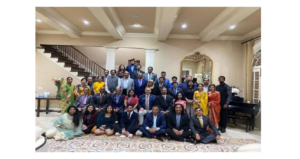
Indu Jaiswal, Dr Bhupendra R Patel, Ravi Batra, Pinky Rangi, Mr Rajan Rangi, Kamal Dandona, Ranju Batra, Satbir Singh Bedi and Chanbir Kaur. Curran lauded the honorees for their achievements and hoped many more women will come forward to play significant role in the county.

Curran also spoke of the many opportunities that were available to women in Nassau County.

Shammi Singh, Dr Shama Rasool, Indu Jaiswal, Reema Rasool and Dr Ayaz Rasool

The gala was attended by a couple of local politicians and officials and attracted a large number of community members, leaders and presidents of various organizations.  Those who addressed the gathering included IAF founder Bobby Kumar Kalotee, IAF chair Indu Jaiswal, IAF PR chair Mohinder Taneja and Gala Chair Shammi Singh.

Bhairavi Desai leads NY Taxi Workers Alliance Rallly at City Hall to Mourn Four Driver Suicides and Demand Action

(New York, NY) On Wednesday, March 28, NYTWA members, including yellow cab, green car, black car, and app-dispatched drivers, gathered on the steps of City Hall to mourn four colleagues who committed suicide in the past four months and to demand immediate action by the Mayor. Drivers stood with Gabriel Ochisor, the son of Nicanor Ochisor, a yellow-taxi owner-driver who committed suicide on March 16th.

NYTWA Executive Director Bhairavi Desai said, “The Governor, Speaker and Majority Leader should have been standing with us today to give us courage as we mourn our brothers, instead they are scheming to put congestion pricing on the backs of drivers. Yellow cabs, in particular, have contributed to close to $1 billion toward the MTA since 2009. There is a serious crisis among drivers.  Any other cut to their wage – especially one aimed at reducing their ridership – is going to have serious human consequences. Albany and City Hall need to hear our call for help. It’s born from tragedy not theater.”

Four driver deaths in four months: Nicanor Ochisor, a yellow taxi owner-driver, Danilo Corporan Castillo and Alfredo Perez, Bronx livery drivers, and Douglas Schifter, a black car driver. All driven to financial ruin by unregulated Wall Street darlings Uber and Lyft, who in 2016 had more lobbyists than Walmart, Microsoft and Amazon combined. Meanwhile, an MIT study found more than half of Uber drivers earn below minimum wage. No driver wins this vicious race to the bottom.

Nicanor’s family has started a GoFundMe campaign to pay off his medallion so his wife can finally retire. Speakers at the rally included:  Bhairavi Desai, Executive Director of the New York Taxi Workers Alliance; Gabriel Ochisor, son of Nicanor Ochisor; City Council Member Barry Grodenchik; City Council Member Stephen Levin

Nicanor, the most recent driver pushed to suicide, was an immigrant worker and a yellow taxi medallion owner-driver, who drove with his wife, an increasing pattern among drivers’ families working around the clock without time to rest or recuperate with loved ones, adding to the crushing devastation of poverty. Nicanor lost his life savings and was pushed to financial ruin when New York City broke its promise to professional drivers. Instead of keeping its commitment to yellow cab drivers, who operate in the heavily-regulated medallion industry, the city allowed Uber, Lyft, and their cohorts to flood our streets with vehicles covered by zero regulation. This anti-regulation zealotry came at the expense of professional drivers. Black car, yellow cab, green car and even Uber drivers themselves have been pushed into poverty as drivers see their incomes plummet, competing for fares in streets swamped by 100,000 for-hire vehicles and with no relief in sight.

We must stop treating the devastation of people’s lives as inevitable. We cannot allow Uber to continue to destroy lives for a business model that hasn’t even been proven sustainable. We must come together now and demand protections for ALL drivers and for rational regulations that level the playing field.

NYTWA has the following demands:

Cap the number of for-hire-vehicles to protect full-time work. Yellow and green cabs are already capped. Uber/Lyft are not and are responsible for the flooding of cars on our streets.

Establish the TLC-regulated yellow and green cab meter rate as the wage floor across all sectors. No company can go lower.  No more slashing rates on drivers’ backs. Uber & co. should also not be able to charge more from the rider and pay less to the driver.

Raise the current rates so that drivers are able to support themselves and their families.

Place caps on expenses charged drivers such as vehicle financing, commission / lease rates and TLC fines.  Fines should be in relation to how much we earn, not punish us for being poor.

Protect drivers against wage theft by increasing the Taxi and Limousine Commission enforcement capability and allowing restitution to drivers when companies have been found to violate rules.

Founded in 1998, the New York Taxi Workers Alliance (NYTWA) is the 19,000-member strong union of NYC taxicab drivers, representing yellow cab drivers, green car, and black car drivers, including drivers for Uber and Lyft. We fight for justice, rights, respect and dignity for the over 50,000 licensed men and women who often labor 12 hour shifts with little pay and few protections in the city’s mobile sweatshop. Our members come from every community, garage, and neighborhood. To find out more visit NYTWA.org, follow us on twitter.com/nytwa or like us on facebook.com/nytwa.

New law targets telephone scam

A new legislation to combat a widespread telephone scam that has adversely affected the Indian American community has been signed into law, U.S. Rep. Grace Meng (D-Queens, NY) who introduced the Bill, has announced.

The legislation would crack down on criminals who engage in spoofing, a scheme in which criminals disguise their caller ID to make it appear that they’re calling from a financial institution, police department or government agency, especially the Internal Revenue Service (IRS), falsely claiming to victims that they are from one of these official entities and end up stealing their money by convincing them to wire cash or provide bank account or personal information, according to a press release.

The legislation would make spoofing attempts from abroad a criminal act since currently it is not against the law to defraud Americans through calls from outside the U.S.

Her measure would also expand spoofing protections to cover text messaging and internet-based Voice over Internet Protocol (VoIP) services that enable individuals to make calls from computers and tablets.

“Spoofing has been one of the fastest growing forms of fraud in America, but the enactment of my Anti-Spoofing Act will provide new and critical tools to stop those who perpetrate this deceitful and malicious crime. Finally, we can fight back against these unconscionable thieves who for too long have preyed on unwitting consumers including the most vulnerable in our society such as immigrants and the elderly,” said Meng, in a statement.

“Enactment of this legislation has been a long time coming. Spoofing is an issue that I began to tackle during my first term in Congress. My bill passed the House several times but the Senate refused to act. I kept up the fight though and continuously pushed for this legislation to become law. I thank Reps. Joe Barton (R-TX) and Leonard Lance (R-NJ) who, from the beginning, partnered with me on this measure, and I thank everybody who supported this bipartisan and common-sense effort. I am proud to have championed this legislation and I’m extremely pleased that it is now the law of the land,” she added.

In addition, the legislation would require the Federal Communications Commission (FCC) and the Federal Trade Commission (FTC) to regularly update education materials that help consumers identify and protect themselves from caller ID scams.

Meng first sponsored anti-spoofing legislation after receiving spoofing complaints from local seniors and the “Communities of Maspeth and Elmhurst Together (COMET),” a civic organization in her district in Queens, New York.

Early Bird Registration For AAPI’s 36th Annual AAPI Convention Ends On March 31st Sri Sri Ravishankar will deliver keynote address at AAPI Convention in Ohio

(New York, NY: March 26th, 2018): “The Early Bird Special Registration for the 36th Annual Convention & Scientific Assembly of the American Association of Physicians of Indian Origin (AAPI) to be held at the at Columbus Convention Center, OH July  4-8, 2018 will end at midnight on March 31st,”  Dr. Gautam Samadder, President of AAPI, announced here today.

“We are expecting to have a record attendance of more than 2,000 delegates including Physicians, Academicians, Researchers and Medical students at the convention. The annual convention offers extensive academic presentations, recognition of achievements and achievers, and professional networking at the alumni and evening social events,” Dr. Samadder added.

Ambassador Nikki Haley, the top American diplomat and US Ambassador to the United Nations, and Ambassador Navtej Singh Sarna, an Indian author-columnist, diplomat and current Indian Ambassador to the US, have been invited to attend the AAPI convention and address the delegates, Dr. Samadder announced.

World Leader and Humanitarian Sri Sri Ravishankar will be one of the keynote speakers at AAPI Convention. He will participate in Q & A session for Physician wellness program as well.

Sri Sri, a spiritual leader founded the Art of Living Foundation in 1981, which aims to relieve individual stress, societal problems, and violence, and is considered as one of the world’s largest humanitarian, non-governmental organizations and is known for its great services to humanity.

The convention will be addressed by senior world leaders, including US Senators, Nobel Lauretes, Governors, Congressmen, and celebrities from the Hollywood and Bollywood world.

The annual convention this year is being organized by the Ohio Chapter and is led by Convention Chair, Dr. John A. Johnson. A pool of dedicated AAPI leaders are working hard to make the Convention a unique event for all the participants, Dr. Johnson said.

In addition to offering over 12 hours of cutting edge CMEs to the physicians, the event will provide an optional additional 10 hours of CME Living Well Program: The Happiness Program, an Advanced Physician Wellness program at a discounted price. It will address Physician burnout and Stress for a happier and healthier professional work life.

“Many of the physicians who will attend this convention have excelled in different specialties and subspecialties and occupy high positions as faculty members of medical schools, heads of departments, and executives of hospital staff. The AAPI Convention offers an opportunity to meet directly with these physicians who are leaders in their fields and play an integral part in the decision-making process regarding new products and services,” Dr. Ashok Jain, Chair of AAPI’s BOT, said.

In addition to the exhibition hall featuring large exhibit booth spaces in which the healthcare industry will have the opportunity to engage, inform and educate the physicians directly through one on one, hands on product demonstrations and discussions, there will be focused group and specialty Product Theater, Interactive Medical Device Trade Show, and special exhibition area for new innovations by young physicians.

AAPI members represent a variety of important medical specialties. Sponsors will be able to take advantage of the many sponsorship packages at the 36th annual convention, creating high-powered exposure to the highly coveted demographic of AAPI‘s membership,” Dr. Naresh Parikh, President-Elect of AAPI, said.

Representing the interests of the over 100,000 physicians of Indian origin, leaders of American Association of Physicians of Indian Origin (AAPI), the largest ethnic organization of physicians, for 34 years, AAPI Convention has provided a venue for medical education programs and symposia with world renowned physicians on the cutting edge of medicine.

“Physicians and healthcare professionals from across the country and internationally will convene and participate in the scholarly exchange of medical advances, to develop health policy agendas, and to encourage legislative priorities in the coming year. Do not miss on the Early Bird Special. We look forward to seeing you in Columbus, Ohio!” said Dr. Gautam Samadder.

For more details, and sponsorship opportunities, please visit:  www.aapiconvention.org   and www.aapiusa.org

The Chicago Medical Society Day

The Chicago City Council adopted a resolution on March 28, 2018 designating March 30 as the “Chicago Medical Society Day”. This day is also observed as the “National Doctor’s Day”. Dr. Vemuri S. Murthy is the current President of Chicago Medical Society and a past President of the Indian American Medical Association, Illinois.

This proclamation is an important milestone in the annals of one of the largest County Medical Societies in the USA founded in 1850, currently representing 17,000 Cook County Physicians serving 5 million patients. As part of this special recognition, the proclamation “applauds the proud history and contributions of the Chicago Medical Society” in diverse areas of public health, patient care, medical education, physician advocacy and community Cardiopulmonary Resuscitation (CPR) training with ongoing commitment of service to the local communities.

This recognition is one more way the Chicago Medical Society is working to educate legislators, citizens, and groups about the important work of our local physicians and their representative organization.

Chicago Medical Society conducts the community CPR programs (Project SMILE, “Saving More Illinois Lives through Education”) in Chicago communities partnering with organizations such as the Indian American Medical Association, Illinois. US Congressmen, Illinois Legislators and Members of Chicago Consular Corps (including the Chicago Indian Consulate) were among the participants of the CPR program.

El Al Sues Israel After Air India Flies Through Saudi Airspace

The Israeli government has hailed Air India’s new nonstop service from New Delhi to Tel Aviv as a historic breakthrough — the Indian carrier is the first commercial airline to take a geopolitical shortcut through Saudi Arabian airspace.

But Israel’s national airline, El Al, still has to take the long way and fears that it will suffer serious financial damage from what it views as aerial discrimination.

So in a first of its own, El Al petitioned Israel’s Supreme Court on Wednesday, filing suit against the government; the Civil Aviation Authority; Prime Minister Benjamin Netanyahu; the transportation minister, Yisrael Katz; and Air India.

Flying in a straight line cuts more than two hours off the usual flight time, and allows Air India to lower its ticket price. Even though Saudi Arabia granted permission for the route, El Al is asking the Israeli court to prevent Air India from taking the shorter path unless the Israeli carrier

receives a similar permit.

The dispute was touched off by Air India’s inaugural flight last week from New Delhi. As is the case with most of its neighbors in the Middle East, Israel does not have formal diplomatic relations with Saudi Arabia, and the Saudis have for decades banned jets traveling to or from Israel from crossing their airspace.

18th Annual New York Indian Film Festival Showcases 78 Shorts, Docs & Feature Films from South Asia, North America & the UK

FOUR world premieres, TWO international premieres, SIX North American premieres, ONE U.S. premiere and 11 New York premieres from FOUR South Asian countries (India, Pakistan, Bangladesh & Sri Lanka), as well as North America and the United Kingdom, will be unveiled at the 18th annual NYIFF, which will take place from May 7th to the 12th at the Village East Cinemas in the Lower East Side of Manhattan. The entire festival schedule, which comprises of 78 films in 11 different languages (English, Hindi, Marathi, Malayalam, Tamil, Telugu, Kannada, Tulu, Konkani, Bengali & Assamese), is now available on the festival’s website.

The media is invited to cover the NYIFF kick-off press conference on Friday, May 4th from 5 to 8 p.m. at the Consulate General of India (3 East 64th Street, between Madison and 5th Avenues).

The festival will open with the U.S. premiere of Ravi Jadhav’s Marathi language film NUDE (with English subtitles) and close with the New York premiere of veteran NYIFF director Hansal Mehta’s biopic on Islamic fundamentalist Omar Saeed Sheikh, OMERTA. This year’s centerpiece slot will be occupied by Miransha Naik’s Konkoni language film JUZE (with English subtitles),making its North American premiere at NYIFF.

Additional highlights at the festival include: Tribute to late Shashi Kapoor and late Sridevi; Merchant-Ivory Restrospective; Discovering the Film & Television Market in India Panel Discussion; Shooting Films in New York State Panel Discussion; The Inclusion Rider’s Role in Diversifying Hollywood Panel Discussion; Networking events and nightly parties; Opening and Closing Night Red Carpets.

The New York Indian Film Festival (NYIFF) is the oldest, most prestigious film festival screening premieres of feature, documentary and short films made from, of, and about the Indian subcontinent in the Independent, arthouse, alternate and diaspora genres. Seven days of screenings, post-screening discussions, industry panels, award ceremony, special events, nightly networking parties, red carpet galas, media attention and packed audiences build an awareness of Indian cinema, entertain & educate North Americans about the real India, and add to the amazing cultural diversity of New York City. For more information, please visit the website HERE.  The Indo-American Arts Council is a registered 501(c)3 not-for-profit, secular service and resource arts organization, passionately dedicated to showcasing, promoting and building an awareness of Indian sub-continental performing, visual and literary arts.

Nature’s ‘alarming’ decline threatens food, water, energy: UN study

Human activities are causing an alarming decline in the variety of plant and animal life on Earth and jeopardising food, clean water and energy supplies, a UN-backed study of biodiversity said on Friday.

Climate change will become a steadily bigger threat to biodiversity by 2050, adding to damage from pollution and forest clearance to make way for agriculture, according to more than 550 experts in a set of reports approved by 129 governments.

“Biodiversity, the essential variety of life-forms on earth, continues to decline in every region of the world,” the authors wrote after talks in Colombia. “This alarming trend endangers the quality of life of people everywhere.”

Four regional reports covered the Americas, Asia and the Pacific, Africa, Europe and Central Asia – all areas of the planet except the poles and the high seas.

For the Americas, the report estimated that the value of nature to people – such as crops, wood, water purification or tourism – was at least $24.3 trillion a year, equivalent to the region’s gross domestic product from Alaska to Argentina.

Almost two-thirds of those natural contributions were in decline in the Americas, it said. Robert Watson, chair of the Intergovernmental Science-Policy Platform on Biodiversity and Ecosystem Services (IPBES), said biodiversity was not only about saving rare butterflies, trees, birds or rhinos.

While that was important, he told Reuters a key message was: “Please stop thinking of biodiversity just as an environmental issue. It’s way more important than that”.

Among other economic estimates, the Africa report said the absorption of greenhouse gases by a hectare (2.5 acres) of forest in Central Africa was worth $14,000 a year.

Unless governments take strong action to limit greenhouse gas emissions, “climate change may be the biggest threat to biodiversity” by mid-century, Watson said.

He said US delegates had not challenged findings about man-made climate change, although US President Donald Trump doubts mainstream scientific opinion and plans to pull out of the 2015 Paris climate agreement.

For pollution, eight of 10 rivers around the world with most plastic waste were in Asia. On current trends, overfishing meant there could be no exploitable fish stocks in the Asia-Pacific region by mid-century.

Around the world, ever more animals and plants were under threat from human activities, ranging from elephants in Africa to rare mosses and snails in Europe, the study said.

“By 2100, climate change could … result in the loss of more than half of African bird and mammal species,” said Emma Archer of South Africa, the co-chair of the African assessment.

Rising human populations in many developing nations would require new policies, both to protect nature and to meet UN goals of eradicating poverty and hunger by 2030.

In Europe and Central Asia, wetlands have declined by half since 1970, threatening many species. Forest cover had risen by 22.9 percent in China and other nations in northeast Asia between 1990 and 2015. Parks and other protected areas were expanding in many regions, including the Americas and Asia-Pacific. And populations of animals such as the Iberian lynx, Amur tiger and far eastern leopard were coming back from the brink of extinction thanks to conservation.

Akhil Kondepudi wins National Brain Bee Championship

Akhil Kondepudi from St. Louis, Missouri, has won the Eleventh USA National Brain Bee Championship which was held at the University of Maryland in Baltimore from March 15 to 18.

Winners from 54 Chapter competitions in 37 states gathered to test their knowledge of the human brain.

The national competition tests high school students on a range of topics covering all aspects of neuroscience, including intelligence, emotions, memory, sleep, neurodegenerative diseases, schizophrenia, addictions and the senses.

The competition involved a neuroanatomy laboratory practical exam with real human brains, patient diagnosis with patient actors, neurohistology, brain MRI imaging identification and orals, and was sponsored by the Department of Neural and Pain Sciences of the University of Maryland’s School of Dentistry.

Kondepudi will represent the United States at the World Brain Bee Championship hosted by the Federation of European Neuroscience Societies in July. Besides a monetary prize Kondepudi was also given an 8-week internship in a neuroscience laboratory, a donation was given to the Disabled American Veterans as well.

Six other Indian Americans were among the top 10 winners: Hemanth Asirvatham of Minneapolis, Minnesota; Sehej Bindra of Piscataway, New Jersey; Sneha Shinde of Rootstown, Ohio; Aayush Setty of Atlanta, Georgia; Lasya Kambhampati of Kansas City, Kansas; Veda Chanda of Hershey, Pennsylvania.

The USA Brain Bee is an Official Regional Brain Bee of the International Brain Bee which is lead by a Board of Directors from the Society for Neuroscience, the American Psychological Association, the Dana Alliance for Brain Initiatives, The International Brain Research Organization, and the Federation of European Neurosciences Societies.

Currently there are about 200 Brain Bee Chapters in about 50 countries in 6 continents. Each Chapter conducts a competition involving many high schools, those winners represent their cities at their respective National Championships and each National Champion is then invited to compete in the World Championship held every year in a different city.

The competition involved a neuroanatomy laboratory practical exam with real human brains, patient diagnosis with patient actors, neurohistology, brain MRI imaging identification and a question-and-answer session.

kondepudi, for taking the top prize, was awarded with $1,500 and an eight-week internship in a neuroscience lab, and will represent the U.S. at the World Brain Bee Championship in Berlin in July. Indian American Hemanth Asirvatham of Minneapolis, Minn., took second; and Sehej Bindra of Piscataway, N.J., took third and were awarded $1,000 and $500, respectively.

Khan Academy founder wins 2018 Visionary of the Year award

Salman Khan, the founder of Khan Academy, has won the 2018 Visionary of the Year award from The San Francisco Chronicle.

According to a San Francisco Chronicle report, Khan received his award at a gala that was held at the War Memorial Veterans Building in San Francisco, California, which was attended by about 150 people, including Oakland Mayor Libby Schaaf, former Secretary of State George Shultz and his wife, Charlotte Shultz.

Khan was nominated among five other finalists and will be granted $25,000 as part of the award.

In 2008, Khan quit his day job in finance to start Khan Academy, an educational website where he delivered tutorials in math by posting videos on YouTube.

Soon enough the Silicon Valley entrepreneur became a celebrity as he had impacted many children and their families who were struggling in school. Today Khan Academy has more than 62 million registered users in nearly 200 countries where his voice is widely recognized as he narrates many of the tutorials.

According to San Francisco Chronicle, students and parents have often stopped him on the street to thank him for his virtual assistance in their work. Khan Academy features coursework in various fields from art to science at all levels from kindergarten to college as well as SAT instruction and personal finance.

Khan’s Mountain View nonprofit has more than 150 employees now and he still continues his mission to provide “world-class” education to anyone anywhere at no cost.

The Bill and Melinda Gates Foundation, Google and Bank of America are just few of Khan’s supporters and he has been featured on “60 Minutes” and the “Colbert Report”. He has written a book called “The One World Schoolhouse: Education Reimagined,” according to a San Francisco Chronicle.

Khan accepted his award as he recalled the first student he had helped out; his cousin Nadia.

“As I tell everyone, this is just something I fell into. I thought it was a dumb idea at first,” he said.

US wants visa applicants to submit phone, email, social media details

The Trump administration wants all US visa applicants to submit details of their previous phone numbers, email addresses and social media histories as part of its “vetting” practice and to prevent entry of individuals who might pose a threat to the country.

In a document posted on the Federal Register on Thursday, anyone who wants to come to the US on a non-immigrant visa will have to answer a list of questions under new rules.

The State Department estimates that the new visa forms would affect 710,000 immigrant and 14 million non-immigrant visa applicants.

It said that in addition to asking the visa applicants to provide their identifications or handles of their social media platform, they would also be asked to give details of their phone and mobile numbers used in the last five years.

Other questions seek five years of previously used telephone numbers, email addresses and international travel whether the visa applicant has been deported or removed from any country and whether specified family members have been involved in terrorist activities, said the document which would be formally published today.

After its publication, the public would have 60 days to comment on the proposed new visa form.

“One question lists multiple social media platforms and requires the applicant to provide any identifiers used by applicants for those platforms during the five years preceding the date of application,” the document said.

It said the State Department will collect the information from visa applicants for “identity resolution and vetting purposes” based on statutory visa eligibility standards.

However, it intends not to routinely ask the question of applicants for specific visa classifications, such as most diplomatic and official visa applicants, it said. The revised visa application forms will also include additional information regarding the visa medical examination that some applicants may be required to undergo.

Changes to H1-B Visa process that started on April 2nd

H-1B visa filing for the fiscal year 2019 (beginning October 1, 2018) started on April 2nd. The petitions for the H-1B visas, most popular visa among Indian IT professionals, began to  accept applications starting this week. According to US Citizenship and Immigration Services (USCIS) website, the government began accepting H-1B petitions that are subject to the FY 2019 cap from April 2, 2018. Companies/individuals can file an H-1B petition no more than six months before the employment start date requested for the beneficiary.

The H-1B filing season comes after the Donald Trump administration late last month announced new rules for H-1B visa holders. The new rules come via a 7-page policy memorandum published by USCIS. Here are the eight big recent changes announced regarding H-1B visa filing and process. H-1B visa will be granted for only that duration for which a beneficiary will have to do the specified work.

Currently, visas are granted for three years and an extension for another three years is almost given. US Citizenship & Immigration Services (USCIS) said, in the new guidance issued, that its officers can seek detailed documentation and more evidence from companies to establish that they have specific assignments in a specialty occupation for the H-1B beneficiary, and that they have these assignments for the entire time requested on the petition.

The new rules imply that one may not even now get the initial full three years. There will be more paperwork as detailed documentation will be required on the nature of assignment at the client site. India’s apex software body National Association of Software and Services Companies (NASSCOM) said, “This will be an unnecessary and expensive paperwork burden that will not make much difference (to companies sending their own staff).” Under the new policy announced by Trump administration, companies have to prove that the employees that they send to the US on H-1B visas have “specific and no speculative qualifying assignments in a speciality occupation” for the entire visa period.

This means that employees coming to the US on H-1B visa cannot be moved between projects and companies once they are in the country. A Bengaluru-based staffing expert told the media that when third-party companies file petitions for H-1B visas to deploy professionals, they eventually employ people on multiple worksites and the fresh policies will put in stringent paperwork to do that. The new policy suggests that companies may have to share additional evidence, such as more details in the work orders or in letters from the end client regarding the beneficiaries’ work.

The contract letter should now provide additional information, such as a detailed description of the specialized duties the beneficiary will perform, the qualifications required to perform those duties, the duration of the job, salary or wages paid, hours worked, benefits, a detailed description of who will supervise the beneficiary and the beneficiary’s duties, and any other related evidence.

Texas Governor Greg Abbott meets Narendra Modi during India visit

Texas Governor Greg Abbott met with the Prime Minister of India, Narendra Modi, in New Delhi, March 28. During the meeting, Governor Abbott thanked the Prime Minister for his hospitality and spoke on the importance of continuing to grow Texas-India relations both economically and culturally. This marks the first time the Prime Minister has met with a United States Governor, according to a press release from the governor’s office.

“Texas is continuing to grow relations with India both economically & culturally. A productive meeting today in New Delhi with Prime Minister @narendramodi,” Gov. Abbott tweeted a few hours after the meeting. According to the Governor’s office, Texas is 2nd among all U.S. states for exports to India with exports valued at nearly $3.4 billion in 2017.

“I am extremely grateful to Prime Minister Modi for welcoming me to his country and for the opportunity to discuss the meaningful relationship between Texas and India,” Abbott is quoted saying in the release. “While Texas and India have long maintained an important economic relationship, this trip has also highlighted our commonly shared values of family, faith, community and hard work. These are the bonds that we will continue to build on, and I look forward to growing this partnership even more after this successful trip,” the Governor added.

The meeting which took place at the Prime Minister’s residence, lasted more than an hour. Among the topics the two leaders discussed were Hurricane Harvey relief efforts, the Indian-American community in Texas, healthcare, defense, their respective economies, and energy. The The Governor talked about how productive his trip has been and the potential it will have in creating more jobs and investment for the people of Texas.

The Governor and Prime Minister spoke on how they can continue to strengthen the strong bond between Texas and India and reaffirmed  their commitment to continuing the successful partnership, the press release said.

The Governor also met with India’s Minister of Commerce and Industry and Civil Aviation, Suresh Prabhu the same day.  “Texas is working to establish a direct flight from Texas to India,” and the meeting was held to further that goal, the Governor’s Facebook page said. The two also discussed mutually beneficial trade.

On March 26, while in Mumbai, Gov. Abbott  closed a deal with JSW Steel to expand its operations in Baytown, Texas, that the governor’s office said, will create 500 new jobs and expand economic growth in Texas.

“The Memorandum signed by Greg Abbott and JSW USA is part of our long term strategy to enhance our U.S. footprint,” Parth Jindal of JSW Group is quoted saying in a press release. “It reiterates our commitment to stay invested and grow in the U.S. market. It also provides JSW USA an opportunity to participate in USA’s infrastructure development and job creation priorities,” Jindal added. “Access to natural gas at extremely economical prices and the abundant availability of scrap steel in Texas make conditions very conducive for manufacturing through the Electric Arc Furnace route,” Jindal said.

Earlier, on March 25, Gov. Abbott addressed the Rotary Club of Bombay, touting the Texas economy and the importance of strengthening the bond between India and Texas.

Governor Abbott also emphasized the importance of trade with India, noting that Texas is the 2nd largest exporter to India in the U.S., and the 4th largest importer of Indian goods in the U.S., a press release from his office said.

“It’s not just the exchange of goods that connects the people of India and Texas,” Abbott is quoted saying at the Rotary meeting. “The values that we share are founded on family, faith, commitment to our communities, and hard work.”

Following his address, the Governor participated in a question and answer session with members of the Rotary Club of Bombay which is one of the oldest rotaries in India founded in 1929.

Dallas News, which accompanied the Governor and his delegation to India, reported Abbott has 15 Texans in his delegation, including “some Indian American businessmen who have flown to India at their own expense to accompany him for part of his nine-day jaunt.”

The governor also visited the headquarters of the multinational Mahindra & Mahindra in south Mumbai, where he praised the company and its operations in Texas. Mahindra North America. donated  $1.5 million in cash and kind after the disastrous  Hurricane Harvey last September, according to Dallas News. “That shows us that you’re more than just a business operating in Texas. You are a genuine part of our community,” the Governor is quoted saying in the Dallas News report. He also praised Indian immigrants in Texas, describing them as “very productive, very hard-working, very committed to the ideals that … underlie both America and the American dream,” the news report  stated.

The Impact of Migration and Diet on Food Allergy Development

Food allergy is a potentially life-threatening immunologic reaction to food protein upon consumption of food. It affects 8% of children in the United States, while almost 40% of children with food allergy experience a severe reaction.1 Common symptoms include hives, vomiting, dizziness, shortness of breath, and wheezing. Past studies demonstrate that food allergy prevalence is on the rise,2 yet factors contributing to food allergy development are still not well understood.

Major hypotheses for food allergy development include, but are not limited to, birth via caesarian section, the hygiene hypothesis, and infant eczema. Previous literature suggests that environmental changes upon migration to a new country may contribute to peanut allergy development among immigrant populations. When observing a group of Australian infants, peanut prevalence among infants with both parents born in East Asia was 7.7%, 6.7% for infants with one parent born in East Asia, and 2.3% for infants with both parents born in Australia.3

There is a burgeoning prevalence of food allergic disorders in individuals of Asian origin residing in the USA. Review of the scarce literature published on this topic4 reveals the possibility that Asians have higher odds of food allergy compared with Caucasian children, but significantly lower odds of formal diagnosis.

In addition to environment, distinctive cultural practices and dietary cuisine may contribute to food allergies. South Asian diets are often different from Western diets. A study on food allergy among Indian adults in Karnataka, South India suggested that cow’s milk and apple were among common food allergens.5 Other sources also suggest that eggplant, melon, and legumes like chickpea are commonly reported food allergens for Indian adults. A pilot study exploring food allergies among individuals in Kansas City, Missouri of Asian Indian descent revealed that Indian Americans have ‘different’ food allergens  (such as chickpea flour, capsicum, eggplant and Indian lentils) in addition to the classic “Top 8” allergens reported in the USA (milk, egg, wheat, soy, peanut, tree nuts, fish, shellfish).6

To study the potential impact of environment and diet on food allergy development, a team of researchers from Northwestern Feinberg School of Medicine, Ann & Robert H. Lurie Children’s Hospital of Chicago, and Stanford University School of Medicine are conducting a survey exploring food allergies in adults and children of Asian Indian descent in the United States. Information from this voluntary and anonymous survey will be used to advance knowledge regarding allergies among individuals of Asian Indian origin. For more information and to access the survey, please visit:

https://www.surveymonkey.com/r/SouthAsianFoodAllergySurvey

Or visit: http://www.ruchigupta.com/current-study-recruitment/

Ruchi S. Gupta, MD, MPH, is an Associate Professor of Pediatrics and Medicine, Northwestern Feinberg School of Medicine, and is the Director, Science and Outcomes of Allergy & Asthma Research, Northwestern Feinberg School of Medicine (SOAAR); Mary Ann & J Milburn Smith Senior Scientist in Smith Child Health Research Outreach and Advocacy Center

Stanley Manne Research Institute, Ann & Robert H. Lurie Children’s Hospital of Chicago

Clinical Attending, Ann & Robert H. Lurie Children’s Hospital of Chicago.

Dr. Ruchi Gupta MD, MPH has more than 15 years of experience as a board-certified pediatrician and health researcher. She is nationally recognized for her groundbreaking research in the area of food allergy and asthma epidemiology; especially for her research on childhood food allergy prevalence.

Dr. Gupta has also significantly contributed to academic research surrounding economic costs, pediatric management of food allergy and asthma, ED visits and hospitalizations, quality of life, and community interventions in schools. In addition to being the author of The Food Allergy Experience, Dr. Gupta has written and co-authored over 70 original peer-reviewed research articles and has had her work featured in major TV networks and print media. She continues to make meaningful improvements in population health outcomes and the lives of children and their families.

References:

  1. Gupta RS, Springston EE, Warrier MR, et al. The Prevalence, Severity, and Distribution of Childhood Food Allergy in the United States. Pediatrics. 2011.

  1.        Prescott SL, Pawankar R, Allen KJ, et al. A global survey of changing patterns of food allergy burden in children. World Allergy Organization Journal. 2013;6(1):21.
  2. Koplin JJ, Peters RL, Ponsonby AL, et al. Increased risk of peanut allergy in infants of Asian-born parents compared to those of Australian-born parents. Allergy. 2014;69(12):1639-1647.

  1. Arakali SR, Green TD, Dinakar C. Prevalence of food allergies in South Asia. Annals of Allergy, Asthma & Immunology. 2017;118(1):16-20.
  2. Mahesh PA, Wong GW, Ogorodova L, et al. Prevalence of food sensitization and probable food allergy among adults in India: the EuroPrevall INCO study. Allergy. 2016;71(7):1010-1019.

  1.        Motiani R, Dinakar C.  A survey to explore the types of food causing food allergic reactions among adults and children of Asian Indian Origin.  Journal of Investigative Medicine.  Feb 2013; 61(2): abstract 320.

World heading to a Cold War era: UN Chief

“I am really very concerned. I think we are coming to a situation that is similar, to a large extent, to what we lived during the Cold War but with two very important differences,” UN Secretary General Antonio Guterres said in response to questions by reporters on the US announcement to expel Russian UN diplomats and could a new Cold War be developing.

UN chief expressed his concerns of the world heading to a time reminiscent of the Cold war era in the wake of the tensions between US and Russia and called for putting precautions in place to guarantee effective communication and prevent escalation.

His comments came after the Trump administration this week ordered the expulsion of 60 Russians from the US over the alleged poisoning of ex-double agent Sergei Skripal in the UK on March 4.

Of the 60 expelled, 12 are intelligence operatives from the Russian Mission to the UN who have been accused of abusing their privilege of residence in the United States. Guterres said in the Cold War, there were clearly two superpowers with a complete control of the situation of two areas in the world.

“Now, we have many other actors that are relatively independent and with an important role in many of the conflicts that we are witnessing, with risks of escalation that are well known,” he said.

He pointed out that during the Cold War, there were mechanisms of communication and control in place to avoid the escalation of incidents and to make sure that things would not get out of control when tensions would rise.

But with those mechanisms now dismantlement, it is time “for precautions of this sort, guaranteeing effective communication, guaranteeing capacity to prevent escalation. I do believe that mechanisms of this sort are necessary again.” On how optimistic is he over the summit between South Korea and North Korea, the Secretary General said he is “very encouraged” by the announcement of the inter-Korean summit.

He said he is “very happy” that it was possible in the visit to North Korea by Under-Secretary-General for Political Affairs Jeffrey Feltman for the UN to make very clearly the case that a resumption of dialogues between the North and the South of the Peninsula was needed to reach the peaceful denuclearisation of the Korean Peninsula.

The UN chief had met in PyeongChang both the North Korean delegation and as well as South Korean President Moon Jae In and had encouraged them as much as possible to move in these two directions.

“I was extremely encouraged by the recent visit of the leader of the North Korea to China, and I think China is, of course, a very important contributor to a solution in this region,” he said referring to the surprise visit by Kim Jong-un to Beijing this week.

“I believe that, in this world where, unfortunately, so many problems seem not to have a solution, I think there is here an opportunity for a peaceful solution to something that, a few months ago, was haunting us as the biggest danger we were facing,” he said, a reference to the escalation of tensions over North Korea’s nuclear programme.

Happiest Couples Do These For Each Other Without Being Asked

Small gestures can have a big impact. In a healthy relationship, people tend to give love and support freely and frequently. They don’t wait for a special occasion to show their appreciation. They genuinely enjoy doing nice things for one another “just because” ― no prompting necessary.

We asked relationship experts to tell us what kinds of things, both big and small, happy couples do for each other without being asked. Here’s what they had to say:

  1. They check in with each other.

“Whether it’s a ‘hello’ text or call to ask, ‘How did it go?’ the happiest couples reach out. They call to say, ‘I’m running late,’ or ‘We just landed,’ or ‘Do you need me to stop at the store on my way home?’ The message: I’m thinking of you. The result: A feeling of being connected, being a key part of each other’s lives.”  ― Winifred M. Reilly, marriage and family therapist and author of It Takes One to Tango

  1. They give each other compliments.

“This doesn’t have to be a lovey-dovey compliment about being the best wife in the world, but even an offhand remark recognizing someone’s contribution, like ‘great dinner!’ Although some couples do well without positive feedback, the majority of people like at least a little bit of verbal recognition for their contribution, and happy couples are free with positive feedback.”  ― Samantha Rodman, psychologist and dating coach

  1. They surprise each other with a card, just because.

“Giving your partner a card that says ‘Thinking of you’ or ‘Thank you for all you do’ is such a sweet gesture. It will make him or her feel special and it’s a great reminder to you as well of all you have to be grateful for. An added fun touch would be to leave the card somewhere your loved one will happen on it. My husband loves to leave cards for me in the refrigerator. I often leave his cards under his pillow.” ― Susan Pease Gadoua, marriage therapist and the co-author of The New I Do: Reshaping Marriage for Skeptics, Realists and Rebels

  1. They act generously, instead of keeping score.

“Generosity is something freely given as a gift, with nothing expected in return. When a relationship feels secure, it is easy to want to offer more than your fair share of tasks or thoughtful gestures to show your love for your partner. Whether moving their clothes to the dryer for them or going on their favorite hike again, highly fulfilled couples tend to maintain great satisfaction from being thoughtful and generous toward their partner rather than scorekeeping.” ― Kari Carroll, couples therapist

  1. They speak openly about their thoughts and feelings.

“When partners feel that it’s like pulling teeth to get each other to divulge any thoughts or feelings, a relationship can feel very lonely. Happy couples may not communicate constantly on a deep level, but they do it frequently enough to feel that they really know one another.”  ― Samantha Rodman

  1. They surprise their partner with their favorite food.

“We all know that food is nurturing and helps people feel connected. But when you go out of your way to bring home a special food you know they will love, it’s a wonderful way to put ‘I love you’ into action. If the favorite food is a meal that you make — rather than, say, a pint of Haagen Dazs — you’ll undoubtedly get even more points.” ― Susan Pease Gadoua

  1. Or with a freshly washed car.

“Regardless of whether you do the washing yourself or take the car to a car wash, when your partner sees their squeaky clean wheels on the street or in the driveway, he or she will likely be very grateful.” ― Susan Pease Gadoua

  1. They’re in the habit of saying ‘thank you.’

“Despite the mundanity and complacency that can develop within a long-term partnership, a sure way to keep the fire alive and burning brightly is to watch your partner beam when you regularly notice and point out their contributions to your life. People want to be reminded they are of value to you, and secure couples understand that this should be frequent. Although you may assume your love to be understood, in reality, acknowledging your partner’s efforts and contributions consistently builds an even deeper connection.” ― Kari Carroll

Stephen Hawking is no more: His contributions will live for ever “Work gives you meaning and purpose, and life is empty without it:” Stephen Hawking

Stephen Hawking left a legacy that transcended academia – it’s found in motion pictures, best-selling books, and beyond. His passion for science and unlocking the universe’s secrets inspired millions across the globe to be more curious about the universe.

In a 2010 interview with American journalist Diane Sawyer on ABC World News, Sawyer asked Hawking what advice he’d give to his children. One of the pieces of advice: “Work gives you meaning and purpose, and life is empty without it.”

Could his philosophy of work apply to all of us? Is life really empty without a job that not only puts bread on the table, but that also becomes self-actualising personal fulfilment?

“If you love what you do, then small problems that come up aren’t going to bug you and make you want to quit. It’s good for the individual and the organisation,” says Sally Maitlis, professor of organisational behaviour and leadership at the University of Oxford. “But when you love it to the point that it’s absolutely central to how you understand yourself and what your contribution to the world is, it can be damaging.”

Maitlis explored this notion last year with Kira Schabram, a University of Washington management professor, with a study of 50 animal shelter workers in North America: many were attracted to the occupation because of a childhood love of animals, or a belief that they had the right skills to make a difference.

Pope Francis greets Stephen Hawking during an audience with participants attending a plenary session of the Pontifical Academy of Sciences at the Vatican Nov. 28, 2016. Hawking, the British-born theoretical physicist, cosmologist and popular author died March 14 at the age of 76. (CNS photo/L’Osservatore Romano, handout) See HAWKING-VATICAN March 14, 2018.

As a result, workers poured in extra hours, volunteered for difficult shifts, constantly shared ideas. But many eventually burnt out or became frustrated. They encountered frequent euthanasia of animals, or had to deal with the realities of meager resources and poor management that plagued many of the shelters. Some eventually quit.

Picking a career that gives you an inner compass of purpose absolutely has positive effects on your life Still, Maitlis and other experts all agree that picking a career that gives you an inner compass of purpose absolutely has positive effects on your life. Research has long backed this.

Stephen Hawking’s career spanned beyond academia, into motion pictures and beyond. Last month, the American Psychological Association published an article that synthesised findings on this topic that stretch back as far as 1993. Research from Harvard professor Teresa Amabile found that “no matter the size of a goal – whether curing cancer or helping a colleague – having a sense of meaning and feeling a sense of progress can contribute to happiness in the workplace.”

But finding work with purpose can be hard for many.

Anat Lechner, a management professor at New York University, says it’s simply a matter of being aware of what you love to do. It’s when you’re so enthralled with what you’re doing, it’s hard to separate the hobby from the actual job. “You can’t separate Elon Musk from everything that he’s building,” she says.

And while many people can actually identify these passions – the things that they naturally gravitate toward and might do for fun off the clock – they often don’t act on them, in terms of creating a career.

“They would rather go work at the JP Morgans because they think it’s a safe bet,” Lechner says. “They put a stop to things that otherwise could prosper and grow and value-add, and the world could pay back in a good way.”

Amy Wrzesniewski, professor of organisational behaviour at Yale University, suggests overcoming this by “job crafting”: teasing out the bits you like about your current job, and then spin off into something that’s more rewarding as a whole.

This can apply to those types of workers Schabram and Maitlis studied: the ones who landed their dream job, but it wasn’t what they expected. “Is there some way to stay involved in music, or whatever it might be, that allows you to connect with the elements [of the job] that are most meaningful?” Wrzesniewski asks. “Instead of being backed into a role definition?”

Some of the workers in Schabram and Maitlis’s study did this by pivoting away from shelters and turning to other jobs that were still animal-centric, like grooming and training. Wrzesniewski also points to a self-sabotaging world view that prohibits people from finding the things they like.

Some think “you sort of have to discover it – almost like it’s an objective identity that lives in the world, and you have to turn over enough rocks to find it,” Wrzesniewski says. “It can create a ton of anxiety.” Instead, the process can be more trial-and-error experimenting.

Homing in on what you love can give you the raw energy that blends career and identity; that allows your work to give you greater meaning and purpose beyond chasing promotions or paying bills. “When you’re so immersed in what it is you do, you become one,” Lechner says. “I think Hawking had that.”

(Courtesy: Bryan Lufkin at BBC)

How do happily married couples fight

All couples argue, but it’s the way they argue that determines if their relationship will go the distance. “Instead of attacking the other person’s character, happy couples color inside the lines and express their own feelings,” psychotherapist Vikki Stark, director of the Sedona Counselling Center of Montreal, told The Huffington Post. “It’s fine to say, ‘I’m furious with you right now!’ It’s not fine to say, ‘You’re a sorry excuse for a human being.’”

What else stands out in happy couples’ approach to arguments? Below, Stark and other relationship experts share eight ways healthy couples argue differently.

  1. don’t shy away from discussing topics

Couples in it for the long-haul don’t shy away from discussing topics that could just as easily be swept under the rug. They ask the big, scary questions ASAP — “When, if ever, are we going to have kids?” “What are we going to do if you get that job in another state? I don’t want to move to there!” — so they don’t become bigger isssues in the relationship later on, said Diane Sawaya Cloutier, an author and relationship expert.

“When taboo or uncomfortable topics remain unaddressed, they can turn any benign event into a big drama that could have been avoided in the first place,” she said. “Couples who talk about it can manage potential dramas.”

  1. They start slow and take turns talking.

Arguments generally end the same way they began, said Bonnie Ray Kennan, a marriage and family therapist based in Southern California. Couples who’ve mastered the art of arguing fairly take things slow, addressing difficult conversations with a soft, reassuring tone and dialing it down whenever things get too emotionally charged.

“Starting a difficult conversation softly and respectfully dramatically increases the chances of a good outcome,” she said. “Conversely, a ‘harsh start-up’ is very hard to process well, especially for men.” Couples who argue with finesse also know the value of give and take: “One person speaks and the other person truly listens,” Ray Kennan said.

  1. They don’t name call.

Happy couples in long-term relationships rarely get into knock-down, drag-out fights because they don’t lower themselves to school-yard tactics: no matter how heated things get, there’s no name calling, eye rolling or biting sarcasm.

“Both partners understand that contemptuous behaviors are hard to take back and have a corrosive impact on a relationship,” Ray Kennan said. “Over time, they’ve become mindful of the effects of such dirty fighting and so they take it out of their repertoire.”

  1. They know how to cool down.

When things do get out of hand, savvy arguers know how to get a grip on their emotions. They value taking a time out, whether that means counting to 10 and taking slow, deep breaths or simply telling their spouse, “Hey, can we revisit this in the morning?”

“These couples know how to acknowledge and honor their emotions without getting overrun by them,” Amy Kipp, a couples and family therapist in San Antonio, told HuffPost. “They use self-soothing skills to make sure they’re at their best. When both partners are able to soothe themselves and take breaks, they’re usually able to reach a resolution (or agree to disagree!) with more ease.”

  1. They set ground rules for arguments.

It’s not that long-time couples have never resorted to low blows or have said something regrettable during an argument. They have in the past — and then they learned from the mistake. Once the emotionally charged fight ends, smart couples lay down some ground rules for arguing so it never gets out of hand again, said author and relationship expert Mario P. Cloutier.

The ground rules could be specific — “We will not interrupt each other when one is giving his or her perspective” — or more big picture: “It’s not about being right. It’s about getting to a common ground and resolving the problem,” suggested Cloutier.

  1. They acknowledge each other’s feelings and points of view.

They may be bumping heads but couples in happy, long-time relationships try their best to see the other side of the argument, Kipp said.

“They may say, ‘I know you see it differently than me, but I appreciate that you are listening to my perspective,’” she said. “These positive moments decrease defensiveness and allow for a more productive conversation.”

  1. They give each other the benefit of the doubt.

Partners who are able to have healthy and productive arguments don’t jump to conclusions in the middle of fights. They aren’t quick to assume their S.O. wants to jump ship and leave them just because he or she is a voicing a concern. They quiet their insecurities, listen and try to give their partner the benefit of the doubt, Kipp said.

“Healthy relationships mean that people assume their partner is doing the best they can at the moment,” she explained. “In an argument, this means assuming both partners have the same goal: a mutually beneficial resolution. This allows arguments to be a team effort to achieve the goal rather than an adversarial ‘fight.’”

  1. They never forget that ultimately, they’re a team.

Even during their most tense arguments, healthy couples never forget that they’re a team: for richer, for poorer, in sickness and in health…  and until the argument exhausts them and both parties agree that they’d rather call a timeout and get a bite to eat.

“Couples in satisfying long-term relationships are able to remember that, no matter how angry they may be, life will continue after today,” said Stark. “Because of that, they don’t want to do lasting damage. Even in an emotional state, they are able to hang on to the long-term value of the couple. They’re a team, protecting their future together.”

(Courtesy: Huffington Post)

A female version of the most popular scotch brand: Johnnie Walker has a Jane Walker now

Johnnie Walker Black Label just got a little bit more feminine. The whiskey maker is putting a woman in its logo for the first time ever — a new Jane Walker edition that is on sale for a limited time. The image of a top-hatted and tuxedo man is transformed into a shapely, long-haired woman in the same dashing outfit.

The special-edition whiskey is being sold starting in March to coincide with Women’s History Month and International Women’s Day celebrations, according to the company. The suggested retail price is $34 for a 750-milliliter bottle. The temporary change to the “striding man” logo is an attempt to market the drink to women.

“Important conversations about gender continue to be at the forefront of culture and we strongly believe there is no better time than now to introduce our Jane Walker icon and contribute to pioneering organizations that share our mission,” said Stephanie Jacoby, vice president of Johnnie Walker. “We are proud to toast the many achievements of women and everyone on the journey towards progress in gender equality.”

Johnnie Walker has pledged to donate $1 for every Jane Walker edition bottle sold to organizations that back women’s causes for a total of up to $250,000. “Women have played a significant role in the brand’s history dating back to 1893, when John Walker & Sons purchased the Cardhu distillery from Elizabeth Cumming,” the company said. “Cardhu is one of the single malts that comprises Johnnie Walker Black Label and is considered the heartbeat of the blend.” the company said.

Johnnie Walker is owned by Britain-based Diageo, whose other brands include Crown Royal, Smirnoff, Ketel One, Captain Morgan, Baileys, Tanqueray and Guinness.

“Women have always been extremely important consumers of a lot of different types of consumer packaged goods,” said Charles Taylor, a marketing professor at Villanova University. “In the environment of #MeToo, this is a very positive and uncontroversial type of response by the marketers.”

Early Bird Registration For AAPI’s 36th Annual AAPI Convention Ends On March 31st

(New York, NY: March 26th, 2018): “The Early Bird Special Registration for the 36th Annual Convention & Scientific Assembly of the American Association of Physicians of Indian Origin (AAPI) to be held at the at Columbus Convention Center, OH July  4-8, 2018 will end at midnight on March 31st,”  Dr. Gautam Samadder, President of AAPI, announced here today.
“We are expecting to have a record attendance of more than 2,000 delegates including Physicians, Academicians, Researchers and Medical students at the convention. The annual convention offers extensive academic presentations, recognition of achievements and achievers, and professional networking at the alumni and evening social events,” Dr. Samadder added.
Ambassador Nikki Haley, the top American diplomat and US Ambassador to the United Nations, and Ambassador Navtej Singh Sarna, an Indian author-columnist, diplomat and current Indian Ambassador to the US, have agreed to attend the AAPI convention and address the delegates, Dr. Samadder announced.
The convention will be addressed by senior world leaders, including US Senators, Nobel Lauretes, Governors, Congressmen, and celebrities from the Hollywood and Bollywood world.
The annual convention this year is being organized by the Ohio Chapter and is led by Convention Chair, Dr. John A. Johnson. A pool of dedicated AAPI leaders are working hard to make the Convention a unique event for all the participants, Dr. Johnson said.
In addition to offering over 12 hours of cutting edge CMEs to the physicians, the event will have upto 10 hours of CMEs, product theaters/promotional opportunities, plenary sessions, multi-segment CEOs Forum, women’s leadership forum.
“Many of the physicians who will attend this convention have excelled in different specialties and subspecialties and occupy high positions as faculty members of medical schools, heads of departments, and executives of hospital staff. The AAPI Convention offers an opportunity to meet directly with these physicians who are leaders in their fields and play an integral part in the decision-making process regarding new products and services,” Dr. Ashok Jain, Chair of AAPI’s BOT, said.
In addition to the exhibition hall featuring large exhibit booth spaces in which the healthcare industry will have the opportunity to engage, inform and educate the physicians directly through one on one, hands on product demonstrations and discussions, there will be focused group and specialty Product Theater, Interactive Medical Device Trade Show, and special exhibition area for new innovations by young physicians.
AAPI members represent a variety of important medical specialties. Sponsors will be able to take advantage of the many sponsorship packages at the 36th annual convention, creating high-powered exposure to the highly coveted demographic of AAPI‘s membership,” Dr. Naresh Parikh, President-Elect of AAPI, said.
Representing the interests of the over 100,000 physicians of Indian origin, leaders of American Association of Physicians of Indian Origin (AAPI), the largest ethnic organization of physicians, for 34 years, AAPI Convention has provided a venue for medical education programs and symposia with world renowned physicians on the cutting edge of medicine.
“Physicians and healthcare professionals from across the country and internationally will convene and participate in the scholarly exchange of medical advances, to develop health policy agendas, and to encourage legislative priorities in the coming year. Do not miss on the Early Bird Special. We look forward to seeing you in Columbus, Ohio!” said Dr. Gautam Samadder.
For more details, and sponsorship opportunities, please visit:  www.aapiconvention.org   and www.aapiusa.org

Chair for Tamil Language at Harvard

“Tamil is one of the world’s major languages, and the only South Asian language to have evolved continuously from a very ancient past while remaining a living contemporary language spoken by tens of millions of people. Its literary tradition is among the nest in human civilization, encompassing marvelous love poetry, epic, philosophical texts, reflexive sciences of grammar, logic, and poetics, historiography, and an enormous religious literature,” said reputed indologist David Shulman.

The antiquity of the language whose richness still awes scholars is just one of the many reasons that have encouraged Tamils in the US to pitch for a permanent chair (professorship) for the language at the Harvard University. “Besides livelihood, the purpose of education is also to create an intelligent and civilised society, teach cultural values and develop scholars,” says S T Sambandam, one of the initiators of the campaign, explaining the significance of such a chair to Tamils.

With institution of the chair estimated to cost around 6 million USD, the fundraising committee so far has just crossed the halfway mark, collecting close to 3 million USD. “Being one of the classical languages, Tamil draws the interest of foreigners. The interest for the study of Sangam and other literary works has also grown in recent times. The demand for the study of Tamil would also facilitate translation of Tamil books into other world languages,” says Soma Illangovan, who has been living in the US for the past 40 years.

With around 10,000 schools students currently studying Tamil as a second language in the US, Vijay Janakiraman, co-initiator of the Harvard Tamil chair campaign says the chair will encourage more students to take up Tamil, leading to a cascading effect on Tamil communities living across the world.

While raising funds for the chair is no joke, what keeps fund raising committee members going is the success story of the Tamil chair at the University of California in Berkeley. The chair was instituted in 1996 after Tamil communities in North America successfully raised 425,000 USD. Some of the major activities of the chair has been starting Tamil font encoding schemes and partly funding digitalization of ancient literary works including those from the Sangam era. The chair also invites Tamil scholars from different parts of the world for lectures.

While Sambandam and Jayasankar have jointly contributed 1 million for the chair, major contributions have come from Tamils in Toronto and Canada and from NRIs in other communities. Tamil cinema personalities like Suriya, R Madhavan, Mysskin and GV Prakash Kumar too have done their bit. Kanchana and Jack Poola, members of BOT of The Asian Era have contributed to the cause.

“Tamil is one of the world’s major languages, and the only South Asian language to have evolved continuously from a very ancient past (some 2000 years of astonishing cultural activity) while remaining a living contemporary language spoken by tens of millions of people,” said Prof. David Shulman of Harvard. 
 
Its literary tradition is among the finest in human civilization, encompassing marvelous love poetry, epic, philosophical texts, the reflexive sciences of grammar, logic, and poetics, historiography, and an enormous religious literature. An infrastructure for Tamil already exists at Harvard; a chair in Tamil will formalize this humanistic field there and impact upon the study of South Asian civilization in other major academic centers throughout the world,” he added.
Committee members, however, rue that no support has come from the Tamil Nadu government yet, although former chief minister J Jayalalitha had promised to contribute 50% of the required funds for the proposed chair. They feel help should come without much delay. Lest the Harvard Tamil chair committee fails to raise the required funds before June 2018, the Harvard University would cancel the proposal for the chair. The million dollar question is would the Tamil Nadu government pitch-in in time to fulfill Jayalalitha’s commitment and the dreams of the Tamil diaspora.

Here’s How to Turn It Off

Just as Facebook has been trying to overcome a user data scandal involving the U.K. political consulting firm Cambridge Analytica, the world’s largest social media company is again under fire for practices related to overreaching data collection.
Facebook acknowledged Sunday that for years it has been collecting the call and text history of users who own Android phones. It says it has been doing so with users permission, but it’s not that simple.
People who explicitly “opted in” to allowing Facebook to harvest their cell phone data did so by agreeing to let the company import their phone contacts so they could use Messenger or Facebook Lite on Android phones — but it was not obvious to many users that they were agreeing to have their cell phone records logged when they agreed to import their contacts to use those apps on their Android phones.
The company defended itself by explaining that “people have to expressly agree to use” the opt-in feature for importing their contacts on Messenger or Facebook Lite to allow Facebook to collect the cell phone data, but Sunday’s statement is the first time the social media company actually spelled out that practice in clear terms for users.
“When you sign up for Messenger or Facebook Lite on Android, or log into Messenger on an Android device, you are given the option to continuously upload your contacts as well as your call and text history,” the statement reads. “For Messenger, you can either turn it on, choose ‘learn more’ or ‘not now’. On Facebook Lite, the options are to turn it on or ‘skip’. If you chose to turn this feature on, we will begin to continuously log this information, which can be downloaded at any time using the Download Your Information tool.”
This circumspect cell phone data harvesting came to light via Twitter as users began posting their personal records downloaded from Facebook, offering incontrovertible evidence the company had indeed been collecting the data.
Facebook also said in its statement that users’ information “is securely stored and we do not sell this information to third parties,” but last week’s scandal involving U.K. political data firm Cambridge Analytica highlighted that the company has in fact been vulnerable to manipulation by the outside companies it voluntarily shares information with.
The company’s stock has dropped more than 14% in a little over a week since the news broke that Cambridge Analytica was improperly harvesting data via a third-party company that Facebook willingly gave user data to. Facebook’s CEO Mark Zuckerberg apologized in a statement on the social platform, as well as in a full-page newspaper ad, but the fallout appears to be continuing as the #DeleteFacebook hashtag continues to trend on social media, and high-profile users like Elon Musk delete their company pages.

‘Crazy Wisdom’ of Buddhism Caught On in the West

Decades before meditation and mindfulness became popular (and profitable) parts of mainstream life, lifestyle practices derived from Buddhism existed on the fringes of American society. But, as with many other things, the arrival of the counterculture in the 1960s brought once-obscure ideas into everyday use.

Buddhism& Beyond is a series of programs exploring Buddhism, its practice, and its popularity in contemporary culture, organized in conjunction with the exhibition Unknown Tibet: The Tucci Expeditions and Buddhist Painting, on view at Asia Society Museum from February 27 through May 20, 2018.

A participant in this process was Wes “Scoop” Nisker. Raised in a Jewish household, Nisker discovered Buddhism during college, when his study of European existentialist literature first brought him in contact with Asian spiritual practices. In the decades since Nisker, a long-time radio personality in the San Francisco Bay Area, has helped popularize Buddhist teachings through a series of witty, insightful books like Essential Crazy WisdomThe Big Bang, The Buddha, and the Baby Boom; and You Are Not Your Fault.

In a recent conversation with Asia Society, Nisker discussed the origins of Buddhism’s popularity in the United States, how Buddhism and Christianity differ, and why he thinks the mainstreaming of once-obscure Buddhist practices is a good thing. The conversation has been edited and condensed for clarity.

Why do you think Buddhist practices became popular in the United States?

It was definitely a cultural earthquake. It actually began with Sigmund Freud, who at the beginning of the 20th century drove the explosion of interest in people’s psychological health and understanding of the brain, and then continued when the Second World War shattered old belief systems and broke the back of Western philosophy. We had to start over again and ask basic questions, like “who are we?” “What are we here for?” “What is the universe here for?”

Then came Zen and Hindu swamis and spiritual teachers to tell us how to calm our minds and open our hearts and realize that we’re not just separate individuals like we were taught in the West, but that we were all part of something bigger. This was radical and exciting.

We Baby Boomers had an extended adolescence and had a chance to try a lot of stuff. When I worked as a radio announcer in San Francisco in the late ’60s and early ’70s, all of a sudden there was a whole New Age movement teaching us how to eat right and strip down old mores and value systems. It really was an earthquake. And now it’s mainstream. I googled “mindfulness” the other day and there were tens of millions of hits.

Do you feel vindicated that meditation and mindfulness have become so mainstream? Or are you concerned that it’s become watered down and commoditized and practiced by people who don’t understand its origins?

I say bring it on! Mindfulness is useful for calming your mind and lowering your blood pressure.

Which is great. We all want to end suffering — that’s the bottom line of Buddhist teaching. And whether you believe in the Buddha or not doesn’t matter. The Buddha himself said that if you didn’t believe him, you could explore for yourself and find your own truth.

Many of the people practicing mindfulness in the workplace or at home will perhaps miss some of the spiritual goals. The beauty of mindfulness, as it’s presented in Buddhism, is that it’s a way to understand your life and extend empathy to all because we’re sharing the same incarnation and cultural and historical moment. We’re all in this together. There’s a whole spiritual side that comes with Buddhist teaching that might be missed by someone doing mindfulness simply as an exercise of the brain.

Your distinction between Buddhism and Christianity — one is concerned with the salvation of the self, while the other argues that there is no self —  seems like it would have a lot of applicability in daily life. How has it affected situations you’ve encountered?

It basically comes down to not thinking I was the center of the world anymore. I didn’t have one identity. I was a mammal and an Earthling and a human and an American and a Jew — to say I was just one thing would not have helped me understand myself. The Buddha understood that there’s no lasting self to anything. Anything that comes together from different elements is bound to dissolve or disappear and has no lasting selfness or existence.

The whole material world is just a mass of change. So the understanding of selflessness, to me, coincides with our scientific understanding of reality.

What would you advise someone curious about Buddhism to start reading?

There are many good books about Buddhism. But I believe that the best way to understand Buddhism is to do the practice of meditation as the Buddha described it. I’d tell people to find a center in your town, which isn’t too hard these days, and start with a whole day of meditation practice with a teacher who teaches mindfulness, even if it isn’t Buddhist. This will alter and console you and help you in your life. It’s a radical practice and it’s very exciting that it’s taken hold so firmly.

Almost half of Fortune 500 companies were founded by American immigrants or their children

As two critical immigration policy issues face Congress—the fate of 800,000 immigrants brought to the United States illegally as children (“DREAMers”), and the re-introduction of the bipartisan Startup Act, which among other things, provides 75,000 visas to entrepreneurs that come to this country to start high-potential companies—new evidence demonstrates yet again just how critical foreign-born entrepreneurs are to lasting economic prosperity in the United States.
The Center for American Entrepreneurship, a non-partisan policy and advocacy organization, published a study today on the founders of America’s most valuable companies—those in the Fortune 500. The results are striking—43 percent of companies in the 2017 Fortune 500 were founded or co-founded by an immigrant or the child of an immigrant, and among the Top 35, that share is 57 percent.
These 216 companies produced $5.3 trillion in global revenue and employed 12.1 million workers worldwide last year, spanning a wide range of industrial activities—though half are in the high-technology, wholesale and retail trade, and financial and insurance sectors.
These iconic immigrant-founded American companies come from a broad range of geographies, too. Sixty-eight metropolitan areas and five non-metropolitan areas spread across 33 states are headquarters to Fortune 500 firms founded by an immigrant or the child of an immigrant.
The New York, Chicago, San Jose, Houston, and Dallas metropolitan areas are headquarters to the most, with at least eight such companies in each. On a population adjusted-basis, metro areas with the highest density include the Northern Chicago suburbs (Lake County-Kenosha County), San Jose, Cambridge, Bridgeport-Stamford, and Richmond.
Among states, New York, California, Illinois, Texas, and Virginia have the most, as each are home to at least 13 immigrant or child-of-immigrant founded Fortune 500 firms. Delaware, Connecticut, New York, Virginia, and Illinois have the most on a population-adjusted basis.
Digging deeper into the numbers, 18.4 percent of Fortune 500 companies were founded by immigrants, and another 24.8 percent were founded by the children of immigrants—figures that are consistent with broader research literature. Though accounting for less than 14 percent of the population, immigrants found almost a quarter of all new businesses, nearly one-third of venture-backed companies, and half of Silicon Valley high-tech startups.
“America was indebted to immigration for her settlement and prosperity. That part of America which had encouraged them most had advanced most rapidly in population, agriculture and the arts.” –James Madison, Constitutional Convention (1787)
And, research has shown that the economic benefits of immigrants are lasting. U.S. cities and regions that welcomed more immigrants in the past have been linked with higher incomes, less poverty and unemployment, and greater educational attainment today. Immigrants also make outsized contributions to science and technology, whether measured as patent productivity or breakthrough discoveries—in recent years, U.S.-based researchers have been awarded with 65 percent of Nobel Prizes, though more than half of this group was born abroad.
43 percent of companies in the 2017 Fortune 500 were founded or co-founded by an immigrant or the child of an immigrant, and among the Top 35, that share is 57 percent.
But, the issue is much bigger than targeting only well-educated immigrants or those backed by venture capitalists. Many foreign-born founders of iconic American companies—those in the Fortune 500—wouldn’t have met such thresholds. They were poor, young, and fleeing harsh economic and political conditions. A recent Harvard Business School study found that among foreign-born entrepreneurs, those who come here as children have among the best business outcomes (growth and survival rates).
The evidence on immigrants, entrepreneurship, and economic growth is clear. Now it is up to Congress to take action—first by joining the rest of the advanced economies in creating a visa for high-potential entrepreneurs, and second by ensuring the safety and legality of DREAMers to stay and thrive in the only country they call home. During a period of slow growth, declining startup rates, and anemic productivity gains, the United

Shah Rukh Khan has over 33 Million followers on Twitter

Since the launch in 2006, Twitter has increased in popularity and celebrities are extensively using the social media platform to promote their newest product.  Twitter currently has more than 330 million users and this figure is expected to grow exponentially as more features are added.

Like Instagram, the social media site has become a place where A-listers can influence fans and speak out about current affairs.

With YouTube being the eighth most followed account and Twitter the 11th, who are the top most followed people on Twitter? Katy Perry, Obama and Justin Bieber are some of the most followed people around the world.

While President Donald Trump is notorious for making political announcements on Twitter, sometimes, taking his staff and Cabinet by surprise, Bollywood superstar Shah Rukh Khan dived into a pool and went underwater after garnering over 33 million fans on Twitter.

Shah Rukh Khan, who was sporting a tuxedo paired with dark sunglasses and completed his look with gelled hair, took to Twitter, where he shared a video and captioned it: “This didn’t go as planned… But on a lazy Sunday afternoon, with my limited floatation expertise, this is the best I could do! Judge nahi karna, feel karna (don’t judge, just feel). Thanks.”

Before jumping into the pool, Khan said: “Hi guys, this is me, and I thought every time we reach a big number… I should always do something special for you, but normally I do not get the time. But today I have got the time, so I gelled my hair back, wore my coolest dark glasses and I am even wearing a bow tie.

“A full tuxedo and today I want to give the most overwhelming loving message that I’ve given you in the last decade. So listen to it carefully because this is very heartfelt.”

After he dived into the pool, popular dialogues said by the star from his over two-decade-long journey, played in the background, like “pyaar dosti hai” and “bade bade deshon mein aisi choti choti baatein hoti rehti hai.”

Once he came out of the pool, the “Raees” star said: “I hope you heard every word I said it was right from my heart and so overwhelming that I am running out of breath and where are my glasses. Lots of love to you all.”

Once the video got over, the caption came: “Thank you 33 million.” Shah Rukh Khan is an avid user of social media platforms.

Shah Rukh Khan, 52, is one of the most-successful actors of Bollywood. He has completed over 25 years in the industry. Most of his films have been hits and some like Dilwale Dulhania Le Jayenge, Veer Zara, Kal Ho Naa Ho, were incredibly successful at the box office. DDLJ, which released in 1995, is still playing at a theatre in Mumbai.

He was last seen in Jab Harry Met Sejal and is currently filming Zero, with Katrina Kaif and Anushka Sharma. In Zero, SRK plays the role of a dwarf. The film releases this December.

President Donald Trump bested Pope Francis and took the top slot among current world leaders on his favorite method of communication: Twitter. The @realDonaldTrump personal account crossed 49 million followers to overtake the nine different language accounts that the pope uses, making the president the most-followed world leader, according to measurements kept by public relations firm Burson-Marsteller.

Next on the world stage for Twitter followers was India’s Prime Minister Narendra Modi, with 34.9 million followers for his official @narendramodi account, plus an additional 21.3 million followers who track the @PMOIndia prime minister’s office account.


Is Nikki Haley considering a Presidential run

Over the past several months, there have been a number of articles in the national press, including The New York Times and Newsweek, speculating whether former South Carolina Governor and the current US Ambassador to the UN Nikki Haley might consider a presidential run in 2020. Some say her efforts and clear leadership as governor and ambassador to the United Nations have put her in a strong position to possibly become this nation’s first female president.
“Nikki Haley may end up as our first female president,” Fox News’ strategic analyst Lieutenant Colonel Ralph Peters recently commended current U.S. Ambassador to the United Nations.
Haley is definitely solidifying her foreign-policy resume and is earning a reputation as a tough ambassador. Newsweek even pointed out that Haley has had a higher profile than even Secretary of State Rex Tillerson, especially earlier in the administration.
Also, the recently-released book penned by Michael Wolff, “Fire and Fury: Inside the Trump White House,” which was released on January 5th,  claims that Nikki Haley is considering a presidential run. The Indian American aspiring leader and ambassador had no response publicly to the book.
Haley, in her time since taking over her new post, to which she was appointed by Trump, has emerged as a close confident of Trump and has been strongly pushing for Trump’s foreign policy agenda at the United Nations, attracting frequent praise from Trump himself.
However, the book portrays Haley in somewhat of a negative light saying that she has presidential ambitions and does not have a good view of Trump. “By October, however, many on the president’s staff took particular notice of one of the few remaining Trump opportunists: Nikki Haley, the U.N. ambassador,” the book said.
“I work with the president and speak with him multiple times a week; this is a man, he didn’t become the president by accident,” Haley was quoted to have said. “We need to be realistic at the fact that every person, regardless of race, religion, or party, who loves the country, should support this president. It’s that important.”
Entering American politics in 2004, Ambassador Haley assumed office as a member of the South Carolina House of Representatives from the 87th district and was elected chair of freshman caucus and majority whip in the South Carolina General Assembly. She was successfully re-elected in 2006 and 2008.
Being a Republican, Ambassador Haley holds on to the fiscally conservative viewpoint on taxation, which advocates for lower taxes and deregulation of the economy. Being a daughter of Sikh immigrants, she believes immigration laws should be enforced thereby ensuring that immigrants follow legal procedures, which led her to support legislative reforms to address issues of illegal immigration. As a pro-life advocate, she voted for the Penalties for Harming an Unborn Child/Fetus law in 2006 and supported the Pre-Abortion Ultrasound law in 2007.
Ambassador Haley was elected governor of South Carolina in 2010; her election made her the second Indian-American, the first woman and youngest person in U.S. history to serve as governor in the United States. Haley said, “it was a shock to the people of South Carolina. One, I was the first minority [elected in South Carolina]. Two, I was the youngest governor in the country. And three, oh my God she’s a girl.”
In June 2015 her empathetic response to the removal of the Confederate flag from the South Carolina states grounds after the Charleston Massacre, garnered her praise during her governorship. “What I realized now more than ever is people were driving by and felt hurt and pain. No one should feel pain,” said Haley.
Though her governorship of South Carolina is surely commendable, she has flourished in her new role as U.S. Ambassador to the UN, despite criticisms of her lack of experience in foreign relations and diplomacy. In November 2016, president-elect Donald Trump recommended the former governor as a “proven dealmaker,” adding that “we look forward to making plenty of deals and she will be a great leader representing us on the world stage.”
Even though Ambassador Haley supports President Trump today, she still holds true to her own beliefs. For example, by encouraging women everywhere to come forward with their traumatic, sexual harassment experiences. “I know he was elected, but women should always feel comfortable coming forward and we should all be willing to listen to them.”
A popular twice-elected governor of South Carolina, she’s an experienced GOP politician in an administration packed with outsiders. As the daughter of Indian immigrants, she stands out in an administration run chiefly by white men. Telegenic and poised, she has a knack for the limelight that stands in sharp contrast to the administration’s tendencies toward the rumpled (former press secretary Sean Spicer) or reclusive (Tillerson).
But in her first seven months at the helm of the US mission to the UN, Haley’s differences have gone far beyond optics. Trump campaigned on a foreign policy platform of “America first” — the idea that the US should avoid getting involved in unnecessary conflicts overseas and focus narrowly on national security interests over promotion of democracy and human rights abroad.
But Haley has pursued the opposite course. From her stern criticism of Moscow to her championing of human rights to her calls for Syrian regime change, she’s routinely diverged from, or outright contradicted, Trump’s stance on the biggest foreign policy issues of the day.
As Politico first reported, the Democratic National Committee is already digging into the pasts of Haley, Vice President Mike Pence, Ohio Gov. John Kasich and Nebraska Sen. Ben Sasse – Republicans at the center of Washington speculation as presidential contenders if Trump isn’t on the ballot for some reason in 2020.
Haley told CNN’s Jamie Gangel, she “can’t imagine running for the White House.” During our interview, she deflected questions about her future in or out of the Trump administration and said she’s concentrating on “making the American

US-India strategic ties to grow in 2018

India’s relationship with the United States is expected to continue to grow in the New Year, analysts say. The new US security plan released last week said: “We will deepen our strategic partnership with India and support its leadership role in the Indian Ocean security and throughout the broader region.” Washington also pledged to increase quadrilateral cooperation with Japan, Australia and India. “We welcome India’s emergence as a leading global power and stronger strategic and defence partner. We will seek to increase quadrilateral cooperation with Japan, Australia and India.”

After US President Donald Trump gave a leadership role to India in his new “America First Security Strategy”, New Delhi voiced appreciation for Washington laying importance to the bilateral relationship.

“We appreciate the strategic importance given to India-US relationship in the new National Security Strategy released by the US,” External Affairs Ministry spokesperson Raveesh Kumar said last week. “As two responsible democracies, India and the US share common objectives, including combating terrorism and promoting peace and security throughout the world,” Kumar said.

In November, India, the US, Japan and Australia held a quadrilateral meeting in the Philippines on the sidelines of the East Asia and Asean Summits to discuss the security and prosperity of the Indo-Pacific region.

This assumes significance given China’s aggressiveness in the South China Sea and attempts to increase its influence in the Indian Ocean. Kumar said: “A close partnership between India and the US contributes to peace, stability and prosperity in the Indo-Pacific region, as well as to the economic progress of the two countries.”

Trump’s security strategy also stated that the US would continue to push Pakistan to speed up its counter-terrorism efforts. “We will press Pakistan to intensify its counter-terrorism efforts, since no partnership can survive a country’s support for militants and terrorists who target a partner’s own service members and officials,” it said.

The India-US relationship is going to get stronger and better under the Trump administration in a wide range of areas, including regional security issues, trade and economy, terrorism, a senior White House official has said.

Under both Republican and Democratic administrations, U.S.-India relations have improved significantly over the past 10 years. Today the two countries have a $115 billion two-way trading relationship, growing foreign direct investment, and an increasingly shared vision of the region’s strategic outlook that has bolstered bilateral defense interests.

Yet the bilateral trade relationship is modest at best. To put things in perspective, bilateral trade relationship between South Korea and U.S. is two times bigger by volume than that between India and the U.S., while Korea’s GDP is 40 percent smaller than India’s. China, with a similar population to India’s, conducts bilateral trade with the U.S. that is six times larger.

“India is a natural ally of the United States, because of the shared commitment to democracy and to counterterrorism, and because the region is so vital to the US security,” Raj Shah, the White House Principal Deputy Press Secretary, told a group of India . Shah’s comments came hours after Prime Minister Narendra Modi and US President Donald Trump held their second bilateral meeting in Manila on the sidelines of the ASEAN Summit.

The two countries are going to have a “strong relationship and it’s going to get stronger” under this president, Shah, the highest-ranking Indian-American ever in the White House press wing, told a group of Indian reporters last week.

“India is a natural ally of the United States, because of the shared commitment to democracy and to counterterrorism, and because the region is so vital to the US security,” he said. Shah said that the US-India relationship should stand on its own leg and “not be contingent” on any other relationship.

By designating India as a major defense partner, the United States committed to continue its work toward facilitating technology sharing with India to a level commensurate with that of its closest allies and partners. Furthermore, the United States committed to continuing efforts to facilitate the export of goods and technologies for projects, programs, and joint ventures in support of official U.S.-India defense cooperation and India’s “Make in India” initiative.

Subsequently, the U.S. Congress passed the National Defense Authorization Act (NDAA) for Fiscal Year 2017, which included recognition of India as a major defense partner. This act legally recognizes a unique partnership designation by the United States to India and codifies in U.S. law the spirit of the June 2016 joint statement.

Now is the time to act. The Trump administration is eager to raise the bar and willing to get past impediments, with an eye towards finding creative and historic approaches to make progress. The administration, with its recently published National Security Strategy, has clearly stated its intent to expand defense and security cooperation with India as a Major Defense Partner. India, for its part, is positioned well to continue the trajectory with the Modi government remaining on firm political footing with no significant change expected over the next few years.

For both governments, continuing to delay major cooperative decisions, holding out for a better deal, and allowing entrenched antibodies to delay further progress, will only ensure we both fall short of the possible. Meanwhile, the world and our adversaries are not resting nor delaying their investments and preparedness.


High Schoolers lead nationwide protests against gun violence in schools

Tens of thousands of high school students across the nation led a protest, streaming out of schools across the country to protest against gun violence in the wake of last month’s mass shooting at Marjory Stoneman Douglas High School in Parkland, Florida that had killed 17 people.

“I’m just mad there’s no action by our government representatives,” Daniel Rogov, a junior in Brooklyn, New York, said. “It’s all thoughts and prayers; it’s all talk,” he told the media. “After a gun violence tragedy there’s a speech talking about how we need change but there never is change.”

From Maine to California, the 17-minute walkout — one minute for each of the 17 people killed at Florida’s Marjory Stoneman Douglas High School one month ago — began around 10 a.m. in each time zone.

Some participants read the names of each victim; others stood in silence around sets of empty chairs. At Granada Hills Charter High School in Los Angeles, students lay down on a football fieldto spell out the walkout’s rallying cry: “Enough.”

The protests, which began at 10 a.m. across every time zone, was officially scheduled to last 17 minutes — one minute for each of the victims gunned down in the Feb. 14 massacre at Marjory Stoneman Douglas High School in Parkland, Florida. But many students ralled for much longer.

Earlier less than a week after the shooting in Florida, dozens of students had gathered in front of the White House to demand changes to gun laws. The demonstration was organized by Teens For Gun Reform, an organization created by students in the Washington, D.C., area in the wake of the shooting

Protesters participated in what they said would be a three-minute lie-in, which began around 12:30 p.m. on Presidents Day. They lay down in front of the White House “in representation of the victims of school shootings,” according to a post on the group’s Facebook page.

Across the country, Indian-American lawmakers and those running for election, as well as those heading important organizations, expressed solidarity with the students. The nationwide political expression by students, including Indian-Americans, is not going to be a one-day affair, leaders have indicated.

Former U.S. Attorney for the Southern District of New York, Preet Bharara, tweeted, “All 3 of my kids chose for themselves to participate in #NationalStudentWalkout today. Very proud of them. This was a part of their education, not a break from it.” Bharara was among several Indian-American leaders in the country to come out in support of the students.

California Congressman Ami Bera, a Democrat, tweeted, on March 14 night, “We need commonsense measures to prevent gun violence because kids   deserve to be safe at school. I’m inspired by students across the country and hopeful their actions will spark the overdue change we need.  #NationalWalkoutDay #NeverAgain.”

Senator Kamala Harris, D-California, noted youth was no bar to protesting. “Martin Luther King was only 26 when he helped lead the Montgomery Bus Boycott. John Lewis was 21 when he went down to Mississippi as one of the original Freedom Riders. Diane Nash was 22 when she started leading sit-ins in Nashville,” Harris tweeted.

“Enough is enough as the 14,000 kids who have died, shows,” said Puneet Ahluwalia, Republican political and business strategist from Virginia. He was referring to one of the student protests which put a number on gun violence deaths. Ahluwalia, who is the parent of a high-school going daughter and one who is in first year in university, told News India Times, “We need to come out with common-sense reforms to curtail these threats, We cannot afford to lose another life. So just as we have regulations for other industries, we need them for the guns.”

Congresswoman Pramila Jayapal, D-Washington, gave a shout out to local students “Ballard High School student organizers are gathering to make their voices heard – we must step up and listen.#NationalWalkoutDay #EndGunViolence.”

Hiral Tipirneni, candidate for Congress from Arizona tweeted, “The young folks have it right – gun violence is a public health issue & must be treated as such. …” and called for ‘commonsense” solutions.

Former Justice Department Civil Rights Division Chief Vanita Gupta, currently president of the largest civil rights organization in the country, called on Congress to “go back to the drawing board and pass the gun safety legislation that people in America actually want.”

Initially organized by the Women’s March youth branch, the National Student Walkout demanded three key actions from Congress:

— Ban assault weapons;

— Require universal background checks before gun sales;

— Pass a gun violence restraining order law that would allow courts to disarm people who display warning signs of violent behavior.

Participants at the protests waved signs and chanted enough as they marched through the streets and rallied in front of government buildings, including the White House. They called on lawmakers to do something before another school falls victim to gun violence.

“This is not a matter of left versus right. This is a matter of public safety,” said the students. “We’re all working together, which is something we haven’t seen from the adults in a very long time.”

Hillary Clinton warns of threats to democracy in India and around world

Democracies across the world, including the US and India, are at a crossroads and there was a need to stand up against the chaos to protect democracy, Hillary Rodham Clinton has said. Speaking at the concluding session of the India Today Conclave 2018, the former US Secretary of State said never before did the world need India’s energy like now to speak against sexism, racism and stand up at this crossroad moment. “Don’t give way to anger, resentment and disappointment. Stay engaged, speak out,” Clinton said. Both the US and India were facing serious undercurrents threatening to strike at the roots of democracy, warning that US President Donald Trump “will damage it”.

Talking at length about the state of affairs in the U.S. since the 2016 presidential elections, which she lost to real-estate tycoon Trump, Clinton said she did not have a problem with power differences, but worried that there were fewer debates on pertinent issues, which could move the country towards one-party dominance.

“That is the situation in Washington at present.” She said it was “the first-ever reality TV election” in U.S. history. “Reality TV because a person who is the most outrageous and prone to say incorrect things gets away with it, drawing big rankings. Many people were, unfortunately, attracted to such diatribes.”

Clinton counted the reaction against immigrants as one of the reasons for Trump’s win. She said the U.S. was home to hard-working, law-abiding immigrants from around the world, including Latin America, India and China, and that Trump’s campaign of ‘Make America Great Again’ was backward. “I won from the places which has two-thirds share in the gross domestic product.”

She also said a smear campaign and threats from Trump to put her in jail damaged her chances. “That stopped my momentum and decreased my votes.” The Associated Press adds that Clinton told her audience at the India Today Conclave 2018 that the U.S. did not “deserve” Donald Trump’s presidency and these are “perilous times.”

Clinton said the Republican president has “quite an affinity for dictators” and said Trump “really likes their authoritarian posturing and behavior.” But she said she thinks it’s “more than that” with Russian President Vladimir Putin and Russia.

Clinton was critical of Trump’s reality campaign tactics and questioned whether she should have provided more entertainment to voters who responded to Trump’s brash style. She also believes former FBI director James Comey’s Oct. 28, 2016, letter to Congress about her private email server cost her support from white women voters.

Dr. Kiran Patel donates $171,500 in dedicating home to single mother in Florida

Indian American cardiologist-turned-entrepreneur Dr. Kiran Patel and his wife Dr. Pallavi Patel, a pediatrician, contributed $171,500 along with Habitat for Humanity of Hillsborough County in Florida, to buy a home for Sonya Pratt, a single mother of two boys and a girl, according to the Tampa Bay Times.

Tina Swain, the CEO of Habitat Hillsborough praised the couple and the Patel Foundation for their donation which “was made in partnership with the Patel-owned Clearwater Beach Wyndham Grand Hotel & Beach Resort, whose staff members volunteered more than 400 hours to help build homes for many Habitat for Humanity homebuyers.”

Patel attended the home’s dedication ceremony on Monday, March 5 and presented Pratt with the house keys.

Pratt told the Tampa Bay Times that she has always dreamed of owning her own home as until now, she was living with her sister in a two-bedroom apartment along with one other adult and three children.

Patel is thankful to be member of the community and is happy that he can contribute to the Habitat for Humanity of Hillsborough County.

“It’s wonderful being here and this is what happens when fellow human beings help one another. Money is something that people can create, but time is something that God gives us that is so important and so valuable to make life better for others,” he told the Tampa Bay Times.

“I would first like to thank God and then the Drs. Patel, and thank you, thank you, thank you to everyone one else who made this possible,” Pratt told the Tampa Bay Times.

With the help of family members, Pratt completed the required 300 hours of “sweat equity” involvement in building the home as well as the 10 homeownership-related classes she needed to take in order to qualify for the program’s zero-interest mortgage.

Also, Joyce Beeman, a representative of the Tampa Chapter of the Daughters of the American Revolution presented Pratt with an American Flag and she also received a handmade comforter, which was created by Nancy Blunk and was given to her by Harriet Blymiller of the Quilter’s Workshop of Tampa Bay.

Pratt will now enjoy her new three-bedroom, two-bath home with her mother Ann Jackson and two sons, her adult daughter Kennethia Blue will soon be living next door to her in another home built by Habitat for Humanity.

2 Congressional districts contested by Indian-Americans as potential for victory in 2018 polls

Congressman Ami Bera, a Democrat in his third term from California’s District 7 and New Jersey’s District 7, held by long-time Republican Leonard Lance, which is being challenged in the upcoming Nov. 6 elections, by two Indian-American Democrats, Peter Jacob and Goutam Jois, are reported by the bipartisan rating agency, Politico, that evaluates various electoral races nationwide and is considered reliable in calculating the odds of victory.

In its most recent assessment, “Competitive Races,” Politico has shifted its assessment of 9 House races, two of which could potentially affect the political fortunes of Indian-American candidates positively.

Cook Political Report says Ami Bera to be having an easier time getting re-elected. Bera won his first election in 2012. In his 2014 election he won with 50.4 percent of the vote and a lead of just 1,455 votes. In 2016, he won by a larger margin of 51.2 percent and 6,965 votes. This time round, Cook has classified District 7 as “likely Democrat” from the earlier “lean Democrat” category (cookpolitical.com/ratings/house-race-ratings).

The District 7 race has been one of the most expensive in the country targeted unsuccessfully so far by Republicans. Currently, Bera’s fundraising prowess (Cash on hand $829,319) has far outstripped his two main Republican opponents Andrew Grant and Yona Barash, according to Ballotpedia. District 7 in California covers central California including much of Sacramento County and its open primaries are scheduled for June 5.

In the other seat reclassified by Cook, in New Jersey’s District 7, Democratic candidate Lisa Mandelblatt has so far raised the most in the race in which 6 Democrats are vying for their party’s endorsement in the June 5 primaries. Cook had described NJ-7 as a Republican leaning seat, but has now put it in the “toss-up” column. Ballotpedia also describes this District as a “race to watch” in 2018. The Democratic Congressional Campaign Committee has also targeted it hoping to flip the seat from red to blue. District 7 in New Jersey covers the northwestern portion of the state and encompasses Hunterdon County and parts of Essex, Morris, Somerset, Union, and Warren counties.

Congressman Ro Khanna is 4th richest Californian in Congress

With a minimum net worth of $27 million, freshman lawmaker Ro Khanna (D-Fremont) is the fourth-richest Californian in Congress. That’s according to a new list compiled by Roll Call, which analyzed federal financial disclosure forms to determine that the total net worth of the Golden State’s 55-member delegation came to $439 million in 2016—a 14 percent drop from the year before—while Congress as a whole got richer.
In all, the Capitol Hill newspaper found in partnership with the Los Angeles Times, there are 20 millionaires in Congress from California with fortunes from real estate holdings, investment portfolios and their spouses. The state is home to both the richest and the poorest members of Congress, both of them SoCal Republicans: Darrell Issa tops the list with a net worth of $283.3 million while dairy farmer David Valadao comes dead last from a negative net worth of $17 million in business credit lines.
Khanna, an economist and intellectual property lawyer, reported that his wife Ritu Khanna—the multimillionaire daughter of Monte Ahuja, an executive of investment firm Mura Holdings and car parts company Transtar—holds 99 percent of his assets.
The first-term congressman, who proposed a $1 trillion tax credit and other policies to benefit the working class, spent none of his family’s money on his last race, according to Roll Call. His wealth includes more than 500 different investments and a few trusts. He also reported more than $500,000 in tech stocks and $50,000 in student loans.
Elsewhere in Silicon Valley and the Peninsula, Rep. Anna Eshoo (D-Menlo Park) lands 12th on the list for California, citing a $2 million net worth in 2016, while Rep. Zoe Lofgren (D-San Jose) a district away comes in 17th place with $1.6 million.
Sen. Dianne Feinstein (D-San Francisco) is the second-richest member of the state delegation and the wealthiest woman in Congress with a reported worth of $61.5 million. House Minority Leader Nancy Pelosi, another San Francisco Democrat, comes No. 5 on the ranking with stocks from Apple and Facebook and a net worth of $16 million, even after she and her husband reported losing $11 million in assets since the year prior.
Sen. Kamala Harris (D-Oakland), is No. 29 with a reported net worth of $391,100. Fellow Oakland Democrat Barbara Lee comes in at No. 45 in the state due to a $225,000 negative net worth from two mortgages.
Roll Call and the LA Times noted that the accuracy of the financial disclosure forms is a little iffy. Some are penned by hand and hard to decipher, and mistakes earn only warning letters from an ethics panel.

Pramilla Malick to run again for New York State Senate Seat

Environmental activist Pramilla Malick plans to run again for the state Senate seat held by John Bonacic, the Mount Hope Republican and 20-year incumbent she challenged in 2016.

Malick, a Minisink resident, has helped lead opposition to the nearly completed Competitive Power Ventures plant in Wawayanda, a project that took center stage in the recent, high-profile corruption trial for a former top aide to Gov. Andrew Cuomo. Malick has spoken at rallies outside the federal courthouse in Manhattan during the case, in which former aide Joe Percoco was accused of taking bribes to help CPV.

Malick, a Democrat from Minisink, earned her way onto the ticket in 2016 through a write-in primary in 2016 but was defeated by more than 20 points by Republican incumbent John Bonacic. Malick said people are “rightfully disgusted” with the way government is being run, according to reports.

“We are dealing with some really heavy issues – some life and death issues; this is going to be a pretty serious, high stakes race, I believe. We are fighting for the survival of our county at this point,” she said in multiple reports.

The candidate, according to her campaign website, www.pramilla.com, said she is campaigning with a platform of issues including the environment, ethics, education, energy and employment.

After failing in the 2016 election, Malick did not completely fall into obscurity. In the summer of 2017, she was among a group of protesters who were arrested and faced jail time when protesting a natural gas power plant being built in Wawayanda. She was released after spending four days behind bars.

A mother of four, Malick has spent much of her career working with technology companies helping people gain skills and industry certifications required for meaningful careers in the IT industry, her campaign page said.

Environmental activist Pramilla Malick plans to run again for the state Senate seat held by John Bonacic, the Mount Hope Republican and 20-year incumbent she challenged in 2016.

Malick, a Minisink resident, has helped lead opposition to the nearly completed Competitive Power Ventures plant in Wawayanda, a project that took center stage in the recent, high-profile corruption trial for a former top aide to Gov. Andrew Cuomo. Malick has spoken at rallies outside the federal courthouse in Manhattan during the case, in which former aide Joe Percoco was accused of taking bribes to help CPV.

Navdeep Arora, a partner at McKinsey sentenced for consulting fraud

A former Chicago-based partner of Indian origin, in the global consulting firm McKinsey & Company, has been sentenced to two years in federal prison for scheming with a client to bilk their companies out of hundreds of thousands of dollars.

Navdeep Arora, 53, was a former partner in the Chicago office of McKinsey & Company Inc.. He was found guilty of plotting with a former internal consultant at State Farm Mutual Automobile Insurance Co., to defraud both companies out of phony consulting fees, a press release from the U.S. Attorney for the Northern District of Illinois, said.

Investigators found Arora also fraudulently obtained money from McKinsey, State Farm and other McKinsey clients in the form of purported work-related travel reimbursements for expenses that were actually incurred on Arora’s personal trips.  The total in fraudulent bills equalled more than half a million dollars at $586,000, the press release said.

Arora falsely expensed personal trips to Scottsdale, Ariz.; Vail, Colo.; Las Vegas, Nev.; London, England; Prague, Czech Republic; Munich, Germany; and elsewhere.  He took the State Farm employee, Matthew Sorensen, on two personal vacations – to Napa, Calif. and New York, N.Y. – and expensed them to State Farm as business expenses.  The costs included flights, hotels, meals, car services and other items.

Arora, of London, England, and formerly of Chicago, was arrested in 2016 at JFK International Airport in New York after arriving on an overseas flight.  He pleaded guilty last year to one count of wire fraud.  U.S. District Judge Ronald A. Guzman imposed the sentence March 14, in federal court in Chicago.

Arora and Sorensen “concocted a fraudulent scheme to benefit themselves during their employment,” Assistant U.S. Attorney Sunil R. Harjani argued in the government’s sentencing memorandum, according to the press release.  “The defendants’ actions have caused both companies to undertake time and expense uncovering this fraud, destroyed a longstanding relationship between these two companies, and caused reputational harm,” Harjani is quoted saying.

Sorensen, of Bloomington, Ill., also pleaded guilty to a wire fraud charge.  Judge Guzman in September 2017 sentenced Sorensen to one year and one day in prison.

Arora and Sorensen had a longstanding business relationship through Arora’s work overseeing the consulting services McKinsey provided to State Farm, according to the press release.  At State Farm, Sorensen provided input and recommendations about whether to hire outside consultants for company projects and who to retain.

According to the charges, their fraud scheme began in 2007.  Arora and Sorensen used two corporate entities – “Gabriel Solutions” and “Andy’s BCB” – to defraud their employers out of the phony fees.  Sorensen, the press release said, billed McKinsey for the bogus work purportedly performed by the companies, while Arora allocated the fees to the State Farm projects to which he was assigned.  As a result, McKinsey and State Farm paid $38,265 for consulting services purportedly performed by “Andy’s BCB,” and $452,710 in fees billed by “Gabriel Solutions.”

Sorensen pocketed a large majority of the money, while Arora received a substantial salary and benefits from McKinsey for maintaining its business relationship with State Farm, the press release said.

Daler Mehndi accused of human trafficking

Popular Punjabi singer Daler Mehndi has been sentenced to two years in prison for human trafficking, according to a BBC report. The BBC reported that in 2003, Mehndi and six others were accused of taking large amounts of money from people and making false promises of taking them to the U.S. and Canada to look for jobs.

“I have been granted bail. We will appeal in higher court,” the singer said.  The Court of Judicial Magistrate Nidhi Saini, held Daler Mehndi guilty under section 420 (Cheating) and 120 (B) of the Indian Penal Code (Conspiracy). Mehndi was granted bail after he furnished a bail bond and said he would challenge the verdict.

The singer apparently made these people a part of his performing troupe so that when they went on tour, they could be “illegally” dropped off to get jobs in the North American region. According to an NDTV report, in 1998 and 1999, Mehndi and his brother Shamsher Singh had allegedly taken two troupes to the U.S. during which 10 people were supposedly “dropped off” illegally in San Francisco and New Jersey.

Though police had seized documents in 2006, including a list of the victims who had paid the alleged “passage money” to the brothers, after raiding the offices of Mehndi at Connaught Place in New Delhi, they claimed that he was innocent.

However, the court had upheld that the singer be prosecuted as there was “sufficient evidence against him on the judicial file and scope for further investigation” and soon after the police registered a case against Mehndi and Singh, 35 more complaints came in, “alleging that the two brothers had taken ‘passage money’ from them to help them migrate to the U.S. ‘illegally’ but had failed to do so,” according to an NDTV report.

Mehndi was convicted on Friday, March 16 in the Patiala state of Punjab, but was soon released on bail and told the Associated Press that he is innocent and that his brother was the main accuser, who died last year.

Mehndi rose to fame in the late 1990s and early 2000s with his energetic, Punjabi songs including the hit numbers “Tunak Tunak Tun,” “Bolo Ta Ra Ra” and “Saade Naal Rahoge Toh” and has lent his voice for Bollywood film songs as well.

Harry Arora to run for Congress in Connecticut

With his base in wealthy Fairfield County in the state of Connecticut, Rep. Jim Himes is a top campaign fundraiser, but the Democrat has a new Republican challenger who says he plans to rival the incumbent in raising political money. With his announcement, Harry Arora, 48, an Indian American investment firm founder is looking to make waves in public service, running for Congress in Connecticut’s 4th Congressional District.

Arora of Greenwich, Conn., filed his paperwork to run for the seat in late December, seeking the Republican Party nomination. With no other opponent filing for the race, he will bypass the Aug. 14 primary and head directly to the Nov. 6 general against Democratic incumbent Rep. Jim Himes.

The candidate, who fought and survived cancer, has also helped with other campaigns in the past. It was his battle with cancer that led him to shift his focus from business to public service, Arora said. With his background in investing, and as an analyst and investment manager, he believes he is well suited to utilize his skill set in public office.

“Connecticut has never recovered fully from the great recession. Businesses and talent are fleeing the state because of the hostile policy environment – we are in a vicious cycle and our elected officials are oblivious to it,” he said.

“I am running for the U.S. Congress to propose and advocate policies which will help my state get back on track. I want to bring back honest discussion in our national debate,” the candidate added.

A release from Arora’s campaign said, “Like Himes, Arora is also from the investment industry and has the ability to raise money to match Himes.”

“He is the first investment manager in Fairfield County to run for Congress, which gives him access to capable donors,” the release said. “It is the combination of intellect, passion and genuine desire to serve, which people see and feel when they meet me. That is what is going to win this race for me,” he asserted to India-West.

Arora, if elected, would likely join a growing group of Indian American members of Congress — Ro Khanna and Ami Bera of California, Pramila Jayapal of Washington and Raja Krishnamoorthi of Illinois — but would be the first hailing from the East Coast.

“A large number of Indian Americans are first generation and have become American citizens in recent years. They have been busy in their personal fights – to raise their families, to do well at their jobs, build businesses and careers. Indian Americans are highly educated, hardworking and entrepreneurial,” he said.

“I am glad to see that so many other Indians are running for office. It is not easy. Perhaps the time has come. Indian Americans are well represented in banking, legal, technology and so many other professions. It is now time they step up to the challenge of public office.”

The candidate added that if 2 percent of the country is of Indian ethnicity, the government should have nine Indian origin representatives and two senators. By those standards, the community is halfway there, with four representatives in the House and one — Kamala Harris of California — in the Senate.

Renu Khator 2018 is the Recipient of Mentor Award

The American Council on Education has named Renu Khator the recipient of the 2018 Council of Fellows/Fidelity Investments Mentor Award on March 11th. Khator, Indian American University of Houston System chancellor and University of Houston president, was honored with the award during the 100th annual ACE meeting.

The Council of Fellows/Fidelity Investments Mentor Award is bestowed annually to acknowledge the substantial role of mentors in the success of ACE Fellows Program participants, according to a council news release.

Since its inception in 1965, the ACE Fellows Program​ has strengthened institutions and leadership in American postsecondary education by identifying and preparing nearly 1,900 faculty and administrators for senior positions in higher education leadership, it said.

More than 80 percent of Fellows have gone on to serve as chief executive officers of colleges or universities, provosts, vice presidents and deans, the council noted. Between 2005 and 2018, Khator has mentored five Fellows. Her commitment to mentoring diverse professionals helps expand the pipeline to the presidency to include high-achievers from minority communities.

And her mentees all agree: She is authentic, attentive, thoughtful, transparent and personable, according to the news release. “Her stellar career aside, president Khator has proven an invaluable asset to the ACE Fellows Program,” said Sherri Lind Hughes, assistant vice president of ACE Leadership, in a statement. “As a mentor, she finds teaching moments in all aspects of her presidency and doesn’t shy away from hardships or obstacles as opportunities for her mentees to learn something new.”

The UH System’s first woman chancellor and the first Indian American to head a comprehensive research university in the United States, Khator assumed her current post in January 2008, according to her bio.

She now oversees a four-university system that serves nearly 71,000 students, has an annual budget that exceeds $1.7 billion, and has a $6 billion-plus impact on the Greater Houston area’s economy each year, the news release said.

During her tenure, UH has experienced record-breaking research funding, enrollment, and private support. As part of an ongoing $1.5-billion campus construction program, UH launched its 74-acre Energy Research Park, opened its 40,000-seat TDECU Stadium and increased student residence hall capacity to 8,000.

In 2015, UH was awarded a Phi Beta Kappa chapter, one of fewer than 300 schools to earn that designation from the prestigious national honor society. In 2011, UH earned Tier One status, the Carnegie Foundation’s top category of research universities, the release said.

Khator is a past chair of ACE’s Board of Directors and serves on numerous other boards, forums and councils. Prior to UH, Khator held various positions at the University of South Florida. She earned her bachelor’s degree from Kanpur University and her master of arts and doctorate from Purdue University.

Since 2008, Fidelity Investments has been a generous supporter of the ACE Fellows Program, enabling the council of Fellows to provide support for the discretionary fund of the Mentor Award winner’s institution as well as the Fellows Fund for the Future, which provides stipends to defray costs of sponsoring a Fellow for qualified institutions.

Efforts to rewrite Indian history worry Christians, Muslims

Christian and Muslim leaders in India are appalled by federal government moves to “revise” the country’s history in a bid to push a pro-Hindu narrative. Reuters revealed last week that a committee appointed by the Narendra Modi government has been working for six months to prove Hindus are direct descendants of India’s first inhabitants. The reports also said that the committee is seeking to demonstrate that ancient Hindu scriptures are fact, not myth.

The aim of Modi’s pro-Hindu Bharatiya Janata Party (BJP) and affiliated Hindu groups is “ultimately to shape the national identity to match their religious views, that India is a nation of and for Hindus,” reported Reuters, which broke the story on March 6.

Culture Minister Mahesh Sharma told the news agency that the committee was part of larger plans to revise India’s history. Christian and Muslim leaders say the move is a systematic attempt to sideline non-Hindus as second-class citizens in their own land.

The measure “cannot be appreciated” and especially as it comes amid accusations of the government ignoring “burning issues” of the country, said Bishop Theodore Mascarenhas, secretary-general of the Indian bishops’ conference.

“There is large-scale poverty in the country, coupled with marginalization and alienation of the farmers and village poor,” Bishop Mascarenhas told ucanews.com. “Instead of trying to rewrite history, the government should first deal with the issues troubling the common masses.”

Catholic lay leader A.C. Michael said the effort to revise or rewrite history was part of an agenda to bury Christian contributions to India’s development and to demonize Muslims as invaders who inflicted violence upon Hindus.

“They have already issued an education policy which is silent on Christian contributions to education. Although Christian missionaries brought modern education to India, the document is silent on it,” Michael said. India’s Christians make significant contributions in education and health care through their thousands of schools and medical facilities.

Michael agreed with Zafarul-Islam Khan, chairman of the Delhi Minority Commission, that the committee aims to extend the Hindu-nation agenda beyond politics. Khan said the government wants to educate young generations with a world view of Hindu hegemony. “This will further entrench the Hindu-nation narrative in the Indian polity and marginalize non-Hindus,” he asserted.

BJP’s ideological mentor, the Rashtriya Swayamsevak Sangh (RSS), has been claiming that the ancestors of all Indians — Christians and Muslim included — were Hindu and that they must accept the common Hindu ancestry and all cultural aspects of Hinduism.

Prominent RSS member Dinanath Batra has argued that the world’s first airplane was invented in India because Indian epic Ramayana speaks of Hindu lord Ram flying in a mythical vehicle to Sri Lanka.

Some Hindu educationists have likewise been advocating the removal of Urdu and Persian worlds from school textbooks. They also want to avoid eulogizing Muslim rulers including the Mughal Empire who ruled most of northern India from 1526-1857.

Kausar Rza, a Muslim leader, said the move also aims at attracting votes. “The BJP came to power four years ago promising development and employment. No promises were fulfilled. Next year we face another election, so the BJP is raising these emotive issues for votes,” she said.

The history of Muslim rule in India started in the 12th century and continued until the 19th century with ups and downs until the British siege of Mughal Delhi in 1857. Most Muslim rulers came from what is now Afghanistan and were responsible for building some of India’s most notable structures such as New Delhi’s Red Fort, Agra’s Taj Mahal and thousands of mosques across the subcontinent. India’s population of 1.2 billion people includes 172 million Muslims and 29 million Christians.

Deepika Padukone Bags Entertainer of the Year Award

Bollywood’s leading lady Deepika Padukone was felicitated with the ‘Entertainer of the year award’ by a leading magazine after the humungous success of her magnum opus Padmaavat. Dressed in a white gown, Deepika looked like a dream as she received the award from veteran actress Rekha.

Deepika garnered immense appreciation and love from all quarters for her powerful performance as the Rajputani Queen. Earning accolades for not just her beauty but also effortless acting, Deepika was hailed by the critics and audience alike.  Deepika Padukone bags the Entertainer of the year award for “Padmaavat.” This was given by “Hello!” magazine, and she received the award from Rekha.

The actress entertained the audience with her power-packed acting doubled with her perfect expressions. Known to express just with her eyes, Deepika Padukone received praises for the climax scene where she won the hearts of the audience without speaking a single word.

For Padukone, it is probably another vindication of the fact that despite her long absence after “Piku” (2015), she is still the Numero Uno. And Bhansali will hopefully no longer grudge his film coming in so much trouble and not releasing as he visualized. Shahid Kapoor has had no 100 crore film, and he has taken a jump straight into this bracket.

Padukone, Singh and Bhansali had crossed 100 crore together in “Goliyon Ki RasLila: RamLila” (2013) and “Bajirao Mastani” (2015). Padukone also has “Yeh Jawaani Hai Deewani” (2013) in the list of 100 crore films besides “Chennai Express” (again 2013) and “Happy New Year” (2014).

IAAC To Celebrate 20th Anniversary Gala In New York On May 6

The Indo-American Arts Council (IAAC) will celebrate its 20th anniversary Gala Benefit on Sunday, May 6, 2018, onboard the Cornocopia Majesty,one of New York City’s luxury yachts.

IAAC is a registered 501(c) 3 not-for-profit, secular service and resource arts organization, passionately dedicated to showcasing, promoting and building an awareness of Indian sub-continental performing, visual and literary arts.

Eminent personalities from the art, film, fashion, academia, corporate, medical and entertainment industries will gather at Pier 81 to celebrate this special occasion. Salman Rushdie, Mira Nair, Madhur Jaffrey, Aasif Mandvi, the Consul General of India in New York Sandeep Chakravorty and the Indian Ambassador to the United Nations Syed Akbaruddin, will be among the invited guests for the event, according to a press release by IAAC.

IAAC (www.iaac.us) was founded by four individuals: the late Gopal Raju (then Editor, India Abroad), Talat Ansari (Senior Partner, Kelly, Drye & Warren), Jonathan Hollander (Artistic Director, Battery Dance Company), and Aroon Shivdasani (Executive and Artistic Director, IAAC).

For well over a decade, Hollander has built and maintained a busy cultural bridge between India and the U.S. He has choreographed over 75 works, performed in theaters and festivals across continents. In 1982, he created the Downtown Dance Festival (now renamed Battery Dance Festival) which is known to have become New York City’s longest-running dance festival.

Ansari is a partner in the firm’s New York office and chair of the India practice group. He focuses his practice on corporate and commercial transactions, infrastructure projects, and international litigation and arbitration. He has 37 years of experience representing India-based industrial, servicing and trading companies.

Shivdasani sits on several artistic and social Boards, on the Advisory Boards of several other art and charity organizations, and has been on the juries of the Emmys, beauty contests, grants, art, film, dance and theatre contests. She has received Outstanding Citizen awards as well as honor and appreciation awards from several organizations for her passionate work for artists and the community. On January 4, 2015, Aroon was named one of the top 20 Global Indian Women by The Economic Times.

IAAC pioneered a movement that gave birth to myriad Indian arts organizations that have sprouted up all over the United States, in every artistic discipline.

“In 1998 Indian artists were invisible, unknown and unappreciated in North America. For well over 20 years, we have blazed a trail promoting, showcasing and building an awareness, in North America, of the hitherto invisible arts of India through presentations of Indian film, dance, art, music, theatre, literature & fashion. The IAAC has also raised money and awareness of social causes, natural disasters and other issues – such as the Latur & Bhuj earthquakes, the Tsunami, communal violence in India, 9/11 here in the US, gender equality, women’s rights and more, all thru artistic presentations.” said Shivdasani, in a statement.

The gala, which commences at 6 p.m., will be held onboard the Cornocopia Majesty, with a lavish waterfront setting. The yacht will sail around Manhattan while guests dine, dance and enjoy the spectacular entertainment on board with Master of Ceremonies Sree Sreenivasan.

The event offers guests a live jazz band by the Metrocard Jazz Society band, a photo exhibit of IAAC archival images from 1998 through today, video footage from 20 years of IAAC, cocktails, scrumptious hors d’oeuvres, gourmet dinner and dancing, according to the press release.

Guests will also have the opportunity to participate in an exciting live auction for hand-picked auction items. Adding to the excitement is a spectacular fashion show, and a dance performance by Battery Dance Company, creating a truly unique experience to celebrate the work done by IAAC for two decades.

For a sneak peak at some of the items up for bid this year, check out: http://www.iaac.us/20th- AnniversaryGala/auction.htm For tickets, go to: https://goo.gl/vNKRNd

Ameya Pawar launches news outlet to unite the Illinois community

A Chicago alderman and former Democratic candidate for governor has announced plans to launch One Illinois, a statewide, nonprofit digital news outlet, in April.

Billed as nonpartisan, the progressive news site clearly will be aimed at countering the conservative Illinois Policy Institute and Breitbart News, among others.

Founder Ameya Pawar, who will serve as president and executive director, said the effort will be funded through a Kickstarter campaign and contributions from readers, philanthropists, agencies and organizations. (Here is the link.)

“We want to build a lasting coalition of neighbors around the issues that unite us,” Pawar said in announcing the startup Wednesday. “We believe journalism and storytelling is the best way to shape a new narrative about Illinoisans reconnecting with one another.”

In an obvious jab at the Illinois Policy Institute’s media enterprises, Pawar said: “There are outlets out there — we know who they are — and we’re out to change their prevailing narrative that casts state politics as a zero-sum game with only winners and losers. We’re going to change the way people perceive communities as deserving and undeserving by putting a human face on public policy and its effects on residents across the state.”

An alderman from Chicago’s North Side since 2011, Pawar dropped out of the gubernatorial race last fall, citing insufficient campaign funding.

Longtime Chicago journalist Ted Cox, a veteran of the Daily Herald, DNAinfo Chicago and the Chicago Reader, will serve as editor of One Illinois. At the outset he’ll oversee a staff of freelance writers, video producers and podcasters.

“Our goal is to build a broad-based audience across party lines, across race and class, and across Illinois to help shape a more positive and unified narrative,” Cox said in a statement. “Our journalism is committed to giving voice to the people. . . . We’re going to let Illinoisans talk to each other and tell their stories through good, solid journalism, and that’s going to have an impact.”

One Illinois is the second Chicago-based digital news startup announced in recent weeks. Three former editors from DNAinfo Chicago also unveiled plans for Block Club Chicago, a new neighborhood news website to be funded by reader subscriptions.

Amnesty website to document hate crimes

Human rights NGO Amnesty International India launched an interactive data website for keeping a track of and documenting hate crimes across the country. “The first step to ensuring justice and ending impunity for hate crimes — where people are targeted because of their membership of a particular group — is to highlight their occurrence,” said Aakar Patel, Executive Director, Amnesty International India.

In 2017, an alarming number of alleged hate crimes — including assault, rape and murder — were reported against people from marginalized groups, especially Dalits and Muslims, the Amnesty International said as it launched the website named ‘Halt the Hate’.

“Our website aims to draw attention to some of these crimes by tracking and documenting them. Dalits have been attacked for merely sporting moustaches, and Muslims lynched for transporting cattle. Dalit women have been branded as witches, and raped and killed,” Patel said.

‘Halt the Hate’ documents alleged hate crimes against Dalits, Adivasis, members of racial or religious minority groups, transgender persons, and other marginalised people which are reported in mainstream English and Hindi media.

It documents 141 incidents of alleged hate crimes against Dalits and 44 against Muslims in 2017, including 69 incidents of killings where at least 146 people were killed. 35 incidents were found where women from these groups or transgender persons faced sexual violence.

The website documents alleged hate crimes from September 2015, when Mohammad Akhlaq was killed in Dadri, Uttar Pradesh, for allegedly possessing beef.  Cow-related violence and so-called ‘honour killings’ were among the common instances of the hate crimes.

Uttar Pradesh was the state with the most such incidents in 2016 and 2017. In 2016, 237 alleged hate crimes were recorded. Uttar Pradesh, Haryana, Tamil Nadu, Karnataka and Gujarat recorded the most incidents. Patel said that the extent of hate crime in India is unknown because the law – barring some exceptions – does not recognize hate crimes as specific offences.

“The data on our website is just a snapshot of alleged hate crimes in India. Many incidents are not reported in the media. While criminal investigations have been initiated in some cases, too many have gone unpunished,” he said.

He said police needed to take steps to “unmask any potentially discriminatory motive” in a crime, and political leaders must be “more vocal” in denouncing such violence.

Fifth largest diamond in history sells for $40 million

The 910-carat Lesotho Legend was sold for $40 million in a tender in Antwerp, Gem Diamonds Ltd. said Tuesday. The company found the stone, which is about the size of two golf balls, at its Letseng mine in the African country this year.

While it’s the most Gem has yet received for a diamond, other companies have sold for more. Lucara Diamond Corp. got a record $63 million for an 813-carat stone last year and $53 million for the 1,109-carat diamond it found at the same time, which was the second-biggest in history.

And another 2 precious world biggest diamonds Niravmodi and Mehul choksi escaped out of India. The Letseng mine is famous for the size and quality of the diamonds it produces and has the highest average selling price in the world. Gem sold a 357-carat stone for $19.3 million in 2015 and in 2006 found the 603-carat Lesotho Promise.

So far this year, the company has found six diamonds bigger than 100 carats, putting it on track for its best year yet. Twitter Appoints ‘Distinguished Software Engineer’ Parag Agrawal as New Chief Technology Officer

Parag Agrawal appointed COO of Twitter

Twitter has appointed distinguished software engineer Parag Agrawal, an alumnus of the Indian Institute of Technology at Mumbai, as its chief technology officer, according to an update at the micro-blogging site. The Indian American computer scientist takes the position most recently held by Adam Messinger, who left in late 2016, CNBC reported March 8.

The appointment of Agrawal, who completed his doctorate in computer science from Stanford University in 2011, was announced internally in October 2017. Agrawal joined Twitter in October 2011 as an ads engineer, and he most recently held the title of distinguished software engineer.

Before joining Twitter, he did research internships at AT&T, Microsoft and Yahoo. His contributions at Twitter include leading efforts to increase the relevance of tweets in Twitter users’ timelines using artificial intelligence. AI also helps Twitter in preventing abuse on the social network.

“In his capacity as CTO, he’s focused on scaling a cohesive machine learning and AI approach across our consumer and revenue product and infrastructure teams,” a Twitter spokesman told CNBC.

Twitter also announced this week that it intends to hire a director of social science in an attempt to “increase the collective health, openness and civility of public conversation” on its platform.

Umiya Mataji Temple Chicago celebrates Holi with Colors of Umiya Ma devotion

Chicago IL: Umiya Mataji Sanstha Chicago Midwest (UMSCM) Celebrated colorful legendary Festival of  Holi, symbolizing victory of God over Evil by Hindu’s all over the word, by sprinkling  colors with Dancing & Chanting,.

 This occurred on Saturday – March 03, 2018. It is unusual for any event to be held outdoors in Chicago is this time of year in month of March due to the unpredictable freezing cold weather. Believers in trust faith and miracle of the Mataji ignored the standard and against the odds of snowy weather, held the celebration outdoor at Umiya Mataji Temple Chicago, 1800 Joliet Street, West Chicago, IL 60185. Over 500 community members braved the weather and showed up in big turnout including prominent community leaders, sponsors, committee members, volunteers, friends, and well-wishers, participating in half day event.

Holi is a Hindu festival that marks the arrival of spring. Known widely as the Festival of Color, it takes place over two days, and is a celebration of fertility, color, and love, as well as the triumph of good versus evil.  Holi split into two events: Holika Dahan and Rangwali Holi. Holika Dahan takes place the night before Rangwali Holi. Wood and dung-cakes are burned in a symbolic pyre to signify good defeating evil (in Hindu Vedi scriptures, the God Vishnu helps burn the devil Holika to death). The next morning, people gather in public spaces and take part in Rangwali Holi. This is a raucous affair where people chase each other around, throwing handfuls of colored powders (known as gulal) at one another, while getting drenched in water.

Holi celebration was aimed to garner the spirit of giving and scattering joy, commencing with variety of delicious food. The event started with appetizer including Hot Bhajiya (Pakora), Gota & Tea served as light refreshments. Subsequently at the end of Holi celebration, Steamy hot Dinner was served with Khichadi, Kadhi and Thepla. This event was free of charge for participants by Umiya Mataji Sanstha Chicago Midwest.

It was a great joy to see the children having a good time in the woods playing with colors with their friends and family as well as participating in the community enrichment activities of Holi. Whole area was covered with clouds of vibrant colors. It was a memorable breathtaking celebration.

Shree Umiya Mataji is a Kuldevi of all Kadva Patidars Samaj. It was a heart touching religious moments eclipsing with Aarti & Bhajans. All the devotees prayed at Mataji in temple with a great gusto by dancing and singing devotional songs. The audience repeatedly chanted ‘Shree Umiya Mata Ki Jai!!’ and the whole atmosphere was festive devotional saintly and spiritual.

“We celebrate this festival to forget the outgoing year’s pains and begin the New Year with feelings of love, sympathy, cooperation, equality and positive energy. Occasions like this are a good opportunity to introduce kids to the cultural aspects of our tradition,” said by Lalbhai Patel

“Holi solemnizes the love of Radha and Krishna. The spraying of colored powders recalls the love dance of Lord Krishna and His devotees. The color, fun and frolic that accompany the celebration of Holi are the witness to a feeling of oneness and sense of brotherhood. The festival brings home the spirit of cultural and social harmony” Said by Khodabhai (Ken) Patel.

Umiya Mataji Sanstha of Chicago Midwest (UMSCM) plans to build Umiya Mataji Mandir. They purchase Church with land acquired at $ 1. 4 million at 1800 Joliet Street, West Chicago, IL 60185, Lot Size is 8 and ¾ acres, Current Pre-existing Building size is 8000 sq. feet attached house of 3 bed room house. UMSCM is a not for Profit, 501 3 (c), organization was establish in 2016 with an objective to build a first ever Temple of Mataji along with great Community center. The main purpose of the association is to provide a platform for Cultural, Educational, Social, Religious and spiritual needs of Kadva Patidar Samaj.

UMSCM executive board: Jayantibhai P. Patel (Chairman), Shailesh R. Patel (Vice Chairman), Lalbhai M. Patel (President), Dipal G. Patel (Vice President), Devandra Patel (Secretary), Jignesh H. Patel (Jt. Secretary), Saurabh Patel (Jt. Secretary), Piyush Patel (Treasurer) and Hasmukhbhai P. Patel (Jt. Treasurer)

UMSCM working team: Ashok S. Patel, Ashvinkumar A. Patel, Vishnubhai G. Patel, Dashubhai R. Patel, Girishkumar Patel, Jagdish N. Patel, Jayesh V. Patel, Jitendra Patel, Mahendra R. Patel, Navnitkumar Patel, Pulkitkumar N. Patel, Rajendrakumar Patel, Sanjay G. Patel, Bharat Patel Kantibhai (KS) Patel, Kishan Patel, Jitubhai Patel and Rasik Patel

Nasa is going two million kilometres to mine an asteroid

Asteroids are known to be treasure troves of precious minerals. A Nasa mission is under way to test the feasibility on a nearby asteroid, and a niche group of companies is ramping up to claim a piece of the pie.

Nasa’s Osiris-Rex, launched from Cape Canaveral in Florida in 2016, has travelled over 1.3 billion km since, orbiting the sun for a year and hurtling past Earth to change course toward near-Earth asteroid Bennu

In August, Osiris-Rex will capture its first images of Bennu and begin its 2 million-km approach, arriving in December. It will spend more than a year orbiting the asteroid to photograph and survey it.

In July 2020, Osiris-Rex will descend to Bennu’s surface and retrieve up to three samples. After nearly four years in space, Osiris-Rex will spend mere seconds extracting material from the surface of the asteroid.

Bennu comes very close to Earth every six years and scientists estimate asteroids of its type are made of about 10% iron and nickel

Shape & chemistry
During its time at Bennu, the spacecraft will analyse the asteroid’s shape and chemistry, sample its surface materials and collect data on its orbit so scientists can determine the likelihood of it crashing into Earth in the future

Osiris-Rex will begin its return journey back to Earth in March 2021. When it nears Earth in September 2023, it will eject the sample capsule, which will parachute to the surface.

Industry barons see a future in finding and harnessing water on asteroids for rocket fuel, which will allow astronauts and spacecrafts to stay in orbit for longer periods. Investors, including Richard Branson, China’s Tencent Holdings and the nation of Luxembourg, see a longerterm solution to replenishing materials such as iron and nickel as Earth’s natural resources are depleted.

Millions of asteroids roam our solar system. The estimated potential value of some of these asteroids — assuming you could completely mine them, and assuming current market valuations — is so substantial as to be barely comprehensible. The most valuable known asteroid is estimated to be worth $15 quintillion, according to Asterank, a database owned by Planetary Resources, a company that aims to mine asteroids. That represents the world’s total gross domestic product (about $80 trillion) 192,283 times over.

There’s a lot we still don’t know about these asteroids, so their estimated values should be taken with a grain of salt.

Better India will show you all the positive news, on all the channels you might want it “It was a huge revelation: If these kinds of stories, read by just a few thousand back then, could drive this kind of response, then imagine what we could achieve if we got to hundreds of thousands, then millions, of readers.”

Anuradha Kedia, cofounder of The Better India with her husband Dhimant Parekh — both have engineering backgrounds — started the effort in 2009 as a side-project blog. They spent their weekends writing posts about people doing good work that reflected a side of Indian communities they felt wasn’t represented in mainstream news at the time.

“There was so much negative and sensational news out there about all the issues that existed within our country. We know that coverage is important,” Kedia said. “But we knew a lot of people who work on the ground, who work in the social sector helping people, some in their own small ways, and we felt none of these organizations and none of their good deeds really got any mainstream coverage.”

Over next few years, the site started to spread beyond their network of friends and family. Journalists from larger news organizations sent The Better India tips for social issues and solutions-focused stories that didn’t fit at their own organizations, Kedia and Parekh said. (In those early days, when he spoke to mainstream media editors, Parekh claims, many told him there would be no readership for explicitly positive stories; the market incentives simply weren’t there.)

The two soon realized that places they spotlighted would sometimes get a flood of interest from strangers wanting to help out. A couple of years into the blog’s existence, they had written a post about a school for deaf students, Parekh said, and a week later the school got in touch to say a group of people had driven over to volunteer and donated money for renovations.

“It was a huge revelation: If these kinds of stories, read by just a few thousand back then, could drive this kind of response, then imagine what we could achieve if we got to hundreds of thousands, then millions, of readers,” Parekh said.

Kedia quit her job to focus on building sources, reaching out to people working in sectors from health and science to education to gender rights to hear about what was changing, what approaches they were trying, on-the-ground realities: “The work done in those years formed the backbone of the site; we still get stories to this day that come through that network.” By 2014, the site had grown too big for one person to run it; Parekh also left his job to join The Better India full time. At the beginning of 2015, they raised around USD $160,000 from angel investors to hire more staff. It’s also gotten some funding from the Independent and Public Spirited Media Foundation.

The Bangalore-based operation is now a profitable organization with 27 full-time staffers, and its good news mission sprawls across all the usual distribution channels, plus some: The site now has 1.9 million followers on Facebook, 565,000 on Twitter (“no traffic, just influencers”), 52,000 on Instagram, and 10,800 subscribers on YouTube. It also has about 100,000 subscribers to its email newsletters (in additional to a regular briefing, it even offers customized corporate packages), 35,000 subscribers to its WhatsApp channel, some content partnerships with larger organizations including radio stations, and ambitions for a TV show, Kedia and Parekh say. 30 percent of its audience comes from outside of India (mainly, the U.S., U.K., and Singapore).

“We still see ourselves as, we would call it a solutions-based media platform,” Parekh said. “What we really focused on, as Anuradha talked about earlier, are innovations, initiatives by common citizens, grassroots-level change.”

The good news focus is, of course, not an unfamiliar editorial strategy, though The Better India caught an early wave. Its stories are all over the place: A quick scan of recent pieces will get you original interviewsdelightful historiespolicy explainers, and many original videos — but also a lot of excited headlines on top of aggregation from larger mainstream outlets such as The Times of India, Indian Express, Hindustan Times, and the Week. (All media are watching each other: The Times of India, for instance, now has a Good News & Inspiring News Stories from India section.)

The Better India publishes around 18 to 20 pieces a day — a mix of video, short hits, and longform — around half of which come out of original reporting. Its stories continue to be relentlessly positive, often accompanied by an action item (e.g., This resilient farmer tills his land with a cot frame. Here are his bank details if you want to donate. Reader, he got the bulls.)

Right now sponsored content makes up 80 percent of The Better India’s revenue, a stream Parekh said he expects will continue to grow in the next few years. The “Partner Campaigns” section of its site hosts these sponsored videos and stories. “We were trying to figure out how do we work with that wouldn’t dilute our content. We thought: Hey, let’s look at brands that want to talk about stuff we also want to talk about, if there’s an overlap, we could partner and co-create content,” Parekh said. Programmatic advertising is currently another slice of revenue. The site juststarted to test asking for reader donations as well. (Three additional revenue streams under consideration for the coming year: organizing events around issues such as healthcare innovation and women’s empowerment, providing consulting to companies looking to build corporate social responsibility initiatives, licensing publishing and audience engagement tools it built in-house.)

(A couple of years ago, you may have seen that viral video above — or read one of the many articles about it — about a small company in Hyderabad that made edible spoons. That was one of The Better India’s biggest successes. The video is part of an India Innovates series, and TBI is looking for sponsors for a second season.)

The site also has a section that functions like a contributor network for foundations, NGOs, and other vetted social-good initiatives to post policy ideas, inspirational stories, helpful guides — though here no self-promotion is allowed and no money is exchanged. In all of these sections, the main rule applies: only inspirational, useful, fun topics allowed.

The Better India has earned its reach by being everywhere, and though it’s hampered by being mainly English-language, it’s made more systematic efforts to reach beyond younger, urban readers. It designed a WhatsApp hack to help broadcast a “magazine” digest — a PDF pulled together automatically from posts published to the site that day and fed into a design template, allowing people to read Better India stories offline (about 80 percent of subscribers there who get the content, read the content). It’s started a Hindi edition. It syndicates some of its stories to regional news outlets that translate and run those stories for their own audiences. It’s making a lot of social-friendly video, but not just to “jump on the video bandwagon.” In any case, The Better India has also taken a significant hit from Facebook’s recent algorithm changes.

“This is why we’re experimenting with formats,” Kedia said. “If you’re looking at populations that are lower income, that have not had as much access to education or exposure to technology, video, through sharing, has reached these underserved populations as well. Even if they aren’t able to consume our longform articles in English, they can get the gist of the video.”

Always Connected to Your Phone? ASU Professor Wants to Reassess Our Relationship with Tech

Can you unplug from your mobile device and not feel anxious? If not, you’re in the majority — Americans are more tied to their personal technology than ever. The latest statistics from the Pew Research Center reveal that 69 percent of adults use social media, and three-quarters of those look at Facebook at least once a day.

Is that troubling? A professor at Arizona State University says asking that question is becoming more urgent. “It’s a very recent phenomenon,” said Matt Sopha, clinical assistant professor of information systems in the W. P. Carey School of Business at ASU. His research areas include social media and influence and information systems teaching methods. “There have been murmurings of it over the years, but we do have to rethink our relationship with technology,” he said.

A nationwide initiative called the National Day of Unplugging is asking all Americans to do just that by going on a 24-hour “digital detox,” from sundown Friday through sundown Saturday.

Instead of looking at their devices during this time, people would instead go outside or connect with each other face to face.

Sopha is available to comment on our relationship with our mobile devices and what we can do to develop healthier habits.

Question: Are you worried about how we engage with our devices?

Answer: I have a deep affinity for technology and for gadgets and gizmos and all of that stuff. But I do make a concerted effort to unplug from the devices from time to time. I try to not actively engage with my phone when I’m at home or out with my loved ones.

The nature of how we engage with these devices has taken on a new meaning in the zeitgeist.

I was reading the other day that on average we spend about four hours a day on our devices. If you’re awake time is 14 or 15 hours a day, you’re talking 20 percent of your day is spent glued to this device.

I wonder what that does to us.

One of the questions I ask my grad students all the time is: “We have evolved technology. But we have to take a step back and look at how technology is evolving us.”

If you think about how our brain processes stimuli, are these devices training our brains in a way that we don’t necessarily understand? It’s tapping into pleasure centers and dopamine receptors.

We were at a concert not too long back. The young lady sitting next to use was fascinating to me because she spent the entire show on Snapchat, recording the concert and photographing the concert and snapping her friends. She was experiencing the concert through the screen rather than through the environment around her. I couldn’t help but wonder if she was missing out on something.

What happens when technology takes over and we forget how to human?

Q: Are young people concerned about how much time they spend on their devices?

A: This is one of the things they always want to talk about because theirs is a generation of digital natives. Whereas with my generation, the internet wasn’t really a thing until I was a teenager.

They’re very versed in this, almost to the point where they take it for granted sometimes. The class tries to reposition their thinking about technology in the workplace and technology as a tool.

The young people that I teach are so much smarter than I ever was at their age. They ask bigger questions. They are intellectually curious. They observe the world around them in a way that is incredibly powerful.

That gives me hope.

But I will live a thousand years and I will never know what Snapchat is for.

Q: Why is it so hard to put down our phones?

A: If you think about social media feeds, they’re by design endless. It’s not like, ‘OK, you’ve reached the end of your updates and you’re done.’ They’re constantly feeding you more stuff. And companies like Facebook and Twitter do that because they want to serve you ads and they want to mine your data.

It’s the old adage that if any service is free, you’re not the customer, you’re the product.

And they trigger these pleasure centers in our brain to give us that “just one more post.”

Q: Is completely unplugging is the answer?

A: I try to take a healthy middle-ground approach.

If we’re going to use the analogy of an addiction, would you tell someone addicted to a chemical substance, “OK, cold turkey for 24 hours and you’re good”?

I don’t think that completely unplugging form our devices is a healthy way to approach it, because then we limit ourselves from being able to utilize the observable good that they can do.

I’m a marathoner and a triathlete. I put my earbuds on and I listen to podcasts. And I keep my phone with me because if something were to happen to me, there would be a GPS footprint. I get my work email on my phone. And my mom calls me.

All of that is healthy.

I think the thing that’s unhealthy is when it becomes obsessive — when you’re picking up the phone to look at and it and you don’t remember why you picked it up.

Perhaps we need to not break up with our technology but to reassess our relationship — maybe go to couples counseling for our technology.

Five years of Pope Francis, an analysis: Pope Francis revitalizes Vatican II reforms

(Note: The article below presents a birds eye-view of Pope Francis’ efforts during the 5 years of his pontificate to update his church. CCV readers will find it a very rewarding experience, if they go through it attentively.)

         The lamp posts or high lights are: 1.”First encyclical, Lumen Fidei (“The Light of Faith”) June 29, 2013, 2. first apostolic exhortation, Evangelii Gaudium (“The Joy of the Gospel”), in November that year; 3. in May 2015 environmental and social encyclical “Laudato Si’, on Care for Our Common Home,”  4. in May 2015 environmental and social encyclical “Laudato Si’, on Care for Our Common Home,”  5. In May 2016 post-synodal exhortation Amoris Laetitia (“The Joy of Love”), restored to the church the freedoms of dialogue and development of doctrine that his predecessor popes had curtailed beyond measure saying Let no one say ‘this you cannot say,” and the pope got what he asked for;  then the dubia of 4 cardinals; 6. Celibacy,  Gay  priests, priesthood to be closed to women…, Mary Magdalene’s role as the “true and authentic evangelizer,” Sexual violence, Chilean Bishop Juan Barros, accused of a cover-up.

7.Ecumenism: Francis had an impressive visit to the Lutheran World Federation in Lund, Sweden, Oct. 31, 2016. As we mark the 500th anniversary of the Reformation, we would hope to see greater movement, especially around the question of the sharing of the Eucharistic meal for marriages between Protestant and Catholic partners; 8.Year of Mercy: With the rediscovery of mercy as the “first attribute of God” and declaring a church wide “Holy Year of Mercy,” Francis took a step in transitioning from a regulative understanding of the church to a church built on the foundation of the Gospel and open to all people in the world. interreligious dialogue and outreadh to Islam;

9.Message for World Peace Day: With the message “Nonviolence: A Style of Politics for Peace” marking the 50th anniversary of World Peace Day Jan. 1, 2017, Francis appealed for peace through active nonviolence; 10.Reform of the Curia: appointment of 9   Council of Cardinals of  cardinals; 11.Change is hard due to  “curial diseases.”  Wish you all a fruitful and rewarding reading. james kottoor, editor ccv.

“Only if the reforms of the Second Vatican Council are continued can the church be saved,” Fr. Hans Küng said in the fall of 2012 at a symposium marking the 50th anniversary of the opening of the Second Vatican Council.

The Swiss theologian, who had been an adviser to the council (and will celebrate his 90th birthday March 19), had watched through the pontificates of John Paul II and Benedict XVI as the reforms of the council were implemented slowly, relativized by the magisterium, and, in many cases, massively obstructed and opposed.

Within a half of a year, Benedict would make history by being the first pope in nearly 600 years to resign. The resignation was necessary, not only because of his advanced age — he was 85 at the time — but above all because of a fundamental leadership crisis in the Vatican. Although for more than 30 years he held one of the highest positions in the Vatican, Cardinal Joseph Ratzinger had failed to really lead the Vatican and, once he became pope, failed to solve problems in the church, some of which he had inherited from John Paul II.

On March 13, 2013, Cardinal Jorge Mario Bergoglio, archbishop of Buenos Aries, Argentina, was elected pope. Although he had not himself witnessed the proceedings of the council in Rome, this cardinal came from a continent where the vision of this reform council has been consistently accepted and implemented.

From the first moment he was introduced to the world on the balcony overlooking St. Peter’s Square, Pope Francis introduced a fundamentally new style in Rome, a pastoral style of leadership that the faithful had so long longed for.

He set the course of renewal for the church with stirring sermons and concrete signs, such as renouncing inherited symbols of power like titles and the papal apartments. He made his priorities plain when he made the destination of his first visit outside Rome the Mediterranean island of Lampedusa, a refuge for people fleeing war and economic deprivation.

The post-conciliar way of the Latin American church from which Francis comes is characterized by the clashes, above all, over liberation theology, which was strictly opposed for decades by Ratzinger when he was prefect of the Congregation for the Doctrine of the Faith. Bergoglio himself had repeated conflicts with the Vatican, and even experienced censorship himself. He is a representative of the “theology of the people,” the Argentine version of liberation theology.

The theology of Vatican II, which was developed further in Latin America and matured in often-painful practice, is what Francis brought back to the Vatican. In many respects, Francis took up the interchurch reform projects and sociopolitical positions of Pope Paul VI. The claim that the church must be a church for the poor and the need for reform of the church structure go hand in hand with Francis. This was the core of the intervention he made before the papal election during the consistory of cardinals March 9, 2013. He said then that church reform and social reform, ecumenism ad intra and ecumenism ad extra belong together.

His writings set a course

On June 29, 2013, Francis issued his first encyclical, Lumen Fidei (“The Light of Faith”), but his predecessor had written much of it — “This is encyclical stands on two legs!” Vatican Radio reported — so it is a document of the difficult transition, a compromise between continuity and new beginnings that left the burning internal church issues still undecided. Much more attention was given three days later to Francis’ symbolic first journey to the refugees on Lampedusa.

In November that year, Francis released his first apostolic exhortation, Evangelii Gaudium (“The Joy of the Gospel”), which was a much more programmatic doctrinal text and clearly showed the will to make concrete reforms, even in the church structure. On the basis of the Vatican II dogmatic constitution Lumen Gentium, Evangelii Gaudium contains a program of evangelization as well as demands and proposals for a thorough and lasting reform of church structures and their pastoral, diaconal and political functions. This begins with the Vatican and ends at parishes around the world. To see the world through the eyes of the poor, to read the Bible and to act is what Francis is all about — a fundamental change of perspective!

The environmental and social encyclical “Laudato Si’, on Care for Our Common Home,” has received a positive response worldwide since its release in May 2015. It is as if humanity longed for a strong voice that, with the authority of the ministry and the personal authenticity of this pope, denounced the inconsistencies of world development and called for people at various levels to act.

With two Synods of Bishops on family life, convened in 2014 and 2015, and with his post-synodal exhortation Amoris Laetitia (“The Joy of Love”) released in May 2016, Francis initiated the urgently needed development of Catholic sexual ethics and pastoral and family theology. It is about much more than internal reform requirements such as the admission of divorced and remarried couples to the sacraments, however important and indispensable these are.

The broad consultation process used to prepare for the synods on the family has been welcomed worldwide as a sign of a new culture of dialogue in the church. It became clear that the church’s sexual doctrine as a whole is understood neither in content nor in form because it has lost contact with the reality of human beings. A more intelligible form of proclamation alone will not be enough, since the gap is founded in the doctrine itself.

With the crucial statement in Paragraph 3 of Amoris Laetitia “that not all discussions of doctrinal, moral or pastoral issues need to be settled by interventions of the magisterium,” Francis restored to the church the freedoms of dialogue and development of doctrine that his predecessor popes had curtailed beyond measure.

But Francis deliberately made no obvious corrections to doctrine. The question is why, for example, Amoris Laetitia deals in a blanket and undifferentiated way with the concept of indissolubility of marriage and why the question of when a marriage is considered a sacrament is ignored.

The controversial reactions to Amoris Laetitia show that the discourse intended by Francis about the long-blocked issues has started. But the reception of the teaching is far from complete, neither in the theological faculties nor in the parishes. Not since Humanae Vitae, the 1968 encyclical that affirmed the church’s ban on artificial birth control, has a papal writing caused so much unrest in the church as has Amoris Laetitia. This time, however, in reverse: Now it is cardinals, bishops and some theologians who refuse the pope’s course.

Yet Francis did nothing but adopt the principle of differentiation formulated by John Paul II’s 1981 apostolic exhortation on marriage and family, Familiaris Consortio. Francis did open up ways — as John Paul did not do — for the church to deal with these difficult situations in a differentiated way.

With Amoris Laetitia and the decentralization intended by Francis, it is above all the bishops worldwide who now have the responsibility to “seek solutions better suited to [each country’s] culture and sensitive to its traditions and local needs.” To date, however, far too few episcopal conferences have followed the pope’s invitation to develop appropriate pastoral responses that would be friendly to marriages and families for their respective cultural areas.

The German bishops, for example, didn’t respond until Feb. 1, 2017. The long hesitation of the episcopal conferences is partly because, in the fall of 2016, four cardinals publicly declared their doubts about Amoris Laetitia and tried to enshrine as irrevocable for all the future the marriage doctrine formulated by John Paul II and Benedict XVI.

In addition to the major project of the synods on the family, Francis has engaged in countless other activities, initiatives and decisions that, combined, form a dynamic but well-considered transformation process based on the principles of the Second Vatican Council. While Francis is regarded as a conservative on values and he is not expected to make any quick dogmatic changes — for example, on the issues of sexual doctrines and of women’s role in the church — he has shown a great willingness to listen and learn.

Scorecard on the issues

Laity: From the beginning, Francis has emphasized the importance of the people of the church, the so-called laity. The laypeople are the protagonists of the church and the world. The ecclesiastical hierarchy is called to serve them, not to use them. Here we see a completely different picture of the church than the monarchical and strictly hierarchical tradition: a picture of the church that finally corresponds to the communion theology of Vatican II.

Celibacy: Francis seems to be open to repealing mandatory celibacy for Roman Catholic priests. He has suggested he would consider ordaining “married men of proven quality” (viri probati). Although these statements are still vague, they are an important signal that an open debate is possible. Now it is up to the bishops, not to complain about the lack of priests to serve the pastoral needs of their diocese, but to send “brave and bold proposals” to Rome, as Francis told Bishop Erwin Kräutler in 2014.

Gay priests: Given his hopeful statement about gay priests, “Who am I to judge?”, which earned Francis a lot of praise, the unchallenged exclusion of homosexuals from priestly ordination has been disappointing. A December 2016 document from the Congregation for Clergy, “The Gift of the Priestly Vocation,” reaffirmed a 2005 instruction banning gay men from entering the priesthood. It leaves old assessments unquestioned and continues a false exaggeration of the role celibacy plays in the priesthood.

Women: The role of women is one of the most difficult and controversial matters within the Roman Catholic Church. Several times, Francis has emphasized that the church needs more women in all areas, especially in leadership positions. These comments were warmly received by many in the church, not just Catholic women’s associations. Francis has appointed five instead of two women to the International Theological Commission.

But Francis has not yet sufficiently distanced himself from John Paul II’s 1994 apostolic letter Ordinatio Sacerdotalis, which claims the ban on women to the priesthood is an unalterable ecclesiastical doctrine. Though prohibiting discussions about women’s ordination imposed at that time had the opposite effect, John Paul and Benedict left a problem for their successors that is hard to overcome. When asked, Francis has declared the door to the priesthood to be closed to women. But he does after all use the image of a door — and, for this door, maybe a theological key can be found.

In the view of German Jesuit theologian Hans Waldenfels, Francis may have cracked open that door when in 2016 he recognized Mary Magdalene’s role as the “true and authentic evangelizer.” He also raised the July 22 memorial of Mary Magdalene to a feast on the church’s liturgical calendar. Another theologian, Michael Seewald from Muenster, Germany, does not consider the previous arguments against the ordination of women to be valid and recommends a new debate on the priesthood for women.

Sexual violence: Recent years have seen intensifying efforts to fight against the sexual abuse of minors and the crimes of clerics, and to reform church structures to ensure the protection of children and vulnerable adults. Benedict XVI came slowly to this fight, but he set the church on an improved track. Francis has continued and reinforced what Benedict began. Francis has pronounced a zero-tolerance policy toward all delinquent offenders, and he has called all bishops to greater accountability, including those were involved in covering up abuse.

The results of his efforts have been mixed, as we can see in the case of the Chilean Bishop Juan Barros, accused of a cover-up. The Vatican has yet to explain why, after Francis received a letter from a Chilean abuse survivor, the Vatican did not act as it should have.

Ecumenism: Francis had an impressive visit to the Lutheran World Federation in Lund, Sweden, Oct. 31, 2016, which included a moving liturgy. The focus was on forgiving the sins of past centuries as well as celebrating progress made over the last 50 years. In contrast, Benedict’s 2011 meeting with the Council of the Evangelical Church in Germany in Erfurt brought no “gifts.” Germany has the unique situation of an equal number of Catholic and Protestant Christians.

As we mark the 500th anniversary of the Reformation, we would hope to see greater movement, especially around the question of the sharing of the eucharistic meal for marriages between Protestant and Catholic partners. According to Cardinal Walter Kasper, who for many years was the Vatican’s point man on ecumenical issues, the Vatican has signaled that it would accept an opening on this issue, but the first move must be made by the bishops, who should make concrete proposals.

Liturgy: At the beginning of his pontificate, many thought that Francis was not particularly interested in liturgy. The appointment of Cardinal Robert Sarah as prefect of Congregation for Divine Worship and the Discipline of the Sacraments reinforced this impression. However, after a speech in London in which Sarah urged priests to celebrate Mass ad orientem whenever possible and announced a revision to the liturgical reform of the council, Francis stopped him, saying, in effect, “No reform of the reform!”

With his apostolic letter Magnum Principium, issued motu proprio (“on his own intiative”), Francis once again highlighted the intentions of the Second Vatican Council and returned the responsibility for the translation of liturgical texts to the national bishops’ conferences.

Beatification and canonization: The simultaneous canonizations of Popes John XXIII and John Paul II can be seen as an attempt by Francis to reconcile two very different wings within the Roman Catholic Church. Francis’ declaration of Salvadoran Archbishop Oscar Romero, murdered at the altar during Mass, as a martyr for the Catholic faith, and just this month making way for Romero’s canonization, is a clear signal for a politically effective role model.

Pope Francis visits patients at the Villa Speranza hospice, which is connected to Gemelli Hospital, in Rome Sept. 16, 2016. The visit was part of the pope’s series of Friday works of mercy during the Holy Year. (CNS/L’Osservatore Romano, handout)

Year of Mercy: With the rediscovery of mercy as the “first attribute of God” and declaring a churchwide “Holy Year of Mercy,” Francis took a step in transitioning from a regulative understanding of the church to a church built on the foundation of the Gospel and open to all people in the world. This is also a clear sign of interreligious dialogue, which — along with his choosing the name “Francis” — can also be understood as an outreach to Islam.

Message for World Peace Day:With the message “Nonviolence: A Style of Politics for Peace” marking the 50th anniversary of World Peace Day Jan. 1, 2017, Francis appealed for peace through active nonviolence. This message, initiated by Pax Christi International and the Pontifical Council for Justice and Peace, is in many ways a paradigm shift in the understanding of the church’s magisterium.

Reform of the Curia: Shortly after his election, Francis announced a reform of the Roman Curia. To aid him in this, he appointed a Council of Cardinals of eight (later nine) members, led by Honduran Cardinal Oscar Andrés Rodríguez Maradiaga of Tegucigalpa and with representatives from Europe, Asia, Latin America, Africa and North America. Outsiders undoubtedly find it difficult to see much progress in this reform and may wonder if it can really succeed. However, examining the list of men Francis has been appointing as new cardinals around the world shows that cultural diversity is being promoted

Change is a laborious process that takes time to achieve and always generates resistance. The strength of the resistance to any kind of reform within the Vatican is evidenced in the sharp criticism Francis has delivered at annual Christmas receptions for the Roman Curia in which he has castigated them for “curial diseases.”

Last Testament: In His Own Words, the 2016 book-length interview by journalist Peter Seewald with Benedict, who had promised not to speak publicly as the pope emeritus, is an indication of how much the struggle for the church’s path continues. But the Jesuit Francis, with his decades of leadership experience even in the extremely difficult times of the Argentine military junta, seems to have already taken these reactions into account. Instead of quick decisions and fighting votes, Francis wants to initiate processes that should lead to consensus-based results.

From the beginning, Francis has had the support of the people of the church on a large scale, but we should be on guard against “pope euphoria.” Francis’ example and his “spiritual leadership style” alone will not be enough to break up the encrusted structures of the Roman church. “Absolutist systems cannot be resolved by continuous reforms; dramatic corrections and breaks are inevitable,” says German theologian Hermann Häring. Therefore, a criticism of church leadership that is developed from the memory of Jesus and the issues of the present is indispensable.

But even a pope like Francis cannot achieve spiritual and structural renewal alone. He urgently needs support not only from reform groups, but above all from bishops and priests. In light of the ongoing attacks on Francis and on Amoris Laetitia, the Viennese pastoral theologian Paul Zulehner and the Czech sociologist and religious philosopher Tomas Halik started the international initiative “Pro Pope Francis” to support Francis’ pastoral course. In Spanish-speaking regions, there is the initiative “Pro Papa Francisco.”

The Roman Catholic Church is facing a decisive change now. After decades of refusing to accept the teachings of the Second Vatican Council, we must relearn how to dialogue within the church and how to conduct theological discourse. This won’t be easy. New communication and leadership structures must be developed that meet the demands of the message of the Gospel as well as the requirements of a global religious community in the most diverse cultural areas. In addition, the church leaders must definitively address sexual violence and must urgently reassess the role of women in the church.

Francis desires a pastoral conversion, which is much more than just a pastoral reorientation. For this to happen, however, the people of the church and the theological sciences must again be much more actively involved and must also call for their own participation. Only in this way can Francis’ pastoral conversion succeed.

The Roman Catholic Church is the largest “global player” ever. It has a great responsibility far beyond its own religious community and its own religious terms. The global community is watching whether and how the largest individual church body intervenes in the survival questions of humanity, and which ethical standards it proclaims and practices. Church reform and the survival issues of humanity are closely intertwined.

The crucial question for the future of all religions is what they can do to help solve the immense global, social and economic problems, and, above all, whether they find among themselves a peaceful coexistence. It is to be hoped that, after two restoration pontificates, the Roman Catholic Church will now be able to take up the course of reform set out by the Second Vatican Council and initiate the processes necessary for the Roman Catholic Church to take on a new and more positive role in the rapidly changing global human community.

Editor’s Note: A German-language verison of this article was first printed in HerderKorrespondenz earlier this month. An extended version „Wendezeit für die römische Kirche“ (“Turning time for the Roman church”) will be published in May in ET-Studies 1/2018, Journal of the European Society for Catholic Theology.

International Women’s Day celebrated at Indian Consulate in New York

The annual International Women’s Day held at the Indian Consulate in New York on March 8th, five illustrious Indian American women were among those who had addressed the nearly 100 participants who had come to celebrate women for their success, contributions to the society and for leadership.
Miss India USA 2017 Shree Saini who spoke on the occasion, said, “empowerment begins with a child, whether it is a male or a female. We need to give our children the unconditional love and support to build their self-esteem as only then they will they feel empowered to conquer any obstacles in life.”
The event was organized by the Federation of Indian Associations (FIA), whose president Srujal Parikh said “I’ve always been surrounded by powerful women; my mom, my wife, my daughter and my friends,” before he recognized the group of women who have been the backbone of FIA who always “work so hard to make sure everything runs smoothly.”
In his opening remarks, Consul General Sandeep Chakravorty said, “Today when we are celebrating the International Women’s Day. I pay my tribute to women all over for their courage, hard work and daily toil in making the world a better place. While women constitute half of humanity they are responsible for bringing up the other half. (*). We are delighted and honoured by the presence of incredible panelists for today’s conference on Women Leadership. I will introduce them later. I also take this opportunity to thank FIA and its dynamic leadership of Ramesh Patel and Srujal Parikh for joining hands with us in celebrating this important day.
According to the Indian Ambassador, International Women’s Day is a day to celebrate womanhood, their social, political, cultural, political, economic achievements and their significant contributions to society, while laying importance on gender equality. People across athe world come together to commemorate women — not just well-known personalities, but also each woman who plays a pivotal part in the shaping of their lives. The day has come to be increasingly associated with feminism and equal rights for women. It asserts the equal freedoms and rights that women have access to just like men.
“International Women’s Day was initially celebrated as International Working Women’s Day and the earliest celebration is believed to be held at a socialist political event in New York City in 1909. In 1975, during International Women’s Year, the United Nations began celebrating International Women’s Day on 8th of March. This year, International Women’s Day comes on the heels of unprecedented global movement for women’s rights, equality and justice. Sexual harassment, violence and discrimination against women has captured headlines and public discourse, propelled by a rising determination for change.
“International Women’s Day 2018 is an opportunity to transform this momentum into action, to empower women in all settings, rural and urban, and celebrate the activists who are working relentlessly to claim women’s rights and realize their full potential. UN has introduced the theme for this year’s Women’s Day as ‘Time Is Now: Rural and Urban Activists Transforming Women’s Lives,” He said.
The Consul General also welcomed the five women who spoke on the occasion, including TV anchor Nisha Mathur, author Myra Godfrey, social worker Eshita Chakrabarti, musician and entrepreneur Chandrika Tandon and Professor Gayatri Chakravorty Spivak; as well as violinist Daisy Joplin, who gave a moving performance. Eight female pilots from Air India were felicitated as well.

Air India’s all-women-crew pilots get a rousing welcome at Indian Consulate, New York

Air India says it has become the first airline to fly around the world with an all-female crew, just ahead of International Women’s Day.

“Air India scripted history by flying an all-women crew flight around the world,” the airline said in a statement on Facebook, after Flight AI 174 touched back down in New Delhi on Friday.

The Boeing 777 flew from New Delhi to San Francisco last Monday, traveling over the Pacific Ocean. The crew completed a mandatory rest period before flying over the Atlantic back to New Delhi, completing the round-the-world trip.

“Literally with high flying women. All 4 Air India flights into US today, JFK, Newark, Chicago & SFo were commandered by women pilots. We were delighted to honour 8 women pilots at the Consulate on #Internationalwomensday .Big thanks to Vandana Sharma of @airindiain & FIA,” tweeted Consul General of India, New York, Sandeep Chakravorty.

In addition to the four flights to the US, the airline flew all-women-crew flights to destinations including Milan, Frankfurt, and Singapore.

“The national carrier has planned several flights on its domestic and international sectors operated only by its women employees to salute woman power,” the airliner had said last week in a press release. It had announced that the all-women-crew flights that the company intends to operate to celebrate this year’s International Women’s Day will have women pilots in addition to women cabin crew, check-in staff, doctor, commercial staff, ground operators to technicians, engineers, flight dispatchers and even safety and quality auditors.

Air India reiterated that by flying all-women-crew in its flights it wants to stress on its constant efforts to encourage women by giving them an equal opportunity in the workplace.

The schedule for the crews was also planned by a woman – Amrita Sharan, Executive Director Integration and Industrial Relations and in charge of Crew Management, announced the carrier.

Smiling members of Air India’s crew, wearing saris and jackets, posed for selfies in San Francisco International Airport last Monday before setting off on the final leg of the trip.

Every member of staff — from the flight’s captains to the cabin crew, check-in and ground handling staff — were women. Even the engineers, who certified the aircraft, and air traffic controllers, who cleared its departure and arrival, were women, the company said.

An Air India spokesman told the media that the airline has applied for a Guinness World Record to mark the occasion, part of a series of all-women flights scheduled to mark International Women’s Day on March 8.

Jain Acharya Lokesh invites pope to inter-faith meet in India

Jain Acharya Dr. Lokesh Muni has invited Pope Francis to visit India for the International Interfaith Conference which will be held in New Delhi to which the Pope delightfully agreed. Acharya Muni had personally invited the Pontiff after he had a historic interfaith dialogue with Supreme Religious Leader His Holiness Pope Francis in Vatican City on March 7.

 “The International Interfaith Conference will be a step ahead towards world peace. I hope and wish to come to India soon and inter-religious dialogue is necessary for protection of humanity, World peace and harmony” His Holiness Pope Francis said in his address to the delegation.

In this particular meeting, the international issues which were discussed include world peace, religious harmony, environmental protection and human welfare. Acharya Lokesh said that violence and terrorism cannot solve any problem and that all conflicts should be resolved through dialogue.

“We must respect others point of view and thoughts along with our own. Environmental pollution and conceptual pollution both are harmful. Indian culture is based on unity in diversity and European culture emphasizes inter-religious harmony,” said Acharya Lokesh.

“India is a multicultural country, where people of different communities, religions, faiths and cultures live together with love and harmony. Jain philosophy is based on unity in diversity, non-violence and non possessiveness and can solve many global problems like violence, terrorism, environmental pollution and inequality,” he added.

Acharya Lokesh is hopeful that the Pope’s participation International Interfaith Conference, organized by Ahimsa Vishwa Bharti, will help spread the message of world peace and harmony, creating a global impact.

President Ramnath Kovind, Prime Minister Narendra Modi and other top leaders of the major world’s religions will be invited to the International Interfaith Conference. “Your Holiness, I am here to invite you for an international Inter-religious meeting, in which my organization has invited the president and prime minister of India and supreme heads of all religions of India,” said Acharya Dr. Lokesh Muni in a written message to Pope Francis delivered in person in the Vatican.

Dr. Lokesh Muni continued, “I am deeply happy to inform you that in the past we have organized many international inter-religious programs that have graced many international faith and social luminaries.”

In his invitation on behalf of Jain religion Lokesh Muni continued, “This invitation is close to my heart, as I know you are champion of peace and harmony and tirelessly working for bonding and love between religions. I am hopeful that you must grace this program according to your suitability of time. We are really optimistic and I am humbled if you can say two words of nonviolence. I am really grateful, if we can meet alone and discuss a few very important issues, which could bring our religions closer.”

Lokesh Muni first garlanded the pope with cardamom during the Wednesday audience when the pope came around to greet the VVIPs. Muni said the pope’s good works spread just as the fragrance of the “elaichi mala” (cardamom garland). Then he showed the brochure of the previous international meet and invited him on behalf of the Government of India and his Jain community to come and inaugurate the next program. Muni also gave the pope a bronze plaque depicting the Jain mantras explaining stages in human life. The Acharya, versatile thinker, writer and poet, handed over a Jain plaque to the pope. Pope in his broken English, said, “I like and hope to come.”

Mahatma Gandhi’s Letter about Jesus Christ sold for $50,000 In a letter written in 1926, Gandhi calls Jesus, “one of the greatest teachers of mankind”

Jesus was “one of the greatest teachers of mankind,” Gandhi wrote in a letter he write on April 6th, 1926. The letter has been preserved in a private collection for decades and is being sold by the Pennsylvania-based Raab Collection.

The rare letter has found a buyer, who paid $50,000 to acquire it, according to the Pennsylvania-based Raab Collection, which said that the letter has been in a private collection for half a century. The name of the buyer has not been disclosed.

The typed document, which bears Gandhi’s handwritten signature, “is the embodiment of Gandhi’s vision for a world of religions at peace. His belief in Jesus as a teacher of mankind shows his efforts to find commonality with his fellow man,” said Nathan Raab, principal at the Raab Collection.

In 1926, an American Christian religious elder, Milton Newberry Frantz, wrote to Gandhi, asking him to read a recent publication he had written with verses about Christianity. Gandhi wrote back to Frantz from his Sabarmati Ashram in Gujarat.

“Dear Friend, I have your letter. I am afraid it is not possible for me to subscribe to the creed you have sent me. The subscriber is made to believe that the highest manifestation of the unseen reality was Jesus Christ. In spite of all my efforts, I have not been able to feel the truth of that statement. I have not been able to move beyond the belief that Jesus was one of the great teachers of mankind.”

Gandhi, a devout Hindu, goes on to write: “Do you not think that religious unity is to be had not by a mechanical subscription to a common creed but by all respecting the creed of each? In my opinion, difference in creed there must be so long as there are different brains. But who does it matter if all these are hung upon the common thread of love and mutual esteem? I return the stamp kindly sent by you. It cannot be used in India,” he concluded.

The Raab Collection called the letter “one of the finest letters on religion that Gandhi ever wrote,” adding that “Our research discloses no other letter of Gandhi mentioning Jesus to have ever reached the public market.”

A Student-Led Celebration of South Asian Culture at Harvard Annual cultural show has pooled hundreds of students’ talents for 30 years

The Harvard South Asian Association celebrated 30 years of its annual cultural show, Ghungroo, with four performances in February. More than 300 students came together to direct, produce and perform a variety of dances, musical selections, dramatic pieces and poetry inspired by the traditions of South Asia. Billed as Harvard’s largest student- run production, Ghungroo brings both experienced and less experienced performers together into a large dance, whether or not they are part of the South Asian community.

Every spring, the South Asian Association produces a show called Ghungroo, which is an enormous celebration of South Asian culture through manifold acts of dance, music, and drama entirely directed, choreographed, and performed by undergraduate students. Ghungroo began in 1988, and is the largest student-run production at Harvard! Any undergrad at Harvard can participate, and students from so many different backgrounds and cultures come together to sing, dance, act, or help produce the show – no prior experience necessary!

This year’s production, directed by Menaka Narayanan, Aditi Sundaram, and Ivraj Seerha, focused on the creation of Ghungroo, tracing its trajectory since its inception. Performances highlighted what it means to be a part of the show and how it brings the community together.

Students from a variety of backgrounds and majors presented music and dance performances from a classical fusion orchestra to raas and a Bollywood dance featuring the latest South Asian hit songs. The half-hour grand finale was the combined effort of 117 members of the Harvard Class of 2018.

Harvard South Asian Association co-presidents and Ghungroo co-producers Simi Shah and Ayman Mohammad, the highlight of the performances was to have Harvard alumni — including some founding members — who returned to campus to see how the show has evolved.

“It was truly remarkable sharing this experience with alumni, be it the founding members of Ghungroo or the directors and producers who mentored us our first year as college students,” Shah said. “Having over 60 alumni come back over the course of the weekend speaks to the significance of Ghungroo and what it means to the broader community of South Asians who take this experience beyond Harvard.”

10 Indian Americans make it to Forbes Billionaires list 2018

Ten richest of all Indian Americans have made it to the Forbes List 2018< The World’s Billionaires on March 6th. The richest Indian American on the list is Rakesh Gangwal, the co-founder of the airline Indigo and is worth $3.3 billion, after he made an extra $1.2 billion in the past year. Romesh T. Wadhwani, an IT entrepreneur and philanthropist, closely follows him, with a net worth of $3.1 billion, who ended up topping the list last year.

Forbes list this year has a record of 2,208 members including two new Indian Americans, Niraj Shah who is worth $1.6 billion and Jayshree Ullal who is worth $1.3 billion. Shah is the CEO and co-founder of Wayfair while Ullal is the CEO of Arista Networks.

Other Indian American billionaires who are on the list include Vinod Khosla ($2.3 billion), Google investor Kavitark Ram Shriram ($2.1 billion), Vista Equity Partners cofounder Brian Sheth ($2 billion), pharmaceutical executive John Kapoor ($1.8 billion), software executive and investor Aneel Bhusri ($1.6 billion) and Syntel co-founder Bharat Desai ($1.1 billion).

Sheth is the youngest Indian American billionaire on the list whose wealth went up by $900 million, while Khosla’s net worth increased by $700 million. The combined net worth of Indian American billionaires is $20.2 billion.

Pakistani American engineer and owner of the National Football League’s Jacksonville Jaguars Shahid Khan was the first South Asian American to appear on the billionaires’ list. Khan, 67, appeared at No. 217 on the list with a net worth of $7.2 billion. He bought auto parts supplier Flex-N-Gate in 1980. His design for a one-piece truck bumper was the basis for his success, Forbes said. The company now has 62 plants and more than 24,000 employees worldwide.  Shahid Khan’s net worth in the current year is $7.2 billion.

Forbes India Names 25 Women ‘Trailblazers’

Forbes India has released a its “W-Power Trailblazers” issue, featuring 25 women who are rising stars in business, including Chiki Sarkar, publisher, Juggernaut Books; Adhuna Bhabani, founder-director, Bblunt; Anupriya Acharya, CEO (India), Publicis Media; Kavitha Sairam, co-founder, FIB-SOL Life Technologies; and Dina Wadia and Shivpriya Nanda, joint managing partners, J. Sagar Associates, among others.

“We need to specify that this is not a ranking but a qualitative selection – a grouping of ground breakers, game-changers and innovators working across diverse sectors such as technology, law, banking, insurance, media, biotech and the startup sector,” Forbes India said in a statement.

“Mandated quotas smack of tokenism, and we have as many women who favor reservations as those who would like merit to be the decider,” said Brian Carvalho, editor of Forbes India, referring to the lack of women on company boards.

“With the overwhelming response that we received for the first edition of W-Power last year, a second edition was imminent. This issue is unique because of the methodology used in selection of the leaders. We believe that this list cannot be ranked hence we adopt a qualitative approach,” said Joy Chakraborthy, CEO-Forbes India and president, revenue, Network18. The final list of 25 was based on jury votes.

Sri Kulkarni advances to runoff in Congressional Primary in Texas

The 2018 nation-wide primaries leading to the general election began with the first primaries being held in the state of Texas on March 6ht. There were several Indian American candidates who had their names on the ballot.

The lone Indian American political candidate who had success in the March 6 primary elections throughout Texas, Sri Kulkarni. Seeking the Democratic nomination, he advanced to a May 22 runoff after earning 31.8 percent of the vote in Texas’ 22nd Congressional District. He will face Letitia Plummer, who finished second with 24.3 percent. There were five candidates in the race.

According to Texas election law, if a candidate does not get more than 50 percent of the votes, there will be a runoff between the top two finishers. If Kulkarni emerges as a winner in the runoff, he will run against the incumbent Republican representative Pete Olson.

If elected, Sri will become the first Indian American congressman from the state of Texas. He is one of the nearly two-dozen Indian Americans who are running for Congress this year.

Sri, who raised more than USD 96,000 in campaign donations, is hoping that the demographic diversity of the district it is a majority minority district  will favour him. He told PTI that he was running because of the anti- American policies of the Trump administration. 

“We are all grateful and could not have done this without y’all. Over 9,000 voters came out to support us and we are all truly humbled. When I began this journey, I aimed to bring reason, compassion and decency into our government. People said it was impossible. Many said it was risky. Others said it was pointless, but I knew I had to do something,” Kulkarni said in a Facebook post after the results came out.

“I resigned as a diplomat in the U.S. State Department, where I had served our country for 14 years. I met with and listen to thousands of people in District 22 on how to make that much needed change possible. We stand proud and celebrate the beautiful diversity of our unique neighborhoods. We have shown we can bridge our communities and have our voices represented,” he added.

According to his campaign website Kulkarni “is a proven leader who has been serving his family, community and country for his entire life” and while in Congress will focus on universal healthcare, veterans and national defense, climate change, gun violence, education, economic inequality, disaster relief, criminal justice reform and immigration reform.

“When I began this journey, I aimed to bring reason, compassion and decency into our government. People said it was impossible. Many said it was risky. Others said it was pointless, but I knew I had to do something,” he added. “I resigned as a diplomat in the U.S. State Department, where I had served our country for 14 years. I met with and listen to thousands of people in District 22 on how to make that much needed change possible. “We stand proud and celebrate the beautiful diversity of our unique neighborhoods. We have shown we can bridge our communities and have our voices represented,” he said.

Other Indian Americans and South Asian Americans were running for lower level offices. Juli Mathew advanced running unopposed for the Fort Bend County Court-at-Law No. 3 judge position.

Syed S. Ali moved on by running unopposed in the state’s 131st Legislative District for state representative on the GOP side. In the 93rd District, Nisha Mathews came up short in the Democratic primary for state representative, falling to Nancy Bean. Dinesh Mali failed to earn the Republican nomination for state representative in the 105th District, falling short to Rodney Anderson.

Rep. Raja Krishnamoorthi urges Chicagoans to vote for Illinois primary election

Chicago IL: Press Conference for media was held On behalf of United States Congressman Raja Krishnamoorthi, at Mysore Woodlands on 2548 W. Devon Ave. Chicago, IL. At this press conference Congressman Raja Krishnamoorthi covered a wide range of significant topics including his legislative accomplishments, future legislation agenda and other relevant current topics.

Democratic Congressman Raja Krishnamoorthi of Illinois has urged suburban Chicago residents to vote for Illinois primary election. “As I have said many times, if you don’t have a seat at the table, then you are on the menu. Registering to vote and voting ensures at your voice is heard and you have a proverbial seat at the table when important decisions are made affecting you.”

 “Indian-Americans and all suburban Chicago residents must register to vote to allow their voices to be heard,” he said and added, “As I have said many times, if you don’t have a seat at the table, then you are on the menu. Registering to vote and voting ensures that your voice is heard and you have a proverbial seat at the table when important decisions are made affecting you.”

Volunteers and friends of Krishnamoorthi helped register voters at the Itasca temple last week. The efforts at the event will be replicated by him elsewhere to help increase the number of registered voters in the Indian-American community.

Meanwhile, Raja Krishnamoorthi continued his incredible fundraising success by bringing in more than $650,000 in the 4th quarter of 2017. The first-term Member of Congress from the 8th District of Illinois that includes Chicago’s west and northwest suburbs has more than $3.31 million cash on hand to begin his re-election campaign as of the end of the fourth fundraising quarter that ended December 31.

“My constituents sent me to Washington to work every day on growing and strengthening the middle class, and that’s what we’ve done,” Krishnamoorthi said. “These resources will help us amplify that message to continue our important work in Congress. Krishnamoorthi and Republican Congressman Glenn “GT” Thompson of Pennsylvania are the two lead sponsors of bipartisan legislation that passed the House of Representatives unanimously to improve career and technical education, as well as to help give Americans the skills they need to compete for in-demand jobs.

The Strengthening Career and Technical Education for the 21st Century Act (H.R. 2353) reauthorizes the Carl D. Perkins Career and Technical Education Act and is the first major overhaul of the program since 2006.

“As President Trump said in his State of the Union speech, career and technical education is going to be a critical part of our country’s economy, and this legislation will help strengthen and modernize it,” Krishnamoorthi said. “The bill works to close the skills gap by pairing businesses and educators together to establish training programs to prepare students for in-demand careers.” The son of immigrants, Krishnamoorthi was elected to Congress in November 2016 with nearly 60 percent of the vote against his Republican opponent.

RHC announces new Congressional Hindu Caucus

With the 2018 elections to the US Congress and Senate across the stare round the corner, Indian American businessman Shalabh ‘Shalli’ Kumar, founder of the Republican Hindu Coalition, has announced the formation of a Congressional Hindu Caucus, which is scheduled to launch March 13th.

Republican Hindu Coalition is committed to provide a single unified platform to build a strong, effective & respected Hindu American voice in Washington and across the country. Modeled after the highly successful Republican Jewish Coalition with full support from it’s leaders, RHC shall become a unique bridge between the Hindu American community and Republican Party Leaders.

In a message announcing the RHC’s agenda for March and April, Kumar said that the RHC has sent out invitations to more than 110 House members, asking them – or their chiefs of staff or legislative directors – to attend a March 8 briefing, ahead of the March 13 launch of the new caucus.

Kumar and others will brief attendees about the aims of the RHC – which was founded in 2017 to support Donald Trump’s presidential bid. Attendees will also be briefed on the CHC, its agenda, and policy pursuits.

On March 13, 50 House members, accompanied by 50 members of RHC’s leadership, are expected to attend the launch of the new caucus. At press time, it was unclear whether any of the four Indian American members of the House – who are all Democrats – would be attending the briefing or the launch.

Aishwarya Rai is Global Goodwill Ambassador of Smile Train, bringing smile to children born with Clefts

Actress Aishwarya Rai Bachchan on Tuesday, March 6th said she is happy to continue making a small contribution in bringing about a larger and effective change for children born with clefts.

Aishwarya is the global goodwill ambassador of Smile Train, an international cleft charity. It celebrated the completion of 500,000 free cleft lip and palate reconstructive surgeries for children born with clefts within 18 years of starting its India program.

“I am proud to be associated with Smile Train for all these years and extend my heartfelt congratulations to them for changing the lives of half a million cleft patients in India,” the Bollywood star said.

“Supporting this work of Smile Train through The Aishwarya Rai Foundation has been my small personal contribution in the larger picture of honorable, effective change in the lives of cleft patients. I look forward to continuing this journey of giving new reasons to smile to children born with clefts,” the former beauty queen said in a statement.

Looking elegant in a pristine white ensemble, Rai joined 100 doctors, former patients and their families, including Pinki Sonkar of Oscar-winning documentary “Smile Pinki” at the event. Smile Train also launched the Train in India initiative under which medical professionals from other countries in South Asia will be trained in cleft care at its partner hospitals.

Nearly 1/5th of less Indian students came to U.S. for Computer Science, Engineering Grad Programs

International student enrollment in graduate science and engineering programs in the US dropped in 2017 after several years of increases. Science and engineering fields saw a 6% decrease in international graduate students from the fall of 2016 to the fall of 2017, and almost all of that decrease was concentrated in two fields: computer science and engineering.

This follows steady increases from 2005 to 2015 and comes at a time when demand for tech workers outstrips supply — and foreign-born students are increasingly filling a gap left by declining numbers of American citizens studying science and technology at the graduate level.

The biggest drop came from Indian students, whose numbers fell by 19% in 2017. Saudi Arabia, Iran and South Korea also sent fewer students in 2017. The figures were released in the 2018 Science and Engineering Indicators report from the National Science Foundation’s governing body, the National Science Board.

“In the U.S., (international students) are tremendously important,” said Geraldine Richmond, a member of the National Science Board and chemistry professor at the University of Oregon. “Over 50% of our graduate students in technical areas are from outside the country.”

Students from India enrolled in all degree programs has seen a drastic drop, with a 17.7 percent drop in students coming to the U.S., going from 117,540 to 96,700. Additionally, there was a 19.2 percent drop in Indian students coming to the U.S. specifically for computer science and engineering programs. In 2016, there were 95,950 in such programs, and only 77,500 in 2017.

Within all other programs, there was a 10.8 percent decline of Indian students, dropping from 21,590 to 19,260. Overall, the 4 percent drop saw 840,160 enrolled foreign students in 2016 to 808,640 students enrolled in 2017, the National Science Board showed.

The data of the NSB analyzed the government’s student visa data in a report last month, according to a San Francisco Chronicle report.

“The U.S. government policy, such as the Trump administration’s announced plans to restrict the ability of international students to work after graduation, could accelerate any negative trends,” the report said.

Concerns about staying in the U.S. after graduation have been rising as the Trump administration increases its scrutiny of H-1B visas, which are work permits that allow foreigners to live and work in the U.S. for a period of time, the publication said.

“We have a research engine that needs to be fueled, and that fuel is really our graduate students,” Richmond said. “So, as we continue to try to attract the best and brightest in our country, we also seek to attract the best and brightest from these other countries.”

Graduate programs also feed, in part, into hubs like Silicon Valley, where more than half of tech workers are foreign-born.

“There is an insatiable demand. There’s more jobs than we can fill with the current slate of talent,” said Michael Morell, a founder of the tech recruiting firm Riveria Partners.

“The way we talk about it internally is, if you are an average or above-average engineer with core skills as a computer scientist, that is probably a negative unemployment rate.”

Senate Panel Approves Trump’s nominee Rohit Chopra to Federal Trade Commission

The Senate Commerce Committee voted to approve President Donald Trump’s four nominees to the Federal Trade Commission, who included Indian American Rohit Chopra, a spokeswoman for the committee said on February 28th.

The panel approved the nominations of Chopra, a Democrat; as well as antitrust lawyer Joe Simons, who will chair the commission; and Republicans Christine Wilson and Noah Phillips.

It was not immediately clear when the full Senate would vote on the nominations. Trump has been slow in filling the FTC posts, leaving the agency in the hands of two Obama appointees for more than a year into his term, according to a Reuters report.

The FTC works with the U.S. Justice Department to enforce antitrust law and investigates companies accused of deceptive advertising.

The FTC has been sharply criticized for settling with Google in early 2013 after a lengthy investigation into whether the company had manipulated search results to hurt rivals, among other offenses, the report said.

U.S. Senator Chuck Schumer has recommended that the White House nominate one of his top aides, Rebecca Slaughter, to the second Democratic seat, it added.

Chopra is a senior fellow at the Consumer Federation of America. His work there has focused on consumer protection issues facing young people and military families. He is widely regarded for his expertise in the student loan market. (See earlier India-West story here.)

He previously served as assistant director of the Consumer Financial Protection Bureau, where he oversaw the agency’s work on behalf of students and young consumers. He was also named by the Secretary of the Treasury to serve as the CFPB’s Student Loan Ombudsman. Chopra later served as Special Adviser to the Secretary of Education to seek enhancements to student loan servicing and to develop stronger consumer protection standards.

Satjeet Kaur named executive Director of Sikh Coalition

The Sikh Coalition on February 22 announced that it has named Satjeet Kaur as its new executive director. In her post, Kaur will lead the day-to-day management of the coalition’s staff and drive the strategic direction of the organization in the U.S., it said in a news release.

“This organization has been built through the outstanding work of so many people over the last 17 years,” said Satjeet. “I’m humbled by the opportunity to use this momentum to further civil rights in this country and empower the Sikh community.”

Since joining the staff in 2010, Satjeet has contributed to every programmatic area of the organization’s work. In her early years, she managed operations, supported education projects, developed Sikh awareness resources and launched the Sikh Coalition’s social media platforms. Recently, as the Senior Director of Development and Finance, she refined organizational branding, incorporated game-changing technology, and installed new processes that resulted in the Sikh Coalition receiving recognition as one of the top nonprofits for transparency and governance. Click hereto learn more.

Of late, as the senior director of development and finance, she refined organizational branding, incorporated game-changing technology, and installed new processes that resulted in the Sikh Coalition receiving recognition as one of the top nonprofits for transparency and governance, the coalition noted.

“Satjeet is undoubtedly the right choice for this job. Her integrity, judgment and commitment to the community have inspired thousands. For nearly eight years, I have admired her endless contributions to our work and her leadership across the Sikh community and within our team,” said co-founder and board chairman Narinder Singh in a statement.

“She has the full support of our board, the complete trust of our staff and the backing of the philanthropic institutions that help support our work,” Singh added.

After serving as interim executive director for the past five months, Singh will return to the board of directors as executive chairman. In this expanded capacity he will chair the board of the Sikh Coalition and provide support to Kaur and the leadership of the organization.

The Sikh Coalition’s goal remains working towards a world where Sikhs, and other religious minorities in America, may freely practice their faith without bias and discrimination. In 2018, this work continues through high-impact advocacy in the courtroom, classroom, community and halls of Congress, it said.

“For 17 years, you have depended on us to defend your rights and create lasting impact for the generations that follow,” said Kaur. “I’m honored to help lead this work with our committed team and I am excited about what the future holds for bringing you more lasting results.”

‘Unknown Tibet: The Tucci Expeditions and Buddhist Painting’ Opens to American Audiences for First Time

Buddhism & Beyond is a series of programs exploring Buddhism, its practice, and its popularity in contemporary culture, organized in conjunction with the exhibition Unknown Tibet: The Tucci Expeditions and Buddhist Painting, on view at Asia Society Museum from February 27 through May 20, 2018.

Last week, Asia Society Museum showcased the rich, vibrant, Tibetan paintings discovered by Italian academic and explorer Giuseppe Tucci to American audiences for the first time in the exhibition Unknown Tibet: The Tucci Expeditions and Buddhist Painting. The collection of paintings and photographs — which are on loan from the Museum of Civilisation-Museum of Oriental Art’s Giuseppe Tucci exhibition in Rome — highlight Tucci’s contributions to the understanding of Tibet, including Tibetan Buddhism, in the West.

The exhibition, which is curated by Deborah Klimburg-Salter, University Professor Emeritus, CIRDIS, Institute for Art History, University of Vienna; and Associate, Department of South Asian Studies, Harvard University and Adriana Proser, John H. Foster Senior Curator for Traditional Asian Art, Asia Society, opened at Asia Society New York on February 27 and is on view through May 20. Asia Society Museum celebrated the occasion with a special opening celebration for members that included tea tastings, exhibition tours, a lecture led by Klimburg-Salter, a welcome from the Lulu and Anthony Wang Asia Society President and CEO Josette Sheeran, remarks from Asia Society’s Vice President of Global Arts and Programming Boon Hui Tan, and a blessing from a Tibetan monk.

New Wave of Hate Crimes Demands Vigilance

March 8, 2018 (New York, NY) – This week, the Sikh Coalition’s legal team has taken on three hate crime cases, and we are in the process of connecting with other communities on at least three more hate incidents. This is in addition to a hate crime case we have been involved with since January.

While this is an alarming recent spike, it follows a pattern: We estimate that Sikhs in the U.S. are experiencing an average of one hate crime per week since the start of 2018. This figure is likely to be the tip of the iceberg as many individuals of hate crimes do not report them to law enforcement or the Sikh Coalition.

We provide completely free and confidential legal assistance to Sikhs who have been discriminated against or subject to bias based upon their religious beliefs or identity. Please fill out our legal intake form if you believe you have been discriminated against or subject to bias, and would like to request legal assistance from the Sikh Coalition. The Sikh Coalition handles nearly 200 free and confidential legal intakes a year, and we examine every submission on a case-by-case basis.

“Our organization is designed to be your insurance policy when a hate crime occurs,” said the Sikh Coalition’s Legal Director, Amrith Kaur. “Nobody in America has more legal experience dealing with hate crime cases for Sikhs than our organization, and we are always here to protect your rights.”

TAKE ACTION & KNOW YOUR RIGHTS

1. Report Hate Incidents – If you or somebody you know has experienced threats of hate violence, bias-based property damage or hate vandalism, seek medical attention if needed and call law enforcement immediately. Please be aware that law enforcement should not ask you about your immigration status, and in the event that they do, you have the right to not answer this question. Please contact the Sikh Coalition at 212-655-3095 or by filling out our quick reporting form to have a free and confidential consultation with experienced attorneys in either English or Punjabi.

2. Know Your Rights – Download our FAQ guide on hate crimes, hate speech and on how to report incidents to authorities and the Sikh Coalition. Display our hate crime poster at your gurdwara, which is available in both English and Punjabi. Additionally, the Sikh Coalition continues to provide educational brochures that introduce non-Sikhs to the Sikh faith and community. This resource is available in 18 different languages. To get copies of any of our resources please email education@sikhcoalition.org.

3. Share Gurdwara Security Toolkit – Print or email our Gurdwara Security Toolkit, and share it with your gurdwara. In 2017, over 50 gurdwaras worked with the Sikh Coalition to take proactive steps to make their gurdwaras safer. Ask your gurdwara if they have already participated, and if they haven’t, please have a committee member email community@sikhcoalition.org.

4. Share This Information With Your Friends and Family – Forward this email to your immediate circle of friends and family. Encourage them to sign up for the Sikh Coalition’s email alerts so that they can continue to receive related updates on resources and information. Take the next easy step and post this information to your social media accounts. It’s critical that we disseminate this information to everybody in the community so that if a hate crime happens, they know we are here to provide free and confidential legal resources.

Indian Overseas Congress, USA condemns vandalizing of statues in India

We strongly condemn the widespread vandalizing of statues across India to score cheap political points thereby exacerbating tension between communities and political parties’ said George Abraham, Vice-Chairman of the Indian Overseas Congress, USA. ‘attacking and defacing statues of Indian icons such as Mahatma Gandhi, B.R. Ambedkar, and Periyar Ramasamy is a symptom of growing intolerance in the society that is anathema to the basic tenets of the democratic tradition’ Mr. Abraham added. IOC also condemns the destruction of statues in Tripura and West Bengal and calls for the peaceful transition of power after an election.

Undoubtedly, under BJP rule, a climate of division and intolerance has been fostered for political gains. It is to be noted that these acts of vandalism are primarily directed at figures mostly revered by Dalits, whom some of the BJP supporters disdain. Emboldened by the BJP victory in Tripura, the vandals appeared to have destroyed the statue of a Lenin and ransacked the offices of the Communist Party of India.  While BJP is trying to woo the Dalits with their ‘Hindu card’ strategy, the true color of their attitude towards them is quite evident with their destructive and polarizing actions. We welcome the statement by the Prime Minister condemning these pernicious acts by a few and call upon the authorities to bring those who are responsible for to swift justice.

Ligand Licenses Glucagon Receptor Antagonist Program to Roivant Sciences

SAN DIEGO (March 6, 2018) – Ligand Pharmaceuticals Incorporated (NASDAQ: LGND) today announced the signing of a license agreement granting Roivant Sciences exclusive global rights to develop and commercialize LGD-6972, Ligand’s glucagon receptor antagonist (GRA). Under the terms of the agreement, Ligand will receive upfront license fees, and is eligible to receive clinical and regulatory milestone payments as well as sales-based milestone payments and royalties. Roivant will be responsible for all costs related to the program, effective immediately. Further details regarding the transaction and an update to Ligand’s 2018 guidance are provided in Ligand’s Form 8-K being filed today with the Securities and Exchange Commission (SEC).

LGD-6972 is a novel, potent, oral, small-molecule GRA. In September 2017 Ligand announced positive topline results from a Phase 2 clinical study evaluating the efficacy and safety of LGD-6972 as an adjunct to diet and exercise in patients with type 2 diabetes mellitus (T2DM) inadequately controlled on metformin monotherapy. Full data from the Phase 2 trial has been submitted for presentation at the 78th annual Scientific Sessions of the American Diabetes Association being held in Orlando from June 22-26, 2018.

“This global license with Roivant for our diabetes program is another important deal in a long history of success converting our inventions, data and intellectual property into licenses to advance promising medicines and deliver value to our shareholders,” said John Higgins, Chief Executive Officer, Ligand Pharmaceuticals. “Roivant is well capitalized and they are assembling an experienced team at Metavant to efficiently drive the program forward. This is a major partnership that has the potential to generate substantial medical value for both type 1 and type 2 diabetes patients. If LGD-6972 is successfully developed, this license with Roivant has the potential to be Ligand’s largest financial asset with the possibility of annual royalties into the late 2030s given current and pending IP.”

Roivant is a privately-held company that has established multiple subsidiary biopharmaceutical companies focused on distinct disease areas, each with dedicated leadership and development-stage programs. With its affiliates, Roivant has raised more than $2.7 billion in capital to date to fund clinical programs and pursue adjacent business opportunities in healthcare. Roivant recently formed Metavant Sciences to develop LGD-6972 (now RVT-1502) as well as imeglimin (RVT-1501), another novel clinical-stage oral antidiabetic therapy. Metavant is focused on addressing the significant unmet medical needs of patients with cardiometabolic disorders. Roivant is also evaluating additional assets for Metavant’s pipeline.

Glucagon is a hormone produced by the pancreas that stimulates the liver to produce glucose (sugar). Overproduction of glucose by the liver is an important cause of high glucose levels in patients with T2DM and is due in part to inappropriately elevated levels of glucagon.
Roivant is dedicated to transformative innovation in healthcare. Roivant focuses on realizing the full potential of promising biomedical research by developing and commercializing novel therapies across diverse therapeutic areas. Roivant partners with innovative biopharmaceutical companies and academic institutions to ensure that important medicines are rapidly developed and delivered to patients.

Roivant advances its drug pipelines through wholly- or majority-owned subsidiary companies, including Myovant (women’s health and endocrine diseases), Axovant (neurology), Urovant (urology), Enzyvant (rare diseases), Dermavant (dermatology) and Metavant (cardiometabolic diseases). Roivant also pursues its mission by incubating and launching innovative healthcare companies operating outside of traditional biopharmaceutical development, including Datavant (healthcare analytics). Roivant’s long-range mission is to reduce the time and cost of developing and delivering new medicines for patients. For more information, please visit www.roivant.com.

Ligand is a biopharmaceutical company focused on developing or acquiring technologies that help pharmaceutical companies discover and develop medicines. Our business model creates value for stockholders by providing a diversified portfolio of biotech and pharmaceutical product revenue streams that are supported by an efficient and low corporate cost structure. Our goal is to offer investors an opportunity to participate in the promise of the biotech industry in a profitable, diversified and lower-risk business than a typical biotech company. Our business model is based on doing what we do best: drug discovery, early-stage drug development, product reformulation and partnering.

UK to take up persecution of minorities in India

Britain will raise the issue of alleged persecution of Christians and Sikhs in India during the April meeting of the Commonwealth Heads of Government Meeting (CHOGM) in London and Windsor, following demands by MPs to take it up with Prime Minister Narendra Modi.

During a lengthy debate at the Westminster Hall of the House of Commons on ‘Freedom of religion or belief’ last week, MPs cited details of alleged persecution in India, Pakistan, Bangladesh and elsewhere, and demanded that ministers discuss it when Commonwealth leaders are here for CHOGM.

A ministry of external affairs officer in India said the ministry would need to see the transcript of the debate before making any comments on the issue.

Martin Docherty-Hughes (Scottish National Party) mentioned the detention in Punjab of his constituent, Jagtar Singh Johal, allegedly without charge, and claimed that “members of the Sikh community across the UK have become gravely concerned that they, too, may be detained on the simple premise of being a member of the Sikh faith”.

Fabian Hamilton (Labour) raised the issue of alleged persecution of Christians. Hamilton, who visited Kerala recently, recalled the ancient roots of Christianity in India, “Kerala is home to the largest minority of Christians in India; many are from a Catholic background.” He mentioned reports alleging that India was now one of the most dangerous countries to practise Christianity.

Foreign Office minister for Asia, Mark Field, said “some profound points about Prime Minister Modi and about Christian and Sikh minorities in India” were made by the MPs. “We will do our best to raise some of those in an appropriate manner at the Commonwealth Heads of Government meeting in mid-April, to ensure that Parliament’s voice is properly heard,” adding that Modi “will appreciate that diplomacy sometimes needs to be done behind closed doors, rather than with megaphones”.

Modi is scheduled to attend the CHOGM, when the United Kingdom, as the chair of the group for the next two years, is likely to task New Delhi with a greater role, particularly in the area of trade and business. A regional trade hub is likely to be set up in India.

As the largest country by population in the Commonwealth, India, which has played a key role in the group since its founding in 1949, is seen as vital to London’s plans to enhance trade revenue when the UK loses access to the European Single Market after Brexit in March 2019.

Bilateral meetings are also expected to be held between Modi and British Prime Minister Theresa May when he is in London for the CHOGM from April 16 to 20. It will be his second visit to London as prime minister after the first in November 2015.

Netflix documentary to depict Bhagwan Rajneesh’ followers orchestrated biochemical attack in U.S.

Netflix is set to premiere a series called “Wild Wild Country” this month that tells the story of the Bhagwan Shree Rajneesh and the largest bioterror attack in U.S. history. In 1984, more than 700 people in The Dalles, OR, contracted Salmonella infections after followers of Rajneesh sprinkled the pathogen on salad bar ingredients in 10 local restaurants. The action was an effort to swing the results of an election. The documentary premiered at the 2018 Sundance Film Festival, will be available to stream on Netflix March 16.

The life of Indian guru Bhagwan Shree Rajneesh, also known as Osho, who attracted thousands of followers to his ashrama headquartered in Wasco County, Oregon, from 1981 to 1985, has intrigued many for years. The new Netflix documentary is a series about the “controversial cult leader who built a utopian city in the Oregon desert, resulting in conflict with the locals that escalated into a national scandal.”

On a quiet day in 1981, disciples of Rajneesh suddenly appear in the small, conservative Oregon town of Antelope, dressed in all red and with portraits of their leader hanging from their necks. This, of course, makes the townsfolk uneasy, reads the series’ description on sundance.org.

The documentary goes on to show how Rajneesh’s followers spent over $125 million to build Rajneeshpuram, a 64,000-acre utopia, complete with a hospital, schools, restaurants, a shopping mall, and their own airport. The spokesperson for the movement is Ma Anand Sheela, a fearless disciple whose belief in the principles of Rajneesh are only outweighed by her feisty spirit.

It also highlights how in order to stack the results of county elections in their favor, the Rajneesh bus brings thousands of homeless people onto the ranch. When these new recruits are denied voting rights by the state, Rajneesh leaders surreptitiously infect local restaurants with salmonella, resulting in the largest biochemical terrorist attack on the U.S. soil.

The six-part docu-series, for which Netflix used archival footage and contemporary interviews, is directed by brothers Chapman and Maclain Way and produced by Juliana Lembi.

“Wild Wild Country,” according to The Hollywood Reporter, is “something wild, indeed,” and is “full of unbelievable twists and intriguingly short on easy answers.”

Archie Comics to make Bollywood movies

In an epic announcement that’s sure to send shockwaves around the globe, Archie Comics, home to some of the most popular characters in entertainment, including Archie, Betty & Veronica and Jughead, in partnership with Graphic India, one of India’s leading character entertainment companies, announced plans to develop a live-action, theatrical film based on the iconic Archie Comics characters, bringing Archie and his friends to life, Bollywood-style.

The production, which will be the first international comic to be translated for Indian screens, is in the early stages with an official release date to be announced. The companies have begun taking initial steps toward a modern, entertaining screenplay that will surely resonate with longtime Archie fans in India and beyond. The Bollywood film will reimagine the classic characters like Archie, Betty, Veronica, Reggie, Moose and Jughead as Indians and will feature all the classic elements of the hugely popular comic book series.

“We are supremely excited to partner with the great team at Graphic India to bring Archie and his friends to Bollywood,” said Archie Comics CEO Jon Goldwater. “Archie’s lasting and growing presence in India made this move the logical next step as our stellar library of characters continues to expand into other media. It’s a major moment for Archie and its fans around the world.”

“Archie, Betty, Veronica and Jughead have been a source of inspiration for numerous Bollywood films over the years, and now it’s time to take them fully into Bollywood in an exciting new twist of a story that we have planned,” said Sharad Devarajan, Co-Founder & CEO of Graphic India. “These characters have held a special place in the hearts of Indians for decades and we have no doubt that the new Indian cast of Archie and the gang will be an exciting moment for the country.”

Archie Comics is enjoying tremendous success with the hit TV series Riverdale, which launched in 2017. The company also recently announced with Netflix the upcoming Untitled Sabrina Series. Archie Comics have sold over 2 billion copies worldwide and are published in over 17 languages in over 55 countries.

Archie Comics is the leading mass market comic book publisher in the world and the home to a wide array of the most popular humor, action-adventure and superhero characters in entertainment, including Archie, Jughead, Betty and Veronica, Reggie, Kevin Keller, Josie and the Pussycats, Sabrina the Teenage Witch, Afterlife With Archie, the Dark Circle Comics superhero characters (The Black Hood, The Fox, The Shield, Sam Hill and more), Li’l Jinx and many more. Archie Comics have sold over 2 billion comics worldwide and are published around the world in a number of languages. In addition to comics, the Archie Comics characters are spotlighted weekly on The CW’s Riverdale TV series, the upcoming Untitled Sabrina Series on Netflix, and have been featured in animation, television, film and music. Follow Archie Comics on Twitter, Facebook, YouTube and the Archie Comics Store.

GRAPHIC INDIA is a character entertainment company focused on creating leading characters, comics and stories through mobile and digital platforms.  Led by media entrepreneur Sharad Devarajan, Graphic India is owned by U.S. comic book Company, Liquid Comics, CA Media LP, the Asian investment arm of The Chernin Group, LLC (TCG) and Start Media LLC. The Company was founded by Sharad Devarajan, Suresh Seetharaman and Gotham Chopra. The company’s partners and investors bring together decades of experience in building businesses in character entertainment, media and India. Graphic believes that India is home to some of the most creative talent in the world, with more than 600 million people under the age of 25 and more than 850 million mobile phone users in the country. The Company’s mission is to create enduring stories and heroes that foster the imaginations and fuel the inspirations of a new globalized generation of youth in both India and around the world. www.GraphicIndia.com

Sridevi fondly remembered

When news of Bollywood actress Sridevi’s death in Dubai spread like wildfire late Saturday evening, it understandably met with shock and disbelief. Sridevi was a phenomenon – described as the first female “superstar” — she is being remembered not just by fans in India, but around the world. Sridevi, 54, died on Saturday in a Dubai hotel bathroom. The autopsy report called it an “accidental drowning” in the bathtub.

She was only 55 and looked hale and hearty. Sridevi was in the UAE for a family wedding and was seen cheerfully greeting people in videos circulating on social media. What followed though was pure grief from all over the world and a collective feeling of “gone too soon”. India’s ambassador to the UAE, Navdeep Singh Suri, was the first to confirm and condole the death:

“Absolutely shocked to get the report about untimely demise of #Sridevi. Conveyed my condolences to the family. Our consulate in Dubai is working with local authorities to provide all possible assistance”, he wrote in the tweet.

Sridevi, who had started as a child actor and rose to become a Bollywood sweetheart, left the scene for 15 years only to stage a resounding comeback at the age of 50, unusual in any film industry. News channels from BBC to CNN featured the star, and Twitter lit up with tributes and tears on her untimely death in Dubai at the age of 54.

Sridevi had already been a phenomenon in Tamil and Telugu films before she came to Bollywood, says Professor Gyan Prakash, who teaches history at Princeton and has included Bollywood in some of his courses. “In Bollywood, she could navigate both comedy and intensely emotional roles with ease – intensity in “Chandni” and comedy in “Mr. India.” There are not many in Bollywood who could cover this kind of range,” said Prakash, whose book on Mumbai was made into the film “Bombay Velvet.”

Indo-British filmmaker Gurinder Chadha, who met Sridevi very recently at a get-together hosted by fashion designer Manish Malhotra, told BBC the Sridevi was, “completely and utterly, a force of nature on her own.” adding, “She is, and I don’t use the world lightly, an Icon.”

 Filmmaker Ram Gopal Varma, who directed Sridevi in films like Great Robbery, Govindhaa Govindhaa and Hairaan, says that the late actress has been a “very unhappy woman” and her life was a “classic case of how each person’s actual life is completely different from how the world perceives it”.

In a personal note on her, Varma says that she was the most desirable woman and the biggest super star of the country but that’s just a part of the story. He wrote: “For many, Sridevi’s life was perfect. Beautiful face, great talent, seemingly stable family with two beautiful daughters. From outside everything looked so enviable and desirable… But was Sridevi a very happy person and did she lead a very happy life?”

People hailing from South India and living in the United States, have been listening to the continuous replay of the memorable song, Kanne Kalaimane” from her 1980s film with screen idol Kamal Haasan – “Moondram Tirai” (loosely translated to mean 3rd day of the new moon). “She was so innocent in that movie, nobody can forget that,” Purushottaman recalls, reminiscing  further about the song that was composed by poet Kannadasan, who gave then child-actor Sridevi her first role as God Muruga in “Thunalvan.”

Sridevi’s remarkable comeback in “English Vinglish” at the age of 50, “was very significant for the Indian diaspora,” says Rochona Majumdar, associate professor in the Departments of Cinema and Media Studies, South Asian Languages and Civilizations at the University of Chicago. “It spoke to a generation of middle and upper middle-class women who had an English handicap,” said Majumdar, who is a “huge” fan of Sridevi and feels a sense of personal loss. Majumdar also pointed to “English Vinglish” portraying the Indian-American community in the U.S.

“It is a great shock to our community. We grew up with her and she was a heartthrob for many of us,” said Ranganathan “Ranga” Purushottaman, president of the New York Tamil Sangam, adding, “We loved her from the beginning.”

Familiarity with Sridevi spreads across generations, according to Purushottaman. ” Even our children know her, with her latest movie “English-Vinglish” which had a great effect on us NRIs,” he said, referring to non-resident Indians.

 “The Indian diaspora got to see how they are absorbing and melting into the American environment. And it was a very cosmopolitan environment that director Gauri Shinde showed, in which she (Sridevi) was very good,” Majumdar added.

Sridevi was the Grand Marshal of the Federation of Indian Association’s India Day Parade of 1996 in New York City. “On behalf of the Chairman, Board Of Trustees & the Executive Committee, our condolences to the Kapoor family. This is a dark day for the Indian film industry. We will pray to almighty god to give her departed soul peace and all strength to her family to go through this tough times,” the FIA said in a statement on Sridevi’s demise.

Sridevi’s funeral: millions gather to bid farewell

Millions of people joined film stars and celebrities to bid adieu on Wednesday to the first lady superstar of India, Sridevi, who was cremated in Mumbai with state honors amidst outpouring of grief by her fans.

Sridevi’s daughters Janhvi and Khushi performed the final rituals before the body was consigned to flames in the electric crematorium in Vile Parle with husband Boney Kapoor standing by.

The funeral, marking the final journey of Sridevi, who died due to drowning in the bathtub of her hotel room in Dubai on Saturday night, was one of the largest in recent times in Mumbai city.

It started near her residence before reaching the crematorium after a three-hour long journey in a tall, open truck, fully decorated with white flowers — her favourite colour — with the body being draped in the national tricolour and carried in a glass casket, as cries of ‘Sridevi Amar Rahe’ by her fans rent the air.

Maharashtra government accorded full state honors for the funeral of Sridevi — who was conferred a Padma Shri in 2013, which included draping her body in the national tricolour, elaborate arrangements by the Mumbai Police and a gun salute before the cremation.

Inside the truck was Sridevi lying serene with full make-up, a large south Indian style vermillion and wearing a ceremonial gold and maroon coloured Kanjeevaram sari. A heavy, large necklace adorned her since she died a ‘suhaagan’ (one whose husband is still alive), giving the appearance of a resplendent ‘devi’ (Goddess) in deep slumber.

Her grieving family members including husband Boney Kapoor, her step-son Arjun Kapoor and brothers-in-law Anil Kapoor and Sanjay Kapoor were among those who travelled in the truck with the body.

The truck slowly negotiated the approximately six km passing through some of the poshest areas of Andheri and Vile Parle suburbs, with a massive portrait of Sridevi visible from a distance.

Several lakhs of people including students, office-goers and others accompanied or waited on both side of the roads, looked on from buildings and bungalow terraces. Many climbed on signals and lamp posts for a last glimpse of their beloved heroine.

In terms of sheer numbers, Sridevi’s funeral is estimated to have attracted the highest number of mourners, ranking on par with the previous biggest funeral processions of the legendary singer Mohammed Rafi (July 1980: around a million mourners), and India’s first superstar Rajesh Khanna (July 2012: a little less than a million mourners). The other big funerals of non-political personalities in Mumbai included those of Raj Kapoor (June 1988) and Vinod Khanna (April 2017).

The procession was led by several family members, close relatives, friends and even neighbours of the Green Acres society where the family lived in Lokhandwala Complex. Among the prominent personalities who attended the funeral in Vile Parle were Amitabh Bachchan, Shah Rukh Khan, Randhir Kapoor and others who came to bid a final goodbye to Sridev

Earlier, since dawn, thousands of teary-eyed fans and admirers of the late actress, many carrying flowers, had queued up outside the Celebration Sports Club at Lokhandwala Complex for a final ‘darshan’ of their idol.

After the flower-bedecked body was brought to the club premises a steady stream of celebrities came in their vehicles and where whisked inside to pay their last respects.

Among the early callers seen were Rekha, Aishwarya Rai-Bachchan, Arbaaz Khan, Madhuri Dixit-Nene, Akshaye Khanna, Tabu, Farah Khan, Nitin Mukesh, Neil Nitin Mukesh, Vidya Balan, Sushmita Sen, Shabana Azmi, Javed Akhtar, Madhur Bhandarkar, Deepika Padukone, Sanjay Leela Bhandsali, Jackie Shroff, Farhan Akhtar, Hema Malini, Jaya Bachchan, John Abraham, Ajay Devgn and Kajol, Anupam Kher and Sulabha Arya, among others.

In the past four days since her demise, the Kapoor household had witnessed a steady stream of visitors including Rajinikanth, Kamal Haasan, Shah Rukh Khan, Salman Khan and Krishna Raj Kapoor.

Most of the visitors were sporting dark sunglasses to ward off the harsh early-summer glare, carrying flowers or small bouquets, embraced and consoled the bereaved family members, entering from the main entrance and leaving quickly from the other side as fans tried to catch a glimpse.

Sridevi’s body was flown to Mumbai from Dubai where she passed away following an accidental drowning in a bathtub in her hotel room around 11 pm on February 24, and from the airport was taken to the Kapoor residence in Green Acres. For the final journey, at the club and the crematorium, the Mumbai Police implemented elaborate security arrangements at various venues and arranged special traffic and crowd management

Woman Empowerment……the need of the hour

I had the honor of representing India at the prestigious World Summit for Entrepreneurs held in Washington DC. In fact, I spoke on woman empowerment and received a standing ovation. I recalled my journey from one herbal salon to a global chain of franchise salons, and how I started a network by encouraging ordinary women to start salons in their own homes in a small way, to enable them to achieve financial independence. Education, of course, is the most important aspect of women empowerment. Mahatma Gandhi had said, “If you educate a man you educate an individual, but if you educate a woman, you educate an entire family.”

Yes, in a developing country like hours, education of women is the need of the hour, especially in rural areas. In fact, education helps to highlight a woman’s strength and how much she can do to better the life of her children. I believe that it would help to improve the quality of life of women in the rural areas, paying particular attention to education and health care of women and children. In fact, I feel that special attention should be given to extracurricular activities for girls and women in rural areas. An exercise and diet regime would help both mental and physical health.

Great emphasis should be given to every mother to empower her financially and mentally, so that she can educate her girl child of her rights and also inculcate the values of good health, nutritious diet and education. I believe that woman empowerment means financial independence and selfreliance for women. If women are encouraged to go out to work, the family can benefit from the earnings of two members. The quality of life of their children would definitely improve. I also believe that the development of skills and vocational training are very important for financial independence. I have been committed to vocational training of the speech, hearing and visually impaired, through my free beauty training courses for them.

Today, I feel proud that women have achieved so much. But we still have a long way to go. Woman empowerment is not just about one day in the year. It should be an on-going process, so that each of us can focus on the areas that need change and do our bit. The woman has to realize her own potential and strength as an equal member of society. In fact, the educated and selfreliant mothers can also bring about change in the mindset of society and teach their sons to honour and respect women.

Empowerment is also about women realizing that they should embrace change. Creating awareness is so important, drawing public attention to instances of injustices towards women. Educated women and professionals can work together to focus on issues – like literacy, learning of skills and opportunities for entrepreneurship, through kitchen and cottage industries. They can also participate in programmes on social issues and health care.

The “Pulse Polio” program, for instance, is a successful example. Changes cannot come from outside and by force. It has to come from within the society. The change can be complete when society recognizes that the woman has a separate identity, her own dreams and ambitions and every right to fulfill them. To women, I also want to say “Believe in yourself and your own abilities. Keep learning. Do you dream of being successful? Don’t stop! It is important to dream. Then have the faith and courage to take the first step towards realizing the magic of your dreams.” Indeed, let each woman redefine her place in the world, giving it her own color and fragrance. It would make this world a better place.

The theme for International Women’s Day in 2018 is “Press for Progress.” So this year, let us consider the roles played by women, all over the world, in economic development and social causes. Today is the day to appreciate women for their achievements, so that it inspires all women towards further progress. I feel that each and every one of us can take steps forward in different areas, like education, vocational training, skill development, gender bias, as well as women’s safety and security. We need to come together to help women move forward and realize their limitless potential and strength as an equal member of the family and society. So, this International Women’s Day let us all contribute at an individual level or collectively to Press for Progress!

“With empowerment, women can be a force to reckon with”

Long ago, I had written, “A woman was created to blossom and bloom, in the colours and fragrance of her choice. The way an unwatered plant becomes parched and dies, so does the personality of a woman who is struggling to break through the shackles of social conditioning and achieve recognition as an individual. The change will be complete when society recognizes that it cannot benefit from preventing the emergence of the pearl from the oyster.” Women have made their mark in every field. On International Women’s Day, we celebrate women achievers. I have always believed that there is no such thing as Destiny. We make our own Destiny. You will be what you will yourself to be. I am reminded of what The Washington Post had said, “Shahnaz Husain has done so much for her country’s image abroad that she deserves the sobriquet of India’s Beauty Ambassador.”

It was an honor. When I represented India at President Obama’s summit for entrepreneurs, I spoke on woman empowerment and got a standing ovation. I also felt honoured when I became the first woman in 107 years to receive the “World’s Greatest Woman Entrepreneur” Award from the U.S. based Success magazine. For the last four decades, I have promoted India’s herbal heritage worldwide, becoming a Harvard Case Study for International Brand Creation. Now I am a Subject at Harvard and part of the curriculum for “Emerging Markets.” There is no doubt that a woman can and will be a force to reckon with breaking the glass ceiling.

HAB BANK hosts customer appreciation gala dinner in New Jersey

HAB BANK, nation’s oldest and largest South Asian American bank, hosted a dinner on Friday, February 16, for its Iselin Branch valued customers at The Marigold, Somerset, New Jersey. The event was organized by the Bank’s Iselin Branch to thank and pay tribute to the community that the Bank serve. Over 300 guests included successful entrepreneurs and professionals who attended the gala dinner. Mr. Girish Vazirani, Vice President & Branch Manager, Iselin Branch welcomed the guests and expressed HAB’s gratitude for their presence at the dinner.

In his welcome speech, HAB’s President & CEO Saleem Iqbal thanked the invited guests for taking time out from their busy schedule to be at the HAB’s Customer Appreciation Gala Dinner. The dinner coincided with HAB’s yearlong celebration of its 35 Years of service to the community. Mr. Iqbal devoted much of his speech highlighting the history of South Asian Community and presence in the United States, which dates back to 1820.

The origin was not without struggles and challenges. He pointed out that early migrants from South Asia paved the way to whole new generation of successful South Asians playing pivotal roles in a number of disciplines and industries. From software pioneers in Silicone Valley, mainstream politics, academia and to successful artists in TV and Films, South Asian community has made its mark. Mr. Iqbal highlighted some of the business leaders of South Asian origin that have become an integral part of American landscape and are contributing to our adopted home USA.

Since its charter in 1983, HAB has made great strides and is now the largest South Asian American bank in the United States. Mr. Iqbal highlighted that HAB’s success and progress is primarily because of its dedicated employees and customers at each and every branch.

Besides a large number of clients, HAB’s Imran Habib, Rizwan Qureshi, Zilay Wahidy, Girish Vazirani and several staff members and senior executives attended the event. Multiple media outlets such as ARY Digital, TV Asia, TV 9 and India Life & Times, and Desi Talk extensively covered HAB’s Gala Dinner.

HAB BANK was founded in 1983 and since its inception, it has played a key role in nurturing and strengthening the South Asian community with branch network located in New York, New Jersey and California. Through the years, the Bank has evolved in response to needs of its customers and maintains a close relationship with the community it serves.

The Bank’s core products are Commercial Real Estate Mortgages, International Trade Services, US Small Business Loans and a well-designed commercial banking products and services for small to medium sized businesses. The Bank also has a wide range of consumer products and services including personal checking, savings, CDs, and full-service online banking. The Bank is fully committed to remain engaged and pro-active in meeting the banking requirements of its customer and, above all, continues to work towards “Building Relationships”.

Pearl Banquets South Asian Wedding Expo Offers Ideas to Plan a Perfect Wedding

Chicago IL: When planning a wedding, the cultural traditions have to be handled perfectly and this requires a significant amount of effort, creativity and planning. It includes preparation, managing timelines and checklists, coordinating wedding day activities and putting them all together can be quite an overwhelming process especially when you intend for it to be a major occasion with different number of elements and thousands of minute details. There are many aspects and facets that need to be considered to accomplish a Wedding.

It includes renting a hall of appropriate size with required amenities, designing decorations centered around the theme of the wedding, coordinating flowers arrangements, Mandap decorations, table cloth, chair and napkin design/color, finding a DJ, selecting the entertainment, jewelry, clothes, selection of food menu for different wedding events, preparing the guest list, their local accommodation, organizing transportation for guests etc.

With a view to get an amicable solution and make life easier for anxious and apprehensive parents of bride and groom, 3rd South Asian Wedding Expo was organized by Pearl Banquets on Sunday, February 25, 2018, between 12-00pm to 5-00 pm at Pearl Banquets, 1490 West Lake Street, Roselle, IL. It was planned and coordinated to accommodate every aspect of planning a Wedding with various Stalls specializing in several wedding services.

It also featured about 80 plus different food items including variety of drinks and starters, and complimentary Food Testing which enabled attendees to see what dishes and drinks are available at Pearl Banquets and how they taste. There was sitting arrangements too, befitting Buffet type Dinner/Lunch with agile staff demonstrating how efficiently catering can be done. This resembled a real marriage occasion. The founder of Originally India House and now Pearl Banquets, Jagmohan Jayara has always served the community with classical and contemporary dishes of food that touches their soul and brings to life the Indian Culture.

He opened Pearl Banquets in Roselle IL over 3 years ago. There were almost 50 plus different vendors who had stalls in the exhibition hall, once again making it easy for parents, relatives and friends of the bride and groom to make their choices and selections.

Most of the attendees were invited guests who were in different stages of planning wedding of their prospective bride and groom. There were about 500 guests who flocked to this event.

Overwhelming response from the Community has encouraged Jagmohan to open 3 more eateries and banquet locations in Oakbrook, Buffalo Grove and Downtown Chicago respectively. Their newest creation is Bombay Chopstick, featuring Indo-Chinese Cuisine.

Weddings are a perfect blend of Traditions, Values and celebrations. It is simply not regarded as an event; rather it is considered as a soulful affair of merger of two souls, or on a border scale of two families. Wedding is one of the most awaited moments of our lives, therefore we expect it to be just perfect but even our best-laid plans can go wrong at times. There are ways and means to enable us to make it as perfect as possible with the help of some magazines or Expos organized by experts in this arena. When asked by Suresh Bodiwala, chair of Asian Media USA for most important advice to plan a perfect flawless hassle free wedding, Dr Modi advise was that one should seriously give consideration to hiring a wedding planner to help you with preparing plans for that very special day in your life.

Suresh Bodiwala, chairman of Asian Media USA had an opportunity to interview Sonia Patel,  makeup artists from USA Sakhi, Janki Patel, Samina Khan, and Shital Daftari to hear their perspective of the South Asian Wedding Expo.

 South Asian Wedding Expo was an amazing experience. It was a one-stop shop that brought together various wedding vendors under one roof. It was attended by brides, grooms and their families as well as many other people. It featured fashion shows and food tastings from wedding caterers. As an online Sari Rental Boutique, it was a great opportunity to network with other wedding vendors as well as reach out to brides and grooms via the South Asian Wedding Expo. Saris and Things is a fabulous online boutique, where you can rent, said by Shital Daftari

Anita’s Bollywood Beats from Buffalo Grove the adults group performed on a medley of classical and contemporary and fusion and mesmerized the audience with their graceful synchronization on songs like “Saibo” from “Shor in the City”,  “Kanha Manena” from “Shubh Mangal Savadhan”. This was performed by Anita Rotiwar herself and her students , Urvi Dalal, Lakshmi Ravi, Nital Shah and Nitya Verma. The teen group  performed on a foot tapping  remix songs of the 80s and 90s like “In ankhon ki masti” from the movie Umrao Jaan and “Chamma Chamma” which are revised to suit the taste of the new generation without changing the basic melody.This was performed by Alyssa Sachdeva, Himali Sachdeva, Akshada Dharrao, Riya Khandelwal and Diya Shah.

There are various Vendors who exhibited their products/services at the Expo such as Abc Limousine, Andaaz jewelry, Anisha Creations, Artistic, Arya Sounds, Ashu Cards, Ashutosh Sales Inc,  Bandhan Rentals, Bombay Styles, Champagn Limosine, Doll’s Salon & spa, Dream Events, Emrace Earth Oils, Escape Entertainment, Holiday Inn, JD Events, Joshua, Maharaja Farm, Plush Event Planning, Poonam creations, Premeir Design, Ramis Mandap, Sabs, St J Y, The baking Institute, The Great Recyclery, Waterford Conference Center and Yanini Design

Once again, the South Asian Wedding Expo was a grand success. Gulya Kadyrova, General Manager of Pearl Banquets & Conference Center did excellent job for vendors and public to make their visit more enjoyable and memorable. We are thrilled to see so many brides and grooms get their wedding planning off to a great start. “It was a pleasure to see so many brides and grooms accomplish so much. Now they can relax a bit and focus on building their lives together!”

Termination of Work Authorization for H-4 Visa Holders put on hold

The Department of Homeland Security issued a court filing on February 28th, stating it would not issue a new rule terminating work authorization for H-4 visa holders until June because it needed to review the economic impact of terminating the program.

DHS had been expected to issue a Notice of Proposed Rule Making – NPRM – in February, intending to revoke H-4 EADs. In 2015, the Obama administration granted work authorization to certain H-4 visa holders – about 100,000 women from India – whose spouses are on track to get legal permanent residency.

The Department of Homeland Security had announced on December 15, 2017 that it was proposing a rule that would end work authorization for H-4 visa holders, stripping more than 100,000 people – largely women from India – of their ability to legally work in the U.S. The DHS proposal has caused panic in the Indian American community, as H-4 visa holders with employment authorization could lose their ability to work as early as this summer.

Several groups had opposed this sudden move by the Trump administration. The Information Technology Industry Council, a major lobbying group for the tech industry, led a group of 10 IT organizations which sent a letter Jan. 17 to U.S. Citizenship and Immigration Services director Lee Francis Cissna supporting the continuation of work authorization for H-4 visa holders.

In its letter to Cissna, ITIC and the co-signers noted: “The H-4 rule represents a valuable but targeted opportunity for us to not just attract and retain talent, but to promote immigration to the United States on the basis of one’s skills and merit. Rescinding this program would harm America’s economic competitiveness and hinder efforts to recruit and retain the most qualified employees.”

“It is a function of the failure to reform our nation’s immigration system that this group of H-4 spouses — the majority of whom are women — continue to face uncertainty and may be prevented from working while they wait for bureaucratic backlogs to be cleared,” noted the organization in its letter to Cissna.

ITIC noted that in 2016 there were approximately 3.3 million STEM-related job openings posted online, but U.S. universities graduated 568,000 students with STEM degrees that year.

“To meet this job demand, it is vital that we not only provide STEM education and training to more U.S. children, workers, and college students, but that we also recruit the top talent from U.S. universities and from abroad. The H-4 rule is instrumental in allowing U.S. employers to fill these critical positions with qualified professionals,” stated ITI.

The organization Save Jobs USA filed a lawsuit in 2016, claiming that several computer workers for Southern California Edison had been replaced in 2015 by guest workers from India. The suit is currently being considered by the 9th Circuit Court of Appeals in Washington, DC.

In its filing, DHS noted: “DHS was working to issue an NPRM in February 2018. However in January 2018, United States Citizenship and Immigration Services (USCIS), the component of DHS responsible for oversight of the H-4 visa program at issue in this litigation, re-evaluated the rule and determined that significant revisions to the draft proposal were necessary.”

“Those revisions required a new economic analysis, which required an additional several weeks to perform. The changes to the rule and the revised economic analysis require revisions to the projected timeline for the NPRM’s publication, and therefore cannot be issued in February.”

“Under the revised timeline, DHS anticipates submitting to the Office of Management and Budget for review and clearance the proposed rule in time for publication in June 2018. DHS’s intentions to proceed with publication of an NPRM concerning the H-4 visa rule at issue in this case remain unchanged,” stated the agency in the filing with the United States Court of Appeals for the District of Columbia.

In a recent survey, sampling more than 2,400 H-4 visa holders who currently have work authorization. 59 percent have postgraduate or professional degree and above and 96 percent have a bachelor’s degree and above. 43 percent purchased a home after receiving work authorization. 35 percent of them bought a home over $500,000. 49 percent have annual individual income of over $75,000. 18 percent have over $100,000 annual income. 60 percent pay taxes of more $5,000. Five percent have started their own businesses, creating employment for American workers.

Modi ‘fantastic’ but duty cuts on Harley-Davidson not enough, says Trump

US President Donald Trump called Prime Minister Narendra Modi a “fantastic” and “beautiful” man but ratcheted up the rhetoric on bilateral trade, saying he wasn’t impressed by the recent cuts in tariff on Harley-Davidson motorbikes sold in India.

“Now, the prime minister, who I think is a fantastic man, called me the other day. He said, ‘We are lowering it (the tariff on Harley-Davidson) to 50%.’ I said, ‘Okay, but so far we’re getting nothing.’ So we get nothing, he gets 50 (percent), and they think we’re doing — like they’re doing us a favour,” Trump said at a meeting with state governors at the White House.“

“He (Modi) said it so beautifully. He’s a beautiful man. And he said, ‘I just want to inform you that we have reduced it to 75, but we have further reduced it to 50.’ And I said, ‘Huh.’ What do I say? Am I supposed to be thrilled?”

Trump was referring to a phone conversation he had had with Modi on February 8, in which they had discussed Maldives, Afghanistan and a whole range of bilateral issues, including trade. India earlier used to levy a 100% tariff on motorcycles larger than 800cc, but as of this month, the rates have dropped down to a flat 50%. But the duty on Indian motorbikes sold in the US is 0%.

According to reports, Harley-Davidson India has an annual sale of 3,700, but Trump’s claims that Indian motorcycles sell by the “thousands and thousands” in the United States has been called an exaggeration — the US is not among major importers of Indian bikes.

Trump has publicly litigated his case against tariff rates on Harley-Davidsons and his despite his glowing references to Modi, his tone has grown sharper, even as his administration presses India to lower tariff on other goods and remove non-tariff trade barriers.

“So they have a motorcycle or a motorbike that comes into our country — the number is zero. We get zero. They get 100%, brought down to 75; brought down, now, to 50. Okay,” Trump told his governors.

Trump and Modi share a good working relationship, according to officials on both sides, but the US leader is not known to pass up an opportunity to speak his mind. He also likes to quote Modi’s remarks about Afghanistan — the Indian leader, visiting the White House last June, told him that “never has a country given so much away for so little in return” as the United States had in Afghanistan.

Princeton University establishes M.S. Chadha Center for Global India to Expand Study

Princeton University announced last week that it has established the M.S. Chadha Center for Global India thanks to a gift provided by 1993 Princeton graduate Sumir Chadha. The center, which is named after Chadha’s grandfather, who is a distinguished physician who served as the director general of Health Services for India, will bring together scholars and students from all disciplines to broadly explore contemporary India, including its economy, politics and culture, the university said.

“India’s development since I attended Princeton University 25 years ago has been remarkable in many areas — economic progress, entrepreneurship, innovation and the arts,” said Chadha in a statement.

“Applying Princeton’s world-class scholarship to the study of India will be of great benefit to India, Princeton and the world at large,” the Indian American added. “I am grateful to president Eisgruber for his leadership in extending Princeton’s global reach through this important initiative. It also gives me tremendous pleasure to honor my grandfather, who was a great human being and mentor to me, by naming this center for him.”

Additionally, six other Princeton graduates provided gifts to strengthen the university’s ability to study India and its increasing impact on the world, it said. Sanjay Swani, a member of Princeton’s class of 1987, and his wife, Preeti, have endowed a professorship in India studies and established a global seminar that will take a group of students to India in the summer to learn about the nation and culture firsthand, the university said.

Developing and disseminating a better understanding of India has been identified as one of the university’s strategic priorities designed to keep Princeton at the leading edge of teaching and learning now and in the future.

“The combination of classroom study and firsthand experience is more powerful than either of those on its own,” said Swani. “Princeton students will now be able to learn from stellar faculty in the classroom, and travel to India to see their academic work brought to life. I am very happy to support this extraordinary educational experience.”

Sheila Patel of the class of 1991; Aliya Nedungadi of the class of 1997 and her husband, Ajit Nedungadi; Kush Parmar of the class of 2002 and his wife, Princess Padmaja Kumari Mewar; and Peter Wendell of the class of 1972 and his wife, Lynn Mellen Wendell of the class of 1977, have also provided essential support to Princeton’s exploration of India, the university news release said.

“India is at a pivotal moment in its history. A deeper understanding of its culture, economic growth and status as the world’s largest democracy is essential both to scholars and to the students who will become leaders of our global society,” said president Christopher L. Eisgruber in a statement.

Eisgruber traveled to India in 2016 where he met with alumni, parents and friends, including leaders in business, education and public policy. “Sumir Chadha and Sanjay Swani have worked tirelessly to help position Princeton as the premier center for the study of this tremendously influential nation,” the university president added. “They have the university’s deepest gratitude, as do all who have helped to make this center possible.”

Chadha earned a bachelor’s in computer science as an undergraduate and is the co-founder and managing director of WestBridge Capital Partners, a leading investment firm focused on India. He is also a member of the advisory council of the Princeton Institute for International and Regional Studies and of Eisgruber’s advisory council. He has served as the chairman of the Indian Private Equity and Venture Capital Association and serves on the India Advisory Board of Harvard Business School, where he earned his M.B.A.

Swani, who earned an A.B. in molecular biology at Princeton, is the chair of the advisory council of PIIRS and a member of the Bridge Year committee. He has had a long career in private equity, most recently as a general partner at the firm of Welsh, Carson, Anderson & Stowe for 17 years. He also holds graduate degrees from Harvard University and the Massachusetts Institute of Technology.

“India is a key to the world of tomorrow — precisely what we’re educating our students for,” said Stephen Kotkin, Princeton’s John P. Birkelund ’52 professor in history and international affairs and director of PIIRS.

“These far-seeing gifts will allow us to meet increasing demand for opportunities to learn about India, and deepen even more our collaborative relationships with Indian institutions and scholars,” Kotkin added. “I extend my deepest gratitude to the visionary alumni who have created the center, and have formidably enhanced our teaching and scholarship on and our networks in India.” The center will be led by a distinguished scholar to be announced at a later date.

Dita Bhargava to run for State Treasurer in Connecticut

Abandoning her run to be the Governor of Connecticut, Indian American Dita Bhargava has announced that she will run for State Treasurer instead, according to an official statement. Her reason for switching from gubernatorial to treasurer candidate is because she believes her financial background is better suited to the state’s treasurer post, she told the publication. Bhargava had called a press conference for Monday morning, Feb. 26, in Hartford to formally launch her revamped campaign for the treasurer’s position.

“This fall and winter, as I explored running for statewide office, I visited more than 60 towns across Connecticut to learn about the challenges facing our state. I heard the concerns you voiced over rising living costs and college tuition, escalating taxes, increasing budget deficits, our exodus of young workers, and the future of our pension system, among many other issues,” Bhargava said in the statement.

“Hearing these stories has emboldened my commitment to public service and helped strengthen the fiscal and economic foundations of our state. It’s also led me to reconsider how I can best harness my strengths, knowledge, and experiences in ways that best serve our citizens,” she added.

Bhargava said that the state will need to be steered in a new direction as Denise Nappier completes her 20-year tenure as state Treasurer. “During her tenure, Denise has expanded the discussion on corporate governance to include an awareness of businesses’ social and environmental impact.  She has been a tireless advocate for better financial literacy in our state, where we lag behind our peers. The next Treasurer should have an appreciation for these issues, as well as a comprehensive knowledge of finance, investing, and the economy,” Bhargava stated, adding that her upbringing, professional experience in the financial sector and her progressive vision “are what Connecticut needs in our next Treasurer.”

Bhargava also mentioned in the statement that she wants to find solutions for the middle- and working-class families of Connecticut and she believes she can do so since she has that financial experience on Wall Street as well as in the nonprofit area where she “spent many years helping underserved communities and advocating for family-friendly policies such as paid family leave and equal pay for equal work.”

“I’m fully prepared to steer Connecticut’s financial future in these challenging times. We’re already in a prolonged budgetary crisis, and Donald Trump’s federal tax plan—and the large deficits it will incur—may threaten Connecticut’s fiscal stability and its pension portfolio, already hard-pressed to match liabilities. The people of our state – retirees, workers, students, and the most vulnerable—need and deserve protection. I feel confident that with my experience, vision, and dedication, I’m the candidate most qualified and best equipped to lead our state back to fiscal and economic stability,” Bhargava stated.

Her fundraising haul puts her well ahead of the $75,000 small contribution threshold qualifying for public campaign financing for treasurer if she gets onto the primary ballot.

Former Hartford City Council President Shawn Wooden and Hartford lawyer Arunan Arulampalam, both Democrats, are running for treasurer. On the Republican side, state Sen. Art Linares, R-Westbrook, and former investment executive Thad Gray, of Lakeville, are candidates.

A record number of people are competing to be governor, including the mayors of Hartford and Bridgeport, Luke Bronin and Joe Ganim; former Secretary of the State Susan Bysiewicz; Ned Lamont, the 2010 primary runner-up and cable television entrepreneur; and the former consumer protection and veterans affairs commissioners Jonathan Harris and Sean Connolly.

“I think we have some real talent in the gubernatorial race,” Bhargava said. “I want to make sure that we have the strongest Democratic ticket possible. It’s very important that we keep our state blue.”

Bhargava is an active volunteer and supporter of the Clinton Foundation, Robin Hood Foundation and Inspirica Women’s Shelter and in January of 2017, she was unanimously elected Vice Chair of the Connecticut State Democratic Party, according to her website.

Iowa Senate & House kicked off their sessions with Hindu prayers

On February 26, both Iowa State Senate and House of Representatives in Des Moines started their respective sessions with Hindu prayers, containing verses from world’s oldest existing scripture.

Distinguished Hindu statesman Rajan Zed delivered the invocations from ancient Sanskrit scriptures before the Senate and House. After Sanskrit delivery, he then read the English interpretation of the prayers. Sanskrit is considered a sacred language in Hinduism and root language of Indo-European languages.

Zed, who is the President of Universal Society of Hinduism, recited from Rig-Veda, the oldest scripture of the world still in common use; besides lines from Upanishads and Bhagavad-Gita (Song of the Lord), both ancient Hindu scriptures. He started and ended the prayers with “Om”, the mystical syllable containing the universe, which in Hinduism is used to introduce and conclude religious work.

Wearing saffron colored attire, a ruddraksh mala (rosary), and traditional sandalpaste tilak (religious mark) on the forehead; Rajan Zed sprinkled few drops of water from river Ganga of India, considered holy by Hindus, in the Senate before the prayer; where Senate President Jack Whitver introduced him. Senate adjusted its start time by few minutes so that Zed could pray in both House and Senate.

Reciting from Brahadaranyakopanishad, Zed said “Asato ma sad gamaya, Tamaso ma jyotir gamaya, Mrtyor mamrtam gamaya”, which he then interpreted as “Lead us from the unreal to the real, Lead us from darkness to light, and Lead us from death to immortality.” Reciting from Bhagavad-Gita, he urged Senators and Representatives to keep the welfare of others always in mind.

Rajan Zed is a global Hindu and interfaith leader, who besides taking up the cause of religion worldwide, has also raised huge voice against the apartheid faced by about 15-million Roma (Gypsies) in Europe. Bestowed with World Interfaith Leader Award; Zed is Senior Fellow and Religious Advisor to Foundation for Religious Diplomacy, Spiritual Advisor to National Association of Interchurch & Interfaith Families, on the Advisory Board of The Interfaith Peace Project, etc. He has been panelist for “On Faith”, a prestigious interactive conversation on religion produced by The Washington Post; and leads a weekly interfaith panel “Faith Forum” in a Gannett publication for over seven years.

Hinduism, oldest and third largest religion of the world, has about 1.1 billion adherents and moksh (liberation) is its ultimate goal. There are about three million Hindus in USA. Linda L. Upmeyer is Speaker of Iowa House of Representatives, which has 100 members; while Iowa Senate has 50 members. Iowa, also known as Hawkeye State and whose flag states “Our liberties we prize and our rights we will maintain”, is said to one of the safest states to live. Bordered by Mississippi, Missouri and Big Sioux rivers; its top exports include corn, tractors and soybeans. US President Herbert Hoover, actor John Wayne, Nobel laureate Norman Borlaug, football player Kurt Warner and Olympian artistic gymnast Shawn Johnson—all hail from Iowa. Kim Reynolds is the Governor.

Dr. Hiral Tipirneni wins Arizona Democratic primary for Congress

Indian American physician Hiral Tipirneni defeated her Democratic rival Brianna Westbrook in Tuesday’s closely watched special 8th Congressional District primary on February 27th. Tipirneni, an emergency-room physician, and Westbrook, a progressive activist, were battling for the chance to take on the winner of the Republican primary in the April 24 special general election.

Republican Debbie Lesko won the GOP primary. The special election will settle who finishes the current two-year term for Trent Franks, who resigned in December after being accused of sexual misconduct. Elected leaders, activists, and fundraisers in the Indian-American community are celebrating the victory of an Arizona physician in that state’s 8th Congressional District Democratic primary.

“Thank you to everyone who knocked on a door, picked up a phone, & helped to spread our message through #AZ08! #grassroots,” said Dr. Hiral Tipirneni. She now has to defeat  the Republican primary winner Debbie Lesko to possibly become the second Indian-American woman lawmaker on Capitol Hill.

The AAPI Victory Fund, a political action committee founded by an Indian-American Shekar Narasimhan, tweeted out immediately upon Tipirneni’s victory  “Congratulations @Hiral4Congress #Mineta11 Candidate for winning Democratic Congressional District 8 primaryhttps://t.co/7aS1ZNsTzI via @azcentral #AAPIPower” The organization has endorsed her and is raising funds for her campaign.

Arizona’s 8th District is among the state’s most conservative, suggesting that whoever emerges from the Republican primary Tuesday is considered the favorite to head to Washington. But Democrats have fared better in federal elections across the country since 2016, suggesting the party will make a more competitive showing in the district than typically seen.

The New York Times does not give Tipirneni much of a chance at winning the seat describing District 8 as safely in Republican hands. Past elections results show Franks won 68.5 percent of the vote in the 2016 elections and almost 76 percent in 2014. However, it was a seat that was held by Democrat Gabby Giffords back in 2010. Giffords had to leave after being shot while addressing constituents. Giffords endorsed Tipirneni during the primaries.

The Arizona Democratic Party Chair Felecia Rotellini issued a statement congratulating Tipirneni, describing it as a hard-fought campaign. “She ran an incredible campaign focused on improving the lives of Arizonans in the Eighth Congressional District by offering real solutions for them. This is in direct contrast to the chaos Arizonans have seen on their television screens by the Arizona Republican Party,” Rotellini said, adding, ‘“The Eighth Congressional District deserves a representative that work to get things done for them – like safeguarding Social Security and Arizona’s AHCCCS while making sure their hard-earned tax dollars don’t go to waste in Washington. Dr. Hiral Tipirneni will do exactly that.”

“I think we won because our message was really connecting with voters, resonating,” a triumphant Tipirneni told The Arizona Republic. “I think they are looking for someone who brings something like my skill set to the table, somebody who is ready to work with people from all backgrounds and really focus on solving the problems at hand.”

Judge Ravi K. Sandill to Run for Texas Supreme Court Place 4

Judge Ravi K. Sandill is running for the Supreme Court of Texas, Place 4, to bring balance to the institution that is” increasingly out of touch with the needs of everyday Texans,” he says. “After nearly a quarter century of one-party rule, our state Supreme Court increasingly caters to an extreme, special interest agenda and is ignoring its duty to the nearly 28 million Texans it is elected to serve,” Sandill said on his site. “On issues from public school finance to equal protection under the law, the court has failed to do its job. It is time for a change.”

On his website, he says that after nearly a quarter century of one-party rule, “our state Supreme Court increasingly caters to an extreme, special interest agenda and is ignoring its duty to the nearly 28 million Texans it is elected to serve.

On issues from public school finance to equal protection under the law, the court has failed to do its job.” He says he is running “to restore an independent voice to our state’s highest judicial body and to focus on the rule of law, rather than a fringe ideological agenda.”

Sandill who describes himself as a Texan, husband, dad and cancer survivor, grew up on military bases throughout Texas, attended college in Austin, and graduated from law school in Houston. He has served as judge of the 127th Civil District Court in Harris County since 2009 and, according to his website, is the first district court judge in Texas of South Asian descent.

After graduating law school, Sandill worked as a briefing attorney for Murry Cohen, senior justice on Texas’s First District Court of Appeals. He then went into private practice in Houston, where he focused on commercial, appellate, and trade secret litigation for a number of years. Sandill first ran for judge in 2008 and since then has presided over more than 225 civil trials and has adjudicated over 15,000 matters.

As a young attorney and just two months before he was to marry his law school classmate, Sandill was diagnosed with Hodgkin’s Lymphoma, a cancer of the blood cells. He got married while undergoing chemotherapy and radiation, but the cancer returned just six months later, requiring him to undergo a stem-cell transplant at age 27. Sandill has been cancer-free for more than 13 years.

He and his wife Kelly, a partner at the law firm of Andrews Kurth Kenyon LLP, and their son Asher live in central Houston. The Indian American is from a military family and learned the value of service at a young age, he said. His father, Retired Lt. Col. Brij Sandill, served in the U.S. Army and the U.S. Air Force for a combined 28 years. The judge spent most of his childhood at Fort Hood Army Base in Killeen, Texas, and Sheppard Air Force Base in Wichita Falls, later moving with his family to Royal Air Force Station Lakenheath, England.

Sandill won the 127th district court seat in 2008, defeating a nearly three-decades long incumbent to claim the seat. Since taking over the seat, the Indian American judge has presided over more than 225 civil trials and has adjudicated over 15,000 matters. He was elected to a third term as judge in November 2016.

Sandill serves on the board of directors of the Garland R. Walker American Inn of Court, an organization dedicated to improving the skills, professionalism and ethics of lawyers, and is a frequent speaker on legal topics throughout Texas and the nation.

Hirsh Singh announces run for Congress in New Jersey

Indian American Hirsh Singh announced on Tuesday, Feb. 27 that he will be running for Congress in New Jersey’s 2nd Congressional District, according to the Press of Atlantic City. Sing will be seeking to replace Republican Frank LoBiondo, who is not seeking re-election.

Singh, a Republican, said in a statement he wants to represent the district as a conservative and work to protect President Donald Trump’s agenda. “South Jersey deserves a conservative champion in Congress — someone who will defend the president’s agenda, fight to bring our fair share of tax dollars back to South Jersey, and stand up to Nancy Pelosi and the radical left,” Singh said. “The president’s agenda of slashing regulations, cutting taxes and returning decision-making to state and local governments is working to grow the economy and must be supported.”

In his statement Singh said that he plans to go against President Donald Trump’s agenda and protect his district from its effects. “The president’s agenda of slashing regulations, cutting taxes and returning decision-making to state and local governments is working to grow the economy and must be supported,” he added.

Singh had previously run for governor of New Jersey last year. However, he ended up losing the primary to Lt. Gov. Kim Guadagno. Singh earned his engineering degree from the New Jersey Institute of Technology (NJIT) and has worked with NASA, the Department of Homeland Security, the Federal Aviation Administration, the Pentagon and the United States military where he worked on missile defense systems, satellite navigation, drones, electronic warfare and aircraft safety.

“In the coming weeks, I look forward to meeting with the residents of the 2nd Congressional District, listening to their concerns and sharing my vision for a stronger and more prosperous South Jersey. We need a new voice in Washington who will fight for all of the residents of South Jersey,” Singh said in a statement.

Apple orders M. Night Shyamalan psychological thriller TV Series

Apple has landed a series package from M. Night Shyamalan and British TV writer Tony Basgallop, which recently hit the premium/digital marketplace. The untitled half-hour psychological thriller has received a 10-episode straight-to-series order from the tech giant.

The streaming service has given a straight-to-series order to a psychological thriller series from writer Tony Basgallop (“24: Legacy”) that Shyamalan will executive produce, reports Variety. Plot details for the series are being kept under wraps. The half-hour series has received a 10-episode order, with Shyamalan also set to direct the first episode, adds the report.

Shyamalan’s Blinding Edge Pictures will help produce the untitled Apple thriller series, with Indian American Ashwin Rajan (“Split,” “Wayward Pines”) serving as executive producer. Jason Blumenthal, Todd Black and Steve Tisch of Escape Artists will also executive produce, with Taylor Latham co-executive producing.

Shyamalan, known for blockbusters like “The Sixth Sense,” and the more recent “Split,” is currently working on the post-production of “Glass,” a sequel which brings together the narratives of the 2000 film, “Unbreakable,” and the 2016 thriller, “Split.”

Actors Bruce Willis and Samuel L. Jackson, who played the characters of David Dunn and Elijah Price, respectively, in “Unbreakable,” will reprise their parts in “Glass,” which is expected to release in 2019.

This is the latest straight-to-series order for Apple which has been quickly building up its slate of originals. Over the last couple of months, Apple has ordered a Damien Chazelle drama series, Steven Spielberg’s Amazing Stories reboot, a morning show drama starring Reese Witherspoon and Jennifer Aniston, a comedy series toplined by Kristin Wiig, a space drama from Ron Moore, and world-building drama series See from Steven Knight and Francis Lawrence. On the unscripted side, Apple has greenlighted  docuseries Home from Matt Tyrnauer and Matthew Weaver.

Yogis from 92 nations converge at Rishikesh for International Yoga Festival

The 29th annual, world-famous International Yoga Festival (IYF) at Parmarth Niketan, on the banks of River Ganga, which began on March 2, saw more than 1,500 participants from 92 nations.

Hon’ble Vice President of India, M. Venkaiah Naidu inaugurated the festival that included congratulatory statements from Hon’ble Governor of Uttarakhand, KK Paul; Hon’ble Chief Minister of Uttarakhand, Trivendra Singh Rawat; Hon’ble Union Minister of Tourism, Alphons Kannanthanam, Hon’ble Minister of AYUSH, Government of Uttarakhand, Harak Singh Rawat and Hon’ble Minister of Higher Education, Government of Uttarakhand, Dhan Singh Rawat, Hon’ble Speaker of Legislative Assembly, Prem Chand Agarwal and  Hon’ble MLA of Yamkeshwar, Ritu Khanduri, as well as the participation of numerous renowned faith leaders, dignitaries and yogacharyas from nearly 200 countries across the world.

The inauguration was presided over by H.H. Pujya Swami Chidanand Saraswatiji, President of Parmarth Niketan, and Sadhvi Bhagawati Saraswatiji, Director of International Yoga Festival.

The annual world famous International Yoga Festival at Parmarth Niketan offers daily classes from 4:00 am until 9:30 pm with more than 80 revered saints, yogacharyas, presenters and experts from around the world. Ashtanga Yoga, Raja Yoga, Bhakti Yoga, Kundalini Yoga, Iyengar Yoga, Vinyasa Yoga, Bharat Yoga, Ganga Yoga, and Somatics Yoga are just a few of the more than 200 different offerings throughout the week. There are also classes in meditation, mudras, Sanskrit chanting, reiki, Indian philosophy and spiritual discourses to be held by revered spiritual leaders from India and abroad.

Yoga, once an art restricted only to the sages of the high Himalayas, is now practiced by some 300 million people practice yoga worldwide, making Parmarth Niketan’s International Yoga Festival a tremendous draw for individuals from around the world.

The official inauguration of the event saw a beautiful and colorful tapestry of participants representing the world’s faiths, nations, cultures, races and regions as Argentinians, Afghans, Israelites, Iranians, Japanese, Kenyans, Italians, Americans, Yemenis and people from numerous other nations formed bonds of togetherness under the common flag of yoga, on the banks of the sacred River Ganga, in the World Capital of Yoga.

In his inaugural address, Venkaiah Naidu stated, “I am so glad to learn how this festival has grown and blossomed over the last nearly twenty years at Parmarth Niketan. I am also glad to see the message being propagated here that we have to preserve nature and our culture to pave the way towards our collective future. Yoga is not a religion. It is a culture and a way of life. It is the key to how our ancient civilization has stood the test of time. Yoga unites our thoughts, words and actions, our mind, body and speech. It facilitates greater unity in our society, amongst our generations and amidst our nations.”

Governor Dr. Krishna Kant Paul said, “This festival has not only been able to convey the essence of yoga but it has also been able to motivate a large number of people not only in India but also abroad to turn towards Yoga. The presence of a large of number international delegates here today and year after year is a symbol of the power of yoga and the success of the IYF at Parmarth Niketan.”

Chief Minister of Uttarakhand, Rawatji said, “I warmly welcome you to Devbhoomi, Uttarakhand and I express my appreciation to Pujya Swamiji for bringing people from 94 nations to be touched and transformed by this sacred land. I am certain that during their time they will learn how to live with greater peace, happiness and contentment in their lives. Today, when the world is restless and stressed, losing their peace, in the face of this darkness, yoga is the light for peace and happiness. Yoga is true wealth of our nation.”

Tourism Minister Alphons said, “There is genocide happening in parts of the world, there is violence amongst women and children as well as the environment but amongst all this – there is one thing uniting the world and that is Yoga. That is our great legacy to the world.”

Sadhvi Bhagawati Saraswatiji, Director, International Yoga Festival and President, Divine Shakti Foundation, said, “When we look around the world today, we see violence, crime, war, poverty, environmental destruction. Yoga is our magic wand. If yoga, in its fullness of eight limbs as given by Sage Patanjali were truly practiced and embodied by all, the problems of our world would dissipate and even disappear. The time is now. We are the ones. Yoga is the answer.”

American Yoga Teacher, founder of Recovery 2.0, a new system of using yoga to help people recover from addictions, and renowned Author, Tommy Rosen, said, “The source of the International Yoga Festival’s success is Pujya Swami Chidanand Saraswatiji, who constantly emanates love, just like the River Ganga. He is a living example of what sadhana can do. Let His example, and the wisdom learned at the International Yoga Festival draw all from darkness to light and from fear to love.”

Yoga, once an art restricted only to the sages of the high Himalayas, is now practiced by some 300 million people worldwide, making Parmarth Niketan’s International Yoga Festival a tremendous draw for individuals from around the world. The festival this year will also be blessed with the presence of His Holiness the Dalai Lama, who will attend the Ganga Aarti as well as lead a special meditation and inauguration of Parmarth Niketan’s Lord Buddha statue.

On the eve of the festival, participants joined together for a special Ganga Aarti ceremony. The first day of the festival saw a beautiful tapestry of participants representing the world’s faiths, nations, cultures, races and regions as Argentinians, Afghans, Israelites, Iranians, Japanese, Kenyans, Italians, Americans, Yemenis and people from numerous other nations formed bonds of togetherness under the common flag of yoga.

Pujya Swami Saraswatiji, President, Parmarth Niketan and Founder, International Yoga Festival at Parmarth Niketan, said, “Today is truly a historical day — people from 94 countries and our Hon’ble Vice President together on the banks of Ganga! Yoga is an amazing gift to humanity. As sun and moon are for all, so yoga is for all. Yoga shows us the way from focusing on Wifi to focusing on Why I? Why I am on this Earth? Yoga is the way to a lifelong 3H programme — Health, Happiness and Harmony. So, love yoga, live yoga and be yoga.”

Aicon Gallery presents Hyperreal, a group exhibition

Aicon Gallery is presenting Hyperreal, a group exhibition featuring the work of Jaishri Abichandani, Saks Afridi, Marcy Chevali, Mariam Ghani, Nitin Mukul, Aakash Nihalani, M. Pravat and Salman Toor. The exhibition looks at the various means through which artists explore realms either beyond or outside of reality, while not abandoning representation for the purely abstract or conceptual. Whether through visual or narrative devices, the artists in this exhibition seek to depict, in widely different ways, scenes that on the surface appear to be derived from recognizable forms and figures; but upon closer inspection reveal themselves to be operating in worlds that either do not, cannot, or should not exist…at least not yet.

Throughout millennia of art history and up until the late 19th century, visual artists strove to create objects and paintings that came ever closer to perfectly representing the forms, figures and stories they wished to present to us in a visual language based on the real observable world around them. However, with the advent of photography, where a simple device could perceivably capture reality more perfectly than any master of the figurative arts, the goalposts of painting and sculpture were moved, and modernism, arguably, was born. Indeed, this turning away from skillful representation of the real to an art that would focus more on conveying emotions, concepts, and ideas, would become the very foundation of modern visual art. Thus came in rapid succession modernity’s art movements ranging from impressionism and expressionism through abstraction, conceptual and performance art, and on to the postmodern and even, ironically, photo-realism, to name just a handful. But what about an art that does not shy away from the figurative or representational, but rather uses those very means to realistically depict the unreal?

The concept of “hyperreality” was originally developed by French sociologist Jean Baudrillard who defined it as “the generation by models of a real without origin or reality.” In the context of postmodern art, this idea was taken up as a way of visually blending reality and fiction to create images and narratives where neither the real, nor the representation of the real, exists any longer, and one is left viewing something entirely outside the realm of experiential reality; the hyperreal.

Saks Afridi, born in Pakistan but raised in several countries, takes a multi-disciplinary approach in his artwork. Saks’s art practice is two-fold: collaborative and personal. His personal work investigates the predicaments and perplexities of the life of an ‘Insider Outsider’. This is the practice of achieving a sense of belonging while being out of place, finding happiness in a state of temporary permanence, and re-contextualizing existing historical and cultural narratives with the contemporary. His work Scout 1, in this exhibition, marks the beginning of a hugely ambitious multi-disciplinary unfolding project known as the SpaceMosque Series.

Brooklyn-based artist Aakash Nihalani is best known for his street installations and his ability to playfully transform and manipulate the way we see the very city around us. Using brightly colored tape and conventional shapes, Nihalani transforms everyday streets into fantastic illusionistic environments where walls and sidewalks become visual playthings that reintroduce citizens to their everyday surroundings. Also operating from Brooklyn, Jaishri Abichandani has intertwined art and activism throughout her long career. Her work in this exhibition blends imagery from her feminist activist background with her long-standing investigations into terra cotta artifacts from 3500 B.C until the advent of stylization of the female figure (predating the emergence of Goddess Kali in the Hindu pantheon) in India. Through her sculptural and drawing practices, Queens-based artist Marcy Chevali creates places of ambiguity, where dualities are identified and explored within space, place and situation. By articulating these moments, her objects generate parallel duplicities, rather than a singularity of meaning. In her work, Cirrus, from the current exhibition, she uses flame worked glass as an artifice to create a sense of duality.

Being a first-generation Indian born in the U.S., Nitin Mukul’s hyphenated-identity plays a crucial role in his collages and paintings. Combining images from a variety of sources, including his own photographs, Mukul reveals threads of his dislocated heritage through his work. His work is a confluence of perceived and imagined realities and landscapes based on the visual world around him, but heightened by the histories and futures which have and will shape our perceptions of that world. In a similar vein, Mariam Ghani’s haunting dream-like video works feature diverse architectural, natural, and urban environments, which she plumbs to examine the complex histories of both the geographic and cultural landscapes in which they’re set. Known for her visually captivating imagery, Ghani’s videos create an all-encompassing experience for the viewer, using landscape, sound and the human body to tell a unique story of her filmed sites.

Delhi-based artist M. Pravat’s works predominantly begin with the examination of architectural forms or plans – some iconic, and some imagined – which are then deconstructed and built up again, in a visual manifestation of the process undergone by our personal memories of environments and events as they shift, blur and break down over time. Brooklyn-based painter Salman Toor’s works pay homage to Renaissance-era masters but present a unique vision of the complexities and exchanges between South Asian popular culture and the historical traditions of Western idealization. Toor paints intuitively, from memory, embracing the surprise of the transformations he encounters as an image comes to life. His paintings moves seamlessly between abstraction and representation. He uses text and figures to carve out a psychological space or site of fantasy, memory and deconstruction. The Exhibition runs from March 1st through March 31, 2018 in the New York Gallery.

India-born Carlos Coreira elected U.S. Soccer Federation President

Carlos Coreira, a Mumbai native who has lived in the U.S. since the early 1970s, has been elected as the new president of the United States Soccer Federation. The 62-year-old son of a Goan father and Colombian mother moved with his widowed mother and three siblings when he was 15 years old in 1971.

Cordeiro said in reports that he has “football blood” in his veins for as long as he can remember. “With a Colombian mother and a Goan father, nothing less is expected,” the former Goldman Sachs executive told Times of India. Cordeiro will be tasked with righting the ship of a U.S. Soccer program that saw its men’s national team fail to qualify for the FIFA World Cup for the first time since 1986.

Cordeiro, 61, will serve a four-year term, after a 30-year career in international finance. According to a U.S. Soccer Federation press release, Cordeiro was born to a Colombian mother and a Portuguese father in 1956.

He immigrated to the United States from India with his widowed mother and three siblings at the age of 15 and became an American citizen 10 years later. He is a graduate of Miami Beach High School, Harvard College and Harvard Business School.

A dedicated philanthropist, Cordeiro became a partner at Goldman Sachs in the early 1990s and was later appointed vice chairman-Asia. He advised governments such as Nelson Mandela’s post-apartheid South Africa, global corporations, and financial institutions including the World Bank.

Now retired, he continues to serve as an honorary unpaid advisor to the firm.From 2005 to 2015, he also served as an independent director of BHP Billiton, the world’s largest natural resources company, where he focused on governance, finance and risk management. He first joined the U.S. Soccer Federation in 2007.

“Thank you to those of you who have supported me today,” Cordeiro said in a statement. “This is incredibly humbling. … To those of you who didn’t vote for me, I’m going to work to earn your support and trust over the next four years. I promise I will work for all of you to bring us together as one soccer community.”

Anil Kumble & Harbhajan Singh join Hotstar’s CricFest event to spread the cheer

Hotstar, India’s largest premium streaming platform, is all set to reimagine VIVO Indian Premier League (IPL) 2018 by making India’s greatest sporting spectacle more engaging and bringing it closer to U.S. cricket fans. As the official digital streaming partner for VIVO IPL 2018, Hotstar will live stream matches across North America beginning this April.

To celebrate this, Hotstar hosted the VIVO IPL Hotstar CricFest, a cricketing extravaganza at MatchPoint NYC in Brooklyn on Saturday, February 24th, in association with event partner, CricClubs. Cricket legends Anil Kumble andHarbhajan Singh graced the occasion and interacted with fans, as they experienced cricket first-hand through live simulations, activities and entertainment zones.  Ipsita Dasgupta, President – Strategy and Incubation and Hotstar International at Star India presented content and features of the Hotstar platform that make the experience unique, immersive and engaging for North American cricket fans.

“Hotstar aims to become a platform that connects and celebrates the South Asian diaspora by bringing rich and diverse entertainment across Indian movies, TV shows and live sports.  It gives us great pleasure to bring VIVO IPL 2018 on Hotstar for cricket fans in North America,” said Ipsita Dasgupta, President – Strategy and Incubation, and Hotstar International at Star India. “Leveraging our technology, consumer insight and expertise in cricket coverage, Hotstar will deliver an immersive and engaging experience combined with greater convenience to our North American audience.”

“VIVO IPL is, undoubtedly, the most exciting cricket property in our country and brings together the best of cricket talent from across the world in an intense league,” said Anil Kumble, former Team India player, captain and coach. “Cricket fans in the U.S. deserve to watch the sport on a platform that understands their love for the game and is powered by technology that focuses on delivering a great consumer experience. I’m truly excited that Hotstar is the official digital streaming partner of VIVO IPL 2018 in the U.S.”

“It’s incredible to see such passion for cricket halfway across the world,” said Harbhajan Singh, former captain of Mumbai Indians and current member of Chennai Super Kings. “VIVO IPL 2018 will be an exciting season for all cricket fans and enthusiasts, including those in America, who can now participate in the same experience as millions of Indians back home do through Hotstar.” Hotstar, India’s largest premium streaming platform for Indian TV shows, movies and live sports, is now also available in the U.S. and Canada. A subsidiary of Star India and 21st Century Fox, Hotstar was launched in India in 2015 and became the fastest app to reach a million downloads within a week of going live.

The platform offers a bouquet of rich and diverse content encompassing the latest movies, popular TV shows, documentaries and live sports. By delivering premium, on-demand content across devices and in multiple languages, Hotstar ensures South Asians across the world are never too far from their favorite entertainment. Hotstar can be accessed through us.hotstar.comca.hotstar.com or via iOS AppStore, Google Playstore, Roku, Chromecast, Amazon Fire, and Android TV.otballers like Kathy Carter Kyle Martino and Eric Wynalda, the report said.

The popularity of Hotstar in India can be gauged by the fact that its app got 340 million views for all 49 matches during the ICC Cricket World Cup 2015, and over 200 million views during the IPL Season 8. Popular sports presenter Gaurav Kapur moderated proceedings during a press conference, and later, for a chat with Kumble and Singh amidst almost 1,000 invited fans, from the tristate area. “We are interested in the casual cricket fans here in the US, and we are constantly innovating to make their experience engaging and immersive,” said Dasgupta.

Turban is not a fashion accessory, Sikhs remind Gucci

Now that the dust has settled on the baby dragons and severed heads that models carried in the Gucci show last week, the Italian design house is coming under fire, something that is becoming rather commonplace. The Kering-owned brand is on the hook – this time around – for using Sikh turbans as “fashion accessories,” and thereby, as some are arguing, disrespecting an item that is central to the Sikh identity.

Models sashaying down the runway sporting creations by Gucci during the brand’s Fall/Winter 2018/2019 collection at the Milan Fashion Week would’ve attracted the attention of fashionistas and those closely associated with the fashion world. However, one accessory that the luxury brand chose to accentuate its outfits has created a major furor.

The fashion giant put turbans – which is one of Sikh’s five articles of faith – as an accessory on a host of white models and is now drawing flak on social media. And not just turbans, it also used hijabs and elaborate headgears to showcase its collection.

Gucci’s use of the turbans – which are worn as a headgear by many men and women in various countries, including non-Sikhs, as noted by a number of Twitter users – as a fashion accessory has been met with mixed opinions.

The New York-based civil rights group Sikh Coalition tweeted: “The Sikh turban is a sacred article of faith, @gucci, not a mere fashion accessory. #appropriation. We are available for further education and consultation if you are looking for observant Sikh models.”

Twitter users, led by Sikh social activist and restaurateur Harjinder Singh Kukreja, have been debating Gucci creative director Alessandro Michele’s choice to include the turbans in his Fall/Winter 2018 collection, especially on white models.

A tweet posted by Singh Kukreja read, “Dear @gucci, the Sikh Turban is not a hot new accessory for white models but an article of faith for practising Sikhs. Your models have used Turbans as ‘hats’ whereas practicing Sikhs tie them neatly fold-by-fold.” Kukreja continued on to note that “using fake Sikhs/Turbans is worse than selling fake Gucci products.

Leading ethnic media outlets echoed this notion, stating that as many religions and cultures across the world have distinct characteristics, “the turban for the Sikh culture” is a “customary symbol that has become [part of] their identity over the years.” It is a symbol, according to the publication’s columnist Avantika Chopra, that Sikhs are “often protective and sensitive about.”

No shortage of individual sided with Singh Kukreja in his distaste for the Gucci accessories. For instance, one Twitter user stated, “Gucci is appropriating [the turban] for no reason other than to get some buzz for their business.”

A small section of observers, however, did not find anything wrong with non-Sikhs wearing a turban. “I can’t understand your logic… You have turban days in New York and proudly create awareness of Sikh turban by tying turbans. What is wrong with models wearing it. I think they are sporting it in good spirit. @gucci please ignore this guy,” wrote a user who goes by the name of @thewrysingh.

Others, however, were not as put off. One Twitter user wrote in response to Singh Kukreja’s tweet, “I think its positive and creates awareness. They’re wearing them in a respectful way.” Another stated, “They are promoting wearing turbans. There is no vulgarity in their costume to disrespect the turban. We need to add on to the fashion statement with the values and reason that goes with the custom of wearing it.”

Gucci is not the only brand that is being accused of engaging in cultural appropriation. Recently, people called out Zara for its $90 plaid “check mini skirt,” which was a refashioned lungi

Award for movie about Catholic priest from India using yoga to treat addicts

British filmmaker Philippa Frisby’s documentary on Father Joseph Pereira’s yoga center fighting drug addiction won the Special Jury Mention Award at the 2018 Jaipur International Film Festival.

Fr Joseph Pereira, a Catholic priest from India began the Kripa Center two decades ago to rehabilitate street children who were addicted to drugs.

The film, The Circle, on Kripa Dharavi Center in Mumbai is a story that has to be told,” said Frisby, who is also a certified Iyengar yoga teacher.

The 65-minute narrates the life of four street children. It features how they fall into addiction and survive by selling refuse, using drugs to block out their inner pain.

The film shows the children going to school, forming friendships with other boys in the Center, and beginning the process of rebuilding their self-esteem and hope for the future.

“I had used up almost all my savings for this film and when we won, I was overwhelmed. But for me, it was more important to share this inspirational story with the world,” Frisby told the Times of India.

Mumbai’s Dharavi neighborhood is the second largest slum in Asia, and home to over 700,000 people. This is where Fr Pereira began the Kripa Center two decades ago to rehabilitate those street children who were addicted to drugs.

The priest said many young students from foreign universities also visit the center and share with the children various useful skills.

Now more people will find out about this in The Circle, and Frisby said it was a unique experience. “It has been an amazing journey. It has been a life enhancer and life-changer,” the Mumbai:

How the ‘Crazy Wisdom’ of Buddhism Caught On in the West

Decades before meditation and mindfulness became popular (and profitable) parts of mainstream life, lifestyle practices derived from Buddhism existed on the fringes of American society. But, as with many other things, the arrival of the counterculture in the 1960s brought once-obscure ideas into everyday use.

Buddhism & Beyond is a series of programs exploring Buddhism, its practice, and its popularity in contemporary culture, organized in conjunction with the exhibition Unknown Tibet: The Tucci Expeditions and Buddhist Painting, on view at Asia Society Museum from February 27 through May 20, 2018.

A participant in this process was Wes “Scoop” Nisker. Raised in a Jewish household, Nisker discovered Buddhism during college, when his study of European existentialist literature first brought him in contact with Asian spiritual practices. In the decades since Nisker, a long-time radio personality in the San Francisco Bay Area, has helped popularize Buddhist teachings through a series of witty, insightful books like Essential Crazy WisdomThe Big Bang, The Buddha, and the Baby Boom; and You Are Not Your Fault.

In a recent conversation with Asia Society, Nisker discussed the origins of Buddhism’s popularity in the United States, how Buddhism and Christianity differ, and why he thinks the mainstreaming of once-obscure Buddhist practices is a good thing. The conversation has been edited and condensed for clarity.

Why do you think Buddhist practices became popular in the United States?

It was definitely a cultural earthquake. It actually began with Sigmund Freud, who at the beginning of the 20th century drove the explosion of interest in people’s psychological health and understanding of the brain, and then continued when the Second World War shattered old belief systems and broke the back of Western philosophy. We had to start over again and ask basic questions, like “who are we?” “What are we here for?” “What is the universe here for?”

Then came Zen and Hindu swamis and spiritual teachers to tell us how to calm our minds and open our hearts and realize that we’re not just separate individuals like we were taught in the West, but that we were all part of something bigger. This was radical and exciting.

We Baby Boomers had an extended adolescence and had a chance to try a lot of stuff. When I worked as a radio announcer in San Francisco in the late ’60s and early ’70s, all of a sudden there was a whole New Age movement teaching us how to eat right and strip down old mores and value systems. It really was an earthquake. And now it’s mainstream. I googled “mindfulness” the other day and there were tens of millions of hits.

Do you feel vindicated that meditation and mindfulness have become so mainstream? Or are you concerned that it’s become watered down and commoditized and practiced by people who don’t understand its origins?

I say bring it on! Mindfulness is useful for calming your mind and lowering your blood pressure.

Which is great. We all want to end suffering — that’s the bottom line of Buddhist teaching. And whether you believe in the Buddha or not doesn’t matter. The Buddha himself said that if you didn’t believe him, you could explore for yourself and find your own truth.

Many of the people practicing mindfulness in the workplace or at home will perhaps miss some of the spiritual goals. The beauty of mindfulness, as it’s presented in Buddhism, is that it’s a way to understand your life and extend empathy to all because we’re sharing the same incarnation and cultural and historical moment. We’re all in this together. There’s a whole spiritual side that comes with Buddhist teaching that might be missed by someone doing mindfulness simply as an exercise of the brain.

Your distinction between Buddhism and Christianity — one is concerned with the salvation of the self, while the other argues that there is no self —  seems like it would have a lot of applicability in daily life. How has it affected situations you’ve encountered?

It basically comes down to not thinking I was the center of the world anymore. I didn’t have one identity. I was a mammal and an Earthling and a human and an American and a Jew — to say I was just one thing would not have helped me understand myself. The Buddha understood that there’s no lasting self to anything. Anything that comes together from different elements is bound to dissolve or disappear and has no lasting selfness or existence.

The whole material world is just a mass of change. So the understanding of selflessness, to me, coincides with our scientific understanding of reality.

What would you advise someone curious about Buddhism to start reading?

There are many good books about Buddhism. But I believe that the best way to understand Buddhism is to do the practice of meditation as the Buddha described it. I’d tell people to find a center in your town, which isn’t too hard these days, and start with a whole day of meditation practice with a teacher who teaches mindfulness, even if it isn’t Buddhist. This will alter and console you and help you in your life. It’s a radical practice and it’s very exciting that it’s taken hold so firmly.

2 Indian Americans, two parties, vying for CT Governor’s race nominations

There are two Indian American candidates in the running to occupy the governor’s mansion in the state of Connecticut. Mudita ‘Dita’ Bharagava of Greenwich, Connecticut, a Democrat, had announced her intention to run for governor of the state back in October, while another Indian-American, state legislator Dr. Prasad Srinivasan, a Republican, is already registered to run for the Aug. 14 primaries in the Constitution state. The deadline for filing is June 12, and Bhargava has yet to file her papers to run for Governor.

 Connecticut’s unpopular Governor, incumbent Dan Malloy, a Democrat, announced last April that he would not seek a third term. That has led to a slew of Democratic and Republican candidates rushing to fill the gap. At least 8 Democrats and 14 Republicans have filed their paperwork.

Bhargava is facing some headwinds from her own Democratic colleagues, according to a news report by the The New Haven Register, which in its online edition indicated there was talk among rival Democrats that Bhargava should run for some other office. The report did not identify anyone by name, saying only that, “State treasurer is one that the former hedge fund portfolio manager’s name has been linked to by some rival Democrats.”

Bhargava responded that all her life she had been used to people pigeonholing her. I’m used to people telling me I don’t belong somewhere,” the nhregister.com report quoted Bhargava saying. Bhargava told the paper she had faced sexual harassment in the workplace during her life.

“Yeah, absolutely. It was the 1990s. At that time, you either took it and continued to work hard toward your goals or you left. Leaving was not a choice for me,” said the potential gubernatorial candidate who has worked at Royal Bank of Scotland in New York, been a Wall Street trader as well as a portfolio manager at Bear Stearns, Citadel Investment Group, Citigroup, Credit Suisse and Dillon Read Capital Management. Bhargava told nhregister.com “she hasn’t ruled out anything, including switching her exploratory committee to a candidate committee for governor,” the news outlet said in a Feb. 12 report. The Democratic gubernatorial hopeful said at the time of her initial announcement that she was a “different kind” of Democrat because she was not a politician and is pro-business. In later interviews she has fleshed out her ideas about public-private partnership for the economic development of the state.

Dr. Srinivasan is currently serving his fourth term as the State Representative from Glastonbury. He is the Assistant Republican Leader and is the Ranking member of the Public Health Committee. He also serves in the Environment and Judiciary Committees. He serves on the Health Information Technology Council and as Co-Chair of the National Health Policy Council. A. medical practitioner in the Greater Hartford area since 1980, Dr. Srinivasan was named “Top Doctor” by Connecticut Magazine, eighth year in a row. Connecticut’s Fairfield Medical County Association established a Prasad Srinivasan Award for medical advocacy.

In terms of community involvement, Dr. Srinivasan had established the Prasad Family Foundation in 1999 to promote Education and donates Legislative Salary for worthy causes. He also serves as Ambassador of Hartford Foundation for Public Giving and as a Corporator for Hartford Hospital.

A physician by profession, Srinivasan opposed the legalization of cannabis for medical use in 2012, saying he believed in its efficacy, but was troubled by questions of practicality. But he relented in 2016 and voted to expand the law to allow the limited use of cannabis to treat children with conditions not treatable by conventional means.

He voted against repeal of the death penalty in 2012. He supported passage of the sweeping gun-control law passed in 2013 in response to the Sandy Hook School shooting of 26 children and staff. “I am old enough,” he said, “and I am young enough.”

An eloquent speaker and totally committed to high ideals in public and private life, Dr. Srinivasan has been serving as the Assistant Republican leader in the House, a Ranking member of the Public Health Committee, and a National Co-Chair of the Health Policy Council. He has been presented with numerous awards for his legislative leadership. He was the Top Doctor 7th year in a row by Connecticut Magazine.

Prasad Srinivasan is married to Mrs. Kala Prasad, a professional musician for  over 30 years. Their two children graduated from Glastonbury High school. Son, Sashank Prasad, M.D., is Associate Professor at Harvard Medical School. Sashank’s wife, Kerry, is a high school teacher by profession, currently a stay home mom taking care of their two children. Daughter, Anusha Prasad-Rodriguez is the Head of Alternate Investments at Oppenheimer. Her husband, Paul, is a manager at Analysis Group, Inc.  They have two daughters.

Indian-American Impact Fund announces first round of endorsements for 2018 elections

The Indian American Impact Fund, a recently launched political action committee, announced Feb. 8, that it has endorsed two candidates for the U.S. Congress, whose races will be watched closely in the run-up to the November elections, as well as an Indian-American running for the state senate.

Maryland State Delegate Aruna Miller is running from Maryland’s 6th Congressional District, currently represented by Rep. John Delaney, a Democrat, who declared he will not run for re-election. Miller, who has the most cash-on-hand of the five Democratic candidates vying for their party’s endorsement in teh June 26 primary. An engineer by trade, Miller has served in the Maryland State House since 2010 where her focus has been in STEM education, streamlining the regulatory process for small businesses, and bringing 21st century jobs to Maryland. Miller has been endorsed by EMILY’s List, 314 Action, all four sitting Indian American members of the House of Representatives, and a number of state and local elected officials. If elected, Miller will be the second Indian-American woman to serve in the United States House of Representatives.

The second candidate Impact is endorsing is Hamilton County Clerk of Courts Aftab Pureval in Ohio, who recently announced his run for the U.S. Congress from the 1st District, currently represented by Republican Rep. Steve Chabot. Pureval will have to defeat Laura Ann Weaver, in the May 8 Democratic primary, before going on to challenge Chabot. Ballotpedia lists this as a ‘safe Republican’ seat. Democrats are banking of  Pureval’s past performance. In 2016, Pureval won an upset victory, defeating an incumbent who had a storied family name. The seat had been held by Republicans for a 100 years, Impact noted. A former federal prosecutor and attorney for Procter & Gamble, Pureval, is credited with overhauling the Hamilton County Courts website, expanding its hours, opening a legal help center, and streamlining operations in order to return over $800,000 to the county’s general fund, Impact said.

Ram Villivalam is making his bid for Illinois 8th State Senate District. The open primary is on March 20. Villivalam takes on incumbent State Senator Ira Silverstein, a Democrat. The 8th State Senate District has the highest percentage of Asian Americans in the state of Illinois, according to Impact. According to Ballotpedia, another Indian-American, Zehra Quadri, is running for the same seat. Villivalam has earned the endorsements of several members Congress, Impact says, including U.S. Congressman Raja Krishnamoorthi, D-Illinois, and U.S. Congressman Ro Khanna, D-California, as well as constituency groups such as the Sierra Club and Equality Illinois PAC. If elected, Villivalam would be the first Indian-American ever elected to the Illinois state legislature.

“Not only do these individuals showcase the talent and patriotism of the Indian American community, they also represent the next generation of American political leadership,” Deepak Raj, co-founder of Impact and chair of the Impact Fund is quoted saying in the press release. “Voters are hungry for fresh faces and new ideas. These candidates are well-positioned to be part of a new wave of national and state leaders who will help fight back against xenophobic rhetoric and regressive policies and fight for economic opportunity and a stronger, fairer economy.”

In addition, Impact Fund has endorsed for re-election all four Indian American Members of the U.S. House of Representatives: Ami Bera, D-California; Pramila Jayapal, D-Washington; Krishnamoorthi; and Khanna, who are due for re-lection this November.

Sameena Mustafa running for Congress in Illinois’ 5th District

Indian American activist Sameena Mustafa is running for Congress in Illinois’ 5th Congressional District, vying for the Democratic nomination in the March 20 primary. Mustafa is among four Democrats running in the primary, including incumbent Rep. Mike Quigley, who has held the seat since he was elected in 2009. The other candidates in the primary are Steve Schwartzberg and Benjamin Thomas Wolf.

Sameena’s story is the story of the American Dream. The story of opportunity, hard work and dedication to service. “I’m Sameena Mustafa. My background is I’ve worked in business, non-profit and the arts. Most recently I was a commercial real estate tenant advocate for 13 years representing groups, non-profits, small business that represent the most marginalized in our community, so women and girls, the LBT community, immigrants and refugees, and that has been my life’s work. I’ve been on boards, I’ve been a volunteer for domestic violence shelters, it is my passion to work for the community, and this is a continuation of that,” she told The Sun Times recently.

Mustafa, the daughter of Muslim immigrants from India who has lived in the 5th Congressional District of Illinois for three decades, has worked in business, the non-profit sector and the arts.

Sameena was born in Evanston, IL to Indian Muslim immigrant parents and grew up in the Edgebrook neighborhood of Chicago. Her father worked as an engineer at O’Hare, and her mother as a pediatrician at the Uptown Board of Health Clinic. Sameena attended Chicago Public Schools, Regina Dominican H.S., and graduated from Northwestern University.

After graduation, she managed a Planned Parenthood clinic, and for the past decade has worked in real estate as a tenant advocate for small businesses and community nonprofits serving women, immigrants, refugees, LGBTQ, and sexual assault survivors.

Sameena has lived in the 5th District for 30 years and currently resides in the North Center neighborhood with her husband, Talha.

Sameena has been a leader in the business, arts, and nonprofit communities for 25 years. For over a decade she has counseled and negotiated on behalf of small businesses and nonprofits against landlords and financial institutions as a real estate tenant representative and advocate for organizations such as Upwardly Global, Instituto del Progreso Latino, Neighborhood Housing Services of Chicago, Rape Victim Advocates, Chicago Women’s Health Center and the Chicago Foundation for Women.

As a former Planned Parenthood manager, she is the only candidate in the race with direct healthcare experience in a federally-funded clinic.

In Congress, Mustafa said she will fight for economic justice, human rights and political reform to show that the 5th District stands for bold, progressive and inclusive leadership. Mustafa’s priorities include reproductive choice for women, Medicare for all, pushing for a living wage and empowering workers, ensuring rights and protections for all people, providing a path to citizenship to immigrants regardless of status, fighting voter suppression, rolling back the systemic architecture of mass incarceration, revamping the corporate and individual tax system, campaign finance reform, combating climate change, and protecting net neutrality, her site said.

“I will fight for the causes that are important to the people of the 5th District and work to resolve the issues that affect the American people most,” she said in a Chicago Sun-Times report. “We are living in a critical time in our history and the need for representatives who are not beholden to corporate donors and lobbyists has never been greater. This is why I will push for a constitutional amendment to ensure free and fair elections to address the corrosive effect of money in politics.”

Soor Aur Saptak to host concert for blind children in India

Soor Aur Saptak, a group of Indian-American singers has planned a rollicking Bollywood style event Feb. 24, in Portland, Oregon, to raise funds for a foundation that treats visually impaired children in India.

In India, there are an estimated 400,000 blind children out of the 1.5 million around the world. It also notes that 75 percent of visual impairment is avoidable, in a world where there are some 217 million visually impaired and 36 million blind people.

“Recognizing the significance of sight for a child – which includes tremendous opportunities for education, socializing, productivity, and family life – Soor Aur Saptak dedicated their efforts to restoring vision for children in rural India,” the press release says. It chose Seva Foundation to channel the funds it raises because this organization has worked globally to eradicate visual  impairment and blindness, Soor Aur Saptak says.

Soor Aur Saptak, which means “Notes and Octaves” in Hindi, was founded in 2012, and held its first event in 2013, raising $6,500. But in 2017 the event raised more than $43,000 which enabled almost 69,000 children to have eye screenings, it said in a press release. “Selling out each year, bringing people together for an all-singing, all-dancing Bollywood evening continues to be a successful way to help raise awareness and funds for a good cause,” the group says. The Feb. 24 event will be held at the Sonrise Church in Hillsboro, Oregon.

AIF hopes to raise $500K at gala in California

The American India Foundation (AIF) Orange County chapter is expecting to raise $500,000 at their fifth annual gala on March 17, at the Pasea Resort in Huntington Beach, California. The gala will also be celebrating AIF’s contribution to India for 16 years under their five programs of education, livelihood, public health, leadership and gender focus.

The gala is expected to draw a crowd of over 300 local community professionals and will honor the achievements of Orange County contributors and highlight the success made by the OC contributions to the programs.

The evening will be filled with traditional Indian cuisine, a live performance by Molodi Live (as seen on Good Morning America) and a live auction featuring International travel packages, exclusive sporting opportunities, wine and culinary experience.

AIF’s Orange County Chapter was launched in the summer of 2013 with the aim of accelerating AIF’s mission of catalyzing social and economic change in India. Last year they raised over $400,000.

AIF is committed to catalyzing social and economic change in India and building a lasting bridge between the United States and India through high-impact interventions in education, livelihoods, public health, and leadership development. Its programming seeks to achieve gender equity through developing inclusive models that focus on and empower girls and women.

AIF was founded in 2001 by then President Bill Clinton following a suggestion from then Indian Prime Minister Vajpayee. AIF has raised more than $118 million and impacted some 3.7 million lives from across 24 states of India. Learn more about the people who make this a reality—our Board of Directors, Trustees, advisory councils, and international team of development professionals.

-+=