
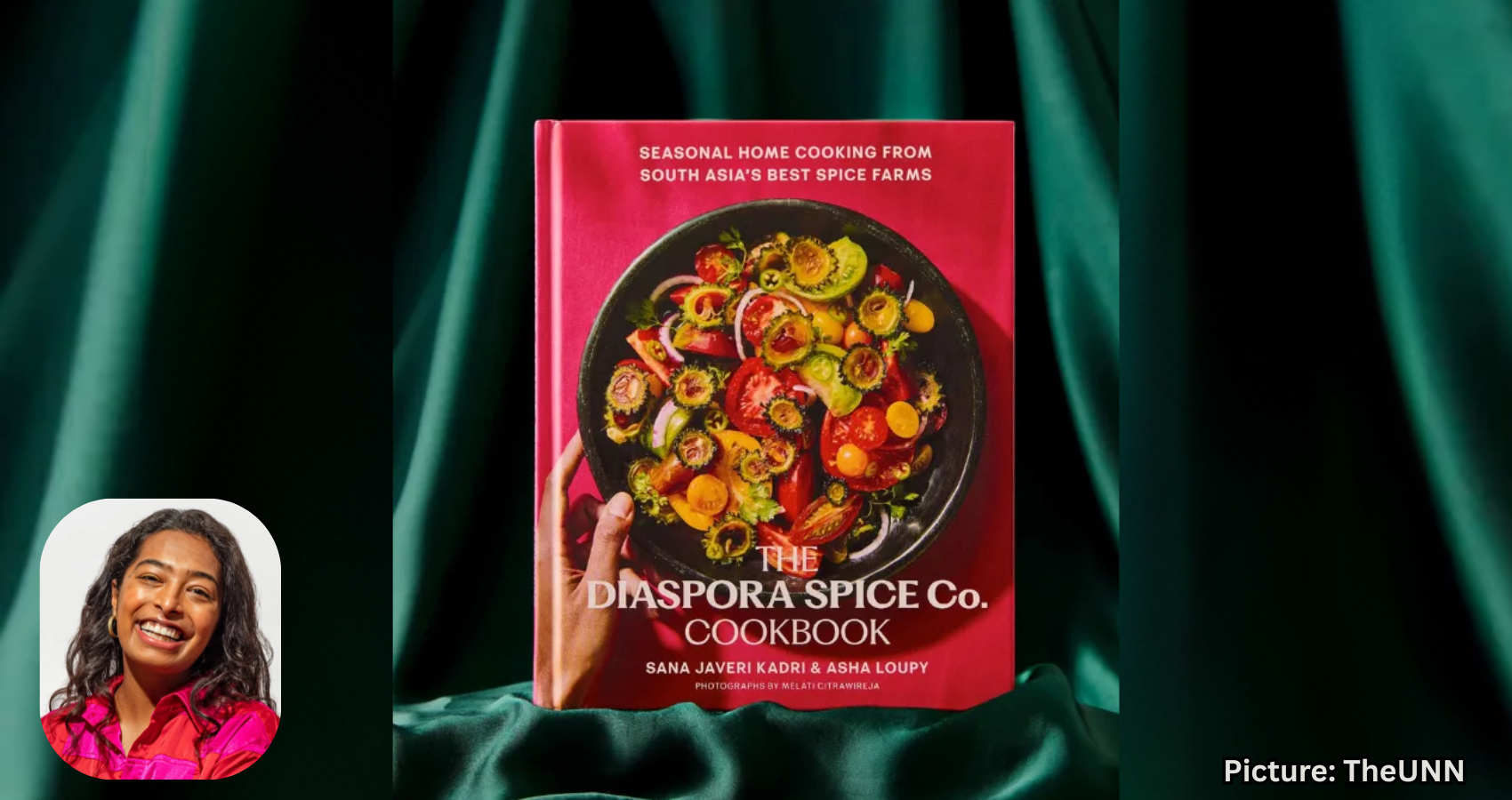
Exploring the origins of spices, Sana Javeri Kadri’s upcoming cookbook emphasizes the stories behind South Asian food, shifting the focus from recipes to the farmers who cultivate these essential ingredients.
What if the most powerful way to tell the story of South Asian food is not through restaurants, chefs, or even recipes, but through the people who grow the spices that make those recipes possible? This question lies at the heart of Sana Javeri Kadri’s work.
As the founder and CEO of Diaspora Co., Kadri has dedicated nearly a decade to building a business—and now a book—that shifts the spotlight away from the finished dish and back toward the very beginning of the food chain. Her debut, The Diaspora Spice Co. Cookbook (Harvest, March 2026, co-authored with longtime recipe developer Asha Loupy), aims to teach readers not just how to cook South Asian food, but how to see it differently.
Kadri’s journey began with a sense of dissonance. Born and raised in a Muslim-Jain Hindu family in Mumbai, where food served as a great unifier, she moved to the United States and encountered familiar ingredients marketed as trends, stripped of specificity and disconnected from the people who grew them. In 2017, she launched Diaspora Co. with a single product: heirloom turmeric sourced directly from a farm in Andhra Pradesh. The premise was radical—pay farmers fairly, highlight regional diversity, and treat flavor as a function of care rather than mass production.
Historically, spices changed hands ten or more times between harvest and kitchen shelf, with farmers capturing almost none of the value. Today, Diaspora Co. sources 30 single-origin spices from 150 regenerative farms across India and Sri Lanka, paying partners an average of six times the commodity price, compared to the roughly 15% premium that fair-trade certification offers. Since its founding, the company has paid $2.5 million directly to farmers.
The Diaspora Spice Co. Cookbook grew out of Kadri and Loupy’s annual, three-month harvest-season visits to partner farms, where they share meals with the families whose labor underpins every meal. The result profiles 35 women across India and Sri Lanka and gathers 85 heirloom family recipes, adapted for a global pantry without losing their specificity. The Mir family of saffron growers, for instance, shared not just their technique for blooming the spice but also the dishes they cherish most. The recipes span chutneys, pickles, vegetables, seafood, meat, rice, breads, and desserts.
This book challenges the assumption that spices are interchangeable commodities. A single variety of turmeric or pepper carries the imprint of soil, climate, and specific hands. By centering the women farmers who hold this knowledge, Kadri and Loupy expand the definition of culinary authority beyond credentialed chefs into everyday practice, inherited technique, and the intelligence built through a lifetime of working with the land.
The resonance of this narrative runs deep. The story Kadri tells is one that the Indian diaspora knows well: the gap between how South Asian food is experienced from the inside—rich, specific, rooted in memory—and how it is often presented to the outside world: exotic, interchangeable, and stripped of context.
In a food culture driven by speed and spectacle, this insistence feels both timely and necessary. Kadri and Loupy remind us that every spice has a story, and that paying attention to those stories can change not just how we cook, but how we understand the world around us.
The following is an excerpt from The Diaspora Spice Co. Cookbook © 2026 by Diaspora Spice Co. Photography © 2026 by Melati Citrawireja. Reproduced by permission of Harvest, an imprint of HarperCollins Publishers. All rights reserved.
Gongura Pappu, Andhra-Style Dal with Sorrel
Recipe by Divya Kasaraneni; Origin: Kankipadu, Andhra Pradesh. Serves 6 to 8.
Gongura Pappu is an Andhra Pradesh-style dal made with sorrel leaves, a monsoon staple known by different names across India. For me, a trip to the Kasaraneni family home during the turmeric harvest is incomplete without a lunch of bright, punchy gongura pappu served over steamed red rice. Without fail, a jar of sorrel pickle is sneakily pressed into my hands to take home by Venkata Narasamma, Prabhu’s grandmother and the family matriarch.
There are countless variations of lentils and beans cooked as staples across South Asia—endless combinations of chana, toor, moong, masoor, urad, chawli, matki, and rajma. My Gujarati nani favored simple split toor, while my Punjabi dadi preferred heavy rajma and creamy split urad. The Kasaraneni family makes their pappu with chana because it’s what they grow, and it gives the dish a silky creaminess that is hard to beat. Where other lentil dishes might play supporting roles in a meal, this one has main character energy.
For the Dal:
2¾ cups (250 g) chana dal
2½ teaspoons fine sea salt, plus more if needed
1½ teaspoons ground turmeric
3 tablespoons untoasted sesame oil or other neutral oil
½ teaspoon cumin seeds
1 white onion, finely diced
4 garlic cloves, finely chopped
1-inch piece ginger, finely chopped
2 to 3 serrano peppers, quartered lengthwise
3 plum tomatoes (about ½ pound/227 g), diced
1½ tablespoons Andhra Chilli Powder
2 tablespoons amchur powder
1½ cups (65 g) roughly chopped fresh sorrel
⅓ cup (17 g) roughly chopped cilantro, leaves and tender stems
Juice of ½ to 1 lemon (1 to 4 tablespoons)
For the Tadka:
1½ tablespoons untoasted sesame oil or other neutral oil
4 garlic cloves, quartered
2 teaspoons split urad dal
1 teaspoon black mustard seeds
1 to 2 whole Guntur Sannam chillies, torn in half
18 fresh curry leaves
Begin by rinsing the chana dal in cold water until the water runs clear. Drain and transfer the dal to an electric pressure cooker, adding 1½ teaspoons of salt, 1 teaspoon of turmeric, and 5 cups (1.2 L) of water. Cook on high pressure for 18 minutes, then allow to naturally release for 15 minutes. Release the pressure, mash some of the dal, and keep warm.
While the pressure cooker is releasing, heat sesame oil in a Dutch oven over medium heat. When shimmering, add cumin seeds and cook until they start to sputter. Add the onion and sauté until softened and golden. Stir in garlic, ginger, and serrano peppers, cooking until the garlic is light golden. Add tomatoes, chili powder, remaining turmeric, and a splash of water, stirring to combine. Reduce heat and cover, cooking until the tomatoes break down.
Stir in amchur powder, the cooked chana dal, and additional water. Cook uncovered, stirring frequently, for 15 minutes, adding sorrel in the last 5 minutes to wilt.
For the tadka, heat sesame oil in a small saucepan. Add garlic, urad dal, mustard seeds, and chillies, frying until golden. Add curry leaves and cook until bright green. Pour the tadka into the dal, add cilantro and lemon juice, and stir to combine. Serve with hot rice and ghee.
Note: Fresh sorrel adds a tangy flavor to dishes from Andhra Pradesh. If unavailable, substitute with baby spinach and use the juice from a whole lemon.
According to India Currents, Kadri’s work emphasizes the importance of understanding the stories behind spices and the farmers who cultivate them.