
Under the new temporary rule announced by the U.S. Citizenship and Immigration Service early May, certain categories of work visas will automatically extend validity of their work authorization from 180 days to 540 days starting May 4, 2022.
As per USCIS’s guidelines, “This rule temporarily amends existing Department of Homeland Security (DHS) regulations to provide that the automatic extension period applicable to expiring Employment Authorization Documents (Forms I-766 or EADs) for certain renewal applicants who have filed Form I-765, Application for Employment Authorization, will be increased from up to 180 days to up to 540 days from the expiration date stated on their EADs.”
This new rule brings hope to some of the thousands of Indians working in the U.S. As Partner and Attorney Min Kim of Chugh LLP explains, “The temporary rule should primarily help foreign nationals with an EAD incidental to a filed and pending AOS application as EAD adjudications have routinely taken much longer than 180 days given the unprecedented backlogs at the Service Centers in recent months.”
 Now, an AOS applicant, or an eligible H-4 spouse, or L-2 spouse among other eligible EAD applicants, can be assured that there will be minimal concern of an employment-gap in their work authorization as they await their renewed EAD cards to arrive, Kim explains.
But he does remind those in line that, “Once again, the expansion of the auto-extension rule does not make more people eligible for this benefit, but for those who do fall in the bucket of eligible EAD applicants, it helps stabilize their ability to remain in the U.S. and continue to work.”
Background For last several years USCIS processing delays have caused the spouses of H, L and E visa holders to quit their jobs and wait over a year in most cases for their employment authorization document renewals caused by USCIS processing delays.
These are doctors, nurse practitioners, engineers, teachers, media professionals, et al, who could have continued serving our communities but could not for no fault of theirs.
Kimberly Hernandez, 21, of Arlington, Va., stands in the center of Mount Pleasant Street as the march heads toward the White House on Thursday. MUST CREDIT: Washington Post photo by Sarah L. Voisin
They did everything by the book, filed their papers six months ahead of time, and continued to look at processing times which increased from 90 days in pre-Covid era to 1.7 years in current times.
In March 2022, USCIS announced it wishes to implement premium processing to reduce some of the backlog. While USCIS will begin premium processing for various categories in October 2022, the announcement came with a start date in 2025 for H, L and E visa categories. Why this differential treatment with the spouse of visa holders?
A welcome change with a caveat The new temporary rule is welcomed by employers and attorneys but does nothing much for the community affected most by USCIS’s processing delays – certain spouses of high skilled immigrant visa holders from highly populated countries like India and China, under H, L and E categories. These visa holders still need a valid I-94 to benefit from USCIS’s new temporary regulation which means they must have a valid underlying visa.
Nevertheless, Managing Partner and Attorney Diya Mathews of Chugh LLP gives a qualified welcome to the change and questions the delays.
“The extension of another 180 days for pending EAD applications is a welcome move by the DHS. However, this is still simply a stop-gap measure. DHS needs to look into why the adjudication of a 765 application, especially when it’s a renewal, should take as much time as it currently does. Is DHS really so backlogged that it cannot ensure that EAD adjudications in under 6 months?”
Things were different at one point in the past. “It used to be that if your EAD application was not adjudicated in 6 months, you could go to the local Field office and get an interim EAD,” Mathews recalls.
H4 EAD visa holders from across the country met with staff at the Office of Management and Budget in Washington, D.C. in 2019, to advocate against rescinding employment authorization. Photo: courtesy Neha Mahajan/Skilled Immigrants In America.
“That provision has been taken away. We have clients who now have to jump through the hoops so they don’t lose their jobs navigating this byzantine EAD adjudication system,” she notes.
And Department of Homeland Security apparently has a mechanism for expediting deserving cases, “but it’s the rare case that actually meet their criteria for expedited processing,” Mathews says adding that while these interim measures are helpful to a limited extent, DHS needs to address the underlying issues and work on improving the case processing times for these applications.
The H, L and E visa holders have two options: They step outside of United States and reenter with their visas stamped,
Wait for their visas to be approved by USCIS which at the moment is neck deep with over 1.5 million pending work permits.
Recently, USCIS Director Ur Jaddou noted that there are 1.5 million work permits requests pending approval.
Since the beginning of Covid, U.S. consulates and embassies across the world are not yet working in full capacity and dates are periodically released by State Department. It is a simple case where demand is higher than the supply. Social media support groups on WhatsApp and Telegram are filled with folks anxiously looking for a date to get their visa stamped!
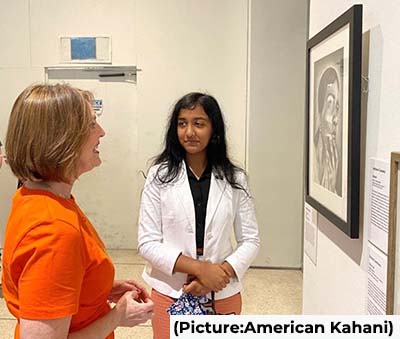 Ms Karthik’s self-portrait tackles perception versus reality.”I wanted to see if I could draw myself as I am and not how I think I am,” she said.
 The Hyderabad data centre region is another addition to the existing network of 3 regions in India across Pune, Mumbai, and Chennai, which have been operational for more than five years.
 The initial $1 million pledge will create The Houston Tamil Studies Chair, Inc. Research Endowment in the UH College of Liberal Arts and Social Sciences. These funds will support research program costs, equipment and seminars with invited scholars who are experts on Tamil societies and the Tamil diaspora in the United States.
 She further said, “I have always appreciated frankness. There is no need to speak to me through the media. So let us all have a free and honest discussion. But what should get communicated outside the four walls of this room is the collective decision of the CWC.”
 ASEI Michigan chapter president Muthu Sivanantham introduced and facilitated discussion with the next two speakers. Dr Raj Ramesh, a TEDx speaker who happens to have a doctorate in AI was the next author to speak. He has broad experience with digital transformation and helps organizations bring together complementary strengths of machines and humans to effect grand change. His talk featuring interesting doodles and interactive audience participation surveys was patterned on his recent book, “AI & You” and he advised how to co-exist with machines by sharing how to think, thrive, and transform in an AI driven future.
 “We can now say that human beings have flown a rotorcraft on another planet,” said MiMi Aung, Ingenuity project manager at JPL. “We’ve been talking about our Wright brothers moment on another planet for so long. And now, here it is.”
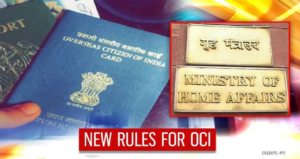 With a view to update the data regarding new passports obtained by the OCI cardholder, it has been decided that he/she shall upload a copy of the new passport containing his/her photo and also a latest photo on the online OCI portal, each time a new passport is issued up to 20 years of age and once after completing 50 years of age. These documents may be uploaded by the OCI cardholder within 3 months of receipt of the new passport.