
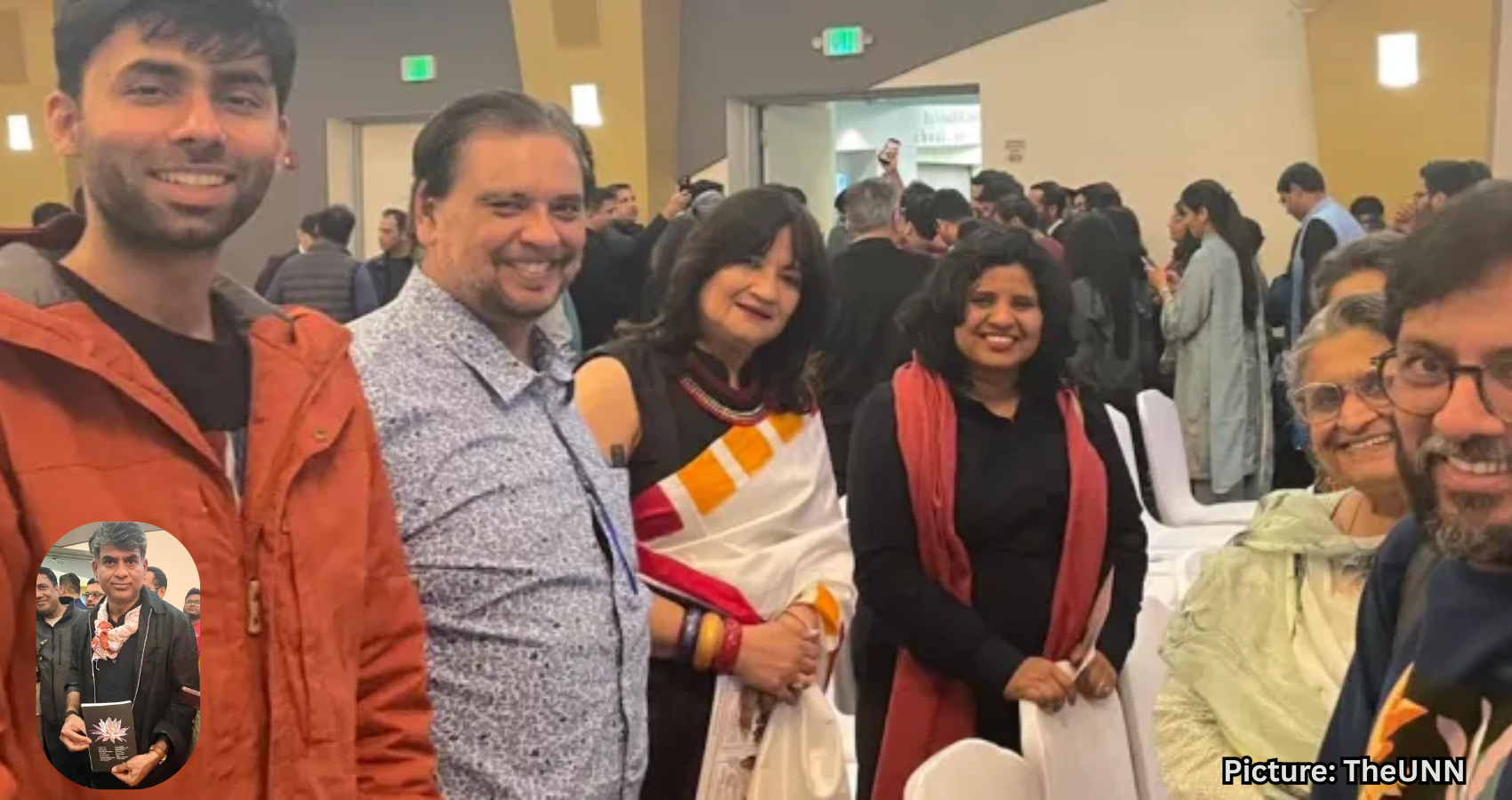
Indian journalist Saurab Dwivedi discussed the importance of language and community engagement during an event hosted by EnActe Arts at the India Community Center in the Bay Area.
Indian journalist Saurab Dwivedi, founder of the Hindi-language digital news platform Lallantop, was the featured speaker at an event hosted by EnActe Arts and Agora at the India Community Center on April 16. The session was moderated by Anuradha Luther Maitra.
This marked Dwivedi’s first visit to the Bay Area, following public engagements at the University of Texas at Austin and a stop in Seattle.
Lallantop, launched in 2015 under the India Today Group, has become a significant player in the Indian digital news landscape. The platform is known for its colloquial reporting style and aims to make news accessible to young audiences in the Hindi heartland by simplifying complex jargon.
With a substantial presence on YouTube, boasting over 34 million subscribers, Lallantop covers a wide range of topics, including news, politics, cinema, and history. Popular shows such as The Lallantop Show and Tarikh, along with segments like Duniyadari, Social List, and The Cinema Show, contribute to its diverse content offerings.
During the discussion, Dwivedi addressed the lingering effects of a colonized mindset in India, where opportunities are often perceived as contingent upon proficiency in English. He recounted experiences from his hometown, where it is common to hear remarks like, “How smart is this person, so fluent in English?”
Dwivedi emphasized the importance of inclusivity in language, noting that advances in technology have allowed for a broader range of voices and languages in the public sphere. He expressed pride in contributing to this change and advocated for the learning of multiple languages in a multilingual nation like India. He posed a thought-provoking question: Why should someone from Chennai need to adapt to Delhi, while a Delhi-raised individual struggles with Kannada in Bengaluru or Tamil in Chennai without basic communication skills?
He shared how his philosophy of life and purpose is inspired by India (Bharat), a land rich in history and culture, from the Indus Valley civilization to the ancient centers of learning at Nalanda and Takshila. These cultural hubs were once focal points for the exchange of ideas.
In collaboration with his wife, Dwivedi has established a library in his hometown, aimed at serving as a community space with special resources for vulnerable populations, particularly children and women. The couple has committed to creating 1,000 libraries across India. Inspired by students who offered to contribute part of their scholarships to support the initiative, Dwivedi overcame his initial reluctance to seek help from strangers, reaching out to the community to realize his vision. He quoted, “May every village have a library like Nalanda,” reflecting his commitment to education and access to knowledge.
Jyoti Bachani, who attended the event, shared her own experiences, stating, “I know my childhood would not have been the same without easy access to the Ramakrishna Mission library in my neighborhood, where new worlds opened up to me from the pages of the books and magazines, decades before the Internet was available to us.” She expressed hope for many helping hands and generous contributions to support the cause of expanding libraries in India.
When asked about the apparent disinterest of young people in reading, Dwivedi gently noted that children often mirror the behaviors of the adults around them, suggesting that the issue may not lie solely with the youth.
At one point in the evening, Maitra inquired about Dwivedi’s guiding principles, to which he responded with the Hindi term for “north star,” or “dhruv tara.”
He encouraged attendees to ask questions when they do not understand something, rather than pretending to know. He asserted that asking questions is crucial for learning and becoming better informed.
Reflecting on the importance of giving back to the community, Dwivedi remarked that there is no greater pilgrimage—regardless of religion or community—than nurturing one’s roots and reinvesting in the institutions that shaped us, whether through books, libraries, or teaching. “In a world racing forward, perhaps the most radical act is to remember—and to rebuild,” Bachani noted, highlighting the spontaneous applause Dwivedi received for many of his insights.
At her request, Dwivedi posed for a photo holding a copy of *Being Becoming Belonging*, a multilingual anthology of poetry edited by Bachani, who is a founder of the Poetry of Diaspora in Silicon Valley.
Audience members, including fellow poets from Silicon Valley’s creative community, expressed gratitude to EnActe Arts and its founder, Vinita Sud Belani, along with Managing Director Kalpana Handu Guha, for facilitating such meaningful conversations in the Bay Area.
Bachani described Dwivedi as “an extremely intelligent man with a dominant curiosity, well-read and disciplined, deeply rooted and confident, imaginative with a vision for whatever he pursues with dedication.”
As the evening concluded, the discussions left a lasting impression on attendees, reinforcing the significance of language, community, and the power of knowledge.
According to India Currents.