
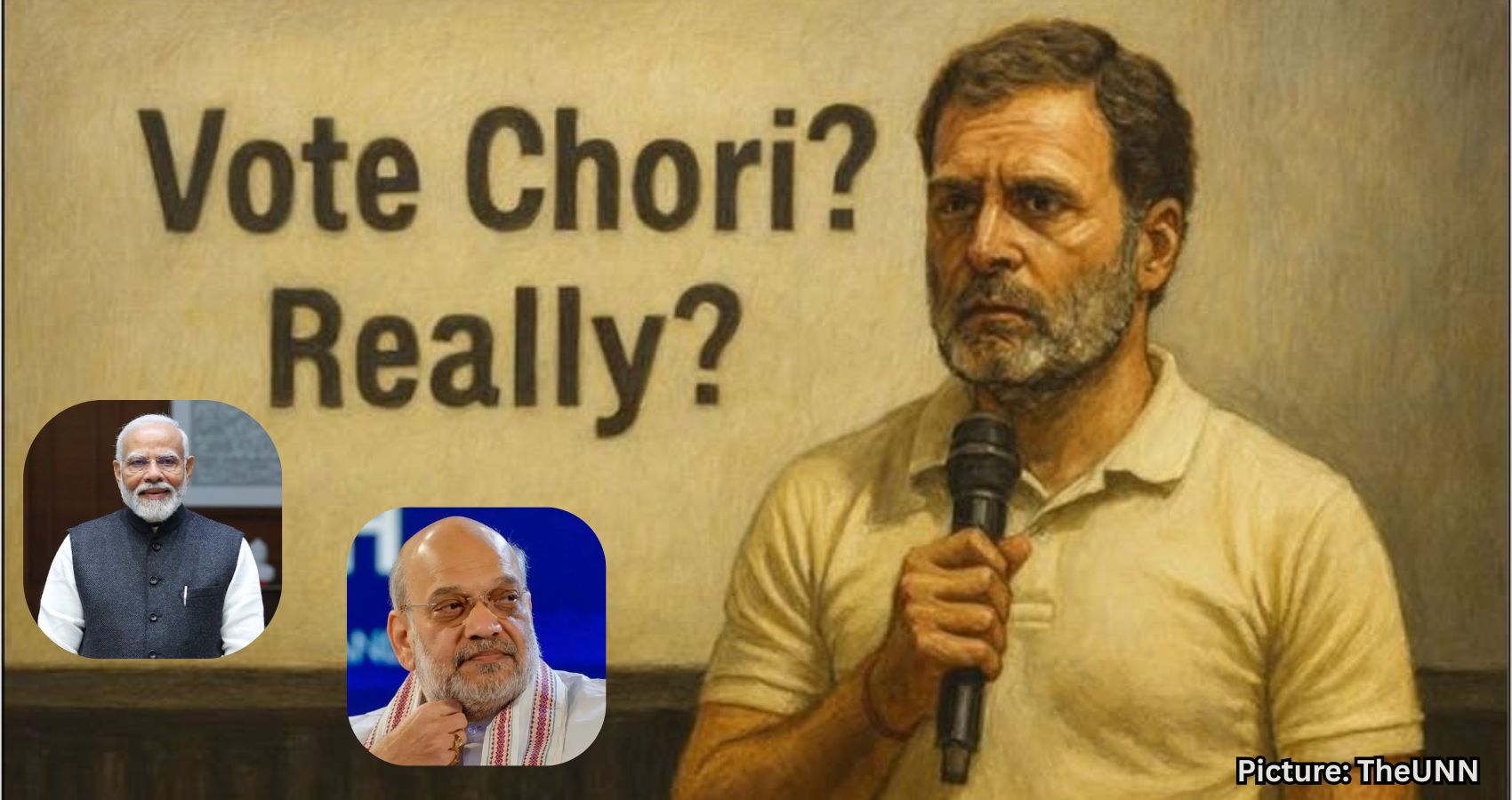
The ongoing debate about Rahul Gandhi’s leadership overlooks a crucial question: does he truly understand power, and can he transform moral authority into effective political action?
The discussion surrounding Rahul Gandhi’s suitability for the prime ministership has taken an interesting turn, particularly in the exchange between historians Ramachandra Guha and Shashi Tharoor. Both individuals are respected figures in their own right, yet their debate seems to be missing a fundamental question that goes beyond mere qualifications for office.
Guha questions whether Gandhi has the necessary experience and proven track record to hold high office. Tharoor counters this by asserting that democratic leadership cannot be solely defined by an administrative résumé, pointing out that many influential leaders throughout history have ascended to power without prior governmental experience. While both perspectives have merit, they miss the deeper inquiry: does Rahul Gandhi truly understand the nature of power?
When examining the essence of authority, it becomes clear that history is often shaped not just by governments, but by the individuals who have influenced them. Leaders like Mahatma Gandhi, Nelson Mandela, Václav Havel, and Martin Luther King Jr. did not necessarily rise through conventional political channels. Instead, they had the ability to articulate a collective yearning before the public had even found the words to express it. Their authority stemmed not from formal credentials but from an innate understanding of the political landscape and the aspirations of their constituents.
This context is often overlooked in Guha’s argument. The path to national leadership is not solely paved with demonstrated executive competence; it is also about the ability to clarify a political moment, to resonate with the fears and hopes of the populace, and to offer a vision for the future. Voters are drawn not just to a candidate’s résumé but to the narrative and direction they provide.
The notion of dynastic politics complicates Guha’s stance further. If Rahul Gandhi is indeed a product of a political dynasty, he inherits not just a name but a wealth of institutional knowledge—decades of victories and failures, relationships built and broken, and a unique education in the intricacies of power. Growing up in the Nehru-Gandhi family has immersed him in the workings of the Indian state, its challenges, and its vulnerabilities.
Conversely, if he is to be judged solely as an individual, then his character, instincts, judgment, and political vision must come under scrutiny. Critics cannot simultaneously argue that he is a novice constrained by his lineage while also denying that this lineage provides valuable political insight. The critique shifts depending on the narrative that needs to be supported at any given moment.
Yet, the more pressing question remains: what has Rahul Gandhi actively chosen to do with the inheritance he has received?
For over a decade, Rahul Gandhi has occupied a unique position in Indian politics, functioning less as a traditional politician and more as a moral critic of the existing order. He has raised concerns about economic inequality, questioned institutional integrity, and highlighted the need for democratic accountability. Regardless of one’s agreement with his views, it is evident that a coherent moral framework underpins his critiques.
However, morality and power operate under different principles, and conflating the two can lead to significant political missteps. A moral actor seeks truth and clarity, exposing contradictions and valuing principles. In contrast, a political actor aims for authority and consensus, navigating contradictions to achieve effectiveness, and building coalitions to translate ideas into tangible outcomes.
This is where Rahul Gandhi faces his greatest challenge. His political journey has not lacked convictions; rather, it has been marked by an uncertain relationship with power—its demands, complexities, and necessary compromises. For years, his approach resembled that of a witness rather than a contender for power. While this garnered admiration from a segment of the electorate, it did not translate into electoral success.
Interestingly, a comparison can be drawn with Narendra Modi, who, prior to 2014, was viewed by many intellectuals as unsuitable for national leadership due to his divisive nature and provincial instincts. However, history revealed that Modi’s instincts from Gujarat were scalable, and they became the foundation for his governance of India. His character, once established, persisted and evolved into policy and institutional frameworks.
What, then, does Rahul Gandhi’s behavior indicate about his political instincts? For a long time, his inclination towards consultation and skepticism of centralized authority suggested uncertainty about his desire for power and the sacrifices it demands.
However, a notable shift has occurred. Through extensive efforts like the Bharat Jodo Yatras and the challenges of recent elections, Gandhi has undergone a visible transformation. He is no longer just a distant intellectual or a reluctant heir; he is actively engaging with the electorate, attempting to build a grassroots narrative and establish a direct connection with the people.
This evolution marks a significant psychological transition. It moves from merely witnessing political contradictions to actively mobilizing support and seeking power. Gandhi is beginning to understand that opposition requires not just identifying problems but also proposing solutions. A leader cannot solely highlight issues; they must also provide a clear path forward.
The broader implications of this discussion extend beyond Rahul Gandhi himself and touch upon the health of Indian democracy. A thriving democracy requires both critics of power and those capable of wielding it. The crisis emerges when these two roles fail to understand each other. India currently faces this tension, raising the critical question of whether it can still produce leaders who embody both moral legitimacy and political effectiveness.
Ultimately, the future will judge Rahul Gandhi not by the surname he bears or the criticisms he has faced, but by his ability to complete the transition he has begun. He must demonstrate that morality, when coupled with the willingness to seek, organize, and exercise power, can transform into meaningful action that shapes the world.
According to The American Bazaar, the real test lies in whether Gandhi can bridge the gap between conscience and authority, ensuring that those who see clearly can also act decisively.