
The first public trial of former Assad-era officials in Syria marks a significant step towards accountability for decades of repression and violence, following the regime’s collapse in late 2025.
Syria’s interim judicial authorities have initiated the first public trial of several former senior officials from the deposed government of Bashar al-Assad. This landmark proceeding, taking place in the capital city of Damascus, represents the first domestic effort to hold the former regime accountable for decades of alleged systemic repression, torture, and mass killings.
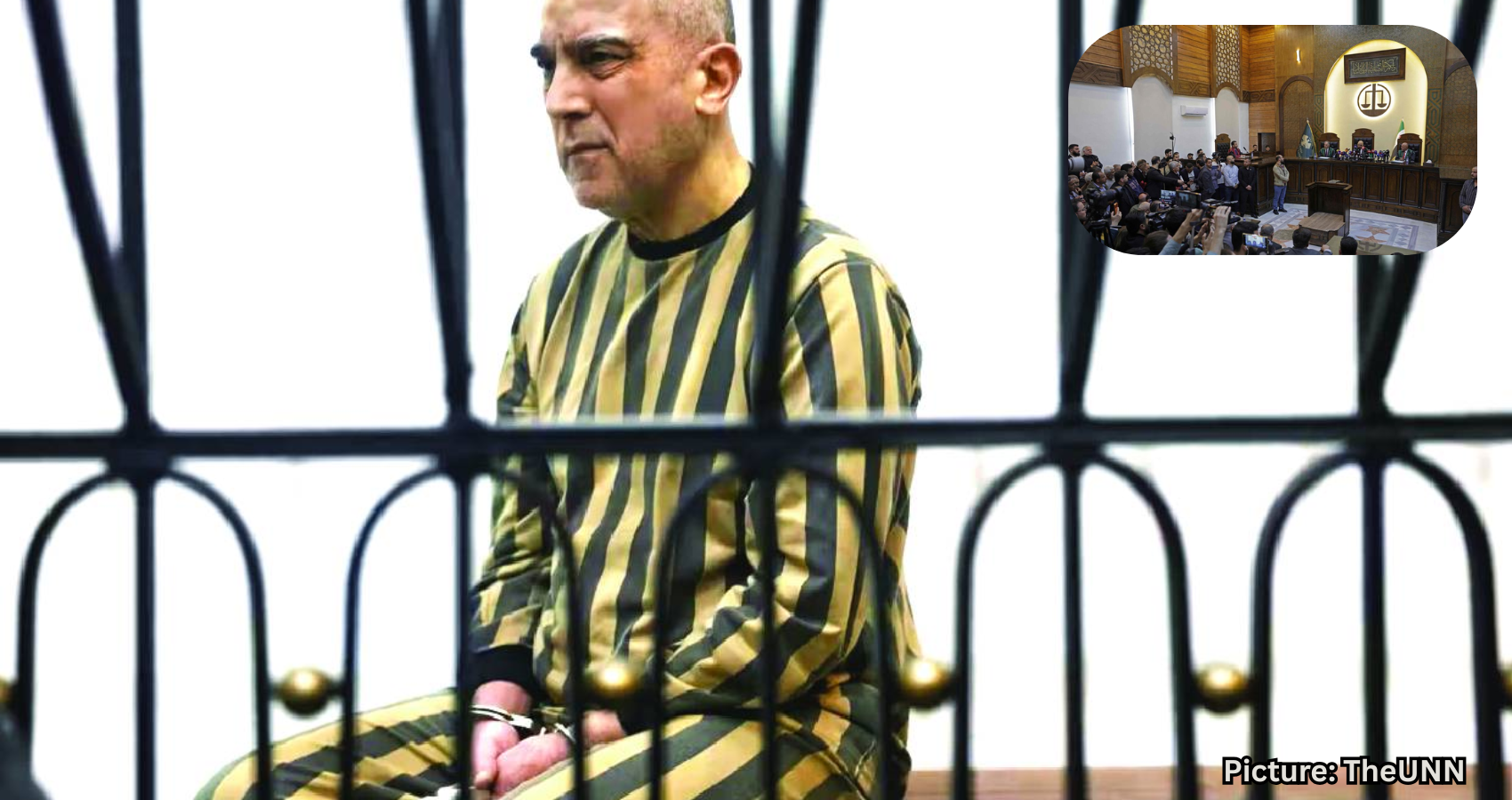
The inaugural hearing occurred on a recent Sunday, featuring only one defendant: Atif Najib, a former security official. He appeared in court handcuffed and expressionless, standing behind a reinforced cage while wearing a striped prison uniform. Najib, along with other former officials, faces numerous charges, including orchestrating mass shootings against peaceful protesters, overseeing notorious detention centers, and specifically torturing children during the early years of the Syrian civil war.
Najib is a maternal cousin of Bashar al-Assad and previously held the rank of Brigadier General in the Syrian army. Notably, both Bashar and his brother Maher, the former commander of the Syrian military’s 4th Armoured Division, are being tried in absentia, having fled Syria.
This trial marks a pivotal moment for a nation transitioning from over 53 years of Assad family rule. While Bashar al-Assad remains in exile, several high-ranking members of his inner circle and family were present in the courtroom.
“Today we begin the first trials of transitional justice in Syria,” declared Judge Fakhr al-Din al-Aryan as he opened the preparatory session. This includes defendants in custody, as well as those who have fled justice.
The interim government under al-Sharaa, which is supported by various international legal consultants, has emphasized that the trials will adhere to international standards of due process. Unlike the closed-door military tribunals that were common under the previous Assad regime, these sessions are being held in a public forum, with legal representation provided for the defendants.
However, the trial faces significant security challenges. The transitional authorities must balance the public’s demand for immediate justice with the necessity for a thorough, evidence-based legal process that can withstand international scrutiny. Advocacy groups, including the Human Rights Foundation (HRF), have described this as a “pivotal opportunity” to transition Syria toward individual rights and away from the cycle of state-sponsored brutality.
The collapse of the Assad regime followed more than half a century of heavy-handed rule and over a decade of civil war. The regime fell after opposition fighters launched a significant offensive against pro-government forces. The trial of former officials is viewed as a critical test for establishing the rule of law and the independence of the new Syrian judiciary.
Initial skirmishes began on the frontline between opposition-held Idlib and the neighboring governorate of Aleppo. Several armed factions, backed by neighboring Turkey and led by Hayat Tahrir al-Sham (HTS), formerly known as al-Nusra Front, initiated an 11-day operation dubbed “Deterrence of Aggression” to overthrow the Assad regime. This operation was led by Ahmed Hussein al-Sharaa, who is now recognized as Syria’s de facto leader, alongside various rebel groups including the Syrian National Army (SNA) and the Free Syrian Army (FSA).
While these forces were unable to penetrate Assad’s strongholds in Lattakia and Tartous, they advanced into Homs and Hama, areas that became known as the “Capital of the Syrian Revolution.” As the regime fell in December 2024, al-Assad and his high-profile ministers fled to Moscow, while many officials sought refuge in the heartland of Assad’s Alawite minority provinces. Syrian Prime Minister al-Jalali remained to maintain governmental operations, while Najib, who was heading Syria’s political security branch in Daraa—where the 2011 uprising first erupted—was arrested in January 2025.
In the aftermath of the civil war, which resulted in the deaths of over a million civilians and the displacement of millions more, tens of thousands of Syrians disappeared within the brutal prison system. Najib has been accused of repressing and arbitrarily arresting civilians who expressed dissent against the Assad regime.
Al-Sharaa, the interim president, has vowed to deliver justice and hold accountable those officials who committed atrocities. In a recent post on social media platform X, he stated that justice remains “a major goal that the state and its institutions strive to achieve.”
During the initial hearing, the judge did not question Najib but postponed the next session to May 10, indicating that Sunday’s proceedings were primarily for “preparatory administrative and legal procedures.”
Looking ahead, while the current trial focuses on officials captured during the transition, the court also conducted the first procedural hearing in the trial of Bashar al-Assad in absentia. International warrants remain active, and the proceedings in Damascus are expected to enhance global efforts to bring the former president to a formal international tribunal should he ever be apprehended.
As the court adjourned, the atmosphere outside the Damascus courthouse was described as one of cautious optimism. The legal repercussions stemming from the Assad era are anticipated to unfold over several years, involving thousands of victims and a complex web of financial and human rights crimes. The sight of the regime’s inner circle facing a judge serves as a powerful signal that the era of absolute impunity in Syria may be coming to an end.
According to The Sunday Guardian, this trial is a significant step towards accountability in Syria.