
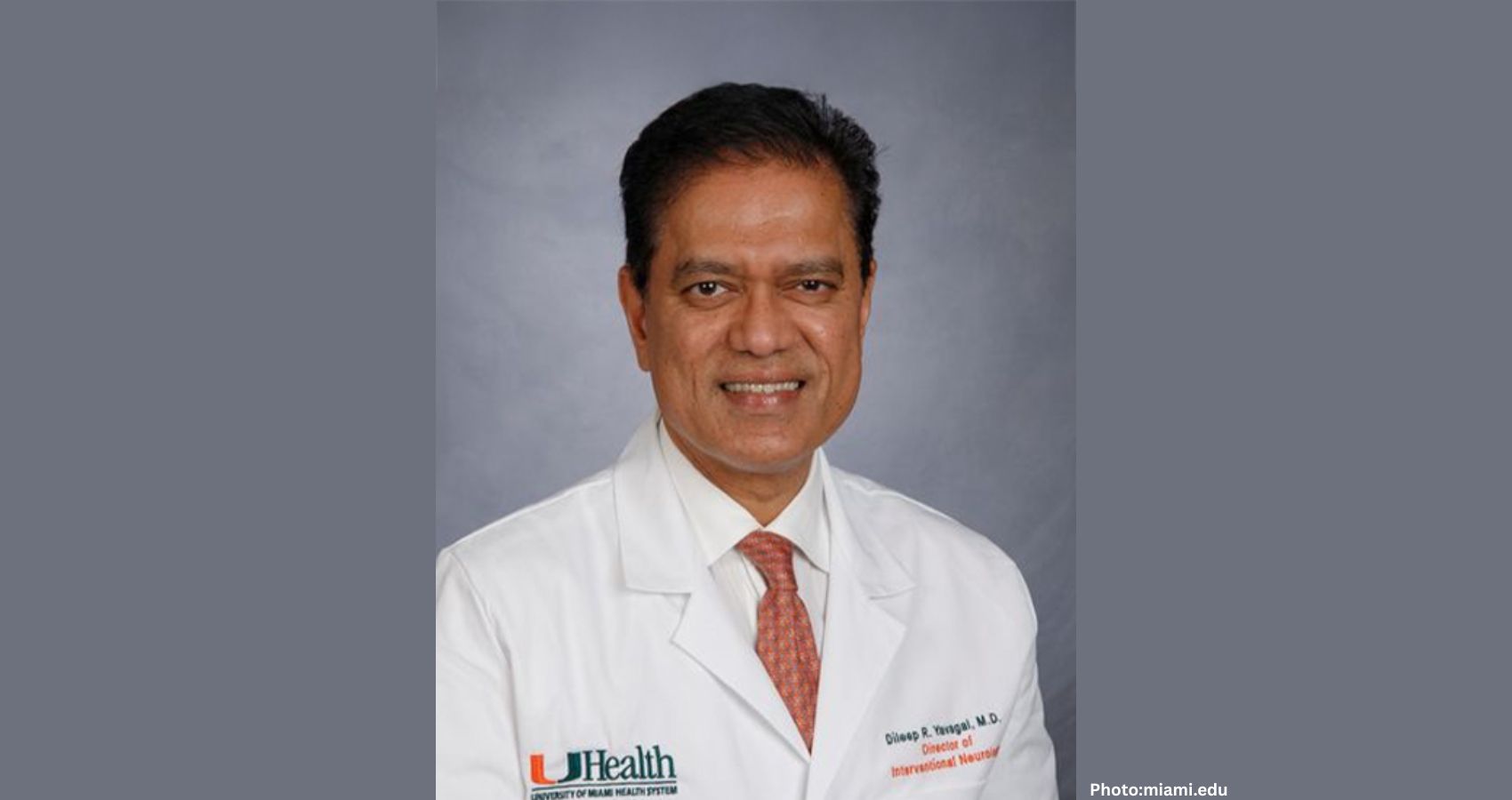
Indian American neurologist Dileep Yavagal has been honored with a Lifetime Achievement Award for his significant contributions to stroke treatment and equitable healthcare access globally.
Dr. Dileep Yavagal, a prominent Indian American neurologist, has been awarded a Lifetime Achievement Award in recognition of his extensive work in transforming stroke treatment and enhancing access to life-saving care both in the United States and around the world.
Yavagal, who serves as the chief of interventional neurology and is a professor of clinical neurology and neurological surgery at the University of Miami Miller School of Medicine, received this prestigious accolade during the 2026 American Academy of Neurology (AAN) Annual Meeting, as reported by the university.
The award was presented by the Association of Indian American Neurologists (AINA) in collaboration with the American Brain Foundation. It acknowledges Dr. Yavagal’s pivotal role in establishing mechanical thrombectomy as a standard treatment for acute ischemic stroke, as well as his ongoing efforts to address disparities in access to this critical care.
“Receiving this Lifetime Achievement Award is deeply humbling,” Dr. Yavagal stated, reflecting on the honor and the responsibilities it entails. “It reflects the work of many collaborators, mentors, and trainees who share a commitment to ensuring that where you live — or what resources you have — does not determine whether you survive a stroke with your independence intact.”
Dr. Yavagal is a founding member and former president of the Society of Vascular and Interventional Neurology (SVIN). His involvement in landmark clinical trials, such as SWIFT PRIME, has demonstrated the significant benefits of mechanical thrombectomy for patients suffering from large-vessel occlusion strokes, thereby reshaping treatment guidelines on a global scale.
While these trials established the medical possibilities for stroke treatment, much of Dr. Yavagal’s subsequent research and international collaboration has focused on ensuring that these advancements reach those who need them most.
As the founder of Mission Thrombectomy, a global initiative active in over 90 countries, he has adopted a public health approach to stroke care. This initiative combines data collection, training, advocacy, and systems design to improve access to care in resource-limited settings.
A key aspect of this work has been innovation aimed at affordability. Dr. Yavagal recently led the GRASSROOT trial, a multicenter study conducted across eight stroke centers in India. This trial evaluated a locally manufactured, lower-cost stent retriever for mechanical thrombectomy.
The findings from the trial indicated high rates of successful clot removal and low complication rates, providing evidence that high-quality endovascular stroke care can be effectively delivered in low- and middle-income countries when paired with optimized workflows and training.
These results have significant implications for global health, particularly as the high cost of single-use thrombectomy devices has historically hindered their adoption. By demonstrating that cost-effective technology can achieve strong clinical outcomes, Dr. Yavagal’s research is paving the way for sustainable stroke care systems in resource-constrained countries.
In addition to his global efforts, Dr. Yavagal has rigorously examined disparities in stroke treatment within the United States. In a comprehensive study involving over 24,000 patients using the national Get With The Guidelines®-Stroke registry, he and his colleagues discovered that patients residing in rural areas are 15% less likely to receive mechanical thrombectomy compared to their urban counterparts, even after accounting for stroke severity, demographics, and social determinants of health.
This research underscores how geographical location, hospital resources, and transfer patterns continue to influence outcomes for patients experiencing severe strokes. Although rural hospitals often recognize strokes quickly and initiate transfers appropriately, limited access to thrombectomy-capable centers and specialized personnel remains a significant barrier.
“These are not theoretical gaps. They translate directly into disability and loss of independence for patients,” Dr. Yavagal has remarked regarding the disparities faced by rural stroke patients.
His work has positioned rural America as a critical area for redesigning stroke care systems, emphasizing the necessity for regional planning, integration of telestroke services, and investment in transfer networks.
Born and trained in India, Dr. Yavagal has maintained strong connections to his home country through teaching, research collaborations, and capacity-building initiatives.
According to a university release, Dr. Yavagal’s contributions continue to make a profound impact on the field of neurology and stroke care worldwide.