
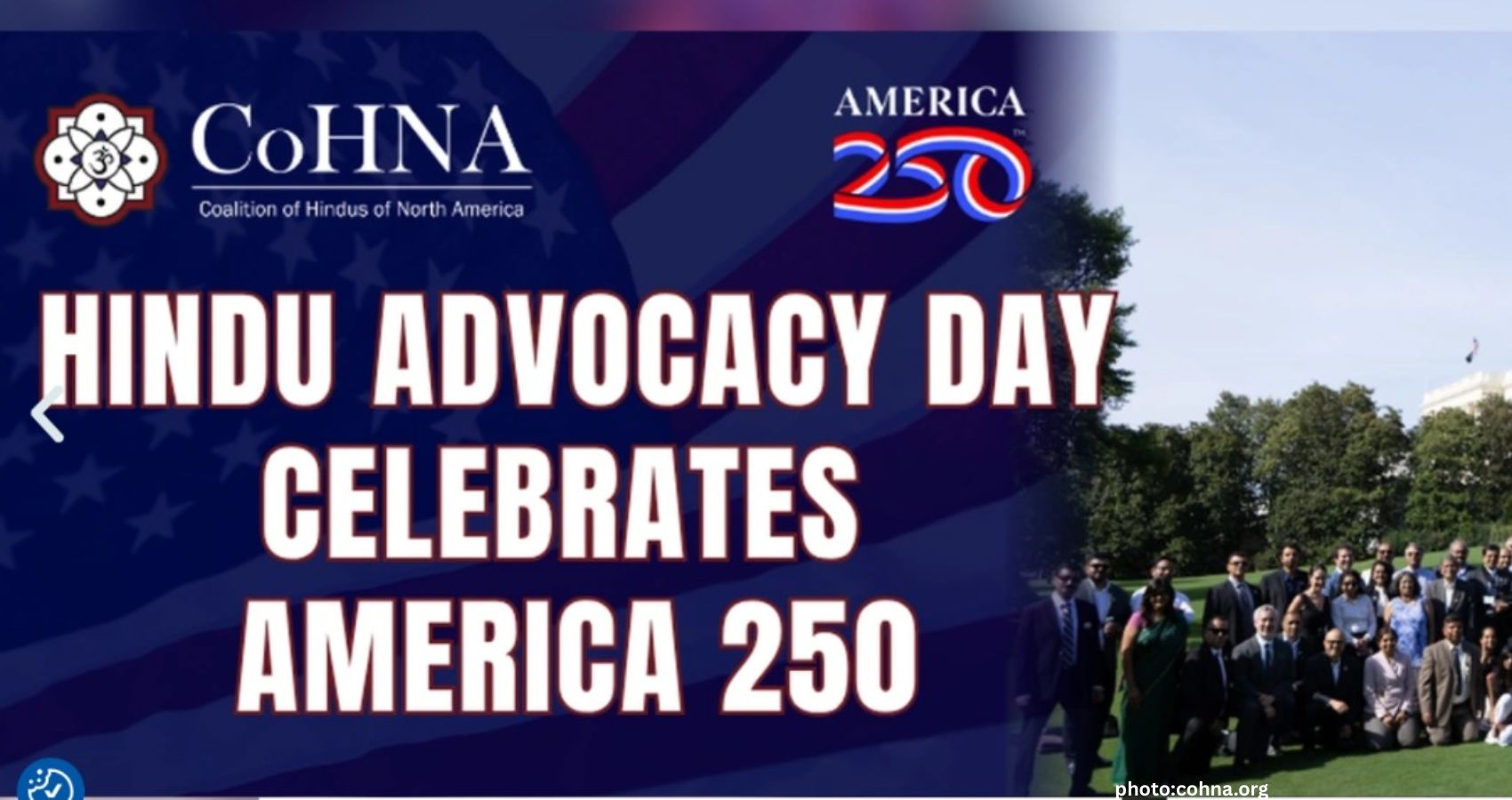
Over 130 Hindu Americans gathered on Capitol Hill for the 5th Hindu Advocacy Day, addressing rising Hinduphobia and celebrating the nation’s 250th anniversary.
The Coalition of Hindus of North America (CoHNA) recently hosted its fifth Day of Advocacy on Capitol Hill, uniting over 130 Hindu Americans from 15 states. The event, as detailed in a press release from CoHNA, focused on bipartisan concerns regarding the rise of Hinduphobia, the celebration of America’s 250th anniversary, and the experiences of Hindu youth in the United States.
Participants included seven Congressional representatives and 12 staffers from both political parties. Prior to the formal gathering, Hindu delegates conducted more than 50 meetings with Senate and Congressional staff and visited over 120 Congressional offices to engage with lawmakers.
CoHNA President Nikunj Trivedi expressed the significance of the event, stating, “We came together as Americans, sharing stories, building relationships, and singing the national anthem. American Hindus come from all walks of life—students, entrepreneurs, cab drivers, pharmacists, homemakers, retail workers, engineers, bankers, and scientists. We are thinkers, teachers, writers, and veterans. It was an honor and privilege to share insights, educate, and come together with our lawmakers and interfaith allies to celebrate the grand anniversary of our country.”
The event featured speakers from various interfaith communities, including members of the Armenian and Jewish communities, as well as a city council member from Maple Grove, Minnesota. A youth panel from the CoHNA Youth Action Network (CYAN) at Rutgers University shared their experiences in campus advocacy, discussing their multi-year efforts to secure representation, protest Hinduphobic events, engage with university administration, and host an academic conference on Hinduism. A national leader from CYAN also spoke about the history of Hinduism in America, dating back to the Founding Fathers, while other attendees shared their personal journeys.
Ruchir Bakshi, a Hindu veteran who served in Afghanistan and Iraq, also addressed the gathering. He shared how the Bhagavad Gita influenced his approach to civic engagement and military service, teaching him the values of discipline and integrity.
Lawmakers from both parties spoke about anti-Hindu hate, temple vandalism, and the role of the Hindu community in the United States. In light of America’s upcoming 250th anniversary, Rep. Buddy Carter (R-GA) remarked, “Freedom of religion is one of our greatest rights,” while condemning recent incidents of temple vandalism. Rep. Shri Thanedar (D-MI) emphasized the contributions of immigrant communities, urging the Hindu community to “demand respect for our contributions in science, medicine, academia, and politics.”
Rep. Suhas Subramanyam (D-VA) addressed younger attendees, encouraging them to speak out against prejudice. “Embrace who you are as Hindus,” he said, adding that “being different becomes cool later in life—be proud now.”
The discussions also touched on local and state legislation. Rep. Zoe Lofgren (D-CA) expressed concerns that caste-based legislation could deepen discrimination rather than resolve it. Meanwhile, Rep. Sanford Bishop (D-GA) asserted that “Hinduphobia is un-American,” highlighting Georgia as the first state to pass a resolution condemning it.
Other Georgia lawmakers, including Rep. Brian Jack (R-GA) and Rep. Rich McCormick (R-GA), praised the community’s civic engagement. Jack stated, “Georgia is leading the way against Hinduphobia,” while McCormick described Hindu Americans as “hardworking, intelligent, family-oriented, robust—that’s the American Dream.”
The advocacy day also featured presentations from researchers examining issues affecting the South Asian diaspora in American civic life. Dr. Joel Finkelstein, co-director of the Network Contagion Research Institute (NCRI) and a fellow at the Miller Institute for Secure Communities at Rutgers University, presented findings on recent attempts to incorporate caste into U.S. policymaking. He noted that “caste has almost no pre-existing narrative in U.S. civic life, making it an ideal test case for isolating the effect of a training narrative,” urging policymakers to evaluate empirical evidence before altering curricula or laws.
Prasiddha Sudhakar of the NCRI presented a research paper titled “From Policy Drift to Purity Grift,” which analyzed how online immigration debates have targeted American Hindus. The study found that incidents reported as “anti-Indian” often specifically focused on Hindu traditions, festivals, and temples, frequently amplified by foreign actors and domestic influencers.
Political strategist and former Capitol Hill staffer Anang Mittal introduced the Citation Integrity Dashboard, an independent, non-partisan tool designed to assess the transparency, methodology, and verifiable evidence behind high-profile institutional claims concerning India and Hindu Americans.
Sudha Jagannathan, CoHNA’s director of government relations, emphasized the importance of the event’s bipartisan turnout. “It was gratifying to see so many lawmakers—both Democrats and Republicans—unite against temple attacks and anti-Hindu hate, and speak up for religious freedom for American Hindus,” Jagannathan stated. “This is the sort of bipartisan support that we at CoHNA are building for the Hindu American community because the future belongs to those who show up and advocate.”
The event highlighted the growing presence and influence of Hindu Americans in the political landscape, as they continue to advocate for their rights and recognition in the broader American narrative, according to India Currents.