
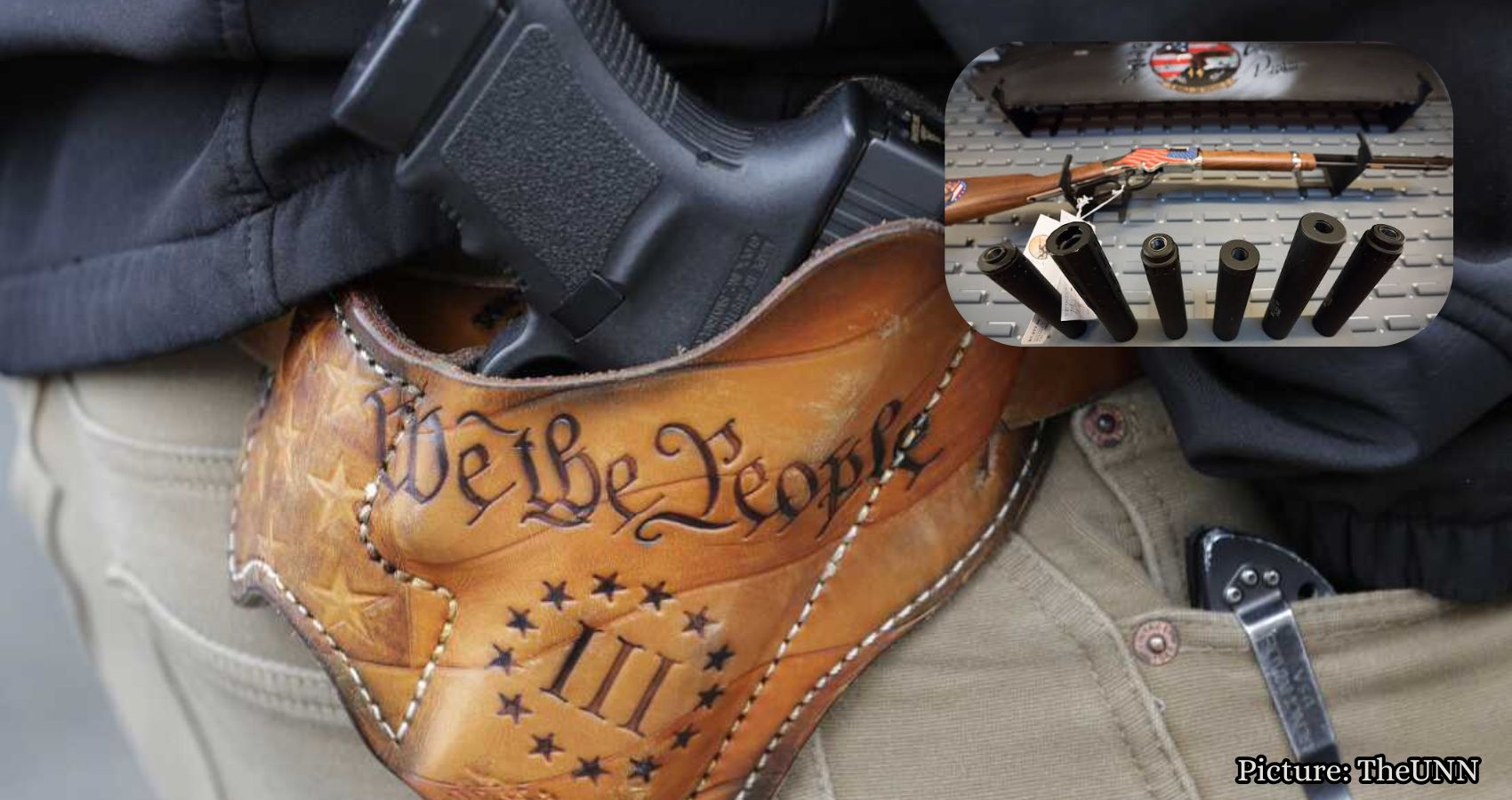
Gun rights advocates celebrate a significant ruling that removes the $200 tax on firearm suppressors and short-barreled rifles, marking a pivotal moment for Second Amendment rights, according to Rep. Andrew Clyde.
Gun rights advocates are applauding a recent ruling that simplifies the process for obtaining firearm suppressors and certain types of firearms. Rep. Andrew Clyde, R-Ga., a former business owner who founded Clyde Armory in Georgia, described the decision as “the greatest restoration” of Second Amendment rights in nearly a century.
Clyde argued that the previous regulatory framework, which included a $200 tax on silencers and short-barreled rifles, was fundamentally flawed. He emphasized that taxing a constitutional right undermines its very existence. “If you can tax something legitimately, then you can actually destroy it through increased taxation,” Clyde told Fox News Digital. “You might, quote, ‘have a right on paper,’ but you don’t really have a right because you can’t afford the right. Is that really a right? It’s not.”
The ruling stems from Clyde’s efforts last year to amend the National Firearms Act of 1934, which imposed the tax and required additional federal registration for certain firearms. This initiative was part of the One Big Beautiful Bill Act (OBBBA), which successfully reduced the tax to zero. Gun rights groups have since leveraged this change to argue that the registration requirements are unconstitutional.
While the ruling directly impacts the parties involved in the lawsuit, it does not constitute a national injunction against the law, as reported by the Associated Press. Nevertheless, Clyde hailed the decision as an “incredible win for the Second Amendment,” expressing hope for further victories in the future.
“When you protect the Second Amendment, which protects every other amendment in the entire Constitution — I think that’s the teeth behind the Constitution,” Clyde stated. He elaborated on the interconnectedness of the Second Amendment with other constitutional rights, including freedom of assembly, religion, speech, and the press.
In a show of solidarity, Clyde led 47 Republican lawmakers in a letter urging Attorney General Todd Blanche not to appeal the ruling. The letter articulated concerns that an appeal would prolong regulatory uncertainty for law-abiding gun owners and businesses, consuming Department of Justice resources to defend a position that both Congress and a federal district court have deemed untenable.
The celebration among gun rights activists intensified when the Trump administration opted not to appeal the judge’s ruling, allowing the order to take effect without delay. However, this decision drew criticism from gun violence prevention groups.
Kris Brown, president of Brady: United Against Gun Violence, expressed dismay at the government’s inaction. “Today, our government is failing us. At midnight, uniquely lethal weapons and devices — including silencers, short-barreled rifles, and shotguns — were deregulated for the first time in nearly a century,” Brown stated. “The Department of Justice had the opportunity to act to protect our safety, but it failed to do so. Today, the gun industry and silencer dealers are celebrating, while Americans are left less safe.”
The ruling marks a significant shift in the landscape of gun rights in the United States, reflecting ongoing debates about the balance between individual rights and public safety. As advocates on both sides of the issue continue to voice their opinions, the implications of this decision will likely resonate throughout the political and social spheres.
According to Fox News, the ruling represents a pivotal moment for Second Amendment rights, with potential ramifications for future legislation and regulation surrounding firearms in the United States.