
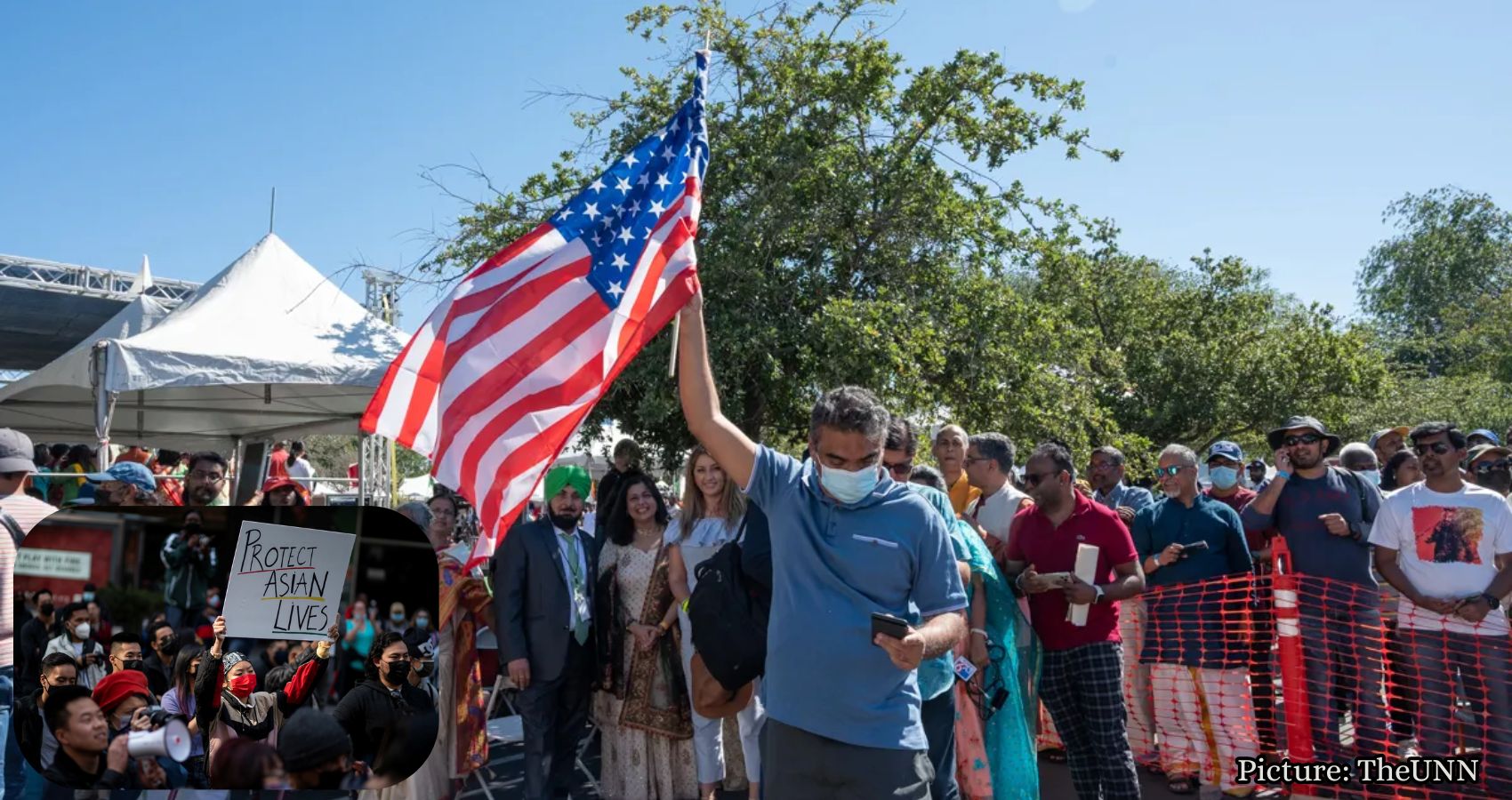
South Asian Americans face a complex reality shaped by the “model minority” myth, which obscures the diverse experiences within the community and highlights the need for solidarity and accountability.
Before the narrative of the “model minority” emerged, Indian Americans were often labeled the “problem minority.” Historical accounts from the late 19th and early 20th centuries depicted early Punjabi and Bengali migrant farm workers as “undesirable,” “effeminate,” and “caste-ridden.”
Since then, Indian Americans have made significant strides, evolving from being barred from naturalization and citizenship rights in the 1920s to holding influential positions in politics and corporate America today. However, this progress has not been uniform across the South Asian diaspora. Some prominent Indian Americans have aligned themselves with conservative white Americans who advocate for crackdowns on other immigrant communities, exacerbating existing divides.
In 2023, the median annual income for Indian-headed households reached $151,200, nearly double the national average. While this statistic is a source of pride for many, it raises questions about the overall benefit to the entire South Asian community. Alongside wealthier Indian American families, numerous South Asians work in low-wage professions such as taxi driving, restaurant work, and delivery services.
These immigrant workers often face fewer protections, greater exploitation, and lower wages. Official poverty statistics reflect this disparity: as of 2025, about 6 percent of Indians in the U.S. lived in poverty, compared to 9 percent of Nepalese, 9 percent of Sri Lankans, 12 percent of Pakistanis, and 14 percent of Bangladeshis.
All South Asian communities in the U.S. are descendants of immigrants seeking better lives. However, U.S. immigration policies have historically favored certain groups. From 1965 to the late 1970s, a significant wave of Indian immigrants arrived following the end of discriminatory immigration restrictions. This influx primarily included highly skilled individuals, often from upper-caste backgrounds, such as physicians, engineers, and lawyers, who successfully assimilated into American society and became emblematic of the “model minority.”
As upper-caste Indians thrived, later immigration pathways, including the Diversity Visa program initiated in the 1990s, allowed many South Asians from historically marginalized caste backgrounds to enter the U.S. These individuals often had less access to education and professional networks, leading to greater economic hardship and discrimination.
This divide has further entrenched the separation between upper-caste Indians and the broader South Asian diaspora. Many affluent Indian Hindus have found common ground with conservative white Christians, who dominate the Republican Party and uphold a capitalistic system that aligns with their values.
While my family, like many others, attributes our success to hard work and discipline, this acknowledgment often fails to extend to low-wage South Asian workers who embody the same values. Instead, there has been a rise in conservative Indian American politicians who engage in anti-immigration rhetoric.
During his presidential campaign, Republican Vivek Ramaswamy proposed to “gut” the H1-B visa program and revoke birthright citizenship, echoing sentiments previously expressed by former President Donald Trump. Other figures, such as former South Carolina Governor Nikki Haley and FBI Director Kash Patel, have also voiced support for stringent immigration enforcement.
This hypocrisy is evident: privileged and upper-caste individuals have benefited disproportionately from U.S. immigration policies compared to their less fortunate counterparts.
Despite their assimilation into America’s ruling class, conservative Indian American politicians cannot escape the racism that persists in society. Ramaswamy has faced significant online racism, with comments urging him to “go back to India.” Similarly, Usha Vance, married to Vice President JD Vance, has encountered anti-Asian rhetoric from MAGA supporters criticizing her interracial marriage.
The “model minority” label does not shield individuals from experiencing racism. Instead, it serves as a political tool that obscures systemic discrimination, maintains racial hierarchies, and masks the economic struggles faced by South Asian communities.
It is time for a shift in our community’s status quo, emphasizing solidarity and accountability among our leaders.
Some leaders are already paving a different path. New York City Mayor Zohran Mamdani and Representatives Ro Khanna (D-CA) and Pramila Jayapal (D-WA) proudly embrace their Indian heritage while vocally opposing the Trump administration’s immigration policies. They advocate for an economic agenda that empowers working people, regardless of race, color, religion, or immigration status, underscoring the interconnectedness of these struggles.
We must look to these South Asian figures, hold them accountable, and challenge the racist and classist attitudes that persist in our communities. Most importantly, we need to recognize that our struggles are intertwined. As a community of over a billion people with a rich history of struggle and liberation, unity can drive progress and foster beauty in our world.
Ramya Gosike is a Henry A. Wallace Fellow at the Institute for Policy Studies, highlighting the urgent need for solidarity among South Asian Americans.