
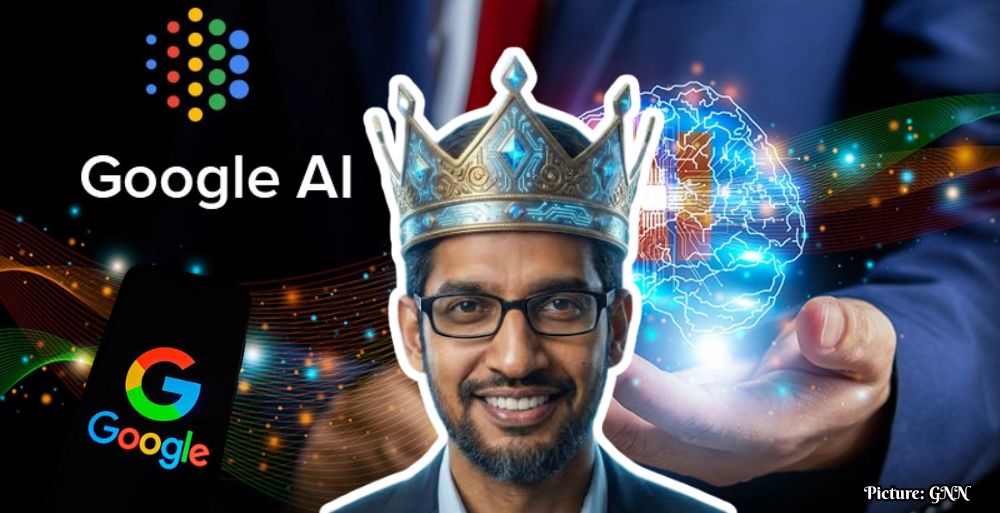
Google is signaling a comeback with new AI product launches and favorable legal developments following its longest monthly losing streak in over a decade.
After experiencing its longest monthly losing streak in over a decade, Google is making a notable comeback with the launch of new artificial intelligence (AI) products and favorable legal outcomes that are instilling optimism among investors.
September has started positively for Google, following a challenging summer marked by operational restructuring and intensified competition in the AI sector. The tech giant recently unveiled Gemini 3.8 Flash, its latest AI model, along with a new cybersecurity offering tailored for government and enterprise clients. This announcement comes on the heels of a prolonged decline on Wall Street, where the company faced its most significant monthly drop in over ten years.
On September 6, 2023, during an AI Impact Summit in New Delhi, Google’s CEO Sundar Pichai highlighted the capabilities of Gemini 3.8 Flash and the Flash Cyber model. The launch underscores Google’s ongoing commitment to advancing its AI technology, particularly in coding and agentic tasks, which are increasingly becoming focal points for monetization in the tech industry. “We believe this is our best reasoning and coding model yet, with substantial improvements over previous iterations,” Pichai stated.
In addition to its product launches, Google has also seen positive developments in the legal arena. A federal judge recently ruled against the U.S. Department of Justice (DOJ) in its antitrust case against the company, deciding not to require Google to divest its ad exchange, AdX. This ruling is viewed as a significant victory for Google, strengthening its position as it navigates the competitive AI landscape. Antitrust attorney Wyatt Fore remarked, “It’s a big deal that courts have decided against structural breakups, allowing Google to pursue its AI initiatives without regulatory constraints.” This ruling follows a previous decision where attempts to force Google to divest from its Chrome browser were also dismissed.
The recent legal victories come at a crucial time for Alphabet Inc., Google’s parent company, as it seeks to regain momentum after facing a series of setbacks, including high-profile talent departures and internal restructuring at its DeepMind division. Despite these challenges, the company’s stock demonstrated slight resilience, rising 0.6% on Wednesday, although it remains down overall since the beginning of September.
Gemini 3.8 Flash is designed to enhance performance in software engineering and complex task management, providing Google with a competitive edge in the rapidly evolving AI market. The company has priced this model competitively, charging 75 cents per million input tokens and $3.75 per million output tokens, maintaining the same rates as the previous Flash model while offering enhanced features.
According to Tulsee Doshi, senior director of product management at Google DeepMind, the recent Flash models have exceeded expectations, enabling the company to leverage their capabilities effectively. “These models have surprised us positively in their performance,” she stated, indicating a strategic pivot towards more iterative and cost-effective AI solutions.
Despite these advancements, analysts remain cautious about Google’s standing in the enterprise AI market, where it is perceived to be trailing behind competitors like Anthropic and OpenAI. Gil Luria, an analyst at D.A. Davidson, commented, “While this model keeps Google in the race, it likely won’t change the perception that they are a distant third in the enterprise market.” Luria advises investors to hold their positions rather than aggressively pursue stock purchases at this time.
Google’s ability to leverage its existing customer base is crucial to its strategy moving forward. Approximately 75% of Google Cloud customers are already utilizing its AI products, with spending on these services reportedly increasing by 50% compared to initial commitments. Thomas Kurian, CEO of Google Cloud, emphasized the scalability of Google’s offerings and the importance of maintaining competitive pricing to attract new clients.
Demis Hassabis, who recently transitioned from CEO to chairman of DeepMind, addressed the future of AI at the G20 Innovation meeting, suggesting that Gemini could serve as a versatile platform to coordinate various specialized models. This approach could enable Google to compete on breadth and efficiency, rather than solely on the superiority of individual models.
Looking ahead, as Google invests heavily in its AI infrastructure, it is banking on growth and market share gains to deliver long-term financial returns. Berkshire Hathaway’s CEO Greg Abel expressed optimism about Alphabet’s prospects in AI, citing the effective utilization of Google’s technology across its portfolio companies. “We see Google as a significant player in AI, based on the benefits we are already experiencing,” Abel noted.
While Google’s advertising business continues to thrive—reporting a 14% growth in the latest quarter—the company must navigate the complexities of balancing its investments in AI with the need for immediate financial performance. Overall, the developments in September represent a critical juncture for Google as it seeks to reclaim its status in the AI race while addressing ongoing regulatory scrutiny, according to Source Name.