
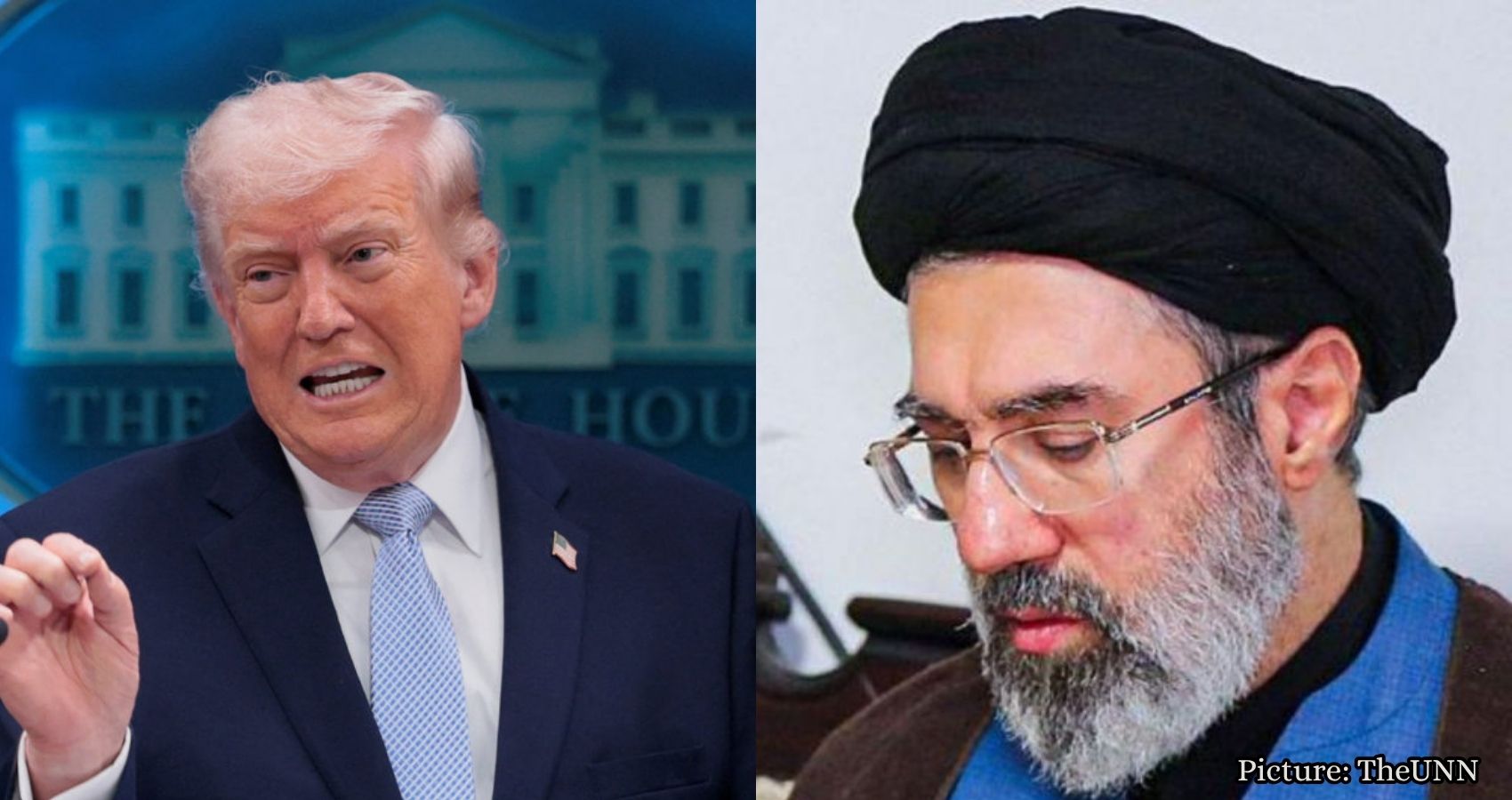
President Donald Trump declared Iran a “Failed Nation,” while experts warn that the country is nearing an economic breaking point amid escalating tensions with the U.S.
U.S. military strikes on Iranian launchers near the Strait of Hormuz have prompted a retaliatory ballistic missile attack from Iran, coinciding with a rise in Brent crude oil prices, which surpassed $90 a barrel on Monday.
In a post on Truth Social, President Donald Trump labeled Iran a “Failed Nation,” asserting that the country is economically and militarily broken. “Iran is officially a Failed Nation. IT IS DEAD!” he wrote. Trump claimed that Iran lacks a functioning navy and air force, has no currency, and is unable to pay its soldiers or police. He also stated that inflation in Iran has surged to 300%, suggesting that the leadership is “in total disarray and incapable of properly representing the country.”
Iran is currently facing multifaceted pressures, including renewed U.S. military actions, tighter sanctions, and a significant decline in oil exports. These factors raise concerns about how long Tehran can endure this economic strain while maintaining leverage against Washington.
Official Iranian data, as reported by Reuters, indicated that annual inflation was at 66% in July, with the International Monetary Fund (IMF) projecting an average inflation rate of 68.9% by 2026. Trump’s remarks came during a period of heightened military escalation between the U.S. and Iran. U.S. forces targeted two Iranian launchers on Larak Island after observing forces from the Islamic Revolutionary Guard Corps preparing to launch rockets into the Strait of Hormuz. In retaliation, Iran launched ballistic missiles toward U.S. bases in Jordan, which reported intercepting eight missiles that entered its airspace.
The renewed confrontation aligns with Washington’s increasing economic pressure on Iran. Treasury Secretary Scott Bessent indicated that the administration plans to implement additional secondary sanctions on a weekly basis, initially targeting banks and potentially cutting off financial institutions that facilitate Iranian transactions within the U.S. dollar-based financial system.
Iran’s leadership has acknowledged the growing economic strain. President Masoud Pezeshkian noted that Iran’s exports and imports have decreased by nearly 35% due to U.S. sanctions and the naval blockade. The IMF has projected a contraction of 5.4% in Iran’s economy for this year.
Miad Maleki, a senior fellow at the Foundation for Defense of Democracies, expressed concern that the Islamic Republic may be approaching an economic breaking point. Maleki, who previously oversaw U.S. sanctions programs, stated, “It’s very clear — we see very clear signs, indications of what I would call an economy that is on the verge of collapse, if it hasn’t already collapsed yet.” He emphasized that Iran’s ability to convert oil exports into usable revenue is a critical pressure point.
Maleki estimates that Tehran requires approximately 1 million barrels of oil exports per day to sustain itself, 1.5 million to avoid hyperinflation, and about 2 million to support development. However, Iranian exports have plummeted, and Tehran is increasingly struggling to repatriate revenue from the oil it can sell. Data from Kpler, cited by Reuters, revealed that Chinese imports of Iranian crude have dropped from an average of 1.4 million barrels per day in 2025 to a provisional 534,000 barrels per day in August.
Maleki noted that Iran is relying more on money creation rather than making politically sensitive cuts to salaries and pensions. However, he cautioned that there are limits to this approach. “They can keep printing money, but they can’t really print the type of commodities that they need, such as gasoline, such as wheat,” he said.
The mounting pressure may lead to a dangerous paradox. Danny Citrinowicz, a fellow at Israel’s Institute for National Security Studies, warned that while the maritime blockade and economic pressure are impacting Tehran, the U.S. should not assume that economic pain will lead to capitulation. Citrinowicz suggested that continued pressure might incentivize Iran to escalate its actions if its leaders believe that the current situation is worse than renewed confrontation. He indicated that Iran could target U.S. economic assets in the Gulf, ports, or vessels enforcing the blockade, despite its degraded missile-production capabilities.
Maleki concurred that Iran is likely to attempt escalation but questioned how much leverage the country still possesses. “They’re going to try to escalate,” he said, referring to recent attacks. However, he noted that further escalation could adversely affect Gulf states that Iran has relied on for trade, sanctions evasion, and diplomacy, potentially resulting in even greater economic and diplomatic pressure.
When asked whether Iran is losing its leverage, Maleki responded affirmatively, stating that Tehran has emerged weakened from both internal unrest and external conflicts, becoming increasingly isolated domestically and internationally. He emphasized that he is closely monitoring potential shortages that could trigger another wave of domestic unrest, particularly concerning essential items like gasoline.
Commercial traffic through the Strait of Hormuz remained severely disrupted on Monday, while Brent crude prices rose more than 2% in response to the renewed U.S.-Iran exchanges. Although Gulf oil flows have recovered from wartime lows, they still remain below pre-war levels.
Maleki anticipates that Iranians will return to the streets and urged Western governments to prepare to assist them in organizing and communicating if Tehran shuts down internet access again. “What we need to do is to contain this regime, cut off this economic lifeline, empower the Iranian people, and be prepared next time Iranians are back on the street [and] take actions to stop this regime from slaughtering Iranians,” he said. “At this point, they are the weakest they’ve been since 1979. Every time they try to escalate, they become weaker,” he added.
According to Reuters, the situation remains fluid as both sides navigate the complexities of military and economic pressures.