
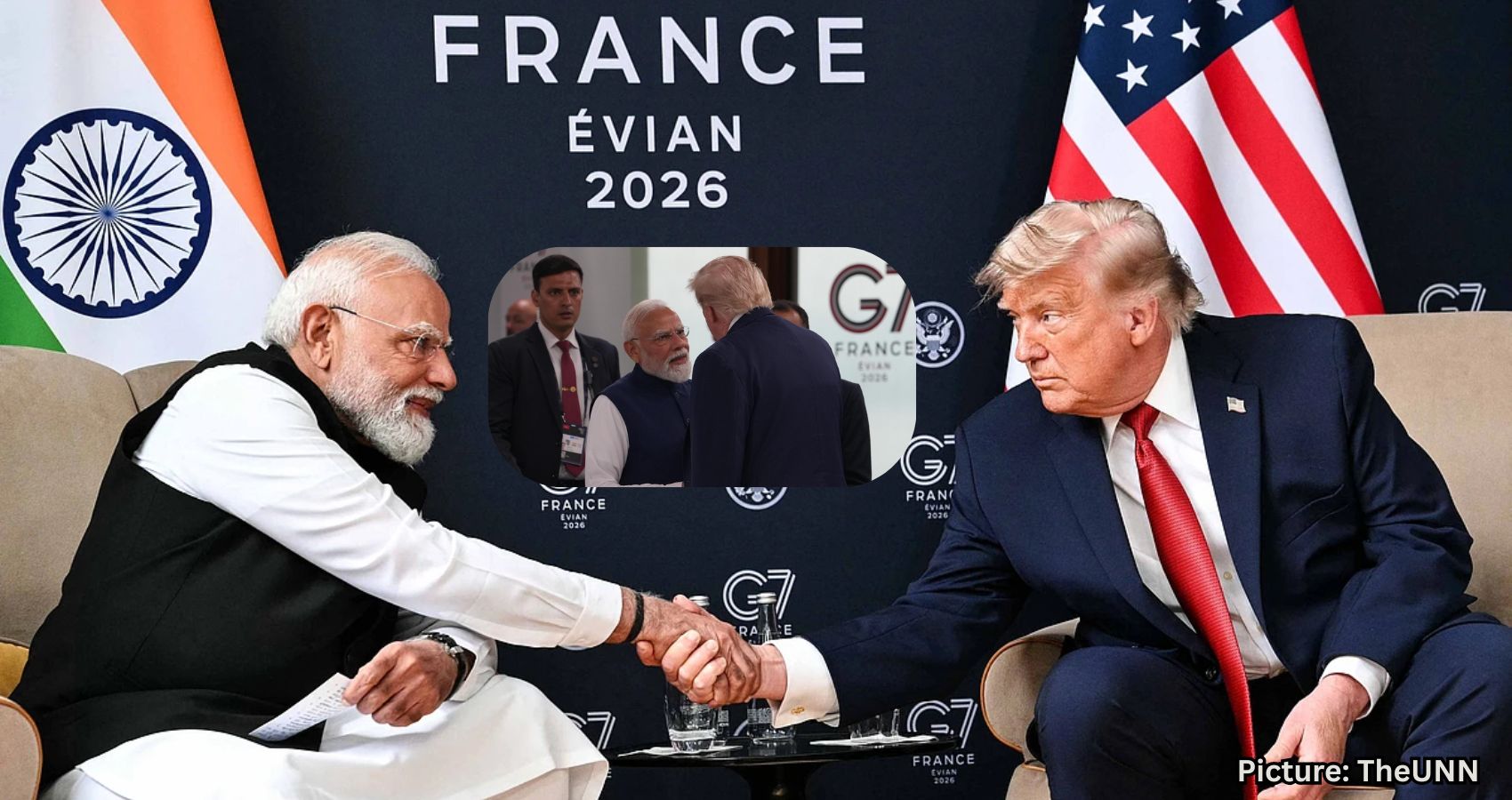
At the G7 summit in Évian, the dynamics of U.S.-India relations shifted as President Trump and Prime Minister Modi engaged in a complex diplomatic exchange.
During the recent G7 summit in Évian, France, the meeting between U.S. President Donald Trump and Indian Prime Minister Narendra Modi revealed evolving realities in their bilateral relationship.
Trump entered the meeting with his characteristic blend of flattery and theatrics, while Modi appeared to adopt a more assertive stance. Gone were the days of Modi referring to Trump as “my friend Donald,” a phrase that had characterized their previous interactions. Instead, Modi addressed Trump formally as “His Excellency President Trump,” signaling a shift in their rapport.
Trump, seemingly oblivious to this change, offered a peculiar compliment, stating, “He’s the most beautiful-looking man. He looks so nice, like an angel. But actually, he’s as tough as he is a killer.” This remark, which could be interpreted as a diplomatic faux pas, was met with Modi’s understated response: “Don’t go by the looks.” This retort suggested that Modi was aware of Trump’s tactics and was not easily swayed.
Despite the awkwardness, it is important to acknowledge Trump’s awareness of India and its political landscape. He understands Modi’s voter base and the significance of the Indian diaspora. His comments, though unconventional, were likely intended to resonate with audiences in both India and the United States.
Trump’s declaration that “as long as I am President, India has a great friend in the White House” carried an underlying warning. The phrasing emphasized his personal connection to India rather than a broader commitment from the United States. This statement could be interpreted as a reminder that the friendship is contingent upon Trump’s presidency, which is set to end in January 2028.
The meeting took a somber turn when Modi raised the issue of three Indian sailors who were killed in the Strait of Hormuz, a situation linked to a U.S.-Israeli military operation. Modi approached the topic delicately, expressing concern for the safety of Indian seafarers while hoping for a resolution through the Iran deal. However, Trump’s response was dismissive, moving on to the next question without addressing the gravity of the situation.
In a different context, Modi’s mention of the sailors’ deaths would have sparked significant media coverage in India, potentially leading to accusations of national betrayal. Yet, in Évian, the lack of substantial dialogue on the matter was framed as a diplomatic success.
The conversation then shifted to Iran, a critical issue for India, which imports 55% of its liquefied petroleum gas (LPG) through the Strait of Hormuz. Modi hinted at India’s potential role as a back-channel to Iran, given the country’s historical ties and trade relationships. However, Trump’s response indicated that the U.S. would handle Iran independently, effectively sidelining India from the discussions.
The exchange left many questions unanswered. Trump’s characterization of Modi as a friend contrasted sharply with Modi’s formal address, suggesting a growing distance between the two leaders. Trump’s assurance of support for India was conditional, and his evasiveness regarding the sailors’ deaths highlighted a lack of accountability.
As Modi navigates the complexities of international diplomacy, the question remains: does New Delhi have a contingency plan for the future? With Trump’s presidency set to conclude in two years, the dynamics of U.S.-India relations may shift dramatically, especially if a successor is less familiar with India’s geopolitical concerns.
Ultimately, the Strait of Hormuz and its implications for India’s economy will persist, regardless of who occupies the Oval Office. The evolving relationship between Trump and Modi reflects broader uncertainties in international politics, leaving both nations to reconsider their strategies moving forward.
The post originally appeared on The American Bazaar.