
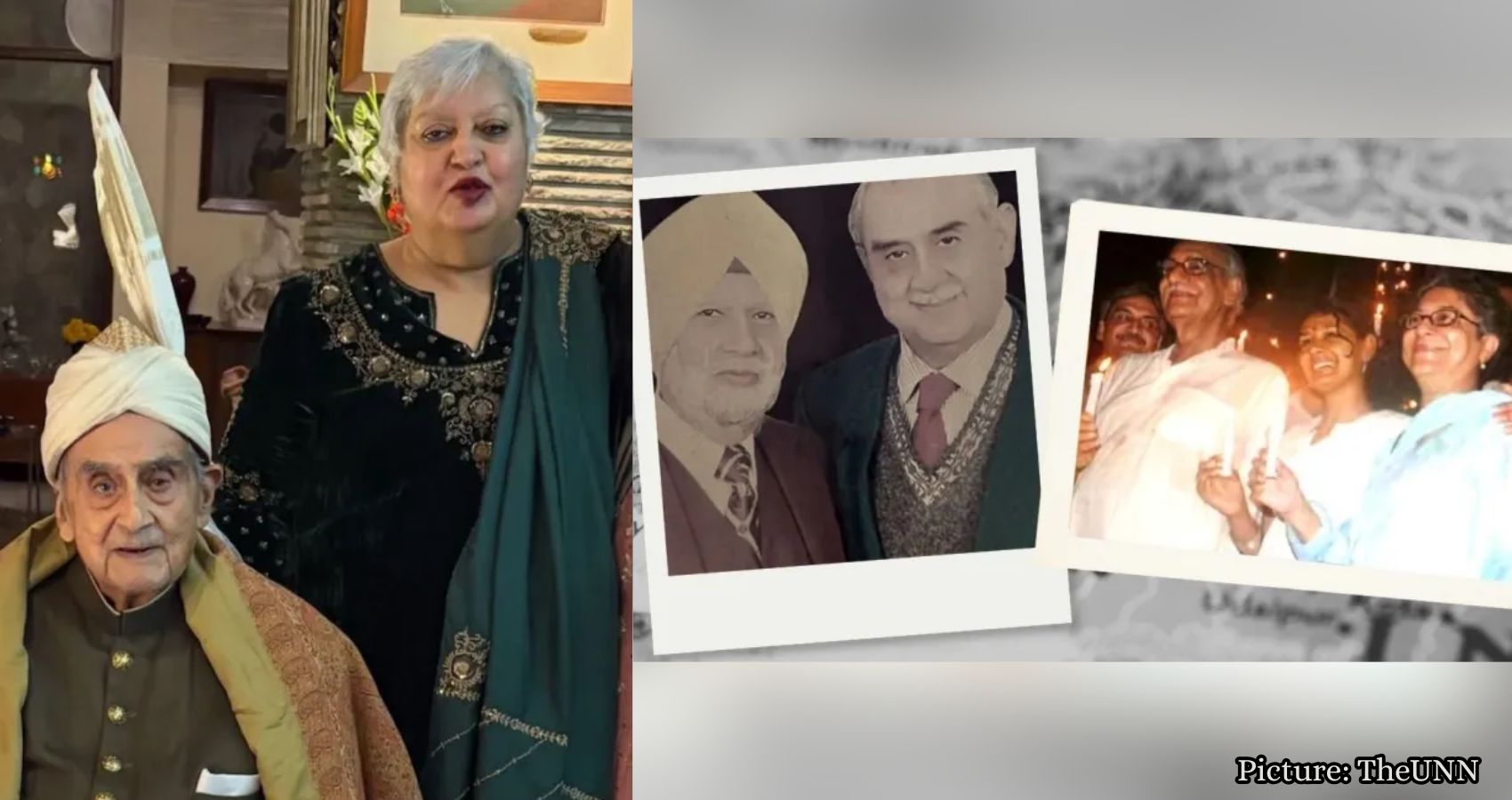
The enduring friendship between Syed Babar Ali and Harcharan Singh Brar transcends the divisions of Partition, showcasing a bond that remains strong despite political and geographical barriers.
A few days before his 100th birthday on June 30, 2023, Pakistan’s renowned industrialist, educationist, and philanthropist Syed Babar Ali participated in a rare video interview with freelance journalist Shumaila Khan at his residence in Lahore.
The interview was facilitated by Dr. Tarunjit Singh Butalia, a visitor from India who has dedicated decades to fostering interfaith dialogue and building connections across the India-Pakistan border. With roots in Butala village near Gujranwala, Pakistan, Dr. Butalia serves as an honorary envoy for Aitchison College, an institution with which he has a deep familial connection.
During a phone call from Lahore, where he was preparing biryani for guests, Dr. Butalia reflected on the impact of the Partition on personal relationships. He noted that had it not been for the division of India in 1947, he would have attended Aitchison College, just like his father, grandfather, and great-grandfather before him.
In the interview, Syed Babar Ali, adorned in a Kashmiri jamawar shawl that belonged to his late friend Harcharan Singh Brar, shared poignant memories of their friendship. This shawl was a gift from Brar, highlighting the deep bond they shared.
Ali and Brar first met in third grade at Aitchison College, where they studied together from 1934 to 1943, and later at Government College (now the University of Lahore). Their friendship flourished despite their differing political affiliations—Brar aligned with the Congress Party while Ali supported the Muslim League.
<p“Politics wasn’t the story,” Ali remarked during the interview. “Friendship was.” He emphasized that their political debates never affected their relationship, a sentiment that resonated deeply with Khan, who described the interview as “the most moving” she had ever conducted.
In a powerful gesture of remembrance, Ali arranged for a classroom at Aitchison College to be named after Brar, who served as the Chief Minister of Punjab, India, and later as the Governor of Haryana and Odisha. A plaque bearing Brar’s name now adorns Classroom No. 108, with his photograph displayed inside, symbolizing the enduring legacy of their friendship.
Dr. Butalia noted that this friendship serves as an inspiration for young Pakistanis and Indians, who will be the future leaders of South Asia. Brar’s daughter, Kanwaljit “Babli” Kaur, traveled from Chandigarh, India, to attend the classroom inauguration, where she expressed her gratitude for Ali’s continued support and recognition of her father.
Ali’s commitment to honoring Brar extended beyond the classroom. In 1989, when he built a library at Aitchison College, he personally invited Brar to inaugurate it, a testament to their lifelong connection.
Reflecting on their bond, Ali recounted a memorable moment from the Aitchison College centenary celebrations in 1986. When asked by General Zia-ul-Haq about his attachment to Lahore, Brar famously replied, “If I could be certain that after death I would be born again in Lahore, I would be ready to die today.”
Brar’s marriage was another poignant chapter in their shared history. Ali recounted how Brar sought his help in proposing to a talented athlete whose family faced political challenges. After navigating the complexities of their situation, the wedding took place, celebrated by both families.
The emotional depth of their friendship was evident when Babli Brar spoke about the impact of Ali’s support following her father’s passing in 2009. Ali attended the bhog ceremony, a significant event in Sikh mourning rituals, where he was asked to speak first due to his close relationship with Brar.
As they navigated the complexities of life, their bond remained steadfast. Brar once asked Ali to accompany him to the U.S. for medical treatment, underscoring the depth of their friendship. Dr. Butalia documented their relationship in an article for *Dawn*, further solidifying their legacy.
Looking ahead, Aitchison College is set to celebrate its 140th anniversary on November 3, 2026, with alumni from India expected to attend. Meanwhile, peace marchers from Jalandhar, India, are preparing for their annual journey to Amritsar, aiming to light candles at the border on the night of August 14-15, a tradition that has persisted for 31 years.
“Even if we are separated by borders, our shared commitment to peace continues to unite us,” said Saeeda Diep of the Institute for Peace and Secular Studies in Lahore, reflecting the sentiments of many who participate in this annual ceremony.
Ali echoed these thoughts during his interview, lamenting the restrictions that hinder movement across the border. “We speak the same language, share the same food, and have so much in common. But because of restrictions on contact, we are drifting apart,” he said, advocating for open borders as a means to reconnect.
The story of Syed Babar Ali and Harcharan Singh Brar transcends mere friendship; it embodies the resilience of human connections in the face of political and geographical divides. Their enduring bond serves as a testament to the spirit of unity that persists among many Pakistanis and Indians, despite the barriers that separate them.
As Shumaila Khan aptly noted, the friendship between Ali and Brar is a reminder that beneath the politics and tensions, a deep curiosity and affection still exist, waiting for the opportunity to flourish once more.
This story was first published on Global Southasia (formerly Sapan News).