
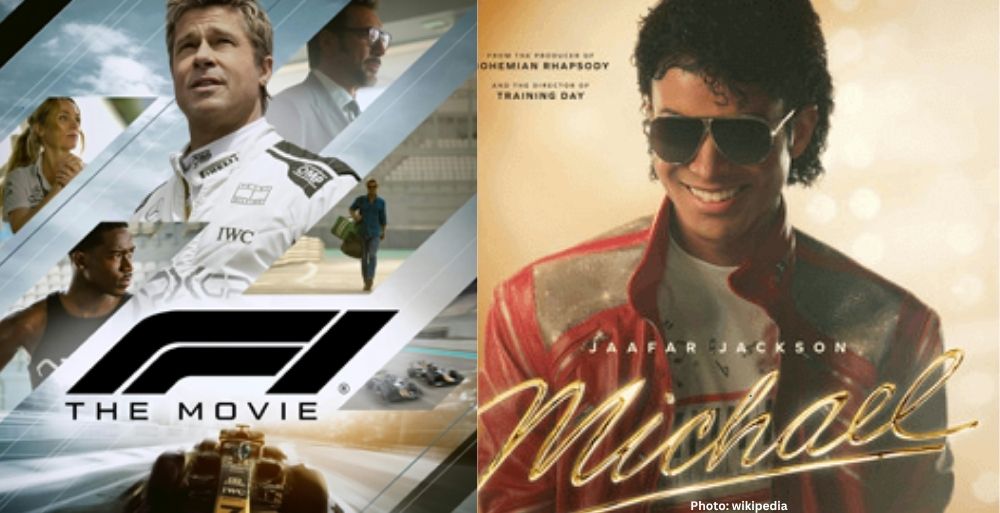
Smaller, non-dubbed Hollywood films like *Michael* and *F1: The Movie* are gaining traction in India, as urban audiences seek premium theatrical experiences beyond traditional blockbusters.
As big-budget Hollywood franchises continue to dominate Indian multiplexes, a quieter yet significant trend is emerging at the box office. Smaller, non-dubbed English-language films are steadily finding their audience in urban India, indicating a growing willingness among viewers to engage with content-driven cinema that goes beyond the realm of superhero spectacles and action-heavy franchises.
Recent releases exemplify this shift. The biopic *Michael*, centered on the late pop icon Michael Jackson, has surpassed ₹50 crore in India, equivalent to roughly $6 million. Meanwhile, the sports drama *F1: The Movie* has achieved even greater success, crossing the ₹100 crore mark, or about $12 million, despite minimal reliance on Hindi dubbing. Industry observers note that these films illustrate a changing landscape where theatrical success in India is no longer confined to large-scale commercial entertainers, as reported by The Mint.
Another title contributing to this trend is the science-fiction film *Project Hail Mary*, which has earned over ₹70 crore, approximately $8.4 million, in India without significant localization efforts. Earlier this year, Christopher Nolan’s *Oppenheimer* also crossed ₹100 crore during its theatrical run, setting a strong benchmark for premium English-language releases.
Ashish Misra, head of commercialization at Cinépolis India, emphasized the evolving audience for these films. “Non-dubbed Hollywood has settled into a clear pattern in India. It plays as a premium, urban-led segment that delivers steady box office without trying to compete with the mass market,” Misra stated.
According to trade experts, the audience for these films is primarily concentrated in metro cities and urban centers, particularly among English-speaking viewers aged 18 to 45. This demographic is already accustomed to consuming global entertainment through streaming platforms and social media, yet they still regard certain theatrical releases as essential cinematic experiences.
The rise of premium viewing formats like IMAX and 4DX has also rekindled interest in theatrical experiences for niche Hollywood films. Industry insiders report that audiences are increasingly willing to pay higher ticket prices for immersive formats, especially for visually ambitious dramas, science-fiction narratives, and music-driven films.
Sanjeev Kumar Bijli, executive director at PVR INOX Ltd, noted that original-language viewing has become a crucial aspect of the appeal for various genres. “While dubbing remains the most effective tool for mass-market penetration in tier-two and tier-three cities, as seen with massive hits like *Avatar* or *Jurassic World*, many prestige films find their strength in their original language,” Bijli explained. “For certain genres, such as musical biopics or high-intensity dramas, the original voice performance is central to the film’s artistic integrity.”
The conversation surrounding audience preferences gained further attention after actress Alia Bhatt addressed the gender imbalance in India’s theatrical audience during a discussion with Anupama Chopra at the Cannes Film Festival. “In India, when we talk about box office and numbers, there is a conversation that comes up pretty often, which is that 75% of the movie-going audience is male, so we need to cater to the masses,” Bhatt remarked during the session.
A widely shared LinkedIn post responding to Bhatt’s comments argued that India’s theatrical ecosystem still favors films centered around action, horror-comedy, patriotism, mythology, or large-scale spectacle. The post highlighted the global success of *The Devil Wears Prada 2*, which reportedly grossed nearly ₹4,000 crore worldwide, or about $480 million, while contributing only ₹35 crore, roughly $4.2 million, from India.
The post contended that dialogue-heavy dramas focusing on fashion, workplace dynamics, or urban relationships struggle to achieve nationwide theatrical success in India. “No genre anchor. Indian hits need action, horror-comedy, patriotism, or mythology,” it stated. “The urban woman who loves this film already watches it at home. The theatre adds nothing she needs.”
It also pointed out that successful female-led Indian blockbusters often thrive because they blend strong women-centric storytelling with broader commercial elements. Films like *Stree 2*, *Gangubai Kathiawadi*, and *Raazi* each had additional draws, whether through horror-comedy, large-scale visual storytelling, or patriotic themes.
Despite these challenges, the steady rise of non-dubbed Hollywood titles suggests that India’s multiplex market is becoming increasingly segmented. While mass entertainers continue to dominate the broader box office, premium urban audiences are demonstrating a greater willingness to support niche, original-language storytelling on the big screen. This evolving landscape indicates a promising future for diverse cinematic offerings in India.
The insights into this trend were reported by The Mint.