
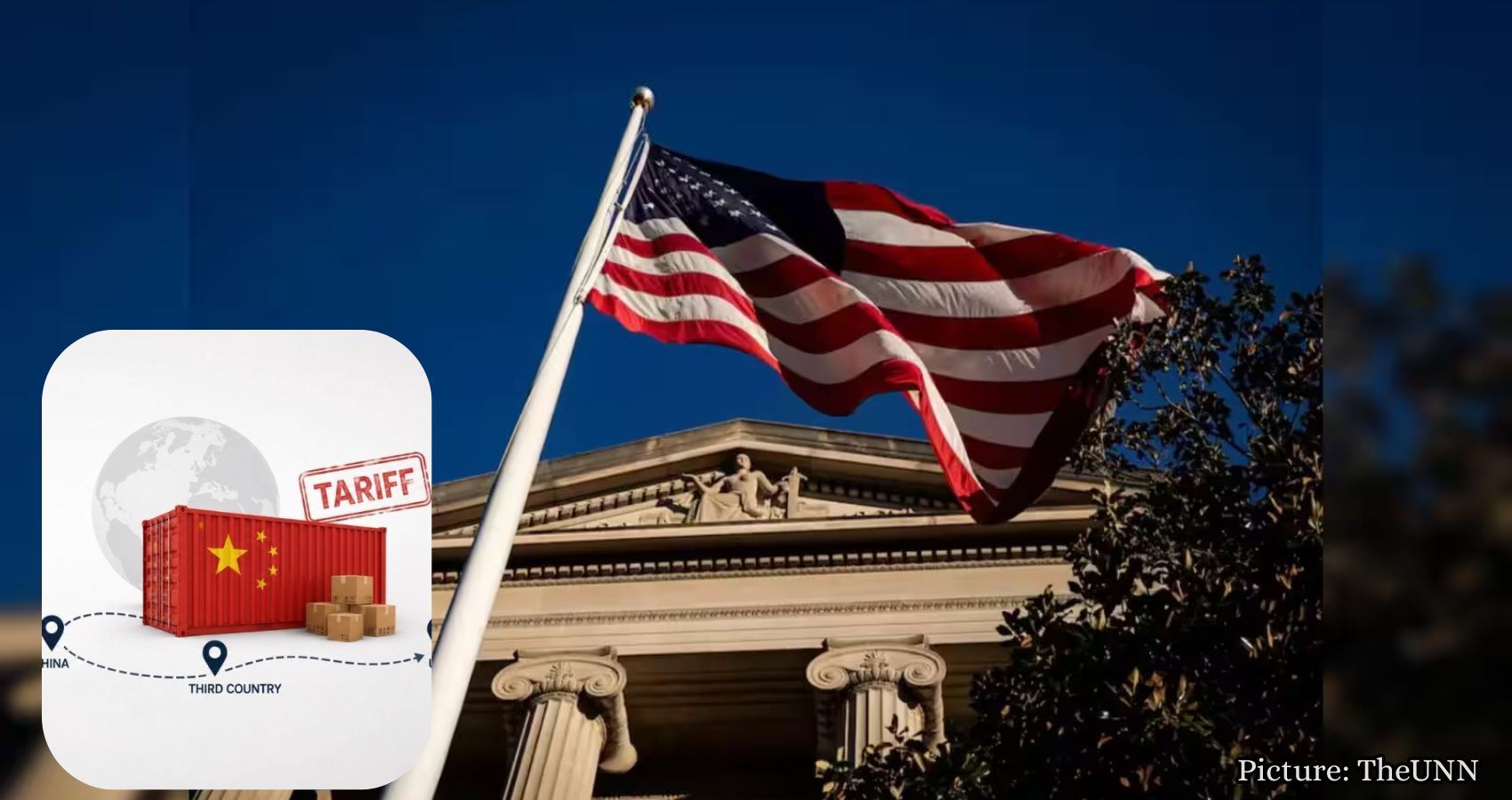
The United States has identified India as one of over 40 countries at risk of facilitating the evasion of tariffs on Chinese goods, potentially complicating trade negotiations with New Delhi.
The United States government has placed India on a list of more than 40 nations considered at risk for facilitating the evasion of U.S. tariffs on Chinese goods. This classification, detailed in a recent report from the White House Office of Trade and Manufacturing Policy, raises concerns about trade practices that could undermine U.S. tariff policies.
The report accuses exporters in various countries, including India, of engaging in practices such as rerouting shipments, relabeling products, or falsely declaring the country of origin. These actions are intended to facilitate the entry of Chinese goods into the U.S. market, a phenomenon the report has termed the “Great Transshipment Scam.” This initiative reflects a concerted effort by the U.S. to detect and penalize such shipments.
In the report, India is classified in Tier 1, alongside other major economies such as Canada, the European Union, Israel, Japan, Mexico, South Korea, and Taiwan. This designation, referred to as “Diversified Scale Leaders,” includes large, diversified industrial economies where the risk of transshipment exists within otherwise legitimate trade flows.
Conversely, Tier 2 countries, labeled “Significant Economic Integration with China,” include Brazil, Indonesia, Malaysia, Thailand, Turkey, and Vietnam. A third tier, Tier 3, encompasses nations such as Bangladesh, Cambodia, the Philippines, Singapore, Sri Lanka, and the United Arab Emirates, characterized as “Small, Opportunistic Targets.” It is important to note that this classification does not imply that the governments of these countries are intentionally assisting exporters in evading tariffs; rather, it highlights jurisdictions where the U.S. perceives varying levels of transshipment risk.
U.S. trade adviser Peter Navarro specifically pointed out India and Vietnam during discussions surrounding the report. He expressed concern that countries facing higher U.S. tariffs might have increased incentives to facilitate the transshipment of Chinese goods through their territories. Navarro stated, “This is about the 40-plus countries that are enabling the transshipping, and as we impose higher tariffs on other countries, India, Vietnam, down the line, they’re going to try this transshipment too.”
He urged these countries to address broader trade barriers rather than resorting to transshipment as a means to circumvent U.S. tariffs. Navarro emphasized that legitimate pathways to lower tariff burdens should be pursued, stating, “The way to pay less is not to cheat; it is to stop dumping, respect intellectual property, drop your barriers to American goods and move towards reciprocity.” He also warned that preferential access to the American market should not be misconstrued as a license to facilitate the laundering of another country’s exports.
Transshipment is a common practice in global trade, where goods frequently pass through several countries before reaching their final destination. However, U.S. officials are particularly concerned with shipments that are allegedly rerouted or undergo minimal processing in a third country to obscure their Chinese origin and evade tariffs. The report cited specific instances, such as Chinese electric motors being integrated into recliners in Vietnam and the emergence of so-called “screwdriver factories,” where imported components undergo limited assembly before being exported as products originating from another country.
U.S. officials noted that such minimal processing may fail to meet the “substantial transformation” standard required for a product to legitimately claim a new country of origin. This distinction is critical in determining the legitimacy of trade practices under U.S. law.
The U.S. government plans to intensify its enforcement efforts against transshipment practices. This includes an executive order aimed at enhancing the authority of U.S. Customs and Border Protection and introducing an AI-driven monitoring system dubbed a “detective border.” This system is designed to flag shipments that may be more likely to involve transshipment before they reach U.S. ports.
Additionally, the administration aims to integrate anti-transshipment provisions into future trade agreements, potentially imposing penalties on countries that allow disguised Chinese goods to enter the U.S. through their territories. Such provisions could have implications for ongoing negotiations, including a potential trade agreement between the U.S. and India.
Under the proposed enforcement framework, if a shipment is later identified as having been transshipped, U.S. customs authorities may seek to retroactively apply tariffs on a company’s shipments from the past year, rather than restricting enforcement to just the specific shipment in question.
This report emerges amid ongoing negotiations between India and the U.S. over a reciprocal tariff agreement, as both nations navigate complex issues related to trade and energy ties, particularly in the context of India’s relationship with Russia. While U.S. officials have stated that the report is not solely focused on China, they have highlighted Vietnam, Cambodia, Malaysia, Indonesia, and the Philippines as key transshipment hubs. Countries facing increased U.S. tariffs could have additional incentives to engage in similar practices.
As the U.S. prepares for potential discussions involving President Donald Trump and Chinese President Xi Jinping, officials have refrained from commenting on how the findings of this report might influence those negotiations, indicating that it will inform the U.S. Trade Representative’s approach moving forward, according to Source Name.