
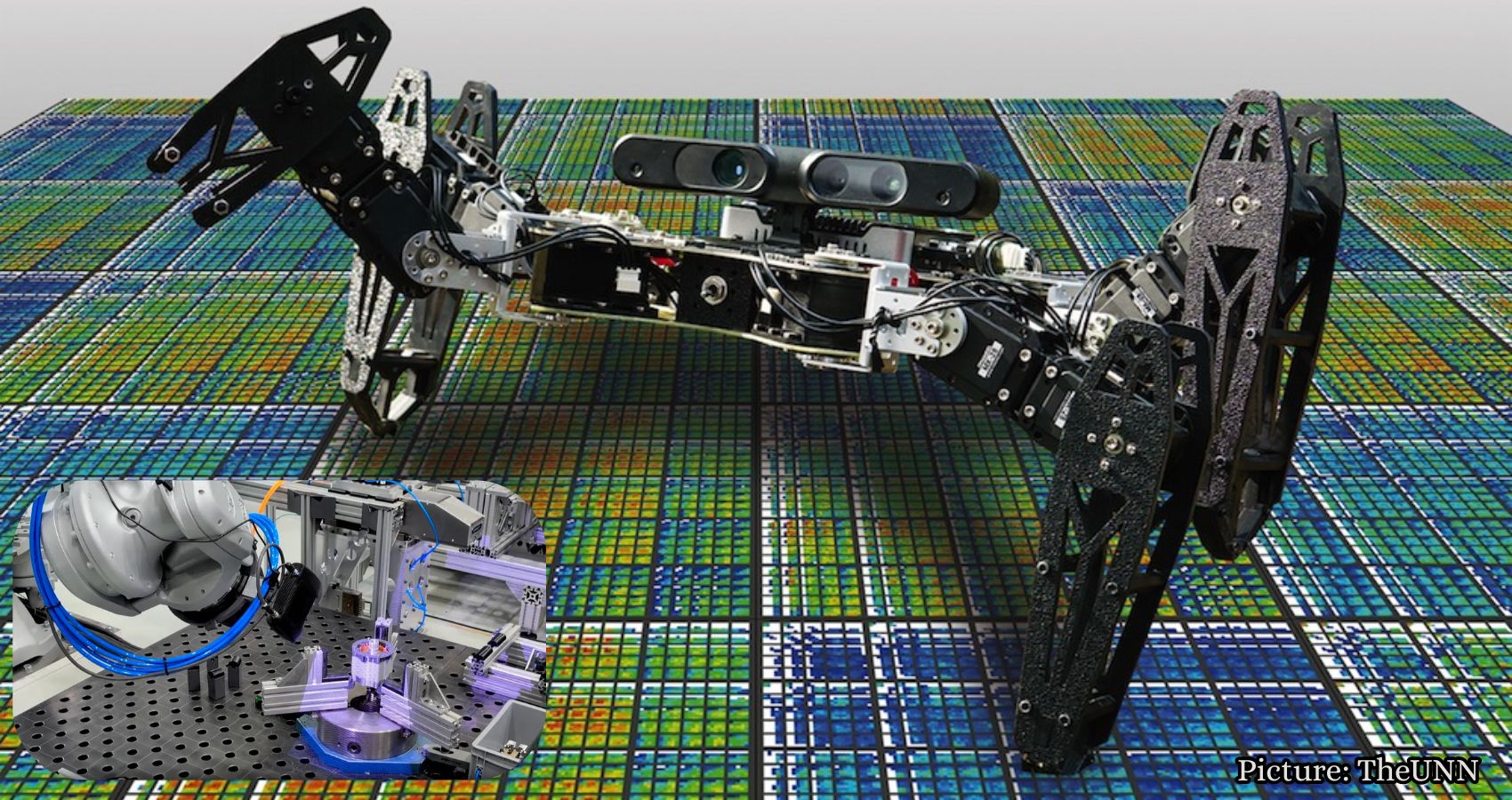
Researchers at the Karlsruhe Institute of Technology have developed an innovative robotic disassembly system that adapts to challenges such as stuck screws and missing parts in old machines.
For decades, robots have played a crucial role in manufacturing, helping to assemble the products we use daily. Now, researchers are teaching these machines a new skill that could prove vital: dismantling products when they fail or become obsolete.
With over 4.6 million industrial robots currently operating worldwide, the demand for automation in manufacturing continues to rise. This trend raises an important question: what happens to these machines and other complex products when their components wear out or malfunction?
To address this issue, a team at the Karlsruhe Institute of Technology in Germany has developed a robotic disassembly system that is designed to handle the complexities of older machines. Unlike traditional systems that assume every screw and component will function perfectly, this innovative approach prepares for the unpredictable nature of disassembly.
Old machines often present various challenges, such as stuck screws, missing components, or alterations from previous repairs. The robotic system is capable of assessing these issues in real-time and adjusting its disassembly strategy accordingly.
Jan Baumgärtner, a researcher involved in the project, highlights the difference between assembly and disassembly. While assembling a new product follows a clear sequence, dismantling a broken machine can lead to numerous complications. This uncertainty necessitates that robots possess not only instructions but also the ability to adapt their understanding of the situation as they work.
The disassembly process begins with a computer-aided design (CAD) model that outlines how the product should be constructed. The robot then examines the actual behavior of individual components. If a part does not move as expected, the system updates its understanding and modifies its approach. For instance, if a screw behaves differently than anticipated, the robot incorporates this new information into its decision-making process.
The researchers employ a probabilistic planning method known as a Partially Observable Markov Decision Process (POMDP). This approach allows the robot to recognize that it does not have complete information about the machine’s state. Instead of adhering to a rigid plan, the robot assigns probabilities to potential issues and continuously updates its assumptions based on new data.
In practical tests, the researchers simulated scenarios involving stuck screws in electric motors. Initially, the robotic system attempted to unscrew the fasteners as expected. However, when it encountered a stuck screw, it adapted by using a milling tool to remove material and gain access to the desired component. In another test, the robot recognized that a screw was missing and efficiently adjusted its actions to avoid searching for it.
This adaptability is crucial, as the researchers found that traditional deterministic planning works well only when everything functions as anticipated. When uncertainty arises, the probabilistic system can outperform its deterministic counterpart, particularly when alternative disassembly routes are available. In experiments, both methods yielded similar results with new components, but the probabilistic planner achieved faster disassembly times in scenarios involving stuck parts.
While the current research focuses on electric motors and angle grinders, the broader implications of this technology could extend to larger systems. Baumgärtner envisions a future where multiple robotic arms equipped with various tools work together in a facility. One robot could handle screws, while another addresses components requiring more aggressive removal methods, effectively creating an assembly line that operates in reverse.
One of the key goals of this research is to contribute to a more circular economy. By enabling manufacturers to recover valuable components from older products instead of discarding them entirely, the robotic disassembly system could help reduce electronic waste.
The system can prioritize certain components during disassembly, allowing manufacturers to focus on preserving high-value parts. Ultimately, the researchers aim to develop an automated process capable of extracting faulty components, replacing them, and rebuilding the product. Their ambitious economic goal is to make automated repairs cost-effective enough that fixing an electronic device would be cheaper than producing a new one.
While we may not see robotic repair stations in local electronics shops anytime soon, this research points toward a transformative approach for manufacturers to consider when dealing with broken products. Currently, many electronic devices become e-waste because recovering individual components is often too labor-intensive or costly. However, advancements in automation could change this dynamic.
By improving robotic systems’ ability to handle damaged products, manufacturers may be able to recover more high-value parts and make refurbishing equipment more economically viable in various industries. Additionally, a machine that intelligently preserves useful components could help reduce the amount of functional hardware discarded due to a single failed part.
The challenge remains whether manufacturers will design future products with automated disassembly in mind. Repair becomes significantly easier when engineers consider how a product will eventually be taken apart during the design phase.
This research highlights the robot’s capacity to manage uncertainty, a significant departure from traditional factory robots that thrive in controlled environments. As robots learn to recognize when reality diverges from the blueprint, the potential applications for robotics could expand significantly.
Repair and recycling are particularly compelling areas, as economic factors often dictate whether a product is salvaged or sent to the scrap heap. While this research is still in its early stages, the concept behind it holds significant promise. The more adept robots become at disassembling products, the more feasible it becomes to recover expensive components rather than discarding entire machines due to a single malfunction.
If robots could make repairing electronics cheaper than replacing them, how would that change your approach to keeping devices? Would you be more inclined to repair rather than replace, or do you believe manufacturers will always prioritize selling new products? Share your thoughts with us at Cyberguy.com.
According to Fox News.