
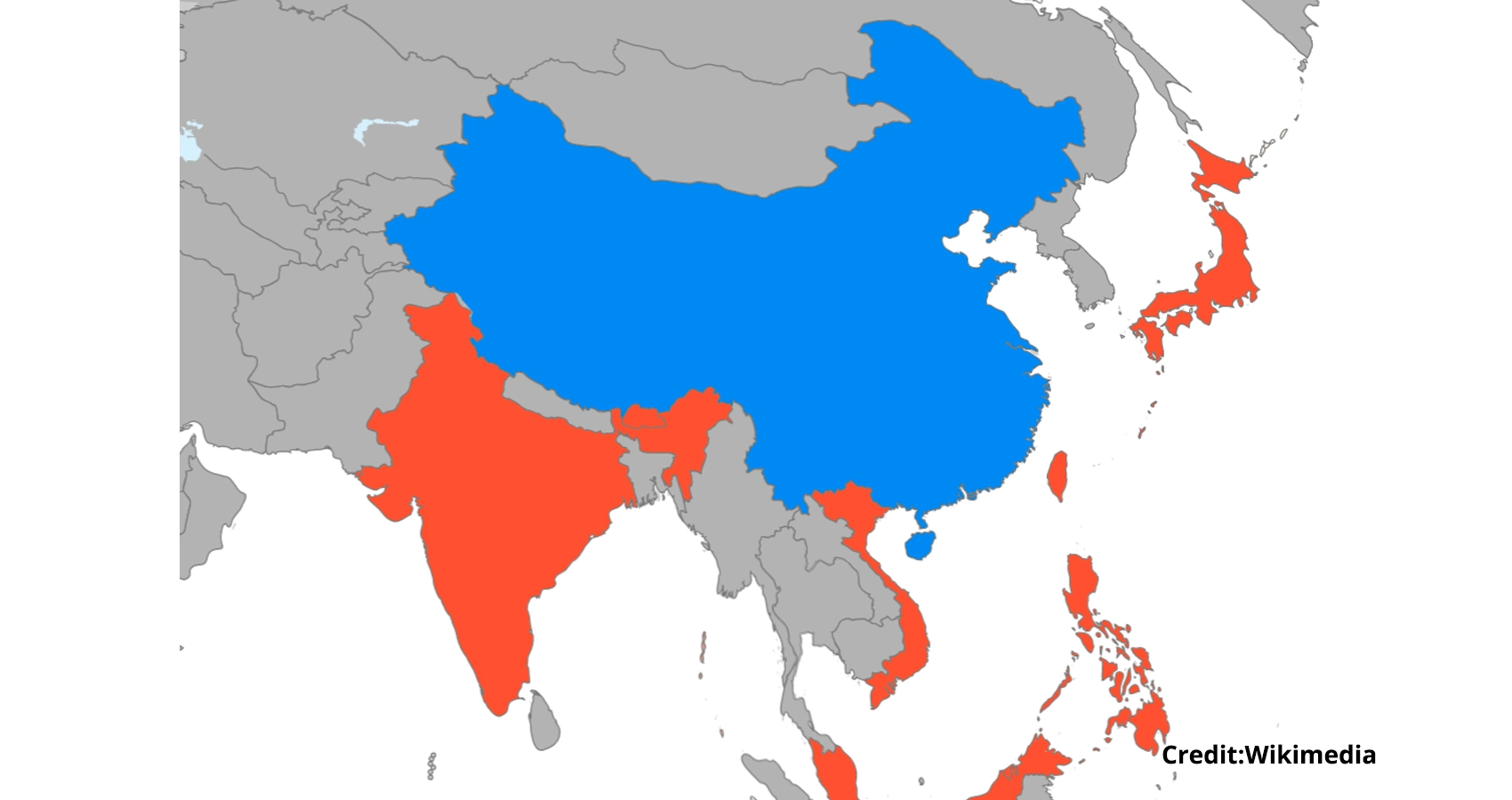
China’s territorial ambitions across Asia reveal a complex interplay of historical claims, military assertiveness, and strategic narratives that challenge regional stability.
U.S. President Donald Trump met with Chinese President Xi Jinping at Joint Base Andrews on September 23, 2026, marking Xi’s first visit to the United States in over a decade. While the summit is expected to focus on artificial intelligence and the ongoing conflicts in Ukraine and Iran, many diplomats argue that the world must also confront a deeper, long-standing issue: China’s expansionist history and its continued efforts to absorb territories that do not historically or legally belong to it.
Across Asia’s mountains, coastlines, and contested seas, China is steadily reshaping the geopolitical landscape. Beijing publicly promotes a narrative of peaceful rise, yet its actions in Tibet, Taiwan, India, Aksai Chin, and the South China Sea reveal a far more assertive territorial ambition. The tension between China’s diplomatic messaging and its on-ground behavior has become one of the defining geopolitical stories of the 21st century.
Diplomats across Southeast Asia often describe a notable contradiction: “China says one thing in public — and another behind closed doors.” This duality is not accidental; it is central to Beijing’s strategy of claiming territory through narrative, presence, and pressure.
A Playbook of Occupation, Renaming, and Normalization
A 2026 cross-national media study found that Chinese state outlets deploy a consistent pattern: assert historical ownership, rename disputed areas, saturate domestic media with nationalist narratives, and present a softer, conciliatory tone to international audiences. Political scientist Esther Song, who analyzed more than 31,000 Chinese news articles, notes that Chinese-language media emphasizes “unwavering sovereignty,” while English-language outlets highlight “stability and cooperation.”
A Vietnamese journalist captured the absurdity of this approach with a wry observation: “If China names a reef, it becomes theirs — at least in their newspapers.”
This symbolic renaming is not trivial; it is part of a broader effort to rewrite reality — on maps, in media, and eventually on the ground.
Tibet: The First Territory Absorbed
China’s territorial expansion began in 1950 when the People’s Liberation Army marched into Tibet. Beijing referred to this as a “peaceful liberation,” while Tibetans remember it as the moment their homeland was taken.
A Tibetan elder in Dharamshala recalled: “Liberation? They liberated us from our land.”
Since then, China has pursued demographic and cultural engineering: suppressing monasteries, restricting Tibetan language instruction, and encouraging Han migration. A former UN human rights officer summarized the transformation: “China didn’t just occupy Tibet. It rewrote Tibet.”
The Dalai Lama, in his 1988 Strasbourg Address to the European Parliament, stated: “Since 1949 the People’s Republic of China forcibly invaded Tibet. Since that time, Tibet has endured the darkest period in its history. More than a million of our people have died as a result of the occupation… Speaking for all Tibetans, I must sadly inform you, our tragedy continues.”
In his 2025 book, *Voice for the Voiceless*, he wrote: “The right of the Tibetan people to be the custodians of their own homeland cannot be indefinitely denied, nor can their aspiration for freedom be crushed forever through oppression.”
In a widely cited interview, he remarked: “Insofar as the Tibetans on the ground are concerned, the Communist Chinese rule in Tibet remains that of a foreign, unwanted, and oppressive occupier.” Tibet became the template for China’s future territorial ambitions — a mix of military force, narrative reconstruction, and administrative absorption.
Taiwan: The Territory China Claims but Never Ruled
Taiwan is the clearest example of China claiming territory it has never governed. The island has been self-ruled for decades, with its own democratic institutions, military, and global economy. Yet Beijing insists Taiwan is a “breakaway province.”
A Taiwanese student activist put it bluntly: “How can we break away from something we were never part of?”
China’s pressure on Taiwan mirrors its broader strategy of historical revisionism, military intimidation, and information warfare — portraying reunification as inevitable. In 2026, a Taiwanese fisherman described seeing Chinese drones overhead: “They weren’t surveying the sea. They were surveying us.”
World leaders have repeatedly warned China against coercion. Former Japanese Prime Minister Fumio Kishida stated: “Peace in the Taiwan Strait is not just a regional issue — it is a global necessity.”
President-elect of Taiwan, Lai Ching-te, aptly stated: “Taiwan has never been ruled by the People’s Republic of China. Our future will be decided by the 23 million people of Taiwan — never by Beijing.”
Former President Ma Ying-jeou, despite being China-friendly, rejects Beijing’s claims and stated in a 2015 interview: “The people of Taiwan have the right to choose their own path. No one can deny that Taiwan has been self-governed for decades.”
India: The Himalayan Border Where China Advances by Inches
Along the India-China border, Beijing has adopted what Indian analysts call “salami slicing” — incremental encroachment that shifts the status quo without triggering full-scale war.
The 2020 Galwan Valley clash, where soldiers fought with stones and clubs, was a turning point. An Indian Army officer later remarked: “They come a few meters at a time. But every meter is India.”
China’s claims in Arunachal Pradesh — which it calls “South Tibet” — have no basis in India’s historical records or colonial-era treaties. Yet Beijing continues to build military infrastructure along disputed ridgelines, issue “stapled visas” to Indian citizens from Arunachal, and rename Indian villages with Chinese names.
A retired Indian diplomat described a 2024 negotiation session: “They brought maps that no historian recognizes. When we objected, they said the maps were ‘updated.’”
Indian Prime Minister Narendra Modi has repeatedly emphasized India’s position: “The border cannot be redrawn by force. India will defend every inch of its sovereignty.”
Aksai Chin: The Frozen Frontier China Seized
No region illustrates China’s territorial ambition more starkly than Aksai Chin, a high-altitude desert plateau that India considers part of Ladakh but China has controlled since the late 1950s. Aksai Chin’s importance lies in its geography: it connects Xinjiang and Tibet, forming a strategic corridor for China’s military and administrative control. India argues that historical treaties — including the Johnson Line — place Aksai Chin firmly within Indian territory. China rejects these claims, citing its own maps and administrative boundaries.
During a 2023 press conference, former U.S. Secretary of State Antony Blinken remarked: “Aksai Chin is a reminder that China’s territorial claims often rest on unilateral interpretations of history.”
India’s former Foreign Secretary Harsh Vardhan Shringla stated: “Aksai Chin was taken when India was vulnerable. China now treats it as unquestionable territory — but history tells a different story.”
Recent satellite imagery shows expanded Chinese infrastructure — roads, military outposts, and logistics hubs — reinforcing China’s hold over the region.
South China Sea: Occupation by Presence
In the South China Sea, China’s territorial aspirations unfold through ships, dredgers, and coast guard vessels. The pattern is familiar: occupy a reef, build a structure, rename it, and declare it sovereign territory.
In June 2026, a Philippine Bureau of Fisheries aircraft flew over Scarborough Shoal, where officers observed a Chinese Navy warship shadowing them — silent, imposing, and unmistakably signaling control.
A Philippine officer recounted: “They didn’t speak. They didn’t warn. They just followed us — like they were saying, ‘This is ours now.’”
Former Philippine President Rodrigo Duterte once warned: “If we lose the West Philippine Sea, we lose our future.”
Rewriting the Rules, Not Just the Map
China’s territorial ambition extends beyond geography. A 2026 report from the China Institute for Marine Affairs declared that China’s “time of passivity regarding the law of the sea is over,” calling for reforms to international maritime law to better reflect China’s interests.
A Southeast Asian diplomat summarized the message: “They told us the law must evolve. But what they meant was: the law must evolve toward China.”
Former Australian Prime Minister Scott Morrison echoed this concern: “China seeks to reshape not just territory, but the rules that govern territory.”
A Region Responds — and Watches
Across Asia, smaller nations are documenting the tension between China’s peaceful rhetoric and its assertive actions. Journalists, diplomats, and citizens continue to record the contradictions.
A Malaysian fisherman described the shift bluntly: “One day the sea was ours. The next day, China said it was theirs. Nothing changed — except their confidence.”
An Indonesian analyst offered a sobering insight: “China is not just claiming territory. It is claiming the story of the territory.”
In today’s world, the story often determines the map, and the implications of these narratives will continue to shape the geopolitical landscape of Asia.
According to Source Name.