
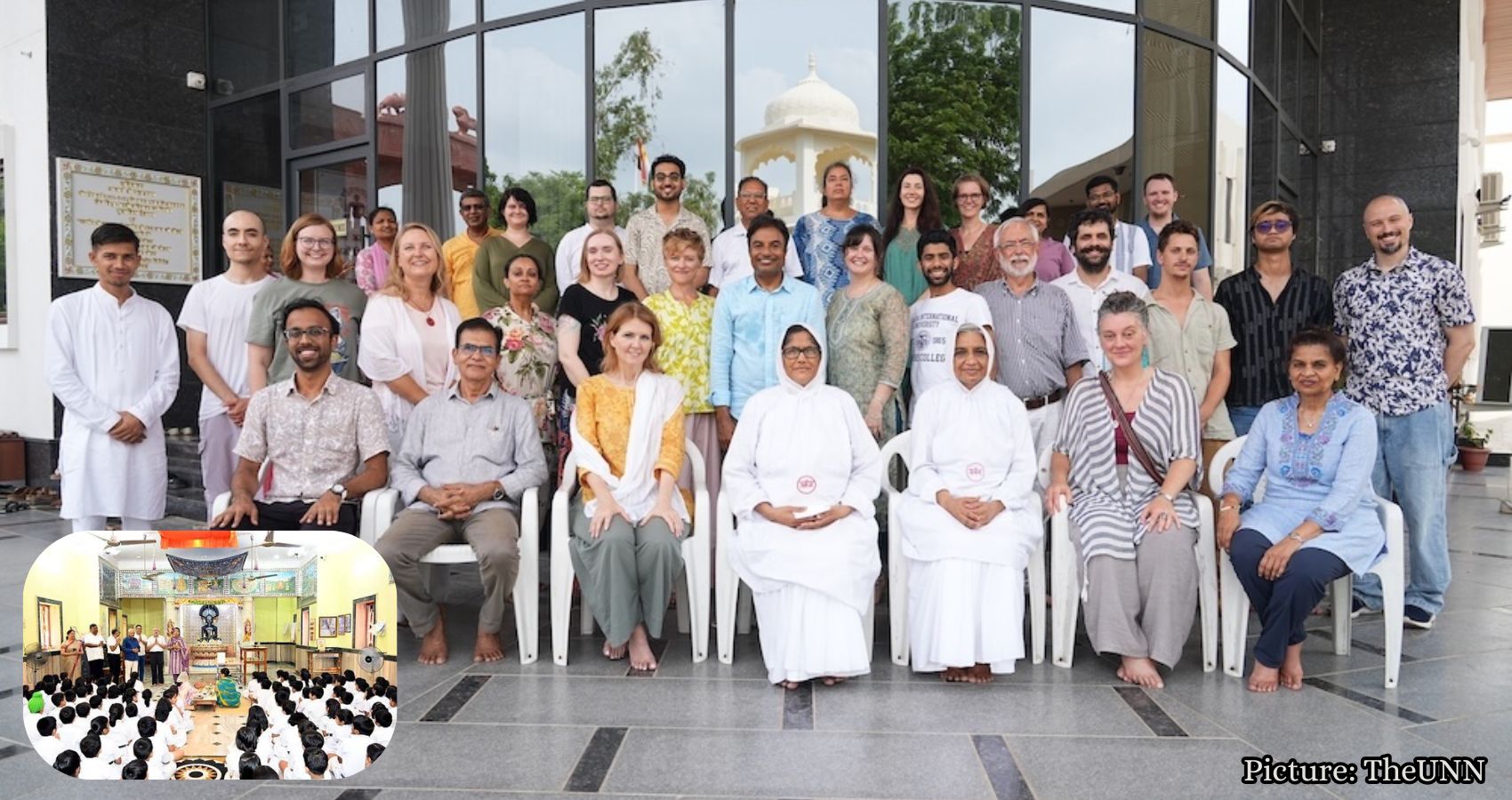
Students from around the world immerse themselves in the Jain way of life during a transformative three-week program in Ladnun, Rajasthan, blending scholarship, meditation, and monastic living.
Nestled in the arid plains of Rajasthan, approximately 230 miles west of Delhi, the town of Ladnun may seem unremarkable to many travelers. With its narrow streets, whitewashed temples, and a relaxed pace, it stands in stark contrast to India’s bustling metropolitan centers.
This summer, however, Ladnun has emerged as an unexpected destination for those seeking to explore one of the world’s oldest philosophies. For over three centuries, it has served as the spiritual home of the Terapanth order of Jainism, a reformist sect recognized for its disciplined monastic tradition and its emphasis on nonviolence, self-restraint, and spiritual inquiry. Last month, these traditions welcomed a unique group of nearly three dozen students, scholars, and faculty members from eight countries who are spending three weeks not just studying Jainism, but living it.
The immersive summer program, which began on July 20 and concludes on August 7, is the result of a collaboration among Florida International University, California State University Long Beach, the Jain Education and Research Foundation (JERF), Jain Visva Bharati Institute, and philanthropist Dr. Jasvant Modi, whose support has been instrumental in making this initiative possible.
Rather than treating Jainism as a mere academic subject confined to classrooms and textbooks, the program is designed to allow participants to experience the philosophy through daily practice. Each morning begins with meditation, followed by lectures on Jain philosophy, Prakrit—the ancient language of many Jain scriptures—and foundational principles such as “Ahimsa” (nonviolence), “Anekantavada” (the multiplicity of viewpoints), and “Aparigraha” (non-attachment to possessions). Participants also interact with monks and nuns, observe their disciplined routines, and engage in a lifestyle centered on simplicity, compassion, and mindfulness.
“It has been a very eventful week, and it has been a tremendous experience,” said Anne Vallely, a professor at the University of Ottawa and a leading scholar of Jainism in the Western world. She described the demanding schedule, stating, “We have our lessons from 9:00 in the morning, and they go really into 10 o’clock, 11:00 at night.”
The program reflects months of meticulous planning by scholars in both India and the United States. Florida International University, which hosts the first endowed chairs in Jain Studies in the U.S., collaborated closely with California State University Long Beach to develop the curriculum. The Jain Education and Research Foundation played a key role in coordinating the academic and logistical aspects, while Jain Visva Bharati opened its expansive campus and monastic community to the international participants.
At the heart of this initiative is a broader mission: to introduce Jain philosophy to a global audience at a time when its central teachings of nonviolence, environmental sustainability, restraint, and respect for diverse perspectives are increasingly relevant. This vision has been championed by Dr. Jasvant Modi, a physician, entrepreneur, and philanthropist whose extensive support for Jain education has helped establish academic programs across the United States. “I was born in India in the Jain faith, and those principles of Ahimsa, compassion, and respect for all living beings have guided my entire life as a physician,” Modi shared. “After my medical career, I realized philanthropy allows me to heal on a larger scale, not just one patient at a time. I contribute to Jain education because I believe America’s young students must be exposed to this ancient wisdom of tolerance, non-possessiveness, and plurality, which is so undervalued today.”
This year also marks the 300th anniversary of the founding of the Terapanth order, providing participants with the opportunity to witness commemorative events while learning about one of Jainism’s most influential traditions. Established in the 18th century by Acharya Bhikshu, the Terapanth order is distinguished by its centralized leadership and disciplined monastic structure, with monks and nuns traveling extensively to spread Jain teachings rather than remaining in permanent monasteries.
Throughout the three weeks, students discovered that learning extended far beyond formal lectures. Meals became lessons in mindful eating, and silence served as a form of reflection. Conversations with monks and nuns often continued long after scheduled sessions ended. Participants learned not only the philosophical foundations of Jainism but also how these principles influence everyday decisions, from food choices to conflict resolution and environmental responsibility.
For many students, the immersive setting transformed abstract ideas into lived experiences. “I’m surrounded by scholars, and I’ve gotten to meet with sadhvis and sadhus, and it’s just been lovely,” said Carol Rodriguez, a participant who holds a Ph.D. in Jain Studies from the University of Florida. Rodriguez, who earned her bachelor’s and master’s degrees in Jain Studies from Florida International University in Miami, translated portions of the Lilavatisara, a 13th-century work by Jain monk Jinaratnasuri.
The diverse international composition of the group further enriched the discussions. Participants brought varied academic backgrounds and cultural perspectives, creating conversations that reflected Jainism’s emphasis on dialogue and multiple viewpoints rather than absolute certainty. Organizers hope the program will serve as a model for future international collaborations in religious studies, philosophy, sustainability, and peace education.
Unlike traditional study abroad programs, the Ladnun initiative invites participants to become temporary members of a living spiritual community, where learning occurs as much through observation and daily practice as through formal instruction. As the summer school concludes, participants will return to their universities and communities around the world with more than just lecture notes and academic credits. They will carry with them firsthand experiences of a philosophy that has quietly endured for millennia, along with memories of a small Rajasthan town where, for three weeks, Jainism was not merely studied but lived.
According to The American Bazaar, the program exemplifies a unique approach to education that intertwines academic inquiry with spiritual practice.