
Chapter 11 of the Bhagavad Gita offers profound insights into the nature of perception, which are increasingly relevant as we navigate the complexities of artificial intelligence.
In today’s world, the challenge we face with artificial intelligence (AI) extends beyond the creation of machines that may surpass human intelligence. It involves understanding how these technologies can reshape our perception of ourselves and our reality.
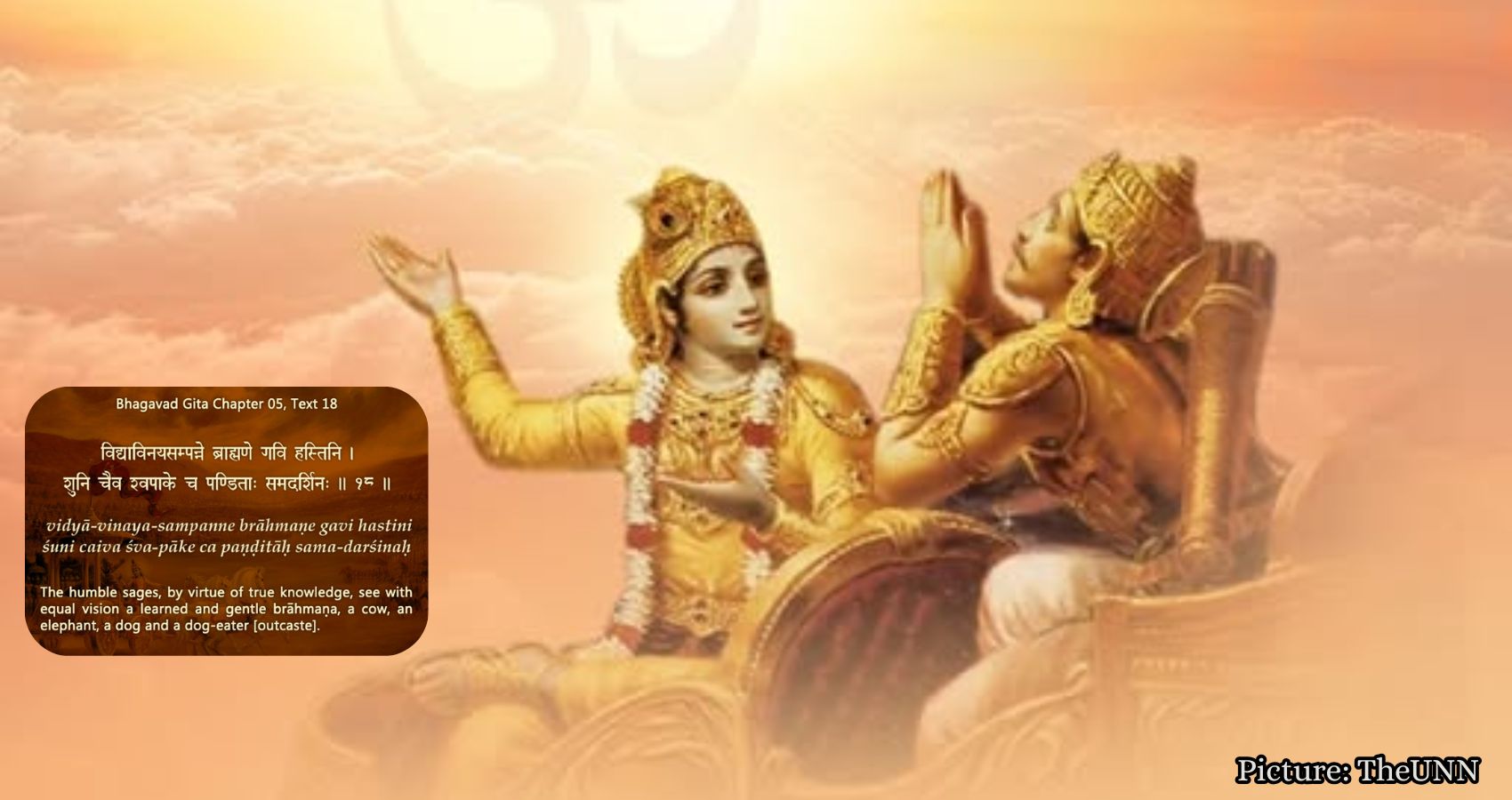
One of the most significant lessons regarding perspective can be found in Chapter 11 of the Bhagavad Gita. This chapter recounts a pivotal moment on the battlefield of Kurukshetra, where the warrior Arjuna requests Krishna to reveal his true nature. Arjuna’s inquiry, “You say you are God, but how do I know that?” sets the stage for a transformative experience.
In response, Krishna grants Arjuna a divine “faculty” of sight, allowing him to perceive a cosmic vision known as the “Vishwaroopa Darshana Yoga,” or the divine vision of the Universe. This extraordinary revelation is not only a highlight of the Gita but also a moment that has resonated through history, famously quoted by J. Robert Oppenheimer in 1945.
As Krishna unveils his Vishwaroopa, Arjuna witnesses countless faces, eyes, weapons, and beings extending in every direction. He experiences creation and destruction simultaneously, encountering a reality that transcends ordinary human perception. This vision is both awe-inspiring and overwhelming.
However, a crucial detail often overlooked is that Arjuna’s ability to see this divine form stems from an adjustment in his focus. The vision was always present; it merely required a shift in perspective. Krishna’s role is not to alter reality but to facilitate Arjuna’s understanding of it.
Complicating this optical lesson is the fact that the enemy king, Dhritarashtra, is blind and unable to directly witness the events transpiring between Arjuna and Krishna. Instead, he relies on Sanjaya, an observer granted the extraordinary ability to perceive and narrate the unfolding events. This layered experience highlights the complexity of perspective, as the revelation passes through multiple lenses.
Krishna enables divine vision, Arjuna adjusts his perception, and Sanjaya communicates the experience to Dhritarashtra. Yet, between seeing and understanding lies a profound mystery.
The Gita introduces a term that encapsulates the challenge of such perception: “sudurdarsham,” which translates to something exceedingly difficult to behold. This term emphasizes that the difficulty lies not merely in the complexity of the Vishwaroopa but in the limitations of ordinary human perception. Arjuna gains a unique capacity to see, a distinction that resonates in our current age of artificial intelligence.
Today, AI serves as a tool that allows us to view ourselves in ways previously unimaginable. It acts as a new kind of observer, revealing patterns and insights that challenge our understanding. This aspect of AI may prove more significant than the question of whether machines surpass human intelligence.
As we grapple with AI’s revelations, we must confront a critical question: What happens when we can see something but do not comprehend its meaning? This dilemma echoes Arjuna’s struggle, as Krishna’s revelation does not simply provide information; it necessitates understanding and interpretation.
AI can unveil patterns without grasping their significance. It can identify trends without understanding the underlying reasons. In this sense, AI resembles Sanjaya, who perceives what Dhritarashtra cannot and communicates it to him. AI processes vast amounts of information beyond our cognitive limits and reports back to us, acting as a narrator of sorts.
However, the analogy has its limits. Sanjaya is not merely a machine; he is an observer and narrator. AI, on the other hand, is a computational system that detects patterns and generates outputs, increasingly mediating our interaction with information. The important parallel is that AI is becoming our Sanjaya-like narrator, bridging the gap between a complex reality and human observers.
This raises the question: If AI can articulate what it sees, who will interpret its meaning? Here, we return to Arjuna. If AI expands our perception, we must assume the role of the observer, tasked with deciphering the implications of what we witness. This is where Krishna’s wisdom becomes essential.
AI should not replace Krishna. Krishna embodies qualities that AI cannot replicate: perspective, wisdom, meaning, and responsibility. He does not merely show Arjuna something extraordinary; he helps him understand his place within that revelation. This distinction may become one of the defining issues of the AI era.
As we develop machines capable of revealing more about the world and ourselves, we must remember that revelation does not come with an instruction manual for living with what has been revealed. AI can inform us of our actions, but it cannot dictate the kind of individuals we should aspire to be.
Dhritarashtra’s character serves as a cautionary tale. He represents the temptation to relinquish our capacity for perception and judgment to an intermediary. His blindness compels him to depend on Sanjaya, which mirrors the risk we face today: surrendering our judgment to AI.
The more powerful the intermediary becomes, the more crucial the observer’s judgment is. This is particularly important because AI operates on human assumptions, trained on human data. Consequently, when AI reflects our behaviors, it may also reveal the consequences of our biases and blind spots.
The connection between the Vishwaroopa and AI lies in the overwhelming nature of revelation. Arjuna does not receive a comforting vision; instead, he confronts a reality filled with beauty and terror, creation and destruction. This experience expands his understanding while destabilizing his previous notions of his place within that reality.
AI may not be mystical, but it is beginning to unveil the complexities of systems we once understood only superficially. It shows us how interconnected our behaviors are and, unsettlingly, that some traits we believed to be uniquely human may be replicable as computational patterns.
However, revealing reality does not equate to understanding it. The Gita suggests that Arjuna’s ability to see the Vishwaroopa does not automatically grant him wisdom. He must still interpret what he has witnessed and decide how to act.
This may be the crux of humanity’s current position. AI is broadening our field of vision, revealing aspects of reality that were previously hidden. Yet, as the instrument grows more powerful, the observer’s role becomes increasingly vital.
Ultimately, the future of AI may hinge less on the machines’ ability to see and more on our capacity to interpret what we observe. This requires a willingness to adjust our beliefs when confronted with evidence that challenges our preconceived notions.
The real lesson embedded in this ancient narrative for our modern technological age is that AI may serve as our new instrument of perception. It may become our Sanjaya, illuminating patterns previously beyond our reach. We stand as Arjuna, facing an expanding universe of information and a reality larger than our prior understanding. We must be cautious not to become Dhritarashtra, relinquishing our judgment to the voice that interprets what it sees.
The Vishwaroopa was not the conclusion of Arjuna’s journey; it was the moment when seeing demanded understanding. Perhaps this is where the age of AI truly begins.
According to The American Bazaar.