
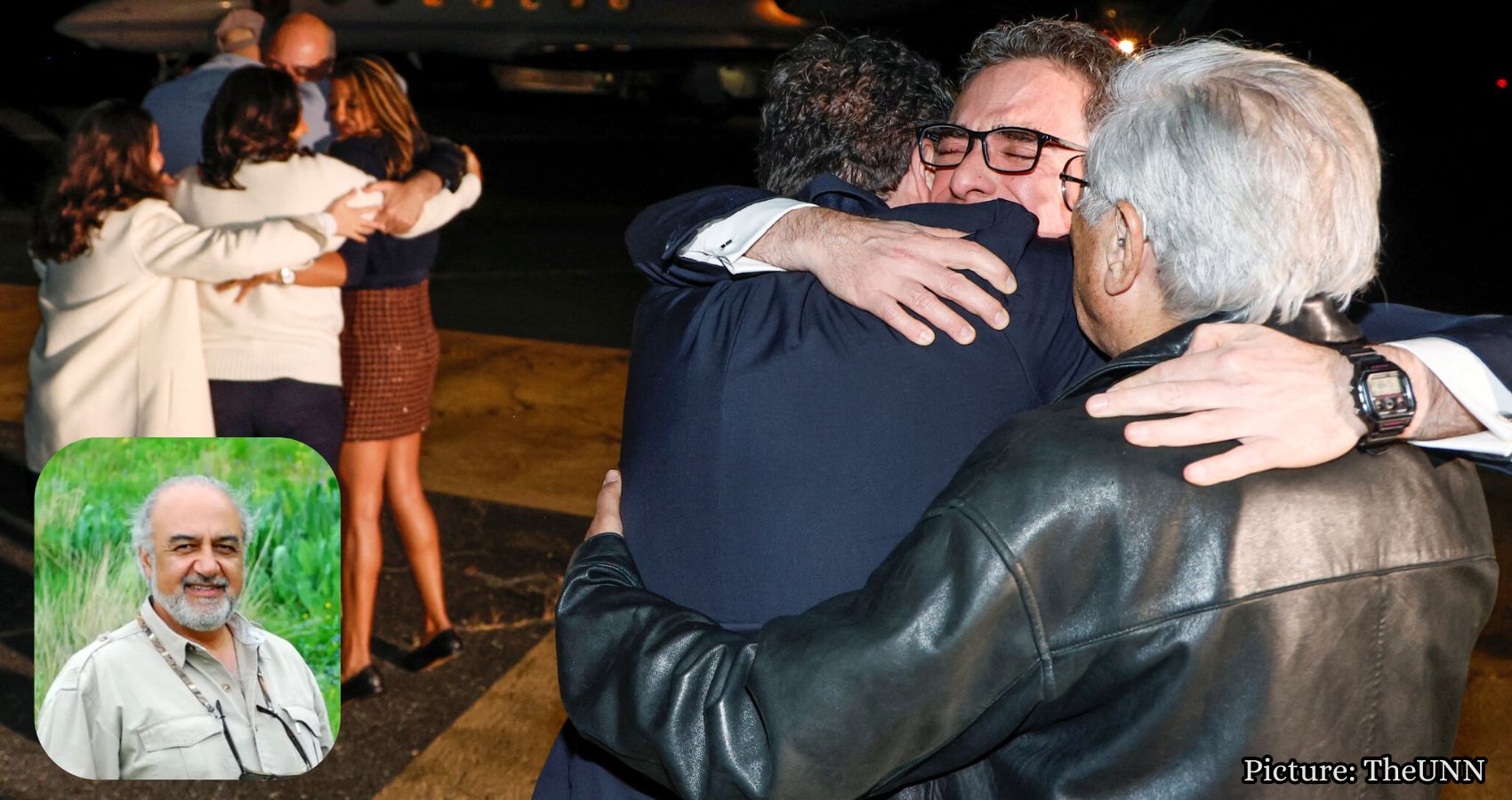
Morad Tahbaz, an American conservationist recently freed from Iran’s Evin Prison, shares his harrowing experiences and warns that ongoing U.S.-Iran tensions could jeopardize other hostages.
Morad Tahbaz, an American conservationist, has recounted his nearly six-year ordeal in Iran’s prison system, describing it as a living hell. His most harrowing experience came during four months of solitary confinement in a small cell, illuminated by a bright light that never turned off. Tahbaz was detained in Ward 2A of Evin Prison, a high-security facility controlled by the intelligence branch of Iran’s Islamic Revolutionary Guard Corps (IRGC).
During his imprisonment, Tahbaz was allowed outside his cell only twice a day for brief periods of about ten minutes. Each time he left his cell, he was forced to wear a blindfold. His weekly calls with his wife were closely monitored, with officials interrupting whenever he spoke in English. “This is probably the harshest and toughest imprisonment that any prisoner will go through,” he told Fox News Digital after his release in September 2023.
Tahbaz was arrested in January 2018 while working in Iran, where he co-founded the Persian Wildlife Heritage Foundation, dedicated to protecting endangered species like the Asiatic cheetah and Persian leopard. Among the bizarre accusations against him was that he trained lizards to spy on Iranian military installations for Israel. “You can’t make this stuff up,” he remarked, highlighting the absurd narratives constructed by the regime.
After enduring two years in the IRGC intelligence facility, Tahbaz was transferred to the general prison population, where he encountered a range of inmates, from suspected ISIS members to former Iranian government officials. The conditions were marked by constant uncertainty. “The uncertainty when you are a hostage is not like you think at the end of your sentence they’ll necessarily let you go,” he explained. “They’ll just come up with another charge to keep you there for as long as you’re of value to them.”
Tahbaz was released on September 18, 2023, as part of a Qatar-mediated agreement between the United States and Iran, which also involved the release of five Iranians held by the U.S. and the transfer of $6 billion in previously frozen Iranian funds for humanitarian purposes. While he is grateful to be home, he expressed concern that the ongoing conflict between the U.S. and Iran could make other Americans held in Iran more vulnerable and valuable as bargaining chips.
“I do think the strikes in Iran will have an impact on the hostages’ situation and their circumstances,” he warned. He believes that the current geopolitical tensions could exacerbate the plight of hostages, making them more susceptible to mistreatment.
Tahbaz’s apprehension is rooted in his own experiences during his imprisonment, particularly how Iranian interrogators reacted to rising tensions with the U.S. “When I was taken in January of 2018, it was right at the beginning of the first Trump administration,” he recalled. “The amount of frustration and anger at the rollback of the JCPOA at that time was thrown into my face just about every day of my interrogation.”
The Joint Comprehensive Plan of Action (JCPOA), a 2015 nuclear deal, was abandoned by the U.S. in May 2018, shortly after Tahbaz’s arrest. He fears that the current conflict could similarly affect prisoners who are innocent and have no control over political decisions made in Washington.
Tahbaz emphasized that the issue of hostage-taking has persisted since the Iranian Revolution, and he believes it will continue as long as there are no significant consequences for Iran’s actions. “This business of hostage-taking has been going on essentially since the beginning of the revolution,” he stated. “It will continue, in my opinion, as long as there is no deterrence.”
He pointed to the recent case of Dena Karari, an Iranian American who faced allegations of espionage and was unable to leave Iran for months. Her release was framed as a “gesture of goodwill” by former President Trump, but Tahbaz noted that dual nationals remain particularly at risk because Iran does not recognize their foreign citizenship. “You’re condemned and they pass sentence, and now you are a bargaining chip,” he explained.
The exact number of Americans currently detained in Iran is unclear, but reports indicate at least six U.S. citizens or permanent residents are imprisoned, including journalist Reza Valizadeh and businessman Kamran Hekmati. Advocates have warned that escalating military actions could increase the risk of harm to these detainees.
Tahbaz believes that the Iranian regime views hostages as commodities to be leveraged in negotiations. “You’re seeing that playing out even with the war, this tit for tat, you do this, we’ll do that,” he said. “The hostages are, you know, just a commodity from Iran’s perspective, to be used at the right time.”
His insights into the Iranian regime’s internal dynamics suggest that competing interests within the IRGC are vying to maintain their political and economic power. He noted that sanctions have inadvertently strengthened certain IRGC-linked entities, allowing them to profit from black and gray market operations.
Ordinary Iranians, however, bear the brunt of these economic hardships. “The people who are hurt most by all of this are the people of Iran,” Tahbaz lamented. He believes that while Iranians may return to protests, many have lost faith in Western governments to assist in regime change.
Tahbaz is currently working on a memoir titled “Green Parrots: A Memoir of Survival in Iran’s Evin Prison,” set to be published on September 29, 2023. The book details his survival strategies during his imprisonment, drawing on skills he developed while working with endangered wildlife.
While his release is a testament to successful negotiations, Tahbaz warns that without meaningful deterrence, the cycle of hostage-taking will persist, and the Americans still held in Iran may find their situations increasingly perilous.
His reflections serve as a stark reminder of the complex interplay between geopolitics and the lives of individuals caught in the crossfire, underscoring the urgent need for a more effective response to hostage situations.
According to Fox News Digital, Tahbaz’s experiences shed light on the ongoing challenges faced by hostages and their families amid rising geopolitical tensions.