
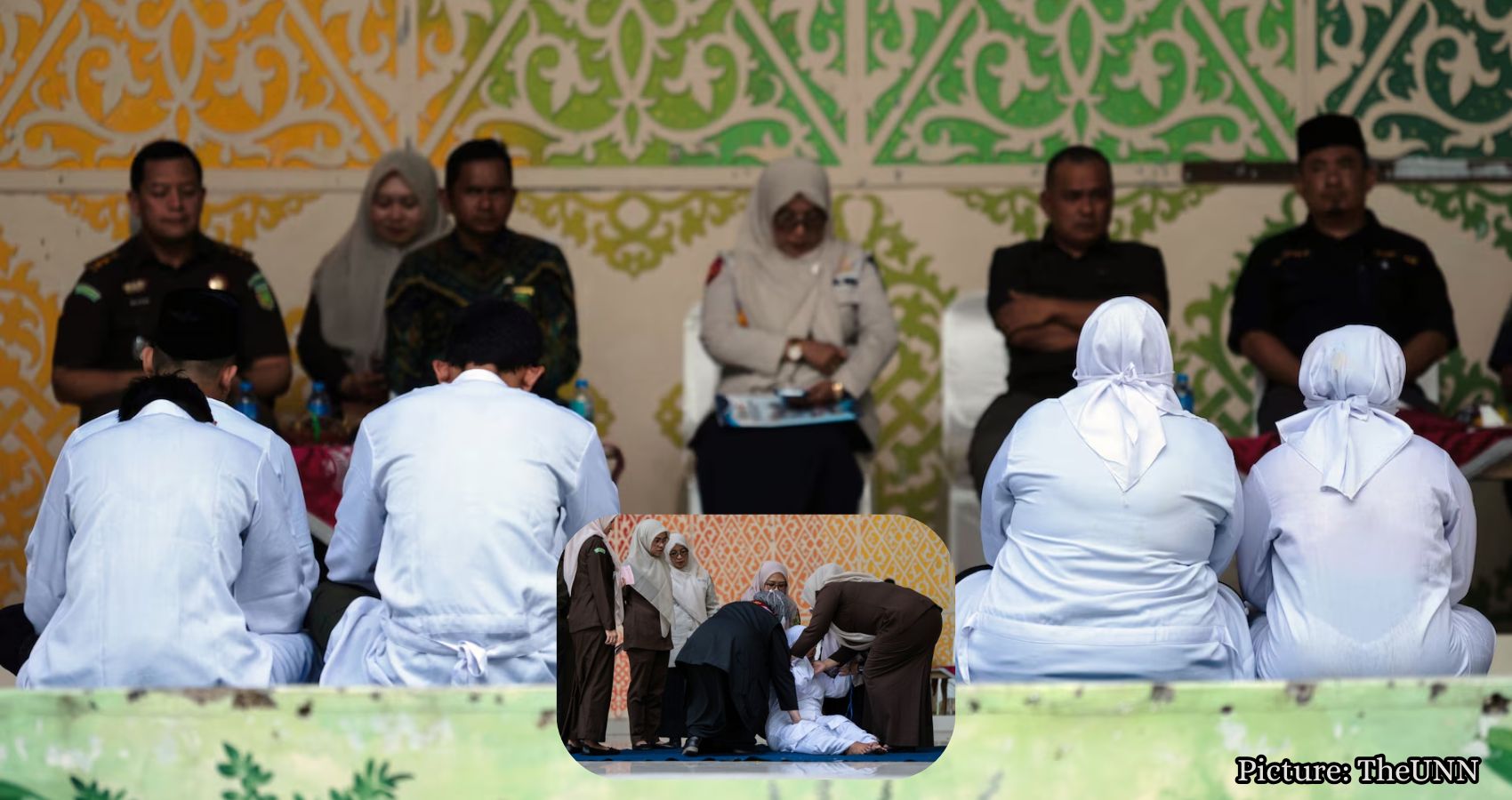
A young couple in Indonesia’s Aceh province faced public caning after being convicted of kissing during a TikTok livestream, igniting widespread outrage and debate over local morality laws.
A young couple in Indonesia was publicly caned on Thursday after being found guilty of kissing during a TikTok livestream. The couple, a 22-year-old man and a 25-year-old woman, each received 21 lashes, as reported by The Associated Press.
Their conviction stemmed from violations of local morality laws enforced under an Islamic Sharia court in Aceh province, known for its conservative stance. The couple had been detained since March and had already served four months in prison before their punishment was administered. Initially sentenced to 25 lashes, their sentence was reduced to 21 due to the time already served, according to the AP.
Local authorities revealed that the couple filmed their TikTok video inside a car one night in March. As the video gained traction online, they were subsequently apprehended for what officials characterized as an “immoral act.” Sharia police stated that their actions came to light following complaints from residents who were disturbed by the content of the livestream.
“The trigger was their livestream on TikTok while engaging in immoral acts in the car,” said Muhammad Rizal, head of the Sharia Police, in a statement. “This sparked criticism from netizens and local residents, who then reported them to the authorities.”
In addition to the caning, the court ordered the confiscation of a cellphone and a USB flash drive containing the TikTok video, which authorities pledged to destroy.
A local resident who attended the caning, 22-year-old Aini Nadhirah, expressed her belief that the punishment was justified. “In my opinion, this caning is entirely justified because it serves as a warning to other Aceh residents to be more careful when using social media,” Nadhirah said. “It also raises awareness that such actions are unacceptable, thereby educating the public.”
Aceh is unique within Indonesia, a predominantly Muslim nation, as it enforces its own Islamic Criminal Code that governs moral conduct. This right was granted by Indonesia’s secular central government around 2005 as part of a peace agreement to end a separatist insurgency. The implementation of these laws has since expanded to include non-Muslims.
Under Aceh’s legal framework, moral offenses—including adultery and same-sex relations—can result in penalties of up to 100 lashes. Caning is also employed for individuals accused of gambling, drinking, adultery, and premarital intimacy.
The practice of public caning in Aceh has faced longstanding criticism from human rights organizations, including Amnesty International Indonesia, which has labeled it as cruel and degrading. Despite Indonesia’s ratification of international conventions that prohibit cruel punishment, authorities in Aceh defend the practice, arguing that it does not fall under such definitions.
The incident has sparked renewed discussions about the balance between local customs and human rights, particularly in a region where traditional values often clash with modern social norms.
According to The Associated Press, the case highlights the ongoing tensions surrounding morality laws in Indonesia, especially in regions like Aceh where such laws are strictly enforced.