
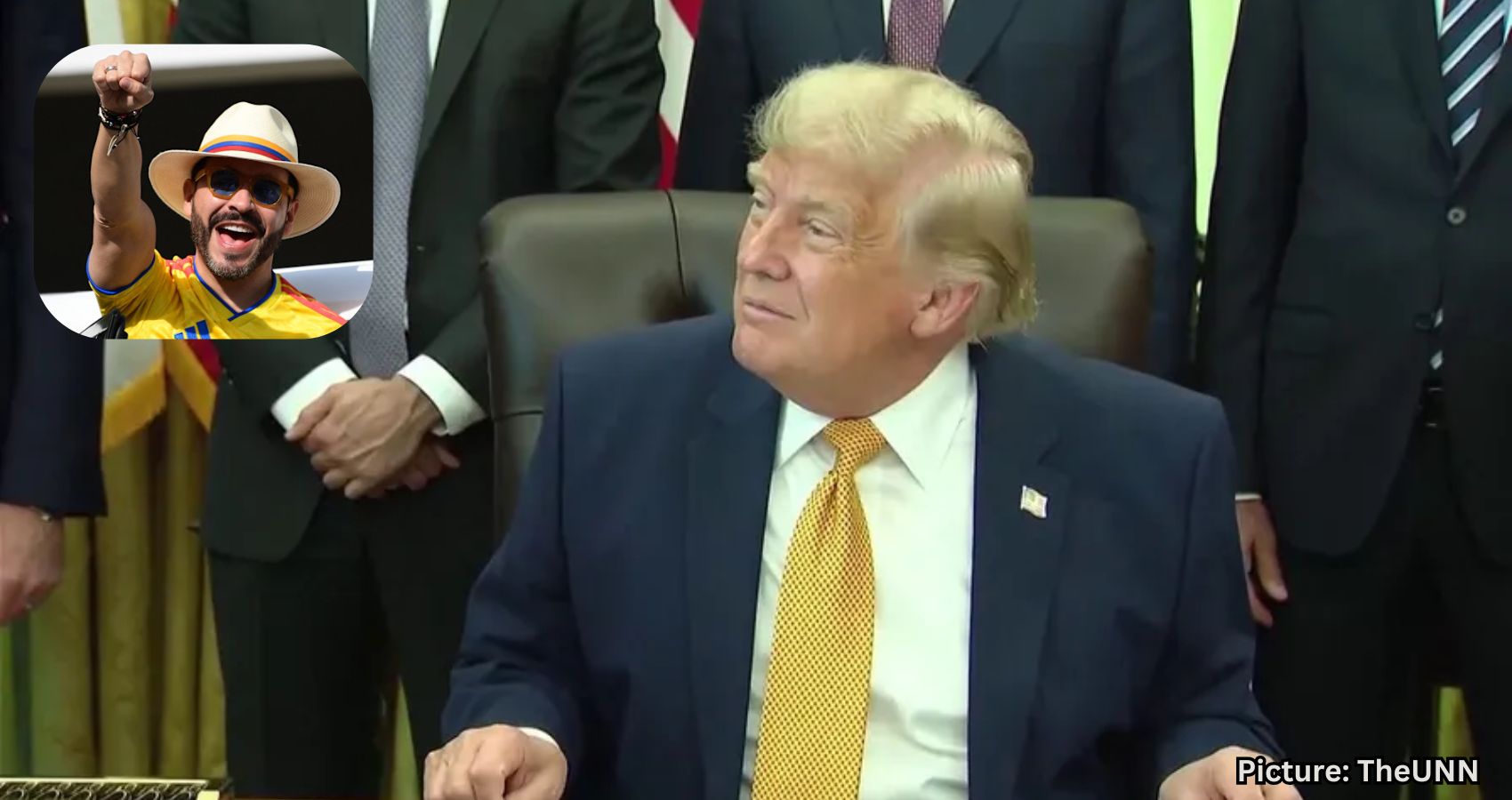
President Donald Trump congratulated Abelardo de la Espriella on his apparent election victory in Colombia, while rival Ivan Cepeda has launched a legal challenge over alleged voting irregularities.
President Donald Trump extended his congratulations to conservative attorney Abelardo de la Espriella on what appears to be his election victory in Colombia. As of the latest count, with 99.9% of votes tallied, de la Espriella leads with 49.7% compared to 48.7% for his left-wing opponent, Senator Ivan Cepeda. However, the results have yet to be officially certified.
De la Espriella, who is affectionately known as “El Tigre” by his supporters, performed strongly in Colombia’s mountainous interior and the vote-rich state of Antioquia. In contrast, Cepeda found success in the capital, Bogotá, and coastal regions, reflecting trends seen in previous presidential elections.
Despite de la Espriella’s lead, Cepeda has initiated a legal challenge, citing irregularities at thousands of polling stations. Overturning the election results would be unprecedented in Colombian history, raising questions about the legitimacy of the electoral process.
If de la Espriella’s lead holds, it would align with a broader rightward shift observed in several Latin American countries, including Chile, Ecuador, Bolivia, and Peru, where conservative candidates have gained traction in recent elections.
During a signing event at the White House, Trump expressed his support for de la Espriella, stating, “He called me last night, and he thanked me for the endorsement. He won. He won the election.” When asked about the future of U.S.-Colombia relations, Trump asserted that they would improve under de la Espriella’s leadership, declaring, “It’ll be better. He’s going to be a great president.”
The election showcased two candidates representing starkly different political ideologies. De la Espriella, who has garnered significant backing from Trump, has promised a return to the law-and-order policies of former President Álvaro Uribe. His campaign includes a commitment to an aggressive military strategy against guerrilla groups and criminal organizations.
On the other hand, Cepeda, a long-time figure on the Colombian left, has advocated for a continuation of the negotiation-based approach championed by former President Gustavo Petro. Cepeda has served as a senator for 12 years and previously held a position in the Chamber of Representatives. His father, Manuel Cepeda, was a notable member of the Colombian Communist Party and was assassinated in 1994 during a tumultuous period in Colombia’s history.
The first round of the election, held on May 31, saw de la Espriella secure 43.7% of the vote, while Cepeda garnered 40.9%. Right-wing Senator Paloma Valencia trailed significantly with 6.9%.
On Sunday evening, Secretary of State Marco Rubio also congratulated de la Espriella, expressing optimism about future cooperation between the U.S. and Colombia in areas such as regional security and immigration.
While the political landscapes of the U.S. and Colombia differ significantly, de la Espriella’s campaign has drawn parallels to Trump’s own outsider approach. Both candidates successfully navigated their respective elections without prior experience in elected office, relying on grassroots support and a rejection of established party structures.
Central to de la Espriella’s appeal has been his strongman image, which he has used to critique Petro’s policy of peace through negotiation with armed groups. Critics argue that Petro’s approach has allowed groups like the National Liberation Army (ELN) and dissident factions of the Revolutionary Armed Forces of Colombia (FARC) to regroup and regain control over key territories and drug trafficking routes.
De la Espriella has promised to reinstate a robust military campaign aimed at reclaiming territory from these groups and has proposed the construction of “mega-prisons,” citing El Salvador’s President Nayib Bukele as a model for combating criminal organizations.
His administration is also expected to usher in a return to free-market economic policies, reduced government intervention, and a renewed emphasis on lowering taxes.
With the potential for a strengthened U.S.-Colombia relationship, analysts are keenly observing the evolving dynamics between Colombia and Venezuela. De la Espriella is likely to adopt a stance similar to that of the Trump administration, advocating for a timeline for free and fair elections in Venezuela and urging the government to take action against the ELN, which has historically found refuge in border regions.
As the situation develops, the implications of de la Espriella’s presidency could have far-reaching effects on both Colombian and regional politics, particularly in relation to U.S. foreign policy in Latin America.
According to The Associated Press, the unfolding events will be closely monitored as the legal challenge and certification process continues.