
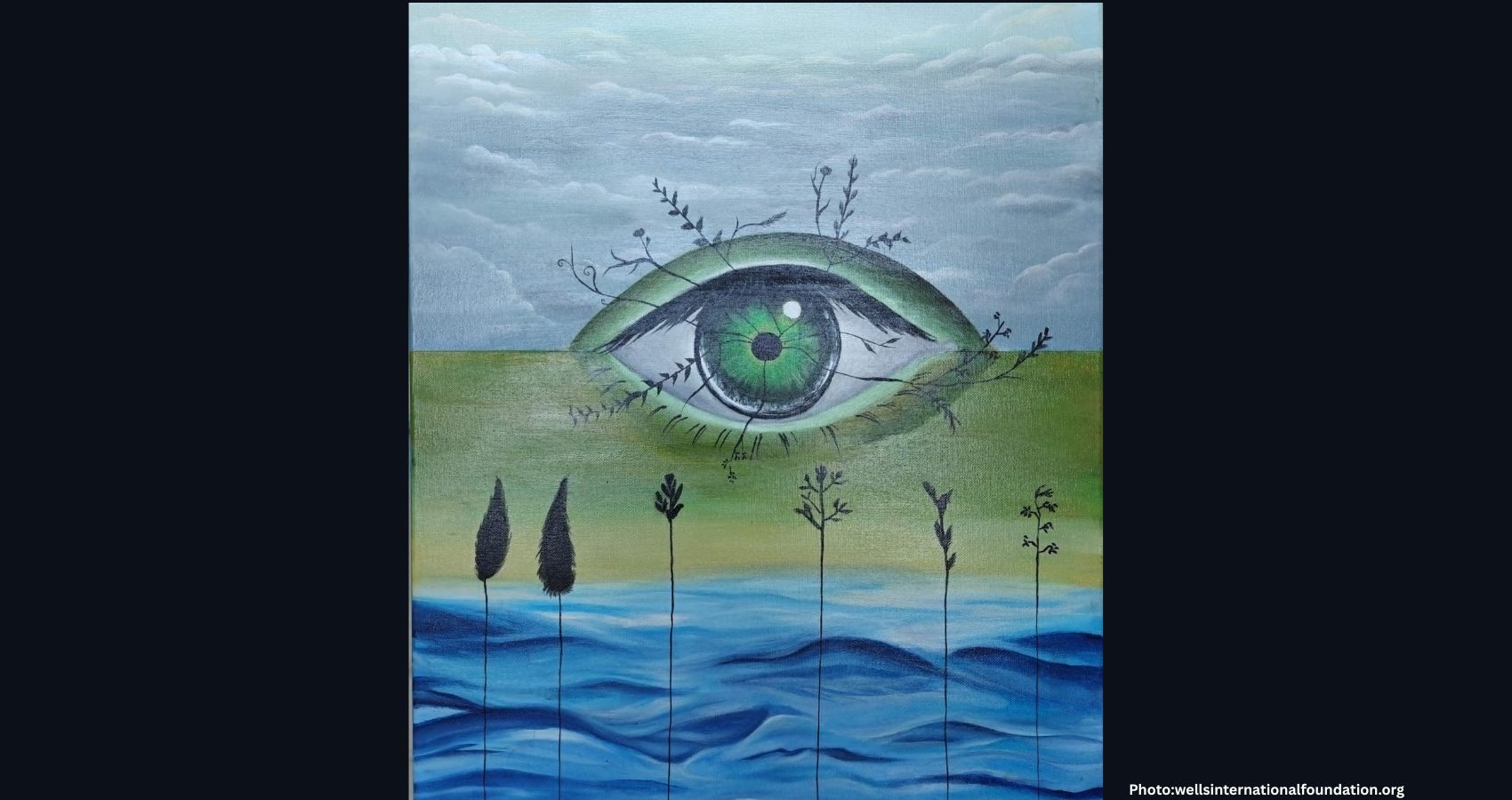
Aaradhya Sunder, a 12-year-old artist from Singapore, showcases her evolving talent at Art Capital Paris, reflecting a disciplined approach to art that began in her childhood.
Long before Aaradhya Sunder captivated audiences at Art Capital Paris, her artistic journey began in her family home in Delhi. At just two and a half years old, she transformed the walls of her home into a canvas of splashes of color, lines, and handprints. With crayons and pencil colors in hand, she marked every reachable surface, filling her surroundings with vibrant expressions of her creativity.
Instead of curtailing her artistic impulses, Aaradhya’s family chose to nurture her curiosity. They understood that while walls could be repainted, the instinct to create might not return if suppressed. What started as a natural inclination gradually evolved into a disciplined practice.
Now twelve and residing in Singapore, Aaradhya approaches her painting with a quiet intensity that immerses her in the creative process. When she paints, she does so in silence, without music or narration. Time seems to fade away as she stands before the canvas, absorbed in a meditative state. Once a piece is completed, she quietly sets it aside, as if concluding a personal conversation with the canvas.
“Painting makes everything quiet,” Aaradhya explains. “It feels like I’m thinking without noise.”
Her teachers first recognized her unique ability to engage deeply with her art. At her German school in Delhi, instructors noted her remarkable endurance, spending extended periods focused on line and tone. This observation led to encouragement from a teacher at her subsequent American school, prompting her family to seek structured artistic guidance.
Under the mentorship of art educator Dipti Karki in Delhi, Aaradhya’s training shifted toward the fundamentals of art, including composition, proportion, and light. Karki reflects on her early years, stating, “Aaradhya has been with me since she was very young. Her connection with art and the process of making has been exceptional from an early age. Watching her growth has been an absolute privilege and delight.”
In Singapore, Aaradhya continued to refine her practice at Little Artists Art Studio under the guidance of Shalini Kapoor and other mentors. Here, she embraced disciplined repetition and observational study as central to her artistic routine.
Aaradhya’s father notes that Singapore has provided not only the infrastructure but also an environment that respects artistic effort within a culture of discipline and merit. “We are deeply grateful for the encouragement she has received here — from her teachers, mentors, and institutions. Singapore has given her the space to grow quietly,” he says.
Aaradhya herself expresses gratitude for her learning environment, stating, “I feel blessed to learn here.”
In 2025, Aaradhya’s talent was recognized when a jury selected her to exhibit at Art Capital Paris, held within the historic Salon des Artistes Français, an institution founded in 1667. This opportunity was significant not for its novelty but for the rigorous evaluation process that transcended generational distinctions. Her painting, “The Eye of Tomorrow,” explored themes of environmental fragility through layered symbolism and compositional coherence. Alain Bazard, President of the Painting, Drawing, Digital Art, and Tapestry sections of the Salon, praised the work for its discipline and symbolic clarity.
In 2026, Aaradhya returned to Art Capital for a second consecutive juried exhibition, presenting her work “The Girl Who Paints Her Soul.” This piece marked a shift in her artistic expression, moving from outward allegory to introspection. Executed in graphite, the self-portrait embraced a more restrained tonal range, suggesting a deeper refinement in her artistic voice.
For her father, navigating the art world remains a new experience. “I did not grow up inside this ecosystem,” he admits. “There are moments of uncertainty. But when I see the sincerity with which she works, I remind myself that my role is not to shape the canvas — only to support the hand holding the brush.”
In addition to her artistic pursuits, Aaradhya balances academics with sports and creative leadership. She swims, plays basketball and badminton, and served as the Primary School’s Arts Captain last year. Fluent in four languages — Hindi, English, German, and Mandarin — she reflects the diverse environments in which she is growing up.
Despite her growing recognition, Aaradhya finds public acknowledgment more overwhelming than motivating. At home, her family emphasizes the importance of consistency: showing up, beginning again, and returning to the canvas.
Aaradhya’s artistic training has included mentorship in Singapore and educational sessions led by instructors associated with the Museum of Modern Art (MoMA) in New York, as well as the rigorous curriculum of the Nanyang Academy of Fine Arts (NAFA). Her work has been showcased at the National Gallery Singapore’s Children’s Biennale and various juried platforms in Beijing.
Later this year, she will travel to Washington, D.C., to participate in a program aligned with the World Children’s Festival, celebrating the United States’ 250th anniversary. Dr. Ashfaq Ishaq, Founder of the International Child Art Foundation, commended Aaradhya’s creativity and versatility, stating, “She is highly creative and a polyglot. She can use her creativity in any field she chooses, not only art.”
Despite her impressive achievements, Aaradhya maintains a steady rhythm in her artistic practice. Her teachers in both Singapore and India emphasize the importance of repetition and fundamentals, reminding her that talent without structure rarely endures. “They tell me to slow down,” she says. “They tell me to look again.”
The Paris exhibitions are not seen as a culmination of her journey but rather as part of an ongoing apprenticeship. Art Capital is a demanding context where works must stand independently, and Aaradhya’s consecutive inclusions reflect a cycle of preparation, submission, selection, and reflection. For her, this cycle has become a discipline in itself.
Yet, amidst her accomplishments, Aaradhya remains unmistakably twelve. She sometimes procrastinates on homework, becomes absorbed in coding projects, and finds joy in simple pleasures like pizza or a Parisian croissant. “I think sometimes I’m good at art,” she says softly. “But I just want to keep improving.”
In a landscape eager to celebrate early achievement, Aaradhya’s trajectory emphasizes formation over spectacle, discipline over display, and repetition over revelation. Her two consecutive juried exhibitions in Paris — first with “The Eye of Tomorrow” and then with “The Girl Who Paints Her Soul” — signify not an arrival but a continuity within a framework that values rigor.
The walls of her childhood home in Delhi may have been repainted, but what remains is her enduring habit of returning to the canvas, standing before a blank surface, and beginning anew.
According to India Currents.