
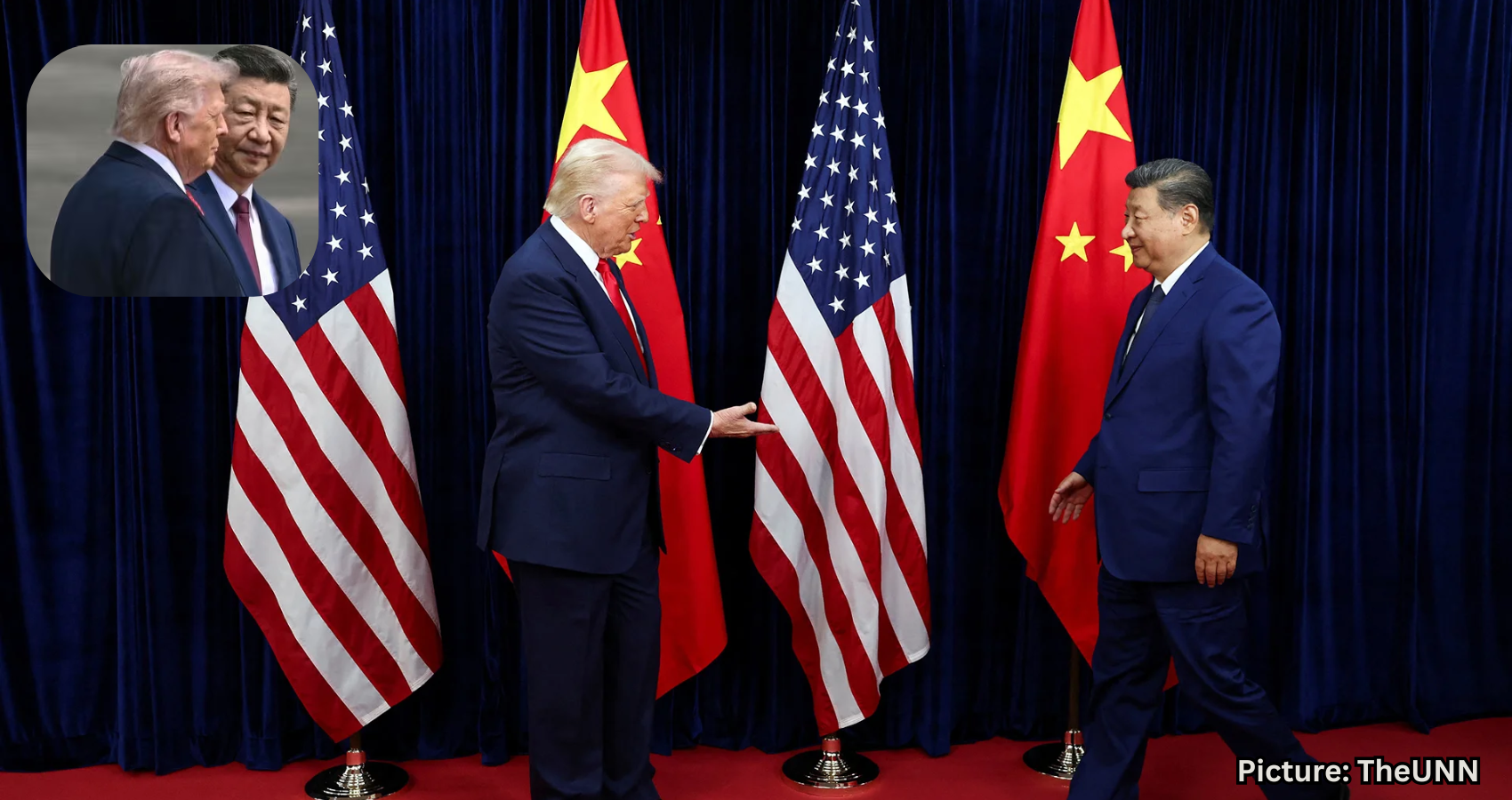
Pastor Ezra Jin’s daughter, Grace Drexel, expresses hope that President Trump will advocate for her father’s release during his visit to Beijing, where Jin has been detained for seven months.
Grace Drexel sat in Washington, D.C., five weeks away from the birth of her third child, sharing her family’s plight regarding her father, Pastor Ezra Jin. The grandfather her children barely know has been detained in China for the past seven months, along with numerous other Christian leaders. This situation is part of what advocates describe as one of the largest crackdowns on underground Protestant churches in recent years. As President Donald Trump prepares for meetings with Chinese leader Xi Jinping in Beijing, Drexel clings to a rare glimmer of hope that Trump will raise her father’s case directly with Xi.
“I’ll bring it up,” Trump told a reporter when asked if he planned to discuss Pastor Jin’s imprisonment during his trip. Drexel expressed her gratitude, stating, “It’s such a tremendous honor. To have one of the most powerful men in the world know my father by name and mention his case to General Secretary Xi Jinping is incredible.”
White House spokesperson Olivia Wales emphasized Trump’s commitment to religious freedom, stating, “There is no greater champion for religious freedom around the world than President Trump.” For Drexel, this moment could potentially end years of suffering. Her family has been separated for almost a decade; her mother and younger brothers fled China in 2018 after authorities shut down Zion Church’s physical sanctuary in Beijing, fearing they could become collateral damage in the escalating crackdown on Christians. Pastor Jin chose to remain behind with his community.
“My father actually had many opportunities to apply for a green card,” Drexel explained. “He felt the calling for China.” Since 2020, Drexel has not seen her father in person. Now, as she prepares to welcome her third child, she longs for her father to reunite with the family. “We would really, really love for our children to also experience and learn from their Grandpa,” she said.
Drexel described her father not as a political dissident but as a pastor devoted to his faith outside the control of the Communist Party. “My father is a pastor in China, and like Christians everywhere, he believed that the church should only have one God and serve one God,” she told Fox News Digital. She characterized Zion Church as independent from government oversight and deeply rooted in Scripture and community service.
“We helped with the society and the community around us, love our neighbors, and to love God,” she said. Beyond his pastoral role, Drexel portrayed her father as a gentle man dedicated to those around him. “Ultimately, I know my father as just a very gentle and kind man,” she reflected. “He is not very confrontational generally. He just loved everyone around him.” She added that he never criticized anyone, including his children, as they grew up.
With tears in her eyes, Drexel recounted how relatives learned that her father had been handcuffed, had his head shaved, and was struggling to receive medication while in detention. “And this kind and gentle man is now in prison,” she lamented. “All because he was just leading a church.”
The crackdown against Zion Church began years before Pastor Jin’s arrest. According to Drexel, pressure intensified around 2016 and 2017 after Xi Jinping rewrote China’s religious regulations and advanced the policy known as the “Sinicization” of religion. Critics argue this policy forces religious groups to align with Communist Party ideology, and Zion Church became one of many targeted by authorities.
Initially, Drexel said government officials demanded that the church install facial-recognition cameras inside the sanctuary to monitor worshippers. “We told them all our services are public. You can come and view anytime,” she recalled. “But we didn’t feel that we wanted to put an extra amount of surveillance or control on our congregation.” After the church refused, authorities installed surveillance cameras in the building’s lobby and began systematically targeting church members.
“Each and every member who came on Sunday [was] being harassed,” she said. Some worshippers lost their jobs, others were forced out of their apartments, and some families faced threats regarding their children’s education and their parents’ retirement benefits. “It was all possible under the Chinese Communist Party if they wanted you to stop doing something,” she noted.
Eventually, authorities confiscated the church’s property and shut down its physical worship space. Pastor Jin then moved services online and into smaller home gatherings, which led authorities to accuse church leaders of the “illegal use of information networks” due to those decentralized worship activities. Drexel emphasized that her father’s case is just one part of a much larger crackdown occurring across China.
“There are so many pastors and church leaders and churches being persecuted in China actively today,” she said. “We know that there are hundreds of pastors that are currently in prison or are in detention.” She described the current climate as a “very critical period in China,” adding that it is “very disheartening and very scary for many Christians in China.”
The broader persecution campaign against Christians, Uyghur Muslims, Tibetan Buddhists, and Falun Gong practitioners is documented in “China’s War on Faith,” a recently released book by former Ambassador-at-Large for International Religious Freedom Sam Brownback. The book profiles believers who have been imprisoned, tortured, and surveilled for practicing religion outside state-approved institutions, arguing that the Chinese Communist Party increasingly views independent faith as a threat to its authority.
Drexel believes that Trump’s decision to publicly mention her father’s name represents more than just diplomacy. “We hope that as the two leaders are meeting together, they will both have a softening of the hearts and will release my father and allow him to come to the U.S.,” she said.
In a statement to Fox News Digital, Chinese Embassy spokesperson Liu Pengyu asserted that the Chinese government protects “freedom of religious belief in accordance with the law.” He claimed that people of all ethnic groups in China enjoy religious freedom, citing official figures that indicate nearly 200 million religious believers in the country, along with over 380,000 clerical personnel and more than 140,000 registered places of worship. Liu argued that Beijing regulates religious affairs involving “national interests and the public interest” while opposing what it describes as illegal or criminal activities disguised as religion. He also accused foreign countries and media outlets of interfering in China’s internal affairs under the pretext of religious freedom and urged journalists to “respect the facts” and cease what he termed “attacking and smearing” China’s religious policies and record.