
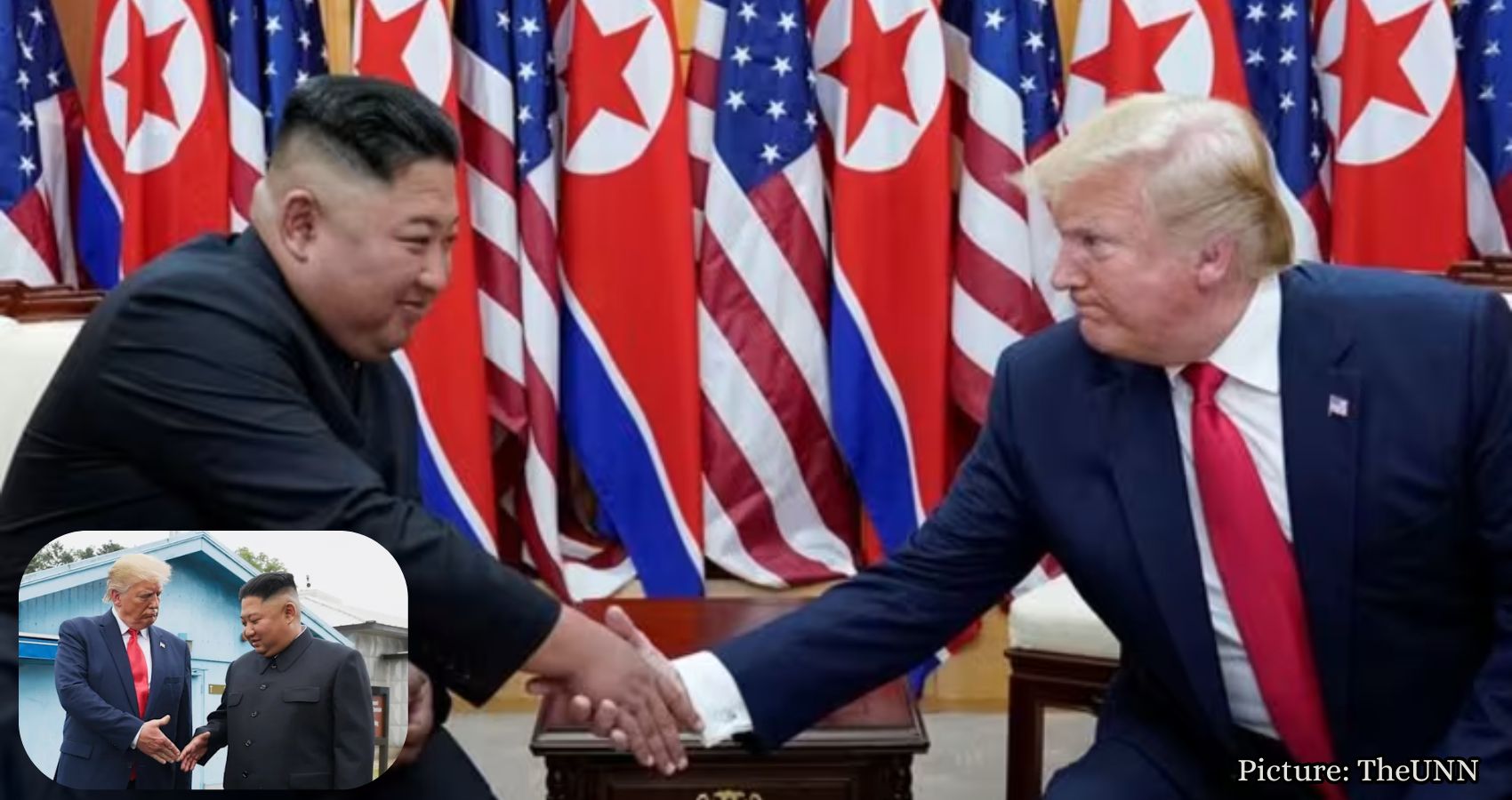
As President Trump seeks to revive diplomacy with North Korea, he faces a more formidable nuclear threat and a strengthened alliance between Pyongyang and Moscow, complicating efforts for denuclearization.
President Donald Trump is looking to reinvigorate summit diplomacy with North Korea’s Kim Jong Un, but he faces a significantly stronger North Korea that now possesses an estimated 50 to 70 nuclear weapons and has forged a powerful partnership with Russia. This evolving landscape presents a stark contrast to the conditions during Trump’s first term, making denuclearization increasingly elusive.
Trump’s renewed outreach comes amid a nuclear standoff with Iran, another unresolved issue from his previous administration. Unlike Iran, however, North Korea has a well-established nuclear arsenal and multiple delivery systems, which limits Trump’s options for a military solution and narrows the potential for a diplomatic agreement compared to eight years ago.
Victor Cha, the Korea Chair at the Center for Strategic and International Studies, suggests that Trump may view renewed diplomacy with North Korea as a way to divert attention from Iran and reduce the number of adversaries facing the United States. “I think he frankly wants to take the headlines off of Iran,” Cha told Fox News Digital, emphasizing that North Korea presents a fundamentally different nuclear challenge. “There really isn’t a military solution for a country like North Korea that has 50, 60, 70 nuclear weapons and several delivery systems for those weapons.”
Given this reality, a comprehensive denuclearization agreement appears increasingly unattainable. Instead, negotiations may focus on more limited objectives, such as restricting nuclear and long-range missile tests, establishing crisis communication channels, mitigating Pyongyang’s ties with Moscow, or reaching a peace agreement that allows Kim’s nuclear arsenal to remain intact.
“There is no grand bargain with North Korea that quickly eliminates the country’s nuclear arsenal,” said Kelsey Davenport, director for nonproliferation policy at the Arms Control Association. “North Korea can drive a harder bargain now than it could have in 2018.”
This week, Trump expressed optimism about meeting Kim before the end of the year, highlighting the personal rapport that facilitated their earlier engagements. “I get along with him,” Trump stated. “And you know what? The fact that I get along with him, that’s a good thing, not a bad thing.”
A White House official indicated that the leaders “will meet at the appropriate time,” although no specific date or location has been disclosed.
Trump’s potential gains from this renewed engagement may include a limited agreement that reduces immediate nuclear threats rather than seeking to eliminate North Korea’s arsenal entirely. Cha identified several objectives that fall short of full denuclearization, such as formally banning nuclear and intercontinental ballistic missile tests, reducing Pyongyang’s ties with Moscow, and establishing a crisis-management channel between the U.S. and North Korea.
Additionally, Trump may pursue a peace declaration or treaty that would allow him to claim progress on a conflict that has remained technically unresolved since the 1953 armistice. Washington’s bargaining chips could include phased sanctions relief, reductions in military exercises, adjustments to U.S. troop levels, and the political value of direct engagement with the U.S. president. For Kim, an agreement that preserves his nuclear weapons could be perceived as progress toward the regime’s long-standing goal of gaining de facto acceptance as a nuclear state.
Kim may also have strategic reasons for keeping Trump engaged. Cha noted that North Korea might view ongoing dialogue with the U.S. president as a means to mitigate the risk of military confrontation, especially given Trump’s willingness to use force during his second term.
Trump may have already initiated his first negotiating move by reducing joint military exercises with South Korea, a tactic he employed during his initial diplomacy with Kim. North Korea, however, dismissed this reduction as insufficient and responded by launching approximately ten short-range ballistic missiles into its eastern waters the following day.
Anthony Ruggiero, who served as the National Security Council director for North Korea during Trump’s first term, remarked that the reduced exercises align with a pattern established during Trump’s earlier diplomacy. “I’m kind of surprised that people are surprised. President Trump took the same action in his first term, and the only thing that’s really surprising is not that he did it; it’s that he waited this long to do it,” Ruggiero told Fox News Digital.
During their 2018 summit in Singapore, Kim signed a broad pledge to work toward the complete denuclearization of the Korean Peninsula. However, the agreement lacked a timetable or verification terms, and Pyongyang has since rejected denuclearization as a basis for negotiations. Cha pointed out that Kim was under greater pressure from U.N. Security Council sanctions and facing a worsening food situation eight years ago, giving Trump more leverage at that time. “It’s a very different situation now,” Cha noted.
This shift in leverage is partly attributed to North Korea’s deepening ties with Russia. Pyongyang’s support for Moscow’s military efforts in Ukraine has strengthened its relationship with a powerful ally capable of providing economic and military assistance while shielding North Korea from further accountability at the U.N. Security Council. China remains an essential economic partner as well.
Despite these challenges, sanctions relief could still serve as a potent incentive for negotiations. Ruggiero emphasized that pressure diminishes if the U.S. does not effectively close the loopholes North Korea exploits to evade sanctions. “The North Koreans always complain that the sanctions don’t hurt them, but then that’s the first thing they always ask for,” he said.
The recovery of American war dead could also provide Trump with a tangible humanitarian achievement. The 2018 Singapore agreement included a commitment to recover the remains of U.S. service members killed during the Korean War, and Pyongyang returned 55 boxes believed to contain American remains at that time. Future agreements could aim to restart recovery efforts within North Korea, where joint U.S.-North Korean operations last occurred in 2005.
However, a sweeping disarmament deal remains unlikely. Davenport suggested that Trump should concentrate on measures that reduce nuclear risks and slow the program’s growth, including a missile-test moratorium, crisis communication channels, and a potential freeze on nuclear development. “The ideal would be a return of International Atomic Energy Agency inspectors, but that’s not going to happen early in the process,” she cautioned.
While satellite imagery could assist in monitoring reactor operations, plutonium reprocessing, and missile testing, verifying a halt in uranium enrichment would be significantly more challenging. A direct crisis-management channel could provide substantial value, as Washington currently lacks an established military line to Pyongyang. “If all of a sudden our radars pick up a ballistic missile flying through the air, we have no way of contacting North Korea to ask them, ‘Is this your intent? Did you send this?'” Cha explained.
Cha also noted a degree of restraint in North Korea’s recent activities. Although Pyongyang conducted several intercontinental ballistic missile tests during the Biden administration, it has not launched an ICBM in flight since Trump returned to office and has refrained from conducting a nuclear test since 2017.
Any potential agreement would also test the U.S.-South Korea alliance. While Seoul may welcome renewed dialogue after years of stalled negotiations, it will likely be cautious about concessions affecting U.S. troop levels or military exercises. Cha indicated that South Korea may not have been aware in advance of Trump’s decision to reduce military exercises, but it could still view renewed U.S.-North Korea negotiations as a net positive if they lead to a revival of diplomacy. However, over the long term, South Korea would want a role in the negotiations and assurances that its alliance interests are not compromised in any deal with Pyongyang.
“Where the rubber really hits the road on this is the whole question of U.S. troops in Korea because North Korea would like them out, South Korea would like them to stay, and it’s not entirely clear what President Trump wants,” Cha concluded.
According to Fox News, the dynamics of U.S.-North Korea relations are evolving, and the upcoming negotiations will test the resolve and strategies of both leaders.