
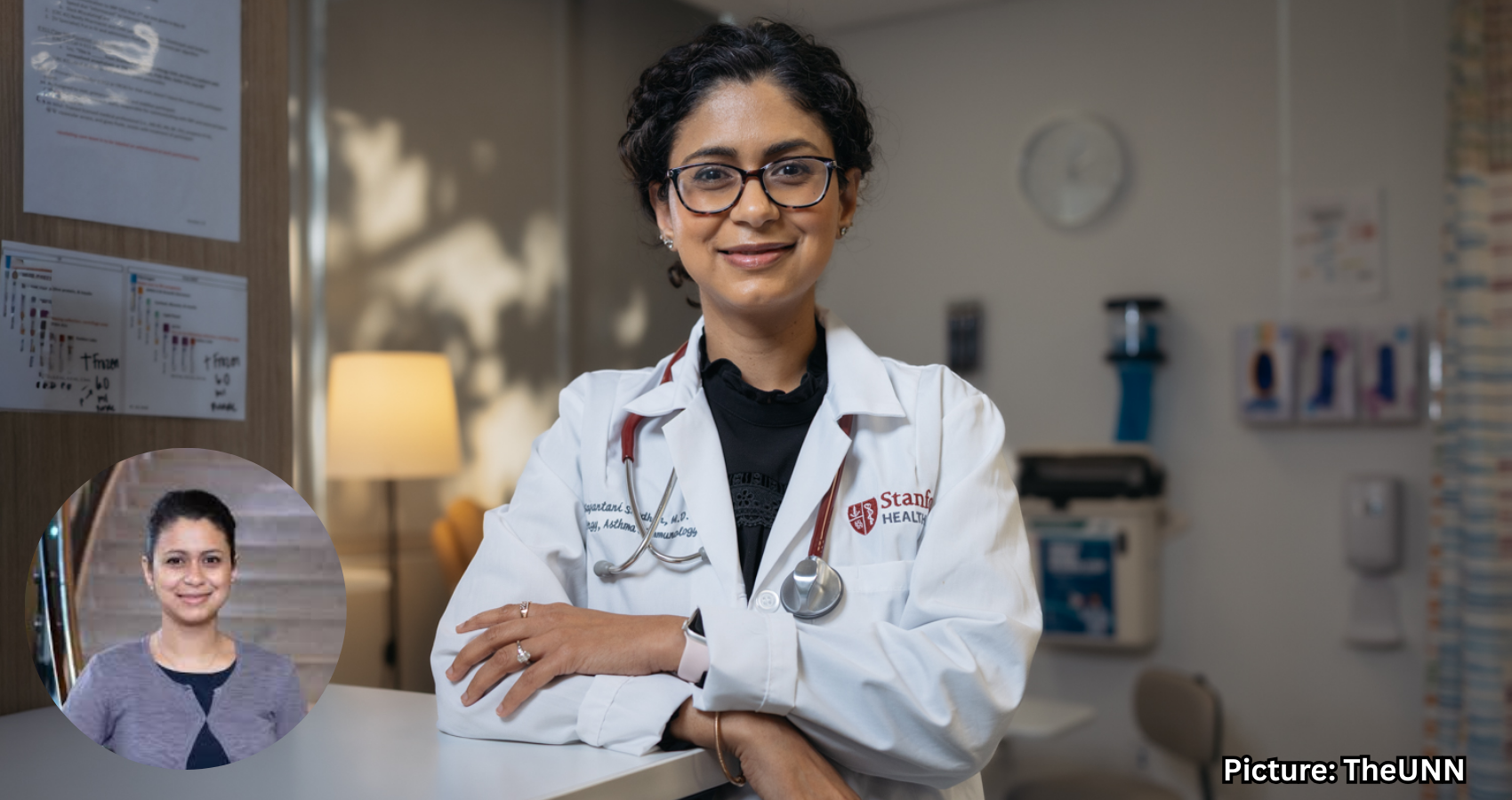
Indian American pediatric allergist Sayantani Sindher is dedicated to improving the lives of children with food allergies through innovative research and treatment options.
Living with food allergies significantly impacts quality of life, affecting family dynamics and mental health. Indian American pediatric allergist Sayantani Sindher emphasizes that the daily stress associated with managing food allergies drives her commitment to advancing food allergy care.
“Food allergies affect 8 to 10% of the U.S. population, so classrooms often have multiple children navigating them,” says Sindher, who serves as a clinical associate professor of medicine and pediatrics and directs the Clinical Translational Research Unit at Stanford University’s Sean N. Parker Centre for Allergy and Asthma Research.
“We worry about food allergies because accidental exposure can cause severe symptoms, even death,” she notes in a recent piece for Stanford’s “Research Matters” series, which highlights the work of Stanford scientists and its potential to advance human health. “However, living with food allergies has a greater quality-of-life toll. Constant vigilance around food can lead to chronic stress and anxiety. Treatment options can help mitigate these effects.”
<pSindher’s primary goal is to improve the lives of children with food allergies and their families. She envisions better guidelines for preventing food allergies and immediate treatment options upon diagnosis in the future.
Early intervention is crucial, as younger immune systems are more responsive to treatment. Sindher discusses an ongoing clinical trial involving babies under two months old with eczema or severe dry skin. Early eczema has been linked to food allergies, and the hope is that treating eczema and minimizing skin damage early will reduce the likelihood of developing food allergies later.
Her research focuses on improving food allergy diagnosis and treatment monitoring. Sindher points out that traditional methods like skin prick testing and blood work are often unreliable. These tests cannot accurately assess symptom severity, have a high false positive rate, and do not effectively monitor treatment outcomes.
“So, we often give allergic individuals the food they’re allergic to and observe their reactions to confirm allergies or treatment response,” writes Sindher. “We’re also exploring better treatment options.”
Initially, food allergy treatment involved strict avoidance of allergens. However, accidental exposures can still occur. Oral immunotherapy, which was approved in 2020, involves administering daily small amounts of the allergen to desensitize the body. While promising, it is not suitable for everyone, carries a risk of reactions, can cause food aversion, and necessitates lifestyle modifications such as adjusting exercise and meal plans.
In a recent trial, Sindher’s team discovered that the injectable medication omalizumab reduces the risk of allergic reactions. This medication is now FDA-approved for children aged one year and older, either as a standalone treatment or in conjunction with oral immunotherapy.
The injection must be administered every two to four weeks to prevent the body from reverting to its allergic state. However, for children with severe food allergies, it has proven to be life-changing. “Patients express relief when they can enjoy ice cream with friends or travel abroad without fear of their child’s allergies,” she notes.
While omalizumab is effective for many, it does not work for everyone, and some children are needle-phobic. Sindher mentions that new drugs and interventions are being developed to lessen the burden on patients. Sublingual immunotherapy, which has fewer side effects than oral immunotherapy, as well as a peanut patch and less-frequent injection options, are currently being explored.
In another study, her lab is conducting food challenges with individuals prescribed omalizumab, both at the start of treatment and six months later, while collecting blood samples to identify biomarkers that indicate medication effectiveness.
“We’re also conducting quality of life surveys and burden of treatment assessments to better understand how to help patients safely consume food and reduce stress in their daily lives,” Sindher adds.
Allergy immunology is unique in that it involves treating the entire family, including parents, children, and siblings. “It’s like an old-timey doctor who knows everything about the family, from their vacations to their pets,” she explains.
“My research allows me to see them every two weeks, fostering a deep bond,” writes Sindher. “I bridge the gap between research and clinical practice, using patient insights to inform my work and making informed decisions for families.”
According to Stanford University, Sindher’s work is paving the way for innovative solutions in food allergy treatment, ultimately aiming to enhance the quality of life for affected families.