
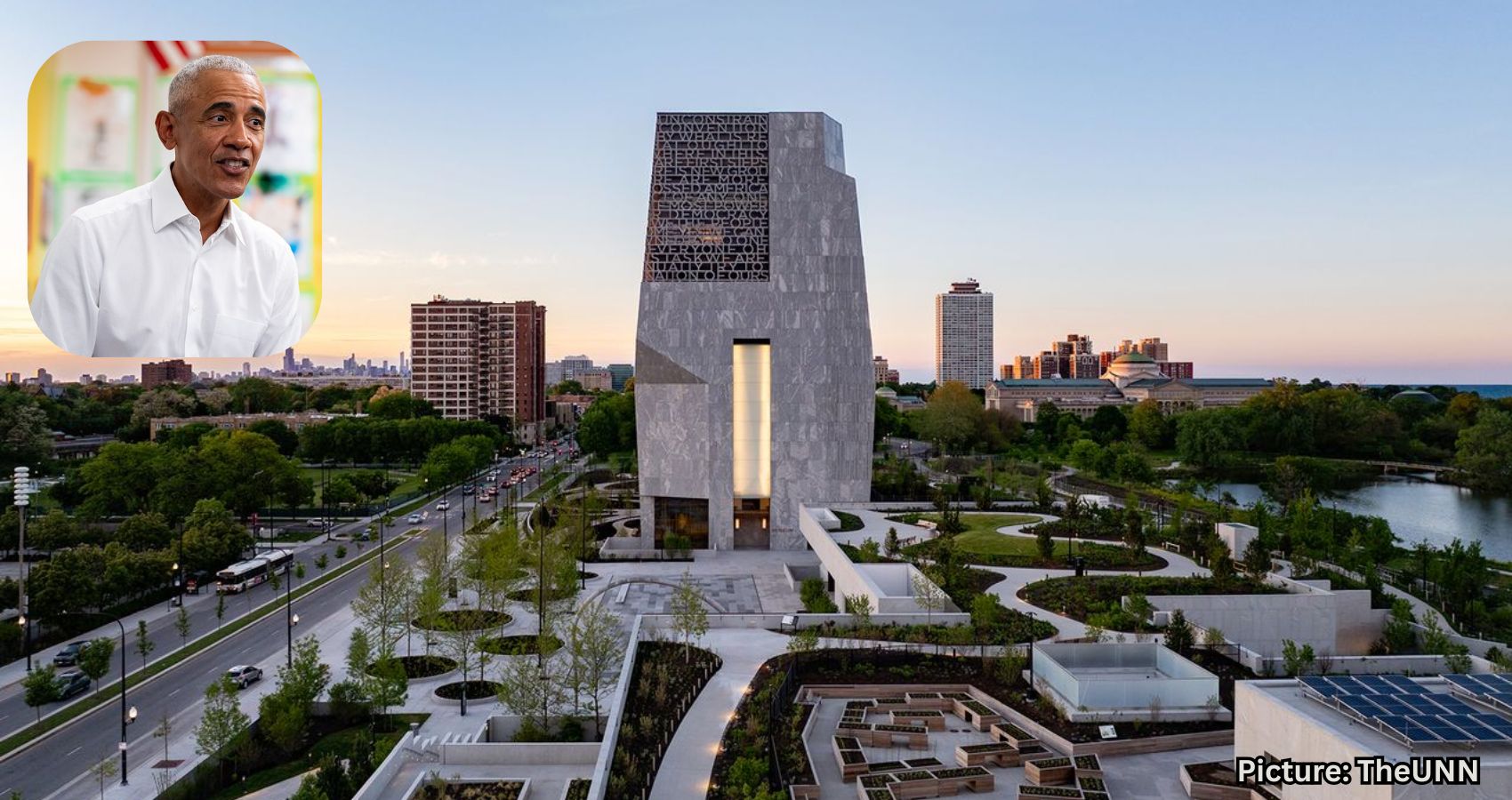
The Obama Presidential Center, which recently opened in Chicago, is criticized for functioning more as an activism hub for the Obama Foundation than a traditional presidential library.
Critics are raising concerns about the Obama Presidential Center, which opened last week on public parkland in Chicago, arguing that it serves as an activism hub for Barack Obama’s foundation rather than a conventional presidential library.
With a price tag exceeding $1 billion, the center is located near the shores of Lake Michigan and has drawn significant attention. However, unlike other modern presidential libraries that house a former president’s papers for public access, the Obama Presidential Center lacks this component. Instead, Obama’s presidential records are stored elsewhere, with digital versions potentially becoming available in the future.
The center’s primary functions include serving as a museum dedicated to Obama’s presidency and as the headquarters for the Obama Foundation, a private nonprofit organization. The expansive 19.3-acre campus will host various leadership programs and features such as a “Democracy in Action Lab,” conference facilities, foundation offices, and a large athletic complex aimed at youth sports and community initiatives—elements not typically associated with a presidential library.
Surrounding the campus are signs proclaiming “Bring Change Home” and “A Home For Action,” reflecting the messaging used by the Obama Foundation in its annual reports. The foundation describes the center not as a traditional presidential library, but rather as a “campus” and a “living institution.” In its 2024 annual report, the foundation stated, “We are building more than a campus. We are creating a living institution that will inspire, empower, and connect the next generation of leaders.”
As of 2021, the center had already cost over $800 million, and estimates suggest it has now surpassed the $1 billion mark. This departure from the traditional model of presidential libraries has drawn scrutiny. Tevi Troy, a presidential historian and former aide in the George W. Bush administration, remarked, “Usually, these libraries are a monument to a presidency, and the presidency is in the past, it’s in the rear-view mirror. It looks like Obama wants to use it as some kind of activism center, something that continues to promote his ideas and his political views.”
Troy noted that this direction aligns with Obama’s background as a community organizer and activist. “Obama was a community organizer. He’s an activist. That’s how he came up, and it doesn’t surprise me that he wants to go in this direction,” he said.
During the opening ceremony, Obama provided insight into the center’s mission. “We designed the center not to be some lifeless mausoleum,” he stated, emphasizing the importance of highlighting stories from Obama Foundation leaders around the world. Among those present was a Polish human-rights lawyer involved in numerous lawsuits related to refugees, climate policy, LGBTQ rights, and anti-discrimination litigation.
Obama reiterated the center’s mission, saying, “While we are non-partisan, we are not value-neutral. We have a point of view.” Critics argue that the opening ceremony confirmed their fears that the center is intended not only to preserve Obama’s presidency but also to promote his vision for the future.
The center’s location on approximately 19 acres of Jackson Park—a public space comparable to New York’s Central Park—has sparked debate over the transfer of public land to a private foundation under a controversial 99-year agreement approved by city leaders for a nominal fee of $10. Opponents contend that this transfer violated the public trust doctrine, a legal principle designed to protect public assets for community benefit. Although legal challenges were ultimately unsuccessful, critics argue that the core public trust arguments were never fully examined in court.
Richard Epstein, a law professor at New York University and an expert on the public trust doctrine, represented the local Protect Our Parks group in their legal efforts. He expressed frustration over the outcome, stating, “When we were defeated, we weren’t told that we were wrong on the merits. We were told that we had no right to bring the complaint at all.” Epstein emphasized that the public trust doctrine is meant to act as a restraint on legislative decisions.
Concerns about the financial implications of the land transfer persist. Epstein pointed out that the courts never fully assessed whether the foundation had adequate financial safeguards in place before gaining control of the site, including a promised $470 million reserve fund intended to protect taxpayers from future liabilities. A recent investigation revealed that only $1 million has been deposited into this fund.
Epstein warned that transferring public land without thoroughly vetting the foundation’s finances could expose taxpayers to future risks if the center faces financial difficulties. These concerns were further amplified by reports that minority-owned and local subcontractors involved in the center’s construction claim they are owed millions of dollars.
Moreover, critics highlight that the public land transfer was only part of the taxpayer contribution, as hundreds of millions of taxpayer dollars were spent on surrounding road, utility, and transportation improvements associated with the project. While supporters argue these upgrades modernized the area, opponents contend they were primarily designed to benefit a privately operated institution.
Bob Grogan, chairman of the Illinois Republican Party, criticized the project, asserting that it was initially marketed as a presidential library to garner public support and secure the land, only to evolve into something entirely different. “This isn’t a presidential library. It’s a Democratic headquarters on the South Side,” Grogan stated, describing the shift as a classic example of Chicago politics’ “bait-and-switch.” He added, “It’s not just a museum. It’s the home base for the foundation and everything it does.”
The National Archives and Records Administration, which oversees all other presidential libraries, confirmed that the Obama Center is operated entirely by the Obama Foundation and is not part of the federal presidential library system. This means the foundation, rather than the federal government, determines how the center is managed, what exhibits are presented, and how Obama’s legacy is portrayed.
While Troy acknowledged that presidential libraries have evolved over time and that digital access to records could ultimately benefit historians, he cautioned against straying too far from the traditional purpose of such institutions. “I worry about getting too far afield from the purpose of what these things are supposed to be, which are memorials to a presidency and a repository for all their documents,” he said.
The ongoing debate surrounding the Obama Presidential Center raises important questions about the intersection of public land use, the role of presidential libraries, and the legacy of one of America’s most prominent political figures.
According to Fox News.