
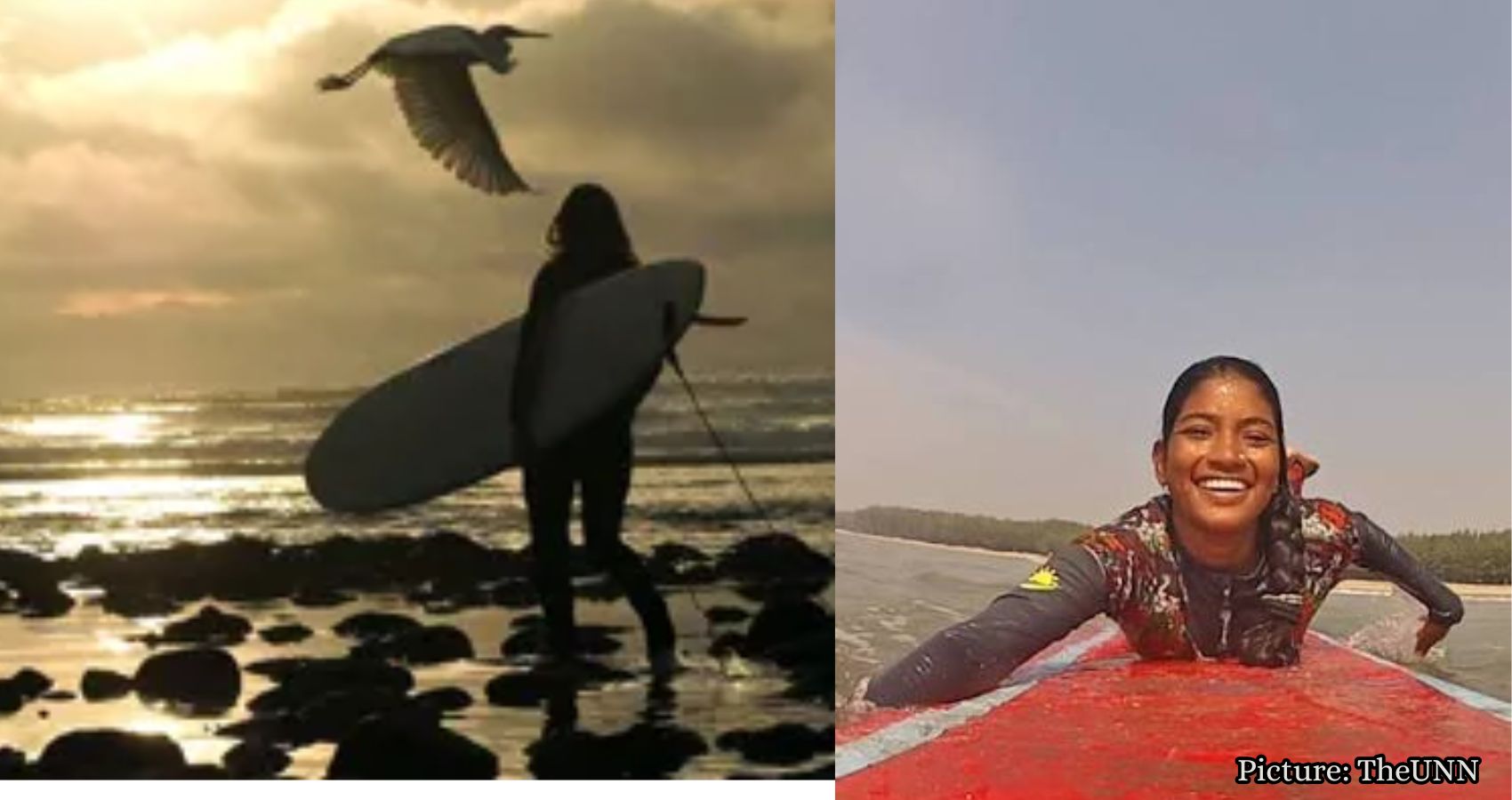
Farhana Huq’s ‘Brown Girl Surf’ is transforming surf culture by amplifying the voices of women from underrepresented backgrounds and promoting sustainability and community engagement.
Farhana Huq grew up just minutes from the New Jersey Shore, yet the ocean never felt like a place where she belonged. Her early love for nature was nurtured by her father, who took her fishing, built a treehouse in their backyard, and encouraged her curiosity about the outdoors. However, surfing always seemed out of reach for Huq, not due to the waves, but because she didn’t see women who looked like her in the water.
“There weren’t really places to learn surfing unless you were born into a surfing family,” Huq, the daughter of Pakistani and Bangladeshi immigrants, shared in a Rooted Unmuted interview. “And girls really didn’t surf.”
In response to this lack of representation, Huq founded Brown Girl Surf, initially a storytelling platform aimed at amplifying the voices of women surfers from underrepresented backgrounds. Over time, it has evolved into a broader social enterprise focused on sustainability, climate action, ethical beauty, and community building.
Despite its growth, Huq emphasizes that the core mission remains unchanged: to create the representation she lacked while growing up.
Huq describes her upbringing as a blend of cultural reinvention. Her mother, who immigrated from Bangladesh, escaped an arranged marriage at the age of 15 before starting anew in the United States. “She was one of the first women in our family to really break conventional barriers,” Huq recalled. “But she still held onto her traditions and values.”
This duality shaped Huq’s worldview early on. She balanced South Asian traditions at home with a very different culture outside, all while being raised in a family that encouraged girls to pursue their passions—an opportunity many women do not have.
As a teenager, Huq became the first South Asian girl to join the U.S. National Karate Team. Her time at Tufts University and her experiences in post-apartheid South Africa heightened her awareness of the challenges many women face globally. “I realized very early that life looked very different for girls around the world,” she said.
Motivated by this realization, she founded C.E.O. Women, a nonprofit dedicated to helping low-income immigrant and refugee women become entrepreneurs. Over a decade, she led the organization, working with more than 2,000 women.
However, the demands of running the nonprofit took a toll on Huq’s health. She found herself gaining weight, feeling sluggish, and ultimately depleted despite the organization’s success. “I had this strong desire to reconnect with my health and my body,” she explained.
Huq’s journey into surfing began during a trip to Hawaii, where she humorously recalls her initial struggles. “I sucked. I mean, really sucked,” she said. Yet, the ocean continued to draw her in.
She later traveled to Costa Rica to dedicate herself to surfing, eventually falling in love with the sport while surfing in Northern California. “Something felt so empowering about being able to maneuver through the ocean, catch a wave, and ride it,” she reflected.
Surfing became a space for Huq to reconnect with herself emotionally and creatively after years of burnout. It offered her a sense of risk, adventure, and ownership over her body—elements not always encouraged for South Asian women.
A pivotal moment came after a year-long surf sabbatical around the world, when doctors discovered several cysts in her body. Although they were small, the experience prompted Huq to reevaluate her life. “My first instinct was, ‘I have to surf and live in the moment now,’” she said.
During her research, Huq stumbled upon an article about India’s first female surfer, sparking her curiosity. “I was fascinated,” she said. “I wanted to know who she was, how she did it, and how she got her family’s acceptance.”
As she delved deeper, Huq discovered women in countries like India, Bangladesh, China, and Gaza quietly breaking barriers through surfing, despite facing social expectations and cultural restrictions. These stories became the foundation of Brown Girl Surf: creating representation instead of waiting for it.
Initially, Brown Girl Surf focused on amplifying the voices of women surfers from underrepresented backgrounds. “We need examples of living possibilities,” Huq stated. “When people see someone else doing something they never thought was possible, they start believing they can do it too.”
As Brown Girl Surf expanded, so did its impact. Huq traveled internationally to document female surfers’ stories, helped launch collaborative surf programs, and built networks connecting women across different cultures.
“There weren’t a lot of role models that looked like me,” she noted.
Brown Girl Surf transcended surfing; it challenged assumptions about who gets to occupy space and pursue unconventional passions. During the pandemic, Huq found herself stranded in Morocco for nineteen months. Struggling to find suitable products for her sun-bleached hair and dehydrated skin, she began experimenting with solutions herself. What started as upcycled soap bars sold out of a basket at surfer parking lots evolved into a sustainable beauty line now available in retail stores across California.
One of Brown Girl Surf’s latest products, Nilotica Surf Cream, utilizes Nilotica shea sourced from a women’s cooperative in Uganda, emphasizing fair wages and economic opportunities for women and their communities.
For Huq, sustainability is more than just branding; it is a matter of responsibility and community. “Climate, community, and surf culture are all connected,” she asserted.
This commitment deepened after becoming a climate fellow through Terra.do, where she studied climate adaptation and connected with a network of climate-focused organizers and entrepreneurs.
In 2012, Huq received a $500 Amber Grant to help launch Brown Girl Surf as a storytelling platform supported by a small T-shirt line. Fourteen years later, she received another Amber Grant, this time a $10,000 award to support the next evolution of Brown Girl Surf’s sustainable skincare and haircare line. For Huq, this moment felt symbolic. “It’s amazing to be back,” she said.
The return of the same grant organization years later symbolizes something larger about Brown Girl Surf itself: longevity. What began as a woman striving to create representation in spaces where she felt invisible has evolved without losing its original purpose.
Huq encourages young South Asians to embrace their unique paths. “A lot of us grow up feeling like we have to follow a very specific path,” she said. “But I think there’s also value in listening to the thing that keeps pulling at you.”
She advises young people not to recklessly romanticize risk. “Don’t go all in immediately,” she cautioned. “Build a solid footing while you’re figuring things out.”
Ultimately, Huq hopes Brown Girl Surf serves as a reminder that if young people don’t see themselves represented, they don’t have to wait for permission to belong. Sometimes, they must create that space themselves. “We need more examples of people living boldly,” she concluded. “That’s how possibility spreads.”
According to India Currents.