
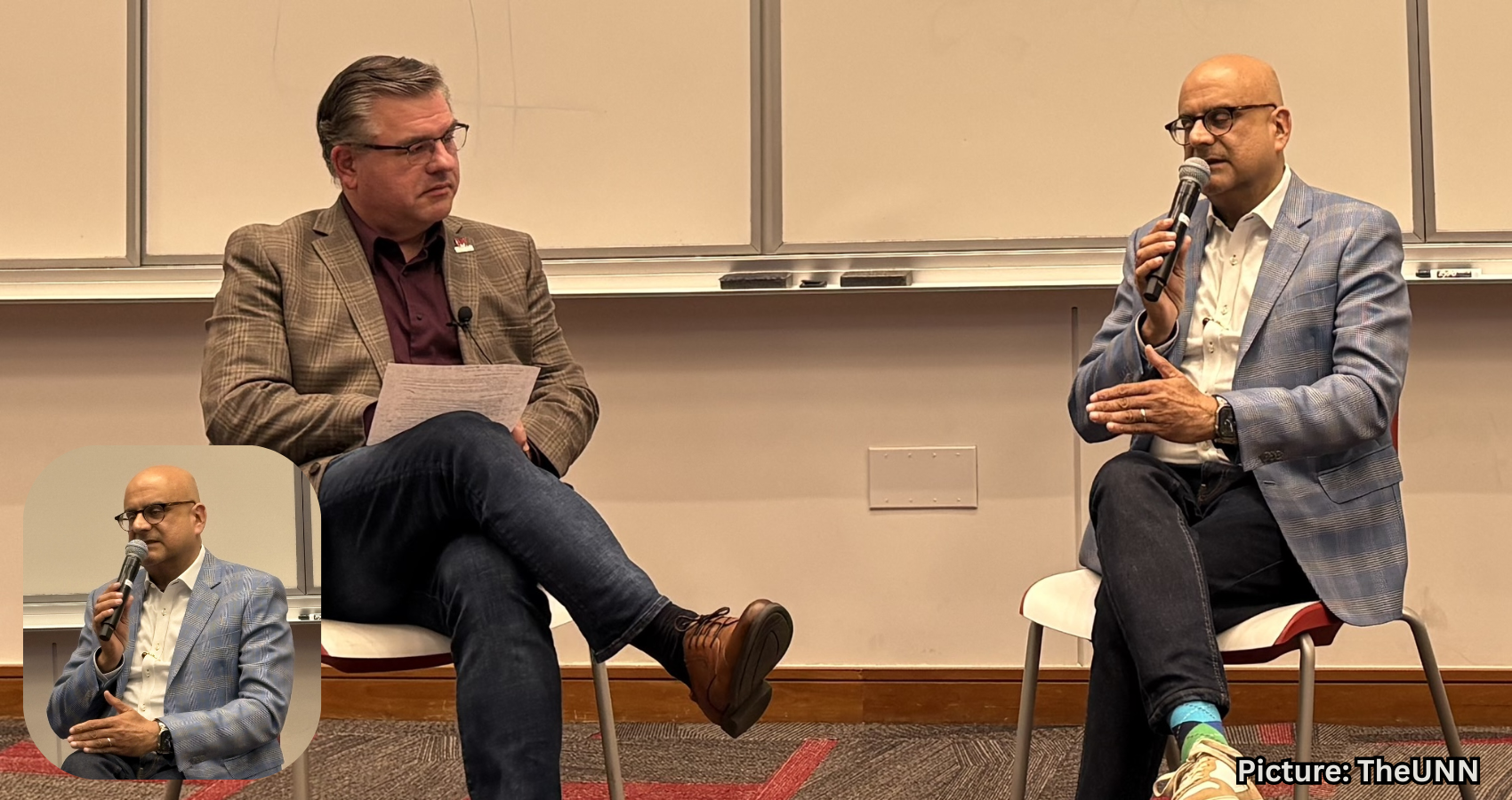
Deepak Hathiramani shared valuable insights on scaling businesses and achieving successful exits for entrepreneurs in the government contracting sector during a recent event at the University of Maryland.
At the recent “Startup Bazaar: GovCon” event held at the University of Maryland in College Park, Deepak Hathiramani, founder of Vistronix Intelligence and Technology Solutions, offered a wealth of knowledge for aspiring entrepreneurs in the government contracting sector. Speaking on June 13, Hathiramani shared his experiences and lessons learned from over three decades of building, scaling, and eventually exiting businesses.
The fireside chat, moderated by Michael Hoffmeyer, managing director of the Dingman-Lamone Center for Entrepreneurship at the university’s Robert H. Smith School of Business, addressed a critical question for entrepreneurs: What does it take to build a company that can successfully scale and achieve a meaningful exit?
Hathiramani emphasized a fundamental principle for entrepreneurs: “There is no right way of doing the wrong thing.” He underscored the importance of integrity in business, stating, “Creating a culture with unquestionable integrity and ethics is absolutely paramount.” His insights were shaped by both successes and setbacks throughout his career.
Originally from Africa and raised in India, Hathiramani moved to the United States with dreams of entrepreneurship. After gaining experience at various startups, including one that successfully exited and another that went public before collapsing, he founded a government contracting company in 1990. However, the path was fraught with challenges.
Hathiramani recounted how he grew his business to approximately $30 million, only to face near bankruptcy due to strategic missteps. The company ultimately survived, he noted, thanks to a strong culture and a solid financial foundation. In 2016, Vistronix was acquired by ASRC Federal Holding Company.
Reflecting on his journey, Hathiramani identified several key lessons that shaped his entrepreneurial philosophy. One of the most significant was the importance of surrounding oneself with talented individuals who can challenge conventional thinking. “You always want to surround yourself with people who are smarter than you and give them the flexibility to challenge the status quo,” he advised. “That’s how the best idea wins.”
He also highlighted a crucial reality for founders: the team that helps a company reach one stage of growth may not be the right fit for the next phase. “The people who get you from A to B may not be the same people who get you from B to C,” he said, stressing the need for swift decision-making in personnel changes.
Another vital insight from Hathiramani involved the nature of capital. He pointed out that “capital comes in different shades of green,” cautioning entrepreneurs against focusing solely on securing funding without considering the value that investors can bring beyond financial support. This sentiment resonated with Hoffmeyer, who noted the distinction between ordinary capital and “smart money,” which includes strategic guidance and industry expertise.
Hathiramani argued that selecting capital partners is one of the most consequential decisions founders face. “Ensuring that they bring more than just financial capital and bring strategic capital is another important factor,” he said. “The least valuable thing they bring is the capital.”
The discussion also touched on the unique challenges of scaling government contracting businesses. Hathiramani noted that many GovCon firms encounter predictable growth plateaus, often experiencing rapid growth to certain revenue levels before stalling. Vistronix itself reached approximately $200 million in annual revenue, at which point leadership faced a pivotal decision: to pursue aggressive growth or capitalize on favorable market conditions through a sale.
“The next step was, do we take it to $500 million to $1 billion?” Hathiramani recalled. Ultimately, they opted for an exit, weighing the risks associated with further scaling against the strong acquisition interest they were receiving.
Despite having planned to sell the company from the outset, Hathiramani acknowledged the emotional challenges of the process. “It still is a very difficult and emotional process,” he said. “As an entrepreneur, as the leader of a company, you’ve got to be able to separate your emotions from the decisions that drive the business and create value.”
Preparing for life after the sale eased the transition for Hathiramani. Instead of immediately launching another venture, he chose to return to school full-time for about 18 months before pursuing new opportunities.
During the acquisition process, Hathiramani also prioritized ensuring that the acquiring company aligned culturally and strategically with Vistronix. “We wanted to ensure that the employees would be taken care of, their culture aligned with our culture, and that we knew what the long-term strategic plan was,” he explained.
The conversation shifted to the current state of the government contracting market. Hathiramani argued that the era of broad-based IT contracting is coming to an end. “If you look at where the government is emphasizing and spending dollars, being a generalist or a pure IT company is not going to survive in the next five years,” he said. He advised entrepreneurs to become “six inches wide and a mile deep,” focusing on developing deep expertise in specific mission areas rather than trying to serve a broad audience.
As consolidation accelerates across the industry, Hathiramani pointed to long-term trends driving investment in defense and national security technologies, including rising global instability and increasing defense budgets. “The world is not getting any safer,” he remarked. “Most future wars are going to be autonomous.”
Audience members also sought Hathiramani’s insights on trust, leadership, and company culture. He emphasized that trust must be cultivated from the top down, requiring leaders to establish clear expectations and accountability. “Trust starts at the very top,” he said, noting that leaders must demonstrate integrity through their actions.
As the session concluded, entrepreneurs in attendance sought advice on transitioning from subcontractor status to becoming prime contractors and building enterprise value. Hathiramani described subcontracting as a common entry point for GovCon firms but stressed the importance of reinvesting in capabilities and relationships rather than settling for a lifestyle business.
“Our objective was to continue to invest in the business, recruit the right people, develop the relationship with the right customers, understand their mission, and then position ourselves with the right contracts,” he explained.
In closing, Hathiramani reiterated key themes from the discussion: integrity, culture, focus, and the importance of surrounding oneself with talented individuals. For founders contemplating their own exits in the future, he offered a succinct summary: “Integrity and ethics are paramount. Culture is absolutely critical. And surrounding yourself with people who are smarter than you is absolutely critical.”
The event marked the third annual Startup Bazaar at UMD, building on the success of previous gatherings and featuring a keynote address by Atif Chaudhry, Maryland’s Secretary of General Services, who discussed how businesses can collaborate with government agencies.
These insights from Hathiramani provide a roadmap for entrepreneurs navigating the complex landscape of government contracting, grounded in decades of hard-earned experience, according to The American Bazaar.