
Centre Proposes Inclusion of Traditional Medicine in WHO’s List

In a bid to gain global recognition for India’s traditional medicine, the Indian government has made a formal request for the inclusion of Ayurveda and related systems in the 11th revision of the World Health Organization’s International Classification of Diseases (ICD). This move is aimed at establishing a standardized language that can be utilized by healthcare professionals worldwide.

Vaidya Rajesh Kotecha, the Secretary of the Ministry of Ayush, emphasized the significance of this proposal, underscoring that it would play a crucial role in effectively regulating and integrating traditional medicine into the existing healthcare system. He shared his thoughts in an interview with The Hindu.

The envisioned inclusion of the second module for Ayurveda in ICD-11 is anticipated to streamline research and evaluation processes, ultimately establishing its efficacy within the global healthcare framework. This development follows the successful integration of Module-1, covering traditional medicine conditions originating from ancient China, into ICD-11.

The digitization of ICD-11 is an essential aspect of this effort, and the proposed integration of Ayurveda is seen as a major stride towards achieving various goals. It is expected to lead to better insurance coverage, improved reporting of adverse events, and the alignment of traditional medicine practices with global healthcare standards.
The Ministry of Ayush is actively involved in the development of Module-2, drawing upon the knowledge and experiences gained through the National Ayush Morbidity and Standardized Terminologies Electronic portal and the Ayush Health Information Management System.

This initiative is not just limited to the inclusion of Ayurveda in a global classification system; it is expected to have far-reaching implications. It is poised to facilitate the integration of traditional medicine into mainstream health information systems, bridging the gap between traditional and modern healthcare practices. Additionally, it aligns with the objective of achieving universal health coverage, a vision endorsed by the World Health Organization.

The proposed inclusion of Ayurveda and related traditional systems in the 11th revision of the International Classification of Diseases (ICD) is a significant step in promoting these age-old healthcare practices on a global scale. This initiative, led by the Indian government, is aimed at providing a common language for healthcare professionals worldwide to better understand and integrate traditional Indian medicine.

Vaidya Rajesh Kotecha, the Secretary of the Ministry of Ayush, highlighted the importance of this move. He emphasized that it would not only support the effective regulation of traditional medicine but also facilitate its integration into the existing healthcare system. This integration is crucial for ensuring that traditional Indian medicine, including Ayurveda, can coexist harmoniously with modern healthcare practices.

The proposed inclusion of the second module for Ayurveda in ICD-11 is expected to have several positive outcomes. It will streamline research and evaluation processes, allowing for a more comprehensive understanding of the effectiveness of Ayurveda and related systems in the context of global healthcare.

ICD-11 has already successfully included Module-1, which covers traditional medicine conditions originating from ancient China. With the digital transformation of ICD-11, the integration of Ayurveda is a significant step forward. It is anticipated to lead to better insurance coverage for traditional Indian medicine, improved reporting of adverse events, and the alignment of traditional healthcare practices with global healthcare standards.

The Ministry of Ayush is actively involved in the development of Module-2, drawing upon the experiences and knowledge gained through the National Ayush Morbidity and Standardized Terminologies Electronic portal and the Ayush Health Information Management System. This involvement demonstrates the government’s commitment to ensuring that Ayurveda and related systems are well-represented in the global healthcare classification system.

Furthermore, this move goes beyond the mere inclusion of Ayurveda in a classification system. It is expected to promote the seamless integration of traditional Indian medicine into mainstream health information systems. This integration will bridge the gap between traditional and modern healthcare practices, creating a more holistic approach to healthcare.

In line with the vision of the World Health Organization, this initiative aligns with the objective of achieving universal health coverage. By recognizing and standardizing traditional Indian medicine, it takes a step closer to making healthcare accessible to all. This is a noteworthy development that has the potential to positively impact the global healthcare landscape.
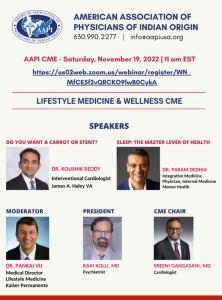
AAPI Holds Lifestyle Medicine & Wellness CME

“Lifestyle medicine is the simplest yet most powerful approach to true health and healing,” said Dr. Ravi Kolli, President of the American Association of Physicians of Indian Origin (AAPI) while setting the context for the Lifestyle Medicine & Wellness Webinar organized on November 19th, 2022. “We understand that well-being is more than the absence of disease. It’s our hope that by attending this very important webinar today, we all will experience the transformative power of using everyday choices and habits to achieve peak performance and well-being.”

Dr. Sreeni Gangasani, AAPI’s CME Chair, while welcoming the nearly 200 AAPI members who attended the webinar, introduced Dr. Koushik Reddy, who is passionate and deeply committed to the idea of health promotion and disease prevention, using lifestyle and nutrition-related tools, and, Dr. Param Dedhia, a dedicated internal and integrative medicine practitioner, who is a board-certified Integrative Medicine Physician, Internal Medicine Doctor, Obesity Medicine Expert, and Sleep Medicine Specialist, who led the discussions today on Lifestyle Medicine and Wellness.

“I Have a Carrot and a Stent, You Pick!,” Dr. Koushik R. Reddy, director of interventional cardiology at the James A Haley VA Medical Center in Tampa, FL, challenged a record over 200 Physicians who had joined the webinar on weekend morning.  Dr. Kaushik Reddy emphasized the importance of a fundamental diet, physical activity, and other lifestyle approaches in the primordial and primary prevention of many NCDs that can easily be prevented through simple day-to-day choices.

Dr. Koushik Reddy argued that our healthcare system is really a disease management system, but we still have some agency. He shared with AAPI members several pillars he believes will help each of us have a happy, long healthy life. In his address, he said, he is deeply committed to the idea of health promotion and disease prevention, using lifestyle and nutrition-related tools. It is with this passion and commitment, he boldly challenges his patients with – “I have a carrot and a stent, you pick!”

Picture : TheUNN

Dr. Reddy said Lifestyle medicine-certified clinicians are trained to apply evidence-based, whole-person, prescriptive lifestyle change to treat and, when used intensively, often reverse such conditions. Applying the six pillars of lifestyle medicine—a whole-food, plant-predominant eating pattern, physical activity, restorative sleep, stress management, avoidance of risky substances, and positive social connections—also provides effective prevention for these conditions. Dr. Reddy discussed the flaws and opportunities inherent in our healthcare system as it relates to heart health. He spoke about the power of plant-based nutrition and lifestyle medicine, and how he incorporates those principles into his current practice.

Both the quality of life and the quantity of life, are inseparable components of a Good Lifestyle, he said. Pointing to how in 1920, the life expectancy was 42, and in 202o, it has nearly doubled to 78. While the quantity of life has increased tremendously, the quality of life has suffered greatly. “While we are living longer, we are also dying longer due to illnesses.”  Dr. Reddy pointed out that the United States is not among the healthy nations of the world because “We are failing the system.” In his efforts to spread the message, he said, “I am happy to work with AAPI and help spread the message of Lifestyle Medicine beyond AAPI and to back home in India.”

Dr. Reddy, after practicing interventional cardiology for ten years, changed his focus towards cardiovascular health promotion and disease prevention, using lifestyle and nutrition-based strategies. He is a member of the American College of Cardiology’s working group on nutrition and lifestyle and is board certified in Cardiology, Interventional Cardiology, and Lifestyle Medicine. He is closely involved with the department of Whole Health at the Tampa VA hospital. Working in partnership with the local Whole Health leadership, he established two preventive cardiology clinics. “HEAL – Healthy Eating and Living – Introductory Program. CALM – Comprehensive Approach to Lifestyle Medicine – 6 weeks of the multidisciplinary program.”

In his insightful address on “Sleep, The Master Lever Of Health,” Dr. Param Dedhia, who had his education at Johns Hopkins University and Canyon Ranch, which allowed him to bridge eastern and western philosophies, and connect traditional wisdom to modern science, is the Founder & Medical Director of Moveo Health, a personalized health program focused on longevity, shared at length some valuable lessons and words of wisdom on the importance of staying curious and honoring our health.

Referring to Sleep Medicine in the United States as only 40 years old, Dr. Dedhia stressed the importance of sleep in our daily lives and said, “Sleep is about restoring.” He said, “Sleep evolves through adulthood. So, we must evolve our lifestyles to promote sleep. According to him, “Most adults need 7-9 hours” of sleep daily. In his address, he pointed to the function & promise of sleep, which Restores, and Cools the brain and body. It helps regulate ion channels and optimizes physiological growth. Sleep is Anti-Inflammatory, as it helps reduce inflammatory markers. Sleep improves one’s mood, by soothing emotions & mental fatigue.
Sleep is “Actively cardio-protective and Enhances neuro-plasticity.” Another important function of Sleep is to help “Improve memory formation & consolidation.” Sleep “connects us physically, mentally & emotionally” and helps us “Replete energy stores.”

Dr. Dedhia, who continues to pursue his passion and be an advocate for people to live their best lives, quoting scientific studies and evidence-based research, Dr. Dedhia said, “Rx for optimal sleep & health are: (1) Quantity and (2) Quality, which are determined by ‘Daytime Lifestyle’ and ‘Nighttime Sleep,’ by creating ‘Night Time Rituals’ that last a lifetime.”

Dr. Sreeni Gangasani, AAPI CME Chair, said, with the rapidly worsening trends in Chronic Lifestyle Related Non-communicable diseases across the world stemming from modern food and diet practices, inadequate physical activity, poor sleep, worsening stress, poor social relationships, and risky substances abuse – healthcare systems across the world are now inundated with premature and preventable mortality and morbidity from these NCDs. In this context, “Today’s webinar is filled with inspiring and informative talks and presentations by two great speakers that shed the light on the importance of lifestyle interventions as the primary mode of prevention.

In his vote of thanks, Dr, Pankaj Vu, Director of Lifestyle Medicine at Kaiser Permanente, while expressing gratitude to the internationally renowned speakers for their inspiring discussions on Lifestyle Medicine and for AAPI members for being part of this important session said, said, “In support of physician well-being and self-care, such sessions are being offered to the AAPI members, families and friends.”

In his remarks, Dr. Satheesh Kathula, Vice President of AAPI, while referring to the importance of the Webinar, said, “It is well established that evidence-based clinical nutrition and lifestyle practices play a pivotal role in the prevention, treatment, and potential reversal of various common chronic diseases. However, this area of science is underappreciated at all levels of medical education and training. Most medical schools and residency programs do not offer any organized training in nutrition and lifestyle medicine. Given recent data on the rising cost and loss of quality of life secondary to preventable causes, there is an absolute need for a drastic reform of the US medical education system.” Fort more details on AAPI, please visit: www.aapiusa.org

Kids Ages 5-11 Are Now Eligible For Covid Vaccine

An FDA panel of independent advisers to the Food and Drug Administration is recommending that the agency issue an emergency use authorization for the Pfizer-BioNTech vaccine in children ages 5 to 11 years old. The panel voted unanimously to recommend emergency use authorization of Pfizer’s Covid-19 on Tuesday, October 26th.

The FDA panel accepted Pfizer’s data indicating the vaccine is safe and 90.7% effective in preventing COVID-19 infections in this age group. Members of the FDA’s Vaccines and Related Biological Products Advisory Committee agreed the benefits of vaccinating younger children appeared to outweigh the risks, but some members appeared troubled about voting to vaccinate a large population of younger children based on studies of a few thousand.

“It is reassuring to me that we are giving a lower dose,” said Dr. Paul Offit, who directs the Vaccine Education Center at Children’s Hospital of Philadelphia.

Pfizer has cut its vaccine to one-third of the adult dose for the children under 12 and said clinical trials showed this lower dose protected children well against symptomatic infection. The hope is it will cause fewer side-effects. Accordingly, a dose of Pfizer for young children will contain one-third the amount of active ingredient compared to the adult dose. Children would receive a second dose 21 days or more after their first shot.

Children 5-11 years of age have accounted for approximately 9% of reported COVID-19 cases in the U.S. overall, and currently account for approximately 40% of all pediatric COVID-19 cases, says Dr. Doran Fink, clinical deputy director of the division of vaccines and related products for the FDA. Currently, the case rate among children ages 5 to 11 is “near the highest” of any age group, he says.

The committee’s recommendation comes as more than 1.9 million cases have been reported among children ages 5-11, with approximately 8,300 children hospitalized to date, according to the CDC. About one-third of these hospitalized children required treatment in the ICU. The rate of hospitalization is three times higher among children of color than among white children.

Unvaccinated children with COVID-19 can develop a serious complication called multisystem inflammatory syndrome or MIS-C, as well as an inflammation of the heart muscle called myocarditis.

Myocarditis occurs naturally after infections with other viruses and it has also been seen as a rare side effect after vaccination with the two mRNA vaccines, Pfizer and Moderna, especially in young men. Myocarditis was a focus of the scientific presentations and discussion on the possible risks of the vaccine if authorized for young children.

Overall, the incidence of serious adverse events reported in Pfizer’s studies was less than 2 in 1,000, Ball said, and all were found to be unrelated to the vaccine. Less serious side effects occurred more often, including swollen lymph nodes in a few children and symptoms like pain at the injection site, fatigue and headache, she said.

Capt. Amanda Cohn, a physician and medical officer with the CDC and also a voting member of the FDA committee, said that the number of children in the Pfizer studies is similar to the number that has been used to approve other childhood vaccines. “I don’t want to minimize the risk,” Cohn told the committee during a debate over the vote. “At this moment, based on the totality of the evidence, the benefits do outweigh the risk,” she said.

The agency typically goes along with the advice of its expert panels, though it isn’t bound to do so. It will issue a decision within the next several days. If the FDA authorizes the vaccine for these younger children, as seems likely, another panel of experts advising the Centers for Disease Control and Prevention would make its own recommendations and offer guidelines next week on its use among this age group.

The vaccine provides a broad defense against COVID-19 and “effectively neutralized the delta variant” in young kids, said Dr. William Gruber, senior vice president of vaccine clinical research and development at Pfizer, speaking during the committee hearing.

Gruber said the dose size was chosen to “strike the right balance” between providing strong immunity and limiting side effects. He said that the observed adverse effects seen in the company’s studies “did not suggest any safety concerns.” An FDA review supported that conclusion.

The FDA will now take the committee’s vote under consideration and is likely to extend EUA to the vaccine for younger children in the coming days. Then vaccine advisers to the US Centers for Disease Control and Prevention will meet next week, November 2-3, to discuss the decision and decide whether to recommend that US kids get the vaccine. The final word will lie with CDC Director Dr. Rochelle Walensky, and vaccination could begin next week if she gives the go-ahead.

-+=