
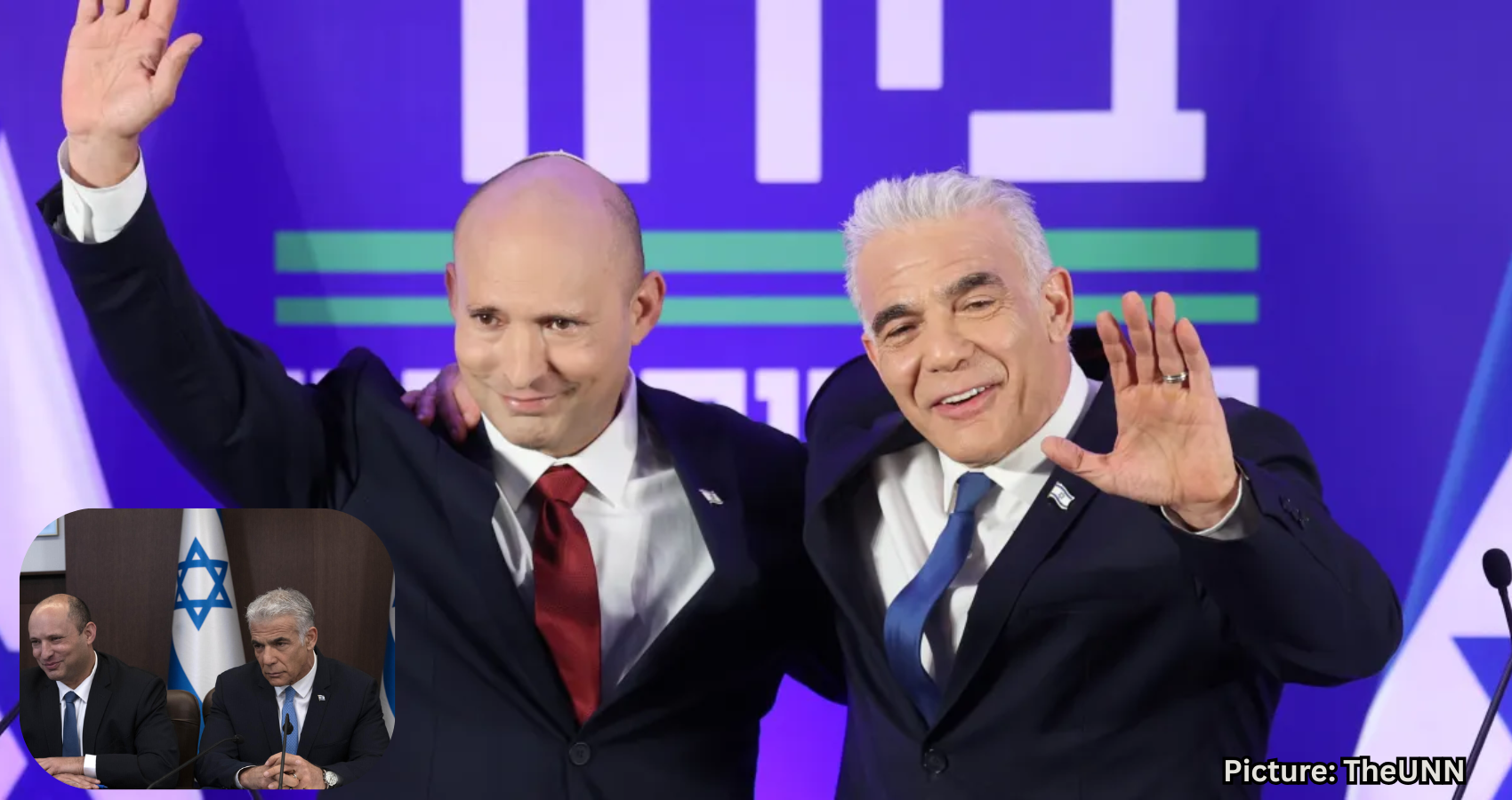
Former Israeli Prime Ministers Naftali Bennett and Yair Lapid have announced a merger of their political parties to challenge Prime Minister Benjamin Netanyahu in the upcoming elections.
In a significant political maneuver, former Israeli Prime Ministers Naftali Bennett and Yair Lapid have declared their intention to merge their political parties, aiming to form a unified front against Prime Minister Benjamin Netanyahu in the upcoming elections. This announcement, made on Sunday, represents a crucial step towards consolidating a fragmented opposition that has struggled to mount a cohesive challenge to Netanyahu’s longstanding leadership.
The two leaders previously served together in a coalition government formed in 2021, which marked the end of Netanyahu’s 12-year tenure. Under a rotation agreement, Bennett initially served as prime minister, followed by Lapid, who took the reins for the final six months of the coalition’s existence. However, their partnership was short-lived, ultimately fracturing due to internal ideological differences. Following the dissolution of their coalition, Netanyahu’s party regained power, further complicating the political landscape in Israel.
In an official statement, Lapid’s Yesh Atid party emphasized the rationale behind the merger, stating, “The move is intended to unite the bloc, put an end to internal divisions, and focus all efforts on winning the critical upcoming elections.” This declaration reflects a growing recognition among opposition leaders of the urgency to rally support and present a unified alternative to Netanyahu’s administration.
The political environment in Israel has been characterized by frequent elections and coalition governments, particularly in recent years. The coalition that Bennett and Lapid formed in 2021 was notable for its diversity, bringing together parties from various parts of the political spectrum. Their alliance was primarily forged out of a common goal: to oust Netanyahu from power. Bennett, who represents a right-wing Orthodox perspective, and Lapid, known for his centrist and secular views, demonstrated that leaders with differing ideologies can collaborate when faced with a shared adversary.
Despite their successful collaboration during their brief time in office, substantial ideological differences persist between Bennett and Lapid. Bennett is known for his hard-line stance on issues related to the Palestinians, while Lapid adopts a more moderate approach. Nonetheless, their previous cooperation indicates a willingness to prioritize the common goal of challenging Netanyahu over their individual political philosophies.
The current political climate in Israel is marked by heightened tensions and uncertainty as the next elections approach. Netanyahu’s government has faced criticism domestically and internationally over its handling of key issues, including security policies and relations with Palestinians. His return to power has reignited debates over longstanding grievances within Israeli society, particularly the divisions between secular and religious communities.
Lapid has served as the opposition leader since the dissolution of the coalition, consistently voicing critiques of Netanyahu’s policies and decisions. Meanwhile, Bennett’s retreat from politics after leaving office was interpreted by some analysts as a temporary pause rather than a permanent exit. His return to the political arena, alongside Lapid, suggests a recalibration of strategies among opposition factions in light of the impending elections.
The merger of Bennett and Lapid’s parties could have significant implications for the upcoming elections. By pooling their resources and support bases, they aim to enhance their electoral prospects against Netanyahu, who has maintained a robust following among Israeli voters. Political analysts suggest that a united opposition could attract voters who are disillusioned with Netanyahu’s leadership yet hesitant to support any single political party.
As Bennett and Lapid prepare for a joint news conference later on Sunday to outline their vision and strategy, the evolving political landscape in Israel remains fluid. The decision to merge not only signifies an effort to consolidate opposition forces but also highlights the complexities of Israeli politics, where alliances are often formed through necessity rather than ideological compatibility. The effectiveness of this merger will largely depend on their ability to appeal to a broad spectrum of voters while managing the inherent differences that exist between their respective parties.
Moreover, the implications of this merger extend beyond the immediate electoral context. A successful alliance between Bennett and Lapid could reshape the future trajectory of Israeli politics, potentially leading to a shift in voter sentiment and a reconfiguration of the political landscape. Observers will be closely watching how this partnership develops and whether it can galvanize a significant movement against Netanyahu’s administration.
As the elections draw nearer, the dynamics within the opposition and the broader electorate will be critical in determining the potential outcomes. Bennett and Lapid’s alliance may represent a pivotal moment in Israeli politics, signaling a possible turning point in the ongoing struggle for political power in the country, according to GlobalNet News.