
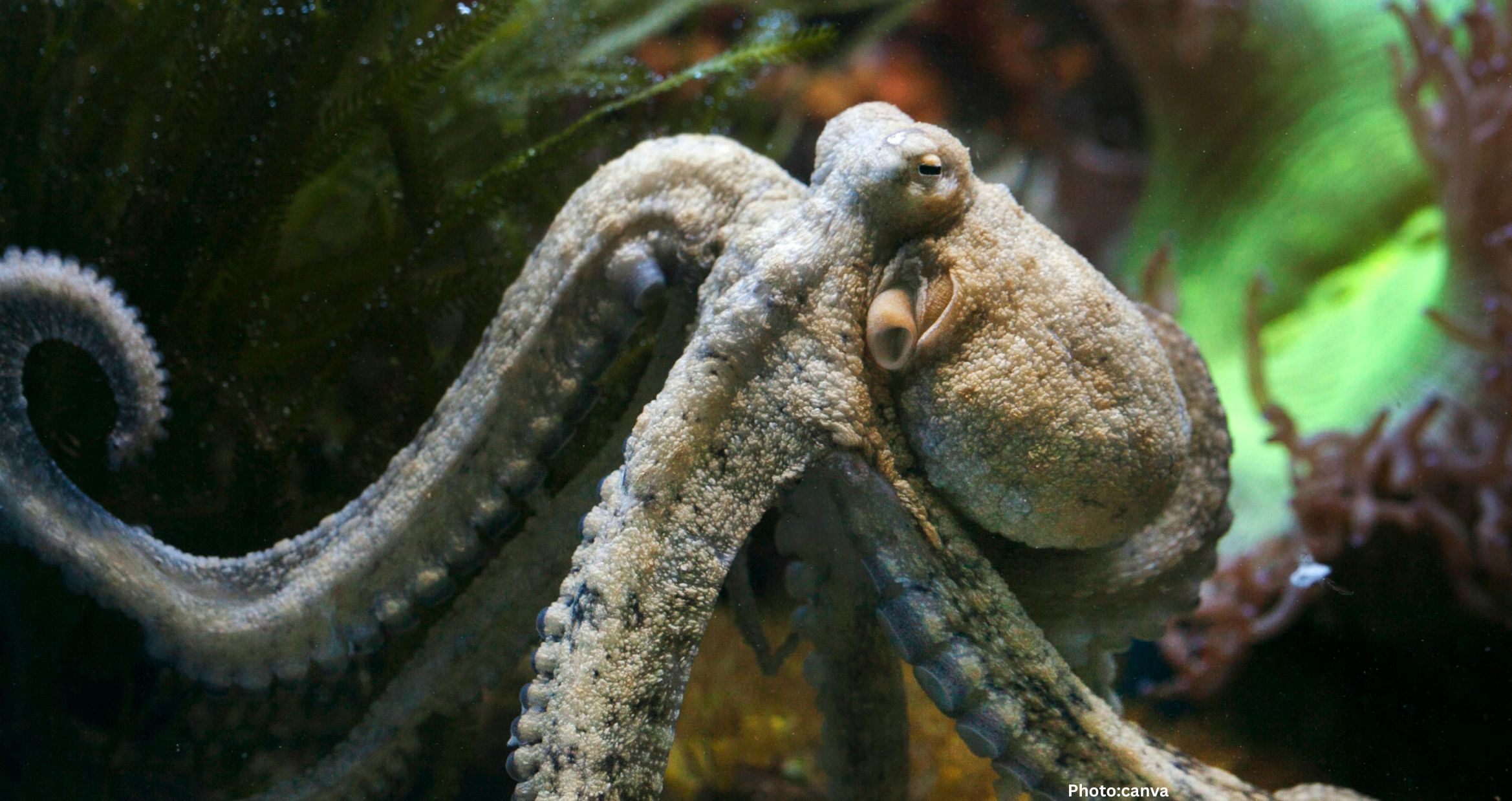
New research reveals that ancient octopuses were formidable predators, utilizing powerful jaws to hunt alongside dinosaurs during the Late Cretaceous period, challenging previous notions of marine food chain dynamics.
Ancient octopuses may have been much larger and more formidable than previously thought, serving as apex predators during the age of dinosaurs. A recent study from Hokkaido University suggests that these early relatives of modern octopuses thrived 100 million years ago, a time when dinosaurs roamed the Earth.
Traditionally, scientists believed that the earliest finned octopuses emerged around 15 million years ago. However, the new findings, published in the journal Science, are based on fossilized jaws discovered in Late Cretaceous rock samples. These fossils were unearthed from seafloor sediments in Japan and Vancouver Island, dating back between 100 and 72 million years.
Due to the soft-bodied nature of octopuses, their fossils are rare, with jaw bones being the primary remnants available for study. This has made tracing their evolutionary history a challenging task. Researchers employed high-resolution grinding tomography and artificial intelligence models to identify these fossilized remains.
The Late Cretaceous period marked the end of the Mesozoic Era, a time dominated by dinosaurs such as Tyrannosaurus rex and Triceratops. The fossils in question belonged to a group of extinct finned octopuses known as Cirrata. These creatures are believed to have used their powerful jaws to crush their prey, indicating a predatory lifestyle.
Professor Yasuhiro Iba of Hokkaido University stated, “Our findings suggest that the earliest octopuses were gigantic predators that occupied the top of the marine food chain in the Cretaceous.” He noted that these ancient octopuses could reach lengths of nearly 20 meters, potentially surpassing the size of large marine reptiles from the same era.
One of the most intriguing aspects of the research was the condition of the fossilized jaws. Iba highlighted the significant wear observed, including chipping, scratching, and cracking. “In well-grown specimens, up to 10% of the jaw tip relative to the total jaw length had been worn away, which is larger than that seen in modern cephalopods that feed on hard-shelled prey,” he explained. This wear suggests that these ancient predators engaged in aggressive feeding strategies, indicating repeated and forceful interactions with their prey.
The implications of this research challenge the long-held belief that vertebrate predators dominated the Late Cretaceous marine ecosystems, relegating invertebrates to a lower position in the food chain. “This study provides the first direct evidence that invertebrates could evolve into giant, intelligent apex predators in ecosystems that have been dominated by vertebrates for about 400 million years,” Iba added.
The findings underscore the significance of powerful jaws and the evolutionary loss of superficial skeletons, traits common to both octopuses and marine vertebrates, in the development of large, intelligent marine predators.
As research continues to uncover the complexities of ancient marine life, these revelations about the size and predatory nature of early octopuses offer a fascinating glimpse into the dynamics of prehistoric ecosystems.
According to Hokkaido University, this study reshapes our understanding of the role of invertebrates in the marine food chain during the Late Cretaceous period.