
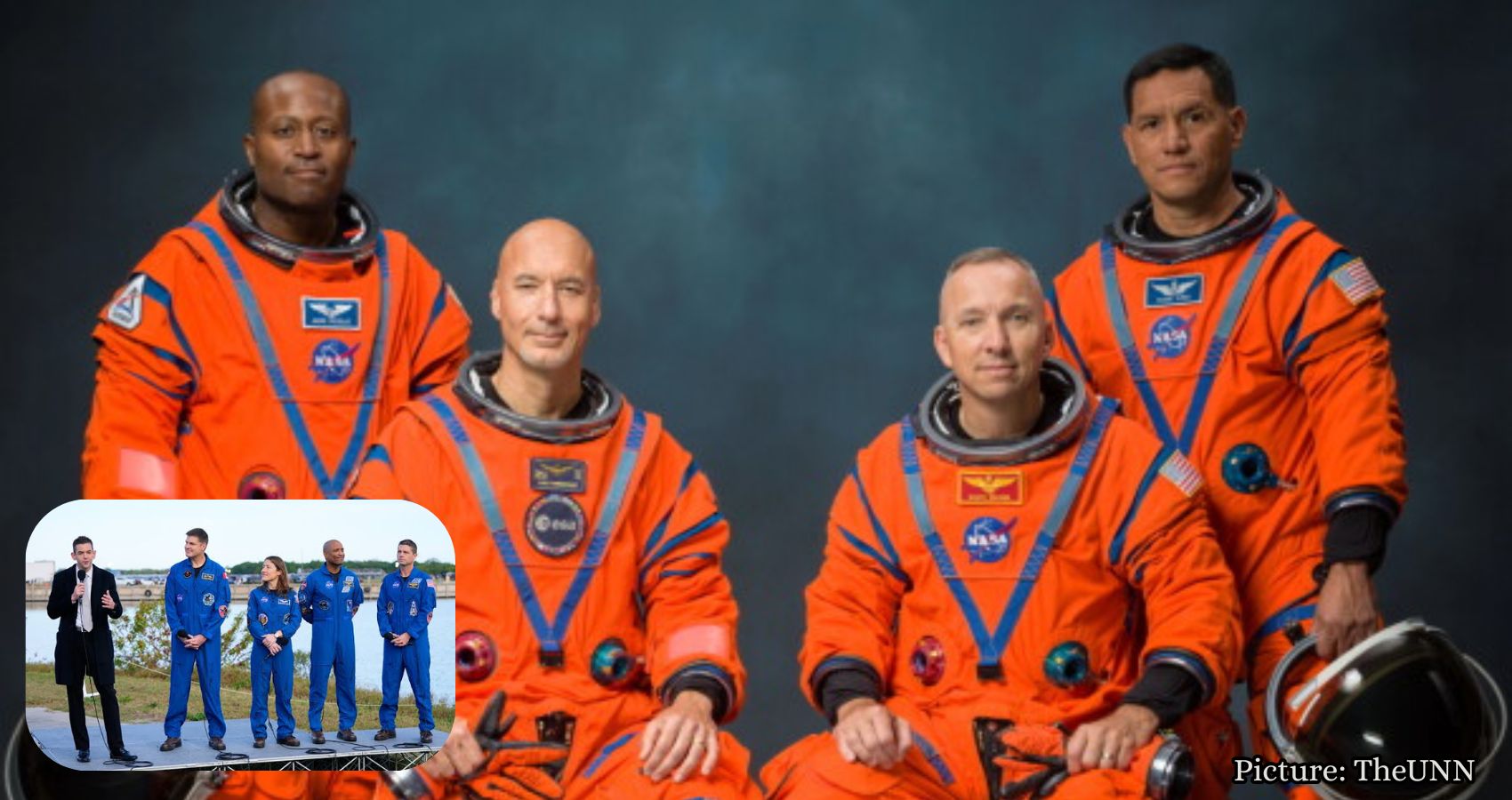
The Artemis II crew reflects on their historic lunar flyby, emphasizing their mission to connect with humanity and inspire future space exploration.
The Artemis II crew recently shared their experiences following a groundbreaking 10-day lunar flyby during a discussion with U.S. Ambassador to the United Nations Mike Waltz. The mission, which concluded with their return to Earth on April 10, was described by the astronauts as a “glorious” experience.
Comprising Reid Wiseman, Victor Glover, Christina Koch, and Jeremy Hansen, the crew made history by setting a new record for the farthest distance traveled by humans in space, surpassing the previous mark established by Apollo 13 in 1970. Their splashdown occurred off the coast of San Diego, marking a significant milestone in human space exploration.
During their conversation with Waltz, the ambassador presented the crew with “MUNGA” hats, an acronym for “Make the U.N. Great Again,” inspired by former President Donald Trump’s “Make America Great Again” slogan. The discussion turned to the crew’s reflections on their journey, particularly the view of Earth from space.
“As a crew, we wanted to go for all and by all,” Wiseman stated at the U.N. headquarters in New York. “We wanted to set the stage for Artemis III. We wanted to get this space agency in this world ready for Artemis III and IV. But in the end, we really wanted to connect with humanity. We wanted humanity to just pause for a second and see that this world can still do something exceptionally well when they put their mind to it.”
Artemis III is anticipated to launch next year, followed by Artemis IV the subsequent year. Glover elaborated on the emotional spectrum experienced during the mission, noting that the feelings were not uniform throughout the journey. “What we saw out the window was changing, and that is one of the unique things,” he explained. “I always felt the urge to just be grateful for what we were seeing, and to be grateful for what we were eventually going back to.”
Koch shared her perspective on viewing Earth from space, describing how the surrounding darkness made the planet feel “even more special than it’s ever been.” She remarked, “Instead of this absolute background that just exists everywhere for us, because that’s all we’ve had, it makes the lines that we redraw on it seem big and important. You realize that actually, there’s nothing absolute or guaranteed about this, and that there is such thing as a global scale.”
Hansen reflected on the vastness of space, expressing feelings of both insignificance and empowerment. “It was like this weird thing where, like stars, some stars look closer in our galaxy than others. And it just kept catching my eye, and it just kept making me feel really tiny, really small as an individual,” he said. “But then, at the same time, I was out there experiencing it, and it made me feel very powerful as a human race. What we can do together, the fact that we were out there and something that has been really heartwarming since we got back to Earth and started to see how many people stopped to watch the mission and resonate with it.”
Glover also recounted the emotional highs of the mission, particularly the “glorious moment” of returning to Earth. The crew’s visit to the U.N. came shortly after their meeting with Trump at the White House, where he had spoken to them while they were orbiting the moon in early April.
NASA Administrator Jared Isaacman took the opportunity to acknowledge the progress made since the inception of the Artemis program, which was established by Trump. “In fact, in just 2020, President Trump established the Artemis Accords. Now, the initial framework was an agreement of principles between the United States and seven other like-minded countries on the responsible exploration of space,” he noted.
The Artemis II mission not only set records but also aimed to inspire future generations and foster a sense of global unity through space exploration. As the crew members continue to reflect on their journey, their message resonates: humanity can achieve remarkable things when it comes together with a shared purpose.
According to Fox News, the Artemis II crew’s mission serves as a testament to the potential of collaborative efforts in space exploration.