
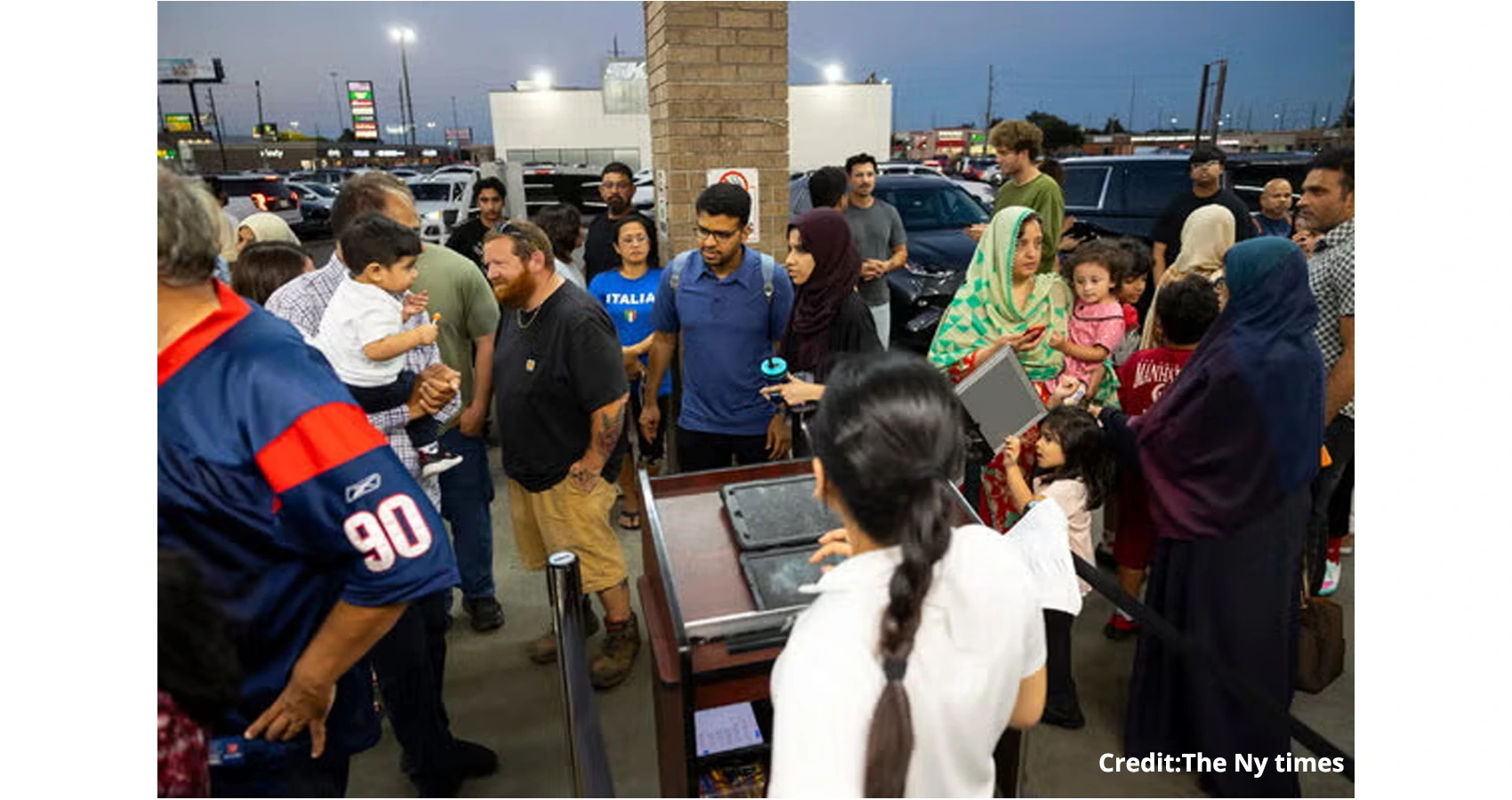
Houston’s Aga’s Restaurant has achieved the remarkable distinction of being the busiest single-location restaurant on Uber Eats worldwide, serving thousands of customers daily.
Aga’s Restaurant, a family-operated Indian-Pakistani establishment located in a Houston strip mall, has made headlines by becoming the busiest single-location restaurant on Uber Eats globally. The restaurant not only handles a significant volume of delivery and takeout orders but also caters to thousands of dine-in customers each day.
Spanning 16,000 square feet, Aga’s serves approximately 4,000 dine-in guests daily while managing around 1,600 takeout and delivery orders, according to a report by The New York Times. The restaurant boasts an impressive annual total of about half a million takeout and delivery orders, contributing to a revenue that reaches well into eight figures.
Uber Eats has confirmed that Aga’s receives more delivery orders than any other single-location restaurant worldwide. This achievement is particularly noteworthy given that Indian and Pakistani cuisine does not rank among Uber Eats’ top three most-ordered cuisines, and Houston itself is not listed among the platform’s leading cities for delivery.
The restaurant’s success has resulted in a constant influx of delivery drivers outside its doors. Gilbert Guajardo, an Uber Eats driver, shared with The New York Times that 99 percent of his delivery orders come from Aga’s, allowing him to earn approximately $50,000 from deliveries over the past two years. Many drivers now focus primarily on delivering from Aga’s due to the steady stream of orders and tips.
Aga’s also processes a considerable number of orders directly from customers. The Maredia family has converted a storage room into a call center, where employees take orders in multiple languages to better serve their diverse clientele.
The Maredia family, comprised of six siblings, acquired Aga’s in 2010 despite lacking prior restaurant experience. Shaukat Maredia, one of the owners, recalled that the restaurant was struggling when they took over. The siblings renovated the space, enhanced the service, and introduced dishes inspired by their Indian and Pakistani heritage.
They incorporated regional specialties such as Hyderabadi gosht and Balti gosht, relying on family members, YouTube videos, and other resources to refine their cooking skills. Initially, the restaurant grew through word of mouth, and by 2013, it had become profitable.
Aga’s biggest breakthrough came during the COVID-19 pandemic. Having started delivery services two years prior, the restaurant saw a surge in demand as customers opted for takeout. To accommodate this increase, Aga’s expanded its kitchen and increased its workforce by approximately 20 percent. Today, the restaurant employs around 200 people, with an average wage of about $20 per hour.
According to Maredia, about 60 percent of Aga’s customers identify as South Asian, while the remaining 40 percent come from various backgrounds. This diverse clientele is a key factor in the restaurant’s popularity.
Bao Ong, a restaurant critic for the Houston Chronicle, named Aga’s the city’s best restaurant in 2025, attributing its appeal to Houston’s multicultural population. Research from Rice University’s Kinder Institute for Urban Research indicates that the Houston area is home to approximately 655,000 South Asian residents.
Aga’s has maintained a focus on authentic Indian and Pakistani flavors rather than altering its menu to cater to mainstream tastes. Its offerings include a variety of dishes such as nihari, kebabs, goat chops, biryani, Hyderabadi gosht, and Balti gosht.
During peak hours, the restaurant can become extremely crowded, with hundreds of patrons waiting for tables. In response to this demand, the banquet hall was converted into additional dining space in 2019.
The high volume of orders has also provided Aga’s with leverage in negotiations with delivery companies. Maredia noted that the restaurant successfully persuaded DoorDash, Uber Eats, and Grubhub to reduce their commission rates in exchange for their business. While the companies did not confirm specific details, they have actively promoted Aga’s throughout Houston. As of 2026, Uber Eats holds approximately 31 percent of the U.S. delivery market, while DoorDash commands around 64 percent, according to YipitData figures cited by The New York Times.
Looking ahead, the Maredia family is expanding the Aga’s model. They recently opened a takeout location in Katy, about 30 miles west of Houston, and are planning to establish a commissary kitchen along with additional takeout locations across Texas. The Katy location was specifically designed for takeout and delivery, and discussions are already underway to expand into an adjoining storefront due to the rapid growth of the new site.
Aga’s remarkable journey from a struggling strip-mall restaurant to becoming Uber Eats’ top single-location restaurant exemplifies the potential for a locally rooted Indian-Pakistani establishment to thrive through strong community demand, efficient delivery services, and consistent operational excellence.
According to The New York Times, Aga’s success story is a testament to the power of community engagement and culinary authenticity.