
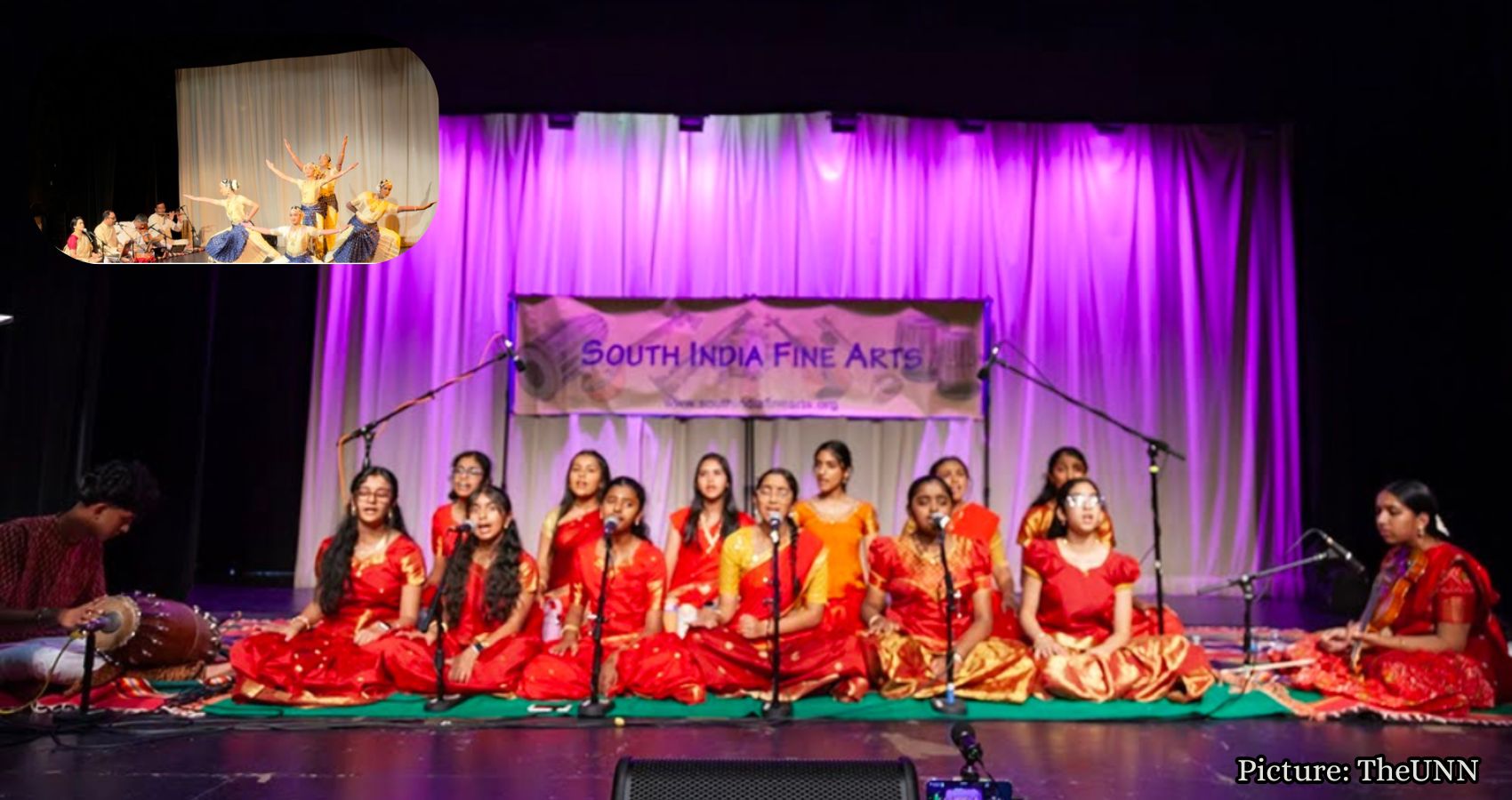
Last weekend, the Historic Hoover Theater in San Jose hosted a vibrant festival celebrating South Indian classical arts, highlighting the cultural contributions of the Indian diaspora in the Bay Area.
Last weekend, my husband and I attended an artistic presentation of South Indian classical arts at the Historic Hoover Theater in San Jose. The South India Fine Arts (SIFA) organization hosted a weekend festival, Lalithakala Vaibhavam, showcasing a diverse array of talent in South Indian traditional classical arts over the course of two full days. This event highlighted the rich cultural contributions that have emerged from the San Francisco Bay Area.
Decades ago, as young parents with children born in the diaspora, my husband and I recognized that imparting the arts was the most effective way to introduce our cultural heritage to them. While our children were growing up as Americans, we felt it was essential to nurture and cultivate their inherited “Indian” identity. We pondered how to present this cultural richness to them in the most sincere way possible.
Our family life during those years was often frenetic. Some days felt terribly skewed, while others were more evenly divided. Our children would perform a Dikshitar piece extolling a Hindu god at a morning event and then play Ave Maria at a Western violin recital in the afternoon. Such experiences reflect the complexities of life in the diaspora, where navigating multiple identities is crucial for a sense of belonging. Balancing these diverse aspects of ourselves while maintaining our life goals can lead to a richer and more meaningful existence. Unfortunately, this wisdom often comes to us later in life, but the investment in the arts must begin early, during childhood and youth.
It takes decades, even generations, for a community to establish itself in a new location. The first two generations of Indian immigrants have built a vast network of community offerings in the Bay Area, making early education in cultural arts a fundamental aspect for Indian-American families.
One of the essential needs of a young community is a platform where arts practitioners can showcase their skills. SIFA was founded 47 years ago by a group of South Indian classical arts enthusiasts to fulfill this need. While much of its energy has been devoted to presenting top-notch Carnatic and Bharatanatyam talent from South India, the organization has also made efforts to feature local artists over the years. Recently, we have witnessed a rise in several home-grown talents, making this past weekend a significant milestone for SIFA.
I fondly recall the weekends my husband and I spent with our children attending music and dance concerts presented on the SIFA stage. We often took for granted the immense dedication of the officers and volunteers who worked tirelessly behind the scenes at every event. Organizations like SIFA are largely fueled by the passion and enthusiasm of a few individuals, while the rest of us, who benefit from their selfless efforts, sometimes fall into the trap of entitlement, focusing on what went wrong rather than appreciating their hard work.
Another aspect of arts encouragement that increasingly troubles me is the contrasting value system surrounding the pursuit of the arts in a region overflowing with wealth. Daily, we read about the latest public offerings in the AI sector, yet it remains unclear how much impact the ultra-wealthy individuals, many of whom have South Indian heritage, have had on the arts scene for Indian-Americans.
Financial support is crucial for organizations like SIFA; donations and sponsorships are vital for their various outreach programs. Recently, I learned about an Indian-American show with the potential to reach Broadway, contingent on securing a few million dollars from a wealthy donor. It was disheartening to realize that, in a valley dominated by tech giants with multi-trillion-dollar valuations, we still find ourselves pleading for continued patronage of the arts. This situation simply does not add up.
This brings me to another observation regarding the mindset of those striving to make a living in the creative arts. In such a prosperous valley, where financial success often overshadows other values, both teachers and students must adopt a different mentality to persevere and maintain their commitment to the arts.
Many Indian classical teachers in the valley, most of whom hold professional degrees alongside their artistic accomplishments, could have pursued lucrative careers in high-tech fields. Instead, they have dedicated their lives to nurturing a niche art form within the broader landscape of classical arts. I know of teachers who balance two demanding careers, working as engineers and scientists during the day while teaching and performing music in the evenings and on weekends. These committed educators have played a vital role in fostering and sustaining the arts ecosystem in this valley.
A patron of the arts in our area, Sudha Pennathur, observed that watching the performances during this past weekend’s festival made her acutely aware of the broader implications of teaching Carnatic music in this region. As she watched the young artists perform, she reflected on the collective responsibility we all share to nurture and encourage this new generation.
“They are not simply students learning an art form—they are the future keepers and torchbearers of a musical and cultural legacy that has been handed down to us over generations,” she remarked. “That, to me, is the real significance of Lalithakala Vaibhavam. It provides more than a stage. It tells our young artists that their dedication matters, that their talent is valued, and that there is a community that wants to see them continue and flourish.”
As we continue to celebrate and support the arts, it is essential to recognize the importance of nurturing our cultural heritage and the artists who keep it alive.
According to India Currents.