
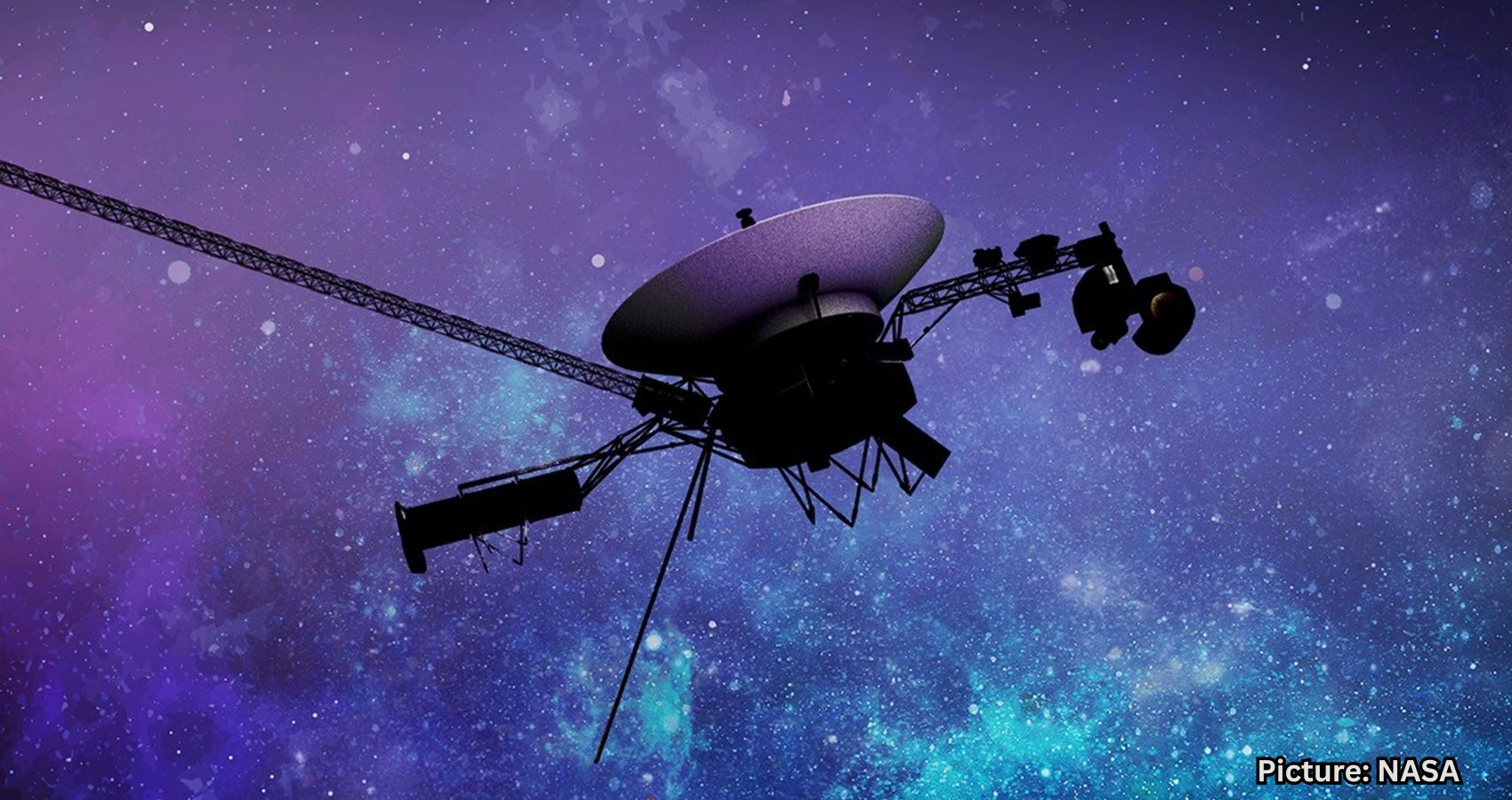
Nasa has shut down Voyager 1’s charged particles instrument to conserve power as the spacecraft continues its journey through interstellar space, now over 15 billion miles from Earth.
Nasa has taken the significant step of shutting down one of Voyager 1’s science instruments in a bid to conserve dwindling power. This decision comes as the nearly 49-year-old spacecraft continues its remarkable journey through interstellar space, now more than 15 billion miles from Earth.
Engineers at Nasa’s Jet Propulsion Laboratory (JPL) in Southern California sent commands on Friday to deactivate Voyager 1’s Low-Energy Charged Particles (LECP) experiment. This instrument has operated almost continuously since the spacecraft was launched in 1977. The shutdown is part of ongoing efforts to manage the spacecraft’s power supply, which is diminishing at a rate of approximately 4 watts per year.
“While shutting down a science instrument is not anybody’s preference, it is the best option available,” said Kareem Badaruddin, Voyager mission manager at JPL, in a statement. He noted that Voyager 1 still has two functioning science instruments: one that listens to plasma waves and another that measures magnetic fields. Both instruments continue to send back valuable data from a region of space that no other human-made craft has ever explored.
The decision to shut down the LECP highlights the increasingly delicate balancing act faced by the Voyager team as both spacecraft age far beyond their original mission timelines. Voyager 1 and its twin, Voyager 2, are powered by radioisotope thermoelectric generators that convert heat from decaying plutonium into electricity. After nearly five decades in space, engineers have had to progressively power down heaters and instruments while ensuring that the spacecraft do not become too cold, which could jeopardize key systems, including fuel lines.
“The team remains focused on keeping both Voyagers going for as long as possible,” Badaruddin added.
The urgency of this action was amplified after Voyager 1 experienced an unexpected drop in power during a routine roll maneuver on February 27, according to Nasa. Engineers were concerned that any further decline could trigger the spacecraft’s undervoltage fault protection system, designed to automatically shut down components to safeguard the probe. Recovering from such a fault can be a lengthy process and carries additional risks, prompting the team to act proactively.
The two Voyager probes remain the only spacecraft positioned far enough from Earth to collect data on detecting pressure fronts and regions of varying particle density in the space beyond our heliosphere, according to Nasa.
In a press release, Nasa stated, “Engineers are confident that shutting down the LECP will give Voyager 1 about a year of breathing room.” During this time, they are finalizing a more ambitious energy-saving initiative for both Voyagers, referred to as “the Big Bang.” This plan aims to extend the operational lifespan of the spacecraft further.
The concept behind “the Big Bang” involves swapping out a group of powered devices all at once, hence the nickname. This strategy will involve turning off certain systems and replacing them with lower-power alternatives to ensure the spacecraft remains warm enough to continue gathering scientific data.
The decision to deactivate the LECP was not made hastily. Nasa indicated that mission science and engineering teams had long ago agreed on the order in which spacecraft systems would be shut down as power availability declined. Of the ten original instrument sets carried by the twin probes, seven have now been switched off. Voyager 2’s LECP instrument was deactivated in March 2025.
Given that Voyager 1 is now over 15 billion miles from Earth, commands sent to the spacecraft take approximately 23 hours to arrive. The shutdown sequence itself takes more than three hours to complete. However, one component of the LECP system—a small motor that rotates the sensor to scan in all directions—will remain powered, as it consumes only about half a watt. Engineers hope this will leave the door open for the possibility of restarting the instrument in the future if additional power becomes available.
As the Voyager missions continue to push the boundaries of human exploration, the dedicated team at Nasa remains committed to maximizing the lifespan and scientific output of these extraordinary spacecraft, which have provided invaluable insights into our solar system and beyond.
According to Nasa, the ongoing efforts to manage power consumption are crucial for the continued operation of Voyager 1 and its twin.