
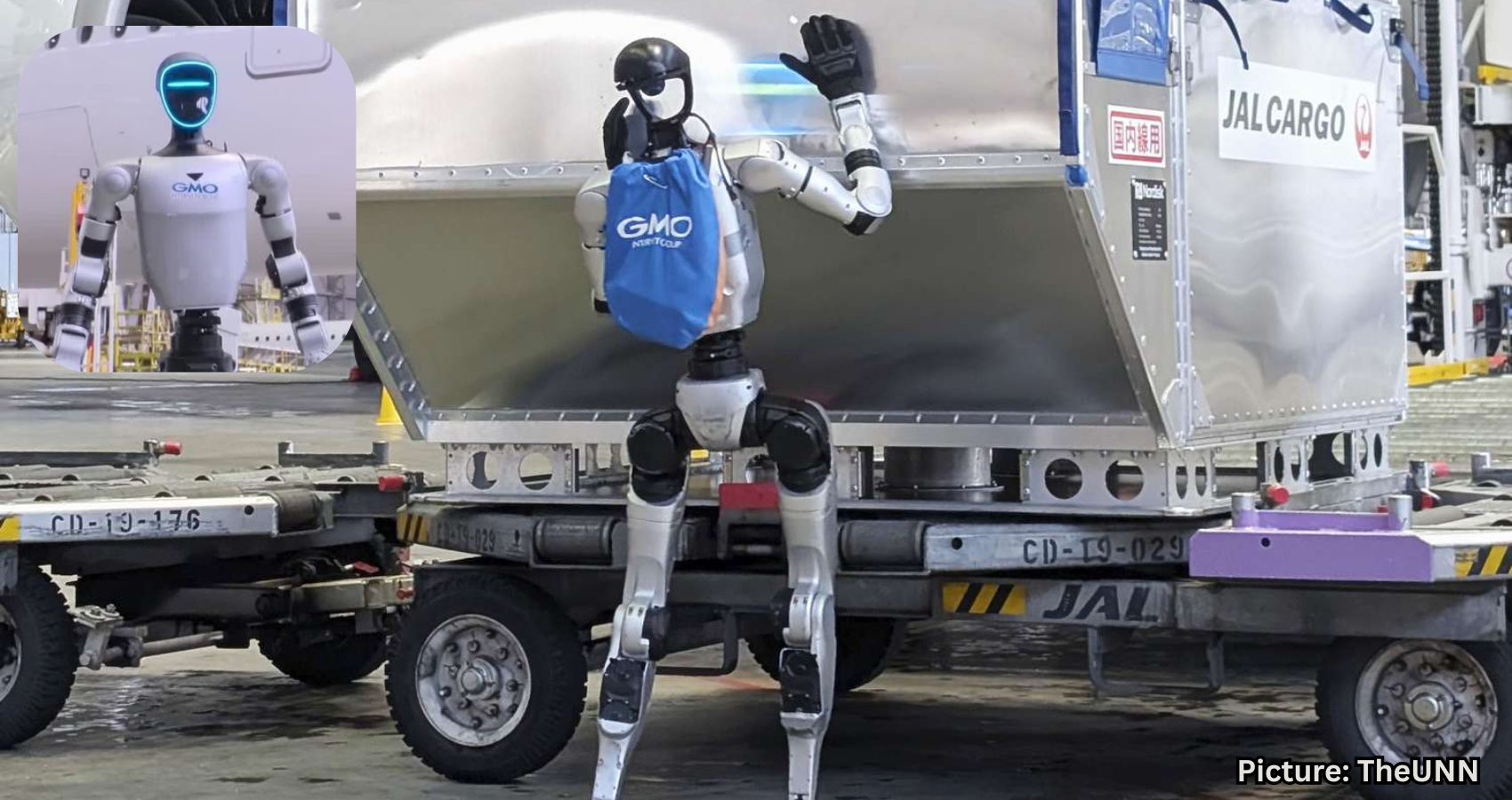
Japan Airlines is testing humanoid robots at Haneda Airport to assist with baggage handling amid rising passenger demand and a shrinking workforce.
Japan Airlines is embarking on an innovative trial at Haneda Airport, one of the busiest airports in Japan, where humanoid robots are set to assist ground crews with baggage and cargo handling. This initiative aims to address the growing demand for air travel while tackling the challenge of worker shortages in the aviation sector.
As air travel becomes increasingly automated, with passengers scanning tickets and dropping off bags, the introduction of robots represents a significant shift in the airport experience. The collaboration between Japan Airlines and GMO AI & Robotics, a division of the GMO Internet Group, seeks to integrate these robots into existing airport operations, ultimately promoting a more sustainable approach to managing airport logistics as demand continues to rise.
Airports are currently facing dual pressures: a surge in passenger numbers and a decline in the available workforce. Japan, in particular, is experiencing this squeeze acutely, as the tourism industry flourishes while the working-age population diminishes. Japan Airlines employs thousands of ground crew workers, underscoring the scale of the challenge posed by this labor shortage.
Rather than overhauling airport systems entirely, companies are exploring the potential of humanoid robots that can seamlessly fit into existing workflows. These robots, designed to resemble humans, can navigate the same spaces and utilize the same equipment as their human counterparts, minimizing the need for significant operational changes.
The robots being tested are developed by Unitree Robotics. One model, known as the G1, is compact enough to maneuver through tight spaces while being capable of lifting and pushing cargo. Standing just over four feet tall and weighing approximately 77 pounds, the G1’s design allows it to fold for easy storage, an essential feature in crowded airport environments.
What sets the G1 apart is not just its size but also its advanced sensory capabilities. Equipped with 3D LiDAR and depth cameras, the robot can comprehend its surroundings, recognize objects, adjust its movements accordingly, and even respond to voice commands. During a recent demonstration, the G1 successfully pushed cargo onto a conveyor belt and communicated with a nearby worker, showcasing the potential for real-time coordination between machines and humans.
Before the robots are deployed in real-world settings, they undergo extensive training in a virtual environment. Engineers create digital replicas of the robots and utilize simulation tools, such as Nvidia’s Isaac Simulator, to practice various tasks without any real-world risks. Motion capture data is employed to help the robots mimic human movements, while reinforcement learning fine-tunes these actions through repetition. This process, known as Sim2Real, aims to minimize errors when the robots are eventually introduced into busy airport environments.
While the expansion of automation in airports is underway, airlines are establishing clear boundaries for the roles robots will play. Initially, these machines are expected to handle repetitive and physically demanding tasks, such as moving baggage and loading cargo. In the future, they may also assist with cabin cleaning and operate certain types of ground support equipment. As the technology evolves, workers may transition to roles focused on supervision, decision-making, and robot management.
Despite the advancements in automation, critical responsibilities will remain with human workers. Airports are dynamic environments where personnel, aircraft, and ground equipment operate in close proximity. The primary goal of this trial is to identify how humanoid robots can safely assist crews while alleviating physical strain on workers.
Attempts to automate airport operations are not new; however, traditional robots have faced challenges in unpredictable settings where objects move, and people frequently traverse work zones. Humanoid robots offer a promising alternative, as their human-like design allows them to adapt without necessitating significant infrastructure changes.
The trial at Haneda Airport is set to run through 2028, providing airlines ample time to assess the robots’ performance and refine their integration into daily operations. The rollout will follow a phased approach, beginning with observation and testing before progressing to more practical applications. If successful, similar systems could be implemented in airports worldwide.
While U.S. airports may not see robots on the tarmac immediately, the developments in Japan could foreshadow a broader trend in the aviation industry. If these trials prove effective, similar robotic systems may soon appear at major airports in the United States, potentially leading to faster baggage handling and reduced delays during peak travel periods.
Moreover, the introduction of robots could significantly improve working conditions for airport crews. By taking on the heaviest lifting tasks, robots may help reduce injuries and create more sustainable job environments over time. However, airlines will need to demonstrate that these systems are safe, reliable, and capable of performing under the pressures of busy airport operations before they are widely adopted.
As robots begin to handle luggage on airport tarmacs, the transition may take some getting used to. However, the rationale behind this trial is clear: airports are becoming busier, and ground crews are already engaged in physically demanding work under significant pressure. If these robots can safely manage some of the heaviest loads, they could provide crucial support to workers and enhance the efficiency of flight operations.
The real test will be how effectively humans and machines can collaborate in the bustling environment of an airport, where every minute counts. As this technology develops, it raises an important question: Would you trust robots to handle your luggage reliably? Let us know your thoughts at CyberGuy.com.
According to Fox News.