
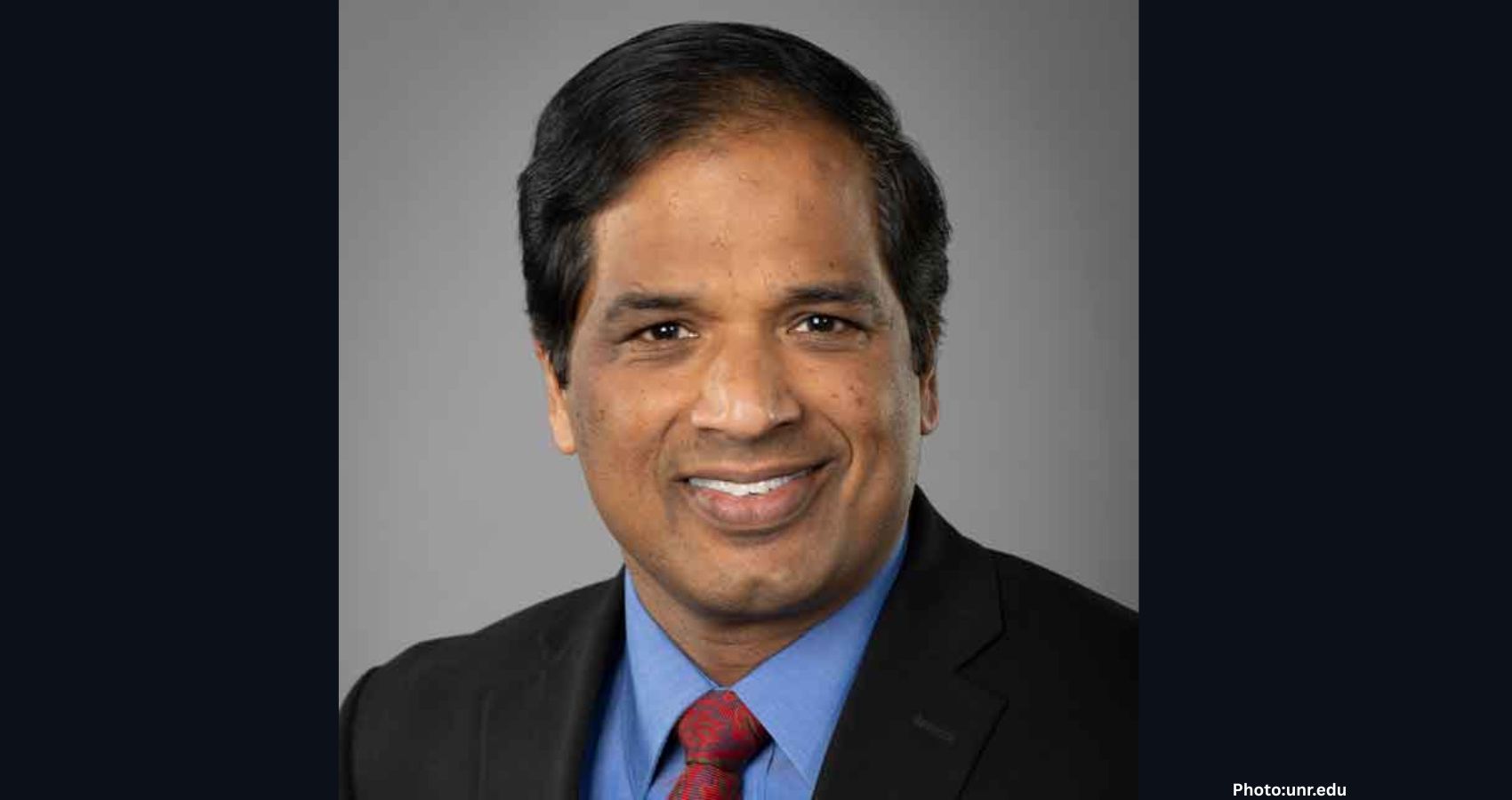
Krishna Pagilla, an Indian American environmental expert, has been appointed to the U.S. Environmental Protection Agency’s Science Advisory Board to advise on water sustainability and public health protection efforts.
Krishna Pagilla’s journey from an aspiring engineer at Osmania University in Hyderabad, India, to a prominent figure in American environmental policy culminated in his recent appointment to the U.S. Environmental Protection Agency’s Science Advisory Board (SAB).
Pagilla, a distinguished professor of civil and environmental engineering at the University of Nevada, Reno (UNR), was appointed to the board by EPA Administrator Lee Zeldin on April 17. This prestigious role places him among an elite group of 37 scientists tasked with providing independent expertise to guide the agency’s mission of protecting human health and the environment.
For Pagilla, this appointment represents a continuation of a career characterized by “circular” thinking, particularly in the area of transforming waste into valuable resources. As the director of the Nevada Water Innovation Institute, he has dedicated years to pioneering research in water reclamation and exploring the intricate connections within the “water-energy-resource nexus.”
“Water is not just a utility; it is the lifeblood of our communities,” Pagilla has often emphasized in his research. His work focuses on ensuring that as urban centers expand, their water systems remain resilient through innovative treatment and reuse technologies.
Pagilla’s path to this significant national role began in Hyderabad, where he earned his Bachelor of Engineering from Osmania University in 1987. Driven to enhance his knowledge, he moved to the United States, where he obtained a Master’s degree from the University of Oklahoma and later a PhD from the University of California, Berkeley.
This combination of foundational education in India and rigorous research training in the U.S. has established Pagilla as a leading voice in global environmental biotechnology. His expertise is particularly relevant as Nevada and the broader American West grapple with increasing challenges related to drought.
Pagilla is no stranger to the EPA’s advisory roles, having previously served on the board during both the Trump and Biden administrations. His reappointment reflects a rare level of bipartisan respect for his scientific objectivity and technical expertise.
At UNR, Pagilla’s influence extends beyond research; he plays a crucial role in mentoring the next generation of engineers in the Scrugham Engineering and Mines building. Colleagues describe him as a bridge-builder, adept at connecting academic research with the practical needs of local water agencies.
As the challenges of water scarcity intensify, Pagilla’s expertise in potable water reuse will be essential. His commitment ensures that the water cycle continues beyond treatment plants, fostering a sustainable loop for future generations.
According to The American Bazaar, Pagilla’s contributions to environmental science and policy are poised to make a significant impact on water sustainability efforts across the nation.