
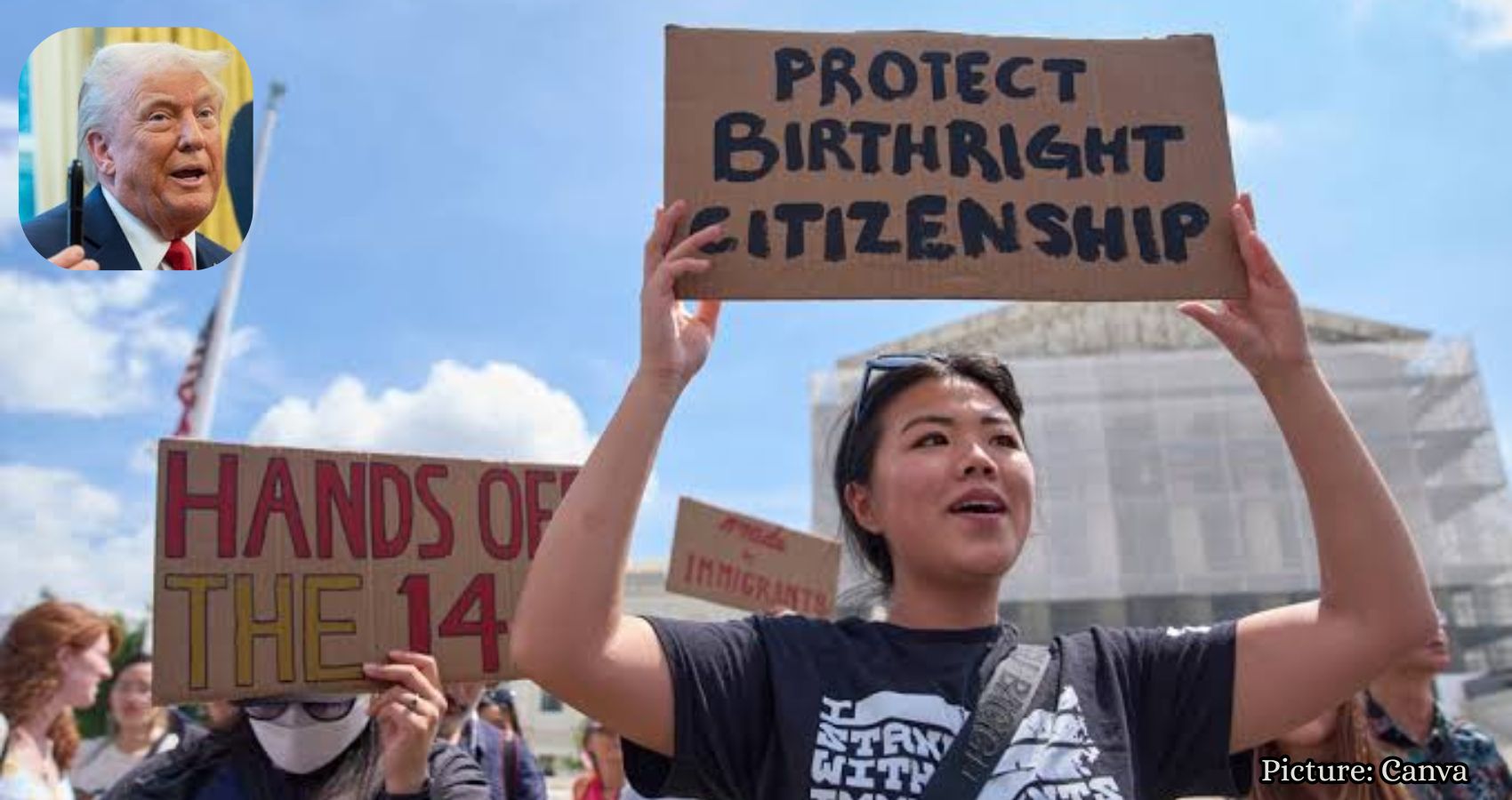
The ongoing debate over birthright citizenship continues as former President Donald Trump seeks to challenge a Supreme Court ruling that upheld the practice, which grants citizenship to anyone born on U.S. soil.
The battle over birthright citizenship remains unresolved for former President Donald Trump, despite a June 30 Supreme Court ruling that rejected his executive order aimed at denying citizenship to children born in the United States to parents who are in the country illegally or temporarily.
In a recent statement on his social media platform, Truth Social, Trump announced, “I will be asking for a Rehearing by the United States Supreme Court, IMMEDIATELY.” He claimed that networks facilitating “birth tourism,” which enable non-U.S. citizens to travel to the country solely to give birth, have become a significant industry.
Trump described the Supreme Court’s decision as a “miscarriage of justice,” warning that it could “destroy America” if not overturned. His administration has consistently expressed strong opposition to birthright citizenship, a practice that has granted automatic citizenship to nearly everyone born on U.S. soil for over a century.
On his first day in office, Trump signed an executive order that sought to restrict birthright citizenship, challenging a long-standing legal precedent established by the 14th Amendment to the U.S. Constitution.
In various interviews, Trump has claimed, “You know, we’re the only country that has it,” a statement that is not accurate.
To better understand the context of this issue, it is essential to examine the history and legal framework surrounding birthright citizenship.
Birthright citizenship was established in 1868 with the ratification of the 14th Amendment, which was enacted in the aftermath of the Civil War to ensure that former slaves would be granted citizenship. The landmark Supreme Court case of Wong Kim Ark in the late 1800s further expanded this definition to include children born in the U.S. to immigrant parents. Subsequent rulings have reinforced the principle that anyone born on U.S. soil is a citizen, regardless of their parents’ immigration status, with very few exceptions primarily concerning children born to foreign diplomats.
Until the Trump administration, birthright citizenship was largely accepted as a fundamental aspect of U.S. law, with few voices questioning its legitimacy. Historically, even many Republicans have expressed support for immigration, recognizing the contributions of newcomers to the nation.
Former President Ronald Reagan, during a 1984 naturalization ceremony in Detroit, praised immigrants, stating, “Recent immigrants have crawled over walls and under barbed wire and through mine fields to reach the U.S., and all of them have added to the sum total of what your new country is.”
Trump has framed birthright citizenship as a “magnet for illegal immigration,” linking it to rising concerns over border security and illegal crossings. His administration has pointed to illegal “birth tourism” networks as evidence of the need for reform, claiming that these operations facilitate the entry of non-U.S. citizens into the country for the sole purpose of giving birth and securing U.S. citizenship for their children.
While birth tourism is a real phenomenon, it is far less prevalent than Trump suggests. Some companies promote these services, charging significant fees to assist foreign nationals in giving birth in the U.S. However, the practice of giving birth on U.S. soil while holding a temporary visa is not illegal. The act of applying for a visa solely to obtain U.S. citizenship for a child, however, is considered fraudulent, according to the Migration Policy Institute.
In legal arguments against birthright citizenship, government lawyers have focused on a specific phrase in the 14th Amendment: “subject to the jurisdiction thereof.” They contend that this language allows the U.S. to deny citizenship to children born to women who are in the country illegally. However, during oral arguments in April, even some conservative justices on the Supreme Court expressed skepticism regarding this interpretation.
Trump’s assertion that the United States is unique in its provision of birthright citizenship is misleading. While it is true that many countries do not offer unrestricted birthright citizenship, several nations, particularly in the Americas, including Canada and Mexico, do grant citizenship to anyone born on their soil. Furthermore, numerous countries, including Germany and Australia, employ a mixed approach that considers various factors such as parentage, place of birth, residency, and ethnicity in determining citizenship.
The future of birthright citizenship in the United States remains uncertain as legal challenges continue to unfold. The implications of these debates extend beyond legal interpretations, touching on broader discussions about immigration, national identity, and the values that define American society.
As the conversation evolves, it is crucial to remain informed about the facts surrounding birthright citizenship and the historical context that underpins this contentious issue, according to The Associated Press.