
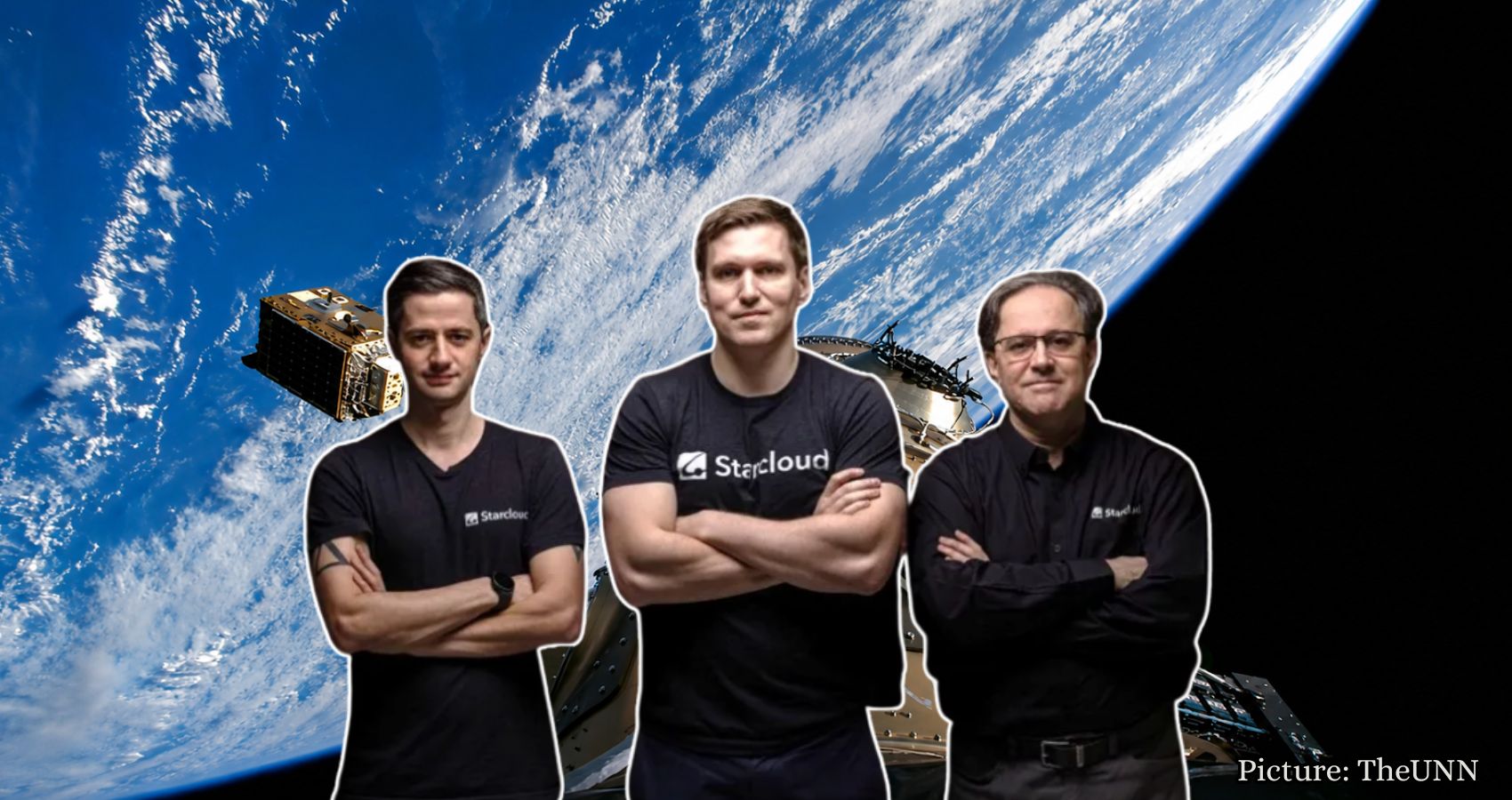
Space tech startup Starcloud has successfully raised an additional $250 million for its orbital data centers, bringing its total Series A funding to $420 million and increasing its valuation to $2.3 billion.
Starcloud, an innovative startup focused on developing satellites capable of performing artificial intelligence (AI) inference in orbit, has announced a significant funding milestone. The company has secured a $250 million extension to its March funding round, which initially raised $170 million. This latest round brings Starcloud’s total Series A funding to $420 million and elevates its valuation to $2.3 billion, as reported by TechCrunch.
The newly acquired capital will be instrumental in expanding Starcloud’s operations. Specifically, the funds will be used to establish a larger manufacturing facility and to advance the development of the Starcloud-3 spacecraft, which is designed to serve as the company’s largest orbital data center. This spacecraft is slated to launch aboard SpaceX’s upcoming Starship rocket.
CEO Philip Johnston emphasized the urgency of securing launch capacity as the market for rocket transportation becomes increasingly competitive. “We can see what’s coming — we’re going to need to book an enormous amount of launch,” Johnston stated in an interview with TechCrunch.
Johnston further elaborated on the challenges ahead, noting, “As soon as we can, we want to get under contract with things like Starship. One of the biggest costs is now on securing your launch capacity…launch is pretty constrained right now because [SpaceX’s] Falcon 9 program is scheduled to end in 2028.”
Starcloud achieved unicorn status earlier this year when it raised $170 million at a valuation of $1.1 billion during a funding round led by Benchmark and EQT Ventures. The recent funding extension was spearheaded by Manhattan West Ventures, with notable participation from industry giants such as Nvidia and Cisco. Other investors included Benchmark, EQT, Soma, NFX, 776, Cedar Capital, Goanna Capital, and Standard Capital.
Johnston highlighted the significance of Nvidia’s investment, viewing it as a validation of Starcloud’s position in the emerging space computing sector. Starcloud is currently the only known company operating an Nvidia H100 terrestrial data center GPU in orbit and has successfully trained a model using this technology. In contrast, most other space GPUs are primarily designed for edge processing. Starcloud is collaborating with Nvidia as the chipmaker develops its first purpose-built GPU for space, known as the Vera Rubin Space-1 chip.
<p“The reason they’ve chosen to do this investment now is because of all of this data that we got from Starcloud One,” Johnston explained. “They, more than any other VC, did way more technical duty on this than anybody else.”
Looking ahead, Starcloud aims to launch the space-ready chip, which is still in the design phase, into orbit by late 2028. Johnston noted that his engineering team is currently focused on several critical design considerations, including the relationship between the chip’s operating temperature and the size of the radiators needed to dissipate heat, the placement of radiation shielding, and the ruggedization required for the chips to withstand the rigors of a rocket launch.
Currently, Starcloud employs 25 individuals and is in the process of developing production lines at a 100,000-square-foot facility located in Woodinville, Washington. This area is notable for being home to other major players in the space industry, including Amazon and SpaceX, who are also engaged in satellite manufacturing for communication networks.
As Starcloud continues to expand its capabilities and secure its place in the competitive landscape of space technology, the company remains poised to make significant contributions to the future of orbital data centers and AI applications in space.
According to TechCrunch, Starcloud’s innovative approach and strategic partnerships position it well for future growth in the burgeoning space tech sector.