
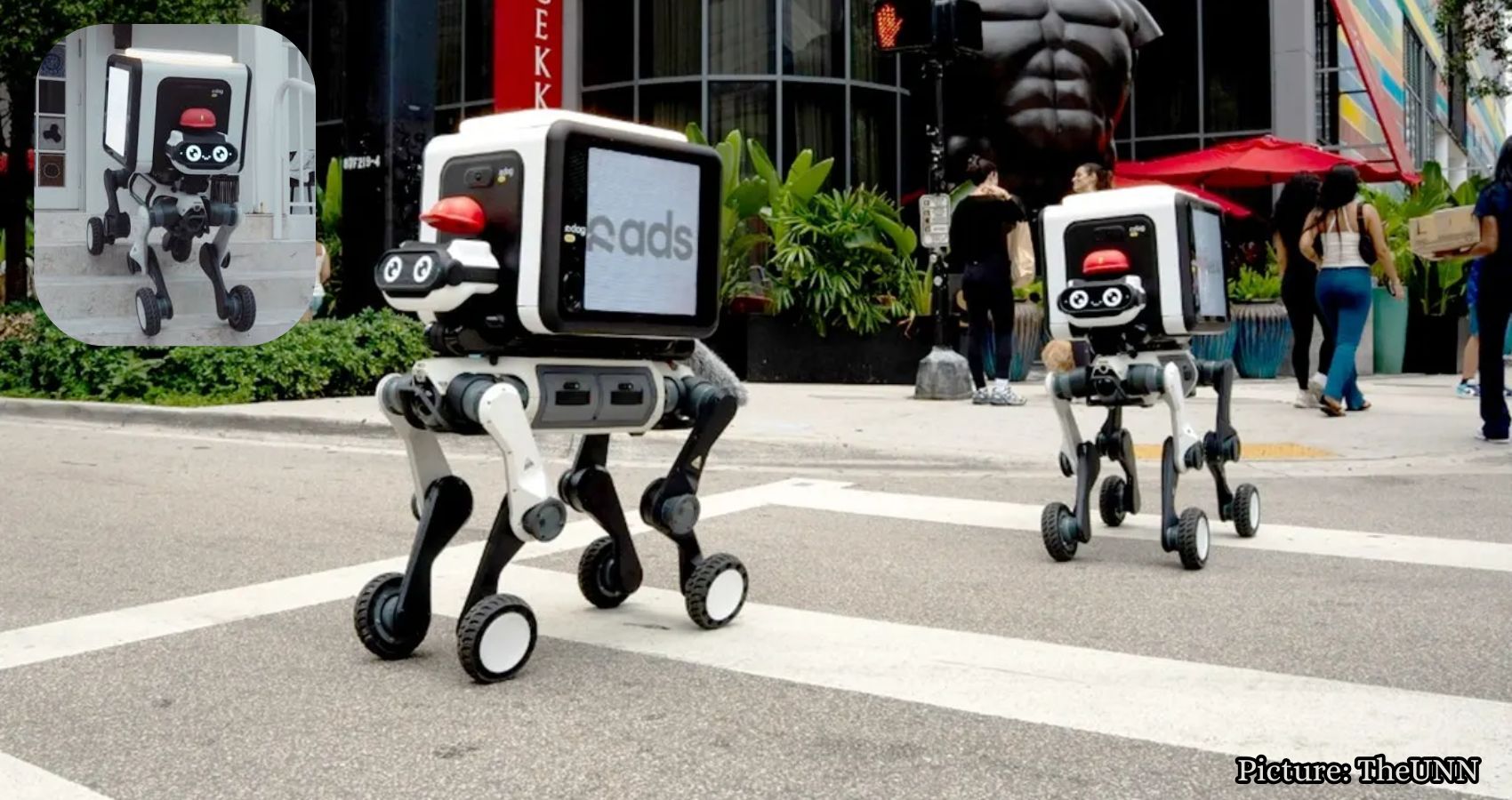
Robot.com’s innovative R-dog combines mobility and advertising, potentially transforming package delivery by navigating obstacles like stairs while displaying ads during its journey.
Robot.com has unveiled its latest innovation, the R-dog, a four-legged delivery robot designed to tackle one of the most challenging aspects of package delivery: the final stretch to a recipient’s door. Unlike traditional wheeled delivery robots that often struggle with stairs and curbs, R-dog utilizes a unique combination of articulated legs and wheels, allowing it to navigate a variety of terrains.
The San Francisco-based company introduced the R-dog on August 11, aiming to enhance the efficiency of autonomous delivery systems. With the ability to cover the last 330 feet of a delivery route, R-dog is engineered to overcome obstacles that typically hinder wheeled robots, making it a promising solution for urban environments.
Each of R-dog’s legs ends in a wheel, enabling it to glide smoothly across flat surfaces. When faced with more challenging terrain, such as stairs or curbs, the flexible legs come into play, ensuring that the robot can continue its journey without interruption. The cargo compartment, which forms the bulk of R-dog’s body, is capable of carrying various items, including food orders and standard packages.
In addition to its practical delivery capabilities, R-dog features built-in screens that display advertisements along its route. This dual functionality allows the robot to serve as a moving billboard while completing its delivery tasks. The incorporation of advertising into the delivery process could provide an additional revenue stream, making the economics of robotic delivery more viable.
Robot.com’s design philosophy emphasizes user interaction and comfort. The R-dog’s friendly appearance, complete with a tail, aims to make it more approachable for the public. This is particularly important as the robot navigates through neighborhoods, where it may encounter a variety of interactions with pedestrians.
Getting a delivery robot from point A to point B can be straightforward, but the real challenge often lies in the final steps. Traditional delivery robots excel on smooth, predictable surfaces but can falter when faced with unexpected obstacles. R-dog’s four-legged design is intended to address this issue, expanding the potential for autonomous delivery in diverse environments such as campuses, apartment complexes, and urban neighborhoods.
Once R-dog reaches its destination, it employs an unattended auto drop-off system to release the package. This feature allows the robot to continue on its route without requiring a person to physically unload it. However, questions remain about how R-dog will determine which package to deliver when multiple items are stored in its compartment. As the prototype continues to be refined, clarity on this aspect will be crucial for its successful deployment.
Beyond its delivery capabilities, R-dog is equipped with two video screens linked to Robot.com’s advertising platform, R-ads. This allows brands to manage their advertising campaigns remotely, potentially generating revenue during each delivery. The interactive nature of R-dog could enhance the advertising experience, as it is designed to engage with people who approach it, making the interaction more dynamic than traditional static ads.
Robot.com is collaborating with FieldAI to develop the navigation system for R-dog, which will enable it to adapt to changing environments without requiring prior mapping. This capability is essential for navigating busy streets and unpredictable obstacles, ensuring that R-dog can operate effectively in real-world scenarios.
Founded in 2017, Robot.com has already deployed over 500 robots across the United States, Canada, and parts of the Middle East and North Africa. The company has completed more than 2.5 million tasks with its existing fleet, which includes robots designed for sidewalk delivery and industrial logistics. R-dog represents the next step in the evolution of their delivery technology.
Commercial deployments of R-dog are anticipated for 2027, with college campuses expected to be the first testing grounds. These environments offer a unique combination of short delivery distances and varied terrains, making them ideal for R-dog’s capabilities. While pricing details have yet to be announced, Robot.com is focusing on commercial delivery pilots and brand activations rather than individual consumer sales at this stage.
If R-dog performs as intended, it could revolutionize the last-mile delivery process, bringing packages closer to customers’ doors and reducing the need for human intervention. The integration of advertising into the delivery experience also hints at a future where convenience and marketing coexist in innovative ways.
As R-dog moves closer to commercial use, it will be essential to monitor its performance in real-world conditions, including its ability to navigate stairs and crowded sidewalks. Additionally, transparency regarding the data collected through its advertising system will be crucial for addressing privacy concerns.
In conclusion, R-dog is not just a clever delivery robot; it represents a significant step towards making autonomous delivery a practical reality. Whether consumers will embrace the idea of a robot dog delivering packages while displaying ads remains to be seen. For now, the focus will be on refining the technology and ensuring that it meets the needs of both businesses and consumers.
For further updates on R-dog and its development, stay tuned to Robot.com and related news sources.
According to Robot.com.