
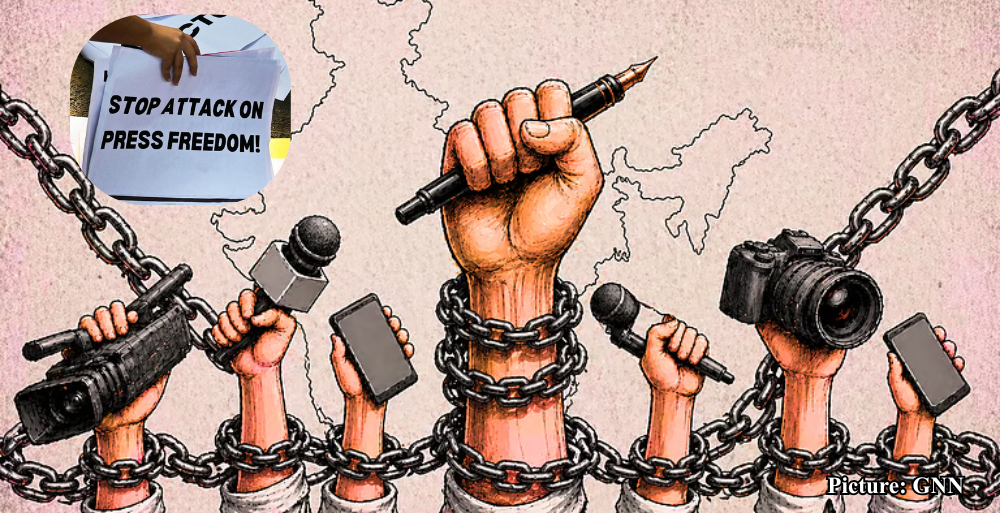
Press freedom—long regarded as the oxygen of democracy—is confronting its most severe global crisis in decades. Nowhere is this strain more consequential than in the world’s two largest democracies: India and the United States. Both nations are grounded in constitutional traditions that elevate the free exchange of ideas as a democratic cornerstone. Yet today, journalists in both countries face mounting legal, political, economic, and digital pressures that are not episodic but systemic. These cumulative forces are reshaping the relationship between the state, the media, and the public—and raising urgent questions about democratic resilience.
At the Associated Press’ Press Freedom Week, AP Executive Editor Julie Pace captured the gravity of the moment, warning that “threats to journalism are accelerating faster and in more places than we’ve ever seen.” Her observation reflects a global reality in which traditional safeguards for independent reporting are eroding under new forms of state power, information control, and public distrust.
For many journalists, press freedom is not an abstract principle but a lived reality shaped by risk and resistance. Dasha Litvinova, a reporter covering Russia and the war in Ukraine, underscored this human dimension: “I’ve covered fellow reporters facing arrests, harassment, long prison sentences, their news outlets being raided, outlawed and blocked—and I’ve seen them standing tall in the face of it all.” Similarly, Farnoush Amiri, a United Nations correspondent, emphasized the privilege embedded in press freedom, noting that it means being able “to walk up to world leaders or elected officials and ask difficult and uncomfortable questions and not be punished for it.”
India: A Democratic Paradox Under Strain
India’s press freedom landscape embodies a striking paradox. The country hosts one of the world’s most diverse and energetic media ecosystems, with thousands of outlets publishing in dozens of languages. Yet the conditions under which this media operates have grown increasingly restrictive. Legal instruments, political pressures, and digital regulations have collectively narrowed the space for independent journalism.
Over the past decade, Indian journalists—particularly investigative reporters—have faced heightened scrutiny under laws such as the Unlawful Activities (Prevention) Act (UAPA), financial investigation statutes, and defamation provisions. While not explicitly designed to target the press, these laws grant broad discretionary powers that can be used to initiate prolonged investigations, seize digital devices, or impose extended legal uncertainty. Investigative journalist Rana Ayyub has described this environment starkly, arguing that “the cost of speaking truth to power has never been higher.”
Beyond formal legal pressures, journalists in India frequently confront online harassment, coordinated disinformation campaigns, and threats to personal safety. These risks are especially acute in rural and semi‑urban areas, where reporting on local corruption, land disputes, or communal tensions can escalate into physical violence. Digital regulation has further intensified these constraints. Recurrent internet shutdowns—often justified on national security grounds—have disrupted reporting, while new platform rules have expanded government authority to demand content takedowns or traceability. As broadcast journalist Barkha Dutt has warned, the cumulative effect is a “culture of intimidation” that encourages self‑censorship and weakens the press’s watchdog role.
United States: Institutional Strength, Emerging Vulnerabilities
The United States continues to benefit from some of the strongest constitutional protections for the press in the world. The First Amendment provides a robust legal foundation, and courts have historically defended journalists’ rights to investigate and publish. Yet institutional strength has not made the American press immune to erosion.
At the same AP forum, Jodie Ginsberg, CEO of the Committee to Protect Journalists, cautioned that patterns once associated with “deteriorating democracies worldwide” are now visible in the United States. Journalists increasingly face harassment, doxxing, and threats, particularly those covering political extremism, public health, and local governance. At the same time, the collapse of local news has created vast “news deserts,” leaving communities without reliable sources of accountability journalism.
Former Washington Post editor Marty Baron has described this moment as an “epistemological crisis,” in which large segments of the public no longer agree on basic facts. New York Times publisher A.G. Sulzberger has similarly warned that “the greatest threat to press freedom is the normalization of attacks on the press.” Legal vulnerabilities persist as well: the absence of a federal shield law leaves journalists unevenly protected, while surveillance tools originally designed for counterterrorism have raised concerns about overreach. Political rhetoric that delegitimizes the press has further fueled public mistrust.
Converging Pressures and Global Implications
Despite their differing political systems, India and the United States share several structural vulnerabilities. Both face polarization that delegitimizes journalism, digital ecosystems that amplify disinformation, economic fragility in local media, and legal ambiguity surrounding surveillance and online reporting. These pressures are not merely professional challenges; they are indicators of deeper democratic stress.
Globally, these trends reflect a broader democratic drift. Authoritarian and hybrid regimes have refined strategies of information control, from Russia’s criminalization of dissent to China’s vast digital censorship apparatus. CNN’s Christiane Amanpour has described the latter as “the most sophisticated information control system ever built.” Even established democracies are not immune, as concerns grow over strategic lawsuits, surveillance, and political interference.
Strengthening Democratic Resilience
Addressing the crisis in press freedom requires sustained institutional and public commitment. In India, narrowing overly broad statutes, strengthening judicial oversight, and protecting digital journalists are essential steps. In the United States, enacting a federal shield law, rebuilding local news ecosystems, and reinforcing norms of press independence are critical. Globally, greater transparency in algorithmic governance, safeguards against online harassment, and support for nonprofit journalism can help rebuild public trust.
As Nobel laureate Maria Ressa has argued, “Democracy is impossible without facts. Journalism is the pipeline of those facts.” Press freedom is not self‑executing; it survives only when societies actively defend it. India and the United States now stand at that crossroads—facing a choice whose consequences will reverberate far beyond their borders.