
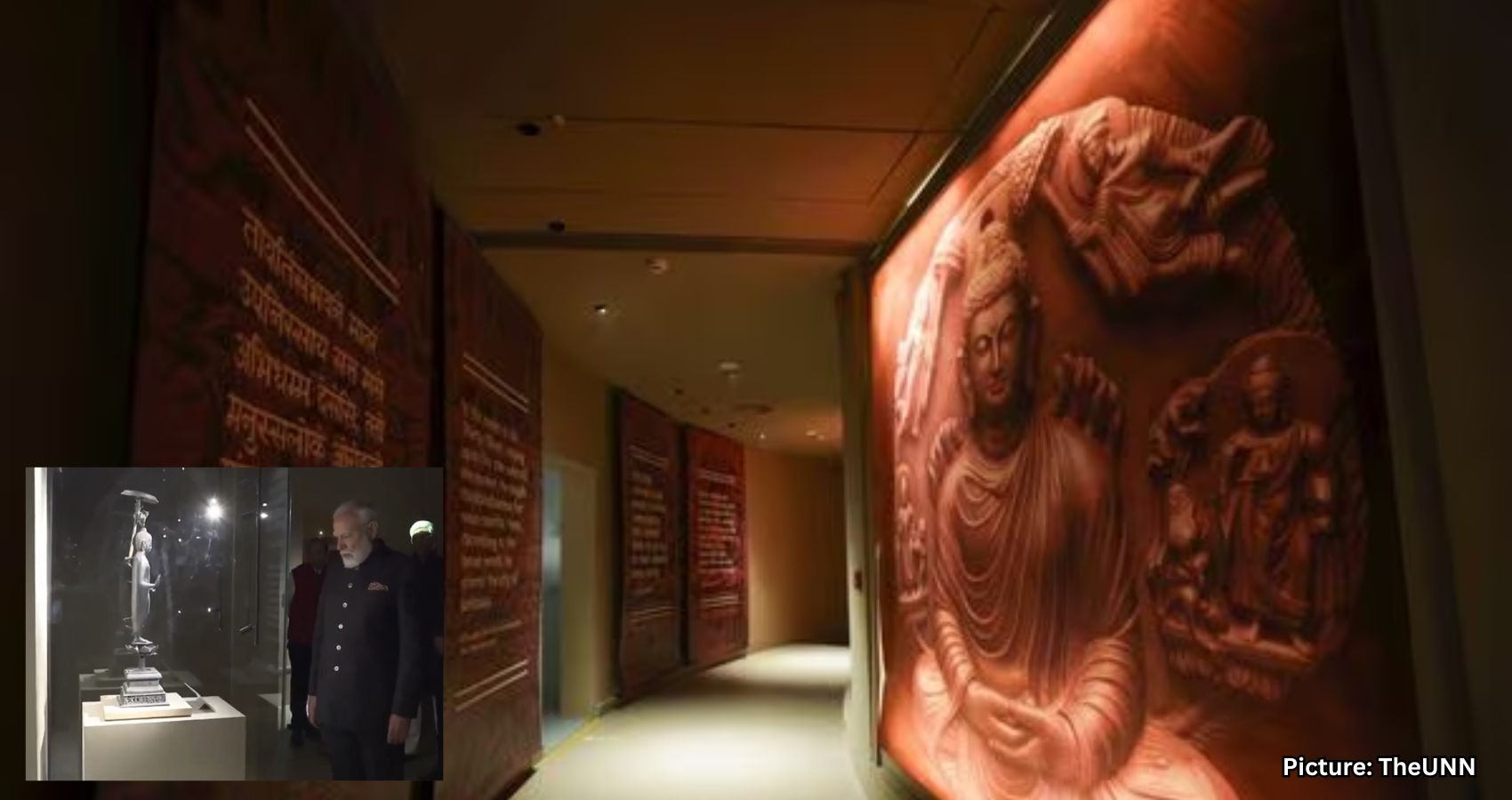
Prime Minister Narendra Modi will inaugurate an exhibition in New Delhi showcasing the repatriated Piprahwa Gems, significant Buddhist relics returned to India after more than a century.
Prime Minister Narendra Modi is set to inaugurate “The Light and The Lotus: Relics of the Awakened One,” a prominent exhibition featuring sacred Buddhist relics, in New Delhi on Saturday, January 3. This exhibition will highlight the Piprahwa Gems, a collection of revered antiquities associated with the Historical Buddha, which were taken from India in 1898 and returned last year, as stated by the Ministry of Culture.
The exhibition will take place at the Rai Pithora Cultural Complex and will be open to the public starting Sunday. In addition to the Piprahwa relics, visitors can expect an immersive display of 88 antiquities, a repatriation gallery that documents the return of cultural treasures, and a detailed model of the original excavation site.
The relics, discovered buried in reliquaries alongside corporeal remains believed to belong to Gautama Buddha, have been described by Sotheby’s as “among the most extraordinary archaeological discoveries of all time.”
The Piprahwa antiquities comprise 349 gemstones unearthed in 1898 by William Claxton Peppé, an English estate manager, during the excavation of a Buddhist stupa at Piprahwa, located in the present-day Siddharthnagar district of Uttar Pradesh, near the Nepal border.
This excavation site is widely recognized as ancient Kapilavastu, the capital of the Shakya republic where Prince Siddhartha Gautama is thought to have spent his early years. The findings included bone fragments, ash, soapstone and crystal caskets, a sandstone coffer, and a diverse array of offerings such as pearls, rubies, sapphires, topaz, and patterned gold sheets.
Under the Indian Treasure Trove Act of 1878, the British Crown claimed the discovery. Most of the collection, which included nearly 1,800 pearls and precious objects, was transferred to what is now the Indian Museum in Kolkata. However, around one-fifth of the finds, including duplicate gems, remained with Peppé.
The sacred bones and ash believed to be of the Buddha were later donated by Viceroy Elgin to King Rama V of Siam, now known as Thailand.
The auction of the retained gems sparked controversy and a legal battle. The portion of the gems kept by the Peppé family was passed down through generations and was put up for auction by Chris Peppé in 2013. In May 2025, Sotheby’s Hong Kong listed the collection for auction, estimating a sale price exceeding $100 million, which raised significant concerns in India and among global Buddhist communities.
On May 5, 2025, the Ministry of Culture issued a legal notice to Sotheby’s and the Peppé family, demanding an immediate halt to the auction and the repatriation of the relics. The notice contended that the artefacts represented the inalienable religious and cultural heritage of India and the global Buddhist community, and that their sale violated Indian law, international conventions, and United Nations cultural heritage frameworks.
The Archaeological Survey of India also reached out to the Consulate General of India in Hong Kong, requesting urgent intervention to stop the auction.
India’s legal claim encountered complications, as the excavation occurred on land allotted to Peppé by the British government, and the artefacts were removed from India long before the Antiquities and Art Treasures Act of 1972 came into effect. Despite these challenges, Indian authorities worked with Hong Kong’s Financial Investigation Unit to emphasize the ethical and legal concerns surrounding the sale.
A pivotal breakthrough occurred when Indian industrialist Pirojsha Godrej purchased the entire collection of 349 gemstones for an undisclosed amount. Godrej has agreed to loan a significant portion of the collection to the National Museum for five years and to allow the entire collection to be displayed for three months upon its arrival in India.
This arrangement facilitated the return of the relics without necessitating a commercial transaction by the government, thereby avoiding ethical and legal complexities.
The inauguration of “The Light and The Lotus” represents a significant milestone in India’s ongoing efforts to reclaim and preserve its cultural and spiritual heritage, reaffirming the nation’s commitment to protecting artefacts of profound importance to both its historical narrative and the global Buddhist community, according to Source Name.