
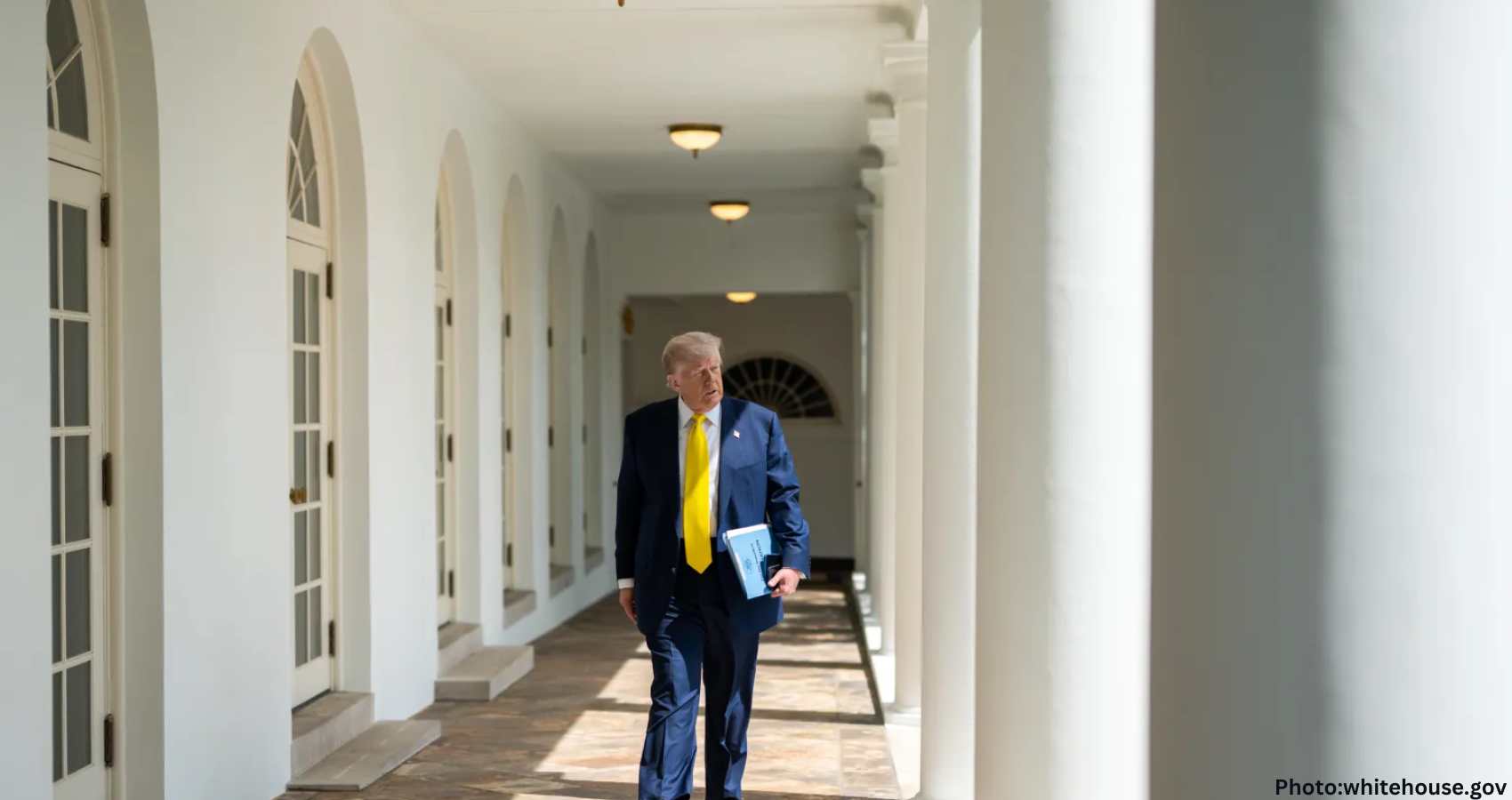
President Trump’s recent White House address highlighted his administration’s economic achievements while addressing public dissatisfaction and declining approval ratings.
In an 18-minute address delivered from the White House, President Donald Trump focused on a range of topics, emphasizing the U.S. economy and his administration’s accomplishments. The speech aimed to counteract public dissatisfaction and declining approval ratings as he prepares for the upcoming midterm elections in 2026.
During the address, Trump discussed various issues, including wages, employment, military strength, and illegal immigration. He also sought to draw comparisons between his administration’s efforts and those of former President Joe Biden.
Trump placed blame on Democrats, particularly Biden, for ongoing economic challenges such as inflation and high living costs. He argued that his policies have laid the foundation for stronger economic growth moving forward.
A notable highlight of the speech was the announcement of a one-time “warrior dividend” bonus of $1,776 for over 1.4 million U.S. military service members. This symbolic gesture, referencing the year of the nation’s founding, was framed as a Christmas gift and is reportedly funded in part by tariff revenue.
Several key claims made during the speech warrant closer examination:
Regarding economic conditions, Trump asserted that wages are increasing at a rate much faster than inflation. While fact-checkers confirm that wages are indeed outpacing inflation, the difference is not as significant as he suggested, with wage growth at 3.5% compared to inflation at 3.0%.
On investment, Trump claimed to have secured $18 trillion in investments. However, the reality is closer to $7 to $9.6 trillion, which includes vague pledges and deals that have not yet been finalized.
In terms of job creation, Trump stated that all net job growth during his presidency has benefited American-born citizens. This claim is misleading, as foreign-born workers have also experienced improvements in unemployment rates.
Trump made several assertions about the cost of living that merit scrutiny. He exaggerated the price drops for eggs and Thanksgiving turkeys, stating that egg prices fell by 43.9%, while the actual figure is closer to 43.9%, not the claimed 82%. Turkey prices reportedly fell by 3.7%, not the 33% he suggested.
When discussing gasoline prices, Trump claimed they were averaging between $1.99 and $2.50 nationally. In reality, current averages are higher, falling between $2.89 and $2.90.
On prescription drug costs, Trump claimed that prices would drop by 400% to 600%. While some agreements exist that could lead to reductions—such as a 50% to 85% decrease on certain drugs and a 40% cut for GLP-1 drugs—many of these deals are contingent, confidential, or not fully implemented.
In terms of immigration, Trump claimed that the country faced an invasion of 25 million individuals from prisons and asylums. This assertion is false, as undocumented entries during Biden’s administration are estimated to be between 7.4 million and 10.2 million.
While some of Trump’s claims are accurate or directionally correct—such as wages outpacing inflation and falling gas prices—many appear exaggerated, particularly regarding immigration, investment totals, and cost reductions. Several promises, especially those related to drug pricing and investment, depend on future implementation.
In addition to economic issues, Trump addressed immigration, crime, and upcoming housing initiatives, hinting at plans to nominate a new Federal Reserve chair who would support lower interest rates. Despite his optimistic tone, analysts noted that the address contained few significant new policy announcements and echoed familiar talking points.
The speech comes at a time of growing frustration over rising costs, job market concerns, and public sentiment regarding economic conditions. As Trump seeks to regain momentum ahead of the 2026 midterm elections, the effectiveness of his address remains to be seen.
According to The American Bazaar, the address reflects Trump’s ongoing efforts to connect with voters and address their concerns as he navigates a challenging political landscape.